

- Market Size (2026)
- USD 320.8 Mn
- Forecast (2036)
- USD 732.0 Mn
- CAGR (2026 to 2036)
- 8.6%
How big is Matzo Market in 2026?
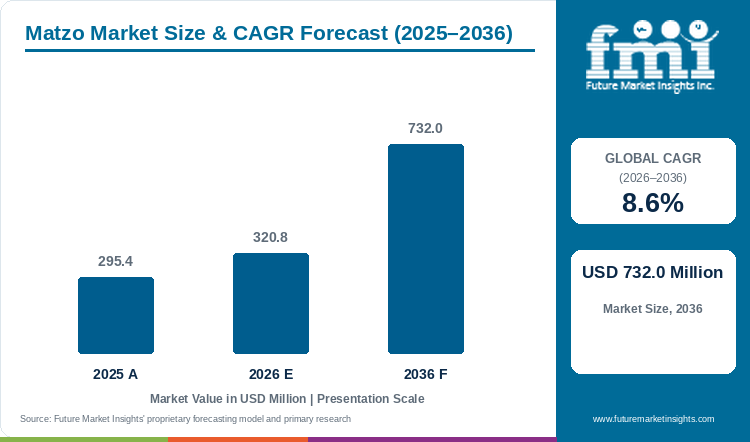
Tracking from USD 295.4 million in 2025 to USD 320.8 million in 2026, the matzo market valuation is projected to hit USD 732.0 million by 2036, supported by an 8.6% CAGR.
The global matzo market was valued at USD 295.4 million in 2025 and is estimated to reach USD 320.8 million in 2026. The market is projected to reach USD 732.0 million by 2036, expanding at a compound annual growth rate (CAGR) of 8.6% between 2026 and 2036. Classic original sheets are projected to capture 37.0% of 2026 product type demand, as unseasoned perforated wheat squares serve ritual compliance and everyday cracker use from the same line. Demand is supported by year-round snacking conversion of a Passover staple, which stretches one certified production calendar into twelve months of grocery turns [4]. That everyday-use pivot explains why matzo trails the savory crackers market growing at 11.7% CAGR, since cracker categories ride flavor velocity while matzo growth stays gated by kosher-for-Passover supervision capacity and an eight-week retail window [6]. Brand expansion is testing that ceiling, as Kayco widened the Manischewitz portfolio in March 2026 with crisp mini matzo water crackers and Passover baking mixes [8], and The Matzo Project took vegan nut-free chips onto Publix shelves in October 2025 [7]. Claim policing tightened too after BBB National Programs issued a compliance decision on flatbread sodium representations in May 2025 [20]. Packers that convert supervised matzo lines into certified-all-year snack platforms decouple from the Passover calendar and capture the year-round cracker dollar through 2036.
Key Market Trends & Insights
- By product type: Classic / Original sheets are projected to capture 37.0% of the product type segment in 2026 because unseasoned perforated wheat squares serve both Passover obligations and year-round matzo brei or table cracker occasions.
- By claim: Conventional formulations are estimated to command 45.0% of the claim segment in 2026 as standard wheat flour and water doughs sheet rapidly without tearing under 600-degree-Fahrenheit tunnel-oven baking.
- By format: Fresh offerings are expected to hold 34.0% of the format segment in 2026 owing to pre-holiday artisanal shmurah bakery runs and high-turnover supermarket bakery table displays.
- By packaging format: Multipack configurations are forecast to generate 33.0% of the packaging format segment in 2026 through 5-pound ceremonial bundles and multi-sleeve corrugated family boxes.
- By sales channel: Supermarkets & Hypermarkets are anticipated to account for 36.0% of the sales channel segment in 2026 via dedicated kosher aisle planograms and seasonal end-cap promotions.
Regional Highlights
- Top national expansion: Saudi Arabia is projected to lead evaluated national markets at a 9.9% CAGR through 2036 as modern retail chains expand imported low-moisture crispbread and specialty diet crackers.
- Broader country progression: The UAE is expected to expand at a 9.6% CAGR ahead of South Korea at 9.3% and the USA at 8.9%, while Japan is forecast to progress at a 7.7% CAGR.
Market Size & Forecast
Table 1: Market Size and Forecast for the Matzo Market (USD million and CAGR percentage), 2025 to 2036
| Metric | Value |
|---|---|
| 2025 Market Size | USD 295.4 million |
| Estimated Market Size in 2026 | USD 320.8 million |
| Projected Market Size by 2036 | USD 732.0 million |
| CAGR, 2026 to 2036 | 8.6% |
| Added Revenue, 2026 to 2036 | USD 411.2 million |
Commercial matzo manufacturing operates under tighter thermal and chronological tolerances than any other segment of the global biscuits and crackers industry. Under Orthodox Union (OU) and international kosher-for-Passover (KFP) supervision, water and flour contact cannot exceed 18 minutes before complete baking, and mechanical docking rollers must perforate the dough sheet to prevent leavening blisters [2]. Instrumented high-temperature flatbread tunnel-oven studies published in Applied Sciences in August 2025 confirmed that radiant baking above 450 degrees Celsius drives rapid evaporative moisture flash-off and locks crisp cellular structure within seconds [3]. Automated bakeries in Israel, the USA, and Europe consequently run 24-hour production campaigns from October through March to build pre-holiday container inventories.
Commercial Tunnel-Oven Output and Box-Pack Throughput Sizing
Table 2: Commercial Tunnel-Oven Output and Box-Pack Throughput Sizing for the Matzo Market (USD million and operational ranges), 2025 to 2036
| Metric | 2025 | 2026 | 2036 |
|---|---|---|---|
| Market size (USD million) | 295.4 | 320.8 | 732.0 |
| Commercial matzo volume (thousand tonnes) | 54.0 to 59.5 | 58.2 to 64.0 | 122.0 to 135.0 |
| Retail 1-lb & 5-lb boxes shipped (million units) | 78.0 to 86.0 | 84.0 to 93.0 | 176.0 to 195.0 |
| Average wholesale realization per kg (USD) | 5.1 to 5.5 | 5.2 to 5.6 | 5.6 to 6.0 |
Operational note: Throughput ranges reconcile high-speed kosher tunnel-oven capacities and hand-baked shmurah bakery output against 30-gram to 35-gram standard square sheet weights and 2% to 4% final baked moisture specifications.
Breakage during transoceanic container shipping represents a major margin leak for thin perforated matzo sheets. Industrial producers invest in inner cellophane overwraps and corrugated dividers while cross-merchandising broken or bite-sized pieces into the savory snacks aisle.
Per Capita & Retail Channel Sizing
Table 3: Per Capita and Retail Channel Spending Indicators for the Matzo Market (USD), 2025 to 2036
| Metric | 2025 | 2026 | 2036 |
|---|---|---|---|
| World population (billion) | 8.2 | 8.3 | 9.0 |
| Spend per 1,000 people (USD) | 36.0 | 38.7 | 81.3 |
| Annual procurement per kosher / specialty grocery site (USD) | 1,850 to 2,200 | 1,980 to 2,360 | 3,900 to 4,650 |
| Modern retail & online multi-pack share (%) | 68.0% to 72.0% | 70.0% to 74.0% | 78.0% to 82.0% |
Table 4: Retail & Institutional Channel Spending Indicators for the Matzo Market (USD and percentages), 2026
| Metric | Value | Institutional Reference Basis |
|---|---|---|
| Market size, 2026 | USD 320.8 million | 2026 global revenue baseline |
| Supermarkets & hypermarkets revenue, 2026 | USD 115.5 million | 36.0% sales-channel segment allocation |
| Classic / Original revenue, 2026 | USD 118.7 million | 37.0% product-type segment allocation |
| Conventional claim revenue, 2026 | USD 144.4 million | 45.0% claim segment allocation |
Extending matzo velocity beyond the eight-day Passover window requires repositioning unleavened squares as clean-label dip carriers on everyday charcuterie boards. Specialty brands actively package salted and everything-seasoned matzo chips in stand-up pouches modeled on artisan bread crisps.
Analyst Perspective
"Commercial matzo profitability hinges on balancing high-volume 5-pound Passover loss-leader bundles against high-margin year-round snacking chips, gluten-free oat/tapioca squares, and artisanal shmurah gift boxes. Bakeries that master 18-minute kosher line changeovers and inner-sleeve shock protection will capture both ceremonial and mainstream specialty grocery shelves."
- Nandini Roy Choudhury, Principal Consultant, Future Market Insights.
How is the matzo market segmented?
The matzo market is segmented by product type, claim, format, packaging format, and sales channel. In 2026, Classic / Original is projected at 37.0%, Conventional at 45.0%, Fresh at 34.0%, Multipack at 33.0%, and Supermarkets & Hypermarkets at 36.0%.
By product type: Classic / Original, Whole Grain & Seeded, Flavored & Filled, Mini & Snacking, and Premium / Artisan.
By claim: Conventional, Clean Label, Organic, Gluten-Free, and High-Protein.
By format: Fresh, Ambient Packaged, Frozen, Chilled, and Par-Baked.
By packaging format: Multipack, Single-Serve, Family Pack, and Bulk Foodservice.
By sales channel: Supermarkets & Hypermarkets, Artisan Bakeries, Convenience Stores, Online & DTC, and Foodservice Distributors.
Why does Classic / Original lead the product type segment?
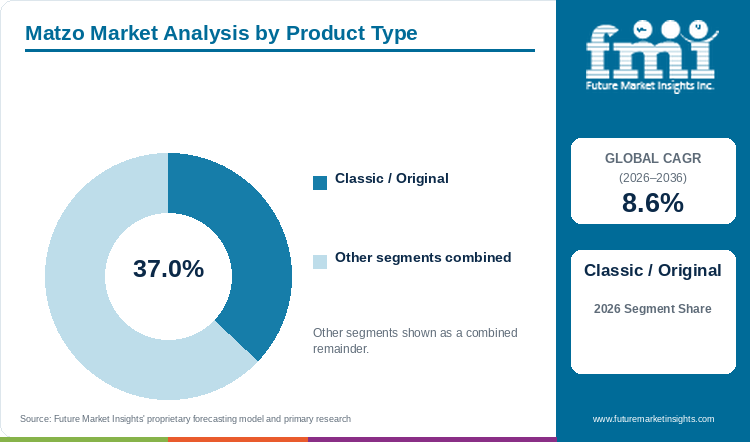
Classic / Original sheets are projected to capture 37.0% of the product type segment in 2026, supported by ceremonial seder mandates and recipe versatility.
Table 5: Product Type Share for the Matzo Market (percentage share), 2026
| Product Type | Share (2026) |
|---|---|
| Classic / Original | 37.0% |
| Other Segments Combined | 63.0%* |
| Total | 100.0% |
*Note: Remaining product type subsegments sum to 100.0% of 2026 matzo revenue.
Table 6: Product Type Leadership and Market Growth for the Matzo Market (segment and CAGR percentage), 2026 to 2036
| Metric | Value |
|---|---|
| Global CAGR (2026 to 2036) | 8.6% |
| Leading Segment | Classic / Original |
Unflavored two-ingredient wheat-and-water matzo remains the non-negotiable baseline for Passover seders and institutional kosher catering because halachic rules forbid fruit juice, egg, or spice additions in primary ceremonial matzo (Lechem Oni). Outside the holiday period, plain perforated squares form the structural base for homemade matzo ball meal and matzo brei across specialty bakery products aisles.
- Classic / Original is projected to account for 37.0% of the product type segment in 2026 because two-ingredient flour-and-water sheets satisfy strict Passover seder requirements and everyday culinary recipes.
- In March 2026, Manischewitz debuted its 2026 kosher-for-Passover innovations including crisp mini matzo water crackers to complement traditional machine-baked plain matzo bundles [4].
Why does Conventional define the largest claim segment?
Conventional formulations are estimated to secure 45.0% of the claim segment in 2026, driven by high-speed dough sheeting and kosher-for-Passover grain rules.
Rabbinical law stipulates that only five traditional cereal grains (wheat and barley as well as spelt, rye, and oats) can fulfill the ceremonial Passover matzo obligation and give conventional refined wheat flour a structural advantage over non-cereal alternatives. Conventional soft and hard whole-wheat flour blends laminate cleanly into sub-2-millimeter ribbons without requiring hydrocolloid gums that slow down 18-minute equipment washdowns.
- Conventional formulations command an estimated 45.0% share of the claim segment in 2026 as traditional wheat flour and water doughs sheet at industrial speeds without breaking.
- In its 2026 Passover regulatory guidance, the Orthodox Union (OU Kosher) reaffirmed that ceremonial matzo must be milled from the five traditional grain species under moisture-guarded supervision whereas tapioca and potato starch variants qualify only as non-ceremonial matzo-style crackers [2].
What keeps Fresh ahead in the format segment?
Fresh formats are expected to command 34.0% of the format segment in 2026, reflecting pre-Passover bakery batching and crisp aromatic quality.
Consumers and communal seder organizers pay substantial unit premiums for freshly baked hand-rolled shmurah matzo and recently dispatched seasonal bakery runs that retain toasted wheat aroma. Unlike long-stored warehouse inventory that absorbs ambient odors, fresh production batches command top-tier pricing across specialty kosher markets and ready-to-finish bakery products counters.
- Fresh matzo is expected to hold 34.0% of the format segment in 2026 because high unit prices for freshly baked shmurah rounds and seasonal bakery runs elevate dollar value share.
- In April 2026, Passover coverage by Jüdische Allgemeine detailed community demand for freshly baked kosher-for-Passover matzo batches distributed across synagogues and specialty grocers in Germany [5].
Why does Multipack lead the packaging format segment?
Multipack configurations are forecast to generate 33.0% of the packaging format segment in 2026, owing to 5-pound holiday bundles and inner freshness sleeves.
Because an observant household consumes dozens of matzo sheets over the eight days of Passover, commercial bakeries bundle five individual 1-pound boxes into shrink-wrapped multipacks or pack multiple hermetically sealed film sleeves inside master cartons. Individual inner pouches protect remaining sheets from humidity uptake once the outer carton is opened.
- Multipack formats are forecast to represent 33.0% of the packaging format segment in 2026 because 5-pound multi-box bundles serve as the primary retail unit during spring holiday promotions.
- In August 2025, The Matzo Project debuted its first kosher-for-Passover gluten-free multipack and baking mix lineup through a NuMarket campaign to expand multi-unit household pantry stocking [6].
What gives Supermarkets & Hypermarkets the leading position in sales channel?
Supermarkets & Hypermarkets are anticipated to account for 36.0% of the sales channel segment in 2026, reinforced by seasonal end-cap pallet displays.
National supermarket chains and hypermarkets anchor global matzo volume by building high-visibility Passover pallet islands four weeks before the holiday while maintaining dedicated kosher and international cracker bays year-round. Supermarket category managers also place gluten-free and seeded matzo crackers inside mainstream gluten-free food sets to capture non-holiday wellness shoppers.
- Supermarkets & Hypermarkets are anticipated to capture 36.0% of the sales channel segment in 2026 as mainstream grocery chains cross-merchandise matzo across both kosher and specialty cracker aisles.
- In October 2025, Brooklyn-based specialty brand The Matzo Project launched its certified kosher Matzo Chips, Matzo Flats, and Matzo Ball Mix across Publix supermarket aisles in the USA [7].
What are the drivers, restraints, and opportunities in the matzo market?
In the matzo market, year-round snackification into seasoned matzo chips and gluten-free crisps propels revenue growth whereas extreme Passover seasonality and 18-minute kosher line washdowns restrain margins and upcycled matzo-meal extensions create new opportunities.
- Driver: Repositioning unleavened flatbreads into everyday artisanal snack chips, everything-bagel crisps, and kosher-certified charcuterie crackers expands supermarket velocity across all four quarters.
- Restraint: Heavy concentration of annual volume around Passover creates working-capital inventory bottlenecks, while mandatory 18-minute rabbinical dough line stops increase unit labor costs.
- Opportunity: Formulating celiac-safe potato-and-tapioca matzo-style squares and upcycling bakery sheet breakage into value-added matzo ball and coating mixes improves plant margin realization.
Growth Analysis and Future Potential: Qualitative Demand Catalysts
Specialty food brands and heritage kosher bakeries are breaking out of the seasonal ethnic aisle by reformulating matzo into sturdy triangular snack chips seasoned with sea salt, harissa, and everything-bagel spices. Modern consumers treat crisp unleavened squares as low-fat and yeast-free vehicles for hummus, artisanal cheeses, and tinned fish boards. This snacking crossover allows matzo producers to compete directly for shelf space beside pita bread chips and seeded crispbreads. In June 2025, Kayco unveiled a new 24-ounce ready-to-serve Manischewitz Chicken Matzo Ball Soup and specialty food expansion to attract convenience-focused grocery shoppers [8]. Supermarket buyers consequently retain top-selling flavored matzo SKUs on permanent year-round planograms.
Risk Assessment of the Matzo Market: Operational and Formulation Friction
Extreme demand seasonality and strict halachic manufacturing constraints impose heavy fixed-cost burdens on commercial matzo plants. To earn kosher-for-Passover certification, industrial mixer bowls and docking rollers must be completely stripped and sanitized every 18 minutes so residual dough cannot ferment into chametz while grain lots undergo strict mycotoxin screening [2]. In March 2025, LC-MS/MS flatbread baking experiments published in Foods demonstrated that while high-temperature baking reduces aflatoxins B1 and G1 by 39% and deoxynivalenol by 16% to 25%, ochratoxin A resists thermal degradation and requires upstream wheat lot rejection [9]. Bakers evaluating gluten-free bakery premix or oat-based shmurah lines also face severe dough brittleness and elevated sheet breakage during automated packaging.
Commercial Opportunity Analysis: Formulation Differentiation and Value-Add Formats
Producers unlock high-margin revenue streams by developing gluten-free matzo-style squares from tapioca, potato, and chickpea starches as well as functional fiber-enriched whole-grain sheets. Integrating potato bread and rolls starch technology with bakery ingredients and flour improver systems reduces sheet shattering during transit and broadens distribution into celiac and paleo retail bays. In January 2026, flatbread salt-substitution trials published in Plant Foods for Human Nutrition confirmed that replacing sodium chloride with choline chloride in baked flatbreads maintained crisp texture while reducing dietary sodium load [10]. In March 2026, Manischewitz expanded its holiday lineup with crisp 3-ounce mini matzo water crackers and kosher-for-Passover baking mixes to capture year-round charcuterie and dessert occasions [4].
Matzo Market by Country (2026 to 2036)
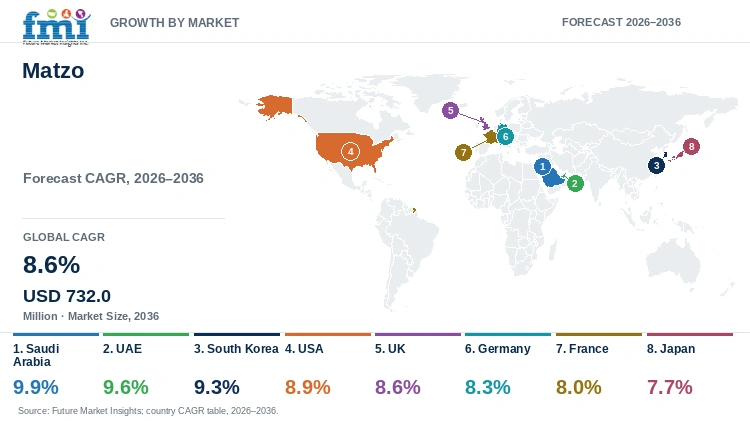
As per FMI, Saudi Arabia is projected to lead matzo market growth across evaluated countries at a 9.9% CAGR through 2036, whereas Japan is forecast to expand at a 7.7% CAGR. National demand patterns reflect Gulf modern grocery crispbread imports and East Asia clean-label diet cracker adoption as well as North America kosher snacking scale and Western Europe certified retail channels.
Table 7: Country CAGR and Primary Growth Levers for the Matzo Market (CAGR percentage and operational drivers), 2026 to 2036
| Country | CAGR (2026 to 2036) | Primary Growth Lever |
|---|---|---|
| Saudi Arabia | 9.9% | Modern supermarket expansion of imported yeast-free crispbreads and clean-label diet crackers |
| UAE | 9.6% | Certified kosher hospitality catering in Dubai and Abu Dhabi plus premium gourmet grocery retail |
| South Korea | 9.3% | E-commerce and department-store demand for low-fat unleavened wheat crisps and imported snack crackers |
| USA | 8.9% | Large ceremonial Passover base plus 1,800+ store specialty snacking matzo chip distribution |
| UK | 8.6% | Mainstream supermarket kosher bays and artisan thin-cracker charcuterie demand in London and Manchester |
| Germany | 8.3% | Community synagogue and specialty retail Passover procurement plus organic spelt crispbread sales |
| France | 8.0% | Europe's largest kosher retail and hypermarket network anchored by Consistoire-certified Pessah runs |
| Japan | 7.7% | Specialty import grocery demand for portion-controlled, additive-free unleavened wheat crackers |
Source: Future Market Insights analysis
Saudi Arabia Matzo Market Outlook (2026 to 2036)
Whereas North America and Europe matzo volume is anchored by ceremonial Passover traditions, Saudi Arabia drives commercial demand through modern hypermarkets and specialty health-food importers marketing unleavened wheat crispbreads as yeast-free and low-fat diet crackers. Commercial unleavened flatbread and matzo-style cracker sales in Saudi Arabia are projected to expand at a leading 9.9% CAGR from 2026 to 2036 across premium retail and hospitality channels. According to the April 2026 USDA Foreign Agricultural Service Food Processing Ingredients report for Saudi Arabia, modern grocery retail and international hospitality developments under Vision 2030 continue to lift packaged bakery and specialty cracker imports [11]. Strict SFDA Arabic shelf-life and nutritional labeling mandates govern customs clearance.
Key takeaway: In Saudi Arabia, modern hypermarket health-cracker assortments and international hospitality catering are projected to drive yeast-free unleavened flatbread imports.
UAE Matzo Market Outlook (2026 to 2036)
Commercial matzo revenues in the UAE are forecast to rise at a 9.6% CAGR between 2026 and 2036 across luxury hotel banquet kitchens, certified kosher caterers, and gourmet supermarkets in Dubai and Abu Dhabi. Following the normalization of regional hospitality protocols and the establishment of local kosher certification agencies, international convention hotels in the UAE maintain dedicated pantry inventories of sealed matzo boxes and gluten-free unleavened crackers. Gulf retail expansion during 2026 continued to widen cracker and snack placements across regional hypermarket shelves. High summer humidity requires foil-lined inner sleeves.
Key takeaway: In the UAE, international convention hospitality catering and gourmet supermarket assortments are forecast to sustain certified matzo and unleavened cracker turnover.
South Korea Matzo Market Outlook (2026 to 2036)
Department-store food halls and cross-border e-commerce platforms distinguish South Korea by positioning imported matzo and thin unleavened wheat squares as clean-label and yeast-free pairing crackers for wine, cream cheese, and espresso cafés. Data from the 2025 Survey on the Overseas Expansion of Foodservice Industry released by the Ministry of Agriculture, Food and Rural Affairs (MAFRA) in February 2026 confirmed that bakery and café chains from South Korea expanded across 56 countries while domestic grocers broadened imported snack assortments [14]. Commercial matzo and unleavened crisp sales in South Korea are anticipated to advance at a 9.3% CAGR through 2036 across online and specialty retail channels. High container freight rates and brittle sheet breakage during parcel delivery necessitate reinforced box packaging.
Key takeaway: In South Korea, premium department-store grocery halls and wine-pairing snack trends are anticipated to propel imported unleavened cracker growth.
USA Matzo Market Outlook (2026 to 2036)
The USA represents the largest commercial value anchor for branded matzo outside Israel and combines massive spring Passover supermarket pallet programs with fast-growing year-round artisan matzo chip brands. Household food expenditure data updated by the USDA Economic Research Service in June 2026 showed U.S. food-at-home spending at USD 1.10 trillion in 2025 to support premium center-store snacking and kosher grocery categories [1]. Specialty challenger brands like The Matzo Project launched across Publix supermarket aisles in October 2025 while Manischewitz introduced mini matzo water crackers and Passover innovations in March 2026 [4] [7]. Post-Passover promotional discounting and supermarket slotting fees put the USA on an 8.9% CAGR through 2036.
Key takeaway: In the USA, year-round specialty matzo chip placement in mainstream supermarkets and mini matzo cracker innovation are expected to drive steady revenue expansion.
UK Matzo Market Outlook (2026 to 2036)
Mainstream grocery multiples in the UK such as Tesco, Sainsbury's, and Waitrose stock Rakusen's and imported Israeli and U.S. matzo brands in both dedicated kosher bays and everyday water-cracker aisles. Commercial matzo revenue in the UK is projected to progress at an 8.6% CAGR over the 2026 to 2036 forecast period across retail supermarkets and institutional catering accounts. According to the April 2026 USDA Foreign Agricultural Service Grain and Feed update and UK retail bakery tracking, steady consumer preference for low-fat, clean-label crackers supports domestic and imported unleavened flatbread turnover across Greater London and Manchester [15]. Post-Brexit customs documentation and corrugated packaging costs still pressure importer margins.
Key takeaway: In the UK, dual merchandising across mainstream supermarket cracker aisles and certified kosher bays is projected to support consistent matzo growth.
Germany Matzo Market Outlook (2026 to 2036)
Germany combines growing Jewish community Passover procurement across Berlin, Munich, and Frankfurt with mainstream organic grocery demand for yeast-free spelt (Dinkel) and whole-grain unleavened crispbreads. Passover reporting by Jüdische Allgemeine in April 2026 documented expanding community procurement of certified kosher matzo and seasonal festival goods across urban synagogues and specialty grocers in Germany, while Destatis recorded 291,955 naturalizations in 2024 across the country [5] [16]. Commercial matzo sales in Germany are projected to grow at an 8.3% CAGR from 2026 to 2036 across specialty food stores and hypermarkets. Strict European Union mycotoxin limits on cereal flours and discounter private-label competition require rigorous supplier quality documentation.
Key takeaway: In Germany, synagogue community kosher distribution and organic spelt unleavened crispbread adoption are projected to underpin market growth.
France Matzo Market Outlook (2026 to 2036)
Market demand for commercial matzo in France is forecast to expand at an 8.0% CAGR between 2026 and 2036 across hypermarkets, kosher butcher-grocers, and institutional school and community caterers. France hosts Western Europe's largest observant Jewish population, which generates concentrated spring container shipments of machine-baked and hand-baked shmurah matzo as well as year-round snacking cracker sales. In March 2026, the Consistoire de Paris published its official Pessah 5786 (2026) rabbinical certification guide governing kosher-for-Passover matzo bakeries and retail supervision across France where INSEE recorded 14,871 active supermarkets and hypermarkets [17] [18]. Intense retail price competition during March and April hypermarket promotions nevertheless compresses baseline 5-pound bundle margins across urban chains.
Key takeaway: In France, Consistoire-supervised Pessah hypermarket programs and dense urban kosher retail networks are forecast to sustain commercial matzo demand.
Japan Matzo Market Outlook (2026 to 2036)
Japan represents a specialized import market where international supermarkets in Tokyo and Yokohama market thin unleavened matzo crackers to expatriate households, diplomatic missions, and health-conscious domestic shoppers seeking additive-free wheat crisps. According to the April 2026 USDA Foreign Agricultural Service Grain and Feed Annual report for Japan, food-use wheat imports remain stable at 4.5 million metric tons in 2026/27 as consumers favor portion-controlled, shelf-stable baked snacks [19]. Imported matzo packages in Japan command premium unit pricing when packed in moisture-proof individual inner trays that prevent softening during the June-to-September rainy season. Long maritime lead times and niche retail shelf space place Japan on a 7.7% CAGR from 2026 to 2036.
Key takeaway: In Japan, international gourmet supermarket listings and moisture-sealed portion packs are expected to support steady imported matzo turnover.
Full report country CAGRs cover: North America; Latin America; Western Europe; Eastern Europe; East Asia; South Asia and Pacific; Middle East and Africa.
Who are the notable companies in the matzo market?
Kayco (Manischewitz), Streit's Matzos, Yehuda Matzos, The Matzo Project, Angel Bakeries, Toufayan Bakeries, Kontos Foods, Signature Flatbreads, Gruma (Mission Foods), Grupo Bimbo, Olé Mexican Foods, FGF Brands, and Europastry are the notable companies in the matzo market.
Auditing kosher certification registries and supermarket category planograms confirms that the competitive landscape divides into dedicated kosher matzo producers, specialty unleavened snack challengers, and broad industrial flatbread and bakery platforms. Kayco (operating flagship heritage brand Manischewitz), Streit's Matzos (Aron Streit Inc.), and Israel-based Yehuda Matzos (Matzot Yehuda) manufacture the majority of global kosher-for-Passover perforated square matzo and matzo meal. Gruma S.A.B. de C.V. operates U.S. subsidiary Mission Foods (consolidated as one corporate entity to prevent parent-subsidiary duplication) while Angel Bakeries, Toufayan Bakeries, and Kontos Foods supply certified Mediterranean flatbreads and crisps. Additional industrial bakery platforms include Signature Flatbreads, Grupo Bimbo, and Olé Mexican Foods as well as FGF Brands and Europastry.
- Dedicated Heritage & Artisanal Matzo Producers: Kayco (Manischewitz), Streit's Matzos, Yehuda Matzos, and The Matzo Project manufacture certified kosher-for-Passover matzo sheets, whole-wheat and gluten-free matzo squares, and year-round seasoned matzo chips.
- Specialty & Mediterranean Flatbread Bakers: Angel Bakeries, Toufayan Bakeries, Kontos Foods, and Signature Flatbreads operate high-speed kosher- and halal-certified tunnel ovens producing thin flatbreads, crisps, and unleavened carriers.
- Global Industrial Flatbread & Bakery Platforms: Gruma (Mission Foods), Grupo Bimbo, Olé Mexican Foods, FGF Brands, and Europastry operate multinational sheeting, docking, and packaged bakery distribution networks.
Competitive Benchmarking: Matzo Market
Table 8: Competitive Benchmarking for the Matzo Market (qualitative capability ratings), 2026
| Company | Direct Matzo SKU Range | Kosher / Claim Breadth | Supermarket & Deli Access | Geographic Reach |
|---|---|---|---|---|
| Kayco (Manischewitz) | High | High | High | High |
| Streit's Matzos | High | High | High | Medium |
| Yehuda Matzos | High | High | High | High |
| The Matzo Project | High | High | Medium | Medium |
| Angel Bakeries | Medium | High | High | High |
| Toufayan Bakeries | Medium | High | High | High |
| Kontos Foods | Medium | High | High | High |
| Signature Flatbreads | Medium | High | High | High |
| Gruma (Mission Foods) | Medium | Medium | High | High |
| Grupo Bimbo | Medium | Medium | High | High |
| Olé Mexican Foods | Medium | High | High | Medium |
| FGF Brands | Medium | High | High | High |
| Europastry | Medium | Medium | High | High |
Scoring basis: Capability ratings evaluate documented 18-minute kosher-for-Passover matzo sheet production, gluten-free and seasoned chip SKU breadth, and rabbinical certification coverage. Retail access and geographic scores reflect audited supermarket distribution doors and multi-country export container reach.
Key Developments in the Matzo Market
- Kayco expanded its flagship Manischewitz Passover portfolio in March 2026 with crisp mini matzo water crackers and kosher-for-Passover baking mixes following its June 2025 specialty soup and retail rollout [4] [8].
- The Matzo Project launched its vegan, nut-free Matzo Chips and Matzo Flats across Publix supermarkets in October 2025 after debuting its kosher-for-Passover gluten-free lineup in August 2025 [6] [7].
- BBB National Programs' National Advertising Division issued a May 2025 compliance decision regarding Olé Mexican Foods' La Banderita and La Casera flatbread sodium and preservative claims [20], while Toufayan Bakeries rolled out Seed Oil-Free Wraps nationwide in April 2026 [21] and Europastry reported record EUR 1.506 billion turnover in July 2025 [22].
Key Players in the Matzo Market
Dedicated Heritage and Artisanal Matzo Producers
- Kayco (Manischewitz)
- Streit's Matzos
- Yehuda Matzos
- The Matzo Project
Specialty and Mediterranean Flatbread Bakers
- Angel Bakeries
- Toufayan Bakeries
- Kontos Foods
- Signature Flatbreads
Global Industrial Flatbread and Bakery Platforms
- Gruma (Mission Foods)
- Grupo Bimbo
- Olé Mexican Foods
- FGF Brands
- Europastry
Matzo Market - Report Scope
Table 9: Report Scope for the Matzo Market (coverage fields and definitions), 2026 to 2036
| Coverage field | Report scope |
|---|---|
| Market breakdown | Product Type; Claim; Format; Packaging Format; Sales Channel |
| Quantitative Units | USD Million |
| Market Definition | Includes commercial manufacturer revenue from packaged machine-baked and hand-baked matzo sheets, matzo crackers/chips, and gluten-free matzo-style squares across covered product, claim, format, packaging, and channel segments. Category Scope Note: Excludes leavened yeast breads, soft tortillas, pocket pita, and prepared liquid soups sold outside dry matzo sheet and cracker SKUs. |
| Regions Covered | North America; Latin America; Western Europe; Eastern Europe; East Asia; South Asia and Pacific; Middle East and Africa |
| Countries Covered | Saudi Arabia, UAE, South Korea, USA, UK, Germany, France, Japan, and additional countries in the full report |
| Key Companies Covered | Kayco (Manischewitz), Streit's Matzos, Yehuda Matzos, The Matzo Project, Angel Bakeries, Toufayan Bakeries, Kontos Foods, Signature Flatbreads, Gruma (Mission Foods), Grupo Bimbo, Olé Mexican Foods, FGF Brands, Europastry |
| Forecast Period | 2026 to 2036 |
| Approach | Primary and secondary research with top-down and bottom-up market triangulation. |
Matzo Market - Research Methodology
Table 10: Research Methodology for the Matzo Market (research methods and approach), 2026 edition
| Method | Approach |
|---|---|
| Primary Research | Structured interviews with kosher-for-Passover bakery plant managers, rabbinical kashrut supervisors (mashgichim), supermarket kosher and specialty cracker category buyers, and ethnic food distributors to validate 18-minute line washdown costs, box breakage rates, and seasonal slotting fees. |
| Secondary Research | Audit of Orthodox Union (OU) and Consistoire de Paris 2026 Passover certification guides, USDA ERS Food Expenditure Series, USDA FAS GAIN grain and retail reports, INSEE and Destatis statistical registries, and peer-reviewed flatbread baking studies (Applied Sciences, Foods, Plant Foods for Human Nutrition). |
| Market Sizing and Forecasting | Top-down kosher and specialty unleavened cracker expenditure models reconciled against bottom-up high-speed docking tunnel-oven capacities and seasonal 1-lb/5-lb box shipments from 2026 to 2036. |
| Country Forecasting Model | Econometric national projections weight observant Jewish population centers, specialty snacking grocery door counts, kosher hospitality tourism arrivals, and gluten-free/clean-label cracker adoption across eight countries. |
| Operational Benchmark Traceability | Tonnage, box shipment counts, and channel spending indicators in Tables 2, 3, and 4 trace to 30-to-35-gram square sheet weights, 5-lb Passover bundle configurations, and audited supermarket category sales. |
| Data Triangulation and Validation | Supplier revenues are cross-checked against verified kosher matzo SKU catalogs (combining Manischewitz under Kayco and consolidating Mission Foods under parent Gruma) while excluding non-matzo soft flatbreads. |
Matzo Market by Segments
Matzo Market segmented by Product Type:
- Classic / Original
- Whole Grain & Seeded
- Flavored & Filled
- Mini & Snacking
- Premium / Artisan
Matzo Market segmented by Claim:
- Conventional
- Clean Label
- Organic
- Gluten-Free
- High-Protein
Matzo Market segmented by Format:
- Fresh
- Ambient Packaged
- Frozen
- Chilled
- Par-Baked
Matzo Market segmented by Packaging Format:
- Multipack
- Single-Serve
- Family Pack
- Bulk Foodservice
Matzo Market segmented by Sales Channel:
- Supermarkets & Hypermarkets
- Artisan Bakeries
- Convenience Stores
- Online & DTC
- Foodservice Distributors
Matzo Market by Region
- North America
- United States
- Canada
- Latin America
- Brazil
- Mexico
- Argentina
- Chile
- Western Europe
- Germany
- France
- United Kingdom
- Italy
- Spain
- Benelux
- Nordics
- Eastern Europe
- Poland
- Czech Republic
- Romania
- Hungary
- East Asia
- China
- Japan
- South Korea
- South Asia and Pacific
- India
- ASEAN
- Australia and New Zealand
- Middle East and Africa
- GCC Countries
- South Africa
- Türkiye
- Israel
Research Sources and Bibliography
- [1] Zeballos, E., & Sinclair, W. (2026, June 1). Ag and Food Statistics: Charting the Essentials - Food Prices and Spending. U.S. Department of Agriculture, Economic Research Service.
- [2] Singer, S. (2026, February 18). Orthodox Union Kosher for Passover 2026 Product and Grain Supervision Guide. Orthodox Union (OU Kosher).
- [3] Mansour, Y., Rahmé, P., El Hajj, N., & Rouaud, O. (2025, August 3). Thermal and Expansion Analysis of the Lebanese Flatbread Baking Process Using a High-Temperature Tunnel Oven. Applied Sciences, 15(15), 8611.
- [4] Manischewitz & Jewish News Syndicate (JNS). (2026, March 24). Manischewitz debuts kosher-for-Passover innovations for 2026. Jewish News Syndicate Wire.
- [5] Jüdische Allgemeine. (2026, April 1). Pessach verstehen: Bedeutung, Bräuche und Traditionen. Jüdische Allgemeine (Zentralrat der Juden in Deutschland).
- [6] The Matzo Project & Specialty Food Association. (2025, August 22). Not Your Average Product Launch: The Matzo Project New Gluten-Free Kosher-for-Passover Lineup. Specialty Food Association Member Press Releases.
- [7] Startup CPG. (2025, October 30). Startup CPG Newswire: The Matzo Project Launches at Publix. Startup CPG Newswire.
- [8] Kayco & Specialty Food Association. (2025, June 27). Kayco Unveils New Manischewitz Brand Soup Line and Kosher Hot Dogs Signaling Expansion into the Specialty Foods Market. Specialty Food Association Member Press Releases.
- [9] Kotsiou, K., Terzidis, M. A., & Papageorgiou, M. (2025, March 7). Effect of Baking Conditions on Mycotoxin Levels in Flatbreads Prepared from Artificially Contaminated Doughs. Foods, 14(6), 910 (PubMed PMID 40231926).
- [10] Santamaria, M., Leguet, C., Doumani, N., Le-Bail, P., & Rosell, C. M. (2026, January 26). Substitution of Salt with Choline Chloride in Double-Layer Flatbreads: Impact on Technological Properties and Starch Digestibility. Plant Foods for Human Nutrition, 81(1), 16 (PubMed PMID 41586942).
- [11] USDA Foreign Agricultural Service. (2026, April 12). Saudi Arabia: Food Processing Ingredients and Specialty Bakery Annual. Global Agricultural Information Network (GAIN) Report Series 2026.
- [12] Dubai Department of Economy and Tourism. (2026, September 9). Tourism Performance Report January - August 2026. Government of Dubai, Department of Economy and Tourism.
- [13] Dubai Municipality. (2025, July 30). Over 34,000 food inspections conducted in first half of 2025. Government of Dubai, Dubai Municipality Newsroom.
- [14] Jeong, K., & Ministry of Agriculture, Food and Rural Affairs (MAFRA). (2026, February 6). Key Findings from the 2025 Survey on the Overseas Expansion of Foodservice Industry. Food Industry Policy Bureau, Republic of Korea MAFRA.
- [15] USDA Foreign Agricultural Service. (2026, April 16). United Kingdom: Grain, Bakery, and Specialty Food Retail Update. Global Agricultural Information Network (GAIN) UK Report Series 2026.
- [16] Federal Statistical Office of Germany (Destatis). (2025, June 10). 291 955 Einbürgerungen im Jahr 2024. Statistisches Bundesamt (Destatis) Press Release No. 204.
- [17] Consistoire Israélite de Paris. (2026, March 2). Pessah 2026 (5786): Guide et informations nécessaires pour l'organisation de la fête de Pessah. Association Consistoriale Israélite de Paris (ACIP).
- [18] Institut national de la statistique et des études économiques (INSEE). (2025, July 10). Équipements et services à la population en 2024 - France entière. INSEE Base permanente des équipements (BPE).
- [19] USDA Foreign Agricultural Service. (2026, April 10). Japan: Grain and Feed Annual. Global Agricultural Information Network (GAIN) Japan Report Series 2026.
- [20] BBB National Programs, Inc. (2025, May 5). NAD Recommends Olé Mexican Foods Discontinue La Banderita and La Casera Sodium and Preservative Claims. BBB National Programs National Advertising Division (NAD).
- [21] Perishable News & Toufayan Bakeries. (2026, April 7). Toufayan Bakeries Seed Oil-Free Wraps Now Available Nationwide and on Amazon. Perishable News Bakery Division.
- [22] Europastry, S.A. (2025, July 29). Europastry dispara su facturación a un récord de 1.506 millones en 2024 impulsada por la innovación en bollería y panadería congelada. Cinco Días / El País.
This bibliography is provided for reader reference and is not exhaustive. The full report contains the complete reference list and detailed citations.
This Report Answers
- How large is the matzo market in 2026 and what value is forecast for 2036?
- How are matzo bakeries converting seasonal Passover demand into year-round snacking sales?
- Why does Classic / Original lead the product type segment?
- Why does Conventional retain the largest share in the claim segment?
- How do projected CAGRs differ across Saudi Arabia, the UAE, the USA, and France?
- Which companies manufacture certified kosher matzo sheets versus broader flatbreads?
- What 18-minute halachic baking and mycotoxin controls govern commercial production?
- What packaging and breakage tolerances should supermarket buyers specify before contracting?
Frequently Asked Questions
How big is the matzo market in 2026, and what is forecast for 2036?
According to FMI, global matzo revenue is estimated to reach USD 320.8 million in 2026 from USD 295.4 million in 2025. Sales are forecast to hit USD 732.0 million by 2036 as ceremonial Passover bundles pair with year-round seasoned matzo chip and gluten-free cracker expansion.
What is the CAGR for the matzo market from 2026 to 2036?
Future Market Insights projects an 8.6% CAGR between 2026 and 2036. This expansion yields USD 411.2 million in incremental annual revenue across supermarket, specialty bakery, and online channels.
Which product type segment leads the matzo market?
Classic / Original is projected to capture 37.0% of the product type segment in 2026 because unseasoned two-ingredient sheets fulfill Passover seder obligations and everyday culinary recipes.
Which claim segment represents the largest share in the matzo market?
Conventional wheat formulations are estimated to hold 45.0% of the claim segment in 2026 as traditional wheat flour satisfies five-grain rabbinical rules and sheets rapidly within 18-minute baking limits.
Which country has the highest growth outlook during the assessment period?
Saudi Arabia is projected to lead evaluated national markets at a 9.9% CAGR through 2036, followed by the UAE at 9.6% and South Korea at 9.3%.
Who are the key players in the market?
Dedicated kosher matzo producers include Kayco (Manischewitz) and Streit's Matzos as well as Yehuda Matzos and The Matzo Project. Specialty flatbread participants include Angel Bakeries, Toufayan Bakeries, and Kontos Foods as well as Signature Flatbreads. Global bakery platforms include Gruma (Mission Foods), Grupo Bimbo, and Olé Mexican Foods in addition to FGF Brands and Europastry.
Preview the report firsthand - request a free sample
Get SampleGet the brochure for pricing and purchase details.
Get PDFTable of Content
- Key Takeaways
- Market Size and CAGR
- Top Growth Driver
- Fastest Growing Segment
- Leading Region
- Key Companies
- Emerging Opportunities
- Executive Summary
- Global Market Outlook
- Demand-side Trends
- Supply-side Trends
- Technology Roadmap Analysis
- Analysis and Recommendations
- Analyst Perspective (What is happening? Why now? What should investors know?)
- Key Questions Answered
- How large is the market?
- What is the CAGR?
- What are key trends?
- Which region dominates?
- Who are the leaders?
- Market Overview
- Market Coverage / Taxonomy
- Market Definition / Scope / Limitations
- Research Methodology
- Chapter Orientation
- Analytical Lens and Working Hypotheses
- Market Structure, Signals, and Trend Drivers
- Benchmarking and Cross-market Comparability
- Market Sizing, Forecasting, and Opportunity Mapping
- Research Design and Evidence Framework
- Desk Research Programme (Secondary Evidence)
- Expert Input and Fieldwork (Primary Evidence)
- Tooling, Models, and Reference Databases
- Data Engineering and Model Build
- Quality Assurance and Audit Trail
- Market Background
- Market Dynamics (Drivers, Restraints, Opportunity, Trends)
- Scenario Forecast (Optimistic, Likely, Conservative)
- Impact Analysis
- AI Impact
- Sustainability Impact
- Regulatory Impact
- Technology Impact
- Consumer / Buyer Analysis
- Purchase Drivers
- Adoption Barriers
- Buyer Journey
- Opportunity Map Analysis
- Product Life Cycle Analysis
- Supply Chain Analysis
- Investment Feasibility Matrix
- Value Chain Analysis
- PESTLE and Porter's Analysis
- Regulatory Landscape
- Regional Parent Market Outlook
- Production and Consumption Statistics
- Import and Export Statistics
- Global Market Analysis and Forecast, 2021 to 2036
- Historical Market Size Value (USD Million) Analysis, 2021 to 2025
- Current and Future Market Size Value (USD Million) Projections, 2026 to 2036
- Y-o-Y Growth Trend Analysis
- Absolute $ Opportunity Analysis
- Global Market Pricing Analysis, 2021 to 2036
- Global Market Analysis and Forecast, By Product Type, 2021 to 2036
- Introduction / Key Findings
- Historical Market Size Value (USD Million) Analysis By Product Type, 2021 to 2025
- Current and Future Market Size Value (USD Million) Analysis and Forecast By Product Type, 2026 to 2036
- Classic / Original
- Whole Grain & Seeded
- Flavored & Filled
- Mini & Snacking
- Premium / Artisan
- Y-o-Y Growth Trend Analysis By Product Type, 2021 to 2025
- Absolute $ Opportunity Analysis By Product Type, 2026 to 2036
- Global Market Analysis and Forecast, By Claim, 2021 to 2036
- Introduction / Key Findings
- Historical Market Size Value (USD Million) Analysis By Claim, 2021 to 2025
- Current and Future Market Size Value (USD Million) Analysis and Forecast By Claim, 2026 to 2036
- Conventional
- Clean Label
- Organic
- Gluten-Free
- High-Protein
- Y-o-Y Growth Trend Analysis By Claim, 2021 to 2025
- Absolute $ Opportunity Analysis By Claim, 2026 to 2036
- Global Market Analysis and Forecast, By Format, 2021 to 2036
- Introduction / Key Findings
- Historical Market Size Value (USD Million) Analysis By Format, 2021 to 2025
- Current and Future Market Size Value (USD Million) Analysis and Forecast By Format, 2026 to 2036
- Fresh
- Ambient Packaged
- Frozen
- Chilled
- Par-Baked
- Y-o-Y Growth Trend Analysis By Format, 2021 to 2025
- Absolute $ Opportunity Analysis By Format, 2026 to 2036
- Global Market Analysis and Forecast, By Packaging Format, 2021 to 2036
- Introduction / Key Findings
- Historical Market Size Value (USD Million) Analysis By Packaging Format, 2021 to 2025
- Current and Future Market Size Value (USD Million) Analysis and Forecast By Packaging Format, 2026 to 2036
- Multipack
- Single-Serve
- Family Pack
- Bulk Foodservice
- Y-o-Y Growth Trend Analysis By Packaging Format, 2021 to 2025
- Absolute $ Opportunity Analysis By Packaging Format, 2026 to 2036
- Global Market Analysis and Forecast, By Sales Channel, 2021 to 2036
- Introduction / Key Findings
- Historical Market Size Value (USD Million) Analysis By Sales Channel, 2021 to 2025
- Current and Future Market Size Value (USD Million) Analysis and Forecast By Sales Channel, 2026 to 2036
- Supermarkets & Hypermarkets
- Artisan Bakeries
- Convenience Stores
- Online & DTC
- Foodservice Distributors
- Y-o-Y Growth Trend Analysis By Sales Channel, 2021 to 2025
- Absolute $ Opportunity Analysis By Sales Channel, 2026 to 2036
- Global Market Analysis and Forecast, By Region, 2021 to 2036
- Introduction
- Historical Market Size Value (USD Million) Analysis By Region, 2021 to 2025
- Current Market Size Value (USD Million) Analysis and Forecast By Region, 2026 to 2036
- North America
- Latin America
- Western Europe
- Eastern Europe
- East Asia
- South Asia and Pacific
- Middle East and Africa
- Market Attractiveness Analysis By Region
- North America Market Analysis and Forecast, By Country, 2021 to 2036
- Historical Market Size Value (USD Million) Trend Analysis By Market Taxonomy, 2021 to 2025
- Market Size Value (USD Million) Forecast By Market Taxonomy, 2026 to 2036
- By Country
- United States
- Canada
- By Product Type
- By Claim
- By Format
- By Packaging Format
- By Sales Channel
- By Country
- Market Attractiveness Analysis
- By Country
- By Product Type
- By Claim
- By Format
- By Packaging Format
- By Sales Channel
- Key Takeaways
- Latin America Market Analysis and Forecast, By Country
- Historical Market Size Value (USD Million) Trend Analysis By Market Taxonomy, 2021 to 2025
- Market Size Value (USD Million) Forecast By Market Taxonomy, 2026 to 2036
- By Country
- Brazil
- Mexico
- Argentina
- Chile
- By Product Type
- By Claim
- By Format
- By Packaging Format
- By Sales Channel
- By Country
- Market Attractiveness Analysis
- By Country
- By Product Type
- By Claim
- By Format
- By Packaging Format
- By Sales Channel
- Key Takeaways
- Western Europe Market Analysis and Forecast, By Country
- Historical Market Size Value (USD Million) Trend Analysis By Market Taxonomy, 2021 to 2025
- Market Size Value (USD Million) Forecast By Market Taxonomy, 2026 to 2036
- By Country
- Germany
- France
- United Kingdom
- Italy
- Spain
- Benelux
- Nordics
- By Product Type
- By Claim
- By Format
- By Packaging Format
- By Sales Channel
- By Country
- Market Attractiveness Analysis
- By Country
- By Product Type
- By Claim
- By Format
- By Packaging Format
- By Sales Channel
- Key Takeaways
- Eastern Europe Market Analysis and Forecast, By Country
- Historical Market Size Value (USD Million) Trend Analysis By Market Taxonomy, 2021 to 2025
- Market Size Value (USD Million) Forecast By Market Taxonomy, 2026 to 2036
- By Country
- Poland
- Czech Republic
- Romania
- Hungary
- By Product Type
- By Claim
- By Format
- By Packaging Format
- By Sales Channel
- By Country
- Market Attractiveness Analysis
- By Country
- By Product Type
- By Claim
- By Format
- By Packaging Format
- By Sales Channel
- Key Takeaways
- East Asia Market Analysis and Forecast, By Country
- Historical Market Size Value (USD Million) Trend Analysis By Market Taxonomy, 2021 to 2025
- Market Size Value (USD Million) Forecast By Market Taxonomy, 2026 to 2036
- By Country
- China
- Japan
- South Korea
- By Product Type
- By Claim
- By Format
- By Packaging Format
- By Sales Channel
- By Country
- Market Attractiveness Analysis
- By Country
- By Product Type
- By Claim
- By Format
- By Packaging Format
- By Sales Channel
- Key Takeaways
- South Asia and Pacific Market Analysis and Forecast, By Country
- Historical Market Size Value (USD Million) Trend Analysis By Market Taxonomy, 2021 to 2025
- Market Size Value (USD Million) Forecast By Market Taxonomy, 2026 to 2036
- By Country
- India
- ASEAN
- Australia and New Zealand
- By Product Type
- By Claim
- By Format
- By Packaging Format
- By Sales Channel
- By Country
- Market Attractiveness Analysis
- By Country
- By Product Type
- By Claim
- By Format
- By Packaging Format
- By Sales Channel
- Key Takeaways
- Middle East and Africa Market Analysis and Forecast, By Country
- Historical Market Size Value (USD Million) Trend Analysis By Market Taxonomy, 2021 to 2025
- Market Size Value (USD Million) Forecast By Market Taxonomy, 2026 to 2036
- By Country
- GCC Countries
- South Africa
- Türkiye
- Israel
- By Product Type
- By Claim
- By Format
- By Packaging Format
- By Sales Channel
- By Country
- Market Attractiveness Analysis
- By Country
- By Product Type
- By Claim
- By Format
- By Packaging Format
- By Sales Channel
- Key Takeaways
- Key Countries Market Analysis
- United States
- Pricing Analysis
- Market Share Analysis, 2025
- By Product Type
- By Claim
- By Format
- By Packaging Format
- By Sales Channel
- Canada
- Pricing Analysis
- Market Share Analysis, 2025
- By Product Type
- By Claim
- By Format
- By Packaging Format
- By Sales Channel
- Mexico
- Pricing Analysis
- Market Share Analysis, 2025
- By Product Type
- By Claim
- By Format
- By Packaging Format
- By Sales Channel
- Brazil
- Pricing Analysis
- Market Share Analysis, 2025
- By Product Type
- By Claim
- By Format
- By Packaging Format
- By Sales Channel
- Chile
- Pricing Analysis
- Market Share Analysis, 2025
- By Product Type
- By Claim
- By Format
- By Packaging Format
- By Sales Channel
- Germany
- Pricing Analysis
- Market Share Analysis, 2025
- By Product Type
- By Claim
- By Format
- By Packaging Format
- By Sales Channel
- United Kingdom
- Pricing Analysis
- Market Share Analysis, 2025
- By Product Type
- By Claim
- By Format
- By Packaging Format
- By Sales Channel
- Italy
- Pricing Analysis
- Market Share Analysis, 2025
- By Product Type
- By Claim
- By Format
- By Packaging Format
- By Sales Channel
- Spain
- Pricing Analysis
- Market Share Analysis, 2025
- By Product Type
- By Claim
- By Format
- By Packaging Format
- By Sales Channel
- France
- Pricing Analysis
- Market Share Analysis, 2025
- By Product Type
- By Claim
- By Format
- By Packaging Format
- By Sales Channel
- India
- Pricing Analysis
- Market Share Analysis, 2025
- By Product Type
- By Claim
- By Format
- By Packaging Format
- By Sales Channel
- ASEAN
- Pricing Analysis
- Market Share Analysis, 2025
- By Product Type
- By Claim
- By Format
- By Packaging Format
- By Sales Channel
- Australia and New Zealand
- Pricing Analysis
- Market Share Analysis, 2025
- By Product Type
- By Claim
- By Format
- By Packaging Format
- By Sales Channel
- China
- Pricing Analysis
- Market Share Analysis, 2025
- By Product Type
- By Claim
- By Format
- By Packaging Format
- By Sales Channel
- Japan
- Pricing Analysis
- Market Share Analysis, 2025
- By Product Type
- By Claim
- By Format
- By Packaging Format
- By Sales Channel
- South Korea
- Pricing Analysis
- Market Share Analysis, 2025
- By Product Type
- By Claim
- By Format
- By Packaging Format
- By Sales Channel
- Poland
- Pricing Analysis
- Market Share Analysis, 2025
- By Product Type
- By Claim
- By Format
- By Packaging Format
- By Sales Channel
- Hungary
- Pricing Analysis
- Market Share Analysis, 2025
- By Product Type
- By Claim
- By Format
- By Packaging Format
- By Sales Channel
- Türkiye
- Pricing Analysis
- Market Share Analysis, 2025
- By Product Type
- By Claim
- By Format
- By Packaging Format
- By Sales Channel
- South Africa
- Pricing Analysis
- Market Share Analysis, 2025
- By Product Type
- By Claim
- By Format
- By Packaging Format
- By Sales Channel
- Saudi Arabia
- Pricing Analysis
- Market Share Analysis, 2025
- By Product Type
- By Claim
- By Format
- By Packaging Format
- By Sales Channel
- UAE
- Pricing Analysis
- Market Share Analysis, 2025
- By Product Type
- By Claim
- By Format
- By Packaging Format
- By Sales Channel
- United States
- Market Structure Analysis
- Competition Dashboard
- Competition Benchmarking
- Market Share Analysis of Top Players
- By Regional
- By Product Type
- By Claim
- By Format
- By Packaging Format
- By Sales Channel
- Emerging Startups
- Innovation Benchmarking
- Competition Analysis
- Competition Deep Dive
- Kayco (Manischewitz)
- Overview
- Product Portfolio
- Profitability by Market Segments
- Sales Footprint
- Strategy Overview
- Marketing Strategy
- Product Strategy
- Channel Strategy
- Streit's Matzos
- Yehuda Matzos
- The Matzo Project
- Angel Bakeries
- Toufayan Bakeries
- Kontos Foods
- Signature Flatbreads
- Gruma (Mission Foods)
- Grupo Bimbo
- Olé Mexican Foods
- FGF Brands
- Europastry
- Kayco (Manischewitz)
- Case Studies
- Success Stories
- Recent Developments
- Competition Deep Dive
- Assumptions & Acronyms Used


