

- Industry Size (2026)
- USD 338.10 Mn
- Forecast (2036)
- USD 1286.79 Mn
- CAGR (2026 to 2036)
- 14.3%
MEA Cloud Integration Market Size, Market Forecast and Outlook By FMI
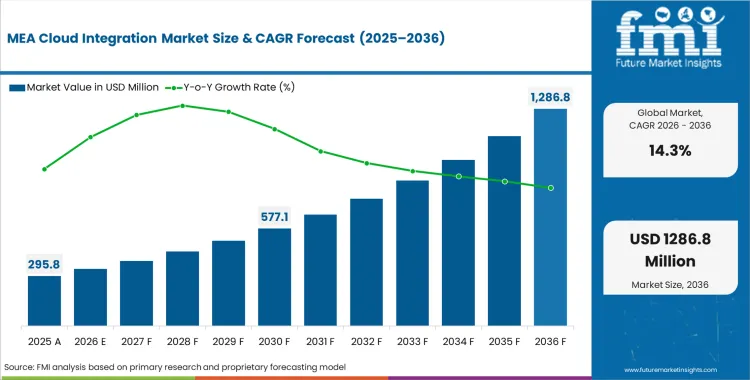
The mea cloud integration market was valued at USD 295.80 million in 2025, projected to reach USD 338.10 million in 2026, and is forecast to expand to USD 1286.79 million by 2036 at a 14.3% CAGR. Accelerating enterprise digital transformation programs, expanding government cloud-first mandates, and the proliferation of multi-cloud architectures across banking, telecom, and government sectors are driving procurement cycles for cloud integration platforms and services in the Middle East and Africa. IT directors managing hybrid cloud environments across Saudi Vision 2030 smart city projects and South African financial services modernization programs treat cloud integration as mandatory middleware infrastructure rather than discretionary IT tooling.
Summary of MEA Cloud Integration Market
- Market Overview
- The mea cloud integration market is valued at USD 295.80 million in 2025 and is projected to reach USD 1286.79 million by 2036.
- The industry is expected to grow at a 14.3% CAGR from 2026 to 2036, creating an incremental opportunity of USD 948.69 million.
- The market is an enterprise middleware category where multi-cloud connectivity, data residency compliance, and API management capability define competitive positioning.
- Demand and Growth Drivers
- Demand is accelerating as Saudi Vision 2030, UAE smart government, and South African financial modernization programs mandate cloud-first IT architectures across enterprise and government sectors.
- Multi-cloud adoption is expanding iPaaS platform procurement as organizations require middleware connecting on-premise legacy systems with multiple public cloud providers.
- Data residency regulations across GCC and African jurisdictions are driving demand for cloud integration platforms with region-specific data sovereignty capabilities.
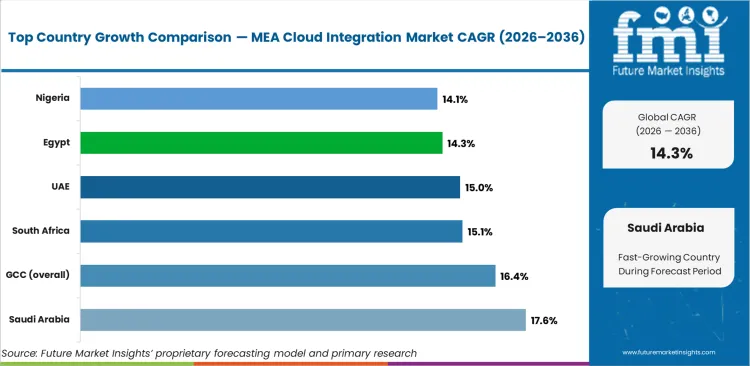
- Among key countries, Saudi Arabia leads at 17.6% CAGR, followed by GCC (overall) at 16.4%, South Africa at 15.1%, and UAE at 15.0%.
- Product and Segment View
- The market includes cloud integration platforms (iPaaS) and professional/managed services for enterprise application connectivity across hybrid and multi-cloud environments.
- Applications span CRM integration, marketing automation orchestration, enterprise risk management, human capital management, and database management system connectivity.
- Cloud Integration Platform leads by Solution with 62.1% share in 2026, driven by iPaaS demand for multi-vendor cloud application connectivity.
- BFSI leads by Industry with 17.0% share in 2026, reflecting banking and insurance hybrid cloud migration with regulatory data residency compliance requirements.
- The scope includes iPaaS platforms, integration middleware, API management tools, and associated implementation services, while excluding standalone cloud infrastructure (IaaS) and SaaS application licenses.
- Geography and Competitive Outlook
- Saudi Arabia leads growth at 17.6% CAGR driven by Vision 2030 digital infrastructure targets, followed by GCC and South Africa through financial and government sector modernization.
- Nigeria and Egypt sustain growth through expanding digital banking and e-government platform deployment.
- Competition is shaped by product performance, technical capability, and distribution reach, with key players including Amazon Web Services, Google, SAP, Microsoft Corporation, TIBCO Software Inc, Dell Technologies, Oracle Corporation, Informatica, MuleSoft LLC, Software AG.
- Analyst Opinion at FMI
- FMI is of the opinion that the MEA cloud integration market is structurally linked to government digital transformation program timelines, where cloud-first mandates under Saudi Vision 2030 and UAE smart government frameworks create non-discretionary integration platform procurement. Vendors that lack certified deployments within GCC data residency jurisdictions face procurement exclusion from the largest enterprise and government contracts.
- Strategic Implications / Executive Takeaways
- Platform vendors must establish certified cloud integration deployments within GCC and African data residency jurisdictions to qualify for government and financial sector procurement.
- Enterprise IT directors should prioritize iPaaS platforms with pre-built connectors for regional banking, ERP, and government systems to reduce implementation timelines.
- System integrators must develop regional delivery capability with Arabic and French language support to serve MEA enterprise clients across diverse regulatory environments.
MEA Cloud Integration Market Key Takeaways
| Metric | Details |
|---|---|
| Industry Size (2026) | USD 338.10 million |
| Industry Value (2036) | USD 1286.79 million |
| CAGR (2026-2036) | 14.3% |
Source: Future Market Insights, 2026
Cloud integration platforms retain the lead position at 62.1% share in 2026, driven by enterprise demand for iPaaS solutions that connect on-premise legacy systems with public cloud applications across multi-vendor environments. BFSI accounts for 17.0% of industry demand as banks and insurance companies migrate core banking platforms to hybrid cloud architectures while maintaining regulatory data residency compliance. As per FMI, the convergence of Saudi Vision 2030 digital infrastructure targets, UAE smart government initiatives, and South African financial sector modernization programs is creating parallel procurement demand across the region. Organizations delaying integration platform investment face data silos that prevent the real-time analytics and automated workflows required by digital transformation program milestones.
All key markets reflect differentiated growth trajectories. Saudi Arabia advances at 17.6% driven by Vision 2030 digital infrastructure mandates and smart city project deployment. GCC (overall) advances at 16.4% fueled by government cloud-first policies and financial sector digital transformation programs. South Africa advances at 15.1% sustained by financial services modernization and e-government platform expansion. UAE advances at 15.0% supported by smart government initiatives and free zone digital infrastructure development. Egypt advances at 14.3% anchored by digital banking expansion and government digitization programs. Nigeria advances at 14.1% maintained by fintech ecosystem growth and mobile-first enterprise cloud adoption.
MEA Cloud Integration Market Definition
MEA Cloud Integration represents the middleware platforms and professional services that connect enterprise applications, databases, and workflows across hybrid and multi-cloud environments within the Middle East and Africa region. The market encompasses integration platform-as-a-service (iPaaS), API management tools, data integration middleware, and associated implementation, consulting, and managed services deployed across BFSI, IT and telecom, healthcare, retail, government, and education sectors.managed service
MEA Cloud Integration Market Inclusions
Market scope includes iPaaS platforms, integration middleware, API management tools, and associated professional and managed services for MEA enterprise cloud integration. Regional market sizes, forecast period 2026 to 2036, and segment breakdowns by Solution, Industry, and Application are fully covered.
MEA Cloud Integration Market Exclusions
The scope excludes standalone cloud infrastructure services (IaaS), SaaS application licenses, and on-premise-only enterprise application integration. Network infrastructure hardware and telecommunications carrier services are omitted from the valuation.
MEA Cloud Integration Market Research Methodology
Primary Research
Analysts engaged with procurement managers, technical specification leads, and operations directors across key end-use segments to map decision gates triggering equipment and service upgrades.
Desk Research
Data collection aggregated regulatory compliance timelines, standards body publication schedules, industry association reports, and publicly filed corporate disclosures.
Market-Sizing and Forecasting
Baseline values derive from bottom-up aggregation of product shipment volumes, service contract values, and consumption data, applying region-specific adoption curves to project future demand.
Data Validation and Update Cycle
Projections are tested against publicly reported expenditure guidance from leading industry participants and validated through cross-referencing with regulatory filing data and trade association statistics.
Semi-Annual Market Update
The below table presents the expected CAGR for the Middle East & Africa cloud integration market over several semi-annual periods spanning from 2026 to 2036. This assessment outlines changes in the memory interconnect industry and identify revenue trends, offering key decision makers an understanding about market performance throughout the year.
H1 represents first half of the year from January to June, H2 spans from July to December, which is the second half. In the first half (H1) of the year from 2026 to 2036, the business is predicted to surge at a CAGR of 13.6%, followed by a higher growth rate of 14.2% in the second half (H2) of the same decade.
| Particular | Value CAGR |
|---|---|
| H1 | 13.6% (2026 to 2036) |
| H2 | 14.2% (2026 to 2036) |
| H1 | 14.0% (2026 to 2036) |
| H2 | 14.6% (2026 to 2036) |
Moving into the subsequent period, from H1 2025 to H2 2035, the CAGR is projected to increase slightly to 14.0% in the first half and remain higher at 14.6% in the second half. In the first half (H1) the market witnessed a decrease of 40 BPS and in the second half (H2), the market witnessed an increase of 40 BPS.
Key Industry Highlights
Digital Transformation Initiatives in the Region Powers the Market Growth
The MEA region is experiencing a major digital transformation across different sectors initiated mainly by the government and, to a great extent, through private sector investment. Digitalization initiatives such as Saudi Vision 2030 in Saudi Arabia and the UAE Digital Government Strategy promote ambitious projects to enhance the digital economy.
Governments advocate for private-sector businesses to embrace cloud for operational efficiency, cost savings, and improved customer service. For example, smart city projects rely on a seamless flow of data through IoT-enabled devices, cloud platforms, and government systems, necessitating integrated cloud solutions.
Cloud integration finds application in the oil and gas sector among many others in the private domain and BFSI besides the retail and healthcare sectors. These industries implement the cloud as a means to have a new IT backbone that allows them to digitally operate.
Cloud integration also provides capability to automatically share data from legacy systems on premise in real-time with modern applications in cloud on the runs improving business processes and decision-making capabilities.
At this time, almost every enterprise endeavors to remain ahead of competition in an ever-evolving digital scenario and, such cloud integration solutions provide the perfect link to keep seamless connectivity on every platform while optimizing operational efficiency.
Rapid Adoption of Hybrid Cloud Creates High Demand of Cloud Integration
The hybrid cloud adoption trend is marching forward very fast within Middle East. Businesses are compelled to adopt hybrid solutions because they would need the flexibility, security, and cost efficiency.
Most prefer hybrid cloud scenarios that involve on-premises infrastructure and public-private cloud service in order to meet those specific business requirements. For example, because of data sovereignty laws, sensitive data is stored on-premise rather than migrated to the cloud but less critical workloads find their way into the cloud in search of scalability and cost benefits.
Cloud integration is a critical requirement of any hybrid approach because it enables smooth data flow between on-premise systems and cloud platforms. The adoption of hybrid cloud solutions is, therefore, essential in safeguarding sensitive data as well as nurturing digital innovation in sectors such as healthcare, finance, and manufacturing.
Also, data centers in the region across MEA are being established by cloud providers like Microsoft, AWS, and Oracle to drive the hybrid culture of sourcing for localized services while complying with the regulations.
Also, by using hybrid cloud strategies, organizations are able to optimally utilize workloads, minimize downtimes, and instead make their disaster recovery capabilities more effective. As a result of this growth in hybrid adoption, cloud integration solutions will be increasingly relevant in keeping up with handling data and processes from different environments.
Security Concerns Act as a Notable Challenge in the Market
Security concerns continue to be a very significant barrier in the path of adoption of cloud integration by various businesses across the MEA region. There exists obvious reluctance against the much-anticipated cross-cloud integration with sensitive data, owing to the risks that accrue with cyberattacks, data breaches, and unauthorized access.
Much of the cybersecurity threats that have Makhapula been increasing in the region, manifested mainly in the forms of ransomware attacks and data breaches, come with varied increase and sophistication.
New vulnerabilities introduced by cloud integration need to be addressed by organizations that intend to embark on the journey to ensure the security of data and systems.
For instance, insecure APIs, poor encryption, and misconfigured integrations can easily serve as points of entry for attackers. In addition, cloud platforms and on-premise systems can be integrated with extremely abundant surface attack increases, thus making it even more difficult for organizations to protect the entire IT environment.
Primarily among these would be such sectors as finance, healthcare, government, etc., which pose security risks, as they deal with highly sensitive data and strict adherence to compliance requirements.
Most often than not, these sectors have avoided complete cloud integration owing to the fear of possible data losses and breaches of compliance regulations. Thus, companies would need to invest heavily in security measures such as secure, encrypted data transfer, secure API gateways, and real-time threat monitoring to achieve this value in integrated cloud and on-premise systems.
2021 to 2025 Middle East & Africa Cloud Integration Sales Outlook Compared to Demand Forecasts from 2026 to 2036
The industry showcased a CAGR of 13.5% during the period between 2021 and 2025. The industry reached a value of USD 260.5 million in 2025 from USD 156.8 million in 2021.
During this time, the demand for hybrid cloud environments soared as organizations sought to juggle between data security and scalability. The quickening pulse associated with COVID in 2021 acted as a catalyst in adopting the cloud during, particularly, education, government, and e-commerce, which drove the demand for integration services with a requirement for on-premise systems to connect with cloud applications.
On the other hand, the market is estimated to grow at a CAGR of 14.3% during the forecasted period between 2025 and 2035. The market is expected to grow swiftly as it has a potential to reach a value of USD 1,123.4 million in 2035 from USD 295.8 million in 2025.
Between the years 2025 and 2035, enterprises are expected to be increasingly adopting hybrid multi-cloud strategies to optimize the cross-cloud load balancing of workloads. These integration platforms are the real enablers of having public-private mixed on-premise systems interact.
In demand of the customized cloud integration solutions will be the domains of health, government Affairs, energy, and Logistics. An example would be oil and gas integration where cloud and oil and gas are integrated to get data to improve operations, that data being from IoT-based monitoring systems.
Market Concentration
Tier 1 vendors typically consist of names such as Microsoft Azure, Amazon Web Services (AWS), Oracle, and IBM. Their market dominance is attributed to the massive cloud infrastructure as well as their high presence combined with all the integration platforms that they offer.
End-to-end solutions are hybrid-cloud, collaborated with SaaS applications and on-premise systems. Such vendors have also set up various regional data centers across countries such as KSA, UAE, and South Africa facilitating compliance with data sovereignty laws. The total contribution from Tier 1 vendors is around 40% - 45% of the total market size.
Tier 2 vendors are: Regional host such as Etisalat, Liquid Intelligent Technologies, and MTN Group, and non-regionals such such as Mule Soft, Dell, and TIBCO Software. The advantage of these vendors is that they focus their offers towards mid-market enterprises and provide more affordable cloud integration solutions to meet specific industries such as retailing, health care, and manufacturing, among others. Tier 2 would probably constitute around 30% - 35% market size capture.
Tier-3 providers are local system integrators and consulting firms and specialized solution providers such as CloudHPT, Solutions by STC, and eHosting DataFort. These vendors cater primarily towards SMEs and provide their clients with customized cloud integration services.
Most of their offerings are tailored around specific use cases, such as legacy system integration or connecting IoT devices to cloud platforms. It is estimated that the share of Tier 3 vendors would constitute nearly 25% - 30% of total market size.
Country-wise Insights
The section highlights the CAGRs of countries experiencing growth in the cloud integration market, along with the latest advancements contributing to overall market development. Based on current estimates KSA, Other GCC Countries and South Africa are expected to see steady growth during the forecast period.
.webp "Top Country Growth Comparison Mea Cloud Integration Market Cagr (2026 2036)")
| Countries | CAGR from 2026 to 2036 |
|---|---|
| KSA | 17.6% |
| Other GCC Countries | 16.4% |
| South Africa | 15.1% |
KSA's Vision 2030 Boosts Cloud Integration Market Growth with Digital Transformation
KSA's cloud integration market is on the fast lane to growth under several initiatives like Saudi Vision 2030, whose goals include diversifying the economy and reducing the dependence on oil exports. It has spent huge sums of investment in digital transformation, and promoting cloud technologies in health care, education, and e-government, among other sectors.
In addition, there are now established AWS and Microsoft Azure cloud data centers in-country in keeping with milieu localization requirements under the Saudi Data Privacy Law.
According to a recent report from the Communications and Information Technology Commission (CITC) in Saudi Arabia, cloud computing in Saudi Arabia increased 40 percent in the public sector alone in the past two years.
Much with the above has driven phenomenal demand for its integration services, such as increased adoption by BFSI and oil and gas, where clouds have been able to make real-time data sharing and improved operational efficiency possible.
GCC Countries Smart City and Economic Diversification Strategies Fuel Cloud Integration Demand
Other GCC nations are also riding the wave of rapid growth in the cloud integration market. This trend is prevalent in the UAE, Qatar and Kuwait, with specific emphasis on the Smart Dubai initiative. It aims to transform Dubai into the world's epicenter for smart cities and results in greater IoT and cloud adoption.
Dubai Electricity and Water Authority (DEWA) uses a cloud platform for smarter energy management, for example. Further investments into technology infrastructure, including cloud integration, are also fuelling the Qatar National Vision 2030 and the country's efforts toward economic diversification.
Also, enabling effective integration of AI and big data platforms with huge government investments in data centers makes it hard for GCC countries to see their future beyond continued growth in cloud integration.
South Africa’s ICT Infrastructure Expansion and Role as Gateway to Sub-Saharan Africa Drive Cloud Integration Growth
The market in South Africa is rapidly growing with the expansion of its ICT infrastructure. Cloud consumption will cross the USD 1 billion mark by 2025, as more businesses in the public and private sectors shift some or all of their IT workloads to the cloud. In 2021, AWS and Microsoft expanded their data center regions in South Africa to offer local solutions that comply with data protection laws.
The adoption of cloud-based solutions in South Africa is accelerating in sectors such as mining, finance, and retail, as firms look to alternative solutions for more efficient and cost-effective options.
As per an FMI report in 2023, cloud integration services in South Africa witnessed a healthy 22% year-on-year growth, primarily propelled by the adoption of IoT and digital banking solutions that are essential for seamless cloud integration in data management and customer experience.
Competition Outlook
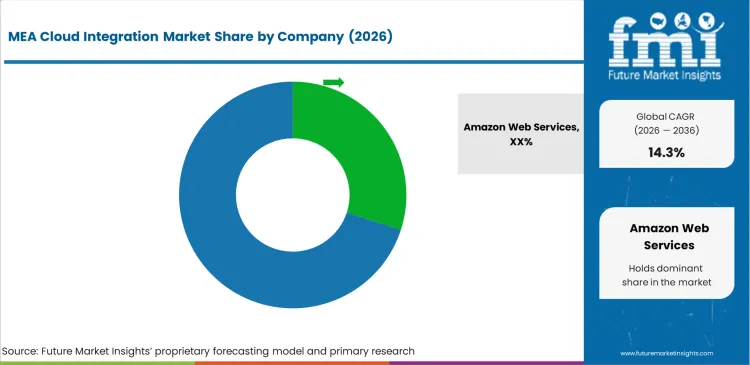
Competitive landscape is very intense regarding cloud integration in MEA whereby all top-line players provide the full spectrum of offerings such as iPaaS, hybrid-cloud as well as SaaS integrations.
These vendors are working towards the localization of their services, regulatory compliance, and incorporating advanced features within the products, such as AI-enabled integrations and real-time data synchronization.
Among the key differentiators driving competition and market share expansion in this highly dynamic space are strategic partnerships, industry-targeted solutions, and flexible pricing models.
Industry Update
- In Jan 2025, Stonebranch, the market leader in service orchestration and automation solutions, announced its Universal Connector for SAP has achieved SAP certification as integrated with RISE with SAP S/4HANA Cloud. This integration allows organizations to orchestrate automated workloads centrally across all SAP applications and beyond.
- In Jan 2025, Moments Lab and LucidLink announced a powerful integration of their respective cloud technologies that enables corresponding customers to have instant access to all live and archived media and direct a selected clip into the file space of their LucidLink account for immediate editing.
- In Aug 2025, Genpact announced its integration with Salesforce Data Cloud to enable AI-enabled industry cloud solutions that help enterprises transform their operations and gain competitive advantages.
Scope of the Report
| Metric | Value |
|---|---|
| Quantitative Units | USD 338.10 million to USD 1286.79 million, at a CAGR of 14.3% |
| Market Definition | MEA Cloud Integration represents the middleware platforms and professional services that connect enterprise applications, databases, and workflows across hybrid and multi-cloud environments within the Middle East and Africa region. The market encompasses integration platform-as-a-service (iPaaS), API management tools, data integration middleware, and associated implementation, consulting, and managed services deployed across BFSI, IT and telecom, healthcare, retail, government, and education sectors. |
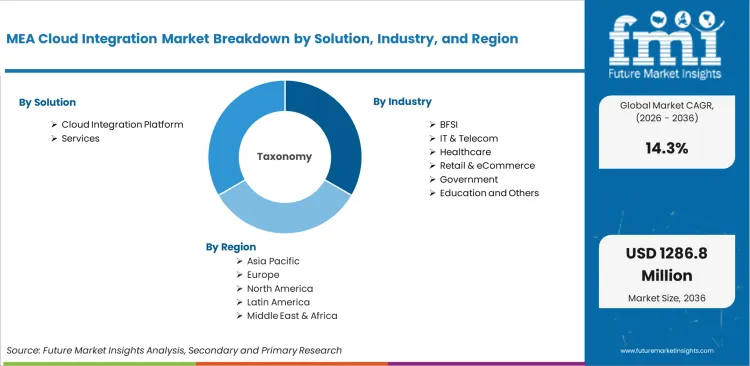
| Segmentation | Solution: Cloud Integration Platform, Services; Industry: BFSI, IT & Telecom, Healthcare, Retail & eCommerce, Government, Education and Others; Application: Customer Relationship Management, Marketing Automation, Enterprise Risk Management, Human Capital Management, Database Management System |
| Regions Covered | North America, Latin America, Europe, East Asia, South Asia, Oceania, Middle East & Africa |
| Countries Covered | Saudi Arabia, GCC (overall), South Africa, UAE, Egypt, Nigeria, and 40 plus countries |
| Key Companies Profiled | Amazon Web Services, Google, SAP, Microsoft Corporation, TIBCO Software Inc, Dell Technologies, Oracle Corporation, Informatica, MuleSoft LLC, Software AG |
| Forecast Period | 2026 to 2036 |
| Approach | Forecasting models apply a hybrid bottom-up and top-down methodology starting with installed base metrics and cross-validating projections against primary research and public disclosure data. |
Cloud Integration Market Segmentation
By Solution:
In terms of solution, the segment is divided into Cloud Integration Platform (iPaaS) and Services.
By Application:
In terms of application, the segment is segregated into Customer Relationship Management (CRM), Marketing Automation, Enterprise Risk Management (ERM), Human Capital Management (HCM) and Database Management System (DBMS).
By Industry:
In terms of industry, the segment is segregated into BFSI, IT & Telecom, Healthcare, Retail & eCommerce, Government, Education and Others.
By Country:
A country analysis has been carried out in key countries of KSA, Other GCC Countries, Turkiye, South Africa, Other African Union and Rest of Middle East & Africa.
Bibliography
- 1. Communications and Information Technology Commission of Saudi Arabia. (2025). Cloud Computing Regulatory Framework. CITC.
- 2. Telecommunications and Digital Government Regulatory Authority of UAE. (2025). Cloud-First Policy for Government Entities. TDRA.
- 3. South African Reserve Bank. (2025). Cloud Computing and Data Security Directive for Financial Institutions. SARB.
- 4. African Union. (2025). Digital Transformation Strategy for Africa 2021-2030: Progress Report. AU.
- 5. International Telecommunication Union. (2025). Digital Development Dashboard: Middle East and Africa. ITU.
- 6. Organisation for Economic Co-operation and Development. (2025). Going Digital in the Middle East and North Africa. OECD.
This bibliography is provided for reader reference. The full Future Market Insights report contains the complete reference list with primary research documentation.
Frequently Asked Questions
How large is the demand for MEA Cloud Integration in the global market in 2026?
Demand for MEA Cloud Integration in the global market is estimated to be valued at USD 338.10 million in 2026.
What will be the market size of MEA Cloud Integration in the global market by 2036?
Market size for MEA Cloud Integration is projected to reach USD 1286.79 million by 2036.
What is the expected demand growth for MEA Cloud Integration between 2026 and 2036?
Demand for MEA Cloud Integration is expected to grow at a CAGR of 14.3% between 2026 and 2036.
Which Solution is poised to lead global sales by 2026?
Cloud Integration Platform accounts for 62.1% share in 2026.
How significant is BFSI in driving MEA Cloud Integration adoption in 2026?
BFSI represents 17.0% of segment share in 2026.
What is Saudi Arabia's growth outlook in this report?
Saudi Arabia is projected to grow at a CAGR of 17.6% during 2026 to 2036.
What is MEA Cloud Integration and what is it mainly used for?
MEA Cloud Integration represents the middleware platforms and professional services that connect enterprise applications, databases, and workflows across hybrid and multi-cloud environments within the Middle East and Africa region. The market encompasses integration platform-as-a-service (iPaaS), API management tools, data integration middleware, and associated implementation, consulting, and managed services deployed across BFSI, IT and telecom, healthcare, retail, government, and education sectors.
What is included in the scope of this MEA Cloud Integration report?
Market scope includes iPaaS platforms, integration middleware, API management tools, and associated professional and managed services for MEA enterprise cloud integration. Regional market sizes, forecast period 2026 to 2036, and segment breakdowns by Solution, Industry, and Application are fully covered.
Preview the report firsthand - request a free sample
Get SampleGet the brochure for pricing and purchase details.
Get PDFTable of Content
- Executive Summary
- Global Market Outlook
- Demand-side Trends
- Supply-side Trends
- Technology Roadmap Analysis
- Analysis and Recommendations
- Market Overview
- Market Coverage / Taxonomy
- Market Definition / Scope / Limitations
- Research Methodology
- Chapter Orientation
- Analytical Lens and Working Hypotheses
- Market Structure, Signals, and Trend Drivers
- Benchmarking and Cross-market Comparability
- Market Sizing, Forecasting, and Opportunity Mapping
- Research Design and Evidence Framework
- Desk Research Programme (Secondary Evidence)
- Company Annual and Sustainability Reports
- Peer-reviewed Journals and Academic Literature
- Corporate Websites, Product Literature, and Technical Notes
- Earnings Decks and Investor Briefings
- Statutory Filings and Regulatory Disclosures
- Technical White Papers and Standards Notes
- Trade Journals, Industry Magazines, and Analyst Briefs
- Conference Proceedings, Webinars, and Seminar Materials
- Government Statistics Portals and Public Data Releases
- Press Releases and Reputable Media Coverage
- Specialist Newsletters and Curated Briefings
- Qualitative Interviews and Expert Elicitation
- Quantitative Surveys and Structured Data Capture
- Blended Approach
- Why Primary Evidence is Used
- Field Techniques
- Interviews
- Surveys
- Focus Groups
- Observational and In-context Research
- Social and Community Interactions
- Stakeholder Universe Engaged
- C-suite Leaders
- Board Members
- Presidents and Vice Presidents
- R&D and Innovation Heads
- Technical Specialists
- Domain Subject-matter Experts
- Scientists
- Physicians and Other Healthcare Professionals
- Governance, Ethics, and Data Stewardship
- Research Ethics
- Data Integrity and Handling
- Desk Research Programme (Secondary Evidence)
- Tooling, Models, and Reference Databases
- Data Engineering and Model Build
- Data Acquisition and Ingestion
- Cleaning, Normalisation, and Verification
- Synthesis, Triangulation, and Analysis
- Quality Assurance and Audit Trail
- Market Background
- Market Dynamics
- Drivers
- Restraints
- Opportunity
- Trends
- Scenario Forecast
- Demand in Optimistic Scenario
- Demand in Likely Scenario
- Demand in Conservative Scenario
- Opportunity Map Analysis
- Product Life Cycle Analysis
- Supply Chain Analysis
- Investment Feasibility Matrix
- Value Chain Analysis
- PESTLE and Porter’s Analysis
- Regulatory Landscape
- Regional Parent Market Outlook
- Production and Consumption Statistics
- Import and Export Statistics
- Market Dynamics
- Global Market Analysis 2021 to 2025 and Forecast, 2026 to 2036
- Historical Market Size Value (USD Million) Analysis, 2021 to 2025
- Current and Future Market Size Value (USD Million) Projections, 2026 to 2036
- Y-o-Y Growth Trend Analysis
- Absolute $ Opportunity Analysis
- Global Market Pricing Analysis 2021 to 2025 and Forecast 2026 to 2036
- Global Market Analysis 2021 to 2025 and Forecast 2026 to 2036, By Solution
- Introduction / Key Findings
- Historical Market Size Value (USD Million) Analysis By Solution , 2021 to 2025
- Current and Future Market Size Value (USD Million) Analysis and Forecast By Solution , 2026 to 2036
- Cloud Integration Platform
- Services
- Cloud Integration Platform
- Y-o-Y Growth Trend Analysis By Solution , 2021 to 2025
- Absolute $ Opportunity Analysis By Solution , 2026 to 2036
- Global Market Analysis 2021 to 2025 and Forecast 2026 to 2036, By Industry
- Introduction / Key Findings
- Historical Market Size Value (USD Million) Analysis By Industry, 2021 to 2025
- Current and Future Market Size Value (USD Million) Analysis and Forecast By Industry, 2026 to 2036
- BFSI
- IT & Telecom
- Healthcare
- Retail & eCommerce
- Government
- Education and Others
- BFSI
- Y-o-Y Growth Trend Analysis By Industry, 2021 to 2025
- Absolute $ Opportunity Analysis By Industry, 2026 to 2036
- Global Market Analysis 2021 to 2025 and Forecast 2026 to 2036, By Application
- Introduction / Key Findings
- Historical Market Size Value (USD Million) Analysis By Application, 2021 to 2025
- Current and Future Market Size Value (USD Million) Analysis and Forecast By Application, 2026 to 2036
- Customer Relationship Management
- Marketing Automation
- Enterprise Risk Management
- Human Capital Management
- Database Management System
- Customer Relationship Management
- Y-o-Y Growth Trend Analysis By Application, 2021 to 2025
- Absolute $ Opportunity Analysis By Application, 2026 to 2036
- Global Market Analysis 2021 to 2025 and Forecast 2026 to 2036, By Region
- Introduction
- Historical Market Size Value (USD Million) Analysis By Region, 2021 to 2025
- Current Market Size Value (USD Million) Analysis and Forecast By Region, 2026 to 2036
- North America
- Latin America
- Western Europe
- Eastern Europe
- East Asia
- South Asia and Pacific
- Middle East & Africa
- Market Attractiveness Analysis By Region
- North America Market Analysis 2021 to 2025 and Forecast 2026 to 2036, By Country
- Historical Market Size Value (USD Million) Trend Analysis By Market Taxonomy, 2021 to 2025
- Market Size Value (USD Million) Forecast By Market Taxonomy, 2026 to 2036
- By Country
- USA
- Canada
- Mexico
- By Solution
- By Industry
- By Application
- By Country
- Market Attractiveness Analysis
- By Country
- By Solution
- By Industry
- By Application
- Key Takeaways
- Latin America Market Analysis 2021 to 2025 and Forecast 2026 to 2036, By Country
- Historical Market Size Value (USD Million) Trend Analysis By Market Taxonomy, 2021 to 2025
- Market Size Value (USD Million) Forecast By Market Taxonomy, 2026 to 2036
- By Country
- Brazil
- Chile
- Rest of Latin America
- By Solution
- By Industry
- By Application
- By Country
- Market Attractiveness Analysis
- By Country
- By Solution
- By Industry
- By Application
- Key Takeaways
- Western Europe Market Analysis 2021 to 2025 and Forecast 2026 to 2036, By Country
- Historical Market Size Value (USD Million) Trend Analysis By Market Taxonomy, 2021 to 2025
- Market Size Value (USD Million) Forecast By Market Taxonomy, 2026 to 2036
- By Country
- Germany
- UK
- Italy
- Spain
- France
- Nordic
- BENELUX
- Rest of Western Europe
- By Solution
- By Industry
- By Application
- By Country
- Market Attractiveness Analysis
- By Country
- By Solution
- By Industry
- By Application
- Key Takeaways
- Eastern Europe Market Analysis 2021 to 2025 and Forecast 2026 to 2036, By Country
- Historical Market Size Value (USD Million) Trend Analysis By Market Taxonomy, 2021 to 2025
- Market Size Value (USD Million) Forecast By Market Taxonomy, 2026 to 2036
- By Country
- Russia
- Poland
- Hungary
- Balkan & Baltic
- Rest of Eastern Europe
- By Solution
- By Industry
- By Application
- By Country
- Market Attractiveness Analysis
- By Country
- By Solution
- By Industry
- By Application
- Key Takeaways
- East Asia Market Analysis 2021 to 2025 and Forecast 2026 to 2036, By Country
- Historical Market Size Value (USD Million) Trend Analysis By Market Taxonomy, 2021 to 2025
- Market Size Value (USD Million) Forecast By Market Taxonomy, 2026 to 2036
- By Country
- China
- Japan
- South Korea
- By Solution
- By Industry
- By Application
- By Country
- Market Attractiveness Analysis
- By Country
- By Solution
- By Industry
- By Application
- Key Takeaways
- South Asia and Pacific Market Analysis 2021 to 2025 and Forecast 2026 to 2036, By Country
- Historical Market Size Value (USD Million) Trend Analysis By Market Taxonomy, 2021 to 2025
- Market Size Value (USD Million) Forecast By Market Taxonomy, 2026 to 2036
- By Country
- India
- ASEAN
- Australia & New Zealand
- Rest of South Asia and Pacific
- By Solution
- By Industry
- By Application
- By Country
- Market Attractiveness Analysis
- By Country
- By Solution
- By Industry
- By Application
- Key Takeaways
- Middle East & Africa Market Analysis 2021 to 2025 and Forecast 2026 to 2036, By Country
- Historical Market Size Value (USD Million) Trend Analysis By Market Taxonomy, 2021 to 2025
- Market Size Value (USD Million) Forecast By Market Taxonomy, 2026 to 2036
- By Country
- Kingdom of Saudi Arabia
- Other GCC Countries
- Turkiye
- South Africa
- Other African Union
- Rest of Middle East & Africa
- By Solution
- By Industry
- By Application
- By Country
- Market Attractiveness Analysis
- By Country
- By Solution
- By Industry
- By Application
- Key Takeaways
- Key Countries Market Analysis
- USA
- Pricing Analysis
- Market Share Analysis, 2025
- By Solution
- By Industry
- By Application
- Canada
- Pricing Analysis
- Market Share Analysis, 2025
- By Solution
- By Industry
- By Application
- Mexico
- Pricing Analysis
- Market Share Analysis, 2025
- By Solution
- By Industry
- By Application
- Brazil
- Pricing Analysis
- Market Share Analysis, 2025
- By Solution
- By Industry
- By Application
- Chile
- Pricing Analysis
- Market Share Analysis, 2025
- By Solution
- By Industry
- By Application
- Germany
- Pricing Analysis
- Market Share Analysis, 2025
- By Solution
- By Industry
- By Application
- UK
- Pricing Analysis
- Market Share Analysis, 2025
- By Solution
- By Industry
- By Application
- Italy
- Pricing Analysis
- Market Share Analysis, 2025
- By Solution
- By Industry
- By Application
- Spain
- Pricing Analysis
- Market Share Analysis, 2025
- By Solution
- By Industry
- By Application
- France
- Pricing Analysis
- Market Share Analysis, 2025
- By Solution
- By Industry
- By Application
- India
- Pricing Analysis
- Market Share Analysis, 2025
- By Solution
- By Industry
- By Application
- ASEAN
- Pricing Analysis
- Market Share Analysis, 2025
- By Solution
- By Industry
- By Application
- Australia & New Zealand
- Pricing Analysis
- Market Share Analysis, 2025
- By Solution
- By Industry
- By Application
- China
- Pricing Analysis
- Market Share Analysis, 2025
- By Solution
- By Industry
- By Application
- Japan
- Pricing Analysis
- Market Share Analysis, 2025
- By Solution
- By Industry
- By Application
- South Korea
- Pricing Analysis
- Market Share Analysis, 2025
- By Solution
- By Industry
- By Application
- Russia
- Pricing Analysis
- Market Share Analysis, 2025
- By Solution
- By Industry
- By Application
- Poland
- Pricing Analysis
- Market Share Analysis, 2025
- By Solution
- By Industry
- By Application
- Hungary
- Pricing Analysis
- Market Share Analysis, 2025
- By Solution
- By Industry
- By Application
- Kingdom of Saudi Arabia
- Pricing Analysis
- Market Share Analysis, 2025
- By Solution
- By Industry
- By Application
- Turkiye
- Pricing Analysis
- Market Share Analysis, 2025
- By Solution
- By Industry
- By Application
- South Africa
- Pricing Analysis
- Market Share Analysis, 2025
- By Solution
- By Industry
- By Application
- USA
- Market Structure Analysis
- Competition Dashboard
- Competition Benchmarking
- Market Share Analysis of Top Players
- By Regional
- By Solution
- By Industry
- By Application
- Competition Analysis
- Competition Deep Dive
- Amazon Web Services
- Overview
- Product Portfolio
- Profitability by Market Segments (Product/Age /Sales Channel/Region)
- Sales Footprint
- Strategy Overview
- Marketing Strategy
- Product Strategy
- Channel Strategy
- SAP
- Microsoft Corporation
- TIBCO Software Inc
- Dell Technologies
- Oracle Corporation
- Informatica
- MuleSoft LLC
- Software AG
- Amazon Web Services
- Competition Deep Dive
- Assumptions & Acronyms Used


