

- Market Size (2026)
- USD 438.6 Mn
- Forecast (2036)
- USD 815.6 Mn
- CAGR (2026 to 2036)
- 6.4%
Multi-Language and Icon-Based Cabin Signage Systems Market Size, Market Forecast and Outlook By FMI
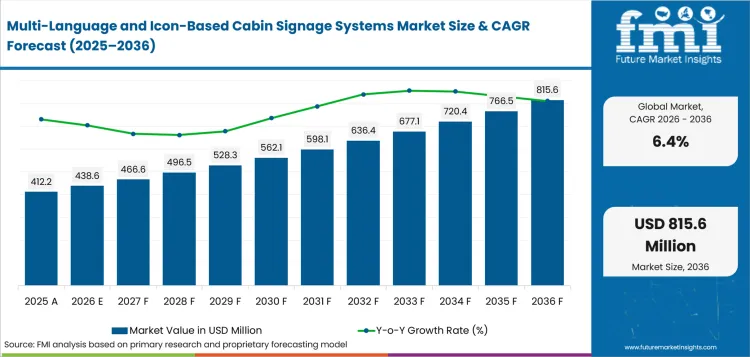
Multi-language and icon-based cabin signage systems market was valued at USD 412.2 million in 2025 and is expected to reach USD 438.6 million in 2026. Demand is forecast to reach USD 815.6 million by 2036 at 6.4% CAGR over the forecast period. Commercial airlines are forecast to account for 61.0% of end-use demand in 2026. OEM fitment is forecast to represent 57.0% of installation channel demand in 2026.
Key Takeaways, Market Size, and Forecast
- Multi-language and icon-based cabin signage systems market stood at USD 412.2 million in 2025.
- By 2036, the industry is forecast to reach USD 815.6 million.
- Market value is expected to move at 6.4% CAGR from 2026 to 2036.
- Demand is forecast to add USD 377.0 million in incremental opportunity over 2026 to 2036.
- Passenger information signs are expected to hold 35.0% share of sign type demand in 2026.
- Icon-based displays are forecast to represent 43.5% share of display format demand in 2026.
- Commercial airlines are expected to account for 61.0% of end-use demand in 2026.
- OEM fitment is forecast to hold 57.0% share of installation channel demand in 2026.
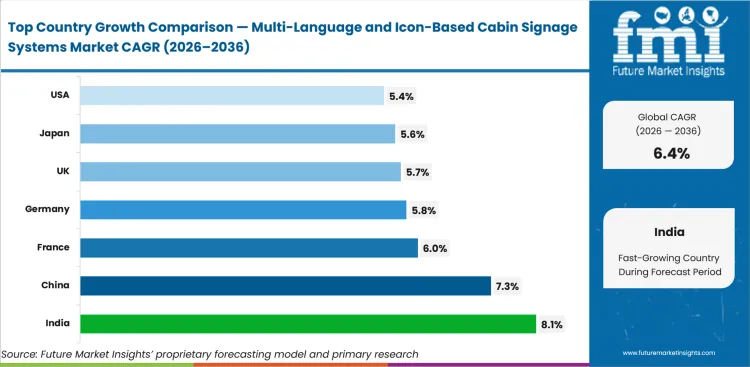
- India at 8.1% CAGR and China at 7.3% CAGR are expected to record a faster country pace through 2036.
Summary of the Multi-Language and Icon-Based Cabin Signage Systems Market
- Demand and Growth Drivers
- Airlines need cabin signs that passengers can understand quickly. Icon-based messages help passengers follow seat-belt and exit instructions without depending on one language.
- Cabin safety rules support demand for approved passenger information signs. Aircraft operators need signs that stay clear during boarding and emergency movement.
- Retrofit work is supporting demand for LED signs and photoluminescent markers. Airlines use these products to improve visibility and reduce wiring work during cabin updates.
- Product and Segment View
- Passenger information signs hold a central role in aircraft cabins. They carry seat-belt and device-use messages that passengers need during every flight.
- Icon-based displays are becoming more useful on international routes. Simple symbols help passengers understand safety messages even if they do not read the cabin language.
- OEM fitment supports early demand because signs must match cabin layout before aircraft delivery. Retrofit kits support older cabins that need clearer signs and lower maintenance effort.
- Geography and Competitive Outlook
- The United States and Europe support demand through strict cabin safety rules. Airlines in these regions need approved signs with clear documentation.
- China and India support faster demand as airline fleets and airport capacity expand. Mixed-language passenger flow increases the need for simple cabin signs.
- Suppliers compete on certified symbols and reliable sign hardware. Airlines prefer products that are easy to install and simple to replace during maintenance checks.
- Analyst Opinion
- Nikhil Kaitwade, is Principal Consultant at FMI. He says, “Cabin signage is moving from a lighting part into a passenger comprehension product. Airlines need signs for mixed-language passengers during routine messages and emergency movement. Suppliers combining certified symbols with low-power lighting and simple retrofit kits will be better placed in new aircraft and cabin upgrade work.”
- Multi-Language and Icon-Based Cabin Signage Systems Market Value Analysis
- The multi-language and icon-based cabin signage systems market is moving from basic cabin labeling into a more safety-focused visual communication area.
- Adoption is supported by airlines that need clear seat-belt and exit messages for passengers using different languages.
- Market value is strengthened by OEM fitment because sign placement must match cabin layout and certification records.
- Retrofit demand is supported by LED signs and photoluminescent markers that reduce maintenance work and improve emergency guidance.
Cabin signage is becoming more important as airlines carry passengers who use different languages. In August 2024, FAA changed passenger information sign rules so symbols can replace letters if the message is clear. This supports icon-based seat-belt and no-smoking signs in new aircraft and retrofit programs. In March 2026, EASA said exit signs can use a universal exit symbol. EASA requires exit markings to be readable from 76 cm. The word “OPEN” must be at least 25 mm high. These rules make certified visual clarity an important supplier requirement. Diehl Aviation is supporting simpler emergency sign layouts through self-powered emergency lights and signs. The system uses an internal energy buffer for 10 minutes of operation and supports a 7-year replacement cycle. This gives airlines a stronger reason to upgrade cabin signs because it can reduce wiring work and maintenance effort.
Multi-Language and Icon-Based Cabin Signage Systems Market Definition
Multi-language and icon-based cabin signage systems are certified aircraft cabin signs used to guide passengers through clear text and simple symbols. They help passengers understand seat-belt instructions, exit direction and lavatory status without depending on one language. Airlines use these systems to improve cabin safety during boarding and emergency movement. Aircraft makers use them during cabin design because sign placement must match seating layout and lighting plans.
Multi-Language and Icon-Based Cabin Signage Systems Market Inclusions
Market scope covers multi-language and icon-based cabin signage systems categorized by sign type, including passenger information signs and exit signs; display format, including icon-based displays and text signs; aircraft type, including narrow-body aircraft and wide-body aircraft; installation channel, including OEM fitment and retrofit kits; and end user, including commercial airlines, aircraft OEMs, business aviation, and defense aviation. The scope also includes certified cabin signs integrated within passenger service units, lavatory areas, exit paths, and cabin monuments in which visual safety messages guide passenger movement. Revenue scope covers 2026 to 2036. The key stakeholders include cabin signage suppliers, aircraft lighting companies, aircraft OEMs, airline operators, cabin interior integrators, MRO providers, retrofit specialists, aviation regulators, and certification authorities.
Multi-Language and Icon-Based Cabin Signage Systems Market Exclusions
Scope excludes airport terminal signs and cockpit-only warning panels. General interior trim and non-certified airline branding graphics are excluded unless supplied as part of a certified cabin sign package. External aircraft markings are excluded except rescue or emergency markings supporting cabin evacuation procedures.
Multi-Language and Icon-Based Cabin Signage Systems Market Research Methodology
- Primary Research: FMI analysts reviewed cabin signage suppliers and aircraft interior integrators across major aviation countries.
- Desk Research: Public aviation rules and airline traffic statistics supported demand checks.
- Market Sizing and Forecasting: Market size was built from aircraft production flow and average sign package value.
- Data Validation: Forecast checks compared passenger activity and certified cabin lighting product evidence.
Why is the Multi-Language and Icon-Based Cabin Signage Systems Market Growing?
- Cabin safety rules support demand for passenger information signs as airlines need readable messages inside every aircraft cabin.
- Mixed-language passenger flow supports icon-based signs because simple symbols reduce confusion during boarding and emergency movement.
- Retrofit programs create demand for low-power LED signs and self-powered emergency signage.
Certified cabin signs are receiving more budget attention as airlines need fast passenger understanding during routine and safety events. FAA passenger information rules require lighted signs and legible seat-belt wording for each passenger seat. The rule keeps signage tied to cabin safety work instead of decorative cabin design. Icon formats add value as a seat-belt symbol or exit arrow can be read by passengers using different languages. Suppliers able to provide approved symbols and aircraft-ready wiring interfaces are better placed during line-fit decisions.
Retrofit demand is moving ahead as older cabins shift toward simpler emergency marking and lower wiring effort. STG Aerospace states its saf-Tglo signage uses self-illuminated photoluminescent technology for commercial and military aircraft. The company lists the product as a tritium and electrical replacement for fixed-wing and rotorcraft cabins. Products connected with the demand for photoluminescent aircraft rescue marking systems receive attention as airlines seek clearer evacuation cues with lower maintenance work.
Market Segmentation Analysis
- Passenger information signs are expected to lead sign type demand in 2026 with 35.0% share.
- Icon-based displays are forecast to hold 43.5% share during 2026.
- Frequent short-haul use is expected to keep narrow-body aircraft ahead with 51.0% share in 2026.
- Sign layout and wiring interfaces need early design approval, so OEM fitment is expected to represent 57.0% share in 2026.
- Commercial airlines are forecast to account for 61.0% share in 2026.
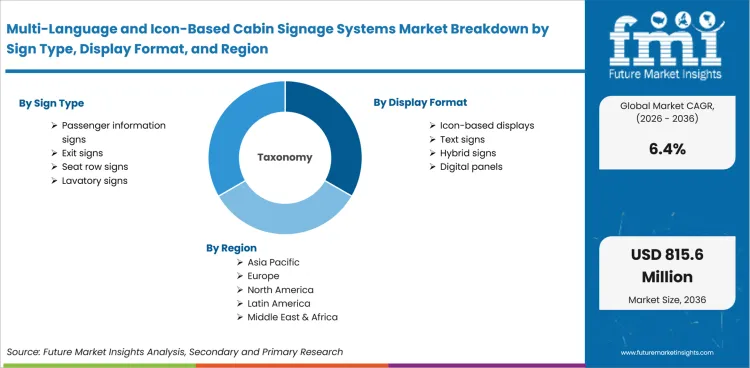
The market is divided into five primary segment groups based on sign type and display format. Aircraft type and installation channel add the next layers. End use completes the structure. Sign type covers passenger information signs and exit signs. Seat row signs and lavatory signs complete the group. Display format covers icon-based displays and text signs. Hybrid signs and digital panels complete the format scope. Aircraft type covers narrow-body aircraft and wide-body aircraft. Regional aircraft and business jets complete the aircraft scope. Installation channel covers OEM fitment and retrofit kits. MRO replacement completes the channel scope. End use covers commercial airlines and aircraft OEMs. Business aviation and defense aviation complete the end-use scope.
Insights into Multi-Language and Icon-Based Cabin Signage Systems Market by Sign Type
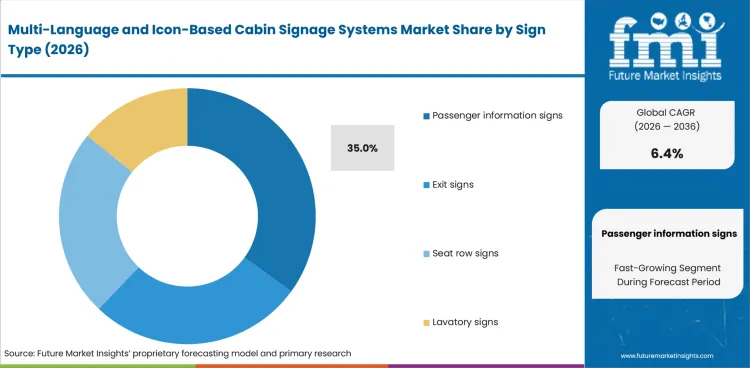
- Passenger information signs are expected to account for 35.0% share in 2026. Airlines need clear seat-belt and device-use messages across each passenger row.
- Exit signs support emergency movement inside the cabin. Seat row and lavatory signs connect with cabin headliner and psu integration modules outlook as signs move into overhead cabin assemblies.
Insights into Multi-Language and Icon-Based Cabin Signage Systems Market by Display Format
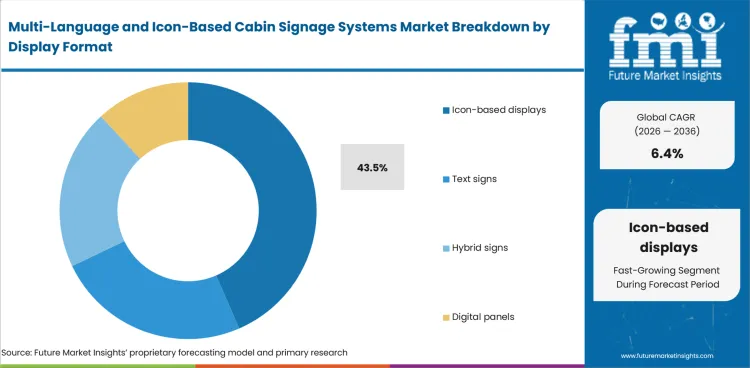
- In 2026, icon-based displays are expected to hold 43.5% share. Simple symbols help passengers understand safety messages without relying on one language.
- Text signs continue in cabins needing approved wording. Hybrid signs support demand for commercial aircraft cabin interior upgrades as airlines combine short text with icons.
Insights into Multi-Language and Icon-Based Cabin Signage Systems Market by Aircraft Type
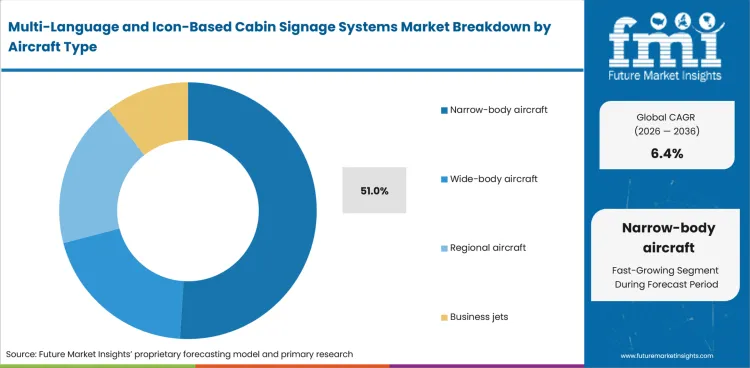
- Narrow-body aircraft are forecast to represent 51.0% share in 2026. Frequent short routes need repeated cabin messages during boarding and landing.
- Wide-body aircraft need wider language coverage for long routes. Regional aircraft use compact sign packages through economy cabin interior refurbishment services as older cabins are refreshed.
Insights into Multi-Language and Icon-Based Cabin Signage Systems Market by Installation Channel
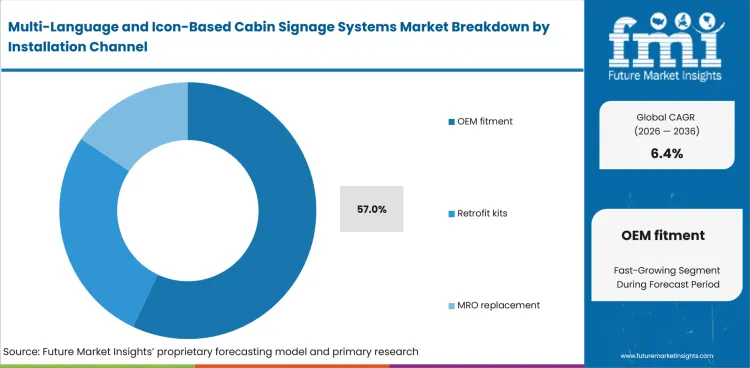
- OEM fitment is expected to hold 57.0% share in 2026. Aircraft makers prefer sign packages matched with cabin layout and certification records from the start.
- Retrofit kits support airlines replacing older plates and lighted signs. MRO replacement demand moves through commercial aircraft mro channels as fleets need approved cabin parts.
Insights into Multi-Language and Icon-Based Cabin Signage Systems Market by End User
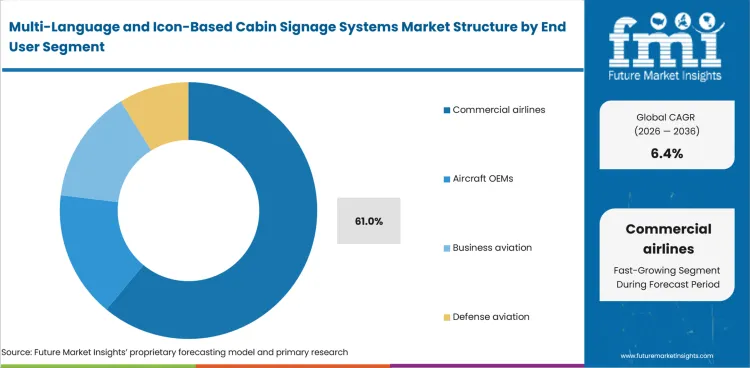
- Commercial airlines are forecast to account for 61.0% share in 2026. Scheduled fleets need standard safety signs for passengers using different languages.
- Aircraft OEMs shape early sign design through cabin layout planning. Business aviation and defense aviation need certified signs linked with the demand for aircraft evacuation readiness.
Multi-Language and Icon-Based Cabin Signage Systems Market Drivers, Restraints, and Opportunities
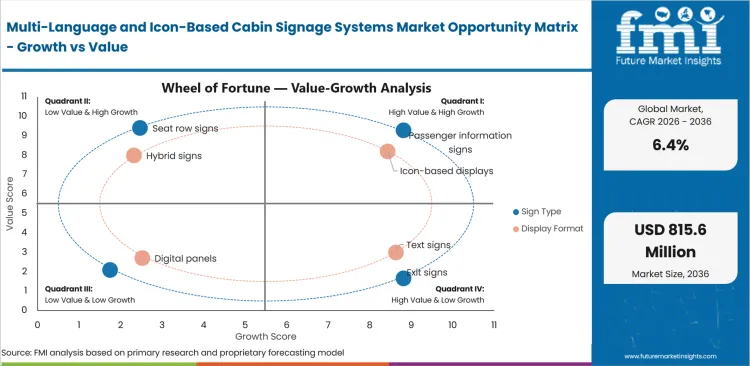
- Certified readability is raising demand for icon-rich passenger information and emergency marking systems.
- Custom artwork cost can slow smaller retrofit programs as airlines need approved drawings and cabin records.
- Aftermarket distribution creates new routes for cabin sign and lighting replacement work.
Certified Readability Raises Demand
Cabin signage demand is supported by rules requiring passengers to see and understand safety messages. FAA emergency lighting rules include illuminated emergency exit marking and locating signs. The rule also covers floor proximity escape path marking as part of emergency lighting systems. Sign suppliers must prove brightness and placement suitability before aircraft use. Products combining approved icons with clear illumination reduce confusion during boarding and cabin incidents.
Custom Artwork Cost Slows Retrofit Work
Airline cabin signs are not simple printed labels once symbols and lighting assemblies need certification evidence. Smaller fleets may delay changes as every sign package can need drawing control and aircraft records. Multi-language plates can raise part count if operators do not standardize symbol sets. Cost pressure creates demand for modular sign families with approved artwork and faster documentation support.
Aftermarket Channels Open Replacement Work
Cabin signage replacement depends on part availability and airline maintenance planning. In April 2025, Satair and Collins Aerospace extended a cabin interior parts distribution agreement covering cabin and external lighting products. The agreement supports spare-part access for airlines and MRO providers. Signage suppliers tied to custom livery themed interior lighting concepts outlook can benefit as cabin lighting and sign replacement enter the same service path.
Analysis of Multi-Language and Icon-Based Cabin Signage Systems Market by Key Countries
.webp "Top Country Growth Comparison Multi Language And Icon Based Cabin Signage Systems Market Cagr (2026 2036)")
| Country | CAGR |
|---|---|
| United States | 5.4% |
| China | 7.3% |
| India | 8.1% |
| Germany | 5.8% |
| France | 6.0% |
| Japan | 5.6% |
| United Kingdom | 5.7% |
Source: Future Market Insights, 2026.
Sales Analysis of Multi-Language and Icon-Based Cabin Signage Systems Market in the United States
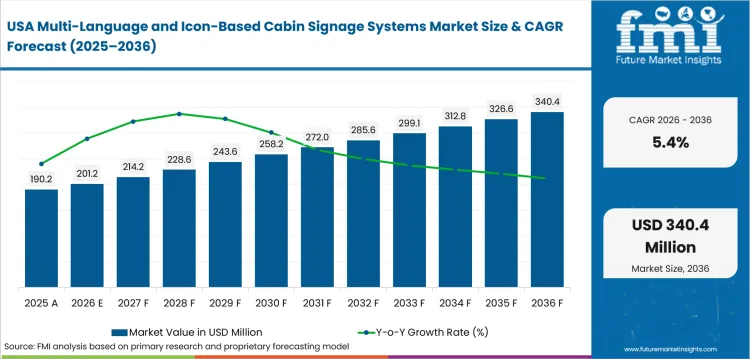
Established country market · 2026 to 2036
United States Market Outlook
The United States market is estimated at USD 98.5 million in 2026 and is expected to reach USD 166.7 million by 2036. The market is projected to expand at 5.4% CAGR through 2036, with USD 68.2 million in incremental opportunity.
Demand is supported by large airline fleets and strict FAA cabin safety rules. Airlines need approved passenger information signs, exit signs and emergency markings that match aircraft records.
Key Growth Drivers
- FAA reported 976.3 million U.S. passenger enplanements for 2025, supporting steady need for certified cabin signs in high-use airline fleets.
- FAA passenger sign rules require lighted seat-belt signs to be visible from passenger seats, supporting demand for passenger information signs.
- Large hub operations support retrofit demand as airlines update cabin layouts and need signs that match revised seat maps.
Key Restraints
- FAA reported the top 100 airports account for 93.7% of total U.S. enplanements, limiting wider sign replacement outside high-traffic airport networks.
- Strict part traceability raises replacement cost as airlines must use approved signs with certified drawings.
What makes the United States unique
FAA rules make cabin signage a compliance product before it becomes a design choice. Passenger information signs and emergency markings need clear visibility across each certified cabin layout.
Key Companies
- Astronics Corporation
- Luminator Aerospace
- Bruce Aerospace
Sales & Marketing Channels
- OEM aircraft programs
- Airline retrofit contracts
- FAA-certified MRO channels
- Cabin lighting distributors
- Direct supplier tenders
Market Taxonomy & Sub-Regions Covered
| Segment | Sub-Segments |
|---|---|
| By Sign Type | Passenger Information Signs · Exit Signs · Seat Row Signs · Lavatory Signs |
| By Display Format | Icon-Based Displays · Text Signs · Hybrid Signs · Digital Panels |
| By Aircraft Type | Narrow-Body Aircraft · Wide-Body Aircraft · Regional Aircraft · Business Jets |
| By Installation Channel | OEM Fitment · Retrofit Kits · MRO Replacement |
| By End User | Commercial Airlines · Aircraft OEMs · Business Aviation · Defense Aviation |
| Key Sub-Regions Covered | California · Washington · Texas · Florida · New York |
Frequently Asked Questions
How fast is the United States multi-language and icon-based cabin signage systems market advancing?
The United States market is projected to expand at 5.4% CAGR from 2026 to 2036.
Which segment leads in the United States market?
Commercial airlines lead in 2026 as large fleets need certified passenger information signs and emergency markers.
What supports demand in the United States?
Demand is supported by FAA cabin sign rules, large airline operations and recurring cabin retrofit work.
Sales Analysis of Multi-Language and Icon-Based Cabin Signage Systems Market in China
Fast-moving country market · 2026 to 2036
China Market Outlook
The China market is estimated at USD 63.0 million in 2026 and is expected to reach USD 127.4 million by 2036. The country is forecast to register 7.3% CAGR in this market over the forecast period, adding USD 64.4 million in incremental opportunity.
Demand is supported by large airport passenger flow and domestic aircraft program activity. Airlines need signs that combine Chinese wording with simple icons for mixed passenger groups.
Key Growth Drivers
- CAAC reported 1,529.046 million passenger throughput at civil transport airports in 2025, supporting demand for passenger information signs across large airline operations.
- CAAC reported 12.448 million aircraft movements in 2025, supporting replacement need for signs exposed to frequent cabin use.
- CAAC reported 41 transport airports with annual passenger throughput above 10.0 million in 2025, supporting standardized cabin signage across major airline networks.
Key Restraints
- CAAC reported aircraft movements increased only 0.4% in 2025, which can slow replacement demand tied only to flight cycle expansion.
- Local qualification rules can lengthen supplier approval time for imported cabin signage systems.
What makes China unique
China combines large passenger flow with local aircraft program development. Suppliers need multilingual sign formats that work for domestic routes and international cabin layouts.
Key Companies
- Collins Aerospace China
- COMAC
- China Southern Airlines
Sales & Marketing Channels
- Domestic aircraft OEM programs
- Airline retrofit tenders
- CAAC-approved supply channels
- Aircraft interior integrators
- MRO replacement routes
Market Taxonomy & Sub-Regions Covered
| Segment | Sub-Segments |
|---|---|
| By Sign Type | Passenger Information Signs · Exit Signs · Seat Row Signs · Lavatory Signs |
| By Display Format | Icon-Based Displays · Text Signs · Hybrid Signs · Digital Panels |
| By Aircraft Type | Narrow-Body Aircraft · Wide-Body Aircraft · Regional Aircraft · Business Jets |
| By Installation Channel | OEM Fitment · Retrofit Kits · MRO Replacement |
| By End User | Commercial Airlines · Aircraft OEMs · Business Aviation · Defense Aviation |
| Key Sub-Regions Covered | Guangdong · Shanghai · Beijing · Jiangsu · Sichuan |
Frequently Asked Questions
How fast is China’s multi-language and icon-based cabin signage systems market advancing?
China is forecast to register 7.3% CAGR in the market from 2026 to 2036.
Which segment leads in China?
Commercial airlines lead in 2026 as domestic carriers need standardized passenger information signs across large fleets.
What is driving demand in China?
Demand is supported by record airport passenger throughput, high aircraft movement and domestic aircraft program activity.
Sales Analysis of Multi-Language and Icon-Based Cabin Signage Systems Market in India
Fastest country market · 2026 to 2036
India Market Outlook
The India market is estimated at USD 24.5 million in 2026 and is expected to reach USD 53.4 million by 2036. India is likely to post 8.1% CAGR in the sector by 2036, creating USD 28.9 million in incremental opportunity.
Demand is tied to airport expansion and rising fleet induction. Mixed-language passenger flow makes icon-based cabin signage useful for seat-belt messages, exit guidance and lavatory signs.
Key Growth Drivers
- DGCA granted Navi Mumbai International Airport an aerodrome license on 30 September 2025 for a 3700.0 meter runway, supporting future airline capacity.
- DGCA stated the airport has CAT-I instrument landing support for all-weather operations, supporting higher service readiness.
- India’s multi-language travel environment supports icon-based displays as airlines need clear cabin signs across domestic route networks.
Key Restraints
- DGCA airport approval requirements show strict aviation safety review, which can delay new airport ramp-up and related cabin equipment demand.
- Cost-sensitive airline operations can slow retrofit timing when sign replacement is not tied to aircraft induction or required maintenance.
What makes India unique
India has fast airline expansion and a diverse passenger language profile. Cabin signs with icons can reduce crew explanation time during short-haul domestic operations.
Key Companies
- Air India
- IndiGo
- Air India Engineering Services Limited
Sales & Marketing Channels
- Airline induction programs
- Narrow-body retrofit work
- DGCA-approved MRO channels
- Aircraft OEM delivery routes
- Cabin maintenance suppliers
Market Taxonomy & Sub-Regions Covered
| Segment | Sub-Segments |
|---|---|
| By Sign Type | Passenger Information Signs · Exit Signs · Seat Row Signs · Lavatory Signs |
| By Display Format | Icon-Based Displays · Text Signs · Hybrid Signs · Digital Panels |
| By Aircraft Type | Narrow-Body Aircraft · Wide-Body Aircraft · Regional Aircraft · Business Jets |
| By Installation Channel | OEM Fitment · Retrofit Kits · MRO Replacement |
| By End User | Commercial Airlines · Aircraft OEMs · Business Aviation · Defense Aviation |
| Key Sub-Regions Covered | Maharashtra · Karnataka · Delhi NCR · Telangana · Tamil Nadu |
Frequently Asked Questions
How fast is India’s multi-language and icon-based cabin signage systems market advancing?
India is likely to post 8.1% CAGR in the sector from 2026 to 2036.
Which segment leads in India?
Commercial airlines lead in 2026 as fleet induction raises need for passenger information signs and exit signs.
What makes India a priority country?
India has new airport capacity and a mixed-language passenger structure that supports icon-based cabin signs.
Sales Analysis of Multi-Language and Icon-Based Cabin Signage Systems Market in Germany
Aircraft systems supply hub · 2026 to 2036
Germany Market Outlook
The Germany market is estimated at USD 28.5 million in 2026 and is expected to reach USD 50.1 million by 2036. Germany is projected to record 5.8% CAGR through 2036, adding USD 21.6 million in incremental opportunity.
Demand is supported by European aircraft interior activity and airline maintenance work. Certified cabin signs need clear documentation as operators refresh passenger cabins and replace aging lighting parts.
Key Growth Drivers
- Destatis reported 97,324,895 boarding air passengers at German airports in 2025, supporting demand for readable cabin signs in active airline fleets.
- Destatis reported 75,899,603 international boarding passengers in 2025, supporting multilingual and icon-based sign needs.
- Aircraft interior suppliers in Germany support cabin sign integration through certified lighting and panel programs.
Key Restraints
- Destatis recorded 2025 boarding passengers below the 2019 level of 101,338,253, which can limit demand tied to passenger recovery.
- Retrofit work in Germany needs detailed certification records, which can slow cabin sign replacement for older aircraft.
What makes Germany unique
Germany has aircraft interior supply depth and strong maintenance discipline. Cabin sign suppliers need high documentation quality to support airline and MRO approval needs.
Key Companies
- Diehl Aviation
- Lufthansa Technik
- Deutsche Aircraft
Sales & Marketing Channels
- Aircraft interiors suppliers
- Airline MRO contracts
- European OEM programs
- Cabin lighting integrators
- Certified retrofit channels
Market Taxonomy & Sub-Regions Covered
| Segment | Sub-Segments |
|---|---|
| By Sign Type | Passenger Information Signs · Exit Signs · Seat Row Signs · Lavatory Signs |
| By Display Format | Icon-Based Displays · Text Signs · Hybrid Signs · Digital Panels |
| By Aircraft Type | Narrow-Body Aircraft · Wide-Body Aircraft · Regional Aircraft · Business Jets |
| By Installation Channel | OEM Fitment · Retrofit Kits · MRO Replacement |
| By End User | Commercial Airlines · Aircraft OEMs · Business Aviation · Defense Aviation |
| Key Sub-Regions Covered | Hamburg · Bavaria · Hesse · North Rhine-Westphalia · Baden-Württemberg |
Frequently Asked Questions
How fast is Germany’s multi-language and icon-based cabin signage systems market advancing?
Germany is projected to record 5.8% CAGR from 2026 to 2036.
Which segment leads in Germany?
Commercial airlines lead in 2026 as active fleets need passenger information signs and emergency markers.
What supports Germany’s role in this market?
Germany is supported by aircraft interior suppliers, airline maintenance activity and European certification needs.
Sales Analysis of Multi-Language and Icon-Based Cabin Signage Systems Market in France
Aircraft interiors and OEM-linked market · 2026 to 2036
France Market Outlook
The France market is estimated at USD 30.0 million in 2026 and is expected to reach USD 53.7 million by 2036. The industry outlook in France points to 6.0% CAGR through 2036, with USD 23.7 million in incremental opportunity.
Demand is shaped by aircraft production depth and airline retrofit planning. French cabin programs need signs that support multilingual passenger movement and certified emergency guidance.
Key Growth Drivers
- Groupe ADP reported 107.0 million passengers at Paris airports in 2025, supporting cabin signage demand tied to high passenger movement.
- Groupe ADP reported Paris airport traffic rose 3.4% in 2025, supporting renewed cabin refresh planning among airline operators.
- DGAC rules for 2026 require passenger transport tax declarations linked to safety and security rates, supporting regulated cabin safety spending.
Key Restraints
- DGAC tax guidance for 2026 adds reporting obligations for airlines, which can keep spending focused on required safety and operations.
- Paris airport traffic reached 98.5% of 2019 levels in the first ten months of 2025, showing that full traffic recovery was not uniform across the year.
What makes France unique
France combines aircraft OEM influence with airline service activity. Cabin signage suppliers benefit when products match aircraft program requirements and airline retrofit schedules.
Key Companies
- Safran Cabin
- Airbus
- Air France Industries KLM Engineering & Maintenance
Sales & Marketing Channels
- Aircraft OEM fitment
- Airline retrofit programs
- Cabin interiors suppliers
- French MRO networks
- Certified lighting channels
Market Taxonomy & Sub-Regions Covered
| Segment | Sub-Segments |
|---|---|
| By Sign Type | Passenger Information Signs · Exit Signs · Seat Row Signs · Lavatory Signs |
| By Display Format | Icon-Based Displays · Text Signs · Hybrid Signs · Digital Panels |
| By Aircraft Type | Narrow-Body Aircraft · Wide-Body Aircraft · Regional Aircraft · Business Jets |
| By Installation Channel | OEM Fitment · Retrofit Kits · MRO Replacement |
| By End User | Commercial Airlines · Aircraft OEMs · Business Aviation · Defense Aviation |
| Key Sub-Regions Covered | Île-de-France · Occitanie · Nouvelle-Aquitaine · Provence-Alpes-Côte d’Azur · Pays de la Loire |
Frequently Asked Questions
How fast is France’s multi-language and icon-based cabin signage systems market advancing?
France is forecast to advance at 6.0% CAGR from 2026 to 2036.
Which segment leads in France?
Commercial airlines lead in 2026 as passenger routes need multilingual signs and clear emergency guidance.
What makes France important for suppliers?
France has aircraft production depth and cabin interior suppliers with access to global aircraft programs.
Sales Analysis of Multi-Language and Icon-Based Cabin Signage Systems Market in Japan
Accessibility-focused aviation market · 2026 to 2036
Japan Market Outlook
The Japan market is estimated at USD 23.8 million in 2026 and is expected to reach USD 41.0 million by 2036. Adoption in Japan is anticipated to move ahead at 5.6% CAGR during the forecast period, adding USD 17.2 million in incremental opportunity.
Demand is supported by high airline service standards and the need for clear passenger guidance. Icon-based signs are useful as airlines serve domestic passengers and inbound travelers.
Key Growth Drivers
- MLIT reported national airspace reorganization was completed in March 2025 under CARATS, supporting future traffic handling needs.
- MLIT extended CARATS planning to 2040, supporting long-term aviation system planning and future cabin communication needs.
- Japan’s inbound travel environment supports icon-based displays as airlines need cabin signs that work for passengers from different countries.
Key Restraints
- METI stated advanced air mobility commercial operations are expected between 2027 and 2028, delaying demand tied to new aircraft formats.
- Japanese airlines place high weight on service reliability, so new suppliers need proven certification and support records.
What makes Japan unique
Japan places high value on clarity, safety and service quality. Cabin signs need clean symbols and compact formats that work in small and premium cabins.
Key Companies
- Jamco Corporation
- All Nippon Airways
- Japan Airlines
Sales & Marketing Channels
- Airline cabin refresh programs
- Aircraft interior integrators
- OEM fitment routes
- Certified MRO channels
- Premium cabin suppliers
Market Taxonomy & Sub-Regions Covered
| Segment | Sub-Segments |
|---|---|
| By Sign Type | Passenger Information Signs · Exit Signs · Seat Row Signs · Lavatory Signs |
| By Display Format | Icon-Based Displays · Text Signs · Hybrid Signs · Digital Panels |
| By Aircraft Type | Narrow-Body Aircraft · Wide-Body Aircraft · Regional Aircraft · Business Jets |
| By Installation Channel | OEM Fitment · Retrofit Kits · MRO Replacement |
| By End User | Commercial Airlines · Aircraft OEMs · Business Aviation · Defense Aviation |
| Key Sub-Regions Covered | Tokyo · Aichi · Osaka · Fukuoka · Hokkaido |
Frequently Asked Questions
How fast is Japan’s multi-language and icon-based cabin signage systems market advancing?
Japan is expected to move at 5.6% CAGR from 2026 to 2036.
Which segment leads in Japan?
Commercial airlines lead in 2026 as airline service standards support clear passenger information signs.
What makes Japan unique in cabin signage?
Japan values compact design and clear visual communication across domestic and inbound passenger routes.
Sales Analysis of Multi-Language and Icon-Based Cabin Signage Systems Market in the United Kingdom
Retrofit-centered aviation market · 2026 to 2036
United Kingdom Market Outlook
The United Kingdom market is estimated at USD 24.0 million in 2026 and is expected to reach USD 41.8 million by 2036. The country is expected to post 5.7% CAGR through 2036, creating USD 17.8 million in incremental opportunity.
Demand is supported by high passenger movement and a developed aviation services network. Cabin refurbishment work supports replacement of older signs with certified LED and photoluminescent formats.
Key Growth Drivers
- UK CAA reported 302.0 million passenger journeys through UK airports in 2025, supporting demand for readable cabin signs in high-use fleets.
- UK CAA reported passenger journeys rose 2.0% from 2024, supporting ongoing cabin equipment replacement.
- Airline cabin refurbishment supports retrofit kits as operators update interiors without replacing whole aircraft.
Key Restraints
- UK CAA reported 73.0% of flights operated on time in 2025, so delay pressure can keep airline spending focused on operational fixes.
- Busy aircraft schedules can limit cabin access time, slowing sign replacement unless work fits regular maintenance windows.
What makes the United Kingdom unique
The United Kingdom has a strong retrofit and MRO service structure. Photoluminescent and LED sign suppliers can benefit when airlines update cabins during planned maintenance visits.
Key Companies
- STG Aerospace
- British Airways Engineering
- TUI Airways
Sales & Marketing Channels
- Airline retrofit programs
- MRO service contracts
- Cabin lighting distributors
- UK aviation maintenance channels
- Direct airline tenders
Market Taxonomy & Sub-Regions Covered
| Segment | Sub-Segments |
|---|---|
| By Sign Type | Passenger Information Signs · Exit Signs · Seat Row Signs · Lavatory Signs |
| By Display Format | Icon-Based Displays · Text Signs · Hybrid Signs · Digital Panels |
| By Aircraft Type | Narrow-Body Aircraft · Wide-Body Aircraft · Regional Aircraft · Business Jets |
| By Installation Channel | OEM Fitment · Retrofit Kits · MRO Replacement |
| By End User | Commercial Airlines · Aircraft OEMs · Business Aviation · Defense Aviation |
| Key Sub-Regions Covered | England · Scotland · Wales · Northern Ireland |
Frequently Asked Questions
How fast is the United Kingdom multi-language and icon-based cabin signage systems market advancing?
The United Kingdom is expected to post 5.7% CAGR from 2026 to 2036.
Which segment leads in the United Kingdom?
Commercial airlines lead in 2026 as high passenger movement supports demand for passenger information signs.
What supports retrofit demand in the United Kingdom?
Retrofit demand is supported by airline cabin refurbishment and established aviation maintenance channels.
Competitive Landscape and Strategic Positioning
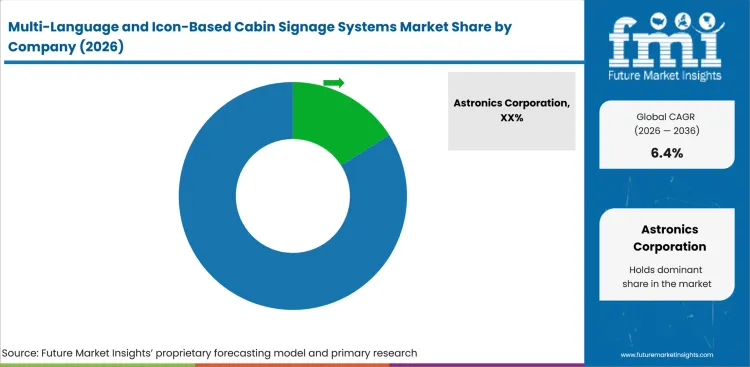
- Supplier selection is shaped by certified icon artwork and LED sign electronics. Airlines need cabin signs that meet safety rules and match aircraft records.
- Sign suppliers are evaluated on brightness control and low-weight design. Both points matter because passenger service units have limited space and power allowance.
- Photoluminescent specialists are preferred in retrofit work. Self-powered signs reduce wiring work and make emergency sign replacement easier during maintenance checks.
- New suppliers face a high entry barrier. Cabin signs need airworthiness evidence and aircraft-level documentation before airlines can use them.
Competitive positioning depends on how well suppliers combine sign readability with cabin lighting depth. Astronics lists passenger information signs within its cabin lighting portfolio and says its emergency egress lighting systems serve above 200.0 airline operators worldwide. Collins Aerospace lists passenger information signs for electronic devices and no-smoking or fasten-seat-belt indications. Companies tied to aircraft lighting programs have a clearer route as airlines bundle signs with lighting upgrades.
Luminator Aerospace lists LED passenger information signs in 3.0 inch, 5.0 inch, 6.0 inch and 8.0 inch formats for fixed-wing aircraft. STG Aerospace states its photoluminescent signage is FAA, EASA and CAAC approved for major aircraft platforms. The same supplier evidence supports the demand for quick access maintenance-friendly interior panel systems as sign access and cabin service planning become part of retrofit decisions.
Key Companies in the Multi-Language and Icon-Based Cabin Signage Systems Market
- Integrated Cabin Systems: Diehl Aviation and Collins Aerospace hold firm positions through cabin lighting and interior integration. Safran Cabin supports airline program access through aircraft interior depth.
- Signage and Lighting Specialists: Astronics Corporation and Luminator Aerospace serve passenger information signs and LED cabin sign assemblies. Bruce Aerospace supports specialist aircraft programs.
- Emergency Signage Specialists: STG Aerospace holds a defined role through photoluminescent exit signs and low-level emergency guidance products.
Competitive Benchmarking: Multi-Language and Icon-Based Cabin Signage Systems Market
| Company | Icon Library Depth | Certified Sign Hardware | Retrofit Support | Geographic Footprint |
|---|---|---|---|---|
| Diehl Aviation | High | High | Medium | Global with Europe strength |
| Collins Aerospace | Medium | High | High | Global with USA strength |
| Astronics Corporation | Medium | High | High | Global airline and OEM access |
| STG Aerospace | Medium | Medium | High | Europe and airline retrofit focus |
| Luminator Aerospace | Medium | Medium | Medium | North America and global aviation channels |
| Bruce Aerospace | Medium | Medium | Medium | USA and specialist aircraft programs |
| Safran Cabin | Medium | High | Medium | Global aircraft interiors footprint |
Source: Future Market Insights competitive analysis, 2026.
Key Developments in Multi-Language and Icon-Based Cabin Signage Systems Market
- In April 2025, Diehl Aviation presented eDecor at Aircraft Interiors Expo 2025. The system uses electronic paper technology across cabin surfaces and can support seat row numbering and illuminated cabin icons through flight attendant panel control.
- In April 2026, Diehl Aviation won the Crystal Cabin Award for its Adaptive User Routing System. The concept displays safety announcements visually on an integrated mirror screen and uses adaptive lighting for passengers with low vision.
Key Players in the Multi-Language and Icon-Based Cabin Signage Systems Market
Major Global Players
- Diehl Aviation
- Collins Aerospace
- Astronics Corporation
- Safran Cabin
- Luminator Aerospace
Specialist and Regional Players
- STG Aerospace
- Bruce Aerospace
Report Scope and Coverage
| Parameter | Details |
|---|---|
| Quantitative Units | USD 438.6 million to USD 815.6 million at 6.4% CAGR |
| Market Definition | Certified aircraft cabin signs using text and icons to guide passenger safety messages and cabin movement |
| Segments Covered | Sign type, display format, aircraft type, installation channel, end user, and region |
| Sign Type | Passenger information signs, exit signs, seat row signs, and lavatory signs |
| Display Format | Icon-based displays, text signs, hybrid signs, and digital panels |
| Aircraft Type | Narrow-body aircraft, wide-body aircraft, regional aircraft, and business jets |
| Installation Channel | OEM fitment, retrofit kits, and MRO replacement |
| End User | Commercial airlines, aircraft OEMs, business aviation, and defense aviation |
| Regions Covered | North America, Latin America, Western Europe, Eastern Europe, East Asia, South Asia and Pacific, Middle East and Africa |
| Countries Covered | United States, China, India, Germany, France, Japan, United Kingdom, and more than 30.0 countries |
| Key Companies Profiled | Diehl Aviation, Collins Aerospace, Astronics Corporation, Safran Cabin, Luminator Aerospace, STG Aerospace, and Bruce Aerospace |
| Forecast Period | 2026 to 2036 |
| Approach | Hybrid bottom-up and top-down method using aircraft fleet activity, cabin retrofit demand, sign package pricing, certification needs, and supplier activity |
Source: Future Market Insights, 2026.
Multi-Language and Icon-Based Cabin Signage Systems Market Breakdown by Sign Type and Display Format
Multi-Language and Icon-Based Cabin Signage Systems Market Segmented by Sign Type
- Passenger information signs
- Exit signs
- Seat row signs
- Lavatory signs
Multi-Language and Icon-Based Cabin Signage Systems Market Segmented by Display Format
- Icon-based displays
- Text signs
- Hybrid signs
- Digital panels
Multi-Language and Icon-Based Cabin Signage Systems Market Segmented by Aircraft Type
- Narrow-body aircraft
- Wide-body aircraft
- Regional aircraft
- Business jets
Multi-Language and Icon-Based Cabin Signage Systems Market Segmented by Installation Channel
- OEM fitment
- Retrofit kits
- MRO replacement
Multi-Language and Icon-Based Cabin Signage Systems Market Segmented by End User
- Commercial airlines
- Aircraft OEMs
- Business aviation
- Defense aviation
Multi-Language and Icon-Based Cabin Signage Systems Market Segmented by Region
- North America
- Latin America
- Western Europe
- Eastern Europe
- East Asia
- South Asia and Pacific
- Middle East and Africa
Research Sources and Bibliography
- Federal Aviation Administration. (2024, August 23). Modernization of passenger information requirements relating to no smoking sign illumination. Federal Register.
- European Union Aviation Safety Agency. (2026, March). Easy Access Rules for Additional Airworthiness Specifications: Regulation (EU) 2015/640. EASA.
- Satair. (2025, April 9). Satair and RTX’s Collins Aerospace extend 50-year relationship with new agreement. Airbus.
- Federal Aviation Administration. (2026). Introduction to the Terminal Area Forecast: 2025 TAF summary, FY 2025–FY 2055. FAA.
- Civil Aviation Administration of China. (2026, April 22). CAAC releases Statistical Bulletin of Civil Aviation Industry Development in 2025. CAAC.
- Directorate General of Civil Aviation. (2025, September 30). Navi Mumbai International Airport was granted aerodrome license on 30/09/2025. DGCA.
- Statistisches Bundesamt. (2026). Boarding air passengers at German airports. Destatis.
- Aéroports de Paris SA. (2026, January 15). December & full-year 2025 traffic figures. Groupe ADP.
- Aéroports de Paris SA. (2025, November 17). October 2025 traffic figures. Groupe ADP.
- Direction générale de l’aviation civile. (2026, February). One stop tax shop airport taxes: Safety and security rate. Ministères Écologie Énergie Territoires.
- Ministry of Land, Infrastructure, Transport and Tourism. (2025, June). Collaborative Actions for Renovation of Air Traffic Systems 2040 (CARATS2040). MLIT.
- Ministry of Economy, Trade and Industry. (2026, March 27). Advanced Air Mobility Roadmap Revised. METI.
- UK Civil Aviation Authority. (2026, February 24). UK aviation officially breaks records with over 300m passenger journeys in 2025. UK CAA.
- Astronics Corporation. (2025, August 6). Astronics Corporation reports record aerospace segment revenue in 2025 second quarter. Astronics Corporation.
- Diehl Aviation. (2025, April 10). Diehl Aviation’s eDecor: A game-changer in customizable aircraft cabin design. Diehl Aviation.
- Diehl Aviation. (2026, April 14). Diehl Aviation wins Crystal Cabin Award for Accessibility Innovation “AURS”. Diehl Aviation.
This Report Answers
- What is the expected 2026 value of the multi-language and icon-based cabin signage systems market?
- What value is the market forecast to reach by 2036?
- Which sign type is expected to hold the leading share in 2026?
- Which display format is forecast to have wider use in international cabins?
- Which installation channel holds a firm share in 2026?
- Which countries are expected to record faster CAGR from 2026 to 2036?
- How do FAA cabin sign rules affect demand for certified signage systems?
- Which companies are active in aircraft cabin signage and lighting products?
- How do icon-based displays support mixed-language passenger movement?
- What methodology was used to size the market and validate the forecast?
Frequently Asked Questions
What is the value of the multi-language and icon-based cabin signage systems market in 2026?
Market value is expected to reach USD 438.6 million in 2026, supported by certified cabin sign demand and aircraft interior refresh work.
What CAGR is expected for the market from 2026 to 2036?
Demand is expected to move at 6.4% CAGR from 2026 to 2036 as airlines adopt clearer safety signs and low-power display formats.
Which sign type is expected to hold a firm share?
Passenger information signs are expected to account for 35.0% share in 2026 due to frequent use of seat-belt and device-use messages.
Why are icon-based displays receiving more attention?
Icon-based displays are receiving more attention as simple symbols are easier to read across mixed-language passenger groups.
Which installation channel is expected to lead in 2026?
OEM fitment is expected to hold 57.0% share in 2026 as signs must match cabin layout and certification needs before aircraft delivery.
Which countries are forecast to move faster?
India and China are expected to record faster pace at 8.1% CAGR and 7.3% CAGR through 2036.
Preview the report firsthand - request a free sample
Get SampleGet the brochure for pricing and purchase details.
Get PDFTable of Content
- Key Takeaways
- Market Size and CAGR
- Top Growth Driver
- Fastest Growing Segment
- Leading Region
- Key Companies
- Emerging Opportunities
- Executive Summary
- Global Market Outlook
- Demand-side Trends
- Supply-side Trends
- Technology Roadmap Analysis
- Analysis and Recommendations
- Analyst Perspective (What is happening? Why now? What should investors know?)
- Key Questions Answered
- How large is the market?
- What is the CAGR?
- What are key trends?
- Which region dominates?
- Who are the leaders?
- Market Overview
- Market Coverage / Taxonomy
- Market Definition / Scope / Limitations
- Research Methodology
- Chapter Orientation
- Analytical Lens and Working Hypotheses
- Market Structure, Signals, and Trend Drivers
- Benchmarking and Cross-market Comparability
- Market Sizing, Forecasting, and Opportunity Mapping
- Research Design and Evidence Framework
- Desk Research Programme (Secondary Evidence)
- Expert Input and Fieldwork (Primary Evidence)
- Tooling, Models, and Reference Databases
- Data Engineering and Model Build
- Quality Assurance and Audit Trail
- Market Background
- Market Dynamics (Drivers, Restraints, Opportunity, Trends)
- Scenario Forecast (Optimistic, Likely, Conservative)
- Impact Analysis
- AI Impact
- Sustainability Impact
- Regulatory Impact
- Technology Impact
- Consumer / Buyer Analysis
- Purchase Drivers
- Adoption Barriers
- Buyer Journey
- Opportunity Map Analysis
- Product Life Cycle Analysis
- Supply Chain Analysis
- Investment Feasibility Matrix
- Value Chain Analysis
- PESTLE and Porter's Analysis
- Regulatory Landscape
- Regional Parent Market Outlook
- Production and Consumption Statistics
- Import and Export Statistics
- Global Market Analysis and Forecast, 2021 to 2036
- Historical Market Size Value (USD Million) & Volume (Unit) Analysis, 2021 to 2025
- Current and Future Market Size Value (USD Million) & Volume (Unit) Projections, 2026 to 2036
- Y-o-Y Growth Trend Analysis
- Absolute $ Opportunity Analysis
- Global Market Pricing Analysis, 2021 to 2036
- Global Market Analysis and Forecast, By Sign Type, 2021 to 2036
- Introduction / Key Findings
- Historical Market Size Value (USD Million) & Volume (Unit) Analysis By Sign Type, 2021 to 2025
- Current and Future Market Size Value (USD Million) & Volume (Unit) Analysis and Forecast By Sign Type, 2026 to 2036
- Passenger information signs
- Exit signs
- Seat row signs
- Lavatory signs
- Passenger information signs
- Y-o-Y Growth Trend Analysis By Sign Type, 2021 to 2025
- Absolute $ Opportunity Analysis By Sign Type, 2026 to 2036
- Global Market Analysis and Forecast, By Display Format, 2021 to 2036
- Introduction / Key Findings
- Historical Market Size Value (USD Million) & Volume (Unit) Analysis By Display Format, 2021 to 2025
- Current and Future Market Size Value (USD Million) & Volume (Unit) Analysis and Forecast By Display Format, 2026 to 2036
- Icon-based displays
- Text signs
- Hybrid signs
- Digital panels
- Icon-based displays
- Y-o-Y Growth Trend Analysis By Display Format, 2021 to 2025
- Absolute $ Opportunity Analysis By Display Format, 2026 to 2036
- Global Market Analysis and Forecast, By Aircraft Type, 2021 to 2036
- Introduction / Key Findings
- Historical Market Size Value (USD Million) & Volume (Unit) Analysis By Aircraft Type, 2021 to 2025
- Current and Future Market Size Value (USD Million) & Volume (Unit) Analysis and Forecast By Aircraft Type, 2026 to 2036
- Narrow-body aircraft
- Wide-body aircraft
- Regional aircraft
- Business jets
- Narrow-body aircraft
- Y-o-Y Growth Trend Analysis By Aircraft Type, 2021 to 2025
- Absolute $ Opportunity Analysis By Aircraft Type, 2026 to 2036
- Global Market Analysis and Forecast, By Installation Channel, 2021 to 2036
- Introduction / Key Findings
- Historical Market Size Value (USD Million) & Volume (Unit) Analysis By Installation Channel, 2021 to 2025
- Current and Future Market Size Value (USD Million) & Volume (Unit) Analysis and Forecast By Installation Channel, 2026 to 2036
- OEM fitment
- Retrofit kits
- MRO replacement
- OEM fitment
- Y-o-Y Growth Trend Analysis By Installation Channel, 2021 to 2025
- Absolute $ Opportunity Analysis By Installation Channel, 2026 to 2036
- Global Market Analysis and Forecast, By End User, 2021 to 2036
- Introduction / Key Findings
- Historical Market Size Value (USD Million) & Volume (Unit) Analysis By End User, 2021 to 2025
- Current and Future Market Size Value (USD Million) & Volume (Unit) Analysis and Forecast By End User, 2026 to 2036
- Commercial airlines
- Aircraft OEMs
- Business aviation
- Defense aviation
- Commercial airlines
- Y-o-Y Growth Trend Analysis By End User, 2021 to 2025
- Absolute $ Opportunity Analysis By End User, 2026 to 2036
- Global Market Analysis and Forecast, By Region, 2021 to 2036
- Introduction
- Historical Market Size Value (USD Million) & Volume (Unit) Analysis By Region, 2021 to 2025
- Current Market Size Value (USD Million) & Volume (Unit) Analysis and Forecast By Region, 2026 to 2036
- North America
- Latin America
- Western Europe
- Eastern Europe
- East Asia
- South Asia and Pacific
- Middle East & Africa
- Market Attractiveness Analysis By Region
- North America Market Analysis and Forecast, By Country, 2021 to 2036
- Historical Market Size Value (USD Million) & Volume (Unit) Trend Analysis By Market Taxonomy, 2021 to 2025
- Market Size Value (USD Million) & Volume (Unit) Forecast By Market Taxonomy, 2026 to 2036
- By Country
- USA
- Canada
- Mexico
- By Sign Type
- By Display Format
- By Aircraft Type
- By Installation Channel
- By End User
- By Country
- Market Attractiveness Analysis
- By Country
- By Sign Type
- By Display Format
- By Aircraft Type
- By Installation Channel
- By End User
- Key Takeaways
- Latin America Market Analysis and Forecast, By Country
- Historical Market Size Value (USD Million) & Volume (Unit) Trend Analysis By Market Taxonomy, 2021 to 2025
- Market Size Value (USD Million) & Volume (Unit) Forecast By Market Taxonomy, 2026 to 2036
- By Country
- Brazil
- Chile
- Rest of Latin America
- By Sign Type
- By Display Format
- By Aircraft Type
- By Installation Channel
- By End User
- By Country
- Market Attractiveness Analysis
- By Country
- By Sign Type
- By Display Format
- By Aircraft Type
- By Installation Channel
- By End User
- Key Takeaways
- Western Europe Market Analysis and Forecast, By Country
- Historical Market Size Value (USD Million) & Volume (Unit) Trend Analysis By Market Taxonomy, 2021 to 2025
- Market Size Value (USD Million) & Volume (Unit) Forecast By Market Taxonomy, 2026 to 2036
- By Country
- Germany
- UK
- Italy
- Spain
- France
- Nordic
- BENELUX
- Rest of Western Europe
- By Sign Type
- By Display Format
- By Aircraft Type
- By Installation Channel
- By End User
- By Country
- Market Attractiveness Analysis
- By Country
- By Sign Type
- By Display Format
- By Aircraft Type
- By Installation Channel
- By End User
- Key Takeaways
- Eastern Europe Market Analysis and Forecast, By Country
- Historical Market Size Value (USD Million) & Volume (Unit) Trend Analysis By Market Taxonomy, 2021 to 2025
- Market Size Value (USD Million) & Volume (Unit) Forecast By Market Taxonomy, 2026 to 2036
- By Country
- Russia
- Poland
- Hungary
- Balkan & Baltic
- Rest of Eastern Europe
- By Sign Type
- By Display Format
- By Aircraft Type
- By Installation Channel
- By End User
- By Country
- Market Attractiveness Analysis
- By Country
- By Sign Type
- By Display Format
- By Aircraft Type
- By Installation Channel
- By End User
- Key Takeaways
- East Asia Market Analysis and Forecast, By Country
- Historical Market Size Value (USD Million) & Volume (Unit) Trend Analysis By Market Taxonomy, 2021 to 2025
- Market Size Value (USD Million) & Volume (Unit) Forecast By Market Taxonomy, 2026 to 2036
- By Country
- China
- Japan
- South Korea
- By Sign Type
- By Display Format
- By Aircraft Type
- By Installation Channel
- By End User
- By Country
- Market Attractiveness Analysis
- By Country
- By Sign Type
- By Display Format
- By Aircraft Type
- By Installation Channel
- By End User
- Key Takeaways
- South Asia and Pacific Market Analysis and Forecast, By Country
- Historical Market Size Value (USD Million) & Volume (Unit) Trend Analysis By Market Taxonomy, 2021 to 2025
- Market Size Value (USD Million) & Volume (Unit) Forecast By Market Taxonomy, 2026 to 2036
- By Country
- India
- ASEAN
- Australia & New Zealand
- Rest of South Asia and Pacific
- By Sign Type
- By Display Format
- By Aircraft Type
- By Installation Channel
- By End User
- By Country
- Market Attractiveness Analysis
- By Country
- By Sign Type
- By Display Format
- By Aircraft Type
- By Installation Channel
- By End User
- Key Takeaways
- Middle East & Africa Market Analysis and Forecast, By Country
- Historical Market Size Value (USD Million) & Volume (Unit) Trend Analysis By Market Taxonomy, 2021 to 2025
- Market Size Value (USD Million) & Volume (Unit) Forecast By Market Taxonomy, 2026 to 2036
- By Country
- Kingdom of Saudi Arabia
- Other GCC Countries
- Türkiye
- South Africa
- Other African Union
- Rest of Middle East & Africa
- By Sign Type
- By Display Format
- By Aircraft Type
- By Installation Channel
- By End User
- By Country
- Market Attractiveness Analysis
- By Country
- By Sign Type
- By Display Format
- By Aircraft Type
- By Installation Channel
- By End User
- Key Takeaways
- Key Countries Market Analysis
- USA
- Pricing Analysis
- Market Share Analysis, 2025
- By Sign Type
- By Display Format
- By Aircraft Type
- By Installation Channel
- By End User
- Canada
- Pricing Analysis
- Market Share Analysis, 2025
- By Sign Type
- By Display Format
- By Aircraft Type
- By Installation Channel
- By End User
- Mexico
- Pricing Analysis
- Market Share Analysis, 2025
- By Sign Type
- By Display Format
- By Aircraft Type
- By Installation Channel
- By End User
- Brazil
- Pricing Analysis
- Market Share Analysis, 2025
- By Sign Type
- By Display Format
- By Aircraft Type
- By Installation Channel
- By End User
- Chile
- Pricing Analysis
- Market Share Analysis, 2025
- By Sign Type
- By Display Format
- By Aircraft Type
- By Installation Channel
- By End User
- Germany
- Pricing Analysis
- Market Share Analysis, 2025
- By Sign Type
- By Display Format
- By Aircraft Type
- By Installation Channel
- By End User
- UK
- Pricing Analysis
- Market Share Analysis, 2025
- By Sign Type
- By Display Format
- By Aircraft Type
- By Installation Channel
- By End User
- Italy
- Pricing Analysis
- Market Share Analysis, 2025
- By Sign Type
- By Display Format
- By Aircraft Type
- By Installation Channel
- By End User
- Spain
- Pricing Analysis
- Market Share Analysis, 2025
- By Sign Type
- By Display Format
- By Aircraft Type
- By Installation Channel
- By End User
- France
- Pricing Analysis
- Market Share Analysis, 2025
- By Sign Type
- By Display Format
- By Aircraft Type
- By Installation Channel
- By End User
- India
- Pricing Analysis
- Market Share Analysis, 2025
- By Sign Type
- By Display Format
- By Aircraft Type
- By Installation Channel
- By End User
- ASEAN
- Pricing Analysis
- Market Share Analysis, 2025
- By Sign Type
- By Display Format
- By Aircraft Type
- By Installation Channel
- By End User
- Australia & New Zealand
- Pricing Analysis
- Market Share Analysis, 2025
- By Sign Type
- By Display Format
- By Aircraft Type
- By Installation Channel
- By End User
- China
- Pricing Analysis
- Market Share Analysis, 2025
- By Sign Type
- By Display Format
- By Aircraft Type
- By Installation Channel
- By End User
- Japan
- Pricing Analysis
- Market Share Analysis, 2025
- By Sign Type
- By Display Format
- By Aircraft Type
- By Installation Channel
- By End User
- South Korea
- Pricing Analysis
- Market Share Analysis, 2025
- By Sign Type
- By Display Format
- By Aircraft Type
- By Installation Channel
- By End User
- Russia
- Pricing Analysis
- Market Share Analysis, 2025
- By Sign Type
- By Display Format
- By Aircraft Type
- By Installation Channel
- By End User
- Poland
- Pricing Analysis
- Market Share Analysis, 2025
- By Sign Type
- By Display Format
- By Aircraft Type
- By Installation Channel
- By End User
- Hungary
- Pricing Analysis
- Market Share Analysis, 2025
- By Sign Type
- By Display Format
- By Aircraft Type
- By Installation Channel
- By End User
- Kingdom of Saudi Arabia
- Pricing Analysis
- Market Share Analysis, 2025
- By Sign Type
- By Display Format
- By Aircraft Type
- By Installation Channel
- By End User
- Türkiye
- Pricing Analysis
- Market Share Analysis, 2025
- By Sign Type
- By Display Format
- By Aircraft Type
- By Installation Channel
- By End User
- South Africa
- Pricing Analysis
- Market Share Analysis, 2025
- By Sign Type
- By Display Format
- By Aircraft Type
- By Installation Channel
- By End User
- USA
- Market Structure Analysis
- Competition Dashboard
- Competition Benchmarking
- Market Share Analysis of Top Players
- By Regional
- By Sign Type
- By Display Format
- By Aircraft Type
- By Installation Channel
- By End User
- Emerging Startups
- Innovation Benchmarking
- Competition Analysis
- Competition Deep Dive
- Astronics Corporation
- Overview
- Product Portfolio
- Profitability by Market Segments (Product/Region/Sales Channel)
- Sales Footprint
- Strategy Overview
- Marketing Strategy
- Product Strategy
- Channel Strategy
- Diehl Aviation
- Collins Aerospace
- Safran Cabin
- Luminator Aerospace
- STG Aerospace
- Bruce Aerospace
- Astronics Corporation
- Case Studies
- Success Stories
- Recent Developments
- Competition Deep Dive
- Assumptions & Acronyms Used


