

- Market Size (2026)
- USD 193.2 Mn
- Forecast (2036)
- USD 524.2 Mn
- CAGR (2026 to 2036)
- 10.5%
How big is Nematode Suppression Additives Market in 2026?
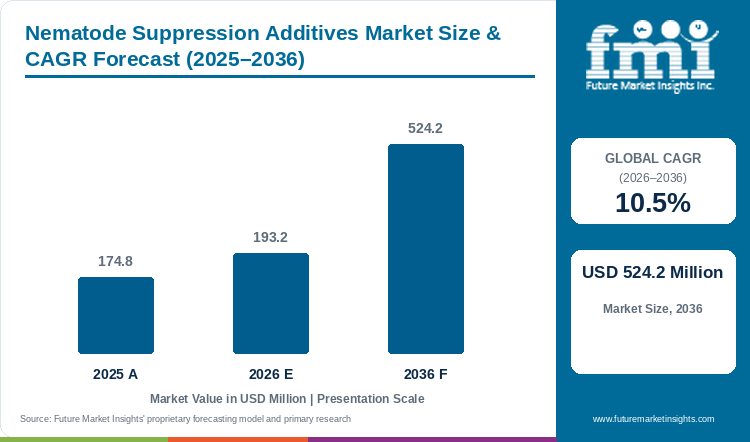
The global nematode suppression additives market evolved from a 2025 valuation of USD 174.8 million to USD 193.2 million in 2026, and is set to achieve USD 524.2 million by 2036, reflecting a 10.5% CAGR.
Commercial soybean and vegetable growers are shifting input budgets toward biological root-zone protectants because decades of relying on single-gene resistant crop cultivars no longer prevent subterranean yield losses, lifting global nematode suppression additives market value from USD 174.8 million in 2025 to USD 193.2 million in 2026 and USD 524.2 million by 2036 at a 10.5% CAGR. This erosion of genetic crop defense was confirmed in January 2026 when a pangenome investigation in BMC Genomics across nine Heterodera glycines populations documented hidden structural variation that allows soybean cyst nematodes to overcome standard host resistance genes [1]. Because seed companies and agronomy dealers need a shelf-stable biological partner to pair with vulnerable crop genetics across agricultural microbials programs, Bacillus-Based Bionematicides are expected to hold a 48.6% Active Type segment share in 2026 and anchor USD 331.0 million in 10-year expansion. Even so, slower bacterial root colonization in cold spring soils below 12 degrees Celsius still restrains repeat grower orders when farms skip pre-plant egg-count sampling.
Key Market Trends & Insights
- By active type: Bacillus-Based Bionematicides are expected to hold a 48.6% Active Type segment share in 2026 because dormant bacterial endospores survive polymer seed coatings and warehouse storage.
- By crop type: Within the Crop Type segment, Fruits & Vegetables are projected to account for a 44.2% share in 2026, owing to intensive drip application schedules in tomatoes and cucurbits.
- By application method: Soil Drench & Drip Chemigation captures an estimated 46.4% Application Method segment share in 2026, supported by direct delivery of fungal conidia and terpenes into infested root zones.
- By target setting: Across the Target Setting segment, Open-Field Row & Broad-Acre Cropping is anticipated to garner a 49.3% share in 2026 through preventive seed and in-furrow programs in soybean and potato rotations.
- By sales channel: Agri-Input Distributors & Agronomy Dealerships register a forecast 47.6% Sales Channel segment share in 2026, enabled by cold-chain warehousing and custom slurry seed treatment.
Regional Highlights
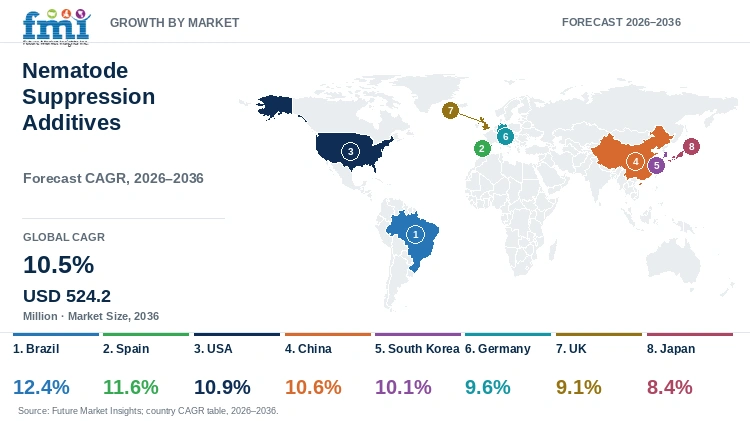
- South America and Mediterranean acceleration: Brazil leads the eight evaluated countries at a 12.4% CAGR through 2036, followed by Spain at 11.6% driven by tropical double-cropping and greenhouse vegetable growers replacing restricted chemical fumigants.
- North America and Eurasia progression: The USA is projected to advance at a 10.9% CAGR ahead of China at 10.6% and South Korea at 10.1%, while Germany at 9.6% and the UK at 9.1% plus Japan at 8.4% reflect mature integrated rotation programs.
Market Size & Forecast
Table 1: Market Size and Forecast for the Nematode Suppression Additives Market (USD million and CAGR percentage), 2025 to 2036
| Metric | Value |
|---|---|
| 2025 Market Size | USD 174.8 million |
| Estimated Market Size in 2026 | USD 193.2 million |
| Projected Market Size by 2036 | USD 524.2 million |
| CAGR, 2026 to 2036 | 10.5% |
| Added Revenue, 2026 to 2036 | USD 331.0 million |
Mandatory withdrawals of organophosphate and carbamate soil fumigants across the European Union and North America have left commercial farms with fewer chemical knockdown options, directly driving the revenue expansion shown in Table 1. As a matter of fact, U.S. Environmental Protection Agency biopesticide registration rules updated in February 2026 grant reduced-risk residue exemptions to microbial and biochemical nematicides that prove target pest specificity and batch fermentation purity [2]. These residue exemptions matter to commercial fruit and vegetable packers because supermarket buyers enforce strict maximum residue limits at harvest, prompting agronomy dealers to bundle spore-forming seed dressings and fungal drenches with biological nematicides in multi-season supply contracts.
Treated Acreage and Rhizosphere Dose Requirement Sizing
Table 2: Treated Acreage and Formulation Dose Sizing for the Nematode Suppression Additives Market (USD million and operational ranges), 2025 to 2036
| Metric | 2025 | 2026 | 2036 |
|---|---|---|---|
| Market size (USD million) | 174.8 | 193.2 | 524.2 |
| Globally treated agricultural area (million hectares) | 6.8 to 7.5 | 7.4 to 8.2 | 18.5 to 20.8 |
| Formulated biological & botanical volume (thousand metric tons) | 11.2 to 12.6 | 12.3 to 13.8 | 31.0 to 35.2 |
| Average seasonal additive spend per treated hectare (USD) | 23.3 to 25.7 | 23.6 to 26.1 | 25.2 to 28.3 |
Operational note: Treated hectare and dose ranges reconcile low-cost broad-acre soybean seed treatments (USD 9 to 15 per hectare) against multi-application horticultural drip chemigation programs (USD 65 to 175 per hectare) across three seasonal root-flush windows.
The wide gap in per-hectare seasonal expenditure shown in Table 2 explains why horticultural crop protection generates higher revenue density per hectare while broad-acre row crops drive total treated land area. Protected tomato and cucurbit growers face continuous juvenile hatching across warm irrigation cycles, which forces them to inject fungal conidia and terpene emulsions through drip lines every 14 to 21 days at higher cumulative cost. By contrast, soybean and maize producers operate on tight per-acre input margins and prefer one-pass preventive protection, prompting downstream seed treaters to coat seeds with endospore suspensions and seed coating materials before spring planting.
Per-Hectare & Commercial Farm Program Sizing
Table 3: Per-Farm and Cropping-System Expenditure Indicators for the Nematode Suppression Additives Market (USD), 2025 to 2036
| Metric | 2025 | 2026 | 2036 |
|---|---|---|---|
| Global cropland under intensive nematode management (million ha) | 64.0 | 66.5 | 92.0 |
| Additive expenditure per 1,000 managed hectares (USD) | 2,731.3 | 2,905.3 | 5,697.8 |
| Annual spend per commercial greenhouse operation (USD) | 1,850 to 2,400 | 1,980 to 2,560 | 3,450 to 4,300 |
| Diagnostic-guided preventive contract share (%) | 61.0% to 65.0% | 63.5% to 67.5% | 75.0% to 79.5% |
Table 4: Agronomy & Formulation Allocation Benchmarks for the Nematode Suppression Additives Market (USD and percentages), 2026
| Metric | Value | Institutional Reference Basis |
|---|---|---|
| Global market size, 2026 | USD 193.2 million | 2026 global root-zone additive baseline |
| Registered bionematicide active strains globally | 48 commercial strains | EPA, EU EFSA, and MAPA pesticide registries |
| Bacillus-based active allocation, 2026 | 48.6% share | Endospore seed and in-furrow formulations |
| Soil drench & drip chemigation allocation, 2026 | 46.4% share | Rhizosphere liquid and wettable-granule delivery |
Achieving the high preventive contract renewal rates tracked in Tables 3 and 4 depends on overcoming variable field efficacy across acidic or low-organic-matter soils. When biological nematicides are applied into degraded soils without organic substrates, introduced fungal spores struggle to establish around emerging root tips and grower repeat orders drop. To stabilize field performance and protect dealer retention, input suppliers now co-package chitinolytic fungi and bacterial lipopeptides with microbial biofertilizers so treated crops regenerate root hairs while suppressing juvenile invasion.
Analyst Perspective
"Commercial adoption of nematode suppression additives depends on coupling pre-plant soil egg-count diagnostics with formulations that survive commercial seed-slurry tanks and warm drip-irrigation lines. Suppliers that substantiate multi-season yield protection against soybean cyst and vegetable root-knot complexes will capture recurring distributor program allocations."
- Nikhil Kaitwade, Principal Consultant, Future Market Insights.
How is the nematode suppression additives market segmented?
The nematode suppression additives market is segmented by active type, crop type, application method, target setting, sales channel, and region. In 2026, Bacillus-Based Bionematicides are expected to hold a 48.6% share, Fruits & Vegetables are projected at 44.2%, Soil Drench & Drip Chemigation is estimated at 46.4%, Open-Field Row & Broad-Acre Cropping is anticipated at 49.3%, and Agri-Input Distributors & Agronomy Dealerships are forecast at 47.6%.
By active type: Bacillus-Based Bionematicides, Nematophagous Fungal Formulations, Botanical & Terpene Nematicidal Extracts, and Pasteuria, Burkholderia & Microbial Metabolite Additives.
By crop type: Fruits & Vegetables, Oilseeds & Pulses, Cereals & Grains, and Turf, Ornamentals & Plantation Crops.
By application method: Soil Drench & Drip Chemigation, Seed Coating & In-Furrow Treatment, Granular Broadcast & Bed Incorporation, and Transplant Root-Dip & Bare-Root Soak.
By target setting: Open-Field Row & Broad-Acre Cropping, Protected Greenhouse & High-Tunnel Horticulture, Permanent Orchard, Vineyard & Plantation Blocks, and Commercial Turfgrass, Golf & Nursery Systems.
By sales channel: Agri-Input Distributors & Agronomy Dealerships, Agricultural Cooperatives & Grower Associations, Specialty Horticultural & Biological Supply Chains, and Direct-to-Farm & Digital Input Platforms.
Why do Bacillus-Based Bionematicides lead the active type segment?
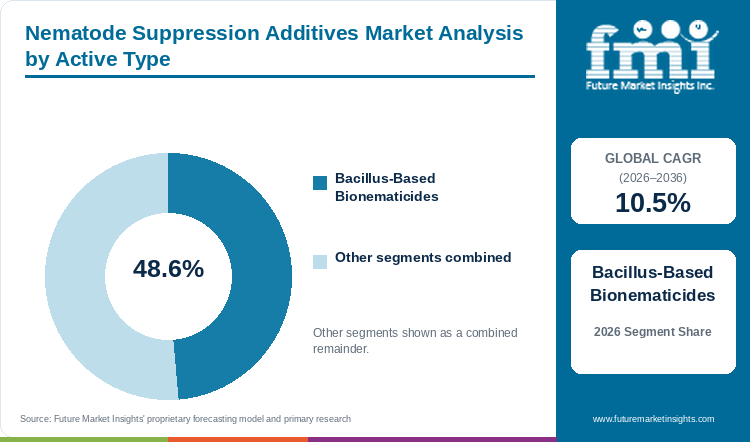
In the Active Type segment, Bacillus-Based Bionematicides are expected to hold a 48.6% share in 2026 on the strength of rapid spermosphere root colonization.
Table 5: Active Type Share for the Nematode Suppression Additives Market (percentage share), 2026
| Active Type | Share (2026) |
|---|---|
| Bacillus-Based Bionematicides | 48.6% |
| Other Segments Combined | 51.4%* |
| Total | 100.0% |
*Calculated as the balance remaining after deducting the leading segment's reported share from 100.0%.
Table 6: Active Type Leadership and Market Growth for the Nematode Suppression Additives Market (segment and CAGR percentage), 2026 to 2036
| Metric | Value |
|---|---|
| Global CAGR (2026 to 2036) | 10.5% |
| Leading Segment | Bacillus-Based Bionematicides |
Distributor and seed-company preference for Bacillus-Based Bionematicides over live fungal conidia comes down to warehouse logistics and tank-mix survival. While live fungal spores often require cold-chain storage below 25 degrees Celsius and can lose viability when mixed with chemical fungicides, dormant Bacillus amyloliquefaciens and Bacillus firmus endospores survive 18 months of ambient warehousing and high-shear pumping across biological seed carriers lines.
- Within the Active Type segment, Bacillus-Based Bionematicides are expected to capture 48.6% of 2026 demand, supported by low-dose flowable concentrate compatibility with fungicide and insecticide seed slurries.
- Explaining why growers trust these bacterial dressings for early root defense, a January 2025 review in Frontiers in Microbiology documented that rhizosphere-colonizing Bacillus species suppress plant-parasitic nematodes through cyclic lipopeptide secretion and hydrolytic chitinase activity plus induced systemic resistance [3].
Why do Fruits & Vegetables represent the largest crop type segment?
Fruits & Vegetables are projected to represent a 44.2% Crop Type segment share in 2026, driven by zero-residue supermarket standards for fruiting horticulture.
Although oilseeds and cereals occupy far more global land area, Fruits & Vegetables generate the largest share of supplier revenue because visual root and tuber quality directly determines whether a harvest can be sold into fresh retail channels. When Meloidogyne root galling stunts fruiting tomatoes and bell peppers or Globodera cysts blemish table potatoes, growers face outright load rejection and therefore fund three to five sequential applications per season with bioenzyme fertilizers rather than relying on a single low-cost seed treatment.
- Across the Crop Type segment, Fruits & Vegetables are projected to hold a 44.2% share in 2026 because high-value vegetable and potato growers fund multi-pass biological rhizosphere treatments.
- Confirming the biological mechanism behind these multi-pass horticulture programs, a July 2025 synthesis in the Journal of Fungi showed that Trichoderma species parasitize Meloidogyne eggs and second-stage juveniles in tomato and cucurbit root zones through protease and chitinase enzymes [4].
What keeps Soil Drench & Drip Chemigation ahead in the application method segment?
Soil Drench & Drip Chemigation accounts for an estimated 46.4% Application Method segment share in 2026, enabled by pressurized root-zone injection.
While seed coatings protect emerging radicles during the first three to four weeks after drilling, they cannot stop second- and third-generation nematode egg hatches later in the growing season. Soil Drench & Drip Chemigation solves this mid-season vulnerability by allowing farms to meter fungal conidia and botanical terpene emulsions directly into the wetted root zone whenever soil temperatures trigger juvenile migration, complementing early-season chitosan-based seed coatings in vegetable beds and perennial orchards.
- Soil Drench & Drip Chemigation is estimated to secure 46.4% of the Application Method segment in 2026, attributable to precise moisture-zone placement and repeat in-season dosing capability.
- Illustrating regulatory momentum for drip-applied biologicals, in March 2025 Certis Biologicals secured its first European Union low-risk authorization in the Netherlands for soil- and drip-applied NemaClean (Purpureocillium lilacinum strain PL11) targeting root-knot nematodes in fruiting vegetables [5].
Why does Open-Field Row & Broad-Acre Cropping lead the target setting segment?
Across the Target Setting segment, Open-Field Row & Broad-Acre Cropping is anticipated to hold a 49.3% share in 2026 due to vast row-crop acreage.
Protected greenhouses can sanitize beds between crops using steam or substrate replacement, whereas Open-Field Row & Broad-Acre Cropping operators have no way to sterilize millions of hectares of infested field soil. Once soybean cyst or root-lesion nematodes establish in open-field tracts, growers must integrate biological seed and in-furrow protectants with neonicotinoid pesticides and non-host rotations every season to prevent 15% to 30% yield drag.
- Open-Field Row & Broad-Acre Cropping is anticipated to account for 49.3% of the Target Setting segment in 2026, influenced by mechanized planter and seed-treater adoption across North America and South America.
- Highlighting how regulatory agencies are prioritizing open-field row-crop nematode control, in November 2025 the U.S. Environmental Protection Agency registered the nematicide active ingredient cyclobutrifluram for soybean and cotton seed treatments plus turf systems [6].
What gives Agri-Input Distributors & Agronomy Dealerships the leading position in the sales channel segment?
Agri-Input Distributors & Agronomy Dealerships are forecast to capture a 47.6% Sales Channel segment share in 2026, reinforced by technical agronomy advisory.
Unlike synthetic herbicides that farmers can purchase online and spray on visible weeds, nematode suppression additives target microscopic root pests that require laboratory soil egg counts and custom slurry calibration. Agri-Input Distributors & Agronomy Dealerships dominate channel sales because they combine pre-plant soil-sampling services with downstream commercial seed-treater equipment and temperature-monitored warehouse storage.
- For the Sales Channel segment, Agri-Input Distributors & Agronomy Dealerships are forecast to hold a 47.6% share in 2026, linked to integrated soil-sampling services and downstream seed-treater infrastructure.
- To widen the biological portfolio available to regional agronomy dealers, in March 2025 Bioceres Crop Solutions announced U.S. EPA registration for ProFarm Group's Rinotec bacterial metabolite platform following earlier commercial clearance in Brazil [7].
What are the drivers, restraints, and opportunities in the nematode suppression additives market?
Across the nematode suppression additives market, chemical fumigant withdrawals and diagnostic soil sampling expand preventive biological adoption, whereas high infestation density limits standalone efficacy and botanical terpene blends create specialty-crop opportunities.
- Driver: Regulatory cancellations of synthetic organophosphate and carbamate soil fumigants compel growers to adopt biological and botanical rhizosphere suppressants.
- Restraint: Variable biological efficacy under heavy initial nematode egg densities and strict cold-chain shelf-life requirements delay standalone adoption without integrated crop management.
- Opportunity: Micro-encapsulated botanical terpene emulsions and heat-tolerant fungal formulations create recurring revenue in protected vegetables and specialty tuber rotations.
Growth Analysis and Future Potential: Qualitative Demand Catalysts
The primary catalyst accelerating market expansion is the convergence of supermarket zero-residue procurement mandates with the breakdown of single-gene host plant resistance in soybeans and fruiting vegetables. When continuous cropping selects for virulent cyst and root-knot biotypes, growers can no longer rely on genetics alone and instead combine resistant varieties with chitinolytic fungi and humic acid soil conditioners that parasitize egg masses before juvenile hatching. Validating this integrated buyer shift, a March 2025 study in Plants demonstrated that pairing biological control agents with multi-functional soil amendments optimizes root-zone nematode suppression while eliminating synthetic chemical residues in harvested produce [8].
Risk Assessment of the Nematode Suppression Additives Market: Operational and Formulation Friction
Despite strong regulatory tailwinds, biological nematode suppressants face a clear technical ceiling because live microbes do not deliver the immediate knockdown of synthetic fumigants when fields harbor extreme initial juvenile populations. Explaining this adoption friction, a September 2026 review in the Journal of Nematology noted that biological nematicides experience inconsistent field persistence across variable soil microbiomes and temperatures when applied without diagnostic threshold monitoring [9]. When pre-plant soil assays reveal severe Meloidogyne or Globodera pressure, commercial growers must still integrate biological drenches with targeted chemical fungicide active ingredients and succinate dehydrogenase inhibitors while maintaining warehouse storage below 30 degrees Celsius.
Commercial Opportunity Analysis: Formulation Differentiation and Value-Add Formats
To overcome cold-chain friction and capture higher gross margins, formulators are engineering shelf-stable liquid botanical extracts and micro-encapsulated fungal suspensions that require zero refrigeration or pre-soaking. For instance, in May 2026 BioWorks introduced TotalNema Ax as a botanical nematicide combining castor oil and clove oil active ingredients for soil drench and chemigation use across specialty potatoes and fruiting vegetables [10]. Because cold-pressed terpene emulsions pass cleanly through 120-mesh drip emitters and carry zero pre-harvest interval restrictions, suppliers can monetize late-season rescue applications in high-value horticulture.
Nematode Suppression Additives Market by Country (2026 to 2036)
Double-cropped tropical row-crop rotations and European Union greenhouse fumigant withdrawals place Brazil at the lead of national expansion with a 12.4% CAGR through 2036, followed by Spain at 11.6% and the USA at 10.9%, while Japan progresses at an 8.4% annual pace. National growth differences reflect year-round root-lesion nematode reproduction in South America, oxamyl and 1,3-dichloropropene phase-outs in Mediterranean horticulture, and automated seed-treater penetration across North America and East Asia.
Table 7: Country CAGR and Primary Growth Levers for the Nematode Suppression Additives Market (CAGR percentage and operational drivers), 2026 to 2036
| Country | CAGR (2026 to 2036) | Primary Growth Lever |
|---|---|---|
| Brazil | 12.4% | Cerrado soybean-maize double-cropping root-lesion and root-knot pressure plus accelerated MAPA bio-input approvals |
| Spain | 11.6% | Almeria and Murcia greenhouse vegetable drip-applied bionematicide programs replacing restricted chemical soil fumigants |
| USA | 10.9% | Widespread SCN seed-treatment adoption on 86+ million soybean acres and specialty potato and vegetable drip applications |
| China | 10.6% | MARA zero-growth chemical pesticide policy and solar-greenhouse cucurbit and tomato root-knot management |
| South Korea | 10.1% | Continuous greenhouse cucumber and melon cultivation requiring biological soil drenching during winter fallow cycles |
| Germany | 9.6% | Federal biological antagonist integration in organic and conventional table-potato and starch-potato rotations |
| UK | 9.1% | Persistent Globodera potato cyst nematode management following regulatory withdrawal of oxamyl granular nematicides |
| Japan | 8.4% | Hokkaido and Kyushu upland soybean cyst and root-lesion nematode management under MAFF MIDORI biopesticide targets |
Source: Future Market Insights analysis
Brazil Nematode Suppression Additives Market Outlook (2026 to 2036)
Demand for nematode suppression additives in Brazil is projected to expand at a 12.4% CAGR through 2036, outpacing all other evaluated countries because tropical double-cropping leaves zero winter fallow window to break root-lesion and root-knot reproductive cycles. When Mato Grosso and Parana growers plant second-crop maize immediately after harvesting soybeans, Pratylenchus brachyurus juveniles multiply continuously in warm Cerrado soils and force farms to treat every planting pass. To capture this year-round demand, Syngenta expanded its agricultural biologicals portfolio and commercial fermentation pipeline in February 2025 to scale biological pest and nematode management across Brazil [11]. Even so, high ambient warehouse temperatures in rural Goias can degrade live fungal spores if dealers lack refrigerated storage, favoring heat-tolerant bacterial endospores.
Key takeaway: In Brazil, continuous tropical soybean-maize double cropping and fast-track biological registrations are projected to drive a leading 12.4% annual expansion.
Spain Nematode Suppression Additives Market Outlook (2026 to 2036)
Unlike open-field grain producers, export vegetable cooperatives in Almeria and Murcia operate more than 32,000 hectares of plastic-covered greenhouses where European Union bans on 1,3-dichloropropene and oxamyl have eliminated chemical pre-plant soil fumigation. This regulatory phase-out is forecast to drive an 11.6% CAGR for nematode suppression additives in Spain from 2026 to 2036, supported by mandatory zero-residue contracts from supermarket chains across Northern Europe. Timing these drip applications is critical because a May 2026 study in PLOS Pathogens showed that root-knot nematodes reprogram tomato sugar-transporter genes early during juvenile invasion, requiring preventive drenching at transplanting [12]. However, alkaline irrigation water in southern Spain can still reduce fungal conidia viability unless growers buffer tank pH before chemigation.
Key takeaway: In Spain, mandatory zero-residue export standards and chemical fumigant bans across Almeria greenhouses are forecast to sustain an 11.6% CAGR.
USA Nematode Suppression Additives Market Outlook (2026 to 2036)
What separates the USA from smaller horticultural markets is the scale of automated downstream seed treatment across more than 86 million soybean acres, where three decades of relying on the single PI 88788 resistance gene have allowed virulent cyst populations to rebound. Addressing this genetic resistance gap, the U.S. Environmental Protection Agency published its proposed registration decision and biological evaluation in April 2025 for seed-applied nematode control on soybeans and cotton in the USA [13]. Pre-blending spore-forming bionematicides into commercial seed slurries is expected to push demand in the USA at a 10.9% CAGR between 2026 and 2036. Lower commodity soybean prices during bumper harvest years can still pressure growers in the Midwest to trim optional in-furrow biological add-ons.
Key takeaway: In the USA, eroding single-gene SCN resistance and automated downstream seed-treater bundling are expected to support a 10.9% annual growth pace.
China Nematode Suppression Additives Market Outlook (2026 to 2036)
Continuous year-after-year monoculture of cucumbers and tomatoes inside unheated solar greenhouses across Shandong and Liaoning provinces makes China uniquely vulnerable to stunting Meloidogyne root-knot outbreaks. While national Ministry of Agriculture and Rural Affairs directives cap synthetic organophosphate granule use, domestic breeders and input suppliers are pairing genetic resistance with microbial soil drenches. For instance, in June 2026, investigators in Harbin published a genome-wide association study in Frontiers in Plant Science identifying new Heterodera glycines resistance loci to combine with rhizosphere biologicals in China [14]. Provincial green-input subsidies are anticipated to lift expenditure on nematode suppression additives in China at a 10.6% CAGR through 2036, reinforced by protected vegetable base upgrades despite fragmented village dealer advisory.
Key takeaway: In China, intensive solar-greenhouse vegetable monoculture and MARA chemical-reduction mandates are anticipated to drive a 10.6% CAGR through 2036.
South Korea Nematode Suppression Additives Market Outlook (2026 to 2036)
Demand for biological and botanical nematode suppression additives in South Korea is estimated to progress at a 10.1% CAGR from 2026 to 2036, linked to strict Positive List System pesticide residue limits across domestic grocery channels. Because oriental melon and cucumber growers in Gyeongbuk and Chungnam provinces replant heated plastic houses with minimal fallow intervals, Meloidogyne incognita egg densities build rapidly in the top 20 centimeters of soil. Growers combine summer solarization with terpene soil drenches and microbial root dips at seedling transplanting to protect early fruit set without triggering residue violations. High heating fuel costs during winter cropping cycles can still limit how early farmers warm greenhouse beds to activate microbial colonization.
Key takeaway: In South Korea, continuous greenhouse cucurbit cropping and strict Positive List System residue limits are estimated to sustain a 10.1% annual growth rate.
Germany Nematode Suppression Additives Market Outlook (2026 to 2036)
Arable demand in Germany is shaped by strict processor quality deductions in Lower Saxony and Bavaria, where starch and table-potato buyers reject loads showing Globodera cyst blemishes or internal Meloidogyne hapla necrosis. Phase-outs of synthetic granular nematicides in these potato and sugar-beet rotations are projected to expand procurement in Germany at a 9.6% CAGR through 2036, enabled by federal low-risk biopesticide clearances. Regional agronomy institutes now pair oilseed radish trap crops with in-furrow fungal and bacterial rhizosphere additives at spring tuber planting to hold soil egg counts below economic damage thresholds. Lengthy zonal dossier reviews under European Union and national BVL authorities nevertheless delay the commercial rollout of novel microbial strains.
Key takeaway: In Germany, federal research into biological antagonists and strict potato quality tolerances are projected to support a 9.6% CAGR over the forecast decade.
UK Nematode Suppression Additives Market Outlook (2026 to 2036)
Following the regulatory withdrawal of oxamyl granular nematicides across the UK, ware and seed potato growers in Cambridgeshire and Lincolnshire as well as eastern Scotland face an acute control gap against Globodera pallida cyst nematodes. Because Globodera pallida cysts persist in field soils for over a decade and lack full varietal potato resistance, farms can no longer rely on a single chemical knockdown at planting. Adoption of liquid fungal and botanical rhizosphere additives with GPS grid soil sampling is forecast to advance the nematode suppression additives market in the UK at a 9.1% CAGR from 2026 to 2036, attributed to potato agronomy upgrades. Cold and waterlogged spring soils across northern growing districts can still slow early microbial root establishment.
Key takeaway: In the UK, post-oxamyl control gaps across cyst-infested potato land are forecast to drive a 9.1% annual expansion in rhizosphere suppression additives.
Japan Nematode Suppression Additives Market Outlook (2026 to 2036)
Upland farming in Hokkaido and Kyushu across Japan differs from continental row-crop systems because volcanic Andosol soils bind synthetic soil chemicals tightly while harboring active native rhizosphere fungi. Under the Ministry of Agriculture, Forestry and Fisheries MIDORI strategy to cut chemical pesticide risk by 50% by 2050, prefectural agricultural cooperatives are testing Pasteuria and Bacillus formulations tailored to these volcanic soil profiles. Cooperative agronomy trials focus on protecting high-value soybean and sweet potato rotations against Heterodera glycines and Pratylenchus penetrans without disrupting beneficial soil mycorrhizae. While labor shortages on small upland farms slow manual drenching, cooperative seed and planter programs are projected to grow demand across Japan at an 8.4% CAGR through 2036, stemming from MIDORI biopesticide adoption.
Key takeaway: In Japan, MAFF MIDORI chemical-reduction targets and volcanic-soil microbial screening are projected to sustain an 8.4% CAGR through 2036.
Full report country CAGRs cover: North America; Latin America; Western Europe; Eastern Europe; East Asia; South Asia and Pacific; Middle East and Africa.
Who are the notable companies in the nematode suppression additives market?
Sumitomo Chemical Co., Ltd. (Valent BioSciences), Certis Biologicals, Syngenta Crop Protection AG, Bayer CropScience AG, BASF SE, ProFarm Group (Bioceres Crop Solutions), Koppert B.V., and BioWorks, Inc. are the notable companies in the nematode suppression additives market.
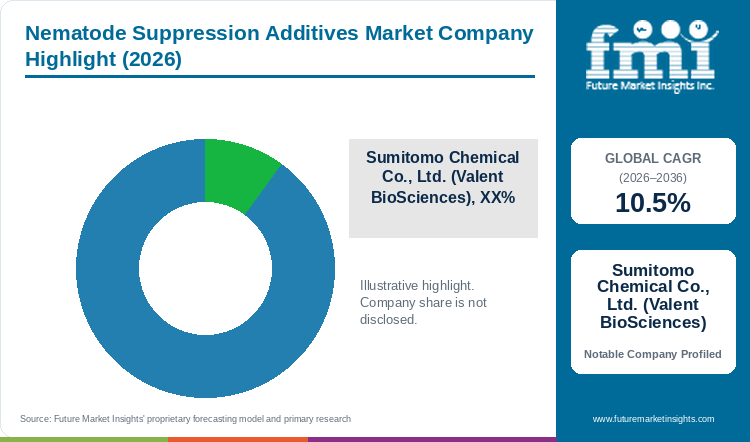
Competitive differentiation in the global nematode suppression additives market centers on strain-level regulatory registrations and formulation stability in seed-slurry and drip systems. Multinational crop-science groups such as Sumitomo Chemical (via Valent BioSciences) and Syngenta Crop Protection as well as Bayer CropScience and BASF SE anchor broad-acre soybean and corn seed-treatment channels with proprietary Bacillus and Pasteuria endospore platforms. Biological specialists Certis Biologicals and ProFarm Group (Bioceres Crop Solutions) along with Koppert B.V. and BioWorks, Inc. focus on liquid and wettable-granule fungal and botanical formulations tailored for drip chemigation in fruiting vegetables and potatoes.
- Endospore Seed-Treatment & Broad-Acre Platforms: Sumitomo Chemical Co., Ltd. (Valent BioSciences) and Syngenta Crop Protection AG along with BASF SE supply high-concentration Bacillus and Pasteuria seed dressings engineered for industrial soybean and row-crop treater lines.
- Nematophagous Fungal & Rhizosphere Colonization Specialists: Certis Biologicals and Bayer CropScience AG along with Koppert B.V. commercialize Purpureocillium lilacinum and Trichoderma harzianum formulations for horticultural drip and soil drenching.
- Microbial-Metabolite & Botanical Nematicide Innovators: ProFarm Group (Bioceres Crop Solutions) and BioWorks, Inc. deliver fermentation-derived Burkholderia metabolites and cold-pressed botanical oil emulsions for specialty and row crops.
Competitive Benchmarking: Nematode Suppression Additives Market
Table 8: Competitive Benchmarking for the Nematode Suppression Additives Market (qualitative capability ratings), 2026
| Company | Active Strain & Extract Breadth | Seed & Drip Placement Versatility | Regulatory Dossier Depth | Geographic Reach |
|---|---|---|---|---|
| Sumitomo Chemical Co., Ltd. (Valent BioSciences) | High | High | High | USA, Brazil, Canada, and Asia-Pacific row-crop and specialty regions |
| Certis Biologicals | High | High | High | USA, European Union, Latin America, and African horticulture |
| Syngenta Crop Protection AG | High | High | High | Global seed-care network across North America, Latin America, and Europe |
| Bayer CropScience AG | High | High | High | Global broad-acre and greenhouse distribution in 70+ countries |
| BASF SE | Medium | High | High | North America, Brazil, and European Union commercial seed treatment |
| ProFarm Group (Bioceres Crop Solutions) | High | High | High | USA, Brazil, and Latin America broad-acre channels |
| Koppert B.V. | Medium | High | Medium | European Union, North America, and East Asia greenhouses |
| BioWorks, Inc. | Medium | High | Medium | USA and Canada specialty horticulture channels |
Scoring basis: Capability tiers evaluate documented plant-parasitic nematode product registrations and placement versatility across seed coating and drip chemigation routes as well as active regulatory authorizations across U.S. EPA and EU EFSA frameworks.
Key Developments in the Nematode Suppression Additives Market
- In May 2026, BioWorks, Inc. launched TotalNema Ax in the USA as a botanical nematicide formulated with castor oil and clove oil extracts for soil drench and chemigation control of plant-parasitic nematodes in potatoes and vegetables.
- In March 2025, Certis Biologicals obtained its first European Union low-risk biopesticide authorization in the Netherlands for NemaClean (Purpureocillium lilacinum strain PL11) to suppress root-knot nematodes in protected fruiting vegetables.
- In February 2025, Andermatt Group established its new subsidiary Andermatt Italia in Italy through a joint venture with Technical Service SRL to expand direct biological crop-protection and rhizosphere input distribution across Mediterranean horticulture [15].
Key Players in the Nematode Suppression Additives Market
Endospore Seed-Treatment and Broad-Acre Platforms
- Sumitomo Chemical Co., Ltd. (Valent BioSciences)
- Syngenta Crop Protection AG
- BASF SE
Nematophagous Fungal and Rhizosphere Colonization Specialists
- Certis Biologicals
- Bayer CropScience AG
- Koppert B.V.
Microbial-Metabolite and Botanical Nematicide Innovators
- ProFarm Group (Bioceres Crop Solutions)
- BioWorks, Inc.
Nematode Suppression Additives Market - Report Scope
Table 9: Report Scope for the Nematode Suppression Additives Market (coverage fields and definitions), 2026 to 2036
| Coverage field | Report scope |
|---|---|
| Market breakdown | Active Type; Crop Type; Application Method; Target Setting; Sales Channel |
| Quantitative Units | USD Million |
| Market Definition | Commercial supplier revenue from biological and microbial-metabolite plus botanical nematode-suppression additives formulated to suppress plant-parasitic nematodes at the crop root zone. Category Scope Note: Excludes synthetic organophosphate/carbamate/halogenated fumigant nematicides and entomopathogenic nematodes sold solely for insect-larval control plus unbundled soil-testing laboratory services. |
| Regions Covered | North America; Latin America; Western Europe; Eastern Europe; East Asia; South Asia and Pacific; Middle East and Africa |
| Countries Covered | Brazil, Spain, USA, China, South Korea, Germany, UK, Japan, and additional countries in the full report |
| Key Companies Covered | Sumitomo Chemical Co., Ltd. (Valent BioSciences), Certis Biologicals, Syngenta Crop Protection AG, Bayer CropScience AG, BASF SE, ProFarm Group (Bioceres Crop Solutions), Koppert B.V., BioWorks, Inc. |
| Forecast Period | 2026 to 2036 |
| Approach | Primary and secondary research with top-down and bottom-up market triangulation. |
Nematode Suppression Additives Market - Research Methodology
Table 10: Research Methodology for the Nematode Suppression Additives Market (research methods and approach), 2026 edition
| Method | Approach |
|---|---|
| Primary Research | Structured interviews with commercial seed-treater managers and greenhouse technical agronomists plus plant nematologists and biological input regulatory directors to validate per-hectare application rates and seasonal treatment frequencies. |
| Secondary Research | Analysis of U.S. EPA Biopesticides and Pollution Prevention Division registrations and EU EFSA pesticide peer-review dossiers plus MAPA bio-input registries in Brazil and peer-reviewed nematology journals. |
| Market Sizing and Forecasting | Top-down biological crop-protection expenditure models reconciled against bottom-up treated hectare volumes and per-hectare seed-coating versus drip-chemigation spend from 2025 to 2036. |
| Country Forecasting Model | Econometric country projections weight nematode-susceptible soybean and potato plus fruiting-vegetable acreage with synthetic fumigant phase-out timelines and national biopesticide registration throughput across eight agricultural systems. |
| Operational Benchmark Traceability | Treated-area and dose indicators in Tables 2 and 3 plus Table 4 trace to pangenome and rhizosphere biocontrol studies in BMC Genomics and Frontiers in Microbiology with U.S. EPA registration dossiers. |
| Data Triangulation and Validation | Demand estimates are cross-checked against commercial bionematicide fermentation capacity and distributor seed-treatment volumes while excluding insect-targeting entomopathogenic nematodes. |
Nematode Suppression Additives Market by Segments
Nematode Suppression Additives Market segmented by Active Type:
- Bacillus-Based Bionematicides
- Nematophagous Fungal Formulations
- Botanical & Terpene Nematicidal Extracts
- Pasteuria, Burkholderia & Microbial Metabolite Additives
Nematode Suppression Additives Market segmented by Crop Type:
- Fruits & Vegetables
- Oilseeds & Pulses
- Cereals & Grains
- Turf, Ornamentals & Plantation Crops
Nematode Suppression Additives Market segmented by Application Method:
- Soil Drench & Drip Chemigation
- Seed Coating & In-Furrow Treatment
- Granular Broadcast & Bed Incorporation
- Transplant Root-Dip & Bare-Root Soak
Nematode Suppression Additives Market segmented by Target Setting:
- Open-Field Row & Broad-Acre Cropping
- Protected Greenhouse & High-Tunnel Horticulture
- Permanent Orchard, Vineyard & Plantation Blocks
- Commercial Turfgrass, Golf & Nursery Systems
Nematode Suppression Additives Market segmented by Sales Channel:
- Agri-Input Distributors & Agronomy Dealerships
- Agricultural Cooperatives & Grower Associations
- Specialty Horticultural & Biological Supply Chains
- Direct-to-Farm & Digital Input Platforms
Nematode Suppression Additives Market by Region
- North America
- United States
- Canada
- Latin America
- Brazil
- Mexico
- Argentina
- Chile
- Western Europe
- Germany
- France
- United Kingdom
- Italy
- Spain
- Benelux
- Nordics
- Eastern Europe
- Poland
- Czech Republic
- Romania
- Hungary
- East Asia
- China
- Japan
- South Korea
- South Asia and Pacific
- India
- ASEAN
- Australia and New Zealand
- Middle East and Africa
- GCC Countries
- South Africa
- Türkiye
- Israel
Research Sources and Bibliography
- [1] Borges dos Santos, L., Showmaker, K. C., Masonbrink, R. E., Walden, K. K. O., Gomes Viana, J. P., Kwon, K.-M., et al. (2026, January 15). Pangenome analysis of nine soybean cyst nematode genomes reveals hidden variation contributing to diversity and adaptation. BMC Genomics, 27, 177 (PMCID: PMC12892471).
- [2] U.S. Environmental Protection Agency. (2026, February 23). Biopesticide Registration. U.S. Environmental Protection Agency.
- [3] Vasantha-Srinivasan, P., Park, K. B., Kim, K. Y., Jung, W.-J., & Han, Y. S. (2025, January 17). The role of Bacillus species in the management of plant-parasitic nematodes. Frontiers in Microbiology, 15, 1510036 (PMCID: PMC11782231).
- [4] Contreras-Soto, M. B., Tovar-Pedraza, J. M., Solano-Báez, A. R., Bayardo-Rosales, H., & Márquez-Licona, G. (2025, July 11). Biocontrol Strategies Against Plant-Parasitic Nematodes Using Trichoderma spp.: Mechanisms, Applications, and Management Perspectives. Journal of Fungi, 11(7), 517 (PMCID: PMC12300834).
- [5] Certis Biologicals. (2025, March 5). Certis Biologicals Announces the first EU Authorization of NemaClean®. Certis Biologicals News Releases.
- [6] U.S. Environmental Protection Agency. (2025, November 5). EPA Registers New Pesticide Active Ingredient Cyclobutrifluram. U.S. Environmental Protection Agency.
- [7] Bioceres Crop Solutions Corp. (2025, March 11). Bioceres Crop Solutions Announces EPA Registration of Rinotec Insecticide and Nematicide Platform, a Game-Changing Solution for Integrated Pest Management. Bioceres Crop Solutions Investor Relations.
- [8] Abd-Elgawad, M. M. M. (2025, March 23). Integrated Nematode Management Strategies: Optimization of Combined Nematicidal and Multi-Functional Inputs. Plants, 14(7), 1004 (PMCID: PMC11990402).
- [9] Kud, J., Ehlers, R.-U., Topalović, O., Siddique, S., Mitter, N., & Mimee, B. (2026, September 24). Rethinking control strategies for plant-parasitic nematodes. Journal of Nematology, 58(1), 463-475 (PMCID: PMC13606025).
- [10] BioWorks, Inc. (2026, May 15). BioWorks Introduces TotalNema Ax™ Nematicide to Deliver Innovative Nematode Control for Specialty Ag Crops. BioWorks News.
- [11] Syngenta AG. (2025, February 26). Syngenta strengthens global leadership in agricultural biologicals. Syngenta Media Releases.
- [12] Maxwell, M. W. H., Rohilla, B., Chippendale, J., & Bell, C. A. (2026, May 6). The stage-specific regulation and role of root-knot nematode SWEET genes. PLOS Pathogens, 22(5), e1014161 (PMCID: PMC13148671).
- [13] U.S. Environmental Protection Agency. (2025, April 21). EPA Announces Proposed Registration of New Active Ingredient Cyclobutrifluram. U.S. Environmental Protection Agency.
- [14] Hu, H., Cui, Z., Wu, D., Zhang, Q., Wang, X., Liu, Y., et al. (2026, June 11). Mining resistance genes of soybean cyst nematode based on genome-wide association study. Frontiers in Plant Science, 17, 1834180 (PMCID: PMC13294213).
- [15] Andermatt Group AG. (2025, February 6). Expanding Sustainability: Andermatt Group Establishes Italian Subsidiary. Andermatt Group AG.
- [16] Syngenta AG. (2025, June 30). Syngenta to become global leader in biologicals; expanding nature inspired solutions for farmers. Syngenta Media Releases.
This bibliography is provided for reader reference and is not exhaustive. The full report contains the complete reference list and detailed citations.
This Report Answers
- How large is the nematode suppression additives market in 2026 and what is projected by 2036?
- Which root-zone pest pressures and fumigant restrictions drive bionematicide procurement?
- Why do Bacillus-Based Bionematicides lead the Active Type segment?
- Why do Fruits & Vegetables capture the largest Crop Type segment share globally?
- How do national growth rates compare across Brazil and Spain plus the USA and China?
- Which agricultural biological companies hold registered plant-parasitic nematode claims today?
- Where do high initial nematode densities and cold-chain storage hurdles restrain switching?
- What soil assay and tank-mix parameters should growers verify before ordering root-zone additives?
Frequently Asked Questions
How big is the nematode suppression additives market in 2026, and what is forecast for 2036?
Commercial seed-treatment and horticultural drip programs lift the global nematode suppression additives market size to USD 193.2 million in 2026 from USD 174.8 million in 2025. Total industry valuation is projected to reach USD 524.2 million by 2036 as row-crop and vegetable farms replace synthetic fumigants with biological root protection.
What is the CAGR for the nematode suppression additives market from 2026 to 2036?
Global market value is forecast to expand at a 10.5% compound annual growth rate from 2026 to 2036, generating USD 331.0 million in added annual revenue over the 10-year assessment horizon.
Which active type segment leads the nematode suppression additives market?
Bacillus-Based Bionematicides are expected to hold a 48.6% share of the Active Type segment in 2026, driven by endospore durability on treated soybean and corn seeds.
Which crop type segment leads the nematode suppression additives market?
Within the Crop Type segment, Fruits & Vegetables are projected to account for a 44.2% share in 2026, owing to multi-pass drip chemigation schedules in tomatoes and cucurbits plus potatoes.
Which country records the fastest growth outlook during the forecast period?
Brazil is projected to lead national expansion at a 12.4% CAGR through 2036, supported by continuous Cerrado soybean-maize double cropping and rapid MAPA bio-input approvals.
Who are the key players in the nematode suppression additives market?
Sumitomo Chemical Co., Ltd. (Valent BioSciences), Certis Biologicals, Syngenta Crop Protection AG, Bayer CropScience AG, BASF SE, ProFarm Group (Bioceres Crop Solutions), Koppert B.V., and BioWorks, Inc. supply registered root-zone suppression formulations.
Preview the report firsthand - request a free sample
Get SampleGet the brochure for pricing and purchase details.
Get PDFTable of Content
- Key Takeaways
- Market Size and CAGR
- Top Growth Driver
- Fastest Growing Segment
- Leading Region
- Key Companies
- Emerging Opportunities
- Executive Summary
- Global Market Outlook
- Demand-side Trends
- Supply-side Trends
- Technology Roadmap Analysis
- Analysis and Recommendations
- Analyst Perspective (What is happening? Why now? What should investors know?)
- Key Questions Answered
- How large is the market?
- What is the CAGR?
- What are key trends?
- Which region dominates?
- Who are the leaders?
- Market Overview
- Market Coverage / Taxonomy
- Market Definition / Scope / Limitations
- Research Methodology
- Chapter Orientation
- Analytical Lens and Working Hypotheses
- Market Structure, Signals, and Trend Drivers
- Benchmarking and Cross-market Comparability
- Market Sizing, Forecasting, and Opportunity Mapping
- Research Design and Evidence Framework
- Desk Research Programme (Secondary Evidence)
- Expert Input and Fieldwork (Primary Evidence)
- Tooling, Models, and Reference Databases
- Data Engineering and Model Build
- Quality Assurance and Audit Trail
- Market Background
- Market Dynamics (Drivers, Restraints, Opportunity, Trends)
- Scenario Forecast (Optimistic, Likely, Conservative)
- Impact Analysis
- AI Impact
- Sustainability Impact
- Regulatory Impact
- Technology Impact
- Consumer / Buyer Analysis
- Purchase Drivers
- Adoption Barriers
- Buyer Journey
- Opportunity Map Analysis
- Product Life Cycle Analysis
- Supply Chain Analysis
- Investment Feasibility Matrix
- Value Chain Analysis
- PESTLE and Porter's Analysis
- Regulatory Landscape
- Regional Parent Market Outlook
- Production and Consumption Statistics
- Import and Export Statistics
- Global Market Analysis and Forecast, 2021 to 2036
- Historical Market Size Value (USD Million) Analysis, 2021 to 2025
- Current and Future Market Size Value (USD Million) Projections, 2026 to 2036
- Y-o-Y Growth Trend Analysis
- Absolute $ Opportunity Analysis
- Global Market Pricing Analysis, 2021 to 2036
- Global Market Analysis and Forecast, By Active Type, 2021 to 2036
- Introduction / Key Findings
- Historical Market Size Value (USD Million) Analysis By Active Type, 2021 to 2025
- Current and Future Market Size Value (USD Million) Analysis and Forecast By Active Type, 2026 to 2036
- Bacillus-Based Bionematicides
- Nematophagous Fungal Formulations
- Botanical & Terpene Nematicidal Extracts
- Pasteuria, Burkholderia & Microbial Metabolite Additives
- Y-o-Y Growth Trend Analysis By Active Type, 2021 to 2025
- Absolute $ Opportunity Analysis By Active Type, 2026 to 2036
- Global Market Analysis and Forecast, By Crop Type, 2021 to 2036
- Introduction / Key Findings
- Historical Market Size Value (USD Million) Analysis By Crop Type, 2021 to 2025
- Current and Future Market Size Value (USD Million) Analysis and Forecast By Crop Type, 2026 to 2036
- Fruits & Vegetables
- Oilseeds & Pulses
- Cereals & Grains
- Turf, Ornamentals & Plantation Crops
- Y-o-Y Growth Trend Analysis By Crop Type, 2021 to 2025
- Absolute $ Opportunity Analysis By Crop Type, 2026 to 2036
- Global Market Analysis and Forecast, By Application Method, 2021 to 2036
- Introduction / Key Findings
- Historical Market Size Value (USD Million) Analysis By Application Method, 2021 to 2025
- Current and Future Market Size Value (USD Million) Analysis and Forecast By Application Method, 2026 to 2036
- Soil Drench & Drip Chemigation
- Seed Coating & In-Furrow Treatment
- Granular Broadcast & Bed Incorporation
- Transplant Root-Dip & Bare-Root Soak
- Y-o-Y Growth Trend Analysis By Application Method, 2021 to 2025
- Absolute $ Opportunity Analysis By Application Method, 2026 to 2036
- Global Market Analysis and Forecast, By Target Setting, 2021 to 2036
- Introduction / Key Findings
- Historical Market Size Value (USD Million) Analysis By Target Setting, 2021 to 2025
- Current and Future Market Size Value (USD Million) Analysis and Forecast By Target Setting, 2026 to 2036
- Open-Field Row & Broad-Acre Cropping
- Protected Greenhouse & High-Tunnel Horticulture
- Permanent Orchard, Vineyard & Plantation Blocks
- Commercial Turfgrass, Golf & Nursery Systems
- Y-o-Y Growth Trend Analysis By Target Setting, 2021 to 2025
- Absolute $ Opportunity Analysis By Target Setting, 2026 to 2036
- Global Market Analysis and Forecast, By Sales Channel, 2021 to 2036
- Introduction / Key Findings
- Historical Market Size Value (USD Million) Analysis By Sales Channel, 2021 to 2025
- Current and Future Market Size Value (USD Million) Analysis and Forecast By Sales Channel, 2026 to 2036
- Agri-Input Distributors & Agronomy Dealerships
- Agricultural Cooperatives & Grower Associations
- Specialty Horticultural & Biological Supply Chains
- Direct-to-Farm & Digital Input Platforms
- Y-o-Y Growth Trend Analysis By Sales Channel, 2021 to 2025
- Absolute $ Opportunity Analysis By Sales Channel, 2026 to 2036
- Global Market Analysis and Forecast, By Region, 2021 to 2036
- Introduction
- Historical Market Size Value (USD Million) Analysis By Region, 2021 to 2025
- Current Market Size Value (USD Million) Analysis and Forecast By Region, 2026 to 2036
- North America
- Latin America
- Western Europe
- Eastern Europe
- East Asia
- South Asia and Pacific
- Middle East and Africa
- Market Attractiveness Analysis By Region
- North America Market Analysis and Forecast, By Country, 2021 to 2036
- Historical Market Size Value (USD Million) Trend Analysis By Market Taxonomy, 2021 to 2025
- Market Size Value (USD Million) Forecast By Market Taxonomy, 2026 to 2036
- By Country
- United States
- Canada
- By Active Type
- By Crop Type
- By Application Method
- By Target Setting
- By Sales Channel
- By Country
- Market Attractiveness Analysis
- By Country
- By Active Type
- By Crop Type
- By Application Method
- By Target Setting
- By Sales Channel
- Key Takeaways
- Latin America Market Analysis and Forecast, By Country
- Historical Market Size Value (USD Million) Trend Analysis By Market Taxonomy, 2021 to 2025
- Market Size Value (USD Million) Forecast By Market Taxonomy, 2026 to 2036
- By Country
- Brazil
- Mexico
- Argentina
- Chile
- By Active Type
- By Crop Type
- By Application Method
- By Target Setting
- By Sales Channel
- By Country
- Market Attractiveness Analysis
- By Country
- By Active Type
- By Crop Type
- By Application Method
- By Target Setting
- By Sales Channel
- Key Takeaways
- Western Europe Market Analysis and Forecast, By Country
- Historical Market Size Value (USD Million) Trend Analysis By Market Taxonomy, 2021 to 2025
- Market Size Value (USD Million) Forecast By Market Taxonomy, 2026 to 2036
- By Country
- Germany
- France
- United Kingdom
- Italy
- Spain
- Benelux
- Nordics
- By Active Type
- By Crop Type
- By Application Method
- By Target Setting
- By Sales Channel
- By Country
- Market Attractiveness Analysis
- By Country
- By Active Type
- By Crop Type
- By Application Method
- By Target Setting
- By Sales Channel
- Key Takeaways
- Eastern Europe Market Analysis and Forecast, By Country
- Historical Market Size Value (USD Million) Trend Analysis By Market Taxonomy, 2021 to 2025
- Market Size Value (USD Million) Forecast By Market Taxonomy, 2026 to 2036
- By Country
- Poland
- Czech Republic
- Romania
- Hungary
- By Active Type
- By Crop Type
- By Application Method
- By Target Setting
- By Sales Channel
- By Country
- Market Attractiveness Analysis
- By Country
- By Active Type
- By Crop Type
- By Application Method
- By Target Setting
- By Sales Channel
- Key Takeaways
- East Asia Market Analysis and Forecast, By Country
- Historical Market Size Value (USD Million) Trend Analysis By Market Taxonomy, 2021 to 2025
- Market Size Value (USD Million) Forecast By Market Taxonomy, 2026 to 2036
- By Country
- China
- Japan
- South Korea
- By Active Type
- By Crop Type
- By Application Method
- By Target Setting
- By Sales Channel
- By Country
- Market Attractiveness Analysis
- By Country
- By Active Type
- By Crop Type
- By Application Method
- By Target Setting
- By Sales Channel
- Key Takeaways
- South Asia and Pacific Market Analysis and Forecast, By Country
- Historical Market Size Value (USD Million) Trend Analysis By Market Taxonomy, 2021 to 2025
- Market Size Value (USD Million) Forecast By Market Taxonomy, 2026 to 2036
- By Country
- India
- ASEAN
- Australia and New Zealand
- By Active Type
- By Crop Type
- By Application Method
- By Target Setting
- By Sales Channel
- By Country
- Market Attractiveness Analysis
- By Country
- By Active Type
- By Crop Type
- By Application Method
- By Target Setting
- By Sales Channel
- Key Takeaways
- Middle East and Africa Market Analysis and Forecast, By Country
- Historical Market Size Value (USD Million) Trend Analysis By Market Taxonomy, 2021 to 2025
- Market Size Value (USD Million) Forecast By Market Taxonomy, 2026 to 2036
- By Country
- GCC Countries
- South Africa
- Türkiye
- Israel
- By Active Type
- By Crop Type
- By Application Method
- By Target Setting
- By Sales Channel
- By Country
- Market Attractiveness Analysis
- By Country
- By Active Type
- By Crop Type
- By Application Method
- By Target Setting
- By Sales Channel
- Key Takeaways
- Key Countries Market Analysis
- United States
- Pricing Analysis
- Market Share Analysis, 2025
- By Active Type
- By Crop Type
- By Application Method
- By Target Setting
- By Sales Channel
- Canada
- Pricing Analysis
- Market Share Analysis, 2025
- By Active Type
- By Crop Type
- By Application Method
- By Target Setting
- By Sales Channel
- Mexico
- Pricing Analysis
- Market Share Analysis, 2025
- By Active Type
- By Crop Type
- By Application Method
- By Target Setting
- By Sales Channel
- Brazil
- Pricing Analysis
- Market Share Analysis, 2025
- By Active Type
- By Crop Type
- By Application Method
- By Target Setting
- By Sales Channel
- Chile
- Pricing Analysis
- Market Share Analysis, 2025
- By Active Type
- By Crop Type
- By Application Method
- By Target Setting
- By Sales Channel
- Germany
- Pricing Analysis
- Market Share Analysis, 2025
- By Active Type
- By Crop Type
- By Application Method
- By Target Setting
- By Sales Channel
- United Kingdom
- Pricing Analysis
- Market Share Analysis, 2025
- By Active Type
- By Crop Type
- By Application Method
- By Target Setting
- By Sales Channel
- Italy
- Pricing Analysis
- Market Share Analysis, 2025
- By Active Type
- By Crop Type
- By Application Method
- By Target Setting
- By Sales Channel
- Spain
- Pricing Analysis
- Market Share Analysis, 2025
- By Active Type
- By Crop Type
- By Application Method
- By Target Setting
- By Sales Channel
- France
- Pricing Analysis
- Market Share Analysis, 2025
- By Active Type
- By Crop Type
- By Application Method
- By Target Setting
- By Sales Channel
- India
- Pricing Analysis
- Market Share Analysis, 2025
- By Active Type
- By Crop Type
- By Application Method
- By Target Setting
- By Sales Channel
- ASEAN
- Pricing Analysis
- Market Share Analysis, 2025
- By Active Type
- By Crop Type
- By Application Method
- By Target Setting
- By Sales Channel
- Australia and New Zealand
- Pricing Analysis
- Market Share Analysis, 2025
- By Active Type
- By Crop Type
- By Application Method
- By Target Setting
- By Sales Channel
- China
- Pricing Analysis
- Market Share Analysis, 2025
- By Active Type
- By Crop Type
- By Application Method
- By Target Setting
- By Sales Channel
- Japan
- Pricing Analysis
- Market Share Analysis, 2025
- By Active Type
- By Crop Type
- By Application Method
- By Target Setting
- By Sales Channel
- South Korea
- Pricing Analysis
- Market Share Analysis, 2025
- By Active Type
- By Crop Type
- By Application Method
- By Target Setting
- By Sales Channel
- Poland
- Pricing Analysis
- Market Share Analysis, 2025
- By Active Type
- By Crop Type
- By Application Method
- By Target Setting
- By Sales Channel
- Hungary
- Pricing Analysis
- Market Share Analysis, 2025
- By Active Type
- By Crop Type
- By Application Method
- By Target Setting
- By Sales Channel
- Türkiye
- Pricing Analysis
- Market Share Analysis, 2025
- By Active Type
- By Crop Type
- By Application Method
- By Target Setting
- By Sales Channel
- South Africa
- Pricing Analysis
- Market Share Analysis, 2025
- By Active Type
- By Crop Type
- By Application Method
- By Target Setting
- By Sales Channel
- United States
- Market Structure Analysis
- Competition Dashboard
- Competition Benchmarking
- Market Share Analysis of Top Players
- By Regional
- By Active Type
- By Crop Type
- By Application Method
- By Target Setting
- By Sales Channel
- Emerging Startups
- Innovation Benchmarking
- Competition Analysis
- Competition Deep Dive
- Sumitomo Chemical Co., Ltd. (Valent BioSciences)
- Overview
- Product Portfolio
- Profitability by Market Segments
- Sales Footprint
- Strategy Overview
- Marketing Strategy
- Product Strategy
- Channel Strategy
- Certis Biologicals
- Syngenta Crop Protection AG
- Bayer CropScience AG
- BASF SE
- ProFarm Group (Bioceres Crop Solutions)
- Koppert B.V.
- BioWorks, Inc.
- Sumitomo Chemical Co., Ltd. (Valent BioSciences)
- Case Studies
- Success Stories
- Recent Developments
- Competition Deep Dive
- Assumptions & Acronyms Used


