

- Market Size (2026)
- USD 620.7 Mn
- Forecast (2036)
- USD 1291.2 Mn
- CAGR (2026 to 2036)
- 7.6%
How big is NMEA Gateway Modules Market in 2026?
USD 620.7 million in 2026 and USD 1,291.2 million by 2036, expanding at 7.6% CAGR.
Sales of NMEA gateway modules are estimated to rise at 7.6% CAGR through 2036, increasing valuation from USD 576.9 million in 2025 to USD 620.7 million in 2026, and reaching USD 1,291.2 million by 2036. NMEA’s 2026 Standards Week update described operational OneNet devices entering interoperability testing and continued gateway-certification work for networks linking newer Ethernet and CAN endpoints with retained marine electronics. Installers therefore buy translation hardware to preserve usable sensors while newer displays consume the required onboard data.
Dutch dealers see frequent retrofit work because recreational owners often upgrade displays and sensors without replacing every serviceable instrument. Watersportverbond reported in January 2026 that about 4.6 million Dutch adults participated in watersports during 2024. That installed user base gives new yacht systems repeated opportunities to enter mixed-generation networks through dealer-led upgrades. Japan follows a slower integration route because regulated communication equipment requires more documented compatibility before adjacent electronics change.
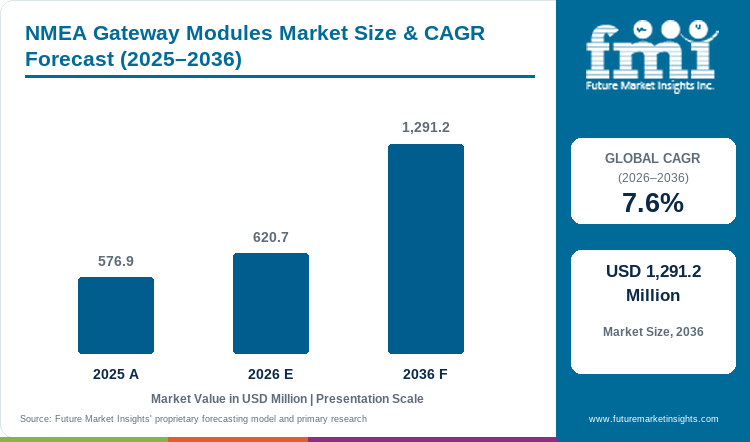
Key Takeaways
- Retrofit demand rises when owners retain serviceable NMEA 0183 instruments while adding newer endpoints that require reliable protocol translation.
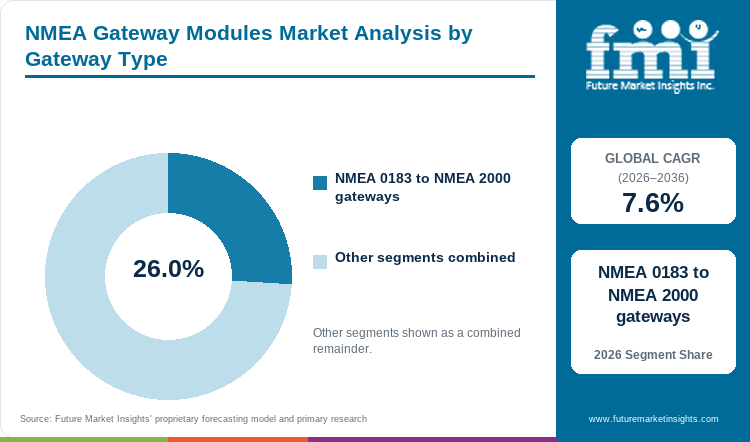
- Based on gateway type, NMEA 0183 to NMEA 2000 gateways are projected to account for 26.0% in 2026, driven by staged refits between serial and CAN-based networks.
- By connectivity, wired links are estimated to hold 34.0% in 2026, supported by fixed backbones that simplify isolation checks during commissioning.
- In 2026, recreational boats are expected to lead vessel type with 34.0% share, attributable to phased electronics upgrades that preserve usable onboard equipment.
- Commissioning risk limits adoption because connector compatibility cannot guarantee correct message mapping or electrical isolation during mixed-generation retrofit work.
- Key players in the NMEA gateway modules market include Actisense, Maretron, Yacht Devices, Garmin, Navico Group, Raymarine / Teledyne FLIR, Furuno, Digital Yacht, Vesper Marine / Garmin, and ShipModul.
Analyst Perspective
"Gateway economics are settled during commissioning because repeated troubleshooting can erase hardware savings. Suppliers earn repeat business when installers verify message coverage and electrical isolation before vessel handover."
- Sudip saha, Principal Consultant, Future Market Insights
How is the NMEA gateway modules market segmented?
The NMEA gateway modules market is segmented by gateway type, connectivity, vessel type, application, sales channel and region.
The NMEA gateway modules market is segmented by gateway type, connectivity, vessel type, application and sales channel. Gateway types include NMEA 0183 to NMEA 2000, NMEA 2000 to Ethernet, CAN to NMEA, Wi-Fi - Bluetooth NMEA and multi-protocol gateways. Connectivity covers wired, Wi-Fi, Bluetooth, Ethernet and cellular-enabled formats. Vessel categories include recreational boats, yachts, fishing vessels, workboats and sailing boats. Applications cover engine data conversion, navigation integration, sensor network bridging, display - MFD connectivity and remote diagnostics. Sales channels include marine electronics dealers, boat OEMs, aftermarket retrofit and system integrators.
What operating condition supports NMEA 0183 to NMEA 2000 gateway demand?
Mixed-generation refits keep serial instruments useful when newer marine communication systems and multifunction displays expect NMEA 2000 data. Actisense documented in January 2025 that NGX-1 provides bidirectional NMEA 0183 and NMEA 2000 conversion. Installers compare conversion libraries and electrical isolation before selecting a gateway for retained sensors.
- By gateway type, NMEA 0183 to NMEA 2000 gateways are forecast to represent 26.0% in 2026, owing to persistent retrofit requirements between serial and CAN-based networks.
- Boat owners avoid unnecessary replacement when a tested converter carries required messages without adding another unsupported network layer.
How does wired connectivity influence gateway selection during commissioning?
Wired links give installers a fixed electrical path when helm systems include displays and marine steering systems. NMEA cybersecurity guidance published in 2025 places gateways and diagnostic connections inside controlled installation areas. Technicians can isolate faults on a known backbone without relying on wireless availability.
- Wired connectivity is likely to capture 34.0% share in 2026, supported by fixed data paths that installers can validate before commissioning additional endpoints.
- Wireless access can serve secondary devices after technicians establish a stable primary backbone and verify required gateway data routes.
What makes recreational boats important within the vessel type category?
Recreational boats receive electronics in stages because owners replace displays and boat camera systems on different schedules. Actisense launched the FSH-1 NMEA 2000 Wi-Fi Fish Decoder in April 2025 for recreational fishing installations. Installers can preserve existing equipment when each added endpoint passes network-data checks before handover.
- Recreational boats are set to lead the vessel type category with 34.0% share in 2026, driven by phased display and sensor upgrades that preserve serviceable equipment.
- Gateway suppliers improve retrofit economics by documenting conversion behavior for common sensors and displays before installation begins onboard.
Why does engine data conversion account for a significant application share?
Engine gateways translate propulsion messages so existing CAN data can appear on NMEA 2000 displays beside navigation information from marine engines. Yacht Devices updated its Engine Gateway in October 2025 to support Suzuki outboards and Hyundai marine engines. Installers verify each engine generation before removing a dedicated display.
- Engine data conversion is projected to hold 26.0% share in 2026, attributable to the operating value of propulsion data on networked helm displays.
- Buyers need model-specific protocol documentation because connector compatibility cannot confirm which engine parameters will reach the display.
How do marine electronics dealers convert gateway demand into installed systems?
Marine electronics dealers turn a gateway sale into a commissioned network that may include marine IMU sensors and other data sources. NMEA scheduled NMEA 2000 and OneNet developer classes during 2026 for technical staff implementing these standards. Dealers inspect wiring and message behavior before choosing a converter.
- The sales channel category is forecast to be led by marine electronics dealers at 38.0% share in 2026, supported by their role in compatibility diagnosis and commissioning.
- Dealer-led projects reduce buyer risk because one technical team can select the gateway and resolve unsupported data during installation.
What are the drivers, restraints and opportunities in the NMEA Gateway Modules Market?
Mixed-generation vessel electronics expand gateway demand while commissioning risk limits conversion and secure diagnostic access broadens the service opportunity.
- Driver: Retaining serviceable NMEA 0183 equipment during NMEA 2000 upgrades increases purchases of protocol converters and network gateways.
- Restraint: Incomplete message mapping, electrical faults and weak cybersecurity controls can turn a simple hardware retrofit into repeated service work.
- Opportunity: Gateways that expose authenticated diagnostics and logged vessel data can support remote service without replacing the safety-critical onboard backbone.
Installed electronics sustain protocol-translation demand
Owners often replace a display before replacing marine diesel engines or sensors that still provide reliable data, so mixed-protocol refits preserve value already installed onboard. Actisense documented in April 2026 that NMEA 0183 equipment can remain active beside NMEA 2000 backbones using NGX-1 and PRO-NDC-1E2K gateways for bidirectional conversion. Dealers can therefore limit a retrofit to the translation points needed by the new helm equipment and keep serviceable instruments operating. That narrower hardware scope lowers replacement cost and gives dedicated gateway modules a direct transaction role on vessels where serial and CAN-based electronics must coexist during the same ownership cycle.
Commissioning quality determines gateway economics
Network complexity becomes a restraint when a gateway is inserted beside connected marine ADAS systems without a controlled commissioning process. NMEA cybersecurity guidance published in 2025 tells installers to label NMEA 2000 devices and place diagnostic connections in controlled locations. Unsupported PGNs or poor termination can still force a second service visit even when the gateway itself is inexpensive. Buyers therefore favor products with clear conversion matrices and useful fault visibility because unresolved installation work can erase the hardware savings that justified the retrofit. Dealer teams also need repeatable test steps before vessel handover so later faults can be separated from gateway configuration errors.
Remote diagnostics expand gateway service value
Remote service becomes more practical when gateway data exposes readings from marine pressure sensors and other networked devices before a technician reaches the vessel. Actisense released W2K-1 firmware v1.396 in February 2025 with live PGN viewing and expanded network diagnostics. Installers can review message traffic before deciding whether a service visit requires hardware replacement. Gateway suppliers can charge for more capable interfaces when diagnostic visibility reduces unnecessary travel. Remote access still needs authentication that separates safety-critical onboard traffic from public networks and prevents service convenience from weakening the vessel network during scheduled maintenance decisions made by technicians working from shore.
Which country CAGRs are profiled in the NMEA Gateway Modules Market?
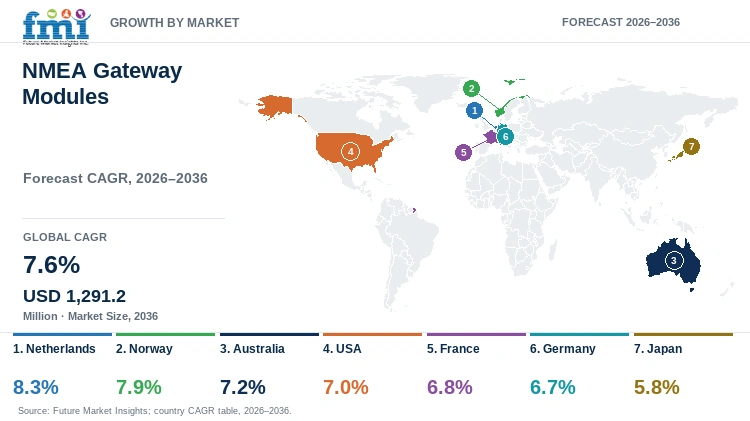
| Country | CAGR |
|---|---|
| Netherlands | 8.3% |
| Norway | 7.9% |
| Australia | 7.2% |
| USA | 7.0% |
| France | 6.8% |
| Germany | 6.7% |
| Japan | 5.8% |
How do country-level CAGRs compare in the NMEA Gateway Modules Market?
The country CAGRs span 2.5 percentage points between the Netherlands at 8.3% and Japan at 5.8%. Netherlands and Norway form the upper group while Australia and USA occupy the middle band above France and Germany.
- Netherlands supports frequent specialist retrofits because dense recreational participation keeps many mixed-generation vessel networks in service.
- Norway rewards dependable field support because long coastal routes increase the cost of repeat service visits.
- Australia favors onboard logging because remote vessel operations make technician travel expensive after commissioning faults emerge.
- USA requires broad compatibility coverage because recreational fleets retain many engine generations and electronics interfaces.
- France gives dealers recurring integration work as pleasure-boat registrations continually add vessels needing later electronics upgrades.
- Germany requires flexible commissioning support because inland and coastal fleets contain varied wiring histories and equipment ages.
- Japan emphasizes documented interoperability because regulated communication equipment must coexist reliably with retained navigation and engine systems.
Similar growth rates produce different entry conditions because fleet mix and service distance alter commissioning economics for installers. The full report provides country-level CAGR analysis across North America, Latin America, Western Europe, Eastern Europe, East Asia, South Asia and Pacific, and the Middle East and Africa.
Country-wise Analysis
- The Netherlands has a dense recreational boating base that gives marine electronics dealers frequent work on displays and sensors added over several ownership cycles. By 2036, the Netherlands is projected to grow at 8.3% CAGR, supported by mixed-generation refits within that installed base. Watersportverbond reported in January 2026 that about 4.6 million Dutch adults participated in watersports during 2024. Smaller boats can contain wiring and instruments installed at different times, which makes message mapping and isolation checks important before handover. Gateway suppliers can improve dealer productivity with compact isolated interfaces and clear conversion documentation that reduces repeated troubleshooting onboard during refits.
- Norway’s long coastline makes return service expensive after a gateway installation leaves the nearest trained marine electronics technician. Norway’s NMEA gateway modules outlook is anticipated to advance at 7.9% CAGR over the assessment period, driven by demand for dependable conversion and fault visibility on dispersed coastal routes. The Norwegian Maritime Authority’s June 2026 national boating campaign focused on knowledge and competence at sea. Installers therefore need network behavior they can document and diagnose before vessels return to remote operating areas. Gateway suppliers can reduce repeat visits with clear wiring requirements and logging tools that expose faults before vessel handover.
- Australian commercial and recreational vessels can operate far from metropolitan service centers, raising the cost of diagnosing intermittent faults after installation. NMEA gateway module demand in Australia is forecast to rise at 7.2% CAGR over the forecast period, attributable to remote operations that increase the value of visible system status. AMSA recorded 4,174 marine incidents during 2025 and identified power or propulsion system failures among common incident types nationally. Long travel distances make repeat troubleshooting expensive for operators and marine service teams. Suppliers can improve order conversion with rugged interfaces and onboard logging that identifies network problems before replacement hardware is selected.
- The USA combines a broad recreational aftermarket with many engine and electronics generations that remain aboard after display replacement. Adoption of NMEA gateway modules in the USA is estimated to expand at 7.0% CAGR through 2036, supported by incremental refits that bridge retained equipment. The USA Coast Guard recorded 3,887 recreational boating incidents in 2024 and listed machinery failure among the five primary contributing factors. Message support still varies by engine and instrument generation, so compatibility work can extend installation time. Suppliers need explicit PGN coverage and responsive technical support for dealers handling mixed fleets with different wiring histories nationwide.
- France’s active pleasure-boating sector places older vessels back into dealer workshops during ownership changes and equipment upgrades. The French NMEA gateway modules sector is projected to record 6.8% CAGR during the assessment period, driven by retrofit work that preserves serviceable sensors beside newer displays. The French maritime ministry reported in August 2026 that pleasure-boat registrations increase by about 12,000 units each year. Buyers still vary widely in budget and replacement scope, so a sale rarely justifies changing every legacy instrument. Companies can support dealer conversion with clear compatibility tools and installation packages that limit unnecessary equipment replacement during local refits.
- Germany combines inland waterways with coastal recreational use, giving installers a wide mix of vessel ages and operating conditions. In Germany, NMEA gateway module demand is predicted to advance at 6.7% CAGR through 2036, supported by a large recreational craft base that receives periodic electronics upgrades. The Federal Ministry of Transport reported in January 2026 that Germany has about 370,000 sport and recreational craft. Different vessel layouts can make termination and network-power planning uneven during retrofit work. Suppliers can improve project economics with standards-based wiring guidance and gateway documentation that minimizes changes to retained instruments during local dealer commissioning work.
- Japanese marine installations place strong weight on documented equipment behavior before network changes are accepted on operating vessels. NMEA gateway module sales in Japan are forecast to expand at 5.8% CAGR by 2036, shaped by compatibility-led replacement and formal safety-equipment requirements. Japan’s Ministry of Land, Infrastructure, Transport and Tourism stated in May 2026 that qualifying passenger and recreational fishing vessels must carry statutory radio equipment for continuous shore communication. Gateway products must coexist cleanly with regulated communication and emergency-position equipment.
Who are the notable companies in the NMEA Gateway Modules Market?
Actisense, Maretron, Yacht Devices, Garmin, Navico Group, Raymarine / Teledyne FLIR, Furuno, Digital Yacht, Vesper Marine / Garmin, and ShipModul are notable companies serving the NMEA gateway modules market.
Competition separates protocol-conversion specialists from integrated marine electronics groups and monitoring suppliers. Specialists compete on message coverage and diagnostics while integrated groups place conversion inside broader onboard systems. Entry depends on proving vessel-specific compatibility and supporting installers after commissioning.
- Actisense, Yacht Devices, Digital Yacht and ShipModul focus on protocol conversion and installer-facing network interfaces.
- Maretron and Vesper Marine / Garmin connect gateway functions with vessel monitoring and connected communications workflows.
- Garmin, Navico Group, Raymarine / Teledyne FLIR and Furuno integrate NMEA connectivity within broader navigation platforms.
Competitive Benchmarking: NMEA Gateway Modules Market
| Company | Legacy Conversion | IP/Wireless Routing | Diagnostics/Remote Access | Geographic Reach |
|---|---|---|---|---|
| Actisense | High | High | High | Global |
| Maretron | Medium | Medium | High | International |
| Yacht Devices | High | High | High | Europe and North America |
| Garmin | Medium | Medium | Medium | Global |
| Navico Group | Medium | Medium | Medium | Global |
| Raymarine / Teledyne FLIR | Medium | High | High | Global |
| Furuno | Medium | Medium | Medium | Global |
| Digital Yacht | High | High | High | Europe and North America |
| Vesper Marine / Garmin | Medium | High | High | Global |
| ShipModul | High | High | Medium | Europe and North America |
High indicates broad directly documented capability within the stated gateway criterion for the exact market function. Medium indicates narrower direct coverage that still addresses the stated buyer requirement with current public documentation. Low indicates limited dedicated coverage despite related marine electronics capability elsewhere in the company portfolio. Geographic reach describes documented sales or service coverage within relevant marine markets and is not scored.
Key Developments in the NMEA Gateway Modules Market
- In August 2026, ShipModul released MiniPlex-3 firmware 3.40.0 with NMEA 2000 bearing-reference handling for converted navigation data.
- In February 2026, Yacht Devices added Web Gauges to its Wi-Fi and Ethernet gateways for browser-based engine warning visibility.
- In July 2025, Teledyne acquired Maretron assets and retained the Maretron trade name within Raymarine for deeper vessel integration.
Key Players in the NMEA Gateway Modules Market
Dedicated Protocol-Conversion Specialists
- Actisense
- Yacht Devices
- Digital Yacht
- ShipModul
Network Monitoring and Connected-Vessel Platforms
- Maretron
- Vesper Marine / Garmin
Integrated Marine Electronics Platforms
- Garmin
- Navico Group
- Raymarine / Teledyne FLIR
- Furuno
NMEA Gateway Modules Market - Report Scope
| Coverage field | Report scope |
|---|---|
| Market breakdown | By gateway type, connectivity, vessel type, application, sales channel and region. |
| Quantitative Units | USD million. |
| Market Definition | Dedicated NMEA gateway modules and separately sold marine-network interfaces that translate or route data among NMEA 0183, NMEA 2000, CAN/J1939, Ethernet, Wi-Fi, Bluetooth or cellular endpoints. |
| Regions Covered | North America, Latin America, Western Europe, Eastern Europe, East Asia, South Asia and Pacific, and Middle East and Africa. |
| Countries Covered | Netherlands, Norway, Australia, USA, France, Germany, Japan, and 25+ additional countries included in the full report. |
| Key Companies Profiled | Actisense, Maretron, Yacht Devices, Garmin, Navico Group, Raymarine / Teledyne FLIR, Furuno, Digital Yacht, Vesper Marine / Garmin, ShipModul. |
| Forecast Period | 2026 to 2036. |
| Approach | Primary and secondary research with market triangulation. |
NMEA Gateway Modules Market - Research Methodology
| Method | Approach |
|---|---|
| Primary Research | FMI analysts gathered input from manufacturers, service providers, technology developers, distributors, end users, procurement teams, and subject-matter experts. Interviews examined purchasing decisions, product or service evaluation, adoption barriers, approval requirements, pricing considerations, and expectations for technical or commercial support. Respondents were also asked what evidence is required before a trial, pilot, or initial order develops into regular purchasing. |
| Desk Research | Desk research covered government statistics, regulatory publications, trade data, industry associations, technical literature, standards, company filings, product information, and official corporate announcements. Sources were reviewed for relevance, publication date, geographic coverage, and consistency with the defined market scope. Claims relating to performance, applications, approvals, capacity, investment, and commercial activity were retained only when supported by credible public evidence. |
| Market Sizing and Forecasting | The market model combined the baseline value with historical performance, segment structure, pricing and volume indicators, adoption levels, company participation, and country-level demand conditions. Forecast assumptions considered economic activity, investment trends, regulatory developments, technology adoption, purchasing cycles, supply availability, and barriers to wider market use. Segment and regional estimates were reconciled before the final market total was calculated. |
| Data Validation | Estimates were checked against multiple independent indicators, including public data, company activity, trade patterns, industry developments, and findings from primary interviews. Validation also tested whether products, services, applications, and company revenues fell within the defined market boundaries. Adjacent categories, unsupported claims, overlapping revenues, and activities without direct market relevance were excluded to reduce double counting and maintain consistency across segments and countries. |
NMEA Gateway Modules Market by Segments
NMEA Gateway Modules Market segmented by Gateway Type:
- NMEA 0183 to NMEA 2000 gateways
- NMEA 2000 to Ethernet gateways
- CAN to NMEA gateways
- Wi-Fi - Bluetooth NMEA gateways
- Multi-protocol gateways
NMEA Gateway Modules Market segmented by Connectivity:
- Wired
- Wi-Fi
- Bluetooth
- Ethernet
- Cellular-enabled
NMEA Gateway Modules Market segmented by Vessel Type:
- Recreational boats
- Yachts
- Fishing vessels
- Workboats
- Sailing boats
NMEA Gateway Modules Market segmented by Application:
- Engine data conversion
- Navigation integration
- Sensor network bridging
- Display - MFD connectivity
- Remote diagnostics
NMEA Gateway Modules Market segmented by Sales Channel:
- Marine electronics dealers
- Boat OEMs
- Aftermarket retrofit
- System integrators
NMEA Gateway Modules Market by Region:
- North America
- United States
- Canada
- Latin America
- Brazil
- Mexico
- Argentina
- Chile
- Western Europe
- Germany
- France
- United Kingdom
- Italy
- Spain
- Benelux
- Nordics
- Eastern Europe
- Poland
- Czech Republic
- Romania
- Hungary
- East Asia
- China
- Japan
- South Korea
- South Asia and Pacific
- India
- ASEAN
- Australia and New Zealand
- Middle East and Africa
- GCC Countries
- South Africa
- Türkiye
- Israel
Research Sources and Bibliography
- National Marine Electronics Association. (2026). Standards Week reflections: A look ahead with Mark Oslund.
- Watersportverbond. (2026, January 27). Recreëren op het water geniet een grote populariteit.
- Actisense. (2025, January 8). Which Actisense NMEA Gateway is right for you?
- National Marine Electronics Association. (2025). Cyber vulnerabilities.
- Actisense. (2025, April 1). Actisense launches revolutionary FSH-1 NMEA 2000 Wi-Fi Fish Decoder.
- Yacht Devices. (2025, October 23). Suzuki and Hyundai protocols.
- National Marine Electronics Association. (2026). NMEA 2000 & OneNet developer classes: 2026 course schedule.
- Actisense. (2026, April 1). Retrofitting NMEA 2000 onto a boat with legacy NMEA 0183 equipment.
- Actisense. (2025, February 5). New Features Alert: W2K-1 NMEA 2000 Wi-Fi Gateway.
- Norwegian Maritime Authority. (2026, June 25). Løft blikket 2026: I believe he might still be alive today if he had been wearing a lifejacket.
- Australian Maritime Safety Authority. (2026, June 25). Marine incident data highlights safety risks across Australia’s fleet.
- USA Coast Guard. (2025, July 1). Coast Guard reports fewest boating fatalities in more than 50 years.
- Ministry for the Sea, France. (2026, August 3). Le secteur de la plaisance et des loisirs nautiques.
- Federal Ministry of Transport, Germany. (2026, January 13). Wassersport und Freizeitschifffahrt.
- Ministry of Land, Infrastructure, Transport and Tourism, Japan. (2026, May 19). 旅客船・遊漁船等に対する安全設備等の義務化について.
- ShipModul B.V. (2026, August 25). MiniPlex-3 firmware changelog: Version 3.40.0.
- Yacht Devices. (2026, February 4). New Web Gauges.
- Teledyne Technologies Incorporated. (2025, July 1). Teledyne acquires Maretron.
- Maretron. (2026, July 25). Downloads: N2KAnalyzer V3 with firmware images, version 3.4.2.5.
- Yacht Devices. (2025, September 9). Ethernet Gateway for Lowrance.
- Garmin. (2026, May 27). Never miss a word on the water with Garmin Signal VHF marine radios.
- Navico Group. (2026, January 16). B&G expands the Nemesis lineup with new 7-inch sailing display.
- Raymarine. (2025, February 27). New Raymarine-Seakeeper integration lets boaters skip the wait.
- Furuno. (2026, August 31). VR Navigation System VNS-100.
- Digital Yacht. (2025, October 28). New NMEA 2000 and diagnostics solutions from Digital Yacht.
- Garmin. (2025, August 22). Cortex release history: Version 2.2.2.
- ShipModul B.V. (2025, January 1). Declaration of Conformity: MiniPlex-3Wi and MiniPlex-3Wi-N2K.
- Actisense. (2025, September 26). Double win for Actisense at NMEA Product of Excellence Awards 2025.
- Yacht Devices. (2025, February 3). Python Gateway 1.05 Update.
- Actisense. (2025, October 17). Actisense commits to the Australian boating & commercial marine markets with new venture.
- Raymarine. (2026, March 24). Raymarine unveils RCU-1.
- Garmin. (2025, October 16). New Garmin OnBoard System redefines boating safety.
- Navico Group. (2025, February 12). Simrad Yachting debuts new NSS 4 delivering a sleeker, faster and smarter multifunction display.
This bibliography is provided for reader reference and is not exhaustive. The full report contains the complete reference list and detailed citations.
This Report Answers
- How large is the NMEA gateway modules market in 2026?
- Which retrofit conditions support demand for mixed-protocol NMEA gateway modules?
- Which gateway type represents 26.0% of category demand in 2026?
- Why does wired connectivity represent 34.0% of category demand in 2026?
- How do engine-data conversion requirements affect NMEA gateway module selection?
- Why do marine electronics dealers retain 38.0% of channel demand?
- How do country growth rates differ for NMEA gateways through 2036?
- Which companies compete in protocol conversion and connected-vessel integration today?
- Which commissioning risks can delay successful NMEA gateway module retrofits?
Frequently Asked Questions
How big is the NMEA gateway modules market in 2026?
The NMEA gateway modules market is valued at USD 620.7 million in 2026 and reaches USD 1,291.2 million by 2036. Mixed-generation refits sustain demand when owners retain serviceable instruments during network upgrades.
What is the CAGR of the NMEA gateway modules market through 2036?
The NMEA gateway modules market is projected to expand at 7.6% CAGR between 2026 and 2036. Retrofit work requires translation between retained NMEA 0183 equipment and newer NMEA 2000 endpoints.
Which gateway type leads the NMEA gateway modules market?
NMEA 0183 to NMEA 2000 gateways represent 26.0% of gateway type demand in 2026. Their position reflects refits that preserve useful serial instruments while newer displays adopt NMEA 2000.
Which connectivity format represents 34.0% of category demand in 2026?
Wired connectivity represents 34.0% of the connectivity category in 2026 for NMEA gateway modules. Fixed backbones give installers predictable power and termination conditions before secondary wireless paths are added.
How do country growth rates differ through the forecast period?
Country CAGRs range from 8.3% in the Netherlands to 5.8% in Japan through 2036. Refit frequency and service distance change commissioning economics between national markets with similar growth rates.
Which companies are active in the NMEA gateway modules market?
Active companies include Actisense, Maretron, Yacht Devices, Garmin, Navico Group, Raymarine / Teledyne FLIR, Furuno, Digital Yacht, Vesper Marine / Garmin and ShipModul. Their roles span protocol conversion, network diagnostics, vessel monitoring and integrated electronics.
Preview the report firsthand - request a free sample
Get SampleGet the brochure for pricing and purchase details.
Get PDFTable of Content
- Key Takeaways
- Market Size and CAGR
- Top Growth Driver
- Fastest Growing Segment
- Leading Region
- Key Companies
- Emerging Opportunities
- Executive Summary
- Global Market Outlook
- Demand-side Trends
- Supply-side Trends
- Technology Roadmap Analysis
- Analysis and Recommendations
- Analyst Perspective (What is happening? Why now? What should investors know?)
- Key Questions Answered
- How large is the market?
- What is the CAGR?
- What are key trends?
- Which region dominates?
- Who are the leaders?
- Market Overview
- Market Coverage / Taxonomy
- Market Definition / Scope / Limitations
- Research Methodology
- Chapter Orientation
- Analytical Lens and Working Hypotheses
- Market Structure, Signals, and Trend Drivers
- Benchmarking and Cross-market Comparability
- Market Sizing, Forecasting, and Opportunity Mapping
- Research Design and Evidence Framework
- Desk Research Programme (Secondary Evidence)
- Expert Input and Fieldwork (Primary Evidence)
- Tooling, Models, and Reference Databases
- Data Engineering and Model Build
- Quality Assurance and Audit Trail
- Market Background
- Market Dynamics (Drivers, Restraints, Opportunity, Trends)
- Scenario Forecast (Optimistic, Likely, Conservative)
- Impact Analysis
- AI Impact
- Sustainability Impact
- Regulatory Impact
- Technology Impact
- Consumer / Buyer Analysis
- Purchase Drivers
- Adoption Barriers
- Buyer Journey
- Opportunity Map Analysis
- Product Life Cycle Analysis
- Supply Chain Analysis
- Investment Feasibility Matrix
- Value Chain Analysis
- PESTLE and Porter's Analysis
- Regulatory Landscape
- Regional Parent Market Outlook
- Production and Consumption Statistics
- Import and Export Statistics
- Global Market Analysis and Forecast, 2021 to 2036
- Historical Market Size Value (USD Million) Analysis, 2021 to 2025
- Current and Future Market Size Value (USD Million) Projections, 2026 to 2036
- Y-o-Y Growth Trend Analysis
- Absolute $ Opportunity Analysis
- Global Market Pricing Analysis, 2021 to 2036
- Global Market Analysis and Forecast, By Gateway Type, 2021 to 2036
- Introduction / Key Findings
- Historical Market Size Value (USD Million) Analysis By Gateway Type, 2021 to 2025
- Current and Future Market Size Value (USD Million) Analysis and Forecast By Gateway Type, 2026 to 2036
- NMEA 0183 to NMEA 2000 gateways
- NMEA 2000 to Ethernet gateways
- CAN to NMEA gateways
- Wi-Fi - Bluetooth NMEA gateways
- Multi-protocol gateways
- Y-o-Y Growth Trend Analysis By Gateway Type, 2021 to 2025
- Absolute $ Opportunity Analysis By Gateway Type, 2026 to 2036
- Global Market Analysis and Forecast, By Connectivity, 2021 to 2036
- Introduction / Key Findings
- Historical Market Size Value (USD Million) Analysis By Connectivity, 2021 to 2025
- Current and Future Market Size Value (USD Million) Analysis and Forecast By Connectivity, 2026 to 2036
- Wired
- Wi-Fi
- Bluetooth
- Ethernet
- Cellular-enabled
- Y-o-Y Growth Trend Analysis By Connectivity, 2021 to 2025
- Absolute $ Opportunity Analysis By Connectivity, 2026 to 2036
- Global Market Analysis and Forecast, By Vessel Type, 2021 to 2036
- Introduction / Key Findings
- Historical Market Size Value (USD Million) Analysis By Vessel Type, 2021 to 2025
- Current and Future Market Size Value (USD Million) Analysis and Forecast By Vessel Type, 2026 to 2036
- Recreational boats
- Yachts
- Fishing vessels
- Workboats
- Sailing boats
- Y-o-Y Growth Trend Analysis By Vessel Type, 2021 to 2025
- Absolute $ Opportunity Analysis By Vessel Type, 2026 to 2036
- Global Market Analysis and Forecast, By Application, 2021 to 2036
- Introduction / Key Findings
- Historical Market Size Value (USD Million) Analysis By Application, 2021 to 2025
- Current and Future Market Size Value (USD Million) Analysis and Forecast By Application, 2026 to 2036
- Engine data conversion
- Navigation integration
- Sensor network bridging
- Display - MFD connectivity
- Remote diagnostics
- Y-o-Y Growth Trend Analysis By Application, 2021 to 2025
- Absolute $ Opportunity Analysis By Application, 2026 to 2036
- Global Market Analysis and Forecast, By Sales Channel, 2021 to 2036
- Introduction / Key Findings
- Historical Market Size Value (USD Million) Analysis By Sales Channel, 2021 to 2025
- Current and Future Market Size Value (USD Million) Analysis and Forecast By Sales Channel, 2026 to 2036
- Marine electronics dealers
- Boat OEMs
- Aftermarket retrofit
- System integrators
- Y-o-Y Growth Trend Analysis By Sales Channel, 2021 to 2025
- Absolute $ Opportunity Analysis By Sales Channel, 2026 to 2036
- Global Market Analysis and Forecast, By Region, 2021 to 2036
- Introduction
- Historical Market Size Value (USD Million) Analysis By Region, 2021 to 2025
- Current Market Size Value (USD Million) Analysis and Forecast By Region, 2026 to 2036
- North America
- Latin America
- Western Europe
- Eastern Europe
- East Asia
- South Asia and Pacific
- Middle East and Africa
- Market Attractiveness Analysis By Region
- North America Market Analysis and Forecast, By Country, 2021 to 2036
- Historical Market Size Value (USD Million) Trend Analysis By Market Taxonomy, 2021 to 2025
- Market Size Value (USD Million) Forecast By Market Taxonomy, 2026 to 2036
- By Country
- United States
- Canada
- By Gateway Type
- By Connectivity
- By Vessel Type
- By Application
- By Sales Channel
- By Country
- Market Attractiveness Analysis
- By Country
- By Gateway Type
- By Connectivity
- By Vessel Type
- By Application
- By Sales Channel
- Key Takeaways
- Latin America Market Analysis and Forecast, By Country
- Historical Market Size Value (USD Million) Trend Analysis By Market Taxonomy, 2021 to 2025
- Market Size Value (USD Million) Forecast By Market Taxonomy, 2026 to 2036
- By Country
- Brazil
- Mexico
- Argentina
- Chile
- By Gateway Type
- By Connectivity
- By Vessel Type
- By Application
- By Sales Channel
- By Country
- Market Attractiveness Analysis
- By Country
- By Gateway Type
- By Connectivity
- By Vessel Type
- By Application
- By Sales Channel
- Key Takeaways
- Western Europe Market Analysis and Forecast, By Country
- Historical Market Size Value (USD Million) Trend Analysis By Market Taxonomy, 2021 to 2025
- Market Size Value (USD Million) Forecast By Market Taxonomy, 2026 to 2036
- By Country
- Germany
- France
- United Kingdom
- Italy
- Spain
- Benelux
- Nordics
- By Gateway Type
- By Connectivity
- By Vessel Type
- By Application
- By Sales Channel
- By Country
- Market Attractiveness Analysis
- By Country
- By Gateway Type
- By Connectivity
- By Vessel Type
- By Application
- By Sales Channel
- Key Takeaways
- Eastern Europe Market Analysis and Forecast, By Country
- Historical Market Size Value (USD Million) Trend Analysis By Market Taxonomy, 2021 to 2025
- Market Size Value (USD Million) Forecast By Market Taxonomy, 2026 to 2036
- By Country
- Poland
- Czech Republic
- Romania
- Hungary
- By Gateway Type
- By Connectivity
- By Vessel Type
- By Application
- By Sales Channel
- By Country
- Market Attractiveness Analysis
- By Country
- By Gateway Type
- By Connectivity
- By Vessel Type
- By Application
- By Sales Channel
- Key Takeaways
- East Asia Market Analysis and Forecast, By Country
- Historical Market Size Value (USD Million) Trend Analysis By Market Taxonomy, 2021 to 2025
- Market Size Value (USD Million) Forecast By Market Taxonomy, 2026 to 2036
- By Country
- China
- Japan
- South Korea
- By Gateway Type
- By Connectivity
- By Vessel Type
- By Application
- By Sales Channel
- By Country
- Market Attractiveness Analysis
- By Country
- By Gateway Type
- By Connectivity
- By Vessel Type
- By Application
- By Sales Channel
- Key Takeaways
- South Asia and Pacific Market Analysis and Forecast, By Country
- Historical Market Size Value (USD Million) Trend Analysis By Market Taxonomy, 2021 to 2025
- Market Size Value (USD Million) Forecast By Market Taxonomy, 2026 to 2036
- By Country
- India
- ASEAN
- Australia and New Zealand
- By Gateway Type
- By Connectivity
- By Vessel Type
- By Application
- By Sales Channel
- By Country
- Market Attractiveness Analysis
- By Country
- By Gateway Type
- By Connectivity
- By Vessel Type
- By Application
- By Sales Channel
- Key Takeaways
- Middle East and Africa Market Analysis and Forecast, By Country
- Historical Market Size Value (USD Million) Trend Analysis By Market Taxonomy, 2021 to 2025
- Market Size Value (USD Million) Forecast By Market Taxonomy, 2026 to 2036
- By Country
- GCC Countries
- South Africa
- Türkiye
- Israel
- By Gateway Type
- By Connectivity
- By Vessel Type
- By Application
- By Sales Channel
- By Country
- Market Attractiveness Analysis
- By Country
- By Gateway Type
- By Connectivity
- By Vessel Type
- By Application
- By Sales Channel
- Key Takeaways
- Key Countries Market Analysis
- United States
- Pricing Analysis
- Market Share Analysis, 2025
- By Gateway Type
- By Connectivity
- By Vessel Type
- By Application
- By Sales Channel
- Canada
- Pricing Analysis
- Market Share Analysis, 2025
- By Gateway Type
- By Connectivity
- By Vessel Type
- By Application
- By Sales Channel
- Mexico
- Pricing Analysis
- Market Share Analysis, 2025
- By Gateway Type
- By Connectivity
- By Vessel Type
- By Application
- By Sales Channel
- Brazil
- Pricing Analysis
- Market Share Analysis, 2025
- By Gateway Type
- By Connectivity
- By Vessel Type
- By Application
- By Sales Channel
- Chile
- Pricing Analysis
- Market Share Analysis, 2025
- By Gateway Type
- By Connectivity
- By Vessel Type
- By Application
- By Sales Channel
- Germany
- Pricing Analysis
- Market Share Analysis, 2025
- By Gateway Type
- By Connectivity
- By Vessel Type
- By Application
- By Sales Channel
- United Kingdom
- Pricing Analysis
- Market Share Analysis, 2025
- By Gateway Type
- By Connectivity
- By Vessel Type
- By Application
- By Sales Channel
- Italy
- Pricing Analysis
- Market Share Analysis, 2025
- By Gateway Type
- By Connectivity
- By Vessel Type
- By Application
- By Sales Channel
- Spain
- Pricing Analysis
- Market Share Analysis, 2025
- By Gateway Type
- By Connectivity
- By Vessel Type
- By Application
- By Sales Channel
- France
- Pricing Analysis
- Market Share Analysis, 2025
- By Gateway Type
- By Connectivity
- By Vessel Type
- By Application
- By Sales Channel
- India
- Pricing Analysis
- Market Share Analysis, 2025
- By Gateway Type
- By Connectivity
- By Vessel Type
- By Application
- By Sales Channel
- ASEAN
- Pricing Analysis
- Market Share Analysis, 2025
- By Gateway Type
- By Connectivity
- By Vessel Type
- By Application
- By Sales Channel
- Australia and New Zealand
- Pricing Analysis
- Market Share Analysis, 2025
- By Gateway Type
- By Connectivity
- By Vessel Type
- By Application
- By Sales Channel
- China
- Pricing Analysis
- Market Share Analysis, 2025
- By Gateway Type
- By Connectivity
- By Vessel Type
- By Application
- By Sales Channel
- Japan
- Pricing Analysis
- Market Share Analysis, 2025
- By Gateway Type
- By Connectivity
- By Vessel Type
- By Application
- By Sales Channel
- South Korea
- Pricing Analysis
- Market Share Analysis, 2025
- By Gateway Type
- By Connectivity
- By Vessel Type
- By Application
- By Sales Channel
- Poland
- Pricing Analysis
- Market Share Analysis, 2025
- By Gateway Type
- By Connectivity
- By Vessel Type
- By Application
- By Sales Channel
- Hungary
- Pricing Analysis
- Market Share Analysis, 2025
- By Gateway Type
- By Connectivity
- By Vessel Type
- By Application
- By Sales Channel
- Türkiye
- Pricing Analysis
- Market Share Analysis, 2025
- By Gateway Type
- By Connectivity
- By Vessel Type
- By Application
- By Sales Channel
- South Africa
- Pricing Analysis
- Market Share Analysis, 2025
- By Gateway Type
- By Connectivity
- By Vessel Type
- By Application
- By Sales Channel
- Netherlands
- Pricing Analysis
- Market Share Analysis, 2025
- By Gateway Type
- By Connectivity
- By Vessel Type
- By Application
- By Sales Channel
- Norway
- Pricing Analysis
- Market Share Analysis, 2025
- By Gateway Type
- By Connectivity
- By Vessel Type
- By Application
- By Sales Channel
- Australia
- Pricing Analysis
- Market Share Analysis, 2025
- By Gateway Type
- By Connectivity
- By Vessel Type
- By Application
- By Sales Channel
- United States
- Market Structure Analysis
- Competition Dashboard
- Competition Benchmarking
- Market Share Analysis of Top Players
- By Regional
- By Gateway Type
- By Connectivity
- By Vessel Type
- By Application
- By Sales Channel
- Emerging Startups
- Innovation Benchmarking
- Competition Analysis
- Competition Deep Dive
- Actisense
- Overview
- Product Portfolio
- Profitability by Market Segments
- Sales Footprint
- Strategy Overview
- Marketing Strategy
- Product Strategy
- Channel Strategy
- Maretron
- Yacht Devices
- Garmin
- Navico Group
- Raymarine / Teledyne FLIR
- Furuno
- Digital Yacht
- Vesper Marine / Garmin
- ShipModul
- Actisense
- Case Studies
- Success Stories
- Recent Developments
- Competition Deep Dive
- Assumptions & Acronyms Used


