
- Market Size (2026)
- USD 3.3 Bn
- Forecast (2036)
- USD 7.1 Bn
- CAGR (2026 to 2036)
- 8.0%
How Big Is the Nuclear Turbine Generator Market in 2026?
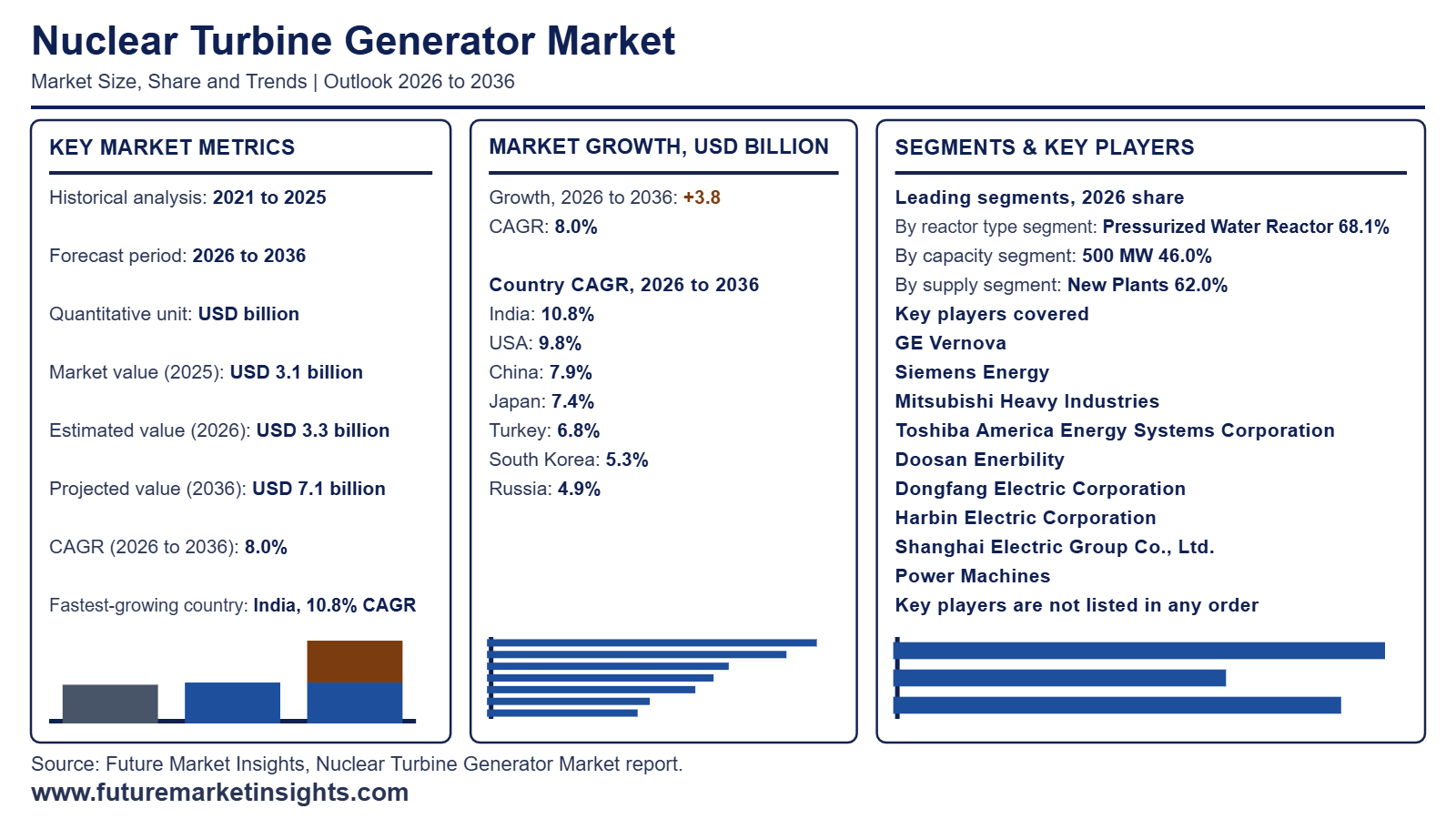
Global nuclear turbine generator market evolved from a 2025 valuation of USD 3.1 billion to USD 3.3 billion in 2026, and is set to achieve USD 7.1 billion by 2036, reflecting an 8.0% CAGR. FMI analysis suggests that heavy-machinery investment in conventional-island turbine packages and high-pressure rotor uprates is projected to create an incremental opportunity of USD 3.8 billion over the decade as utilities accelerate buyer adoption and convert reactor construction approvals into firm steam turbine and generator orders.
| Market Metric | Valuation / Share / Forecast Benchmark |
|---|---|
| 2025 Market Size (Historical) | USD 3.1 billion |
| 2026 Market Size (Estimated) | USD 3.3 billion |
| 2036 Market Size (Projected) | USD 7.1 billion |
| Compound Annual Growth Rate (2026 to 2036) | 8.0% CAGR |
| Incremental Dollar Opportunity (2026 to 2036) | USD 3.8 billion |
| Dominant Reactor Type Segment (2026 Share) | Pressurized Water Reactor (68.1% share in 2026) | Other Segment Combined (31.9%) |
| Leading Capacity Segment (2026 Share) | 1,000 MW to 1,500 MW (46.0% share in 2026) | Other Segment Combined (54.0%) |
| Leading Supply Segment (2026 Share) | New Plants (62.0% share in 2026) | Other Segment Combined (38.0%) |
| Leading Speed Segment (2026 Share) | Half-Speed 1,500 Rpm (40.0% share in 2026) | Other Segment Combined (60.0%) |
| Fastest-Growing Country Markets (2026 to 2036) | India (10.8% CAGR), USA (9.8% CAGR), China (7.9% CAGR) |
| Leading Tier-1 Companies | GE Vernova, Siemens Energy, Mitsubishi Heavy Industries, Toshiba America Energy Systems Corporation, Doosan Enerbility, Dongfang Electric Corporation, Harbin Electric Corporation, Shanghai Electric Group Co., Ltd., Power Machines, Bharat Heavy Electricals Limited |
Source: Future Market Insights analysis of the nuclear turbine generator market, 2026.
Executive Market Overview
Sales of nuclear turbine generators are rising due to sovereign baseload reactor approvals and utility machinery investment in high-pressure steam-path uprates across existing nuclear fleets. Once a utility pours first safety-related concrete for a nuclear station, procurement teams lock in steam turbine rotors, moisture separator reheaters, and synchronous generators years in advance beside pressurized water reactor systems. Global construction tracking by the International Energy Agency (January 2025) confirms 63 nuclear reactors totaling over 70 GW under construction, and the International Energy Agency (2026) recorded ten new reactor construction starts during 2025, which directly drives order backlogs for conventional-island rotating equipment. FMI finds that country-wise expansion is led by India at a 10.8% CAGR, the USA at 9.8%, and China at 7.9%, outpacing Russia at 4.9% owing to fleet-mode 700 MW PHWR orders in India, plant restarts and uprates in the United States, and serial Hualong One approvals in China.
Industry expansion faces manufacturing restraints from ultra-heavy monoblock rotor forging lead times, wet-steam blade erosion rules, and tight refueling outage windows that limit supplier switching. Turbine builders are addressing these bottlenecks through strategic investments in standardized low-pressure blade modules and regional joint ventures, as seen when Doosan Enerbility (February 2026) signed a contract with subsidiary Doosan Škoda Power to supply steam turbines and control systems for Czech Dukovany Units 5 and 6. Analysts at FMI have noted that general steam turbines are projected to grow at a 2.5% CAGR and steam turbine services at 6.3% through 2036, whereas nuclear turbine generators advance faster at 8.0% due to multi-gigawatt nuclear buildouts and SMR turbine islands beside nuclear engineering services at 6.8%. Market scope covers nuclear steam turbine-generator trains and nuclear-specific uprate services, excluding nuclear fuel and reactor-island steam generators.
This Report Answers
- How large the nuclear turbine generator market is in 2026 and what valuation it reaches by 2036
- Which reactor type, capacity, supply, and speed segments lead buyer preference in 2026
- Which reactor construction programs and steam-path uprates drive sales and which forging bottlenecks restrain market growth
- Which seven profiled countries are projected to grow fastest between 2026 and 2036
- How Siemens Energy, Doosan Enerbility, BHEL, and Chinese turbine manufacturers execute conventional-island packages
- How the nuclear turbine generator market is defined, segmented, and measured across regions
Analyst Perspective
"Turbine-island manufacturers are projected to expand operating margins by combining standardized 1,500 rpm low-pressure rotor production for serial pressurized water reactors with high-margin high-pressure steam-path uprates across operating North American and European plants. Ultra-heavy alloy steel forging bottlenecks and refueling outage schedule alignment remain the primary risks capable of delaying equipment revenue recognition."
- Nikhil Kaitwade, Principal Consultant, Future Market Insights.
Key Market Trends & Insights
- Serial Hualong One and VVER-1200 Approvals Drive Multi-Unit Equipment Orders: Utility preference for standardized Generation III+ reactor designs is accelerating repeat orders for identical 1,500 rpm steam turbine-generator trains across multi-unit sites. Standardized replication of validated low-pressure blade profiles and stator windings across consecutive units cuts engineering overhead compared with custom thermal machines or gas turbines. In July 2026, China General Nuclear Power Group (July 2026) confirmed State Council approval of eight nuclear units across four projects including six Hualong One reactors, while Dongfang Electric Corporation (April 2026) placed its Hualong One turbine-generator at San'ao Unit 1 into operation. FMI predicts serial multi-unit procurement is expected to sustain factory order books through 2036.
- High-Pressure Turbine Retrofits and Stator Replacements Lift Fleet Output: Machinery investment in existing nuclear stations is rising as operators replace high-pressure turbine cylinders and generator stators during scheduled outages to gain 30 MW to 50 MW of extra carbon-free power per unit without altering the reactor core. Steam-path aerodynamic upgrades and synchronous condensers gives utilities rapid payback under industrial power contracts. Bruce Power (November 2025) signed an exclusive agreement with Siemens Energy Canada for new high-pressure steam turbines across Bruce A Units 1 to 4 adding over 30 MW per unit, and Doosan Škoda Power (September 2025) won a generator replacement contract for Czech Temelín Units 1 and 2. Market tracking by FMI shows power-uprate retrofits are anticipated to drive steady aftermarket revenue through 2036.
- Small Modular Reactor Partnerships Standardize Compact Turbine Islands: Strategic investments in small modular reactor programs are prompting developers to lock in exclusive turbine-island suppliers during front-end engineering so 300 MW to 470 MW turbine skids can be factory-built. Pre-engineering compact steam turbines with modular condensers and cooling towers shortens site construction schedules and lowers project financing risk. Rolls-Royce SMR (February 2025) selected Siemens Energy as exclusive partner to design, manufacture, and commission the complete turbine system for its modular reactor fleet. FMI believes standardized SMR conventional islands are projected to open a major new equipment sales channel through 2036.
What Are the Main Drivers, Restraints, and Opportunities?
Sovereign reactor construction starts and existing-fleet power uprates drive nuclear turbine-generator sales, whereas heavy rotor forging bottlenecks and wet-steam qualification rules restrain delivery speed, leaving shuttered plant restarts and standardized SMR turbine packages as key growth opportunities.
Driver: Sovereign Nuclear Baseload Construction and Fleet Life-Extension Programs
Demand for nuclear turbine generators is growing owing to national energy-security policies and industrial baseload electricity requirements that are converting reactor announcements into poured concrete. Because forging and machining a nuclear low-pressure rotor and generator stator takes three to four years, utilities issue conventional-island equipment awards early in the construction schedule beside heat recovery system generators. Global nuclear tracking by the International Energy Agency (2026) confirms that ten reactors began construction in 2025, while the Nuclear Power Corporation of India Limited (August 2026) documented March 2026 first concrete at Kaiga Units 5 and 6 with Bharat Heavy Electricals Limited managing the turbine-island package. FMI's demand analysis indicates that multi-unit baseload buildouts are expected to sustain equipment orders through 2036.
Restraint: Ultra-Heavy Monoblock Forging Limits and Wet-Steam Qualification Hurdles
Market growth is restrained by the narrow global supply of 200-ton nuclear-grade alloy steel rotor forgings and the strict mechanical qualification required for saturated wet-steam operation. Nuclear steam turbines operate at lower temperatures and higher moisture levels than fossil boilers, requiring specialized moisture extraction grooves and long last-stage blades that prevent general process plants gas turbines suppliers from bidding. Technical documentation from Siemens Energy (2026) and Arabelle Solutions (2026) shows that nuclear low-pressure rotors must be validated for 60-year fatigue life against water-droplet erosion. In addition, International Energy Agency (January 2025) nuclear financing studies note that construction risks and supply-chain bottlenecks penalize late design changes, which researchers at FMI point out is expected to restrict new supplier entry.
Opportunity: Shuttered Nuclear Station Restarts and Pre-Engineered SMR Turbine Trains
Key opportunities for market expansion are emerging from the recommissioning of idled nuclear power stations in North America and Japan and from repeatable turbine-generator packages for small modular reactors. Reactivation of a preserved nuclear unit requires comprehensive steam-path re-blading, stator rewinding, and digital control retrofits across the turbine hall beside turbine inlet cooling systems. Project records from Siemens Energy (April 2025) detail steam turbine and generator refurbishment work supporting the historic restart of the Palisades Nuclear Power Plant in Michigan, and the U.S. Department of Energy (May 2026) confirmed federal support for reactor restarts and uprates one year after the May 2025 executive orders. FMI expects plant restarts and SMR fleet rollouts to generate high-margin orders through 2036.
How Is the Nuclear Turbine Generator Market Segmented?
Nuclear Turbine Generator Market is segmented by Reactor Type, Capacity, Supply, Speed, and Region. Forecast period from 2026 to 2036.
| Segmentation Axis | Sub-Segments Covered | 2026 Leading Segment & Share | Other Segment Combined & Total |
|---|---|---|---|
| Reactor Type | Pressurized Water Reactor, Pressurized Heavy Water Reactor, Boiling Water Reactor, Small Modular and Advanced Reactors | Pressurized Water Reactor (68.1% share in 2026) | Other Segment Combined (31.9%) | Total (100.0%) |
| Capacity | 1,000 MW to 1,500 MW, 600 MW to 1,000 MW, Below 600 MW, Above 1,500 MW | 1,000 MW to 1,500 MW (46.0% share in 2026) | Other Segment Combined (54.0%) | Total (100.0%) |
| Supply | New Plants, Retrofit and Replacement, Uprates, Life-Extension Services | New Plants (62.0% share in 2026) | Other Segment Combined (38.0%) | Total (100.0%) |
| Speed | Half-Speed 1,500 Rpm, Half-Speed 1,800 Rpm, Full-Speed 3,000 Rpm, Full-Speed 3,600 Rpm | Half-Speed 1,500 Rpm (40.0% share in 2026) | Other Segment Combined (60.0%) | Total (100.0%) |
| Region | North America, Latin America, Western Europe, Eastern Europe, East Asia, South Asia and Pacific, Middle East and Africa | East Asia & North America (fastest growth in India at 10.8% CAGR) | Global Coverage Across 7 Core Countries (100.0%) |
Source: Future Market Insights analysis of the nuclear turbine generator market, 2026.
Why Does the Pressurized Water Reactor Segment Dominate Reactor Type Demand?
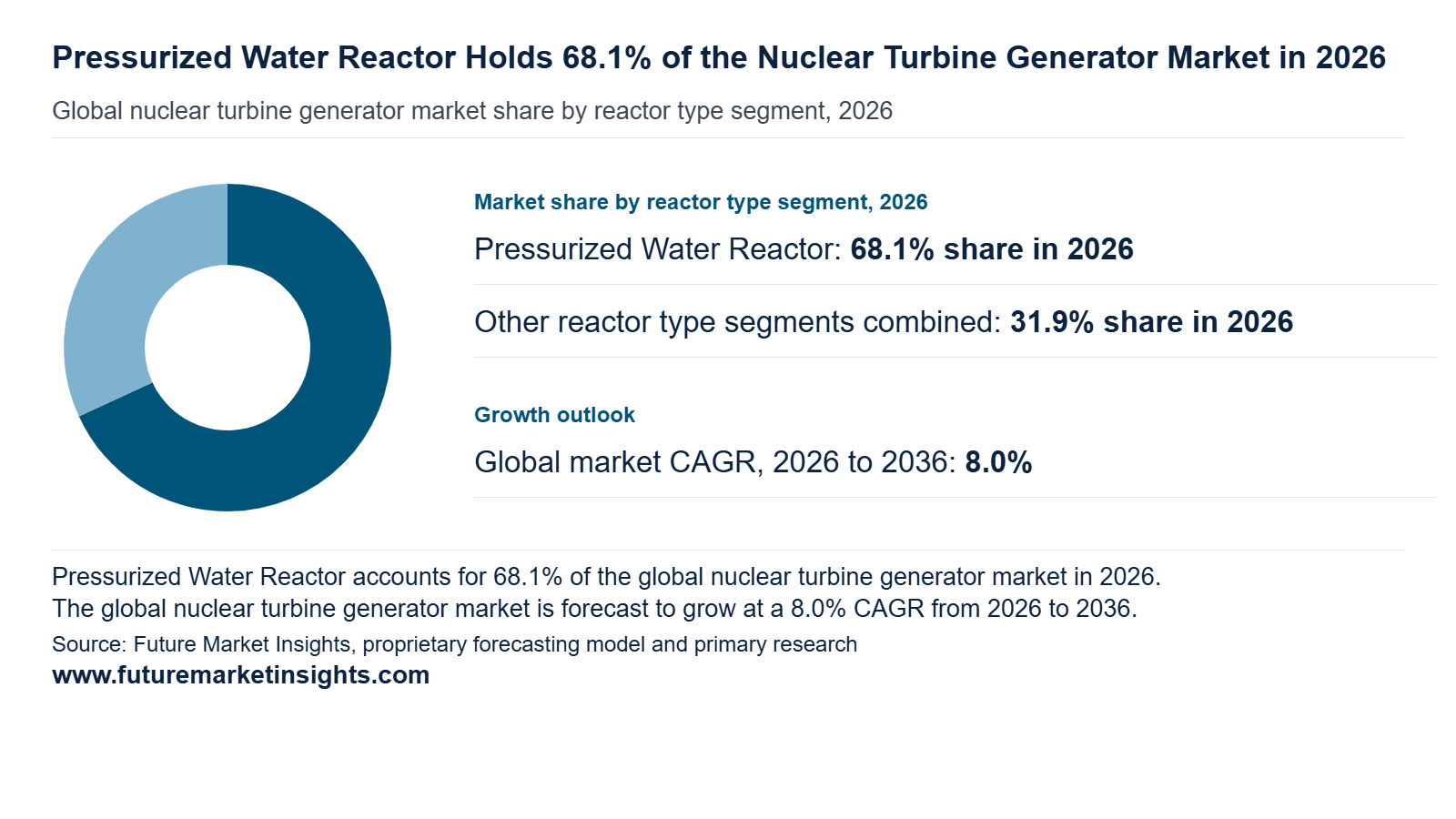
In 2026, 68.1% of reactor type demand is accounted for by pressurized water reactor systems, driven by indirect steam-cycle architecture that keeps radioactive primary coolant out of the turbine hall and lowers maintenance costs. Standardized national build programs for Hualong One, VVER-1200, APR1400, and AP1000 reactors allow turbine manufacturers to reuse validated cylinder castings and moisture separator reheaters across multiple plant sites. Official disclosures from China General Nuclear Power Group (July 2026) confirming State Council approval of six Hualong One reactors within an eight-unit batch and Doosan Enerbility (February 2026) contracting steam turbines for two Czech Dukovany PWR units show why this reactor design anchors supplier backlogs. FMI suggests that serial PWR construction pipelines are expected to preserve this dominant share through 2036.
What Anchors the 1,000 MW to 1,500 MW Band as the Leading Capacity Segment?
Utility buyer preference for grid-scale Generation III+ reactor blocks places the 1,000 MW to 1,500 MW segment at 46.0% of capacity demand in 2026. One tandem-compound turbine-generator train in this rating band absorbs the entire steam flow of a 1,100 MW to 1,400 MW reactor while staying within proven monoblock rotor forging and rail-transport limits beside power generation gas turbines. Project commissioning records from Harbin Electric Corporation (November 2025) documenting the 1,500 rpm steam test of its Hualong One turbine-generator at Hainan Changjiang Unit 3 and TITAN-2 Holding (May 2026) connecting the Kursk NPP-2 Unit 1 VVER-TOI turbine train to the grid confirm industry convergence around this rating. Analysts at FMI note that repeatable gigawatt-class reactor specifications are projected to keep 1,000 MW to 1,500 MW units ahead through 2036.
How Do New Plants Shape Purchasing Across the Supply Segment?
New plants capture 62.0% of supply segment sales in 2026, owing to the complete scope of high-pressure and low-pressure turbine cylinders, synchronous generator stators, exciters, and governing systems purchased under greenfield reactor capital budgets. While retrofit and uprate contracts replace selected rotors during outages, a new plant order covers hundreds of tons of precision rotating machinery. Annual filings from the Nuclear Power Corporation of India Limited (August 2026) confirming March 2026 first concrete and BHEL turbine-island execution at Kaiga Units 5 and 6 and Shanghai Electric Group Co., Ltd. (April 2026) reporting RMB 9.9 billion in 2025 nuclear equipment orders (+25.4% year-on-year) demonstrate how new reactor starts drive revenue. FMI predicts greenfield conventional-island awards will remain the primary revenue source through 2036.
Why Is Half-Speed 1,500 Rpm Prevalent in the Speed Category?
Within speed classifications, 40.0% of 2026 demand is held by half-speed 1,500 rpm systems due to widespread 50 Hz grid standards across China, India, Europe, Russia, and Turkey where four-pole generators allow longer last-stage low-pressure blades. Operation of a large nuclear turbine rotor at 1,500 rpm instead of 3,000 rpm cuts centrifugal stress in half, enabling wider exhaust areas that handle high volumes of wet nuclear steam with minimal blade erosion. Technical specifications from Mitsubishi Heavy Industries (2025) and Arabelle Solutions (2026) covering 1,500 rpm nuclear steam turbines rated up to 1,770 MW confirm strong utility preference for four-pole half-speed shaft lines. FMI survey reflects that 50 Hz baseload reactor expansion in Asia and Europe is anticipated to maintain half-speed 1,500 rpm leadership through 2036.
Regional & Country Outlook
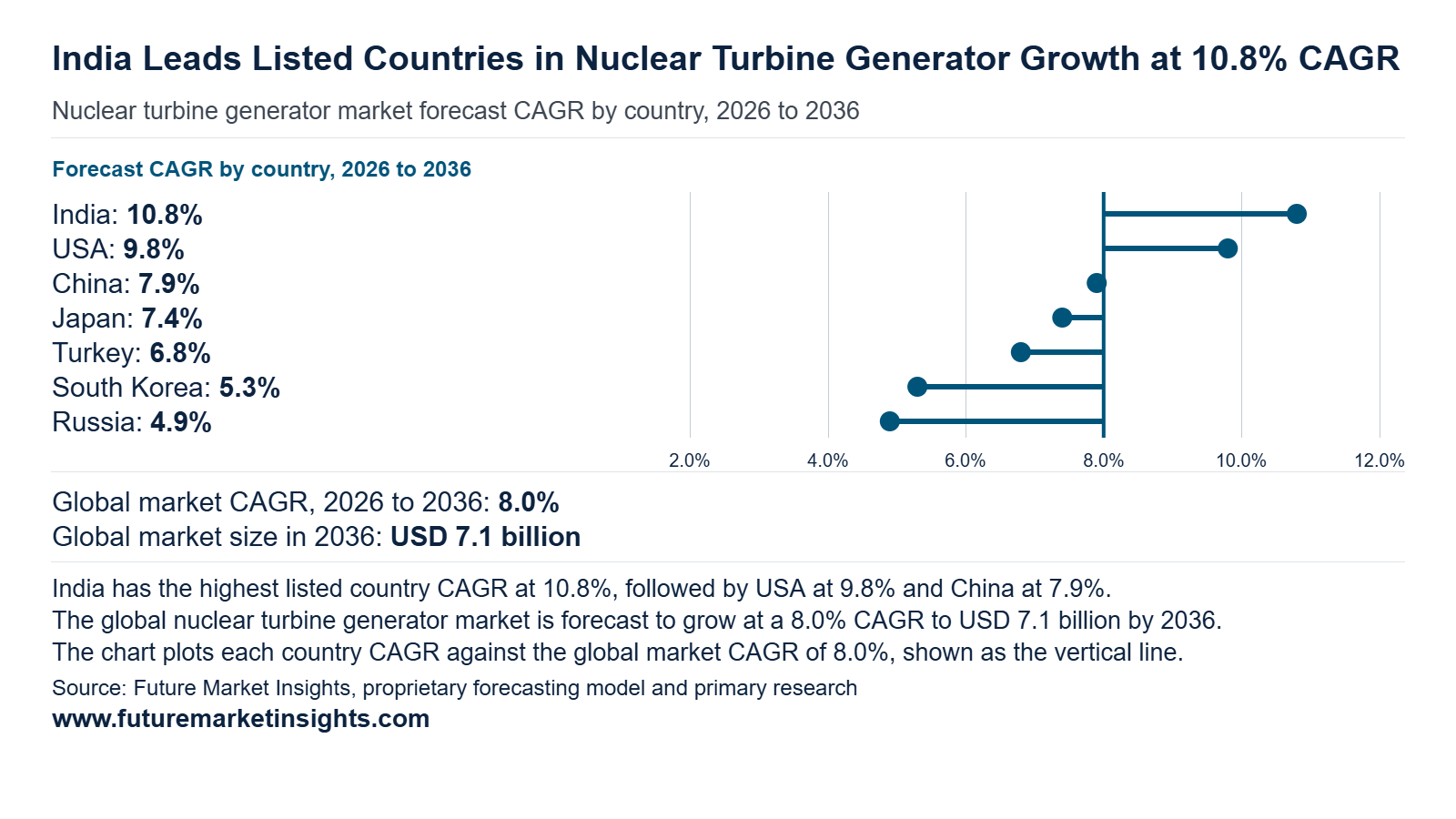
East Asia and North America lead global nuclear turbine generator demand through serial reactor buildouts and fleet power uprates, while South Asia and Pacific and Eastern Europe record rapid growth as domestic PHWR and VVER programs advance. FMI projects India to lead country growth at a 10.8% CAGR from 2026 to 2036, followed by the USA at 9.8% and China at 7.9%. Japan is projected to expand at 7.4%, Turkey at 6.8%, South Korea at 5.3%, and Russia at 4.9%, creating a 5.9% spread across the seven profiled countries as utilities align rotor procurement with grid frequency and domestic manufacturing rules.
| Country | 2026 Revenue | 2036 Revenue | 10-Year Addition | 2026 to 2036 CAGR | Global Share (2026 -> 2036) |
|---|---|---|---|---|---|
| India | USD 0.5 billion | USD 1.4 billion | +USD 0.9 billion | 10.8% | 15.2% -> 19.7% |
| USA | USD 0.7 billion | USD 1.8 billion | +USD 1.1 billion | 9.8% | 21.2% -> 25.4% |
| China | USD 1.1 billion | USD 2.4 billion | +USD 1.3 billion | 7.9% | 33.3% -> 33.8% |
| Japan | USD 0.2 billion | USD 0.4 billion | +USD 0.2 billion | 7.4% | 6.1% -> 5.6% |
| Turkey | USD 0.1 billion | USD 0.2 billion | +USD 0.1 billion | 6.8% | 3.0% -> 2.8% |
| South Korea | USD 0.2 billion | USD 0.3 billion | +USD 0.1 billion | 5.3% | 6.1% -> 4.2% |
| Russia | USD 0.3 billion | USD 0.5 billion | +USD 0.2 billion | 4.9% | 9.1% -> 7.0% |
Source: Future Market Insights analysis of the nuclear turbine generator market, 2026.
India
Demand for nuclear turbine generator across India is projected to climb from USD 0.5 billion in 2026 to USD 1.4 billion by 2036, advancing at a 10.8% CAGR, contributing +USD 0.9 billion in incremental revenue. Unlike Western markets that focus mainly on existing-plant uprates, India is executing fleet-mode bulk procurement of standardized 700 MW pressurized heavy water reactors and a dedicated Small Modular Reactor mission. Parliamentary records from the Press Information Bureau, Government of India (July 2026) outline a national target of 100 GW of nuclear capacity by 2047, while the Nuclear Power Corporation of India Limited (August 2026) confirmed March 2026 first concrete at Kaiga Unit 5 with Bharat Heavy Electricals Limited (February 2026) executing domestic turbine-island packages and overhauls. FMI predicts that localized PHWR fleet orders and SMR development are expected to drive rapid Indian expansion through 2036.
USA
Demand for nuclear turbine generator across USA is forecast to advance from USD 0.7 billion in 2026 to USD 1.8 billion by 2036, advancing at a 9.8% CAGR, contributing +USD 1.1 billion in incremental revenue. Rather than waiting a decade for greenfield gigawatt plants, U.S. nuclear operators are investing in steam-path upgrades that add dozens of megawatts during refueling outages. Official policy updates from the U.S. Department of Energy (May 2026) highlight accelerated reactor restarts and uprates one year after the May 2025 nuclear executive orders, while Siemens Energy (April 2025) is refurbishing the steam turbine and generator for the Palisades restart and GE Vernova (2026) delivers Advanced Steam Path upgrades. Analysts at FMI have noted that corporate clean-baseload contracts are projected to sustain U.S. turbine upgrades and SMR orders through 2036.
China
Demand for nuclear turbine generator across China is estimated to rise from USD 1.1 billion in 2026 to USD 2.4 billion by 2036, advancing at a 7.9% CAGR, contributing +USD 1.3 billion in incremental revenue. Chinese utilities achieve lower conventional-island capital costs and faster delivery by ordering standardized Hualong One equipment batches from domestic state manufacturers. Corporate disclosures from China General Nuclear Power Group (July 2026) confirm State Council approval of eight nuclear units including six Hualong One reactors, while Dongfang Electric Corporation (April 2026) commissioned the San'ao Unit 1 turbine-generator and Harbin Electric Corporation (November 2025) completed steam testing at Hainan Changjiang Unit 3. FMI suggests that serial coastal and inland reactor approvals are expected to anchor Chinese turbine production through 2036.
Japan
Demand for nuclear turbine generator across Japan is projected to expand from USD 0.2 billion in 2026 to USD 0.4 billion by 2036, advancing at a 7.4% CAGR, contributing +USD 0.2 billion in incremental revenue. Japanese utilities prioritize lifecycle modernization of existing turbine islands and engineering preparations for next-generation light water reactors. Government policy adopted by the Ministry of Economy, Trade and Industry of Japan (February 2025) under the Seventh Strategic Energy Plan maximizes nuclear reactor restarts to meet rising semiconductor and AI electricity demand, supported by domestic turbine engineering from Mitsubishi Heavy Industries (2025) and Toshiba America Energy Systems Corporation (June 2025). FMI's industry assessment indicates that phased station restarts are anticipated to support steady Japanese equipment orders through 2036.
Turkey
Demand for nuclear turbine generator across Turkey is anticipated to grow from USD 0.1 billion in 2026 to USD 0.2 billion by 2036, advancing at a 6.8% CAGR, contributing +USD 0.1 billion in incremental revenue. Unlike countries with older fleets requiring maintenance, Turkish demand is concentrated entirely in greenfield multi-unit erection and intergovernmental negotiations for second and third nuclear stations at Sinop and Thrace. Country nuclear records from the International Atomic Energy Agency (2026) document four VVER-1200 units under construction at Akkuyu, and TITAN-2 Holding (January 2026) confirmed the hydraulic rigging and installation of the turbine-generator stator in the Akkuyu Unit 2 turbine hall. FMI observes that sequential unit commissioning and new Black Sea plant tenders are expected to shape Turkish market growth through 2036.
South Korea
Demand for nuclear turbine generator across South Korea is projected to climb from USD 0.2 billion in 2026 to USD 0.3 billion by 2036, advancing at a 5.3% CAGR, contributing +USD 0.1 billion in incremental revenue. South Korean equipment makers offset moderate domestic reactor additions by supplying turbine islands and rotors to international nuclear builds. Official project status records from Korea Hydro & Nuclear Power (2026) document first concrete at Shin-Hanul Unit 3 in May 2025 and Unit 4 milestones in 2026, while Doosan Enerbility (February 2026) signed a contract with subsidiary Doosan Škoda Power to supply steam turbines and control systems for Czech Dukovany Units 5 and 6. FMI expects domestic APR1400 completion and European nuclear export orders to underpin South Korean manufacturing through 2036.
Russia
Demand for nuclear turbine generator across Russia is forecast to advance from USD 0.3 billion in 2026 to USD 0.5 billion by 2036, advancing at a 4.9% CAGR, contributing +USD 0.2 billion in incremental revenue. Russian conventional-island demand is served domestically by Power Machines, with order timing governed by Rosatom's phased domestic construction calendar. Project commissioning disclosures from TITAN-2 Holding (May 2026) confirm that Kursk NPP-2 Unit 1 entered regular grid operation on 1 May 2026 using a low-speed turbine-generator train supplied by Power Machines (2026). Researchers at FMI point out that domestic fleet replacement schedules and VVER-TOI replication across follow-on Russian units will decide the pace of equipment orders through 2036.
Competitive Environment and Notable Companies
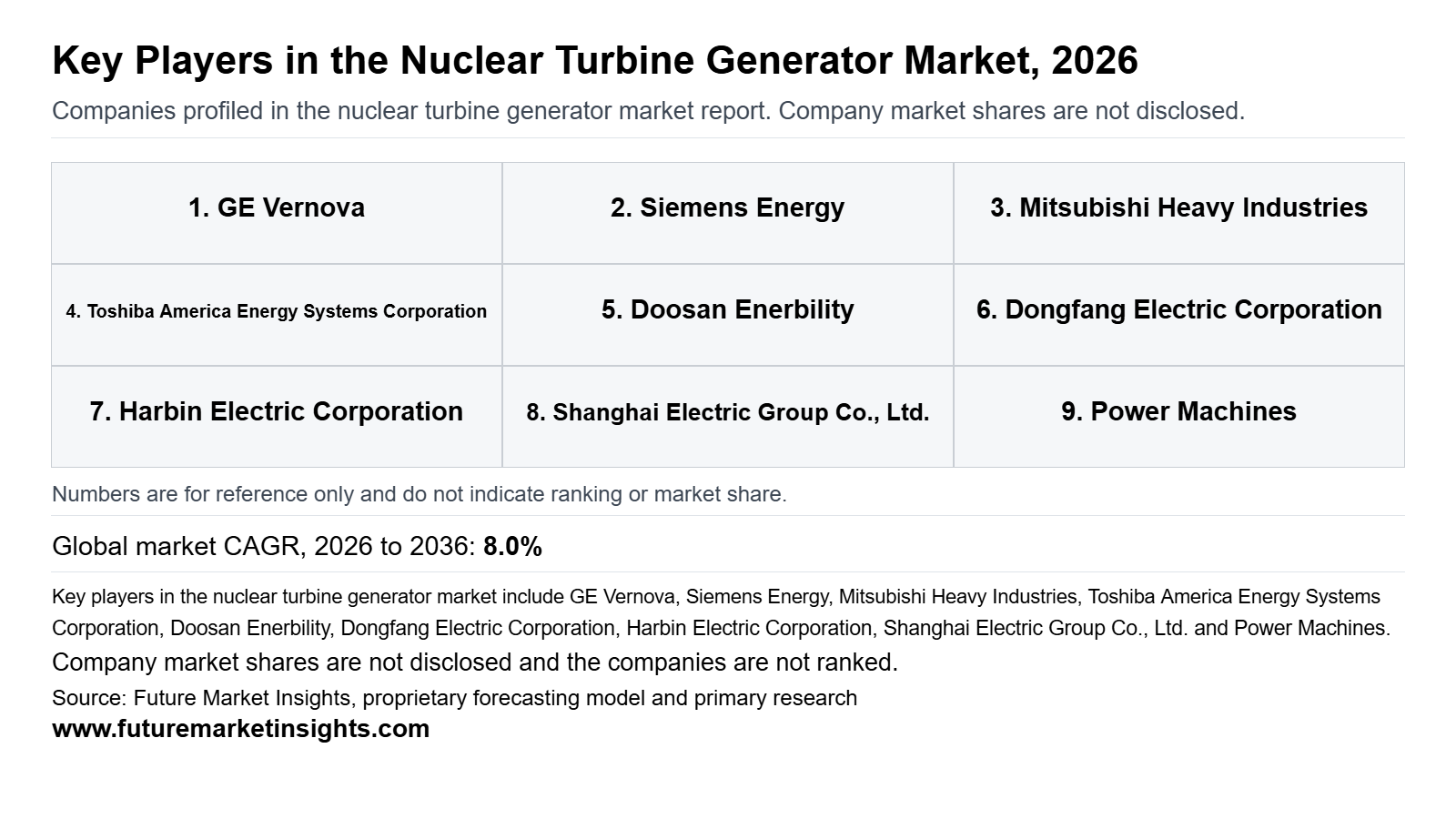
Notable companies operating in the global nuclear turbine generator market include GE Vernova, Siemens Energy, Mitsubishi Heavy Industries, Toshiba America Energy Systems Corporation, Doosan Enerbility, Dongfang Electric Corporation, Harbin Electric Corporation, Shanghai Electric Group Co., Ltd., Power Machines, and Bharat Heavy Electricals Limited (BHEL). FMI's competitive survey identifies three supplier groups: international nuclear turbine-island OEMs executing cross-border new builds, SMR partnerships, and fleet uprates; Chinese state-owned heavy electrical groups supplying serial Hualong One and CAP1000 plants; and domestic specialists serving national PHWR and VVER programs.
How Are Companies Positioned in the Nuclear Turbine Generator Market?
Siemens Energy, Mitsubishi Heavy Industries, Toshiba America Energy Systems Corporation, and Doosan Enerbility lead cross-border nuclear steam turbine engineering, uprates, and SMR partnerships, while EDF's Arabelle Solutions (2026) operates the Arabelle nuclear steam turbine new-build business and GE Vernova (2026) retains Americas nuclear turbine services and BWRX-300 SMR capabilities. Dongfang Electric Corporation, Harbin Electric Corporation, and Shanghai Electric Group Co., Ltd. supply Chinese reactor builds, whereas According to FMI analysis, Power Machines serves Russian VVER plants and Bharat Heavy Electricals Limited anchors India's PHWR fleet.
What Matters When a Buyer Selects a Nuclear Turbine Generator Supplier?
Nuclear utility procurement boards evaluate suppliers on documented operating references at matching reactor thermal ratings, 50 Hz or 60 Hz shaft-line torsional stability, monoblock low-pressure rotor forging access, and outage replacement speed. FMI finds that utilities contracting power uprates with Siemens Energy (November 2025) at Bruce Power or Doosan Škoda Power (September 2025) at Temelín require guaranteed megawatt output gains within existing condenser and turbine-pedestal dimensions.
Which Capabilities Distinguish Product Offers?
Technical differentiation centers on welded versus monoblock low-pressure rotor construction, last-stage titanium or high-alloy blade length, and digital electro-hydraulic governing systems. Mitsubishi Heavy Industries (2025) and Siemens Energy (2026) engineer long last-stage blades for 1,500 rpm and 1,800 rpm wet-steam service, while GE Vernova (2026) offers pre-engineered Advanced Steam Path (ASP) upgrades that shorten outage durations by up to 20 days. Analysts at FMI note that Harbin Electric Corporation (November 2025) and Dongfang Electric Corporation (April 2026) differentiate through integrated 1,500 rpm Hualong One turbine-generator sets.
How Does Geographic Reach Affect Competition?
Bilateral nuclear cooperation treaties and national localization mandates strongly govern supplier eligibility. Dongfang Electric Corporation, Harbin Electric Corporation, and Shanghai Electric Group Co., Ltd. (April 2026) capture domestic Chinese builds, whereas Bharat Heavy Electricals Limited (February 2026) holds entrenched localization advantages across Indian NPCIL plants. FMI observes that Doosan Enerbility (February 2026) uses its Czech subsidiary Doosan Škoda Power to win European Union nuclear tenders, while Siemens Energy and GE Vernova lead North American and Western European uprates.
| Verified Company Evidence (2025 to 2026) | Market & Adoption Impact | Buyer Procurement Action |
|---|---|---|
| February 2026: Doosan Enerbility signed a contract with subsidiary Doosan Škoda Power to supply steam turbines and turbine control systems for Dukovany Units 5 and 6 in the Czech Republic (Doosan Enerbility, February 2026). | Establishes a combined Korean-Czech manufacturing supply chain for European new-build nuclear conventional islands. | Evaluate localized European subsidiary fabrication when tendering Generation III+ turbine islands. |
| November 2025: Bruce Power signed an exclusive agreement with Siemens Energy Canada to supply new high-pressure steam turbines for Bruce A Units 1 to 4, adding over 30 MW per unit (Bruce Power, November 2025). | Demonstrates capital-efficient megawatt uprates across operating PHWR/CANDU nuclear fleets without reactor core changes. | Audit high-pressure cylinder efficiency during planned life-extension outages to capture uprate megawatts. |
| April 2026: Dongfang Electric Corporation's Hualong One turbine-generator set at San'ao Nuclear Power Unit 1 entered operation (Dongfang Electric Corporation, April 2026). | Validates serial domestic delivery of 1,200 MW-class half-speed nuclear turbine-generator trains in China. | Benchmark serial rotor manufacturing lead times across standardized Hualong One conventional islands. |
| February 2025: Rolls-Royce SMR selected Siemens Energy as exclusive turbine-systems partner for its modular nuclear fleet (Rolls-Royce SMR, February 2025). | Locks in standardized conventional-island turbine design, manufacture, and commissioning for 470 MW SMR units. | Pre-qualify standardized turbine-generator skids during SMR front-end engineering design. |
Source: Verified corporate disclosures and Future Market Insights analysis, 2026.
| Company | Core Positioning | Verified Activity & Source Attribution |
|---|---|---|
| GE Vernova | Americas nuclear steam turbine services, Advanced Steam Path uprates, and BWRX-300 SMR solutions | Markets Advanced Steam Path upgrades delivering up to 2.2% to 15% output gains and supports Americas nuclear turbine islands (GE Vernova, 2026). |
| Siemens Energy | Large nuclear steam turbines, HP rotor uprates, plant restarts, and SMR turbine islands | Partnered with Rolls-Royce SMR in February 2025, supported the Palisades restart in April 2025, and won the Bruce A HP turbine upgrade in November 2025 (Siemens Energy, April 2025). |
| Mitsubishi Heavy Industries | 1,500 rpm and 1,800 rpm nuclear steam turbines and integrated generator sets | Supplies large nuclear steam turbines with welded rotors and expanded nuclear energy division revenue in its 2025 annual report (Mitsubishi Heavy Industries, 2025). |
| Toshiba America Energy Systems Corporation | Nuclear steam turbine-generators, TX-10 series turbines, and North American uprate services | Published updated nuclear steam turbine generator technical specifications in June 2025 covering high-pressure and double-flow low-pressure units (Toshiba America Energy Systems Corporation, June 2025). |
| Doosan Enerbility | APR1400/APR1000 nuclear steam turbines, generators, and European execution via Doosan Škoda Power | Contracted in February 2026 to supply steam turbines for Czech Dukovany Units 5 and 6; subsidiary Doosan Škoda Power won Temelín generator replacements in September 2025 (Doosan Enerbility, February 2026). |
| Dongfang Electric Corporation | 1,500 rpm Hualong One and CAP1400 nuclear steam turbine-generator packages | Placed the Yangtze River Delta Hualong One turbine-generator at San'ao Unit 1 into operation in April 2026 (Dongfang Electric Corporation, April 2026). |
| Harbin Electric Corporation | Large nuclear steam turbines and synchronous generators for Hualong One and VVER units | Completed 1,500 rpm non-nuclear steam commissioning for the Hainan Changjiang Unit 3 Hualong One turbine-generator in November 2025 (Harbin Electric Corporation, November 2025). |
| Shanghai Electric Group Co., Ltd. | Shanghai Electric Group nuclear conventional-island steam turbines and stators | Reported RMB 9.9 billion (+25.4% YoY) in 2025 nuclear power equipment orders at its April 2026 annual results briefing (Shanghai Electric Group Co., Ltd., April 2026). |
| Power Machines | 1,500 rpm and 3,000 rpm VVER nuclear steam turbines and turbogenerators | Supplied the turbine-generator set for Kursk NPP-2 Unit 1, which was commissioned for regular grid supply in May 2026 (Power Machines, 2026). |
| Bharat Heavy Electricals Limited (BHEL) | Indigenous 700 MW PHWR nuclear steam turbine-generator trains and overhaul services | Executing the turbine-island package for Kaiga Units 5 and 6 (first concrete March 2026) and issued Kaiga Unit 1 turbine overhaul tenders in February 2026 (Bharat Heavy Electricals Limited, February 2026). |
Source: Verified corporate disclosures and Future Market Insights analysis, 2026.
Key takeaways from the Nuclear Turbine Generator Market Report
- The market is estimated at USD 3.3 billion in 2026, on track to reach USD 7.1 billion by 2036.
- Over the ten-year forecast period, the market is expected to add USD 3.8 billion at a 8.0% CAGR.
- Reactor type demand is led by pressurized water reactor at 68.1% share in 2026.
- Units rated 1,000 MW to 1,500 MW hold 46.0% of capacity share, while new plants account for 62.0% of supply in 2026.
- India is forecast to grow at a notable 10.8% CAGR, ahead of USA at 9.8% and China at 7.9%.
Nuclear Turbine Generator Market-Report Scope and Research Methodology
FMI analysts size the global nuclear turbine generator market through primary interviews with nuclear steam-turbine and generator manufacturers, heavy forging foundries, nuclear utility conventional-island engineering directors, and EPC procurement managers, combined with desk research across international atomic energy registries, national nuclear regulator filings, and corporate disclosures. Core 2025 and 2026 valuations reconcile new-build turbine-generator train milestones, high-pressure and low-pressure rotor uprate contracts, and stator replacement awards across all seven tracked countries and regional clusters. Segment shares across Reactor Type, Capacity, Supply, and Speed axes are cross-checked against reactor construction starts and outage schedules, while excluding reactor-island nuclear steam supply systems, nuclear fuel assemblies, standalone electricity sales, and fossil or hydro turbines to prevent double counting.
| Coverage Field | Report Scope |
|---|---|
| Market Definition | Revenue from nuclear-power steam turbine-generator trains (high-pressure and low-pressure turbines, moisture separator reheaters, synchronous generators, exciters, and turbine controls) and nuclear-specific uprate, refurbishment, and life-extension services. |
| Reactor Type Segments | Pressurized Water Reactor, Pressurized Heavy Water Reactor, Boiling Water Reactor, and Small Modular and Advanced Reactors. |
| Capacity Segments | 1,000 MW to 1,500 MW, 600 MW to 1,000 MW, Below 600 MW, and Above 1,500 MW. |
| Supply Segments | New Plants, Retrofit and Replacement, Uprates, and Life-Extension Services. |
| Speed Segments | Half-Speed 1,500 Rpm, Half-Speed 1,800 Rpm, Full-Speed 3,000 Rpm, and Full-Speed 3,600 Rpm. |
| Exclusions | Reactor-island steam generators and pressure vessels, nuclear fuel fabrication, downstream wholesale or retail electricity revenue, and fossil-fired, geothermal, or hydro turbines. |
| Quantitative Units | USD Billion for global market sizing; CAGR (%) for country and global growth rates. |
| Historical & Base Years | 2025 (Historical) and 2026 (Estimated Base Year). |
| Forecast Period | 2026 to 2036 (10-Year Projection Window). |
| Regions Covered | North America, Latin America, Western Europe, Eastern Europe, East Asia, South Asia and Pacific, and Middle East and Africa. |
| Countries Profiled | India, USA, China, Japan, Turkey, South Korea, and Russia. |
| Companies Covered | GE Vernova, Siemens Energy, Mitsubishi Heavy Industries, Toshiba America Energy Systems Corporation, Doosan Enerbility, Dongfang Electric Corporation, Harbin Electric Corporation, Shanghai Electric Group Co., Ltd., Power Machines, and Bharat Heavy Electricals Limited (BHEL). |
| Research Approach | Primary conventional-island OEM, forging supplier, and nuclear utility interviews combined with secondary IAEA, IEA, national energy ministry, and corporate disclosure triangulation. |
Source: Future Market Insights analysis of the nuclear turbine generator market, 2026.
Research Sources and Bibliography
- Arabelle Solutions. (2026). Arabelle Nuclear Steam Turbine for Large Reactors Technical Portfolio. https://www.arabellesolutions.com/en/our-technology/pioneering-steam-turbines/arabelle-turbine-for-large-reactors
- Bharat Heavy Electricals Limited. (2026, February 13). Overhauling of HP and LP Turbines, Generator Rotor Installation and Related Works at Kaiga Unit 1. https://tenders.bhel.com/overhauling-hp-and-lp-turbines-generator-rotor-installation-governing-system-overhauling-hp
- Bruce Power. (2025, November 24). Bruce Power Signs Exclusive Agreement with Siemens Energy Canada for New Steam Turbines. https://www.brucepower.com/2025/11/24/bruce-power-signs-exclusive-agreement-with-siemens-energy-canada-for-new-steam-turbines-to-increase-output-power-ontarios-clean-energy-future/
- China General Nuclear Power Group. (2026, July 31). Hualong One 2.0 Demonstration Projects Approved by State Council. https://en.cgnpc.com.cn/encgn/pressReleases/2026-09/21/content_573fe17583974b3e99b955868bb1e558.shtml
- Dongfang Electric Corporation. (2026, April 30). Yangtze River Delta Hualong One Nuclear Power Unit at San'ao Enters Operation. https://www.dongfang.com/info/1643/20556.htm
- Doosan Enerbility. (2026, February 19). Doosan Enerbility Signs Steam Turbine Contract with Doosan Skoda Power for Czech Nuclear Power Plant. https://www.doosanenerbility.com/en/about/news_board_view?id=21000799&page=1&pageSize=9
- Doosan Škoda Power. (2025, September 10). The Largest Generator Replacement Contract in the History of Operating Czech NPPs Heads to Plzeň. https://www.doosanskodapower.com/en/about/news_board_view?id=21000815
- GE Vernova. (2026). Advanced Steam Path (ASP) Upgrade to Help Increase Steam Turbine Power Output. https://www.gevernova.com/gas-power/resources/articles/2026/advanced-steam-path-upgrade-to-help-increase-power
- Harbin Electric Corporation. (2025, November 8). Non-Nuclear Steam Commissioning of the No. 3 Turbine-Generator Set at Hainan Changjiang Phase II. https://www.htc.com.cn/ennewscenterv/3192.html
- International Atomic Energy Agency. (2026). Country Nuclear Power Profile: Türkiye Akkuyu VVER-1200 Construction Highlights. https://cnpp.iaea.org/public/countries/TR/profile/highlights
- International Energy Agency. (2026). Global Energy Review 2026: Technology-Nuclear Construction Starts. https://www.iea.org/reports/global-energy-review-2026/technology-nuclear
- International Energy Agency. (2025, January 16). The Path to a New Era for Nuclear Energy. https://www.iea.org/reports/the-path-to-a-new-era-for-nuclear-energy
- Korea Hydro & Nuclear Power. (2026). Shin-Hanul Units 3 and 4 Nuclear Construction Project Status. https://www.khnp.co.kr/eng/contents.do?key=4578
- Ministry of Economy, Trade and Industry of Japan. (2025, February 18). Cabinet Decision on the Seventh Strategic Energy Plan. https://www.meti.go.jp/english/press/2025/0218_001.html
- Mitsubishi Heavy Industries. (2025). MHI Report 2025: Nuclear Power and Steam Turbine Business Overview. https://www.mhi.com/finance/library/annual/pdf/report_2025.pdf
- Nuclear Power Corporation of India Limited. (2026, August 21). Annual Report FY 2025-26: Kaiga Units 5 and 6 First Concrete and Fleet Progress. https://npcil.nic.in/WriteReadData/userfiles/file/Annual_Report_FY_2025_26_21082026.pdf
- Power Machines. (2026). Nuclear Power Industry: High-Speed and Low-Speed Turbine Island and Turbogenerators. https://power-m.ru/en/customers/nuclear-energy/turbine-island/
- Press Information Bureau, Government of India. (2026, July 30). Parliament Question: Enhancing Nuclear Energy toward 100 GW Capacity by 2047. https://www.pib.gov.in/PressReleasePage.aspx?PRID=2291831&lang=2®=48
- Rolls-Royce SMR. (2025, February 28). Rolls-Royce SMR and Siemens Energy Partner in Small Modular Reactor Turbine Systems Deployment. https://www.rolls-royce-smr.com/press/rolls-royce-smr-and-siemens-energy-partner-in-small-modular-reactor-deployment
- Shanghai Electric Group Co., Ltd.. (2026, April 3). Shanghai Electric Holds 2025 Annual Results Briefing: Nuclear Equipment Orders Growth. https://www.shanghai-electric.com/listed_en/c/2026-04-03/591279.shtml
- Siemens Energy. (2025, April 25). Palisades Nuclear Power Plant, USA: Historic Restart and Steam Turbine Refurbishment. https://www.siemens-energy.com/global/en/home/references/recommissioning-palisades-nuclear.html
- Siemens Energy. (2026). Steam Turbine and Generator Solutions for Nuclear Power Plants. https://www.siemens-energy.com/global/en/home/products-services/product/nuclear-power-plant-solutions.html
- TITAN-2 Holding. (2026, January 15). A Turbine Generator Stator Has Been Installed in the Turbine Hall at the Akkuyu NPP Power Unit 2. https://www.titan2.ru/en/media-press/lenta-novostej/46-projects-news/2838-a-turbine-generator-stator-has-been-installed-in-the-turbine-hall-at-the-akkuyu-npp-power-unit-2
- TITAN-2 Holding. (2026, May 1). Power Unit 1 Officially Commissioned at Kursk NPP-2 Site in Kurchatov. https://www.titan2.ru/en/media-press/lenta-novostej/46-projects-news/2909-power-unit-1-officially-commissioned-at-kursk-npp-2-site-in-kurchatov
- Toshiba America Energy Systems Corporation. (2025, June). Nuclear Steam Turbine Generators Technical Brochure (TX-10 Series). https://toshiba.com/taes/wp-content/uploads/2025/06/Toshiba-stg_brochure.pdf
- U.S. Department of Energy. (2026, May 23). One Year After Executive Orders, U.S. Nuclear Energy Renaissance Is in Full Swing. https://www.energy.gov/ne/articles/one-year-after-executive-orders-us-nuclear-energy-renaissance-full-swing
Table of Content
- Key Takeaways
- Market Size and CAGR
- Top Growth Driver
- Fastest Growing Segment
- Leading Region
- Key Companies
- Emerging Opportunities
- Executive Summary
- Global Market Outlook
- Demand-side Trends
- Supply-side Trends
- Technology Roadmap Analysis
- Analysis and Recommendations
- Analyst Perspective (What is happening? Why now? What should investors know?)
- Key Questions Answered
- How large is the market?
- What is the CAGR?
- What are key trends?
- Which region dominates?
- Who are the leaders?
Read More...
- Market Overview
- Market Coverage / Taxonomy
- Market Definition / Scope / Limitations
- Research Methodology
- Chapter Orientation
- Analytical Lens and Working Hypotheses
- Market Structure, Signals, and Trend Drivers
- Benchmarking and Cross-market Comparability
- Market Sizing, Forecasting, and Opportunity Mapping
- Research Design and Evidence Framework
- Desk Research Programme (Secondary Evidence)
- Expert Input and Fieldwork (Primary Evidence)
- Tooling, Models, and Reference Databases
- Data Engineering and Model Build
- Quality Assurance and Audit Trail
- Market Background
- Market Dynamics (Drivers, Restraints, Opportunity, Trends)
- Scenario Forecast (Optimistic, Likely, Conservative)
- Impact Analysis
- AI Impact
- Sustainability Impact
- Regulatory Impact
- Technology Impact
- Consumer / Buyer Analysis
- Purchase Drivers
- Adoption Barriers
- Buyer Journey
- Opportunity Map Analysis
- Product Life Cycle Analysis
- Supply Chain Analysis
- Investment Feasibility Matrix
- Value Chain Analysis
- PESTLE and Porter's Analysis
- Regulatory Landscape
- Regional Parent Market Outlook
- Production and Consumption Statistics
- Import and Export Statistics
- Global Market Analysis and Forecast, 2021 to 2036
- Historical Market Size Value (USD Billion) Analysis, 2021 to 2025
- Current and Future Market Size Value (USD Billion) Projections, 2026 to 2036
- Y-o-Y Growth Trend Analysis
- Absolute $ Opportunity Analysis
- Global Market Pricing Analysis, 2021 to 2036
- Global Market Analysis and Forecast, By Reactor Type, 2021 to 2036
- Introduction / Key Findings
- Historical Market Size Value (USD Billion) Analysis By Reactor Type, 2021 to 2025
- Current and Future Market Size Value (USD Billion) Analysis and Forecast By Reactor Type, 2026 to 2036
- Pressurized Water Reactor
- Pressurized Heavy Water Reactor
- Boiling Water Reactor
- Small Modular and Advanced Reactors
- Y-o-Y Growth Trend Analysis By Reactor Type, 2021 to 2025
- Absolute $ Opportunity Analysis By Reactor Type, 2026 to 2036
- Global Market Analysis and Forecast, By Capacity, 2021 to 2036
- Introduction / Key Findings
- Historical Market Size Value (USD Billion) Analysis By Capacity, 2021 to 2025
- Current and Future Market Size Value (USD Billion) Analysis and Forecast By Capacity, 2026 to 2036
- 1
- 000 MW to 1
- 500 MW
- 600 MW to 1
- 000 MW
- Below 600 MW
- Above 1
- 500 MW
- Y-o-Y Growth Trend Analysis By Capacity, 2021 to 2025
- Absolute $ Opportunity Analysis By Capacity, 2026 to 2036
- Global Market Analysis and Forecast, By Supply, 2021 to 2036
- Introduction / Key Findings
- Historical Market Size Value (USD Billion) Analysis By Supply, 2021 to 2025
- Current and Future Market Size Value (USD Billion) Analysis and Forecast By Supply, 2026 to 2036
- New Plants
- Retrofit and Replacement
- Uprates
- Life-Extension Services
- Y-o-Y Growth Trend Analysis By Supply, 2021 to 2025
- Absolute $ Opportunity Analysis By Supply, 2026 to 2036
- Global Market Analysis and Forecast, By Speed, 2021 to 2036
- Introduction / Key Findings
- Historical Market Size Value (USD Billion) Analysis By Speed, 2021 to 2025
- Current and Future Market Size Value (USD Billion) Analysis and Forecast By Speed, 2026 to 2036
- Half-Speed 1
- 500 Rpm
- Half-Speed 1
- 800 Rpm
- Full-Speed 3
- 000 Rpm
- Full-Speed 3
- 600 Rpm
- Y-o-Y Growth Trend Analysis By Speed, 2021 to 2025
- Absolute $ Opportunity Analysis By Speed, 2026 to 2036
- Global Market Analysis and Forecast, By Region, 2021 to 2036
- Introduction
- Historical Market Size Value (USD Billion) Analysis By Region, 2021 to 2025
- Current Market Size Value (USD Billion) Analysis and Forecast By Region, 2026 to 2036
- North America
- Western Europe
- East Asia
- South Asia and Pacific
- Market Attractiveness Analysis By Region
- North America Market Analysis and Forecast, By Country, 2021 to 2036
- Historical Market Size Value (USD Billion) Trend Analysis By Market Taxonomy, 2021 to 2025
- Market Size Value (USD Billion) Forecast By Market Taxonomy, 2026 to 2036
- By Country
- United States
- Canada
- By Reactor Type
- By Capacity
- By Supply
- By Speed
- By Country
- Market Attractiveness Analysis
- By Country
- By Reactor Type
- By Capacity
- By Supply
- By Speed
- Key Takeaways
- Western Europe Market Analysis and Forecast, By Country
- Historical Market Size Value (USD Billion) Trend Analysis By Market Taxonomy, 2021 to 2025
- Market Size Value (USD Billion) Forecast By Market Taxonomy, 2026 to 2036
- By Country
- United Kingdom
- Germany
- France
- By Reactor Type
- By Capacity
- By Supply
- By Speed
- By Country
- Market Attractiveness Analysis
- By Country
- By Reactor Type
- By Capacity
- By Supply
- By Speed
- Key Takeaways
- East Asia Market Analysis and Forecast, By Country
- Historical Market Size Value (USD Billion) Trend Analysis By Market Taxonomy, 2021 to 2025
- Market Size Value (USD Billion) Forecast By Market Taxonomy, 2026 to 2036
- By Country
- China
- Japan
- South Korea
- By Reactor Type
- By Capacity
- By Supply
- By Speed
- By Country
- Market Attractiveness Analysis
- By Country
- By Reactor Type
- By Capacity
- By Supply
- By Speed
- Key Takeaways
- South Asia and Pacific Market Analysis and Forecast, By Country
- Historical Market Size Value (USD Billion) Trend Analysis By Market Taxonomy, 2021 to 2025
- Market Size Value (USD Billion) Forecast By Market Taxonomy, 2026 to 2036
- By Country
- India
- Australia
- Rest of world aggregate
- By Reactor Type
- By Capacity
- By Supply
- By Speed
- By Country
- Market Attractiveness Analysis
- By Country
- By Reactor Type
- By Capacity
- By Supply
- By Speed
- Key Takeaways
- Key Countries Market Analysis
- United States
- Pricing Analysis
- Market Share Analysis, 2025
- By Reactor Type
- By Capacity
- By Supply
- By Speed
- Canada
- Pricing Analysis
- Market Share Analysis, 2025
- By Reactor Type
- By Capacity
- By Supply
- By Speed
- Germany
- Pricing Analysis
- Market Share Analysis, 2025
- By Reactor Type
- By Capacity
- By Supply
- By Speed
- United Kingdom
- Pricing Analysis
- Market Share Analysis, 2025
- By Reactor Type
- By Capacity
- By Supply
- By Speed
- France
- Pricing Analysis
- Market Share Analysis, 2025
- By Reactor Type
- By Capacity
- By Supply
- By Speed
- India
- Pricing Analysis
- Market Share Analysis, 2025
- By Reactor Type
- By Capacity
- By Supply
- By Speed
- China
- Pricing Analysis
- Market Share Analysis, 2025
- By Reactor Type
- By Capacity
- By Supply
- By Speed
- Japan
- Pricing Analysis
- Market Share Analysis, 2025
- By Reactor Type
- By Capacity
- By Supply
- By Speed
- South Korea
- Pricing Analysis
- Market Share Analysis, 2025
- By Reactor Type
- By Capacity
- By Supply
- By Speed
- Australia
- Pricing Analysis
- Market Share Analysis, 2025
- By Reactor Type
- By Capacity
- By Supply
- By Speed
- United States
- Market Structure Analysis
- Competition Dashboard
- Competition Benchmarking
- Market Share Analysis of Top Players
- By Regional
- By Reactor Type
- By Capacity
- By Supply
- By Speed
- Emerging Startups
- Innovation Benchmarking
- Competition Analysis
- Competition Deep Dive
- GE Vernova
- Overview
- Product Portfolio
- Profitability by Market Segments
- Sales Footprint
- Strategy Overview
- Marketing Strategy
- Product Strategy
- Channel Strategy
- Siemens Energy
- Mitsubishi Heavy Industries
- Toshiba America Energy Systems Corporation
- Doosan Enerbility
- Dongfang Electric Corporation
- Harbin Electric Corporation
- Shanghai Electric Group Co., Ltd.
- Power Machines
- Bharat Heavy Electricals Limited (BHEL)
- GE Vernova
- Case Studies
- Success Stories
- Recent Developments
- Competition Deep Dive
- Assumptions & Acronyms Used
List of Tables
- Table 1: Global Market Value (USD Billion) Forecast by Region, 2021 to 2036
- Table 2: Global Market Value (USD Billion) Forecast by Reactor Type, 2021 to 2036
- Table 3: Global Market Value (USD Billion) Forecast by Capacity, 2021 to 2036
- Table 4: Global Market Value (USD Billion) Forecast by Supply, 2021 to 2036
- Table 5: Global Market Value (USD Billion) Forecast by Speed, 2021 to 2036
- Table 6: North America Market Value (USD Billion) Forecast by Country, 2021 to 2036
- Table 7: North America Market Value (USD Billion) Forecast by Reactor Type, 2021 to 2036
- Table 8: North America Market Value (USD Billion) Forecast by Capacity, 2021 to 2036
- Table 9: North America Market Value (USD Billion) Forecast by Supply, 2021 to 2036
- Table 10: North America Market Value (USD Billion) Forecast by Speed, 2021 to 2036
- Table 11: Western Europe Market Value (USD Billion) Forecast by Country, 2021 to 2036
- Table 12: Western Europe Market Value (USD Billion) Forecast by Reactor Type, 2021 to 2036
- Table 13: Western Europe Market Value (USD Billion) Forecast by Capacity, 2021 to 2036
- Table 14: Western Europe Market Value (USD Billion) Forecast by Supply, 2021 to 2036
- Table 15: Western Europe Market Value (USD Billion) Forecast by Speed, 2021 to 2036
- Table 16: East Asia Market Value (USD Billion) Forecast by Country, 2021 to 2036
- Table 17: East Asia Market Value (USD Billion) Forecast by Reactor Type, 2021 to 2036
- Table 18: East Asia Market Value (USD Billion) Forecast by Capacity, 2021 to 2036
- Table 19: East Asia Market Value (USD Billion) Forecast by Supply, 2021 to 2036
- Table 20: East Asia Market Value (USD Billion) Forecast by Speed, 2021 to 2036
- Table 21: South Asia and Pacific Market Value (USD Billion) Forecast by Country, 2021 to 2036
- Table 22: South Asia and Pacific Market Value (USD Billion) Forecast by Reactor Type, 2021 to 2036
- Table 23: South Asia and Pacific Market Value (USD Billion) Forecast by Capacity, 2021 to 2036
- Table 24: South Asia and Pacific Market Value (USD Billion) Forecast by Supply, 2021 to 2036
- Table 25: South Asia and Pacific Market Value (USD Billion) Forecast by Speed, 2021 to 2036
List of Figures
- Figure 1: Global Market Pricing Analysis
- Figure 2: Global Market Value (USD Billion) Forecast 2021-2036
- Figure 3: Global Market Value Share and BPS Analysis by Reactor Type, 2026 and 2036
- Figure 4: Global Market Y-o-Y Growth Comparison by Reactor Type, 2026-2036
- Figure 5: Global Market Attractiveness Analysis by Reactor Type
- Figure 6: Global Market Value Share and BPS Analysis by Capacity, 2026 and 2036
- Figure 7: Global Market Y-o-Y Growth Comparison by Capacity, 2026-2036
- Figure 8: Global Market Attractiveness Analysis by Capacity
- Figure 9: Global Market Value Share and BPS Analysis by Supply, 2026 and 2036
- Figure 10: Global Market Y-o-Y Growth Comparison by Supply, 2026-2036
- Figure 11: Global Market Attractiveness Analysis by Supply
- Figure 12: Global Market Value Share and BPS Analysis by Speed, 2026 and 2036
- Figure 13: Global Market Y-o-Y Growth Comparison by Speed, 2026-2036
- Figure 14: Global Market Attractiveness Analysis by Speed
- Figure 15: Global Market Value (USD Billion) Share and BPS Analysis by Region, 2026 and 2036
- Figure 16: Global Market Y-o-Y Growth Comparison by Region, 2026-2036
- Figure 17: Global Market Attractiveness Analysis by Region
- Figure 18: North America Market Incremental Dollar Opportunity, 2026-2036
- Figure 19: Western Europe Market Incremental Dollar Opportunity, 2026-2036
- Figure 20: East Asia Market Incremental Dollar Opportunity, 2026-2036
- Figure 21: South Asia and Pacific Market Incremental Dollar Opportunity, 2026-2036
- Figure 22: North America Market Value Share and BPS Analysis by Country, 2026 and 2036
- Figure 23: North America Market Value Share and BPS Analysis by Reactor Type, 2026 and 2036
- Figure 24: North America Market Y-o-Y Growth Comparison by Reactor Type, 2026-2036
- Figure 25: North America Market Attractiveness Analysis by Reactor Type
- Figure 26: North America Market Value Share and BPS Analysis by Capacity, 2026 and 2036
- Figure 27: North America Market Y-o-Y Growth Comparison by Capacity, 2026-2036
- Figure 28: North America Market Attractiveness Analysis by Capacity
- Figure 29: North America Market Value Share and BPS Analysis by Supply, 2026 and 2036
- Figure 30: North America Market Y-o-Y Growth Comparison by Supply, 2026-2036
- Figure 31: North America Market Attractiveness Analysis by Supply
- Figure 32: North America Market Value Share and BPS Analysis by Speed, 2026 and 2036
- Figure 33: North America Market Y-o-Y Growth Comparison by Speed, 2026-2036
- Figure 34: North America Market Attractiveness Analysis by Speed
- Figure 35: Western Europe Market Value Share and BPS Analysis by Country, 2026 and 2036
- Figure 36: Western Europe Market Value Share and BPS Analysis by Reactor Type, 2026 and 2036
- Figure 37: Western Europe Market Y-o-Y Growth Comparison by Reactor Type, 2026-2036
- Figure 38: Western Europe Market Attractiveness Analysis by Reactor Type
- Figure 39: Western Europe Market Value Share and BPS Analysis by Capacity, 2026 and 2036
- Figure 40: Western Europe Market Y-o-Y Growth Comparison by Capacity, 2026-2036
- Figure 41: Western Europe Market Attractiveness Analysis by Capacity
- Figure 42: Western Europe Market Value Share and BPS Analysis by Supply, 2026 and 2036
- Figure 43: Western Europe Market Y-o-Y Growth Comparison by Supply, 2026-2036
- Figure 44: Western Europe Market Attractiveness Analysis by Supply
- Figure 45: Western Europe Market Value Share and BPS Analysis by Speed, 2026 and 2036
- Figure 46: Western Europe Market Y-o-Y Growth Comparison by Speed, 2026-2036
- Figure 47: Western Europe Market Attractiveness Analysis by Speed
- Figure 48: East Asia Market Value Share and BPS Analysis by Country, 2026 and 2036
- Figure 49: East Asia Market Value Share and BPS Analysis by Reactor Type, 2026 and 2036
- Figure 50: East Asia Market Y-o-Y Growth Comparison by Reactor Type, 2026-2036
- Figure 51: East Asia Market Attractiveness Analysis by Reactor Type
- Figure 52: East Asia Market Value Share and BPS Analysis by Capacity, 2026 and 2036
- Figure 53: East Asia Market Y-o-Y Growth Comparison by Capacity, 2026-2036
- Figure 54: East Asia Market Attractiveness Analysis by Capacity
- Figure 55: East Asia Market Value Share and BPS Analysis by Supply, 2026 and 2036
- Figure 56: East Asia Market Y-o-Y Growth Comparison by Supply, 2026-2036
- Figure 57: East Asia Market Attractiveness Analysis by Supply
- Figure 58: East Asia Market Value Share and BPS Analysis by Speed, 2026 and 2036
- Figure 59: East Asia Market Y-o-Y Growth Comparison by Speed, 2026-2036
- Figure 60: East Asia Market Attractiveness Analysis by Speed
- Figure 61: South Asia and Pacific Market Value Share and BPS Analysis by Country, 2026 and 2036
- Figure 62: South Asia and Pacific Market Value Share and BPS Analysis by Reactor Type, 2026 and 2036
- Figure 63: South Asia and Pacific Market Y-o-Y Growth Comparison by Reactor Type, 2026-2036
- Figure 64: South Asia and Pacific Market Attractiveness Analysis by Reactor Type
- Figure 65: South Asia and Pacific Market Value Share and BPS Analysis by Capacity, 2026 and 2036
- Figure 66: South Asia and Pacific Market Y-o-Y Growth Comparison by Capacity, 2026-2036
- Figure 67: South Asia and Pacific Market Attractiveness Analysis by Capacity
- Figure 68: South Asia and Pacific Market Value Share and BPS Analysis by Supply, 2026 and 2036
- Figure 69: South Asia and Pacific Market Y-o-Y Growth Comparison by Supply, 2026-2036
- Figure 70: South Asia and Pacific Market Attractiveness Analysis by Supply
- Figure 71: South Asia and Pacific Market Value Share and BPS Analysis by Speed, 2026 and 2036
- Figure 72: South Asia and Pacific Market Y-o-Y Growth Comparison by Speed, 2026-2036
- Figure 73: South Asia and Pacific Market Attractiveness Analysis by Speed
- Figure 74: Global Market - Tier Structure Analysis
- Figure 75: Global Market - Company Share Analysis
Frequently Asked Questions
How big is the nuclear turbine generator market in 2026?
Future Market Insights estimates the global nuclear turbine generator market valuation at USD 3.3 billion in 2026, advancing from USD 3.1 billion in 2025 as reactor construction and fleet uprates progress.
What is the projected size and CAGR of the nuclear turbine generator market through 2036?
Global nuclear turbine generator sales are projected to reach USD 7.1 billion by 2036, expanding at an 8.0% CAGR from 2026 to 2036 and generating USD 3.8 billion in incremental opportunity.
Which Reactor Type segment leads the nuclear turbine generator market in 2026?
Pressurized Water Reactor leads the Reactor Type axis with a 68.1% demand share in 2026, supported by serial Hualong One, VVER-1200, and APR1400 construction pipelines.
Which Capacity segment captures the largest share of nuclear turbine generator sales?
Units rated 1,000 MW to 1,500 MW account for 46.0% of Capacity sales in 2026 because utility-scale Generation III+ reactors use a single high-output turbine-generator train per block.
How much share do New Plants hold in the nuclear turbine generator supply mix?
New Plants represent 62.0% of Supply demand in 2026 as complete steam turbine, generator, and excitation packages are contracted within greenfield reactor capital budgets.
Why does Half-Speed 1,500 Rpm lead the Speed category?
Half-Speed 1,500 Rpm captures 40.0% of Speed demand in 2026 because four-pole synchronous operation on 50 Hz grids lowers centrifugal stress on long low-pressure wet-steam blades.
Which countries are projected to grow fastest in the nuclear turbine generator market?
India leads national growth at a 10.8% CAGR from 2026 to 2036, followed by the USA at 9.8% and China at 7.9% on the back of PHWR fleet builds, uprates, and Hualong One approvals.
Which companies are profiled as key players in the nuclear turbine generator market?
Key profiled companies include GE Vernova, Siemens Energy, Mitsubishi Heavy Industries, Toshiba America Energy Systems Corporation, Doosan Enerbility, Dongfang Electric Corporation, Harbin Electric Corporation, Shanghai Electric Group Co., Ltd., Power Machines, and Bharat Heavy Electricals Limited.
Preview the report firsthand - request a free sample
Get SampleGet the brochure for pricing and purchase details.
Get PDF
