

- Market Size (2026)
- USD 169.1 Mn
- Forecast (2036)
- USD 260.1 Mn
- CAGR (2026 to 2036)
- 4.4%
How big is Overnight Repair Serums Market in 2026?
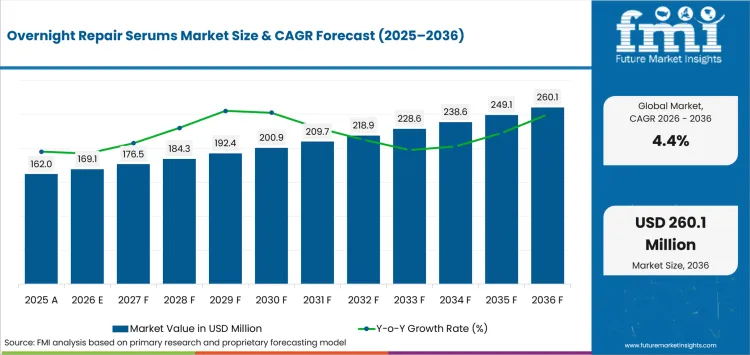
USD 169.1 million in 2026 and USD 260.1 million by 2036 at a 4.4% CAGR.
Demand for overnight repair serums is projected to expand at a 4.4% CAGR between 2026 and 2036, increasing valuation from USD 169.1 million in 2026 to USD 260.1 million by 2036. Brands are separating nighttime repair from basic moisturization when formulas can demonstrate visible recovery benefits without disrupting established evening routines. In March 2025, Estée Lauder Companies presented clinical evidence that a facial night cream improved post-procedure skin appearance without reported tolerance concerns.
Evidence-backed performance can help repair-focused products secure a distinct position within nighttime skincare regimens. South Korea's projected 5.3% CAGR exceeds Japan's 3.6% because new skincare formats move through commercial channels at different speeds. The Ministry of Food and Drug Safety reported in May 2026 that South Korean cosmetics exports increased 11.8% during 2025. The export growth reflects broad international distribution activity that gives Korean treatment brands more opportunities to introduce and scale new product concepts. Japan remains an important skincare market, but growth is shaped by established product routines and a mature competitive landscape.
Key Takeaways of Overnight Repair Serums Market
- Night-specific repair claims raise demand by giving serums a defined evening role beside existing moisturizer routines.
- Based on product type, concentrate serums are projected to account for 37.0% in 2026 due to compact evening dosing.
- In 2026, conventional products are expected to lead nature with 51.0% share because formulation freedom supports broader active choice.
- Cream & balm is set to lead format with 31.0% share in 2026 due to textures suited to overnight wear.
- Irritation and substantiation risk can stop repeat purchase if concentrated actives complicate layering or weaken defensible repair claims.
- Some of the key players in this market include Estee Lauder Companies, L'Oreal, Shiseido, Amorepacific, Procter & Gamble, Kao Corporation, Beiersdorf, Unilever, Coty, and e.l.f. Beauty.
Analyst Perspective
"Overnight repair serums earn a separate budget once formulas provide recovery benefits beyond general hydration. Repeat purchase depends on credible repair evidence and textures that remain comfortable beside other nighttime actives."
- Rahul Pandita, Principal Consultant, Future Market Insights
How is the Overnight Repair Serums Market segmented?
The overnight repair serums market is segmented by product type, nature, format, price positioning, sales channel and region.
Product type covers concentrate serums, ampoule formats, booster drops and pressed - balm serums. Nature includes conventional, vegan & cruelty-free, natural & organic, dermocosmetic - clinical and fragrance-free & sensitive options. Format covers cream & balm, liquid & serum, stick & solid, spray & mist, sheet & patch and powder. Price positioning spans mass, masstige, premium and professional offers. Sales channels include e-commerce & DTC, specialty beauty retail, pharmacies & drugstores, supermarkets & hypermarkets and salons & spas.
What makes concentrate serums central to the product type category?
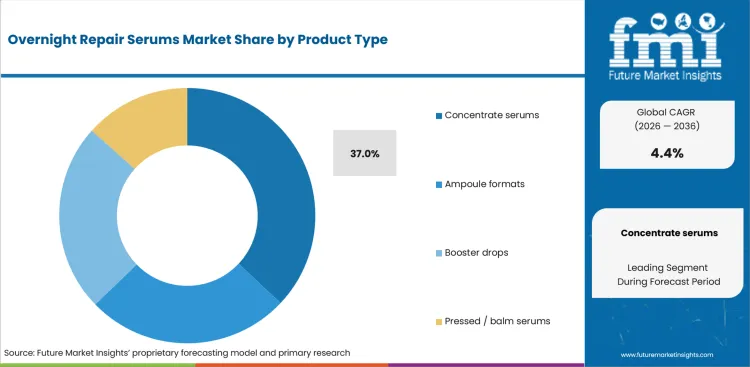
Concentrate serums define a specific nighttime treatment role without replacing moisturizer in familiar routines. Shiseido announced renewed ULTIMUNE in January 2025 for a March launch, showing how the facial serum category can carry aging-care research without teaching consumers another delivery method.
- By product type, concentrate serums are estimated to hold 37.0% in 2026 owing to compact dosing that supports a defined treatment step.
- Repeat purchase requires comfortable layering beside retinoids or exfoliating products already used during nighttime routines.
Why do conventional products lead the nature category?
Conventional formulas allow wider active and texture combinations than natural or fragrance-free briefs normally permit. Beiersdorf said in August 2025 that its EPICELLINE NIVEA serum would reach mass retail in 30 countries by end of 2025, extending research-led skincare products without specialist certification.
- In 2026, conventional products are expected to lead nature with 51.0% share because formulation freedom supports varied active systems and price tiers.
- Nightly formulas still need tolerable active concentrations because formulation freedom does not prevent irritation-related churn.
How does cream & balm support the format category?
Cream & balm textures suit overnight treatment because richer emollients stay on skin without interfering with daytime makeup or sunscreen. Richer sensory payoff also differentiates anti-aging creams and serums from lightweight daytime treatments without changing the evening step.
- Based on format, cream & balm is projected to account for 31.0% in 2026 due to cushioning textures that suit overnight wear.
- Estée Lauder Companies reported in May 2026 that La Mer’s Rejuvenating Night Eye Cream contributed to fiscal third-quarter skincare innovation and night-treatment positioning.
What supports mass within price positioning?
Mass pricing lowers first-purchase resistance for a serum intended to become a nightly routine step. L’Oréal’s April 2025 results linked consumer-products performance to Revitalift Laser Tri-peptides serum, showing accessible anti-aging skincare can carry treatment claims at mass scale.
- Mass is set to lead price positioning with 33.0% share in 2026 due to lower trial resistance and broad retail availability.
- Simple scientific language must clearly distinguish a mass-market overnight serum from ordinary moisturizer before consumers commit to regular repeat use.
What drives e-commerce & DTC within sales channel?
Digital selling gives serum brands room to explain application order and active compatibility before repeated use. Coty reported in February 2025 that e-commerce represented about one-fifth of sales, keeping discovery close to replenishment for beauty and personal care products that need clear instructions.
- By sales channel, e-commerce & DTC is forecast to represent 37.0% in 2026 driven by education and direct replenishment paths.
- Digital conversion weakens if ingredient claims remain difficult to compare or routine guidance leaves consumers uncertain about safe layering.
What are the drivers, restraints and opportunities in the Overnight Repair Serums Market?
Night-specific treatment supports demand, irritation and substantiation slow conversion, and sensitive-skin design offers a lower-friction repeat-use route.
- Driver: Dedicated evening repair routines support separate serum purchases once consumers understand the treatment’s defined role.
- Restraint: Concentrated actives raise irritation and substantiation risk as repair claims move beyond ordinary moisturization.
- Opportunity: Sensitive-skin formulas and simple layering guidance widen repeat use among consumers already using nighttime actives.
Night-specific research makes a separate treatment step easier to defend
Night-specific research gives brands stronger support for separate treatment purchase than general serum messaging. At SCALE in May 2026 Estée Lauder Companies linked new findings to nighttime franchises and anti-aging serums.
Safety review and claim substantiation raise the conversion burden
Concentrated actives face greater scrutiny because irritation can end nightly use despite credible efficacy claims. The UK Office for Product Safety and Standards recorded 325,496 cosmetic notifications and an 11% annual increase during 2025-2026.
Sensitive-skin formats give brands a lower-friction route into nightly repair
Skincare packaging systems that control dosing can support gentler repeat use for consumers already layering strong nighttime actives. Kao announced its Curél carbonated foam serum in July 2025 for Japan before wider Asian and European rollout.
Which country CAGRs are covered in the Overnight Repair Serums Market?
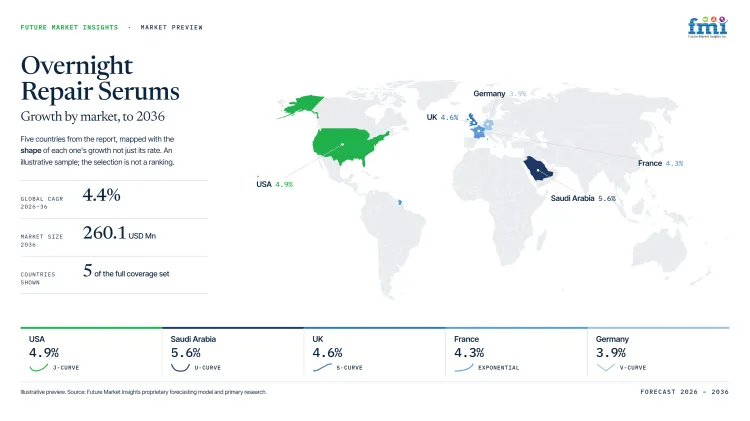
| Country | CAGR |
|---|---|
| UAE | 5.9% |
| Saudi Arabia | 5.6% |
| South Korea | 5.3% |
| USA | 4.9% |
| UK | 4.6% |
| France | 4.3% |
| Germany | 3.9% |
| Japan | 3.6% |
How do country-level CAGRs compare in the Overnight Repair Serums Market?
The 2.3-point spread separates faster Gulf and South Korean growth from mature Western European and Japanese routines. UAE and Saudi Arabia convert premium beauty exposure through import-heavy channels, while South Korea turns domestic product velocity into rapid discovery. USA and UK sit closer to the global rate because channel depth is already broad.
- Hotel-linked beauty retail keeps imported treatment brands visible to the UAE’s internationally mobile shopper base.
- Pharmacy chains and social commerce expand Saudi skincare discovery beyond mall-based prestige beauty counters.
- Short product-development cycles let Korean brands refresh active combinations before shifting consumer attention moves elsewhere.
- Crowded anti-aging assortments raise the value of claim differentiation and dermatologist-facing evidence in the USA.
- Prestige retail concentrates international serum brands in the UK, raising comparison pressure during first trial.
- French pharmacy and selective-beauty channels give dermocosmetic credentials more weight during premium treatment selection.
- German shoppers expect ingredient explanations and performance evidence before adding another concentrated nightly treatment.
- Department-store beauty advisors give Japanese treatment launches a service-heavy route requiring precise application guidance.
Similar CAGRs can still produce different entry conditions because regulation and routine structure shape conversion differently. The full report provides country-level CAGR analysis across North America, Latin America, Western Europe, Eastern Europe, East Asia, South Asia and Pacific and Middle East and Africa.
Country-wise Analysis
- USA skincare shoppers move between direct digital stores and department-store counters where ingredient claims can be compared before trial. Prestige skincare products compete for the same evening routine space and make sampling especially important for unfamiliar repair claims at launch. The USA overnight repair serums sector is projected to record 4.9% CAGR, supported by broad channel access and serum familiarity. Amorepacific reported in April 2025 that Sulwhasoo entered Macy’s online channel and selected stores with First Care Activating Serum. Crowded anti-aging language remains the main friction since a nighttime serum must explain a distinct repair job before another step is added.
- German skincare purchasing gives science-led mass and pharmacy propositions a credible local route into repeat routines without requiring prestige pricing. Germany is estimated to post 3.9% CAGR over the forecast period, attributable to local dermocosmetic demand and strong research capacity. Beiersdorf began construction of a 14,000-square-meter Innovation Center in Hamburg during June 2025 to shorten development cycles and support small-batch testing. The local friction is translation instead of scientific access because technical claims must become simple usage instructions at shelf and online. Brands that pair evidence with clear dosing can consistently convert German research credibility into regular nightly replenishment.
- French beauty consumers evaluate premium skincare beside refill economics and packaging convenience, which gives replenishment design unusual commercial weight. FEBEA published research in June 2025 showing that 59% of surveyed cosmetics consumers had purchased refills during the prior year. France's overnight repair serums outlook is anticipated to advance at 4.3% CAGR, driven by sustained premium skincare engagement and refill interest. Cosmetic packaging formats used for serum replenishment influence repeat cost as well as waste reduction. Availability is a practical local friction if replacement packs disappear from the original purchase channel during routine replenishment between major retail visits and online reordering.
- UK consumers discover treatment serums quickly online, yet cosmetic ingredient restrictions and notification duties shape what reaches sale. Adoption of overnight repair serums in the UK is estimated to expand at 4.6% CAGR through 2036, supported by broad digital beauty access and established prestige retail networks. The Cosmetic Products (Restriction of Chemical Substances) Regulations 2025 were made in March 2025 and introduced updated ingredient restrictions. Claim and formula control remains the local friction since concentrated night actives must stay tolerable under compliant instructions. Retailers respond better to concise guidance that separates cosmetic repair positioning from claims requiring another regulatory route.
- Saudi beauty purchasing increasingly mixes mall-based prestige retail with pharmacy access and e-commerce for premium international skincare brands with established local distribution. The Saudi Food and Drug Authority updated its cosmetic product notification guidance in March 2025 and keeps notification requirements visible for commercial entry. Saudi Arabia is estimated to post 5.6% CAGR over the forecast period, driven by broader beauty assortment and digital discovery. Importer coordination becomes the main friction because registration and Arabic-ready product information must align before inventory is scaled. Companies with disciplined local documentation can reduce launch delays without weakening the repair story consumers expect from concentrated nighttime treatments.
- Dubai gives the UAE a dense premium retail base where imported skincare can move quickly from social discovery into physical trial. UAE is estimated to post 5.9% CAGR over the forecast period, driven by international brand exposure and digital merchandising. Dubai Municipality highlighted Montaji+ at Beautyworld Middle East in October 2025 as part of its evaluation and registration oversight for cosmetics and personal care products. Beauty and cosmetic packaging for premium serums must carry compliant product information before promotional activity outruns legal availability. Fast conversion is valuable only if approved inventory can be replenished locally without repeated registration delays during restocking.
- Japanese consumers assign skincare products precise places in multi-step routines, raising the burden on another evening serum. Amorepacific documented Sulwhasoo’s first official Japan entry in June 2026 following a May @cosme TOKYO pop-up centered on First Care Activating Serum. Overnight repair serum sales in Japan are forecast to expand at 3.6% CAGR by 2036, supported by mature prestige beauty retail and strong treatment familiarity. Routine competition limits adoption unless a new treatment explains how its timing or benefit differs from familiar essences and moisturizers. A tightly specified application role can win trial without asking consumers to rebuild the evening regimen.
- South Korean consumers encounter dense multi-brand beauty stores and fast online merchandising that expose new serum formats to immediate comparison. Amorepacific reported in May 2025 that its Korean business gained from multi-brand stores and online channels during the first quarter. Overnight repair serum demand in South Korea is forecast to rise at 5.3% CAGR, attributable to fast retail turnover and online discovery. Rapid product turnover can shorten the time available to establish a repeat routine for another anti-aging serum. Brands need visible evidence and stable availability before rapid social discovery shifts toward a newer competing treatment story in crowded assortments.
Who are the notable companies in the Overnight Repair Serums Market?
Estee Lauder Companies, L'Oreal, Shiseido, Amorepacific, Procter & Gamble, Kao Corporation, Beiersdorf, Unilever, Coty and e.l.f. Beauty are notable companies serving this market.
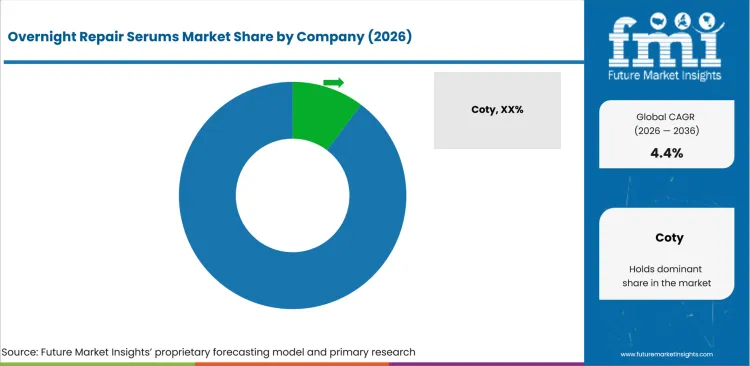
Prestige night-treatment franchises and mass serum platforms compete beside sensitive-skin research and digital-first skincare portfolios. Entry requires evidence that a serum can hold a distinct evening role without causing irritation.
- Estee Lauder Companies and L'Oreal join Shiseido and Amorepacific in documented prestige serum and night-care activity.
- Procter & Gamble and Kao Corporation join Beiersdorf and Unilever in documented mass or dermocosmetic skin science.
- Coty and e.l.f. Beauty extend competition with portfolio expansion and digital-first retail access in international channels.
Competitive Benchmarking: Overnight Repair Serums Market
| Company | Night-treatment relevance | Skin-repair science | Serum portfolio breadth | Geographic Reach |
|---|---|---|---|---|
| Estee Lauder Companies | High | High | High | Global prestige beauty channels |
| L'Oreal | High | High | High | Global |
| Shiseido | High | High | High | Global |
| Amorepacific | Medium | High | High | Asia, Americas and Europe |
| Procter & Gamble | Medium | High | High | Global consumer beauty channels |
| Kao Corporation | Medium | High | High | Japan, Asia, Europe and Americas |
| Beiersdorf | Medium | High | High | Global |
| Unilever | Medium | High | High | Global |
| Coty | Low | Medium | Medium | Americas, Europe and Asia-Pacific |
| e.l.f. Beauty | Medium | Medium | High | North America, UK and expanding international retail |
Key Developments in the Overnight Repair Serums Market
- In June 2025, L’Oreal agreed to acquire a majority stake in Medik8 and add the skincare brand to its Luxe Division.
- In May 2025, e.l.f. Beauty agreed to acquire rhode and broaden its portfolio with a skin-focused brand.
- In May 2025, Beiersdorf partnered with Vincere Biosciences on skincare research targeting cellular health and aging.
Key Players in the Overnight Repair Serums Market
Prestige Night-Treatment and Research-Led Platforms
- Estee Lauder Companies
- L'Oreal
- Shiseido
- Amorepacific
Mass and Dermocosmetic Skin-Science Platforms
- Procter & Gamble
- Kao Corporation
- Beiersdorf
- Unilever
Portfolio and Digital-First Beauty Operators
- Coty
- e.l.f. Beauty
Overnight Repair Serums Market - Report Scope
| Coverage field | Report scope |
|---|---|
| Market breakdown | By product type, nature, format, price positioning, sales channel and region. |
| Quantitative Units | Revenue in USD million snd CAGR in %. |
| Market Definition | Cosmetic serum and treatment formats positioned for overnight skin repair, recovery, barrier support or aging-care routines. |
| Regions Covered | North America, Latin America, Western Europe, Eastern Europe, East Asia, South Asia and Pacific and Middle East and Africa. |
| Countries Covered | USA, Germany, France, UK, Saudi Arabia, UAE, Japan, South Korea and 20+ countries included in the full report. |
| Key Companies | Estee Lauder Companies, L'Oreal, Shiseido, Amorepacific, Procter & Gamble, Kao Corporation, Beiersdorf, Unilever, Coty, e.l.f. Beauty. |
| Forecast Period | 2026 to 2036. |
| Approach | Primary and secondary research with market triangulation. |
Overnight Repair Serums Market - Research Methodology
| Method | Approach |
|---|---|
| Primary Research | FMI analysts gathered input from manufacturers, service providers, technology developers, distributors, end users, procurement teams, and subject-matter experts. Interviews examined purchasing decisions, product or service evaluation, adoption barriers, approval requirements, pricing considerations, and expectations for technical or commercial support. Respondents were also asked what evidence is required before a trial, pilot, or initial order develops into regular purchasing. |
| Desk Research | Desk research covered government statistics, regulatory publications, trade data, industry associations, technical literature, standards, company filings, product information, and official corporate announcements. Sources were reviewed for relevance, publication date, geographic coverage, and consistency with the defined market scope. Claims relating to performance, applications, approvals, capacity, investment, and commercial activity were retained only when supported by credible public evidence. |
| Market Sizing and Forecasting | The market model combined the baseline value with historical performance, segment structure, pricing and volume indicators, adoption levels, company participation, and country-level demand conditions. Forecast assumptions considered economic activity, investment trends, regulatory developments, technology adoption, purchasing cycles, supply availability, and barriers to wider market use. Segment and regional estimates were reconciled before the final market total was calculated. |
| Data Validation | Estimates were checked against multiple independent indicators, including public data, company activity, trade patterns, industry developments, and findings from primary interviews. Validation also tested whether products, services, applications, and company revenues fell within the defined market boundaries. Adjacent categories, unsupported claims, overlapping revenues, and activities without direct market relevance were excluded to reduce double counting and maintain consistency across segments and countries. |
Overnight Repair Serums Market by Segments
Overnight Repair Serums Market segmented by Product Type:
- Concentrate serums
- Ampoule formats
- Booster drops
- Pressed - balm serums
Overnight Repair Serums Market segmented by Nature:
- Conventional
- Vegan & cruelty-free
- Natural & organic
- Dermocosmetic - clinical
- Fragrance-free & sensitive
Overnight Repair Serums Market segmented by Format:
- Cream & balm
- Liquid & serum
- Stick & solid
- Spray & mist
- Sheet & patch
- Powder
Overnight Repair Serums Market segmented by Price Positioning:
- Mass
- Masstige
- Premium
- Professional
Overnight Repair Serums Market segmented by Sales Channel:
- E-commerce & DTC
- Specialty beauty retail
- Pharmacies & drugstores
- Supermarkets & hypermarkets
- Salons & spas
Overnight Repair Serums Market by Region:
- North America
- United States
- Canada
- Latin America
- Brazil
- Mexico
- Argentina
- Chile
- Western Europe
- Germany
- France
- United Kingdom
- Italy
- Spain
- Benelux
- Nordics
- Eastern Europe
- Poland
- Czech Republic
- Romania
- Hungary
- East Asia
- China
- Japan
- South Korea
- South Asia and Pacific
- India
- ASEAN
- Australia and New Zealand
- Middle East and Africa
- GCC Countries
- South Africa
- Türkiye
- Israel
Research Sources and Bibliography
- The Estée Lauder Companies. (2025, March 31). The Estée Lauder Companies shares new findings at the American Academy of Dermatology
- Ministry of Food and Drug Safety, Republic of Korea. (2026, May 28). ’25년 화장품 무역수지 흑자 첫 100억 달러 돌파, 세계 2위 화장품 수출국 달성
- Shiseido Company, Limited. (2025, January 22). Backed by world-leading skin research, SHISEIDO’s iconic ULTIMUNE is a serum reborn - to slow the skin aging cycle.
- Beiersdorf AG. (2025, August 13). Beiersdorf brings epigenetic innovation to the mass market: NIVEA serum featuring skin rejuvenation ingredient EPICELLINE®
- The Estée Lauder Companies. (2026, May 1). The Estée Lauder Companies reports fiscal 2026 third quarter results
- L’Oréal Groupe. (2025, April 18). L’Oréal First Quarter 2025 Sales
- Coty Inc. (2025, February 10). Coty reports solid 1H25 financial performance, with strong margin expansion and cash generation in an uncertain market environment
- The Estée Lauder Companies. (2026, May 26). The Estée Lauder Companies shares new research findings at the 21st Annual Symposium for Cosmetic Advances & Laser Education (SCALE) Conference
- Office for Product Safety and Standards. (2026, August 5). OPSS Delivery Report 2025-2026
- Kao Corporation. (2025, July 7). Kao unveils innovative Curél products featuring carbonated foam technology to combat dryness-induced dullness
- Amorepacific. (2025, April 21). Sulwhasoo enters Macy’s, America’s largest department store chain
- Beiersdorf AG. (2025, June 20). Investing in the future of skincare: Beiersdorf lays foundation stone for its Innovation Center in Hamburg
- Fédération des Entreprises de la Beauté. (2025, June 16). La recharge cosmétique : une solution d’avenir pour conjuguer beauté et durabilité
- UK Government. (2025, March 27). The Cosmetic Products (Restriction of Chemical Substances) Regulations 2025
- Saudi Food and Drug Authority. (2025, March 11). Guidance and Requirements of Cosmetic product Notification
- Dubai Municipality. (2025, October 27). Product safety at Beautyworld Middle East 2025
- Amorepacific. (2026, June 30). Opening the Door to Japan with a First Impression Only Sulwhasoo Could Make
- Amorepacific. (2025, May 2). Amorepacific Holdings consolidated Q1 2025 business performance
- L’Oréal Groupe. (2025, June 9). L’Oréal Groupe to acquire a majority stake in Medik8
- e.l.f. Beauty. (2025, May 28). e.l.f. Beauty announces definitive agreement to acquire rhode in $1 billion deal
- Beiersdorf AG. (2025, May 22). Strategic partnership with Vincere Biosciences: Beiersdorf continues to invest in innovative strength
- L’Oréal Groupe. (2025, June 10). Beauty at the heart of longevity L’Oréal Groupe
- Amorepacific. (2025, April 29). Amorepacific Research Confirms Potential of Microalgal-Derived PDRNs in Skin Regeneration and Wound Healing
- Shiseido Company, Limited. (2025, January 15). Co-creating Future Beauty by Connecting Researchers and Consumers at “Shiseido Beauty Park” Opening on January 22
- The Estée Lauder Companies. (2025, October 30). The Estée Lauder Companies Reports Fiscal 2026 First Quarter Results
- Procter & Gamble. (2026, August 27). Olay launches 'Barrier Bootcamp' with new Repair Serum Body Wash Collection - your shower-powered workout for skin barrier repair
- Coty Inc. (2025, March 21). Coty divests stake in SKKN by Kim
- Procter & Gamble. (2026, January 8). From Concept to Counter: P&G Drives Skincare Innovation with OLAY Cleansing Melts
- Kao Corporation. (2025, December 2). Curél launches deep stratum corneum barrier serum and Skin Repair UV Serum
- Beiersdorf AG. (2026, September 1). Beiersdorf Strengthens Derma Business with Microbiome Technology
- Unilever PLC. (2025, May 16). 2025 Information Memorandum
- L’Oréal Groupe. (2026, April 2). L’Oréal and Institut Pasteur announce historic partnership to advance skin health science
- Amorepacific. (2026, January 21). Sulwhasoo Announces Official Debut on Premier UK Online Platform ‘Cult Beauty’
- e.l.f. Beauty. (2025, September 4). rhode Launches in Sephora
- Shiseido Company, Limited. (2026, May 26). みずみずしく鍛えて、明日を上向きに。SHISEIDOバイタルパーフェクション新セラム誕生。
- e.l.f. Beauty. (2026, August 31). rhode Announces Official Launch Date for Its Retail Expansion in Europe with Sephora
This bibliography is provided for reader reference and is not exhaustive. The full report contains the complete reference list and detailed citations
This Report Answers
- How large is the overnight repair serums market through 2036?
- Which product type accounts for 37.0% of 2026 demand?
- Why do conventional products hold 51.0% of nature in 2026?
- How do cream & balm textures affect overnight treatment selection?
- Why does e-commerce & DTC hold 37.0% of 2026 sales channels?
- How do country growth rates differ through 2036?
- Which companies represent the main overnight repair serum models?
- What limits repeat purchase after concentrated night-repair trial?
Frequently Asked Questions
How big is the Overnight Repair Serums Market in 2026?
The overnight repair serums market is valued at USD 169.1 million in 2026 and is projected to reach USD 260.1 million by 2036. Night-specific repair claims support growth by giving concentrated treatments a defined place within evening skincare routines.
What is the CAGR of the Overnight Repair Serums Market from 2026 to 2036?
The overnight repair serums market is projected to grow at a CAGR of 4.4% between 2026 and 2036. Expansion depends on credible repair claims and comfortable textures that sustain repeated use beside nighttime actives.
Which product type leads the Overnight Repair Serums Market?
The concentrate serums segment is expected to hold 37.0% of the overnight repair serums market in 2026, supported by compact dosing that gives treatment a defined evening role. Familiar application reduces routine change during first trial and supports continued use beside moisturizer.
Which nature segment leads the Overnight Repair Serums Market?
The conventional segment is expected to represent 51.0% of the overnight repair serums market in 2026, driven by broader formulation flexibility in active systems and price tiers. Wider formulation freedom supports assortment without requiring specialist certification for every finished product line.
Which countries are projected to record the country growth comparison in the Overnight Repair Serums Market?
UAE is projected at 5.9% CAGR, followed by Saudi Arabia at 5.6% and South Korea at 5.3% through 2036. Premium beauty exposure and fast digital discovery explain the upper group without implying current market-size rank.
Which companies are active in the Overnight Repair Serums Market?
Key companies operating in the overnight repair serums market include Estee Lauder Companies, L'Oreal, Shiseido, Amorepacific, Procter & Gamble, Kao Corporation, Beiersdorf, Unilever, Coty and e.l.f. Beauty. Treatment science differentiates portfolios while channel access determines how routine-specific products reach repeat users.
Preview the report firsthand - request a free sample
Get SampleGet the brochure for pricing and purchase details.
Get PDFTable of Content
- Key Takeaways
- Market Size and CAGR
- Top Growth Driver
- Fastest Growing Segment
- Leading Region
- Key Companies
- Emerging Opportunities
- Executive Summary
- Global Market Outlook
- Demand-side Trends
- Supply-side Trends
- Technology Roadmap Analysis
- Analysis and Recommendations
- Analyst Perspective (What is happening? Why now? What should investors know?)
- Key Questions Answered
- How large is the market?
- What is the CAGR?
- What are key trends?
- Which region dominates?
- Who are the leaders?
- Market Overview
- Market Coverage / Taxonomy
- Market Definition / Scope / Limitations
- Research Methodology
- Chapter Orientation
- Analytical Lens and Working Hypotheses
- Market Structure, Signals, and Trend Drivers
- Benchmarking and Cross-market Comparability
- Market Sizing, Forecasting, and Opportunity Mapping
- Research Design and Evidence Framework
- Desk Research Programme (Secondary Evidence)
- Expert Input and Fieldwork (Primary Evidence)
- Tooling, Models, and Reference Databases
- Data Engineering and Model Build
- Quality Assurance and Audit Trail
- Market Background
- Market Dynamics (Drivers, Restraints, Opportunity, Trends)
- Scenario Forecast (Optimistic, Likely, Conservative)
- Impact Analysis
- AI Impact
- Sustainability Impact
- Regulatory Impact
- Technology Impact
- Consumer / Buyer Analysis
- Purchase Drivers
- Adoption Barriers
- Buyer Journey
- Opportunity Map Analysis
- Product Life Cycle Analysis
- Supply Chain Analysis
- Investment Feasibility Matrix
- Value Chain Analysis
- PESTLE and Porter's Analysis
- Regulatory Landscape
- Regional Parent Market Outlook
- Production and Consumption Statistics
- Import and Export Statistics
- Global Market Analysis and Forecast, 2021 to 2036
- Historical Market Size Value (USD Million) Analysis, 2021 to 2025
- Current and Future Market Size Value (USD Million) Projections, 2026 to 2036
- Y-o-Y Growth Trend Analysis
- Absolute $ Opportunity Analysis
- Global Market Pricing Analysis, 2021 to 2036
- Global Market Analysis and Forecast, By Product Type, 2021 to 2036
- Introduction / Key Findings
- Historical Market Size Value (USD Million) Analysis By Product Type, 2021 to 2025
- Current and Future Market Size Value (USD Million) Analysis and Forecast By Product Type, 2026 to 2036
- Concentrate serums
- Ampoule formats
- Booster drops
- Pressed / balm serums
- Concentrate serums
- Y-o-Y Growth Trend Analysis By Product Type, 2021 to 2025
- Absolute $ Opportunity Analysis By Product Type, 2026 to 2036
- Global Market Analysis and Forecast, By Nature, 2021 to 2036
- Introduction / Key Findings
- Historical Market Size Value (USD Million) Analysis By Nature, 2021 to 2025
- Current and Future Market Size Value (USD Million) Analysis and Forecast By Nature, 2026 to 2036
- Conventional
- Vegan & cruelty-free
- Natural & organic
- Dermocosmetic / clinical
- Fragrance-free & sensitive
- Conventional
- Y-o-Y Growth Trend Analysis By Nature, 2021 to 2025
- Absolute $ Opportunity Analysis By Nature, 2026 to 2036
- Global Market Analysis and Forecast, By Format, 2021 to 2036
- Introduction / Key Findings
- Historical Market Size Value (USD Million) Analysis By Format, 2021 to 2025
- Current and Future Market Size Value (USD Million) Analysis and Forecast By Format, 2026 to 2036
- Cream & balm
- Liquid & serum
- Stick & solid
- Spray & mist
- Sheet & patch
- Powder
- Cream & balm
- Y-o-Y Growth Trend Analysis By Format, 2021 to 2025
- Absolute $ Opportunity Analysis By Format, 2026 to 2036
- Global Market Analysis and Forecast, By Price Positioning, 2021 to 2036
- Introduction / Key Findings
- Historical Market Size Value (USD Million) Analysis By Price Positioning, 2021 to 2025
- Current and Future Market Size Value (USD Million) Analysis and Forecast By Price Positioning, 2026 to 2036
- Mass
- Masstige
- Premium
- Professional
- Mass
- Y-o-Y Growth Trend Analysis By Price Positioning, 2021 to 2025
- Absolute $ Opportunity Analysis By Price Positioning, 2026 to 2036
- Global Market Analysis and Forecast, By Sales Channel, 2021 to 2036
- Introduction / Key Findings
- Historical Market Size Value (USD Million) Analysis By Sales Channel, 2021 to 2025
- Current and Future Market Size Value (USD Million) Analysis and Forecast By Sales Channel, 2026 to 2036
- E-commerce & DTC
- Specialty beauty retail
- Pharmacies & drugstores
- Supermarkets & hypermarkets
- Salons & spas
- E-commerce & DTC
- Y-o-Y Growth Trend Analysis By Sales Channel, 2021 to 2025
- Absolute $ Opportunity Analysis By Sales Channel, 2026 to 2036
- Global Market Analysis and Forecast, By Region, 2021 to 2036
- Introduction
- Historical Market Size Value (USD Million) Analysis By Region, 2021 to 2025
- Current Market Size Value (USD Million) Analysis and Forecast By Region, 2026 to 2036
- North America
- Latin America
- Western Europe
- Eastern Europe
- East Asia
- South Asia and Pacific
- Middle East & Africa
- Market Attractiveness Analysis By Region
- North America Market Analysis and Forecast, By Country, 2021 to 2036
- Historical Market Size Value (USD Million) Trend Analysis By Market Taxonomy, 2021 to 2025
- Market Size Value (USD Million) Forecast By Market Taxonomy, 2026 to 2036
- By Country
- USA
- Canada
- By Product Type
- By Nature
- By Format
- By Price Positioning
- By Sales Channel
- By Country
- Market Attractiveness Analysis
- By Country
- By Product Type
- By Nature
- By Format
- By Price Positioning
- By Sales Channel
- Key Takeaways
- Latin America Market Analysis and Forecast, By Country
- Historical Market Size Value (USD Million) Trend Analysis By Market Taxonomy, 2021 to 2025
- Market Size Value (USD Million) Forecast By Market Taxonomy, 2026 to 2036
- By Country
- Brazil
- Mexico
- Chile
- Rest of Latin America
- By Product Type
- By Nature
- By Format
- By Price Positioning
- By Sales Channel
- By Country
- Market Attractiveness Analysis
- By Country
- By Product Type
- By Nature
- By Format
- By Price Positioning
- By Sales Channel
- Key Takeaways
- Western Europe Market Analysis and Forecast, By Country
- Historical Market Size Value (USD Million) Trend Analysis By Market Taxonomy, 2021 to 2025
- Market Size Value (USD Million) Forecast By Market Taxonomy, 2026 to 2036
- By Country
- Germany
- UK
- Italy
- Spain
- France
- Nordic
- BENELUX
- Rest of Western Europe
- By Product Type
- By Nature
- By Format
- By Price Positioning
- By Sales Channel
- By Country
- Market Attractiveness Analysis
- By Country
- By Product Type
- By Nature
- By Format
- By Price Positioning
- By Sales Channel
- Key Takeaways
- Eastern Europe Market Analysis and Forecast, By Country
- Historical Market Size Value (USD Million) Trend Analysis By Market Taxonomy, 2021 to 2025
- Market Size Value (USD Million) Forecast By Market Taxonomy, 2026 to 2036
- By Country
- Russia
- Poland
- Hungary
- Balkan & Baltic
- Rest of Eastern Europe
- By Product Type
- By Nature
- By Format
- By Price Positioning
- By Sales Channel
- By Country
- Market Attractiveness Analysis
- By Country
- By Product Type
- By Nature
- By Format
- By Price Positioning
- By Sales Channel
- Key Takeaways
- East Asia Market Analysis and Forecast, By Country
- Historical Market Size Value (USD Million) Trend Analysis By Market Taxonomy, 2021 to 2025
- Market Size Value (USD Million) Forecast By Market Taxonomy, 2026 to 2036
- By Country
- China
- Japan
- South Korea
- By Product Type
- By Nature
- By Format
- By Price Positioning
- By Sales Channel
- By Country
- Market Attractiveness Analysis
- By Country
- By Product Type
- By Nature
- By Format
- By Price Positioning
- By Sales Channel
- Key Takeaways
- South Asia and Pacific Market Analysis and Forecast, By Country
- Historical Market Size Value (USD Million) Trend Analysis By Market Taxonomy, 2021 to 2025
- Market Size Value (USD Million) Forecast By Market Taxonomy, 2026 to 2036
- By Country
- India
- ASEAN
- Australia & New Zealand
- Rest of South Asia and Pacific
- By Product Type
- By Nature
- By Format
- By Price Positioning
- By Sales Channel
- By Country
- Market Attractiveness Analysis
- By Country
- By Product Type
- By Nature
- By Format
- By Price Positioning
- By Sales Channel
- Key Takeaways
- Middle East & Africa Market Analysis and Forecast, By Country
- Historical Market Size Value (USD Million) Trend Analysis By Market Taxonomy, 2021 to 2025
- Market Size Value (USD Million) Forecast By Market Taxonomy, 2026 to 2036
- By Country
- Kingdom of Saudi Arabia
- Other GCC Countries
- Türkiye
- South Africa
- Other African Union
- Rest of Middle East & Africa
- By Product Type
- By Nature
- By Format
- By Price Positioning
- By Sales Channel
- By Country
- Market Attractiveness Analysis
- By Country
- By Product Type
- By Nature
- By Format
- By Price Positioning
- By Sales Channel
- Key Takeaways
- Key Countries Market Analysis
- USA
- Pricing Analysis
- Market Share Analysis, 2025
- By Product Type
- By Nature
- By Format
- By Price Positioning
- By Sales Channel
- Canada
- Pricing Analysis
- Market Share Analysis, 2025
- By Product Type
- By Nature
- By Format
- By Price Positioning
- By Sales Channel
- Mexico
- Pricing Analysis
- Market Share Analysis, 2025
- By Product Type
- By Nature
- By Format
- By Price Positioning
- By Sales Channel
- Brazil
- Pricing Analysis
- Market Share Analysis, 2025
- By Product Type
- By Nature
- By Format
- By Price Positioning
- By Sales Channel
- Chile
- Pricing Analysis
- Market Share Analysis, 2025
- By Product Type
- By Nature
- By Format
- By Price Positioning
- By Sales Channel
- Germany
- Pricing Analysis
- Market Share Analysis, 2025
- By Product Type
- By Nature
- By Format
- By Price Positioning
- By Sales Channel
- UK
- Pricing Analysis
- Market Share Analysis, 2025
- By Product Type
- By Nature
- By Format
- By Price Positioning
- By Sales Channel
- Italy
- Pricing Analysis
- Market Share Analysis, 2025
- By Product Type
- By Nature
- By Format
- By Price Positioning
- By Sales Channel
- Spain
- Pricing Analysis
- Market Share Analysis, 2025
- By Product Type
- By Nature
- By Format
- By Price Positioning
- By Sales Channel
- France
- Pricing Analysis
- Market Share Analysis, 2025
- By Product Type
- By Nature
- By Format
- By Price Positioning
- By Sales Channel
- India
- Pricing Analysis
- Market Share Analysis, 2025
- By Product Type
- By Nature
- By Format
- By Price Positioning
- By Sales Channel
- ASEAN
- Pricing Analysis
- Market Share Analysis, 2025
- By Product Type
- By Nature
- By Format
- By Price Positioning
- By Sales Channel
- Australia & New Zealand
- Pricing Analysis
- Market Share Analysis, 2025
- By Product Type
- By Nature
- By Format
- By Price Positioning
- By Sales Channel
- China
- Pricing Analysis
- Market Share Analysis, 2025
- By Product Type
- By Nature
- By Format
- By Price Positioning
- By Sales Channel
- Japan
- Pricing Analysis
- Market Share Analysis, 2025
- By Product Type
- By Nature
- By Format
- By Price Positioning
- By Sales Channel
- South Korea
- Pricing Analysis
- Market Share Analysis, 2025
- By Product Type
- By Nature
- By Format
- By Price Positioning
- By Sales Channel
- Russia
- Pricing Analysis
- Market Share Analysis, 2025
- By Product Type
- By Nature
- By Format
- By Price Positioning
- By Sales Channel
- Poland
- Pricing Analysis
- Market Share Analysis, 2025
- By Product Type
- By Nature
- By Format
- By Price Positioning
- By Sales Channel
- Hungary
- Pricing Analysis
- Market Share Analysis, 2025
- By Product Type
- By Nature
- By Format
- By Price Positioning
- By Sales Channel
- Kingdom of Saudi Arabia
- Pricing Analysis
- Market Share Analysis, 2025
- By Product Type
- By Nature
- By Format
- By Price Positioning
- By Sales Channel
- Türkiye
- Pricing Analysis
- Market Share Analysis, 2025
- By Product Type
- By Nature
- By Format
- By Price Positioning
- By Sales Channel
- South Africa
- Pricing Analysis
- Market Share Analysis, 2025
- By Product Type
- By Nature
- By Format
- By Price Positioning
- By Sales Channel
- USA
- Market Structure Analysis
- Competition Dashboard
- Competition Benchmarking
- Market Share Analysis of Top Players
- By Regional
- By Product Type
- By Nature
- By Format
- By Price Positioning
- By Sales Channel
- Emerging Startups
- Innovation Benchmarking
- Competition Analysis
- Competition Deep Dive
- Coty
- Overview
- Product Portfolio
- Profitability by Market Segments
- Sales Footprint
- Strategy Overview
- Marketing Strategy
- Product Strategy
- Channel Strategy
- Procter & Gamble
- Kao Corporation
- Beiersdorf
- Unilever
- L'Oreal
- Estee Lauder Companies
- Amorepacific
- e.l.f. Beauty
- Shiseido
- Coty
- Case Studies
- Success Stories
- Recent Developments
- Competition Deep Dive
- Assumptions & Acronyms Used


