

- Market Size (2026)
- USD 177.4 Mn
- Forecast (2036)
- USD 291.7 Mn
- CAGR (2026 to 2036)
- 5.1%
How big is Peptide Lip-Plumping Actives Market in 2026?
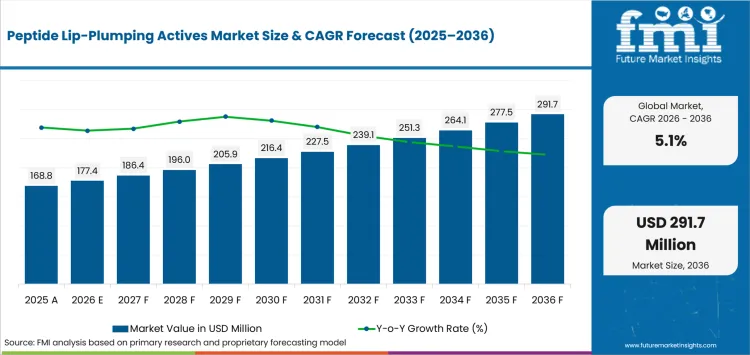
USD 177.4 million in 2026 and USD 291.7 million by 2036 at a 5.1% CAGR.
Sales of peptide lip-plumping actives are projected to expand at a 5.1% CAGR between 2026 and 2036 as beauty brands seek visible volume effects through topical formats. Lubrizol released new data for Argireline YOUth peptide in lipstick applications in February 2026 and placed a cosmetic peptide directly inside a finished lip-color format. That application evidence gives brands a more relevant basis for comparing peptide performance before they repeat a specification across lip care and adjacent skincare programs.
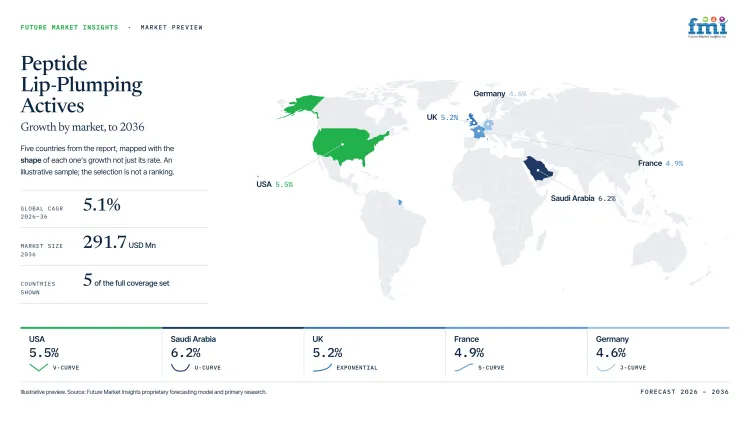
Country growth diverges because the United Kingdom's projected 5.2% CAGR by 2036 exceeds Germany's 4.6% as British retail refresh gives brands more launch windows. In April 2026, the Office for National Statistics reported that cosmetics and toiletries stores increased across every month of the first quarter while other non-food volumes rose 4.7%. Germany's slower rate therefore puts more weight on qualification efficiency than headline parent-market scale when peptide suppliers plan repeat orders.
Key Takeaways
- Demand rises as peptide actives support visible lip volume or firmness with evidence that brands can reuse across adjacent skincare formats.
- Based on product type, standard grade is projected to account for 42.0% in 2026 due to routine cosmetic specifications that reduce unnecessary qualification work.
- In 2026, anti-aging is expected to lead the function category with 27.0% share because collagen and wrinkle endpoints give peptide actives familiar claims language.
- By application, facial skincare is forecast to represent 42.0% in 2026 driven by established peptide testing across serums and creams.
- Formulation instability and weak claims documentation can extend qualification cycles as brands must defend the finished product instead of the ingredient concept.
- Key players in the peptide lip-plumping actives market include Croda, dsm-firmenich, Ashland, Lubrizol, BASF, Evonik, Clariant, and Symrise.
Analyst Perspective
“For lip-plumping peptides, repeat orders depend on finished-formula proof more than sequence novelty alone. Strong programs pair visible volume or firmness evidence with delivery stability that lets brands carry one active across lipstick, serum and hybrid lip-care formats.”
- Rahul Pandita, Principal Consultant, Future Market Insights
How is the peptide lip-plumping actives market segmented?
The peptide lip-plumping actives market is segmented by product type, function, application, grade, sales channel and region.
Market taxonomy covers product type, function, application, grade, sales channel and region. Product types include standard grade, high-purity or clinical grade, natural and certified grade and customized systems. Functions include anti-aging, hydration and barrier, brightening, soothing and sensitive care and UV protection. Applications cover facial skincare, body care, haircare, color cosmetics and suncare. Grades include standard cosmetic, natural-certified, pharmaceutical or clinical and organic-certified routes. Sales channels include direct brand sales, specialty distributors, contract manufacturers and online B2B channels.
How does facial skincare anchor the application category?
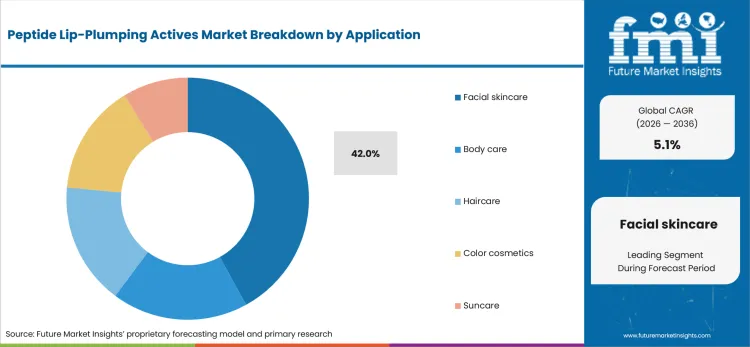
Facial skincare gives peptide actives the deepest testing base across serums, creams and targeted treatments. Evonik presented Vecollage Fortify P at in-cosmetics Global in April 2026 as a precision collagen polypeptide in powder format, extending peptide formulation options for active-led facial care products.
- Based on application, facial skincare is projected to account for 42.0% in 2026 due to established testing conventions for firmness and visible skin-aging claims.
- Formulators can transfer proven delivery and compatibility work into lip-adjacent concepts with fewer technical unknowns during finished-product development. Established facial testing gives development teams a lower-friction route for peptide evaluation across adjacent lip and hybrid care formats.
What makes standard grade central to the product type category?
Routine cosmetic programs favor peptide actives that fit established safety documentation and common serum or emulsion processing. Clariant presented a next-generation synthetic tetrapeptide at the December 2025 SCC meeting, showing current peptide research targets practical cosmetic science and formulation use for commercial beauty programs.
- By product type, standard grade is estimated to hold 42.0% in 2026 owing to routine qualification and broad sequence flexibility in cosmetic programs.
- Formulators reserve high-purity or customized routes for claims that justify tighter controls and more specialized supporting evidence. Standard specifications leave broader room for repeated development across mass and premium beauty programs with conventional cosmetic review requirements.
Why does anti-aging lead the function category?
Anti-aging gives peptide formulators a familiar commercial route because collagen and wrinkle endpoints already shape established anti-aging products. In April 2025, dsm-firmenich introduced SYN-COLL CB as a natural-origin tripeptide developed around collagen support. The launch gives formulation teams a current benchmark for low-dose peptide efficacy across cosmetic formats.
- In 2026, anti-aging is expected to lead the function category with 27.0% share because collagen-related endpoints translate peptide activity into measurable cosmetic claims.
- Brand teams can carry the same efficacy language into lip-adjacent serums and selected organic cosmetics. Repeat use improves if wrinkle or firmness evidence retains credibility across several compatible finished-product formats during brand review.
What supports standard cosmetic grade in the grade category?
Standard cosmetic grade fits the legal and technical boundary of this market since revenue covers cosmetic ingredients and excludes therapeutic peptide products. Symrise launched SymLash XTreme in June 2025 as a ready-to-use lipopeptide liquid for several cosmetic formats.
- The standard cosmetic grade is likely to capture 49.0% share in 2026 attributable to beauty programs that prioritize cosmetic safety dossiers and formulation guidance.
- Clinical or pharmaceutical specifications impose extra controls that most ordinary beauty claims do not require during commercial cosmetic qualification. Cosmetic-grade systems therefore offer a wider route into lip care products while preserving application-specific evidence.
What are the drivers, restraints and opportunities in the Peptide Lip-Plumping Actives Market?
Multifunctional beauty claims support demand while formulation qualification slows adoption and export-ready technical packages widen repeat specification opportunities.
- Driver: Peptide actives gain specification value as one formulation supports visible plumping plus familiar firmness or skin-aging claims across several beauty formats.
- Restraint: Stability testing and finished-product compliance can delay orders as peptide activity must survive processing and remain defensible under local claims rules.
- Opportunity: Ingredient makers can expand revenue by packaging peptide efficacy with direct formulation support and documentation that brands can reuse across regional launches.
Multifunctional Claims Increase Specification Value
A peptide earns broader specification value when one evidence package supports lip care and adjacent facial formulations without changing the core claim logic. The UK Department for Business and Trade reported in December 2025 that beauty contributed GBP 31.5 billion to national GDP during 2025. That commercial base increases the number of established skincare products programs where measurable firmness or volume claims can justify repeat active use.
Qualification Work Extends Development Timelines
Formula stability and safety documentation determine how quickly an evaluated peptide becomes a repeat order. FDA updated cosmetic registration and listing materials in February 2026 as MoCRA biennial renewal work continued for registered facilities. Incomplete identity or safety records force brands to reopen technical review during regional launches, extending the time between laboratory acceptance and routine purchasing.
Export-Ready Technical Packages Expand Revenue Routes
Peptide makers gain a wider revenue route when one technical package supports facial care, lip care and hybrid color formats across export programs. FEBEA reported in February 2026 that makeup and face-care products represented 49% of French cosmetics exports during 2025. The product mix rewards actives with efficacy language and formulation data that can move into natural cosmetics and adjacent formats without rebuilding the support file for every launch.
Which country CAGRs are profiled in the Peptide Lip-Plumping Actives Market?
| Country | CAGR |
|---|---|
| UAE | 6.6% |
| United States | 5.5% |
| United Kingdom | 5.2% |
| France | 4.9% |
| Germany | 4.6% |
How do country-level CAGRs compare in the Peptide Lip-Plumping Actives Market?
The 2.0-point spread separates the UAE's distribution-led expansion from Germany's slower qualification cycle across the selected profile. The United States and United Kingdom form a middle band with mature commercial brand infrastructure. France stays close to Germany because disciplined claims review makes technical support more influential than small rate differences.
- Dubai importers use Montaji+ records before distributor-led launches of premium lip oil products.
- United States laboratories front-load ingredient identity and safety records under MoCRA review.
- British beauty exporters favor efficacy packages transferable across destination-market safety files globally.
- French prestige programs require claim evidence suited to European and export review.
- German formulators prioritize reproducible specifications that reduce repeated commercial development trials locally.
Comparable rates produce different order economics as qualification workload and channel costs vary locally. The full report provides country-level CAGR analysis across North America, Latin America, Europe, East Asia, South Asia, Oceania and the Middle East and Africa.
Country-wise Analysis
- Across Dubai’s distributor-led beauty trade, importers operate inside a registration-heavy market where Montaji+ and local testing shape product release before prestige launches reach stores across regional beauty channels and specialist programs. The UAE peptide lip-plumping actives outlook is projected to expand at 6.6% CAGR through 2036 as distribution broadens and Dubai Municipality reported in October 2025 that nearly 13,000 establishments participate in the cosmetics and consumer-products trade. That concentration gives ingredient makers direct access to active distributors and prestige brands but orders convert faster with technical dossiers that support local registration plus smaller opening volumes without reformulation for each retailer.
- United States brand laboratories now examine ingredient composition and safety evidence closely before premium anti-wrinkle products move from bench work into commercial launch files. FDA reported in December 2025 that its PFAS assessment found significant data gaps covering use levels, dermal absorption and toxicity for cosmetic substances, which raises the value of precise ingredient records for novel actives. Peptide lip-plumping active demand in the United States is forecast to rise at 5.5% CAGR through 2036 as large brand programs reward evidence-ready systems, although entrants need claims data and documentation that legal teams can reuse without reopening basic ingredient questions locally.
- With every Great Britain cosmetic assigned to a Responsible Person and product information file, technical documentation becomes part of commercial readiness across prestige and specialist channels. Peptide lip-plumping actives demand in the United Kingdom is projected to record 5.2% CAGR during the assessment period and OPSS reported in July 2025 that 69 cosmetic serious undesirable effect notifications were logged and triaged during 2024-25. Portable efficacy packages fit the country's export-oriented development model, but ingredient makers still need safety support that survives local assessment and travels into overseas dossiers without repeated interpretation across regional launch markets during regional brand qualification work.
- For French prestige laboratories, domestic and export formulas move through the same European safety and claims discipline across facial and lip programs, with hyaluronic acid care offering a familiar benchmark for visible hydration and volume. DGCCRF reported in February 2026 that only 26 of 147 recently inspected cosmetics operators held complete or nearly complete product information files, while many files lacked adequate claim substantiation or safety material. France is estimated to post 4.9% CAGR through 2036 as established brands keep testing differentiated actives, but commercial entry depends on traceable safety records and efficacy data that travel across destination markets without separate technical packages.
- Comparing peptide actives against established ingredients is routine in Germany, where experienced laboratories and contract development teams prioritize reproducible specifications plus measurable skin performance. Adoption of peptide lip-plumping actives in Germany is estimated to expand at 4.6% CAGR through 2036 and IKW reported in December 2025 that 90% of surveyed companies viewed bureaucracy as a major burden. High labor costs and regulatory workload raise qualification expense, so stable specifications and application data become commercially useful by reducing repeated trials before brands commit to larger launch batches and shortening the path from evaluation to repeat purchasing for premium beauty programs locally.
Who are the notable companies in the Peptide Lip-Plumping Actives Market?
Croda, dsm-firmenich, Ashland, Lubrizol, BASF, Evonik, Clariant and Symrise are the notable companies serving this market.
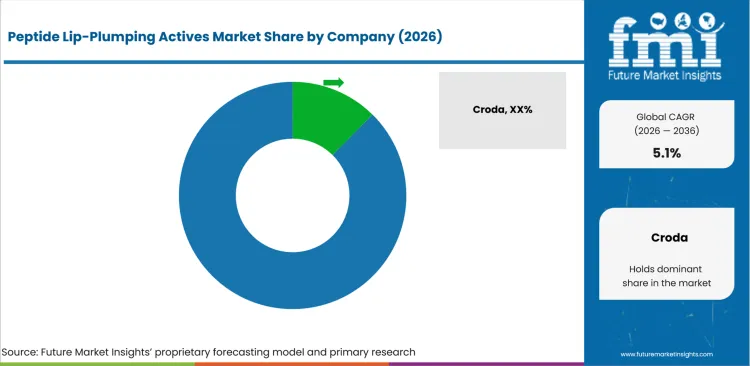
Competition turns on peptide depth and the quality of evidence that cosmetic laboratories can carry into finished-product claims. Dedicated active platforms gain an advantage by pairing sequence science with delivery or application testing. Broader personal-care ingredients support more of the surrounding formula during brand development. Entry barriers therefore come from validated efficacy and formulation support instead of corporate scale alone.
- Croda and dsm-firmenich concentrate visible commercial activity around peptide actives supported by documented skin-aging evidence for cosmetic formulation programs. Ashland and Lubrizol extend that group with peptide-hybrid or application-specific systems aimed at established cosmetic formulation programs.
- BASF and Evonik pair peptide technologies with broader cosmetic ingredient portfolios and global formulation resources that support multi-format development programs.
- Clariant and Symrise extend peptide participation across specialized cosmetic-active portfolios that address targeted skin or appearance applications for established beauty brands.
Competitive Benchmarking: Peptide Lip-Plumping Actives Market
| Company | Current Peptide Activity | Cosmetic Claim Evidence | Application Support | Geographic Reach |
|---|---|---|---|---|
| Croda | High | High | High | Global |
| dsm-firmenich | Medium | High | Medium | Global |
| Ashland | Medium | High | High | Global |
| Lubrizol | High | Medium | Medium | Global |
| BASF | High | High | Medium | Global |
| Evonik | High | Medium | High | Global |
| Clariant | Medium | Medium | Medium | Global |
| Symrise | Medium | High | High | Global |
Scoring basis: High current peptide activity requires a verified 2026 peptide action while Medium requires a verified 2025 action and Low identifies current activity without a 2025 or 2026 action. High claim evidence requires multiple measured cosmetic endpoints while Medium requires one documented endpoint and Low identifies a narrower documented claim. High application support requires delivery technology or several verified finished-product formats while Medium requires one supported formulation route and Low identifies a narrower documented route.
Key Developments in the Peptide Lip-Plumping Actives Market
- In April 2026, Croda launched Matrixyl Neolide with patented encapsulation that protects the peptide in formulations and releases it gradually after skin application.
- In April 2026, BASF launched NeoHelix Regenerate as a precision cosmetic peptide that targets damaged collagen and supports measurable skin-renewal endpoints.
- In April 2025, Ashland launched Collapeptyl as a hyaluronic hybrid peptide for collagen-focused skincare with quantified wrinkle and collagen study results.
Key Players in the Peptide Lip-Plumping Actives Market
Dedicated Peptide and Biomimetic Active Platforms
- Croda
- dsm-firmenich
- Ashland
- Lubrizol
Broad Beauty Ingredient Platforms with Peptide Technologies
- BASF
- Evonik
Specialized Cosmetic Active and Appearance Platforms
- Clariant
- Symrise
Peptide Lip-Plumping Actives Market - Report Scope
| Coverage field | Report scope |
|---|---|
| Market breakdown | By product type, function, application, grade, sales channel and region. |
| Quantitative Units | USD million. |
| Market Definition | Cosmetic peptide active ingredients used to support fuller-looking lips and adjacent firmness or skin-aging claims, excluding finished lip products, injectable fillers and therapeutic peptides. |
| Regions Covered | North America, Latin America, Europe, East Asia, South Asia and Pacific and Middle East and Africa. |
| Countries Covered | UAE, United States, United Kingdom, France, Germany, and 20+ countries included in the full report. |
| Key Companies Profiled | Croda, dsm-firmenich, Ashland, Lubrizol, BASF, Evonik, Clariant, Symrise. |
| Forecast Period | 2026 to 2036. |
| Approach | Primary and secondary research with market triangulation. |
Peptide Lip-Plumping Actives Market - Research Methodology
| Method | Approach |
|---|---|
| Primary Research | FMI analysts gathered input from manufacturers, service providers, technology developers, distributors, end users, procurement teams, and subject-matter experts. Interviews examined purchasing decisions, product or service evaluation, adoption barriers, approval requirements, pricing considerations, and expectations for technical or commercial support. Respondents were also asked what evidence is required before a trial, pilot, or initial order develops into regular purchasing. |
| Desk Research | Desk research covered government statistics, regulatory publications, trade data, industry associations, technical literature, standards, company filings, product information, and official corporate announcements. Sources were reviewed for relevance, publication date, geographic coverage, and consistency with the defined market scope. Claims relating to performance, applications, approvals, capacity, investment, and commercial activity were retained only when supported by credible public evidence. |
| Market Sizing and Forecasting | The market model combined the baseline value with historical performance, segment structure, pricing and volume indicators, adoption levels, company participation, and country-level demand conditions. Forecast assumptions considered economic activity, investment trends, regulatory developments, technology adoption, purchasing cycles, supply availability, and barriers to wider market use. Segment and regional estimates were reconciled before the final market total was calculated. |
| Data Validation | Estimates were checked against multiple independent indicators, including public data, company activity, trade patterns, industry developments, and findings from primary interviews. Validation also tested whether products, services, applications, and company revenues fell within the defined market boundaries. Adjacent categories, unsupported claims, overlapping revenues, and activities without direct market relevance were excluded to reduce double counting and maintain consistency across segments and countries. |
Peptide Lip-Plumping Actives Market by Segments
Peptide Lip-Plumping Actives Market segmented by Product Type:
- Standard grade
- High-purity / clinical grade
- Natural & certified grade
- Customized systems
Peptide Lip-Plumping Actives Market segmented by Function:
- Anti-aging
- Hydration & barrier
- Brightening
- Soothing & sensitive
- UV & protection
Peptide Lip-Plumping Actives Market segmented by Application:
- Facial skincare
- Body care
- Haircare
- Color cosmetics
- Suncare
Peptide Lip-Plumping Actives Market segmented by Grade:
- Standard cosmetic grade
- COSMOS / natural certified
- Pharma & clinical grade
- Organic certified
Peptide Lip-Plumping Actives Market segmented by Sales Channel:
- Direct to brands
- Specialty distributors
- Contract manufacturers
- Online B2B
Peptide Lip-Plumping Actives Market by Region:
- North America
- United States
- Canada
- Latin America
- Brazil
- Mexico
- Argentina
- Chile
- Western Europe
- Germany
- France
- United Kingdom
- Italy
- Spain
- Benelux
- Nordics
- Eastern Europe
- Poland
- Czech Republic
- Romania
- Hungary
- East Asia
- China
- Japan
- South Korea
- South Asia and Pacific
- India
- ASEAN
- Australia and New Zealand
- Middle East and Africa
- GCC Countries
- South Africa
- Türkiye
- Israel
Research Sources and Bibliography
- USA Food and Drug Administration. (2026, May 4). How FDA is implementing landmark cosmetics legislation to positively impact public health.
- USA Food and Drug Administration. (2026, February 11). Registration & listing of cosmetic product facilities and products.
- Dubai Municipality. (2025, October 27). Product safety at Beautyworld Middle East 2025.
- Department for Business and Trade. (2025, December 1). Major British beauty brands set to showcase at Cosmoprof India 2025.
- Fédération des Entreprises de la Beauté. (2026, February 6). Coup de frein sur les exportations de cosmétiques français en 2025 : le secteur demeure deuxième contributeur à la balance commerciale malgré un repli sur le marché américain.
- Industrieverband Körperpflege- und Waschmittel e.V. (2025, December 3). Market data: Renewed growth for the beauty and home care industry.
- Office for National Statistics. (2026, April 24). Retail sales, Great Britain: March 2026.
- Croda International Plc. (2026, April 21). Croda unveils Matrixyl® Neolide™, an iconic peptide with smarter delivery.
- BASF SE. (2026, April 9). BASF ushers in a new era of collagen science with precision peptide and bio-identical collagen III.
- dsm-firmenich. (2025, April 4). dsm-firmenich introduces SYN®-COLL CB: the next generation of eco-conscious, high-performance peptides for sustainable well-aging.
- Ashland Inc. (2025, April 3). Ashland unveils collapeptyl™, a revolutionary biofunctional delivering superior performance for the collaverse™ ecosystem.
- Lubrizol Corporation. (2026, February 10). New Data Reveals the Power of Argireline® YOUth Peptide in Lipstick Applications.
- Evonik Industries AG. (2026, April 8). in-cosmetics® Global 2026: Evonik brings new beauty identity to life with fairy tale innovation world.
- Clariant. (2025, December 15). SCC Annual Scientific Meeting & Showcase.
- Symrise AG. (2025, June 30). Symrise introduces SymLash® XTreme for enhanced eyelash density and holistic eye beauty care.
- USA Food and Drug Administration. (2025, December 29). Per and Polyfluoroalkyl Substances (PFAS) in Cosmetics.
- Office for Product Safety and Standards. (2025, July 30). OPSS Delivery Report 2024-2025: Statistical Annex.
- Direction générale de la concurrence, de la consommation et de la répression des fraudes. (2026, February 2). Cosmétiques : des TPE nouvelles dans le secteur qui méconnaissent trop souvent la réglementation.
- Croda International Plc. (2026, August 7). Croda unlocks new growth through the reinvention of heritage beauty active Volufiline™.
- Croda International Plc. (2026, June 17). Croda strengthens premium beauty pipeline with next-generation skincare active Malvallin™.
- dsm-firmenich. (2026, June 16). dsm-firmenich appoints TER Chemicals as exclusive distributor for Beauty & Care in Germany and the Netherlands.
- Ashland Inc. (2026, March 12). Ashland announces strategic partnership with IMCD for the exclusive distribution of personal and home care ingredients in the United States.
- Lubrizol Corporation. (2025, August 13). Lubrizol Accelerates Sustainability Commitment with PFAS-free Peptide Portfolio.
- BASF SE. (2026, June 30). BASF and Bota Biosciences Introduce Bio-Identical Collagen III Powered by AI.
- Evonik Industries AG. (2026, June 2). Evonik opens new Asia Beauty Science & Innovation Center in Shanghai.
- Clariant. (2025, November 5). Clariant celebrates Care Chemicals expansion at Daya Bay, strengthening its position in China.
- Symrise AG. (2026, March 17). Symrise establishes a new Care & Wellness Division.
- Clariant. (2025, March 19). Lucas Meyer Cosmetics by Clariant introduces GlowCytocin™ to capture the science of “Love Glow”.
This Report Answers
- What is the peptide lip-plumping actives market size in 2026 and what value is projected for 2036?
- What commercial conditions support repeat specification of peptide lip-plumping actives across beauty formulations?
- Why does standard grade hold the leading position within the product type category?
- Why does anti-aging represent the leading function for peptide lip-plumping actives in 2026?
- Why does facial skincare hold the leading application position in the current market structure?
- How do growth conditions differ across the five profiled country CAGR forecasts in this market?
- Which formulation and compliance frictions can delay conversion from peptide evaluation to repeat commercial orders?
- How do leading ingredient companies differ across the four buyer-relevant benchmarking criteria?
Frequently Asked Questions
How big is the Peptide Lip-Plumping Actives Market in 2026?
The peptide lip-plumping actives market is valued at USD 177.4 million in 2026 and is projected to reach USD 291.7 million by 2036. Growth is attributable to repeat specification of peptide actives across lip-adjacent skincare and beauty formats.
What is the CAGR of the Peptide Lip-Plumping Actives Market from 2026 to 2036?
The peptide lip-plumping actives market is projected to grow at a CAGR of 5.1% between 2026 and 2036. Expansion is supported by multifunctional claims and formulation-ready delivery systems that reduce repeat development work.
Which product type leads the Peptide Lip-Plumping Actives Market?
The standard grade segment is expected to hold 42.0% of the peptide lip-plumping actives market in 2026, owing to routine cosmetic specifications that reduce additional qualification work. Broad formulation compatibility keeps development practical across mass and premium beauty programs.
Which application leads the Peptide Lip-Plumping Actives Market?
The facial skincare segment is expected to hold 42.0% of the peptide lip-plumping actives market in 2026, driven by established peptide testing across serums and creams. That evidence base gives lip-adjacent programs a lower-friction route for evaluating firmness and skin-aging claims.
Which companies are active in the Peptide Lip-Plumping Actives Market?
Key companies operating in the market include Croda, dsm-firmenich, Ashland, Lubrizol, BASF, Evonik, Clariant, and Symrise. These companies compete through peptide science and documented efficacy while broader formulation support helps brands place actives into repeat commercial programs.
Preview the report firsthand - request a free sample
Get SampleGet the brochure for pricing and purchase details.
Get PDFTable of Content
- Key Takeaways
- Market Size and CAGR
- Top Growth Driver
- Fastest Growing Segment
- Leading Region
- Key Companies
- Emerging Opportunities
- Executive Summary
- Global Market Outlook
- Demand-side Trends
- Supply-side Trends
- Technology Roadmap Analysis
- Analysis and Recommendations
- Analyst Perspective (What is happening? Why now? What should investors know?)
- Key Questions Answered
- How large is the market?
- What is the CAGR?
- What are key trends?
- Which region dominates?
- Who are the leaders?
- Market Overview
- Market Coverage / Taxonomy
- Market Definition / Scope / Limitations
- Research Methodology
- Chapter Orientation
- Analytical Lens and Working Hypotheses
- Market Structure, Signals, and Trend Drivers
- Benchmarking and Cross-market Comparability
- Market Sizing, Forecasting, and Opportunity Mapping
- Research Design and Evidence Framework
- Desk Research Programme (Secondary Evidence)
- Expert Input and Fieldwork (Primary Evidence)
- Tooling, Models, and Reference Databases
- Data Engineering and Model Build
- Quality Assurance and Audit Trail
- Market Background
- Market Dynamics (Drivers, Restraints, Opportunity, Trends)
- Scenario Forecast (Optimistic, Likely, Conservative)
- Impact Analysis
- AI Impact
- Sustainability Impact
- Regulatory Impact
- Technology Impact
- Consumer / Buyer Analysis
- Purchase Drivers
- Adoption Barriers
- Buyer Journey
- Opportunity Map Analysis
- Product Life Cycle Analysis
- Supply Chain Analysis
- Investment Feasibility Matrix
- Value Chain Analysis
- PESTLE and Porter's Analysis
- Regulatory Landscape
- Regional Parent Market Outlook
- Production and Consumption Statistics
- Import and Export Statistics
- Global Market Analysis and Forecast, 2021 to 2036
- Historical Market Size Value (USD Million) Analysis, 2021 to 2025
- Current and Future Market Size Value (USD Million) Projections, 2026 to 2036
- Y-o-Y Growth Trend Analysis
- Absolute $ Opportunity Analysis
- Global Market Pricing Analysis, 2021 to 2036
- Global Market Analysis and Forecast, By Product Type, 2021 to 2036
- Introduction / Key Findings
- Historical Market Size Value (USD Million) Analysis By Product Type, 2021 to 2025
- Current and Future Market Size Value (USD Million) Analysis and Forecast By Product Type, 2026 to 2036
- Standard grade
- High-purity / clinical grade
- Natural & certified grade
- Customized systems
- Standard grade
- Y-o-Y Growth Trend Analysis By Product Type, 2021 to 2025
- Absolute $ Opportunity Analysis By Product Type, 2026 to 2036
- Global Market Analysis and Forecast, By Function, 2021 to 2036
- Introduction / Key Findings
- Historical Market Size Value (USD Million) Analysis By Function, 2021 to 2025
- Current and Future Market Size Value (USD Million) Analysis and Forecast By Function, 2026 to 2036
- Anti-aging
- Hydration & barrier
- Brightening
- Soothing & sensitive
- UV & protection
- Anti-aging
- Y-o-Y Growth Trend Analysis By Function, 2021 to 2025
- Absolute $ Opportunity Analysis By Function, 2026 to 2036
- Global Market Analysis and Forecast, By Application, 2021 to 2036
- Introduction / Key Findings
- Historical Market Size Value (USD Million) Analysis By Application, 2021 to 2025
- Current and Future Market Size Value (USD Million) Analysis and Forecast By Application, 2026 to 2036
- Facial skincare
- Body care
- Haircare
- Color cosmetics
- Suncare
- Facial skincare
- Y-o-Y Growth Trend Analysis By Application, 2021 to 2025
- Absolute $ Opportunity Analysis By Application, 2026 to 2036
- Global Market Analysis and Forecast, By Grade, 2021 to 2036
- Introduction / Key Findings
- Historical Market Size Value (USD Million) Analysis By Grade, 2021 to 2025
- Current and Future Market Size Value (USD Million) Analysis and Forecast By Grade, 2026 to 2036
- Standard cosmetic grade
- COSMOS / natural certified
- Pharma & clinical grade
- Organic certified
- Standard cosmetic grade
- Y-o-Y Growth Trend Analysis By Grade, 2021 to 2025
- Absolute $ Opportunity Analysis By Grade, 2026 to 2036
- Global Market Analysis and Forecast, By Sales Channel, 2021 to 2036
- Introduction / Key Findings
- Historical Market Size Value (USD Million) Analysis By Sales Channel, 2021 to 2025
- Current and Future Market Size Value (USD Million) Analysis and Forecast By Sales Channel, 2026 to 2036
- Direct to brands
- Specialty distributors
- Contract manufacturers
- Online B2B
- Direct to brands
- Y-o-Y Growth Trend Analysis By Sales Channel, 2021 to 2025
- Absolute $ Opportunity Analysis By Sales Channel, 2026 to 2036
- Global Market Analysis and Forecast, By Region, 2021 to 2036
- Introduction
- Historical Market Size Value (USD Million) Analysis By Region, 2021 to 2025
- Current Market Size Value (USD Million) Analysis and Forecast By Region, 2026 to 2036
- North America
- Latin America
- Western Europe
- Eastern Europe
- East Asia
- South Asia and Pacific
- Middle East & Africa
- Market Attractiveness Analysis By Region
- North America Market Analysis and Forecast, By Country, 2021 to 2036
- Historical Market Size Value (USD Million) Trend Analysis By Market Taxonomy, 2021 to 2025
- Market Size Value (USD Million) Forecast By Market Taxonomy, 2026 to 2036
- By Country
- USA
- Canada
- By Product Type
- By Function
- By Application
- By Grade
- By Sales Channel
- By Country
- Market Attractiveness Analysis
- By Country
- By Product Type
- By Function
- By Application
- By Grade
- By Sales Channel
- Key Takeaways
- Latin America Market Analysis and Forecast, By Country
- Historical Market Size Value (USD Million) Trend Analysis By Market Taxonomy, 2021 to 2025
- Market Size Value (USD Million) Forecast By Market Taxonomy, 2026 to 2036
- By Country
- Brazil
- Mexico
- Chile
- Rest of Latin America
- By Product Type
- By Function
- By Application
- By Grade
- By Sales Channel
- By Country
- Market Attractiveness Analysis
- By Country
- By Product Type
- By Function
- By Application
- By Grade
- By Sales Channel
- Key Takeaways
- Western Europe Market Analysis and Forecast, By Country
- Historical Market Size Value (USD Million) Trend Analysis By Market Taxonomy, 2021 to 2025
- Market Size Value (USD Million) Forecast By Market Taxonomy, 2026 to 2036
- By Country
- Germany
- UK
- Italy
- Spain
- France
- Nordic
- BENELUX
- Rest of Western Europe
- By Product Type
- By Function
- By Application
- By Grade
- By Sales Channel
- By Country
- Market Attractiveness Analysis
- By Country
- By Product Type
- By Function
- By Application
- By Grade
- By Sales Channel
- Key Takeaways
- Eastern Europe Market Analysis and Forecast, By Country
- Historical Market Size Value (USD Million) Trend Analysis By Market Taxonomy, 2021 to 2025
- Market Size Value (USD Million) Forecast By Market Taxonomy, 2026 to 2036
- By Country
- Russia
- Poland
- Hungary
- Balkan & Baltic
- Rest of Eastern Europe
- By Product Type
- By Function
- By Application
- By Grade
- By Sales Channel
- By Country
- Market Attractiveness Analysis
- By Country
- By Product Type
- By Function
- By Application
- By Grade
- By Sales Channel
- Key Takeaways
- East Asia Market Analysis and Forecast, By Country
- Historical Market Size Value (USD Million) Trend Analysis By Market Taxonomy, 2021 to 2025
- Market Size Value (USD Million) Forecast By Market Taxonomy, 2026 to 2036
- By Country
- China
- Japan
- South Korea
- By Product Type
- By Function
- By Application
- By Grade
- By Sales Channel
- By Country
- Market Attractiveness Analysis
- By Country
- By Product Type
- By Function
- By Application
- By Grade
- By Sales Channel
- Key Takeaways
- South Asia and Pacific Market Analysis and Forecast, By Country
- Historical Market Size Value (USD Million) Trend Analysis By Market Taxonomy, 2021 to 2025
- Market Size Value (USD Million) Forecast By Market Taxonomy, 2026 to 2036
- By Country
- India
- ASEAN
- Australia & New Zealand
- Rest of South Asia and Pacific
- By Product Type
- By Function
- By Application
- By Grade
- By Sales Channel
- By Country
- Market Attractiveness Analysis
- By Country
- By Product Type
- By Function
- By Application
- By Grade
- By Sales Channel
- Key Takeaways
- Middle East & Africa Market Analysis and Forecast, By Country
- Historical Market Size Value (USD Million) Trend Analysis By Market Taxonomy, 2021 to 2025
- Market Size Value (USD Million) Forecast By Market Taxonomy, 2026 to 2036
- By Country
- Kingdom of Saudi Arabia
- Other GCC Countries
- Türkiye
- South Africa
- Other African Union
- Rest of Middle East & Africa
- By Product Type
- By Function
- By Application
- By Grade
- By Sales Channel
- By Country
- Market Attractiveness Analysis
- By Country
- By Product Type
- By Function
- By Application
- By Grade
- By Sales Channel
- Key Takeaways
- Key Countries Market Analysis
- USA
- Pricing Analysis
- Market Share Analysis, 2025
- By Product Type
- By Function
- By Application
- By Grade
- By Sales Channel
- Canada
- Pricing Analysis
- Market Share Analysis, 2025
- By Product Type
- By Function
- By Application
- By Grade
- By Sales Channel
- Mexico
- Pricing Analysis
- Market Share Analysis, 2025
- By Product Type
- By Function
- By Application
- By Grade
- By Sales Channel
- Brazil
- Pricing Analysis
- Market Share Analysis, 2025
- By Product Type
- By Function
- By Application
- By Grade
- By Sales Channel
- Chile
- Pricing Analysis
- Market Share Analysis, 2025
- By Product Type
- By Function
- By Application
- By Grade
- By Sales Channel
- Germany
- Pricing Analysis
- Market Share Analysis, 2025
- By Product Type
- By Function
- By Application
- By Grade
- By Sales Channel
- UK
- Pricing Analysis
- Market Share Analysis, 2025
- By Product Type
- By Function
- By Application
- By Grade
- By Sales Channel
- Italy
- Pricing Analysis
- Market Share Analysis, 2025
- By Product Type
- By Function
- By Application
- By Grade
- By Sales Channel
- Spain
- Pricing Analysis
- Market Share Analysis, 2025
- By Product Type
- By Function
- By Application
- By Grade
- By Sales Channel
- France
- Pricing Analysis
- Market Share Analysis, 2025
- By Product Type
- By Function
- By Application
- By Grade
- By Sales Channel
- India
- Pricing Analysis
- Market Share Analysis, 2025
- By Product Type
- By Function
- By Application
- By Grade
- By Sales Channel
- ASEAN
- Pricing Analysis
- Market Share Analysis, 2025
- By Product Type
- By Function
- By Application
- By Grade
- By Sales Channel
- Australia & New Zealand
- Pricing Analysis
- Market Share Analysis, 2025
- By Product Type
- By Function
- By Application
- By Grade
- By Sales Channel
- China
- Pricing Analysis
- Market Share Analysis, 2025
- By Product Type
- By Function
- By Application
- By Grade
- By Sales Channel
- Japan
- Pricing Analysis
- Market Share Analysis, 2025
- By Product Type
- By Function
- By Application
- By Grade
- By Sales Channel
- South Korea
- Pricing Analysis
- Market Share Analysis, 2025
- By Product Type
- By Function
- By Application
- By Grade
- By Sales Channel
- Russia
- Pricing Analysis
- Market Share Analysis, 2025
- By Product Type
- By Function
- By Application
- By Grade
- By Sales Channel
- Poland
- Pricing Analysis
- Market Share Analysis, 2025
- By Product Type
- By Function
- By Application
- By Grade
- By Sales Channel
- Hungary
- Pricing Analysis
- Market Share Analysis, 2025
- By Product Type
- By Function
- By Application
- By Grade
- By Sales Channel
- Kingdom of Saudi Arabia
- Pricing Analysis
- Market Share Analysis, 2025
- By Product Type
- By Function
- By Application
- By Grade
- By Sales Channel
- Türkiye
- Pricing Analysis
- Market Share Analysis, 2025
- By Product Type
- By Function
- By Application
- By Grade
- By Sales Channel
- South Africa
- Pricing Analysis
- Market Share Analysis, 2025
- By Product Type
- By Function
- By Application
- By Grade
- By Sales Channel
- USA
- Market Structure Analysis
- Competition Dashboard
- Competition Benchmarking
- Market Share Analysis of Top Players
- By Regional
- By Product Type
- By Function
- By Application
- By Grade
- By Sales Channel
- Emerging Startups
- Innovation Benchmarking
- Competition Analysis
- Competition Deep Dive
- Croda
- Overview
- Product Portfolio
- Profitability by Market Segments
- Sales Footprint
- Strategy Overview
- Marketing Strategy
- Product Strategy
- Channel Strategy
- Evonik
- BASF
- Clariant
- Symrise
- Ashland
- Lubrizol
- Givaudan
- IFF
- DSM-Firmenich
- Croda
- Case Studies
- Success Stories
- Recent Developments
- Competition Deep Dive
- Assumptions & Acronyms Used


