

- Market Size (2026)
- USD 142.2 Mn
- Forecast (2036)
- USD 327.5 Mn
- CAGR (2026 to 2036)
- 8.7%
How big is Pineapple Buns Market in 2026?
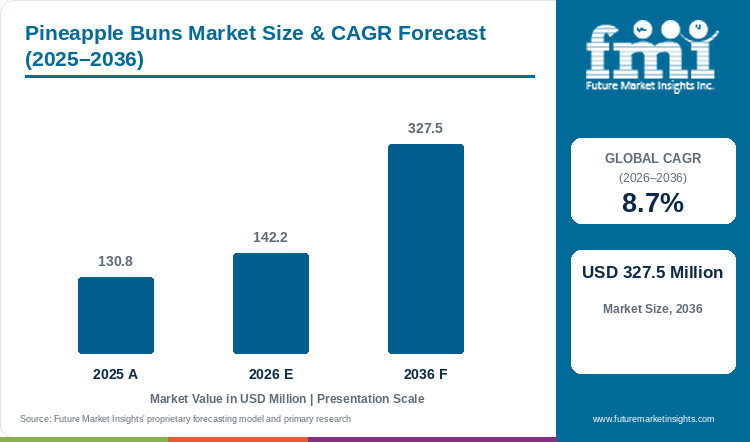
With a valuation of USD 130.8 million in 2025 and moving to USD 142.2 million in 2026, the global pineapple buns market is positioned to attain USD 327.5 million by 2036, exhibiting a CAGR of 8.7%.
Growing shopper appetite for Asian bakery items across mainstream supermarkets and bubble-tea cafes is turning Hong Kong-style pineapple buns (`bo lo bao`) from a neighborhood specialty into a standard retail and foodservice line. Instead of mixing yeasted bread dough and sweet cookie topping separately in each store, grocery bakeries and cafe operators order pre-topped frozen buns where classic / original holds a 35.0% product type share in 2026. Pre-topped frozen dough pucks let standard store ovens bake crackled-crust buns on demand all day. Future Market Insights projects the global pineapple buns market to grow from USD 130.8 million in 2025 to USD 142.2 million in 2026 and reach USD 327.5 million by 2036 at an 8.7% CAGR, ahead of the 6.5% CAGR in frozen bakery products. In June 2026, the Hong Kong Special Administrative Region Government (HKSAR) featured pineapple-bun crust crafting at its Traditional Cuisine Carnival, which boosted international buyer interest in Cantonese bakery items [1]. Even so, moisture moving from the soft bread into the sugar crust during bagged storage still limits shelf life in ambient grocery aisles.
Key Market Trends & Insights
- By product type: Classic / original buns are expected to hold a 35.0% share in 2026, resulting from consumer demand for the signature golden lattice-cracked sugar crust.
- By claim / nature: Conventional formulations are estimated to hold a 56.0% share in 2026, due to butter shortening plasticity and egg-yolk crust browning.
- By format: Frozen buns are projected to account for a 29.0% share in 2026, influenced by cafe operators baking small tray batches on demand.
- By packaging format: Multipack boxes and four-count flow-packs are predicted to record a 30.0% share in 2026, in line with household breakfast replenishment.
- By sales channel: Supermarkets & hypermarkets are anticipated to capture a 44.0% share in 2026, attributed to Asian-bakery perimeter tables and frozen aisle doors.
Regional Highlights
- Top national expansion: International hotel breakfast buffets and Asian mall cafe openings propel the UAE at a category-leading 10.2% CAGR through 2036.
- Broader country progression: High daily grain consumption supports a 9.9% CAGR in Saudi Arabia ahead of South Korea at 9.6% and the USA at 9.2%, whereas mature melonpan competition moderates Japan to a 7.9% CAGR.
Market Size & Forecast
Table 1: Market Size and Forecast for the Pineapple Buns Market (USD million and CAGR percentage), 2025 to 2036
| Metric | Value |
|---|---|
| 2025 Market Size | USD 130.8 million |
| Estimated Market Size in 2026 | USD 142.2 million |
| Projected Market Size by 2036 | USD 327.5 million |
| CAGR, 2026 to 2036 | 8.7% |
| Added Revenue, 2026 to 2036 | USD 185.3 million |
Scaling Hong Kong-style pineapple buns (`bo lo bao`) outside traditional Cantonese bakehouses requires keeping a crisp sugar-cookie cap attached to a soft yeasted milk bun through freezing and delivery. When unbaked or par-baked buns warm up and refreeze during shipping, the brittle cookie topping cracks or slides off during final store baking. In December 2025, Finsbury Food Group invested in expanded proofing and blast-freezing lines at its Kara foodservice bakery site to raise specialty bun output for retail and foodservice buyers [2]. Industrial commissaries are therefore running pre-topped sweet buns beside enriched brioche buns on automated make-up lines to ship uniform frozen units to grocery chains.
Outlet-Pool and Bun-Unit Sizing
Table 2: Outlet-Pool and Bun-Unit Sizing for the Pineapple Buns Market (USD million and operational ranges), 2025 to 2036
| Metric | 2025 | 2026 | 2036 |
|---|---|---|---|
| Market size (USD million) | 130.8 | 142.2 | 327.5 |
| Commercial pineapple buns sold (million units) | 185.0 to 210.0 | 200.0 to 228.0 | 430.0 to 485.0 |
| Four-bun multipacks & foodservice cases (million) | 32.0 to 36.0 | 35.0 to 39.0 | 76.0 to 85.0 |
| Average wholesale price per bun (USD) | 0.62 to 0.70 | 0.63 to 0.71 | 0.68 to 0.76 |
Operational note: Unit-volume ranges reflect commercial single-bun weights (85 to 110 grams) and four-count retail multipack boxes across specialty Asian bakeries, bubble-tea cafes, and supermarket in-store bakery counters.
Bubble-tea franchises and pan-Asian grocery chains in North America require pre-topped frozen dough pucks that proof and bake to a crackled golden dome within 18 minutes. Co-packers run pineapple-bun doughs on high-speed divider-rounders shared with yeast-leavened dinner rolls to maximize oven capacity across morning shifts.
Per Capita & Bakery Outlet Sizing
Table 3: Per Capita and Outlet Spending Indicators for the Pineapple Buns Market (USD), 2025 to 2036
| Metric | 2025 | 2026 | 2036 |
|---|---|---|---|
| Global urban bakery shopper pool (million) | 4,620.0 | 4,710.0 | 5,340.0 |
| Spend per 1,000 urban shoppers (USD) | 28.3 | 30.2 | 61.3 |
| Annual spend per bakery & cafe door (USD) | 1,420.0 to 1,650.0 | 1,510.0 to 1,750.0 | 2,890.0 to 3,320.0 |
| Frozen & par-baked supply share (%) | 44.0% to 48.0% | 46.0% to 50.0% | 55.0% to 59.0% |
Table 4: Facility & Retail Bakery Spending Indicators for the Pineapple Buns Market (USD and percentages), 2026
| Metric | Value | Institutional Reference Basis |
|---|---|---|
| Market size, 2026 | USD 142.2 million | 2026 global pineapple buns revenue baseline |
| Supermarket bakeries & Asian cafes globally | 94,000 outlets | Global Asian-bakery, bubble-tea cafe & grocery counter registry |
| Market spend per commercial outlet | USD 1,512.8 | Annualized wholesale pineapple bun procurement |
| Supermarkets & hypermarkets allocation, 2026 | USD 62.6 million | 44.0% sales channel segment allocation |
Keeping the top crust crisp above a moist bread crumb requires vented film or a brief convection oven re-bake before counter service. Supermarket bakery directors merchandise warm pineapple buns beside laminated Danish pastries to capture higher morning coffee-and-bun basket values.
Analyst Perspective
"Commercializing pineapple buns beyond neighborhood Cantonese bakeries hinges on stopping moisture from the soft yeasted crumb from softening the crisp sugar-shortening cap. Manufacturers that supply freeze-thaw-stable pre-topped dough pucks with clear bilingual allergen labels will win multi-region grocery and bubble-tea cafe contracts."
- Nandini Roy Choudhury, Principal Consultant, Future Market Insights.
How is the pineapple buns market segmented?
The pineapple buns market is segmented by product type, claim / nature, format, packaging format, and sales channel. In 2026, Classic / Original is expected at 35.0%, Conventional at 56.0%, Frozen at 29.0%, Multipack at 30.0%, and Supermarkets & Hypermarkets at 44.0%.
By product type: Classic / original, whole grain & seeded, flavored & filled, and mini & artisan formats.
By claim / nature: Conventional, clean label, organic, and gluten-free & fortified.
By format: Frozen, fresh & chilled, and ambient & par-baked.
By packaging format: Multipack, single-serve, family / loaf pack, and bulk foodservice.
By sales channel: Supermarkets & hypermarkets, artisan & specialty bakeries, convenience & forecourt, online & DTC, and foodservice distributors.
Why does Classic / Original lead the product type category?
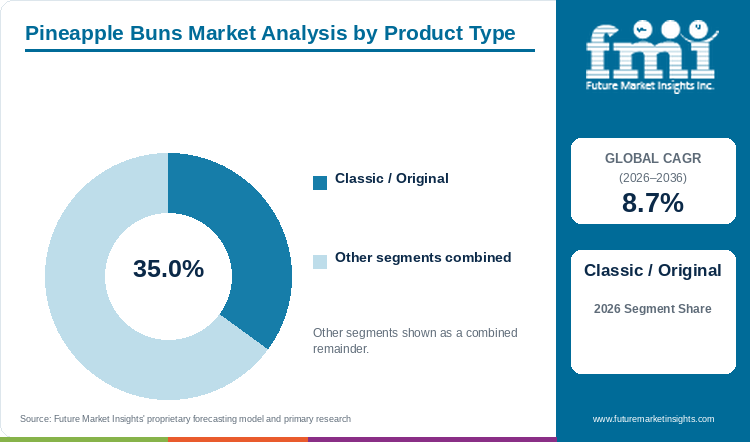
Classic / original buns are expected to hold a 35.0% share of the product type segment in 2026, supported by authentic crackled-crust demand.
Table 5: Product Type Share for the Pineapple Buns Market (percentage share), 2026
| Product Type | Share (2026) |
|---|---|
| Classic / Original | 35.0% |
| Other Segments Combined* | 65.0% |
| Total | 100.0% |
*Calculated as the balance remaining after deducting the leading segment's reported share from 100.0%.
Table 6: Product Type Leadership and Market Growth for the Pineapple Buns Market (segment and CAGR percentage), 2026 to 2036
| Metric | Value |
|---|---|
| Global CAGR (2026 to 2036) | 8.7% |
| Leading Segment | Classic / Original |
Mainstream grocery and cafe buyers anchor assortments with the classic unstuffed pineapple bun because its crackled yellow cookie crust and soft milk-bread crumb work for both grab-and-go snacking and Hong Kong-style cold-butter (`bo lo yau`) cafe orders. Custard-filled and matcha variants have shorter counter holding times, whereas the classic bun sells steadily beside glazed apple fritters with lower end-of-day waste.
- Classic / original buns are expected to hold a 35.0% share of the product type segment in 2026, driven by broad breakfast appeal and lower crust breakage during freezing.
- In September 2026, the Hong Kong Science Museum opened its Food (R)Evolutions exhibition examining the traditional crust-and-crumb preparation of cha chaan teng pineapple buns [3].
Why does Conventional define the largest claim / nature segment?
Conventional formulations are estimated to hold a 56.0% share of the claim / nature segment in 2026, driven by wheat gluten and egg-yolk crust browning.
The familiar diamond-cracked top crust on a pineapple bun relies on standard wheat flour and sugar with whole egg yolk and butter. Gluten-free and dairy-free recipes struggle to match the bread rise and crisp cookie cap simultaneously, so commercial bakeries rely on conventional formulations paired with cultured wheat flour.
- Conventional formulations are estimated to hold a 56.0% share of the claim / nature segment in 2026, attributable to reliable oven rise and lower ingredient costs.
- In January 2025, the U.S. Food and Drug Administration issued Edition 5 of its Final Guidance on Food Allergen Labeling, requiring explicit declaration of wheat and egg as well as milk and sesame across multi-unit bakery packages [4].
What keeps Frozen ahead by format?
Frozen buns are projected to account for a 29.0% share of the format segment in 2026, owing to centralized dual-dough make-up and store bake-off.
Frozen dough pucks and par-baked buns create an inventory buffer between a central commissary and hundreds of retail bakery counters or bubble-tea shops. Stores pull only the trays needed for morning or afternoon traffic and finish them in 12 minutes, avoiding overnight dough mixing at cafes that already bake bake-off croissants.
- Frozen pineapple buns are projected to account for a 29.0% share of the format segment in 2026, supported by long freezer storage life and on-demand store baking.
- Sara Lee Frozen Bakery's commercial specification for its Chef Pierre individually wrapped foodservice bakery packs documents a 365-day frozen shelf life and a 28-day thawed wrapped shelf life, showing how frozen inventory cuts daily store waste [5].
Why does Multipack lead the packaging format category?
Multipack boxes are predicted to record a 30.0% share of the packaging format segment in 2026, reinforced by four-bun clamshell crust protection.
Four-count and six-count plastic clamshell trays and compartmented bakery boxes protect the fragile sugar-cookie crust from crushing when stacked in supermarket freezers or home-delivery parcels. Multi-bun boxes also spread shipping costs across several servings for online bakery orders.
- Multipack formats are predicted to record a 30.0% share of the packaging format segment in 2026, linked to family breakfast buying and reduced per-bun crust damage.
- UK specialty baker Polly Chan's Bakehouse sells four-bun pineapple-bun boxes and 8-to-20 bun parcel boxes for next-day delivery, providing a direct commercial example of multipack merchandising and home reheating instructions [6].
What gives Supermarkets & Hypermarkets the leading position in sales channel?
Supermarkets & hypermarkets are anticipated to capture a 44.0% share of the sales channel segment in 2026, enabled by perimeter Asian-bakery tables.
Mainstream supermarket chains and pan-Asian grocery retailers (such as H Mart and 99 Ranch Market) turn pineapple buns from an occasional Chinatown bakery trip into a weekly household grocery purchase. In-store bakery tables attract first-time buyers with warm aroma while frozen multipack doors capture repeat pantry stocking.
- Supermarkets & hypermarkets are anticipated to capture a 44.0% share of the sales channel segment in 2026, reinforced by centralized warehouse replenishment and private-label Asian bakery programs.
- In April 2025, Rich Products introduced a frozen Funfetti cake layer with a 365-day frozen shelf life for grocery in-store bakeries, which supports the freezer-to-counter merchandising model that grocers use for specialty bakery items [7].
What are the drivers, restraints, and opportunities in the pineapple buns market?
In the pineapple buns market, supermarket Asian-bakery counters and pre-topped frozen dough units are projected to expand volume whereas crust moisture absorption restrains shelf life and air-fryer multipacks create retail opportunities.
- Driver: Mainstream grocery adoption of Asian bakery counters and pre-topped frozen dough technology expands retail and cafe distribution.
- Restraint: Sugar-crust moisture absorption from the crumb and multi-allergen labeling rules slow export qualification and increase staling waste.
- Opportunity: Air-fryer-ready frozen multipacks and savory or custard-filled buns open new sales in suburban grocers and coffee chains.
Growth Analysis and Future Potential: Qualitative Demand Catalysts
Shoppers visiting specialty tea bars and supermarket bakeries are looking for distinctive sweet-savory buns to pair with iced tea and espresso drinks. Making pineapple buns from scratch requires two separate dough mixtures and manual topping before proofing, which is too slow for busy cafe kitchens. Automated topping and freezing lines now let central bakeries ship ready-to-bake buns beside sweet viennoiserie lines. In February 2026, Finsbury Food Group reported in its 2026 Bakery Flavour Trends review that UK grocery shoppers are actively seeking Asian-inspired sweet bakery items including matcha and yuzu buns [8]. Pre-topped frozen units let mainstream stores add authentic Hong Kong buns without extra kitchen staff.
Risk Assessment of the Pineapple Buns Market: Operational and Formulation Friction
Keeping the top cookie crust crisp after packaging is the biggest operational hurdle for pineapple bun suppliers. Within 24 hours inside a sealed plastic bag at room temperature, moisture from the soft bread base softens the sugar topping and causes it to stick to the wrapper. In March 2025, the U.S. Food and Drug Administration posted an allergen recall after a wholesale bakery shipped bread and bun routes with undeclared milk and soy [9]. Because pineapple-bun recipes use wheat and egg with butter on lines shared with foodservice bun carriers, exporters must verify allergen labels and local language rules before shipping. Failed thaw tests or incomplete allergen labels can block a grocery listing even when consumer interest is strong.
Commercial Opportunity Analysis: Formulation Differentiation and Value-Add Formats
Home air-fryers and compact cafe convection ovens have created a major growth opening for par-baked four-count pineapple bun boxes. Heating a chilled or thawed bun at 160 degrees Celsius for four to six minutes restores the crisp cookie top while keeping the inside bread soft and warm. Bakers pairing protective dough conditioners from functional baking ingredients with sturdy clamshell trays can ship buns across long frozen distribution routes without crust cracking. In June 2025, McKee Foods launched Little Debbie Big Pack individually wrapped six-count sweet bakery boxes to serve multi-serve household breakfast and on-the-go snacking [10]. Suppliers that combine protective multipack trays with clear air-fryer heating instructions win repeat orders in suburban supermarkets.
Pineapple Buns Market by Country (2026 to 2036)
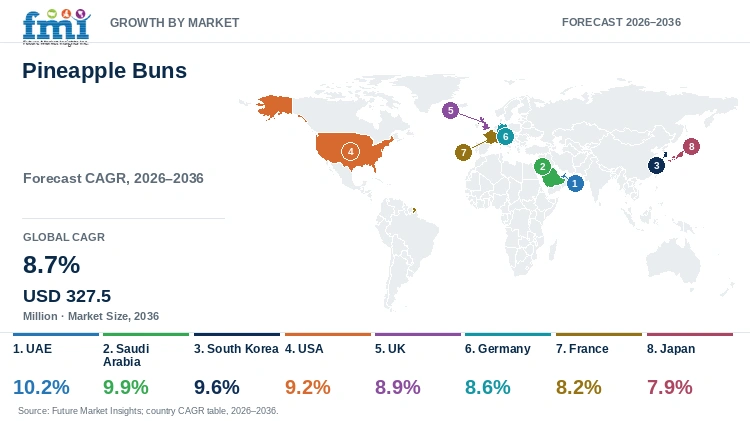
As per FMI, the UAE is projected to lead pineapple buns market expansion across evaluated national markets at a 10.2% CAGR through 2036, whereas Japan is forecast to register a 7.9% CAGR. Commercial rollout across Gulf hospitality venues, East Asian cafe networks, and Western grocery chains depends on sub-zero crust preservation and localized allergen labeling.
Table 7: Country CAGR and Primary Growth Levers for the Pineapple Buns Market (CAGR percentage and operational drivers), 2026 to 2036
| Country | CAGR (2026 to 2036) | Primary Growth Lever |
|---|---|---|
| UAE | 10.2% | International hotel breakfast buffets and Asian mall cafe expansion |
| Saudi Arabia | 9.9% | Expanding specialty cafe chains and Arabic halal foodservice demand |
| South Korea | 9.6% | Cafe cold-butter bun builds (bo lo yau) and convenience-store launches |
| USA | 9.2% | Pan-Asian grocery chain expansion and air-fryer-ready frozen multipacks |
| UK | 8.9% | Direct-to-consumer parcel bun boxes and grocery world-bakery tables |
| Germany | 8.6% | Small-batch frozen bake-off adoption cutting cafe staling waste |
| France | 8.2% | Franco-Asian patisserie fusion using AOP butter sugar-cookie crusts |
| Japan | 7.9% | Custard-crust differentiation from domestic melonpan in urban retailers |
Source: Future Market Insights analysis
UAE Pineapple Buns Market Outlook (2026 to 2036)
International hotel breakfast buffets, Asian specialty supermarkets, and mall cafe chains in Dubai and Abu Dhabi lift UAE pineapple bun demand at a leading 10.2% CAGR from 2026 to 2036. Where East Asian neighborhood bakeries bake fresh batches every two hours, UAE operators rely on imported frozen par-baked buns distributed through Jebel Ali cold-storage hubs. In February 2026, the Dubai Department of Economy and Tourism reported that Dubai welcomed 19.59 million international overnight visitors in 2025, up 5% from 2024 across 827 hotel establishments [11]. High coastal humidity softens unsealed sugar crusts quickly, so Dubai catering buyers specify moisture-barrier trays and brief convection re-crisping before buffet service.
Key takeaway: In the UAE, international hotel breakfast buffets and Asian mall cafes are projected to drive imports of par-baked frozen pineapple buns.
Saudi Arabia Pineapple Buns Market Outlook (2026 to 2036)
Modern quick-service tea and coffee cafes across Riyadh and Jeddah are introducing sweet-crusted Asian buns to a young dining population with high daily bread consumption. Commercial demand in Saudi Arabia is expected to advance at a 9.9% CAGR between 2026 and 2036, supported by rapid shopping-mall foodservice expansion and specialty grocery openings. Under Saudi Food and Drug Authority technical regulation SFDA.FD/GSO 9, all prepackaged food labels sold in the Kingdom must display complete ingredient and allergen statements in Arabic [12]. International bakery exporters must also provide halal fat certification confirming butter or vegetable shortening in the cookie crust with printed freeze-thaw expiration dates before port customs clearance.
Key takeaway: In Saudi Arabia, expanding specialty cafe chains and compliant Arabic halal labeling are expected to support butter-crust pineapple bun adoption.
South Korea Pineapple Buns Market Outlook (2026 to 2036)
Domestic franchise bakery chains and independent Hongdae and Gangnam espresso cafes across South Korea bake fresh Hong Kong-style pineapple buns beside local streusel (`soboro`) breads to capture afternoon snacking traffic. In February 2025, a 25-year national dietary trend analysis published in Epidemiology and Health confirmed sustained energy-share expansion for convenient packaged and commercial bakery foods among urban adults in South Korea [13]. To differentiate pineapple buns from domestic streusel rolls, specialty cafe operators feature thick cold-butter slabs (`ang-butter` and `bo lo yau` builds) and custard fillings that command premium single-serve menu pricing. Commercial pineapple bun sales in South Korea are therefore forecast to register a 9.6% CAGR from 2026 to 2036.
Key takeaway: In South Korea, premium cafe butter-slab bun builds and convenience-store launches are forecast to sustain strong single-serve turnover.
USA Pineapple Buns Market Outlook (2026 to 2036)
Nationwide expansion of pan-Asian supermarket chains (such as H Mart and 99 Ranch Market) and suburban bubble-tea bakery cafes is bringing pineapple buns into mainstream U.S. shopping centers. Under the federal FASTER Act enforced by the U.S. Food and Drug Administration, packaged bakery products sold in the USA must declare sesame as the ninth major food allergen in addition to wheat and egg [14]. Club stores and regional grocers across California and New York stock frozen four-count air-fryer pineapple bun boxes once suppliers verify allergen segregation and crust durability across frozen warehouse drops. Commercial pineapple bun revenue in the USA is anticipated to record a 9.2% CAGR between 2026 and 2036.
Key takeaway: In the USA, expanding pan-Asian supermarket chains and air-fryer-ready frozen multipacks are anticipated to broaden suburban household adoption.
UK Pineapple Buns Market Outlook (2026 to 2036)
Urban Chinatown artisan bakehouses in London and Manchester and national supermarket world-bakery tables propel the UK pineapple buns market at an 8.9% CAGR from 2026 to 2036. Traditional Hong Kong bakery staples have crossed over into UK grocery seasonal flavour calendars and direct-to-consumer nationwide chilled parcel delivery boxes for household breakfast occasions. UK specialty baker Polly Chan's Bakehouse lists wheat and egg with milk allergens as well as four-to-six minute 160-degree air-fryer re-crisping instructions for its classic Hong Kong pineapple buns [15]. Commercial bakery operators selling prepacked-for-direct-sale sweet buns at UK retail bakery counters must maintain full ingredient lists and emphasized allergen labels on every pack.
Key takeaway: In the UK, direct-to-consumer bakery parcel boxes and supermarket Asian-flavour rotations are projected to expand pineapple bun distribution.
Germany Pineapple Buns Market Outlook (2026 to 2036)
Margin pressure across hospitality outlets in Germany makes low-waste frozen bake-off buns the preferred commercial route over scratch daily preparation. Pineapple bun sales in Germany are estimated to grow at an 8.6% CAGR between 2026 and 2036, led by bubble-tea cafes and Asian supermarkets in Berlin and Frankfurt as well as Duesseldorf and Munich. In February 2026, the Federal Statistical Office (Destatis) reported that real hospitality turnover in Germany declined by 2.1% in 2025 as consumers curbed discretionary dining spend [16]. Because independent cafes cannot absorb end-of-day fresh pastry write-offs, distributors across Germany favor pre-topped frozen dough units that staff bake in small six-bun tray increments during afternoon peak hours.
Key takeaway: In Germany, hospitality margin compression is estimated to favor small-batch frozen bake-off pineapple buns that eliminate end-of-day staling waste.
France Pineapple Buns Market Outlook (2026 to 2036)
Shoppers in France compare the crackled sugar cap of imported pineapple buns directly against domestic `chouquettes` and pure-butter brioche mousseline. In October 2026, a NutriNet-Santé cohort study of 112,395 adults in France published in the European Heart Journal linked synthetic preservative additives in industrial foods to higher cardiovascular risk, reinforcing retailer demand for clean-label frozen bake-off buns [17]. Patisseries in Paris and Lyon capture premium prices by formulating pineapple buns with AOP Charentes-Poitou butter crusts and black-sesame or matcha diplomatic cream fillings. Accordingly, the pineapple buns market in France is predicted to expand at an 8.2% CAGR from 2026 to 2036 across specialty patisseries and gourmet grocery freezers.
Key takeaway: In France, clean-label patisserie fusion and pure-butter crust formulations are predicted to drive specialty retail and cafe adoption.
Japan Pineapple Buns Market Outlook (2026 to 2036)
Hong Kong-style pineapple buns in Japan compete directly against domestic melonpan (`meronpan`) in convenience stores and rail-station bakeries, resulting in a 7.9% CAGR from 2026 to 2036. To stand out from dry-biscuit domestic melonpan, specialty importers and Yokohama Chinatown bakeries position authentic `bo lo bao` around a richer egg-custard crust and warm salted-butter slab cafe service. The Consumer Affairs Agency of Japan requires all packaged bakery foods sold domestically to carry local-language labels detailing mandatory wheat and egg allergens with milk and storage instructions [18]. Compliant local-language allergen declarations and compact single-serve moisture-barrier flow-wraps govern retail shelf access across Tokyo and Osaka supermarkets and convenience stores.
Key takeaway: In Japan, differentiation against domestic melonpan through rich butter-crust authenticity and compliant local allergen labels is slated to guide specialty growth.
Full report country CAGRs cover: North America; Latin America; Western Europe; Eastern Europe; East Asia; South Asia and Pacific; Middle East and Africa.
Who are the notable companies in the pineapple buns market?
Rich Products, Sara Lee Frozen Bakery, Dessert Holdings, Mademoiselle Desserts, Finsbury Food Group, Premier Foods, Bauli, and Dr. Oetker are the notable companies evaluated in the pineapple buns market.
FMI analysis indicates that the competitive field spans frozen foodservice dough and bake-off manufacturers as well as European specialty bun groups and multinational packaged bakery corporations. Frozen bake-off leaders operate high-speed make-up and blast-freezing lines capable of supplying pre-topped sweet buns to in-store bakeries and cafe chains. Branded packaged bakery groups use multi-country grocery distribution and protective flow-wrapping to commercialize ambient and chilled sweet buns.
- Frozen Bake-Off and Foodservice Pastry Platforms: Rich Products and Sara Lee Frozen Bakery with Dessert Holdings supply frozen dough and technical in-store bakery programs across North America and export markets.
- European Specialty Bun and Sweet-Bakery Producers: Mademoiselle Desserts and Finsbury Food Group with Premier Foods operate automated bun proofing sites and branded grocery sweet-bakery distribution across the UK and Europe.
- International Fermented-Pastry and Packaged Bakery Groups: Bauli and Dr. Oetker combine natural sourdough fermentation expertise with Coppenrath & Wiese frozen roll and pastry manufacturing.
Competitive Benchmarking: Pineapple Buns Market
Table 8: Competitive Benchmarking for the Pineapple Buns Market (qualitative capability ratings), 2026
| Company | Frozen / Thaw-and-Serve Supply | Sweet-Bun / Dough Compatibility | Retail / Foodservice Access | Geographic Reach |
|---|---|---|---|---|
| Rich Products | High | High | High | High |
| Sara Lee Frozen Bakery | High | Medium | High | Medium |
| Dessert Holdings | High | Medium | High | Medium |
| Mademoiselle Desserts | High | Medium | High | High |
| Finsbury Food Group | High | High | High | Medium |
| Premier Foods | Medium | Medium | High | Medium |
| Bauli | Medium | High | High | High |
| Dr. Oetker | High | High | High | High |
Scoring basis: Capability tiers evaluate documented commercial frozen and par-baked dough supply, fermented sweet-bun and brioche line compatibility, and multi-channel supermarket and foodservice distribution reach.
Key Developments in the Pineapple Buns Market
- ARYZTA AG documented in its March 2026 operational report that it is expanding automated bun bakery capacity across Europe and Asia including a EUR 40 million bun facility investment in Portugal [19].
- Flowers Foods reported in its April 2026 Annual Report that it operates 44 bakeries across 19 U.S. states and expanded its specialty sweet bakery and better-for-you portfolio following the Simple Mills acquisition [20].
- Grupo Bimbo announced in May 2026 that 98% of its daily consumption bread and specialty bun portfolio achieved Positive Nutrition standards free from artificial flavors and colors [21].
Key Players in the Pineapple Buns Market
Frozen Bake-Off and Foodservice Pastry Platforms
- Rich Products
- Sara Lee Frozen Bakery
- Dessert Holdings
European Specialty Bun and Sweet-Bakery Producers
- Mademoiselle Desserts
- Finsbury Food Group
- Premier Foods
International Fermented-Pastry and Packaged Bakery Groups
- Bauli
- Dr. Oetker
Pineapple Buns Market - Report Scope
Table 9: Report Scope for the Pineapple Buns Market (coverage fields and definitions), 2026 to 2036
| Coverage field | Report scope |
|---|---|
| Market breakdown | Product Type; Claim / Nature; Format; Packaging Format; Sales Channel |
| Quantitative Units | USD Million |
| Market Definition | Includes commercial wholesale and retail supplier revenue from identifiable Hong Kong-style pineapple buns (bo lo bao) featuring a yeasted bun base topped with a crisp sugar-pastry crust across fresh, frozen, par-baked, and packaged formats. Category Scope Note: Excludes fruit-filled pineapple turnovers, generic hamburger buns, and bundled cafe beverage revenue. |
| Regions Covered | North America; Latin America; Western Europe; Eastern Europe; East Asia; South Asia and Pacific; Middle East and Africa |
| Countries Covered | UAE, Saudi Arabia, South Korea, USA, UK, Germany, France, Japan, and additional countries in the full report |
| Key Companies Covered | Rich Products, Sara Lee Frozen Bakery, Dessert Holdings, Mademoiselle Desserts, Finsbury Food Group, Premier Foods, Bauli, Dr. Oetker |
| Forecast Period | 2026 to 2036 |
| Approach | Primary and secondary research with top-down and bottom-up market triangulation. |
Pineapple Buns Market - Research Methodology
Table 10: Research Methodology for the Pineapple Buns Market (research methods and approach), 2026 edition
| Method | Approach |
|---|---|
| Primary Research | Structured interviews with Cantonese master bakers, supermarket in-store bakery category managers, bubble-tea chain commissary directors, and frozen dough distributors to validate crust-stability and case pricing. |
| Secondary Research | Analysis of Hong Kong Government culinary registry records, U.S. FDA Edition 5 and FASTER Act allergen guidance, Destatis retail statistics, NutriNet-Sante cohort records, and commercial bakery specifications. |
| Market Sizing and Forecasting | Top-down specialty sweet-bun expenditure models reconciled against bottom-up Asian grocery door counts, cafe daily tray bake-off rates, and four-pack freezer velocity from 2026 to 2036. |
| Country Forecasting Model | Econometric national projections weight pan-Asian supermarket store openings, specialty tea-and-coffee cafe density, hospitality visitor arrivals, and import allergen compliance costs across eight countries. |
| Operational Benchmark Traceability | Bun-unit and outlet spending indicators in Tables 2, 3, and 4 trace to Hong Kong GIS, Dubai DET, NutriNet-Sante, Destatis, and commercial frozen bakery shelf-life standards. |
| Data Triangulation and Validation | Demand estimates are cross-checked against commercial bun-line capacities and specialty Asian bakery distributor volumes without double counting generic brioche or conchas. |
Pineapple Buns Market by Segments
Pineapple Buns Market segmented by Product Type:
- Classic / Original
- Whole Grain & Seeded
- Flavored & Filled
- Mini & Artisan Formats
Pineapple Buns Market segmented by Claim / Nature:
- Conventional
- Clean Label & Organic
- Gluten-Free & Fortified
Pineapple Buns Market segmented by Format:
- Frozen
- Fresh & Chilled
- Ambient & Par-Baked
Pineapple Buns Market segmented by Packaging Format:
- Multipack
- Single-Serve
- Family / Loaf Pack
- Bulk Foodservice
Pineapple Buns Market segmented by Sales Channel:
- Supermarkets & Hypermarkets
- Artisan & Specialty Bakeries
- Convenience & Forecourt
- Online & DTC
- Foodservice Distributors
Pineapple Buns Market by Region
- North America
- United States
- Canada
- Latin America
- Brazil
- Mexico
- Argentina
- Chile
- Western Europe
- Germany
- France
- United Kingdom
- Italy
- Spain
- Benelux
- Nordics
- Eastern Europe
- Poland
- Czech Republic
- Romania
- Hungary
- East Asia
- China
- Japan
- South Korea
- South Asia and Pacific
- India
- ASEAN
- Australia and New Zealand
- Middle East and Africa
- GCC Countries
- South Africa
- Türkiye
- Israel
Research Sources and Bibliography
- [1] Hong Kong Special Administrative Region Government. (2026, June 20). ICH Cuisine Carnival Presents Essence of Hong Kong Pineapple Bun and Traditional Food Making Techniques. Hong Kong Government Information Services.
- [2] Finsbury Food Group. (2025, December 9). Finsbury Food Group Invests in Kara Foodservice Bakery Site to Drive Specialty Bun Innovation and Throughput. Finsbury Food Group Corporate Releases.
- [3] Hong Kong Special Administrative Region Government. (2026, September 30). French Science Festival Food (R)Evolutions Exhibition at Hong Kong Science Museum Explores Cha Chaan Teng Pineapple Buns. Hong Kong Government Information Services.
- [4] U.S. Food and Drug Administration. (2025, January 6). FDA Releases Final Guidance for Industry: Questions and Answers Regarding Food Allergen Labeling (Edition 5). U.S. Department of Health and Human Services.
- [5] Sara Lee Frozen Bakery, LLC. (2026, January 15). Chef Pierre Individually Wrapped Muffin Variety Pack 24ct/4oz (SKU 08635): Frozen and Thawed Commercial Specifications. Sara Lee Frozen Bakery Foodservice Catalog.
- [6] Polly Chan's Bakehouse. (2026, March 10). Order Your Chinese Buns: Four-Bun Pineapple Bun Multipack Boxes and Nationwide Next-Day Delivery. Polly Chan's Bakehouse UK Retail Catalog.
- [7] Rich Products Corporation. (2025, April 10). Rich Products, Funfetti Extend Partnership. Rich Products Corporation.
- [8] Finsbury Food Group. (2026, February 17). 2026 Bakery Flavour Trends: Asian-Inspired Sweet Bakery Formats and Matcha-Infused Buns in UK Retail. Finsbury Food Group Industry Insights.
- [9] U.S. Food and Drug Administration. (2025, March 28). The Bakery Group Issues Allergen Alert on Undeclared Milk, Soy, and Egg in Wholesale Bread and Bun Products. FDA Enforcement Recalls Database.
- [10] McKee Foods Corporation. (2025, June 23). Little Debbie Big Pack Old Fashioned Donuts. Little Debbie.
- [11] Dubai Department of Economy and Tourism. (2026, February 9). Dubai Welcomes 19.59 Million International Overnight Visitors in Third Record Year. Government of Dubai Media Office.
- [12] Saudi Food and Drug Authority (SFDA). (2024, July 18). Mandatory Arabic Food Product Labeling Requirements Under Technical Regulation SFDA.FD/GSO 9. Saudi Food and Drug Authority Regulatory Portal.
- [13] Park, S., & Kim, J. (2025, February 3). Long-Term Trends and Patterns in Packaged and Bakery Food Consumption Among Adults in South Korea. Epidemiology and Health, 47, e2025008 (PubMed PMID 39901034).
- [14] U.S. Food and Drug Administration. (2024, April 12). The FASTER Act: Sesame Is the Ninth Major Food Allergen on Packaged Bakery and Food Products. U.S. Department of Health and Human Services.
- [15] Polly Chan's Bakehouse. (2026, March 10). Pineapple Bun (Bo Lo Bao): Traditional Cracked Cookie-Top Milk Bun Ingredient and Allergen Specifications. Polly Chan's Bakehouse Product Information.
- [16] Statistisches Bundesamt (Destatis). (2026, February 19). Gastgewerbeumsatz 2025 Real 2,1 Prozent Niedriger als im Vorjahr. Destatis Pressemitteilungen.
- [17] Srour, B., Chazelas, E., & Touvier, M. (2026, October 23). Preservative Food Additives, Hypertension, and Cardiovascular Diseases in the NutriNet-Sante Cohort in France. European Heart Journal, 47(40), ehag712 (PubMed PMID 42161430).
- [18] Consumer Affairs Agency, Government of Japan. (2025, May 15). Food Labelling Standards, Mandatory Allergen Declarations, and Japanese-Language Requirements for Imported Foods. Consumer Affairs Agency Official Guidance.
- [19] ARYZTA AG. (2026, March 2). ARYZTA AG 2025 Sustainability and Operational Footprint Report: European and Asian QSR Bun Bakery Lines. ARYZTA AG Corporate Publications.
- [20] Flowers Foods, Inc. (2026, April 14). Flowers Foods 2025 Annual Report (Form ARS): Sweet Bakery, Bun Automation, and Simple Mills Integration. U.S. Securities and Exchange Commission EDGAR.
- [21] Grupo Bimbo S.A.B. de C.V. (2026, May 12). Grupo Bimbo Achieves Positive Nutrition Standards Across 98 Percent of Daily Consumption Bread and Bun Portfolio. Grupo Bimbo Corporate Releases.
- [22] Premier Foods plc. (2026, July 16). Quarter 1 Trading Update for the 13 Weeks Ending 27 June 2026: Branded Sweet Treats and International Rollout. Premier Foods Corporate Releases.
- [23] Dr. August Oetker KG. (2025, April 16). Business Year 2025: Dr. Oetker and Coppenrath & Wiese Expand Frozen Roll and Sweet Bakery Operations. Dr. Oetker Press Portal.
This bibliography is provided for reader reference and is not exhaustive. The full report contains the complete reference list and detailed citations.
This Report Answers
- How large is the pineapple buns market in 2026 and what is forecast for 2036?
- Which in-store bakery and cafe substitution pressures support pineapple bun demand?
- Why does Classic / Original lead the product type category in 2026?
- Why does Conventional lead the claim / nature category globally?
- How do growth rates differ across the UAE and Saudi Arabia versus East Asia?
- Which leading companies operate relevant frozen bun and sweet-bakery platforms today?
- What limits adoption or supplier switching in the pineapple buns market?
- What should buyers evaluate before purchasing commercial pineapple buns?
Frequently Asked Questions
How big is the pineapple buns market in 2026, and what is forecast for 2036?
According to FMI, the global pineapple buns market size is estimated to reach USD 142.2 million in 2026 from USD 130.8 million in 2025. Valuation is forecast to hit USD 327.5 million by 2036 as supermarkets and specialty cafes adopt pre-topped frozen buns.
What is the CAGR for the pineapple buns market from 2026 to 2036?
Future Market Insights projects an 8.7% compound annual growth rate between 2026 and 2036, generating USD 185.3 million in incremental market value across retail grocery and foodservice channels.
Which product type segment leads the pineapple buns market?
Classic / original buns are expected to hold a 35.0% share of the product type segment in 2026 because the unstuffed crackled-crust bun anchors both grab-and-go retail packs and warm butter-slab cafe service.
Which claim / nature segment leads the pineapple buns market?
Conventional formulations are estimated to hold a 56.0% share of the claim / nature segment in 2026 as wheat gluten and egg yolk with plasticized shortening are required to form the signature diamond-cracked topping.
Which country has a notable growth outlook during the assessment period?
The UAE is projected to lead evaluated national growth at a 10.2% CAGR through 2036, supported by international hotel breakfast buffets and Asian bakery cafe openings.
Who are the key players in the market?
Rich Products, Sara Lee Frozen Bakery, Dessert Holdings, Mademoiselle Desserts, Finsbury Food Group, Premier Foods, Bauli, and Dr. Oetker represent key commercial bakery and frozen pastry platforms evaluated in this market.
Preview the report firsthand - request a free sample
Get SampleGet the brochure for pricing and purchase details.
Get PDFTable of Content
- Key Takeaways
- Market Size and CAGR
- Top Growth Driver
- Fastest Growing Segment
- Leading Region
- Key Companies
- Emerging Opportunities
- Executive Summary
- Global Market Outlook
- Demand-side Trends
- Supply-side Trends
- Technology Roadmap Analysis
- Analysis and Recommendations
- Analyst Perspective (What is happening? Why now? What should investors know?)
- Key Questions Answered
- How large is the market?
- What is the CAGR?
- What are key trends?
- Which region dominates?
- Who are the leaders?
- Market Overview
- Market Coverage / Taxonomy
- Market Definition / Scope / Limitations
- Research Methodology
- Chapter Orientation
- Analytical Lens and Working Hypotheses
- Market Structure, Signals, and Trend Drivers
- Benchmarking and Cross-market Comparability
- Market Sizing, Forecasting, and Opportunity Mapping
- Research Design and Evidence Framework
- Desk Research Programme (Secondary Evidence)
- Expert Input and Fieldwork (Primary Evidence)
- Tooling, Models, and Reference Databases
- Data Engineering and Model Build
- Quality Assurance and Audit Trail
- Market Background
- Market Dynamics (Drivers, Restraints, Opportunity, Trends)
- Scenario Forecast (Optimistic, Likely, Conservative)
- Impact Analysis
- AI Impact
- Sustainability Impact
- Regulatory Impact
- Technology Impact
- Consumer / Buyer Analysis
- Purchase Drivers
- Adoption Barriers
- Buyer Journey
- Opportunity Map Analysis
- Product Life Cycle Analysis
- Supply Chain Analysis
- Investment Feasibility Matrix
- Value Chain Analysis
- PESTLE and Porter's Analysis
- Regulatory Landscape
- Regional Parent Market Outlook
- Production and Consumption Statistics
- Import and Export Statistics
- Global Market Analysis and Forecast, 2021 to 2036
- Historical Market Size Value (USD Million) Analysis, 2021 to 2025
- Current and Future Market Size Value (USD Million) Projections, 2026 to 2036
- Y-o-Y Growth Trend Analysis
- Absolute $ Opportunity Analysis
- Global Market Pricing Analysis, 2021 to 2036
- Global Market Analysis and Forecast, By Product Type, 2021 to 2036
- Introduction / Key Findings
- Historical Market Size Value (USD Million) Analysis By Product Type, 2021 to 2025
- Current and Future Market Size Value (USD Million) Analysis and Forecast By Product Type, 2026 to 2036
- Classic / Original
- Whole Grain & Seeded
- Flavored & Filled
- Mini & Artisan Formats
- Y-o-Y Growth Trend Analysis By Product Type, 2021 to 2025
- Absolute $ Opportunity Analysis By Product Type, 2026 to 2036
- Global Market Analysis and Forecast, By Claim / Nature, 2021 to 2036
- Introduction / Key Findings
- Historical Market Size Value (USD Million) Analysis By Claim / Nature, 2021 to 2025
- Current and Future Market Size Value (USD Million) Analysis and Forecast By Claim / Nature, 2026 to 2036
- Conventional
- Clean Label & Organic
- Gluten-Free & Fortified
- Y-o-Y Growth Trend Analysis By Claim / Nature, 2021 to 2025
- Absolute $ Opportunity Analysis By Claim / Nature, 2026 to 2036
- Global Market Analysis and Forecast, By Format, 2021 to 2036
- Introduction / Key Findings
- Historical Market Size Value (USD Million) Analysis By Format, 2021 to 2025
- Current and Future Market Size Value (USD Million) Analysis and Forecast By Format, 2026 to 2036
- Frozen
- Fresh & Chilled
- Ambient & Par-Baked
- Y-o-Y Growth Trend Analysis By Format, 2021 to 2025
- Absolute $ Opportunity Analysis By Format, 2026 to 2036
- Global Market Analysis and Forecast, By Packaging Format, 2021 to 2036
- Introduction / Key Findings
- Historical Market Size Value (USD Million) Analysis By Packaging Format, 2021 to 2025
- Current and Future Market Size Value (USD Million) Analysis and Forecast By Packaging Format, 2026 to 2036
- Multipack
- Single-Serve
- Family / Loaf Pack
- Bulk Foodservice
- Y-o-Y Growth Trend Analysis By Packaging Format, 2021 to 2025
- Absolute $ Opportunity Analysis By Packaging Format, 2026 to 2036
- Global Market Analysis and Forecast, By Sales Channel, 2021 to 2036
- Introduction / Key Findings
- Historical Market Size Value (USD Million) Analysis By Sales Channel, 2021 to 2025
- Current and Future Market Size Value (USD Million) Analysis and Forecast By Sales Channel, 2026 to 2036
- Supermarkets & Hypermarkets
- Artisan & Specialty Bakeries
- Convenience & Forecourt
- Online & DTC
- Foodservice Distributors
- Y-o-Y Growth Trend Analysis By Sales Channel, 2021 to 2025
- Absolute $ Opportunity Analysis By Sales Channel, 2026 to 2036
- Global Market Analysis and Forecast, By Region, 2021 to 2036
- Introduction
- Historical Market Size Value (USD Million) Analysis By Region, 2021 to 2025
- Current Market Size Value (USD Million) Analysis and Forecast By Region, 2026 to 2036
- North America
- Latin America
- Western Europe
- Eastern Europe
- East Asia
- South Asia and Pacific
- Middle East and Africa
- Market Attractiveness Analysis By Region
- North America Market Analysis and Forecast, By Country, 2021 to 2036
- Historical Market Size Value (USD Million) Trend Analysis By Market Taxonomy, 2021 to 2025
- Market Size Value (USD Million) Forecast By Market Taxonomy, 2026 to 2036
- By Country
- United States
- Canada
- By Product Type
- By Claim / Nature
- By Format
- By Packaging Format
- By Sales Channel
- By Country
- Market Attractiveness Analysis
- By Country
- By Product Type
- By Claim / Nature
- By Format
- By Packaging Format
- By Sales Channel
- Key Takeaways
- Latin America Market Analysis and Forecast, By Country
- Historical Market Size Value (USD Million) Trend Analysis By Market Taxonomy, 2021 to 2025
- Market Size Value (USD Million) Forecast By Market Taxonomy, 2026 to 2036
- By Country
- Brazil
- Mexico
- Argentina
- Chile
- By Product Type
- By Claim / Nature
- By Format
- By Packaging Format
- By Sales Channel
- By Country
- Market Attractiveness Analysis
- By Country
- By Product Type
- By Claim / Nature
- By Format
- By Packaging Format
- By Sales Channel
- Key Takeaways
- Western Europe Market Analysis and Forecast, By Country
- Historical Market Size Value (USD Million) Trend Analysis By Market Taxonomy, 2021 to 2025
- Market Size Value (USD Million) Forecast By Market Taxonomy, 2026 to 2036
- By Country
- Germany
- France
- United Kingdom
- Italy
- Spain
- Benelux
- Nordics
- By Product Type
- By Claim / Nature
- By Format
- By Packaging Format
- By Sales Channel
- By Country
- Market Attractiveness Analysis
- By Country
- By Product Type
- By Claim / Nature
- By Format
- By Packaging Format
- By Sales Channel
- Key Takeaways
- Eastern Europe Market Analysis and Forecast, By Country
- Historical Market Size Value (USD Million) Trend Analysis By Market Taxonomy, 2021 to 2025
- Market Size Value (USD Million) Forecast By Market Taxonomy, 2026 to 2036
- By Country
- Poland
- Czech Republic
- Romania
- Hungary
- By Product Type
- By Claim / Nature
- By Format
- By Packaging Format
- By Sales Channel
- By Country
- Market Attractiveness Analysis
- By Country
- By Product Type
- By Claim / Nature
- By Format
- By Packaging Format
- By Sales Channel
- Key Takeaways
- East Asia Market Analysis and Forecast, By Country
- Historical Market Size Value (USD Million) Trend Analysis By Market Taxonomy, 2021 to 2025
- Market Size Value (USD Million) Forecast By Market Taxonomy, 2026 to 2036
- By Country
- China
- Japan
- South Korea
- By Product Type
- By Claim / Nature
- By Format
- By Packaging Format
- By Sales Channel
- By Country
- Market Attractiveness Analysis
- By Country
- By Product Type
- By Claim / Nature
- By Format
- By Packaging Format
- By Sales Channel
- Key Takeaways
- South Asia and Pacific Market Analysis and Forecast, By Country
- Historical Market Size Value (USD Million) Trend Analysis By Market Taxonomy, 2021 to 2025
- Market Size Value (USD Million) Forecast By Market Taxonomy, 2026 to 2036
- By Country
- India
- ASEAN
- Australia and New Zealand
- By Product Type
- By Claim / Nature
- By Format
- By Packaging Format
- By Sales Channel
- By Country
- Market Attractiveness Analysis
- By Country
- By Product Type
- By Claim / Nature
- By Format
- By Packaging Format
- By Sales Channel
- Key Takeaways
- Middle East and Africa Market Analysis and Forecast, By Country
- Historical Market Size Value (USD Million) Trend Analysis By Market Taxonomy, 2021 to 2025
- Market Size Value (USD Million) Forecast By Market Taxonomy, 2026 to 2036
- By Country
- GCC Countries
- South Africa
- Türkiye
- Israel
- By Product Type
- By Claim / Nature
- By Format
- By Packaging Format
- By Sales Channel
- By Country
- Market Attractiveness Analysis
- By Country
- By Product Type
- By Claim / Nature
- By Format
- By Packaging Format
- By Sales Channel
- Key Takeaways
- Key Countries Market Analysis
- United States
- Pricing Analysis
- Market Share Analysis, 2025
- By Product Type
- By Claim / Nature
- By Format
- By Packaging Format
- By Sales Channel
- Canada
- Pricing Analysis
- Market Share Analysis, 2025
- By Product Type
- By Claim / Nature
- By Format
- By Packaging Format
- By Sales Channel
- Mexico
- Pricing Analysis
- Market Share Analysis, 2025
- By Product Type
- By Claim / Nature
- By Format
- By Packaging Format
- By Sales Channel
- Brazil
- Pricing Analysis
- Market Share Analysis, 2025
- By Product Type
- By Claim / Nature
- By Format
- By Packaging Format
- By Sales Channel
- Chile
- Pricing Analysis
- Market Share Analysis, 2025
- By Product Type
- By Claim / Nature
- By Format
- By Packaging Format
- By Sales Channel
- Germany
- Pricing Analysis
- Market Share Analysis, 2025
- By Product Type
- By Claim / Nature
- By Format
- By Packaging Format
- By Sales Channel
- United Kingdom
- Pricing Analysis
- Market Share Analysis, 2025
- By Product Type
- By Claim / Nature
- By Format
- By Packaging Format
- By Sales Channel
- Italy
- Pricing Analysis
- Market Share Analysis, 2025
- By Product Type
- By Claim / Nature
- By Format
- By Packaging Format
- By Sales Channel
- Spain
- Pricing Analysis
- Market Share Analysis, 2025
- By Product Type
- By Claim / Nature
- By Format
- By Packaging Format
- By Sales Channel
- France
- Pricing Analysis
- Market Share Analysis, 2025
- By Product Type
- By Claim / Nature
- By Format
- By Packaging Format
- By Sales Channel
- India
- Pricing Analysis
- Market Share Analysis, 2025
- By Product Type
- By Claim / Nature
- By Format
- By Packaging Format
- By Sales Channel
- ASEAN
- Pricing Analysis
- Market Share Analysis, 2025
- By Product Type
- By Claim / Nature
- By Format
- By Packaging Format
- By Sales Channel
- Australia and New Zealand
- Pricing Analysis
- Market Share Analysis, 2025
- By Product Type
- By Claim / Nature
- By Format
- By Packaging Format
- By Sales Channel
- China
- Pricing Analysis
- Market Share Analysis, 2025
- By Product Type
- By Claim / Nature
- By Format
- By Packaging Format
- By Sales Channel
- Japan
- Pricing Analysis
- Market Share Analysis, 2025
- By Product Type
- By Claim / Nature
- By Format
- By Packaging Format
- By Sales Channel
- South Korea
- Pricing Analysis
- Market Share Analysis, 2025
- By Product Type
- By Claim / Nature
- By Format
- By Packaging Format
- By Sales Channel
- Poland
- Pricing Analysis
- Market Share Analysis, 2025
- By Product Type
- By Claim / Nature
- By Format
- By Packaging Format
- By Sales Channel
- Hungary
- Pricing Analysis
- Market Share Analysis, 2025
- By Product Type
- By Claim / Nature
- By Format
- By Packaging Format
- By Sales Channel
- Türkiye
- Pricing Analysis
- Market Share Analysis, 2025
- By Product Type
- By Claim / Nature
- By Format
- By Packaging Format
- By Sales Channel
- South Africa
- Pricing Analysis
- Market Share Analysis, 2025
- By Product Type
- By Claim / Nature
- By Format
- By Packaging Format
- By Sales Channel
- UAE
- Pricing Analysis
- Market Share Analysis, 2025
- By Product Type
- By Claim / Nature
- By Format
- By Packaging Format
- By Sales Channel
- Saudi Arabia
- Pricing Analysis
- Market Share Analysis, 2025
- By Product Type
- By Claim / Nature
- By Format
- By Packaging Format
- By Sales Channel
- United States
- Market Structure Analysis
- Competition Dashboard
- Competition Benchmarking
- Market Share Analysis of Top Players
- By Regional
- By Product Type
- By Claim / Nature
- By Format
- By Packaging Format
- By Sales Channel
- Emerging Startups
- Innovation Benchmarking
- Competition Analysis
- Competition Deep Dive
- Rich Products
- Overview
- Product Portfolio
- Profitability by Market Segments
- Sales Footprint
- Strategy Overview
- Marketing Strategy
- Product Strategy
- Channel Strategy
- Sara Lee Frozen Bakery
- Dessert Holdings
- Mademoiselle Desserts
- Finsbury Food Group
- Premier Foods
- Bauli
- Dr. Oetker
- Rich Products
- Case Studies
- Success Stories
- Recent Developments
- Competition Deep Dive
- Assumptions & Acronyms Used


