

- Market Size (2026)
- USD 165.1 Mn
- Forecast (2036)
- USD 279.4 Mn
- CAGR (2026 to 2036)
- 5.4%
How big is Plant Exosome Actives Market in 2026?
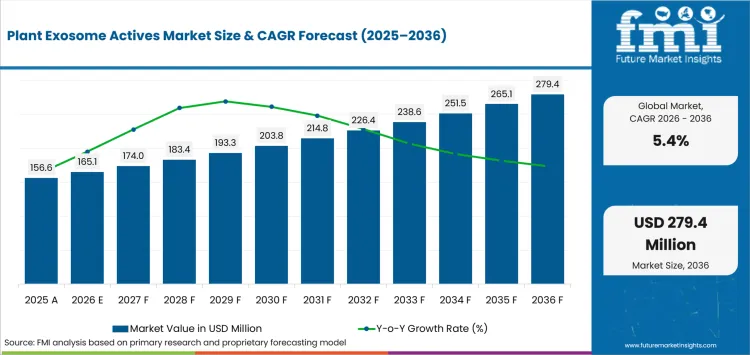
USD 165.1 million in 2026 and USD 279.4 million by 2036 at a 5.4% CAGR.
Demand in the plant exosome actives market is anticipated to push valuation from USD 165.1 million in 2026 to USD 279.4 million by 2036, expanding at a 5.4% CAGR over the forecast period. Cosmetic laboratories require consistent vesicle identity and stability to move premium formulation budgets beyond screening. In March 2026, Symrise launched Cellexora MD as a 100% plant-derived true-exosome ingredient with documented stability, reproducibility, and clinical assessment. The launch gives laboratories a defined basis for comparing plant vesicles with known skin bioactives during premium formulation approval.
Cosmetic launch timelines lengthen in jurisdictions that expect detailed safety files and clearly bounded claims for novel biological ingredients. The European Commission's Safety Gate 2025 report found cosmetics represented 36% of validated dangerous-product alerts, the largest product category. The alert volume keeps ingredient identity and substantiation central to premium natural cosmetics launches. Complete composition, stability, and claim files can shorten review, whereas poorly characterized vesicle systems require additional testing before commercial review can close.
Key Takeaways
- Beauty R&D teams are placing plant exosome actives into formal ingredient qualification as reproducibility, stability, and cosmetic efficacy become purchasing criteria.
- Based on product type, standard grade is projected to account for 39.0% in 2026 due to its fit with routine cosmetic testing and batch comparison.
- The anti-aging segment is likely to capture 24.0% share in 2026 attributable to measurable longevity and wrinkle endpoints.
- By application, facial skincare is forecast to represent 38.0% in 2026 driven by premium active budgets and multi-benefit formats.
- Uneven vesicle characterization and stability data increase qualification work and reduce the number of brands willing to carry a novel biological claim into commercial launch.
- Key players in the plant exosome actives market include DSM-Firmenich, Symrise, Vytrus Biotech, Ashland, Clariant, Croda, Givaudan, and BASF.
Analyst Perspective
"Plant exosome actives justify premium pricing if vesicle identity survives batch release and finished-formula stability testing. Commercial advantage comes from reducing brand-side validation with characterization data, use-level guidance, and claim evidence that carries from prototype into launch."
- Nikhil Kaitwade, Principal Consultant, Future Market Insights
How is the plant exosome actives market segmented?
The plant exosome actives market is segmented by product type, function, application, grade, sales channel, and region.
The taxonomy separates product type into standard grade, high-purity / clinical grade, natural & certified grade, and customized systems. Function covers anti-aging, hydration & barrier, brightening, soothing & sensitive, and UV & protection. Application includes facial skincare, body care, haircare, color cosmetics, and suncare products. Grade spans standard cosmetic grade, COSMOS / natural certified, pharma & clinical grade, and organic certified. Sales channels include direct to brands, specialty distributors, contract manufacturers, and online B2B.
How does facial skincare anchor the application category?
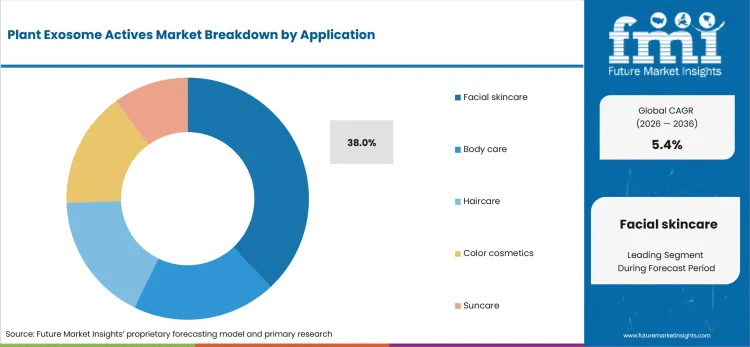
Facial skincare concentrates premium active spend and lets one formula carry longevity, hydration, brightening, or soothing claims in familiar formats. Brand laboratories also have routine testing procedures for facial serums and creams that reduce the setup required for novel skincare actives.
- In 2026, facial skincare is expected to lead the application category with 38.0% share because multi-benefit face care can absorb higher active costs.
- Croda launched Malvallin in June 2026 as a botanical active addressing firmness, hydration, elasticity, and visible facial volume. Facial formulas can absorb higher active costs across multiple premium claims, while body and hair formats face tighter cost-per-dose economics.
What makes standard grade central to the product type category?
Standard grade gives formulation teams a practical entry specification for plant vesicles without the added controls attached to clinical or bespoke material. It fits routine stability, dose, and compatibility work already used for botanical ingredients and other premium actives.
- By product type, standard grade is estimated to hold 39.0% in 2026 owing to lower qualification friction in mainstream cosmetic programs.
- Vytrus Biotech expanded NATRUE approval to several biotechnology actives in October 2025, so certified alternatives carry additional documentation. Standard material retains broader access where natural certification is useful but not a clear commercial purchase requirement.
Why does anti-aging lead the function category?
Anti-aging gives plant-vesicle science endpoints that premium skincare teams already test, including wrinkle appearance, elasticity, and skin resilience. The category can be benchmarked against established anti-aging skincare actives such as peptides and botanical systems.
- Anti-aging is set to lead the function category with 24.0% share in 2026 due to its fit with measurable longevity and wrinkle claims.
- DSM-Firmenich introduced EXOVIVE LIFT in April 2026 after a two-month placebo-controlled study focused on elasticity and wrinkle performance. The launch gives anti-aging programs a direct plant-exosome proof point with credible human evidence and a defined cosmetic claim route.
What supports standard cosmetic grade within the grade category?
Standard cosmetic grade matches the safety, traceability, stability, and claim evidence expected for topical cosmetic ingredients without therapeutic manufacturing controls. It gives formulation teams a workable commercial balance between scientific differentiation and routine qualification cost.
- Standard cosmetic grade is projected to hold 49.0% share in 2026 owing to its fit with routine cosmetic safety and formulation requirements.
- Clariant introduced AlgaSurge in April 2026 as a purified blue-biotechnology active with clinical hydration and cellular-renewal evidence. Its cosmetic launch route shows that advanced biology can enter routine commercial formulation programs with a standard cosmetic safety and claims package.
What are the drivers, restraints and opportunities in the Plant Exosome Actives Market?
Science-backed plant signaling actives attract premium skincare budgets, but characterization costs slow qualification and formulation-ready systems shorten the path to repeat orders.
- Driver: Premium facial-care programs fund biological actives that link plant-origin differentiation with measurable longevity, repair, and barrier endpoints.
- Restraint: Source variation, isolation conditions, and storage behavior increase the validation work required before plant vesicles can enter repeat purchasing.
- Opportunity: Defined vesicle specifications and formulation guidance shift more stability and compatibility work from brand laboratories to ingredient companies.
Premium Skincare Programs Reward Measurable Biological Claims
Premium facial-skincare programs fund biological actives only if visible endpoints can justify the higher ingredient cost. Givaudan introduced PrimalHyal NeuroYouth in March 2026 for a defined neuro-skin-ageing pathway with efficacy claims tied to sensory function and youthful appearance. Plant exosome developers compete for the same premium budgets by translating vesicle biology into measurable longevity or barrier claims that beauty laboratories can test against cosmetic peptide manufacturing benchmarks.
Qualification Cost Limits Faster Conversion
Plant-vesicle qualification becomes expensive because source material and isolation conditions can alter composition during commercial scale-up. IKW's 2025/2026 annual report found that 92% of member companies considered rising costs a considerable burden. Extra characterization competes with constrained laboratory budgets, making stable specifications and claim-ready documentation more important to repeat purchasing than biological novelty by itself for ingredient screening and repeat orders.
Formulation Support Can Convert Science into Repeat Orders
Beauty laboratories approve novel actives faster once stability and delivery are resolved inside a usable ingredient system. In March 2026, Givaudan introduced VectorHyal as a hyaluronic-acid delivery system engineered for active stability and cosmetic performance. Plant exosome developers can pursue similar projects by supplying defined vesicle specifications, application testing, and clear use-level guidance that reduces repeated compatibility work during cosmeceutical ingredients qualification.
Which country CAGRs are profiled in the Plant Exosome Actives Market?
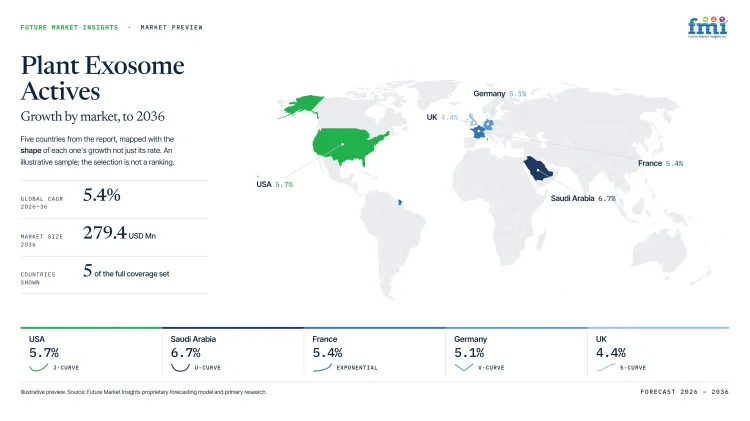
| Country | CAGR |
|---|---|
| Saudi Arabia | 6.7% |
| UAE | 6.4% |
| South Korea | 6.0% |
| USA | 5.7% |
| France | 5.4% |
| Germany | 5.1% |
| Japan | 4.8% |
| UK | 4.4% |
How do country-level CAGRs compare in the Plant Exosome Actives Market?
The 2.3-percentage-point range separates a Gulf-led upper group from mature markets with slower qualification cycles. Saudi Arabia and the UAE lead at 6.7% and 6.4%, followed by South Korea and the USA. France, Germany, Japan, and the UK form the lower band, where documentation discipline moderates conversion for ingredient teams.
- Saudi premium skincare can support earlier stocking after claim qualification.
- UAE distributors gain from compact prestige-beauty resale routes.
- South Korean ODM cycles reward formulation-ready technical data.
- USA laboratories provide a broad pilot-account base.
- French prestige brands keep launch volumes selective.
- German buyers prioritize repeat-order economics and documentation.
- Japanese formulators allow longer proof-building before scale-up.
- UK brands tend to start with smaller launch batches.
Qualification cycles and channel structure still change launch economics. The full report provides country-level CAGR analysis across North America, Latin America, Europe, East Asia, South Asia, Oceania and the Middle East and Africa.
Country-wise Analysis
- Saudi distributors prepare notification files and local warehousing ahead of inventory commitments for novel cosmetic actives sold through premium skincare channels. Saudi Arabia is projected to grow at 6.7% CAGR through 2036, aided by premium beauty investment and a domestic compliance network that SFDA counted at 831 licensed cosmetics warehouses in its January 2026 report. Missing ingredient identity, stability records, or Arabic technical support can delay plant-vesicle launches, so manufacturers with locally usable dossiers can secure distributor commitments earlier and hold enough stock to support repeated retail replenishment once a brand clears local review during the first commercial season locally.
- For premium beauty launches in Dubai, ingredient companies gain rapid retailer access once Montaji registration and central-laboratory requirements are closed. In October 2025, Dubai Municipality said it monitors more than 500,000 imported products, placing novel actives inside a high-volume review system with local laboratory capacity. Plant exosome actives sales in the UAE are forecast to expand at 6.4% CAGR by 2036, owing to premium beauty spending and regional resale activity, although incomplete safety or claims files can stop a launch before distributors turn interest into firm regional orders using one locally accepted technical package for neighboring Gulf markets from Dubai.
- Korean ODM and brand teams compress development schedules for new biological actives, especially facial-care concepts that may enter functional-cosmetics pathways for wrinkle or whitening claims. Plant exosome actives demand in South Korea is predicted to advance at 6.0% CAGR during the forecast period, tied to export-oriented formulation cycles and fast concept turnover. MFDS reported in May 2026 that 2025 cosmetics exports rose 11.8%, which raises the cost of weak substantiation because one claims package may travel into several destination markets ahead of international launch commitments for finished products in regional retail and e-commerce channels at commercial scale after approval globally.
- Before national retail placement, US beauty brands can screen novel actives through independent laboratories and contract manufacturers that support short pilot cycles and frequent formula changes. FDA listed 16,398 active cosmetic facility registrations as of June 30, 2026, giving plant-vesicle companies a broad base of potential formulation accounts under the MoCRA registration system. The USA is estimated to post 5.7% CAGR over the forecast period because premium skincare continues to fund active evaluation, although wider conversion depends on cosmetic-specific safety files and restrained claims that do not imply disease treatment or biological therapy during later national retail rollout cycles and expansion.
- Prestige and dermocosmetic launches in France routinely pass through formulation houses that expect product-information support, responsible-person coordination, and defensible efficacy language ahead of release. Plant exosome actives demand in France is forecast to rise at 5.4% CAGR over the assessment period, reinforced by facial-skincare programs that can absorb the cost of stronger safety and stability evidence. In February 2026, DGCCRF said it inspected 147 cosmetics establishments during a targeted review of product information files, so weak dossiers carry a visible enforcement cost and can reduce the willingness of local companies to test novel vesicle ingredients during early local formulation screening programs.
- In German skincare laboratories, repeatability and technical-file quality carry as much weight as novelty during entry of a biological active into premium or pharmacy-adjacent formulation programs. IKW reported in December 2025 that skin and face care sales rose 11.1%, confirming a commercial base for higher-value actives without relaxing qualification expectations. Germany's plant exosome actives outlook is anticipated to advance at 5.1% CAGR during the assessment period, attributable to mature facial-care demand despite high operating costs that favor standard grades with stable specifications and application support that shortens internal testing required for commercial orders beyond initial laboratory pilots and small brand trials in Germany.
- Long internal testing cycles shape how Japanese cosmetic laboratories evaluate novel biological actives ahead of entry into major skincare lines, department stores, or pharmacy channels. Adoption of plant exosome actives in Japan is estimated to expand at 4.8% CAGR through 2036, given a mature formulation base and steady demand for high-specification facial care. Japan Cosmetic Industry Association data published in October 2025 put skincare at 44.5% of 2024 cosmetic shipment value, but quasi-drug boundaries keep claims conservative and make Japanese stability evidence a prerequisite for wider rollout by established domestic brands during annual line-renewal planning cycles and portfolio renewal decisions nationally.
- Plant exosome actives sales in the UK are projected to expand at a 4.4% CAGR through 2036. Growth comes from active-led skincare launches, but commercialization depends on the level of evidence brands can provide for product claims. UK cosmetic regulations require a responsible person to stand behind each finished cosmetic before sale. The requirement increases the importance of safety documentation and claim substantiation throughout product development. In July 2026, OPSS said the SCPN had received 861,686 notifications by May 28, so traceability is routine and companies with concise safety evidence can fit existing notification workflows without slowing retailer review or small-batch launch schedules at commercial scale nationally.
Who are the notable companies in the Plant Exosome Actives Market?
DSM-Firmenich, Symrise, Vytrus Biotech, Ashland, Clariant, Croda, Givaudan, and BASF are the notable companies profiled in this market.
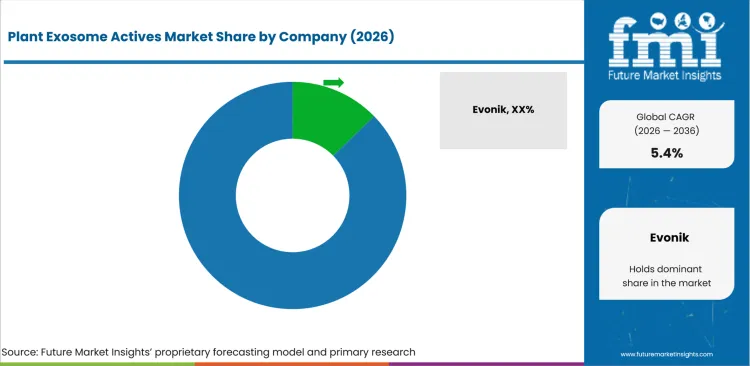
Plant-exosome specialists compete with larger beauty-active groups that bring biotechnology and formulation resources. DSM-Firmenich, Symrise, and Vytrus Biotech publish direct plant-exosome evidence for cosmetic use. Ashland, Clariant, Croda, Givaudan, and BASF contribute adjacent actives, claims evidence, delivery technology, or scale-up infrastructure. Entry depends on repeatable vesicle identity, stability, safety, and claims support during laboratory evaluation against familiar cosmetic chemicals.
- Direct plant-exosome platforms: DSM-Firmenich, Symrise, and Vytrus Biotech publish current vesicle systems for cosmetic use.
- Biofunctional and botanical-active platforms: Ashland, Clariant, and Croda contribute plant science, clinical substantiation, and formulation support.
- Biotechnology and delivery platforms: Givaudan and BASF bring fermentation, encapsulation, extraction, and application infrastructure for cosmetic antioxidants and skin actives.
Competitive Benchmarking: Plant Exosome Actives Market
| Company | Plant-Derived Bioactive Depth | Clinical & Claims Evidence | Formulation Support | Geographic Reach |
|---|---|---|---|---|
| DSM-Firmenich | High | High | High | Global |
| Symrise | High | High | High | Global |
| Vytrus Biotech | High | High | Medium | Europe, Asia-Pacific and Americas |
| Ashland | Medium | High | High | Global |
| Clariant | High | High | High | Global |
| Croda | High | High | High | Global |
| Givaudan | High | High | High | Global |
| BASF | High | High | High | Global |
Scoring basis: High bioactive depth requires a direct plant-exosome platform or multiple plant-biotechnology actives, Medium requires one documented route, and Low identifies adjacent evidence without a direct platform. High clinical evidence requires human testing plus mechanistic support, Medium requires one evidence type, and Low identifies limited substantiation. High formulation support requires application resources in multiple regions, Medium reflects a narrower footprint, and Low identifies limited support. Geographic reach records current official commercial or technical coverage for each company.
Key Developments in the Plant Exosome Actives Market
- In June 2026, Croda commissioned its Guangzhou hub to place beauty-actives production and customer collaboration closer to Asian formulation teams.
- In March 2026, Ashland appointed IMCD US as exclusive US distributor for personal and home care ingredients to expand access to its biofunctional actives.
- In October 2025, Givaudan opened its White Biotechnology Innovation Centre in Toulouse to expand high-precision active-ingredient research and scale-up.
Key Players in the Plant Exosome Actives Market
Direct Plant-Exosome Platforms
- DSM-Firmenich
- Symrise
- Vytrus Biotech
Biofunctional and Botanical-Active Platforms
- Ashland
- Clariant
- Croda
Biotechnology and Delivery Platforms
- Givaudan
- BASF
Plant Exosome Actives Market - Report Scope
| Coverage field | Report scope |
|---|---|
| Market breakdown | By product type, function, application, grade, sales channel and region. |
| Quantitative Units | USD million. |
| Market Definition | Revenue from commercially sold plant-derived extracellular vesicles, exosome-like nanovesicles, or standardized plant-vesicle systems positioned as functional cosmetic actives or active-delivery ingredients. Finished-product revenue, human- or animal-derived exosome products, and substitute actives not sold as plant exosome actives are excluded. |
| Regions Covered | North America, Latin America, Western Europe, Eastern Europe, East Asia, South Asia and Pacific, and Middle East and Africa. |
| Countries Covered | Saudi Arabia, UAE, South Korea, USA, France, Germany, Japan, UK, and 25+ additional countries in the full report. |
| Key Companies Profiled | DSM-Firmenich, Symrise, Vytrus Biotech, Ashland, Clariant, Croda, Givaudan, and BASF. |
| Forecast Period | 2026 to 2036. |
| Approach | Primary and secondary research with market triangulation. |
Plant Exosome Actives Market - Research Methodology
| Method | Approach |
|---|---|
| Primary Research | FMI analysts gathered input from manufacturers, service providers, technology developers, distributors, end users, procurement teams, and subject-matter experts. Interviews examined purchasing decisions, product or service evaluation, adoption barriers, approval requirements, pricing considerations, and expectations for technical or commercial support. Respondents were also asked what evidence is required before a trial, pilot, or initial order develops into regular purchasing. |
| Desk Research | Desk research covered government statistics, regulatory publications, trade data, industry associations, technical literature, standards, company filings, product information, and official corporate announcements. Sources were reviewed for relevance, publication date, geographic coverage, and consistency with the defined market scope. Claims relating to performance, applications, approvals, capacity, investment, and commercial activity were retained only when supported by credible public evidence. |
| Market Sizing and Forecasting | The market model combined the baseline value with historical performance, segment structure, pricing and volume indicators, adoption levels, company participation, and country-level demand conditions. Forecast assumptions considered economic activity, investment trends, regulatory developments, technology adoption, purchasing cycles, supply availability, and barriers to wider market use. Segment and regional estimates were reconciled before the final market total was calculated. |
| Data Validation | Estimates were checked against multiple independent indicators, including public data, company activity, trade patterns, industry developments, and findings from primary interviews. Validation also tested whether products, services, applications, and company revenues fell within the defined market boundaries. Adjacent categories, unsupported claims, overlapping revenues, and activities without direct market relevance were excluded to reduce double counting and maintain consistency across segments and countries. |
Plant Exosome Actives Market by Segments
Plant Exosome Actives Market segmented by Product Type:
- Standard grade
- High-purity / clinical grade
- Natural & certified grade
- Customized systems
Plant Exosome Actives Market segmented by Function:
- Anti-aging
- Hydration & barrier
- Brightening
- Soothing & sensitive
- UV & protection
Plant Exosome Actives Market segmented by Application:
- Facial skincare
- Body care
- Haircare
- Color cosmetics
- Suncare
Plant Exosome Actives Market segmented by Grade:
- Standard cosmetic grade
- COSMOS / natural certified
- Pharma & clinical grade
- Organic certified
Plant Exosome Actives Market segmented by Sales Channel:
- Direct to brands
- Specialty distributors
- Contract manufacturers
- Online B2B
Plant Exosome Actives Market by Region:
- North America
- United States
- Canada
- Latin America
- Brazil
- Mexico
- Argentina
- Chile
- Western Europe
- Germany
- France
- United Kingdom
- Italy
- Spain
- Benelux
- Nordics
- Eastern Europe
- Poland
- Czech Republic
- Romania
- Hungary
- East Asia
- China
- Japan
- South Korea
- South Asia and Pacific
- India
- ASEAN
- Australia and New Zealand
- Middle East and Africa
- GCC Countries
- South Africa
- Türkiye
- Israel
Research Sources and Bibliography
- Symrise. (2026, March 31). Symrise launches Cellexora™ MD, a pioneering healthspan ingredient for premium skincare.
- European Commission, Directorate-General for Justice and Consumers. (2026, March 5). Safety Gate 2025.
- Vytrus Biotech. (2025, October 15). Vytrus expands its NATRUE-certified actives portfolio.
- DSM-Firmenich. (2026, April 10). dsm-firmenich introduces EXOVIVE™ LIFT: The next generation science-backed exosomes, and the first in a breakthrough range of products.
- Croda International Plc. (2026, June 17). Croda strengthens premium beauty pipeline with next-generation skincare active Malvallin™.
- Clariant. (2026, April 15). Lucas Meyer Cosmetics by Clariant to unveil game-changing beauty innovations at in-cosmetics 2026.
- Givaudan. (2026, March 25). Givaudan Active Beauty unveils PrimalHyal™ NeuroYouth.
- Industrieverband Körperpflege- und Waschmittel e. V. (2026). Economy.
- Givaudan. (2026, March 17). Givaudan Active Beauty elevates its delivery systems technology with VectorHyal™.
- Saudi Food and Drug Authority. (2026, January 26). SFDA Reports 18% Growth in Licensed Factories and Warehouses During 2025.
- Dubai Municipality. (2025, October 27). Product safety at Beautyworld Middle East 2025.
- Ministry of Food and Drug Safety, Republic of Korea. (2026, May 28).
- USA Food and Drug Administration. (2026). Registration & Listing of Cosmetic Product Facilities and Products.
- Direction générale de la concurrence, de la consommation et de la répression des fraudes. (2026, February 2). Cosmétiques : des TPE nouvelles dans le secteur qui méconnaissent trop souvent la réglementation.
- Industrieverband Körperpflege- und Waschmittel e. V. (2025, December 3). Market Data.
- Japan Cosmetic Industry Association. (2025, October 27).
- Office for Product Safety and Standards. (2026, July 17). New data on UK cosmetic product safety notifications.
- Ashland Inc. (2026, March 12). Ashland announces strategic partnership with IMCD for the exclusive distribution of personal and home care ingredients in the United States.
- Croda International Plc. (2026, June 26). Croda commissions Guangzhou Hub to strengthen strategic growth and innovation in China.
- Givaudan. (2025, October 16). Givaudan inaugurates a new White Biotechnology Innovation Centre in Toulouse, France.
- Symrise. (2025, October 22). Symrise invests in Cellibre, a USA-based biotechnology company, to accelerate innovation for taste balancing and cosmetic actives markets.
- BASF. (2026, July 16). BASF inaugurates new production plant in Düsseldorf, Germany.
- DSM-Firmenich. (2026, May 1). dsm-firmenich introduces GLYCARE® SK range: HMO biotechnology for skin regeneration and resilience.
- Clariant. (2025, March 19). Lucas Meyer Cosmetics by Clariant introduces GlowCytocin™ to capture the science of "Love Glow".
- Croda International Plc. (2026, May 21). Croda launches Beauty of Zero™ to advance sustainable innovation in personal care.
- DSM-Firmenich. (2026, March 27). dsm-firmenich introduces ALPAFLOR® NEUROSOOTH: climate-adaptive neurocosmetic science for holistic skin well-being.
- Symrise. (2026, March 17). Symrise establishes a new Care & Wellness Division.
- Vytrus Biotech. (2026, January 20). Remembering 2025 Milestones | Vytrus Biotech.
- Ashland Inc. (2026, April 13). Ashland introduces eternight™ biofunctional - unlocking nighttime longevity through Mitobiology™ and the [3R] Science.
- Clariant. (2025, April 7). "Clariant Beauty" launches new solutions for personal care.
- Croda International Plc. (2025, September 8). Celebrating our innovative ingredients: Zenakine™ - redefining neurocosmetic skincare possibilities.
- Givaudan. (2025, March 19). Givaudan Active Beauty unveils Evernityl™, the pioneering active ingredient for timeless beauty.
- BASF. (2026, August 13). BASF's Personal Care business unveils Floragenist™, a new generation of floral actives powered by epigenetic science.
- Vytrus Biotech. (2025, June 3). Biotech Ingredients Renew Halal Certification: A Commitment to Inclusivity and Quality.
- Vytrus Biotech. (2025, May 28). Vytrus advances the science of plant exosomes with awarded Innovations and patented technologies.
This bibliography is provided for reader reference and is not exhaustive. The full report contains the complete reference list and detailed citations
This Report Answers
- What is the 2026 plant exosome actives market value and 2036 forecast?
- What CAGR is projected between 2026 and 2036?
- Why does standard grade lead product type?
- Why does anti-aging lead the function category?
- Why does facial skincare lead application demand?
- Which countries record the highest projected growth?
- Which qualification issues slow wider commercial adoption?
- How do key companies differ in competitive capability?
Frequently Asked Questions
How big is the plant exosome actives market in 2026?
The plant exosome actives market is valued at USD 165.1 million in 2026 and is projected to reach USD 279.4 million by 2036. Premium skincare programs support growth by funding plant-origin actives with measurable cosmetic performance.
What is the CAGR of the plant exosome actives market from 2026 to 2036?
The plant exosome actives market is projected to grow at a CAGR of 5.4% between 2026 and 2036. Expansion depends on reproducible vesicle characterization, stability data, formulation support, and defensible cosmetic claims.
Which product type leads the plant exosome actives market?
The standard grade segment is expected to hold 39.0% of the plant exosome actives market in 2026, driven by its fit with routine cosmetic stability and batch-comparison work. It avoids the added controls attached to clinical or customized material grades.
Which application leads the plant exosome actives market?
The facial skincare segment is anticipated to represent 38.0% of the plant exosome actives market in 2026, attributable to premium active budgets and familiar efficacy testing. Facial serums and creams let brands evaluate several cosmetic endpoints within routine formulation workflows.
Which countries are projected to record the highest growth in the plant exosome actives market?
Saudi Arabia is projected to grow at 6.7% CAGR, followed by the UAE at 6.4% and South Korea at 6.0% through 2036. Premium beauty demand and local qualification routes support the upper growth group.
Which companies are active in the plant exosome actives market?
Key companies operating in the market include DSM-Firmenich, Symrise, Vytrus Biotech, Ashland, Clariant, Croda, Givaudan, and BASF. The eight companies compete on plant-vesicle science, clinical claims evidence, formulation support, biotechnology scale, and regional technical access.
Preview the report firsthand - request a free sample
Get SampleGet the brochure for pricing and purchase details.
Get PDFTable of Content
- Key Takeaways
- Market Size and CAGR
- Top Growth Driver
- Fastest Growing Segment
- Leading Region
- Key Companies
- Emerging Opportunities
- Executive Summary
- Global Market Outlook
- Demand-side Trends
- Supply-side Trends
- Technology Roadmap Analysis
- Analysis and Recommendations
- Analyst Perspective (What is happening? Why now? What should investors know?)
- Key Questions Answered
- How large is the market?
- What is the CAGR?
- What are key trends?
- Which region dominates?
- Who are the leaders?
- Market Overview
- Market Coverage / Taxonomy
- Market Definition / Scope / Limitations
- Research Methodology
- Chapter Orientation
- Analytical Lens and Working Hypotheses
- Market Structure, Signals, and Trend Drivers
- Benchmarking and Cross-market Comparability
- Market Sizing, Forecasting, and Opportunity Mapping
- Research Design and Evidence Framework
- Desk Research Programme (Secondary Evidence)
- Expert Input and Fieldwork (Primary Evidence)
- Tooling, Models, and Reference Databases
- Data Engineering and Model Build
- Quality Assurance and Audit Trail
- Market Background
- Market Dynamics (Drivers, Restraints, Opportunity, Trends)
- Scenario Forecast (Optimistic, Likely, Conservative)
- Impact Analysis
- AI Impact
- Sustainability Impact
- Regulatory Impact
- Technology Impact
- Consumer / Buyer Analysis
- Purchase Drivers
- Adoption Barriers
- Buyer Journey
- Opportunity Map Analysis
- Product Life Cycle Analysis
- Supply Chain Analysis
- Investment Feasibility Matrix
- Value Chain Analysis
- PESTLE and Porter's Analysis
- Regulatory Landscape
- Regional Parent Market Outlook
- Production and Consumption Statistics
- Import and Export Statistics
- Global Market Analysis and Forecast, 2021 to 2036
- Historical Market Size Value (USD Million) Analysis, 2021 to 2025
- Current and Future Market Size Value (USD Million) Projections, 2026 to 2036
- Y-o-Y Growth Trend Analysis
- Absolute $ Opportunity Analysis
- Global Market Pricing Analysis, 2021 to 2036
- Global Market Analysis and Forecast, By Product Type, 2021 to 2036
- Introduction / Key Findings
- Historical Market Size Value (USD Million) Analysis By Product Type, 2021 to 2025
- Current and Future Market Size Value (USD Million) Analysis and Forecast By Product Type, 2026 to 2036
- Standard grade
- High-purity / clinical grade
- Natural & certified grade
- Customized systems
- Standard grade
- Y-o-Y Growth Trend Analysis By Product Type, 2021 to 2025
- Absolute $ Opportunity Analysis By Product Type, 2026 to 2036
- Global Market Analysis and Forecast, By Function, 2021 to 2036
- Introduction / Key Findings
- Historical Market Size Value (USD Million) Analysis By Function, 2021 to 2025
- Current and Future Market Size Value (USD Million) Analysis and Forecast By Function, 2026 to 2036
- Anti-aging
- Hydration & barrier
- Brightening
- Soothing & sensitive
- UV & protection
- Anti-aging
- Y-o-Y Growth Trend Analysis By Function, 2021 to 2025
- Absolute $ Opportunity Analysis By Function, 2026 to 2036
- Global Market Analysis and Forecast, By Application, 2021 to 2036
- Introduction / Key Findings
- Historical Market Size Value (USD Million) Analysis By Application, 2021 to 2025
- Current and Future Market Size Value (USD Million) Analysis and Forecast By Application, 2026 to 2036
- Facial skincare
- Body care
- Haircare
- Color cosmetics
- Suncare
- Facial skincare
- Y-o-Y Growth Trend Analysis By Application, 2021 to 2025
- Absolute $ Opportunity Analysis By Application, 2026 to 2036
- Global Market Analysis and Forecast, By Grade, 2021 to 2036
- Introduction / Key Findings
- Historical Market Size Value (USD Million) Analysis By Grade, 2021 to 2025
- Current and Future Market Size Value (USD Million) Analysis and Forecast By Grade, 2026 to 2036
- Standard cosmetic grade
- COSMOS / natural certified
- Pharma & clinical grade
- Organic certified
- Standard cosmetic grade
- Y-o-Y Growth Trend Analysis By Grade, 2021 to 2025
- Absolute $ Opportunity Analysis By Grade, 2026 to 2036
- Global Market Analysis and Forecast, By Sales Channel, 2021 to 2036
- Introduction / Key Findings
- Historical Market Size Value (USD Million) Analysis By Sales Channel, 2021 to 2025
- Current and Future Market Size Value (USD Million) Analysis and Forecast By Sales Channel, 2026 to 2036
- Direct to brands
- Specialty distributors
- Contract manufacturers
- Online B2B
- Direct to brands
- Y-o-Y Growth Trend Analysis By Sales Channel, 2021 to 2025
- Absolute $ Opportunity Analysis By Sales Channel, 2026 to 2036
- Global Market Analysis and Forecast, By Region, 2021 to 2036
- Introduction
- Historical Market Size Value (USD Million) Analysis By Region, 2021 to 2025
- Current Market Size Value (USD Million) Analysis and Forecast By Region, 2026 to 2036
- North America
- Latin America
- Western Europe
- Eastern Europe
- East Asia
- South Asia and Pacific
- Middle East & Africa
- Market Attractiveness Analysis By Region
- North America Market Analysis and Forecast, By Country, 2021 to 2036
- Historical Market Size Value (USD Million) Trend Analysis By Market Taxonomy, 2021 to 2025
- Market Size Value (USD Million) Forecast By Market Taxonomy, 2026 to 2036
- By Country
- USA
- Canada
- By Product Type
- By Function
- By Application
- By Grade
- By Sales Channel
- By Country
- Market Attractiveness Analysis
- By Country
- By Product Type
- By Function
- By Application
- By Grade
- By Sales Channel
- Key Takeaways
- Latin America Market Analysis and Forecast, By Country
- Historical Market Size Value (USD Million) Trend Analysis By Market Taxonomy, 2021 to 2025
- Market Size Value (USD Million) Forecast By Market Taxonomy, 2026 to 2036
- By Country
- Brazil
- Mexico
- Chile
- Rest of Latin America
- By Product Type
- By Function
- By Application
- By Grade
- By Sales Channel
- By Country
- Market Attractiveness Analysis
- By Country
- By Product Type
- By Function
- By Application
- By Grade
- By Sales Channel
- Key Takeaways
- Western Europe Market Analysis and Forecast, By Country
- Historical Market Size Value (USD Million) Trend Analysis By Market Taxonomy, 2021 to 2025
- Market Size Value (USD Million) Forecast By Market Taxonomy, 2026 to 2036
- By Country
- Germany
- UK
- Italy
- Spain
- France
- Nordic
- BENELUX
- Rest of Western Europe
- By Product Type
- By Function
- By Application
- By Grade
- By Sales Channel
- By Country
- Market Attractiveness Analysis
- By Country
- By Product Type
- By Function
- By Application
- By Grade
- By Sales Channel
- Key Takeaways
- Eastern Europe Market Analysis and Forecast, By Country
- Historical Market Size Value (USD Million) Trend Analysis By Market Taxonomy, 2021 to 2025
- Market Size Value (USD Million) Forecast By Market Taxonomy, 2026 to 2036
- By Country
- Russia
- Poland
- Hungary
- Balkan & Baltic
- Rest of Eastern Europe
- By Product Type
- By Function
- By Application
- By Grade
- By Sales Channel
- By Country
- Market Attractiveness Analysis
- By Country
- By Product Type
- By Function
- By Application
- By Grade
- By Sales Channel
- Key Takeaways
- East Asia Market Analysis and Forecast, By Country
- Historical Market Size Value (USD Million) Trend Analysis By Market Taxonomy, 2021 to 2025
- Market Size Value (USD Million) Forecast By Market Taxonomy, 2026 to 2036
- By Country
- China
- Japan
- South Korea
- By Product Type
- By Function
- By Application
- By Grade
- By Sales Channel
- By Country
- Market Attractiveness Analysis
- By Country
- By Product Type
- By Function
- By Application
- By Grade
- By Sales Channel
- Key Takeaways
- South Asia and Pacific Market Analysis and Forecast, By Country
- Historical Market Size Value (USD Million) Trend Analysis By Market Taxonomy, 2021 to 2025
- Market Size Value (USD Million) Forecast By Market Taxonomy, 2026 to 2036
- By Country
- India
- ASEAN
- Australia & New Zealand
- Rest of South Asia and Pacific
- By Product Type
- By Function
- By Application
- By Grade
- By Sales Channel
- By Country
- Market Attractiveness Analysis
- By Country
- By Product Type
- By Function
- By Application
- By Grade
- By Sales Channel
- Key Takeaways
- Middle East & Africa Market Analysis and Forecast, By Country
- Historical Market Size Value (USD Million) Trend Analysis By Market Taxonomy, 2021 to 2025
- Market Size Value (USD Million) Forecast By Market Taxonomy, 2026 to 2036
- By Country
- Kingdom of Saudi Arabia
- Other GCC Countries
- Türkiye
- South Africa
- Other African Union
- Rest of Middle East & Africa
- By Product Type
- By Function
- By Application
- By Grade
- By Sales Channel
- By Country
- Market Attractiveness Analysis
- By Country
- By Product Type
- By Function
- By Application
- By Grade
- By Sales Channel
- Key Takeaways
- Key Countries Market Analysis
- USA
- Pricing Analysis
- Market Share Analysis, 2025
- By Product Type
- By Function
- By Application
- By Grade
- By Sales Channel
- Canada
- Pricing Analysis
- Market Share Analysis, 2025
- By Product Type
- By Function
- By Application
- By Grade
- By Sales Channel
- Mexico
- Pricing Analysis
- Market Share Analysis, 2025
- By Product Type
- By Function
- By Application
- By Grade
- By Sales Channel
- Brazil
- Pricing Analysis
- Market Share Analysis, 2025
- By Product Type
- By Function
- By Application
- By Grade
- By Sales Channel
- Chile
- Pricing Analysis
- Market Share Analysis, 2025
- By Product Type
- By Function
- By Application
- By Grade
- By Sales Channel
- Germany
- Pricing Analysis
- Market Share Analysis, 2025
- By Product Type
- By Function
- By Application
- By Grade
- By Sales Channel
- UK
- Pricing Analysis
- Market Share Analysis, 2025
- By Product Type
- By Function
- By Application
- By Grade
- By Sales Channel
- Italy
- Pricing Analysis
- Market Share Analysis, 2025
- By Product Type
- By Function
- By Application
- By Grade
- By Sales Channel
- Spain
- Pricing Analysis
- Market Share Analysis, 2025
- By Product Type
- By Function
- By Application
- By Grade
- By Sales Channel
- France
- Pricing Analysis
- Market Share Analysis, 2025
- By Product Type
- By Function
- By Application
- By Grade
- By Sales Channel
- India
- Pricing Analysis
- Market Share Analysis, 2025
- By Product Type
- By Function
- By Application
- By Grade
- By Sales Channel
- ASEAN
- Pricing Analysis
- Market Share Analysis, 2025
- By Product Type
- By Function
- By Application
- By Grade
- By Sales Channel
- Australia & New Zealand
- Pricing Analysis
- Market Share Analysis, 2025
- By Product Type
- By Function
- By Application
- By Grade
- By Sales Channel
- China
- Pricing Analysis
- Market Share Analysis, 2025
- By Product Type
- By Function
- By Application
- By Grade
- By Sales Channel
- Japan
- Pricing Analysis
- Market Share Analysis, 2025
- By Product Type
- By Function
- By Application
- By Grade
- By Sales Channel
- South Korea
- Pricing Analysis
- Market Share Analysis, 2025
- By Product Type
- By Function
- By Application
- By Grade
- By Sales Channel
- Russia
- Pricing Analysis
- Market Share Analysis, 2025
- By Product Type
- By Function
- By Application
- By Grade
- By Sales Channel
- Poland
- Pricing Analysis
- Market Share Analysis, 2025
- By Product Type
- By Function
- By Application
- By Grade
- By Sales Channel
- Hungary
- Pricing Analysis
- Market Share Analysis, 2025
- By Product Type
- By Function
- By Application
- By Grade
- By Sales Channel
- Kingdom of Saudi Arabia
- Pricing Analysis
- Market Share Analysis, 2025
- By Product Type
- By Function
- By Application
- By Grade
- By Sales Channel
- Türkiye
- Pricing Analysis
- Market Share Analysis, 2025
- By Product Type
- By Function
- By Application
- By Grade
- By Sales Channel
- South Africa
- Pricing Analysis
- Market Share Analysis, 2025
- By Product Type
- By Function
- By Application
- By Grade
- By Sales Channel
- USA
- Market Structure Analysis
- Competition Dashboard
- Competition Benchmarking
- Market Share Analysis of Top Players
- By Regional
- By Product Type
- By Function
- By Application
- By Grade
- By Sales Channel
- Emerging Startups
- Innovation Benchmarking
- Competition Analysis
- Competition Deep Dive
- Evonik
- Overview
- Product Portfolio
- Profitability by Market Segments
- Sales Footprint
- Strategy Overview
- Marketing Strategy
- Product Strategy
- Channel Strategy
- IFF
- Croda
- Clariant
- Lubrizol
- DSM-Firmenich
- Symrise
- Ashland
- BASF
- Givaudan
- Evonik
- Case Studies
- Success Stories
- Recent Developments
- Competition Deep Dive
- Assumptions & Acronyms Used


