

- Market Size (2026)
- USD 198.9 Mn
- Forecast (2036)
- USD 462.3 Mn
- CAGR (2026 to 2036)
- 8.8%
How big is Polvorones Market in 2026?
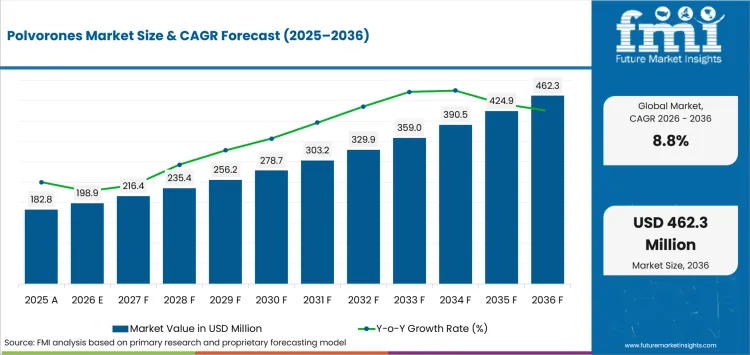
USD 198.9 million in 2026 and USD 462.3 million by 2036 at an 8.8% CAGR.
Sales of polvorones are projected to rise from USD 198.9 million in 2026 to USD 462.3 million by 2036 at an 8.8% CAGR. Longstanding producers serve supermarkets and bakery networks during concentrated Christmas selling periods. In March 2026, the Estepa IGP council said its 18 protected companies had recently produced 15-16 million kilograms of mantecados and polvorones. That production base makes seasonal capacity and packaging decisions commercially material for polvorone producers.
Mainstream retail access determines how much seasonal production reaches household shoppers during the Christmas selling window. USDA Foreign Agricultural Service documented 244 food-store openings in Spain from January through April 2025, 25% more than a year earlier. Supermarkets and self-service formats accounted for a visible part of that expansion. More retail doors increase seasonal listing opportunities for branded polvorones, though local label rules and retailer margins still determine repeat orders.
Key Takeaways
- Seasonal recognition supports demand because polvorones already occupy defined Christmas and pasalubong occasions in important national markets.
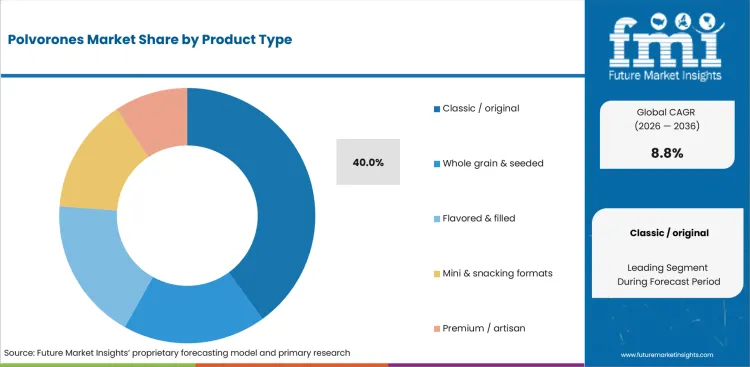
- Based on product type, classic - original is projected to account for 40.0% in 2026 due to familiar recipe cues that shorten seasonal shopper education.
- By claim - nature, conventional is estimated to hold 53.0% in 2026 owing to ingredient profiles that fit mainstream seasonal sourcing and merchandising.
- In 2026, supermarkets & hypermarkets are expected to lead sales channel with 41.0% share because seasonal aisles concentrate branded household traffic.
- Short selling windows raise markdown and inventory risk because production decisions precede full retailer sell-through visibility.
- Some of the key players in this market include La Estepeña, Doña Jimena, Delaviuda Confectionery Group, El Mesías, S.L., Goldilocks Bakeshop, Inc., and MFP Home of Quality Food Corp.
Analyst Perspective
"Polvorone offers should be judged on seasonal sell-through and breakage losses ahead of unit price because weak case packs can erase margin quickly. Commercial value comes from matching recipe credibility with pack protection and the retail route that controls replenishment."
- Nandini Roy Choudhury, Principal Consultant, Future Market Insights
How is the polvorones market segmented?
The polvorones market is evaluated by product type, claim - nature, format, packaging format and sales channel.
Product type covers classic - original, whole grain & seeded, flavored & filled, mini & snacking formats and premium - artisan. Claim - nature includes conventional, clean label, organic, gluten-free and high-protein - fortified. Format covers fresh, frozen, ambient packaged, chilled and par-baked - thaw-and-serve. Packaging format includes single-serve, multipack, family - loaf pack and bulk foodservice. Sales channel covers supermarkets & hypermarkets, artisan & specialty bakeries, convenience & forecourt, online & DTC and foodservice distributors.
Why does classic - original lead the product type category?
Classic recipes give seasonal bakery products a clear sensory reference as shoppers compare flavors or premium extensions. Estepa producers work within a protected traditional category, so bakery products that preserve familiar texture need less shelf explanation.
- Classic - original is set to lead product type with 40.0% share in 2026 due to familiar recipe cues that shorten seasonal purchase decisions.
- In May 2025, the Estepa IGP council said 18 of 21 registered companies were represented in its governing plenary. That producer base gives classic polvorones a protected institutional reference distinct from broader biscuits and crackers.
Why does conventional lead the claim - nature category?
Conventional recipes keep the category close to established ingredient profiles without requiring a separate free-from proposition. Claim-led extensions still matter where gluten-free food has defined shelf space, but they need tighter sourcing and formulation control for seasonal scale.
- By claim - nature, conventional is estimated to hold 53.0% in 2026 owing to familiar ingredient profiles that fit mainstream seasonal sourcing.
- The 2025 Salón Gourmets catalog listed Doña Jimena almond polvorones beside wider Christmas sweets. A separate claim-led line needs recipe proof and ingredient control comparable with gluten-free bakery premix programs.
Why does fresh lead the format category?
Fresh presentation suits bakeries and short Christmas selling windows because texture and aroma are strongest near production. Comparable brioche formats illustrate why fast turnover can carry premium bakery cues, though polvorones retain a drier product structure.
- By format, fresh is forecast to represent 28.0% in 2026 driven by short-cycle production that fits bakery counters and high-velocity Christmas displays.
- Spain’s agriculture ministry said in July 2026 that fresh-food purchasing volume rose 1.2% during 2025. The result supports frequent in-person food shopping, while confectionery dessert packaging still has to protect fragile product during fast seasonal handling.
Why do supermarkets & hypermarkets lead the sales channel category?
Large grocery stores concentrate seasonal visibility and can place biscotti formats beside Christmas sweets during planned promotion windows. Their scale makes case-pack discipline important because weak sell-through becomes excess stock quickly.
- The sales channel is forecast to be led by supermarkets & hypermarkets at 41.0% share in 2026 due to concentrated holiday displays and broad household reach.
- Spain’s agriculture ministry reported that supermarkets represented 68.2% of food purchases in 2025 and gained 2.4 percentage points. Confectionery packaging must protect fragile units and fit retailer case dimensions for that channel scale to become repeat orders.
What are the drivers, restraints and opportunities in the polvorones market?
Seasonal recognition and wider retail access increase order potential, while short selling windows and qualification costs constrain execution. Smaller protected packs and differentiated gifting routes offer the clearest path to broader occasions.
- Driver: Holiday and pasalubong occasions give polvorones a defined purchase reason that supports wider distribution investment.
- Restraint: Concentrated production calendars expose manufacturers to labor, ingredient and markdown costs while seasonal sell-through is still unknown.
- Opportunity: Protected portions and differentiated gift sets can extend retail use without weakening the traditional recipe reference.
Spanish polvorone production follows a highly seasonal demand cycle because most sales are concentrated around Christmas gifting and holiday assortments. Estepa's protected production base gives producers a defined planning window ahead of seasonal orders. On September 12, 2025, the IGP council opened the campaign with 18 protected factories in production. The concentration of certified output provides retailers with a dependable source of seasonal supply during the peak selling period.
Labor cost changes can hit months ahead of final holiday sell-through. The Seville provincial bulletin published 2025 confectionery-sector salary tables on April 7 2025. Manufacturers therefore commit to labor costs without final holiday-volume visibility. An allergen-free food proposition adds formulation and documentation work if a brand chooses a narrower claim route. The combined burden raises the margin threshold for short seasonal production runs.
Travel and gifting channels can widen purchase occasions beyond the household Christmas basket. Turismo de Portugal reported in February 2026 that Portuguese airports handled 36.0 million arriving passengers during 2025. The passenger flow does not prove polvorone purchases, but it expands the audience for portable regional sweets and gift packaging. Pack size and shelf life still need to fit small seasonal orders without raising leftover inventory after visitor peaks.
Which country CAGRs are profiled in the polvorones market?
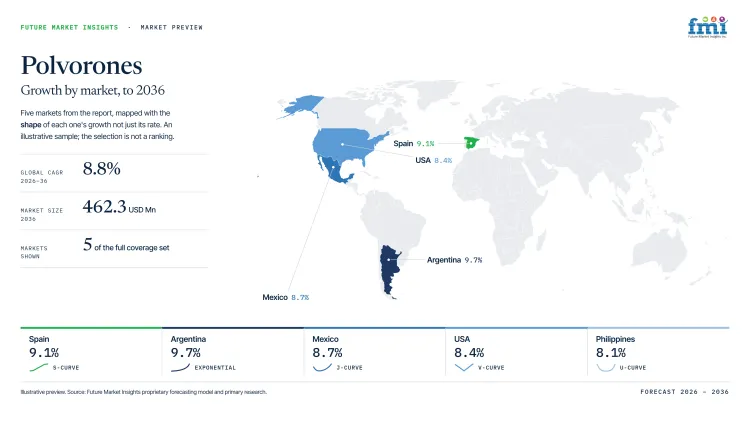
| Country | CAGR |
|---|---|
| France | 10.0% |
| Argentina | 9.7% |
| Chile | 9.4% |
| Spain | 9.0% |
| Mexico | 8.7% |
| USA | 8.4% |
| Philippines | 8.1% |
| Portugal | 7.8% |
How do country-level CAGRs compare in the polvorones market?
The country forecasts span 2.2 percentage points, so operating differences matter almost as much as rank. France and Argentina form the upper band above 9.5%. Chile and Spain follow closely, with Mexico and USA in the middle. Philippines and Portugal grow more slowly. Similar rates therefore mask different routes to shelf space and repeat purchase.
- France combines bakery traffic with tighter nutrition scrutiny.
- Argentina offers supermarket scale under promotion pressure.
- Chile gives importers a digital route for premium tests.
- Spain pairs protected origin with Christmas merchandising.
- Mexico starts with household recognition for polvorón.
- USA needs regional multicultural distribution before scale.
- Philippines competes through bakery brands and flavor breadth.
- Portugal links trial to tourism and specialty retail.
Comparable rates do not imply comparable economics. The full report covers country CAGRs in North America, Latin America, Western Europe, Eastern Europe, East Asia, South Asia and Pacific and Middle East and Africa.
Country-wise Analysis
- French bakeries and specialty-food retailers give seasonal sweets a route outside the supermarket Christmas aisle despite stricter nutrition comparison for packaged indulgence. INSEE published in June 2026 that bakery and pastry retail volume increased 4.8% during 2025, confirming active specialist traffic without proving polvorone purchases. Polvorone demand in France is forecast to rise at 10.0% CAGR over the assessment period as imported heritage products can use those specialist doors before broader grocery expansion. Brands still need clear nutrition labeling and pack sizes that justify premium placement beside familiar local biscuits with stronger everyday recognition and less dependence on Christmas merchandising.
- Argentine supermarket networks give packaged seasonal sweets national retail access even during cautious household spending. Argentina is projected to record 9.7% CAGR during the assessment period given branded polvorones can enter through existing grocery routes before specialty distribution is built. INDEC reported in February 2026 that its December 2025 supermarket survey covered 3,151 sales outlets, giving national brands a practical base for seasonal listings. Promotion calendars and price comparison against local cookies can compress margins, so entrants need case quantities that match retailer velocity and enough pack differentiation to justify space during a narrow holiday window without carrying excess stock afterward.
- Chilean retailers can test imported confectionery through stores and digital channels before committing to a full seasonal rollout. The national statistics institute reported in January 2026 that the retail e-commerce activity index increased 14.0% during 2025, giving specialty sellers a faster route for small launch quantities. Chilean polvorone sales are forecast to expand at 9.4% CAGR by 2036 tied to digital discovery that can prove premium and gift-led products before chainwide listings with lower listing risk. Freight distance and importer margins remain structural constraints, so early orders need shelf-stable packs and conservative case sizes that can prove turnover before larger Christmas displays.
- Spain has the deepest protected-origin production base among the profiled countries, letting retailers merchandise polvorones beside familiar Christmas sweets without explaining the category. Spain is estimated to post 9.0% CAGR over the forecast period since the traditional product already has supermarket and specialist distribution. The agriculture ministry said in July 2026 that consumers made 233 food-purchasing trips during 2025, eight more than a year earlier. Christmas concentration still limits inventory flexibility, so producers must secure retailer forecasts early and protect margin through disciplined gift packs without assuming strong heritage recognition will absorb excess stock after the main promotional window closes.
- Mexican household purchasing already treats polvorón as part of the sweet-biscuit basket, giving branded products a familiar reference in grocery and bakery settings. The INEGI ENIGH expenditure catalog released in 2025 explicitly lists polvorón within sweet biscuits and recognizes purchases in bulk or packaged form. Demand for polvorones in Mexico is predicted to advance at 8.7% CAGR through 2036 reflecting local familiarity that reduces the education needed for first purchase. Domestic cookies and sweet breads intensify direct price comparison, so pack size and ingredient cues must fit grocery budgets before premium positioning earns repeat orders through mainstream and specialty channels.
- USA demand is divided between Hispanic holiday traditions and Filipino bakery occasions, so one national message does not fit the whole addressable audience. The Census Bureau stated in August 2026 that the Hispanic population reached 70.1 million on July 1 2025, giving brands a large demographic base for culturally familiar sweets without proving direct polvorone demand. Adoption of polvorones in USA is estimated to expand at 8.4% CAGR through 2036 helped by multicultural grocery and specialty bakery networks that provide practical entry points. Fragmented awareness and longer distribution routes raise acquisition and breakage costs, so regional launches should prove retailer velocity before broad national listings.
- The Philippines has its own toasted-flour polvoron tradition, and individually wrapped pieces are routine in bakery and pasalubong purchases. Polvorone demand in the Philippines is projected to expand at 8.1% CAGR over the forecast period because the category needs little basic explanation. The Philippine Statistics Authority reported in January 2026 that food and non-alcoholic beverages represented 35.7% of household final consumption expenditure in the fourth quarter of 2025. Brand choice turns on flavor and wrapping quality, but competition among leading bakery names limits easy premium pricing. Repeat orders depend on delivery-ready multipacks and consistent texture after branch handling or home delivery.
- Portuguese tourism and specialty-food retail give seasonal sweets an audience beyond resident Christmas purchasing, especially in destinations with strong visitor traffic. Turismo de Portugal published in February 2026 that the country recorded 32.5 million guests during 2025, a 2.8% increase from 2024. Portugal is forecast to grow at 7.8% CAGR from 2026 to 2036 supported by tourism-linked gifting and Iberian product familiarity that give specialty retailers a clear trial route. Lower growth and price-sensitive retail constrain scale, so brands need compact assortments with enough shelf life to turn through specialty stores without carrying large off-season stocks after holiday and visitor traffic eases.
Who are the notable companies in the polvorones market?
La Estepeña, Doña Jimena, Delaviuda Confectionery Group, El Mesías, S.L., Goldilocks Bakeshop, Inc. and MFP Home of Quality Food Corp. are key companies in the polvorones market.
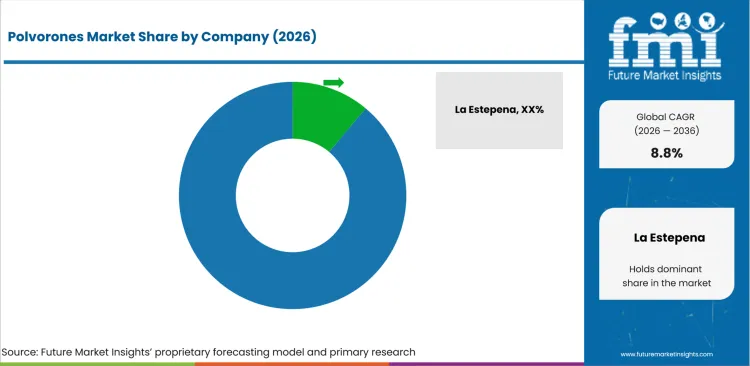
Competition separates by production model because no universal scale advantage determines the field. La Estepeña and El Mesías represent protected Estepa production. Doña Jimena and Delaviuda place polvorones inside broader Christmas assortments. Goldilocks and MFP operate through Filipino bakery or specialty manufacturing routes. Entry therefore depends on product fit, seasonal availability and protective final delivery.
- Protected-origin Spanish specialists: La Estepeña and El Mesías, S.L. compete through Estepa credentials and recognizable seasonal recipes.
- Diversified Spanish confectionery groups: Doña Jimena and Delaviuda Confectionery Group position polvorones inside wider Christmas assortments.
- Philippine polvoron producers: Goldilocks Bakeshop, Inc. and MFP Home of Quality Food Corp. use registered local products and domestic distribution.
Competitive Benchmarking: Polvorones Market
The benchmark separates exact-market documentation, formal qualification and channel activation. High means broad current evidence. Medium means narrower verified evidence. Low means a documented limitation and never fills a missing-information gap. Geographic reach states only the public footprint supported by retained sources, so ratings are not a revenue or share ranking.
| Company | Exact-market documentation | Formal qualification | Channel activation | Geographic Reach |
|---|---|---|---|---|
| La Estepeña | High | High | Medium | Spain, Estepa IGP |
| Doña Jimena | High | Medium | Medium | Spain, trade-fair record |
| Delaviuda Confectionery Group | Medium | Medium | High | Spain, seasonal retail |
| El Mesías, S.L. | High | High | Medium | Spain, Estepa quality registry |
| Goldilocks Bakeshop, Inc. | High | High | High | Philippines, bakery network |
| MFP Home of Quality Food Corp. | Medium | High | Medium | Philippines, licensed manufacturer |
Key Developments in the Polvorones Market
- In March 2025, El Mesías, S.L. received Andalusia’s Calidad Certificada registration for products including Polvorones de Estepa. The approval gives distributors a current public quality credential tied directly to the category.
- In March 2025, Goldilocks Bakeshop, Inc. received Philippine FDA registration FR-4000014105386 for Classic Polvoron. The registration runs through March 2030 and supports formal bakery and retail distribution.
- In July 2025, MFP Home of Quality Food Corp. received Philippine FDA registration FR-4000014699164 for House of Polvoron Artisan Series Strawberry Soft Cookies. The filing gives retailers a documented flavored route beyond classic polvoron.
Key Players in the Polvorones Market
Protected-origin Spanish specialists
- La Estepeña
- El Mesías, S.L.
Diversified Spanish Christmas confectionery
- Doña Jimena
- Delaviuda Confectionery Group
Philippine polvoron manufacturers and bakery platforms
- Goldilocks Bakeshop, Inc.
- MFP Home of Quality Food Corp.
Polvorones Market - Report Scope
| Coverage field | Report scope |
|---|---|
| Market breakdown | By product type, claim - nature, format, packaging format, sales channel and region. |
| Quantitative Units | USD million. |
| Market Definition | Revenue includes finished products marketed as polvorones or polvoron within the stated segmentation universe. It includes Iberian-style baked polvorones and Filipino-style molded toasted-flour polvoron. Revenue excludes adjacent sweets unless explicitly sold as polvorones, ingredient revenue and downstream value beyond the attributable polvorone component. |
| Regions Covered | North America, Latin America, Western Europe, Eastern Europe, East Asia, South Asia and Pacific, and Middle East and Africa. |
| Countries Covered | France, Argentina, Chile, Spain, Mexico, USA, Philippines, Portugal, and more than twenty-five additional countries in the full report. |
| Key Companies Profiled | La Estepeña, Doña Jimena, Delaviuda Confectionery Group, El Mesías, S.L., Goldilocks Bakeshop, Inc., and MFP Home of Quality Food Corp. |
| Forecast Period | 2026 to 2036. |
| Approach | Primary and secondary research with market triangulation. |
Polvorones Market - Research Methodology
| Method | Approach |
|---|---|
| Primary Research | FMI analysts gathered input from manufacturers, service providers, technology developers, distributors, end users, procurement teams, and subject-matter experts. Interviews examined purchasing decisions, product or service evaluation, adoption barriers, approval requirements, pricing considerations, and expectations for technical or commercial support. Respondents were also asked what evidence is required before a trial, pilot, or initial order develops into regular purchasing. |
| Desk Research | Desk research covered government statistics, regulatory publications, trade data, industry associations, technical literature, standards, company filings, product information, and official corporate announcements. Sources were reviewed for relevance, publication date, geographic coverage, and consistency with the defined market scope. Claims relating to performance, applications, approvals, capacity, investment, and commercial activity were retained only when supported by credible public evidence. |
| Market Sizing and Forecasting | The market model combined the baseline value with historical performance, segment structure, pricing and volume indicators, adoption levels, company participation, and country-level demand conditions. Forecast assumptions considered economic activity, investment trends, regulatory developments, technology adoption, purchasing cycles, supply availability, and barriers to wider market use. Segment and regional estimates were reconciled before the final market total was calculated. |
| Data Validation | Estimates were checked against multiple independent indicators, including public data, company activity, trade patterns, industry developments, and findings from primary interviews. Validation also tested whether products, services, applications, and company revenues fell within the defined market boundaries. Adjacent categories, unsupported claims, overlapping revenues, and activities without direct market relevance were excluded to reduce double counting and maintain consistency across segments and countries. |
Polvorones Market by Segments
Polvorones Market segmented by Product Type:
- Classic - original
- Whole grain & seeded
- Flavored & filled
- Mini & snacking formats
- Premium - artisan
Polvorones Market segmented by Claim - Nature:
- Conventional
- Clean label
- Organic
- Gluten-free
- High-protein - fortified
Polvorones Market segmented by Format:
- Fresh
- Frozen
- Ambient packaged
- Chilled
- Par-baked - thaw-and-serve
Polvorones Market segmented by Packaging Format:
- Single-serve
- Multipack
- Family - loaf pack
- Bulk foodservice
Polvorones Market segmented by Sales Channel:
- Supermarkets & hypermarkets
- Artisan & specialty bakeries
- Convenience & forecourt
- Online & DTC
- Foodservice distributors
Polvorones Market by Region:
- North America
- United States
- Canada
- Latin America
- Brazil
- Mexico
- Argentina
- Chile
- Western Europe
- Germany
- France
- United Kingdom
- Italy
- Spain
- Benelux
- Nordics
- Eastern Europe
- Poland
- Czech Republic
- Romania
- Hungary
- East Asia
- China
- Japan
- South Korea
- South Asia and Pacific
- India
- ASEAN
- Australia and New Zealand
- Middle East and Africa
- GCC Countries
- South Africa
- Türkiye
- Israel
Research Sources and Bibliography
- Consejo Regulador IGP Mantecados de Estepa y Polvorones de Estepa. (2026, March 5). El Consejo Regulador de las IGP hace balance de la campaña y avanza los retos del sector para 2026.
- USDA Foreign Agricultural Service. (2025, November 19). Retail Foods Annual: Spain, Report SP2025-0026.
- Consejo Regulador IGP Mantecados de Estepa y Polvorones de Estepa. (2025, May 26). José María Fernández, reelegido de forma unánime presidente de la IGP Mantecados y Polvorones de Estepa.
- Grupo Gourmets. (2025, April 7-10). Polvorones de almendra: Doña Jimena, Salón Gourmets 2025 exhibitor catalogue.
- Ministerio de Agricultura, Pesca y Alimentación. (2026, July 30). El consumo alimentario crece por primera vez en cinco años y roza los 30.800 millones de kilos.
- Philippine Food and Drug Administration. (2025, March 24). Registration FR-4000014109056: Goldilocks Pinipig Polvoron.
- Consejo Regulador IGP Mantecados de Estepa y Polvorones de Estepa. (2025, September 12). Estepa inicia su campaña de mantecados y polvorones con 18 fábricas protegidas.
- Diputación de Sevilla. (2025, April 7). Tablas salariales del Convenio Colectivo del sector de confitería, pastelería, bollería, tortas, mazapanes y otros productos de desayuno para 2025.
- Turismo de Portugal. (2026, February 19). Tourism Outlook 2025.
- Institut national de la statistique et des études économiques. (2026, June). Le compte du commerce en 2025.
- Instituto Nacional de Estadística y Censos. (2026, February 25). Encuesta de supermercados. Diciembre de 2025.
- Instituto Nacional de Estadísticas de Chile. (2026, January 30). Índice de Actividad del Comercio aumentó 5,9% interanualmente en diciembre de 2025.
- Instituto Nacional de Estadística y Geografía. (2025). Encuesta Nacional de Ingresos y Gastos de los Hogares 2024: Catálogo para gastos del hogar.
- USA Census Bureau. (2026, August 11). National Hispanic Heritage Month: 2026.
- Philippine Statistics Authority. (2026, January 29). Q4 2025 Household Final Consumption Expenditure.
- Junta de Andalucía. (2026, February 3). Sistema de información de Calidad Certificada: empresas y productos registrados.
- Philippine Food and Drug Administration. (2025, March 19). Registration FR-4000014105386: Goldilocks Classic Polvoron.
- Philippine Food and Drug Administration. (2025, July 1). Registration FR-4000014699164: House of Polvoron Artisan Series Strawberry Soft Cookies.
- Philippine Food and Drug Administration. (2025, November 13). License LTO-3000007078955: MFP Home of Quality Food Corp.
- Grupo Gourmets. (2026, April 16). 14º Premios Salón Gourmets.
This bibliography is provided for reader reference and is not exhaustive. The full report contains the complete reference list and detailed citations.
This Report Answers
- What are the global Polvorones market values in 2026 and 2036?
- What factors support seasonal purchasing and recurring demand for polvorones during festive and holiday periods?
- Why does the classic/original flavor segment hold the largest share of the market?
- Why do conventional polvorones account for the leading share of product demand?
- Why do supermarkets and hypermarkets remain the dominant distribution channel for polvorones sales?
- Which countries are expected to record the fastest market growth through 2036?
- How do market entry conditions, consumer preferences and distribution structures differ across key countries?
Frequently Asked Questions
How big is the polvorones market in 2026?
The polvorones market is valued at USD 198.9 million in 2026 and is projected to reach USD 462.3 million by 2036. Seasonal recognition and broader retail access support growth.
What is the CAGR of the polvorones market from 2026 to 2036?
The polvorones market is projected to grow at a CAGR of 8.8% between 2026 and 2036. Holiday occasions, grocery access and breakage-resistant packaging support expansion.
Which product type leads the polvorones market?
The classic - original segment is expected to hold 40.0% of the polvorones market in 2026 because familiar recipe cues shorten shopper education. Flavored variants can extend that reference without replacing the traditional core.
Which sales channel leads the polvorones market?
Supermarkets & hypermarkets are expected to hold 41.0% of the polvorones market in 2026 because seasonal aisles concentrate branded household traffic. Specialty bakeries retain a separate provenance-led role for regional and premium assortments.
Which countries are projected to record the highest growth in the polvorones market?
France is projected to grow at 10.0% CAGR, followed by Argentina at 9.7% and Chile at 9.4% through 2036. Bakery activity, supermarket depth and digital retail shape different routes to expansion.
Which companies are active in the polvorones market?
Key companies operating in the polvorones market include La Estepeña, Doña Jimena, Delaviuda Confectionery Group, El Mesías, S.L., Goldilocks Bakeshop, Inc. and MFP Home of Quality Food Corp. Their positions differ by origin credentials, product breadth and distribution model.
Preview the report firsthand - request a free sample
Get SampleGet the brochure for pricing and purchase details.
Get PDFTable of Content
- Key Takeaways
- Market Size and CAGR
- Top Growth Driver
- Fastest Growing Segment
- Leading Region
- Key Companies
- Emerging Opportunities
- Executive Summary
- Global Market Outlook
- Demand-side Trends
- Supply-side Trends
- Technology Roadmap Analysis
- Analysis and Recommendations
- Analyst Perspective (What is happening? Why now? What should investors know?)
- Key Questions Answered
- How large is the market?
- What is the CAGR?
- What are key trends?
- Which region dominates?
- Who are the leaders?
- Market Overview
- Market Coverage / Taxonomy
- Market Definition / Scope / Limitations
- Research Methodology
- Chapter Orientation
- Analytical Lens and Working Hypotheses
- Market Structure, Signals, and Trend Drivers
- Benchmarking and Cross-market Comparability
- Market Sizing, Forecasting, and Opportunity Mapping
- Research Design and Evidence Framework
- Desk Research Programme (Secondary Evidence)
- Expert Input and Fieldwork (Primary Evidence)
- Tooling, Models, and Reference Databases
- Data Engineering and Model Build
- Quality Assurance and Audit Trail
- Market Background
- Market Dynamics (Drivers, Restraints, Opportunity, Trends)
- Scenario Forecast (Optimistic, Likely, Conservative)
- Impact Analysis
- AI Impact
- Sustainability Impact
- Regulatory Impact
- Technology Impact
- Consumer / Buyer Analysis
- Purchase Drivers
- Adoption Barriers
- Buyer Journey
- Opportunity Map Analysis
- Product Life Cycle Analysis
- Supply Chain Analysis
- Investment Feasibility Matrix
- Value Chain Analysis
- PESTLE and Porter's Analysis
- Regulatory Landscape
- Regional Parent Market Outlook
- Production and Consumption Statistics
- Import and Export Statistics
- Global Market Analysis and Forecast, 2021 to 2036
- Historical Market Size Value (USD Million) Analysis, 2021 to 2025
- Current and Future Market Size Value (USD Million) Projections, 2026 to 2036
- Y-o-Y Growth Trend Analysis
- Absolute $ Opportunity Analysis
- Global Market Pricing Analysis, 2021 to 2036
- Global Market Analysis and Forecast, By Product Type, 2021 to 2036
- Introduction / Key Findings
- Historical Market Size Value (USD Million) Analysis By Product Type, 2021 to 2025
- Current and Future Market Size Value (USD Million) Analysis and Forecast By Product Type, 2026 to 2036
- Classic / original
- Whole grain & seeded
- Flavored & filled
- Mini & snacking formats
- Premium / artisan
- Classic / original
- Y-o-Y Growth Trend Analysis By Product Type, 2021 to 2025
- Absolute $ Opportunity Analysis By Product Type, 2026 to 2036
- Global Market Analysis and Forecast, By Claim / Nature, 2021 to 2036
- Introduction / Key Findings
- Historical Market Size Value (USD Million) Analysis By Claim / Nature, 2021 to 2025
- Current and Future Market Size Value (USD Million) Analysis and Forecast By Claim / Nature, 2026 to 2036
- Conventional
- Clean label
- Organic
- Gluten-free
- High-protein / fortified
- Conventional
- Y-o-Y Growth Trend Analysis By Claim / Nature, 2021 to 2025
- Absolute $ Opportunity Analysis By Claim / Nature, 2026 to 2036
- Global Market Analysis and Forecast, By Format, 2021 to 2036
- Introduction / Key Findings
- Historical Market Size Value (USD Million) Analysis By Format, 2021 to 2025
- Current and Future Market Size Value (USD Million) Analysis and Forecast By Format, 2026 to 2036
- Fresh
- Frozen
- Ambient packaged
- Chilled
- Par-baked / thaw-and-serve
- Fresh
- Y-o-Y Growth Trend Analysis By Format, 2021 to 2025
- Absolute $ Opportunity Analysis By Format, 2026 to 2036
- Global Market Analysis and Forecast, By Packaging Format, 2021 to 2036
- Introduction / Key Findings
- Historical Market Size Value (USD Million) Analysis By Packaging Format, 2021 to 2025
- Current and Future Market Size Value (USD Million) Analysis and Forecast By Packaging Format, 2026 to 2036
- Single-serve
- Multipack
- Family / loaf pack
- Bulk foodservice
- Single-serve
- Y-o-Y Growth Trend Analysis By Packaging Format, 2021 to 2025
- Absolute $ Opportunity Analysis By Packaging Format, 2026 to 2036
- Global Market Analysis and Forecast, By Sales Channel, 2021 to 2036
- Introduction / Key Findings
- Historical Market Size Value (USD Million) Analysis By Sales Channel, 2021 to 2025
- Current and Future Market Size Value (USD Million) Analysis and Forecast By Sales Channel, 2026 to 2036
- Supermarkets & hypermarkets
- Artisan & specialty bakeries
- Convenience & forecourt
- Online & DTC
- Foodservice distributors
- Supermarkets & hypermarkets
- Y-o-Y Growth Trend Analysis By Sales Channel, 2021 to 2025
- Absolute $ Opportunity Analysis By Sales Channel, 2026 to 2036
- Global Market Analysis and Forecast, By Region, 2021 to 2036
- Introduction
- Historical Market Size Value (USD Million) Analysis By Region, 2021 to 2025
- Current Market Size Value (USD Million) Analysis and Forecast By Region, 2026 to 2036
- North America
- Latin America
- Western Europe
- Eastern Europe
- East Asia
- South Asia and Pacific
- Middle East & Africa
- Market Attractiveness Analysis By Region
- North America Market Analysis and Forecast, By Country, 2021 to 2036
- Historical Market Size Value (USD Million) Trend Analysis By Market Taxonomy, 2021 to 2025
- Market Size Value (USD Million) Forecast By Market Taxonomy, 2026 to 2036
- By Country
- USA
- Canada
- By Product Type
- By Claim / Nature
- By Format
- By Packaging Format
- By Sales Channel
- By Country
- Market Attractiveness Analysis
- By Country
- By Product Type
- By Claim / Nature
- By Format
- By Packaging Format
- By Sales Channel
- Key Takeaways
- Latin America Market Analysis and Forecast, By Country
- Historical Market Size Value (USD Million) Trend Analysis By Market Taxonomy, 2021 to 2025
- Market Size Value (USD Million) Forecast By Market Taxonomy, 2026 to 2036
- By Country
- Brazil
- Mexico
- Chile
- Rest of Latin America
- By Product Type
- By Claim / Nature
- By Format
- By Packaging Format
- By Sales Channel
- By Country
- Market Attractiveness Analysis
- By Country
- By Product Type
- By Claim / Nature
- By Format
- By Packaging Format
- By Sales Channel
- Key Takeaways
- Western Europe Market Analysis and Forecast, By Country
- Historical Market Size Value (USD Million) Trend Analysis By Market Taxonomy, 2021 to 2025
- Market Size Value (USD Million) Forecast By Market Taxonomy, 2026 to 2036
- By Country
- Germany
- UK
- Italy
- Spain
- France
- Nordic
- BENELUX
- Rest of Western Europe
- By Product Type
- By Claim / Nature
- By Format
- By Packaging Format
- By Sales Channel
- By Country
- Market Attractiveness Analysis
- By Country
- By Product Type
- By Claim / Nature
- By Format
- By Packaging Format
- By Sales Channel
- Key Takeaways
- Eastern Europe Market Analysis and Forecast, By Country
- Historical Market Size Value (USD Million) Trend Analysis By Market Taxonomy, 2021 to 2025
- Market Size Value (USD Million) Forecast By Market Taxonomy, 2026 to 2036
- By Country
- Russia
- Poland
- Hungary
- Balkan & Baltic
- Rest of Eastern Europe
- By Product Type
- By Claim / Nature
- By Format
- By Packaging Format
- By Sales Channel
- By Country
- Market Attractiveness Analysis
- By Country
- By Product Type
- By Claim / Nature
- By Format
- By Packaging Format
- By Sales Channel
- Key Takeaways
- East Asia Market Analysis and Forecast, By Country
- Historical Market Size Value (USD Million) Trend Analysis By Market Taxonomy, 2021 to 2025
- Market Size Value (USD Million) Forecast By Market Taxonomy, 2026 to 2036
- By Country
- China
- Japan
- South Korea
- By Product Type
- By Claim / Nature
- By Format
- By Packaging Format
- By Sales Channel
- By Country
- Market Attractiveness Analysis
- By Country
- By Product Type
- By Claim / Nature
- By Format
- By Packaging Format
- By Sales Channel
- Key Takeaways
- South Asia and Pacific Market Analysis and Forecast, By Country
- Historical Market Size Value (USD Million) Trend Analysis By Market Taxonomy, 2021 to 2025
- Market Size Value (USD Million) Forecast By Market Taxonomy, 2026 to 2036
- By Country
- India
- ASEAN
- Australia & New Zealand
- Rest of South Asia and Pacific
- By Product Type
- By Claim / Nature
- By Format
- By Packaging Format
- By Sales Channel
- By Country
- Market Attractiveness Analysis
- By Country
- By Product Type
- By Claim / Nature
- By Format
- By Packaging Format
- By Sales Channel
- Key Takeaways
- Middle East & Africa Market Analysis and Forecast, By Country
- Historical Market Size Value (USD Million) Trend Analysis By Market Taxonomy, 2021 to 2025
- Market Size Value (USD Million) Forecast By Market Taxonomy, 2026 to 2036
- By Country
- Kingdom of Saudi Arabia
- Other GCC Countries
- Türkiye
- South Africa
- Other African Union
- Rest of Middle East & Africa
- By Product Type
- By Claim / Nature
- By Format
- By Packaging Format
- By Sales Channel
- By Country
- Market Attractiveness Analysis
- By Country
- By Product Type
- By Claim / Nature
- By Format
- By Packaging Format
- By Sales Channel
- Key Takeaways
- Key Countries Market Analysis
- USA
- Pricing Analysis
- Market Share Analysis, 2025
- By Product Type
- By Claim / Nature
- By Format
- By Packaging Format
- By Sales Channel
- Canada
- Pricing Analysis
- Market Share Analysis, 2025
- By Product Type
- By Claim / Nature
- By Format
- By Packaging Format
- By Sales Channel
- Mexico
- Pricing Analysis
- Market Share Analysis, 2025
- By Product Type
- By Claim / Nature
- By Format
- By Packaging Format
- By Sales Channel
- Brazil
- Pricing Analysis
- Market Share Analysis, 2025
- By Product Type
- By Claim / Nature
- By Format
- By Packaging Format
- By Sales Channel
- Chile
- Pricing Analysis
- Market Share Analysis, 2025
- By Product Type
- By Claim / Nature
- By Format
- By Packaging Format
- By Sales Channel
- Germany
- Pricing Analysis
- Market Share Analysis, 2025
- By Product Type
- By Claim / Nature
- By Format
- By Packaging Format
- By Sales Channel
- UK
- Pricing Analysis
- Market Share Analysis, 2025
- By Product Type
- By Claim / Nature
- By Format
- By Packaging Format
- By Sales Channel
- Italy
- Pricing Analysis
- Market Share Analysis, 2025
- By Product Type
- By Claim / Nature
- By Format
- By Packaging Format
- By Sales Channel
- Spain
- Pricing Analysis
- Market Share Analysis, 2025
- By Product Type
- By Claim / Nature
- By Format
- By Packaging Format
- By Sales Channel
- France
- Pricing Analysis
- Market Share Analysis, 2025
- By Product Type
- By Claim / Nature
- By Format
- By Packaging Format
- By Sales Channel
- India
- Pricing Analysis
- Market Share Analysis, 2025
- By Product Type
- By Claim / Nature
- By Format
- By Packaging Format
- By Sales Channel
- ASEAN
- Pricing Analysis
- Market Share Analysis, 2025
- By Product Type
- By Claim / Nature
- By Format
- By Packaging Format
- By Sales Channel
- Australia & New Zealand
- Pricing Analysis
- Market Share Analysis, 2025
- By Product Type
- By Claim / Nature
- By Format
- By Packaging Format
- By Sales Channel
- China
- Pricing Analysis
- Market Share Analysis, 2025
- By Product Type
- By Claim / Nature
- By Format
- By Packaging Format
- By Sales Channel
- Japan
- Pricing Analysis
- Market Share Analysis, 2025
- By Product Type
- By Claim / Nature
- By Format
- By Packaging Format
- By Sales Channel
- South Korea
- Pricing Analysis
- Market Share Analysis, 2025
- By Product Type
- By Claim / Nature
- By Format
- By Packaging Format
- By Sales Channel
- Russia
- Pricing Analysis
- Market Share Analysis, 2025
- By Product Type
- By Claim / Nature
- By Format
- By Packaging Format
- By Sales Channel
- Poland
- Pricing Analysis
- Market Share Analysis, 2025
- By Product Type
- By Claim / Nature
- By Format
- By Packaging Format
- By Sales Channel
- Hungary
- Pricing Analysis
- Market Share Analysis, 2025
- By Product Type
- By Claim / Nature
- By Format
- By Packaging Format
- By Sales Channel
- Kingdom of Saudi Arabia
- Pricing Analysis
- Market Share Analysis, 2025
- By Product Type
- By Claim / Nature
- By Format
- By Packaging Format
- By Sales Channel
- Türkiye
- Pricing Analysis
- Market Share Analysis, 2025
- By Product Type
- By Claim / Nature
- By Format
- By Packaging Format
- By Sales Channel
- South Africa
- Pricing Analysis
- Market Share Analysis, 2025
- By Product Type
- By Claim / Nature
- By Format
- By Packaging Format
- By Sales Channel
- USA
- Market Structure Analysis
- Competition Dashboard
- Competition Benchmarking
- Market Share Analysis of Top Players
- By Regional
- By Product Type
- By Claim / Nature
- By Format
- By Packaging Format
- By Sales Channel
- Emerging Startups
- Innovation Benchmarking
- Competition Analysis
- Competition Deep Dive
- La Estepena
- Overview
- Product Portfolio
- Profitability by Market Segments
- Sales Footprint
- Strategy Overview
- Marketing Strategy
- Product Strategy
- Channel Strategy
- Dona Jimena
- El Almendro
- Delaviuda Confectionery Group
- Lacasa
- Goldilocks Bakeshop
- La Estepena
- Case Studies
- Success Stories
- Recent Developments
- Competition Deep Dive
- Assumptions & Acronyms Used


