

- Industry Size (2026)
- USD 0.8 Bn
- Forecast (2036)
- USD 1.1 Bn
- CAGR (2026 to 2036)
- 3.3%
Protein A Resins Market Size, Market Forecast and Outlook By FMI
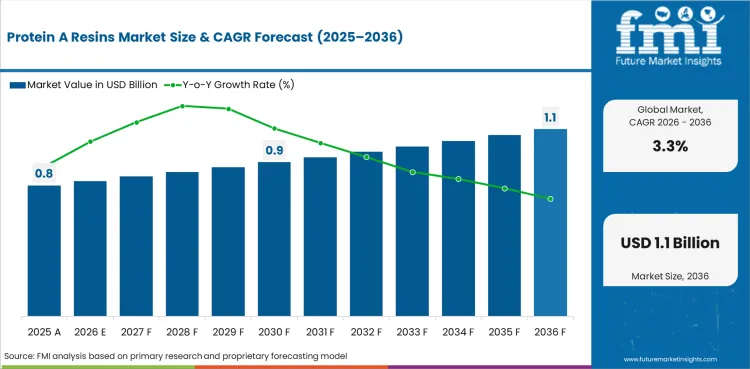
The protein A resins market was valued at USD 0.7 billion in 2025. Industry value is expected to cross USD 0.8 billion in 2026 and reach USD 1.1 billion by 2036 at a 3.3% CAGR. Antibody purification is expected to account for 74.3% share of application demand in 2026. Recombinant protein A resin is estimated to hold 73.8% share of product demand in 2026.
Summary of the Protein A Resins Market
- Demand and Growth Drivers
- Rising monoclonal antibody output is supporting steady resin demand across commercial purification lines.
- Process teams prefer resin platforms that improve purity and yield across repeated capture cycles.
- Biologics research activity is generating the demand from development labs and pilot programs.
- Product and Segment View
- Recombinant protein A resin leads product demand due to tighter ligand control and better batch consistency.
- Antibody purification remains the core use because protein A capture stays prominent in downstream processing.
- Biopharmaceutical manufacturers hold the leading end-user position due to larger resin consumption per campaign.
- Geography and Competitive Outlook
- India and Japan show the strongest growth outlook as biologics production capacity keeps rising.
- China posts healthy expansion as domestic purification capability continues to improve.
- Competition depends on binding performance and resin life along with technical support for validated programs.
- Analyst Opinion
- Sabyasachi Ghosh, Principal Consultant for Healthcare at FMI, opines, "Protein A resin demand is anticipated to shift toward higher control in commercial antibody purification. Manufacturers prefer resin platforms that support stable capture performance and cleaner batch consistency. Suppliers with stronger ligand design and longer usable life should hold the best position across regulated biologics production."
- Protein A Resins Market value analysis
- Commercial antibody production keeps a steady base of annual resin demand in downstream purification.
- Value remains concentrated in resin types that support stronger recovery and lower cycle cost.
- Biopharmaceutical manufacturers account for the largest revenue block due to repeat commercial use.
- Higher-capacity launches are expected to support the next phase of value expansion.
Key Takeaways
| Metric | Value |
|---|---|
| Market Size (2025) | USD 0.7 Billion |
| Market Size (2026) | USD 0.8 Billion |
| Market Size (2036) | USD 1.1 Billion |
| CAGR (2026–2036) | 3.3% |
| Incremental Opportunity | USD 0.3 Billion |
| Leading Application (2026) | Antibody Purification |
| Antibody Purification Share (2026) | 74.3% |
| Fastest-Growing Country | India |
| India CAGR | 6.8% |
Protein A Resins Market Definition
The Protein A Resins Market covers affinity chromatography, resins used to isolate, and purify antibodies, and other Fc domain proteins across biopharmaceutical manufacturing and research workflows.
Protein A Resins Market Inclusions
The report covers market size and forecast estimates across product type, matrix application, and end user groups along with competitive assessment, and country level growth analysis.
Protein A Resins Market Exclusions
The scope excludes general chromatography equipment ion-exchange resins mixed-mode resins filtration systems upstream media and non-protein A purification technologies.
Protein A Resins Market Research Methodology
- Primary Research: Interviews were conducted with downstream processing experts biomanufacturing teams process development staff and chromatography specialists to confirm demand patterns and resin selection factors.
- Desk Research: Public company material scientific literature biologics manufacturing literature and purification guidance were reviewed to map product positioning and end-use demand.
- Market Sizing and Forecasting: A hybrid model was built from antibody production demand resin utilization intensity replacement cycle assumptions and pricing benchmarks across commercial and research settings.
- Data Validation: Segment results were checked for internal consistency and then reviewed through structured analyst validation before finalization.
Why is the Protein A Resins Market Growing?
- Commercial antibody capture is set to promote resin demand in validated purification workflows.
- Resin platforms with lower cycle cost are drawing steady interest from biopharmaceutical manufacturers.
- New biologics capacity in Asia is supporting the demand for modern purification materials..
- Research and development work is strengthening resin use across clinical and laboratory settings.
Commercial biologics manufacturing requires a defined operating model for protein A resin demand. In protein A resin workflows, antibody capture must deliver stable recovery and impurity clearance or downstream cost rises quickly. That requirement sustains recurring use across established resin platforms.
Supplier switching usually follows process validation. Competition centers on resin life and binding efficiency. Demand gains support from monoclonal antibody production and downstream expansion across biologics facilities.
Market Segmentation Analysis
- Recombinant protein A resin is expected to account for 73.8% share of product demand in 2026 because regulated purification lines prefer stronger ligand control and better batch consistency.
- Agarose-based matrix is estimated to hold 61.2% share of matrix demand in 2026 because established purification systems continue to rely on support media with strong process familiarity.
- Antibody purification is anticipated to represent 74.3% share of application demand in 2026 because protein A resin value is concentrated in selective antibody capture across commercial manufacturing.
- Biopharmaceutical manufacturers are expected to hold 68.4% share of end user demand in 2026 because commercial production programs use larger resin volumes and repeat cycle usage.
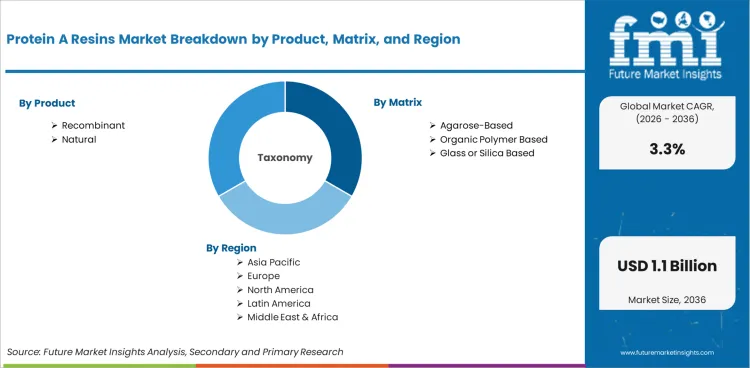
Protein A resins market is segmented by product and matrix and application and end user and molecule type and process scale. Products include recombinant protein A resin and natural protein A resin. Matrix includes agarose-based and organic polymer based and glass or silica-based matrix. Application includes antibody purification and immunoprecipitation. End users include biopharmaceutical manufacturers and clinical research laboratories and academic and research institutes. Molecule types include monoclonal antibodies and Fc-fusion proteins and other Fc proteins.
Protein A Resins Market Analysis by Product
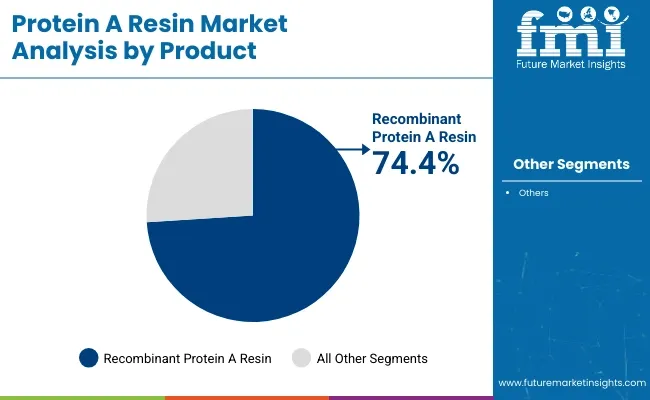
- Recombinant protein A resin is expected to account for 73.8% share of product demand in 2026 because regulated purification lines prefer stronger ligand control and better batch consistency.
- Biopharmaceutical manufacturing programs favor recombinant formats because they align well with validated purification routines and tighter process control.
Insights into the Natural Protein A Resin Segment
- Natural protein A resin retains a smaller role in the market because its use is more limited in modern regulated purification programs.
- Laboratory work and lower-intensity purification activity maintain demand for natural protein A in selected settings.
Protein A Resins Market Analysis by Matrix
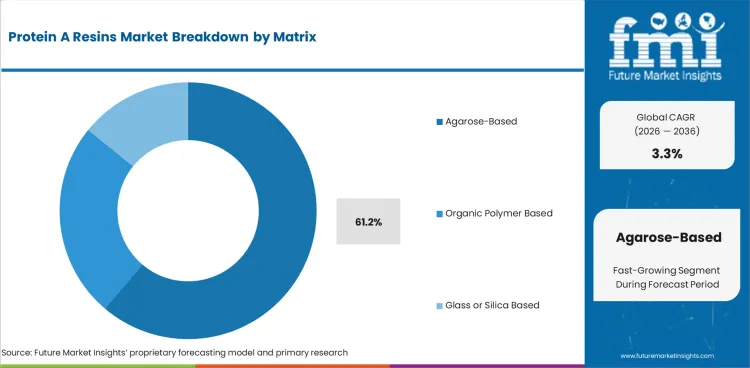
- Agarose-based matrix is estimated to hold 61.2% share of matrix demand in 2026 because established purification systems continue to rely on support media with strong process familiarity.
- Process teams continue to use this base support because it aligns well with existing downstream setups and routine antibody capture work.
Insights into the Organic Polymer Based Segment
- Organic polymer-based matrix remains in newer process programs because durability and cycle efficiency continue to attract technical interest.
- Demand for organic polymer is rising due to purification programs that want longer resin life and stable repeated use.
Protein A Resins Market Analysis by Application
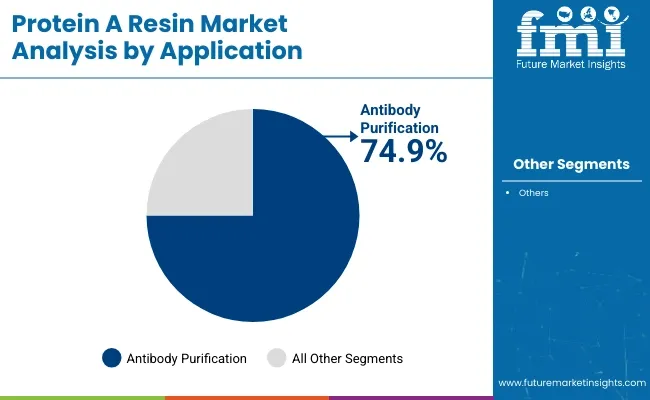
- Antibody purification is anticipated to hold 74.3% share of application demand in 2026 because protein A resin value is concentrated in selective antibody capture across commercial manufacturing.
- Commercial antibody recovery leads this segment because protein A chromatography remains a core capture step in downstream processing.
Insights into the Immunoprecipitation Segment
- Immunoprecipitation serves a smaller demand pool because its use stays tied more closely to research activity than to commercial batch production.
- Academic laboratories and development programs maintain demand for this segment in analytical purification work.
Protein A Resins Market analysis by End User
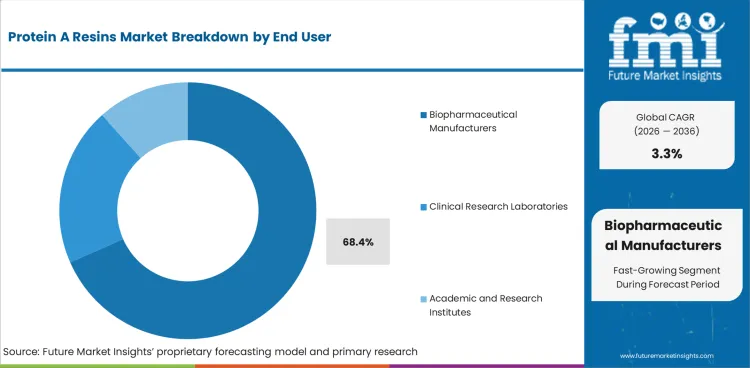
- Biopharmaceutical manufacturers are expected to account for 68.4% share of end user demand in 2026 as commercial production programs use larger resin volumes and repeat cycle usage.
- Commercial manufacturing facilities lead this segment because repeated capture cycles raise resin consumption per program.
Insights into the Clinical Research Laboratories Segment
- Clinical research laboratories support steady resin demand because development studies and analytical workflows continue to need antibody capture tools.
- Consumption in this segment stays below commercial production because batch sizes are smaller and run frequency is lower.
Protein A Resins Market Analysis by Molecule Type
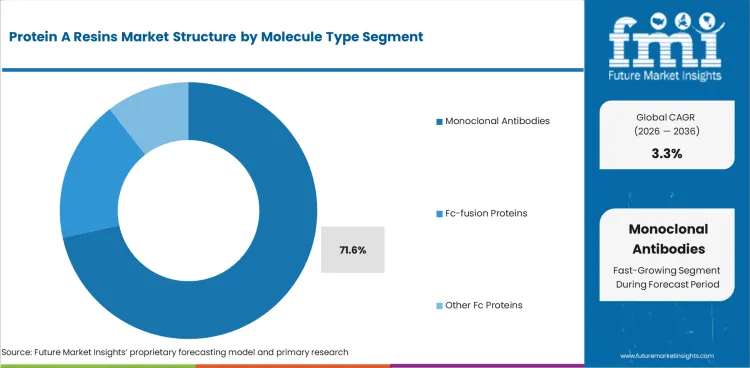
- Monoclonal antibodies are expected to represent 71.6% share of molecule type demand in 2026 because the largest purification programs are built around antibody capture workflows.
- Large antibody pipelines is propelling the demand for monoclonal antibodies as protein A resin remains strongly tied to monoclonal antibody recovery.
Insights into the Fc-fusion Proteins Segment
- Fc-fusion proteins support a smaller share of resin demand because their purification base is narrower than monoclonal antibodies.
- Process development activity maintains demand in selected therapeutic programs.
Protein A Resins Market analysis by Process Scale
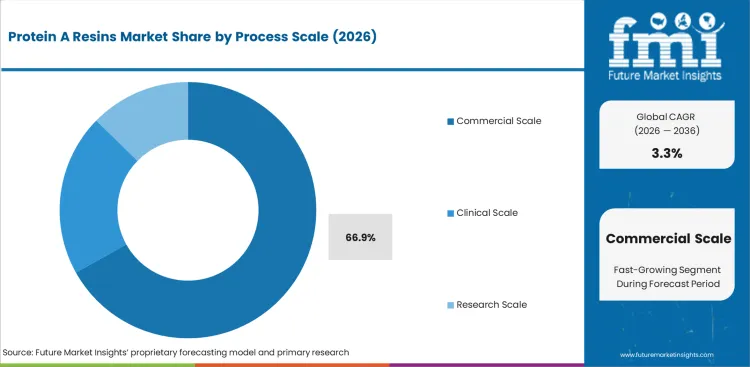
- Commercial scale is expected to hold 66.9% share of process scale demand in 2026 because validated production campaigns consume resin more intensively than research and clinical work.
- Full manufacturing runs keep this segment ahead because resin use rises with repeated purification cycles and larger batch volumes.
Insights into the Clinical Scale Segment
- Clinical scale demand continues to expand from development programs and early manufacturing runs that need reliable purification tools.
- This segment is anticipated to witness moderate expansion as production intensity and resin consumption are lower.
Protein A Resins Market Drivers, Restraints, and Opportunities
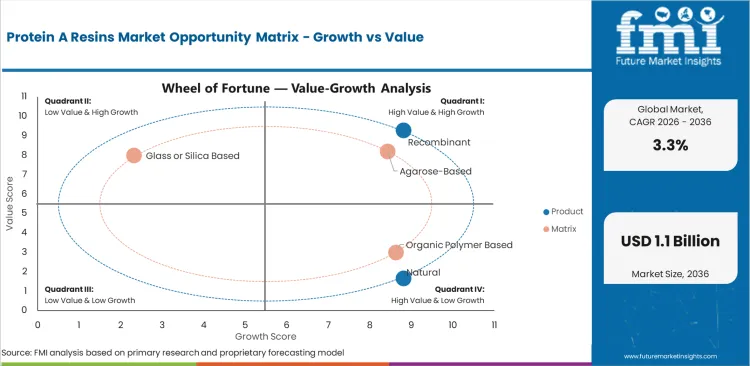
- Recurring antibody capture demand is supporting resin use across commercial biologics production.
- Validation barriers limit faster supplier change across established purification programs.
- New biologics capacity in Asia is opening room for resin demand growth.
Recurring Antibody Capture Demand
Protein A resins remain tied to a core downstream step in antibody purification. Commercial biologics production supports repeated resin use across validated capture workflows and process development programs.
Validation Barriers in Established Programs
Supplier change is often slow after process qualification. Incumbent resin platforms hold a stronger position across approved manufacturing lines.
Emerging Biologics Expansion in Asia
India and China plus other regional hubs are adding biologics production capacity. Capacity additions are creating resin demand from new purification lines and biosimilar manufacturing programs.
Regional Analysis
.webp "Top Country Growth Comparison Protein A Resins Market Cagr (2026 2036)")
| Country | CAGR |
|---|---|
| United States | 1.5% |
| Canada | 3.4% |
| Brazil | 3.8% |
| Italy | 4.2% |
| China | 5.2% |
| Japan | 6.2% |
| India | 6.8% |
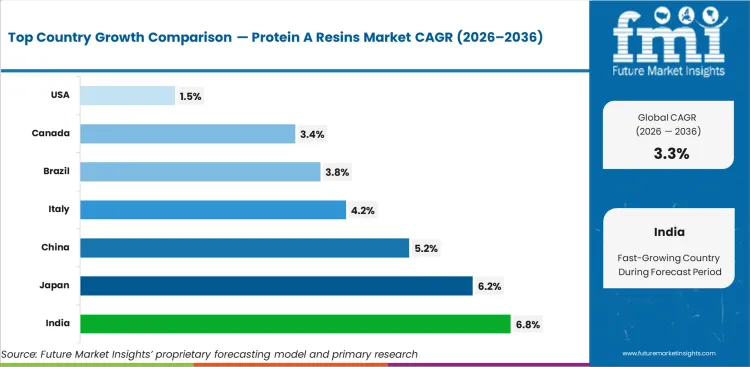
Source. Future Market Insights analysis based on the supplied market model and covered country narratives.
Analysis Of Protein A Resins Market by Key Countries
- India is expected to record the fastest growth at 6.8% CAGR through 2036 as expanding biopharmaceutical production and rising biosimilar activity increase purification demand.
- Japan follows at 6.2% CAGR through 2036 as advanced biologics research and strong process discipline support steady resin consumption.
- China is expected to post 5.2% CAGR through 2036 as manufacturing capacity and process-development work continue to expand across antibody workflows.
- Italy is projected at 4.2% CAGR through 2036. Canada is projected at 3.4% CAGR. Both markets sit in the middle tier because biologics production and purification use continue to improve from smaller installed bases.
Country differences reflect the pace of biologics manufacturing expansion and the depth of purification-focused research activity. India and Japan stay above the global growth rate because both countries are adding modern purification capability. China remains in the faster-growth group because commercial biologics capacity continues to expand. Italy and Canada occupy a middle position because technical demand is improving from smaller production bases.
Demand outlook for Protein A Resins in the United States
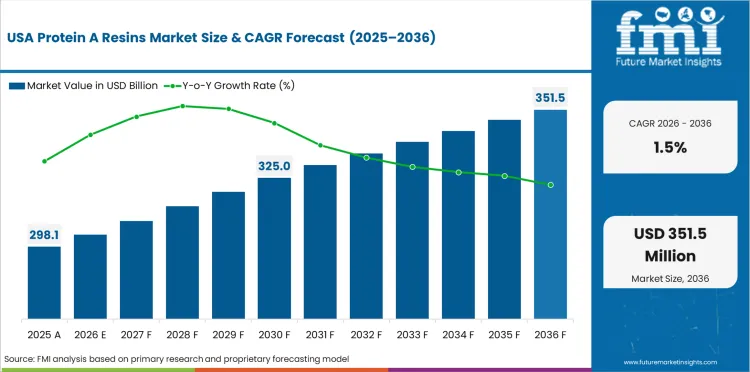
Demand for protein A resins in the United States is expected to rise at a 1.5% CAGR through 2036 because large-scale biologics production is already well established and growth follows a mature replacement cycle.
- Large biologics facilities support stable resin consumption across approved purification lines.
- Process qualification keeps supplier switching measured in established commercial programs.
- Mature capacity limits faster volume expansion during the forecast period.
Future outlook for Protein A Resins in Canada
Canada is projected to record a 3.4% CAGR in protein A resins sector through 2036 because biologics research and industrial purification activity continue to expand from a smaller installed base.
- Life sciences research supports steady demand from development and analytical workflows.
- Commercial scale remains smaller than in the United States.
- Purification use continues to benefit from ongoing biologics activity.
Opportunity analysis of Protein A Resins in Brazil
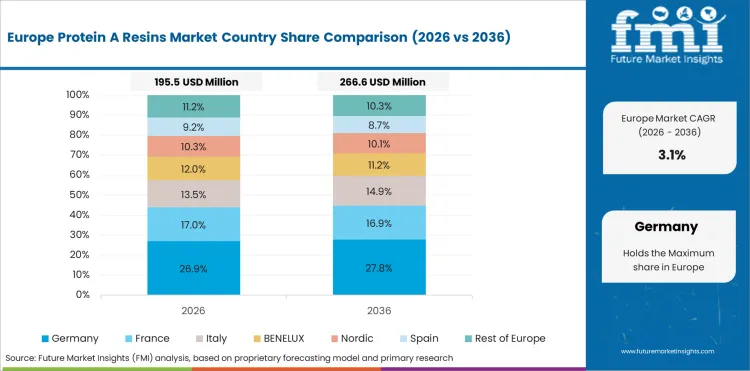
The market for protein A resins in Brazil is expected to expand at a 3.8% CAGR through 2036 as life sciences work and biologics-related purification demand are building from a moderate base.
- Research activity supports gradual improvement in affinity purification demand.
- Industrial scale remains below that of leading North American and East Asian markets.
- Growth reflects improving local capability in bioprocess work.
Future outlook for Protein A Resins in Italy
Protein A resins demand in Italy is likely to expand at a 4.2% CAGR through 2036 due to advanced purification adoption which continue to strengthen in regulated manufacturing.
- Improving bioprocess capability is lifting resin demand growth.
- Technical discipline sustains continued use of protein A capture systems.
- Scale remains lower than in the largest global production hubs.
In-depth analysis of Protein A Resins in China
China is expected to post a 5.2% CAGR in protein A resins industry through 2036 because domestic biologics capacity and process development activity continue to move upward.
- Expanding manufacturing capacity is raising resin consumption.
- Process development work is increasing across local biologics programs.
- Domestic purification capability is improving across major production centers.
Sales analysis of Protein A Resins in Japan
Protein A resins demand in Japan is expected to record a 6.2% CAGR through 2036 because advanced biologics research and strong process discipline support sustained demand for high-quality purification materials.
- Advanced research programs sustain use of premium purification inputs.
- Process discipline favors consistent resin performance and stable supply.
- Investment in high-quality manufacturing systems supports this outlook.
In-depth analysis of Protein A Resins in India
India is expected to register a 6.8% CAGR in protein A resins sector through 2036 because biosimilar expansion and new biologics capacity are increasing demand for modern purification materials.
- Biopharmaceutical manufacturing capacity continues to expand across key states.
- Biosimilar and antibody programs are increasing downstream material demand.
- New production lines are creating room for resin adoption.
Competitive landscape and strategic positioning
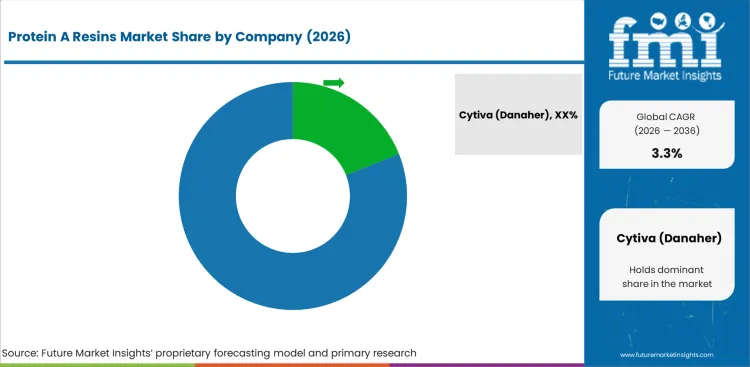
- Competition is moderately concentrated around suppliers with strong downstream purification portfolios.
- Large suppliers benefit from established technical support and trusted performance in regulated programs.
- Smaller specialists can win in selected process programs through capacity-focused launches and focused service.
Competition in the protein A resins market is driven by binding capacity, resin durability, and purification consistency. Suppliers with strong support for validated programs hold a clear advantage, as process teams place high value on stable batch performance.
Recent launches by Cytiva and Ecolab highlight the supplier focus on improving cycle efficiency and capture performance. These developments reinforce a market that rewards measurable process improvements and operational efficiency. Portfolio depth also plays an important role in competitive positioning. The outlook for protein A resins in India, along with ongoing regional production build-out, points to new demand emerging from expanding biologics manufacturing hubs.
Key companies in the Protein A Resins Market
- Major global players: Cytiva (Danaher), Purolite (Ecolab), Merck KGaA, Tosoh Bioscience, Kaneka Corporation, JSR Life Sciences, LLC, and Repligen Corporation.
- Other participants: Avantor Inc., Thermo Fisher Scientific Inc., JNC Corporation, Bio-Rad Laboratories, Abcam Limited, Suzhou Nanomicro Technology Co., Ltd., and GenScript.
Competitive benchmarking: Protein A Resins Market
| Company | Portfolio Depth | Process Support | Geographic Footprint | Commercial Fit |
|---|---|---|---|---|
| Cytiva (Danaher) | High | High | Global | Strong |
| Purolite (Ecolab) | High | High | Global | Strong |
| Merck KGaA |
High |
High | Global | Strong |
| Tosoh Bioscience | High | Medium | Global | Strong |
| Kaneka Corporation | Medium | Medium | Global | Moderate |
| JSR Life Sciences, LLC | High | Medium | Global | Strong |
| Repligen Corporation | Medium | High | Global | Moderate |
Source. Future Market Insights analysis based on the supplied market model and covered country narratives.
Key Developments in the Protein A Resins Market
- In June 2025 Ecolab Life Sciences launched Purolite AP+50 to improve antibody capture efficiency and resin durability.
- In September 2025 Cytiva launched MabSelect SuRe 70 and MabSelect PrismA X to support flexible clinical and commercial purification work.
- In April 2026 Merck completed the acquisition of the chromatography business of JSR Life Sciences and expanded its downstream purification portfolio.
Key Players in the Protein A Resins Market
Major Global Players
- Cytiva (Danaher)
- Purolite (Ecolab)
- Merck KGaA
- Tosoh Bioscience
- Kaneka Corporation
- JSR Life Sciences, LLC
- Repligen Corporation
Other Participants
- Avantor Inc.
- Thermo Fisher Scientific Inc.
- JNC Corporation
- Bio-Rad Laboratories
- Abcam Limited
- Suzhou Nanomicro Technology Co., Ltd.
- GenScript
Report Scope and Coverage
| Metric | Value |
|---|---|
| Quantitative Units | USD 0.7 billion in 2025 to USD 1.1 billion in 2036 at a 3.3% CAGR. |
| Market Definition | Affinity chromatography resins used for selective antibody capture and purification across biopharmaceutical manufacturing and research workflows. |
| Product Segmentation | Recombinant Protein A Resin; Natural Protein A Resin. |
| Matrix Segmentation | Agarose-based; Organic Polymer Based; Glass or Silica Based Matrix. |
| Application Segmentation | Antibody Purification; Immunoprecipitation. |
| End User Segmentation | Biopharmaceutical Manufacturers; Clinical Research Laboratories; Academic and Research Institutes. |
| Additional Segmentation | Molecule Type; Process Scale. |
| Countries Covered | United States; Canada; Brazil; Germany; France; Italy; China; Japan; India; and 40 plus countries. |
| Approach | Hybrid top-down and bottom-up modelling validated through primary interviews and demand triangulation. |
Source. Future Market Insights analysis based on the supplied market model and covered country narratives.
Protein A Resins Market breakdown by Product, Matrix, Application, End User, Molecule Type, and Process Scale
Protein A Resins Market Segmented by Product
- Recombinant Protein A Resin
- Natural Protein A Resin
Protein A Resins Market Segmented by Matrix
- Agarose-based
- Organic Polymer Based
- Glass or Silica Based Matrix
Protein A Resins Market Segmented by Application
- Antibody Purification
- Immunoprecipitation
Protein A Resins Market Segmented by End User
- Biopharmaceutical Manufacturers
- Clinical Research Laboratories
- Academic and Research Institutes
Protein A Resins Market Segmented by Molecule Type
- Monoclonal Antibodies
- Fc-fusion Proteins
- Other Fc Proteins
Protein A Resins Market Segmented by Process Scale
- Commercial Scale
- Clinical Scale
- Research Scale
Protein A Resins Market by Region
- North America
- Latin America
- East Asia
- South Asia and Pacific
- Western Europe
- Eastern Europe
- Middle East and Africa
Bibliography
- Ecolab Life Sciences. (2025, June 16). Ecolab Life Sciences launches new bioprocessing resin to drive manufacturing efficiencies.
- Wang, F. A. S., Fan, Y., Chung, W. K., Dutta, A., Fiedler, E., Haupts, U., Peyser, J., & Kuriyel, R. (2024). Evaluation of mild pH elution protein A resins for antibodies and Fc-fusion proteins. Journal of Chromatography A, 1713, 464523.
- Jafarzadeh Chehraghi, E., Akbarzadehlaleh, P., & Shamsasenjan, K. (2025). Purification of monoclonal antibodies using chromatographic methods: Increasing purity and recovery. Advanced Pharmaceutical Bulletin, 15(1), 27-45.
- LeBarre, J., Bhandari, D., Barbieri, E., Shu, Q., Li, X., Chandra, D., Xu, X., Phillips, M., Bill, J., Williams, T., Gilbert, P., Major, C., Roush, D., Cramer, S., Lenhoff, A., Boi, C., Carbonell, R., & Menegatti, S. (2026). Modernizing the platform process of antibody purification for enhanced impurity clearance. Separation and Purification Technology, 382(Part 5), 136113.
- Merck. (2026, April 1). Merck completes acquisition of JSR Life Sciences’ chromatography business.
- Cytiva Communications. (2025, September 25). Flagship protein A resins from Cytiva increase flexibility and accessibility for clinical and commercial scenarios. Cytiva.
The bibliography is provided for reader reference.
This Report Answers
- What size is the Protein A Resins Market in 2026 and how large can it become by 2036?
- How fast is Protein A Resins Market demand expected to expand from 2026 through 2036?
- Which product application matrix and end user segments lead Protein A Resins Market demand in 2026?
- Why do recombinant protein A resin and antibody purification retain the largest 2026 shares in the Protein A Resins Market?
- How are biopharmaceutical manufacturing and validation barriers shaping the Protein A Resins Market?
- Which countries are expected to post the fastest growth in the Protein A Resins Market through 2036?
- How are recent supplier moves changing the competitive outlook of the Protein A Resins Market?
- Which companies hold the clearest technical and portfolio advantages within the Protein A Resins Market during the forecast period?
Frequently Asked Questions
How large is the protein A resins market in 2026?
The protein A resins market is expected to reach USD 0.8 billion in 2026 as commercial antibody purification maintains resin demand.
How large can the protein A resins market become by 2036?
The protein A resins market is projected to reach USD 1.1 billion by 2036 as resin use grows with biologics manufacturing.
What growth rate is expected in the protein A resins market through 2036?
The protein A resins market is projected to expand at a 3.3% CAGR from 2026 to 2036 under the baseline outlook.
Which product segment leads the protein A resins market by 2026?
Recombinant protein A resin is expected to lead the protein A resins market in 2026 with a 73.8% share because regulated lines prefer tighter ligand control.
Which application segment leads the protein A resins market by 2026?
Antibody purification is expected to lead the protein A resins market in 2026 with a 74.3% share because protein A capture remains central in downstream recovery.
Which country records the fastest growth in the protein A resins market?
India is expected to record the fastest protein A resins market growth with a 6.8% CAGR through 2036 as biologics capacity continues to rise.
Preview the report firsthand - request a free sample
Get SampleGet the brochure for pricing and purchase details.
Get PDFTable of Content
- Key Takeaways
- Market Size and CAGR
- Top Growth Driver
- Fastest Growing Segment
- Leading Region
- Key Companies
- Emerging Opportunities
- Executive Summary
- Global Market Outlook
- Demand-side Trends
- Supply-side Trends
- Technology Roadmap Analysis
- Analysis and Recommendations
- Analyst Perspective (What is happening? Why now? What should investors know?)
- Key Questions Answered
- How large is the market?
- What is the CAGR?
- What are key trends?
- Which region dominates?
- Who are the leaders?
- Market Overview
- Market Coverage / Taxonomy
- Market Definition / Scope / Limitations
- Research Methodology
- Chapter Orientation
- Analytical Lens and Working Hypotheses
- Market Structure, Signals, and Trend Drivers
- Benchmarking and Cross-market Comparability
- Market Sizing, Forecasting, and Opportunity Mapping
- Research Design and Evidence Framework
- Desk Research Programme (Secondary Evidence)
- Expert Input and Fieldwork (Primary Evidence)
- Tooling, Models, and Reference Databases
- Data Engineering and Model Build
- Quality Assurance and Audit Trail
- Market Background
- Market Dynamics (Drivers, Restraints, Opportunity, Trends)
- Scenario Forecast (Optimistic, Likely, Conservative)
- Impact Analysis
- AI Impact
- Sustainability Impact
- Regulatory Impact
- Technology Impact
- Consumer / Buyer Analysis
- Purchase Drivers
- Adoption Barriers
- Buyer Journey
- Opportunity Map Analysis
- Product Life Cycle Analysis
- Supply Chain Analysis
- Investment Feasibility Matrix
- Value Chain Analysis
- PESTLE and Porter's Analysis
- Regulatory Landscape
- Regional Parent Market Outlook
- Production and Consumption Statistics
- Import and Export Statistics
- Global Market Analysis and Forecast, 2021 to 2036
- Historical Market Size Value (USD Billion) Analysis, 2021 to 2025
- Current and Future Market Size Value (USD Billion) Projections, 2026 to 2036
- Y-o-Y Growth Trend Analysis
- Absolute $ Opportunity Analysis
- Global Market Pricing Analysis, 2021 to 2036
- Global Market Analysis and Forecast, By Product, 2021 to 2036
- Introduction / Key Findings
- Historical Market Size Value (USD Billion) Analysis By Product, 2021 to 2025
- Current and Future Market Size Value (USD Billion) Analysis and Forecast By Product, 2026 to 2036
- Recombinant Protein A Resin
- Natural Protein A Resin
- Recombinant Protein A Resin
- Y-o-Y Growth Trend Analysis By Product, 2021 to 2025
- Absolute $ Opportunity Analysis By Product, 2026 to 2036
- Global Market Analysis and Forecast, By Matrix, 2021 to 2036
- Introduction / Key Findings
- Historical Market Size Value (USD Billion) Analysis By Matrix, 2021 to 2025
- Current and Future Market Size Value (USD Billion) Analysis and Forecast By Matrix, 2026 to 2036
- Agarose-based
- Organic Polymer Based
- Glass or Silica Based Matrix
- Agarose-based
- Y-o-Y Growth Trend Analysis By Matrix, 2021 to 2025
- Absolute $ Opportunity Analysis By Matrix, 2026 to 2036
- Global Market Analysis and Forecast, By Application, 2021 to 2036
- Introduction / Key Findings
- Historical Market Size Value (USD Billion) Analysis By Application, 2021 to 2025
- Current and Future Market Size Value (USD Billion) Analysis and Forecast By Application, 2026 to 2036
- Antibody Purification
- Immunoprecipitation
- Antibody Purification
- Y-o-Y Growth Trend Analysis By Application, 2021 to 2025
- Absolute $ Opportunity Analysis By Application, 2026 to 2036
- Global Market Analysis and Forecast, By End User, 2021 to 2036
- Introduction / Key Findings
- Historical Market Size Value (USD Billion) Analysis By End User, 2021 to 2025
- Current and Future Market Size Value (USD Billion) Analysis and Forecast By End User, 2026 to 2036
- Biopharmaceutical Manufacturers
- Clinical Research Laboratories
- Academic and Research Institutes
- Biopharmaceutical Manufacturers
- Y-o-Y Growth Trend Analysis By End User, 2021 to 2025
- Absolute $ Opportunity Analysis By End User, 2026 to 2036
- Global Market Analysis and Forecast, By Molecule Type, 2021 to 2036
- Introduction / Key Findings
- Historical Market Size Value (USD Billion) Analysis By Molecule Type, 2021 to 2025
- Current and Future Market Size Value (USD Billion) Analysis and Forecast By Molecule Type, 2026 to 2036
- Monoclonal Antibodies
- Fc-fusion Proteins
- Other Fc Proteins
- Monoclonal Antibodies
- Y-o-Y Growth Trend Analysis By Molecule Type, 2021 to 2025
- Absolute $ Opportunity Analysis By Molecule Type, 2026 to 2036
- Global Market Analysis and Forecast, By Process Scale
- Introduction / Key Findings
- Historical Market Size Value (USD Billion) Analysis By Process Scale, 2021 to 2025
- Current and Future Market Size Value (USD Billion) Analysis and Forecast By Process Scale, 2026 to 2036
- Commercial Scale
- Clinical Scale
- Research Scale
- Commercial Scale
- Y-o-Y Growth Trend Analysis By Process Scale, 2021 to 2025
- Absolute $ Opportunity Analysis By Process Scale, 2026 to 2036
- Global Market Analysis and Forecast, By Region, 2021 to 2036
- Introduction
- Historical Market Size Value (USD Billion) Analysis By Region, 2021 to 2025
- Current Market Size Value (USD Billion) Analysis and Forecast By Region, 2026 to 2036
- North America
- Latin America
- Western Europe
- Eastern Europe
- East Asia
- South Asia and Pacific
- Middle East & Africa
- Market Attractiveness Analysis By Region
- North America Market Analysis and Forecast, By Country, 2021 to 2036
- Historical Market Size Value (USD Billion) Trend Analysis By Market Taxonomy, 2021 to 2025
- Market Size Value (USD Billion) Forecast By Market Taxonomy, 2026 to 2036
- By Country
- USA
- Canada
- By Product
- By Matrix
- By Application
- By End User
- By Molecule Type
- By Process Scale
- By Country
- Market Attractiveness Analysis
- By Country
- By Product
- By Matrix
- By Application
- By End User
- By Molecule Type
- By Process Scale
- Key Takeaways
- Latin America Market Analysis and Forecast, By Country
- Historical Market Size Value (USD Billion) Trend Analysis By Market Taxonomy, 2021 to 2025
- Market Size Value (USD Billion) Forecast By Market Taxonomy, 2026 to 2036
- By Country
- Brazil
- Mexico
- Chile
- Rest of Latin America
- By Product
- By Matrix
- By Application
- By End User
- By Molecule Type
- By Process Scale
- By Country
- Market Attractiveness Analysis
- By Country
- By Product
- By Matrix
- By Application
- By End User
- By Molecule Type
- By Process Scale
- Key Takeaways
- Western Europe Market Analysis and Forecast, By Country
- Historical Market Size Value (USD Billion) Trend Analysis By Market Taxonomy, 2021 to 2025
- Market Size Value (USD Billion) Forecast By Market Taxonomy, 2026 to 2036
- By Country
- Germany
- UK
- Italy
- Spain
- France
- Nordic
- BENELUX
- Rest of Western Europe
- By Product
- By Matrix
- By Application
- By End User
- By Molecule Type
- By Process Scale
- By Country
- Market Attractiveness Analysis
- By Country
- By Product
- By Matrix
- By Application
- By End User
- By Molecule Type
- By Process Scale
- Key Takeaways
- Eastern Europe Market Analysis and Forecast, By Country
- Historical Market Size Value (USD Billion) Trend Analysis By Market Taxonomy, 2021 to 2025
- Market Size Value (USD Billion) Forecast By Market Taxonomy, 2026 to 2036
- By Country
- Russia
- Poland
- Hungary
- Balkan & Baltic
- Rest of Eastern Europe
- By Product
- By Matrix
- By Application
- By End User
- By Molecule Type
- By Process Scale
- By Country
- Market Attractiveness Analysis
- By Country
- By Product
- By Matrix
- By Application
- By End User
- By Molecule Type
- By Process Scale
- Key Takeaways
- East Asia Market Analysis and Forecast, By Country
- Historical Market Size Value (USD Billion) Trend Analysis By Market Taxonomy, 2021 to 2025
- Market Size Value (USD Billion) Forecast By Market Taxonomy, 2026 to 2036
- By Country
- China
- Japan
- South Korea
- By Product
- By Matrix
- By Application
- By End User
- By Molecule Type
- By Process Scale
- By Country
- Market Attractiveness Analysis
- By Country
- By Product
- By Matrix
- By Application
- By End User
- By Molecule Type
- By Process Scale
- Key Takeaways
- South Asia and Pacific Market Analysis and Forecast, By Country
- Historical Market Size Value (USD Billion) Trend Analysis By Market Taxonomy, 2021 to 2025
- Market Size Value (USD Billion) Forecast By Market Taxonomy, 2026 to 2036
- By Country
- India
- ASEAN
- Australia & New Zealand
- Rest of South Asia and Pacific
- By Product
- By Matrix
- By Application
- By End User
- By Molecule Type
- By Process Scale
- By Country
- Market Attractiveness Analysis
- By Country
- By Product
- By Matrix
- By Application
- By End User
- By Molecule Type
- By Process Scale
- Key Takeaways
- Middle East & Africa Market Analysis and Forecast, By Country
- Historical Market Size Value (USD Billion) Trend Analysis By Market Taxonomy, 2021 to 2025
- Market Size Value (USD Billion) Forecast By Market Taxonomy, 2026 to 2036
- By Country
- Kingdom of Saudi Arabia
- Other GCC Countries
- Türkiye
- South Africa
- Other African Union
- Rest of Middle East & Africa
- By Product
- By Matrix
- By Application
- By End User
- By Molecule Type
- By Process Scale
- By Country
- Market Attractiveness Analysis
- By Country
- By Product
- By Matrix
- By Application
- By End User
- By Molecule Type
- By Process Scale
- Key Takeaways
- Key Countries Market Analysis
- USA
- Pricing Analysis
- Market Share Analysis, 2025
- By Product
- By Matrix
- By Application
- By End User
- By Molecule Type
- By Process Scale
- Canada
- Pricing Analysis
- Market Share Analysis, 2025
- By Product
- By Matrix
- By Application
- By End User
- By Molecule Type
- By Process Scale
- Mexico
- Pricing Analysis
- Market Share Analysis, 2025
- By Product
- By Matrix
- By Application
- By End User
- By Molecule Type
- By Process Scale
- Brazil
- Pricing Analysis
- Market Share Analysis, 2025
- By Product
- By Matrix
- By Application
- By End User
- By Molecule Type
- By Process Scale
- Chile
- Pricing Analysis
- Market Share Analysis, 2025
- By Product
- By Matrix
- By Application
- By End User
- By Molecule Type
- By Process Scale
- Germany
- Pricing Analysis
- Market Share Analysis, 2025
- By Product
- By Matrix
- By Application
- By End User
- By Molecule Type
- By Process Scale
- UK
- Pricing Analysis
- Market Share Analysis, 2025
- By Product
- By Matrix
- By Application
- By End User
- By Molecule Type
- By Process Scale
- Italy
- Pricing Analysis
- Market Share Analysis, 2025
- By Product
- By Matrix
- By Application
- By End User
- By Molecule Type
- By Process Scale
- Spain
- Pricing Analysis
- Market Share Analysis, 2025
- By Product
- By Matrix
- By Application
- By End User
- By Molecule Type
- By Process Scale
- France
- Pricing Analysis
- Market Share Analysis, 2025
- By Product
- By Matrix
- By Application
- By End User
- By Molecule Type
- By Process Scale
- India
- Pricing Analysis
- Market Share Analysis, 2025
- By Product
- By Matrix
- By Application
- By End User
- By Molecule Type
- By Process Scale
- ASEAN
- Pricing Analysis
- Market Share Analysis, 2025
- By Product
- By Matrix
- By Application
- By End User
- By Molecule Type
- By Process Scale
- Australia & New Zealand
- Pricing Analysis
- Market Share Analysis, 2025
- By Product
- By Matrix
- By Application
- By End User
- By Molecule Type
- By Process Scale
- China
- Pricing Analysis
- Market Share Analysis, 2025
- By Product
- By Matrix
- By Application
- By End User
- By Molecule Type
- By Process Scale
- Japan
- Pricing Analysis
- Market Share Analysis, 2025
- By Product
- By Matrix
- By Application
- By End User
- By Molecule Type
- By Process Scale
- South Korea
- Pricing Analysis
- Market Share Analysis, 2025
- By Product
- By Matrix
- By Application
- By End User
- By Molecule Type
- By Process Scale
- Russia
- Pricing Analysis
- Market Share Analysis, 2025
- By Product
- By Matrix
- By Application
- By End User
- By Molecule Type
- By Process Scale
- Poland
- Pricing Analysis
- Market Share Analysis, 2025
- By Product
- By Matrix
- By Application
- By End User
- By Molecule Type
- By Process Scale
- Hungary
- Pricing Analysis
- Market Share Analysis, 2025
- By Product
- By Matrix
- By Application
- By End User
- By Molecule Type
- By Process Scale
- Kingdom of Saudi Arabia
- Pricing Analysis
- Market Share Analysis, 2025
- By Product
- By Matrix
- By Application
- By End User
- By Molecule Type
- By Process Scale
- Türkiye
- Pricing Analysis
- Market Share Analysis, 2025
- By Product
- By Matrix
- By Application
- By End User
- By Molecule Type
- By Process Scale
- South Africa
- Pricing Analysis
- Market Share Analysis, 2025
- By Product
- By Matrix
- By Application
- By End User
- By Molecule Type
- By Process Scale
- USA
- Market Structure Analysis
- Competition Dashboard
- Competition Benchmarking
- Market Share Analysis of Top Players
- By Regional
- By Product
- By Matrix
- By Application
- By End User
- By Molecule Type
- By Process Scale
- Emerging Startups
- Innovation Benchmarking
- Competition Analysis
- Competition Deep Dive
- Cytiva (Danaher)
- Overview
- Product Portfolio
- Profitability by Market Segments
- Sales Footprint
- Strategy Overview
- Marketing Strategy
- Product Strategy
- Channel Strategy
- Purolite (Ecolab)
- Merck KGaA
- Tosoh Bioscience
- Kaneka Corporation
- JSR Life Sciences, LLC
- Repligen Corporation
- Avantor Inc.
- Thermo Fisher Scientific Inc.
- Bio-Rad Laboratories
- Cytiva (Danaher)
- Case Studies
- Success Stories
- Recent Developments
- Competition Deep Dive
- Assumptions & Acronyms Used


