

- Market Size (2026)
- USD 1.3 Bn
- Forecast (2036)
- USD 2.4 Bn
- CAGR (2026 to 2036)
- 6.7%
How big is RAP Recycling Agents Market in 2026?
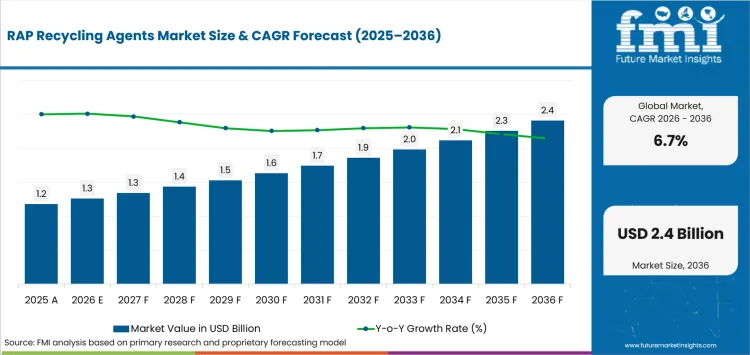
USD 1.3 billion in 2026 and USD 2.4 billion by 2036 at a 6.7% CAGR.
Demand for RAP recycling agents is projected to expand at 6.7% CAGR between 2026 and 2036, increasing valuation from USD 1.3 billion in 2026 to USD 2.4 billion by 2036. Commercial use grows when aged reclaimed binder becomes a constraint on cracking response, compaction or accepted recycled-binder contribution in a job mix formula.
Road agencies are moving more asphalt mixtures toward performance-based qualification. The Federal Highway Administration has documented Balanced Mix Design work involving high-RAP mixtures and long-term aging checks when recycling agents are used. That raises the value of products that help producers use more recycled asphalt while keeping mixture performance inside agency acceptance limits.
Key Takeaways
- Recycling agents gain commercial value when they restore aged-binder behavior and help a producer qualify more reclaimed material without disrupting normal plant control.
- Rejuvenators are projected at 34.0% share in 2026 because the category addresses stiffness and loss of flexibility in aged asphalt binder directly.
- Bio-oils are estimated at 22.0% of Feedstock demand in 2026 as suppliers formulate renewable-content liquids for RAP and reclaimed-shingle use.
- 20-40% RAP is forecast at 38.0% by RAP Content, while Hot mix asphalt is projected at 36.0% by Application and Asphalt mix producers at 42.0% by Sales Channel in 2026.
- RAP stockpile variability and long-term aging can slow qualification when dosage response changes across binder sources or reclaimed-material fractions.
- Ingevity, Cargill, Kraton Corporation, Arkema, BASF, Iterchimica, Collaborative Aggregates, Sripath Technologies, Sasol and Puma Energy Bitumen serve the market through recycling-agent chemistry, binder modification or paving support.
Analyst Perspective
"A recycling agent earns repeat demand when it gives the asphalt producer a controlled way to raise recycled-binder contribution without trading one failure mode for another. Buyers should compare dosage response after aging and mixture-test evidence, then check whether the supplier can support production when RAP properties shift between stockpiles."
- Nikhil Kaitwade, Principal Consultant, Future Market Insights.
How is the RAP Recycling Agents Market segmented?
The RAP recycling agents market is segmented by Agent Type, Feedstock, RAP Content, Application, Sales Channel and Region.
RAP recycling agents are segmented across five commercial axes plus region. Agent Type covers Rejuvenators, Softening agents, Bio-based recycling agents, Aromatic oil blends and Polymer-compatible agents. Feedstock includes Bio-oils, Tall oil derivatives, Naphthenic oils, Petroleum process oils and Engineered chemical blends. RAP Content separates Below 20% RAP, 20-40% RAP, 40-60% RAP and Above 60% RAP. Application covers Hot mix asphalt, Warm mix asphalt, Cold recycling, Full-depth reclamation and Asphalt shingles recycling. Sales Channel includes Asphalt mix producers, Road contractors, Chemical distributors and Government recycling programs.
Why does Hot mix asphalt lead the Application category?
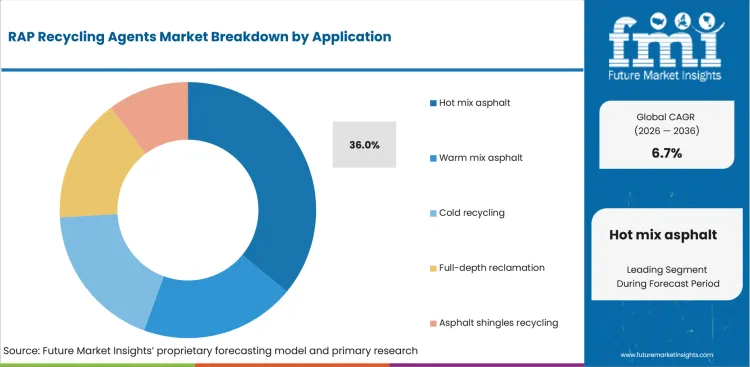
Hot mix asphalt keeps recycling-agent dosing inside a conventional plant workflow where the producer can meter additive and check the job mix formula before paving. Warm mix asphalt reduces production temperature and can pair recycling chemistry with workability support. Cold recycling and Full-depth reclamation move more of the process into rehabilitation operations. Asphalt shingles recycling adds another source of aged binder with its own blending challenge. Related polymer bitumen systems can further change compatibility requirements when modifiers are present.
- Hot mix asphalt is projected to capture 36.0% of Application demand in 2026 because recycling agents can be integrated into established plant production and quality-control routines.
- BASF states that Butonal MB 5126 can be added at the asphalt mixing plant for hot or warm mix production and can enable higher RAP proportions, showing how additive selection is tied to production method.
Why do Rejuvenators lead the Agent Type category?
Rejuvenators target the loss of flexibility that develops as asphalt binder oxidizes in service. Purpose-formulated products compete by restoring a workable balance between stiffness and cracking response rather than by lowering viscosity alone. Softening agents can improve handling, while Bio-based recycling agents add renewable feedstock options. Aromatic oil blends remain relevant where solvency is required, and Polymer-compatible agents support systems that also contain binder modifiers.
- Based on Agent Type, Rejuvenators are projected to account for 34.0% in 2026 because high-RAP mix design often requires direct restoration of aged-binder response.
- Cargill reported in May 2026 that its NCAT test-track program compared a 45% RAP mixture using Anova with a 30% RAP control under performance-based criteria, showing how supplier evidence is moving from dosage claims toward field and mixture performance.
Why do Bio-oils lead the Feedstock category?
Bio-oils can be formulated as liquid recycling agents that add mobility to oxidized binder while giving suppliers a renewable-content route. Tall oil derivatives offer another bio-derived pathway. Naphthenic oils and Petroleum process oils remain established petroleum-based feedstocks, while Engineered chemical blends allow formulators to tune compatibility and aging response for specific binder systems. Purchase decisions still depend on storage stability and repeatable dosing at the plant.
- In 2026, Bio-oils are expected to account for 22.0% of Feedstock demand as suppliers combine aged-binder restoration with renewable feedstock options.
- Sripath Technologies markets ReLIXER as a recycling agent formulated with bio-based oils for reclaimed asphalt pavement and reclaimed asphalt shingles, illustrating the direct connection between feedstock selection and RAP-focused formulation.
Why does 20-40% RAP lead the RAP Content category?
The 20-40% RAP band gives producers meaningful virgin-material displacement while keeping plant operation and qualification within a range already encountered in many performance-based programs. Below 20% RAP can reduce the economic case for a dedicated recycling agent. At 40-60% RAP and Above 60% RAP, reclaimed-binder variability and aging response become more influential, so dosage trials and mix-specific verification carry greater weight.
- The 20-40% RAP segment is forecast to account for 38.0% share in 2026 because it balances recycled-content economics with a manageable testing and production envelope.
- Kraton Corporation introduced its CirKular+ Paving Circularity Series in April 2025 and stated that the platform can support 50% or more reclaimed asphalt in surface-layer mixes, indicating technical work beyond the 20-40% RAP content band.
Why do Asphalt mix producers lead the Sales Channel category?
Asphalt mix producers control the point where a RAP stockpile becomes a qualified mixture. Laboratory teams set binder replacement assumptions and trial dosage, while plant teams manage storage and metering during production. Road contractors influence project execution and Government recycling programs can shape permitted material use. Chemical distributors broaden access where direct supplier coverage is limited. The producer still carries the immediate risk when workability or mixture performance falls outside the job target.
- Asphalt mix producers are expected to account for 42.0% of Sales Channel demand in 2026 because they control mix design, recycling-agent dosing and repeat production.
- Supplier programs that combine product chemistry with trial support and plant guidance reduce the gap between a laboratory formulation and recurring production, which strengthens the direct producer channel.
What are the drivers, restraints and opportunities in the RAP Recycling Agents Market?
Higher RAP targets support demand, while stockpile variability and aging uncertainty slow qualification as performance-backed formulations create room for broader recycled-binder use.
- Driver: Higher recycled-binder use increases the need to restore workability and cracking response in asphalt mixtures accepted under agency specifications.
- Restraint: RAP variability and long-term aging create a testing burden when dosage response changes across stockpiles or recovered binder grades.
- Opportunity: Recycling agents backed by Balanced Mix Design evidence can support higher RAP use across hot, warm and cold recycling workflows.
The core demand mechanism is straightforward: more reclaimed binder reduces virgin-binder demand only if the resulting mixture can still be produced and accepted. FHWA Balanced Mix Design work gives agencies a way to judge cracking and rutting response rather than relying only on volumetric criteria. That shifts attention toward asphalt additives that can show a repeatable performance effect at the mixture level.
RAP is not a uniform raw material. Binder age and aggregate gradation can differ by stockpile, while plant practices influence how much reclaimed binder actually blends with virgin binder. A recycling agent that performs well at one dosage can require adjustment when the source changes. Long-term aging adds another qualification step because an initially soft mixture still needs acceptable durability after simulated or field aging.
The opportunity lies in reducing that qualification burden. Bio-based agents give formulators a renewable feedstock route, while polymer-compatible agents can address mixes that include additional binder modification. Suppliers that pair chemistry with recovered-binder testing and mixture-test support can help producers move into higher RAP bands without treating every project as a new product trial.
What are the country growth rates in the RAP Recycling Agents Market?
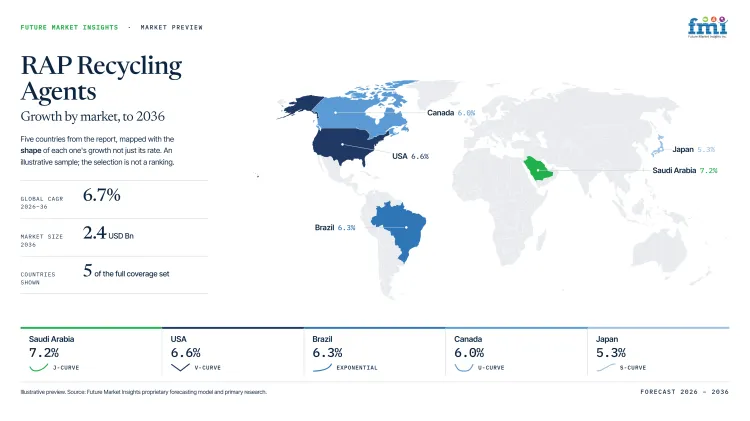
| Country | CAGR |
|---|---|
| Saudi Arabia | 7.2% |
| USA | 6.6% |
| Japan | 5.3% |
| Brazil | 6.3% |
| Canada | 6.0% |
| Germany | 5.7% |
| Australia | 6.9% |
How do country-level CAGRs compare in the RAP Recycling Agents Market?
The seven country CAGRs span 1.9 percentage points across road-recycling programs with different procurement rules and mix-qualification practices. The spacing reflects expected expansion in recycling-agent demand rather than current asphalt tonnage or the share of RAP already used in each country.
- Saudi Arabia is projected at 7.2% CAGR as road rehabilitation programs create a route for in-place and mobile recycling technologies that can increase demand for compatible recycling chemistry.
- USA is forecast at 6.6% CAGR as Balanced Mix Design programs give producers a clearer performance route for high-RAP mixtures and recycling-agent evaluation.
- Japan is estimated at 5.3% CAGR, with recycled-aggregate conformity and traceability shaping how quickly new agent formulations move into routine contracts.
- Brazil is projected at 6.3% CAGR as federal road specifications continue to formalize in-situ recycling methods using asphalt emulsion.
- Canada is forecast at 6.0% CAGR as provincial agencies and producers balance recycled-material use with stockpile control and mixture qualification.
- Germany is estimated at 5.7% CAGR in a road market where reclaimed asphalt is already established and suppliers need to compete on compatibility plus documented performance.
- Australia is projected at 6.9% CAGR as public procurement policies require major transport projects to optimize recycled and reused materials within current specifications.
Comparable CAGRs can produce different routes to purchase. The full report evaluates country conditions across North America, Latin America, Western Europe, Eastern Europe, East Asia, South Asia and Pacific, and the Middle East and Africa.
Country-wise Analysis
- Saudi Arabia is projected to record 7.2% CAGR from 2026 to 2036. The Roads General Authority has publicized machinery that scrapes and recycles asphalt on site, which creates a practical route for rehabilitation systems that reuse aged pavement. Recycling-agent suppliers still need to fit local binder grades and field processes because in-place recycling places different demands on mixing and curing than conventional plant production.
- USA is forecast to expand at 6.6% CAGR through 2036. FHWA has documented state work on Balanced Mix Design for mixtures with high RAP and has highlighted long-term aging when recycling agents are used. That gives suppliers a performance-based selling route: the agent must support the desired recycled-binder contribution while keeping cracking and rutting results inside the agency test window.
- Japan is estimated to advance at 5.3% CAGR during the assessment period. The Ministry of Land, Infrastructure, Transport and Tourism has maintained national attention on recycled aggregate used in asphalt mixtures through survey work and published corrections. This environment favors formulations that arrive with traceable dosage guidance and evidence compatible with contract quality-control procedures.
- Brazil is projected at 6.3% CAGR from 2026 to 2036. DNIT lists specification DNIT 463/2025 for in-situ asphalt pavement recycling with asphalt emulsion, formalizing a rehabilitation route in which recycled material remains central to the new layer. Recycling-agent demand can expand where project owners seek to adjust aged binder or improve workability without abandoning the recycling method.
- Canada is forecast at 6.0% CAGR through 2036. Ontario public data tracks the use of reclaimed materials in road construction, including percentages of recycled asphalt pavement in granular-material reporting. For recycling-agent suppliers, commercial conversion depends on stockpile characterization and an accepted mix design because provincial road programs place weight on specification compliance and repeatable material properties.
- Germany is estimated to record 5.7% CAGR during the forecast period. The Federal Environment Agency treats reclaimed asphalt as a defined secondary raw material and provides recycling guidance, reflecting an established material-recovery chain. Suppliers therefore compete less on the idea of reuse itself and more on compatibility with local binders, recovered-material quality and proof that the treated mixture meets technical requirements.
- Australia is projected to expand at 6.9% CAGR from 2026 to 2036. Victoria's Recycled First Policy requires tenderers on major transport projects to optimize recycled and reused materials within existing standards and specifications, including reclaimed asphalt pavement. That procurement signal supports recycling-agent demand when a formulation helps contractors meet recycled-content objectives without creating a new acceptance risk.
Who are the notable companies in the RAP Recycling Agents Market?
Ingevity, Cargill, Kraton Corporation, Arkema, BASF, Iterchimica, Collaborative Aggregates, Sripath Technologies, Sasol and Puma Energy Bitumen are notable companies serving the RAP recycling agents market.
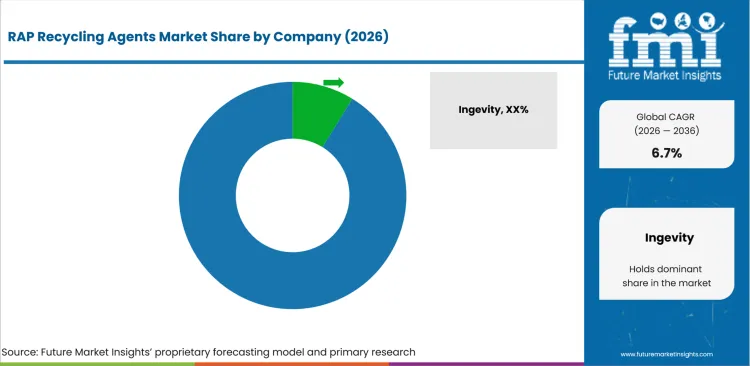
Competition centers on whether a supplier can show a direct RAP-recycling function, support binder compatibility and help a producer move from trial dosage to repeat production. Some companies sell purpose-formulated rejuvenators, while others combine recycling support with polymers or broader asphalt-additive platforms. Route-to-market depth matters because plant trials and project-specific testing often determine repeat orders.
- Cargill, Arkema, Iterchimica, Collaborative Aggregates and Sripath Technologies offer products positioned directly around reclaimed-asphalt rejuvenation or recycling-agent use.
- Ingevity, Kraton Corporation, BASF and Sasol connect RAP support with broader binder, polymer or asphalt-additive capabilities that can matter in more complex mix designs.
- Puma Energy Bitumen adds a bitumen-distribution route for rejuvenator products in markets where customers buy chemistry alongside binder and paving support.
Competitive Benchmarking: RAP Recycling Agents Market
| Company | Direct RAP Recycling-Agent Portfolio | High-RAP and Binder Compatibility Support | Application and Field Technical Support | Geographic Reach |
|---|---|---|---|---|
| Ingevity | High | High | Medium | North America and international paving markets |
| Cargill | High | High | High | North America, Europe and other paving markets |
| Kraton Corporation | Medium | High | Medium | North America, Europe and Asia |
| Arkema | High | High | High | International asphalt-additives markets |
| BASF | Medium | High | High | International; EMEA asphalt support documented |
| Iterchimica | High | High | High | Europe and international road markets |
| Collaborative Aggregates | High | Medium | High | United States |
| Sripath Technologies | High | High | High | International paving markets |
| Sasol | High | High | Medium | Europe, Africa and other asphalt markets |
| Puma Energy Bitumen | High | Medium | High | Australia, New Zealand and selected bitumen markets |
Scoring basis: Direct RAP Recycling-Agent Portfolio is High when first-party material identifies a purpose-formulated rejuvenator or recycling agent for RAP or RAS. Medium covers a broader binder or additive platform with verified reclaimed-asphalt support. High-RAP and Binder Compatibility Support is High when product material addresses aged-binder restoration, recycled-content increase or modifier compatibility directly. Application and Field Technical Support is High when the company documents plant, road or customer implementation support. Medium indicates product guidance without comparable field evidence. Geographic Reach records markets supported by official company material and does not represent complete corporate footprint.
Key Developments in the RAP Recycling Agents Market
- In May 2026, Cargill published NCAT test-track results comparing a 45% RAP mixture using Anova with a 30% RAP control under performance-based requirements.
- In February 2026, Iterchimica published a long-term case review of a Czech road section containing 50% RAP and ACF 2000 Green recycling technology.
- In April 2025, Kraton Corporation launched its CirKular+ Paving Circularity Series for reclaimed-asphalt reuse, with the company stating that the platform can enable 50% or more reclaimed asphalt in surface layers.
Key Players in the RAP Recycling Agents Market
Dedicated RAP Rejuvenation and Recycling-Agent Specialists
- Cargill
- Arkema
- Iterchimica
- Collaborative Aggregates
- Sripath Technologies
Specialty Chemistry and Binder-Compatible Platforms
- Ingevity
- Kraton Corporation
- BASF
- Sasol
Bitumen Distribution and Paving Support
- Puma Energy Bitumen
RAP Recycling Agents Market - Report Scope
| Coverage field | Report scope |
|---|---|
| Market breakdown | By Agent Type, Feedstock, RAP Content, Application, Sales Channel and Region. |
| Quantitative Units | USD billion. |
| Market Definition | Purpose-formulated agents used to restore, soften or otherwise adjust aged asphalt binder so reclaimed asphalt can be incorporated into a qualified asphalt mixture or recycling process. |
| Regions Covered | North America, Latin America, Western Europe, Eastern Europe, East Asia, South Asia and Pacific, and Middle East and Africa. |
| Countries Covered | Saudi Arabia, USA, Japan, Brazil, Canada, Germany, Australia, and other countries included in the full report. |
| Companies Covered | Ingevity, Cargill, Kraton Corporation, Arkema, BASF, Iterchimica, Collaborative Aggregates, Sripath Technologies, Sasol and Puma Energy Bitumen. |
| Forecast Period | 2026 to 2036. |
| Approach | Primary and secondary research with market triangulation. |
RAP Recycling Agents Market - Research Methodology
| Method | Approach |
|---|---|
| Primary Research | FMI analysts gathered input from recycling-agent suppliers, asphalt producers, road contractors, chemical distributors, public procurement teams and technical specialists. Interviews examined product selection, dosage economics, qualification requirements, purchase triggers, channel roles and the evidence required before a trial becomes recurring production. |
| Desk Research | Desk research covered government road-agency publications, transport-ministry material, technical standards, public procurement documents, company filings and first-party product information. Sources were reviewed for market relevance, publication date and consistency with the defined recycling-agent scope. |
| Market Sizing and Forecasting | The market model combined the baseline value with segment structure, agent dosage economics, RAP use patterns, application mix, channel participation and country-level adoption conditions. Forecast assumptions considered road rehabilitation activity, recycled-content policy, performance-testing requirements and supplier commercialization. |
| Data Validation | Estimates were checked against independent public indicators and findings from primary interviews. Validation tested whether products and revenues fell inside the defined RAP recycling-agent boundary while adjacent pavement-preservation treatments, downstream asphalt value and chemistry without a direct recycling-agent function were excluded. |
RAP Recycling Agents Market by Segments
RAP Recycling Agents Market segmented by Agent Type:
- Rejuvenators
- Softening agents
- Bio-based recycling agents
- Aromatic oil blends
- Polymer-compatible agents
RAP Recycling Agents Market segmented by Feedstock:
- Bio-oils
- Tall oil derivatives
- Naphthenic oils
- Petroleum process oils
- Engineered chemical blends
RAP Recycling Agents Market segmented by RAP Content:
- 20-40% RAP
- Below 20% RAP
- 40-60% RAP
- Above 60% RAP
RAP Recycling Agents Market segmented by Application:
- Hot mix asphalt
- Warm mix asphalt
- Cold recycling
- Full-depth reclamation
- Asphalt shingles recycling
RAP Recycling Agents Market segmented by Sales Channel:
- Asphalt mix producers
- Road contractors
- Chemical distributors
- Government recycling programs
RAP Recycling Agents Market by Region:
- North America
- United States
- Canada
- Latin America
- Brazil
- Mexico
- Argentina
- Chile
- Western Europe
- Germany
- France
- United Kingdom
- Italy
- Spain
- Benelux
- Nordics
- Eastern Europe
- Poland
- Czech Republic
- Romania
- Hungary
- East Asia
- China
- Japan
- South Korea
- South Asia and Pacific
- India
- ASEAN
- Australia and New Zealand
- Middle East and Africa
- GCC Countries
- South Africa
- Türkiye
- Israel
Research Sources and Bibliography
- Federal Highway Administration. (2025). 2024 Lead States Balanced Mix Design Peer Exchange: Outcomes Summary.
- Saudi Press Agency. (2024, January 3). Roads General Authority uses modern equipment to scrape and recycle asphalt on site.
- Ministry of Land, Infrastructure, Transport and Tourism, Japan. (2024, July 17; corrected August 5). Survey concerning recycled aggregate used in asphalt mixtures.
- Departamento Nacional de Infraestrutura de Transportes. (2025). DNIT 463/2025 - in-situ asphalt pavement recycling with asphalt emulsion.
- Government of Ontario. Annual granular material data, including reporting fields for recycled asphalt pavement.
- German Environment Agency. Asphaltgranulat: information and recycling guidance for reclaimed asphalt.
- State of Victoria. Recycled First Policy for major transport projects.
- Ingevity. Evoflex CA product information for greater RAP and RAS use.
- Cargill. (2026, May 1). NCAT Test Track case study: performance of Anova in a 45% RAP mixture.
- Kraton Corporation. (2025, April 21). Launch of CirKular+ Paving Circularity Series for reclaimed-asphalt reuse.
- Arkema. Recycled Asphalt Pavement rejuvenators for asphalt and bitumen applications.
- BASF. (2024, June 16). Butonal MB 5126 for hot and warm asphalt production with higher RAP proportions.
- Iterchimica. (2026, February 16). Rejuvenator versus flux oil: ACF 2000 Green road-surface case review.
- Collaborative Aggregates. Delta S RAP rejuvenator handling and product information.
- Sripath Technologies. ReLIXER bio-based recycling-agent product information.
- Sasol Chemicals. Rejuvenators (Recycling Agents) for increasing recycled asphalt in new mixes.
- Puma Energy Bitumen. Asphalt additives and Anova rejuvenator information.
This bibliography is provided for reader reference and is not exhaustive. The full report contains the complete reference list and detailed citations.
This Report Answers
- How does RAP recycling-agent demand change through the forecast period?
- Which operating conditions make recycling agents commercially relevant in asphalt production?
- Which Agent Type supports direct restoration of aged-binder behavior?
- How do feedstock choices affect product positioning and compatibility?
- Why does the mid-range RAP content band concentrate recurring agent demand?
- How do application and sales-channel roles shape qualification and repeat purchase?
- How do country conditions change the route from recycled-material policy to agent demand?
- Which companies serve direct rejuvenation, binder compatibility and paving-support needs?
Frequently Asked Questions
How big is the RAP recycling agents market in 2026?
USD 1.3 billion represents the RAP recycling agents market value in 2026. Demand is tied to asphalt producers and road-recycling programs that need to restore aged-binder behavior as reclaimed material use rises. The market is projected to reach USD 2.4 billion by 2036.
What is the CAGR of the RAP recycling agents market from 2026 to 2036?
A 6.7% CAGR is projected for the RAP recycling agents market between 2026 and 2036. Growth depends on recycled-binder targets moving upward while performance-based qualification becomes more common. Supplier support around dosage, aging response and plant implementation influences whether a product moves from trial use to recurring purchase.
Which Agent Type segment is projected to account for 34.0% of the RAP recycling agents market?
Rejuvenators are projected to account for 34.0% of Agent Type demand in 2026. The segment addresses the loss of flexibility and increased stiffness associated with aged asphalt binder, making it directly relevant when producers seek to raise recycled-binder contribution without creating unacceptable cracking risk.
How much will the RAP recycling agents market add between 2026 and 2036?
USD 1.2 billion is expected to be added to the RAP recycling agents market between 2026 and 2036 when values are expressed to one decimal place. The increase reflects broader use of recycling agents in plant-produced asphalt and rehabilitation workflows where reclaimed binder needs controlled performance restoration.
Which companies are active in the RAP recycling agents market?
Ingevity, Cargill, Kraton Corporation, Arkema, BASF, Iterchimica, Collaborative Aggregates, Sripath Technologies, Sasol and Puma Energy Bitumen are active across direct recycling-agent formulations, binder-modification platforms or paving-support channels. Product fit differs by RAP content, binder condition and the performance tests used for project acceptance.
Preview the report firsthand - request a free sample
Get SampleGet the brochure for pricing and purchase details.
Get PDFTable of Content
- Key Takeaways
- Market Size and CAGR
- Top Growth Driver
- Fastest Growing Segment
- Leading Region
- Key Companies
- Emerging Opportunities
- Executive Summary
- Global Market Outlook
- Demand-side Trends
- Supply-side Trends
- Technology Roadmap Analysis
- Analysis and Recommendations
- Analyst Perspective (What is happening? Why now? What should investors know?)
- Key Questions Answered
- How large is the market?
- What is the CAGR?
- What are key trends?
- Which region dominates?
- Who are the leaders?
- Market Overview
- Market Coverage / Taxonomy
- Market Definition / Scope / Limitations
- Research Methodology
- Chapter Orientation
- Analytical Lens and Working Hypotheses
- Market Structure, Signals, and Trend Drivers
- Benchmarking and Cross-market Comparability
- Market Sizing, Forecasting, and Opportunity Mapping
- Research Design and Evidence Framework
- Desk Research Programme (Secondary Evidence)
- Expert Input and Fieldwork (Primary Evidence)
- Tooling, Models, and Reference Databases
- Data Engineering and Model Build
- Quality Assurance and Audit Trail
- Market Background
- Market Dynamics (Drivers, Restraints, Opportunity, Trends)
- Scenario Forecast (Optimistic, Likely, Conservative)
- Impact Analysis
- AI Impact
- Sustainability Impact
- Regulatory Impact
- Technology Impact
- Consumer / Buyer Analysis
- Purchase Drivers
- Adoption Barriers
- Buyer Journey
- Opportunity Map Analysis
- Product Life Cycle Analysis
- Supply Chain Analysis
- Investment Feasibility Matrix
- Value Chain Analysis
- PESTLE and Porter's Analysis
- Regulatory Landscape
- Regional Parent Market Outlook
- Production and Consumption Statistics
- Import and Export Statistics
- Global Market Analysis and Forecast, 2021 to 2036
- Historical Market Size Value (USD Billion) Analysis, 2021 to 2025
- Current and Future Market Size Value (USD Billion) Projections, 2026 to 2036
- Y-o-Y Growth Trend Analysis
- Absolute $ Opportunity Analysis
- Global Market Pricing Analysis, 2021 to 2036
- Global Market Analysis and Forecast, By Agent Type, 2021 to 2036
- Introduction / Key Findings
- Historical Market Size Value (USD Billion) Analysis By Agent Type, 2021 to 2025
- Current and Future Market Size Value (USD Billion) Analysis and Forecast By Agent Type, 2026 to 2036
- Rejuvenators
- Softening agents
- Bio-based recycling agents
- Aromatic oil blends
- Polymer-compatible agents
- Rejuvenators
- Y-o-Y Growth Trend Analysis By Agent Type, 2021 to 2025
- Absolute $ Opportunity Analysis By Agent Type, 2026 to 2036
- Global Market Analysis and Forecast, By Feedstock, 2021 to 2036
- Introduction / Key Findings
- Historical Market Size Value (USD Billion) Analysis By Feedstock, 2021 to 2025
- Current and Future Market Size Value (USD Billion) Analysis and Forecast By Feedstock, 2026 to 2036
- Bio-oils
- Tall oil derivatives
- Naphthenic oils
- Petroleum process oils
- Engineered chemical blends
- Bio-oils
- Y-o-Y Growth Trend Analysis By Feedstock, 2021 to 2025
- Absolute $ Opportunity Analysis By Feedstock, 2026 to 2036
- Global Market Analysis and Forecast, By RAP Content, 2021 to 2036
- Introduction / Key Findings
- Historical Market Size Value (USD Billion) Analysis By RAP Content, 2021 to 2025
- Current and Future Market Size Value (USD Billion) Analysis and Forecast By RAP Content, 2026 to 2036
- 20-40% RAP
- Below 20% RAP
- 40-60% RAP
- Above 60% RAP
- 20-40% RAP
- Y-o-Y Growth Trend Analysis By RAP Content, 2021 to 2025
- Absolute $ Opportunity Analysis By RAP Content, 2026 to 2036
- Global Market Analysis and Forecast, By Application, 2021 to 2036
- Introduction / Key Findings
- Historical Market Size Value (USD Billion) Analysis By Application, 2021 to 2025
- Current and Future Market Size Value (USD Billion) Analysis and Forecast By Application, 2026 to 2036
- Hot mix asphalt
- Warm mix asphalt
- Cold recycling
- Full-depth reclamation
- Asphalt shingles recycling
- Hot mix asphalt
- Y-o-Y Growth Trend Analysis By Application, 2021 to 2025
- Absolute $ Opportunity Analysis By Application, 2026 to 2036
- Global Market Analysis and Forecast, By Sales Channel, 2021 to 2036
- Introduction / Key Findings
- Historical Market Size Value (USD Billion) Analysis By Sales Channel, 2021 to 2025
- Current and Future Market Size Value (USD Billion) Analysis and Forecast By Sales Channel, 2026 to 2036
- Asphalt mix producers
- Road contractors
- Chemical distributors
- Government recycling programs
- Asphalt mix producers
- Y-o-Y Growth Trend Analysis By Sales Channel, 2021 to 2025
- Absolute $ Opportunity Analysis By Sales Channel, 2026 to 2036
- Global Market Analysis and Forecast, By Region, 2021 to 2036
- Introduction
- Historical Market Size Value (USD Billion) Analysis By Region, 2021 to 2025
- Current Market Size Value (USD Billion) Analysis and Forecast By Region, 2026 to 2036
- North America
- Latin America
- Western Europe
- Eastern Europe
- East Asia
- South Asia and Pacific
- Middle East & Africa
- Market Attractiveness Analysis By Region
- North America Market Analysis and Forecast, By Country, 2021 to 2036
- Historical Market Size Value (USD Billion) Trend Analysis By Market Taxonomy, 2021 to 2025
- Market Size Value (USD Billion) Forecast By Market Taxonomy, 2026 to 2036
- By Country
- USA
- Canada
- By Agent Type
- By Feedstock
- By RAP Content
- By Application
- By Sales Channel
- By Country
- Market Attractiveness Analysis
- By Country
- By Agent Type
- By Feedstock
- By RAP Content
- By Application
- By Sales Channel
- Key Takeaways
- Latin America Market Analysis and Forecast, By Country
- Historical Market Size Value (USD Billion) Trend Analysis By Market Taxonomy, 2021 to 2025
- Market Size Value (USD Billion) Forecast By Market Taxonomy, 2026 to 2036
- By Country
- Brazil
- Mexico
- Chile
- Rest of Latin America
- By Agent Type
- By Feedstock
- By RAP Content
- By Application
- By Sales Channel
- By Country
- Market Attractiveness Analysis
- By Country
- By Agent Type
- By Feedstock
- By RAP Content
- By Application
- By Sales Channel
- Key Takeaways
- Western Europe Market Analysis and Forecast, By Country
- Historical Market Size Value (USD Billion) Trend Analysis By Market Taxonomy, 2021 to 2025
- Market Size Value (USD Billion) Forecast By Market Taxonomy, 2026 to 2036
- By Country
- Germany
- UK
- Italy
- Spain
- France
- Nordic
- BENELUX
- Rest of Western Europe
- By Agent Type
- By Feedstock
- By RAP Content
- By Application
- By Sales Channel
- By Country
- Market Attractiveness Analysis
- By Country
- By Agent Type
- By Feedstock
- By RAP Content
- By Application
- By Sales Channel
- Key Takeaways
- Eastern Europe Market Analysis and Forecast, By Country
- Historical Market Size Value (USD Billion) Trend Analysis By Market Taxonomy, 2021 to 2025
- Market Size Value (USD Billion) Forecast By Market Taxonomy, 2026 to 2036
- By Country
- Russia
- Poland
- Hungary
- Balkan & Baltic
- Rest of Eastern Europe
- By Agent Type
- By Feedstock
- By RAP Content
- By Application
- By Sales Channel
- By Country
- Market Attractiveness Analysis
- By Country
- By Agent Type
- By Feedstock
- By RAP Content
- By Application
- By Sales Channel
- Key Takeaways
- East Asia Market Analysis and Forecast, By Country
- Historical Market Size Value (USD Billion) Trend Analysis By Market Taxonomy, 2021 to 2025
- Market Size Value (USD Billion) Forecast By Market Taxonomy, 2026 to 2036
- By Country
- China
- Japan
- South Korea
- By Agent Type
- By Feedstock
- By RAP Content
- By Application
- By Sales Channel
- By Country
- Market Attractiveness Analysis
- By Country
- By Agent Type
- By Feedstock
- By RAP Content
- By Application
- By Sales Channel
- Key Takeaways
- South Asia and Pacific Market Analysis and Forecast, By Country
- Historical Market Size Value (USD Billion) Trend Analysis By Market Taxonomy, 2021 to 2025
- Market Size Value (USD Billion) Forecast By Market Taxonomy, 2026 to 2036
- By Country
- India
- ASEAN
- Australia & New Zealand
- Rest of South Asia and Pacific
- By Agent Type
- By Feedstock
- By RAP Content
- By Application
- By Sales Channel
- By Country
- Market Attractiveness Analysis
- By Country
- By Agent Type
- By Feedstock
- By RAP Content
- By Application
- By Sales Channel
- Key Takeaways
- Middle East & Africa Market Analysis and Forecast, By Country
- Historical Market Size Value (USD Billion) Trend Analysis By Market Taxonomy, 2021 to 2025
- Market Size Value (USD Billion) Forecast By Market Taxonomy, 2026 to 2036
- By Country
- Kingdom of Saudi Arabia
- Other GCC Countries
- Türkiye
- South Africa
- Other African Union
- Rest of Middle East & Africa
- By Agent Type
- By Feedstock
- By RAP Content
- By Application
- By Sales Channel
- By Country
- Market Attractiveness Analysis
- By Country
- By Agent Type
- By Feedstock
- By RAP Content
- By Application
- By Sales Channel
- Key Takeaways
- Key Countries Market Analysis
- USA
- Pricing Analysis
- Market Share Analysis, 2025
- By Agent Type
- By Feedstock
- By RAP Content
- By Application
- By Sales Channel
- Canada
- Pricing Analysis
- Market Share Analysis, 2025
- By Agent Type
- By Feedstock
- By RAP Content
- By Application
- By Sales Channel
- Mexico
- Pricing Analysis
- Market Share Analysis, 2025
- By Agent Type
- By Feedstock
- By RAP Content
- By Application
- By Sales Channel
- Brazil
- Pricing Analysis
- Market Share Analysis, 2025
- By Agent Type
- By Feedstock
- By RAP Content
- By Application
- By Sales Channel
- Chile
- Pricing Analysis
- Market Share Analysis, 2025
- By Agent Type
- By Feedstock
- By RAP Content
- By Application
- By Sales Channel
- Germany
- Pricing Analysis
- Market Share Analysis, 2025
- By Agent Type
- By Feedstock
- By RAP Content
- By Application
- By Sales Channel
- UK
- Pricing Analysis
- Market Share Analysis, 2025
- By Agent Type
- By Feedstock
- By RAP Content
- By Application
- By Sales Channel
- Italy
- Pricing Analysis
- Market Share Analysis, 2025
- By Agent Type
- By Feedstock
- By RAP Content
- By Application
- By Sales Channel
- Spain
- Pricing Analysis
- Market Share Analysis, 2025
- By Agent Type
- By Feedstock
- By RAP Content
- By Application
- By Sales Channel
- France
- Pricing Analysis
- Market Share Analysis, 2025
- By Agent Type
- By Feedstock
- By RAP Content
- By Application
- By Sales Channel
- India
- Pricing Analysis
- Market Share Analysis, 2025
- By Agent Type
- By Feedstock
- By RAP Content
- By Application
- By Sales Channel
- ASEAN
- Pricing Analysis
- Market Share Analysis, 2025
- By Agent Type
- By Feedstock
- By RAP Content
- By Application
- By Sales Channel
- Australia & New Zealand
- Pricing Analysis
- Market Share Analysis, 2025
- By Agent Type
- By Feedstock
- By RAP Content
- By Application
- By Sales Channel
- China
- Pricing Analysis
- Market Share Analysis, 2025
- By Agent Type
- By Feedstock
- By RAP Content
- By Application
- By Sales Channel
- Japan
- Pricing Analysis
- Market Share Analysis, 2025
- By Agent Type
- By Feedstock
- By RAP Content
- By Application
- By Sales Channel
- South Korea
- Pricing Analysis
- Market Share Analysis, 2025
- By Agent Type
- By Feedstock
- By RAP Content
- By Application
- By Sales Channel
- Russia
- Pricing Analysis
- Market Share Analysis, 2025
- By Agent Type
- By Feedstock
- By RAP Content
- By Application
- By Sales Channel
- Poland
- Pricing Analysis
- Market Share Analysis, 2025
- By Agent Type
- By Feedstock
- By RAP Content
- By Application
- By Sales Channel
- Hungary
- Pricing Analysis
- Market Share Analysis, 2025
- By Agent Type
- By Feedstock
- By RAP Content
- By Application
- By Sales Channel
- Kingdom of Saudi Arabia
- Pricing Analysis
- Market Share Analysis, 2025
- By Agent Type
- By Feedstock
- By RAP Content
- By Application
- By Sales Channel
- Türkiye
- Pricing Analysis
- Market Share Analysis, 2025
- By Agent Type
- By Feedstock
- By RAP Content
- By Application
- By Sales Channel
- South Africa
- Pricing Analysis
- Market Share Analysis, 2025
- By Agent Type
- By Feedstock
- By RAP Content
- By Application
- By Sales Channel
- USA
- Market Structure Analysis
- Competition Dashboard
- Competition Benchmarking
- Market Share Analysis of Top Players
- By Regional
- By Agent Type
- By Feedstock
- By RAP Content
- By Application
- By Sales Channel
- Emerging Startups
- Innovation Benchmarking
- Competition Analysis
- Competition Deep Dive
- Ingevity
- Overview
- Product Portfolio
- Profitability by Market Segments
- Sales Footprint
- Strategy Overview
- Marketing Strategy
- Product Strategy
- Channel Strategy
- Cargill
- Kraton Corporation
- Arkema
- BASF
- Iterchimica
- Collaborative Aggregates
- Sripath Technologies
- RejuvTec
- Puma Energy Bitumen
- Ingevity
- Case Studies
- Success Stories
- Recent Developments
- Competition Deep Dive
- Assumptions & Acronyms Used


