

- Market Size (2026)
- USD 817.6 Mn
- Forecast (2036)
- USD 2140.0 Mn
- CAGR (2026 to 2036)
- 10.1%
How big is Reproductive Toxicity Studies Market in 2026?
USD 817.6 million in 2026 and USD 2,140.0 million by 2036 at a 10.1% CAGR.
Demand for reproductive toxicity studies is forecast to expand at 10.1% CAGR between 2026 and 2036 and increase valuation from USD 817.6 million in 2026 to USD 2140.0 million by 2036. Sponsors purchase these studies to resolve fertility and developmental risks before protocol expansion creates expensive delays across clinical programs. The FDA announced in April 2025 that selected drug programs could incorporate validated new approach methodologies instead of additional animal testing. Commercial value depends on study packages that answer a defined development question without adding unnecessary animal work or avoidable timeline risk.
United States sponsors can source integrated programs from large CRO networks with established regulatory consulting and pathology capacity. Japanese sponsors often require local-language coordination and carefully managed model logistics across domestic submissions and imported study materials. OECD updated Test Guideline 443 in June 2025 and preserved a cohort-based design for extended one-generation reproductive toxicity studies. European programs face stronger pressure to justify animal use through the 3Rs and document how alternative methods support each regulatory context. Related drug discovery services market activity encourages earlier vendor engagement across development programs that require reproductive safety planning. Contract decisions become stronger once sponsors define species availability, assay qualification and regulatory review responsibilities during the proposal stage.
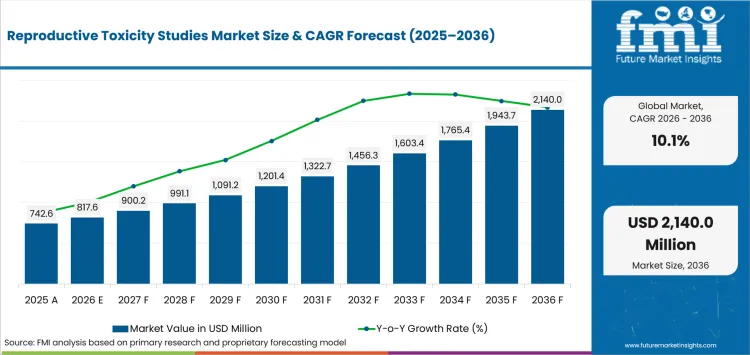
Key Takeaways of the Reproductive Toxicity Studies Market
- Regulatory safety requirements at defined clinical milestones create recurring demand for reproductive toxicity studies; fertility and early embryonic development studies are projected to account for 42.8% of study type demand in 2026, reflecting their gating role in evaluating gamete maturation and implantation before sponsors commit resources to longer developmental programs.
- Rodent models are estimated to hold 44.3% of test system demand in 2026, supported by established breeding performance and regulatory familiarity, with historical control data quality playing a critical role in interpreting borderline or uncommon reproductive findings across fertility and developmental endpoints.
- Pharmaceutical companies are expected to represent 36.3% of end-user demand in 2026, driven by sequenced DART requirements across advancing drug portfolios where each candidate may require distinct fertility, embryo-fetal, or postnatal evidence aligned to clinical exposure decisions and submission milestones.
- Drug development is forecast to account for 41.2% of application demand in 2026, spanning early risk screening through regulated submission packages, with providers that integrate study design, bioanalysis, and pathology across one coordinated plan holding a distinct competitive advantage.
- The USA leads country-level growth at an 11.9% CAGR through 2036, supported by integrated CRO service networks and active regulatory dialogue, while the UK follows at 11.4% CAGR through established preclinical expertise and predictable trial oversight.
- Charles River Laboratories and Labcorp anchor broad global DART platforms, while Inotiv, Pharmaron, Scantox, and Toxys compete through focused regulated execution, specialized pathology, and human stem-cell developmental toxicity assays.
Analyst Perspective
"The reproductive toxicity studies market is increasingly shaped by regulatory relevance and study quality rather than study volume alone. Sponsors are prioritizing designs that address defined exposure questions, maintain robust historical controls, and generate evidence suitable for regulatory decisions. Providers that combine validated methodologies with strong scientific interpretation will be better positioned to support efficient development programs."
- Anurag Sharma, Principal Analyst at Future Market Insights
Source: FMI's proprietary forecasting model and primary research
How is the Reproductive Toxicity Studies Market segmented?
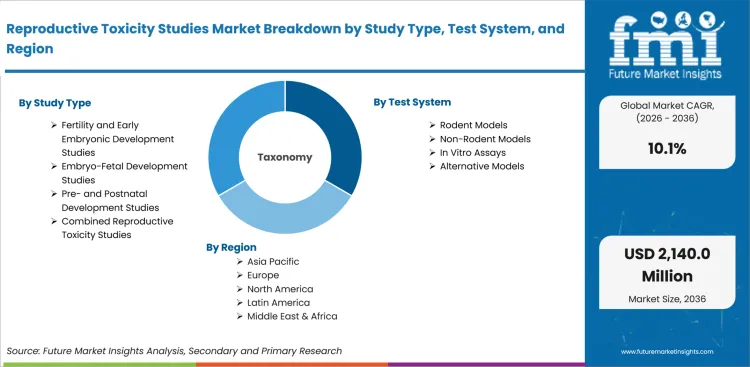
The reproductive toxicity studies industry is segmented by study type, test system, end user, application, and region.
The segmentation framework separates biological study objectives from the systems and sponsor groups used to generate regulated evidence. Study type distinguishes fertility work from embryo-fetal and postnatal designs across the complete reproductive cycle and exposure timeline. Test system identifies rodent and non-rodent models alongside in vitro assays and alternative platforms used within approved protocols. End user separates pharmaceutical and biotechnology companies from CROs and academic research institutes that commission or perform studies. Application classifies drug development and chemical safety assessment beside agrochemical testing and regulatory compliance programs with distinct commercial purposes.
What supports fertility and early embryonic development studies within the study type category?
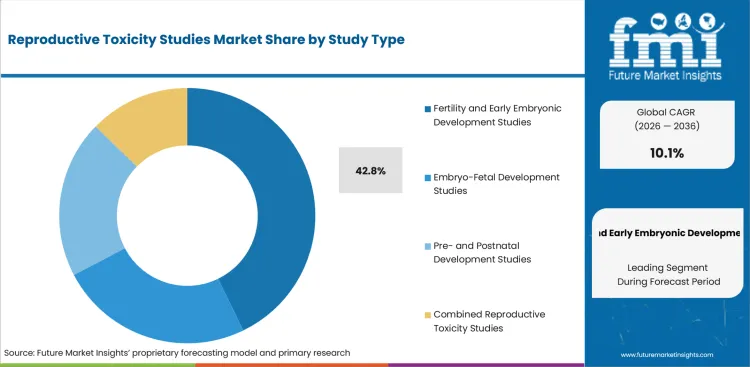
Fertility and early embryonic development studies examine reproductive performance before later gestational endpoints become the primary program question. Frontage Laboratories reported in August 2025 that these studies assess mating and estrous cyclicity; they also examine spermatogenesis and viable implantation. Study directors must coordinate dosing with breeding windows and preserve enough control data to interpret uncommon findings. The design therefore influences candidate progression before sponsors commit resources to longer developmental programs and related pathology work.
- Within study type, fertility and early embryonic development studies are projected to account for 42.8% share in 2026. The position reflects their direct role in evaluating gamete maturation and implantation before broader reproductive exposure decisions. Comparable services in the animal models market require controlled breeding and documented endpoints across outsourced programs.
- Pharmaceutical toxicology teams use these studies to resolve fertility questions that general toxicity packages cannot answer reliably. Early planning protects clinical timelines because missed breeding windows or weak sperm assessments can delay the complete reproductive program and downstream regulatory submission work.
How do sponsors evaluate rodent models within the test system category?
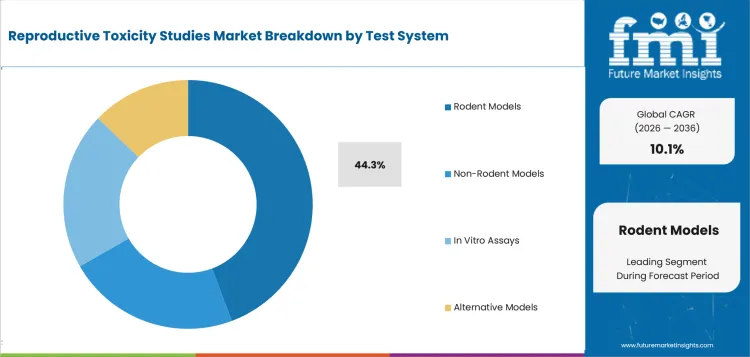
Rodent models provide established reproductive biology and control datasets across common regulatory study designs used by pharmaceutical and chemical sponsors. Study planning must fix strain and female age at mating to protect litter-size objectives and developmental endpoint consistency. Animal specification therefore becomes part of data quality rather than a routine logistics decision for laboratory operations. Specialist teams also need pathology and behavioral methods that remain consistent across generations within complex multigenerational programs.
- Rodent models are estimated to hold 44.3% share within test system in 2026 owing to established breeding performance and regulatory familiarity. Labcorp reported in September 2025 that female age at mating can affect litter-size objectives across three laboratory rat strains. Historical controls therefore improve interpretation across fertility and developmental endpoints within uncommon or borderline findings.
- CRO study directors select rodent models when program questions require sufficiently sized litters and reproducible developmental landmarks. The commercial advantage depends on reliable supply and age control rather than lower animal cost alone. The adjacent healthcare CRO market offers a useful comparison for study-director continuity across long outsourced programs.
What makes pharmaceutical companies central to the end user category?
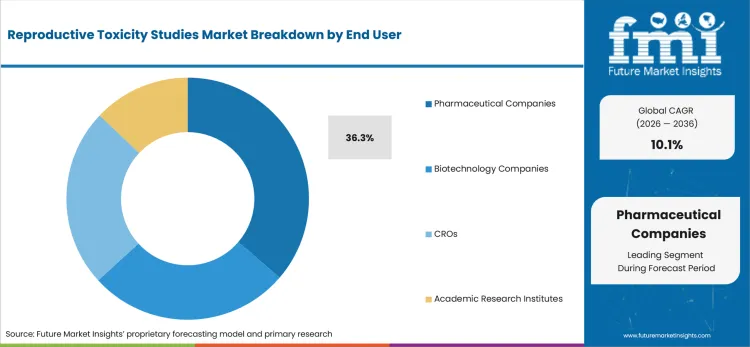
Pharmaceutical companies sequence reproductive safety work around clinical exposure plans and filing milestones for each candidate. Labcorp described in April 2026 how biopharma teams face compressed discovery timelines while traditional DART work occurs later and requires substantial time and test material. The timing gap increases reliance on providers that can align early screening with regulated studies across one sponsor portfolio. Commercial selection still depends on protocol fit and scientific oversight rather than laboratory scale alone.
- Pharmaceutical companies are expected to represent 36.3% of end user demand in 2026 reflecting repeated regulatory requirements across advancing drug portfolios. Each program can require distinct fertility, embryo-fetal or postnatal evidence across several clinical exposure decisions and formal submission milestones.
- Drug safety departments engage specialist laboratories to secure breeding capacity and experienced reproductive pathology during tightly sequenced programs. Outsourcing becomes more attractive when internal facilities cannot maintain dedicated colonies or multigenerational expertise across demanding regulatory schedules. The outsourced testing services market provides a wider comparison for capacity access and specialist documentation across regulated work.
How does drug development influence purchasing within the application category?
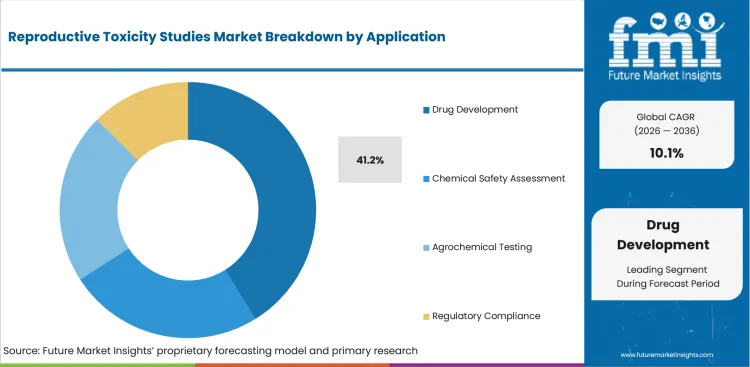
Drug development programs require reproductive evidence at different moments as candidate exposure expands across patient populations. Study timing must account for test-article availability and the biological windows needed for fertility or developmental assessment. Sponsors also need protocol decisions that align with clinical strategy and expected submission dates across one coordinated program. Late changes can create material delays across toxicology and regulatory teams during critical submission preparation.
- Drug development is forecast to represent 41.2% of application demand in 2026 driven by repeated safety decisions across clinical progression. The category covers early risk screening and regulated studies that support later submission packages across expanding patient exposure and marketing applications.
- Biopharmaceutical sponsors favor providers that connect study design with bioanalysis and pathology across one development plan. Labcorp states that an enhanced preliminary EFD study in two species can support unrestricted inclusion of women of childbearing potential through Phase II clinical trials. Related bioanalytical testing services market activity illustrates the value of coordinated data review across complex development programs.
What are the drivers, restraints, and opportunities in the Reproductive Toxicity Studies Market?
Regulatory exposure decisions create demand for reproductive safety evidence; long study windows and specialist capacity constrain execution; qualified human-relevant methods create a route toward earlier risk screening.
- Driver: Sponsors require reproductive evidence before clinical exposure expands to populations whose pregnancies or future fertility could face an uncharacterized risk.
- Restraint: Breeding schedules and lengthy observation periods can delay programs whenever species availability or specialist pathology capacity remains limited.
- Opportunity: Validated new approach methodologies can screen developmental hazards earlier and focus later animal studies on unresolved regulatory questions.
Reproductive safety requirements create recurring workload across drug and chemical development programs that advance into broader exposure settings. The ICH S5(R3) guideline organizes pharmaceutical assessment around fertility, embryo-fetal development and pre- or postnatal development. The linked safety questions require different study designs and often involve separate operational windows across one development plan. Sponsors therefore reserve specialist capacity before clinical milestones become dependent on one complex data package. The related chemical testing services market also shows why regulated evidence must match the substance and intended exposure route.
Long in-life periods create a material scheduling constraint because reproductive studies depend on breeding success and age-controlled observations. Current Inotiv guidance distinguishes shorter fertility studies from longer prenatal and postnatal programs that extend through gestation and offspring assessment. Extended one-generation designs also add cohort decisions and specialized observations across several critical developmental stages. One missed mating window can therefore affect animal allocation and pathology schedules across the complete program. Sponsors need realistic start dates and contingency plans before linking clinical decisions to final reports.
Human-relevant screening methods create a credible opening for earlier developmental hazard assessment and more focused later studies. The National Institutes of Health announced more than USD 150 million in March 2026 to develop and standardize methods that better simulate human biology. Commercial adoption depends on validation and a clearly defined regulatory context rather than technical novelty alone. Providers can combine qualified assays with conventional programs to prioritize compounds and explain remaining uncertainty. The organ-on-chip testing market offers an adjacent route for human-relevant evidence across selected safety questions.
Which country CAGRs are profiled in the Reproductive Toxicity Studies Market?
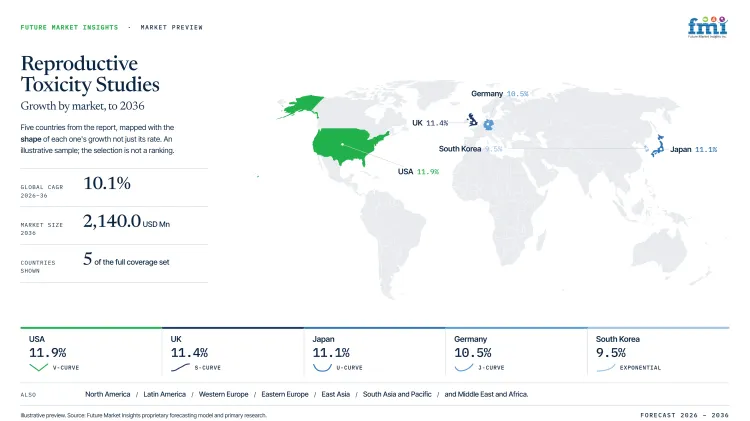
| Country | CAGR |
|---|---|
| USA | 11.9% |
| UK | 11.4% |
| Germany | 10.5% |
| Japan | 11.1% |
| South Korea | 9.5% |
How do country-level CAGRs compare in the Reproductive Toxicity Studies Market?
The country rates span 2.4 percentage points and form two distinct growth bands. USA and UK remain separated by 0.5 percentage points while Japan sits between those two positions. Germany follows 0.6 percentage points behind Japan and remains one percentage point above South Korea. The compressed upper group suggests similar forecast momentum despite different regulatory routes and service structures. The wider gap to South Korea reflects a more demanding entry case rather than a conclusion about current market size.
- USA combines the lucrative forecast with broad CRO capacity and an active transition toward human-relevant safety methods.
- UK remains close to USA through centralized regulatory oversight and established toxicology expertise across multinational development programs.
- Germany occupies the middle position as strong regulatory science operates beside sustained pressure to reduce animal use.
- Japan stays within the upper cluster although local coordination and model logistics can alter program timing for foreign sponsors.
- South Korea sits outside the main cluster because local full-scope DART capacity and cross-border coordination can constrain project starts.
Similar CAGRs can produce different commercial outcomes because service availability and regulatory interpretation affect the cost of each program. Entry decisions should therefore compare study access and acceptance planning rather than reading forecast percentages as equivalent operating conditions.
Country-wise Analysis
- United States sponsors use large preclinical networks that combine DART execution with pathology and regulatory consulting across development hubs. The reproductive toxicity studies market in the USA is projected to grow at 11.9% CAGR through 2036 supported by diverse pipelines and specialist capacity. The FDA confirmed that 46 novel drugs were approved by CDER during 2025 across multiple therapeutic areas. The recorded approval workload supports recurring reproductive safety planning for candidates progressing toward broader clinical exposure and later marketing submissions. Integrated CRO facilities provide a direct enabler while competition for complex animal capacity creates scheduling friction during crowded development periods. Sponsors should reserve species and pathology resources before clinical milestones depend on final DART reports across multiple programs.
- UK programs benefit from centralized trial oversight and preclinical facilities that serve domestic sponsors alongside multinational development teams. Demand for reproductive toxicity studies in the UK is forecast to rise at 11.4% CAGR over the forecast period reflecting predictable regulatory service and experienced toxicology teams. The MHRA has confirmed that 99% of initial clinical trial and investigation applications met statutory timelines, as reported in published performance analysis. Predictable review timing helps sponsors align nonclinical evidence with clinical submission dates and internal decision gates across complex programs. Local toxicology expertise enables protocol coordination while specialist animal capacity and cross-border model logistics remain material execution frictions. Contracts should define transport responsibility and contingency capacity before sponsors approve final start dates for long reproductive studies.
- German programs operate under strict animal welfare expectations and mature regulatory systems covering pharmaceuticals and industrial chemicals. Germany's reproductive toxicity studies sector is estimated to post 10.5% CAGR during the assessment period underpinned by regulated demand and method modernization. The BfR reported in December 2025 that 1.95 million animals were used or killed for scientific purposes during 2024 and represented an 8.2% decline. Internationally accepted GLP infrastructure provides a direct enabler for submission work across pharmaceutical and chemical safety programs. Sustained reductions in animal use create friction for programs lacking a defensible integrated strategy that links alternatives with necessary in vivo evidence. Providers need qualified methods and clear scientific justification for every in vivo component within the submission plan.
- Japanese programs require careful coordination of regulatory interpretation and imported study materials across domestic submission pathways. Adoption of reproductive toxicity studies in Japan is anticipated to expand at 11.1% CAGR from 2026 to 2036 enabled by sustained review activity and specialist domestic support. Japan's health ministry confirmed in December 2025 that thirty newly approved drug items received national sale authorization on December 22. The recorded approval flow supports continuing reproductive safety work across domestic and multinational pipelines requiring coordinated evidence. Established review pathways enable providers with local communication expertise while language requirements and limited specialized model access create material friction. Sponsors should select partners with Japanese regulatory communication and dependable cross-border logistics for models and study materials.
- South Korean sponsors combine active clinical development with a smaller domestic base of full-scope reproductive toxicology providers. Cross-border study management often connects local regulatory teams with overseas animal facilities and specialist pathology groups. South Korea's reproductive toxicity studies market is predicted to advance at 9.5% CAGR by 2036 influenced by trial activity and biotechnology investment. The Ministry of Food and Drug Safety reported in March 2026 that 783 clinical trials received approval during 2025 and exceeded 2024 by 4.8%. Clinical activity creates an enabler for continuing safety work while international coordination and service distance remain material frictions. Commercial plans should assign translation and logistics responsibilities within one accountable contract covering every overseas handoff.
Who are the notable companies in the Reproductive Toxicity Studies Market?
Charles River Laboratories, Labcorp, Inotiv, Frontage Laboratories, Pharmaron, Scantox, Jai Research Foundation, and Toxys are notable companies in this market.
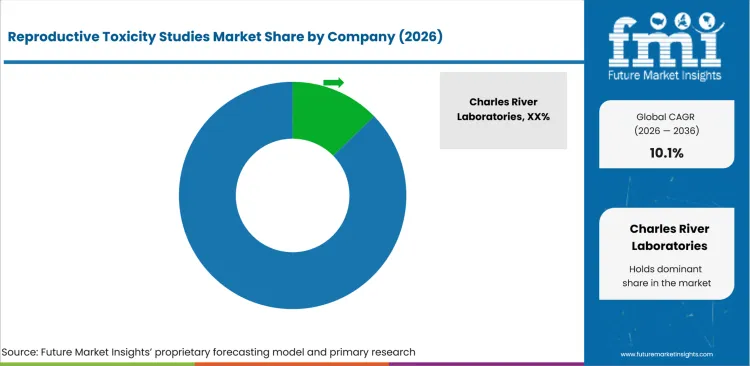
The competitive structure includes integrated global CROs and specialist laboratories with distinct study systems and regulatory roles. Charles River describes broad historical control data and experience with complex DART programs across multiple species. Frontage Laboratories provides regulated FEED, EFD and PPND studies from its Chicago toxicology facility with integrated supporting services. Providers also compete through model access and the ability to connect pathology with bioanalysis across one sponsor program. The healthcare analytical testing provides an adjacent comparison for data integrity and laboratory coordination. The preclinical device testing offers another comparison for regulated quality systems across specialist laboratories. Selection depends on exact protocol capability rather than company size or a broad toxicology portfolio.
- Charles River Laboratories and Labcorp combine broad DART portfolios with specialist pathology and large-animal capabilities across multinational pharmaceutical programs.
- Inotiv and Frontage Laboratories provide regulated DART execution with focused historical controls and integrated supporting services. Pharmaron, Scantox and Jai Research Foundation add different model depth and geographic access across pharmaceutical and chemical programs.
- Toxys supplies a human stem-cell developmental toxicity platform that complements conventional programs through early hazard screening and weight-of-evidence assessment.
Competitive Benchmarking: Reproductive Toxicity Studies Market
| Company | DART Study Breadth | Test-System Breadth | Regulatory and Data Support | Geographic Reach |
|---|---|---|---|---|
| Charles River Laboratories | High | High | High | North America and Europe |
| Labcorp | High | High | High | North America and Europe |
| Inotiv | High | Medium | High | North America |
| Frontage Laboratories | High | Medium | High | North America |
| Pharmaron | High | Medium | High | North America, Europe and East Asia |
| Scantox | High | Medium | High | Europe |
| Jai Research Foundation | High | Medium | High | India |
| Toxys | Low | Low | Medium | Europe and North America |
Key Developments in the Reproductive Toxicity Studies Market
- In October 2025, Charles River Laboratories announced a collaboration with Toxys that gives clients access to the ReproTracker human stem-cell assay. The platform supports early developmental toxicity screening and animal-free teratogenicity assessment beside conventional DART programs. The arrangement expands integrated study planning for sponsors that need human-relevant evidence within a defined regulatory strategy.
- In June 2026, Labcorp reported blinded interlaboratory reproducibility work for the devTOX quickPredict developmental toxicity assay. Labcorp also stated that the assay has an accepted qualification plan within the FDA CDER Biomarker Qualification Program. The development strengthens a potential regulatory pathway for human-cell evidence used within structured weight-of-evidence assessments and formal sponsor submissions.
- In October 2025, Toxys published a trilineage ReproTracker update that included neural differentiation and a higher-throughput design. Toxys reported 86.27% accuracy and 87.50% sensitivity across 51 known teratogenic and non-teratogenic compounds within the validation set. The work broadens early screening across developmental lineages before sponsors commit scarce test material to later in vivo programs.
- In June 2025, Scantox: Danish regulatory toxicology site received full AAALAC International accreditation for its animal care and use program. The certification supports assurance for regulated in vivo studies that depend on controlled housing and consistent welfare practices. Sponsors can include the accreditation within facility qualification for reproductive programs using rats or minipigs.
Key Players in the Reproductive Toxicity Studies Market
Integrated Global DART Providers
- Charles River Laboratories
- Labcorp
- Pharmaron
Specialized In Vivo Testing Providers
- Inotiv
- Frontage Laboratories
- Scantox
- Jai Research Foundation
Human-Relevant Assay Provider
- Toxys
Reproductive Toxicity Studies Market - Report Scope
| Coverage field | Report scope |
|---|---|
| Market breakdown | Study type, test system, end user, application, and region. |
| Quantitative Units | Revenue in USD Million, CAGR in %. |
| Market Definition | Commercial study services, assay platforms, models, pathology, bioanalysis, and regulatory support used directly in reproductive toxicity assessment. |
| Regions Covered | North America, Latin America, Western Europe, Eastern Europe, East Asia, South Asia and Pacific, and Middle East and Africa. |
| Countries Covered | USA, UK, Germany, Japan, and South Korea. |
| Key Companies Profiled | Charles River Laboratories, Labcorp, Inotiv, Frontage Laboratories, Pharmaron, Scantox, Jai Research Foundation, and Toxys. |
| Forecast Period | 2026 to 2036. |
| Approach | Hybrid bottom-up and top-down market sizing supported by primary interviews and official desk research. |
Reproductive Toxicity Studies Market - Research Methodology
| Method | Approach |
|---|---|
| Primary Research | FMI analysts gathered input from manufacturers, service providers, technology developers, distributors, end users, sourcing teams, and subject-matter experts. Interviews examined purchasing decisions, product or service evaluation, adoption barriers, approval requirements, pricing considerations, and expectations for technical or commercial support. Respondents were also asked what evidence is required before a trial, pilot, or initial order develops into regular purchasing. |
| Desk Research | Desk research covered government statistics, regulatory publications, trade data, industry associations, technical literature, standards, company filings, product information, and official corporate announcements. Sources were reviewed for relevance, publication date, geographic coverage, and consistency with the defined market scope. Claims relating to performance, applications, approvals, capacity, investment, and commercial activity were retained only when supported by credible public evidence. |
| Market Sizing and Forecasting | The market model combined the baseline value with historical performance, segment structure, pricing and volume indicators, adoption levels, company participation, and country-level demand conditions. Forecast assumptions considered economic activity, investment trends, regulatory developments, technology adoption, purchasing cycles, supply availability, and barriers to wider market use. Segment and regional estimates were reconciled before the final market total was calculated. |
| Data Validation | Estimates were checked against multiple independent indicators, including public data, company activity, trade patterns, industry developments, and findings from primary interviews. Validation also tested whether products, services, applications, and company revenues fell within the defined market boundaries. Adjacent categories, unsupported claims, overlapping revenues, and activities without direct market relevance were excluded to reduce double counting and maintain consistency across segments and countries. |
Reproductive Toxicity Studies Market by Segments
Reproductive Toxicity Studies Market segmented by Study Type:
- Fertility and Early Embryonic Development Studies
- Embryo-Fetal Development Studies
- Pre- and Postnatal Development Studies
- Combined Reproductive Toxicity Studies
Reproductive Toxicity Studies Market segmented by Test System:
- Rodent Models
- Non-Rodent Models
- In Vitro Assays
- Alternative Models
Reproductive Toxicity Studies Market segmented by End User:
- Pharmaceutical Companies
- Biotechnology Companies
- CROs
- Academic Research Institutes
Reproductive Toxicity Studies Market segmented by Application:
- Drug Development
- Chemical Safety Assessment
- Agrochemical Testing
- Regulatory Compliance
Reproductive Toxicity Studies Market by Region:
- North America
- United States
- Canada
- Latin America
- Brazil
- Mexico
- Argentina
- Chile
- Western Europe
- Germany
- France
- United Kingdom
- Italy
- Spain
- Benelux
- Nordics
- Eastern Europe
- Poland
- Czech Republic
- Romania
- Hungary
- East Asia
- China
- Japan
- South Korea
- South Asia and Pacific
- India
- ASEAN
- Australia and New Zealand
- Middle East and Africa
- GCC Countries
- South Africa
- Türkiye
- Israel
Research Sources and Bibliography
- USA Food and Drug Administration. (2025, April 10). FDA announces plan to phase out animal testing requirement for monoclonal antibodies and other drugs.
- Organisation for Economic Co-operation and Development. (2025, June 25). Test No. 443: Extended one-generation reproductive toxicity study.
- Frontage Laboratories. (2025, August 7). A complete overview of DART (developmental and reproductive toxicology) studies.
- Labcorp. (2025, September 21). The importance of specification of minimum age requirements of female age at mating to achieve regulatory toxicology study objectives: An evaluation of age at mating on varying study types and correlation to litter size in three strains of laboratory rat.
- Labcorp. (2026, April 24). The early DART blind spot: Why developmental toxicity needs a rethink in 2026.
- Labcorp. (n.d.). Developmental and reproductive toxicology (DART).
- Labcorp. (n.d.). Toxicity study: Embryo-fetal developmental.
- USA Food and Drug Administration. (2021, May). S5(R3) detection of reproductive and developmental toxicity for human pharmaceuticals guidance for industry.
- Inotiv. (n.d.). Developmental and reproductive toxicology services.
- National Institutes of Health. (2026, March 18). NIH invests $150 million in human-based research to reduce use of animal models.
- USA Food and Drug Administration. (2026, July 8). Novel drug approvals for 2025.
- Medicines and Healthcare products Regulatory Agency. (2026, June 24). MHRA performance data.
- German Federal Institute for Risk Assessment. (2025, December 9). Less than two million laboratory animals for the first time.
- Ministry of Health, Labour and Welfare. (2025, December 22). [Medicines approved as new drugs].
- Ministry of Food and Drug Safety. (2026, March 6). [783 clinical trials approved in 2025, up 4.8% year over year].
- Charles River Laboratories. (2025, October 8). Charles River and Toxys announce collaboration to validate the use of NAMs for developmental toxicity testing.
- Labcorp. (2026, June 14). Assessment of intralaboratory and interlaboratory reproducibility of the devTOX quickPredict assay.
- Toxys. (2025, September 30). New publication: Trilineage differentiation in ReproTracker for accurate teratogenicity assessment.
- Scantox. (2025, June 27). Scantox receives full AAALAC accreditation-reinforcing our commitment to animal welfare and scientific integrity.
This bibliography lists every unique public source used within the retained analytical evidence and competitive assessment.
This Report Answers
- How large is the reproductive toxicity studies market in 2026 and 2036?
- Which regulatory and development pressures support demand for reproductive toxicity studies?
- Why do fertility and early embryonic development studies hold the dominant study type share?
- How do rodent models influence study design and data interpretation across regulated programs?
- Why do pharmaceutical companies account for the significant end user share?
- How do country growth conditions differ across USA, UK, Germany, Japan, and South Korea?
- Which companies provide integrated DART programs or specialized developmental toxicity assays?
- What limits timely execution across breeding schedules and specialist pathology capacity?
- How can validated human-relevant methods improve early developmental risk screening?
Frequently Asked Questions
How big is the Reproductive Toxicity Studies Market in 2026?
The reproductive toxicity studies market is valued at USD 817.6 million in 2026 and is forecast to reach USD 2140.0 million by 2036.
What is the CAGR of the Reproductive Toxicity Studies Market from 2026 to 2036?
The reproductive toxicity studies market is projected to grow at a CAGR of 10.1% between 2026 and 2036, supported by sponsors requiring reproductive evidence before clinical exposure expands to populations whose pregnancies or future fertility could face an uncharacterized risk.
Which country is growing fastest in the Reproductive Toxicity Studies Market?
The USA is the fastest-growing country in the reproductive toxicity studies market, expanding at an 11.9% CAGR through 2036, ahead of the market average of 10.1%, supported by diverse drug pipelines, integrated CRO service networks, and active regulatory dialogue around human-relevant safety methods.
Who are the leading companies in the Reproductive Toxicity Studies Market?
Leading companies in the reproductive toxicity studies market include Charles River Laboratories, Labcorp, Inotiv, Frontage Laboratories, Pharmaron, Scantox, Jai Research Foundation, and Toxys, competing across integrated global DART programs, specialized in vivo testing services, and human-relevant developmental toxicity assay platforms.
Preview the report firsthand - request a free sample
Get SampleGet the brochure for pricing and purchase details.
Get PDFTable of Content
- Key Takeaways
- Market Size and CAGR
- Top Growth Driver
- Fastest Growing Segment
- Leading Region
- Key Companies
- Emerging Opportunities
- Executive Summary
- Global Market Outlook
- Demand-side Trends
- Supply-side Trends
- Technology Roadmap Analysis
- Analysis and Recommendations
- Analyst Perspective (What is happening? Why now? What should investors know?)
- Key Questions Answered
- How large is the market?
- What is the CAGR?
- What are key trends?
- Which region dominates?
- Who are the leaders?
- Market Overview
- Market Coverage / Taxonomy
- Market Definition / Scope / Limitations
- Research Methodology
- Chapter Orientation
- Analytical Lens and Working Hypotheses
- Market Structure, Signals, and Trend Drivers
- Benchmarking and Cross-market Comparability
- Market Sizing, Forecasting, and Opportunity Mapping
- Research Design and Evidence Framework
- Desk Research Programme (Secondary Evidence)
- Expert Input and Fieldwork (Primary Evidence)
- Tooling, Models, and Reference Databases
- Data Engineering and Model Build
- Quality Assurance and Audit Trail
- Market Background
- Market Dynamics (Drivers, Restraints, Opportunity, Trends)
- Scenario Forecast (Optimistic, Likely, Conservative)
- Impact Analysis
- AI Impact
- Sustainability Impact
- Regulatory Impact
- Technology Impact
- Consumer / Buyer Analysis
- Purchase Drivers
- Adoption Barriers
- Buyer Journey
- Opportunity Map Analysis
- Product Life Cycle Analysis
- Supply Chain Analysis
- Investment Feasibility Matrix
- Value Chain Analysis
- PESTLE and Porter's Analysis
- Regulatory Landscape
- Regional Parent Market Outlook
- Production and Consumption Statistics
- Import and Export Statistics
- Global Market Analysis and Forecast, 2021 to 2036
- Historical Market Size Value (USD Million) Analysis, 2021 to 2025
- Current and Future Market Size Value (USD Million) Projections, 2026 to 2036
- Y-o-Y Growth Trend Analysis
- Absolute $ Opportunity Analysis
- Global Market Pricing Analysis, 2021 to 2036
- Global Market Analysis and Forecast, By Study Type, 2021 to 2036
- Introduction / Key Findings
- Historical Market Size Value (USD Million) Analysis By Study Type, 2021 to 2025
- Current and Future Market Size Value (USD Million) Analysis and Forecast By Study Type, 2026 to 2036
- Fertility and Early Embryonic Development Studies
- Embryo-Fetal Development Studies
- Pre- and Postnatal Development Studies
- Combined Reproductive Toxicity Studies
- Fertility and Early Embryonic Development Studies
- Y-o-Y Growth Trend Analysis By Study Type, 2021 to 2025
- Absolute $ Opportunity Analysis By Study Type, 2026 to 2036
- Global Market Analysis and Forecast, By Test System, 2021 to 2036
- Introduction / Key Findings
- Historical Market Size Value (USD Million) Analysis By Test System, 2021 to 2025
- Current and Future Market Size Value (USD Million) Analysis and Forecast By Test System, 2026 to 2036
- Rodent Models
- Non-Rodent Models
- In Vitro Assays
- Alternative Models
- Rodent Models
- Y-o-Y Growth Trend Analysis By Test System, 2021 to 2025
- Absolute $ Opportunity Analysis By Test System, 2026 to 2036
- Global Market Analysis and Forecast, By End User, 2021 to 2036
- Introduction / Key Findings
- Historical Market Size Value (USD Million) Analysis By End User, 2021 to 2025
- Current and Future Market Size Value (USD Million) Analysis and Forecast By End User, 2026 to 2036
- Pharmaceutical Companies
- Biotechnology Companies
- CROs
- Academic Research Institutes
- Pharmaceutical Companies
- Y-o-Y Growth Trend Analysis By End User, 2021 to 2025
- Absolute $ Opportunity Analysis By End User, 2026 to 2036
- Global Market Analysis and Forecast, By Application, 2021 to 2036
- Introduction / Key Findings
- Historical Market Size Value (USD Million) Analysis By Application, 2021 to 2025
- Current and Future Market Size Value (USD Million) Analysis and Forecast By Application, 2026 to 2036
- Drug Development
- Chemical Safety Assessment
- Agrochemical Testing
- Regulatory Compliance
- Drug Development
- Y-o-Y Growth Trend Analysis By Application, 2021 to 2025
- Absolute $ Opportunity Analysis By Application, 2026 to 2036
- Global Market Analysis and Forecast, By Region, 2021 to 2036
- Introduction
- Historical Market Size Value (USD Million) Analysis By Region, 2021 to 2025
- Current Market Size Value (USD Million) Analysis and Forecast By Region, 2026 to 2036
- North America
- Latin America
- Western Europe
- Eastern Europe
- East Asia
- South Asia and Pacific
- Middle East & Africa
- Market Attractiveness Analysis By Region
- North America Market Analysis and Forecast, By Country, 2021 to 2036
- Historical Market Size Value (USD Million) Trend Analysis By Market Taxonomy, 2021 to 2025
- Market Size Value (USD Million) Forecast By Market Taxonomy, 2026 to 2036
- By Country
- USA
- Canada
- By Study Type
- By Test System
- By End User
- By Application
- By Country
- Market Attractiveness Analysis
- By Country
- By Study Type
- By Test System
- By End User
- By Application
- Key Takeaways
- Latin America Market Analysis and Forecast, By Country
- Historical Market Size Value (USD Million) Trend Analysis By Market Taxonomy, 2021 to 2025
- Market Size Value (USD Million) Forecast By Market Taxonomy, 2026 to 2036
- By Country
- Brazil
- Mexico
- Chile
- Rest of Latin America
- By Study Type
- By Test System
- By End User
- By Application
- By Country
- Market Attractiveness Analysis
- By Country
- By Study Type
- By Test System
- By End User
- By Application
- Key Takeaways
- Western Europe Market Analysis and Forecast, By Country
- Historical Market Size Value (USD Million) Trend Analysis By Market Taxonomy, 2021 to 2025
- Market Size Value (USD Million) Forecast By Market Taxonomy, 2026 to 2036
- By Country
- Germany
- UK
- Italy
- Spain
- France
- Nordic
- BENELUX
- Rest of Western Europe
- By Study Type
- By Test System
- By End User
- By Application
- By Country
- Market Attractiveness Analysis
- By Country
- By Study Type
- By Test System
- By End User
- By Application
- Key Takeaways
- Eastern Europe Market Analysis and Forecast, By Country
- Historical Market Size Value (USD Million) Trend Analysis By Market Taxonomy, 2021 to 2025
- Market Size Value (USD Million) Forecast By Market Taxonomy, 2026 to 2036
- By Country
- Russia
- Poland
- Hungary
- Balkan & Baltic
- Rest of Eastern Europe
- By Study Type
- By Test System
- By End User
- By Application
- By Country
- Market Attractiveness Analysis
- By Country
- By Study Type
- By Test System
- By End User
- By Application
- Key Takeaways
- East Asia Market Analysis and Forecast, By Country
- Historical Market Size Value (USD Million) Trend Analysis By Market Taxonomy, 2021 to 2025
- Market Size Value (USD Million) Forecast By Market Taxonomy, 2026 to 2036
- By Country
- China
- Japan
- South Korea
- By Study Type
- By Test System
- By End User
- By Application
- By Country
- Market Attractiveness Analysis
- By Country
- By Study Type
- By Test System
- By End User
- By Application
- Key Takeaways
- South Asia and Pacific Market Analysis and Forecast, By Country
- Historical Market Size Value (USD Million) Trend Analysis By Market Taxonomy, 2021 to 2025
- Market Size Value (USD Million) Forecast By Market Taxonomy, 2026 to 2036
- By Country
- India
- ASEAN
- Australia & New Zealand
- Rest of South Asia and Pacific
- By Study Type
- By Test System
- By End User
- By Application
- By Country
- Market Attractiveness Analysis
- By Country
- By Study Type
- By Test System
- By End User
- By Application
- Key Takeaways
- Middle East & Africa Market Analysis and Forecast, By Country
- Historical Market Size Value (USD Million) Trend Analysis By Market Taxonomy, 2021 to 2025
- Market Size Value (USD Million) Forecast By Market Taxonomy, 2026 to 2036
- By Country
- Kingdom of Saudi Arabia
- Other GCC Countries
- Türkiye
- South Africa
- Other African Union
- Rest of Middle East & Africa
- By Study Type
- By Test System
- By End User
- By Application
- By Country
- Market Attractiveness Analysis
- By Country
- By Study Type
- By Test System
- By End User
- By Application
- Key Takeaways
- Key Countries Market Analysis
- USA
- Pricing Analysis
- Market Share Analysis, 2025
- By Study Type
- By Test System
- By End User
- By Application
- Canada
- Pricing Analysis
- Market Share Analysis, 2025
- By Study Type
- By Test System
- By End User
- By Application
- Mexico
- Pricing Analysis
- Market Share Analysis, 2025
- By Study Type
- By Test System
- By End User
- By Application
- Brazil
- Pricing Analysis
- Market Share Analysis, 2025
- By Study Type
- By Test System
- By End User
- By Application
- Chile
- Pricing Analysis
- Market Share Analysis, 2025
- By Study Type
- By Test System
- By End User
- By Application
- Germany
- Pricing Analysis
- Market Share Analysis, 2025
- By Study Type
- By Test System
- By End User
- By Application
- UK
- Pricing Analysis
- Market Share Analysis, 2025
- By Study Type
- By Test System
- By End User
- By Application
- Italy
- Pricing Analysis
- Market Share Analysis, 2025
- By Study Type
- By Test System
- By End User
- By Application
- Spain
- Pricing Analysis
- Market Share Analysis, 2025
- By Study Type
- By Test System
- By End User
- By Application
- France
- Pricing Analysis
- Market Share Analysis, 2025
- By Study Type
- By Test System
- By End User
- By Application
- India
- Pricing Analysis
- Market Share Analysis, 2025
- By Study Type
- By Test System
- By End User
- By Application
- ASEAN
- Pricing Analysis
- Market Share Analysis, 2025
- By Study Type
- By Test System
- By End User
- By Application
- Australia & New Zealand
- Pricing Analysis
- Market Share Analysis, 2025
- By Study Type
- By Test System
- By End User
- By Application
- China
- Pricing Analysis
- Market Share Analysis, 2025
- By Study Type
- By Test System
- By End User
- By Application
- Japan
- Pricing Analysis
- Market Share Analysis, 2025
- By Study Type
- By Test System
- By End User
- By Application
- South Korea
- Pricing Analysis
- Market Share Analysis, 2025
- By Study Type
- By Test System
- By End User
- By Application
- Russia
- Pricing Analysis
- Market Share Analysis, 2025
- By Study Type
- By Test System
- By End User
- By Application
- Poland
- Pricing Analysis
- Market Share Analysis, 2025
- By Study Type
- By Test System
- By End User
- By Application
- Hungary
- Pricing Analysis
- Market Share Analysis, 2025
- By Study Type
- By Test System
- By End User
- By Application
- Kingdom of Saudi Arabia
- Pricing Analysis
- Market Share Analysis, 2025
- By Study Type
- By Test System
- By End User
- By Application
- Türkiye
- Pricing Analysis
- Market Share Analysis, 2025
- By Study Type
- By Test System
- By End User
- By Application
- South Africa
- Pricing Analysis
- Market Share Analysis, 2025
- By Study Type
- By Test System
- By End User
- By Application
- USA
- Market Structure Analysis
- Competition Dashboard
- Competition Benchmarking
- Market Share Analysis of Top Players
- By Regional
- By Study Type
- By Test System
- By End User
- By Application
- Emerging Startups
- Innovation Benchmarking
- Competition Analysis
- Competition Deep Dive
- Charles River Laboratories
- Overview
- Product Portfolio
- Profitability by Market Segments
- Sales Footprint
- Strategy Overview
- Marketing Strategy
- Product Strategy
- Channel Strategy
- Labcorp Drug Development
- Eurofins Scientific
- WuXi AppTec
- SGS
- ICON plc
- Inotiv
- Thermo Fisher Scientific
- NAMSA
- Frontage Laboratories
- Charles River Laboratories
- Case Studies
- Success Stories
- Recent Developments
- Competition Deep Dive
- Assumptions & Acronyms Used


