

Restaurants and Mobile Food Services Market Size, Share, and Forecast Analysis Outlook From 2025 to 2035
The global mobile food and restaurant services sector continues to be very competitive with multinational chains, regional companies, and independent business units vying to win market share. Corporate giants rule the space by focusing on automation, online interaction, and menu developments, whereas specialized brands draw the crowds through corporate responsibility initiatives and individualized dinning experiences.
The world's leading three entities-McDonald's, Starbucks, and Yum! Brands-account for nearly 40% of market share with gigantic scale of operation, loyalty systems, and offensive growth policies.
Regional giants like Restaurant Brands International, Darden Restaurants, and Jollibee Foods represent 30% of the industry with localized menus, franchise models, and high brand equity in certain markets. Emerging and niche brands offering plant-based, gourmet fast casual, and tech-enabled delivery models represent 20% of the market. Independent and small-scale operators represent the remaining 10%, serving local markets and providing specialized dining experiences.
With the changing industry, success will depend on digital transformation, sustainability, and flexibility towards consumer tastes. Businesses that focus on automation, AI-based ordering systems, and green packaging will have a tremendous competitive edge in 2025 and beyond.
Leading Restaurants and Mobile Food Services Companies by Market Share
| Key Players | Industry Share (%) 2025 |
|---|---|
| Top 3 (McDonald's, Starbucks, Yum! Brands) | 40% |
| Regional Players (Restaurant Brands International, Darden Restaurants, Jollibee) | 30% |
| Emerging & Niche Brands (Plant-Based, Gourmet Fast Casual, Tech-Driven) | 20% |
| Independent Operators (Small-Scale, Local Restaurants) | 10% |
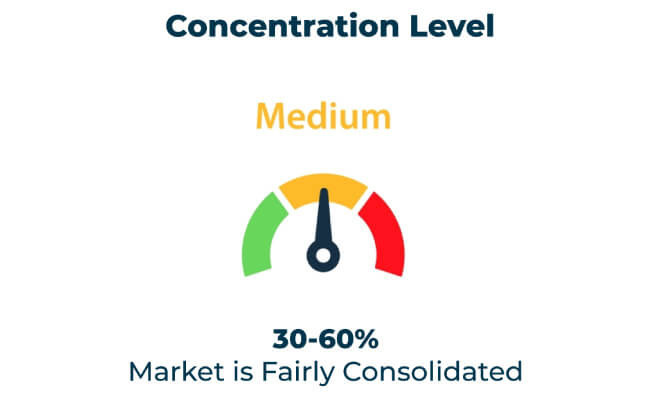
Market Concentration
Segment Analysis
By Service Type
Multinational quick-service restaurant (QSR) chains lead the international restaurant and mobile food services market through driving sales of high volume, capturing economies of scale, and spearheading digital revolution. Being capable of shaping consumer patterns with consistency of branding is a position of leadership these chains command in the evolving foodservice business.
QSR chains like McDonald's, Burger King, and KFC maintain strict standardization across stores, offering the same customer experience everywhere. Customers across markets seek the same quality of product, pricing strategy, and service responsiveness, which encourages brand trust and loyalty.
Frontier QSR brands invest heavily in online platforms to build customer connections and simplify operations. McDonald's and Starbucks utilize AI-driven loyalty schemes to deliver tailored recommendations through the analysis of purchasing history. Self-service kiosks and automated drive-thru systems lower waiting times, and mobile applications accelerate ordering efficiency.
Multinational QSR chains optimize supply chain logistics by buying ingredients in bulk, reducing expenses, and ensuring consistency in the product. McDonald's, for example, partners with global suppliers to ensure consistent food quality across its 40,000+ outlets. This volume allows them to become cost-effective while offering similar prices.
Franchising supports quick expansion by enabling multinational QSR brands to penetrate different markets with low initial capital investment. Subway and Domino's Pizza count on franchise concepts to expand their presence globally without compromising their unique brand essence or local flavors.
Even with standardized menus, top QSR brands sell local flavors to create customer interest. KFC sells rice-based meals in China, McDonald's sells masala-flavored burgers in India, and Starbucks sells matcha-based drinks in Japan. This localization is what makes QSR chains relevant in multicultural environments.
With sustainability an ever-growing concern among consumers, QSR brands are making commitments to green. Chipotle's purchase of organic products and stand behind ethical farm practice, McDonald's commitment to totally recyclable packaging by the year 2030. Brand loyalty and the company's credibility all benefit through compliance with such values.
By Business Model
Chain operators earn a lot of money in the global restaurant and mobile food services market by taking advantage of economies of scale, brand name, and operational efficiency. Their capacity to grow very fast in overseas markets while ensuring food quality and service standards consistency has made them leading players in the market.
Chain operators have centralized supply chains, bulk purchasing power, and streamlined logistics, maintaining costs low and profitability high. McDonald's and Starbucks negotiate big-box supplier contracts, which maintain ingredient costs below those of independent restaurants. Their integrated supply networks allow them to manage quality and consistency across outlets while responding quickly to changes in consumer demand.
Globally recognized brands such as KFC, Burger King, and Subway win customers over by virtue of their established reputation. Their capacity to provide a standardized dining experience globally instills confidence and loyalty in consumers. This benefit enables them to surpass small players who cannot create a robust identity in a highly competitive marketplace.
Frontier chain businesses spend a lot of capital on technology to enhance customer experience and operational efficiency. Domino's Pizza, for example, has adopted AI-based ordering systems, voice-recognition systems, and predictive analytics to optimize delivery services. Starbucks uses data analytics to give customers personalized suggestions through its mobile app, which drives customer interaction and repeat buying.
Franchising has facilitated quick growth for chains such as KFC, Subway, and Dunkin', enabling them to open thousands of outlets globally with little capital outlay. Franchise models minimize financial risks for parent firms while encouraging local entrepreneurs to run a globally known brand. This strategy has worked well in emerging economies where demand for global dining is increasing.
Although they have uniform menus, chain operators tailor their items to accommodate preferences in markets they serve. McDonald's introduces country-specific products such as the McArabia in the Middle East, the Samurai Burger in Japan, and the McSpaghetti in the Philippines. Localization is an approach that builds brand value and optimizes customer interaction across markets.
With increasing emphasis on sustainability in consumer choices, chain players are making green investments. Chipotle buys organic produce and patronizes local farming communities, and McDonald's plans to achieve net-zero carbon by 2050. By integrating sustainability into business models, such brands attract conscious consumers while cutting long-term cost of operations.
By Booking Channel
Online reservations are transforming the global restaurant and mobile food services industry through optimal table management, reduced waiting times, and improved consumer experience. Restaurant reservation platforms, such as OpenTable, Resy, and Zomato Book, enable restaurants to optimize occupancy, enhance efficiency, and acquire new consumers.
Restaurants that incorporate online booking have improved table turnover rates and higher revenue per service. Upscale dining restaurants such as The French Laundry in the United States and Narisawa in Japan employ digital reservation systems to handle high demand, minimizing no-shows and maximizing seating configuration. By having pre-paid reservations, some restaurants ensure revenue despite last-minute cancellations.
Tailored dining experiences fuel customer loyalty. Resy and Tock platforms gather information about guest tastes, dietaries, and frequency of visits so that restaurants can personalize their service. Luxury restaurants including Eleven Madison Park in New York leverage reservation information to provide personalized experiences, increasing guest satisfaction and brand affinity.
Ghost restaurants and mobile food businesses are applying online booking to manage pre-ordering and curbside collections efficiently. Food trucks and temporary restaurants in busy cities like Los Angeles and London now accept bookings through apps, allowing clients to reserve meals prior to their collection. The habit reduces waiting and improves the service efficiency of places with high demands.
Online booking is filling the gap between classic dining and technological innovation in emerging markets. India's Swiggy Dineout and China's Meituan Dianping are enabling local restaurants to digitize bookings, which in turn is enhancing customer retention. With growing smartphone penetration, an increasing number of consumers in areas such as Southeast Asia and Latin America are turning to digital reservations for eating out.
AI-powered reservation platforms predict peak dining hours, allowing restaurants to optimize staffing and inventory. Chain restaurants like Chili’s and Olive Garden use predictive analytics to adjust seating schedules, ensuring seamless operations. AI-driven chatbots also enhance the reservation experience by handling customer queries and modifications in real time.
Performance of Restaurants and Mobile Food Services in Emerging Markets
The mobile food services and restaurant industry is growing very fast in the emerging markets as a result of growth in disposable income, urbanization, and a rising middle class. Global players and domestic players are cashing in on greater consumer spending on eating out in markets such as India, Brazil, and Indonesia.
Food delivery chains are growing fiercely in these countries. Swiggy and Zomato in India, iFood in Brazil, and GoFood in Indonesia have revolutionized eating habits and brought mobile ordering and fast food within reach for urban consumers. Digital payment networks, including UPI in India and Pix in Brazil, have sped up adoption of app-based food services.
Multinational QSR chains are increasing their reach by launching local menus. McDonald's in India serves vegetarian and spiced food, while KFC in Africa modifies its menu according to regional preferences. Simultaneously, native operators such as Jollibee in the Philippines are combating international giants successfully with locally friendly flavors. Emerging markets also come with challenges such as unpredictable supply chain prices and regulatory hurdles. But operators that spend on localization, affordability, and digital interaction continue to deliver solid growth in these markets.
Who Shaped the Year
The restaurant and mobile food services sector experienced dramatic change in 2024 as top brands grew, incorporated new technologies, and launched sustainable dining programs. Major players made strategic acquisitions to consolidate their market positions and improve customer experiences:
- McDonald's: Expanded AI-powered drive-thrus, introduced fully automated kitchen systems, and launched plant-based menu items in new markets.
- Starbucks: Rolled out AI-driven order personalization, increased mobile app adoption, and strengthened sustainability initiatives with recyclable packaging.
- Yum! Brands: Invested in self-service kiosks, AI-driven pricing, and delivery-first restaurant models across international markets.
- Domino’s Pizza: Expanded drone and autonomous vehicle delivery, reducing operational costs and improving efficiency.
- Jollibee Foods: Entered new European markets and optimized delivery logistics with AI-driven demand forecasting.
- Chipotle: Introduced robotic burrito-making systems and enhanced digital-only restaurant formats for faster service.
Key Highlights for the Forecast
- Growth in AI & Automation: Industry leaders are integrating robotic food preparation, self-ordering kiosks, and predictive analytics to optimize operations.
- Sustainability as a Market Driver: More brands are adopting biodegradable packaging, carbon-neutral initiatives, and zero-waste kitchens.
- Rise of Personalized & Subscription-Based Dining: Restaurants are leveraging AI to create custom meal plans and introducing subscription-based loyalty programs.
- Expansion of Ghost Kitchens & Delivery-Only Brands: QSR and casual dining chains are launching digital-first brands to reduce overhead costs and expand reach.
Key Company Initiatives
| Company | Key Initiatives |
|---|---|
| McDonald's | AI-driven drive-thru ordering, automated kitchens, plant-based menu expansion, digital loyalty growth. |
| Starbucks | Mobile order expansion, AI-based menu personalization, sustainable packaging development. |
| Yum! Brands | Self-service kiosks, delivery-only brand expansion, dynamic pricing strategies. |
| Domino’s Pizza | Drone delivery, AI-driven demand forecasting, automated pizza preparation. |
| Jollibee Foods | European market expansion, AI-enhanced logistics, global delivery partnerships. |
| Chipotle | Robotics in food preparation, AI-driven ingredient customization, cashless payment systems. |
Recommendations for Service Providers
- Prioritize Digital Transformation: AI-driven mobile ordering, automated checkouts, and self-service kiosks will enhance operational efficiency and customer satisfaction.
- Enhance Sustainability Efforts: Invest in zero-waste kitchens, plant-based menu expansions, and eco-friendly packaging to attract environmentally conscious consumers.
- Expand Personalized Dining Experiences: AI-powered meal customization, dynamic pricing models, and digital loyalty programs will improve customer retention.
- Optimize Delivery & Ghost Kitchen Strategies: Expanding cloud kitchens and strengthening delivery logistics will drive future growth in online food services.
Future Roadmap
- Advancements in Smart Restaurants: AI-driven menu planning, smart ordering systems, and digital-only restaurant formats will redefine foodservice.
- Culinary Tourism Growth: High-end dining establishments will integrate exclusive culinary events, regional specialties, and gourmet collaborations.
- Tech-Driven Fast Casual Expansion: More brands will implement AI-powered dynamic pricing, self-checkout stations, and robotic kitchen assistants to streamline operations.
Top Segments Studied in the Restaurants and Mobile Food Services Market Report
By Type:
- Full-service Restaurants
- Limited-service Restaurants
- Cafeterias, Grill Buffets, and Buffets
- Mobile Food Services
By Region:
- North America
- Europe
- Asia Pacific
- Latin America
Frequently Asked Questions
Which companies hold the largest market share in the restaurant and mobile food services industry?
Leading players like McDonald's, Starbucks, and Yum! Brands control about 40% of the market through digital expansion and menu innovation.
What percentage of the market do niche brands hold?
Niche brands specializing in plant-based, fast casual, and gourmet dining account for 20% of the market.
How much market share do regional players contribute?
Regional leaders, including Darden Restaurants and Jollibee Foods, represent 30% of the market, leveraging strong brand equity and localized menus.
Preview the report firsthand - request a free sample
Get SampleGet the brochure for pricing and purchase details.
Get PDFTable of Content
- Executive Summary
- Market Overview
- Key Growth Drivers
- Competitive Landscape
- Market Concentration
- Segmented Analysis
- Key Company Initiatives
- Future Roadmap


