

- Market Size (2026)
- USD 3.4 Bn
- Forecast (2036)
- USD 5.2 Bn
- CAGR (2026 to 2036)
- 4.3%
Retail Printers Market Size, Market Forecast and Outlook By FMI
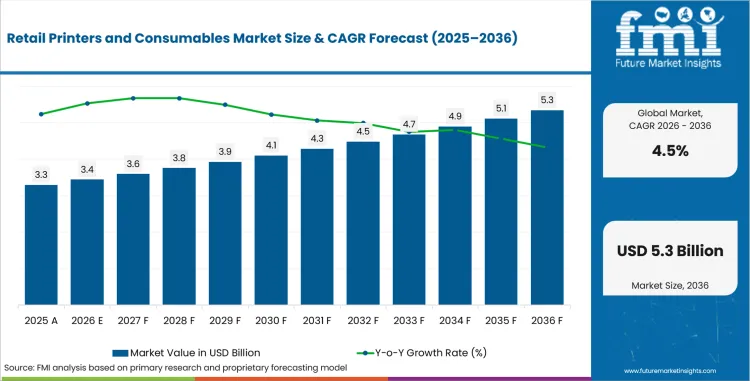
The retail printers market was valued at USD 3.3 billion in 2025. The market is set to reach USD 3.4 billion by 2026-end and grow at a CAGR of 4.3% between 2026-2036 to reach USD 5.2 billion by 2036. Thermal Printers will dominate with a 66.2% share, while Thermal Transfer Label Printer will lead with a 38.4% share.
Key Takeaways, Market Size, and Forecast
- 2025 Market Size: USD 3.29 billion
- 2036 Market Size: USD 5.23 billion
- Forecast CAGR: 4.3% from 2026 to 2036
- Incremental Opportunity (2026-2036): USD 1.80 billion
- Leading Product Type: Thermal Printers
- Thermal Printers Share in 2026: 66.2%
- Fastest-growing Markets: South Korea (6.7%) and EU (6.5%)
| Parameter | Details |
|---|---|
| Market Size in 2025 (Value) | USD 3.3 billion |
| Market Forecast in 2036 (Value) | USD 5.2 billion |
| CAGR (2026-2036) | 4.3% |
| Years Considered | 2021-2036 |
| Base Year | 2025 |
| Forecast Period | 2026-2036 |
| Units Considered | Value (USD Billion) |
| Leading Sub-Region | South Korea |
Summary of the Retail Printers Market
- Demand and Growth Drivers
- Market demand is likely to be shaped by end-use sector requirements.
- Growth is likely to reflect structural shifts in procurement and application.
- Regulatory and compliance requirements are expected to support adoption during the forecast period.
- Product and Segment View
- Thermal Printers is likely to account for 66.2% of the product type segment, supported by established demand across primary end-use applications.
- Departmental Stores is likely to lead the application segment at 34.7%, reflecting procurement patterns across commercial and industrial buyers.
- Thermal Transfer Label Printer is likely to hold 38.4% share in the technology segment, reflecting established application requirements.
- Geography and Competitive Outlook
- South Korea is likely to remain a key market at 6.7% CAGR, reflecting the scale of domestic demand and investment in capacity expansion.
- EU is likely to sustain growth at 6.5% CAGR on account of regulatory compliance requirements and end-use sector modernization.
- Companies that can combine cost competitiveness with specification compliance across key geographies are likely to strengthen positioning during the forecast period.
- Analyst Opinion
- The retail printers market is evolving from a fragmented supplier landscape toward consolidated procurement patterns as end-use industries prioritize specification compliance and supply chain reliability.
- Adoption is being shaped by regulatory developments, sustainability mandates, and cost-performance optimization across key application segments.
- Demand is further supported by replacement cycles in mature markets and capacity expansion in high-growth regions.
- Companies that can improve cost competitiveness while delivering consistent performance across primary applications are likely to strengthen their position over the forecast period.
Retail Printers Market Definition
The retail printers market encompasses products and solutions classified by product type, technology, application, connectivity, printing function, end user format, deployment type. The market scope covers commercially traded products across the full value chain, from production and processing through distribution and end-use application.
Retail Printers Market Inclusions
Market scope encompasses all commercially traded retail printers products categorized by product type (Thermal Printers, Desktop Printers, Industrial Printers, Mobile Printers), technology (Thermal Transfer Label Printer, Label Printing with Ribbon Transfer, Direct Thermal Label Printer, Heat Sensitive Label Printing), application (Departmental Stores, Large Format Retail Printing Operations, Warehouse Retailers, High Volume Inventory Label Printing), connectivity (Wired Retail Printers, USB and Ethernet Connected Printers, Wireless Retail Printers, Wi Fi and Bluetooth Enabled Printers), printing function (Receipt Printing, POS Billing and Transaction Printing, Barcode Printing, Product Tracking and Identification Printing), end user format (Large Retail Chains, Multi Outlet Retail Operations, Independent Retailers, Single Store Printing Operations), deployment type (Fixed POS Printers, Stationary Checkout Printing Devices, Portable POS Printers, Handheld Retail Printing Devices). The revenue range covers the forecast period from 2026 to 2036.
Retail Printers Market Exclusions
The scope does not include adjacent product categories, raw materials sold without processing, or research-stage materials not commercially available.
Retail Printers Market Research Methodology
- Primary Research: FMI analysts conducted interviews with manufacturers, distributors, procurement specialists, and end-use industry experts across major markets.
- Desk Research: Combined industry data, regulatory filings, certification requirements, trade statistics, and manufacturer disclosures.
- Market Sizing and Forecasting: Bottom-up aggregation across segments and regions, triangulated with trade data, production volumes, and company disclosures.
- Data Validation: Cross-checked quarterly against production data, import-export statistics, and primary interview findings.
Why is the Retail Printers Market Growing?
- Structural demand shifts and end-use sector modernization are creating sustained procurement requirements for retail printers products across established and emerging markets.
- South Korea leads growth at 6.7%, reflecting the scale of domestic demand and investment in capacity expansion across primary application segments.
The retail printers market is expanding as industrial modernization, infrastructure investment, and manufacturing capacity expansion generate sustained procurement requirements across key end-use sectors. Growth reflects the structural need for improved operational efficiency, specification compliance, and cost optimization in both established and emerging manufacturing economies.
Demand is further supported by replacement cycles in mature markets, automation-driven equipment upgrades, and the expansion of export-oriented manufacturing facilities that require equipment meeting international quality and certification standards.
Market Segmentation Analysis
- Thermal Printers accounts for 66.2% of the product type segment, reflecting established procurement patterns and application requirements.
- Departmental Stores holds 34.7% share in the application segment, indicating demand concentration in primary commercial applications.
- Wired Retail Printers leads the connectivity segment at 41.3%, supported by technology maturity and installed base.
The retail printers market is segmented by product type, technology, application, connectivity, printing function, end user format, deployment type. Each classification reflects distinct procurement patterns, application requirements, and competitive dynamics that shape demand allocation across the forecast period.
Insights into the Product Type Segment
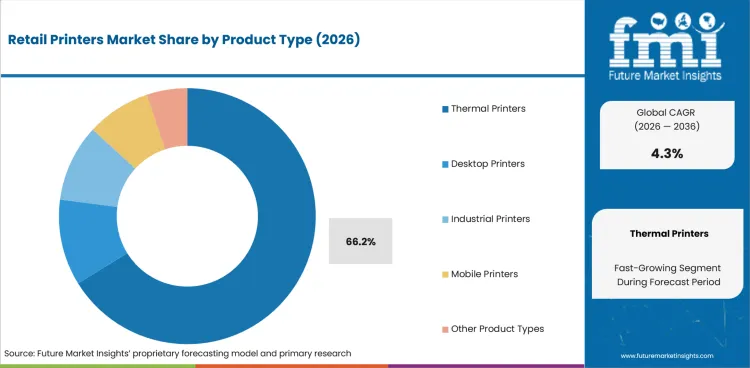
In 2026, thermal printers is projected to account for 66.2% of the product type segment. Demand is concentrated in established applications where performance requirements, cost structures, and supply chain reliability favor proven product formats. Growth reflects specification upgrades and procurement cycle timing across primary end-use industries.
Insights into the Application Segment
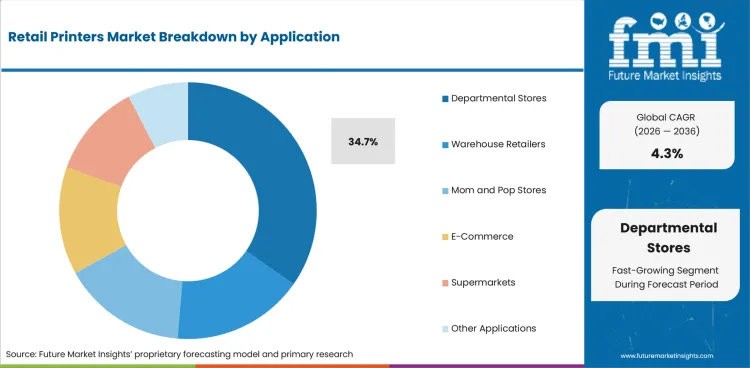
Departmental Stores is projected to hold 34.7% of the application segment in 2026. Procurement is shaped by regulatory compliance requirements, volume-driven pricing structures, and end-user preference for established application formats. Growth in this segment is attributable to expanding commercial adoption and standardization of procurement specifications.
Retail Printers Market Drivers, Restraints, and Opportunities
- Regulatory compliance mandates and sustainability requirements are creating structured demand for specification-compliant products across primary end-use sectors.
- Higher production costs relative to conventional alternatives constrain adoption in price-sensitive segments, concentrating growth in premium and compliance-driven applications.
- Replacement cycles and facility modernization programs are accelerating procurement of upgraded product variants with improved performance characteristics.
The retail printers market continues to expand, supported by regulatory requirements, end-use sector investment, and specification evolution. Constraints including production costs, scaling challenges, and competitive pressure from conventional alternatives are balanced by growth opportunities in compliance-driven procurement, geographic expansion, and technology-enabled performance improvement.
Regulatory and Compliance-Driven Demand
Growth reflects regulatory mandates that require specification upgrades across primary end-use applications. Compliance timelines and certification requirements are creating structured procurement pipelines that favor suppliers with established quality management systems and product documentation.
Cost and Scalability Constraints
Adoption is constrained by production costs that exceed conventional alternatives, limiting penetration in price-sensitive commodity segments. Growth is concentrated in applications where compliance requirements, performance specifications, or brand positioning justify the cost premium.
Technology and Performance Improvement
Investment in process optimization, material science, and digital manufacturing is improving product performance characteristics while reducing unit costs. Companies integrating advanced manufacturing capabilities are gaining specification advantages in competitive procurement processes.
Geographic Expansion Opportunities
Market expansion in developing economies is supported by infrastructure investment, manufacturing capacity growth, and evolving regulatory frameworks that create new procurement requirements. Companies establishing regional distribution and technical support capabilities are positioned to capture incremental demand.
Analysis of Retail Printers Market By Key Countries
.webp "Top Country Growth Comparison Retail Printers Market Cagr (2026 2036)")
| Country | CAGR |
|---|---|
| South Korea | 6.7% |
| EU | 6.5% |
| UK | 6.3% |
| Japan | 6.2% |
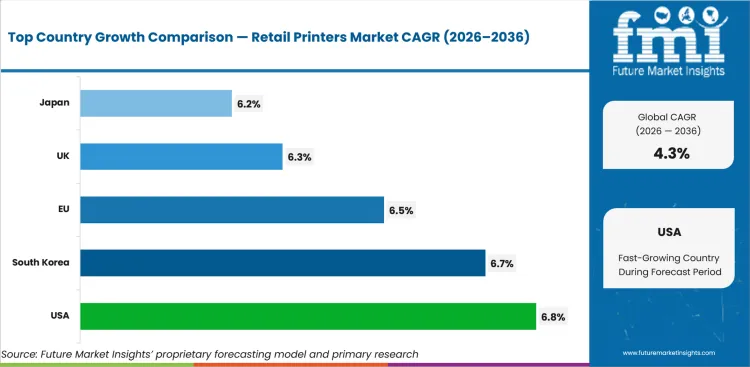
- South Korea leads with a 6.7% CAGR, reflecting the scale of domestic demand, investment in capacity expansion, and evolving regulatory requirements.
- EU at 6.5% shows sustained demand supported by compliance requirements, end-use sector modernization, and established procurement infrastructure.
- UK (6.3%) and Japan (6.2%) continue to expand on account of regulatory frameworks and industrial investment programs.
The global retail printers market is projected to expand at a CAGR of 4.3% from 2026 to 2036. The analysis covers more than 30 countries, with key markets highlighted below.
Demand Outlook for Retail Printers Market in the South Korea
Semiconductor, display, and EV battery industry requirements are defining procurement specifications for retail printers in South Korea, with quality priorities shaping vendor selection at 6.7% CAGR through 2036.
- K-beauty and Korean consumer brands are driving specification requirements for desktop printers in cosmetics, food, and consumer goods packaging.
- Nuclear energy fleet management and decommissioning programs are creating procurement requirements for retail printers in energy sector operations.
- Korean military modernization and defense export programs are sustaining demand for military-specification thermal printers in defense supply chains.
Future Outlook for Retail Printers Market in the EU
EU-wide Industrial Emissions Directive compliance and CE marking harmonization are shaping procurement of retail printers across member states at 6.5% CAGR through 2036.
- EU Industrial Emissions Directive compliance is raising specification requirements for thermal printers across manufacturing and process industry facilities.
- Cross-border CE marking harmonization is simplifying procurement for multinational buyers and favoring standardized desktop printers variants.
- European Green Deal investment and circular economy mandates are accelerating material substitution toward recyclable retail printers alternatives.
Opportunity Analysis of Retail Printers Market in UK
Domestic supply chains for thermal printers are adapting to post-Brexit trade conditions, with local manufacturing investment and nearshore sourcing gaining priority at 6.3% CAGR through 2036.
- MOD defence procurement programs and fleet modernization are sustaining demand for military-specification desktop printers in UK defense supply chains.
- Water utility investment under OFWAT regulatory periods is creating structured procurement cycles for desktop printers in treatment and distribution infrastructure.
- Retailer consolidation among UK grocery chains is concentrating purchasing power and raising specification requirements for retail printers in retail and consumer applications.
In-depth Analysis of Retail Printers Market in Japan
Post-Fukushima grid restructuring, aging infrastructure retrofit, and stringent safety standards are shaping procurement specifications for retail printers across Japanese industrial operations at 6.2% CAGR through 2036.
- Fukushima reconstruction and post-disaster resilience infrastructure are sustaining procurement cycles for retail printers in northeastern Japan prefecture programs.
- Maritime and shipbuilding sector procurement from Imabari, JMU, and Mitsubishi shipyards is generating demand for marine-specification thermal printers.
- Food safety and packaging compliance under MHLW regulations are shaping specification requirements for retail printers in food processing and consumer goods applications.
Competitive Landscape and Strategic Positioning
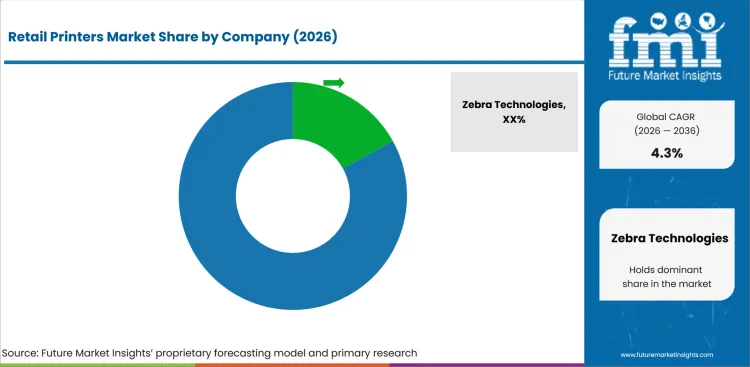
- Zebra Technologies holds a leading position through established manufacturing infrastructure, broad product coverage, and global distribution networks.
- Epson Corporation and Toshiba TEC Corporation offer diversified product portfolios combining standard and specialty variants across multiple end-use applications.
- Emerging players are focusing on specialized applications, regional distribution, and technology differentiation to establish market position.
Zebra Technologies maintains a leading position through integrated manufacturing capabilities, established customer relationships, and broad geographic coverage. Epson Corporation offers a diversified product portfolio across standard and specialty segments.
Toshiba TEC Corporation and Honeywell International have developed complementary capabilities in specific product categories and regional markets. Barriers to entry include capital intensity, regulatory approval timelines, customer qualification requirements, and established supply chain relationships.
Strategic priorities across the competitive landscape include cost reduction, specification compliance, geographic expansion, and partnership development with end-use sector procurement organizations.
Key Companies in the Retail Printers Market
Key global companies leading the retail printers market include:
- Zebra Technologies, Epson Corporation, Toshiba TEC Corporation, Honeywell International maintain strong manufacturing infrastructure, established end-user relationships, and broad product portfolios spanning standard and specialty categories.
- Bixolon Co., Ltd., TSC Auto ID, SATO Holdings have established regional leadership through focused product strategies, local manufacturing capability, and application-specific expertise.
- Star Micronics, Citizen Systems, Postek Electronics represent emerging and specialty participants developing capabilities in advanced product categories, new application segments, and technology-differentiated solutions.
Competitive Benchmarking: Retail Printers Market
| Company | Product Breadth | Technical Capability | Customer Access | Geographic Footprint |
|---|---|---|---|---|
| Zebra Technologies | High | High | Strong | Global |
| Epson Corporation | High | High | Strong | Global |
| Toshiba TEC Corporation | High | Medium | Strong | Global |
| Honeywell International | Medium | High | Moderate | Regional |
| Bixolon Co., Ltd. | Medium | High | Moderate | Regional |
| TSC Auto ID | Medium | High | Moderate | Asia |
| SATO Holdings | Medium | Medium | Low | Regional |
| Star Micronics | Medium | Medium | Low | Regional |
| Citizen Systems | Medium | Medium | Low | Regional |
| Postek Electronics | Medium | Medium | Low | Regional |
Source: Future Market Insights competitive analysis, 2026.
Key Developments in Retail Printers Market
- In 2025, Zebra Technologies expanded its product portfolio with an advanced variant targeting compliance-driven procurement in North America and Europe.
- In 2025, Epson Corporation announced capacity expansion at its primary manufacturing facility to address growing demand across Asia-Pacific markets.
Key Players in the Retail Printers Market
Major Global Players
- Zebra Technologies
- Epson Corporation
- Toshiba TEC Corporation
- Honeywell International
- Bixolon Co., Ltd.
- TSC Auto ID
- SATO Holdings
Emerging Players/Startups
- Star Micronics
- Citizen Systems
- Postek Electronics
Report Scope and Coverage
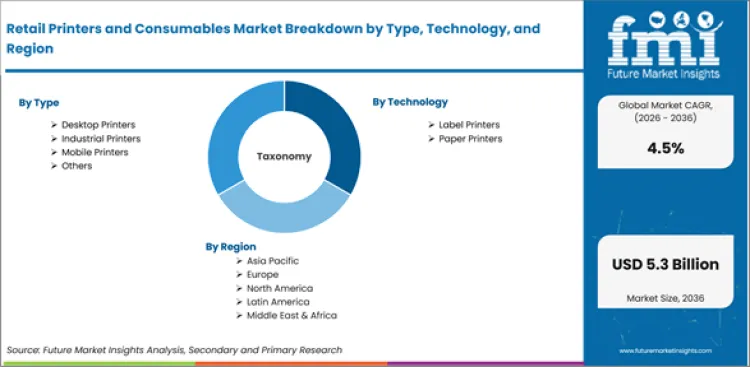
| Parameter | Details |
|---|---|
| Market size by 2036 | USD 5.23 billion |
| Growth rate | 4.3% CAGR (2026-2036) |
| Forecast period | 2026 to 2036 |
| Base year value (2026) | USD 3.43 billion |
| By product type | Thermal Printers, Desktop Printers, Industrial Printers, Mobile Printers, Other Product Types |
| By technology | Thermal Transfer Label Printer, Direct Thermal Label Printer, Inkjet Label Printer, Laser Label Printer, Thermal Transfer Paper Printer, Direct Transfer Paper Printer, Impact Paper Printer, Inkjet Paper Printer |
| By application | Departmental Stores, Warehouse Retailers, Mom and Pop Stores, E-Commerce, Supermarkets, Other Applications |
| By connectivity | Wired Retail Printers, Wireless Retail Printers, Cloud Connected Printers |
| By printing function | Receipt Printing, Barcode Printing, Tag and Ticket Printing |
| By end user format | Large Retail Chains, Independent Retailers, Online Retail Fulfillment Centers |
| By deployment type | Fixed POS Printers, Portable POS Printers, Industrial Labeling Printers |
| Regions covered | North America, Latin America, Europe, East Asia, South Asia and Pacific, Middle East and Africa |
| Countries covered | South Korea, EU, UK, Japan, 30 plus countries |
| Key companies profiled | Zebra Technologies, Epson Corporation, Toshiba TEC Corporation, Honeywell International, Bixolon Co., Ltd., TSC Auto ID, SATO Holdings, Star Micronics, Citizen Systems, Postek Electronics |
| Approach | Hybrid bottom-up and top-down methodology starting with verified transaction data, projecting adoption velocity across segments and regions. |
Market Segmentation Analysis
Retail Printers Market Segmented by Product Type:
- Thermal Printers
- High Speed POS Receipt Printers
- Desktop Printers
- Compact Retail Printing Systems
- Industrial Printers
- Heavy Duty Commercial Printing Systems
- Mobile Printers
- Portable Billing and Labeling Printers
- Other Product Types
- Specialty Retail Printing Equipment
Retail Printers Market Segmented by Technology:
- Thermal Transfer Label Printer
- Label Printing with Ribbon Transfer
- Durable Barcode Label Printing
- Label Printing with Ribbon Transfer
- Direct Thermal Label Printer
- Heat Sensitive Label Printing
- Short Term Retail Label Printing
- Heat Sensitive Label Printing
- Inkjet Label Printer
- High Resolution Color Label Printing
- Retail Branding and Packaging Labels
- High Resolution Color Label Printing
- Laser Label Printer
- Precision Laser Based Printing
- Bulk Retail Documentation Printing
- Precision Laser Based Printing
- Thermal Transfer Paper Printer
- Ribbon Based Paper Receipt Printing
- Long Lasting Transaction Records
- Ribbon Based Paper Receipt Printing
- Direct Transfer Paper Printer
- Direct Heat Receipt Printing
- POS Billing Applications
- Direct Heat Receipt Printing
- Impact Paper Printer
- Pin Based Multi Copy Printing
- Invoice and Receipt Printing
- Pin Based Multi Copy Printing
- Inkjet Paper Printer
- Color Retail Paper Printing
- Promotional and Branding Prints
- Color Retail Paper Printing
Retail Printers Market Segmented by Application:
- Departmental Stores
- Large Format Retail Printing Operations
- Multi Counter Billing Systems
- Large Format Retail Printing Operations
- Warehouse Retailers
- High Volume Inventory Label Printing
- Bulk Barcode Management
- High Volume Inventory Label Printing
- Mom and Pop Stores
- Small Scale Retail Printing Needs
- Compact Billing Solutions
- Small Scale Retail Printing Needs
- E-Commerce
- Digital Commerce Shipping Label Printing
- Order Fulfillment Printing Systems
- Digital Commerce Shipping Label Printing
- Supermarkets
- High Speed Checkout Printing Systems
- Retail Barcode and Pricing Labels
- High Speed Checkout Printing Systems
- Other Applications
- Specialized Commercial Printing Uses
- Custom Retail Printing Solutions
- Specialized Commercial Printing Uses
Retail Printers Market Segmented by Connectivity:
- Wired Retail Printers
- USB and Ethernet Connected Printers
- Fixed Point Retail Printing Systems
- USB and Ethernet Connected Printers
- Wireless Retail Printers
- Wi Fi and Bluetooth Enabled Printers
- Mobile POS Printing Solutions
- Wi Fi and Bluetooth Enabled Printers
- Cloud Connected Printers
- Remote Network Integrated Printers
- Centralized Retail Management Systems
- Remote Network Integrated Printers
Retail Printers Market Segmented by Printing Function:
- Receipt Printing
- POS Billing and Transaction Printing
- Customer Purchase Receipt Systems
- POS Billing and Transaction Printing
- Barcode Printing
- Product Tracking and Identification Printing
- Inventory Label Printing Systems
- Product Tracking and Identification Printing
- Tag and Ticket Printing
- Retail Pricing and Shelf Label Printing
- Promotional Tag Printing Solutions
- Retail Pricing and Shelf Label Printing
Retail Printers Market Segmented by End User Format:
- Large Retail Chains
- Multi Outlet Retail Operations
- Enterprise Scale Printing Infrastructure
- Multi Outlet Retail Operations
- Independent Retailers
- Single Store Printing Operations
- Compact Retail Billing Systems
- Single Store Printing Operations
- Online Retail Fulfillment Centers
- E Commerce Packaging and Shipping Printing
- Warehouse Dispatch Label Systems
- E Commerce Packaging and Shipping Printing
Retail Printers Market Segmented by Deployment Type:
- Fixed POS Printers
- Stationary Checkout Printing Devices
- Countertop Retail Printing Systems
- Stationary Checkout Printing Devices
- Portable POS Printers
- Handheld Retail Printing Devices
- On The Go Billing Solutions
- Handheld Retail Printing Devices
- Industrial Labeling Printers
- High Capacity Warehouse Printing Units
- Continuous Volume Label Production
- High Capacity Warehouse Printing Units
Retail Printers Market by Region:
- North America
- USA
- Canada
- Mexico
- Latin America
- Brazil
- Chile
- Rest of Latin America
- Western Europe
- Germany
- UK
- Italy
- Spain
- France
- Nordic
- BENELUX
- Rest of Western Europe
- Eastern Europe
- Russia
- Poland
- Hungary
- Balkan & Baltic
- Rest of Eastern Europe
- East Asia
- China
- Japan
- South Korea
- South Asia and Pacific
- India
- ASEAN
- Australia & New Zealand
- Rest of South Asia and Pacific
- Middle East & Africa
- Kingdom of Saudi Arabia
- Other GCC Countries
- Turkiye
- South Africa
- Other African Union
- Rest of Middle East & Africa
Research Sources and Bibliography
- 1. International Telecommunication Union. (2025). ITU Global ICT Development Index. ITU.
- 2. World Intellectual Property Organization. (2025). WIPO Technology Trends Report. WIPO.
- 3. European Commission. (2025). EU Digital Economy and Society Index. EC.
- 4. World Bank. (2025). World Bank Digital Development Report. World Bank.
- 5. Organisation for Economic Co-operation and Development. (2025). OECD Digital Economy Outlook. OECD.
This bibliography is provided for reader reference. The full Future Market Insights report contains the complete reference list with publication dates, URLs, and supporting data for all cited works.
This Report Answers
- Estimating the market size and revenue opportunity from 2026 to 2036.
- Segmentation analysis across product type, technology, application, connectivity, printing function.
- Regional and country-level insights covering more than 30 markets.
- Competitive landscape assessment and company benchmarking.
- Identification of investment opportunities across primary application segments.
- Supply chain and procurement structure analysis.
- Technology and specification trend assessment.
- Data delivery in PDF and Excel formats.
Frequently Asked Questions
How big is the retail printers market in 2026?
The global retail printers market is estimated to be valued at USD 3.4 billion in 2026.
What will be the size of retail printers market in 2036?
The market size for the retail printers market is projected to reach USD 5.2 billion by 2036.
How much will be the retail printers market growth between 2026 and 2036?
The retail printers market is expected to grow at a 4.3% CAGR between 2026 and 2036.
What are the key product types in the retail printers market?
The key product types in retail printers market are thermal printers, desktop printers, industrial printers, mobile printers and other product types.
Which technology segment is expected to contribute significant share in the retail printers market in 2026?
In terms of technology, thermal transfer label printer segment is expected to command 38.4% share in the retail printers market in 2026.
Preview the report firsthand - request a free sample
Get SampleGet the brochure for pricing and purchase details.
Get PDFTable of Content
- Executive Summary
- Global Market Outlook
- Demand-side Trends
- Supply-side Trends
- Technology Roadmap Analysis
- Analysis and Recommendations
- Market Overview
- Market Coverage / Taxonomy
- Market Definition / Scope / Limitations
- Research Methodology
- Chapter Orientation
- Analytical Lens and Working Hypotheses
- Market Structure, Signals, and Trend Drivers
- Benchmarking and Cross-market Comparability
- Market Sizing, Forecasting, and Opportunity Mapping
- Research Design and Evidence Framework
- Desk Research Programme (Secondary Evidence)
- Company Annual and Sustainability Reports
- Peer-reviewed Journals and Academic Literature
- Corporate Websites, Product Literature, and Technical Notes
- Earnings Decks and Investor Briefings
- Statutory Filings and Regulatory Disclosures
- Technical White Papers and Standards Notes
- Trade Journals, Industry Magazines, and Analyst Briefs
- Conference Proceedings, Webinars, and Seminar Materials
- Government Statistics Portals and Public Data Releases
- Press Releases and Reputable Media Coverage
- Specialist Newsletters and Curated Briefings
- Sector Databases and Reference Repositories
- FMI Internal Proprietary Databases and Historical Market Datasets
- Subscription Datasets and Paid Sources
- Social Channels, Communities, and Digital Listening Inputs
- Additional Desk Sources
- Expert Input and Fieldwork (Primary Evidence)
- Primary Modes
- Qualitative Interviews and Expert Elicitation
- Quantitative Surveys and Structured Data Capture
- Blended Approach
- Why Primary Evidence is Used
- Field Techniques
- Interviews
- Surveys
- Focus Groups
- Observational and In-context Research
- Social and Community Interactions
- Stakeholder Universe Engaged
- C-suite Leaders
- Board Members
- Presidents and Vice Presidents
- R&D and Innovation Heads
- Technical Specialists
- Domain Subject-matter Experts
- Scientists
- Physicians and Other Healthcare Professionals
- Governance, Ethics, and Data Stewardship
- Research Ethics
- Data Integrity and Handling
- Primary Modes
- Tooling, Models, and Reference Databases
- Desk Research Programme (Secondary Evidence)
- Data Engineering and Model Build
- Data Acquisition and Ingestion
- Cleaning, Normalisation, and Verification
- Synthesis, Triangulation, and Analysis
- Quality Assurance and Audit Trail
- Market Background
- Market Dynamics
- Drivers
- Restraints
- Opportunity
- Trends
- Scenario Forecast
- Demand in Optimistic Scenario
- Demand in Likely Scenario
- Demand in Conservative Scenario
- Opportunity Map Analysis
- Product Life Cycle Analysis
- Supply Chain Analysis
- Investment Feasibility Matrix
- Value Chain Analysis
- PESTLE and Porter’s Analysis
- Regulatory Landscape
- Regional Parent Market Outlook
- Production and Consumption Statistics
- Import and Export Statistics
- Market Dynamics
- Global Market Analysis 2021 to 2025 and Forecast, 2026 to 2036
- Historical Market Size Value (USD Million) Analysis, 2021 to 2025
- Current and Future Market Size Value (USD Million) Projections, 2026 to 2036
- Y-o-Y Growth Trend Analysis
- Absolute $ Opportunity Analysis
- Global Market Pricing Analysis 2021 to 2025 and Forecast 2026 to 2036
- Global Market Analysis 2021 to 2025 and Forecast 2026 to 2036, By Product Type
- Introduction / Key Findings
- Historical Market Size Value (USD Million) Analysis By Product Type, 2021 to 2025
- Current and Future Market Size Value (USD Million) Analysis and Forecast By Product Type, 2026 to 2036
- Thermal Printers
- High Speed POS Receipt Printers
- Desktop Printers
- Compact Retail Printing Systems
- Industrial Printers
- Heavy Duty Commercial Printing Systems
- Mobile Printers
- Portable Billing and Labeling Printers
- Other Product Types
- Specialty Retail Printing Equipment
- Thermal Printers
- Y-o-Y Growth Trend Analysis By Product Type, 2021 to 2025
- Absolute $ Opportunity Analysis By Product Type, 2026 to 2036
- Global Market Analysis 2021 to 2025 and Forecast 2026 to 2036, By Technology
- Introduction / Key Findings
- Historical Market Size Value (USD Million) Analysis By Technology, 2021 to 2025
- Current and Future Market Size Value (USD Million) Analysis and Forecast By Technology, 2026 to 2036
- Thermal Transfer Label Printer
- Label Printing with Ribbon Transfer
- Durable Barcode Label Printing
- Direct Thermal Label Printer
- Heat Sensitive Label Printing
- Short Term Retail Label Printing
- Inkjet Label Printer
- High Resolution Color Label Printing
- Retail Branding and Packaging Labels
- Laser Label Printer
- Precision Laser Based Printing
- Bulk Retail Documentation Printing
- Thermal Transfer Paper Printer
- Ribbon Based Paper Receipt Printing
- Long Lasting Transaction Records
- Direct Transfer Paper Printer
- Direct Heat Receipt Printing
- POS Billing Applications
- Impact Paper Printer
- Pin Based Multi Copy Printing
- Invoice and Receipt Printing
- Inkjet Paper Printer
- Color Retail Paper Printing
- Promotional and Branding Prints
- Thermal Transfer Label Printer
- Y-o-Y Growth Trend Analysis By Technology, 2021 to 2025
- Absolute $ Opportunity Analysis By Technology, 2026 to 2036
- Global Market Analysis 2021 to 2025 and Forecast 2026 to 2036, By Application
- Introduction / Key Findings
- Historical Market Size Value (USD Million) Analysis By Application, 2021 to 2025
- Current and Future Market Size Value (USD Million) Analysis and Forecast By Application, 2026 to 2036
- Departmental Stores
- Large Format Retail Printing Operations
- Multi Counter Billing Systems
- Warehouse Retailers
- High Volume Inventory Label Printing
- Bulk Barcode Management
- Mom and Pop Stores
- Small Scale Retail Printing Needs
- Compact Billing Solutions
- E-Commerce
- Digital Commerce Shipping Label Printing
- Order Fulfillment Printing Systems
- Supermarkets
- High Speed Checkout Printing Systems
- Retail Barcode and Pricing Labels
- Other Applications
- Specialized Commercial Printing Uses
- Custom Retail Printing Solutions
- Departmental Stores
- Y-o-Y Growth Trend Analysis By Application, 2021 to 2025
- Absolute $ Opportunity Analysis By Application, 2026 to 2036
- Global Market Analysis 2021 to 2025 and Forecast 2026 to 2036, By Connectivity
- Introduction / Key Findings
- Historical Market Size Value (USD Million) Analysis By Connectivity, 2021 to 2025
- Current and Future Market Size Value (USD Million) Analysis and Forecast By Connectivity, 2026 to 2036
- Wired Retail Printers
- USB and Ethernet Connected Printers
- Fixed Point Retail Printing Systems
- Wireless Retail Printers
- Wi Fi and Bluetooth Enabled Printers
- Mobile POS Printing Solutions
- Cloud Connected Printers
- Remote Network Integrated Printers
- Centralized Retail Management Systems
- Wired Retail Printers
- Y-o-Y Growth Trend Analysis By Connectivity, 2021 to 2025
- Absolute $ Opportunity Analysis By Connectivity, 2026 to 2036
- Global Market Analysis 2021 to 2025 and Forecast 2026 to 2036, By Printing Function
- Introduction / Key Findings
- Historical Market Size Value (USD Million) Analysis By Printing Function, 2021 to 2025
- Current and Future Market Size Value (USD Million) Analysis and Forecast By Printing Function, 2026 to 2036
- Receipt Printing
- POS Billing and Transaction Printing
- Customer Purchase Receipt Systems
- Barcode Printing
- Product Tracking and Identification Printing
- Inventory Label Printing Systems
- Tag and Ticket Printing
- Retail Pricing and Shelf Label Printing
- Promotional Tag Printing Solutions
- Receipt Printing
- Y-o-Y Growth Trend Analysis By Printing Function, 2021 to 2025
- Absolute $ Opportunity Analysis By Printing Function, 2026 to 2036
- Global Market Analysis 2021 to 2025 and Forecast 2026 to 2036, By End User Format
- Introduction / Key Findings
- Historical Market Size Value (USD Million) Analysis By End User Format, 2021 to 2025
- Current and Future Market Size Value (USD Million) Analysis and Forecast By End User Format, 2026 to 2036
- Large Retail Chains
- Multi Outlet Retail Operations
- Enterprise Scale Printing Infrastructure
- Independent Retailers
- Single Store Printing Operations
- Compact Retail Billing Systems
- Online Retail Fulfillment Centers
- E Commerce Packaging and Shipping Printing
- Warehouse Dispatch Label Systems
- Large Retail Chains
- Y-o-Y Growth Trend Analysis By End User Format, 2021 to 2025
- Absolute $ Opportunity Analysis By End User Format, 2026 to 2036
- Global Market Analysis 2021 to 2025 and Forecast 2026 to 2036, By Deployment Type
- Introduction / Key Findings
- Historical Market Size Value (USD Million) Analysis By Deployment Type, 2021 to 2025
- Current and Future Market Size Value (USD Million) Analysis and Forecast By Deployment Type, 2026 to 2036
- Fixed POS Printers
- Stationary Checkout Printing Devices
- Countertop Retail Printing Systems
- Portable POS Printers
- Handheld Retail Printing Devices
- On The Go Billing Solutions
- Industrial Labeling Printers
- High Capacity Warehouse Printing Value (USD Million)s
- Continuous Volume Label Production
- Fixed POS Printers
- Y-o-Y Growth Trend Analysis By Deployment Type, 2021 to 2025
- Absolute $ Opportunity Analysis By Deployment Type, 2026 to 2036
- Global Market Analysis 2021 to 2025 and Forecast 2026 to 2036, By Region
- Introduction
- Historical Market Size Value (USD Million) Analysis By Region, 2021 to 2025
- Current Market Size Value (USD Million) Analysis and Forecast By Region, 2026 to 2036
- North America
- Latin America
- Western Europe
- Eastern Europe
- East Asia
- South Asia and Pacific
- Middle East & Africa
- Market Attractiveness Analysis By Region
- North America Market Analysis 2021 to 2025 and Forecast 2026 to 2036, By Country
- Historical Market Size Value (USD Million) Trend Analysis By Market Taxonomy, 2021 to 2025
- Market Size Value (USD Million) Forecast By Market Taxonomy, 2026 to 2036
- By Country
- USA
- Canada
- Mexico
- By Product Type
- By Technology
- By Application
- By Connectivity
- By Printing Function
- By End User Format
- By Deployment Type
- By Country
- Market Attractiveness Analysis
- By Country
- By Product Type
- By Technology
- By Application
- By Connectivity
- By Printing Function
- By End User Format
- By Deployment Type
- Key Takeaways
- Latin America Market Analysis 2021 to 2025 and Forecast 2026 to 2036, By Country
- Historical Market Size Value (USD Million) Trend Analysis By Market Taxonomy, 2021 to 2025
- Market Size Value (USD Million) Forecast By Market Taxonomy, 2026 to 2036
- By Country
- Brazil
- Chile
- Rest of Latin America
- By Product Type
- By Technology
- By Application
- By Connectivity
- By Printing Function
- By End User Format
- By Deployment Type
- By Country
- Market Attractiveness Analysis
- By Country
- By Product Type
- By Technology
- By Application
- By Connectivity
- By Printing Function
- By End User Format
- By Deployment Type
- Key Takeaways
- Western Europe Market Analysis 2021 to 2025 and Forecast 2026 to 2036, By Country
- Historical Market Size Value (USD Million) Trend Analysis By Market Taxonomy, 2021 to 2025
- Market Size Value (USD Million) Forecast By Market Taxonomy, 2026 to 2036
- By Country
- Germany
- UK
- Italy
- Spain
- France
- Nordic
- BENELUX
- Rest of Western Europe
- By Product Type
- By Technology
- By Application
- By Connectivity
- By Printing Function
- By End User Format
- By Deployment Type
- By Country
- Market Attractiveness Analysis
- By Country
- By Product Type
- By Technology
- By Application
- By Connectivity
- By Printing Function
- By End User Format
- By Deployment Type
- Key Takeaways
- Eastern Europe Market Analysis 2021 to 2025 and Forecast 2026 to 2036, By Country
- Historical Market Size Value (USD Million) Trend Analysis By Market Taxonomy, 2021 to 2025
- Market Size Value (USD Million) Forecast By Market Taxonomy, 2026 to 2036
- By Country
- Russia
- Poland
- Hungary
- Balkan & Baltic
- Rest of Eastern Europe
- By Product Type
- By Technology
- By Application
- By Connectivity
- By Printing Function
- By End User Format
- By Deployment Type
- By Country
- Market Attractiveness Analysis
- By Country
- By Product Type
- By Technology
- By Application
- By Connectivity
- By Printing Function
- By End User Format
- By Deployment Type
- Key Takeaways
- East Asia Market Analysis 2021 to 2025 and Forecast 2026 to 2036, By Country
- Historical Market Size Value (USD Million) Trend Analysis By Market Taxonomy, 2021 to 2025
- Market Size Value (USD Million) Forecast By Market Taxonomy, 2026 to 2036
- By Country
- China
- Japan
- South Korea
- By Product Type
- By Technology
- By Application
- By Connectivity
- By Printing Function
- By End User Format
- By Deployment Type
- By Country
- Market Attractiveness Analysis
- By Country
- By Product Type
- By Technology
- By Application
- By Connectivity
- By Printing Function
- By End User Format
- By Deployment Type
- Key Takeaways
- South Asia and Pacific Market Analysis 2021 to 2025 and Forecast 2026 to 2036, By Country
- Historical Market Size Value (USD Million) Trend Analysis By Market Taxonomy, 2021 to 2025
- Market Size Value (USD Million) Forecast By Market Taxonomy, 2026 to 2036
- By Country
- India
- ASEAN
- Australia & New Zealand
- Rest of South Asia and Pacific
- By Product Type
- By Technology
- By Application
- By Connectivity
- By Printing Function
- By End User Format
- By Deployment Type
- By Country
- Market Attractiveness Analysis
- By Country
- By Product Type
- By Technology
- By Application
- By Connectivity
- By Printing Function
- By End User Format
- By Deployment Type
- Key Takeaways
- Middle East & Africa Market Analysis 2021 to 2025 and Forecast 2026 to 2036, By Country
- Historical Market Size Value (USD Million) Trend Analysis By Market Taxonomy, 2021 to 2025
- Market Size Value (USD Million) Forecast By Market Taxonomy, 2026 to 2036
- By Country
- Kingdom of Saudi Arabia
- Other GCC Countries
- Turkiye
- South Africa
- Other African Union
- Rest of Middle East & Africa
- By Product Type
- By Technology
- By Application
- By Connectivity
- By Printing Function
- By End User Format
- By Deployment Type
- By Country
- Market Attractiveness Analysis
- By Country
- By Product Type
- By Technology
- By Application
- By Connectivity
- By Printing Function
- By End User Format
- By Deployment Type
- Key Takeaways
- Key Countries Market Analysis
- USA
- Pricing Analysis
- Market Share Analysis, 2025
- By Product Type
- By Technology
- By Application
- By Connectivity
- By Printing Function
- By End User Format
- By Deployment Type
- Canada
- Pricing Analysis
- Market Share Analysis, 2025
- By Product Type
- By Technology
- By Application
- By Connectivity
- By Printing Function
- By End User Format
- By Deployment Type
- Mexico
- Pricing Analysis
- Market Share Analysis, 2025
- By Product Type
- By Technology
- By Application
- By Connectivity
- By Printing Function
- By End User Format
- By Deployment Type
- Brazil
- Pricing Analysis
- Market Share Analysis, 2025
- By Product Type
- By Technology
- By Application
- By Connectivity
- By Printing Function
- By End User Format
- By Deployment Type
- Chile
- Pricing Analysis
- Market Share Analysis, 2025
- By Product Type
- By Technology
- By Application
- By Connectivity
- By Printing Function
- By End User Format
- By Deployment Type
- Germany
- Pricing Analysis
- Market Share Analysis, 2025
- By Product Type
- By Technology
- By Application
- By Connectivity
- By Printing Function
- By End User Format
- By Deployment Type
- UK
- Pricing Analysis
- Market Share Analysis, 2025
- By Product Type
- By Technology
- By Application
- By Connectivity
- By Printing Function
- By End User Format
- By Deployment Type
- Italy
- Pricing Analysis
- Market Share Analysis, 2025
- By Product Type
- By Technology
- By Application
- By Connectivity
- By Printing Function
- By End User Format
- By Deployment Type
- Spain
- Pricing Analysis
- Market Share Analysis, 2025
- By Product Type
- By Technology
- By Application
- By Connectivity
- By Printing Function
- By End User Format
- By Deployment Type
- France
- Pricing Analysis
- Market Share Analysis, 2025
- By Product Type
- By Technology
- By Application
- By Connectivity
- By Printing Function
- By End User Format
- By Deployment Type
- India
- Pricing Analysis
- Market Share Analysis, 2025
- By Product Type
- By Technology
- By Application
- By Connectivity
- By Printing Function
- By End User Format
- By Deployment Type
- ASEAN
- Pricing Analysis
- Market Share Analysis, 2025
- By Product Type
- By Technology
- By Application
- By Connectivity
- By Printing Function
- By End User Format
- By Deployment Type
- Australia & New Zealand
- Pricing Analysis
- Market Share Analysis, 2025
- By Product Type
- By Technology
- By Application
- By Connectivity
- By Printing Function
- By End User Format
- By Deployment Type
- China
- Pricing Analysis
- Market Share Analysis, 2025
- By Product Type
- By Technology
- By Application
- By Connectivity
- By Printing Function
- By End User Format
- By Deployment Type
- Japan
- Pricing Analysis
- Market Share Analysis, 2025
- By Product Type
- By Technology
- By Application
- By Connectivity
- By Printing Function
- By End User Format
- By Deployment Type
- South Korea
- Pricing Analysis
- Market Share Analysis, 2025
- By Product Type
- By Technology
- By Application
- By Connectivity
- By Printing Function
- By End User Format
- By Deployment Type
- Russia
- Pricing Analysis
- Market Share Analysis, 2025
- By Product Type
- By Technology
- By Application
- By Connectivity
- By Printing Function
- By End User Format
- By Deployment Type
- Poland
- Pricing Analysis
- Market Share Analysis, 2025
- By Product Type
- By Technology
- By Application
- By Connectivity
- By Printing Function
- By End User Format
- By Deployment Type
- Hungary
- Pricing Analysis
- Market Share Analysis, 2025
- By Product Type
- By Technology
- By Application
- By Connectivity
- By Printing Function
- By End User Format
- By Deployment Type
- Kingdom of Saudi Arabia
- Pricing Analysis
- Market Share Analysis, 2025
- By Product Type
- By Technology
- By Application
- By Connectivity
- By Printing Function
- By End User Format
- By Deployment Type
- Turkiye
- Pricing Analysis
- Market Share Analysis, 2025
- By Product Type
- By Technology
- By Application
- By Connectivity
- By Printing Function
- By End User Format
- By Deployment Type
- South Africa
- Pricing Analysis
- Market Share Analysis, 2025
- By Product Type
- By Technology
- By Application
- By Connectivity
- By Printing Function
- By End User Format
- By Deployment Type
- USA
- Market Structure Analysis
- Competition Dashboard
- Competition Benchmarking
- Market Share Analysis of Top Players
- By Regional
- By Product Type
- By Technology
- By Application
- By Connectivity
- By Printing Function
- By End User Format
- By Deployment Type
- Competition Analysis
- Competition Deep Dive
- Zebra Technologies
- Overview
- Product Portfolio
- Profitability by Market Segments (Product/Age /Sales Channel/Region)
- Sales Footprint
- Strategy Overview
- Marketing Strategy
- Product Strategy
- Channel Strategy
- Epson Corporation
- Toshiba TEC Corporation
- Honeywell International
- Bixolon Co., Ltd.
- TSC Auto ID
- SATO Holdings
- Star Micronics
- Citizen Systems
- Postek Electronics
- Zebra Technologies
- Competition Deep Dive
- Assumptions & Acronyms Used


