

- Market Size (2026)
- USD 747.7 Mn
- Forecast (2036)
- USD 1253.2 Mn
- CAGR (2026 to 2036)
- 5.3%
How big is Retinol Body Lotions Market in 2026?
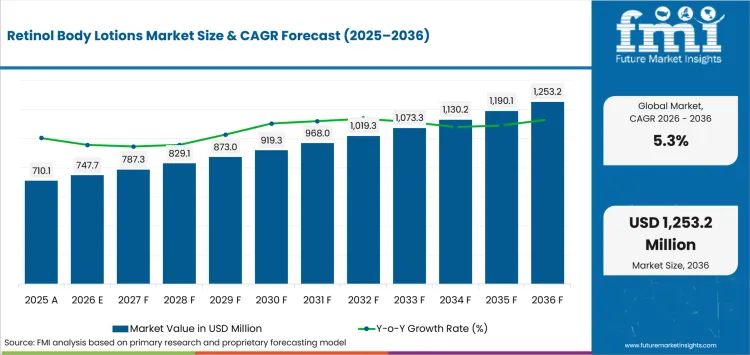
USD 747.7 million in 2026 and USD 1,253.2 million by 2036 at a 5.3% CAGR.
Sales of retinol body lotions are projected to rise from USD 747.7 million in 2026 to USD 1,253.2 million by 2036 at a 5.3% CAGR. Leading personal care brands are expanding retinol offerings across multiple body-care formats to encourage routine product usage. In August 2026, The Procter & Gamble Company launched Olay Repair Serum Body Wash with an antioxidative retinol version and matching body lotion. The paired format shows how retinol can enter a repeat-use body routine through familiar wash-and-lotion purchasing.
National launch work becomes a sales condition once notification and accountable local representation govern the route to shelf. In July 2026 UK OPSS reported 861,686 SCPN cosmetic notifications by May 28 and documented the volume brands must handle before retail activity.
Key Takeaways
- Ingredient familiarity moves active skincare into body moisturization and tolerability determines whether trial becomes repeated use.
- By product type, core - classic lines are estimated to hold 40.0% in 2026 owing to familiar application and routine compatibility.
- Conventional is set to lead the nature category with 51.0% share in 2026 due to formulation flexibility for stability and sensory performance.
- In 2026, cream & balm is expected to lead the format category with 30.0% share because richer vehicles pair moisturization with controlled active delivery.
- Irritation and body-specific vitamin A limits extend product review because brands must align concentration with repeat-use cosmetic claims.
- Key players in the retinol body lotions market include Coty Inc., The Estée Lauder Companies Inc., Unilever PLC, e.l.f. Beauty, Inc., Kao Corporation, L’Oréal Groupe, Shiseido Company, Limited, Amorepacific Corporation, Beiersdorf AG, and The Procter & Gamble Company.
Analyst Perspective
"Retinol body lotion economics depend on formulas that consumers can apply generously without turning irritation management into the routine. Brands gain repeat sales by pairing retinoid credibility with moisturizer comfort and concentration choices that survive regional vitamin A rules."
- Rahul Pandita, Principal Consultant, Future Market Insights
How is the retinol body lotions market segmented?
The market is assessed by Product Type, Nature, Format, Price Positioning, Sales Channel, and Region.
Product type covers core - classic lines, targeted treatment lines, sensitive - gentle lines, premium - clinical lines, and kits & sets. Nature separates conventional formulas from vegan, natural, clinical, and fragrance-free options for repeated use. Format includes cream & balm, liquid & serum, stick & solid, spray & mist, sheet & patch, and powder for different application preferences. Price positioning spans mass, masstige, premium, and professional offers with different cost-per-use levels. Sales channels include e-commerce & DTC, specialty beauty retail, pharmacies & drugstores, supermarkets & hypermarkets, and salons & spas.
Why does cream & balm hold 30.0% within the format category?
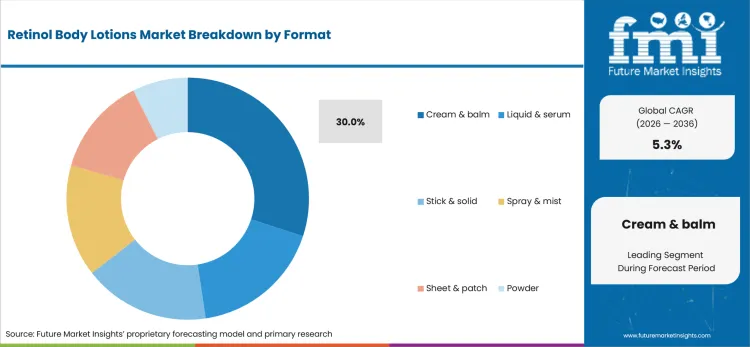
Cream and balm vehicles can offset dryness sensations that discourage repeated retinoid use on larger body areas. Their richer emulsion structure also fits consumers accustomed to sensitive-skin body lotion routines where comfort influences replenishment.
- In 2026, cream & balm is expected to lead the format category with 30.0% share because richer vehicles support moisturization during repeated application. Stick-based body lotions remain a portability-focused alternative for consumers who prefer localized application without handling a jar or pump.
- Beiersdorf AG's 2025 research review says its India team developed a NIVEA Body Creme formula with seventy-two-hour moisturization claims for local markets. The development illustrates why richer body formats are engineered around moisture retention before additional treatment cues are layered in.
Which product type accounts for 40.0% of demand in 2026?
Core - classic lines keep the familiar body-lotion routine intact while introducing active treatment cues consumers already recognize from facial anti-wrinkle products. The everyday lotion format reduces explanation before trial and supports larger packs intended for repeated whole-body application.
- By product type, core - classic lines are estimated to hold 40.0% in 2026 owing to routine familiarity and everyday application.
- e.l.f. Beauty, Inc. launched Keys Soulcare Sacred Body Lotion in February 2025 to extend the brand's body-care range with a daily moisturizer format. The launch fits the core-line route because regular lotion use requires no new application habit before treatment cues are introduced.
Why does conventional hold 51.0% within the nature category?
Conventional formulas let chemists stabilize retinol while adjusting emollients and antioxidants for repeated opening over several weeks. Standard cosmetic ingredients give formulators more options for preservation and sensory performance without forcing a narrower values-based claim onto the product.
- The conventional segment is likely to capture 51.0% share in 2026 attributable to formulation flexibility and compatibility with scaled body-care manufacturing.
- Shiseido Company, Limited documented a new wrinkle-prevention function for retinol in July 2025 through research on collagen-related skin changes. The finding gives formulators additional evidence for treatment claims without changing the need for stability controls in body formats.
What supports mass pricing at 35.0% within the price positioning category?
Whole-body application uses more product than a facial treatment so cost per use can determine whether an active routine survives beyond trial. Mass pricing gives retailers a practical bridge between everyday moisturizers and treatment-oriented anti-aging creams and serums without requiring professional recommendation.
- Mass is set to lead the price positioning category with 35.0% share in 2026 due to accessible pack economics that support frequent application.
- e.l.f. Beauty, Inc. expanded e.l.f. SKIN into Kruidvat and Trekpleister drugstores in May 2025 with online availability in the Netherlands and Belgium. The expansion shows how accessible skincare can pair broad physical distribution with digital replenishment without moving into professional price tiers.
Why does e-commerce & DTC hold 28.0% within the sales channel category?
Digital channels can explain gradual retinol introduction and compatible moisturization in more detail than a shelf label. They also let users compare skincare products before returning to the same formulation after a successful first cycle.
- E-commerce & DTC is projected to hold 28.0% share in 2026 owing to detailed product education and convenient replenishment for active skincare.
- Amorepacific Corporation launched AESTURA in China through Tmall and other major e-commerce platforms in August 2025 with the ATOBARRIER365 line. The launch shows how ingredient-led skincare can enter a large market through digital storefronts before a dense physical network is established.
What are the drivers, restraints and opportunities in the Retinol Body Lotions Market?
Demand rises as facial active routines move into body care while tolerability and vitamin A limits constrain formulation and gentler systems widen repeat-use potential.
- Driver: Familiar active-skincare behavior reduces explanation before consumers add treatment cues to routine body moisturization.
- Restraint: Retinoid irritation and body-specific limits extend review because formulas must match concentration with allowable claims.
- Opportunity: Barrier-supportive delivery and sensitive-skin positioning widen repeat use without relying on stronger retinol concentration.
Facial Active Routines Are Moving Into Body Care
Familiar facial routines make anti-aging agents easier to explain before consumers extend treatment goals to regular body cleansing and moisturization. Unilever's 2025 annual report says Dove Serum Shower Collection expanded into India at year-end following strong North American results. The expansion places treatment cues inside high-frequency personal care and gives retailers a familiar route for explaining serum-style body products.
Vitamin A Limits Narrow the Formulation Window
Retinol body lotions face tighter concentration limits than many leave-on cosmetics sold in the European Union. ECHA listed a 0.05% retinol-equivalent body-lotion maximum in 2026 and retained the vitamin A warning. The cap shifts formulation work toward stability testing and disciplined claims instead of stronger concentration in body-lotion development.
Barrier Support Can Extend Repeat Use
Sensitive-skin delivery broadens the usable audience for active body care by reducing dryness-related discontinuation during regular application. Kao announced Curél Moist Barrier Oil Serum in July 2026 with ceramide-care technology for Japan and Europe. The product pairs barrier support with treatment-oriented positioning that also fits anti-aging serums and moisture-focused body products.
Which country CAGRs are included in the Retinol Body Lotions Market?
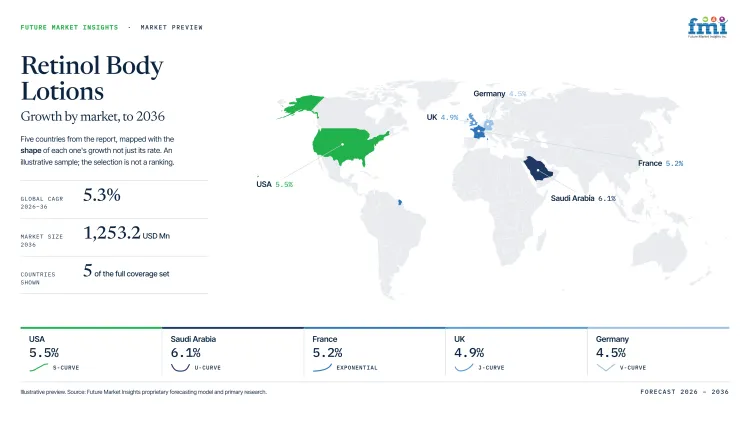
| Country | CAGR |
|---|---|
| UAE | 6.5% |
| Saudi Arabia | 6.1% |
| South Korea | 5.8% |
| USA | 5.5% |
| France | 5.2% |
| UK | 4.9% |
| Germany | 4.5% |
| Japan | 4.2% |
How do country-level CAGRs compare in the Retinol Body Lotions Market?
The country forecasts form three commercial bands within a 2.3-point range from the UAE to Japan. UAE and Saudi Arabia occupy the upper band while South Korea and USA form a second group. France and UK sit near the middle. Germany and Japan advance more slowly because mature skincare routines leave less room for rapid category expansion.
- UAE prestige assortments give imported active-body brands broad shelf exposure through established beauty retailers and malls.
- Saudi premium beauty channels reward recognizable ingredient stories that justify repeat-use body care beyond gifting occasions.
- South Korea's short product cycles move treatment-led body formats quickly through digital beauty platforms and specialty retail.
- USA retailers offer broad physical and digital reach for testing body-care education through multiple consumer touchpoints.
- French pharmacy habits give treatment-oriented moisturizers a trusted setting for explaining active ingredients before purchase.
- UK e-commerce supports active-skincare discovery and lets brands test body formats before committing to broader retail distribution.
- German mass beauty retail keeps price comparison visible and favors straightforward lotion formats over narrowly targeted treatment packs.
- Japan's mature skincare category slows incremental expansion as consumers compare established brands on texture and ingredient credibility.
Similar CAGRs produce different commercial priorities once channel maturity and local operating rules are considered together. The full report covers North America, Latin America, Western Europe, Eastern Europe, East Asia, South Asia and Pacific, and Middle East and Africa.
Country-wise Analysis
- US beauty retailers give retinol body care immediate access to mass stores and specialty channels as well as direct-to-consumer replenishment. Demand for retinol body lotions in the USA is forecast to expand at 5.5% CAGR through 2036 due to ingredient familiarity and wide retail access. The FDA updated Cosmetics Direct on February 11 2026 to support biennial facility-registration renewal under MoCRA and automated renewal reminders. National channel scale speeds discovery but recurring registration and product-listing duties increase operating work for brands that need safety substantiation. Brands with launch-ready files can focus retailer and digital skincare education on repeated whole-body use instead of correcting registration gaps.
- German consumers already buy substantial skin and face care which gives ingredient-led body products a familiar reference point for everyday treatment claims. IKW reported in December 2025 that skin and face care sales increased 11.1% during 2025 within the national beauty sector. Retinol body-lotion demand in Germany is forecast to grow at 4.5% CAGR through 2036 owing to steady skincare spending and national beauty retail reach. EU vitamin A limits and German-language information requirements narrow formula and claim choices so companies need documentation that matches shelf packs and online listings during launch reviews.
- French cosmetic brands operate under close documentation scrutiny which makes product-information files a practical gate before treatment-oriented body products reach national retail. Sales of retinol body lotions in France are projected to expand at 5.2% CAGR through 2036 attributable to dermocosmetic habits and ingredient-led discovery. The DGCCRF reported on February 2 2026 that it inspected 147 cosmetics establishments and reviewed more than 200 product-information files nationwide. Pharmacy credibility supports education but detailed safety records and EU retinol limits raise entry work for smaller or newer operators. Brands need French-ready claims before premium positioning can convert ingredient interest into durable body-care sales through pharmacies and specialty beauty stores.
- Great Britain requires cosmetics brands to manage a national notification route that is separate from the European Union system used for nearby markets. OPSS guidance updated on June 29 2026 requires a UK-based Responsible Person and an English product information file for cosmetics supplied in Great Britain. Specialty retail and e-commerce support active-skincare discovery but duplicated GB and EU administration raises launch cost for regional portfolios. Adoption of retinol body lotions in the UK is projected to expand at 4.9% CAGR through 2036 driven by online education and broad beauty retail access. Brands with separate GB compliance ownership can shorten retailer review without treating one regional file as sufficient for both systems.
- Saudi beauty retailers can support premium active-body offers but imported cosmetics need an accountable local route before national distribution can scale. The Saudi Food and Drug Authority published its cosmetic marketing-notification list on March 5 2025 and updated the searchable service in April 2026. The Saudi retinol body lotions sector is projected to record 6.1% CAGR through 2036 driven by premium beauty spending and growing ingredient awareness. Centralized listing gives importers a defined process but complete product records and clearance coordination can delay retailer launch dates. Companies with local partners that manage notification early can use premium channels without carrying unresolved documentation into shipment planning.
- UAE beauty retailers carry dense prestige and mass assortments that give active-body concepts immediate comparison with established skincare brands. Retinol body-lotion sales in the UAE are anticipated to advance at 6.5% CAGR through 2036 supported by imported assortment depth and beauty spending. MoIAT updated 12 national conformity marks on April 9 2025 and allowed imported products a six-month transition period for the new designs. Assortment depth supports launch choice but conformity testing and label transitions can interrupt shipment timing so companies need completed documentation before inventory reaches the country. Importers that plan conformity work before dispatch reduce the risk of active formats sitting unsellable in local inventory.
- Japanese skincare buyers compare anti-aging skincare through ingredient detail and texture so wording can influence whether a cosmetic claim appears improperly medicinal. Japan's health ministry revised ingredient-display guidance on March 10 2025 and requires the purpose of a highlighted cosmetic ingredient to be objectively supported. Demand for retinol body lotions in Japan is forecast to grow at 4.2% CAGR through 2036 because established skincare routines sustain ingredient-led interest. Consumer literacy supports treatment education but claim boundaries limit promotional wording for brands entering with unfamiliar active-body formats. Localized packaging must explain retinol function without crossing cosmetic-effect boundaries that could complicate national advertising review.
- South Korean consumers move quickly between efficacy-led skincare launches but regulated wrinkle-improvement positioning can place products inside functional-cosmetics review. MFDS issued Notice 2026-19 on March 18 2026 covering national cosmetics safety standards and current ingredient requirements for products sold locally. Technical familiarity speeds trial while safety files and regulated claims can lengthen launch preparation for active-body products entering competitive beauty channels. Retinol body-lotion demand in South Korea is predicted to advance at 5.8% CAGR through 2036 attributable to sophisticated skincare adoption and rapid channel turnover. Companies that decide claim positioning early can avoid reopening evidence files after commercial packaging has already been prepared.
Who are the notable companies in the Retinol Body Lotions Market?
Coty Inc., The Estée Lauder Companies Inc., Unilever PLC, e.l.f. Beauty, Inc., Kao Corporation, L’Oréal Groupe, Shiseido Company, Limited, Amorepacific Corporation, Beiersdorf AG, and The Procter & Gamble Company are active companies in the market.
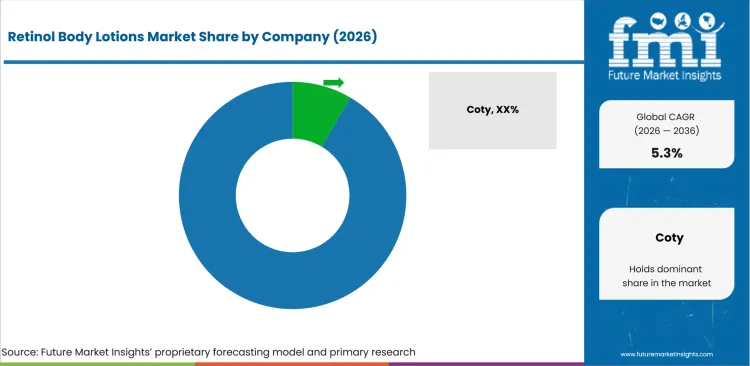
Competition spans scaled body-care groups and prestige skincare companies alongside dermocosmetic and active-led brands. Entry depends on active-skin evidence plus body-care economics that support tolerability and repeat moisturizer use.
- Body-care routes: Unilever PLC, Kao Corporation, Beiersdorf AG, The Procter & Gamble Company, and Coty Inc. serve repeated personal-care use through scaled channels.
- Active-skincare science: The Estée Lauder Companies Inc., L’Oréal Groupe, Shiseido Company, Limited, e.l.f. Beauty, Inc., and Amorepacific Corporation contribute treatment-led research or dermocosmetic expertise.
Competitive Benchmarking: Retinol Body Lotions Market
| Company | Body-Care Route Breadth | Active-Skin Science | Retail Route Breadth | Geographic Reach |
|---|---|---|---|---|
| Coty Inc. | Medium | High | High | Americas, Europe, Asia, Middle East |
| The Estée Lauder Companies Inc. | Medium | High | Medium | About 150 countries and territories |
| Unilever PLC | High | High | High | Global multi-region distribution |
| e.l.f. Beauty, Inc. | High | High | High | North America with international expansion |
| Kao Corporation | High | High | Medium | Asia, Europe, Americas, Middle East |
| L’Oréal Groupe | High | High | High | Global multi-division distribution |
| Shiseido Company, Limited | Low | High | Medium | Asia, Europe, Americas |
| Amorepacific Corporation | Medium | High | Medium | East Asia, North America, Western Europe, South Asia and Pacific |
| Beiersdorf AG | High | High | High | Global consumer and derma distribution |
| The Procter & Gamble Company | High | High | High | Global mass and e-commerce distribution |
Scoring basis: High body-care route breadth requires three documented routes, Medium requires two and Low requires one. Active-skin science and retail-route breadth apply the same three-two-one evidence thresholds to research programs and verified sales channels respectively.
Key Developments in the Retinol Body Lotions Market
- In July 2026, Shiseido Company, Limited launched Clé de Peau Beauté Synactif Body Cream for body treatment in Japan.
- In January 2026, Beiersdorf AG launched NIVEA Creme Natural Touch in Germany as a classic NIVEA Creme extension.
- In August 2025, Amorepacific Corporation launched AESTURA at Sephora Canada with ATOBARRIER365 Body Lotion.
Key Players in the Retinol Body Lotions Market
Scaled Body-Care Platforms
- Unilever PLC
- Kao Corporation
- Beiersdorf AG
- The Procter & Gamble Company
- Coty Inc.
Active-Skincare and Prestige Science
- The Estée Lauder Companies Inc.
- L’Oréal Groupe
- Shiseido Company, Limited
- e.l.f. Beauty, Inc.
Dermocosmetic Expansion
- Amorepacific Corporation
Retinol Body Lotions Market - Report Scope
| Coverage field | Report scope |
|---|---|
| Market breakdown | By product type, nature, format, price positioning, sales channel, and region. |
| Quantitative Units | USD million. |
| Market Definition | Revenue from retinol body lotions and closely aligned topical body moisturizers positioned for repeated cosmetic skin care. |
| Regions Covered | North America, Latin America, Western Europe, Eastern Europe, East Asia, South Asia and Pacific, and Middle East and Africa. |
| Countries Covered | USA, Germany, France, UK, Saudi Arabia, UAE, Japan, South Korea, and additional countries included in the full report. |
| Key Companies | Coty Inc., The Estée Lauder Companies Inc., Unilever PLC, e.l.f. Beauty, Inc., Kao Corporation, L’Oréal Groupe, Shiseido Company, Limited, Amorepacific Corporation, Beiersdorf AG, The Procter & Gamble Company. |
| Forecast Period | 2026 to 2036. |
| Approach | Primary and secondary research with market triangulation. |
Retinol Body Lotions Market - Research Methodology
| Method | Approach |
|---|---|
| Primary Research | FMI analysts gathered input from manufacturers, service providers, technology developers, distributors, end users, procurement teams, and subject-matter experts. Interviews examined purchasing decisions, product or service evaluation, adoption barriers, approval requirements, pricing considerations, and expectations for technical or commercial support. Respondents were also asked what evidence is required before a trial, pilot, or initial order develops into regular purchasing. |
| Desk Research | Desk research covered government statistics, regulatory publications, trade data, industry associations, technical literature, standards, company filings, product information, and official corporate announcements. Sources were reviewed for relevance, publication date, geographic coverage, and consistency with the defined market scope. Claims relating to performance, applications, approvals, capacity, investment, and commercial activity were retained only when supported by credible public evidence. |
| Market Sizing and Forecasting | The market model combined the baseline value with historical performance, segment structure, pricing and volume indicators, adoption levels, company participation, and country-level demand conditions. Forecast assumptions considered economic activity, investment trends, regulatory developments, technology adoption, purchasing cycles, supply availability, and barriers to wider market use. Segment and regional estimates were reconciled before the final market total was calculated. |
| Data Validation | Estimates were checked against multiple independent indicators, including public data, company activity, trade patterns, industry developments, and findings from primary interviews. Validation also tested whether products, services, applications, and company revenues fell within the defined market boundaries. Adjacent categories, unsupported claims, overlapping revenues, and activities without direct market relevance were excluded to reduce double counting and maintain consistency across segments and countries. |
Retinol Body Lotions Market by Segments
Retinol Body Lotions Market segmented by Product Type:
- Core - classic lines
- Targeted treatment lines
- Sensitive or gentle lines
- Premium - clinical lines
- Bundles & sets
Retinol Body Lotions Market segmented by Nature:
- Conventional
- Vegan & cruelty-free
- Natural & organic
- Dermocosmetic - clinical
- Fragrance-free & sensitive
Retinol Body Lotions Market segmented by Format:
- Cream & balm
- Liquid & serum
- Stick & solid
- Spray & mist
- Sheet & patch
- Powder
Retinol Body Lotions Market segmented by Price Positioning:
- Mass
- Masstige
- Premium
- Professional
Retinol Body Lotions Market segmented by Sales Channel:
- E-commerce & DTC
- Specialty beauty retail
- Pharmacies & drugstores
- Supermarkets & hypermarkets
- Salons & spas
Retinol Body Lotions Market by Region:
- North America
- United States
- Canada
- Latin America
- Brazil
- Mexico
- Argentina
- Chile
- Western Europe
- Germany
- France
- United Kingdom
- Italy
- Spain
- Benelux
- Nordics
- Eastern Europe
- Poland
- Czech Republic
- Romania
- Hungary
- East Asia
- China
- Japan
- South Korea
- South Asia and Pacific
- India
- ASEAN
- Australia and New Zealand
- Middle East and Africa
- GCC Countries
- South Africa
- Türkiye
- Israel
Research Sources and Bibliography
- The Procter & Gamble Company. (2026, August 27). Olay Launches 'Barrier Bootcamp' With New Repair Serum Body Wash Collection - Your Shower-Powered Workout for Skin Barrier Repair.
- Office for Product Safety and Standards. (2026, July 17). New data on UK cosmetic product safety notifications.
- e.l.f. Beauty, Inc. (2025, February 19). Keys Soulcare Launches Sacred Body Lotion as a Reminder to Praise our Bodies.
- Shiseido Company, Limited. (2025, July 22). Shiseido Discovers New Feature of Retinol that Prevents Future Wrinkle Formation.
- Beiersdorf AG. (2026, March 3). Research and Development - Beiersdorf Annual Report 2025.
- e.l.f. Beauty, Inc. (2025, May 15). e.l.f. Beauty Expands Presence in The Netherlands and Belgium with Entry into KRUIDVAT and TREKPLEISTER Drugstores.
- Amorepacific Corporation. (2025, August 7). AESTURA Announces Its Official Entry into the Chinese Market with a Strategic E-commerce Focus.
- Unilever PLC. (2026). Unilever Annual Report and Accounts 2025.
- European Chemicals Agency. (2026, January 13). Cosmetic Products Regulation, Annex III - Restricted Substances.
- Kao Corporation. (2026, July 1). Curél Unveils Moist Barrier Oil Serum for Rough, Tight Skin Caused by Extreme Dryness.
- USA Food and Drug Administration. (2026, February 11). FDA Updates Web Portal and Informational Materials to Help Cosmetic Facilities Prepare for Biennial Registration Renewal.
- Industrieverband Körperpflege- und Waschmittel e. V. (2025, December 3). Erneutes Wachstumsplus für die Schönheits- und Haushaltspflegebranche.
- Direction générale de la concurrence, de la consommation et de la répression des fraudes. (2026, February 2). Cosmétiques : des TPE nouvelles dans le secteur qui méconnaissent trop souvent la réglementation.
- Office for Product Safety and Standards. (2026, June 29). Regulation 1223/2009 and the Cosmetic Products Enforcement Regulations 2013: Great Britain.
- Saudi Food and Drug Authority. (2025, March 5). List of Notification of Marketing for Cosmetic Products (Listed Products).
- UAE Ministry of Industry and Advanced Technology. (2025, April 9). MoIAT transforms conformity labels elevating Made in the UAE products globally.
- Japan Ministry of Health, Labour and Welfare. (2025, March 10). 化粧品における特定成分の特記表示について.
- Ministry of Food and Drug Safety, Republic of Korea. (2026, March 18). 「화장품 안전기준 등에 관한 규정」 전문 (식품의약품안전처 고시 제2026-19호).
- Shiseido Company, Limited. (2026, May 20). クレ・ド・ポー ボーテ シナクティフより新ボディクリーム登場.
- Beiersdorf AG. (2026, January 5). Iconic blue tin now available in two versions: Beiersdorf launches NIVEA Creme Natural Touch in Germany.
- Amorepacific Corporation. (2025, July 25). AESTURA Launches Exclusively at Sephora Canada.
- Coty Inc. (2025, February 20). Coty announces Paixão is Leaping Bunny approved by Cruelty Free International.
- The Estée Lauder Companies Inc. (2025, May 21). ELC Brands Showcase Dermatological Science at SCALE Conference.
- L’Oréal Groupe. (2025, October 21). Sales at September 30, 2025.
- Kao Corporation. (2026, August 25). Kao Steps Up EMEA Skincare Growth with Curél Launch in the Nordics.
- Amorepacific Corporation. (2025, January 23). AESTURA Launches Exclusively at Sephora in the United States.
- e.l.f. Beauty, Inc. (2025, September 4). rhode Launches in Sephora.
- Coty Inc. (2025, June 11). Introducing adidas Vibes Fragrance Hair & Body Mists - The Mood-boosting Sportswear Scents for Hair and Body.
- The Estée Lauder Companies Inc. (2025, February 26). The Estée Lauder Companies Partners with Serpin Pharma, Inc to Develop Breakthrough Skin Care Ingredients to Advance Longevity.
- Unilever PLC. (2026, August 19). Unilever and Galaxy Surfactants deepen partnership to accelerate innovation and growth.
- e.l.f. Beauty, Inc. (2025, August 6). e.l.f. Beauty Announces First Quarter Fiscal 2026 Results.
- Kao Corporation. (2026, June 2). Kao Accelerates Skin Care Growth in EMEA with Launch of Curél in the Netherlands.
- L’Oréal Groupe. (2026, April 2). L’Oréal and Institut Pasteur announce historic partnership to advance skin health science.
- Shiseido Company, Limited. (2025, January 22). SHISEIDO ULTIMUNE is a serum reborn to slow the skin aging cycle.
- Amorepacific Corporation. (2026, March 9). AESTURA Announces Official Launch at Sephora Across 17 European Countries.
- Beiersdorf AG. (2026, August 3). Half-year results 2026: Derma outperformance continues, NIVEA enters next phase of rebalancing with 18-month turnaround plan.
- The Procter & Gamble Company. (2025, February 22). OLAY Elevates Your Shower with New Super Serum Body Wash.
This bibliography is provided for reader reference and is not exhaustive because the full report contains the complete source list and detailed citations.
This Report Answers
- What is the 2026 and 2036 market size?
- What moves facial active routines into body care?
- Why do core - classic lines hold 40.0%?
- How do nature and format affect repeat use?
- Why does mass pricing influence whole-body application?
- How do country growth rates differ?
- Which national rules change launch work?
- Which companies serve body care and active skincare?
Frequently Asked Questions
How big is the Retinol Body Lotions Market in 2026?
The retinol body lotions market is valued at USD 747.7 million in 2026 and is projected to reach USD 1,253.2 million by 2036. Active-skincare familiarity supports expansion as consumers extend treatment routines into repeated body moisturization at home.
What is the CAGR of the Retinol Body Lotions Market from 2026 to 2036?
The retinol body lotions market is projected to grow at a CAGR of 5.3% between 2026 and 2036. Ingredient familiarity and repeated body-care use support expansion as digital channels explain active routines more clearly.
Which product type leads the Retinol Body Lotions Market?
The core - classic lines segment is expected to hold 40.0% of the retinol body lotions market in 2026, supported by familiar application. Its everyday lotion format lowers trial friction without requiring professional recommendation or a new application habit.
Which nature segment leads the Retinol Body Lotions Market?
The conventional segment is expected to hold 51.0% of the retinol body lotions market in 2026, attributable to formulation flexibility. Developers can balance retinol stability with preservation and sensory performance for repeated whole-body use.
Which countries record the upper growth rates in the Retinol Body Lotions Market?
UAE is projected to grow at 6.5% CAGR and Saudi Arabia at 6.1% through 2036 within the retinol body lotions market. South Korea follows at 5.8% as channel speed and local claim rules shape adoption.
Which companies are active in the Retinol Body Lotions Market?
Key companies operating in the retinol body lotions market include Coty Inc., The Estée Lauder Companies Inc., Unilever PLC, e.l.f. Beauty, Inc., Kao Corporation, L’Oréal Groupe, Shiseido Company, Limited, Amorepacific Corporation, Beiersdorf AG, and The Procter & Gamble Company. Their positions differ through body-care reach and active-skin science supported by broad retail access.
Preview the report firsthand - request a free sample
Get SampleGet the brochure for pricing and purchase details.
Get PDFTable of Content
- Key Takeaways
- Market Size and CAGR
- Top Growth Driver
- Fastest Growing Segment
- Leading Region
- Key Companies
- Emerging Opportunities
- Executive Summary
- Global Market Outlook
- Demand-side Trends
- Supply-side Trends
- Technology Roadmap Analysis
- Analysis and Recommendations
- Analyst Perspective (What is happening? Why now? What should investors know?)
- Key Questions Answered
- How large is the market?
- What is the CAGR?
- What are key trends?
- Which region dominates?
- Who are the leaders?
- Market Overview
- Market Coverage / Taxonomy
- Market Definition / Scope / Limitations
- Research Methodology
- Chapter Orientation
- Analytical Lens and Working Hypotheses
- Market Structure, Signals, and Trend Drivers
- Benchmarking and Cross-market Comparability
- Market Sizing, Forecasting, and Opportunity Mapping
- Research Design and Evidence Framework
- Desk Research Programme (Secondary Evidence)
- Expert Input and Fieldwork (Primary Evidence)
- Tooling, Models, and Reference Databases
- Data Engineering and Model Build
- Quality Assurance and Audit Trail
- Market Background
- Market Dynamics (Drivers, Restraints, Opportunity, Trends)
- Scenario Forecast (Optimistic, Likely, Conservative)
- Impact Analysis
- AI Impact
- Sustainability Impact
- Regulatory Impact
- Technology Impact
- Consumer / Buyer Analysis
- Purchase Drivers
- Adoption Barriers
- Buyer Journey
- Opportunity Map Analysis
- Product Life Cycle Analysis
- Supply Chain Analysis
- Investment Feasibility Matrix
- Value Chain Analysis
- PESTLE and Porter's Analysis
- Regulatory Landscape
- Regional Parent Market Outlook
- Production and Consumption Statistics
- Import and Export Statistics
- Global Market Analysis and Forecast, 2021 to 2036
- Historical Market Size Value (USD Million) Analysis, 2021 to 2025
- Current and Future Market Size Value (USD Million) Projections, 2026 to 2036
- Y-o-Y Growth Trend Analysis
- Absolute $ Opportunity Analysis
- Global Market Pricing Analysis, 2021 to 2036
- Global Market Analysis and Forecast, By Product Type, 2021 to 2036
- Introduction / Key Findings
- Historical Market Size Value (USD Million) Analysis By Product Type, 2021 to 2025
- Current and Future Market Size Value (USD Million) Analysis and Forecast By Product Type, 2026 to 2036
- Core / classic lines
- Targeted treatment lines
- Sensitive & gentle lines
- Premium & clinical lines
- Kits & sets
- Core / classic lines
- Y-o-Y Growth Trend Analysis By Product Type, 2021 to 2025
- Absolute $ Opportunity Analysis By Product Type, 2026 to 2036
- Global Market Analysis and Forecast, By Nature, 2021 to 2036
- Introduction / Key Findings
- Historical Market Size Value (USD Million) Analysis By Nature, 2021 to 2025
- Current and Future Market Size Value (USD Million) Analysis and Forecast By Nature, 2026 to 2036
- Conventional
- Vegan & cruelty-free
- Natural & organic
- Dermocosmetic / clinical
- Fragrance-free & sensitive
- Conventional
- Y-o-Y Growth Trend Analysis By Nature, 2021 to 2025
- Absolute $ Opportunity Analysis By Nature, 2026 to 2036
- Global Market Analysis and Forecast, By Format, 2021 to 2036
- Introduction / Key Findings
- Historical Market Size Value (USD Million) Analysis By Format, 2021 to 2025
- Current and Future Market Size Value (USD Million) Analysis and Forecast By Format, 2026 to 2036
- Cream & balm
- Liquid & serum
- Stick & solid
- Spray & mist
- Sheet & patch
- Powder
- Cream & balm
- Y-o-Y Growth Trend Analysis By Format, 2021 to 2025
- Absolute $ Opportunity Analysis By Format, 2026 to 2036
- Global Market Analysis and Forecast, By Price Positioning, 2021 to 2036
- Introduction / Key Findings
- Historical Market Size Value (USD Million) Analysis By Price Positioning, 2021 to 2025
- Current and Future Market Size Value (USD Million) Analysis and Forecast By Price Positioning, 2026 to 2036
- Mass
- Masstige
- Premium
- Professional
- Mass
- Y-o-Y Growth Trend Analysis By Price Positioning, 2021 to 2025
- Absolute $ Opportunity Analysis By Price Positioning, 2026 to 2036
- Global Market Analysis and Forecast, By Sales Channel, 2021 to 2036
- Introduction / Key Findings
- Historical Market Size Value (USD Million) Analysis By Sales Channel, 2021 to 2025
- Current and Future Market Size Value (USD Million) Analysis and Forecast By Sales Channel, 2026 to 2036
- E-commerce & DTC
- Specialty beauty retail
- Pharmacies & drugstores
- Supermarkets & hypermarkets
- Salons & spas
- E-commerce & DTC
- Y-o-Y Growth Trend Analysis By Sales Channel, 2021 to 2025
- Absolute $ Opportunity Analysis By Sales Channel, 2026 to 2036
- Global Market Analysis and Forecast, By Region, 2021 to 2036
- Introduction
- Historical Market Size Value (USD Million) Analysis By Region, 2021 to 2025
- Current Market Size Value (USD Million) Analysis and Forecast By Region, 2026 to 2036
- North America
- Latin America
- Western Europe
- Eastern Europe
- East Asia
- South Asia and Pacific
- Middle East & Africa
- Market Attractiveness Analysis By Region
- North America Market Analysis and Forecast, By Country, 2021 to 2036
- Historical Market Size Value (USD Million) Trend Analysis By Market Taxonomy, 2021 to 2025
- Market Size Value (USD Million) Forecast By Market Taxonomy, 2026 to 2036
- By Country
- USA
- Canada
- By Product Type
- By Nature
- By Format
- By Price Positioning
- By Sales Channel
- By Country
- Market Attractiveness Analysis
- By Country
- By Product Type
- By Nature
- By Format
- By Price Positioning
- By Sales Channel
- Key Takeaways
- Latin America Market Analysis and Forecast, By Country
- Historical Market Size Value (USD Million) Trend Analysis By Market Taxonomy, 2021 to 2025
- Market Size Value (USD Million) Forecast By Market Taxonomy, 2026 to 2036
- By Country
- Brazil
- Mexico
- Chile
- Rest of Latin America
- By Product Type
- By Nature
- By Format
- By Price Positioning
- By Sales Channel
- By Country
- Market Attractiveness Analysis
- By Country
- By Product Type
- By Nature
- By Format
- By Price Positioning
- By Sales Channel
- Key Takeaways
- Western Europe Market Analysis and Forecast, By Country
- Historical Market Size Value (USD Million) Trend Analysis By Market Taxonomy, 2021 to 2025
- Market Size Value (USD Million) Forecast By Market Taxonomy, 2026 to 2036
- By Country
- Germany
- UK
- Italy
- Spain
- France
- Nordic
- BENELUX
- Rest of Western Europe
- By Product Type
- By Nature
- By Format
- By Price Positioning
- By Sales Channel
- By Country
- Market Attractiveness Analysis
- By Country
- By Product Type
- By Nature
- By Format
- By Price Positioning
- By Sales Channel
- Key Takeaways
- Eastern Europe Market Analysis and Forecast, By Country
- Historical Market Size Value (USD Million) Trend Analysis By Market Taxonomy, 2021 to 2025
- Market Size Value (USD Million) Forecast By Market Taxonomy, 2026 to 2036
- By Country
- Russia
- Poland
- Hungary
- Balkan & Baltic
- Rest of Eastern Europe
- By Product Type
- By Nature
- By Format
- By Price Positioning
- By Sales Channel
- By Country
- Market Attractiveness Analysis
- By Country
- By Product Type
- By Nature
- By Format
- By Price Positioning
- By Sales Channel
- Key Takeaways
- East Asia Market Analysis and Forecast, By Country
- Historical Market Size Value (USD Million) Trend Analysis By Market Taxonomy, 2021 to 2025
- Market Size Value (USD Million) Forecast By Market Taxonomy, 2026 to 2036
- By Country
- China
- Japan
- South Korea
- By Product Type
- By Nature
- By Format
- By Price Positioning
- By Sales Channel
- By Country
- Market Attractiveness Analysis
- By Country
- By Product Type
- By Nature
- By Format
- By Price Positioning
- By Sales Channel
- Key Takeaways
- South Asia and Pacific Market Analysis and Forecast, By Country
- Historical Market Size Value (USD Million) Trend Analysis By Market Taxonomy, 2021 to 2025
- Market Size Value (USD Million) Forecast By Market Taxonomy, 2026 to 2036
- By Country
- India
- ASEAN
- Australia & New Zealand
- Rest of South Asia and Pacific
- By Product Type
- By Nature
- By Format
- By Price Positioning
- By Sales Channel
- By Country
- Market Attractiveness Analysis
- By Country
- By Product Type
- By Nature
- By Format
- By Price Positioning
- By Sales Channel
- Key Takeaways
- Middle East & Africa Market Analysis and Forecast, By Country
- Historical Market Size Value (USD Million) Trend Analysis By Market Taxonomy, 2021 to 2025
- Market Size Value (USD Million) Forecast By Market Taxonomy, 2026 to 2036
- By Country
- Kingdom of Saudi Arabia
- Other GCC Countries
- Türkiye
- South Africa
- Other African Union
- Rest of Middle East & Africa
- By Product Type
- By Nature
- By Format
- By Price Positioning
- By Sales Channel
- By Country
- Market Attractiveness Analysis
- By Country
- By Product Type
- By Nature
- By Format
- By Price Positioning
- By Sales Channel
- Key Takeaways
- Key Countries Market Analysis
- USA
- Pricing Analysis
- Market Share Analysis, 2025
- By Product Type
- By Nature
- By Format
- By Price Positioning
- By Sales Channel
- Canada
- Pricing Analysis
- Market Share Analysis, 2025
- By Product Type
- By Nature
- By Format
- By Price Positioning
- By Sales Channel
- Mexico
- Pricing Analysis
- Market Share Analysis, 2025
- By Product Type
- By Nature
- By Format
- By Price Positioning
- By Sales Channel
- Brazil
- Pricing Analysis
- Market Share Analysis, 2025
- By Product Type
- By Nature
- By Format
- By Price Positioning
- By Sales Channel
- Chile
- Pricing Analysis
- Market Share Analysis, 2025
- By Product Type
- By Nature
- By Format
- By Price Positioning
- By Sales Channel
- Germany
- Pricing Analysis
- Market Share Analysis, 2025
- By Product Type
- By Nature
- By Format
- By Price Positioning
- By Sales Channel
- UK
- Pricing Analysis
- Market Share Analysis, 2025
- By Product Type
- By Nature
- By Format
- By Price Positioning
- By Sales Channel
- Italy
- Pricing Analysis
- Market Share Analysis, 2025
- By Product Type
- By Nature
- By Format
- By Price Positioning
- By Sales Channel
- Spain
- Pricing Analysis
- Market Share Analysis, 2025
- By Product Type
- By Nature
- By Format
- By Price Positioning
- By Sales Channel
- France
- Pricing Analysis
- Market Share Analysis, 2025
- By Product Type
- By Nature
- By Format
- By Price Positioning
- By Sales Channel
- India
- Pricing Analysis
- Market Share Analysis, 2025
- By Product Type
- By Nature
- By Format
- By Price Positioning
- By Sales Channel
- ASEAN
- Pricing Analysis
- Market Share Analysis, 2025
- By Product Type
- By Nature
- By Format
- By Price Positioning
- By Sales Channel
- Australia & New Zealand
- Pricing Analysis
- Market Share Analysis, 2025
- By Product Type
- By Nature
- By Format
- By Price Positioning
- By Sales Channel
- China
- Pricing Analysis
- Market Share Analysis, 2025
- By Product Type
- By Nature
- By Format
- By Price Positioning
- By Sales Channel
- Japan
- Pricing Analysis
- Market Share Analysis, 2025
- By Product Type
- By Nature
- By Format
- By Price Positioning
- By Sales Channel
- South Korea
- Pricing Analysis
- Market Share Analysis, 2025
- By Product Type
- By Nature
- By Format
- By Price Positioning
- By Sales Channel
- Russia
- Pricing Analysis
- Market Share Analysis, 2025
- By Product Type
- By Nature
- By Format
- By Price Positioning
- By Sales Channel
- Poland
- Pricing Analysis
- Market Share Analysis, 2025
- By Product Type
- By Nature
- By Format
- By Price Positioning
- By Sales Channel
- Hungary
- Pricing Analysis
- Market Share Analysis, 2025
- By Product Type
- By Nature
- By Format
- By Price Positioning
- By Sales Channel
- Kingdom of Saudi Arabia
- Pricing Analysis
- Market Share Analysis, 2025
- By Product Type
- By Nature
- By Format
- By Price Positioning
- By Sales Channel
- Türkiye
- Pricing Analysis
- Market Share Analysis, 2025
- By Product Type
- By Nature
- By Format
- By Price Positioning
- By Sales Channel
- South Africa
- Pricing Analysis
- Market Share Analysis, 2025
- By Product Type
- By Nature
- By Format
- By Price Positioning
- By Sales Channel
- USA
- Market Structure Analysis
- Competition Dashboard
- Competition Benchmarking
- Market Share Analysis of Top Players
- By Regional
- By Product Type
- By Nature
- By Format
- By Price Positioning
- By Sales Channel
- Emerging Startups
- Innovation Benchmarking
- Competition Analysis
- Competition Deep Dive
- Coty
- Overview
- Product Portfolio
- Profitability by Market Segments
- Sales Footprint
- Strategy Overview
- Marketing Strategy
- Product Strategy
- Channel Strategy
- Estee Lauder Companies
- Unilever
- e.l.f. Beauty
- Kao Corporation
- L'Oreal
- Shiseido
- Amorepacific
- Beiersdorf
- Procter & Gamble
- Coty
- Case Studies
- Success Stories
- Recent Developments
- Competition Deep Dive
- Assumptions & Acronyms Used


