

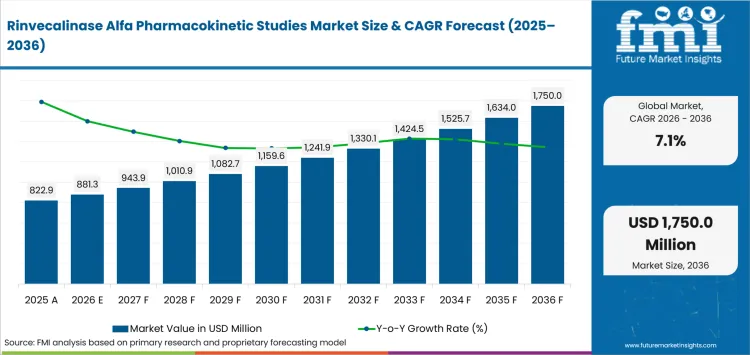
- Market Size (2026)
- USD 881.3 Mn
- Forecast (2036)
- USD 1750.0 Mn
- CAGR (2026 to 2036)
- 7.1%
How big is Rinvecalinase Alfa Pharmacokinetic Studies Market in 2026?
USD 881.3 million in 2026 and USD 1,750.0 million by 2036 at a 7.1% CAGR.
Demand for rinvecalinase alfa pharmacokinetic studies is projected to rise at 7.1% CAGR through 2036, driving valuation to USD 1750.0 million by 2036 from USD 881.3 million in 2026, reflecting recurring exposure studies. Clinical trials create spending whenever sponsors require dose-exposure evidence that supports safe escalation and later protocol decisions. Rinvecalinase alfa is a recombinant human tissue kallikrein-1 protein whose measurable exposure depends on administration materials and validated sampling schedules. Giuffre and colleagues reported in April 2025 that a Phase 1C single-dose study enrolled twelve participants, comprising nine healthy subjects and three adults recently taking angiotensin-converting enzyme inhibitors. The study linked revised dosing decisions with pharmacokinetic results following intravenous administration through polyvinyl chloride materials. The development pathway raises demand for large molecule bioanalysis that can quantify exposure without separating assay performance from clinical operations. Commercial value therefore rests on coordinated protocol design and sample handling that produce regulator-ready evidence within a single, accountable development workflow.
National purchasing conditions differ because rinvecalinase alfa programs require local approvals and dependable specialist sites rather than broad medicine demand alone. United States programs benefit from a deep regulatory and clinical-services base, yet product-specific nonclinical questions can delay pregnancy-study expansion. The United Kingdom provides coordinated regulatory and ethical review that supports efficient multinational study execution pathways. Germany offers established European trial infrastructure through the Clinical Trials Information System although local contracting and site activation remain material tasks. Japan and South Korea provide disciplined regulatory systems plus experienced clinical centers but local bridging plans can increase study preparation. Cross-country programs also require analytical laboratory services that preserve assay comparability across sample shipments and regional laboratories. Sponsors obtain clearer investment signals by separating regulatory access from site readiness and laboratory transfer risk in every national plan.
Key Takeaways of the Rinvecalinase Alfa Pharmacokinetic Studies Market
- Reproducible exposure evidence across dose changes and regulatory submissions drives study spending; Phase I is projected to hold 45.7% of study phase demand in 2026, reflecting its role in resolving early dose behavior before sponsors commit resources to larger patient trials.
- Preeclampsia is estimated to represent 43.2% of indication demand in 2026, supported by concurrent maternal safety and fetal exposure requirements, with DiaMedica reporting in July 2025 that its Phase 2 Part 1a study observed no placental transfer and met prespecified dose-escalation objectives.
- Single ascending dose studies are forecast to account for 44.9% of study type demand in 2026, valued for isolating dose-exposure behavior across sequential cohorts before repeated administration introduces accumulation effects.
- Pharma companies are expected to hold 66.4% of sponsor demand in 2026, retaining authority over regulatory submissions and dose escalation while contracting operational and bioanalytical capacity externally.
- The UK leads country growth at a 7.6% CAGR through 2036, followed by South Korea at 7.3% CAGR through active regulatory review and concentrated clinical capabilities.
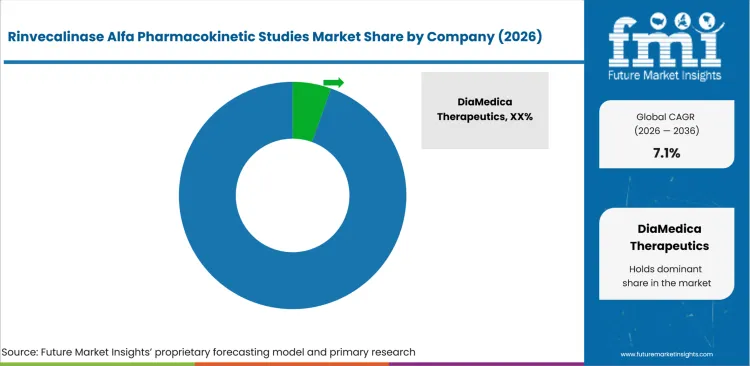
- DiaMedica Therapeutics directs the core development strategy, while IQVIA, ICON, Thermo Fisher PPD, Fortrea, and Charles River Laboratories compete across clinical operations and specialized pharmacokinetic bioanalysis.
Analyst Perspective
"The Rinvecalinase alfa pharmacokinetic studies market will be shaped by how effectively exposure data reduces uncertainty around dose selection and treatment development. Sponsors are assessing sampling design, pharmacokinetic variability, and assay reliability because weak exposure characterization can complicate later-stage decisions. Study providers that produce reproducible data across relevant populations while maintaining regulatory alignment will create stronger development value."
- Anurag Sharma, Principal Analyst at Future Market Insights
Source: FMI's proprietary forecasting model and primary research
How is the Rinvecalinase Alfa Pharmacokinetic Studies Market segmented?
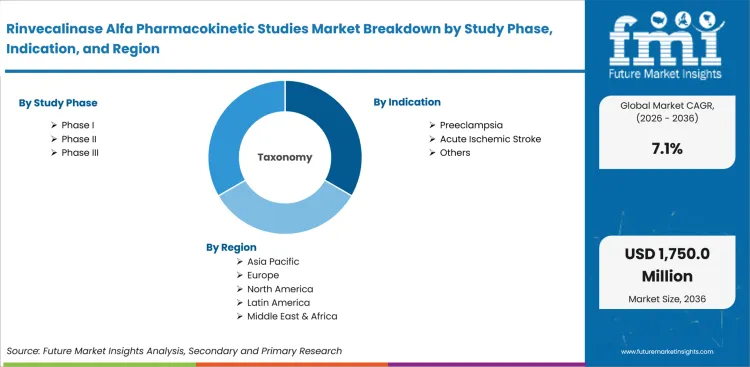
The rinvecalinase alfa pharmacokinetic studies industry is segmented by study phase, indication, study type, sponsor, and region.
The segmentation framework separates development timing from therapeutic purpose and study design across the rinvecalinase alfa evidence program. Study phase classifies work from initial human exposure through confirmatory development and later evidence packages. Indication distinguishes therapeutic programs through preeclampsia and acute ischemic stroke plus other authorized applications worldwide. Study type separates single ascending dose research from multiple ascending dose work and special-population investigations. Sponsor categories distinguish pharmaceutical ownership from contract research execution across laboratory and clinical-site workflows worldwide. Regional analysis compares regulatory access and service capacity across countries with different clinical research systems.
What supports demand for phase I within the study phase category?
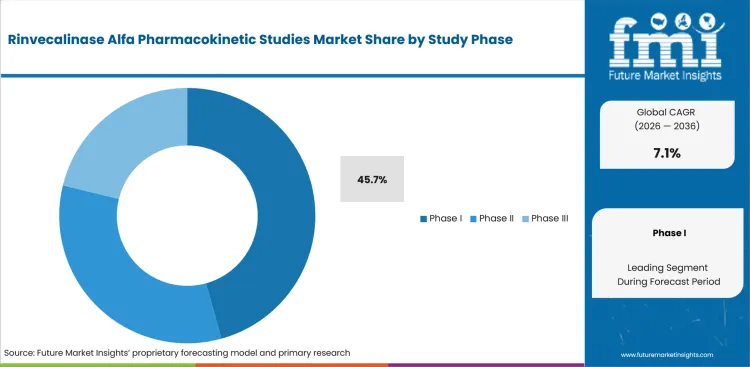
Phase I work resolves the first human exposure questions that determine whether a biologic program can advance safely into broader patient studies. Fortrea reports four dedicated Phase I units and a network exceeding three hundred investigator sites. Fortrea’s operating scale shows how clinical research organizations can combine controlled dosing with medical oversight and rapid sample processing. Rinvecalinase alfa adds assay and infusion-material considerations that require coordination between the clinic and bioanalytical laboratory. Sponsors therefore evaluate Phase I providers through dosing control and sample integrity rather than bed capacity considered alone.
- Phase I is projected to account for 45.7% share within the study phase category in 2026, supported by early exposure and tolerability decisions. Its position reflects the value of resolving dose behavior before sponsors commit resources to larger patient trials.
- Biopharmaceutical development teams use Phase I studies to test administration conditions and sampling schedules under controlled clinical supervision. Adoption depends on a laboratory pathway that returns interpretable pharmacokinetic results quickly enough to guide protocol amendments and subsequent dose selection across global programs.
How does preeclampsia influence the indication category?
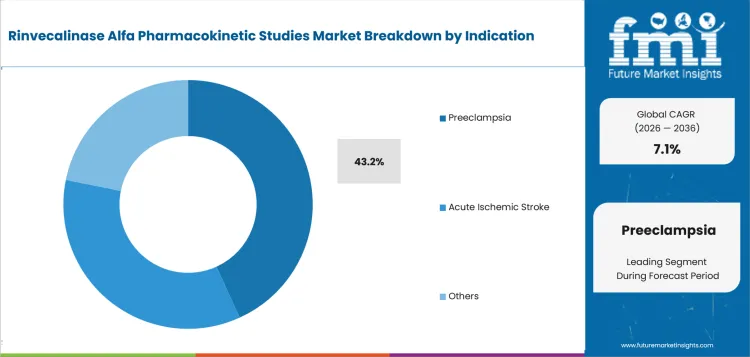
Preeclampsia research requires maternal exposure evidence alongside fetal safety assessment and biomarkers related to uterine blood flow. Repeated dosing cohorts therefore require synchronized blood pressure and uterine artery measurements alongside exposure sampling. Clinical trial software supports this work by linking dosing events with biomarker timing and sample records across specialist maternal-fetal medicine teams. Commercial demand centers on evidence packages that protect maternal safety without losing the fetal exposure question during operational handoffs.
- Preeclampsia is estimated to represent 43.2% of the indication category in 2026, reflecting the specialized evidence needed for pregnancy-related development. The share position is supported by concurrent safety and pharmacokinetic requirements that extend beyond ordinary adult exposure study programs.
- Maternal-fetal medicine investigators require protocols that coordinate dose timing with blood pressure monitoring and fetal exposure assessments. DiaMedica reported in July 2025 that its Phase 2 Part 1a study observed no placental transfer and achieved its prespecified dose-escalation objectives. Sites must preserve complete sample chains during clinically sensitive treatment windows and follow-up assessments for every participant.
Why is single ascending dose research central to the study type category?
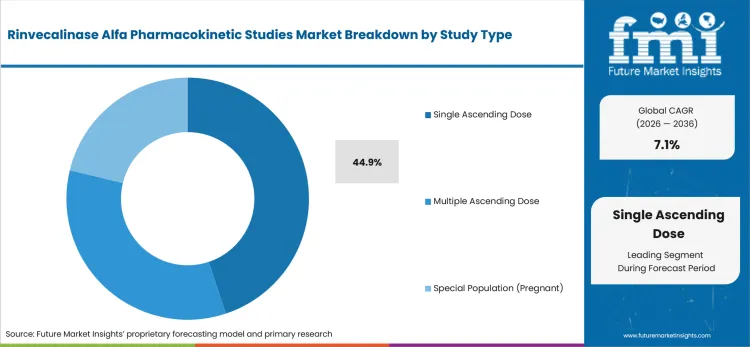
Single ascending dose research provides a controlled method for comparing exposure across sequential dose levels before repeated dosing introduces accumulation effects. Sequential cohorts preserve a clear relationship among dose level and exposure plus immediate tolerability findings. Rinvecalinase alfa programs need this discipline because dose changes can alter both clinical response and assay interpretation. The design creates value by limiting early exposure while producing a structured basis for selecting later regimens.
- By study type, single ascending dose studies are forecast to represent 44.9% share in 2026, attributable to controlled early dose learning. A December 2025 BMJ Open protocol used sequential dosing cohorts for DM199-related pregnancy research programs. The design lets sponsors review exposure and tolerability results before repeated administration receives operational approval.
- Clinical pharmacology teams use single ascending dose designs to isolate dose-exposure behavior across carefully timed sample collections. Outsourced testing services become valuable when validated assays and rapid reporting remain available without building dedicated internal laboratories. Adoption depends on predefined escalation rules that prevent laboratory delays from disrupting clinical dosing decisions.
How do pharma companies shape the sponsor category?
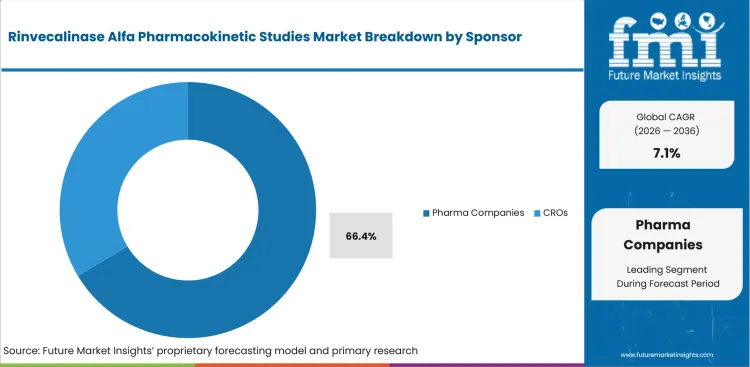
Pharma companies control protocol objectives and regulatory strategy because rinvecalinase alfa remains a development-stage biologic with evidence needs. DiaMedica stated in March 2026 that its programs included Phase 2 pregnancy studies and a Phase 2/3 acute ischemic stroke trial. The sponsor selects service partners while retaining accountability for safety reporting and submission readiness across development programs. Healthcare contract research provides operational capacity but cannot replace the sponsor’s asset-level scientific ownership and regulatory accountability. Commercial contracts therefore require clear boundaries between sponsor decisions and contracted execution across laboratories and clinical sites.
- Based on sponsor, pharma companies are expected to hold 66.4% share in 2026, enabled by direct control over development strategy. Their position reflects ownership of regulatory submissions and funding decisions across the complete rinvecalinase alfa program and lifecycle planning.
- Clinical-stage biopharmaceutical sponsors purchase external operations and assays while preserving internal authority over dose escalation and indication sequencing. Adoption of contracted support expands through agreements that define data ownership and remediation duties before protocol execution begins across multiple indications globally.
What are the drivers, restraints, and opportunities in the Rinvecalinase Alfa Pharmacokinetic Studies Market?
Development demand is supported by dose-specific evidence needs; limited by regulatory and assay uncertainty; and expanded through integrated multinational service models.
- Driver: Active clinical programs require repeatable exposure evidence that supports dose selection and independent regulatory review across several indications.
- Restraint: Additional nonclinical questions and assay-transfer risks can delay clinical expansion until product exposure remains demonstrable under regulator-accepted conditions.
- Opportunity: Integrated laboratories and clinical operators can reduce handoff risk by maintaining one controlled evidence chain across regions.
Active rinvecalinase alfa studies create demand for pharmacokinetic work each time enrollment and dose decisions require current exposure evidence. DiaMedica reported in May 2026 that ReMEDy2 enrollment had reached 75% of the two-hundred-patient threshold for its planned interim analysis. The milestone also reflected approximately seventy activated sites across the United States, Canada, the United Kingdom, and Europe. Clinical operations teams must preserve sample timing and assay consistency across that distributed network throughout enrollment and follow-up. The resulting workload supports repeat business for laboratories and data specialists that can maintain comparability through protocol changes.
Regulatory uncertainty restrains spending by preventing sponsors from treating one pharmacokinetic package as sufficient for every indication and jurisdiction. Preeclampsia expansion therefore depends on evidence that links measured exposure with enzymatic activity as defined by regulatory requirements across jurisdictions. DiaMedica reported in June 2026 that the FDA requested exposure and activity evidence from a completed rat study and prompted a new pharmacokinetic study. Service providers must connect assay sensitivity with the regulator’s biological question because concentration results alone may not support a toxicology or clinical decision.
Integrated service models is expected to generate an opportunity to shorten the interval between sample collection and an accepted development decision. Multinational expansion requires assay alignment and reporting rules that remain stable across every added country. Bioanalytical testing services can capture more value by defining those transfer requirements before clinical activation begins. Health Canada issued a No Objection Letter in March 2026 for a Phase 2 early-onset preeclampsia study with safety and exploratory biomarker assessment. The commercial opening favors providers that accept responsibility for cross-site comparability rather than selling isolated laboratory tasks.
Which country CAGRs are profiled in the Rinvecalinase Alfa Pharmacokinetic Studies Market?
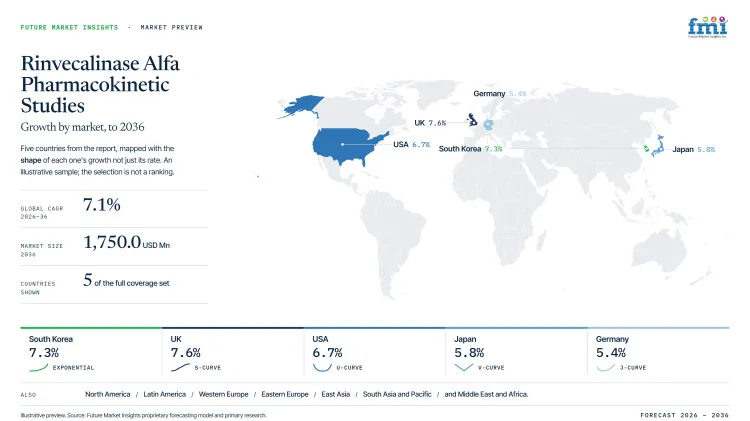
| Country | CAGR |
|---|---|
| USA | 6.7% |
| UK | 7.6% |
| Germany | 5.4% |
| Japan | 5.8% |
| South Korea | 7.3% |
How do country-level CAGRs compare in the Rinvecalinase Alfa Pharmacokinetic Studies Market?
The country comparison spans 2.2 percentage points between the UK at 7.6% and Germany at 5.4%. The UK and South Korea form a close upper cluster with a 0.3-point separation. The USA occupies a middle position at 6.7% and remains 0.6 points below South Korea. Japan and Germany create a lower pair that remains separated by a measured 0.4 percentage points. The measured spread reflects different regulatory and service conditions rather than a direct comparison of current market size or installed research capacity.
- The UK and South Korea share comparatively strong forecast positions although their entry routes differ through regulatory reform and concentrated clinical infrastructure.
- The USA sits between the two clusters because broad trial capacity is balanced by product-specific nonclinical requirements for pregnancy development.
- Japan and Germany record more measured rates while both markets require disciplined local submissions and carefully managed multinational operations.
Similar CAGRs can produce different commercial outcomes because a sponsor must secure legal access and dependable site execution within the same national plan. Assay transfer and sample logistics can materially change project economics even across countries with comparable clinical research capabilities. The full report provides country-level CAGR analysis across North America, Latin America, Europe, East Asia, South Asia, Oceania and the Middle East and Africa.
Country-wise Analysis
- United States development programs operate through a large clinical research network and a regulator that can require product-specific evidence before indication expansion. Demand for the rinvecalinase alfa pharmacokinetic studies market in the USA is forecast to rise at 6.7% CAGR over the forecast period, shaped by broad service capacity and detailed FDA review. ClinicalTrials.gov listed ReMEDy2 as recruiting on April 28, 2026 with sixty-six locations and numerous United States hospitals. The active study network supports specialized development services but does not remove rinvecalinase alfa nonclinical requirements. Sponsors need laboratories that can defend exposure methods during regulatory questions while maintaining site coverage across long travel distances.
- United Kingdom clinical research combines national oversight with coordinated ethical review and specialist hospitals that already support DM199 work. The UK's rinvecalinase alfa pharmacokinetic studies market outlook is anticipated to advance at 7.6% CAGR through 2036, enabled by established research infrastructure and active sponsor sites. Existing DM199 activity connects the forecast with specialist hospitals and controlled sample handling across the country. The Health Research Authority recorded a favorable ethics opinion on August 28, 2025 for ReMEDy2 and specified intravenous plus subcutaneous dosing with repeated biological sampling. Clinical trial packaging and sample export arrangements remain practical frictions for a biologic study that crosses national laboratories. Sponsors should confirm local pharmacy handling and assay shipment routes before activating additional specialist hospitals.
- Germany routes medicinal-product trial applications through the European Clinical Trials Information System and relies on established academic research centers. BfArM states that CTIS has covered all medicinal trial authorization procedures since January 31, 2025. The German rinvecalinase alfa pharmacokinetic studies sector is projected to record 5.4% CAGR during the assessment period, linked to regulated European access and mature laboratory capacity. The centralized route supports multinational submissions while local contracts and German site documentation can extend start-up work. Market entry requires an experienced European operator that manages authority responses and sample logistics without separating those duties across uncoordinated vendors.
- Japan requires clinical trial notifications and locally appropriate development plans before an unapproved medicine enters routine study conduct. Adoption of rinvecalinase alfa pharmacokinetic studies in Japan is estimated to expand at 5.8% CAGR through 2036, supported by disciplined review and advanced clinical pharmacology capabilities. Local bridging strategy remains a friction because overseas exposure data may not answer every Japanese population or protocol question. PMDA published early-consideration guidance in January 2025 for notification materials that can reduce avoidable questions during the standard initial period. Sponsors need a Japanese regulatory partner and assay-transfer plan before adding sites to a global program.
- South Korea concentrates advanced hospitals and clinical research services around dense urban networks with efficient national oversight. South Korea’s rinvecalinase alfa pharmacokinetic studies sector is predicted to post 7.3% CAGR between 2026 and 2036, reinforced by active clinical trial review and capable investigator centers. The Ministry of Food and Drug Safety reported in March 2026 that 783 clinical trials received approval during 2025 and the total increased 4.8%. The approval volume provides an enabling operating base but current public evidence does not confirm rinvecalinase alfa study sites in the country. Commercial planning should prioritize local investigator engagement and validated laboratory transfer before promising enrollment capacity.
Who are the notable companies in the Rinvecalinase Alfa Pharmacokinetic Studies Market?
DiaMedica Therapeutics, IQVIA, ICON plc, Thermo Fisher Scientific PPD, Fortrea, Charles River Laboratories, BioAgilytix, and QPS Holdings are notable companies supporting this market.
Competition combines one asset sponsor with integrated research organizations and specialist laboratories that control different parts of the evidence chain. DiaMedica defines protocol objectives and regulatory strategy for rinvecalinase alfa across active pregnancy and stroke development programs. IQVIA and ICON publish clinical pharmacology capabilities that include pharmacokinetic analysis and multinational trial operations. Fortrea and Thermo Fisher Scientific PPD add dedicated clinical units and global execution resources for sponsor-controlled programs. Charles River Laboratories and BioAgilytix emphasize regulated bioanalysis while QPS combines laboratory coverage with clinical research operations. Drug discovery services offer adjacent expertise but selection requires a direct link to clinical exposure data and regulator-ready reporting. Commercial awards depend on clear responsibility across dosing and assays rather than general portfolio breadth.
- DiaMedica Therapeutics owns the DM199 program and directs pharmacokinetic questions across preeclampsia and acute ischemic stroke development. Its selection decisions determine which clinical operators and laboratories receive market-specific work during each regulatory stage.
- IQVIA and ICON plc alongside Thermo Fisher Scientific PPD and Fortrea provide integrated clinical operations with pharmacology or biometrics support. Their commercial advantage comes from coordinating sites and data while maintaining clear sponsor control over scientific decisions.
- Charles River Laboratories joins BioAgilytix and QPS Holdings in competing through regulated assay platforms and laboratory networks. Selection depends on validated large-molecule methods and documented transfer controls that preserve comparability across regions.
Competitive Benchmarking: Rinvecalinase Alfa Pharmacokinetic Studies Market
| Company | Sponsor and Program Ownership | PK and Bioanalysis | Trial Operations | Geographic Reach |
|---|---|---|---|---|
| DiaMedica Therapeutics | High | Medium | Medium | North America, Europe and South Africa |
| IQVIA | Low | High | High | Global |
| ICON plc | Low | High | High | Global |
| Thermo Fisher Scientific PPD | Low | High | High | Global |
| Fortrea | Low | High | High | Global |
| Charles River Laboratories | Low | High | Medium | North America, Europe and Asia |
| BioAgilytix | Low | High | Low | North America, Europe and Australia |
| QPS Holdings | Low | High | High | North America, Europe and Asia |
Key Developments in the Rinvecalinase Alfa Pharmacokinetic Studies Market
- In June 2026, DiaMedica Therapeutics announced dosing of the first two patients in a Phase 2 fetal growth restriction trial of DM199. The study evaluates three dose levels in up to thirty participants and includes cord-blood exposure assessment. The development extends rinvecalinase alfa pharmacokinetic work into a distinct pregnancy population with specialized maternal and fetal sampling requirements.
- In May 2026, ICON plc opened a clinical research unit covering sixty-nine thousand five hundred square feet in San Antonio and added satellite outpatient clinics in Houston, Texas and Lawrence, Kansas. The unit combines clinical space with pharmacy and laboratory infrastructure under one coordinated early-phase operating model. The expansion increases early-phase capacity for controlled dosing and rapid sample processing across United States development programs.
- In October 2025, BioAgilytix announced multi-million-dollar LC/MS investments and expanded laboratory space in Germany and the United States. The program combined LC/MS with ligand-binding assay services across regulated environments in several international laboratory locations. The investment supports assay transfer and method selection for complex biologics that require comparable exposure measurements across several regions.
- In March 2026, ICON plc and Advarra entered a definitive partnership for a connected site-network model that integrates clinical operations with research-site systems. Advarra stated that its technology supports more than 50,000 investigators worldwide across established academic and community research settings. The arrangement can reduce duplicated site administration and improve visibility across multinational studies that depend on consistent dosing and sample records.
Key Players in the Rinvecalinase Alfa Pharmacokinetic Studies Market
Program Sponsor and Asset Owner
- DiaMedica Therapeutics
Integrated Clinical Research Organizations
- IQVIA
- ICON plc
- Thermo Fisher Scientific PPD
- Fortrea
Bioanalytical and Laboratory Specialists
- Charles River Laboratories
- BioAgilytix
- QPS Holdings
Rinvecalinase Alfa Pharmacokinetic Studies Market - Report Scope
| Coverage field | Report scope |
|---|---|
| Market breakdown | Study phase, indication, study type, sponsor, and region. |
| Quantitative Units | Revenue in USD Million, CAGR in %. |
| Market Definition | Protocol design, clinical operations, regulated bioanalytical assays, sample analysis, pharmacokinetic modeling, and regulatory reporting used directly in rinvecalinase alfa development. |
| Regions Covered | North America, Latin America, Western Europe, Eastern Europe, East Asia, South Asia and Pacific, and Middle East and Africa. |
| Countries Covered | USA, UK, Germany, Japan, and South Korea. |
| Key Companies Profiled | DiaMedica Therapeutics, IQVIA, ICON plc, Thermo Fisher Scientific PPD, Fortrea, Charles River Laboratories, BioAgilytix, and QPS Holdings. |
| Forecast Period | 2026 to 2036. |
| Approach | Hybrid bottom-up and top-down market sizing supported by primary interviews and authoritative official desk research. |
Rinvecalinase Alfa Pharmacokinetic Studies Market - Research Methodology
| Method | Approach |
|---|---|
| Primary Research | FMI analysts gathered input from manufacturers, service providers, technology developers, distributors, end users, sourcing teams, and subject-matter experts. Interviews examined purchasing decisions, product or service evaluation, adoption barriers, approval requirements, pricing considerations, and expectations for technical or commercial support. Respondents were also asked what evidence is required before a trial, pilot, or initial order develops into regular purchasing. |
| Desk Research | Desk research covered government statistics, regulatory publications, trade data, industry associations, technical literature, standards, company filings, product information, and official corporate announcements. Sources were reviewed for relevance, publication date, geographic coverage, and consistency with the defined market scope. Claims relating to performance, applications, approvals, capacity, investment, and commercial activity were retained only when supported by credible public evidence. |
| Market Sizing and Forecasting | The market model combined the baseline value with historical performance, segment structure, pricing and volume indicators, adoption levels, company participation, and country-level demand conditions. Forecast assumptions considered economic activity, investment trends, regulatory developments, technology adoption, purchasing cycles, supply availability, and barriers to wider market use. Segment and regional estimates were reconciled before the final market total was calculated. |
| Data Validation | Estimates were checked against multiple independent indicators, including public data, company activity, trade patterns, industry developments, and findings from primary interviews. Validation also tested whether products, services, applications, and company revenues fell within the defined market boundaries. Adjacent categories, unsupported claims, overlapping revenues, and activities without direct market relevance were excluded to reduce double counting and maintain consistency across segments and countries. |
Rinvecalinase Alfa Pharmacokinetic Studies Market by Segments
Rinvecalinase Alfa Pharmacokinetic Studies Market segmented by Study Phase:
- Phase I
- Phase II
- Phase III
Rinvecalinase Alfa Pharmacokinetic Studies Market segmented by Indication:
- Preeclampsia
- Acute Ischemic Stroke
- Others
Rinvecalinase Alfa Pharmacokinetic Studies Market segmented by Study Type:
- Single Ascending Dose
- Multiple Ascending Dose
- Special Population (Pregnant)
Rinvecalinase Alfa Pharmacokinetic Studies Market segmented by Sponsor:
- Pharma Companies
- CROs
Rinvecalinase Alfa Pharmacokinetic Studies Market by Region:
- North America
- United States
- Canada
- Latin America
- Brazil
- Mexico
- Argentina
- Chile
- Western Europe
- Germany
- France
- United Kingdom
- Italy
- Spain
- Benelux
- Nordics
- Eastern Europe
- Poland
- Czech Republic
- Romania
- Hungary
- East Asia
- China
- Japan
- South Korea
- South Asia and Pacific
- India
- ASEAN
- Australia and New Zealand
- Middle East and Africa
- GCC Countries
- South Africa
- Türkiye
- Israel
Research Sources and Bibliography
- National Library of Medicine. (2026, April 28). Treatment of Acute Ischemic Stroke (ReMEDy2 Trial).
- Giuffre, M., Lista, A. D., Paulson, N., & Masuoka, L. (2025, April 16). A Phase 1C, Open Label, Single Ascending Dose Study to Evaluate the Safety, Tolerability, and Pharmacokinetics of DM199 Administered Intravenously with a Polyvinyl Chloride Bag in Adult Healthy Subjects and Adults Recently Taking Angiotensin-Converting Enzyme Inhibitors.
- Cluver, C. A., Thake, J., Hassim, T., van Greunen, A., Budhram, S., Knipe, K., Decloedt, E., Brink, L., Langenegger, E., Bergman, L., Imberg, H., Bekker, A., Walker, S. P., & Tong, S. (2025, December 17). Safety and potential efficacy of DM199, a tissue kallikrein-1 analogue, for treating pre-eclampsia and fetal growth restriction: Study protocol for a South African, hospital-based phase I/II open-label trial.
- DiaMedica Therapeutics Inc. (2025, July 17). DiaMedica Therapeutics Reports Positive Interim Phase 2 Preeclampsia Results: Statistically Significant Reductions in Blood Pressure and No Placental Transfer.
- DiaMedica Therapeutics Inc. (2026, March 5). DiaMedica Therapeutics Receives Health Canada Clearance to Initiate Phase 2 Study of DM199 in Preeclampsia.
- DiaMedica Therapeutics Inc. (2026, May 20). DiaMedica Therapeutics Announces 75% Enrollment Milestone in ReMEDy2 Phase 2/3 Acute Ischemic Stroke Trial.
- DiaMedica Therapeutics Inc. (2026, June 16). DiaMedica Receives FDA Feedback on DM199 Preeclampsia Nonclinical Program.
- DiaMedica Therapeutics Inc. (2026, June 23). DiaMedica Therapeutics Announces First Patients Dosed in Phase 2 Trial of DM199 for the Treatment of Fetal Growth Restriction.
- DiaMedica Therapeutics Inc. (2026, March 30). DiaMedica Therapeutics Reports Full Year 2025 Financial Results and Provides Business Highlights.
- Health Research Authority. (2025, August 28). Study of DM199 for the treatment of Acute Ischemic Stroke.
- Federal Institute for Drugs and Medical Devices. (2025). Klinische Prüfung [Clinical trials].
- Pharmaceuticals and Medical Devices Agency. (2025, January 16). Clinical Trials.
- Ministry of Food and Drug Safety. (2026, March 6). [783 clinical trial approvals in 2025, up 4.8% year over year].
- IQVIA. (n.d.). Supporting clinical pharmacology throughout its life-cycle.
- ICON plc. (n.d.). Early Clinical.
- Thermo Fisher Scientific. (n.d.). PPD.
- Fortrea. (n.d.). Clinical Pharmacology Services.
- Charles River Laboratories. (n.d.). GLP Ligand Binding Assay Bioanalysis.
- BioAgilytix. (2025, October 20). BioAgilytix Accelerates Global Growth with LC/MS Investments Across Three Continents.
- QPS Holdings, LLC. (n.d.). Clinical Research Services.
- ICON plc. (2026, May 13). ICON expands US early phase research capabilities with new clinic and outpatient centres.
- ICON plc. (2026, March 24). ICON and Advarra introduce new ‘research-ready,’ connected site network model.
This bibliography provides reader reference while the full report contains the complete source list and detailed claim-level citations.
This Report Answers
- How large is the rinvecalinase alfa pharmacokinetic studies market in 2026 and 2036?
- Which evidence needs support the 7.1% CAGR in the rinvecalinase alfa pharmacokinetic studies market?
- Why does Phase I account for the largest selected study phase share during 2026?
- How does preeclampsia change pharmacokinetic study design and maternal-fetal safety assessment?
- Why do single ascending dose studies remain important during early rinvecalinase alfa development?
- How do country growth rates compare across the USA, UK, Germany, Japan, and South Korea?
- Which companies provide sponsor oversight, clinical operations, and bioanalytical services for rinvecalinase alfa studies?
- What regulatory and assay conditions can delay pharmacokinetic evidence generation?
- How should sponsors evaluate cross-country laboratory transfer and clinical site support?
Frequently Asked Questions
How big is the Rinvecalinase Alfa Pharmacokinetic Studies Market in 2026?
The rinvecalinase alfa pharmacokinetic studies market is valued at USD 881.3 million in 2026 and is forecast to reach USD 1750.0 million by 2036.
What is the CAGR of the Rinvecalinase Alfa Pharmacokinetic Studies Market from 2026 to 2036?
The rinvecalinase alfa pharmacokinetic studies market is projected to grow at a CAGR of 7.1% between 2026 and 2036, supported by active clinical programs requiring repeatable exposure evidence that supports dose selection and independent regulatory review across several indications.
Which sponsor type leads the Rinvecalinase Alfa Pharmacokinetic Studies Market?
Pharma companies account for 66.4% of the rinvecalinase alfa pharmacokinetic studies market by sponsor in 2026, driven by direct control over development strategy, regulatory submissions, and funding decisions across the complete rinvecalinase alfa program and lifecycle planning.
Which country is growing fastest in the Rinvecalinase Alfa Pharmacokinetic Studies Market?
The UK is the fastest-growing country in the rinvecalinase alfa pharmacokinetic studies market, expanding at a 7.6% CAGR through 2036, ahead of the market average of 7.1%, enabled by established research infrastructure, coordinated ethical review, and active sponsor sites supporting DM199 study work.
Who are the leading companies in the Rinvecalinase Alfa Pharmacokinetic Studies Market?
Leading companies in the rinvecalinase alfa pharmacokinetic studies market include DiaMedica Therapeutics, IQVIA, ICON plc, Thermo Fisher Scientific PPD, Fortrea, Charles River Laboratories, BioAgilytix, and QPS Holdings, competing across program sponsorship, integrated clinical operations, and specialized pharmacokinetic bioanalysis services.
Preview the report firsthand - request a free sample
Get SampleGet the brochure for pricing and purchase details.
Get PDFTable of Content
- Key Takeaways
- Market Size and CAGR
- Top Growth Driver
- Fastest Growing Segment
- Leading Region
- Key Companies
- Emerging Opportunities
- Executive Summary
- Global Market Outlook
- Demand-side Trends
- Supply-side Trends
- Technology Roadmap Analysis
- Analysis and Recommendations
- Analyst Perspective (What is happening? Why now? What should investors know?)
- Key Questions Answered
- How large is the market?
- What is the CAGR?
- What are key trends?
- Which region dominates?
- Who are the leaders?
- Market Overview
- Market Coverage / Taxonomy
- Market Definition / Scope / Limitations
- Research Methodology
- Chapter Orientation
- Analytical Lens and Working Hypotheses
- Market Structure, Signals, and Trend Drivers
- Benchmarking and Cross-market Comparability
- Market Sizing, Forecasting, and Opportunity Mapping
- Research Design and Evidence Framework
- Desk Research Programme (Secondary Evidence)
- Expert Input and Fieldwork (Primary Evidence)
- Tooling, Models, and Reference Databases
- Data Engineering and Model Build
- Quality Assurance and Audit Trail
- Market Background
- Market Dynamics (Drivers, Restraints, Opportunity, Trends)
- Scenario Forecast (Optimistic, Likely, Conservative)
- Impact Analysis
- AI Impact
- Sustainability Impact
- Regulatory Impact
- Technology Impact
- Consumer / Buyer Analysis
- Purchase Drivers
- Adoption Barriers
- Buyer Journey
- Opportunity Map Analysis
- Product Life Cycle Analysis
- Supply Chain Analysis
- Investment Feasibility Matrix
- Value Chain Analysis
- PESTLE and Porter's Analysis
- Regulatory Landscape
- Regional Parent Market Outlook
- Production and Consumption Statistics
- Import and Export Statistics
- Global Market Analysis and Forecast, 2021 to 2036
- Historical Market Size Value (USD Million) Analysis, 2021 to 2025
- Current and Future Market Size Value (USD Million) Projections, 2026 to 2036
- Y-o-Y Growth Trend Analysis
- Absolute $ Opportunity Analysis
- Global Market Pricing Analysis, 2021 to 2036
- Global Market Analysis and Forecast, By Study Phase, 2021 to 2036
- Introduction / Key Findings
- Historical Market Size Value (USD Million) Analysis By Study Phase, 2021 to 2025
- Current and Future Market Size Value (USD Million) Analysis and Forecast By Study Phase, 2026 to 2036
- Phase I
- Phase II
- Phase III
- Phase I
- Y-o-Y Growth Trend Analysis By Study Phase, 2021 to 2025
- Absolute $ Opportunity Analysis By Study Phase, 2026 to 2036
- Global Market Analysis and Forecast, By Indication, 2021 to 2036
- Introduction / Key Findings
- Historical Market Size Value (USD Million) Analysis By Indication, 2021 to 2025
- Current and Future Market Size Value (USD Million) Analysis and Forecast By Indication, 2026 to 2036
- Preeclampsia
- Acute Ischemic Stroke
- Others
- Preeclampsia
- Y-o-Y Growth Trend Analysis By Indication, 2021 to 2025
- Absolute $ Opportunity Analysis By Indication, 2026 to 2036
- Global Market Analysis and Forecast, By Study Type, 2021 to 2036
- Introduction / Key Findings
- Historical Market Size Value (USD Million) Analysis By Study Type, 2021 to 2025
- Current and Future Market Size Value (USD Million) Analysis and Forecast By Study Type, 2026 to 2036
- Single Ascending Dose
- Multiple Ascending Dose
- Special Population (Pregnant)
- Single Ascending Dose
- Y-o-Y Growth Trend Analysis By Study Type, 2021 to 2025
- Absolute $ Opportunity Analysis By Study Type, 2026 to 2036
- Global Market Analysis and Forecast, By Sponsor, 2021 to 2036
- Introduction / Key Findings
- Historical Market Size Value (USD Million) Analysis By Sponsor, 2021 to 2025
- Current and Future Market Size Value (USD Million) Analysis and Forecast By Sponsor, 2026 to 2036
- Pharma Companies
- CROs
- Pharma Companies
- Y-o-Y Growth Trend Analysis By Sponsor, 2021 to 2025
- Absolute $ Opportunity Analysis By Sponsor, 2026 to 2036
- Global Market Analysis and Forecast, By Region, 2021 to 2036
- Introduction
- Historical Market Size Value (USD Million) Analysis By Region, 2021 to 2025
- Current Market Size Value (USD Million) Analysis and Forecast By Region, 2026 to 2036
- North America
- Latin America
- Western Europe
- Eastern Europe
- East Asia
- South Asia and Pacific
- Middle East & Africa
- Market Attractiveness Analysis By Region
- North America Market Analysis and Forecast, By Country, 2021 to 2036
- Historical Market Size Value (USD Million) Trend Analysis By Market Taxonomy, 2021 to 2025
- Market Size Value (USD Million) Forecast By Market Taxonomy, 2026 to 2036
- By Country
- USA
- Canada
- By Study Phase
- By Indication
- By Study Type
- By Sponsor
- By Country
- Market Attractiveness Analysis
- By Country
- By Study Phase
- By Indication
- By Study Type
- By Sponsor
- Key Takeaways
- Latin America Market Analysis and Forecast, By Country
- Historical Market Size Value (USD Million) Trend Analysis By Market Taxonomy, 2021 to 2025
- Market Size Value (USD Million) Forecast By Market Taxonomy, 2026 to 2036
- By Country
- Brazil
- Mexico
- Chile
- Rest of Latin America
- By Study Phase
- By Indication
- By Study Type
- By Sponsor
- By Country
- Market Attractiveness Analysis
- By Country
- By Study Phase
- By Indication
- By Study Type
- By Sponsor
- Key Takeaways
- Western Europe Market Analysis and Forecast, By Country
- Historical Market Size Value (USD Million) Trend Analysis By Market Taxonomy, 2021 to 2025
- Market Size Value (USD Million) Forecast By Market Taxonomy, 2026 to 2036
- By Country
- Germany
- UK
- Italy
- Spain
- France
- Nordic
- BENELUX
- Rest of Western Europe
- By Study Phase
- By Indication
- By Study Type
- By Sponsor
- By Country
- Market Attractiveness Analysis
- By Country
- By Study Phase
- By Indication
- By Study Type
- By Sponsor
- Key Takeaways
- Eastern Europe Market Analysis and Forecast, By Country
- Historical Market Size Value (USD Million) Trend Analysis By Market Taxonomy, 2021 to 2025
- Market Size Value (USD Million) Forecast By Market Taxonomy, 2026 to 2036
- By Country
- Russia
- Poland
- Hungary
- Balkan & Baltic
- Rest of Eastern Europe
- By Study Phase
- By Indication
- By Study Type
- By Sponsor
- By Country
- Market Attractiveness Analysis
- By Country
- By Study Phase
- By Indication
- By Study Type
- By Sponsor
- Key Takeaways
- East Asia Market Analysis and Forecast, By Country
- Historical Market Size Value (USD Million) Trend Analysis By Market Taxonomy, 2021 to 2025
- Market Size Value (USD Million) Forecast By Market Taxonomy, 2026 to 2036
- By Country
- China
- Japan
- South Korea
- By Study Phase
- By Indication
- By Study Type
- By Sponsor
- By Country
- Market Attractiveness Analysis
- By Country
- By Study Phase
- By Indication
- By Study Type
- By Sponsor
- Key Takeaways
- South Asia and Pacific Market Analysis and Forecast, By Country
- Historical Market Size Value (USD Million) Trend Analysis By Market Taxonomy, 2021 to 2025
- Market Size Value (USD Million) Forecast By Market Taxonomy, 2026 to 2036
- By Country
- India
- ASEAN
- Australia & New Zealand
- Rest of South Asia and Pacific
- By Study Phase
- By Indication
- By Study Type
- By Sponsor
- By Country
- Market Attractiveness Analysis
- By Country
- By Study Phase
- By Indication
- By Study Type
- By Sponsor
- Key Takeaways
- Middle East & Africa Market Analysis and Forecast, By Country
- Historical Market Size Value (USD Million) Trend Analysis By Market Taxonomy, 2021 to 2025
- Market Size Value (USD Million) Forecast By Market Taxonomy, 2026 to 2036
- By Country
- Kingdom of Saudi Arabia
- Other GCC Countries
- Türkiye
- South Africa
- Other African Union
- Rest of Middle East & Africa
- By Study Phase
- By Indication
- By Study Type
- By Sponsor
- By Country
- Market Attractiveness Analysis
- By Country
- By Study Phase
- By Indication
- By Study Type
- By Sponsor
- Key Takeaways
- Key Countries Market Analysis
- USA
- Pricing Analysis
- Market Share Analysis, 2025
- By Study Phase
- By Indication
- By Study Type
- By Sponsor
- Canada
- Pricing Analysis
- Market Share Analysis, 2025
- By Study Phase
- By Indication
- By Study Type
- By Sponsor
- Mexico
- Pricing Analysis
- Market Share Analysis, 2025
- By Study Phase
- By Indication
- By Study Type
- By Sponsor
- Brazil
- Pricing Analysis
- Market Share Analysis, 2025
- By Study Phase
- By Indication
- By Study Type
- By Sponsor
- Chile
- Pricing Analysis
- Market Share Analysis, 2025
- By Study Phase
- By Indication
- By Study Type
- By Sponsor
- Germany
- Pricing Analysis
- Market Share Analysis, 2025
- By Study Phase
- By Indication
- By Study Type
- By Sponsor
- UK
- Pricing Analysis
- Market Share Analysis, 2025
- By Study Phase
- By Indication
- By Study Type
- By Sponsor
- Italy
- Pricing Analysis
- Market Share Analysis, 2025
- By Study Phase
- By Indication
- By Study Type
- By Sponsor
- Spain
- Pricing Analysis
- Market Share Analysis, 2025
- By Study Phase
- By Indication
- By Study Type
- By Sponsor
- France
- Pricing Analysis
- Market Share Analysis, 2025
- By Study Phase
- By Indication
- By Study Type
- By Sponsor
- India
- Pricing Analysis
- Market Share Analysis, 2025
- By Study Phase
- By Indication
- By Study Type
- By Sponsor
- ASEAN
- Pricing Analysis
- Market Share Analysis, 2025
- By Study Phase
- By Indication
- By Study Type
- By Sponsor
- Australia & New Zealand
- Pricing Analysis
- Market Share Analysis, 2025
- By Study Phase
- By Indication
- By Study Type
- By Sponsor
- China
- Pricing Analysis
- Market Share Analysis, 2025
- By Study Phase
- By Indication
- By Study Type
- By Sponsor
- Japan
- Pricing Analysis
- Market Share Analysis, 2025
- By Study Phase
- By Indication
- By Study Type
- By Sponsor
- South Korea
- Pricing Analysis
- Market Share Analysis, 2025
- By Study Phase
- By Indication
- By Study Type
- By Sponsor
- Russia
- Pricing Analysis
- Market Share Analysis, 2025
- By Study Phase
- By Indication
- By Study Type
- By Sponsor
- Poland
- Pricing Analysis
- Market Share Analysis, 2025
- By Study Phase
- By Indication
- By Study Type
- By Sponsor
- Hungary
- Pricing Analysis
- Market Share Analysis, 2025
- By Study Phase
- By Indication
- By Study Type
- By Sponsor
- Kingdom of Saudi Arabia
- Pricing Analysis
- Market Share Analysis, 2025
- By Study Phase
- By Indication
- By Study Type
- By Sponsor
- Türkiye
- Pricing Analysis
- Market Share Analysis, 2025
- By Study Phase
- By Indication
- By Study Type
- By Sponsor
- South Africa
- Pricing Analysis
- Market Share Analysis, 2025
- By Study Phase
- By Indication
- By Study Type
- By Sponsor
- USA
- Market Structure Analysis
- Competition Dashboard
- Competition Benchmarking
- Market Share Analysis of Top Players
- By Regional
- By Study Phase
- By Indication
- By Study Type
- By Sponsor
- Emerging Startups
- Innovation Benchmarking
- Competition Analysis
- Competition Deep Dive
- DiaMedica Therapeutics
- Overview
- Product Portfolio
- Profitability by Market Segments
- Sales Footprint
- Strategy Overview
- Marketing Strategy
- Product Strategy
- Channel Strategy
- Contract Research Organizations (IQVIA
- ICON
- etc.)
- DiaMedica Therapeutics
- Case Studies
- Success Stories
- Recent Developments
- Competition Deep Dive
- Assumptions & Acronyms Used


