

- Industry Size (2026):
- USD 4.8 Bn
- Forecast (2036):
- USD 7.2 Bn
- CAGR (2026 to 2036)
- 4.2%
Rotary Swaging Machine Market Forecast and Outlook 2026 to 2036
The rotary swaging machine market is projected to grow from USD 4.8 billion in 2026 to USD 7.2 billion by 2036, expanding at a CAGR of 4.2%. The market holds a stable position within the precision metal forming equipment landscape, supported by consistent demand from automotive, industrial machinery, aerospace, and medical manufacturing. Rotary swaging machines are valued for their ability to deliver high dimensional accuracy, improved material strength, and near-net-shape forming with low waste, making them relevant across both high-volume and specification-driven production environments. Demand growth is largely replacement-led, as manufacturers upgrade legacy mechanical systems to CNC-controlled, energy-efficient, and automation-ready platforms. Capital investment decisions emphasize long service life, tooling flexibility, and compatibility with integrated production lines rather than rapid capacity expansion. Asia Pacific contributes volume growth through manufacturing scale-up, while Europe and North America sustain value growth through precision upgrades. Between 2026 and 2036, market expansion remains steady, shaped by disciplined capital allocation, recurring retrofit demand, and rising expectations for process accuracy and operational efficiency.
Quick Stats for Rotary Swaging Machine Market
- Rotary Swaging Machine Market Value (2026): USD 4.8 Billion
- Rotary Swaging Machine Market Forecast Value (2036): USD 7.2 Billion
- Rotary Swaging Machine Market Forecast CAGR 2026 to 2036: 4.2%
- Leading Machine Type in Rotary Swaging Machine Market: Radial Swaging Machines (40% share)
- Leading Application in Rotary Swaging Machine Market: Automotive (60% share)
- Key Growth Regions in Rotary Swaging Machine Market: Asia Pacific, Europe, North America, Latin America, Middle East & Africa
- Top Key Players in Rotary Swaging Machine Market: Talurit (Novare Group), SAHM SPLICE GmbH, FENN, Comtech North America, Loos & Co., Inc., Kuriyama of America Inc.
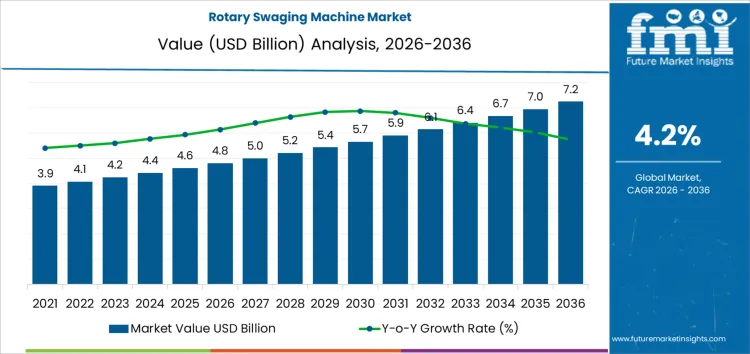
Rotary Swaging Machine Market Key Takeaways
| Metric | Value |
|---|---|
| Rotary Swaging Machine Market Value (2026) | USD 4.8 Billion |
| Rotary Swaging Machine Market Forecast Value (2036) | USD 7.2 Billion |
| Rotary Swaging Machine Market Forecast CAGR 2026 to 2036 | 4.2% |
How Are Precision Manufacturing Requirements Influencing the Rotary Swaging Machine Market?
The rotary swaging machine market is increasingly shaped by manufacturers’ need for high-precision metal forming with minimal material waste. Industries such as automotive, aerospace, medical devices, and energy are adopting rotary swaging to produce tubes, rods, and hollow components with tight dimensional tolerances and improved mechanical properties. For machine builders, demand is shifting toward systems that support complex geometries, multi-step forming, and repeatable accuracy across high production volumes, reinforcing the importance of machine rigidity and process control.
Purchasing decisions are also being influenced by automation readiness and production flexibility. End users are seeking swaging machines that integrate easily with upstream cutting systems and downstream finishing or inspection equipment. Features such as CNC control, programmable stroke profiles, and real-time force monitoring are becoming standard evaluation criteria. Suppliers offering modular platforms that can be customized for different materials steel, aluminum, titanium, and specialty alloys-are gaining preference among contract manufacturers and OEMs serving multiple end markets.
Regional manufacturing strategies are further shaping demand patterns. Expansion of precision component manufacturing in Asia Pacific is driving volume sales, while Europe and North America are generating demand for advanced, high-value swaging machines used in aerospace and medical applications. At the same time, replacement of aging mechanical equipment with energy-efficient and digitally controlled systems is supporting steady retrofit demand. For manufacturers and suppliers, competitive advantage increasingly depends on application engineering support, long-term service capability, and the ability to align machine performance with evolving precision manufacturing requirements in the rotary swaging machine market.
What Are the Key Segmentation Insights for the Rotary Swaging Machine Market?
The rotary swaging machine market is segmented by machine type and application, reflecting how forming precision and production volume requirements influence equipment selection. By machine type, radial swaging machines represent the leading segment, as they are widely used for high-accuracy metal forming and diameter reduction processes. Other machine types in the rotary swaging machine market include conventional rotary swaging machines, hydraulic swaging machines, and other specialized swaging systems designed for specific force and material requirements. By application, automotive manufacturing forms the primary demand base, supported by large-scale component production. Machinery and equipment, chemical and materials processing, and other industrial uses contribute to diversified adoption.
Why Do Radial Swaging Machines Lead The Rotary Swaging Machine Market By Machine Type?
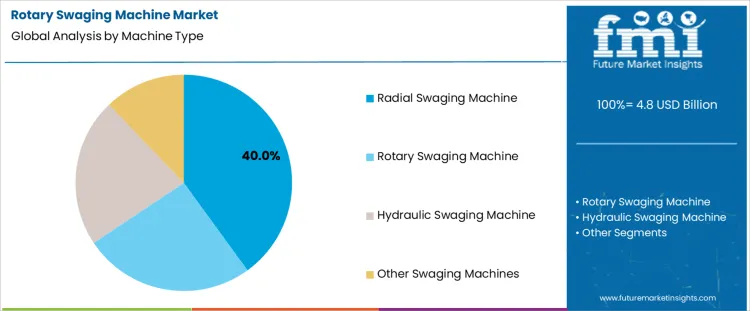
Radial swaging machines hold 40% share of the rotary swaging machine market because they provide precise dimensional control and uniform material deformation. These machines apply radial hammering forces evenly around the workpiece, enabling production of shafts, tubes, and stepped components with high repeatability. Automotive and industrial manufacturers use radial swaging machines to achieve tight tolerances without material wastage. Compatibility with automation and CNC control supports high-volume production environments. For machine suppliers, radial swaging machines offer opportunities for customization, tooling upgrades, and service contracts. This combination of precision capability, productivity, and commercial value explains their leading position.
Why Does The Automotive Sector Dominate The Rotary Swaging Machine Market By Application?
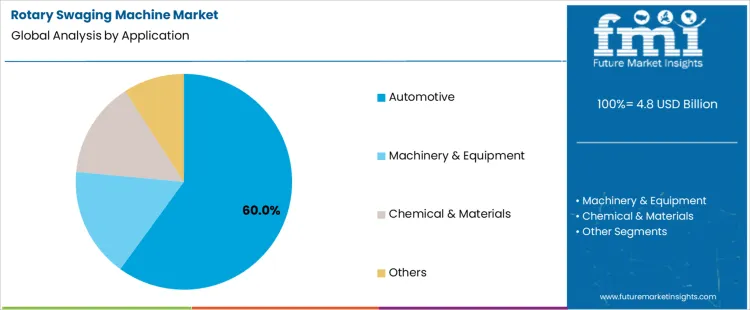
Automotive applications account for 60% share of the rotary swaging machine market because vehicle manufacturing requires large volumes of precision-formed metal components. Rotary swaging machines are used to produce drive shafts, steering components, tubular parts, and transmission elements with consistent mechanical properties. The process improves material strength through work hardening while reducing machining steps. Automotive manufacturers prioritize swaging technology to support lightweighting and high-performance design goals. Rising vehicle production and component standardization sustain equipment demand. From a supplier perspective, automotive customers offer long-term volume contracts and repeat orders. These production-driven factors explain the dominance of automotive applications.
What Are The Key Drivers Of The Rotary Swaging Machine Market?
The rotary swaging machine market is driven by increasing demand for precision cold-forming processes in automotive, aerospace, medical device, and industrial manufacturing. Rotary swaging machines enable accurate, high-repeatability reduction of tube and rod diameters, end forming, and tapering without material heating, improving mechanical properties and minimizing waste. Growth in lightweight structural components, stainless and high-strength alloy applications, and miniaturized part production supports adoption. For manufacturers and suppliers, machine rigidity, spindle configuration options, tool-change flexibility, cycle speed, and service responsiveness are critical competitive differentiators that influence procurement and long-term customer relationships.
How Are Technology Trends Influencing The Rotary Swaging Machine Market?
Technology trends are influencing the rotary swaging machine market by advancing automation, tooling systems, and digital integration. Smart servo-driven systems with closed-loop control enhance precision and reduce setup times, enabling faster production changeovers. Integration with programmable logic controllers (PLCs), human-machine interfaces (HMIs), and Industry 4.0 connectivity improves process monitoring, cycle optimization, and predictive maintenance. Adaptive tooling and quick-change modular dies support small batch and mixed-product runs, increasing utilization across multiple product lines. For suppliers, offering digital diagnostics, remote support, and customizable software enhances value propositions for manufacturers pursuing higher throughput and reduced downtime.
Why Do Cost Structures And Operational Challenges Restrain The Rotary Swaging Machine Market?
Cost structures and operational challenges restrain the rotary swaging machine market, particularly for small and mid-sized manufacturers. High upfront investment for advanced swaging systems with automation and multi-axis capabilities can limit adoption among lower-volume producers. Tooling costs for specialized swage dies and consumables increase total cost of ownership and require careful life cycle planning. In markets with limited access to skilled technicians, setup, calibration, and maintenance challenges can reduce machine utilization. Integration with existing production lines may require custom fixtures or process redesign, extending implementation timelines and elevating project risk for buyers and suppliers alike.
What Is the Country-Wise Outlook for the Rotary Swaging Machine Market?
The rotary swaging machine market is shaped by demand for precision metal forming across automotive, aerospace, medical devices, and industrial manufacturing. Adoption varies by country depending on machining sophistication, export-oriented manufacturing activity, and replacement cycles for legacy forming equipment. Developed markets emphasize accuracy, automation, and process repeatability, while emerging economies focus on capacity expansion and cost-efficient production. Growth is influenced by increasing use of lightweight alloys, tubing components, and near-net-shape forming methods. Suppliers offering robust machine design, tooling flexibility, and integration with CNC and automated production lines are better positioned to capture opportunities across key manufacturing economies.
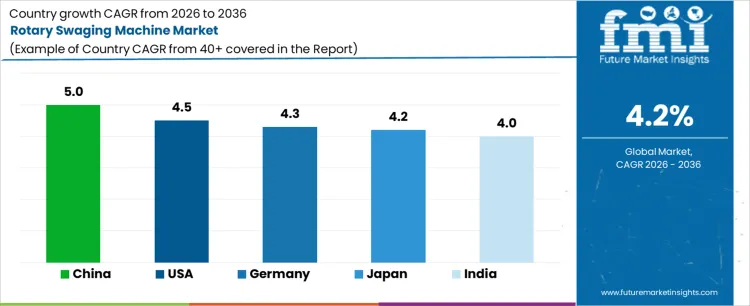
| Country | CAGR (%) |
|---|---|
| China | 5.0% |
| USA | 4.5% |
| Germany | 4.3% |
| Japan | 4.2% |
| India | 4.0% |
How Is China Driving Volume-Led Growth in the Rotary Swaging Machine Market?
Demand for rotary swaging machine in China, growing at a CAGR of 5.0% during 2026 to 2036, is supported by large-scale production of automotive components, industrial machinery parts, and export-oriented metal products. Manufacturers increasingly deploy rotary swaging for high-throughput forming of tubes, rods, and stepped shafts where dimensional consistency and material utilization are critical. Buyers prioritize machine durability, competitive pricing, and compatibility with automated and semi-automated production lines. Domestic OEMs dominate standard mechanical and hydraulic machine segments, creating intense price competition. Advanced CNC-controlled swaging systems are selectively adopted by Tier-1 suppliers and exporters supplying international markets. Government programs promoting equipment upgrades and advanced manufacturing indirectly support procurement visibility. Service availability and local spare parts access strongly influence brand selection. China remains a volume-oriented market where supplier success depends on scalable manufacturing, efficient cost structures, and localized technical support rather than high customization.
What Shapes Specification-Driven Adoption in the United States Rotary Swaging Machine Market?
Sales of rotary swaging machine in the United States, expanding at a CAGR of 4.5% during 2026 to 2036, is driven by aerospace, automotive, defense, and medical device production. Buyers emphasize tight tolerance control, repeatability, and seamless integration with CNC systems, robotic handling, and digital monitoring platforms. Replacement of legacy forming equipment supports steady investment in modern swaging solutions rather than greenfield capacity expansion. Procurement decisions focus on machine accuracy, tooling flexibility, safety compliance, and long-term reliability instead of upfront cost. Volumes remain moderate, yet unit values are higher due to customization, automation features, and application engineering requirements. Suppliers offering process simulation, tooling optimization, and on-site technical support gain preference. Qualification cycles are structured, with emphasis on documentation and performance validation.
Why Does Germany Remain a Precision-Focused Market for Rotary Swaging Machines?
The rotary swaging machine market in Germany, growing at a CAGR of 4.3% during the forecast period, reflects strong emphasis on precision engineering, material efficiency, and process stability. Automotive suppliers, machinery manufacturers, and industrial equipment producers adopt rotary swaging for tight-tolerance forming of shafts, tubes, and hollow components. Buyers prioritize build quality, vibration control, tooling accuracy, and compatibility with Industry 4.0 production environments. Demand is primarily replacement-led, as manufacturers modernize existing forming lines to improve efficiency and reduce scrap rates. Procurement processes are highly structured and specification-intensive, favoring suppliers with detailed technical documentation, proven references, and reliable service networks. Volumes are moderate, but average selling prices remain attractive due to customization and engineering depth. Germany rewards machine builders capable of delivering precision performance, modular design options, and long-term lifecycle support aligned with high-quality manufacturing standards.
How Does Japan Support Steady Demand for High-Accuracy Rotary Swaging Technology?
Demand for rotary swaging machine in Japan, expanding at a CAGR of 4.2% during 2026 to 2036, is shaped by demand from automotive, electronics, and industrial machinery sectors producing high-precision components. Buyers emphasize process control, compact machine footprints, energy efficiency, and low defect rates. Rotary swaging is selected for applications requiring consistent forming quality and minimal post-processing. Demand is supported by continuous equipment upgrades aimed at maintaining strict quality benchmarks rather than capacity expansion. Procurement decisions favor proven reliability, long service life, and strong engineering credibility. Volumes remain stable, while specification rigor supports higher-value machine sales. Suppliers offering precise tooling systems, vibration reduction technologies, and responsive technical support gain preference. Japan favors manufacturers that align with lean manufacturing principles, long-term operational stability, and incremental performance improvement rather than aggressive cost competition.
Why Is India Emerging as a Gradual Growth Market for Rotary Swaging Machines?
Sale of rotary swaging machine in India, growing at a CAGR of 4.0% during 2026 to 2036, reflects gradual uptake across automotive components, industrial fabrication, and engineering workshops. Manufacturers seek cost-effective forming solutions to improve material utilization and reduce secondary machining steps. Buyers prioritize affordability, robustness, and ease of maintenance over advanced automation features. Demand is driven by expansion of domestic manufacturing and replacement of manual or semi-automatic forming methods. Procurement decisions are highly price-sensitive, with strong influence from local distributors, financing availability, and service reach. Standard mechanical and hydraulic machines dominate sales volumes, while CNC-controlled systems see selective adoption among export-focused suppliers. India offers long-term growth potential as automation penetration increases and manufacturers progressively move toward higher-precision forming technologies supported by skill development and localized service infrastructure.
What Strategic Factors Define Competition in the Rotary Swaging Machine Market?
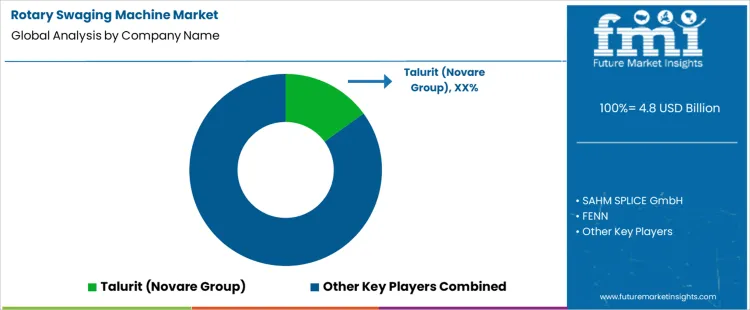
Competition in the rotary swaging machine market is shaped by process accuracy, tooling adaptability, and repeatable force control that directly influence downstream product integrity. Talurit (Novare Group) positions its rotary swaging systems around precision die synchronization and automated feeding architectures, as highlighted in official machine brochures. Emphasis is placed on consistent deformation profiles for wire rope, cable assemblies, and tubular components used in lifting and industrial safety applications. SAHM SPLICE GmbH competes through heavy-duty rotary swaging platforms designed for large cross-section components, with documentation focusing on mechanical robustness and long service intervals under high load conditions.
Application specialization remains a key differentiator. FENN emphasizes rotary swaging machines engineered for aerospace, medical, and precision tubing markets, supported by brochures detailing spindle alignment accuracy and controlled material flow. Comtech North America highlights digitally monitored swaging systems, with product literature stressing force feedback, process repeatability, and compatibility with quality traceability requirements in regulated manufacturing environments.
Complementary capabilities strengthen competitive positioning. Loos & Co., Inc. leverages swaging know-how alongside specialty wire products, aligning machine recommendations with material behavior. Kuriyama of America Inc. integrates rotary swaging within hose assembly workflows, with brochures emphasizing alignment accuracy and production efficiency. Other players add value through custom swaging heads, retrofit automation, and regional service support. Across the market, leadership is determined by documented forming precision, tooling flexibility, and integration readiness rather than equipment pricing alone.
Key Players in Rotary Swaging Machine Market
- Talurit (Novare Group)
- SAHM SPLICE GmbH
- FENN
- Comtech North America
- Loos & Co., Inc.
- Kuriyama of America Inc.
- Others
Scope of Report
| Attribute | Description |
|---|---|
| Quantitative Unit | USD Billion |
| Machine Type | Radial Swaging Machine, Rotary Swaging Machine, Hydraulic Swaging Machine, Other Swaging Machines |
| Application | Automotive, Machinery & Equipment, Chemical & Materials, Others |
| Countries Covered | China, Japan, South Korea, India, Australia & New Zealand, ASEAN, Rest of Asia Pacific, Germany, United Kingdom, France, Italy, Spain, Nordic, BENELUX, Rest of Europe, United States, Canada, Mexico, Brazil, Chile, Rest of Latin America, Kingdom of Saudi Arabia, Other GCC Countries, Turkey, South Africa, Other African Union, Rest of Middle East & Africa |
| Regions Covered | Asia Pacific, Europe, North America, Latin America, Middle East & Africa |
| Key Companies Profiled | Talurit (Novare Group), SAHM SPLICE GmbH, FENN, Comtech North America, Loos & Co., Inc., Kuriyama of America Inc., Others |
| Additional Attributes | Dollar sales by machine type and application are analyzed across precision metal forming operations. The report includes country-level demand assessment, evaluation of forming accuracy and tooling durability, assessment of automation and control system adoption, competitive benchmarking of equipment manufacturers, and analysis of capital investment and replacement trends across automotive and industrial manufacturing sectors. |
Rotary Swaging Machine Market by Key Segments
Machine Type:
- Radial Swaging Machine
- Rotary Swaging Machine
- Hydraulic Swaging Machine
- Other Swaging Machines
Application:
- Automotive
- Machinery & Equipment
- Chemical & Materials
- Others
Region:
- Asia Pacific
- China
- Japan
- South Korea
- India
- Australia & New Zealand
- ASEAN
- Rest of Asia Pacific
- Europe
- Germany
- United Kingdom
- France
- Italy
- Spain
- Nordic
- BENELUX
- Rest of Europe
- North America
- United States
- Canada
- Mexico
- Latin America
- Brazil
- Chile
- Rest of Latin America
- Middle East & Africa
- Kingdom of Saudi Arabia
- Other GCC Countries
- Turkey
- South Africa
- Other African Union
- Rest of Middle East & Africa
Bibliography
- International Organization for Standardization. (2024). ISO 16092-1:2024 Machine tools — Safety requirements for metal forming machines — Part 1: Presses — General requirements. ISO.
- United States Bureau of Labor Statistics. (2025). Manufacturing: Employment, output, and industry performance overview. U.S. Department of Labor.
- Organisation for Economic Co-operation and Development. (2024). OECD Science, Technology and Industry Scoreboard 2024: Innovation and competitiveness in manufacturing. OECD Publishing.
Frequently Asked Questions
How big is the rotary swaging machine market in 2026?
The global rotary swaging machine market is estimated to be valued at USD 4.8 billion in 2026.
What will be the size of rotary swaging machine market in 2036?
The market size for the rotary swaging machine market is projected to reach USD 7.2 billion by 2036.
How much will be the rotary swaging machine market growth between 2026 and 2036?
The rotary swaging machine market is expected to grow at a 4.2% CAGR between 2026 and 2036.
What are the key product types in the rotary swaging machine market?
The key product types in rotary swaging machine market are radial swaging machine, rotary swaging machine, hydraulic swaging machine and other swaging machines.
Which application segment to contribute significant share in the rotary swaging machine market in 2026?
In terms of application, automotive segment to command 60.0% share in the rotary swaging machine market in 2026.
Preview the report firsthand - request a free sample
Get SampleGet the brochure for pricing and purchase details.
Get PDFTable of Content
- Executive Summary
- Global Market Outlook
- Demand-side Trends
- Supply-side Trends
- Technology Roadmap Analysis
- Analysis and Recommendations
- Market Overview
- Market Coverage / Taxonomy
- Market Definition / Scope / Limitations
- Market Background
- Market Dynamics
- Drivers
- Restraints
- Opportunity
- Trends
- Scenario Forecast
- Demand in Optimistic Scenario
- Demand in Likely Scenario
- Demand in Conservative Scenario
- Opportunity Map Analysis
- Product Life Cycle Analysis
- Supply Chain Analysis
- Investment Feasibility Matrix
- Value Chain Analysis
- PESTLE and Porter’s Analysis
- Regulatory Landscape
- Regional Parent Market Outlook
- Production and Consumption Statistics
- Import and Export Statistics
- Market Dynamics
- Global Market Analysis 2021 to 2025 and Forecast, 2026 to 2036
- Historical Market Size Value (USD Million) Analysis, 2021 to 2025
- Current and Future Market Size Value (USD Million) Projections, 2026 to 2036
- Y-o-Y Growth Trend Analysis
- Absolute $ Opportunity Analysis
- Global Market Pricing Analysis 2021 to 2025 and Forecast 2026 to 2036
- Global Market Analysis 2021 to 2025 and Forecast 2026 to 2036, By Machine Type
- Introduction / Key Findings
- Historical Market Size Value (USD Million) Analysis By Machine Type , 2021 to 2025
- Current and Future Market Size Value (USD Million) Analysis and Forecast By Machine Type , 2026 to 2036
- Radial Swaging Machine
- Rotary Swaging Machine
- Hydraulic Swaging Machine
- Other Swaging Machines
- Radial Swaging Machine
- Y-o-Y Growth Trend Analysis By Machine Type , 2021 to 2025
- Absolute $ Opportunity Analysis By Machine Type , 2026 to 2036
- Global Market Analysis 2021 to 2025 and Forecast 2026 to 2036, By Application
- Introduction / Key Findings
- Historical Market Size Value (USD Million) Analysis By Application, 2021 to 2025
- Current and Future Market Size Value (USD Million) Analysis and Forecast By Application, 2026 to 2036
- Automotive
- Machinery & Equipment
- Chemical & Materials
- Others
- Automotive
- Y-o-Y Growth Trend Analysis By Application, 2021 to 2025
- Absolute $ Opportunity Analysis By Application, 2026 to 2036
- Global Market Analysis 2021 to 2025 and Forecast 2026 to 2036, By Region
- Introduction
- Historical Market Size Value (USD Million) Analysis By Region, 2021 to 2025
- Current Market Size Value (USD Million) Analysis and Forecast By Region, 2026 to 2036
- North America
- Latin America
- Western Europe
- Eastern Europe
- East Asia
- South Asia and Pacific
- Middle East & Africa
- Market Attractiveness Analysis By Region
- North America Market Analysis 2021 to 2025 and Forecast 2026 to 2036, By Country
- Historical Market Size Value (USD Million) Trend Analysis By Market Taxonomy, 2021 to 2025
- Market Size Value (USD Million) Forecast By Market Taxonomy, 2026 to 2036
- By Country
- USA
- Canada
- Mexico
- By Machine Type
- By Application
- By Country
- Market Attractiveness Analysis
- By Country
- By Machine Type
- By Application
- Key Takeaways
- Latin America Market Analysis 2021 to 2025 and Forecast 2026 to 2036, By Country
- Historical Market Size Value (USD Million) Trend Analysis By Market Taxonomy, 2021 to 2025
- Market Size Value (USD Million) Forecast By Market Taxonomy, 2026 to 2036
- By Country
- Brazil
- Chile
- Rest of Latin America
- By Machine Type
- By Application
- By Country
- Market Attractiveness Analysis
- By Country
- By Machine Type
- By Application
- Key Takeaways
- Western Europe Market Analysis 2021 to 2025 and Forecast 2026 to 2036, By Country
- Historical Market Size Value (USD Million) Trend Analysis By Market Taxonomy, 2021 to 2025
- Market Size Value (USD Million) Forecast By Market Taxonomy, 2026 to 2036
- By Country
- Germany
- UK
- Italy
- Spain
- France
- Nordic
- BENELUX
- Rest of Western Europe
- By Machine Type
- By Application
- By Country
- Market Attractiveness Analysis
- By Country
- By Machine Type
- By Application
- Key Takeaways
- Eastern Europe Market Analysis 2021 to 2025 and Forecast 2026 to 2036, By Country
- Historical Market Size Value (USD Million) Trend Analysis By Market Taxonomy, 2021 to 2025
- Market Size Value (USD Million) Forecast By Market Taxonomy, 2026 to 2036
- By Country
- Russia
- Poland
- Hungary
- Balkan & Baltic
- Rest of Eastern Europe
- By Machine Type
- By Application
- By Country
- Market Attractiveness Analysis
- By Country
- By Machine Type
- By Application
- Key Takeaways
- East Asia Market Analysis 2021 to 2025 and Forecast 2026 to 2036, By Country
- Historical Market Size Value (USD Million) Trend Analysis By Market Taxonomy, 2021 to 2025
- Market Size Value (USD Million) Forecast By Market Taxonomy, 2026 to 2036
- By Country
- China
- Japan
- South Korea
- By Machine Type
- By Application
- By Country
- Market Attractiveness Analysis
- By Country
- By Machine Type
- By Application
- Key Takeaways
- South Asia and Pacific Market Analysis 2021 to 2025 and Forecast 2026 to 2036, By Country
- Historical Market Size Value (USD Million) Trend Analysis By Market Taxonomy, 2021 to 2025
- Market Size Value (USD Million) Forecast By Market Taxonomy, 2026 to 2036
- By Country
- India
- ASEAN
- Australia & New Zealand
- Rest of South Asia and Pacific
- By Machine Type
- By Application
- By Country
- Market Attractiveness Analysis
- By Country
- By Machine Type
- By Application
- Key Takeaways
- Middle East & Africa Market Analysis 2021 to 2025 and Forecast 2026 to 2036, By Country
- Historical Market Size Value (USD Million) Trend Analysis By Market Taxonomy, 2021 to 2025
- Market Size Value (USD Million) Forecast By Market Taxonomy, 2026 to 2036
- By Country
- Kingdom of Saudi Arabia
- Other GCC Countries
- Turkiye
- South Africa
- Other African Union
- Rest of Middle East & Africa
- By Machine Type
- By Application
- By Country
- Market Attractiveness Analysis
- By Country
- By Machine Type
- By Application
- Key Takeaways
- Key Countries Market Analysis
- USA
- Pricing Analysis
- Market Share Analysis, 2025
- By Machine Type
- By Application
- Canada
- Pricing Analysis
- Market Share Analysis, 2025
- By Machine Type
- By Application
- Mexico
- Pricing Analysis
- Market Share Analysis, 2025
- By Machine Type
- By Application
- Brazil
- Pricing Analysis
- Market Share Analysis, 2025
- By Machine Type
- By Application
- Chile
- Pricing Analysis
- Market Share Analysis, 2025
- By Machine Type
- By Application
- Germany
- Pricing Analysis
- Market Share Analysis, 2025
- By Machine Type
- By Application
- UK
- Pricing Analysis
- Market Share Analysis, 2025
- By Machine Type
- By Application
- Italy
- Pricing Analysis
- Market Share Analysis, 2025
- By Machine Type
- By Application
- Spain
- Pricing Analysis
- Market Share Analysis, 2025
- By Machine Type
- By Application
- France
- Pricing Analysis
- Market Share Analysis, 2025
- By Machine Type
- By Application
- India
- Pricing Analysis
- Market Share Analysis, 2025
- By Machine Type
- By Application
- ASEAN
- Pricing Analysis
- Market Share Analysis, 2025
- By Machine Type
- By Application
- Australia & New Zealand
- Pricing Analysis
- Market Share Analysis, 2025
- By Machine Type
- By Application
- China
- Pricing Analysis
- Market Share Analysis, 2025
- By Machine Type
- By Application
- Japan
- Pricing Analysis
- Market Share Analysis, 2025
- By Machine Type
- By Application
- South Korea
- Pricing Analysis
- Market Share Analysis, 2025
- By Machine Type
- By Application
- Russia
- Pricing Analysis
- Market Share Analysis, 2025
- By Machine Type
- By Application
- Poland
- Pricing Analysis
- Market Share Analysis, 2025
- By Machine Type
- By Application
- Hungary
- Pricing Analysis
- Market Share Analysis, 2025
- By Machine Type
- By Application
- Kingdom of Saudi Arabia
- Pricing Analysis
- Market Share Analysis, 2025
- By Machine Type
- By Application
- Turkiye
- Pricing Analysis
- Market Share Analysis, 2025
- By Machine Type
- By Application
- South Africa
- Pricing Analysis
- Market Share Analysis, 2025
- By Machine Type
- By Application
- USA
- Market Structure Analysis
- Competition Dashboard
- Competition Benchmarking
- Market Share Analysis of Top Players
- By Regional
- By Machine Type
- By Application
- Competition Analysis
- Competition Deep Dive
- Talurit (Novare Group)
- Overview
- Product Portfolio
- Profitability by Market Segments (Product/Age /Sales Channel/Region)
- Sales Footprint
- Strategy Overview
- Marketing Strategy
- Product Strategy
- Channel Strategy
- SAHM SPLICE GmbH
- FENN
- Comtech North America
- Loos & Co., Inc.
- Kuriyama of America Inc.
- Others
- Talurit (Novare Group)
- Competition Deep Dive
- Assumptions & Acronyms Used
- Research Methodology


