

- Market Size (2026)
- USD 66.8 Mn
- Forecast (2036)
- USD 205.6 Mn
- CAGR (2026 to 2036)
- 11.9%
How big is the Salinity Root Protectors Market in 2026?
Demand for salinity root protectors is projected to expand at 11.9% CAGR between 2026 and 2036. Industry value grows from USD 59.7 million in 2025 to USD 66.8 million in 2026 and is projected to reach USD 205.6 million by 2036.
Increasing salt content in soil and irrigation water is creating need for salinity root protectors where drainage and leaching are not giving enough control. FAO reports 1.381 billion hectares of salt-affected soils, equal to 10.7% of global land area.[1] This exposure supports use of osmoprotectants, amino acids and agricultural biostimulants through soil, seed or irrigation programs to help roots continue water uptake. FMI values the market at USD 59.7 million in 2025 and USD 66.8 million in 2026. Revenue is anticipated to reach USD 205.6 million by 2036, exhibiting 11.9% CAGR during 2026 to 2036, while crop stage, dose and electrical conductivity may influence repeat purchase.
Application demand varies as irrigation systems and field-validation practices differ. Water-quality monitoring and irrigated acreage can upkeep repeat treatment in the USA, forecast to expand at 11.6% CAGR during 2026 to 2036. South Korea is anticipated to rise at 11.3%, supported by reclaimed-land cultivation and crop-stress research. Its Rural Development Administration dedicated funding under the smart agriculture plan to accelerate field testing.[2] According to FMI analysis, permitted applications, agronomy guidance and trials are likely to receive preference. This can shift salinity root protectors from corrective treatment towards soil and fertigation programs, creating growth prospects for suppliers.
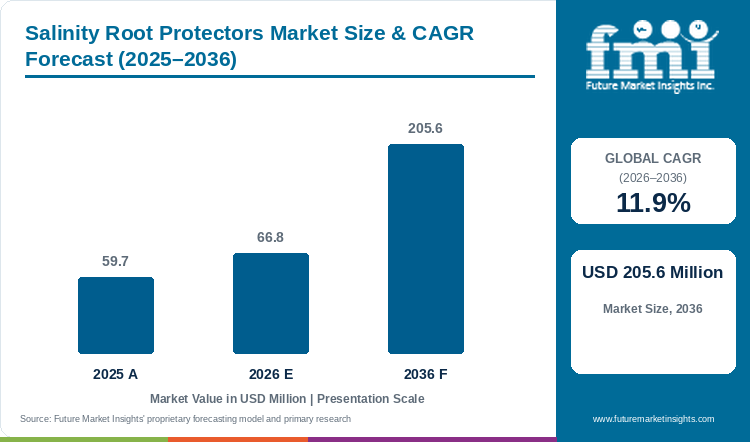
Salinity Root Protectors Market Size & CAGR Forecast (2025-2036)
| Year | Basis | Market value (USD million) |
|---|---|---|
| 2025 | Actual | 59.7 |
| 2026 | Estimate | 66.8 |
| 2036 | Forecast | 205.6 |
| CAGR, 2026 to 2036 | 11.9% | |
Source: Future Market Insights proprietary forecasting model and primary research.
Key Takeaways
- Salt exposure is supporting demand where treatment is used along with irrigation, drainage and measured field conditions.
- Based on product type, osmoprotectant blends are projected to account for 37.0% in 2026, owing to rising use for maintaining osmotic balance.
- By crop type, cereals and grains are estimated to hold 39.6% in 2026, supported by wider acreage and repeat field application.
- In 2026, soil application is expected to lead application method with 38.6% share, owing to direct placement near the root zone.
- The USA is projected to grow at 11.6% CAGR through 2036, supported by irrigated production and water quality monitoring.
- Notable companies include Seipasa, Kimitec, Plant Health Care, BRANDT, Biolchim, Valagro, UPL, and Rovensa Next.
Analyst Perspective
“I see adoption rising where measured salinity shows that normal irrigation practices are not giving enough root protection. I expect crop-specific products with local field results to gain wider use across soil and fertigation programs.”
- Nikhil Kaitwade, Principal Consultant, Future Market Insights.
How is the salinity root protectors market segmented?
The salinity root protectors market is segmented by product type, crop type, application method, farm type, sales channel, and region. In 2026, osmoprotectant blends, cereals and grains, soil application, large commercial farms, and agri-input distributors lead with 37.0%, 39.6%, 38.6%, 38.1%, and 37.2% shares, respectively.
Salinity root protectors market is segmented by product type, crop type, application method, farm type, sales channel and region.
By product type: osmoprotectant blends, seaweed-based formulations, amino acid blends, anti-transpirant combinations, and others.
By crop type: cereals and grains, fruits and vegetables, oilseeds and pulses, turf and ornamentals, and others.
By application method: soil application, foliar application, fertigation or drip, seed application, and others.
By farm type: large commercial farms, mid-size farms, smallholders, greenhouses and nurseries, and others.
By sales channel: agri-input distributors, cooperatives, agri-retail chains, online or direct-to-farm, and others.
By region: North America, Latin America, Western Europe, Eastern Europe, East Asia, South Asia and Pacific, and Middle East and Africa.
Why do osmoprotectant blends hold product type demand?
Osmoprotectant blends are anticipated to contribute 37.0% of product type revenue in 2026, owing to cellular osmotic balance maintenance.
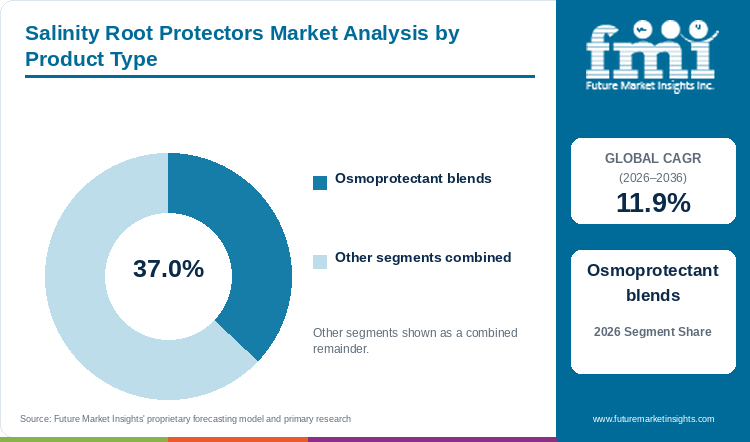
| Product type | Share (2026) |
|---|---|
| Osmoprotectant blends | 37.0% |
| Other segments combined | 63.0%* |
| Total | 100.0% |
| Metric | Value |
|---|---|
| Global CAGR (2026-2036) | 11.9% |
| Leading segment | Osmoprotectant blends |
Saline conditions reduce the water available for roots even when moisture is present in the soil. Glycine betaine and proline help crops maintain osmotic balance, functioning alongside plant growth regulators during establishment and flowering stages. FMI data suggests that crop-specific dose and application timing will support their wider adoption.
- Osmoprotectant blends are projected to hold 37.0% of product type revenue in 2026, owing to increasing use for osmotic-stress management.
- In January 2025, BRANDT issued BioFlex technical material covering crop performance under salinity, drought, and heat stress.[3]
What supports cereals and grains as the preferred crop category?
Cereals and grains are estimated to represent 39.6% of crop type demand in 2026, reflecting extensive broad-acre cultivation and planting treatments.
Cereals and grains cover a wider field area and small reduction in root uptake can affect the output from complete acreage. Salinity protectors can also be added alongside vinasse crop inputs through seed, soil and irrigation passes, without creating another field operation. In the FMI report, this application convenience is supporting repeat use across broad-acre crops.
- Cereals and grains are estimated at 39.6% of crop type revenue in 2026, supported by wider acreage and repeatable field application.
- In March 2025, Seipasa introduced SeiZen with European PFC 6(B) registration and a label spanning field and horticultural crops.[4]
How does soil application meet root-zone protection needs?
Soil application is projected to capture 38.6% of application method revenue in 2026, driven by direct placement near active root zones.
Salt first restricts water and nutrient uptake around the roots, due to which soil application provides a direct treatment route. The formulation can be added with irrigation, humic acid amendments, and fertility work and used before crop damage becomes visible. According to FMI, this direct placement is keeping soil application ahead of foliar, seed and other methods.
- Soil application is forecast at 38.6% in 2026, owing to direct placement of the product near the main salt exposure zone.
- In June 2025, Brandon Bioscience documented BLOCSAL as a salinity-focused formulation using seaweed and protein-hydrolysate inputs.[5]
Why do large commercial farms support repeatable farm-type demand?
Large commercial farms are likely to capture 38.1% of farm type demand in 2026, enabled by field-scale testing and measurement resources.
Large commercial farms utilize soil testing equipment, field mapping, and precision application tools to monitor salinity gradients. These farms can compare treated and untreated crop areas, which helps in finding whether the formulation works under the measured salt condition. FMI research indicates that acreage-scale trials are supporting wider adoption among these farms.
- Large commercial farms are projected at 38.1% in 2026, supported by water testing and acreage-scale product trials.
- FAO assembled measured soil information from 257,419 locations across more than 118 countries for its salt-affected-soils map.[6]
Which conditions keep agri-input distributors relevant in sales channels?
With an estimated 37.2% share in 2026, agri-input distributors lead the sales channel category, underpinned by localized agronomy and grower advice.
One salinity application plan cannot work across all farms as crop, soil type, irrigation water and growth stage keep changing. Agri-input distributors guide growers on tank compatibility with agricultural surfactants, dose, and application timing along with making the product locally available. As noted by FMI, this support is keeping distributors relevant where growers need help before product selection.
- Agri-input distributors are expected to hold 37.2% share in 2026, owing to local agronomy support and wider product availability.
- In November 2025, Seipasa appointed Valent BioSciences as its exclusive U.S. commercialization partner for novel biostimulants.[7]
What are the drivers, restraints, and opportunities in the salinity root protectors market?
In the salinity root protectors market, the key driver is persistent salt exposure, the principal restraint is variable field response, and the strongest opportunity is measured application within existing irrigation and fertility programs.
- Driver: Salt-affected soils and lower-quality irrigation water create root stress that growers cannot always remove during a season.
- Restraint: Crop response changes with salt level, crop stage, soil properties, drainage, and the underlying irrigation source.
- Opportunity: Sensors and decision tools can connect product timing with measured root-zone risk and local crop economics.
Salt Exposure Expands Treatment Need
Salinity intrusion is affecting crop production and the quality of agricultural resources across arid, semi-arid and coastal areas. FAO states that up to 32% of the Earth’s surface is at risk of becoming more arid and prone to salinization by the end of this century.[8] Drainage, leaching and irrigation-water management will remain the first practices for controlling salt movement. Root protectors are applied alongside commercial biofertilizers where stress continues after basic water management and treatment can be integrated into existing crop schedules.
Field Variation Raises Proof Burden
The same formulation can give a different result when electrical conductivity, ion composition, soil moisture and crop stage are changed. A 2026 review evaluated beneficial bacillus metabolites for ion balance and antioxidant response, but also identified variable composition and limited field validation.[9] Trials mentioning salt level, dose, crop stage and application timing are therefore important. Without these details, distributors can avoid recommending the product where response is difficult to repeat.
Measured Programs Improve Product Fit
Use of sensors and irrigation records is helping growers identify a salinity-risk period before visible crop damage comes out. USDA NRCS updated its national conservation standard in 2026 to emphasize root-zone electrical conductivity thresholds for managing salt accumulation.[10] Such measurement can support selection of crop sensitivity, treatment period and application threshold. Integration with smart irrigation, nano fertilizers, and crop nutrition programs is expected to create further growth prospects for salinity root protectors.
Which country CAGRs are profiled in the salinity root protectors market?
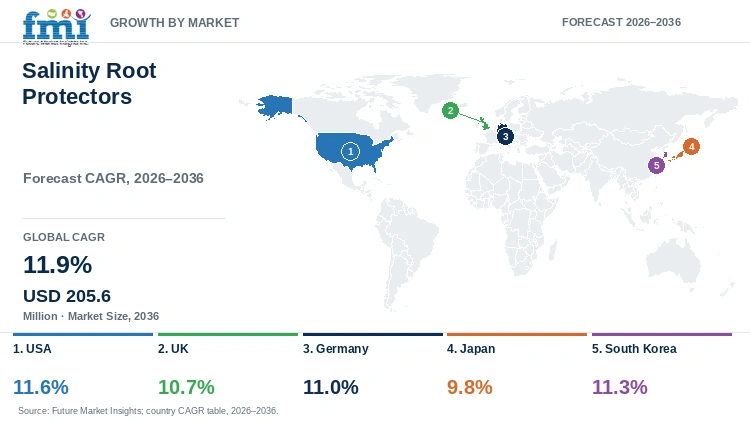
| Country | CAGR |
|---|---|
| USA | 11.6% |
| UK | 10.7% |
| Germany | 11.0% |
| Japan | 9.8% |
| South Korea | 11.3% |
How do country-level CAGRs compare in the salinity root protectors market?
As per the analysis from FMI, country growth rates differ through 2036 because irrigation practices, coastal exposure, and water-quality regulations are not uniform across markets. The USA and South Korea lead projected growth above 11.2 per cent, while Germany, the UK, and Japan follow distinct soil-protection structures.
- United States growers rely on irrigated acreage in western states, where repeat irrigation increases root-zone salinity monitoring.
- The UK focuses on localized coastal farming areas, where arable land faces tidal exposure and saline water intrusion.
- Germany combines precision water testing with strict groundwater protection standards, encouraging targeted root-zone treatment across commercial farms.
- Japan prioritizes documented crop programs and post-disaster coastal soil recovery across intensive horticultural and protected cropping systems.
- South Korea emphasizes reclaimed-land agriculture and national crop research programs to support salt-tolerant cultivation and seedling establishment.
Full report country CAGRs cover: North America; Latin America; Western Europe; Eastern Europe; East Asia; South Asia and Pacific; Middle East and Africa.
Country-wise Analysis
- Salinity root protector demand in the USA is forecast to rise at 11.6% CAGR through 2036, supported by irrigated production and water-quality monitoring. A 2025 U.S. Geological Survey update shows irrigation withdrawals remain concentrated in western states, where repeated irrigation can influence salt movement.[11] Federal research on sensors and degraded irrigation water helps identify fields where residual root stress remains after water and drainage controls. Dealers can position root protectors alongside soil rejuvenation enzymes and fertilizer programs where labels permit. Suppliers still need crop-specific labels, local trials, and timing guidance because a protector cannot correct saline water or inadequate drainage.
- The UK salinity root protectors outlook is anticipated to advance at 10.7% CAGR over the assessment period, influenced by localized coastal exposure and intensive production. In September 2025, Defra and the Rural Payments Agency published support for creating intertidal and saline habitat on eligible arable land.[12] The policy confirms that certain coastal sites face a land-use decision rather than a simple input choice. Product demand is therefore concentrated where growers retain production, measure manageable salt risk, and can test establishment or root uptake under stated conditions.
- Germany is estimated to post 11.0% CAGR over the forecast period, supported by localized irrigation pressure and groundwater-quality concerns. Germany’s Federal Environment Agency states that water management must account for regional climate conditions and agricultural demand.[13] These conditions do not produce uniform national adoption, but they strengthen the case for testing water quality, crop sensitivity, and soil placement before recommending treatment. Local validation remains necessary because soil texture, water source, and drainage determine whether a root-zone product can produce repeatable results.
- Adoption of salinity root protectors in Japan is estimated to expand at 9.8% CAGR through 2036, aided by selective coastal recovery and intensive crop management. On August 31, 2026, Japan’s agriculture ministry updated its continuing recovery program for farming areas affected by the Great East Japan Earthquake.[14] Buyers are likely to favor a defined crop use, application method, and local performance record before repeating biological inputs. Demand remains selective where protected or coastal systems can document root-zone conditions and compare treatment against irrigation and soil controls.
- By 2036, South Korea is projected to grow at 11.3% CAGR, driven by reclaimed-land agriculture and national research on salt-tolerant crops. On August 20, 2026, the Rural Development Administration reported a rice gene involved in salt-stress tolerance and described reduced water and nutrient uptake under salinity.[15] The research supports diagnosis but does not validate every commercial formulation. Credible programs should state salt level, crop stage, application timing, and the production measure used for repeat purchasing.
Who are the notable companies in the salinity root protectors market?
Seipasa, Kimitec, Plant Health Care, BRANDT, Biolchim, Valagro (Syngenta Biologicals), UPL (NPP), and Rovensa Next (Tradecorp) are notable companies profiled in this market.
Salinity root protectors market includes formulation specialists, biological technology companies and wider crop-input suppliers. Companies are working on osmoprotectants, amino acid blends, seaweed formulations, peptides and rhizosphere programs for crops under salt stress. Buyers are not selecting these products only by company size as crop suitability, dose, salt level and application method can change the result. Registration coverage, product availability, technical guidance and distributor support are expected to influence company preference across crop programs.
- Stress-specific formulators: Kimitec, Biolchim, BRANDT, and Rovensa Next.
- Integrated biological platforms: Plant Health Care, Valagro, and UPL.
- Specialty formulation and channel networks: Seipasa and BRANDT.
Competitive Benchmarking: Salinity Root Protectors Market
| Company | Root-zone depth | Application fit | Current activity | Reach |
|---|---|---|---|---|
| Seipasa | High | High | High | High |
| Kimitec | High | High | High | Medium |
| Plant Health Care | High | Medium | High | Medium |
| BRANDT | High | High | High | High |
| Biolchim | Medium | High | High | High |
| Valagro / Syngenta Biologicals | High | High | High | High |
| UPL / NPP | High | High | High | High |
| Rovensa Next / Tradecorp | High | High | High | High |
High represents broad public evidence across the stated capability, Medium represents narrower evidence, and Low represents limited documented breadth. These ratings describe public company capability and do not indicate product quality, revenue share or company ranking.
Key Developments in the Salinity Root Protectors Market
- In May 2026, UPL reported 10 technologies in its Natural Plant Protection pipeline to expand biological crop-stress solutions.[19]
- In December 2025, Rovensa Next launched Biostimulation 360° linking abiotic stress defense with nutrient use efficiency.[18]
- In September 2025, Plant Health Care published an update on PREtec elicitor technology and product-development activity.[16]
- In January 2025, Syngenta announced a collaboration with TraitSeq using artificial intelligence and biomarkers to develop next-generation biostimulants.[17]
Key Players in the Salinity Root Protectors Market
Stress-specific formulators
- Kimitec
- Biolchim
- BRANDT
- Rovensa Next
Integrated biological platforms
- Plant Health Care
- Valagro
- UPL
Specialty formulation and channel networks
- Seipasa
- BRANDT
Salinity Root Protectors Market - Report Scope
| Coverage field | Report scope |
|---|---|
| Market breakdown | Product type, crop type, application method, farm type, sales channel, and region. |
| Quantitative units | USD million. |
| Market definition | Supplier revenue from products marketed to support crop or root performance under salt-related abiotic stress. General fertilizers without a salinity-protection function, drainage infrastructure, salt-tolerant genetics, and downstream crop value are excluded. |
| Regions covered | North America; Latin America; Western Europe; Eastern Europe; East Asia; South Asia and Pacific; Middle East and Africa. |
| Countries covered | USA, UK, Germany, Japan, South Korea, and additional countries in the full report. |
| Key companies profiled | Seipasa, Kimitec, Plant Health Care, BRANDT, Biolchim, Valagro (Syngenta Biologicals), UPL (NPP), Rovensa Next (Tradecorp). |
| Forecast period | 2026 to 2036. |
| Approach | The Future Market Insights report covers supplier activity, segment structure, application routes, and country adoption conditions within the stated market boundary. |
Salinity Root Protectors Market - Research Methodology
| Method | Approach |
|---|---|
| Primary Research | Analysts gathered input from manufacturers, service providers, technology developers, distributors, end users, procurement teams, and subject-matter experts. Interviews examined purchasing decisions, product evaluation, adoption barriers, approval requirements, pricing considerations, and technical support. |
| Desk Research | Desk research covered government statistics, regulatory publications, trade data, industry associations, technical literature, standards, company filings, product information, and official corporate announcements. Sources were checked for date, geography, and direct market relevance. |
| Market Sizing and Forecasting | The model combined the baseline value with historical performance, segment structure, pricing and volume indicators, adoption levels, company participation, and country demand conditions. Forecast assumptions included regulation, technology use, purchasing cycles, and supply availability. |
| Data Validation | Estimates were checked against public data, company activity, trade patterns, and primary-research findings. Adjacent categories, unsupported claims, overlapping revenue, and activities outside the defined market were excluded. |
Salinity Root Protectors Market by Segments
Salinity Root Protectors Market segmented by Product Type:
- Osmoprotectant blends
- Seaweed-based formulations
- Amino acid blends
- Anti-transpirant combinations
- Others
Salinity Root Protectors Market segmented by Crop Type:
- Cereals and grains
- Fruits and vegetables
- Oilseeds and pulses
- Turf and ornamentals
- Others
Salinity Root Protectors Market segmented by Application Method:
- Soil application
- Foliar application
- Fertigation or drip
- Seed application
- Others
Salinity Root Protectors Market segmented by Farm Type:
- Large commercial farms
- Mid-size farms
- Smallholders
- Greenhouses and nurseries
- Others
Salinity Root Protectors Market segmented by Sales Channel:
- Agri-input distributors
- Cooperatives
- Agri-retail chains
- Online or direct-to-farm
- Others
Salinity Root Protectors Market by Region
- North America
- United States
- Canada
- Latin America
- Brazil
- Mexico
- Argentina
- Chile
- Western Europe
- Germany
- France
- United Kingdom
- Italy
- Spain
- Benelux
- Nordics
- Eastern Europe
- Poland
- Czech Republic
- Romania
- Hungary
- East Asia
- China
- Japan
- South Korea
- South Asia and Pacific
- India
- ASEAN
- Australia and New Zealand
- Middle East and Africa
- GCC Countries
- South Africa
- Türkiye
- Israel
Research Sources and Bibliography
- [1] Food and Agriculture Organization of the United Nations. (2026). International Conference on Saline Agriculture 2026.
- [2] Rural Development Administration, Republic of Korea. (2025, September 2). 2026 budget plan for smart agriculture and reclaimed-land farming.
- [3] BRANDT. (2025, January). BRANDT BioFlex technical document.
- [4] Seipasa. (2025, March 28). Seipasa introduces SeiZen with European registration.
- [5] Brandon Bioscience. (2025, June 10). Biostimulant for managing irrigation salinity stress.
- [6] Food and Agriculture Organization of the United Nations. (2026). Global Map of Salt-Affected Soils.
- [7] Seipasa. (2025, November 18). Strategic partnership with Valent BioSciences in the United States.
- [8] Food and Agriculture Organization of the United Nations. (2026). Global saline-agriculture context.
- [9] Alrasheed, R., Naamala, J., Subramanian, S., & Smith, D. L. (2026, May 28). Bacterial cell-free supernatants for salinity stress. Frontiers in Plant Science, 17.
- [10] U.S. Department of Agriculture, Natural Resources Conservation Service. (2026). Conservation Practice Standard: Saline and Sodic Soil Management (Code 610).
- [11] U.S. Geological Survey. (2025). Water use in the United States.
- [12] Department for Environment, Food & Rural Affairs and Rural Payments Agency. (2025, September 10). CCT4: Create intertidal and saline habitat on arable land.
- [13] German Environment Agency. (2026). Water management.
- [14] Ministry of Agriculture, Forestry and Fisheries of Japan. (2026, August 31). Recovery measures following the Great East Japan Earthquake.
- [15] Rural Development Administration, Republic of Korea. (2026, August 20). Gene regulating salt-stress tolerance in rice.
- [16] Plant Health Care. (2025, September 3). PREtec elicitor technology update.
- [17] Syngenta. (2025, January 9). Artificial intelligence and biomarkers for next-generation biostimulants.
- [18] Rovensa Next. (2025, December 5). Biostimulation 360°.
- [19] UPL Limited. (2026, May 11). Capital Markets Day 2025 transcript.
This bibliography is provided for reader reference. The full report contains the complete reference list and detailed citations.
This Report Answers
- What is Salinity Root Protectors Market worth during 2026?
- What value is Salinity Root Protectors Market projected by 2036?
- Which product type holds notable Salinity Root Protectors Market share?
- Which crop type holds notable Salinity Root Protectors Market share?
- Which countries have notable Salinity Root Protectors Market growth?
- Which companies are notable in Salinity Root Protectors Market today?
Frequently Asked Questions
How large is the Salinity Root Protectors Market expected to be in 2026?
Future Market Insights estimates that the salinity root protectors market will reach USD 66.8 million in 2026. The market is projected to expand further and reach USD 205.6 million by 2036.
What CAGR is forecast for the Salinity Root Protectors Market through 2036?
As per FMI, the salinity root protectors market is projected to grow at an 11.9% CAGR from 2026 to 2036. Growth is supported by salt-affected agricultural land and wider use of crop-specific application programs.
Which product type holds a notable salinity root protectors demand share in 2026?
Future Market Insights projects osmoprotectant blends to hold 37.0% of product type demand in 2026. The segment benefits from rising use for maintaining cellular osmotic balance around saline roots.
Which crop type holds a notable salinity root protectors share in 2026?
FMI finds that cereals and grains will hold 39.6% of crop type demand in 2026. Demand is supported by wider planted acreage and suitability across seed, soil and irrigation passes.
Which country has a notable salinity root protectors expansion outlook during the forecast period?
Future Market Insights predicts the USA to expand at an 11.6% CAGR during the 2026 to 2036 assessment period. Growth is supported by irrigated acreage in western states and increasing field water-quality monitoring.
Which companies are active in the Salinity Root Protectors Market during 2026?
As per FMI analysis, notable companies include Seipasa, Kimitec, Plant Health Care, BRANDT, Biolchim, Valagro, UPL, and Rovensa Next. These companies are focusing on biological formulation, registration expansion, and crop-level technical support.
Preview the report firsthand - request a free sample
Get SampleGet the brochure for pricing and purchase details.
Get PDFTable of Content
- Key Takeaways
- Market Size and CAGR
- Top Growth Driver
- Fastest Growing Segment
- Leading Region
- Key Companies
- Emerging Opportunities
- Executive Summary
- Global Market Outlook
- Demand-side Trends
- Supply-side Trends
- Technology Roadmap Analysis
- Analysis and Recommendations
- Analyst Perspective (What is happening? Why now? What should investors know?)
- Key Questions Answered
- How large is the market?
- What is the CAGR?
- What are key trends?
- Which region dominates?
- Who are the leaders?
- Market Overview
- Market Coverage / Taxonomy
- Market Definition / Scope / Limitations
- Research Methodology
- Chapter Orientation
- Analytical Lens and Working Hypotheses
- Market Structure, Signals, and Trend Drivers
- Benchmarking and Cross-market Comparability
- Market Sizing, Forecasting, and Opportunity Mapping
- Research Design and Evidence Framework
- Desk Research Programme (Secondary Evidence)
- Expert Input and Fieldwork (Primary Evidence)
- Tooling, Models, and Reference Databases
- Data Engineering and Model Build
- Quality Assurance and Audit Trail
- Market Background
- Market Dynamics (Drivers, Restraints, Opportunity, Trends)
- Scenario Forecast (Optimistic, Likely, Conservative)
- Impact Analysis
- AI Impact
- Sustainability Impact
- Regulatory Impact
- Technology Impact
- Consumer / Buyer Analysis
- Purchase Drivers
- Adoption Barriers
- Buyer Journey
- Opportunity Map Analysis
- Product Life Cycle Analysis
- Supply Chain Analysis
- Investment Feasibility Matrix
- Value Chain Analysis
- PESTLE and Porter's Analysis
- Regulatory Landscape
- Regional Parent Market Outlook
- Production and Consumption Statistics
- Import and Export Statistics
- Global Market Analysis and Forecast, 2021 to 2036
- Historical Market Size Value (USD Million) Analysis, 2021 to 2025
- Current and Future Market Size Value (USD Million) Projections, 2026 to 2036
- Y-o-Y Growth Trend Analysis
- Absolute $ Opportunity Analysis
- Global Market Pricing Analysis, 2021 to 2036
- Global Market Analysis and Forecast, By Product Type, 2021 to 2036
- Introduction / Key Findings
- Historical Market Size Value (USD Million) Analysis By Product Type, 2021 to 2025
- Current and Future Market Size Value (USD Million) Analysis and Forecast By Product Type, 2026 to 2036
- Osmoprotectant blends
- Seaweed-based formulations
- Amino acid blends
- Anti-transpirant combinations
- Others
- Y-o-Y Growth Trend Analysis By Product Type, 2021 to 2025
- Absolute $ Opportunity Analysis By Product Type, 2026 to 2036
- Global Market Analysis and Forecast, By Crop Type, 2021 to 2036
- Introduction / Key Findings
- Historical Market Size Value (USD Million) Analysis By Crop Type, 2021 to 2025
- Current and Future Market Size Value (USD Million) Analysis and Forecast By Crop Type, 2026 to 2036
- Cereals and grains
- Fruits and vegetables
- Oilseeds and pulses
- Turf and ornamentals
- Others
- Y-o-Y Growth Trend Analysis By Crop Type, 2021 to 2025
- Absolute $ Opportunity Analysis By Crop Type, 2026 to 2036
- Global Market Analysis and Forecast, By Application Method, 2021 to 2036
- Introduction / Key Findings
- Historical Market Size Value (USD Million) Analysis By Application Method, 2021 to 2025
- Current and Future Market Size Value (USD Million) Analysis and Forecast By Application Method, 2026 to 2036
- Soil application
- Foliar application
- Fertigation or drip
- Seed application
- Others
- Y-o-Y Growth Trend Analysis By Application Method, 2021 to 2025
- Absolute $ Opportunity Analysis By Application Method, 2026 to 2036
- Global Market Analysis and Forecast, By Farm Type, 2021 to 2036
- Introduction / Key Findings
- Historical Market Size Value (USD Million) Analysis By Farm Type, 2021 to 2025
- Current and Future Market Size Value (USD Million) Analysis and Forecast By Farm Type, 2026 to 2036
- Large commercial farms
- Mid-size farms
- Smallholders
- Greenhouses and nurseries
- Others
- Y-o-Y Growth Trend Analysis By Farm Type, 2021 to 2025
- Absolute $ Opportunity Analysis By Farm Type, 2026 to 2036
- Global Market Analysis and Forecast, By Sales Channel, 2021 to 2036
- Introduction / Key Findings
- Historical Market Size Value (USD Million) Analysis By Sales Channel, 2021 to 2025
- Current and Future Market Size Value (USD Million) Analysis and Forecast By Sales Channel, 2026 to 2036
- Agri-input distributors
- Cooperatives
- Agri-retail chains
- Online or direct-to-farm
- Others
- Y-o-Y Growth Trend Analysis By Sales Channel, 2021 to 2025
- Absolute $ Opportunity Analysis By Sales Channel, 2026 to 2036
- Global Market Analysis and Forecast, By Region, 2021 to 2036
- Introduction
- Historical Market Size Value (USD Million) Analysis By Region, 2021 to 2025
- Current Market Size Value (USD Million) Analysis and Forecast By Region, 2026 to 2036
- North America
- Latin America
- Western Europe
- Eastern Europe
- East Asia
- South Asia and Pacific
- Middle East and Africa
- Market Attractiveness Analysis By Region
- North America Market Analysis and Forecast, By Country, 2021 to 2036
- Historical Market Size Value (USD Million) Trend Analysis By Market Taxonomy, 2021 to 2025
- Market Size Value (USD Million) Forecast By Market Taxonomy, 2026 to 2036
- By Country
- United States
- Canada
- By Product Type
- By Crop Type
- By Application Method
- By Farm Type
- By Sales Channel
- By Country
- Market Attractiveness Analysis
- By Country
- By Product Type
- By Crop Type
- By Application Method
- By Farm Type
- By Sales Channel
- Key Takeaways
- Latin America Market Analysis and Forecast, By Country
- Historical Market Size Value (USD Million) Trend Analysis By Market Taxonomy, 2021 to 2025
- Market Size Value (USD Million) Forecast By Market Taxonomy, 2026 to 2036
- By Country
- Brazil
- Mexico
- Argentina
- Chile
- By Product Type
- By Crop Type
- By Application Method
- By Farm Type
- By Sales Channel
- By Country
- Market Attractiveness Analysis
- By Country
- By Product Type
- By Crop Type
- By Application Method
- By Farm Type
- By Sales Channel
- Key Takeaways
- Western Europe Market Analysis and Forecast, By Country
- Historical Market Size Value (USD Million) Trend Analysis By Market Taxonomy, 2021 to 2025
- Market Size Value (USD Million) Forecast By Market Taxonomy, 2026 to 2036
- By Country
- Germany
- France
- United Kingdom
- Italy
- Spain
- Benelux
- Nordics
- By Product Type
- By Crop Type
- By Application Method
- By Farm Type
- By Sales Channel
- By Country
- Market Attractiveness Analysis
- By Country
- By Product Type
- By Crop Type
- By Application Method
- By Farm Type
- By Sales Channel
- Key Takeaways
- Eastern Europe Market Analysis and Forecast, By Country
- Historical Market Size Value (USD Million) Trend Analysis By Market Taxonomy, 2021 to 2025
- Market Size Value (USD Million) Forecast By Market Taxonomy, 2026 to 2036
- By Country
- Poland
- Czech Republic
- Romania
- Hungary
- By Product Type
- By Crop Type
- By Application Method
- By Farm Type
- By Sales Channel
- By Country
- Market Attractiveness Analysis
- By Country
- By Product Type
- By Crop Type
- By Application Method
- By Farm Type
- By Sales Channel
- Key Takeaways
- East Asia Market Analysis and Forecast, By Country
- Historical Market Size Value (USD Million) Trend Analysis By Market Taxonomy, 2021 to 2025
- Market Size Value (USD Million) Forecast By Market Taxonomy, 2026 to 2036
- By Country
- China
- Japan
- South Korea
- By Product Type
- By Crop Type
- By Application Method
- By Farm Type
- By Sales Channel
- By Country
- Market Attractiveness Analysis
- By Country
- By Product Type
- By Crop Type
- By Application Method
- By Farm Type
- By Sales Channel
- Key Takeaways
- South Asia and Pacific Market Analysis and Forecast, By Country
- Historical Market Size Value (USD Million) Trend Analysis By Market Taxonomy, 2021 to 2025
- Market Size Value (USD Million) Forecast By Market Taxonomy, 2026 to 2036
- By Country
- India
- ASEAN
- Australia and New Zealand
- By Product Type
- By Crop Type
- By Application Method
- By Farm Type
- By Sales Channel
- By Country
- Market Attractiveness Analysis
- By Country
- By Product Type
- By Crop Type
- By Application Method
- By Farm Type
- By Sales Channel
- Key Takeaways
- Middle East and Africa Market Analysis and Forecast, By Country
- Historical Market Size Value (USD Million) Trend Analysis By Market Taxonomy, 2021 to 2025
- Market Size Value (USD Million) Forecast By Market Taxonomy, 2026 to 2036
- By Country
- GCC Countries
- South Africa
- Türkiye
- Israel
- By Product Type
- By Crop Type
- By Application Method
- By Farm Type
- By Sales Channel
- By Country
- Market Attractiveness Analysis
- By Country
- By Product Type
- By Crop Type
- By Application Method
- By Farm Type
- By Sales Channel
- Key Takeaways
- Key Countries Market Analysis
- United States
- Pricing Analysis
- Market Share Analysis, 2025
- By Product Type
- By Crop Type
- By Application Method
- By Farm Type
- By Sales Channel
- Canada
- Pricing Analysis
- Market Share Analysis, 2025
- By Product Type
- By Crop Type
- By Application Method
- By Farm Type
- By Sales Channel
- Mexico
- Pricing Analysis
- Market Share Analysis, 2025
- By Product Type
- By Crop Type
- By Application Method
- By Farm Type
- By Sales Channel
- Brazil
- Pricing Analysis
- Market Share Analysis, 2025
- By Product Type
- By Crop Type
- By Application Method
- By Farm Type
- By Sales Channel
- Chile
- Pricing Analysis
- Market Share Analysis, 2025
- By Product Type
- By Crop Type
- By Application Method
- By Farm Type
- By Sales Channel
- Germany
- Pricing Analysis
- Market Share Analysis, 2025
- By Product Type
- By Crop Type
- By Application Method
- By Farm Type
- By Sales Channel
- United Kingdom
- Pricing Analysis
- Market Share Analysis, 2025
- By Product Type
- By Crop Type
- By Application Method
- By Farm Type
- By Sales Channel
- Italy
- Pricing Analysis
- Market Share Analysis, 2025
- By Product Type
- By Crop Type
- By Application Method
- By Farm Type
- By Sales Channel
- Spain
- Pricing Analysis
- Market Share Analysis, 2025
- By Product Type
- By Crop Type
- By Application Method
- By Farm Type
- By Sales Channel
- France
- Pricing Analysis
- Market Share Analysis, 2025
- By Product Type
- By Crop Type
- By Application Method
- By Farm Type
- By Sales Channel
- India
- Pricing Analysis
- Market Share Analysis, 2025
- By Product Type
- By Crop Type
- By Application Method
- By Farm Type
- By Sales Channel
- ASEAN
- Pricing Analysis
- Market Share Analysis, 2025
- By Product Type
- By Crop Type
- By Application Method
- By Farm Type
- By Sales Channel
- Australia and New Zealand
- Pricing Analysis
- Market Share Analysis, 2025
- By Product Type
- By Crop Type
- By Application Method
- By Farm Type
- By Sales Channel
- China
- Pricing Analysis
- Market Share Analysis, 2025
- By Product Type
- By Crop Type
- By Application Method
- By Farm Type
- By Sales Channel
- Japan
- Pricing Analysis
- Market Share Analysis, 2025
- By Product Type
- By Crop Type
- By Application Method
- By Farm Type
- By Sales Channel
- South Korea
- Pricing Analysis
- Market Share Analysis, 2025
- By Product Type
- By Crop Type
- By Application Method
- By Farm Type
- By Sales Channel
- Poland
- Pricing Analysis
- Market Share Analysis, 2025
- By Product Type
- By Crop Type
- By Application Method
- By Farm Type
- By Sales Channel
- Hungary
- Pricing Analysis
- Market Share Analysis, 2025
- By Product Type
- By Crop Type
- By Application Method
- By Farm Type
- By Sales Channel
- Türkiye
- Pricing Analysis
- Market Share Analysis, 2025
- By Product Type
- By Crop Type
- By Application Method
- By Farm Type
- By Sales Channel
- South Africa
- Pricing Analysis
- Market Share Analysis, 2025
- By Product Type
- By Crop Type
- By Application Method
- By Farm Type
- By Sales Channel
- United States
- Market Structure Analysis
- Competition Dashboard
- Competition Benchmarking
- Market Share Analysis of Top Players
- By Regional
- By Product Type
- By Crop Type
- By Application Method
- By Farm Type
- By Sales Channel
- Emerging Startups
- Innovation Benchmarking
- Competition Analysis
- Competition Deep Dive
- Seipasa
- Overview
- Product Portfolio
- Profitability by Market Segments
- Sales Footprint
- Strategy Overview
- Marketing Strategy
- Product Strategy
- Channel Strategy
- Kimitec
- Plant Health Care
- BRANDT
- Biolchim
- Valagro / Syngenta Biologicals
- UPL / NPP
- Rovensa Next / Tradecorp
- Rovensa Next
- Valagro
- UPL
- Seipasa
- Case Studies
- Success Stories
- Recent Developments
- Competition Deep Dive
- Assumptions & Acronyms Used


