

- Market Size (2026)
- USD 831.8 Mn
- Forecast (2036)
- USD 2448.3 Mn
- CAGR (2026 to 2036)
- 11.4%
How big is Single-Serve Patisserie Market in 2026?
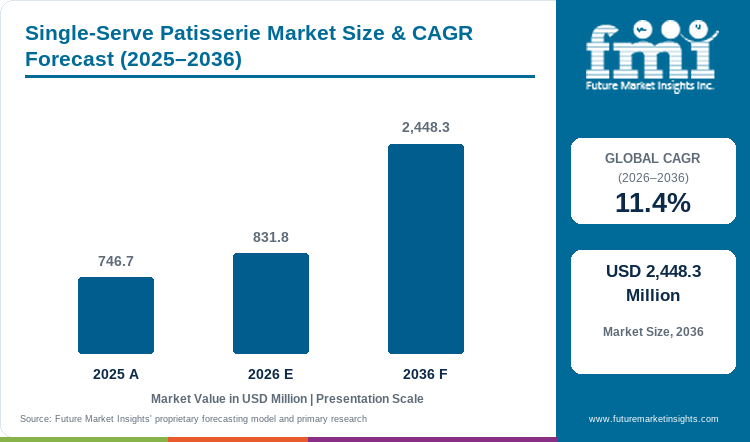
USD 831.8 million in 2026 and USD 2,448.3 million by 2036, expanding at 11.4% CAGR.
Demand for single-serve patisserie is projected to expand at 11.4% CAGR between 2026 and 2036, growing from USD 746.7 million in 2025 to USD 831.8 million in 2026, and escalating to USD 2,448.3 million by 2036. Convenience retailers gain more selling occasions when staff can stock a finished portion without slicing or assembly. Finsbury Food Group reported in January 2026 that mini and snackable cake formats were gaining traction in convenience channels. That shift makes predictable portion cost and fast replenishment important to repeat ordering for stores serving immediate and take-home dessert occasions.
National hospitality activity changes how quickly the same finished portion converts into repeat volume for commercial accounts. The UAE is at 12.7% CAGR compared with Germany at 11.4% because hotel dining gives the Gulf market more high-turnover premium occasions. The UAE Ministry of Economy and Tourism reported in April 2026 that national hotel guests reached 32.34 million during 2025 and increased 5.2% from 2024. Germany follows a different purchase route because portioned products must earn space beside a dense specialist bakery channel. The comparison separates outlet expansion from handling efficiency rather than treating a higher CAGR as proof of a larger present market.
Key Takeaways
- Convenience-led dessert occasions increase demand for portions that reduce service steps without weakening finished presentation.
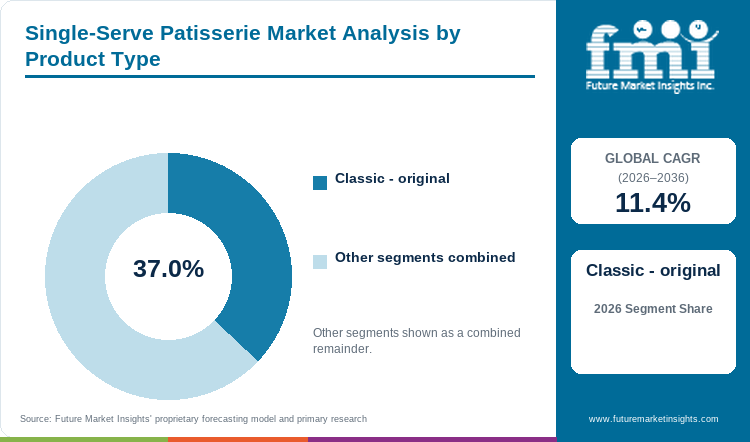
- Based on product type, classic - original is projected to account for 37.0% in 2026, driven by familiar profiles that reduce assortment risk for high-throughput bakery channels.
- By claim - nature, conventional is estimated to hold 48.0% in 2026, supported by flexible formulations that protect mainstream pricing and shelf-life requirements.
- In 2026, fresh is expected to lead format with 35.0% share, attributable to immediate visual quality that supports bakery-led impulse purchases.
- Per-serving packaging and short selling windows can erode margins when protection requirements exceed a smaller portion’s value.
- Some of the key players in this market include Rich Products Corporation, Sara Lee Frozen Bakery, LLC, Dessert Holdings US Co., Emmi Desserts, Finsbury Food Group Limited, Premier Foods plc, McKee Foods Corporation, The J.M. Smucker Co. (Hostess®), Bauli Group, and Dr. Oetker.
Analyst Perspective
“Retailers keep individual patisserie only when the eating experience survives the chosen supply format and still produces acceptable yield. Suppliers should design portion size and handling instructions together because both determine repeat ordering at the selling point.”
- Nandini Roy Choudhury, Principal Consultant, Future Market Insights
How is the single-serve patisserie market segmented?
The single-serve patisserie market is segmented by product type, claim - nature, format, packaging format, sales channel, and region.
Product type includes classic - original, whole grain & seeded, flavored & filled, mini & snacking formats, and premium - artisan. Claim - nature includes conventional, clean label, organic, gluten-free, and high-protein - fortified product positions in the category. Format includes fresh, frozen, ambient packaged, chilled, and par-baked - thaw-and-serve product types in the category. Packaging format includes multipack, single-serve, family - loaf pack, and bulk foodservice configurations for retail or commercial sale. Sales channels include supermarkets & hypermarkets, artisan & specialty bakeries, convenience & forecourt, online & DTC, and foodservice distributors.
How does classic - original shape demand within the product type category?
Retail and foodservice buyers use familiar cake and pastry profiles as a lower-risk base for portioned ranges. Traditional cheesecake and croissant programs need little explanation at the point of sale and can support breakfast or dessert occasions. Mademoiselle Desserts documented in April 2025 that its spring range paired familiar British and French classics with seasonal variants. The example shows how a known base flavor lets a supplier rotate toppings or fillings without changing the buyer’s basic merchandising logic. Classic formats therefore reduce the number of unfamiliar variables that a category team must accept during trial and repeat listing decisions.
- By product type, classic - original is forecast to represent 37.0% in 2026, driven by familiar flavor expectations that reduce assortment risk for repeat bakery purchases.
- A familiar base also lets suppliers test seasonal variants without rebuilding the retailer’s display or serving routine.
What supports conventional demand within the claim - nature category?
Conventional recipes give manufacturers broad ingredient and process choices when shelf life must coexist with price control. Finsbury Food Group explained in June 2026 that free-from bakery demand requires manufacturers to manage ingredient substitution and production controls without losing taste. Those requirements resemble the qualification burden seen in better-for-you snacks where claims must justify additional formulation work. Conventional patisserie avoids some of that burden because suppliers can use routine recipes and sourcing routes. Retailers still add clean-label or free-from lines when a defined shopper need supports the added controls and a clear price architecture.
- Conventional is set to lead the claim - nature category with 48.0% share in 2026, supported by formulation flexibility that protects mainstream price points and shelf-life targets.
- Claim-led alternatives gain space when a defined shopper need justifies added ingredient controls and production separation.
What makes fresh central to the format category?
Fresh portions convert bakery appearance directly at the counter and let shoppers judge finish quality before purchase. Rich Products reported in February 2025 that in-store bakeries were emphasizing freshness together with convenience and customization. Those priorities shape display decisions because a fresh-looking item still needs predictable replenishment and a selling window that protects margin. Retailers may use frozen bakery supply behind the counter when centralized production supports a fresh presentation after thawing. The buyer therefore evaluates appearance and back-of-house control together instead of treating freshness as a manufacturing method by itself.
- The format category is forecast to be led by fresh at 35.0% share in 2026, driven by visible finish and immediate consumption cues in bakery-led merchandising.
- Operators protect margin by matching display quantity with selling life instead of maximizing exposed portions during every trading period.
How does multipack influence selection within the packaging format category?
Multipacks let households buy several controlled portions without repeating the transaction cost of individual purchases. Dr. Oetker announced in May 2025 that PAULA Snack would launch as a four-pack of individually portioned cake snacks. The example links household value with portion control because each serving remains discrete inside one retail unit. Pack design still needs enough protection after opening so later servings remain acceptable during household storage. The same requirement affects bakery packaging machines when manufacturers specify count accuracy and protective wrapping. Retailers favor multipacks when the pack preserves individual use while keeping shelf price and secondary packaging efficient.
- By packaging format, multipack is forecast to represent 37.0% in 2026, supported by household value from grouping several controlled portions in one retail purchase.
- Retailers gain promotional flexibility when remaining servings stay protected after consumers open the outer package at home.
What supports supermarkets & hypermarkets within the sales channel category?
Supermarkets can place fresh portions in bakery fixtures and frozen items in dedicated cabinets during the same shopping trip. Finsbury Food Group explained in March 2026 that bakery suppliers must coordinate factory output with supermarket shelf requirements and delivery schedules. That operating link gives category teams several price and temperature choices without moving shoppers into another channel. Supermarkets can also compare individual patisserie with larger bakery products during the same assortment review. Shelf retention still depends on turnover because every fresh or chilled position competes for labor and space with adjacent lines.
- Supermarkets & hypermarkets are likely to capture 31.0% of sales channel demand in 2026, driven by their ability to merchandise fresh, frozen, chilled, and ambient formats in one store.
- Shelf retention depends on rotation speed because chilled and fresh positions compete for labor and refrigerated space.
What are the drivers, restraints and opportunities in the Single-Serve Patisserie Market?
Portable eating occasions increase demand for ready portions, packaging rules raise per-serving design pressure, and frozen-to-fresh service models widen assortment without adding scratch production.
- Driver: Food-to-go occasions reward portions that travel easily and require limited finishing before sale.
- Restraint: Individual packs expose more material and redesign cost per serving as packaging requirements become stricter.
- Opportunity: Frozen and thaw-and-serve supply can support premium displays where stores cannot justify full scratch production.
Portable Formats Convert Faster Service into Repeat Orders
Food-to-go buyers need indulgent bakery items that can enter a snack purchase without slowing counter service. Finsbury Food Group reported in January 2026 that portion-controlled and miniaturized formats were gaining attention as shoppers spread eating occasions through the day. Staff can stock a finished portion without slicing or assembly and keep serving time predictable. The same workflow supports adjacent ready-to-eat food where the purchase depends on immediate availability. Case count and serving size still need to match real sell-through because oversupply turns convenience into waste. Suppliers secure repeat orders when portion economics remain stable during busy periods and quieter trading windows.
Packaging Rules Raise the Cost of Protecting One Portion
Single portions require enough barrier and physical protection to preserve appearance during distribution and display. The European Commission stated in August 2026 that the Packaging and Packaging Waste Regulation had entered into application with requirements covering recyclability and packaging reduction. A patisserie supplier cannot treat that rule as a packaging-only issue because material reduction can affect crush resistance and shelf life. Buyers must qualify redesigned packs against the same visual and freshness standards used for the food itself. Suppliers that reduce material without increasing damage or store handling can protect unit economics. A failed redesign transfers apparent packaging savings into product waste and rejected deliveries that weaken the buyer’s margin.
Frozen Supply Can Separate Production from Point-of-Sale Presentation
Retailers can broaden cake choice when centralized production leaves stores with only the final merchandising step. Premier Foods launched limited-edition Mr Kipling Simnel Slices in March 2025 and moved a traditional Easter flavor into a smaller convenient slice format. The launch shows how a manufacturer can convert a larger sharing occasion into a portioned retail offer without adding scratch production at store level. Suppliers can extend that route with frozen or thaw-and-serve formats when thaw time and display life remain controlled. The approach gives retailers more seasonal rotation without adding comparable labor at each selling location. This route works where portion size fits the planned selling window and shopper mission.
Which country CAGRs are profiled in the Single-Serve Patisserie Market?
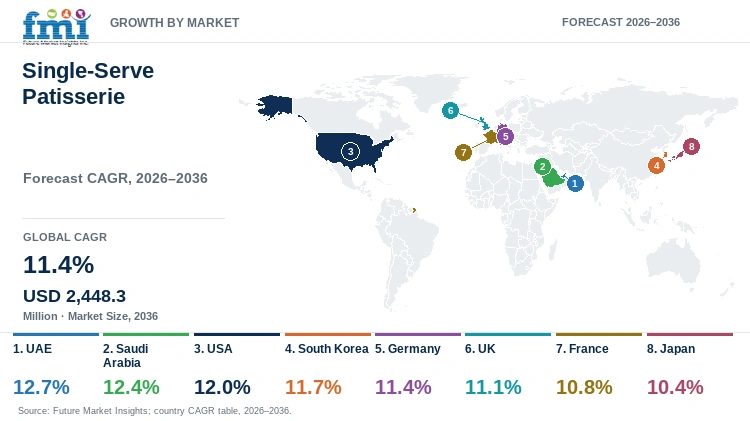
| Country | CAGR |
|---|---|
| UAE | 12.7% |
| Saudi Arabia | 12.4% |
| USA | 12.0% |
| South Korea | 11.7% |
| Germany | 11.4% |
| UK | 11.1% |
| France | 10.8% |
| Japan | 10.4% |
How do country-level CAGRs compare in the Single-Serve Patisserie Market?
The countries span 2.3 percentage points from the UAE at 12.7% to Japan at 10.4%. Gulf markets form the upper group because hospitality adds high-turnover premium occasions, while mature bakery countries convert growth through mature retail and specialist channels rather than a simple expansion in outlet count.
- UAE hospitality accounts provide repeated dessert occasions and support faster rotation of premium individual portions.
- Saudi Arabian foodservice operators have a large national revenue base that supports scaled dessert distribution.
- USA growth depends on fitting existing grocery and foodservice routines with low-handling portion formats.
- South Korean delivery usage makes pack integrity and fast handoff important to portioned dessert selection.
- German bakery density creates broad access but labor and input costs increase pressure for efficient formats.
- UK households continue buying cakes and pastries even as value pressure changes portion and price decisions.
- French specialist bakery density raises the presentation standard for supermarket and hospitality patisserie ranges.
- Japanese household structure supports controlled portions but buyers still expect exact quality and pack discipline.
Comparable CAGRs can still produce different sales tasks because local outlet structure changes service cost and repeat-order economics. The full report provides country-level CAGR analysis across North America, Latin America, Western Europe, Eastern Europe, East Asia, South Asia and Pacific, and the Middle East and Africa.
Country-wise Analysis
- Hotel and restaurant accounts give UAE dessert suppliers a national base of high-turnover premium occasions. By 2036, the UAE is projected to grow at 12.7% CAGR, driven by national hotel traffic that increases dessert service frequency for hospitality operators. The Ministry of Economy and Tourism reported in April 2026 that hotel guests reached 32.34 million during 2025 and grew 5.2% from 2024. Products still need heat-stable packs and reliable cold handling during distribution to busy hospitality accounts. Suppliers offering frozen pastries or chilled portions can shorten store preparation where thaw instructions and display life remain predictable for hotel and café teams during peak visitor periods.
- Saudi foodservice accounts operate at national scale and create regular demand for desserts that can be portioned without skilled finishing. Saudi Arabia's single-serve patisserie outlook is anticipated to advance at 12.4% CAGR over the assessment period, supported by food and beverage service activity that sustains repeat portion demand for commercial accounts. The General Authority for Statistics reported in December 2025 that food and beverage services generated 53.6% of combined accommodation and food-service operating revenue during 2024. Operators still face storage and service consistency requirements that become harder to control across dispersed national sites. Suppliers improve account retention when case configuration matches each outlet’s serving rate and reduces product loss between scheduled deliveries nationwide.
- USA grocery and foodservice channels already give single portions several proven selling routes to shoppers nationwide. Single-serve patisserie demand in the USA is forecast to rise at 12.0% CAGR over the forecast period, attributable to food-away-from-home spending that gives operators established channels for finished dessert portions. USDA Economic Research Service reported in June 2026 that food away from home represented 56.3% of total USA food expenditures during 2025. Retailers compare these portions with wider convenience food ranges during routine assortment and space planning. The constraint is yield control because national accounts expect stable portion cost and predictable labor before expanding distribution into more stores and service points.
- Delivery-oriented foodservice makes packaging performance unusually important for single portions sold through South Korean restaurants and cafés. Adoption of single-serve patisserie in South Korea is estimated to expand at 11.7% CAGR through 2036, driven by delivery ordering that increases dessert handoffs outside bakery counters. Statistics Korea reported in December 2025 that 32.3% of food and beverage service establishments used delivery sales during 2024 and 10.1% used unmanned payment machines. Dessert suppliers must protect appearance after pickup as carefully as they manage in-store display. Retailers carrying cupcakes and similar portions gain flexibility when packs withstand delivery movement without requiring secondary repacking at busy restaurant or café locations.
- German buyers operate within a dense craft bakery system that gives consumers strong reference points for freshness and quality. Germany's single-serve patisserie sector is projected to record 11.4% CAGR during the assessment period, supported by labor-saving formats that reduce preparation work without weakening fresh bakery presentation. The German Bakers’ Confederation reported in April 2025 that 8,912 bakery businesses operated during 2024 and the count declined 3.6% from the prior year. The association also identified continuing energy pressure and skilled labor shortages affecting bakery operating decisions. Suppliers therefore need formats that reduce preparation work while preserving a presentation that does not look standardized beside specialist bakery offers.
- UK demand spans supermarket cake aisles and food-away-from-home occasions where shoppers compare price against convenience. In the UK, single-serve patisserie demand is predicted to advance at 11.1% CAGR through 2036, supported by supermarket and food-away-from-home occasions that keep controlled portions relevant despite softer household pastry volumes. DEFRA reported in November 2025 that household purchases of cakes, buns and pastries averaged 159 grams per person per week in FYE 2024 and declined 1.2% year on year. The volume decline keeps value engineering important even when real eating-out spending improves for consumers. Suppliers need portion sizes that protect perceived value while keeping pack cost and retailer margin within the target price point.
- France retains a very large specialist bakery network that raises the quality threshold for industrial patisserie sold through grocery and hospitality. France is estimated to post 10.8% CAGR over the forecast period, supported by finished portions that let grocery and hospitality buyers extend choice without recreating artisan production on site. INSEE reported in July 2025 that France had 50,106 bakery-patisserie establishments during 2024. Buyers can use frozen baked goods to gain back-of-house flexibility during assortment changes and busy service periods. The commercial constraint is differentiation because a mass-produced portion must earn space beside abundant fresh alternatives through finish quality and reliable portion control at the selling point.
- Japanese retailers serve a national one-person household segment that purchases cakes within routine household budgets. Single-serve patisserie sales in Japan are forecast to expand at 10.4% CAGR by 2036, driven by controlled portions that fit one-person household purchasing patterns. The Statistics Bureau’s 2025 one-person household survey separately records cake expenditure and purchase frequency within its national commodity tables. Buyers still demand exact appearance and packaging discipline because a small portion exposes defects that a larger pack can hide.
Who are the notable companies in the Single-Serve Patisserie Market?
Rich Products Corporation, Sara Lee Frozen Bakery, LLC, Dessert Holdings US Co., Emmi Desserts, Finsbury Food Group Limited, Premier Foods plc, McKee Foods Corporation, The J.M. Smucker Co. (Hostess®), Bauli Group, and Dr. Oetker.
Competition is fragmented between frozen dessert specialists and packaged-cake manufacturers serving retail or foodservice. Entry becomes harder when buyers require verified portion consistency together with channel-specific handling and service records.
- Rich Products Corporation, Sara Lee Frozen Bakery, LLC, Dessert Holdings US Co., and Emmi Desserts serve frozen or finished dessert routes.
- Finsbury Food Group Limited, Premier Foods plc, McKee Foods Corporation, and The J.M. Smucker Co. (Hostess®) supply scaled packaged portions.
- Bauli Group and Dr. Oetker add international packaged bakery or chilled-snack routes suited to individual consumption.
Competitive Benchmarking: Single-Serve Patisserie Market
| Company | Portion-Controlled Patisserie Evidence | Frozen / Thaw-and-Serve Capability | Retail and Foodservice Channel Breadth | Geographic Reach |
|---|---|---|---|---|
| Rich Products Corporation | High | High | High | Global |
| Sara Lee Frozen Bakery, LLC | High | High | High | North America |
| Dessert Holdings US Co. | High | High | High | North America |
| Emmi Desserts | High | High | High | Europe, North America and international |
| Finsbury Food Group Limited | High | Medium | High | United Kingdom and Europe |
| Premier Foods plc | High | Low | Medium | United Kingdom and selected international markets |
| McKee Foods Corporation | High | Low | Medium | North America |
| The J.M. Smucker Co. (Hostess®) | High | Low | High | North America |
| Bauli Group | High | Low | Medium | Europe and international markets |
| Dr. Oetker | Medium | Low | High | Europe and international markets |
Scoring basis: High portion evidence requires multiple documented individual formats and Medium requires one direct route. High frozen capability requires several frozen routes while Medium requires one current route and Low reflects mainly chilled or ambient evidence. High channel breadth requires retail and foodservice access while Medium reflects narrower multi-channel activity.
Key Developments in the Single-Serve Patisserie Market
- In June 2026, Finsbury Food Group Limited launched limited-edition national cupcakes for Tesco and added a nine-cupcake seasonal supermarket format.
- In May 2026, Premier Foods plc announced new Mr Kipling four-pack Whirls and Birthday Cake Slices for packaged cake occasions.
- In December 2025, McKee Foods Corporation introduced a Little Debbie® Single Serve Strawberry Shortcake Roll for immediate sweet-snack purchases.
Key Players in the Single-Serve Patisserie Market
Frozen Dessert and Foodservice Platforms
- Rich Products Corporation
- Sara Lee Frozen Bakery, LLC
- Dessert Holdings US Co.
- Emmi Desserts
Retail Bakery and Packaged Cake Manufacturers
- Finsbury Food Group Limited
- Premier Foods plc
- McKee Foods Corporation
- The J.M. Smucker Co. (Hostess®)
International Sweet Bakery and Chilled Snack Groups
- Bauli Group
- Dr. Oetker
Single-Serve Patisserie Market - Report Scope
| Coverage field | Report scope |
|---|---|
| Market breakdown | By product type, claim - nature, format, packaging format, sales channel, and region. |
| Quantitative Units | USD million. |
| Market Definition | Commercial revenue from finished individual patisserie portions sold through retail, bakery, online, and foodservice routes within the defined formats. |
| Regions Covered | North America, Latin America, Western Europe, Eastern Europe, East Asia, South Asia and Pacific, and Middle East and Africa. |
| Countries Covered | UAE, Saudi Arabia, USA, South Korea, Germany, UK, France, Japan, and 20+ countries included in the full report. |
| Key Companies Profiled | Rich Products Corporation, Sara Lee Frozen Bakery, LLC, Dessert Holdings US Co., Emmi Desserts, Finsbury Food Group Limited, Premier Foods plc, McKee Foods Corporation, The J.M. Smucker Co. (Hostess®), Bauli Group, and Dr. Oetker. |
| Forecast Period | 2026 to 2036. |
| Approach | Primary and secondary research with market triangulation. |
Single-Serve Patisserie Market - Research Methodology
| Method | Approach |
|---|---|
| Primary Research | FMI analysts gathered input from manufacturers, service providers, technology developers, distributors, end users, procurement teams, and subject-matter experts. Interviews examined purchasing decisions, product or service evaluation, adoption barriers, approval requirements, pricing considerations, and expectations for technical or commercial support. Respondents were also asked what evidence is required before a trial, pilot, or initial order develops into regular purchasing. |
| Desk Research | Desk research covered government statistics, regulatory publications, trade data, industry associations, technical literature, standards, company filings, product information, and official corporate announcements. Sources were reviewed for relevance, publication date, geographic coverage, and consistency with the defined market scope. Claims relating to performance, applications, approvals, capacity, investment, and commercial activity were retained only when supported by credible public evidence. |
| Market Sizing and Forecasting | The market model combined the baseline value with historical performance, segment structure, pricing and volume indicators, adoption levels, company participation, and country-level demand conditions. Forecast assumptions considered economic activity, investment trends, regulatory developments, technology adoption, purchasing cycles, supply availability, and barriers to wider market use. Segment and regional estimates were reconciled before the final market total was calculated. |
| Data Validation | Estimates were checked against multiple independent indicators, including public data, company activity, trade patterns, industry developments, and findings from primary interviews. Validation also tested whether products, services, applications, and company revenues fell within the defined market boundaries. Adjacent categories, unsupported claims, overlapping revenues, and activities without direct market relevance were excluded to reduce double counting and maintain consistency across segments and countries. |
Single-Serve Patisserie Market by Segments
Single-Serve Patisserie Market segmented by Product Type:
- Classic - original
- Whole grain & seeded
- Flavored & filled
- Mini & snacking formats
- Premium - artisan
Single-Serve Patisserie Market segmented by Claim - Nature:
- Conventional
- Clean label
- Organic
- Gluten-free
- High-protein - fortified
Single-Serve Patisserie Market segmented by Format:
- Fresh
- Frozen
- Ambient packaged
- Chilled
- Par-baked - thaw-and-serve
Single-Serve Patisserie Market segmented by Packaging Format:
- Multipack
- Single-serve
- Family - loaf pack
- Bulk foodservice
Single-Serve Patisserie Market segmented by Sales Channel:
- Supermarkets & hypermarkets
- Artisan & specialty bakeries
- Convenience & forecourt
- Online & DTC
- Foodservice distributors
Single-Serve Patisserie Market by Region:
- North America
- United States
- Canada
- Latin America
- Brazil
- Mexico
- Argentina
- Chile
- Western Europe
- Germany
- France
- United Kingdom
- Italy
- Spain
- Benelux
- Nordics
- Eastern Europe
- Poland
- Czech Republic
- Romania
- Hungary
- East Asia
- China
- Japan
- South Korea
- South Asia and Pacific
- India
- ASEAN
- Australia and New Zealand
- Middle East and Africa
- GCC Countries
- South Africa
- Türkiye
- Israel
Research Sources and Bibliography
- Finsbury Food Group Limited. (2026, January 8). Biscuits & Cakes in Convenience: Trends and Opportunities.
- Ministry of Economy & Tourism, United Arab Emirates. (2026, April 13). Emirates Tourism Council discusses new action plans to enhance the growth and resilience of the sector in the coming period.
- Mademoiselle Desserts. (2025, April 15). Our Spring 2025 launches.
- Finsbury Food Group Limited. (2026, June 3). The Evolution of Free-From Industry Trends: Data, Taste, and Diets.
- Rich Products Corporation. (2025, February 5). Rich Products reveals top foodservice and in-store bakery trends.
- Dr. Oetker. (2025, May 12). Snack-Innovation von PAULA.
- Finsbury Food Group Limited. (2026, March 11). Why Suppliers for Bakeries Matter: From Factory to Supermarket Shelf.
- Finsbury Food Group Limited. (2026, January 8). Focus on Food To Go: Health, Value and Changing Consumer Habits.
- European Commission. (2026, August 11). New EU rules on packaging enter into application.
- Finsbury Food Group Limited. (2026, January 19). Introducing Little Big Cake.
- General Authority for Statistics, Saudi Arabia. (2025, December 30). Structural Business Statistics for Other Services Activities 2024.
- USA Department of Agriculture, Economic Research Service. (2026, June 11). Total USA food spending reached $2.51 trillion in 2025.
- Statistics Korea. (2025, December 18). Preliminary Results of the Service Industry Survey in 2024.
- Zentralverband des Deutschen Bäckerhandwerks e. V. (2025, April 14). Bäckerhandwerk beweist Resilienz: Betriebsrückgang, aber stabile Zahl an Neugründungen und mehr Azubis.
- Department for Environment, Food & Rural Affairs. (2025, November 6). Family Food FYE 2024.
- Institut national de la statistique et des études économiques. (2025, July 10). Équipements et services à la population en 2024 - France.
- Statistics Bureau of Japan. (2026, February 6). 2025 Yearly Average Survey Results.
- Finsbury Food Group Limited. (2026, June 2). Finsbury Food Group launches limited edition cupcakes.
- Premier Foods plc. (2026, May 29). Mr Kipling unveils exceedingly good innovation.
- McKee Foods Corporation. (2025, December 9). Little Debbie® Single Serve Strawberry Shortcake Roll.
- Emmi Group. (2026, March 26). Emmi Group launches “Emmi Desserts” as the unified name for its global dessert business.
- Rich Products Corporation. (2026, July 6). Rich Products Introduces Mini Cakes.
- Finsbury Food Group Limited. (2026, September 1). Finsbury adds strawberry matcha flavour to Little Big Cake range.
- Dessert Holdings US Co. (2025, July 14). Dessert Holdings Acquires Willamette Valley Pie Co.
- Mademoiselle Desserts. (2026, May 15). Introducing Our Newest Venture.
- Premier Foods plc. (2025, March 24). Mr Kipling launches new lunchbox slices.
- McKee Foods Corporation. (2025, June 25). Little Debbie® Snacks Introduces Big Pack Old Fashioned Donuts.
- The J.M. Smucker Co. (2025, February 27). Fiscal Year 2025 Third Quarter Earnings: Prepared Remarks.
- Bauli Group. (2025, April 9). The Bauli Group focuses on innovation as a strategic lever for growth and differentiation.
- Dr. Oetker. (2025, February 12). Zweifacher Kuchengenuss: zitronig unterwegs, zimtig daheim!
- Emmi Group. (2025, November 25). Emmi Group makes bolt-on acquisition and strengthens its desserts business in England.
- The J.M. Smucker Co. (2025, May 27). The J.M. Smucker Co. Announces Plans to Close Indianapolis Manufacturing Facility in Continued Optimization of Sweet Baked Snacks Segment.
- McKee Foods Corporation. (2025, April 25). Little Debbie® Snacks Launches Big Pack Nutty Buddy Cakes - A Fresh Take on a Classic Favorite!
- Premier Foods plc. (2025, March 13). Spring into Easter with new simnel slices from Mr Kipling.
- Dessert Holdings US Co. (n.d.). Dessert Holdings - Delivering Both Excellence and Deliciousness at Scale. Retrieved September 16, 2026.
- Sara Lee Frozen Bakery, LLC. (n.d.). In-Store Bakery. Retrieved September 16, 2026.
- Emmi Group. (2026, February 26). Nutrition, product quality and safety - Annual Report 2025.
- Sara Lee Frozen Bakery. (2025, May 20). New Cyrus O'Leary's Mini Cheesecakes Are a Big Win for In-Store Bakeries.
This bibliography is provided for reader reference and is not exhaustive. The full report contains the complete reference list and detailed citations
This Report Answers
- How large is the single-serve patisserie market from 2026 to 2036?
- Which product type accounts for the 37.0% share in 2026?
- How do claim - nature choices affect single-serve patisserie formulation decisions?
- Why does fresh format retain a significant position in 2026?
- How do packaging rules affect the economics of individual patisserie portions?
- How do the CAGRs differ among the profiled countries?
- How do verified suppliers compare on portion evidence and channel breadth?
- Which recent company actions are changing portioned bakery and dessert offers?
Frequently Asked Questions
How big is the single-serve patisserie market in 2026?
The single-serve patisserie market is valued at USD 831.8 million in 2026 and is projected to reach USD 2,448.3 million by 2036. Convenience-led dessert occasions increase the value of portions that require little service labor during busy retail and foodservice periods.
What is the CAGR of the single-serve patisserie market from 2026 to 2036?
The single-serve patisserie market is projected to expand at 11.4% CAGR between 2026 and 2036. Growth depends on suppliers matching portion size with channel handling and shelf-life requirements that protect repeat ordering.
Which product type accounts for the dominant share in 2026?
The classic - original segment is expected to hold 37.0% of product type demand in 2026. Familiar flavor profiles reduce trial risk when retailers introduce a new serving size or package.
Which claim - nature segment accounts for the 48.0% 2026 share?
The conventional segment is estimated to represent 48.0% of claim - nature demand in 2026. Broad formulation choices help manufacturers balance texture and shelf life while maintaining mainstream price points for retail channels.
Which companies are active in the single-serve patisserie market?
Key companies include Rich Products Corporation, Sara Lee Frozen Bakery, LLC, Dessert Holdings US Co., Emmi Desserts, Finsbury Food Group Limited, Premier Foods plc, McKee Foods Corporation, The J.M. Smucker Co. (Hostess®), Bauli Group, and Dr. Oetker. Their documented positions cover frozen desserts and packaged cakes together with chilled snacks and foodservice portion routes.
Preview the report firsthand - request a free sample
Get SampleGet the brochure for pricing and purchase details.
Get PDFTable of Content
- Key Takeaways
- Market Size and CAGR
- Top Growth Driver
- Fastest Growing Segment
- Leading Region
- Key Companies
- Emerging Opportunities
- Executive Summary
- Global Market Outlook
- Demand-side Trends
- Supply-side Trends
- Technology Roadmap Analysis
- Analysis and Recommendations
- Analyst Perspective (What is happening? Why now? What should investors know?)
- Key Questions Answered
- How large is the market?
- What is the CAGR?
- What are key trends?
- Which region dominates?
- Who are the leaders?
- Market Overview
- Market Coverage / Taxonomy
- Market Definition / Scope / Limitations
- Research Methodology
- Chapter Orientation
- Analytical Lens and Working Hypotheses
- Market Structure, Signals, and Trend Drivers
- Benchmarking and Cross-market Comparability
- Market Sizing, Forecasting, and Opportunity Mapping
- Research Design and Evidence Framework
- Desk Research Programme (Secondary Evidence)
- Expert Input and Fieldwork (Primary Evidence)
- Tooling, Models, and Reference Databases
- Data Engineering and Model Build
- Quality Assurance and Audit Trail
- Market Background
- Market Dynamics (Drivers, Restraints, Opportunity, Trends)
- Scenario Forecast (Optimistic, Likely, Conservative)
- Impact Analysis
- AI Impact
- Sustainability Impact
- Regulatory Impact
- Technology Impact
- Consumer / Buyer Analysis
- Purchase Drivers
- Adoption Barriers
- Buyer Journey
- Opportunity Map Analysis
- Product Life Cycle Analysis
- Supply Chain Analysis
- Investment Feasibility Matrix
- Value Chain Analysis
- PESTLE and Porter's Analysis
- Regulatory Landscape
- Regional Parent Market Outlook
- Production and Consumption Statistics
- Import and Export Statistics
- Global Market Analysis and Forecast, 2021 to 2036
- Historical Market Size Value (USD Million) Analysis, 2021 to 2025
- Current and Future Market Size Value (USD Million) Projections, 2026 to 2036
- Y-o-Y Growth Trend Analysis
- Absolute $ Opportunity Analysis
- Global Market Pricing Analysis, 2021 to 2036
- Global Market Analysis and Forecast, By Product Type, 2021 to 2036
- Introduction / Key Findings
- Historical Market Size Value (USD Million) Analysis By Product Type, 2021 to 2025
- Current and Future Market Size Value (USD Million) Analysis and Forecast By Product Type, 2026 to 2036
- Classic - original
- Whole grain & seeded
- Flavored & filled
- Mini & snacking formats
- Premium - artisan
- Y-o-Y Growth Trend Analysis By Product Type, 2021 to 2025
- Absolute $ Opportunity Analysis By Product Type, 2026 to 2036
- Global Market Analysis and Forecast, By Claim - Nature, 2021 to 2036
- Introduction / Key Findings
- Historical Market Size Value (USD Million) Analysis By Claim - Nature, 2021 to 2025
- Current and Future Market Size Value (USD Million) Analysis and Forecast By Claim - Nature, 2026 to 2036
- Conventional
- Clean label
- Organic
- Gluten-free
- High-protein - fortified
- Y-o-Y Growth Trend Analysis By Claim - Nature, 2021 to 2025
- Absolute $ Opportunity Analysis By Claim - Nature, 2026 to 2036
- Global Market Analysis and Forecast, By Format, 2021 to 2036
- Introduction / Key Findings
- Historical Market Size Value (USD Million) Analysis By Format, 2021 to 2025
- Current and Future Market Size Value (USD Million) Analysis and Forecast By Format, 2026 to 2036
- Fresh
- Frozen
- Ambient packaged
- Chilled
- Par-baked - thaw-and-serve
- Y-o-Y Growth Trend Analysis By Format, 2021 to 2025
- Absolute $ Opportunity Analysis By Format, 2026 to 2036
- Global Market Analysis and Forecast, By Packaging Format, 2021 to 2036
- Introduction / Key Findings
- Historical Market Size Value (USD Million) Analysis By Packaging Format, 2021 to 2025
- Current and Future Market Size Value (USD Million) Analysis and Forecast By Packaging Format, 2026 to 2036
- Multipack
- Single-serve
- Family - loaf pack
- Bulk foodservice
- Y-o-Y Growth Trend Analysis By Packaging Format, 2021 to 2025
- Absolute $ Opportunity Analysis By Packaging Format, 2026 to 2036
- Global Market Analysis and Forecast, By Sales Channel, 2021 to 2036
- Introduction / Key Findings
- Historical Market Size Value (USD Million) Analysis By Sales Channel, 2021 to 2025
- Current and Future Market Size Value (USD Million) Analysis and Forecast By Sales Channel, 2026 to 2036
- Supermarkets & hypermarkets
- Artisan & specialty bakeries
- Convenience & forecourt
- Online & DTC
- Foodservice distributors
- Y-o-Y Growth Trend Analysis By Sales Channel, 2021 to 2025
- Absolute $ Opportunity Analysis By Sales Channel, 2026 to 2036
- Global Market Analysis and Forecast, By Region, 2021 to 2036
- Introduction
- Historical Market Size Value (USD Million) Analysis By Region, 2021 to 2025
- Current Market Size Value (USD Million) Analysis and Forecast By Region, 2026 to 2036
- North America
- Latin America
- Western Europe
- Eastern Europe
- East Asia
- South Asia and Pacific
- Middle East and Africa
- Market Attractiveness Analysis By Region
- North America Market Analysis and Forecast, By Country, 2021 to 2036
- Historical Market Size Value (USD Million) Trend Analysis By Market Taxonomy, 2021 to 2025
- Market Size Value (USD Million) Forecast By Market Taxonomy, 2026 to 2036
- By Country
- United States
- Canada
- By Product Type
- By Claim - Nature
- By Format
- By Packaging Format
- By Sales Channel
- By Country
- Market Attractiveness Analysis
- By Country
- By Product Type
- By Claim - Nature
- By Format
- By Packaging Format
- By Sales Channel
- Key Takeaways
- Latin America Market Analysis and Forecast, By Country
- Historical Market Size Value (USD Million) Trend Analysis By Market Taxonomy, 2021 to 2025
- Market Size Value (USD Million) Forecast By Market Taxonomy, 2026 to 2036
- By Country
- Brazil
- Mexico
- Argentina
- Chile
- By Product Type
- By Claim - Nature
- By Format
- By Packaging Format
- By Sales Channel
- By Country
- Market Attractiveness Analysis
- By Country
- By Product Type
- By Claim - Nature
- By Format
- By Packaging Format
- By Sales Channel
- Key Takeaways
- Western Europe Market Analysis and Forecast, By Country
- Historical Market Size Value (USD Million) Trend Analysis By Market Taxonomy, 2021 to 2025
- Market Size Value (USD Million) Forecast By Market Taxonomy, 2026 to 2036
- By Country
- Germany
- France
- United Kingdom
- Italy
- Spain
- Benelux
- Nordics
- By Product Type
- By Claim - Nature
- By Format
- By Packaging Format
- By Sales Channel
- By Country
- Market Attractiveness Analysis
- By Country
- By Product Type
- By Claim - Nature
- By Format
- By Packaging Format
- By Sales Channel
- Key Takeaways
- Eastern Europe Market Analysis and Forecast, By Country
- Historical Market Size Value (USD Million) Trend Analysis By Market Taxonomy, 2021 to 2025
- Market Size Value (USD Million) Forecast By Market Taxonomy, 2026 to 2036
- By Country
- Poland
- Czech Republic
- Romania
- Hungary
- By Product Type
- By Claim - Nature
- By Format
- By Packaging Format
- By Sales Channel
- By Country
- Market Attractiveness Analysis
- By Country
- By Product Type
- By Claim - Nature
- By Format
- By Packaging Format
- By Sales Channel
- Key Takeaways
- East Asia Market Analysis and Forecast, By Country
- Historical Market Size Value (USD Million) Trend Analysis By Market Taxonomy, 2021 to 2025
- Market Size Value (USD Million) Forecast By Market Taxonomy, 2026 to 2036
- By Country
- China
- Japan
- South Korea
- By Product Type
- By Claim - Nature
- By Format
- By Packaging Format
- By Sales Channel
- By Country
- Market Attractiveness Analysis
- By Country
- By Product Type
- By Claim - Nature
- By Format
- By Packaging Format
- By Sales Channel
- Key Takeaways
- South Asia and Pacific Market Analysis and Forecast, By Country
- Historical Market Size Value (USD Million) Trend Analysis By Market Taxonomy, 2021 to 2025
- Market Size Value (USD Million) Forecast By Market Taxonomy, 2026 to 2036
- By Country
- India
- ASEAN
- Australia and New Zealand
- By Product Type
- By Claim - Nature
- By Format
- By Packaging Format
- By Sales Channel
- By Country
- Market Attractiveness Analysis
- By Country
- By Product Type
- By Claim - Nature
- By Format
- By Packaging Format
- By Sales Channel
- Key Takeaways
- Middle East and Africa Market Analysis and Forecast, By Country
- Historical Market Size Value (USD Million) Trend Analysis By Market Taxonomy, 2021 to 2025
- Market Size Value (USD Million) Forecast By Market Taxonomy, 2026 to 2036
- By Country
- GCC Countries
- South Africa
- Türkiye
- Israel
- By Product Type
- By Claim - Nature
- By Format
- By Packaging Format
- By Sales Channel
- By Country
- Market Attractiveness Analysis
- By Country
- By Product Type
- By Claim - Nature
- By Format
- By Packaging Format
- By Sales Channel
- Key Takeaways
- Key Countries Market Analysis
- United States
- Pricing Analysis
- Market Share Analysis, 2025
- By Product Type
- By Claim - Nature
- By Format
- By Packaging Format
- By Sales Channel
- Canada
- Pricing Analysis
- Market Share Analysis, 2025
- By Product Type
- By Claim - Nature
- By Format
- By Packaging Format
- By Sales Channel
- Mexico
- Pricing Analysis
- Market Share Analysis, 2025
- By Product Type
- By Claim - Nature
- By Format
- By Packaging Format
- By Sales Channel
- Brazil
- Pricing Analysis
- Market Share Analysis, 2025
- By Product Type
- By Claim - Nature
- By Format
- By Packaging Format
- By Sales Channel
- Chile
- Pricing Analysis
- Market Share Analysis, 2025
- By Product Type
- By Claim - Nature
- By Format
- By Packaging Format
- By Sales Channel
- Germany
- Pricing Analysis
- Market Share Analysis, 2025
- By Product Type
- By Claim - Nature
- By Format
- By Packaging Format
- By Sales Channel
- United Kingdom
- Pricing Analysis
- Market Share Analysis, 2025
- By Product Type
- By Claim - Nature
- By Format
- By Packaging Format
- By Sales Channel
- Italy
- Pricing Analysis
- Market Share Analysis, 2025
- By Product Type
- By Claim - Nature
- By Format
- By Packaging Format
- By Sales Channel
- Spain
- Pricing Analysis
- Market Share Analysis, 2025
- By Product Type
- By Claim - Nature
- By Format
- By Packaging Format
- By Sales Channel
- France
- Pricing Analysis
- Market Share Analysis, 2025
- By Product Type
- By Claim - Nature
- By Format
- By Packaging Format
- By Sales Channel
- India
- Pricing Analysis
- Market Share Analysis, 2025
- By Product Type
- By Claim - Nature
- By Format
- By Packaging Format
- By Sales Channel
- ASEAN
- Pricing Analysis
- Market Share Analysis, 2025
- By Product Type
- By Claim - Nature
- By Format
- By Packaging Format
- By Sales Channel
- Australia and New Zealand
- Pricing Analysis
- Market Share Analysis, 2025
- By Product Type
- By Claim - Nature
- By Format
- By Packaging Format
- By Sales Channel
- China
- Pricing Analysis
- Market Share Analysis, 2025
- By Product Type
- By Claim - Nature
- By Format
- By Packaging Format
- By Sales Channel
- Japan
- Pricing Analysis
- Market Share Analysis, 2025
- By Product Type
- By Claim - Nature
- By Format
- By Packaging Format
- By Sales Channel
- South Korea
- Pricing Analysis
- Market Share Analysis, 2025
- By Product Type
- By Claim - Nature
- By Format
- By Packaging Format
- By Sales Channel
- Poland
- Pricing Analysis
- Market Share Analysis, 2025
- By Product Type
- By Claim - Nature
- By Format
- By Packaging Format
- By Sales Channel
- Hungary
- Pricing Analysis
- Market Share Analysis, 2025
- By Product Type
- By Claim - Nature
- By Format
- By Packaging Format
- By Sales Channel
- Türkiye
- Pricing Analysis
- Market Share Analysis, 2025
- By Product Type
- By Claim - Nature
- By Format
- By Packaging Format
- By Sales Channel
- South Africa
- Pricing Analysis
- Market Share Analysis, 2025
- By Product Type
- By Claim - Nature
- By Format
- By Packaging Format
- By Sales Channel
- UAE
- Pricing Analysis
- Market Share Analysis, 2025
- By Product Type
- By Claim - Nature
- By Format
- By Packaging Format
- By Sales Channel
- Saudi Arabia
- Pricing Analysis
- Market Share Analysis, 2025
- By Product Type
- By Claim - Nature
- By Format
- By Packaging Format
- By Sales Channel
- United States
- Market Structure Analysis
- Competition Dashboard
- Competition Benchmarking
- Market Share Analysis of Top Players
- By Regional
- By Product Type
- By Claim - Nature
- By Format
- By Packaging Format
- By Sales Channel
- Emerging Startups
- Innovation Benchmarking
- Competition Analysis
- Competition Deep Dive
- Rich Products Corporation
- Overview
- Product Portfolio
- Profitability by Market Segments
- Sales Footprint
- Strategy Overview
- Marketing Strategy
- Product Strategy
- Channel Strategy
- Sara Lee Frozen Bakery, LLC
- Dessert Holdings US Co.
- Emmi Desserts
- Finsbury Food Group Limited
- Premier Foods plc
- McKee Foods Corporation
- The J.M. Smucker Co. (Hostess®)
- Bauli Group
- Dr. Oetker
- Rich Products Corporation
- Case Studies
- Success Stories
- Recent Developments
- Competition Deep Dive
- Assumptions & Acronyms Used


