

- Industry Size (2026)
- USD 45.9 Bn
- Forecast (2036)
- USD 64.3 Bn
- CAGR (2026 to 2036)
- 3.6%
Sodium Borohydride Market Size, Market Forecast and Outlook By FMI
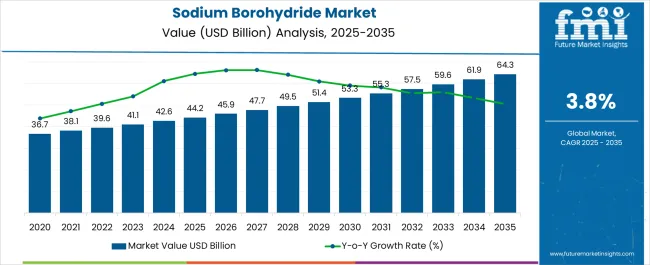
In 2025, the sodium borohydride market was valued at USD 44.2 billion. Based on Future Market Insights' analysis, demand for sodium borohydride is estimated to grow to USD 45.9 billion in 2026 and USD 64.3 billion by 2036. FMI projects a CAGR of 3.8% during the forecast period.
An absolute dollar growth of USD 18.4 billion between 2026 and 2036 reflects structural shifts in industrial processing rather than volume-only expansion of commodity reducing agents. Growth depends on increased specification of high-purity sodium borohydride in pharmaceutical synthesis requiring stereospecific reductions, its essential role in environmentally compliant pulp bleaching that reduces chlorine-based chemical usage, and rising consumption in precious metal recovery from electronic waste and spent catalysts. As per FMI, chemical manufacturers are capturing value not from incremental tonnage alone, but from purity consistency, particle size optimization, and application-specific formulation support that reduce downstream processing costs for pharmaceutical and fine chemical producers.
Summary of the Sodium Borohydride Market
- Market Definition
- The market comprises sodium borohydride, a selective reducing agent used in pharmaceutical synthesis, pulp bleaching, metal recovery, and chemical purification across global industrial value chains.
- Demand Drivers
- Expanding pharmaceutical manufacturing requiring stereospecific reductions for complex active pharmaceutical ingredients.
- Increasing adoption of total chlorine-free bleaching processes in pulp and paper industry driven by environmental regulations.
- Growing precious metal recovery from electronic waste and spent industrial catalysts.
- Rising demand for high-purity chemicals in organic synthesis and fine chemical production.
- Key Segments Analyzed
- Product Form: Powder-Based Sodium Borohydride leads, accounting for 30.5% share in 2025 due to handling ease, precise dosing, and compatibility with automated chemical processes.
- End Use: Pulp and Paper represents the largest end-use sector at 40.2% share, driven by its essential role in environmentally compliant bleaching processes.
- Geography: Asia-Pacific leads global consumption through pharmaceutical and paper production, while North America and Europe drive value through specialty applications and stringent environmental compliance.
- Analyst Opinion at FMI
- Nikhil Kaitwade, Principal Consultant for Chemicals and Materials at Future Market Insights, opines, 'In this revamped edition of the Sodium Borohydride Market report, value is migrating from bulk chemical supply to application-tailored reducing solutions. The compound's selective power is no longer just a chemical property but a strategic enabler for greener pulp bleaching, higher-yield pharmaceutical syntheses, and efficient precious metal recycling. Suppliers mastering impurity control and formulation customization will secure essential positions in pharmaceutical and sustainable industrial value chains through 2036.'
- Strategic Implications / Executive Takeaways
- Invest in high-purity production capabilities serving pharmaceutical and fine chemical applications where impurity profiles impact synthesis yields.
- Develop application-specific particle size distributions and physical forms optimized for customer processes, particularly in continuous pharmaceutical manufacturing.
- Strengthen technical support capabilities enabling co-development with pharmaceutical companies and pulp mills.
- Build supply chain resilience through raw material sourcing diversification and strategic inventory management.
- Methodology
- Built on primary interviews with sodium borohydride manufacturers and downstream chemical buyers.
- Benchmarked against pharmaceutical production statistics and pulp bleaching chemical consumption data.
- Validated using UN Comtrade trade data and internal peer review as per FMI modeling standards.
China leads global expansion, supported by its dominant position in pharmaceutical intermediate manufacturing, pulp and paper production, and electronics recycling industries. India follows, driven by expanding pharmaceutical manufacturing under the Production Linked Incentive scheme, growth in specialty chemical production, and increasing adoption of advanced water treatment technologies. Germany grows on the back of its world-leading chemical and pharmaceutical industry, stringent environmental regulations driving adoption of cleaner bleaching technologies, and expertise in precious metal refining. Brazil benefits from its large pulp and paper industry, which is the world's largest producer of bleached eucalyptus pulp, and growing pharmaceutical manufacturing sector.
Mature markets such as the United States, the United Kingdom, and Japan generate comparatively slower expansion, where demand is shaped more by replacement cycles in pharmaceutical synthesis, environmental compliance upgrades, and specialty applications rather than new industrial capacity expansion, with generic competition from Asian producers acting as a structural constraint on value growth.
Sodium Borohydride Market Definition
The sodium borohydride market covers the global production and supply of an inorganic reducing agent with the chemical formula NaBH₄, also known as sodium tetrahydroborate. This white crystalline powder is a selective and versatile reducing agent used across multiple industries for chemical synthesis, purification, and materials processing. Its chemical properties enable controlled reduction of aldehydes and ketones to alcohols, removal of trace impurities, recovery of precious metals, and bleaching of wood pulp. The compound's selectivity, stability in alkaline solutions, and ability to generate hydrogen upon hydrolysis make it indispensable across pharmaceutical, pulp and paper, metal processing, and fine chemical applications.
Market Inclusions
The report includes global and regional market size estimates in value terms, with a forecast period from 2026 to 2036. It provides segmentation by Product Form, End Use, and Region. The analysis incorporates manufacturing technology trends, purity grade developments, application-specific formulation advances, and regulatory impacts on pharmaceutical and industrial sectors. Regional demand dynamics, country-level growth rates, and competitive positioning are also evaluated as per FMI methodology.
Market Exclusions
The scope excludes downstream formulated products such as finished pharmaceuticals, bleached paper products, and refined metals that utilize sodium borohydride as a processing aid. It also excludes revenue from captive consumption where manufacturers produce sodium borohydride solely for internal use in integrated operations. Laboratory-scale and research-grade quantities are not considered due to negligible market contribution.
Research Methodology
- Primary Research: Interviews were conducted with sodium borohydride manufacturers, pharmaceutical synthesis specialists, pulp and paper technologists, precious metal refiners, and chemical distribution specialists.
- Desk Research: Public company filings from Evonik Industries, Mitsubishi Chemical Corporation, and Merck KGaA were reviewed alongside chemical industry statistics from the European Chemical Industry Council, pulp and paper production data from the Food and Agriculture Organization, and pharmaceutical manufacturing statistics from the European Federation of Pharmaceutical Industries and Associations.
- Market-Sizing and Forecasting: A hybrid top-down and bottom-up model was constructed, reconstructing demand from pharmaceutical production volumes, pulp bleaching chemical consumption patterns, and sodium borohydride usage rates per unit of output across end-use applications.
- Data Validation and Update Cycle: Outputs were subjected to variance testing against production capacity data, trade flow benchmarking using UN Comtrade data, and structured internal review prior to publication.
Sodium Borohydride Market Drivers, Restraints, and Opportunities
Future Market Insights analysis indicates the market has historically existed as a performance-driven specialty chemical category tied to pharmaceutical synthesis and pulp processing. Its baseline scale is anchored in the essential nature of selective reduction for complex molecule synthesis and the environmental imperative for chlorine-free bleaching. As per FMI, the market's valuation is increasingly linked to application-specific performance requirements, where purity consistency and physical form characteristics command premium pricing beyond commodity benchmarks.
FMI analysts observe a clear distinction between standard-grade sodium borohydride optimized for cost and high-purity grades that raise unit value through tighter specifications and application-specific performance benefits. Standard grades face pressure where pharmaceutical and pulp producers consolidate procurement, while growth is concentrated in applications that justify premium pricing through improved synthesis yields, reduced byproduct formation, and superior environmental performance. This shift nets out as steady value growth because quality differentiation and application engineering support margin expansion.
- Pharmaceutical synthesis complexity: The global pharmaceutical industry's focus on complex molecule development, including antibody-drug conjugates and peptide therapeutics, drives demand for selective reducing agents capable of stereospecific transformations. Sodium borohydride's ability to reduce aldehydes and ketones without affecting esters, amides, or carboxylic acids makes it indispensable in multi-step syntheses where functional group selectivity is critical. The European Federation of Pharmaceutical Industries and Associations reports continued growth in pharmaceutical R&D investment, supporting demand for high-purity synthesis intermediates.
- Environmental regulations in pulp and paper: The pulp and paper industry faces increasing pressure to eliminate chlorine-based bleaching chemicals due to concerns about adsorbable organic halides in wastewater. Sodium borohydride enables total chlorine-free bleaching sequences by reducing residual lignin and enhancing peroxide bleaching efficiency. Studies from South China University of Technology demonstrate that sodium borohydride pretreatment significantly improves peroxide bleaching performance while reducing chemical oxygen demand in effluent. The Food and Agriculture Organization projects continued growth in global paper and paperboard production, with particular strength in packaging grades requiring high brightness.
- Precious metal recovery economics: Rising prices for precious metals including gold, silver, platinum, and palladium have made recovery from electronic waste and spent catalysts increasingly economic. Sodium borohydride's strong reducing power enables efficient precipitation of metal ions from solution, recovering values that would otherwise be lost. The United Nations Institute for Training and Research estimates that less than 20% of electronic waste is currently recycled through formal channels, representing substantial growth potential for metal recovery applications.
- Hydrogen storage research: Academic research continues exploring sodium borohydride as a hydrogen storage material for fuel cell applications. Studies from the University of Trieste demonstrate advances in catalyst development for sodium borohydride hydrolysis, achieving hydrogen production rates of 3575 mL min⁻¹ g⁻¹ with cobalt-based catalysts retaining 82.5% activity after 20 cycles. While commercial hydrogen storage applications remain limited, ongoing research creates potential for future demand expansion.
- Raw material cost pressures: Sodium borohydride production through the Brown-Schlesinger process requires sodium hydride and trimethyl borate, both derived from energy-intensive processes. The National Institutes of Health notes that metallic sodium, produced through electrolysis of molten sodium chloride, remains the most costly raw material, creating margin pressure for manufacturers without integrated raw material supply.
- Handling and safety requirements: Sodium borohydride is classified as a dangerous good under UN 1426, requiring specialized handling due to its reactivity with water and potential to release flammable hydrogen gas. GHS classification indicates hazards including H260 (in contact with water releases flammable gases which may ignite spontaneously) and H314 (causes severe skin burns and eye damage). These handling requirements create barriers to entry for smaller consumers and favor established suppliers with safety expertise.
- Regulatory compliance burden: The compound is subject to various international regulations including REACH in Europe, TSCA in the United States, and chemical control laws in major Asian markets. Compliance with these frameworks requires significant documentation and testing investment, advantaging larger manufacturers with regulatory affairs capabilities.
Segmental Analysis
Sodium Borohydride Market Analysis by Product Form
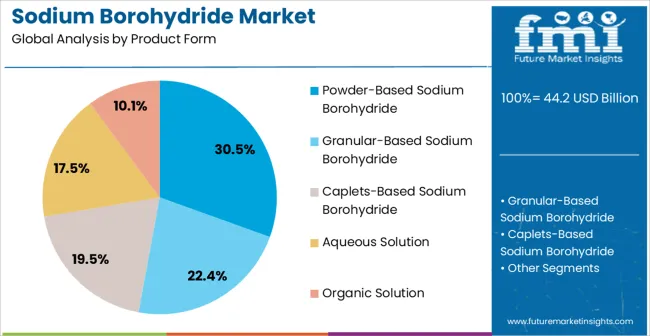
Based on FMI's sodium borohydride market report, powder-based sodium borohydride represents the leading product form, projected to hold 30.5% of the market revenue share in 2025. This dominance is driven by ease of handling, precise dosing capabilities, and compatibility with automated chemical processing equipment. Powder forms enable accurate measurement for controlled chemical reactions, ensuring consistent product quality and performance in pharmaceutical synthesis and fine chemical applications.
The physical characteristics of powder-based sodium borohydride, including consistent particle size distribution and flowability, support uniform dispersion in reaction vessels. Manufacturers benefit from reduced caking during storage and simplified material handling logistics. The powder format also supports efficient integration into automated processing systems and scalable industrial workflows, making it preferred for pharmaceutical and fine chemical manufacturing where reaction reproducibility is critical.
Granular-based sodium borohydride serves applications where dust control and worker safety are primary concerns. The larger particle size reduces airborne dust during handling, simplifying compliance with occupational exposure limits. Granular forms find particular application in pulp and paper mills where bulk handling systems are designed for free-flowing solids.
Aqueous solutions offer handling convenience for customers equipped to receive and store liquid chemicals. These solutions provide ready-to-use reducing agent concentrations, eliminating dissolution steps and associated equipment. The 12% solution in caustic soda is particularly common for applications where the alkaline environment is compatible with downstream processes.
Caplets-based forms, comprising compressed tablets or pellets, offer controlled dissolution rates and reduced dust generation. These are typically used in applications requiring gradual reducing agent addition or where precise metering into process streams is advantageous.
- Particle engineering advances: Manufacturers increasingly offer customized particle size distributions optimized for specific customer applications. Fine powders for rapid dissolution in pharmaceutical batch reactions versus granular forms for dust-free handling in continuous pulp bleaching demonstrate this trend.
- Purity grade differentiation: Premium-priced high-purity grades for pharmaceutical applications command margins substantially above standard industrial grades, rewarding manufacturers with advanced purification capabilities.
- Packaging innovation: Improved packaging technologies including moisture-barrier bags and nitrogen-blanketed containers preserve product quality during transport and storage, particularly important for hygroscopic powder forms.
Sodium Borohydride Market Analysis by End Use
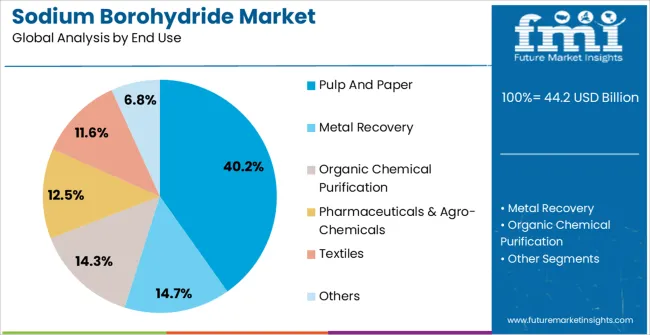
The pulp and paper end-use segment is projected to account for 40.2% of the market revenue share in 2025, establishing it as the leading application area. Growth is driven by increasing demand for bleaching agents that improve paper whiteness and strength while minimizing environmental impact. Sodium borohydride is utilized as a pretreatment agent that reduces residual lignin content and enhances fiber quality, enabling production of high-brightness papers without chlorine-based chemicals.
The mechanism involves selective reduction of carbonyl groups in lignin, which weakens the chromophoric structures responsible for color and facilitates subsequent peroxide bleaching. Research from South China University of Technology demonstrates that sodium borohydride pretreatment significantly improves peroxide bleaching efficiency while reducing chemical oxygen demand in effluent by decreasing dissolved lignin content. This environmental benefit aligns with regulatory trends restricting chlorine-based bleaching.
Pharmaceutical and agro-chemical applications represent the second major end-use segment, consuming high-purity sodium borohydride for active pharmaceutical ingredient synthesis. The Kirk-Othmer Encyclopedia of Chemical Technology notes that a significant application in pharmaceutical synthesis is the stereospecific and selective reduction in steroid production. The compound's ability to reduce aldehydes and ketones while leaving esters, amides, and carboxylic acids untouched makes it indispensable in complex molecule synthesis where functional group selectivity is essential.
Metal recovery applications utilize sodium borohydride's strong reducing power to precipitate precious metals from solution. This application has gained importance with rising precious metal prices and increasing electronic waste volumes. The compound can reduce gold, silver, platinum, and palladium from aqueous solutions, enabling recovery from spent catalysts, electronic scrap, and mining process streams.
Organic chemical purification applications leverage sodium borohydride's ability to remove trace impurities including aldehydes, peroxides, and metal ions from process streams. This application is particularly important in the production of high-purity monomers for polymer manufacture and specialty chemicals requiring stringent quality specifications.
- Pulp and paper regional dynamics: The pulp and paper industry's geographic concentration in North America, Northern Europe, and Brazil creates distinct regional demand patterns. Brazil's position as the world's largest producer of bleached eucalyptus pulp generates substantial sodium borohydride consumption in Latin America.
- Pharmaceutical quality requirements: Pharmacopoeial-grade sodium borohydride for pharmaceutical applications must meet stringent impurity specifications, with tight limits on heavy metals, chloride, and other contaminants. This creates high barriers to entry and rewards established manufacturers with validated processes.
- Metal recovery growth potential: The United Nations estimates that less than 20% of electronic waste is formally recycled, representing substantial growth potential for metal recovery applications as collection and processing infrastructure expands.
Regional Analysis
The sodium borohydride market is segmented geographically across North America, Europe, Asia-Pacific, Latin America, and Middle East & Africa. Growth dynamics differ based on pharmaceutical manufacturing concentration, pulp and paper industry presence, environmental regulatory frameworks, and electronic waste recycling infrastructure.
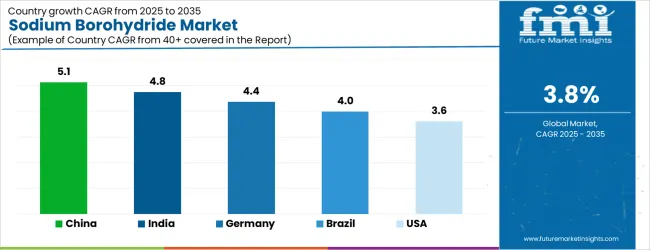
| Country | CAGR |
|---|---|
| China | 5.1% |
| India | 4.8% |
| Germany | 4.4% |
| Brazil | 4.0% |
| USA | 3.6% |
| UK | 3.2% |
| Japan | 2.9% |
Source: Future Market Insights (FMI) analysis, based on proprietary forecasting model and primary research
Asia-Pacific Market Analysis
Asia-Pacific stands as the dominant consumption and production region for sodium borohydride, accounting for the largest share of global demand. The region's leadership is built on concentrated pharmaceutical intermediate manufacturing in China and India, substantial pulp and paper production, and growing electronics recycling infrastructure.
- China: Sodium borohydride demand in China is projected to rise at 5.1% CAGR through 2036, the highest among major markets. Growth is supported by China's position as the world's largest pharmaceutical intermediate manufacturer, with extensive production capacity serving domestic pharmaceutical consumption and global export markets. The country's pulp and paper industry, while facing environmental consolidation, maintains substantial demand for bleaching chemicals.
China's electronics manufacturing ecosystem generates significant quantities of production scrap and end-of-life electronics, supporting growth in precious metal recovery applications. Government policies promoting circular economy principles and domestic resource recovery reinforce demand for metal recovery reagents.
The Chinese chemical industry benefits from integrated raw material access and scale economies in sodium borohydride production. Environmental enforcement has consolidated production among larger, compliant manufacturers, improving quality consistency and reducing supply volatility.
FMI's analysis of sodium borohydride market in Asia-Pacific consists of country-wise assessment that includes China, India, Japan, South Korea, and ASEAN nations.
- India: Sodium borohydride demand in India is projected to rise at 4.8% CAGR through 2036. Growth is supported by India's expanding pharmaceutical manufacturing industry under the Production Linked Incentive scheme, which promotes domestic production of complex active pharmaceutical ingredients requiring sophisticated reducing agents. The country's generic pharmaceutical industry serves both domestic consumption and export markets, with increasing complexity in molecule portfolios.
India's pulp and paper industry, while smaller than China's, continues modernizing with adoption of international environmental standards. Growing electronics consumption and improving e-waste collection infrastructure create opportunities for metal recovery applications.
FMI's analysis of sodium borohydride market in Asia-Pacific consists of country-wise assessment that includes China, India, Japan, and South Korea.
- Japan: Japan represents a mature, technology-intensive market where sodium borohydride demand is projected at 2.9% CAGR through 2036. Japanese consumption focuses on high-purity grades for pharmaceutical synthesis, electronic materials processing, and precious metal recovery from urban mining. Japanese chemical companies emphasize quality consistency and application development rather than volume production.
The country's sophisticated pharmaceutical industry requires pharmacopoeial-grade sodium borohydride for active ingredient synthesis, with supplier qualification processes creating high entry barriers but rewarding established relationships. Japan's leadership in electronics recycling creates specialized demand for metal recovery applications.
FMI's analysis of sodium borohydride market in Asia-Pacific consists of country-wise assessment that includes China, India, Japan, and South Korea.
North America Market Analysis
North America functions as a significant consumption region driven by its large pharmaceutical industry, pulp and paper sector, and precious metal refining capacity. The United States serves as the primary market, with demand shaped by pharmaceutical innovation, environmental compliance requirements, and recycling infrastructure.
- United States: Demand for sodium borohydride in the United States is projected to advance at 3.6% CAGR through 2036. The USA market combines pharmaceutical demand from the world's largest drug development and manufacturing base, pulp and paper consumption from southern and Pacific Northwest mills, and precious metal recovery from electronics recycling and spent catalyst processing.
USA pharmaceutical companies specify high-purity grades meeting stringent impurity requirements, with applications ranging from small molecule synthesis to complex biologic processing. The Kirk-Othmer Encyclopedia notes that stereospecific reductions in steroid production represent significant pharmaceutical applications.
Environmental regulations under the Clean Water Act and state-level restrictions on chlorine-based bleaching drive adoption of sodium borohydride in pulp processing. Precious metal refiners serving the electronics, automotive catalyst, and jewelry industries utilize sodium borohydride for efficient metal recovery.
FMI's analysis of sodium borohydride market in North America consists of country-wise assessment that includes the United States and Canada.
Europe Market Analysis
Europe represents a quality-driven market where stringent environmental regulations, pharmaceutical innovation, and circular economy policies shape sodium borohydride specifications. The region's strong chemical and pharmaceutical industries require intermediates meeting REACH and other regulatory requirements, favoring established suppliers with documentation capabilities.
- Germany: Demand for sodium borohydride in Germany is projected to rise at 4.4% CAGR through 2036. Growth is influenced by Germany's position as Europe's largest chemical producer and its world-leading pharmaceutical and fine chemical industry. German chemical companies emphasize innovation and quality, requiring high-purity reducing agents for advanced synthesis applications.
Germany's pulp and paper industry, concentrated in facilities along major rivers, faces stringent wastewater discharge limits that drive adoption of chlorine-free bleaching technologies. The country's leadership in industrial ecology and circular economy creates opportunities for metal recovery applications.
Pharmaceutical applications in Germany demand pharmacopoeial-grade material for active ingredient synthesis, with documentation requirements exceeding those for industrial applications. The European Federation of Pharmaceutical Industries and Associations reports continued growth in German pharmaceutical R&D and manufacturing.
FMI's analysis of sodium borohydride market in Europe consists of country-wise assessment that includes Germany, United Kingdom, France, Italy, and Spain.
Competitive Aligners for Market Players
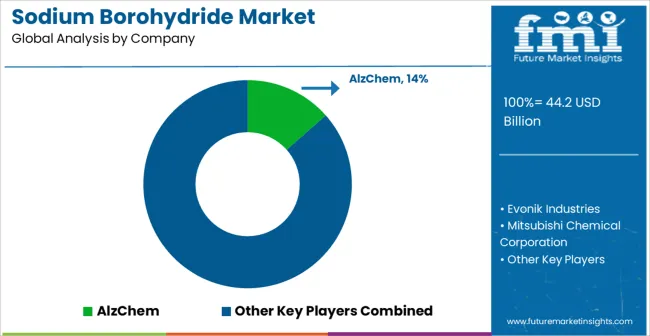
The sodium borohydride market features a mix of global chemical companies and regional specialists, with established players leveraging technical expertise, regulatory compliance capabilities, and application development resources. Major players include Evonik Industries, Mitsubishi Chemical Corporation, Solvay, AlzChem, Merck KGaA, and Clariant International, alongside specialized producers serving regional markets.
Evonik Industries brings deep expertise in specialty chemistry and reducing agent technology, serving pharmaceutical and industrial customers with high-purity grades. Mitsubishi Chemical Corporation leverages its position in Asian markets and integrated raw material access. Solvay's portfolio includes sodium borohydride for multiple applications, supported by global technical service capabilities.
Merck KGaA focuses on high-purity grades for pharmaceutical and laboratory applications, where quality consistency and impurity control command premium pricing. Clariant International serves industrial applications including pulp bleaching and metal recovery, with emphasis on application development and technical support.
Chinese producers including ShanDong Guobang, Jiangsu Huachang, and Nantong Hongzhi serve domestic and export markets with cost-competitive material, gaining share in industrial applications where price sensitivity outweighs technical service requirements [citation:11].
Key Players in the Sodium Borohydride Market
- AlzChem
- Evonik Industries
- Mitsubishi Chemical Corporation
- Solvay
- Ingevity
- Nuodex Industries
- Perstorp
- Merck KGaA
- UBE Corporation
- R.T. Vanderbilt Company
- Clariant International
- Brenntag
- Atofina Chemicals
- KH Neochem
Scope of Report
| Metric | Value |
|---|---|
| Quantitative Units | USD 45.9 billion (2026) to USD 64.3 billion (2036), at a CAGR of 3.8% |
| Market Definition | The sodium borohydride market comprises the global production and supply of an inorganic reducing agent used in pharmaceutical synthesis, pulp bleaching, metal recovery, and chemical purification across pharmaceutical, paper, and industrial value chains. |
| Product Form Segmentation | Powder-Based Sodium Borohydride, Granular-Based Sodium Borohydride, Caplets-Based Sodium Borohydride, Aqueous Solution, Organic Solution |
| End Use Segmentation | Pulp and Paper, Metal Recovery, Organic Chemical Purification, Pharmaceuticals and Agro-Chemicals, Textiles, Others |
| Region Segmentation | North America, Europe, Asia-Pacific, Latin America, Middle East & Africa |
| Countries Covered | United States, Canada, Germany, United Kingdom, France, Italy, Spain, China, India, Japan, South Korea, Brazil and 40+ countries |
| Key Companies Profiled | AlzChem, Evonik Industries, Mitsubishi Chemical Corporation, Solvay, Ingevity, Nuodex Industries, Perstorp, Merck KGaA, UBE Corporation, R.T. Vanderbilt Company, Clariant International, Brenntag, Atofina Chemicals, KH Neochem |
| Forecast Period | 2026 to 2036 |
| Approach | Hybrid top-down and bottom-up market modeling validated through primary interviews with sodium borohydride manufacturers, pharmaceutical synthesis specialists, and pulp and paper technologists, supported by pharmaceutical production statistics and trade data analysis |
Sodium Borohydride Market Analysis by Segments
Product Form
- Powder-Based Sodium Borohydride
- Granular-Based Sodium Borohydride
- Caplets-Based Sodium Borohydride
- Aqueous Solution
- Organic Solution
End Use
- Pulp and Paper
- Metal Recovery
- Organic Chemical Purification
- Pharmaceuticals and Agro-Chemicals
- Textiles
- Others
Region
- North America (United States, Canada, Mexico)
- Latin America (Brazil, Chile, Rest of Latin America)
- Western Europe (Germany, United Kingdom, Italy, Spain, France, Nordic, BENELUX, Rest of Western Europe)
- Eastern Europe (Russia, Poland, Hungary, Balkan & Baltic, Rest of Eastern Europe)
- East Asia (China, Japan, South Korea)
- South Asia and Pacific (India, ASEAN, Australia & New Zealand, Rest of South Asia and Pacific)
- Middle East & Africa (Kingdom of Saudi Arabia, Other GCC Countries, Turkiye, South Africa, Other African Union, Rest of Middle East & Africa)
Bibliography
- The Pharmaceutical Industry in Figures Key Data 2024. European Federation of Pharmaceutical Industries and Associations (EFPIA).
- Yang Yu-qin, Song Yan-ting, Li Jing, Chai Xin-sheng. Mechanism of Sodium Borohydride Pretreatment in Peroxide Bleaching of Pulp. State Key Lab of Pulp & Paper Engineering, South China University of Technology.
- Liu, C. H., Chen, B. H., Hsueh, C. L., Ku, J. R., Jeng, M. S., & Tsau, F. The Concept about the Regeneration of Spent Borohydrides and Used Catalysts from Green Electricity. National Institutes of Health. PMC5455715.
- Sodium borohydride Safety Data Sheet. ChemicalBook. Revision Date: 2026-01-17.
- Sodium borohydride regulatory information. ChemTrack Chemical Database.
- Barendt, J., Dryden, B. Boron Hydrides, Heteroboranes, and their Metalla Derivatives (Commercial Aspects). Kirk-Othmer Encyclopedia of Chemical Technology. Wiley Online Library.
This bibliography is provided for reader reference and is not exhaustive. The full report contains the complete reference list and detailed citations.
This Report Addresses
- Market intelligence to enable structured strategic decision-making across sodium borohydride manufacturers, pharmaceutical synthesis specialists, pulp and paper technologists, and chemical distribution professionals, focusing on the shift from bulk chemical supply to application-tailored reducing solutions.
- Market size estimation and 10-year revenue forecasts, including validated CAGR and absolute dollar opportunity sizing.
- Growth opportunity mapping across Product Form and End Use, with emphasis on high-purity grades for pharmaceutical synthesis, environmentally compliant pulp bleaching applications, and precious metal recovery from electronic waste.
- Segment and regional forecasting covering the sodium borohydride landscape, alongside demand trajectories driven by pharmaceutical manufacturing expansion, environmental regulatory compliance, and circular economy initiatives.
- Competition strategy assessment, including analysis of purity consistency optimization, particle size engineering, and application-specific formulation support that reduce downstream processing costs for pharmaceutical and fine chemical producers.
- Product and technology tracking focused on impurity control capabilities, physical form customization, and handling safety innovations serving diverse industrial requirements from continuous pharmaceutical manufacturing to bulk pulp mill operations.
- Regulatory policy analysis covering REACH and TSCA compliance requirements, pharmaceutical pharmacopoeial standards, and international chemical control laws influencing production specifications and market access.
- Report delivery in PDF, Excel, and presentation-ready formats to support executive planning, product development alignment, and competitive benchmarking across mature and high-growth markets including China, India, Germany, and the United States.
Frequently Asked Questions
How large is the sodium borohydride market in 2026?
Demand for sodium borohydride is estimated to be valued at USD 45.9 billion in 2026.
What will be the market size of sodium borohydride by 2036?
Market size for sodium borohydride is projected to reach USD 64.3 billion by 2036.
What is the expected demand growth for sodium borohydride between 2026 and 2036?
Demand for sodium borohydride is expected to grow at a 3.8% CAGR between 2026 and 2036.
Which product form segment is poised to lead global sales?
Powder-based sodium borohydride leads with 30.5% share in 2025, driven by handling ease, precise dosing, and compatibility with automated chemical processes.
Which end-use segment contributes the largest revenue share?
Pulp and paper commands 40.2% share, driven by its essential role in environmentally compliant bleaching processes and the industry's large scale.
How significant is the pharmaceutical industry in driving demand?
Pharmaceutical applications represent a high-value segment requiring high-purity grades for stereospecific reductions in complex molecule synthesis, including steroid production.
What is driving demand in China?
China's position as the world's largest pharmaceutical intermediate manufacturer, substantial pulp and paper production, and growing electronics recycling industry drive market leadership.
What is the China growth outlook?
China is projected to expand at a 5.1% CAGR during 2026 to 2036.
What drives India's market growth?
Expanding pharmaceutical manufacturing under the Production Linked Incentive scheme and modernization of the pulp and paper industry support India's growth.
What is the India growth outlook?
India is projected to expand at a 4.8% CAGR during 2026 to 2036.
What characterizes the German market?
Germany's world-leading chemical and pharmaceutical industry, stringent environmental regulations, and expertise in precious metal refining drive demand for high-purity grades.
What is the Germany growth outlook?
Germany is projected to expand at a 4.4% CAGR during 2026 to 2036.
What drives the United States market?
Large pharmaceutical industry requiring high-purity grades, substantial pulp and paper sector, and precious metal refining capacity shape USA demand.
What is the United States growth outlook?
The United States is projected to expand at a 3.6% CAGR during 2026 to 2036.
What is the Brazil growth outlook?
Brazil is projected to expand at a 4.0% CAGR during 2026 to 2036, supported by its position as the world's largest bleached eucalyptus pulp producer.
What is sodium borohydride and what is it mainly used for?
Sodium borohydride is an inorganic reducing agent used primarily in pharmaceutical synthesis for selective reductions, pulp bleaching for environmentally compliant paper production, and precious metal recovery from electronic waste and spent catalysts.
What does the sodium borohydride market mean in this report?
It refers to the global manufacturing and supply of sodium borohydride by product form, end use, and region, measured in value terms.
What is included in the scope of this report?
Scope includes market sizing and forecasting for 2026 to 2036, segmentation by product form, end use, and region, along with competitive assessment and country-wise outlook.
What is excluded from the scope of this report?
The scope excludes downstream formulated products such as finished pharmaceuticals and bleached paper, captive consumption for internal use, and laboratory-scale quantities.
Preview the report firsthand - request a free sample
Get SampleGet the brochure for pricing and purchase details.
Get PDFTable of Content
- Executive Summary
- Global Market Outlook
- Demand-side Trends
- Supply-side Trends
- Technology Roadmap Analysis
- Analysis and Recommendations
- Market Overview
- Market Coverage / Taxonomy
- Market Definition / Scope / Limitations
- Research Methodology
- Chapter Orientation
- Analytical Lens and Working Hypotheses
- Market Structure, Signals, and Trend Drivers
- Benchmarking and Cross-market Comparability
- Market Sizing, Forecasting, and Opportunity Mapping
- Research Design and Evidence Framework
- Desk Research Programme (Secondary Evidence)
- Company Annual and Sustainability Reports
- Peer-reviewed Journals and Academic Literature
- Corporate Websites, Product Literature, and Technical Notes
- Earnings Decks and Investor Briefings
- Statutory Filings and Regulatory Disclosures
- Technical White Papers and Standards Notes
- Trade Journals, Industry Magazines, and Analyst Briefs
- Conference Proceedings, Webinars, and Seminar Materials
- Government Statistics Portals and Public Data Releases
- Press Releases and Reputable Media Coverage
- Specialist Newsletters and Curated Briefings
- Sector Databases and Reference Repositories
- FMI Internal Proprietary Databases and Historical Market Datasets
- Subscription Datasets and Paid Sources
- Social Channels, Communities, and Digital Listening Inputs
- Additional Desk Sources
- Expert Input and Fieldwork (Primary Evidence)
- Primary Modes
- Qualitative Interviews and Expert Elicitation
- Quantitative Surveys and Structured Data Capture
- Blended Approach
- Why Primary Evidence is Used
- Field Techniques
- Interviews
- Surveys
- Focus Groups
- Observational and In-context Research
- Social and Community Interactions
- Stakeholder Universe Engaged
- C-suite Leaders
- Board Members
- Presidents and Vice Presidents
- R&D and Innovation Heads
- Technical Specialists
- Domain Subject-matter Experts
- Scientists
- Physicians and Other Healthcare Professionals
- Governance, Ethics, and Data Stewardship
- Research Ethics
- Data Integrity and Handling
- Primary Modes
- Tooling, Models, and Reference Databases
- Desk Research Programme (Secondary Evidence)
- Data Engineering and Model Build
- Data Acquisition and Ingestion
- Cleaning, Normalisation, and Verification
- Synthesis, Triangulation, and Analysis
- Quality Assurance and Audit Trail
- Market Background
- Market Dynamics
- Drivers
- Restraints
- Opportunity
- Trends
- Scenario Forecast
- Demand in Optimistic Scenario
- Demand in Likely Scenario
- Demand in Conservative Scenario
- Opportunity Map Analysis
- Product Life Cycle Analysis
- Supply Chain Analysis
- Investment Feasibility Matrix
- Value Chain Analysis
- PESTLE and Porter’s Analysis
- Regulatory Landscape
- Regional Parent Market Outlook
- Production and Consumption Statistics
- Import and Export Statistics
- Market Dynamics
- Global Market Analysis 2021 to 2025 and Forecast, 2026 to 2036
- Historical Market Size Value (USD Million) Analysis, 2021 to 2025
- Current and Future Market Size Value (USD Million) Projections, 2026 to 2036
- Y-o-Y Growth Trend Analysis
- Absolute $ Opportunity Analysis
- Global Market Pricing Analysis 2021 to 2025 and Forecast 2026 to 2036
- Global Market Analysis 2021 to 2025 and Forecast 2026 to 2036, By Product Form
- Introduction / Key Findings
- Historical Market Size Value (USD Million) Analysis By Product Form , 2021 to 2025
- Current and Future Market Size Value (USD Million) Analysis and Forecast By Product Form , 2026 to 2036
- Powder-Based Sodium Borohydride
- Granular-Based Sodium Borohydride
- Caplets-Based Sodium Borohydride
- Aqueous Solution
- Powder-Based Sodium Borohydride
- Y-o-Y Growth Trend Analysis By Product Form , 2021 to 2025
- Absolute $ Opportunity Analysis By Product Form , 2026 to 2036
- Global Market Analysis 2021 to 2025 and Forecast 2026 to 2036, By End Use
- Introduction / Key Findings
- Historical Market Size Value (USD Million) Analysis By End Use, 2021 to 2025
- Current and Future Market Size Value (USD Million) Analysis and Forecast By End Use, 2026 to 2036
- Pulp and Paper
- Metal Recovery
- Organic Chemical Purification
- Pharmaceuticals and Agro-Chemicals
- Textiles
- Pulp and Paper
- Y-o-Y Growth Trend Analysis By End Use, 2021 to 2025
- Absolute $ Opportunity Analysis By End Use, 2026 to 2036
- Global Market Analysis 2021 to 2025 and Forecast 2026 to 2036, By Region
- Introduction
- Historical Market Size Value (USD Million) Analysis By Region, 2021 to 2025
- Current Market Size Value (USD Million) Analysis and Forecast By Region, 2026 to 2036
- North America
- Latin America
- Western Europe
- Eastern Europe
- East Asia
- South Asia and Pacific
- Middle East & Africa
- Market Attractiveness Analysis By Region
- North America Market Analysis 2021 to 2025 and Forecast 2026 to 2036, By Country
- Historical Market Size Value (USD Million) Trend Analysis By Market Taxonomy, 2021 to 2025
- Market Size Value (USD Million) Forecast By Market Taxonomy, 2026 to 2036
- By Country
- USA
- Canada
- Mexico
- By Product Form
- By End Use
- By Country
- Market Attractiveness Analysis
- By Country
- By Product Form
- By End Use
- Key Takeaways
- Latin America Market Analysis 2021 to 2025 and Forecast 2026 to 2036, By Country
- Historical Market Size Value (USD Million) Trend Analysis By Market Taxonomy, 2021 to 2025
- Market Size Value (USD Million) Forecast By Market Taxonomy, 2026 to 2036
- By Country
- Brazil
- Chile
- Rest of Latin America
- By Product Form
- By End Use
- By Country
- Market Attractiveness Analysis
- By Country
- By Product Form
- By End Use
- Key Takeaways
- Western Europe Market Analysis 2021 to 2025 and Forecast 2026 to 2036, By Country
- Historical Market Size Value (USD Million) Trend Analysis By Market Taxonomy, 2021 to 2025
- Market Size Value (USD Million) Forecast By Market Taxonomy, 2026 to 2036
- By Country
- Germany
- UK
- Italy
- Spain
- France
- Nordic
- BENELUX
- Rest of Western Europe
- By Product Form
- By End Use
- By Country
- Market Attractiveness Analysis
- By Country
- By Product Form
- By End Use
- Key Takeaways
- Eastern Europe Market Analysis 2021 to 2025 and Forecast 2026 to 2036, By Country
- Historical Market Size Value (USD Million) Trend Analysis By Market Taxonomy, 2021 to 2025
- Market Size Value (USD Million) Forecast By Market Taxonomy, 2026 to 2036
- By Country
- Russia
- Poland
- Hungary
- Balkan & Baltic
- Rest of Eastern Europe
- By Product Form
- By End Use
- By Country
- Market Attractiveness Analysis
- By Country
- By Product Form
- By End Use
- Key Takeaways
- East Asia Market Analysis 2021 to 2025 and Forecast 2026 to 2036, By Country
- Historical Market Size Value (USD Million) Trend Analysis By Market Taxonomy, 2021 to 2025
- Market Size Value (USD Million) Forecast By Market Taxonomy, 2026 to 2036
- By Country
- China
- Japan
- South Korea
- By Product Form
- By End Use
- By Country
- Market Attractiveness Analysis
- By Country
- By Product Form
- By End Use
- Key Takeaways
- South Asia and Pacific Market Analysis 2021 to 2025 and Forecast 2026 to 2036, By Country
- Historical Market Size Value (USD Million) Trend Analysis By Market Taxonomy, 2021 to 2025
- Market Size Value (USD Million) Forecast By Market Taxonomy, 2026 to 2036
- By Country
- India
- ASEAN
- Australia & New Zealand
- Rest of South Asia and Pacific
- By Product Form
- By End Use
- By Country
- Market Attractiveness Analysis
- By Country
- By Product Form
- By End Use
- Key Takeaways
- Middle East & Africa Market Analysis 2021 to 2025 and Forecast 2026 to 2036, By Country
- Historical Market Size Value (USD Million) Trend Analysis By Market Taxonomy, 2021 to 2025
- Market Size Value (USD Million) Forecast By Market Taxonomy, 2026 to 2036
- By Country
- Kingdom of Saudi Arabia
- Other GCC Countries
- Turkiye
- South Africa
- Other African Union
- Rest of Middle East & Africa
- By Product Form
- By End Use
- By Country
- Market Attractiveness Analysis
- By Country
- By Product Form
- By End Use
- Key Takeaways
- Key Countries Market Analysis
- USA
- Pricing Analysis
- Market Share Analysis, 2025
- By Product Form
- By End Use
- Canada
- Pricing Analysis
- Market Share Analysis, 2025
- By Product Form
- By End Use
- Mexico
- Pricing Analysis
- Market Share Analysis, 2025
- By Product Form
- By End Use
- Brazil
- Pricing Analysis
- Market Share Analysis, 2025
- By Product Form
- By End Use
- Chile
- Pricing Analysis
- Market Share Analysis, 2025
- By Product Form
- By End Use
- Germany
- Pricing Analysis
- Market Share Analysis, 2025
- By Product Form
- By End Use
- UK
- Pricing Analysis
- Market Share Analysis, 2025
- By Product Form
- By End Use
- Italy
- Pricing Analysis
- Market Share Analysis, 2025
- By Product Form
- By End Use
- Spain
- Pricing Analysis
- Market Share Analysis, 2025
- By Product Form
- By End Use
- France
- Pricing Analysis
- Market Share Analysis, 2025
- By Product Form
- By End Use
- India
- Pricing Analysis
- Market Share Analysis, 2025
- By Product Form
- By End Use
- ASEAN
- Pricing Analysis
- Market Share Analysis, 2025
- By Product Form
- By End Use
- Australia & New Zealand
- Pricing Analysis
- Market Share Analysis, 2025
- By Product Form
- By End Use
- China
- Pricing Analysis
- Market Share Analysis, 2025
- By Product Form
- By End Use
- Japan
- Pricing Analysis
- Market Share Analysis, 2025
- By Product Form
- By End Use
- South Korea
- Pricing Analysis
- Market Share Analysis, 2025
- By Product Form
- By End Use
- Russia
- Pricing Analysis
- Market Share Analysis, 2025
- By Product Form
- By End Use
- Poland
- Pricing Analysis
- Market Share Analysis, 2025
- By Product Form
- By End Use
- Hungary
- Pricing Analysis
- Market Share Analysis, 2025
- By Product Form
- By End Use
- Kingdom of Saudi Arabia
- Pricing Analysis
- Market Share Analysis, 2025
- By Product Form
- By End Use
- Turkiye
- Pricing Analysis
- Market Share Analysis, 2025
- By Product Form
- By End Use
- South Africa
- Pricing Analysis
- Market Share Analysis, 2025
- By Product Form
- By End Use
- USA
- Market Structure Analysis
- Competition Dashboard
- Competition Benchmarking
- Market Share Analysis of Top Players
- By Regional
- By Product Form
- By End Use
- Competition Analysis
- Competition Deep Dive
- AlzChem
- Overview
- Product Portfolio
- Profitability by Market Segments (Product/Age /Sales Channel/Region)
- Sales Footprint
- Strategy Overview
- Marketing Strategy
- Product Strategy
- Channel Strategy
- Evonik Industries
- Mitsubishi Chemical Corporation
- Solvay
- Ingevity
- Nuodex Industries
- Perstorp
- Merck KGaA
- UBE Corporation
- AlzChem
- Competition Deep Dive
- Assumptions & Acronyms Used


