

- Market Size (2026)
- USD 638.6 Mn
- Forecast (2036)
- USD 1862.9 Mn
- CAGR (2026 to 2036)
- 11.3%
How big is Sourdough Sweet Goods Market in 2026?
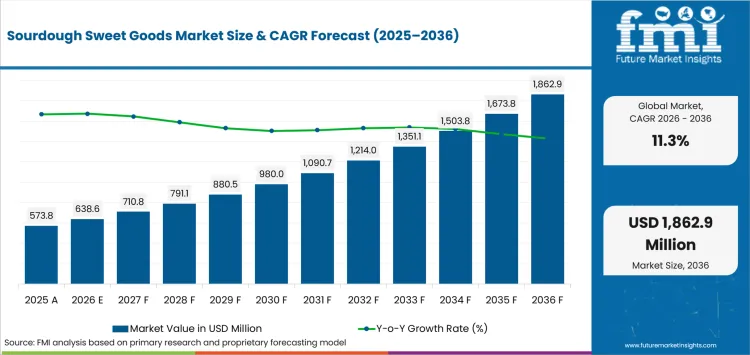
USD 638.6 million in 2026 and USD 1,862.9 million by 2036 at an 11.3% CAGR.
Sales of sourdough sweet goods are projected to grow at 11.3% CAGR between 2026 and 2036, raising market value from USD 638.6 million to USD 1,862.9 million. Industrial growth depends on keeping fermentation stable in doughs carrying high sugar and fat loads. DNV issued Maina Panettoni S.p.A. an IFS Food certificate in January 2025 covering naturally fermented panettone, pandoro, colomba and special-occasion cakes. Its 98.83% Higher Level score documents a scaled production route operating under formal food-safety controls.
Country economics diverge because bakery labor depth changes the cost and speed of local scale-up. The USA Bureau of Labor Statistics projected about 39,900 baker openings each year through 2034 in its August 2025 profile. Those openings support a broad domestic base for recipe trials, although national distribution still demands stable shelf life. Gulf programs often place more qualification work on imported formats and local finishing. The operating difference changes how forecast demand converts into repeat orders within each country.
Key Takeaways of Sourdough Sweet Goods Market
- Bakers expand sourdough sweet ranges once fermentation preserves a distinctive aroma and soft crumb without destabilizing enriched dough production.
- By type, liquid levain is estimated to hold 38.0% in 2026 owing to active starter dosing that keeps fermentation adjustments close to the production line.
- In 2026, conventional products are expected to lead claim / nature with 53.0% share because mainstream recipes face fewer claim-specific formulation restrictions.
- Fresh products are projected to hold 33.0% share in 2026 owing to short selling windows that preserve fermentation-led aroma and texture.
- Shelf-life losses and fermentation variability weaken margins by forcing tighter control over acidity, proofing time and moisture migration in enriched doughs.
- Some of the key players in this market include Bauli S.p.A., Maina Panettoni S.p.A., BALOCCO S.p.A. Industria Dolciaria, Dolciaria A. Loison Srl, Fiasconaro S.r.l., Galup S.r.l., Flamigni Srl, and Bonifanti SpA.
Analyst Perspective
"Commercial value depends on natural leavening surviving sugar-rich dough and distribution without losing the aroma difference that supports premium positioning. Large bakery programs earn better economics where proofing stability and shelf life limit scrap before finished goods reach retail."
- Nandini Roy Choudhury, Principal Consultant, Future Market Insights
How is the Sourdough Sweet Goods Market segmented?
The sourdough sweet goods market is segmented by type, claim / nature, format, packaging format, sales channel and region.
Type covers liquid levain, dried sourdough, ready starters and flavor concentrates. Claim / nature includes conventional, clean label, organic, gluten-free and high-protein / fortified products. Format spans fresh, frozen, ambient packaged, chilled and par-baked / thaw-and-serve goods. Packaging format includes multipack, single-serve, family / loaf pack and bulk foodservice. Sales channel covers supermarkets & hypermarkets, artisan & specialty bakeries, convenience & forecourt, online & DTC and foodservice distributors.
Why does Liquid levain lead demand within the Type category?
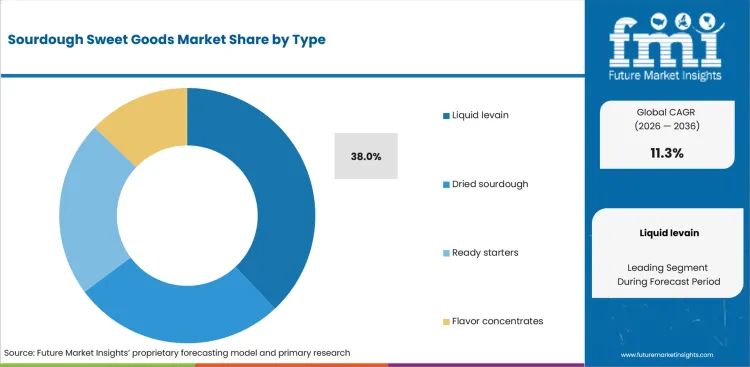
Liquid levain lets industrial bakers meter active culture directly into enriched dough, keeping starter adjustments close to proofing schedules. The related natural sourdough market also depends on repeatable acidity and aroma during larger production runs.
- By type, liquid levain is estimated to hold 38.0% in 2026 owing to direct dosing that keeps fermentation adjustments close to the on-site production line.
- Bauli moved sourdough into daily sweet pastry in April 2025 with Pandorì and its Futura sourdough. The launch verifies a packaged route for sourdough, although Bauli does not disclose liquid levain as the starter form.
Why does conventional lead demand within the claim / nature category?
Conventional recipes avoid separate nutrition-claim qualification during routine reformulation, while the USA FDA extended the effective date for its updated "healthy" claim rule in February 2025.
- In 2026, conventional products are expected to lead claim / nature with 53.0% share because mainstream commercial recipes face fewer claim-specific formulation restrictions.
- Mainstream bakery ingredients fit existing specifications more easily because conventional recipes carry fewer claim-specific constraints during routine reformulation. Bakery ingredient mixes require extra claim checks before a new sweet bakery recipe reaches commercial production. That lower qualification burden keeps commercial iteration focused on taste and process stability.
Why does Fresh lead demand within the Format category?
Fresh formats keep sourdough aroma and soft crumb close to consumption before longer storage dulls fermentation character. Short selling windows make those sensory cues visible near the point of sale. The USA Bureau of Labor Statistics recorded a 1.7% increase during 2025 for fresh sweetrolls, coffeecakes and doughnuts.
- Fresh products are projected to hold 33.0% share in 2026 owing to short selling windows that preserve fermentation-led aroma and texture.
- Frozen bakery routes reduce waste exposure and extend handling time before final retail or foodservice sale. Fresh products depend on faster daily sell-through, which leaves operators less room for forecasting errors and unsold inventory.
Why does Multipack lead demand within the Packaging Format category?
Multipacks turn breakfast and lunchbox use into controlled portions within one retail purchase, which supports planned repeat use. Clean label ingredients affect recipe claims, while clean label bakery enzymes give formulators more ways to adjust dough performance.
- By packaging format, multipack is forecast to represent 40.0% in 2026 due to repeat snack occasions that fit household purchasing and routine retail replenishment cycles.
- The USA FDA proposed front-of-package nutrition labeling in January 2025 for most packaged foods using Low, Med or High descriptors. Pack design therefore carries more nutrition information before a multipack reaches the shelf.
What are the drivers, restraints and opportunities in the Sourdough Sweet Goods Market?
Distinctive fermentation supports demand, while batch variation and bakery cost pressure limit scale. Year-round sweet formats reduce dependence on holiday purchasing.
- Driver: Bakeries use sourdough to preserve a recognizable flavor and texture difference after commercial production and retail handling.
- Restraint: Rich dough fermentation needs tighter control because ingredient inflation and scrap reduce tolerance for inconsistent batches.
- Opportunity: Producers can extend sourdough from seasonal cakes into breakfast and snack formats that generate more frequent purchase occasions.
Commercial Bakery Labor Supports Local Trial Capacity
Fresh and packaged sourdough reaches more trial points where bakeries already have trained production labor and established production routines. In August 2025, the USA Bureau of Labor Statistics recorded 32% of bakers in bakery and tortilla manufacturing during 2024. That labor concentration gives manufacturers a practical base for controlled recipe trials at commercial scale. Baking ingredients must reproduce the same dough behavior as batch size increases and production moves between lines.
Cost Pressure Narrows Tolerance for Fermentation Losses
Rich dough leaves little margin for fermentation drift because sugar and fat alter proofing before finished goods reach the shelf. The USA Bureau of Labor Statistics recorded a 1.5% annual increase in the cereals and bakery products price index through December 2025. Higher input costs make scrap from failed fermentation more expensive for plants running high-volume sweet bakery lines. Bakery flour improvers and tighter controls must reduce that loss before extra formulation cost earns a place in the recipe.
Year-Round Formats Reduce Dependence on Holiday Demand
Seasonal panettone gives sourdough strong recognition but concentrates sales into a short year-end holiday window. Dolciaria A. Loison Srl extended BlackHabana in June 2025 from panettone into Tosa cake and Canestrello biscuits for year-round purchase occasions. The expansion gives natural fermentation a route into products sold beyond the Christmas purchasing cycle. Home baking ingredients and finished formats still need a clear sensory difference that can justify repeat buying through the rest of the year.
Which country CAGRs are profiled in the Sourdough Sweet Goods Market?
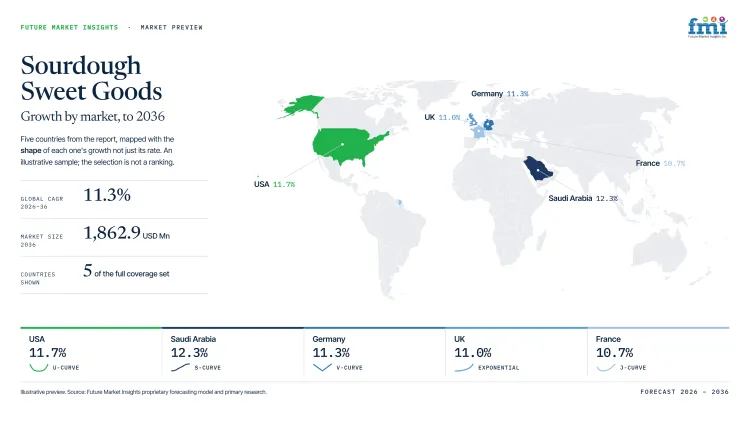
| Country | CAGR |
|---|---|
| Saudi Arabia | 12.3% |
| USA | 11.7% |
| Germany | 11.3% |
| UK | 11.0% |
| France | 10.7% |
How do country-level CAGRs compare in the Sourdough Sweet Goods Market?
The 1.6-point spread between Saudi Arabia and France forms a compact growth band instead of a ranking of market size. Saudi Arabia and USA occupy the upper pair while Germany and UK follow. France marks the lower edge while the narrow gap leaves channel structure more important than CAGR alone.
- Saudi Arabia’s premium bakery channels support demand for indulgent sourdough sweet goods, particularly giftable and individually packaged formats.
- USA retail and foodservice channels favor consistent production, convenient formats, and replenishment of sourdough-based sweet bakery products across national markets.
- UK consumers show established demand for premium bakery, supporting sourdough sweet goods across pastries, enriched breads, and indulgent formats.
- Germany’s strong bakery culture supports traditional sweet bakery products while creating opportunities for sourdough-based variants with premium positioning.
- France’s established viennoiserie and artisan bakery culture provides recognition for fermented sweet goods, although overall market growth remains comparatively lower.
Comparable CAGRs produce different entry costs because each country qualifies recipes through distinct commercial routes. The full report provides country-level CAGR analysis across North America, Latin America, Europe, East Asia, South Asia, Oceania and the Middle East and Africa.
Country-wise Analysis
- Saudi mall cafés and foodservice chains expose consumers to individual sourdough sweet pastries within major urban shopping districts. Imported ingredients and long inland routes can raise costs outside leading cities, tightening economics for frequent menu changes nationally. Saudi Arabia is estimated to post 12.3% CAGR through 2036, as café traffic increases purchase occasions for premium sweet bakery. Local baking or final finishing can shorten freshness gaps, while operators without regional production may face higher handling costs and reduced pricing flexibility. Premium sourdough positioning can strengthen differentiation, particularly where consumers seek artisanal textures, distinctive fermentation profiles, and convenient individually portioned sweet bakery products.
- USA sweet bakery programs run through retail bakeries and in-store counters with short selling windows. Industrial packaged channels require longer shelf-life stability for fermented products sold through wider regional distribution networks. Sourdough sweet goods demand in the USA is forecast to rise at 11.7% CAGR through 2036, supported by multiple commercialization routes for proven recipes. A broad commercial bakery base supports local product trials, while longer routes require tighter proofing, moisture, and packaging control before products reach national retailers. Premium sourdough offerings can gain traction through familiar pastries, enriched breads, and convenient formats that combine indulgence with fermentation-led positioning across retail and foodservice channels.
- German bakery tradition gives naturally leavened sweet goods a familiar craft reference, while discounters and full-line retailers impose tight price architecture on premium listings. Germany is estimated to post 11.3% CAGR through 2036, supported by specialist bakery demand and packaged channels that already sell premium seasonal goods. Traditional bakery recognition can support consumer acceptance of sourdough-based sweet products, but manufacturers must protect crumb structure, aroma, and consistency during production. Premium products also require recipe continuity to remain credible beside established seasonal and indulgent bakery offerings. Artisan positioning, familiar formats, and controlled fermentation can help manufacturers balance premium appeal with Germany’s established bakery expectations.
- UK bakery counters, cafés, and supermarket in-store bakeries provide multiple routes for premium sourdough sweet goods, with convenience shaping purchase frequency. Established demand for pastries and enriched bakery supports experimentation with naturally leavened recipes, although price-sensitive retail channels can limit premium positioning. The UK sourdough sweet goods market is projected to expand at 11.0% CAGR through 2036, supported by premium bakery occasions and broader consumer interest in fermentation-led products. Consistent texture, freshness, and convenient pack formats remain important for wider retail adoption. Manufacturers can strengthen differentiation through familiar British bakery formats while introducing sourdough credentials without compromising softness, sweetness, or visual appeal.
- France’s established viennoiserie and artisan bakery culture provides a strong reference point for naturally fermented sweet bakery products across cafés, bakeries, and premium retail. Sourdough sweet goods demand in France is projected to grow at 10.7% CAGR through 2036, reflecting opportunities across premium pastries, enriched breads, and modern bakery formats. Strong traditional product recognition can support new sourdough variants, but established quality expectations require manufacturers to preserve aroma, crumb characteristics, and visual appeal. Wider commercialization therefore depends on combining fermentation credentials with familiar French sweet bakery cues. Premium positioning can emphasize artisanal preparation, distinctive flavor development, and quality consistency across established pastry channels and contemporary retail formats.
Who are the notable companies in the Sourdough Sweet Goods Market?
Bauli S.p.A., Maina Panettoni S.p.A., BALOCCO S.p.A. Industria Dolciaria, Dolciaria A. Loison Srl, Fiasconaro S.r.l., Galup S.r.l., Flamigni Srl, and Bonifanti SpA.
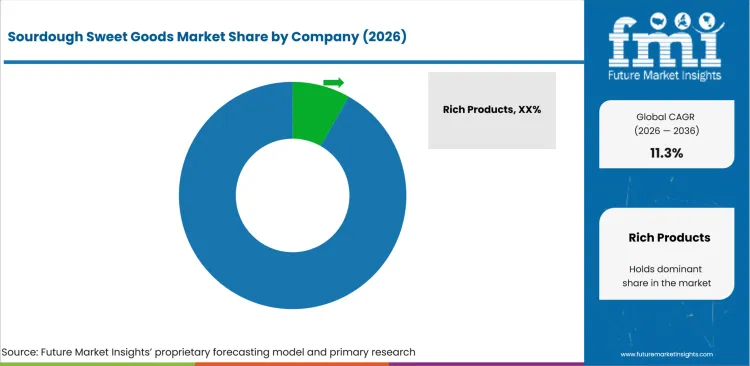
Italian panettone producers hold much of the direct-scope company set because mother-yeast control and long fermentation are embedded in their production. Food-safety records and shelf-life performance determine whether premium leavened products qualify for wider distribution. Scaled groups cover several seasonal formats, while specialists compete through narrower panettone and colomba portfolios. Adjacent frozen baked goods compete for the same freezer and foodservice dessert occasions without carrying the same fermentation requirement.
- Bauli S.p.A., Maina Panettoni S.p.A. and BALOCCO S.p.A. Industria Dolciaria cover multiple naturally leavened seasonal formats.
- Dolciaria A. Loison Srl, Fiasconaro S.r.l. and Galup S.r.l. pair mother-yeast production with premium panettone and export distribution.
- Flamigni Srl and Bonifanti SpA specialize in long-fermented panettone and colomba for premium seasonal demand.
Competitive Benchmarking: Sourdough Sweet Goods Market
| Company | Route Breadth | Quality Documentation | Channel Coverage | Geographic Reach |
|---|---|---|---|---|
| Bauli S.p.A. | High | Medium | High | Global |
| Maina Panettoni S.p.A. | High | High | Medium | Europe; international |
| BALOCCO S.p.A. Industria Dolciaria | High | High | Medium | Europe; exports |
| Dolciaria A. Loison Srl | High | High | High | Europe; 70+ countries |
| Fiasconaro S.r.l. | High | Medium | High | Europe; United States |
| Galup S.r.l. | Medium | Medium | Medium | Italy; select exports |
| Flamigni Srl | High | Medium | Medium | Italy; international |
| Bonifanti SpA | Medium | Medium | Medium | Italy; select exports |
Scoring basis: High route breadth requires three verified naturally leavened sweet formats, while Medium requires two and Low records one. High quality documentation requires current food-safety certification plus explicit fermentation controls documented by the company or certifier. Medium quality documentation records one of those elements, while Low records a basic documented control without current certification. High channel coverage requires domestic retail plus verified export and foodservice routes within current public evidence. Medium channel coverage requires two documented routes, while Low records one current route to market.
Key Developments in the Sourdough Sweet Goods Market
- In April 2026, BALOCCO S.p.A. Industria Dolciaria received BRCGS Food Safety Grade AA+ certification covering production of panettone, pandoro, colomba, and cakes, supporting quality and food-safety standards within premium sweet bakery manufacturing.
- In October 2025, Fiasconaro S.r.l. opened its first United States pop-up in SoHo, expanding consumer access to its panettone and Sicilian sweet specialties and supporting the international positioning of premium Italian sweet bakery products.
- In October 2025, Dolciaria A. Loison Srl introduced PeachMary panettone following more than two years of recipe development combining peach and rosemary, highlighting continued flavor innovation within premium seasonal sweet bakery.
Key Players in the Sourdough Sweet Goods Market
Scaled Naturally Leavened Sweet Bakery Platforms
- Bauli S.p.A.
- Maina Panettoni S.p.A.
- BALOCCO S.p.A. Industria Dolciaria
Artisan Panettone and Mother-Yeast Specialists
- Dolciaria A. Loison Srl
- Fiasconaro S.r.l.
- Galup S.r.l.
- Flamigni Srl
Specialist Natural-Leavening Producer
- Bonifanti SpA
Sourdough Sweet Goods Market - Report Scope
| Coverage field | Report scope |
|---|---|
| Market breakdown | By type, claim / nature, format, packaging format, sales channel and region. |
| Quantitative Units | USD Million. |
| Market Definition | Commercial sales of finished sourdough-fermented sweet bakery goods sold through the defined formats and channels. |
| Regions Covered | North America, Latin America, Europe, East Asia, South Asia and Pacific and Middle East and Africa. |
| Countries Covered | UAE, Saudi Arabia, South Korea, USA, Germany, and 20+ countries included in the full report. |
| Key Companies Profiled | Bauli S.p.A., Maina Panettoni S.p.A., BALOCCO S.p.A. Industria Dolciaria, Dolciaria A. Loison Srl, Fiasconaro S.r.l., Galup S.r.l., Flamigni Srl, and Bonifanti SpA. |
| Forecast Period | 2026 to 2036. |
| Approach | Primary and secondary research with market triangulation. |
Sourdough Sweet Goods Market - Research Methodology
| Method | Approach |
|---|---|
| Primary Research | FMI analysts gathered input from manufacturers, service providers, technology developers, distributors, end users, procurement teams, and subject-matter experts. Interviews examined purchasing decisions, product or service evaluation, adoption barriers, approval requirements, pricing considerations, and expectations for technical or commercial support. Respondents were also asked what evidence is required before a trial, pilot, or initial order develops into regular purchasing. |
| Desk Research | Desk research covered government statistics, regulatory publications, trade data, industry associations, technical literature, standards, company filings, product information, and official corporate announcements. Sources were reviewed for relevance, publication date, geographic coverage, and consistency with the defined market scope. Claims relating to performance, applications, approvals, capacity, investment, and commercial activity were retained only when supported by credible public evidence. |
| Market Sizing and Forecasting | The market model combined the baseline value with historical performance, segment structure, pricing and volume indicators, adoption levels, company participation, and country-level demand conditions. Forecast assumptions considered economic activity, investment trends, regulatory developments, technology adoption, purchasing cycles, supply availability, and barriers to wider market use. Segment and regional estimates were reconciled before the final market total was calculated. |
| Data Validation | Estimates were checked against multiple independent indicators, including public data, company activity, trade patterns, industry developments, and findings from primary interviews. Validation also tested whether products, services, applications, and company revenues fell within the defined market boundaries. Adjacent categories, unsupported claims, overlapping revenues, and activities without direct market relevance were excluded to reduce double counting and maintain consistency across segments and countries. |
Sourdough Sweet Goods Market by Segments
Sourdough Sweet Goods Market segmented by Type:
- Liquid levain
- Dried sourdough
- Ready starters
- Flavor concentrates
Sourdough Sweet Goods Market segmented by Claim / Nature:
- Conventional
- Clean label
- Organic
- Gluten-free
- High-protein / fortified
Sourdough Sweet Goods Market segmented by Format:
- Fresh
- Frozen
- Ambient packaged
- Chilled
- Par-baked / thaw-and-serve
Sourdough Sweet Goods Market segmented by Packaging Format:
- Multipack
- Single-serve
- Family / loaf pack
- Bulk foodservice
Sourdough Sweet Goods Market segmented by Sales Channel:
Supermarkets & hypermarkets
- Artisan & specialty bakeries
- Convenience & forecourt
- Online & DTC
- Foodservice distributors
Sourdough Sweet Goods Market by Region:
- North America
- United States
- Canada
- Latin America
- Brazil
- Mexico
- Chile
- Rest of Latin America
- Western Europe
- Germany
- United Kingdom
- Italy
- Spain
- France
- Nordics
- Benelux
- Rest of Western Europe
- Eastern Europe
- Russia
- Poland
- Hungary
- Balkan and Baltic States
- Rest of Eastern Europe
- East Asia
- China
- Japan
- South Korea
- South Asia and Pacific
- India
- ASEAN
- Australia and New Zealand
- Rest of South Asia and Pacific
- Middle East and Africa
- Kingdom of Saudi Arabia
- Other GCC Countries
- Türkiye
- South Africa
- Other African Union Countries
- Rest of Middle East and Africa
Research Sources and Bibliography
- DNV Business Assurance Italy S.r.l. (2025, January 15). IFS Food Version 8 certificate for Maina Panettoni S.p.A.
- USA Bureau of Labor Statistics. (2025, August 28). Bakers
- Bauli S.p.A. (2025, April 9). The Bauli Group focuses on innovation as a strategic lever for growth and differentiation
- USA Food and Drug Administration. (2025, February 24). FDA Finalizes Updated “Healthy” Nutrient Content Claim
- USA Bureau of Labor Statistics. (2026, January 13). Consumer Price Index - December 2025
- USA Food and Drug Administration. (2025, January 14). FDA Proposes Requiring At-a-Glance Nutrition Information on the Front of Packaged Foods
- Dolciaria A. Loison Srl. (2025, June 10). BlackHabana in Evolution: From Panettone to the New Tosa and Canestrello Creations
- Abu Dhabi Quality and Conformity Council. (2025, March 1). The Abu Dhabi Quality and Conformity Council Approves the Nutri-Mark Label Guideline
- General Authority for Statistics, Saudi Arabia. (2025, October 14). Consumer Price Index - September 2025
- Statistics Korea. (2025, December 23). Preliminary Results of the 2024 Franchise Survey
- Bundesministerium für Landwirtschaft, Ernährung und Heimat. (2025, June 4). Hilfestellung für Unternehmen - Verwendung des Nutri-Score
- BALOCCO S.p.A. Industria Dolciaria. (2026, April 7). BRCGS Global Standard Food Safety certificate
- Fiasconaro S.r.l. (2025, October 30). Fiasconaro Brings Its First Pop-Up Store to New York
- Dolciaria A. Loison Srl. (2025, October 8). PeachMary: the new panettone that challenges flavors with peach and rosemary
- Dolciaria A. Loison Srl. (2026, March 2). Free sale certification, HACCP and quality system declarations
- Fiasconaro S.r.l. (n.d.). Certifications. Retrieved August 25, 2026.
- Galup S.r.l. (n.d.). A beautiful Italian story. Retrieved August 25, 2026.
- Flamigni Srl. (n.d.). Italian artisanal pastry shop since 1930. Retrieved August 25, 2026.
- Bonifanti SpA. (n.d.). Since 1932, panettoni and colombe only with White Mother yeast. Retrieved August 25, 2026.
- Bauli S.p.A. (2025, May 15). Olivieri 1882 entra a far parte del Gruppo Bauli
- Finsbury Food Group Limited. (2026, April 30). Finsbury Food Group Acquires Flower & White To Boost DTC And Healthy Snacking Growth
- Puratos Group. (2025, May 7). Puratos brings a trio of transformative innovations to iba 2025
- Dolciaria A. Loison Srl. (2025, December 1). Loison Pasticceri renews its commitment: the second year of the AIRC Panettone with JRE-Italia begins
- Rich Products Corporation. (2025, April 10). Rich Products, Funfetti extend partnership
- Dessert Holdings. (2025, July 14). Dessert Holdings Acquires Willamette Valley Pie Co.
- Premier Foods plc. (2025, March 24). Mr Kipling launches new lunchbox slices
- Dr. August Oetker Nahrungsmittel KG. (2025, May 15). Runde Backsache: Quarkbällchen aus dem Airfryer
This bibliography is provided for reader reference and is not exhaustive. The full report contains the complete reference list and detailed citations.
This Report Answers
- How large is the Sourdough Sweet Goods Market in 2026 and 2036?
- Which fermentation conditions convert sourdough into repeatable sweet-bakery production?
- Why does liquid levain hold the leading type share in 2026?
- How do conventional claims and fresh formats influence current segment leadership?
- Why does multipack lead the packaging format category in 2026?
- How do UAE, Saudi Arabia, South Korea, USA and Germany differ commercially?
- Which companies document natural-leavened sweet-bakery production and current market activity?
- Which process and shelf-life frictions can delay wider commercialization?
Frequently Asked Questions
How big is the Sourdough Sweet Goods Market in 2026?
The sourdough sweet goods market is valued at USD 638.6 million in 2026 and is projected to reach USD 1,862.9 million by 2036. Growth comes from fermentation that preserves a clear sensory difference in enriched sweet doughs.
What is the CAGR of the Sourdough Sweet Goods Market from 2026 to 2036?
The sourdough sweet goods market is projected to grow at a CAGR of 11.3% between 2026 and 2036. Expansion depends on repeatable fermentation in enriched doughs plus broader use of year-round breakfast and snack formats.
Which type leads the Sourdough Sweet Goods Market?
The liquid levain segment is expected to hold 38.0% of the sourdough sweet goods market in 2026, driven by direct starter dosing that improves fermentation control. Industrial bakeries can adjust active culture closer to proofing schedules during enriched-dough production.
Which countries are projected to record the highest growth in the Sourdough Sweet Goods Market?
UAE is projected to grow at 12.6% CAGR, followed by Saudi Arabia at 12.3% and South Korea at 11.9% through 2036. Their faster outlooks follow premium bakery occasions and dense foodservice or franchise channels that shorten product-testing cycles.
Which companies are active in the Sourdough Sweet Goods Market?
Key companies operating in the sourdough sweet goods market include Bauli S.p.A., Maina Panettoni S.p.A., BALOCCO S.p.A. Industria Dolciaria, Dolciaria A. Loison Srl, Fiasconaro S.r.l., Galup S.r.l., Flamigni Srl, and Bonifanti SpA. Their competition centers on mother-yeast control, format breadth and distribution reach in premium sweet bakery.
Preview the report firsthand - request a free sample
Get SampleGet the brochure for pricing and purchase details.
Get PDFTable of Content
- Key Takeaways
- Market Size and CAGR
- Top Growth Driver
- Fastest Growing Segment
- Leading Region
- Key Companies
- Emerging Opportunities
- Executive Summary
- Global Market Outlook
- Demand-side Trends
- Supply-side Trends
- Technology Roadmap Analysis
- Analysis and Recommendations
- Analyst Perspective (What is happening? Why now? What should investors know?)
- Key Questions Answered
- How large is the market?
- What is the CAGR?
- What are key trends?
- Which region dominates?
- Who are the leaders?
- Market Overview
- Market Coverage / Taxonomy
- Market Definition / Scope / Limitations
- Research Methodology
- Chapter Orientation
- Analytical Lens and Working Hypotheses
- Market Structure, Signals, and Trend Drivers
- Benchmarking and Cross-market Comparability
- Market Sizing, Forecasting, and Opportunity Mapping
- Research Design and Evidence Framework
- Desk Research Programme (Secondary Evidence)
- Expert Input and Fieldwork (Primary Evidence)
- Tooling, Models, and Reference Databases
- Data Engineering and Model Build
- Quality Assurance and Audit Trail
- Market Background
- Market Dynamics (Drivers, Restraints, Opportunity, Trends)
- Scenario Forecast (Optimistic, Likely, Conservative)
- Impact Analysis
- AI Impact
- Sustainability Impact
- Regulatory Impact
- Technology Impact
- Consumer / Buyer Analysis
- Purchase Drivers
- Adoption Barriers
- Buyer Journey
- Opportunity Map Analysis
- Product Life Cycle Analysis
- Supply Chain Analysis
- Investment Feasibility Matrix
- Value Chain Analysis
- PESTLE and Porter's Analysis
- Regulatory Landscape
- Regional Parent Market Outlook
- Production and Consumption Statistics
- Import and Export Statistics
- Global Market Analysis and Forecast, 2021 to 2036
- Historical Market Size Value (USD Million) Analysis, 2021 to 2025
- Current and Future Market Size Value (USD Million) Projections, 2026 to 2036
- Y-o-Y Growth Trend Analysis
- Absolute $ Opportunity Analysis
- Global Market Pricing Analysis, 2021 to 2036
- Global Market Analysis and Forecast, By Type, 2021 to 2036
- Introduction / Key Findings
- Historical Market Size Value (USD Million) Analysis By Type, 2021 to 2025
- Current and Future Market Size Value (USD Million) Analysis and Forecast By Type, 2026 to 2036
- Liquid levain
- Dried sourdough
- Ready starters
- Flavor concentrates
- Liquid levain
- Y-o-Y Growth Trend Analysis By Type, 2021 to 2025
- Absolute $ Opportunity Analysis By Type, 2026 to 2036
- Global Market Analysis and Forecast, By Claim / Nature, 2021 to 2036
- Introduction / Key Findings
- Historical Market Size Value (USD Million) Analysis By Claim / Nature, 2021 to 2025
- Current and Future Market Size Value (USD Million) Analysis and Forecast By Claim / Nature, 2026 to 2036
- Conventional
- Clean label
- Organic
- Gluten-free
- High-protein / fortified
- Conventional
- Y-o-Y Growth Trend Analysis By Claim / Nature, 2021 to 2025
- Absolute $ Opportunity Analysis By Claim / Nature, 2026 to 2036
- Global Market Analysis and Forecast, By Format, 2021 to 2036
- Introduction / Key Findings
- Historical Market Size Value (USD Million) Analysis By Format, 2021 to 2025
- Current and Future Market Size Value (USD Million) Analysis and Forecast By Format, 2026 to 2036
- Fresh
- Frozen
- Ambient packaged
- Chilled
- Par-baked / thaw-and-serve
- Fresh
- Y-o-Y Growth Trend Analysis By Format, 2021 to 2025
- Absolute $ Opportunity Analysis By Format, 2026 to 2036
- Global Market Analysis and Forecast, By Packaging Format, 2021 to 2036
- Introduction / Key Findings
- Historical Market Size Value (USD Million) Analysis By Packaging Format, 2021 to 2025
- Current and Future Market Size Value (USD Million) Analysis and Forecast By Packaging Format, 2026 to 2036
- Multipack
- Single-serve
- Family / loaf pack
- Bulk foodservice
- Multipack
- Y-o-Y Growth Trend Analysis By Packaging Format, 2021 to 2025
- Absolute $ Opportunity Analysis By Packaging Format, 2026 to 2036
- Global Market Analysis and Forecast, By Sales Channel, 2021 to 2036
- Introduction / Key Findings
- Historical Market Size Value (USD Million) Analysis By Sales Channel, 2021 to 2025
- Current and Future Market Size Value (USD Million) Analysis and Forecast By Sales Channel, 2026 to 2036
- Supermarkets & hypermarkets
- Artisan & specialty bakeries
- Convenience & forecourt
- Online & DTC
- Foodservice distributors
- Supermarkets & hypermarkets
- Y-o-Y Growth Trend Analysis By Sales Channel, 2021 to 2025
- Absolute $ Opportunity Analysis By Sales Channel, 2026 to 2036
- Global Market Analysis and Forecast, By Region, 2021 to 2036
- Introduction
- Historical Market Size Value (USD Million) Analysis By Region, 2021 to 2025
- Current Market Size Value (USD Million) Analysis and Forecast By Region, 2026 to 2036
- North America
- Latin America
- Western Europe
- Eastern Europe
- East Asia
- South Asia and Pacific
- Middle East & Africa
- Market Attractiveness Analysis By Region
- North America Market Analysis and Forecast, By Country, 2021 to 2036
- Historical Market Size Value (USD Million) Trend Analysis By Market Taxonomy, 2021 to 2025
- Market Size Value (USD Million) Forecast By Market Taxonomy, 2026 to 2036
- By Country
- USA
- Canada
- By Type
- By Claim / Nature
- By Format
- By Packaging Format
- By Sales Channel
- By Country
- Market Attractiveness Analysis
- By Country
- By Type
- By Claim / Nature
- By Format
- By Packaging Format
- By Sales Channel
- Key Takeaways
- Latin America Market Analysis and Forecast, By Country
- Historical Market Size Value (USD Million) Trend Analysis By Market Taxonomy, 2021 to 2025
- Market Size Value (USD Million) Forecast By Market Taxonomy, 2026 to 2036
- By Country
- Brazil
- Mexico
- Chile
- Rest of Latin America
- By Type
- By Claim / Nature
- By Format
- By Packaging Format
- By Sales Channel
- By Country
- Market Attractiveness Analysis
- By Country
- By Type
- By Claim / Nature
- By Format
- By Packaging Format
- By Sales Channel
- Key Takeaways
- Western Europe Market Analysis and Forecast, By Country
- Historical Market Size Value (USD Million) Trend Analysis By Market Taxonomy, 2021 to 2025
- Market Size Value (USD Million) Forecast By Market Taxonomy, 2026 to 2036
- By Country
- Germany
- UK
- Italy
- Spain
- France
- Nordic
- BENELUX
- Rest of Western Europe
- By Type
- By Claim / Nature
- By Format
- By Packaging Format
- By Sales Channel
- By Country
- Market Attractiveness Analysis
- By Country
- By Type
- By Claim / Nature
- By Format
- By Packaging Format
- By Sales Channel
- Key Takeaways
- Eastern Europe Market Analysis and Forecast, By Country
- Historical Market Size Value (USD Million) Trend Analysis By Market Taxonomy, 2021 to 2025
- Market Size Value (USD Million) Forecast By Market Taxonomy, 2026 to 2036
- By Country
- Russia
- Poland
- Hungary
- Balkan & Baltic
- Rest of Eastern Europe
- By Type
- By Claim / Nature
- By Format
- By Packaging Format
- By Sales Channel
- By Country
- Market Attractiveness Analysis
- By Country
- By Type
- By Claim / Nature
- By Format
- By Packaging Format
- By Sales Channel
- Key Takeaways
- East Asia Market Analysis and Forecast, By Country
- Historical Market Size Value (USD Million) Trend Analysis By Market Taxonomy, 2021 to 2025
- Market Size Value (USD Million) Forecast By Market Taxonomy, 2026 to 2036
- By Country
- China
- Japan
- South Korea
- By Type
- By Claim / Nature
- By Format
- By Packaging Format
- By Sales Channel
- By Country
- Market Attractiveness Analysis
- By Country
- By Type
- By Claim / Nature
- By Format
- By Packaging Format
- By Sales Channel
- Key Takeaways
- South Asia and Pacific Market Analysis and Forecast, By Country
- Historical Market Size Value (USD Million) Trend Analysis By Market Taxonomy, 2021 to 2025
- Market Size Value (USD Million) Forecast By Market Taxonomy, 2026 to 2036
- By Country
- India
- ASEAN
- Australia & New Zealand
- Rest of South Asia and Pacific
- By Type
- By Claim / Nature
- By Format
- By Packaging Format
- By Sales Channel
- By Country
- Market Attractiveness Analysis
- By Country
- By Type
- By Claim / Nature
- By Format
- By Packaging Format
- By Sales Channel
- Key Takeaways
- Middle East & Africa Market Analysis and Forecast, By Country
- Historical Market Size Value (USD Million) Trend Analysis By Market Taxonomy, 2021 to 2025
- Market Size Value (USD Million) Forecast By Market Taxonomy, 2026 to 2036
- By Country
- Kingdom of Saudi Arabia
- Other GCC Countries
- Türkiye
- South Africa
- Other African Union
- Rest of Middle East & Africa
- By Type
- By Claim / Nature
- By Format
- By Packaging Format
- By Sales Channel
- By Country
- Market Attractiveness Analysis
- By Country
- By Type
- By Claim / Nature
- By Format
- By Packaging Format
- By Sales Channel
- Key Takeaways
- Key Countries Market Analysis
- USA
- Pricing Analysis
- Market Share Analysis, 2025
- By Type
- By Claim / Nature
- By Format
- By Packaging Format
- By Sales Channel
- Canada
- Pricing Analysis
- Market Share Analysis, 2025
- By Type
- By Claim / Nature
- By Format
- By Packaging Format
- By Sales Channel
- Mexico
- Pricing Analysis
- Market Share Analysis, 2025
- By Type
- By Claim / Nature
- By Format
- By Packaging Format
- By Sales Channel
- Brazil
- Pricing Analysis
- Market Share Analysis, 2025
- By Type
- By Claim / Nature
- By Format
- By Packaging Format
- By Sales Channel
- Chile
- Pricing Analysis
- Market Share Analysis, 2025
- By Type
- By Claim / Nature
- By Format
- By Packaging Format
- By Sales Channel
- Germany
- Pricing Analysis
- Market Share Analysis, 2025
- By Type
- By Claim / Nature
- By Format
- By Packaging Format
- By Sales Channel
- UK
- Pricing Analysis
- Market Share Analysis, 2025
- By Type
- By Claim / Nature
- By Format
- By Packaging Format
- By Sales Channel
- Italy
- Pricing Analysis
- Market Share Analysis, 2025
- By Type
- By Claim / Nature
- By Format
- By Packaging Format
- By Sales Channel
- Spain
- Pricing Analysis
- Market Share Analysis, 2025
- By Type
- By Claim / Nature
- By Format
- By Packaging Format
- By Sales Channel
- France
- Pricing Analysis
- Market Share Analysis, 2025
- By Type
- By Claim / Nature
- By Format
- By Packaging Format
- By Sales Channel
- India
- Pricing Analysis
- Market Share Analysis, 2025
- By Type
- By Claim / Nature
- By Format
- By Packaging Format
- By Sales Channel
- ASEAN
- Pricing Analysis
- Market Share Analysis, 2025
- By Type
- By Claim / Nature
- By Format
- By Packaging Format
- By Sales Channel
- Australia & New Zealand
- Pricing Analysis
- Market Share Analysis, 2025
- By Type
- By Claim / Nature
- By Format
- By Packaging Format
- By Sales Channel
- China
- Pricing Analysis
- Market Share Analysis, 2025
- By Type
- By Claim / Nature
- By Format
- By Packaging Format
- By Sales Channel
- Japan
- Pricing Analysis
- Market Share Analysis, 2025
- By Type
- By Claim / Nature
- By Format
- By Packaging Format
- By Sales Channel
- South Korea
- Pricing Analysis
- Market Share Analysis, 2025
- By Type
- By Claim / Nature
- By Format
- By Packaging Format
- By Sales Channel
- Russia
- Pricing Analysis
- Market Share Analysis, 2025
- By Type
- By Claim / Nature
- By Format
- By Packaging Format
- By Sales Channel
- Poland
- Pricing Analysis
- Market Share Analysis, 2025
- By Type
- By Claim / Nature
- By Format
- By Packaging Format
- By Sales Channel
- Hungary
- Pricing Analysis
- Market Share Analysis, 2025
- By Type
- By Claim / Nature
- By Format
- By Packaging Format
- By Sales Channel
- Kingdom of Saudi Arabia
- Pricing Analysis
- Market Share Analysis, 2025
- By Type
- By Claim / Nature
- By Format
- By Packaging Format
- By Sales Channel
- Türkiye
- Pricing Analysis
- Market Share Analysis, 2025
- By Type
- By Claim / Nature
- By Format
- By Packaging Format
- By Sales Channel
- South Africa
- Pricing Analysis
- Market Share Analysis, 2025
- By Type
- By Claim / Nature
- By Format
- By Packaging Format
- By Sales Channel
- USA
- Market Structure Analysis
- Competition Dashboard
- Competition Benchmarking
- Market Share Analysis of Top Players
- By Regional
- By Type
- By Claim / Nature
- By Format
- By Packaging Format
- By Sales Channel
- Emerging Startups
- Innovation Benchmarking
- Competition Analysis
- Competition Deep Dive
- Rich Products
- Overview
- Product Portfolio
- Profitability by Market Segments
- Sales Footprint
- Strategy Overview
- Marketing Strategy
- Product Strategy
- Channel Strategy
- Sara Lee Frozen Bakery
- Dessert Holdings
- Mademoiselle Desserts
- Finsbury Food Group
- Premier Foods
- McKee Foods
- Hostess Brands
- Bauli
- Dr. Oetker
- Rich Products
- Case Studies
- Success Stories
- Recent Developments
- Competition Deep Dive
- Assumptions & Acronyms Used


