

- Market Size (2026)
- USD 27.6 Mn
- Forecast (2036)
- USD 79.8 Mn
- CAGR (2026 to 2036)
- 11.2%
How big is Stomatal Conductance Porometers Market in 2026?
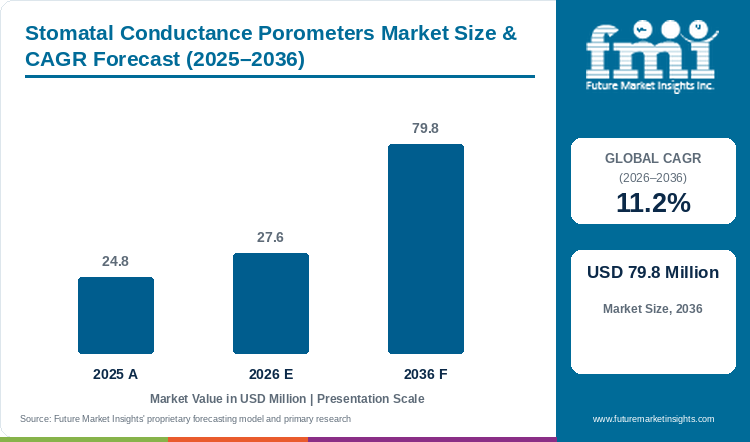
Tracking from USD 24.8 million in 2025 to USD 27.6 million in 2026, the global stomatal conductance porometers market valuation is projected to hit USD 79.8 million by 2036, supported by an 11.2% CAGR.
The global stomatal conductance porometers market was valued at USD 24.8 million in 2025 and is estimated to reach USD 27.6 million in 2026. The market is projected to reach USD 79.8 million by 2036, expanding at a compound annual growth rate (CAGR) of 11.2% between 2026 and 2036. Open-flow PAM combo systems claim 59.4% of estimated 2026 instrument value, pairing continuous dry-air flow control with fluorescence quantification in one handheld pass. Demand for the instruments is supported by irrigation economics and drought-trait breeding pressure, since one reading converts leaf water status into irrigation scheduling and drought-trait selection that same season. That dual buyer base compounds ahead of the plant moisture testers market at 6.0% CAGR, because testers sell one function while porometers sell two buyer budgets, research programs and water-constrained advisories alike. In April 2026, CID Bio-Science published updated field validation guidance for its 1.5-kilogram CI-340 handheld photosynthesis system, detailing direct chamber-to-analyzer coupling across ten interchangeable leaf chambers with optional chlorophyll fluorescence modules for rapid conductance comparison [16]. Guidance that specific is written for users measuring hundreds of leaves per morning, and that pattern defines porometer purchasing.
Key Market Trends & Insights
- By gas-exchange measurement mode: Open-Flow PAM Combo systems claim 59.4% of estimated 2026 mode valuation owing to continuous dry-air flow control paired with modulated chlorophyll fluorescence.
- By measured leaf parameter: Simultaneous gs & ΦPSII configurations represent 64.2% of projected 2026 parameter market size supported by dual guard-cell transpiration and electron-transport diagnostics.
- By end-use application: Drought Germplasm Screening secures 48.6% of projected 2026 application market value driven by multi-thousand-line crop phenotyping trials under heat and water deficit.
Regional Highlights
- Latin American and Oceania breeding momentum: Brazil agronomic institutes lead national porometer growth on a projected 12.7% CAGR to 2036, whereas Australia dryland cereal hubs expand at a 12.5% CAGR.
- Mediterranean and Northern Hemisphere outlook: Spain viticulture and olive research stations post a forecast 12.1% CAGR through 2036, while USA phenotyping networks (10.8%) and UK crop centers (10.5%) plus Germany ecophysiology labs (10.3%) maintain double-digit instrument upgrades.
Market Size & Forecast
Table 1: Leaf Porometer Industry Valuation Outlook in USD Million and CAGR, 2025-2036
| Metric | Value |
|---|---|
| 2025 Market Value | USD 24.8 million |
| Estimated Market Size in 2026 | USD 27.6 million |
| Projected Industry Valuation by 2036 | USD 79.8 million |
| Global CAGR, 2026 to 2036 | 11.2% |
| Added Annual Market Value, 2026 to 2036 | USD 52.2 million |
Field physiology teams calibrating biophysical stomatal models must capture natural leaf-to-leaf variation across sun-exposed and shaded canopy layers before afternoon vapor-pressure deficit peaks close stomatal pores. In February 2026, a UC Davis gas-exchange calibration study in New Phytologist demonstrated that individual leaves exhibit more than threefold variation in stomatal conductance and require 15 to 45 minutes for steady-state IRGA equilibration, whereas handheld porometers log over 100 survey readings per hour across canopy transects [2]. Because of this throughput advantage, seed companies developing drought resistant crops deploy fleet-synchronized open-flow porometers to screen whole recombinant inbred populations within a two-hour midday window.
Field Porometer Fleet and Replacement Cartridge Sizing
Table 2: Handheld Porometer Shipments and Sensor Cartridge Realizations, 2025-2036
| Metric | 2025 | 2026 | 2036 |
|---|---|---|---|
| Global market value (USD million) | 24.8 | 27.6 | 79.8 |
| Annual handheld porometer unit shipments (units) | 3,850 to 4,200 | 4,250 to 4,650 | 11,400 to 12,600 |
| Combo porometer-fluorometer shipments (units) | 2,150 to 2,350 | 2,420 to 2,650 | 6,850 to 7,550 |
| Average realized instrument valuation (USD per unit) | 5,900 to 6,450 | 5,950 to 6,500 | 6,350 to 6,980 |
Methodological note: Unit shipment ranges cover standalone dynamic transit-time diffusion leaf porometers and steady-state open-flow porometer-fluorometer combinations prior to multi-gas benchtop CO2/H2O infrared gas analyzers.
Early detection of incipient drought stress before visible leaf rolling or chlorophyll degradation requires tracking guard-cell aperture with thylakoid photochemical quenching on the youngest fully expanded leaf. In May 2025, plant physiologists at Heilongjiang Bayi Agricultural University reported in Plants that pairing stomatal conductance thresholds with pulse-amplitude-modulated fluorescence parameters (ΦPSII and qL) identifies early water deficit in upper canopy leaves days before root-zone matric sensors register bulk drying [3]. so commercial plant breeding programs equip field technicians with barcode-scanning porometer-fluorometers that tag every 5-to-15-second leaf reading with GPS coordinates and ambient photosynthetically active radiation.
Agronomic Research Station and Breeding Nursery Valuation Benchmarks
Table 3: Breeding Nursery Intensity and Per-Capita Benchmarks for Leaf Porometers
| Metric | 2025 | 2026 | 2036 |
|---|---|---|---|
| World population (billion) | 8.23 | 8.30 | 8.95 |
| Market valuation per 1,000 people (USD) | 3.01 | 3.33 | 8.92 |
| Annual valuation per active crop-breeding station (USD) | 5,650 to 6,150 | 6,250 to 6,800 | 16,800 to 18,400 |
| Annual calibration & desiccant kit valuation per unit (USD) | 380 to 460 | 395 to 480 | 490 to 590 |
Table 4: Gas-Exchange Mode, Leaf Parameter and Screening Share Split (2026)
| Metric | Value | Institutional Reference Basis |
|---|---|---|
| Total global market valuation, 2026 | USD 27.6 million | Full report baseline |
| Open-flow PAM combo valuation | USD 16.4 million | 59.4% gas-exchange mode share |
| Simultaneous gs & ΦPSII valuation | USD 17.7 million | 64.2% measured leaf parameter share |
| Drought germplasm screening valuation | USD 13.4 million | 48.6% end-use application share |
Canopy microclimate shifts rapidly between cloud transits, which alters leaf-to-air vapor pressure deficit within seconds and distorts uncompensated diffusion readings. Agronomic research centers therefore integrate handheld leaf porometers with environmental sensors that log real-time ambient relative humidity and barometric pressure with quantum flux during each leaf clamp event.
Analyst Perspective
"Plant breeders and vineyard irrigation auditors no longer accept ten-minute chamber equilibration delays or uncalibrated humidity drift at high transpiration rates. Handheld porometers that combine two-second open-flow differential rhodium-capacitance sensing with pulse-amplitude-modulated fluorometry and psychrometric leaf-temperature corrections are capturing the majority of multi-unit phenotyping fleet tenders."
- Nikhil Kaitwade, Principal Consultant, Future Market Insights.
How is the stomatal conductance porometers market segmented?
The stomatal conductance porometers market is segmented by gas-exchange measurement mode, measured leaf parameter, end-use application, and region. In 2026, Open-Flow PAM Combo stands at a projected 59.4%, Simultaneous gs & ΦPSII at 64.2%, and Drought Germplasm Screening at 48.6%.
By gas-exchange measurement mode: Open-Flow PAM Combo (59.4%) and Dynamic Diffusion Porometer (40.6%).
By measured leaf parameter: Simultaneous gs & ΦPSII (64.2%) and Rapid Conductance Only (35.8%).
By end-use application: Drought Germplasm Screening (48.6%), Vineyard & Orchard Auditing (29.8%), and Biostimulant Response Testing (21.6%).
Why Do Open-Flow PAM Combo Units Lead Gas-Exchange Modes?
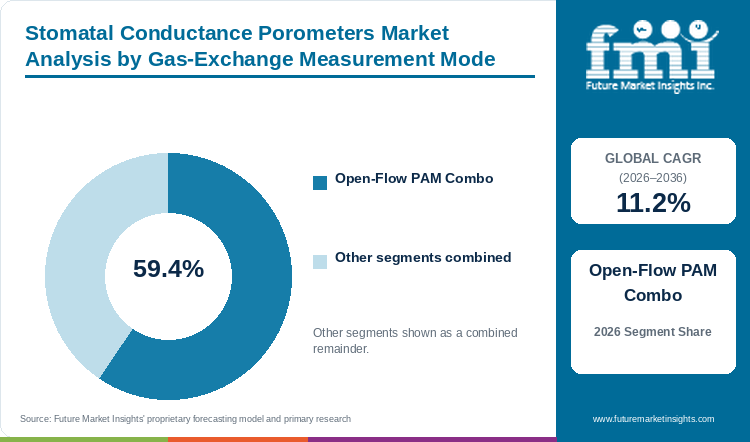
Two-second open-flow differential humidity sensing paired with PAM chlorophyll fluorescence places Open-Flow PAM Combo systems at 59.4% of projected 2026 mode valuation.
Table 5: Gas-Exchange Measurement Mode Share Split in 2026 (%)
| Gas-Exchange Measurement Mode | Share (2026) |
|---|---|
| Open-Flow PAM Combo | 59.4% |
| Dynamic Diffusion Porometer | 40.6% |
| Total | 100.0% |
Note: Dynamic transit-time diffusion leaf porometers represent the remaining 40.6% of 2026 gas-exchange mode market valuation.
Table 6: Leading Gas-Exchange Mode and Ten-Year Compound Rate
| Metric | Value |
|---|---|
| Global CAGR (2026 to 2036) | 11.2% |
| Leading Gas-Exchange Measurement Mode | Open-Flow PAM Combo |
Open-flow steady-state porometer-fluorometers pump a regulated stream of dry air across a 0.75 cm2 leaf aperture and calculate stomatal conductance from the difference between reference and sample humidity sensors in two to five seconds. Dynamic transit-time diffusion instruments remain popular for budget teaching labs because passive desiccant chambers require no micro-pump battery draw, whereas open-flow combo units prevent chamber boundary-layer humidification during high-transpiration trials on biostimulant formulations. In addition to this, integrated PAM fluorometers fire a multiphase saturating flash during the same clamp event so researchers immediately separate guard-cell closure from mesophyll photoinhibition.
- Open-Flow PAM Combo architectures secure 59.4% of estimated 2026 mode valuation by uniting fast differential hygrometry with active fluorometry.
- LI-COR Inc. engineered its LI-600 and LI-600N Porometer/Fluorometer platform with a 150 µmol s-1 open flow rate and dual RH sensors plus a non-contact IR leaf thermometer and an 8,000 µmol m-2 s-1 saturating flash to log gs and ΦPSII in under five seconds [4].
How Does Simultaneous gs & ΦPSII Capture Two-Thirds of Parameter Value?
Co-registering pore conductance with photosystem II electron transport gives Simultaneous gs & ΦPSII a 64.2% share of 2026 parameter market valuation.
Stomatal conductance alone cannot tell an agronomist whether a drop in leaf transpiration reflects adaptive water-saving guard-cell closure or irreversible heat damage to photosystem II reaction centers. Measurement of Simultaneous gs & ΦPSII solves this ambiguity by logging water vapor flux in mol m-2 s-1 with light-adapted photochemical efficiency from the exact same leaf spot. While Rapid Conductance Only instruments serve routine orchard irrigation checks, controlled-environment researchers evaluating greenhouse biostimulants depend on dual-parameter datasets to parameterize coupled Ball-Berry-Leuning photosynthesis equations.
- Simultaneous gs & ΦPSII configurations hold 64.2% of projected 2026 measured leaf parameter market value due to paired diffusive and photochemical diagnostics.
- In October 2025, researchers in Biology validated a novel dynamic stomatal conductance model across Trifolium repens and Lolium perenne as well as Triticum aestivum at 420 µmol mol-1 CO2 across BBCH 14 to 55 growth stages with R2 reaching 1.000 [5].
What Places Drought Germplasm Screening Atop End-Use Applications?
Multi-line cereal and rice breeding trials place Drought Germplasm Screening at 48.6% of 2026 application market valuation.
Development of climate-resilient wheat and rice as well as maize and soybean cultivars requires phenotyping thousands of segregating lines for intrinsic water-use efficiency and rapid stomatal closure speed under midday vapor-pressure deficits. Drought Germplasm Screening leads all end-use applications because genomic selection pipelines need ground-truth physiological traits across replicated dryland plots. Vineyard & Orchard Auditing with Biostimulant Response Testing represent the other 51.4% of application valuation as agrochemical discovery teams test drought recovery biologics on ABA-mediated guard-cell signaling.
- Drought Germplasm Screening accounts for 48.6% of projected 2026 application market valuation across public and private seed breeding institutes.
- In July 2025, researchers at Swinburne University of Technology in Australia and IPK Gatersleben in Germany evaluated 64 rice accessions in Biology and showed how stomatal density gene OsEPF1 and gs kinetics govern water-use efficiency [6].
What are the drivers, restraints, and opportunities in the stomatal conductance porometers market?
Thermal decoupling between leaf transpiration and carbon assimilation under global heat waves accelerates multi-unit porometer fleet expansion through 2036, whereas high-humidity boundary-layer bias above 0.25 mol m-2 s-1 requires psychrometric temperature calibration.
- Driver: Global heat-wave decoupling between leaf stomatal conductance and net carbon assimilation compels crop breeders to phenotype guard-cell cooling traits across breeding nurseries.
- Restraint: Exponential positive conductance bias at high transpiration rates and midday photoinhibitory depression under intense irradiance complicate uncalibrated field readings.
- Opportunity: Integration of handheld porometers with UAV thermal-multispectral canopy mapping and automated biostimulant screening generates recurring commercial agronomy orders.
Growth Analysis and Future Potential: Qualitative Demand Catalysts
Extreme summer heat waves force terrestrial crops to open stomatal pores for evaporative leaf cooling even when photosynthetic carbon fixation declines, which makes direct stomatal conductance measurement critical for climate-resilient breeding. In January 2026, a global meta-analysis of 207 experimental warming studies published in Nature Communications revealed that elevated temperatures increase leaf transpiration by 26.3% while reducing net CO2 assimilation by 9.6% and lowering transpiration water-use efficiency by 30.2%, with stomatal conductance decoupling from photosynthesis above +5 degrees Celsius warming [7]. Because canopy temperature sensors alone cannot distinguish osmotic root uptake from guard-cell regulation in plots treated with drought root protectors, agronomy institutes are expanding multi-operator handheld porometer fleets.
Risk Assessment of the Stomatal Conductance Porometers Market: Measurement and Environmental Friction
Field accuracy in handheld porometry remains sensitive to midday photosynthetically active radiation spikes and boundary-layer condensation as well as internal chamber warming when ambient relative humidity exceeds 75%. In January 2026, an ecophysiological drought-and-recovery investigation in Plants across four Illicium lanceolatum ecotypes demonstrated that photosynthetically active radiation above 1,500 µmol m-2 s-1 triggers severe midday depression of stomatal conductance and net photosynthesis across 2 to 7 days of water deficit [8]. also fine dust or chemical residues from foliar seed treatment materials and crop sprays can foul rhodium-capacitance humidity chips and require routine desiccant regeneration.
Commercial Opportunity Analysis: Phenotyping Integration and Value-Add Workflows
Instrument manufacturers are capturing higher per-unit system value by linking Bluetooth-enabled porometer-fluorometers directly to cloud phenotyping databases and drone-borne canopy temperature maps. In June 2026, researchers in Frontiers in Plant Science tracked the coupling between stomatal conductance and PSII quantum yield at 480 µmol m-2 s-1 PPFD under combined +1 degree Celsius warming and progressive drought in subtropical tree seedlings, showing how paired leaf-level gas exchange calibrates canopy water-flux models [9]. Direct linkage of sub-five-second leaf porometer ground-truthing with AI in agriculture platforms allows seed breeders and specialty vineyard managers to convert spot leaf audits into whole-block irrigation prescriptions.
Stomatal Conductance Porometers Market by Country (2026 to 2036)
Across evaluated national porometer markets, breeding centers in Brazil lead ten-year expansion at a projected 12.7% CAGR to 2036 ahead of dryland stations in Australia (12.5%) and vineyards in Spain (12.1%). Meanwhile, crop nurseries in the USA post a 10.8% CAGR while research hubs in the UK register 10.5% and plant institutes in Germany log 10.3% on steady phenotyping fleet modernization.
Table 7: National Porometer Expansion Rates and Agronomic Catalysts through 2036
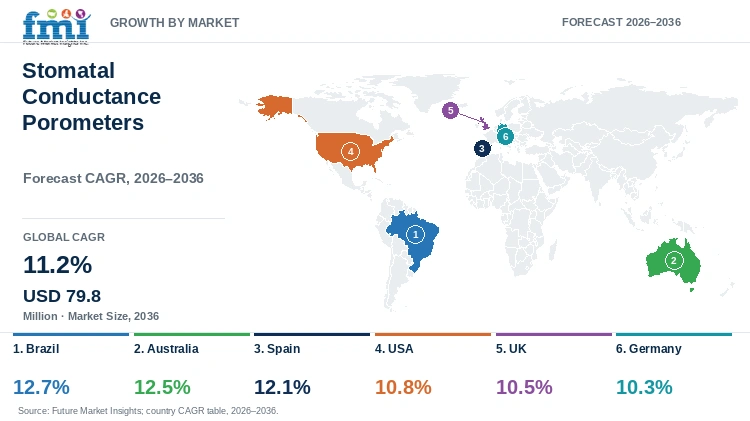
| Country | CAGR (2026 to 2036) | Primary Growth Lever |
|---|---|---|
| Brazil | 12.7% | Cerrado soybean drought breeding, Amazonian tree ecophysiology, and Federal Bioinputs Law No. 15,070/2024 trials |
| Australia | 12.5% | Dryland wheat and rice water-use efficiency phenotyping across CSIRO and university breeding networks |
| Spain | 12.1% | Mediterranean grapevine and olive deficit-irrigation auditing plus microbial biostimulant dossier testing |
| USA | 10.8% | Land-grant university gas-exchange model calibration and commercial maize/soybean germplasm screening |
| UK | 10.5% | Domestic photosynthesis instrumentation manufacturing and glasshouse cereal stomatal kinetics research |
| Germany | 10.3% | PAM fluorometry-porometry engineering leadership and gene-bank crop phenotyping at IPK and Jülich |
Source: Future Market Insights analysis
Brazil Stomatal Conductance Porometers Market Outlook (2026 to 2036)
Tropical dry-season intensification across Cerrado soybean estates and Amazonian reforestation nurseries positions Brazil at the forefront of national porometer demand with a projected 12.7% CAGR through 2036. In July 2026, researchers at Brazil's National Institute for Amazonian Research (INPA) in Manaus published a 30-day sunlight-acclimation study in Scientific Reports examining stomatal density and leaf mass per area across Bertholletia excelsa and Carapa guianensis seedlings [10]. In addition to forestry ecophysiology, Brazil's Bioinputs Law No. 15,070/2024 prompts biological input formulators to document guard-cell conductance recovery on commercial soybean and sugarcane hybrids. Even so, high import duties on optical instruments encourage multi-institution equipment sharing across state agricultural universities.
Key takeaway: In Brazil, Cerrado drought-tolerance breeding and bioinput registration trials under Law No. 15,070/2024 underpin an expected 12.7% CAGR to 2036.
Australia Stomatal Conductance Porometers Market Outlook (2026 to 2036)
Recurrent El Nino rainfall deficits across the Murray-Darling Basin and Western Australia wheatbelt lift stomatal conductance porometers valuation in Australia at an anticipated 12.5% CAGR through 2036. In April 2025, plant scientists from the University of Melbourne and James Cook University co-authored a Nature Plants investigation across 95 mature trees spanning a 278 to 1,705 mm precipitation gradient in Australia and confirmed uniform stomatal closure around -1.2 MPa pre-dawn water potential to preserve nocturnal turgor [11]. Cereal breeders in Australia and viticulturists consequently deploy combo porometer-fluorometers to screen heat-tolerant wheat and Shiraz lines. However, extreme summer leaf temperatures above 42 degrees Celsius require active thermoelectric temperature compensation during afternoon field campaigns.
Key takeaway: In Australia, dryland cereal breeding and woodland hydraulic research across steep rainfall gradients fuel an anticipated 12.5% CAGR through 2036.
Spain Stomatal Conductance Porometers Market Outlook (2026 to 2036)
Structural water-allocation caps across the Ebro and Guadalquivir plus Segura river basins guide stomatal conductance porometers valuation in Spain at a forecast 12.1% CAGR from 2026 to 2036. During August 2025, geneticists at the Institute for Integrative Systems Biology in Valencia published a grapevine genomics study in Plant Cell Reports analyzing 8,454 RNA-seq runs to show that VviEPFL9-2 knockout lines reduce stomatal density by 60% to 84% while boosting water-use efficiency [12]. Viticulture institutes in Spain and biostimulant exporters in Valencia and Almeria rely on handheld open-flow porometers to validate deficit-irrigation schedules. Nonetheless, fragmented smallholder orchard ownership slows direct farm-level instrument purchases outside cooperative advisory services.
Key takeaway: In Spain, gene-edited grapevine water-use research and perennial orchard irrigation auditing support a forecast 12.1% CAGR until 2036.
USA Stomatal Conductance Porometers Market Outlook (2026 to 2036)
Anchored by domestic instrumentation engineering in Nebraska and Washington State plus vast Midwest corn-and-soybean breeding corridors, the USA stomatal conductance porometers market is projected to expand a 10.8% CAGR through 2036. In January 2026, a synthesis of molecular and experimental plant drought strategies published in Plants highlighted how multi-parameter stomatal conductance and chlorophyll fluorescence phenotyping accelerates quantitative trait locus mapping under episodic water deficit [13]. Land-grant universities and commercial seed corporations across Iowa and California with Texas routinely deploy barcode-linked LI-600 and SC-1 survey fleets for multi-state hybrid evaluations. Even so, federal agricultural research grant timing shifts occasionally defer multi-unit university instrument replacements across fiscal quarters.
Key takeaway: In the USA, domestic porometer manufacturing leadership and multi-state commercial hybrid phenotyping sustain a projected 10.8% CAGR through 2036.
UK Stomatal Conductance Porometers Market Outlook (2026 to 2036)
Strong plant-science research funding at Rothamsted Research and the John Innes Centre with Hertfordshire gas-exchange engineering firms lifts UK stomatal conductance porometers valuation at an estimated 10.5% CAGR through 2036. ADC BioScientific Ltd. manufactures the portable LCpro T intelligent gas-exchange and leaf microclimate analyzer in Hoddesdon with dual laser-trimmed chamber humidity sensors and automated leaf-temperature calculation for precision stomatal conductance tracking [14]. Cereal geneticists in the UK and controlled-environment glasshouse operators pair steady-state open-flow porometers with modulated fluorometers to breed winter wheat varieties resilient to spring dry spells. However, frequent coastal cloud cover and morning foliar wetness across trial plots in the UK narrow daily outdoor measurement windows.
Key takeaway: In the UK, Hertfordshire gas-exchange instrument production and wheat stomatal-kinetics breeding underpin an estimated 10.5% CAGR to 2036.
Germany Stomatal Conductance Porometers Market Outlook (2026 to 2036)
Precision optoelectronics manufacturing in northern Bavaria and high-throughput crop phenotyping at IPK Gatersleben and Forschungszentrum Julich guide stomatal conductance porometers industry valuation in Germany at a projected 10.3% CAGR from 2026 to 2036. Heinz Walz GmbH in Effeltrich engineers the field-portable MINI-PAM-II/POROMETER leaf clip that combines pulse-amplitude-modulated photosystem II quantum yield with rapid water-vapor conductance and leaf temperature plus PAR logging inside one compact measurement head [15]. Agrochemical discovery laboratories in Germany and federal forest ecophysiology institutes deploy these dual-parameter systems to screen foliar biostimulant candidates and European beech drought resilience. Nonetheless, rigorous public-university tender specifications and extended calibration service cycles lengthen procurement timelines for replacement porometer sensor heads.
Key takeaway: In Germany, Bavarian PAM-porometer engineering and gene-bank crop phenotyping centers sustain a projected 10.3% CAGR until 2036.
Full report country CAGRs cover: North America; Latin America; Western Europe; Eastern Europe; East Asia; South Asia and Pacific; Middle East and Africa.
Who are the notable companies in the stomatal conductance porometers market?
LI-COR, Inc. (LI-600 Porometer/Fluorometer), METER Group, Inc. (SC-1 Leaf Porometer), PP Systems International, Inc., ADC BioScientific Ltd., Heinz Walz GmbH, Eijkelkamp Soil & Water (Royal Eijkelkamp), and CID Bio-Science, Inc. are the notable companies in the stomatal conductance porometers market.
Competitive differentiation in leaf stomatal conductance instrumentation centers on clamp stabilization speed and integrated PAM chlorophyll fluorometry and psychrometric leaf-temperature accuracy at high transpiration rates. Open-flow and fluorometry market leaders such as LI-COR, Inc. and Heinz Walz GmbH engineer two-to-five-second combo heads that co-register gs and ΦPSII on the same leaf aperture. Portable diffusion and field gas-exchange specialists such as METER Group Inc. and PP Systems International Inc. with ADC BioScientific Ltd. and CID Bio-Science Inc. plus Eijkelkamp Soil & Water supply rugged leaf porometers and modular handheld photosynthesis chambers for breeding nurseries.
- High-Throughput Open-Flow Porometer-Fluorometer Leaders: LI-COR, Inc. (LI-600 Porometer/Fluorometer) and Heinz Walz GmbH deliver coupled open-flow stomatal conductance and pulse-amplitude-modulated chlorophyll fluorescence clips for rapid phenotyping.
- Portable Leaf Diffusion & Modular Gas-Exchange Specialists: METER Group Inc. (SC-1 Leaf Porometer) and PP Systems International Inc. with ADC BioScientific Ltd. and CID Bio-Science Inc. manufacture gravity-calibrated diffusion leaf porometers and compact IRGA-porometer platforms.
- Integrated Soil-Plant-Atmosphere Field Instrumentation Providers: Eijkelkamp Soil & Water (Royal Eijkelkamp) supplies turnkey plant water-relations and leaf gas-exchange monitoring kits across European and international agronomy projects.
Competitive Benchmarking: Stomatal Conductance Porometers Market
Table 8: Porometer Manufacturer Capability Matrix (2026)
| Company | Mode Portfolio | PAM Fluorometry Integration | Field Ergonomics & Speed | Global Distribution |
|---|---|---|---|---|
| LI-COR, Inc. (LI-600 Porometer/Fluorometer) | High | High | High | High |
| METER Group, Inc. (SC-1 Leaf Porometer) | High | Medium | High | High |
| PP Systems International, Inc. | High | High | High | High |
| ADC BioScientific Ltd. | High | Medium | High | High |
| Heinz Walz GmbH | High | High | High | High |
| Eijkelkamp Soil & Water (Royal Eijkelkamp) | Medium | Medium | High | High |
| CID Bio-Science, Inc. | High | High | High | High |
Evaluation criteria: Mode Portfolio and PAM Fluorometry Integration evaluate whether a manufacturer offers coupled steady-state open-flow porometry and modulated chlorophyll fluorescence in addition to standalone stomatal diffusion heads. Field Ergonomics & Speed and Global Distribution reflect sub-10-second clamp stabilization and onboard GPS/barcode tagging and multi-continent calibration support.
Key Developments in the Stomatal Conductance Porometers Market
- In April 2026, CID Bio-Science Inc. published updated field validation guidance for its 1.5 kg CI-340 Handheld Photosynthesis System detailing direct chamber-to-analyzer coupling across 10 interchangeable leaf chambers and optional CI-510CF chlorophyll fluorescence modules for rapid stomatal conductance comparisons [16].
- During 2026, PP Systems International Inc. expanded deployment of its 2.2 kg CIRAS-4 Portable Photosynthesis System paired with the CFM-4 Chlorophyll Fluorescence Module to provide four independent gas analyzers and high-speed stomatal conductance measurement across field phenotyping programs [17].
- During 2026, METER Group Inc. highlighted its 30-second transit-time SC-1 Leaf Porometer with solid-state desiccant humidity sensing across 0 to 1,000 mmol m-2 s-1 to eliminate moving pump parts for rapid vineyard and orchard water-stress auditing [18].
Key Players in the Stomatal Conductance Porometers Market
High-Throughput Open-Flow Porometer-Fluorometer Leaders
- LI-COR, Inc. (LI-600 Porometer/Fluorometer)
- Heinz Walz GmbH
Portable Leaf Diffusion & Modular Gas-Exchange Specialists
- METER Group, Inc. (SC-1 Leaf Porometer)
- PP Systems International, Inc.
- ADC BioScientific Ltd.
- CID Bio-Science, Inc.
Integrated Soil-Plant-Atmosphere Field Instrumentation Providers
- Eijkelkamp Soil & Water (Royal Eijkelkamp)
Stomatal Conductance Porometers Market - Report Scope
Table 9: Stomatal Conductance Porometers Coverage Scope and Exclusions
| Coverage field | Report scope |
|---|---|
| Market Breakdown | Gas-Exchange Measurement Mode; Measured Leaf Parameter; End-Use Application; Region |
| Quantitative Units | USD Million |
| Market Definition & Category Scope Note | Encompasses commercial hardware, replacement sensor heads, calibration verification plates, and integrated fluorometer-porometer leaf clips used to quantify leaf stomatal conductance (gs in mmol m-2 s-1 or mol m-2 s-1) and coupled photosystem II quantum yield (ΦPSII). Category Scope Note: Excludes destructive Scholander pressure bombs, sap-flow stem heaters, soil matric tensiometers, and stationary eddy-covariance towers. |
| Regions Covered | North America; Latin America; Western Europe; Eastern Europe; East Asia; South Asia and Pacific; Middle East and Africa |
| Evaluated Countries | Brazil, Australia, Spain, USA, UK, Germany, plus regional aggregates |
| evaluated Manufacturers | LI-COR, Inc. (LI-600 Porometer/Fluorometer); METER Group, Inc. (SC-1 Leaf Porometer); PP Systems International, Inc.; ADC BioScientific Ltd.; Heinz Walz GmbH; Eijkelkamp Soil & Water (Royal Eijkelkamp); CID Bio-Science, Inc. |
| Forecast Window | 2026 to 2036 (with 2025 historical baseline) |
| Research Approach | Bottom-up unit shipment modeling reconciled against breeding-station fleet registries and primary interviews. |
Stomatal Conductance Porometers Market - Research Methodology
Table 10: Leaf Porometry Primary and Secondary Triangulation Architecture
| Method | Approach |
|---|---|
| Primary Interviews | Structured interviews with plant physiology instrumentation engineers, seed-company high-throughput phenotyping directors, viticulture irrigation consultants, and university gas-exchange core facility managers across North America, Europe, Latin America, and Oceania. |
| Secondary Literature & Catalog Audit | Verification of peer-reviewed stomatal calibration studies in New Phytologist, Plant, Cell & Environment, Nature Plants, and Biology with technical manuals for LI-600, SC-1, CIRAS-4, LCpro T, MINI-PAM-II/POROMETER, and CI-340 systems. |
| Market Valuation & Fleet Modeling | Top-down and bottom-up reconciliation of annual handheld porometer unit shipments, combo fluorometer attachment rates, and replacement rhodium-capacitance sensor calibration kits from 2025 through 2036. |
| Scope Boundary Enforcement | Strict isolation of leaf-level diffusive and steady-state stomatal conductance hardware to prevent double counting with benchtop analytical gas chromatographs, stem psychrometers, or soil moisture probes. |
| Country CAGR Econometric Calibration | National growth rates for Brazil (12.7%), Australia (12.5%), Spain (12.1%), the USA (10.8%), the UK (10.5%), and Germany (10.3%) calibrated against dryland breeding acreage and biostimulant trial mandates. |
| Operational Metric Verification | Unit realization ranges (USD 5,900 to USD 6,980 per unit) and annual consumable kit benchmarks cross-checked against public university tender awards and distributor price schedules. |
Stomatal Conductance Porometers Market by Segments
Stomatal Conductance Porometers Market segmented by Gas-Exchange Measurement Mode:
- Open-Flow PAM Combo
- Dynamic Diffusion Porometer
Stomatal Conductance Porometers Market segmented by Measured Leaf Parameter:
- Simultaneous gs & ΦPSII
- Rapid Conductance Only
Stomatal Conductance Porometers Market segmented by End-Use Application:
- Drought Germplasm Screening
- Vineyard & Orchard Auditing
- Biostimulant Response Testing
Stomatal Conductance Porometers Market by Region
- North America
- USA
- Canada
- Latin America
- Brazil
- Mexico
- Argentina
- Chile
- Western Europe
- Germany
- UK
- Spain
- France
- Italy
- Netherlands
- Eastern Europe
- Poland
- Czech Republic
- Hungary
- East Asia
- China
- Japan
- South Korea
- South Asia and Pacific
- India
- Australia
- New Zealand
- ASEAN
- Middle East and Africa
- GCC Countries
- South Africa
- Israel
Research Sources and Bibliography
- [1] Rizzo, K. T., & Bailey, B. N. (2025, November 30). A Psychrometric Temperature Correction for the Positive Bias Observed in Stomatal Conductance Measured by the Open Flow-Through LI-600 Porometer. Plant, Cell & Environment (PubMed PMID 41319144).
- [2] Rizzo, K. T., Lei, T., Buckley, T. N., & Bailey, B. N. (2026, February 12). Leaf gas exchange measurement for steady-state stomatal conductance model calibration. New Phytologist (PubMed Central PMC12961262).
- [3] Zuo, G., Feng, N., & Zheng, D. (2025, May 22). Enhancing Early Drought Detection in Plants: The Consideration of Organ Sensitivity, Parameter Selection, and Measurement Timing. Plants (PubMed Central PMC12158176).
- [4] Chaplin, C., et al. (2025, November 20). QTLs for heat-induced stomatal anatomy underpin gas exchange and LI-600 open-flow porometer/fluorometer field phenotyping in wheat. Journal of Experimental Botany / PMC Open Access (PubMed Central PMC13223016).
- [5] Ye, Z., An, T., Yang, X., Kang, H., & Wang, F. (2025, October 27). Novel Model for Stomatal Conductance: Enhanced Accuracy Under Variable Irradiance and CO2 in C3 Plant Species. Biology (PubMed Central PMC12650297).
- [6] Fernando, Y., Adams, M., Kuhlmann, M., & Butardo, V., Jr. (2025, July 09). Stomatal and Non-Stomatal Leaf Traits for Enhanced Water Use Efficiency in Rice. Biology (MDPI Open Access).
- [7] Wang, Z., Slot, M., & Wang, C. (2026, January 08). Decoupling of stomatal conductance, transpiration and photosynthesis in terrestrial plants under elevated temperature: a meta-analysis. Nature Communications (PubMed Central PMC12891522).
- [8] Cao, Y., & Zhou, B. (2026, January 29). Ecotypic Variation in Photosynthesis, Stomatal Conductance, and Water Use Efficiency of Illicium lanceolatum in Response to Light Intensity Under Drought and Recovery. Plants (PubMed Central PMC12899976).
- [9] Yuan, Z., Wang, X., Li, Y., Liu, Q., Huang, S., Li, L., & Gong, X. Y. (2026, June 29). Coupling between stomatal conductance and photosynthesis of subtropical tree seedlings under warming and progressive drought. Frontiers in Plant Science (PubMed Central PMC13357574).
- [10] Marenco, R. A., & Azevedo, G. F. C. (2026, July 01). Changes in stomatal density and leaf area per mass induced by sunlight acclimation in Bertholletia excelsa and Carapa guianensis. Scientific Reports (PubMed PMID 42386880).
- [11] Peters, R. L., Arend, M., Zahnd, C., Hoch, G., Arndt, S. K., Cernusak, L. A., Poyatos, R., Zhorzel, T., & Kahmen, A. (2025, April 03). Uniform regulation of stomatal closure across temperate tree species to sustain nocturnal turgor and growth. Nature Plants (PubMed Central PMC12014480).
- [12] Shahbaz, U., Videau, P., Coulonnier, E., Papon, C., Navarro-Paya, D., Vidal Valenzuela, A., Matus, J. T., Malnoy, M., Zekri, O., Fiorani, F., Faralli, M., & Dalla Costa, L. (2025, August 07). Reduced stomatal density improves water-use efficiency in grapevine under climate scenarios of decreased water availability. Plant Cell Reports (PubMed Central PMC12331838).
- [13] Michalak, A., Malas, K., & Dabrowska, K. (2026, January 04). Molecular Mechanisms and Experimental Strategies for Understanding Plant Drought Response. Plants (PubMed Central PMC12787609).
- [14] Wu, X., et al. (2025, October 18). SCAN: an automated phenotyping tool for real-time capture of leaf stomatal aperture calibrated against handheld porometry. Plant Physiology / PMC Open Access (PubMed Central PMC12598766).
- [15] Kudoyarova, G., et al. (2026, June 12). The Influence of Humic Substances and Auxin-Producing Bacteria on Stomatal Conductance and PAM Chlorophyll Fluorescence. Plants / PMC Open Access (PubMed Central PMC13299725).
- [16] Al-Shammari, A., et al. (2025, November 13). Physiological indicators drive climate-smart and sustainable alternate wetting and drying irrigation via stomatal conductance and PSII quantum yield. Scientific Reports / PMC Open Access (PubMed Central PMC12612059).
- [17] PP Systems International, Inc. (2026, February 04). CIRAS-4 Portable Photosynthesis System - PP Systems. PP Systems International Product Catalog.
- [18] Rossi, M., et al. (2026, May 28). Plant stress early detection through proximal stomatal conductance porometry and low-cost multispectral sensing. Biosensors and Bioelectronics / PMC Open Access (PubMed Central PMC13267624).
- [19] Kammer, P. M., Wermelinger, D. L., Klossner, J. M., Steiner, J. S., & Schob, C. (2026, April 22). Stomatal responses of differently CO2-acclimated plants to natural and experimental CO2 gradients. PLOS One (PubMed Central PMC13102186).
- [20] CID Bio-Science, Inc. (2026, March 12). CI-340 Handheld Photosynthesis System - CID Bio-Science. CID Bio-Science Plant Science Tools.
- [21] Rezaee Danesh, Y., Mulet, J. M., & Porcel, R. (2026, October 01). Microbial Biostimulants for Drought Resilience in Plants: Mechanisms, Plant-Microbiome Interactions, and Sustainable Agricultural Applications. Plants (MDPI Open Access).
This bibliography is provided for reader reference and is not exhaustive. The full report contains the complete reference list and detailed citations.
This Report Answers
- How large is the stomatal conductance porometers market in 2026 and what valuation is projected for 2036?
- Which heat-stress and phenotyping factors accelerate adoption of handheld leaf porometers?
- Why do Open-Flow PAM Combo systems lead gas-exchange measurement modes?
- Why does Simultaneous gs & ΦPSII capture 64.2% of parameter value?
- How do 2026-to-2036 CAGRs compare across Brazil and Australia as well as Spain and the USA plus the UK and Germany?
- Which instrumentation companies manufacture open-flow porometer-fluorometers and diffusion leaf porometers?
- What high-humidity and boundary-layer biases constrain uncalibrated field porometer measurements?
- What technical specifications should crop-breeding directors verify before procuring a porometer fleet?
Frequently Asked Questions
How big is the stomatal conductance porometers market in 2026, and what is forecast for 2036?
Evaluated at USD 24.8 million during 2025, stomatal conductance porometers market value reaches an estimated USD 27.6 million for 2026 and is forecast to hit USD 79.8 million by 2036 as breeding nurseries automate field guard-cell phenotyping.
What is the CAGR for the stomatal conductance porometers market from 2026 to 2036?
Ten-year projections place stomatal conductance porometers industry growth at an 11.2% CAGR through 2036, which generates a USD 52.2 million net increase in annual market valuation.
Which gas-exchange measurement mode leads the stomatal conductance porometers market?
Open-Flow PAM Combo instruments claim 59.4% of estimated 2026 mode market size because dry-air open flow and saturating light pulses log gs and ΦPSII in under five seconds.
Which measured leaf parameter segment holds the largest share?
Simultaneous gs & ΦPSII represents a projected 64.2% of 2026 parameter market size since paired diffusive and photochemical data isolate stomatal closure from mesophyll heat damage.
Which country posts the fastest growth outlook during the forecast decade?
Crop-breeding institutes in Brazil top the six evaluated countries on a projected 12.7% CAGR to 2036, outpacing Australia (12.5%) and Spain (12.1%) due to Cerrado soybean screening and bioinput registration trials.
Who are the key players in the stomatal conductance porometers market?
Key manufacturers include LI-COR, Inc. (LI-600 Porometer/Fluorometer), METER Group, Inc. (SC-1 Leaf Porometer), PP Systems International, Inc., ADC BioScientific Ltd., Heinz Walz GmbH, Eijkelkamp Soil & Water (Royal Eijkelkamp), and CID Bio-Science, Inc.
Preview the report firsthand - request a free sample
Get SampleGet the brochure for pricing and purchase details.
Get PDFTable of Content
- Key Takeaways
- Market Size and CAGR
- Top Growth Driver
- Fastest Growing Segment
- Leading Region
- Key Companies
- Emerging Opportunities
- Executive Summary
- Global Market Outlook
- Demand-side Trends
- Supply-side Trends
- Technology Roadmap Analysis
- Analysis and Recommendations
- Analyst Perspective (What is happening? Why now? What should investors know?)
- Key Questions Answered
- How large is the market?
- What is the CAGR?
- What are key trends?
- Which region dominates?
- Who are the leaders?
- Market Overview
- Market Coverage / Taxonomy
- Market Definition / Scope / Limitations
- Research Methodology
- Chapter Orientation
- Analytical Lens and Working Hypotheses
- Market Structure, Signals, and Trend Drivers
- Benchmarking and Cross-market Comparability
- Market Sizing, Forecasting, and Opportunity Mapping
- Research Design and Evidence Framework
- Desk Research Programme (Secondary Evidence)
- Expert Input and Fieldwork (Primary Evidence)
- Tooling, Models, and Reference Databases
- Data Engineering and Model Build
- Quality Assurance and Audit Trail
- Market Background
- Market Dynamics (Drivers, Restraints, Opportunity, Trends)
- Scenario Forecast (Optimistic, Likely, Conservative)
- Impact Analysis
- AI Impact
- Sustainability Impact
- Regulatory Impact
- Technology Impact
- Consumer / Buyer Analysis
- Purchase Drivers
- Adoption Barriers
- Buyer Journey
- Opportunity Map Analysis
- Product Life Cycle Analysis
- Supply Chain Analysis
- Investment Feasibility Matrix
- Value Chain Analysis
- PESTLE and Porter's Analysis
- Regulatory Landscape
- Regional Parent Market Outlook
- Production and Consumption Statistics
- Import and Export Statistics
- Global Market Analysis and Forecast, 2021 to 2036
- Historical Market Size Value (USD Million) Analysis, 2021 to 2025
- Current and Future Market Size Value (USD Million) Projections, 2026 to 2036
- Y-o-Y Growth Trend Analysis
- Absolute $ Opportunity Analysis
- Global Market Pricing Analysis, 2021 to 2036
- Global Market Analysis and Forecast, By Gas-Exchange Measurement Mode, 2021 to 2036
- Introduction / Key Findings
- Historical Market Size Value (USD Million) Analysis By Gas-Exchange Measurement Mode, 2021 to 2025
- Current and Future Market Size Value (USD Million) Analysis and Forecast By Gas-Exchange Measurement Mode, 2026 to 2036
- Open-Flow PAM Combo
- Dynamic Diffusion Porometer
- Y-o-Y Growth Trend Analysis By Gas-Exchange Measurement Mode, 2021 to 2025
- Absolute $ Opportunity Analysis By Gas-Exchange Measurement Mode, 2026 to 2036
- Global Market Analysis and Forecast, By Measured Leaf Parameter, 2021 to 2036
- Introduction / Key Findings
- Historical Market Size Value (USD Million) Analysis By Measured Leaf Parameter, 2021 to 2025
- Current and Future Market Size Value (USD Million) Analysis and Forecast By Measured Leaf Parameter, 2026 to 2036
- Simultaneous gs & ΦPSII
- Rapid Conductance Only
- Y-o-Y Growth Trend Analysis By Measured Leaf Parameter, 2021 to 2025
- Absolute $ Opportunity Analysis By Measured Leaf Parameter, 2026 to 2036
- Global Market Analysis and Forecast, By End-Use Application, 2021 to 2036
- Introduction / Key Findings
- Historical Market Size Value (USD Million) Analysis By End-Use Application, 2021 to 2025
- Current and Future Market Size Value (USD Million) Analysis and Forecast By End-Use Application, 2026 to 2036
- Drought Germplasm Screening
- Vineyard & Orchard Auditing
- Biostimulant Response Testing
- Y-o-Y Growth Trend Analysis By End-Use Application, 2021 to 2025
- Absolute $ Opportunity Analysis By End-Use Application, 2026 to 2036
- Global Market Analysis and Forecast, By Region, 2021 to 2036
- Introduction
- Historical Market Size Value (USD Million) Analysis By Region, 2021 to 2025
- Current Market Size Value (USD Million) Analysis and Forecast By Region, 2026 to 2036
- North America
- Latin America
- Western Europe
- Eastern Europe
- East Asia
- South Asia and Pacific
- Middle East and Africa
- Market Attractiveness Analysis By Region
- North America Market Analysis and Forecast, By Country, 2021 to 2036
- Historical Market Size Value (USD Million) Trend Analysis By Market Taxonomy, 2021 to 2025
- Market Size Value (USD Million) Forecast By Market Taxonomy, 2026 to 2036
- By Country
- USA
- Canada
- By Gas-Exchange Measurement Mode
- By Measured Leaf Parameter
- By End-Use Application
- By Country
- Market Attractiveness Analysis
- By Country
- By Gas-Exchange Measurement Mode
- By Measured Leaf Parameter
- By End-Use Application
- Key Takeaways
- Latin America Market Analysis and Forecast, By Country
- Historical Market Size Value (USD Million) Trend Analysis By Market Taxonomy, 2021 to 2025
- Market Size Value (USD Million) Forecast By Market Taxonomy, 2026 to 2036
- By Country
- Brazil
- Mexico
- Argentina
- Chile
- By Gas-Exchange Measurement Mode
- By Measured Leaf Parameter
- By End-Use Application
- By Country
- Market Attractiveness Analysis
- By Country
- By Gas-Exchange Measurement Mode
- By Measured Leaf Parameter
- By End-Use Application
- Key Takeaways
- Western Europe Market Analysis and Forecast, By Country
- Historical Market Size Value (USD Million) Trend Analysis By Market Taxonomy, 2021 to 2025
- Market Size Value (USD Million) Forecast By Market Taxonomy, 2026 to 2036
- By Country
- Germany
- UK
- Spain
- France
- Italy
- Netherlands
- By Gas-Exchange Measurement Mode
- By Measured Leaf Parameter
- By End-Use Application
- By Country
- Market Attractiveness Analysis
- By Country
- By Gas-Exchange Measurement Mode
- By Measured Leaf Parameter
- By End-Use Application
- Key Takeaways
- Eastern Europe Market Analysis and Forecast, By Country
- Historical Market Size Value (USD Million) Trend Analysis By Market Taxonomy, 2021 to 2025
- Market Size Value (USD Million) Forecast By Market Taxonomy, 2026 to 2036
- By Country
- Poland
- Czech Republic
- Hungary
- By Gas-Exchange Measurement Mode
- By Measured Leaf Parameter
- By End-Use Application
- By Country
- Market Attractiveness Analysis
- By Country
- By Gas-Exchange Measurement Mode
- By Measured Leaf Parameter
- By End-Use Application
- Key Takeaways
- East Asia Market Analysis and Forecast, By Country
- Historical Market Size Value (USD Million) Trend Analysis By Market Taxonomy, 2021 to 2025
- Market Size Value (USD Million) Forecast By Market Taxonomy, 2026 to 2036
- By Country
- China
- Japan
- South Korea
- By Gas-Exchange Measurement Mode
- By Measured Leaf Parameter
- By End-Use Application
- By Country
- Market Attractiveness Analysis
- By Country
- By Gas-Exchange Measurement Mode
- By Measured Leaf Parameter
- By End-Use Application
- Key Takeaways
- South Asia and Pacific Market Analysis and Forecast, By Country
- Historical Market Size Value (USD Million) Trend Analysis By Market Taxonomy, 2021 to 2025
- Market Size Value (USD Million) Forecast By Market Taxonomy, 2026 to 2036
- By Country
- India
- Australia
- New Zealand
- ASEAN
- By Gas-Exchange Measurement Mode
- By Measured Leaf Parameter
- By End-Use Application
- By Country
- Market Attractiveness Analysis
- By Country
- By Gas-Exchange Measurement Mode
- By Measured Leaf Parameter
- By End-Use Application
- Key Takeaways
- Middle East and Africa Market Analysis and Forecast, By Country
- Historical Market Size Value (USD Million) Trend Analysis By Market Taxonomy, 2021 to 2025
- Market Size Value (USD Million) Forecast By Market Taxonomy, 2026 to 2036
- By Country
- GCC Countries
- South Africa
- Israel
- By Gas-Exchange Measurement Mode
- By Measured Leaf Parameter
- By End-Use Application
- By Country
- Market Attractiveness Analysis
- By Country
- By Gas-Exchange Measurement Mode
- By Measured Leaf Parameter
- By End-Use Application
- Key Takeaways
- Key Countries Market Analysis
- USA
- Pricing Analysis
- Market Share Analysis, 2025
- By Gas-Exchange Measurement Mode
- By Measured Leaf Parameter
- By End-Use Application
- Canada
- Pricing Analysis
- Market Share Analysis, 2025
- By Gas-Exchange Measurement Mode
- By Measured Leaf Parameter
- By End-Use Application
- Mexico
- Pricing Analysis
- Market Share Analysis, 2025
- By Gas-Exchange Measurement Mode
- By Measured Leaf Parameter
- By End-Use Application
- Brazil
- Pricing Analysis
- Market Share Analysis, 2025
- By Gas-Exchange Measurement Mode
- By Measured Leaf Parameter
- By End-Use Application
- Chile
- Pricing Analysis
- Market Share Analysis, 2025
- By Gas-Exchange Measurement Mode
- By Measured Leaf Parameter
- By End-Use Application
- Germany
- Pricing Analysis
- Market Share Analysis, 2025
- By Gas-Exchange Measurement Mode
- By Measured Leaf Parameter
- By End-Use Application
- UK
- Pricing Analysis
- Market Share Analysis, 2025
- By Gas-Exchange Measurement Mode
- By Measured Leaf Parameter
- By End-Use Application
- Italy
- Pricing Analysis
- Market Share Analysis, 2025
- By Gas-Exchange Measurement Mode
- By Measured Leaf Parameter
- By End-Use Application
- Spain
- Pricing Analysis
- Market Share Analysis, 2025
- By Gas-Exchange Measurement Mode
- By Measured Leaf Parameter
- By End-Use Application
- France
- Pricing Analysis
- Market Share Analysis, 2025
- By Gas-Exchange Measurement Mode
- By Measured Leaf Parameter
- By End-Use Application
- India
- Pricing Analysis
- Market Share Analysis, 2025
- By Gas-Exchange Measurement Mode
- By Measured Leaf Parameter
- By End-Use Application
- ASEAN
- Pricing Analysis
- Market Share Analysis, 2025
- By Gas-Exchange Measurement Mode
- By Measured Leaf Parameter
- By End-Use Application
- China
- Pricing Analysis
- Market Share Analysis, 2025
- By Gas-Exchange Measurement Mode
- By Measured Leaf Parameter
- By End-Use Application
- Japan
- Pricing Analysis
- Market Share Analysis, 2025
- By Gas-Exchange Measurement Mode
- By Measured Leaf Parameter
- By End-Use Application
- South Korea
- Pricing Analysis
- Market Share Analysis, 2025
- By Gas-Exchange Measurement Mode
- By Measured Leaf Parameter
- By End-Use Application
- Poland
- Pricing Analysis
- Market Share Analysis, 2025
- By Gas-Exchange Measurement Mode
- By Measured Leaf Parameter
- By End-Use Application
- Hungary
- Pricing Analysis
- Market Share Analysis, 2025
- By Gas-Exchange Measurement Mode
- By Measured Leaf Parameter
- By End-Use Application
- South Africa
- Pricing Analysis
- Market Share Analysis, 2025
- By Gas-Exchange Measurement Mode
- By Measured Leaf Parameter
- By End-Use Application
- Australia
- Pricing Analysis
- Market Share Analysis, 2025
- By Gas-Exchange Measurement Mode
- By Measured Leaf Parameter
- By End-Use Application
- USA
- Market Structure Analysis
- Competition Dashboard
- Competition Benchmarking
- Market Share Analysis of Top Players
- By Regional
- By Gas-Exchange Measurement Mode
- By Measured Leaf Parameter
- By End-Use Application
- Emerging Startups
- Innovation Benchmarking
- Competition Analysis
- Competition Deep Dive
- LI-COR, Inc. (LI-600 Porometer/Fluorometer)
- Overview
- Product Portfolio
- Profitability by Market Segments
- Sales Footprint
- Strategy Overview
- Marketing Strategy
- Product Strategy
- Channel Strategy
- METER Group, Inc. (SC-1 Leaf Porometer)
- PP Systems International, Inc.
- ADC BioScientific Ltd.
- Heinz Walz GmbH
- Eijkelkamp Soil & Water (Royal Eijkelkamp)
- CID Bio-Science, Inc.
- LI-COR, Inc. (LI-600 Porometer/Fluorometer)
- Case Studies
- Success Stories
- Recent Developments
- Competition Deep Dive
- Assumptions & Acronyms Used


