

- Market Size (2026)
- USD 257.1 Mn
- Forecast (2036)
- USD 697.8 Mn
- CAGR (2026 to 2036)
- 10.5%
How big is Stone-Milled Flour Market in 2026?
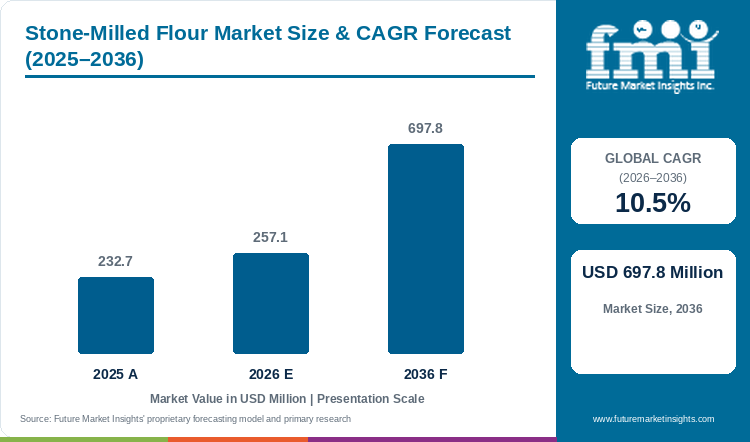
Accounting for USD 232.7 million in 2025 and rising to USD 257.1 million in 2026, the global stone-milled flour market is projected to expand to USD 697.8 million by 2036, advancing at a CAGR of 10.5%.
The global stone-milled flour market was valued at USD 232.7 million in 2025 and is estimated to reach USD 257.1 million in 2026. The market is projected to reach USD 697.8 million by 2036, expanding at a compound annual growth rate (CAGR) of 10.5% between 2026 and 2036. Standard milling grade holds 33.0% of 2026 grade demand because calibrated gluten strength and water absorption suit automated bread lines. Demand for stone-milled flour is supported by federal whole-wheat labeling enforcement, which turned single-pass germ retention into an auditable identity claim rather than an artisan preference [1]. That audit requirement separates this market from the whole-wheat flour category growing at 3.3% CAGR, as commodity whole wheat trades on tonnage while stone-milled lots are contracted acre by acre. The growth in stone-milled consumption is also reflected in sourcing commitments, with ADM's July 2026 partnership with General Mills and Walmart extends regenerative wheat programs across 40,000 Midwest acres [9]. For instance, Ardent Mills entered an agreement in July 2025 to acquire a stone-milling facility in Richardton, North Dakota featuring identity-preserved grain cleaning [3]. Millers that lock certified-identity wheat supply before claim enforcement tightens will hold the contracting advantage through 2036.
Key Market Trends & Insights
- By grade: Standard milling grade holds 33.0% of 2026 grade turnover by delivering calibrated gluten strength and water absorption for automated bread lines.
- By form: Powder / dry form commands 43.0% of 2026 form demand because dry stone-ground flour ships efficiently in 25-kilogram sacks and bulk pneumatic totes.
- By application: Bread & rolls represent 32.0% of 2026 application volume as long sourdough fermentation hydrates coarse bran flecks and builds roasted wheat aroma.
- By claim: Conventional offerings secure 46.0% of 2026 claim revenue by using residue-monitored non-organic wheat contracts that avoid organic land-transition surcharges.
- By sales channel: Direct to industrial bakeries accounts for 51.0% of 2026 channel sales through rapid mill-to-bakery inventory rotation that prevents germ-lipid rancidity.
Regional Highlights
- Top national expansion: The UAE paces country growth with an 11.9% CAGR through 2036 via luxury hotel boulangeries and climate-controlled specialty flour imports.
- Broader country progression: Saudi Arabia follows at an 11.5% CAGR while South Korea posts 11.2% and the USA records 10.9% on expanding artisan sourdough and whole-grain demand.
Market Size & Forecast
Table 1: Market Size and Forecast for the Stone-Milled Flour Market (USD million and CAGR percentage), 2025 to 2036
| Metric | Value |
|---|---|
| 2025 Market Size | USD 232.7 million |
| Estimated Market Size in 2026 | USD 257.1 million |
| Projected Market Size by 2036 | USD 697.8 million |
| CAGR, 2026 to 2036 | 10.5% |
| Added Revenue, 2026 to 2036 | USD 440.7 million |
Broader adoption of stone-milled flour across national retail and foodservice bakery chains requires strict sieve granulation control and microbial pathogen reduction on raw grain. When whole kernels are ground without outer bran scalping, field microbes on the pericarp enter the flour unless millers install optical cleaning and thermal or cold-pasteurization steps ahead of the stones. In addition, October 2026 federal bolted-flour standards under 21 CFR 137.105 mandate that at least 98% of sifted flour pass through a 212-micrometer No. 70 woven wire cloth sieve while capping ash at one-twentieth of dry-basis protein plus 0.35 [2]. Major grain processors are acquiring dedicated stone-milling assets to meet this industrial specification across wheat and emmer and einkorn flour blends. In July 2025 Ardent Mills entered an agreement to acquire a stone mill in Richardton, North Dakota equipped with identity-preserved and gluten-free grain cleaning and microbial-reduction capabilities [3]. These industrial capacity investments generate USD 440.7 million in added category revenue from 2026 to 2036.
Milling Tonnage and Commercial Burr-Mill Capacity Sizing
Table 2: Commercial Milling Tonnage and Line Capacity Sizing for the Stone-Milled Flour Market (kilotonnes and milling units), 2025 to 2036
| Metric | 2025 | 2026 | 2036 |
|---|---|---|---|
| Market size (USD million) | 232.7 | 257.1 | 697.8 |
| Commercial stone-milled flour volume (kilotonnes) | 152.0 to 163.0 | 167.0 to 179.5 | 428.0 to 462.0 |
| Commercial stone-milling & hybrid mill installations | 480 to 525 | 520 to 570 | 1,180 to 1,290 |
| Average wholesale realization (USD per metric ton) | 1,427 to 1,531 | 1,432 to 1,540 | 1,510 to 1,630 |
Operational note: Tonnage figures aggregate commercial 25-kilogram and 50-pound bakery sacks plus bulk FIBC totes and pre-hydrated sourdough pastes.
Commercial stone-milling output expands from 167.0–179.5 kilotonnes in 2026 to 428.0–462.0 kilotonnes by 2036 only when millers prevent frictional heat buildup between rotary burr stones during continuous shifts. Excessive grinding temperatures above 42 degrees Celsius denature native glutenin proteins and accelerate lipase-driven rancidity in co-milled wheat germ oil. In August 2026, quarterly Current Agricultural Industrial Reports (Flour Milling Products) from the USDA National Agricultural Statistics Service tracked commercial wheat and rye ground for flour plus whole-wheat production and 24-hour milling capacity across commercial plants [4]. Installation of chilled-air aspiration and automated gap sensors across industrial wheat milling machines enables millers to run multi-shift schedules without scorching starch or germ lipids.
Per Capita & Artisan Bakery Procurement Indicators
Table 3: Per Capita and Bakery Procurement Indicators for the Stone-Milled Flour Market (USD), 2025 to 2036
| Metric | 2025 | 2026 | 2036 |
|---|---|---|---|
| Global population reference (billion) | 8.2 | 8.3 | 9.0 |
| Spend per 1,000 people (USD) | 28.4 | 31.0 | 77.5 |
| Commercial artisan bakeries, pizzerias & industrial bread plants (thousand) | 125.0 | 134.0 | 235.0 |
| Annual stone-milled flour spend per active bakery account (USD) | 1,861.6 | 1,918.7 | 2,969.4 |
Table 4: Granulation, Moisture & Nutritional Reference Benchmarks for the Stone-Milled Flour Market (technical specifications), 2026
| Metric | Value | Institutional Reference Basis |
|---|---|---|
| Market size, 2026 | USD 257.1 million | 2026 global factory-gate revenue baseline |
| Whole wheat granulation standard | >=90% thru No. 8 (2.36mm); >=50% thru No. 20 (850um) | 21 CFR 137.200 statutory sieve requirement |
| Maximum statutory flour moisture | <= 15.0% w/w | 21 CFR 137.105 and 21 CFR 137.200 moisture ceiling |
| Whole-wheat protein & fiber baseline | 13.28 g protein and 11.4 g fiber per 100 g | 2025 Journal of Food Science whole-wheat benchmark |
Raw grain represents up to 80% of operating cost in flour milling, which gives stone milling a compelling yield advantage because 85% to 100% of the cleaned wheat kernel is sold as food-grade flour rather than low-margin feed middlings. Stable global wheat harvests allow specialty millers to lock in identity-preserved hard red and ancient wheat contracts for artisan bakeries and pizzerias. In October 2026, the Food and Agriculture Organization Cereal Supply and Demand Brief forecast global wheat production at 813.9 million tonnes in 2026 with a 31.7% world cereal stocks-to-use ratio [5]. This dependable grain cushion supports millers operating commercial grain mill systems as annual stone-milled flour spend per active bakery rises from USD 1,918.7 in 2026 to USD 2,969.4 by 2036.
Analyst Perspective
"Commercial bakeries scaling sourdough loaves and laminated pastries specify stone-milled flour for its wheat-germ aromatics and mineral density, provided the miller controls stone dressing and grinding heat below 40 degrees Celsius. Millers that pair identity-preserved regenerative wheat contracts with microbial-reduction grain cleaning and direct-to-bakery sack rotation capture long-term industrial supply agreements."
- Nandini Roy Choudhury, Principal Analyst at Future Market Insights
How is the stone-milled flour market segmented?
The stone-milled flour market is segmented by grade, form, application, claim, sales channel, and region. In 2026, Standard milling grade is projected at 33.0% of the grade segment, Powder / dry at 43.0% of the form segment, Bread & rolls at 32.0% of the application segment, Conventional at 46.0% of the claim segment, and Direct to industrial bakeries at 51.0% of the sales channel segment.
By grade: Standard milling grade, fine / patisserie grade, organic certified, and identity-preserved specialty.
By form: Powder / dry, liquid, paste / semi-solid, and granules / pieces.
By application: Bread & rolls, cakes & muffins, biscuits & cookies, viennoiserie & pastry, and other bakery & snacks.
By claim: Conventional, clean label, organic, and non-GMO / identity preserved.
By sales channel: Direct to industrial bakeries, ingredient distributors, foodservice & artisan supply, and online B2B.
Why does Standard milling grade lead the grade category?
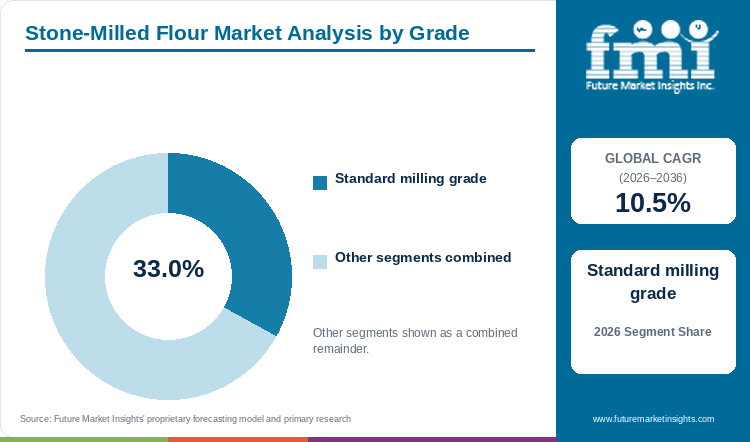
Standard milling grade generates 33.0% of 2026 grade revenue because multi-origin hard and soft wheat blends deliver consistent protein and Falling Number performance on high-speed bakery lines.
Table 5: Grade Share for the Stone-Milled Flour Market (percentage share), 2026
| Grade | Share (2026) |
|---|---|
| Standard milling grade | 33.0% |
| Other Segments Combined | 67.0% |
| Total | 100.0% |
Calculated as the balance remaining after deducting the leading segment's reported share from 100.0%.
Table 6: Grade Leadership and Market Growth for the Stone-Milled Flour Market (segment and CAGR percentage), 2026 to 2036
| Metric | Value |
|---|---|
| Global CAGR (2026 to 2036) | 10.5% |
| Leading Segment | Standard milling grade |
Single-farm landrace wheats exhibit wide harvest-to-harvest swings in gluten elasticity that cause dough slackening on industrial spiral mixers. To prevent batch failures in automated bread plants, commercial millers blend cleaned hard red winter and spring wheats into a calibrated standard milling grade with repeatable water absorption in line with high-protein bread flours. While single-origin heritage grades command higher per-ton prices among boutique bakeries, their lower field yields and variable rheology restrict high-speed line adoption.
- Standard milling grade captures 33.0% of 2026 grade turnover through tight rheological consistency and broad compatibility across bread and roll lines.
- In June 2025, GoodMills Group invested EUR 25 million to double milling capacity at its Kutno facility in Poland from 140,000 to 280,000 tons per year and quadruple bulk flour loading to 100 tons per hour [6].
Why does Powder / dry define the largest form segment?
Powder / dry form accounts for 43.0% of 2026 form volume because free-flowing dry stone-ground flour integrates directly into pneumatic bakery silos and 25-kilogram sack hoppers without refrigeration.
Commercial bakeries design their ingredient handling infrastructure around pneumatic bulk silos and automated dry-hopper weigh scales. Liquid sourdough ferments and semi-solid starter pastes require chilled tank storage and specialized metering pumps, which limits their use to targeted flavor dosing. Dry powder stone-milled flour therefore remains the primary procurement form and is frequently blended with hydrothermally modified flours to fine-tune dough viscosity across automated dividers.
- Powder / dry stone-milled flour represents 43.0% of 2026 form sales due to ambient multi-wall sack stability and pneumatic bulk handling efficiency.
- In May 2026, Bay State Milling was named a 2026 US Best Managed Gold Honoree for scaling its HealthSense High-Fiber Wheat Flour and specialty dry grain supply chain [7].
What keeps Bread & rolls ahead by application?
Bread & rolls command 32.0% of 2026 application demand as long sourdough fermentation hydrates stone-ground bran particles and unlocks roasted wheat and ferulic acid aromatics in hearth loaves and table rolls.
Coarse bran flecks and co-milled wheat germ lipids in stone-ground flour can weigh down delicate sponge cakes, but they thrive in yeast- and sourdough-leavened bread & rolls where extended hydration softens the outer pericarp. Long bulk fermentation activates endogenous enzymes that release ferulic acid aromatics and build crisp, blistered crusts when bakers pair stone-ground wheat with ancient and specialty grain flours. High daily flour consumption per bakery in loaf and roll production further cements bread & rolls as the primary application segment.
- Bread & rolls secure 32.0% of 2026 application volume because artisan boulangeries and commercial sandwich-loaf plants consume bulk stone-ground flour daily.
- In August 2025, sourdough characterization findings published in Foods showed that replacing 20% whole-wheat grist with fermented sourdough cut phytic acid and lifted loaf specific volume and crumb softness [8].
Why does Conventional lead the claim category?
Conventional stone-milled flour holds 46.0% of 2026 claim revenue by use unbleached, residue-monitored wheat crops that avoid the 30% to 50% price premium of certified organic grain.
Supermarket in-store bakeries and wholesale bread plants require unbleached stone-ground flour at cost levels that keep everyday retail loaves price-competitive. Certified organic wheat requires a three-year farm transition period and suffers lower per-acre yields, creating a 30% to 50% grain cost premium. Conventional identity-managed wheat contracts allow millers to supply large commercial bakery accounts at accessible prices while enrolling growers in regenerative farming programs that lower Scope 3 carbon emissions.
- Conventional production generates 46.0% of 2026 claim turnover through cost-competitive wheat procurement across commercial bread and roll plants.
- In July 2026, ADM and General Mills partnered with Walmart to accelerate regenerative agriculture across 40,000 Midwest wheat acres within ADM's nearly 5-million-acre regenerative network [9].
What gives Direct to industrial bakeries the leading position in sales channel?
Direct to industrial bakeries accounts for 51.0% of 2026 sales channel revenue because direct mill-to-bakery contracts rotate freshly ground 50-pound sacks and bulk totes within weeks before germ lipids can oxidize.
Rotary attrition of whole wheat kernels between millstones ruptures wheat-germ oil droplets and exposes polyunsaturated fatty acids to endogenous lipase enzymes, which caps ambient shelf life at four to six months. Because stone-milled flour cannot sit for a year in slow-turning multi-tier distributor warehouses without developing bitter off-notes, commercial bakeries contract directly with mills for scheduled deliveries within 14 to 21 days of grinding. These direct shipments—often bundled with diastatic malted rye flours and malted barley enzyme flours—eliminate distributor markups and staling write-offs.
- Direct to industrial bakeries captures 51.0% of 2026 channel volume through scheduled bulk deliveries and custom ash-and-protein grist blending.
- In August 2025 Scoular expanded its Coolidge, Kansas grain facility along the BNSF mainline, strengthening its 6.5-million-bushel wheat and grain handling network across more than 20 Kansas facilities [10].
What are the drivers, restraints, and opportunities in the stone-milled flour market?
In the stone-milled flour market, sourdough fermentation growth and regenerative wheat partnerships propel demand, whereas wheat-germ lipid rancidity and harvest weather volatility challenge milling operations.
- Driver: Commercial sourdough bakeries and pizzerias specify stone-milled flour for whole-grain dietary fiber and roasted cereal flavor.
- Restraint: Co-milled wheat germ oils oxidize within four to six months at warm ambient temperatures, requiring rapid inventory turnover or chilled storage.
- Opportunity: Scaling microbial-reduction stone milling and low-carbon regenerative wheat contracts unlocks multinational bakery accounts.
Growth Analysis and Future Potential: Qualitative Demand Catalysts
Industrial sourdough bakeries are increasing the inclusion of stone-milled whole-wheat and ancient-grain flours in hearth loaves to meet consumer demand for natural dietary fiber and micronutrients. Formulation with European sourdough cultures and stone-ground grists activates endogenous phytase enzymes that break down phytic acid and soften bran particles without chemical emulsifiers. Specifically, October 2025 experimental baking research in the Journal of Food Science recorded whole-wheat flour protein at 13.28 grams per 100 grams and dietary fiber at 11.4 grams per 100 grams, confirming that 20% spontaneous sourdough inclusion preserves loaf volume and crumb firmness [11]. European milling leaders are linking this nutritional upgrade with decarbonization pledges. In June 2025 GoodMills Group signed the AIBI Sustainable Wheat Initiative Europe Manifesto, targeting a 30% reduction in greenhouse gas emissions from wheat and flour by 2030 [12].
Risk Assessment of the Stone-Milled Flour Market: Operational and Formulation Friction
Because stone milling incorporates the outer pericarp bran and germ directly into the flour stream, millers face strict mycotoxin and acrylamide control challenges when supplying biscuit and bread manufacturers. Uncontrolled field sprouting or enzymatic starch breakdown in wholemeal grists elevates reducing sugars and free asparagine prior to baking. In October 2025, research published in Food Chemistry showed that excessive wheat sprouting in wholemeal doughs accelerates acrylamide formation during low-moisture baking unless sprouting duration is capped at 48 hours [13]. Millers must also navigate evolving national composition laws; in April 2025, UK statutory bread and flour guidance revised by DEFRA updated labeling rules while exempting wholemeal flour and small mills under 500 metric tons per year from mandatory synthetic fortification [14].
Commercial Opportunity Analysis: Formulation Differentiation and Value-Add Formats
Blends of stone-milled wholemeal flour with natural fermented wheat starch and verified regenerative wheat supply allow millers to win multi-year clean-label contracts from retail grocery chains. Wholemeal loaves and rolls are prone to faster mold growth than white bread because bran particles carry higher spore loads and moisture. To solve this without synthetic preservatives, in July 2025, Manildra Group introduced its GemMate 100% fermented wheat starch to extend shelf life and inhibit mold naturally in wholemeal rolls and breads without calcium propionate [15]. In November 2025, ADM further expanded its European regenerative agriculture program to 160,000 enrolled acres across the UK and Germany plus Poland to supply low-carbon milling wheat [16].
Stone-Milled Flour Market by Country (2026 to 2036)
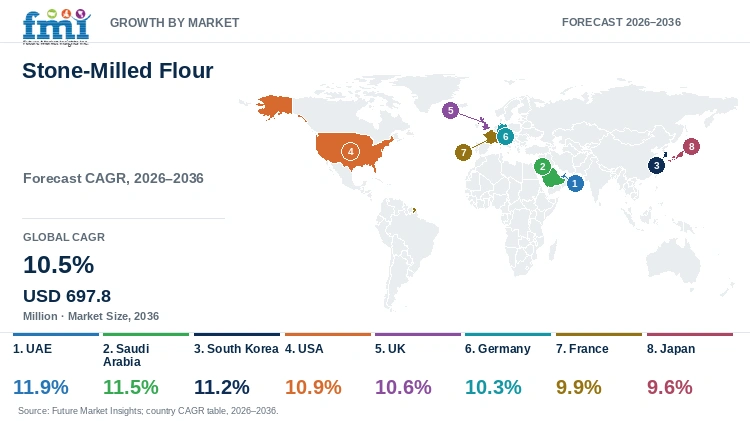
Geographical expansion is led by the UAE with an 11.9% CAGR through 2036 and Saudi Arabia with 11.5%, while South Korea registers 11.2% and the USA achieves 10.9%.
Table 7: Country CAGR and Primary Growth Levers for the Stone-Milled Flour Market (CAGR percentage and operational drivers), 2026 to 2036
| Country | CAGR (2026 to 2036) | Primary Growth Lever |
|---|---|---|
| UAE | 11.9% | Strategic 3-to-6-month wheat stock policy, luxury hotel boulangeries, and USD 1.5B agricultural imports |
| Saudi Arabia | 11.5% | 3.5 MMT wheat import demand, SFDA organic/gluten-free clearance standards, and traditional burr flatbreads |
| South Korea | 11.2% | Artisan sourdough cafe boom, KRW 111.9T food-processing sector, and specialty imported whole-grain flours |
| USA | 10.9% | Ardent Mills North Dakota stone-mill acquisition, 40,000-acre Midwest regenerative wheat, and craft pizzerias |
| UK | 10.6% | DEFRA wholemeal fortification exemption, heritage organic stone milling, and 81% higher milling wheat imports |
| Germany | 10.3% | Germany’s organic bread boom, wholegrain Dinkel and rye sourdough bakeries, and regenerative wheat acres |
| France | 9.9% | 20.4% artisan food retail share, traditional Farine de Meule T80/T110 boules, and clean-label patisserie |
| Japan | 9.6% | Low-RPM chilled granite stone milling (ishiusu-biki) of Hokkaido wheat for artisan bread and pastry |
Source: Future Market Insights analysis
UAE Stone-Milled Flour Market Outlook (2026 to 2036)
Luxury resort boulangeries and Neapolitan pizzerias in Dubai and Abu Dhabi rely on imported European Type 80 stone-ground wheat and durum flours in Italy to serve international hospitality guests. In April 2026, grain and feed reporting from the USDA Foreign Agricultural Service highlighted the UAE policy of maintaining three to six months of strategic wheat reserves with rising hospitality and food-processing wheat demand in MY 2026/27 [17]. July 2026 USDA exporter guidance further noted that the UAE imported USD 1.5 billion in agricultural products from the USA in 2025 [18]. Propelled by these five-star bakery kitchens and strategic grain investments, stone-milled flour shipments in the UAE expand at an 11.9% CAGR over the 2026 to 2036 decade, although intense summer heat requires 16-degree-Celsius reefer containers to prevent wheat-germ oil rancidity.
Key takeaway: In the UAE, strategic grain reserve investments and cold-chain hospitality flour imports power an 11.9% CAGR through 2036.
Saudi Arabia Stone-Milled Flour Market Outlook (2026 to 2036)
Unlike Western markets where stone-milled flour is primarily an artisan sourdough trend, demand in Saudi Arabia is anchored by traditional household consumption of stone-ground whole-wheat (burr) flatbreads and modern craft bakeries in Riyadh and Jeddah. Supported by this dual traditional and hospitality base, the stone-milled flour market in Saudi Arabia advances at an 11.5% CAGR through 2036. In April 2026, USDA Foreign Agricultural Service Saudi Arabia Grain and Feed Annual forecasts indicated that national wheat imports will climb 2% to 3.5 million metric tons in MY 2026/27 on expanding food-processing and hospitality demand [19]. However, exporters shipping specialty stone-ground flours into the Kingdom must satisfy strict August 2026 Saudi Food and Drug Authority customs clearance rules governing organic certification and GSO 1021 gluten-free claims [20].
Key takeaway: In Saudi Arabia, 3.5 million metric tons of wheat import demand and traditional burr bread consumption sustain an 11.5% CAGR through 2036.
South Korea Stone-Milled Flour Market Outlook (2026 to 2036)
Independent sourdough cafes in Seoul's Seongsu-dong and Gangnam districts are driving premium demand for high-extraction Type 85 wheat flours from North America and stone-ground rye flours from France. In May 2026, USDA Foreign Agricultural Service South Korea food-processing findings documented that South Korea's KRW 111.9 trillion (USD 82.1 billion) food processing industry relies on imported identity-preserved milling wheat and premium bakery ingredients [21]. Fueled by these specialty bakery cafes and clean-label school catering tenders, stone-milled flour sales in South Korea register an 11.2% CAGR across the 2026 to 2036 period. Even so, low domestic wheat self-sufficiency exposes artisan flour importers in South Korea to ocean freight surcharges and currency volatility.
Key takeaway: In South Korea, artisan sourdough cafe expansion and premium imported baking grists support an 11.2% CAGR through 2036.
USA Stone-Milled Flour Market Outlook (2026 to 2036)
Industrial bakery acquisitions of dedicated stone-milling assets and Midwest regenerative wheat contracting lift stone-milled flour sales across the USA at a 10.9% CAGR through 2036. Regional grain hubs in the USA are transitioning stone milling from small farmstead gristmills into pathogen-controlled 50-pound sack and bulk tote operations serving national supermarket bakeries. Ardent Mills' July 2025 agreement to acquire the Richardton, North Dakota stone-milling facility and ADM's July 2026 partnership across 40,000 Midwest regenerative wheat acres directly expand bulk supply for bakeries across the USA. Nevertheless, wide geographic distances between northern plains mills and coastal bakeries require rapid inventory rotation to prevent germ-lipid oxidation during summer rail transit.
Key takeaway: In the USA, dedicated stone-mill M&A and 40,000-acre regenerative wheat partnerships generate a 10.9% CAGR through 2036.
UK Stone-Milled Flour Market Outlook (2026 to 2036)
Statutory fortification exemptions for wholemeal flour and small heritage mills give stone-milled flour producers in the UK a distinct regulatory advantage over commodity roller mills. Anchored by Soil Association organic stoneground mills and Real Bread Campaign sourdough bakeries, the UK stone-milled flour market records a 10.6% CAGR over the 2026 to 2036 window. In April 2026, USDA Foreign Agricultural Service UK Grain and Feed data tracked domestic wheat recovery in MY 2026/27 plus ongoing imports of high-protein North America and European milling wheat for UK bakery grists [22]. Yet wet UK summers frequently lower domestic Hagberg Falling Numbers, forcing local stone millers like Doves Farm to blend imported high-protein wheats to maintain bread-making elasticity.
Key takeaway: In the UK, statutory wholemeal fortification exemptions and craft sourdough bakery demand drive a 10.6% CAGR through 2036.
Germany Stone-Milled Flour Market Outlook (2026 to 2036)
Household bread consumption in Germany is uniquely centered on dense whole-grain spelt (Dinkel) and rye (Roggen) sourdough loaves rather than soft white pan bread. Commercial mills across Germany pair Austrian and Swiss composite corundum millstones with optical mycotoxin sorters to supply Bioland and Demeter certified organic bakeries. In April 2026, USDA Foreign Agricultural Service European Union grain projections placed EU grain production at 277 million metric tons in MY 2026/27 following bumper MY 2025/26 milling wheat supplies [23]. Supported by this abundant regional grain base and deep whole-grain culture, the Germany stone-milled flour market progresses at a 10.3% CAGR through 2036, though strict DON mycotoxin limits on outer bran layers require rigorous pre-milling grain cleaning.
Key takeaway: In Germany, strong organic bakery demand and abundant EU spelt and wheat supplies sustain a 10.3% CAGR through 2036.
France Stone-Milled Flour Market Outlook (2026 to 2036)
Artisanal boulangeries in France rely on stone-ground farine de meule (Type 80 and Type 110) dressed on natural flint quarried La Ferté-sous-Jouarre flint burr stones to produce signature tourte de meule and rustic country boules. Commercial artisans and specialized food stores hold a firm slice of food retail outlays in France, creating a resilient direct-to-baker sack channel for Limagrain Ingredients and regional stone mills. Driven by these craft boulangerie standards and clean-label patisserie demand, stone-milled flour revenue across France achieves a 9.9% CAGR between 2026 and 2036. However, because high-extraction stone milling retains the outer kernel, bakers in France demand Culture Raisonnée Contrôlée (CRC) wheat contracts that guarantee zero post-harvest storage insecticides.
Key takeaway: In France, artisanal boulangerie Farine de Meule traditions and residue-free wheat contracts support a 9.9% CAGR through 2036.
Japan Stone-Milled Flour Market Outlook (2026 to 2036)
Specialty flour millers in Japan have pioneered water-cooled, low-speed granite stone milling (ishiusu-biki) of domestic Hokkaido wheat and buckwheat to prevent thermal aroma loss. Powered by craft bakery adoption of these chilled stone-ground grists in Tokyo and Kyoto, the stone-milled flour market in Japan expands at a 9.6% CAGR through 2036. Low-speed operation of rotary granite stones at 15 to 25 revolutions per minute keeps discharge temperatures below 35 degrees Celsius and preserves roasted cereal volatiles for high-hydration baguettes and shokupan loaves. Nevertheless, slow low-RPM stone throughput and high electricity and chilled-storage costs keep stone-milled flour in Japan positioned at a steep price premium over roller-milled flour.
Key takeaway: In Japan, chilled low-RPM granite stone milling for artisan bread and patisserie applications delivers a 9.6% CAGR through 2036.
Full report country CAGRs cover: North America; Latin America; Western Europe; Eastern Europe; East Asia; South Asia and Pacific; Middle East and Africa.
Who are the notable companies in the stone-milled flour market?
Ardent Mills, ADM, Bay State Milling, Limagrain Ingredients, GoodMills Group, King Arthur Baking, Bob's Red Mill, Doves Farm, Manildra Group, and Scoular anchor global stone-milled flour production and specialty grain supply.
The competitive structure of the stone-milled flour market connects multinational commercial milling platforms with European wheat-ingredient innovators and branded organic burr-mill specialists.
- Multinational Commercial Milling & Grain Platforms: Ardent Mills and ADM as well as GoodMills Group and Scoular operate large-scale stone and hybrid milling assets and regenerative wheat supply chains.
- Specialty Functional & European Milling Innovators: Bay State Milling and Limagrain Ingredients along with Manildra Group combine stone-ground and high-fiber flours with fermented clean-label bakery ingredients.
- Branded Artisan & Organic Specialists: King Arthur Baking and Bob's Red Mill and Doves Farm supply quartz- and burr-milled whole-grain flours to craft bakeries and retail aisles.
Competitive Benchmarking: Stone-Milled Flour Market
Table 8: Competitive Benchmarking for the Stone-Milled Flour Market (qualitative capability ratings), 2026
| Company | Standard, Patisserie & Specialty Grade Breadth | Organic & Identity-Preserved Sourcing | Industrial Bakery Bulk & B2B Logistics | Geographic Reach |
|---|---|---|---|---|
| Ardent Mills | High | High | High | High |
| ADM | High | High | High | High |
| Bay State Milling | High | High | High | Medium |
| Limagrain Ingredients | High | High | High | High |
| GoodMills Group | High | High | High | High |
| King Arthur Baking | High | High | High | Medium |
| Bob's Red Mill | High | High | Medium | High |
| Doves Farm | High | High | Medium | Medium |
| Manildra Group | High | Medium | High | High |
| Scoular | Medium | High | High | High |
Comparison criteria: Tier assignments reflect stone-ground grade diversity across standard and organic lines; identity-preserved grain sourcing; and direct bakery bulk logistics.
Key Developments in the Stone-Milled Flour Market
- In July 2025, Ardent Mills entered an agreement to acquire a stone-milling facility in Richardton, North Dakota featuring identity-preserved and gluten-free grain cleaning and microbial-reduction processing.
- In July 2026, ADM partnered with General Mills and Walmart to advance regenerative wheat production across 40,000 Midwest acres following its November 2025 expansion to 160,000 European regenerative acres.
- In June 2025, GoodMills Group joined the AIBI Sustainable Wheat Initiative Europe targeting a 30% emissions cut by 2030 and invested EUR 25 million to double its Kutno mill capacity in Poland to 280,000 tons per year.
Key Players in the Stone-Milled Flour Market
Commercial Grain Milling & Identity-Preserved Supply Platforms
- Ardent Mills
- ADM
- GoodMills Group
- Scoular
Specialty Functional Flour & Clean-Label Milling Innovators
- Bay State Milling
- Limagrain Ingredients
- Manildra Group
Artisan Burr-Mill, Organic & Baker-Direct Leaders
- King Arthur Baking
- Bob's Red Mill
- Doves Farm
Stone-Milled Flour Market - Report Scope
Table 9: Report Scope for the Stone-Milled Flour Market (coverage fields and definitions), 2026 to 2036
| Coverage field | Report scope |
|---|---|
| Market breakdown | Grade; Form; Application; Claim; Sales Channel; Region |
| Quantitative Units | USD Million |
| Market Definition | Commercial factory-gate and mill-direct sales of stone-milled wheat, ancient-grain, and specialty cereal flours across standard milling grade, fine/patisserie grade, organic certified, and identity-preserved specialty lines in powder/dry, liquid, paste/semi-solid, and granules/pieces forms. |
| Regions Covered | North America; Latin America; Western Europe; Eastern Europe; East Asia; South Asia and Pacific; Middle East and Africa |
| Countries Covered | UAE, Saudi Arabia, South Korea, USA, UK, Germany, France, Japan, and 35+ additional countries |
| Key Companies Covered | Ardent Mills, ADM, Bay State Milling, Limagrain Ingredients, GoodMills Group, King Arthur Baking, Bob's Red Mill, Doves Farm, Manildra Group, Scoular |
| Forecast Period | 2026 to 2036 (Base Year: 2025) |
| Approach | Bottom-up commercial stone-mill tonnage and industrial bakery sack/tote value aggregation cross-validated against USDA NASS/FAS milling statistics and FAO cereal balances |
Stone-Milled Flour Market - Research Methodology
Table 10: Research Methodology for the Stone-Milled Flour Market (research methods and approach), 2026 edition
| Method | Approach |
|---|---|
| Primary Research | Structured interviews with head millers, stone-dressing engineers, industrial sourdough bakery directors, and identity-preserved grain procurement managers across North America, Europe, the Middle East, and East Asia. |
| Secondary Research | Direct verification of 21 CFR 137.200 whole-wheat and 21 CFR 137.105 bolted-flour standards, USDA NASS Flour Milling Products reports, FAO Cereal Supply and Demand Briefs, UK DEFRA bread and flour guidance, PubMed sourdough studies, and official company press releases. |
| Market Sizing and Forecasting | Bottom-up aggregation of commercial stone-mill installations, annual grinding throughput in kilotonnes, and wholesale realizations across standard, patisserie, organic, and identity-preserved grades from 2025 through 2036. |
| Country Forecasting Model | Country-level demand modeling weighted by artisan sourdough bakery density, strategic grain reserve policies, organic/regenerative acreage, and cold-chain specialty flour logistics. |
| Operational Benchmark Traceability | Verification of statutory sieve granulation (>=90% No. 8; >=50% No. 20), <=15.0% moisture ceilings, and whole-wheat protein/fiber benchmarks against federal and peer-reviewed records. |
| Data Triangulation and Validation | Reconciliation of mill-direct sack and bulk tote shipments with corporate disclosures from Ardent Mills, ADM, Bay State Milling, GoodMills Group, Manildra Group, and Scoular. |
Stone-Milled Flour Market by Segments
Stone-Milled Flour Market segmented by Grade:
- Standard milling grade
- Fine / patisserie grade
- Organic certified
- Identity-preserved specialty
Stone-Milled Flour Market segmented by Form:
- Powder / dry
- Liquid
- Paste / semi-solid
- Granules / pieces
Stone-Milled Flour Market segmented by Application:
- Bread & rolls
- Cakes & muffins
- Biscuits & cookies
- Viennoiserie & pastry
- Other bakery & snacks
Stone-Milled Flour Market segmented by Claim:
- Conventional
- Clean label
- Organic
- Non-GMO / identity preserved
Stone-Milled Flour Market segmented by Sales Channel:
- Direct to industrial bakeries
- Ingredient distributors
- Foodservice & artisan supply
- Online B2B
Stone-Milled Flour Market by Region
- North America
- USA
- Canada
- Latin America
- Brazil
- Mexico
- Argentina
- Chile
- Western Europe
- Germany
- France
- UK
- Italy
- Spain
- Benelux
- Nordics
- Eastern Europe
- Poland
- Czech Republic
- Romania
- Hungary
- East Asia
- China
- Japan
- South Korea
- South Asia and Pacific
- India
- ASEAN
- Australia and New Zealand
- Middle East and Africa
- GCC Countries (UAE, Saudi Arabia)
- South Africa
- Türkiye
- Israel
Research Sources and Bibliography
- [1] National Archives and Records Administration. (2026, October 15). 21 CFR 137.200 -- Whole wheat flour. - eCFR. Electronic Code of Federal Regulations, Title 21 Part 137.
- [2] National Archives and Records Administration. (2026, October 19). 21 CFR 137.105 -- Flour. - eCFR. Electronic Code of Federal Regulations, Title 21 Part 137.
- [3] Ardent Mills, LLC. (2025, July 31). Ardent Mills Enters Agreement to Acquire Stone Mill in North Dakota, Expanding Emerging Nutrition Portfolio | Ardent Mills. Ardent Mills Official Newsroom.
- [4] U.S. Department of Agriculture, National Agricultural Statistics Service. (2026, August 3). Flour Milling Products | Economics, Statistics, and Market Information System. USDA NASS Current Agricultural Industrial Reports.
- [5] Food and Agriculture Organization of the United Nations. (2026, October 2). FAO Cereal Supply and Demand Brief | Food and Agriculture Organization of the United Nations. FAO World Food Situation Monthly Brief.
- [6] GoodMills Group GmbH. (2025, June 20). GoodMills Group Expands Operations in Poland, Reinforcing European Market Leadership - GoodMills Group. GoodMills Group Official Corporate News.
- [7] Bay State Milling Company. (2026, May 19). Bay State Milling Named a 2026 US Best Managed Gold Honoree - Bay State Milling. Bay State Milling Official Newsroom.
- [8] Navarro, J. L., López, M. S., Salvucci, E., León, A. E., & Steffolani, M. E. (2025, August 13). Chemical and Nutritional Characterization of Sourdoughs Made with Sprouted and Unsprouted Whole-Wheat Flour and Their Effects on the Technological Quality of Bread. Foods, 14(16), 2805 (PubMed NCBI).
- [9] Archer Daniels Midland Company. (2026, July 15). General Mills, ADM, Walmart Partner to Accelerate Regenerative Agriculture Across 40,000 Midwest Wheat Acres | ADM. ADM Official News Releases.
- [10] The Scoular Company. (2025, August 8). Scoular Expands Coolidge, Kansas Facility with New Office & Community Space. Scoular Official Corporate News.
- [11] Iorga, B., Trinetta, V., Boyacioglu, M. H., & Karkle, E. (2025, October 15). Functionality of Intermediate Wheatgrass (Thinopyrum intermedium) in Spontaneous Sourdough Fermentation and Bread Quality. Journal of Food Science, 90(10), e70607 (PubMed NCBI).
- [12] GoodMills Group GmbH. (2025, June 11). GoodMills joins the Sustainable Wheat Initiative Europe - GoodMills Group. GoodMills Group Official Corporate News.
- [13] Kocadağlı, T., Göncüoğlu Taş, N., Hamzalıoğlu, A., & Gökmen, V. (2025, October 15). Formation of acrylamide and aroma compounds in biscuits and crackers prepared with sprouted wheat wholemeal. Food Chemistry, 489, 145032 (PubMed NCBI).
- [14] Department for Environment, Food & Rural Affairs and Food Standards Agency. (2025, April 23). Bread and flour: labelling and composition - GOV.UK. UK Government Official Guidance.
- [15] Manildra Group. (2025, July 9). Natural Ingredient Reduces Food Waste - Manildra Group. Manildra Group Official Newsroom.
- [16] Archer Daniels Midland Company. (2025, November 12). Scaling Regenerative Agriculture Across Europe | ADM. ADM Official Newsroom.
- [17] U.S. Department of Agriculture, Foreign Agricultural Service. (2026, April 17). United Arab Emirates: Grain and Feed Annual | USDA Foreign Agricultural Service. USDA Foreign Agricultural Service GAIN Report.
- [18] U.S. Department of Agriculture, Foreign Agricultural Service. (2026, July 3). United Arab Emirates: Exporter Guide Annual | USDA Foreign Agricultural Service. USDA Foreign Agricultural Service GAIN Report.
- [19] U.S. Department of Agriculture, Foreign Agricultural Service. (2026, April 6). Saudi Arabia: Grain and Feed Annual | USDA Foreign Agricultural Service. USDA Foreign Agricultural Service GAIN Report.
- [20] Saudi Food and Drug Authority. (2026, August 23). Conditions and Requirements for Food Clearance | General Authority for Food and Drug. Kingdom of Saudi Arabia SFDA Official Regulations.
- [21] U.S. Department of Agriculture, Foreign Agricultural Service. (2026, May 27). South Korea: Food Processing Ingredients Annual | USDA Foreign Agricultural Service. USDA Foreign Agricultural Service GAIN Report.
- [22] U.S. Department of Agriculture, Foreign Agricultural Service. (2026, April 30). United Kingdom: Grain and Feed Annual | USDA Foreign Agricultural Service. USDA Foreign Agricultural Service GAIN Report.
- [23] U.S. Department of Agriculture, Foreign Agricultural Service. (2026, April 20). European Union: Grain and Feed Annual | USDA Foreign Agricultural Service. USDA Foreign Agricultural Service GAIN Report.
This bibliography is provided for reader reference and is not exhaustive. The full report contains the complete reference list and primary research documentation.
This Report Answers
- What is the 2026 market size of stone-milled flour and the projected value by 2036?
- Which sourdough fermentation and regenerative wheat programs accelerate stone-milled flour demand?
- Why does Standard milling grade capture the largest share of grade demand?
- Why do direct mill-to-bakery shipments dominate sales channel distribution?
- How do country CAGRs compare across Gulf hospitality importers and European organic mills?
- Which milling groups and specialty grain processors lead stone-milled flour supply?
- How does wheat-germ lipid oxidation restrict warm ambient storage of stone-ground flour?
- What sieve granulation and microbial-cleaning specifications guide industrial bakery flour procurement?
Frequently Asked Questions
How big is the stone-milled flour market in 2026, and what is forecast for 2036?
Global stone-milled flour demand totals USD 257.1 million in 2026 compared with USD 232.7 million in 2025 and is projected to hit USD 697.8 million by 2036.
What is the CAGR for the stone-milled flour market from 2026 to 2036?
Category turnover advances at a 10.5% CAGR from 2026 through 2036, delivering USD 440.7 million in added value.
Which grade segment leads the stone-milled flour market?
Standard milling grade holds 33.0% of 2026 grade sales because blended hard and soft wheat grists give automated bread lines repeatable dough absorption and gluten tolerance.
Which claim segment leads the stone-milled flour market?
Conventional stone-milled flour accounts for 46.0% of 2026 claim volume by providing unbleached whole-grain nutrition without organic land-transition surcharges.
Which country has a notable growth outlook during the assessment period?
The UAE leads national expansion with an 11.9% CAGR through 2036 on the back of luxury hospitality boulangeries and climate-controlled specialty flour imports.
Who are the key players in the market?
Leading suppliers include Ardent Mills; ADM; Bay State Milling; Limagrain Ingredients; GoodMills Group; King Arthur Baking; Bob's Red Mill; Doves Farm; Manildra Group; and Scoular.
Preview the report firsthand - request a free sample
Get SampleGet the brochure for pricing and purchase details.
Get PDFTable of Content
- Key Takeaways
- Market Size and CAGR
- Top Growth Driver
- Fastest Growing Segment
- Leading Region
- Key Companies
- Emerging Opportunities
- Executive Summary
- Global Market Outlook
- Demand-side Trends
- Supply-side Trends
- Technology Roadmap Analysis
- Analysis and Recommendations
- Analyst Perspective (What is happening? Why now? What should investors know?)
- Key Questions Answered
- How large is the market?
- What is the CAGR?
- What are key trends?
- Which region dominates?
- Who are the leaders?
- Market Overview
- Market Coverage / Taxonomy
- Market Definition / Scope / Limitations
- Research Methodology
- Chapter Orientation
- Analytical Lens and Working Hypotheses
- Market Structure, Signals, and Trend Drivers
- Benchmarking and Cross-market Comparability
- Market Sizing, Forecasting, and Opportunity Mapping
- Research Design and Evidence Framework
- Desk Research Programme (Secondary Evidence)
- Expert Input and Fieldwork (Primary Evidence)
- Tooling, Models, and Reference Databases
- Data Engineering and Model Build
- Quality Assurance and Audit Trail
- Market Background
- Market Dynamics (Drivers, Restraints, Opportunity, Trends)
- Scenario Forecast (Optimistic, Likely, Conservative)
- Impact Analysis
- AI Impact
- Sustainability Impact
- Regulatory Impact
- Technology Impact
- Consumer / Buyer Analysis
- Purchase Drivers
- Adoption Barriers
- Buyer Journey
- Opportunity Map Analysis
- Product Life Cycle Analysis
- Supply Chain Analysis
- Investment Feasibility Matrix
- Value Chain Analysis
- PESTLE and Porter's Analysis
- Regulatory Landscape
- Regional Parent Market Outlook
- Production and Consumption Statistics
- Import and Export Statistics
- Global Market Analysis and Forecast, 2021 to 2036
- Historical Market Size Value (USD Million) Analysis, 2021 to 2025
- Current and Future Market Size Value (USD Million) Projections, 2026 to 2036
- Y-o-Y Growth Trend Analysis
- Absolute $ Opportunity Analysis
- Global Market Pricing Analysis, 2021 to 2036
- Global Market Analysis and Forecast, By Grade, 2021 to 2036
- Introduction / Key Findings
- Historical Market Size Value (USD Million) Analysis By Grade, 2021 to 2025
- Current and Future Market Size Value (USD Million) Analysis and Forecast By Grade, 2026 to 2036
- Standard milling grade
- Fine / patisserie grade
- Organic certified
- Identity-preserved specialty
- Y-o-Y Growth Trend Analysis By Grade, 2021 to 2025
- Absolute $ Opportunity Analysis By Grade, 2026 to 2036
- Global Market Analysis and Forecast, By Form, 2021 to 2036
- Introduction / Key Findings
- Historical Market Size Value (USD Million) Analysis By Form, 2021 to 2025
- Current and Future Market Size Value (USD Million) Analysis and Forecast By Form, 2026 to 2036
- Powder / dry
- Liquid
- Paste / semi-solid
- Granules / pieces
- Y-o-Y Growth Trend Analysis By Form, 2021 to 2025
- Absolute $ Opportunity Analysis By Form, 2026 to 2036
- Global Market Analysis and Forecast, By Application, 2021 to 2036
- Introduction / Key Findings
- Historical Market Size Value (USD Million) Analysis By Application, 2021 to 2025
- Current and Future Market Size Value (USD Million) Analysis and Forecast By Application, 2026 to 2036
- Bread & rolls
- Cakes & muffins
- Biscuits & cookies
- Viennoiserie & pastry
- Other bakery & snacks
- Y-o-Y Growth Trend Analysis By Application, 2021 to 2025
- Absolute $ Opportunity Analysis By Application, 2026 to 2036
- Global Market Analysis and Forecast, By Claim, 2021 to 2036
- Introduction / Key Findings
- Historical Market Size Value (USD Million) Analysis By Claim, 2021 to 2025
- Current and Future Market Size Value (USD Million) Analysis and Forecast By Claim, 2026 to 2036
- Conventional
- Clean label
- Organic
- Non-GMO / identity preserved
- Y-o-Y Growth Trend Analysis By Claim, 2021 to 2025
- Absolute $ Opportunity Analysis By Claim, 2026 to 2036
- Global Market Analysis and Forecast, By Sales Channel, 2021 to 2036
- Introduction / Key Findings
- Historical Market Size Value (USD Million) Analysis By Sales Channel, 2021 to 2025
- Current and Future Market Size Value (USD Million) Analysis and Forecast By Sales Channel, 2026 to 2036
- Direct to industrial bakeries
- Ingredient distributors
- Foodservice & artisan supply
- Online B2B
- Y-o-Y Growth Trend Analysis By Sales Channel, 2021 to 2025
- Absolute $ Opportunity Analysis By Sales Channel, 2026 to 2036
- Global Market Analysis and Forecast, By Region, 2021 to 2036
- Introduction
- Historical Market Size Value (USD Million) Analysis By Region, 2021 to 2025
- Current Market Size Value (USD Million) Analysis and Forecast By Region, 2026 to 2036
- North America
- Latin America
- Western Europe
- Eastern Europe
- East Asia
- South Asia and Pacific
- Middle East and Africa
- Market Attractiveness Analysis By Region
- North America Market Analysis and Forecast, By Country, 2021 to 2036
- Historical Market Size Value (USD Million) Trend Analysis By Market Taxonomy, 2021 to 2025
- Market Size Value (USD Million) Forecast By Market Taxonomy, 2026 to 2036
- By Country
- USA
- Canada
- By Grade
- By Form
- By Application
- By Claim
- By Sales Channel
- By Country
- Market Attractiveness Analysis
- By Country
- By Grade
- By Form
- By Application
- By Claim
- By Sales Channel
- Key Takeaways
- Latin America Market Analysis and Forecast, By Country
- Historical Market Size Value (USD Million) Trend Analysis By Market Taxonomy, 2021 to 2025
- Market Size Value (USD Million) Forecast By Market Taxonomy, 2026 to 2036
- By Country
- Brazil
- Mexico
- Argentina
- Chile
- By Grade
- By Form
- By Application
- By Claim
- By Sales Channel
- By Country
- Market Attractiveness Analysis
- By Country
- By Grade
- By Form
- By Application
- By Claim
- By Sales Channel
- Key Takeaways
- Western Europe Market Analysis and Forecast, By Country
- Historical Market Size Value (USD Million) Trend Analysis By Market Taxonomy, 2021 to 2025
- Market Size Value (USD Million) Forecast By Market Taxonomy, 2026 to 2036
- By Country
- Germany
- France
- UK
- Italy
- Spain
- Benelux
- Nordics
- By Grade
- By Form
- By Application
- By Claim
- By Sales Channel
- By Country
- Market Attractiveness Analysis
- By Country
- By Grade
- By Form
- By Application
- By Claim
- By Sales Channel
- Key Takeaways
- Eastern Europe Market Analysis and Forecast, By Country
- Historical Market Size Value (USD Million) Trend Analysis By Market Taxonomy, 2021 to 2025
- Market Size Value (USD Million) Forecast By Market Taxonomy, 2026 to 2036
- By Country
- Poland
- Czech Republic
- Romania
- Hungary
- By Grade
- By Form
- By Application
- By Claim
- By Sales Channel
- By Country
- Market Attractiveness Analysis
- By Country
- By Grade
- By Form
- By Application
- By Claim
- By Sales Channel
- Key Takeaways
- East Asia Market Analysis and Forecast, By Country
- Historical Market Size Value (USD Million) Trend Analysis By Market Taxonomy, 2021 to 2025
- Market Size Value (USD Million) Forecast By Market Taxonomy, 2026 to 2036
- By Country
- China
- Japan
- South Korea
- By Grade
- By Form
- By Application
- By Claim
- By Sales Channel
- By Country
- Market Attractiveness Analysis
- By Country
- By Grade
- By Form
- By Application
- By Claim
- By Sales Channel
- Key Takeaways
- South Asia and Pacific Market Analysis and Forecast, By Country
- Historical Market Size Value (USD Million) Trend Analysis By Market Taxonomy, 2021 to 2025
- Market Size Value (USD Million) Forecast By Market Taxonomy, 2026 to 2036
- By Country
- India
- ASEAN
- Australia and New Zealand
- By Grade
- By Form
- By Application
- By Claim
- By Sales Channel
- By Country
- Market Attractiveness Analysis
- By Country
- By Grade
- By Form
- By Application
- By Claim
- By Sales Channel
- Key Takeaways
- Middle East and Africa Market Analysis and Forecast, By Country
- Historical Market Size Value (USD Million) Trend Analysis By Market Taxonomy, 2021 to 2025
- Market Size Value (USD Million) Forecast By Market Taxonomy, 2026 to 2036
- By Country
- GCC Countries (UAE, Saudi Arabia)
- South Africa
- Türkiye
- Israel
- By Grade
- By Form
- By Application
- By Claim
- By Sales Channel
- By Country
- Market Attractiveness Analysis
- By Country
- By Grade
- By Form
- By Application
- By Claim
- By Sales Channel
- Key Takeaways
- Key Countries Market Analysis
- USA
- Pricing Analysis
- Market Share Analysis, 2025
- By Grade
- By Form
- By Application
- By Claim
- By Sales Channel
- Canada
- Pricing Analysis
- Market Share Analysis, 2025
- By Grade
- By Form
- By Application
- By Claim
- By Sales Channel
- Mexico
- Pricing Analysis
- Market Share Analysis, 2025
- By Grade
- By Form
- By Application
- By Claim
- By Sales Channel
- Brazil
- Pricing Analysis
- Market Share Analysis, 2025
- By Grade
- By Form
- By Application
- By Claim
- By Sales Channel
- Chile
- Pricing Analysis
- Market Share Analysis, 2025
- By Grade
- By Form
- By Application
- By Claim
- By Sales Channel
- Germany
- Pricing Analysis
- Market Share Analysis, 2025
- By Grade
- By Form
- By Application
- By Claim
- By Sales Channel
- UK
- Pricing Analysis
- Market Share Analysis, 2025
- By Grade
- By Form
- By Application
- By Claim
- By Sales Channel
- Italy
- Pricing Analysis
- Market Share Analysis, 2025
- By Grade
- By Form
- By Application
- By Claim
- By Sales Channel
- Spain
- Pricing Analysis
- Market Share Analysis, 2025
- By Grade
- By Form
- By Application
- By Claim
- By Sales Channel
- France
- Pricing Analysis
- Market Share Analysis, 2025
- By Grade
- By Form
- By Application
- By Claim
- By Sales Channel
- India
- Pricing Analysis
- Market Share Analysis, 2025
- By Grade
- By Form
- By Application
- By Claim
- By Sales Channel
- ASEAN
- Pricing Analysis
- Market Share Analysis, 2025
- By Grade
- By Form
- By Application
- By Claim
- By Sales Channel
- Australia and New Zealand
- Pricing Analysis
- Market Share Analysis, 2025
- By Grade
- By Form
- By Application
- By Claim
- By Sales Channel
- China
- Pricing Analysis
- Market Share Analysis, 2025
- By Grade
- By Form
- By Application
- By Claim
- By Sales Channel
- Japan
- Pricing Analysis
- Market Share Analysis, 2025
- By Grade
- By Form
- By Application
- By Claim
- By Sales Channel
- South Korea
- Pricing Analysis
- Market Share Analysis, 2025
- By Grade
- By Form
- By Application
- By Claim
- By Sales Channel
- Poland
- Pricing Analysis
- Market Share Analysis, 2025
- By Grade
- By Form
- By Application
- By Claim
- By Sales Channel
- Hungary
- Pricing Analysis
- Market Share Analysis, 2025
- By Grade
- By Form
- By Application
- By Claim
- By Sales Channel
- Türkiye
- Pricing Analysis
- Market Share Analysis, 2025
- By Grade
- By Form
- By Application
- By Claim
- By Sales Channel
- South Africa
- Pricing Analysis
- Market Share Analysis, 2025
- By Grade
- By Form
- By Application
- By Claim
- By Sales Channel
- UAE
- Pricing Analysis
- Market Share Analysis, 2025
- By Grade
- By Form
- By Application
- By Claim
- By Sales Channel
- Saudi Arabia
- Pricing Analysis
- Market Share Analysis, 2025
- By Grade
- By Form
- By Application
- By Claim
- By Sales Channel
- USA
- Market Structure Analysis
- Competition Dashboard
- Competition Benchmarking
- Market Share Analysis of Top Players
- By Regional
- By Grade
- By Form
- By Application
- By Claim
- By Sales Channel
- Emerging Startups
- Innovation Benchmarking
- Competition Analysis
- Competition Deep Dive
- Ardent Mills
- Overview
- Product Portfolio
- Profitability by Market Segments
- Sales Footprint
- Strategy Overview
- Marketing Strategy
- Product Strategy
- Channel Strategy
- ADM
- Bay State Milling
- Limagrain Ingredients
- GoodMills Group
- King Arthur Baking
- Bob's Red Mill
- Doves Farm
- Manildra Group
- Scoular
- Ardent Mills
- Case Studies
- Success Stories
- Recent Developments
- Competition Deep Dive
- Assumptions & Acronyms Used


