


Systemic Lupus Erythematosus SLE Drugs Market
Systemic Lupus Erythematosus SLE Drugs Market is segmented by Drug Class (Immunosuppresants, NSAIDs, Corticosteroids, Antimalarials, Biologics), Distribution Channel (Hospital pharmacies, Retail pharmacies, Online pharmacies), Route of Administration (Oral, Intravenous , Subcutaneous), and Region. Forecast for 2026 to 2036.
Systemic Lupus Erythematosus SLE Drugs Market Size, Market Forecast and Outlook By FMI
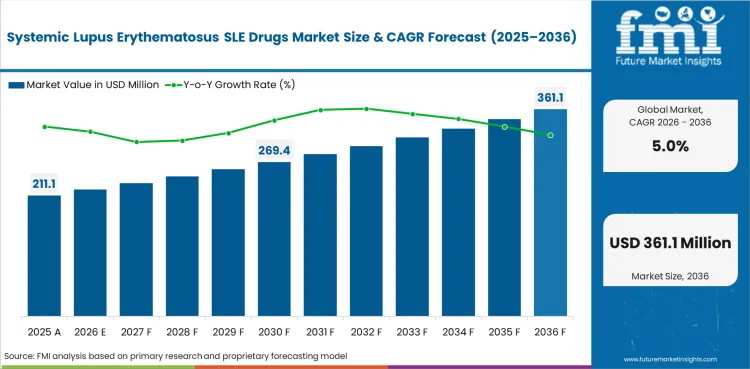
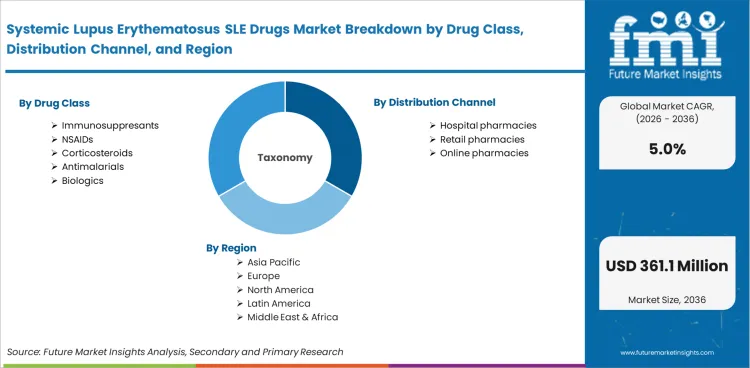
The systemic lupus erythematosus sle drugs market was valued at USD 211.1 million in 2025. The market is set to reach USD 221.7 million by 2026-end and grow at a CAGR of 5.0% between 2026–2036 to reach USD 361.1 million by 2036. Immunosuppresants will dominate with a 36.4% share, while Hospital pharmacies will lead with a 58.4%% share.
Summary of the Systemic Lupus Erythematosus SLE Drugs Market
- Demand and Growth Drivers
- Growing SLE diagnosis rates driven by improved awareness, diagnostic capability, and healthcare access are expanding the identified patient population requiring pharmaceutical treatment.
- Biologic drug approvals including belimumab and anifrolumab are creating new treatment options for moderate to severe SLE patients who are inadequately controlled on conventional immunosuppressive therapy.
- Healthcare system investment in rheumatology and autoimmune disease management in emerging markets is improving access to SLE diagnosis and treatment.
- Product and Segment View
- Immunosuppressants are expected to account for 36.4% of the drug class segment in 2026, reflecting their established role as the treatment backbone for controlling immune mediated tissue damage in SLE.
- Hospital pharmacies are expected to represent 58.4% of the distribution segment in 2026, driven by the institutional management of moderate to severe SLE patients requiring specialist rheumatology care.
- Biologics represent the fastest growing drug class as new approvals and expanding indications create treatment options for patients with refractory disease.
- Geography and Competitive Outlook
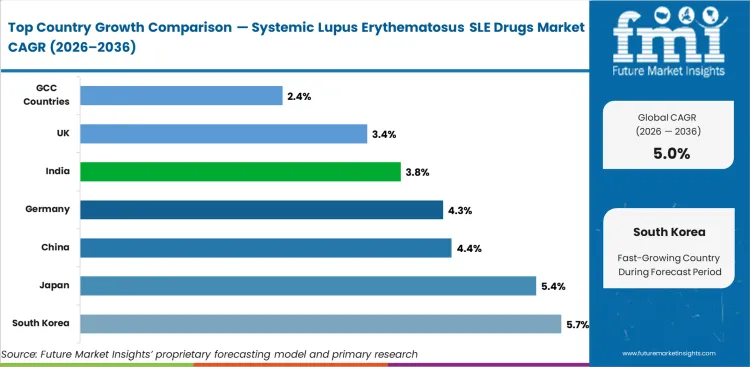
- South Korea is expected to lead growth at 5.7%, reflecting its advanced healthcare system, high SLE prevalence awareness, and early adoption of biologic treatments.
- Japan at 5.4% reflects its rheumatology care infrastructure, biologic drug access, and aging population with increasing autoimmune disease prevalence.
- Companies combining biologic drug portfolios, clinical evidence for SLE indications, and global market access are positioned to capture procurement.
- Analyst Opinion
- The SLE drugs market is entering a period of accelerated growth as biologic approvals create new treatment paradigms for patients inadequately controlled on conventional immunosuppressive therapy.
- Adoption of biologics reflects the unmet medical need in SLE, where a significant proportion of patients experience disease flares and organ damage despite standard of care treatment.
- Growth at 5.0% CAGR reflects the combination of expanding diagnosis, biologic adoption, and healthcare access improvement that collectively increase the treated patient population.
- Companies investing in targeted biologic therapies, lupus nephritis indications, and emerging market access are positioned to capture the highest value growth segments.
Systemic Lupus Erythematosus SLE Drugs Market Definition
The systemic lupus erythematosus (SLE) drugs market covers pharmaceutical treatments for the management of lupus, a chronic autoimmune disease that causes the immune system to attack healthy tissues. Drug classes include immunosuppressants, NSAIDs, corticosteroids, antimalarials, and biologics administered through oral, intravenous, and subcutaneous routes across hospital pharmacies, retail pharmacies, and online pharmacy channels.
Systemic Lupus Erythematosus SLE Drugs Market Inclusions
Market scope includes all commercially traded SLE drug products categorized by drug class (immunosuppressants, NSAIDs, corticosteroids, antimalarials, biologics), distribution channel (hospital pharmacies, retail pharmacies, online pharmacies), and route of administration (oral, intravenous, subcutaneous). Revenue coverage spans 2026 to 2036.
Systemic Lupus Erythematosus SLE Drugs Market Exclusions
The scope does not include general purpose immunosuppressants not indicated for SLE, topical treatments for cutaneous lupus only, dietary supplements, or investigational drugs not yet approved for commercial sale.
Systemic Lupus Erythematosus SLE Drugs Market Research Methodology
- Primary Research: FMI analysts conducted interviews with manufacturers, technology specialists, and procurement professionals across key markets.
- Desk Research: Combined data from industry associations, regulatory bodies, and manufacturer disclosures.
- Market Sizing and Forecasting: Bottom up methodology aggregating segment and regional data with adoption velocity projections.
- Data Validation: Cross checked quarterly against production data, trade statistics, and manufacturer reporting.
Why is the Systemic Lupus Erythematosus SLE Drugs Market Growing?
- Improved SLE diagnostic capability and disease awareness are expanding the identified patient population, increasing the number of patients receiving pharmaceutical treatment.
- Biologic drug approvals (belimumab, anifrolumab) provide new treatment options for moderate to severe SLE, creating a premium drug class that addresses unmet clinical need.
- Healthcare infrastructure development in emerging markets is improving rheumatology access, enabling earlier diagnosis and treatment initiation for SLE patients.
Demand for SLE drugs is driven by the chronic nature of lupus that requires ongoing pharmaceutical management to control disease activity, prevent organ damage, and manage flares. SLE affects an estimated 5 million people worldwide, with higher prevalence in women of childbearing age and certain ethnic populations. Improved diagnostic awareness and testing are identifying previously undiagnosed patients, expanding the treated population.
Biologic therapies represent the primary innovation driver. GSK's belimumab (Benlysta) was the first biologic approved for SLE, targeting B-lymphocyte stimulator to reduce disease activity. AstraZeneca's anifrolumab (Saphnelo) targets the type I interferon receptor, addressing a different disease pathway. These biologics provide treatment options for patients with inadequate response to conventional immunosuppressants, creating a premium market segment.
The treatment landscape remains anchored by conventional drug classes including immunosuppressants (mycophenolate, azathioprine), antimalarials (hydroxychloroquine), corticosteroids, and NSAIDs. These established agents manage disease activity in the majority of SLE patients at lower cost than biologics. The combination of conventional and biologic treatments creates a stratified market where drug selection depends on disease severity, organ involvement, and treatment response.
Market Segmentation Analysis
- Immunosuppressants represent 36.4% of the drug class segment, reflecting their foundational role in SLE treatment protocols for immune system modulation.
- Hospital pharmacies account for 58.4% of distribution, driven by specialist rheumatology management of moderate to severe SLE in institutional settings.
- Biologics are the fastest growing class as new approvals expand treatment options for refractory SLE patients.
The SLE drugs market segments by drug class, distribution channel, and route of administration. By drug class, the market covers immunosuppressants, NSAIDs, corticosteroids, antimalarials, and biologics.
Insights into the Immunosuppressants Drug Class Segment
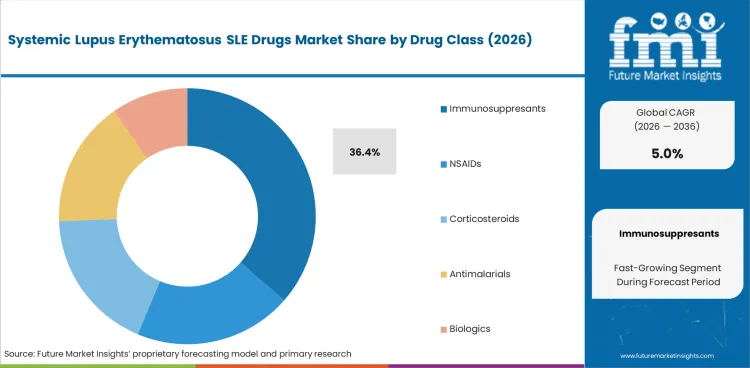
In 2026, immunosuppressants are expected to account for 36.4% of the segment. Mycophenolate mofetil and azathioprine are the most widely prescribed immunosuppressants for SLE, used to control disease activity and prevent organ damage, particularly in lupus nephritis. Their established clinical evidence, generic availability, and guideline recommendations sustain their position as the treatment backbone.
Insights into the Hospital Pharmacies Distribution Segment
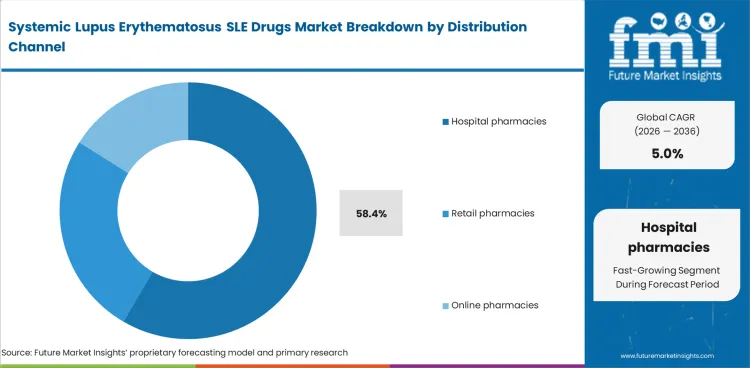
Hospital pharmacies are expected to represent 58.4% in 2026. SLE management requires specialist rheumatology oversight, with moderate to severe patients managed through hospital outpatient clinics. Biologic infusions (belimumab IV) are administered in hospital settings, concentrating biologic distribution through institutional pharmacy channels.
Systemic Lupus Erythematosus SLE Drugs Market Drivers, Restraints, and Opportunities
- Expanding diagnosis and biologic drug adoption create structural demand growth for SLE pharmaceuticals beyond conventional treatment volumes.
- High biologic drug costs and payer coverage variability limit access in price sensitive markets, constraining biologic adoption to patients with severe refractory disease.
- Lupus nephritis indication expansion and emerging pipeline therapies create new treatment segments that increase per-patient drug spending.
The SLE drugs market is expanding at 5.0% CAGR driven by diagnostic improvement, biologic adoption, and healthcare access expansion. Biologic costs constrain broad adoption, while pipeline development creates growth opportunities.
Diagnostic Improvement and Patient Identification
Improved SLE awareness, biomarker testing, and rheumatology access expand the diagnosed and treated patient population, creating proportional drug demand growth.
Biologic Cost and Access Barriers
Biologic SLE treatments carry significant annual costs that limit access in markets without adequate insurance or government coverage. Cost-effectiveness considerations restrict biologic use to patients with documented inadequate response to conventional therapy.
Lupus Nephritis Indication Expansion
Biologic approvals for lupus nephritis create new treatment indications that expand the addressable market for SLE drugs in patients with renal involvement, a major cause of SLE morbidity.
Pipeline Therapy Development
Clinical development of novel biologic and targeted therapies addressing different SLE disease pathways creates future growth potential as new drug approvals expand treatment options.
Analysis of Systemic Lupus Erythematosus SLE Drugs Market By Key Countries
.webp "Top Country Growth Comparison Systemic Lupus Erythematosus Sle Drugs Market Cagr (2026 2036)")
| Country | CAGR |
|---|---|
| South Korea | 5.7% |
| Japan | 5.4% |
| China | 4.4% |
| Germany | 4.3% |
| India | 3.8% |
| UK | 3.4% |
| GCC Countries | 2.4% |
- South Korea leads at 5.7% CAGR through 2036.
- Japan leads at 5.4% CAGR through 2036.
- China leads at 4.4% CAGR through 2036.
- Germany leads at 4.3% CAGR through 2036.
The global systemic lupus erythematosus sle drugs market is projected to grow at a CAGR of 5.0% from 2026 to 2036. The analysis covers more than 30 countries, with the leading markets detailed below.
Demand Outlook for Systemic Lupus Erythematosus SLE Drugs Market in South Korea
South Korea is expected to lead growth at 5.7% through 2036, reflecting its advanced healthcare system, high disease awareness, and early biologic treatment adoption.
- Advanced healthcare supports comprehensive SLE management.
- High disease awareness drives early diagnosis and treatment.
- Biologic adoption creates premium drug class demand.
Future Outlook for Systemic Lupus Erythematosus SLE Drugs Market in Japan
Japan is expected to grow at 5.4% through 2036, supported by rheumatology infrastructure, biologic access, and national health insurance coverage for SLE treatments.
- Rheumatology infrastructure supports specialist SLE management.
- Biologic drug access creates treatment options for refractory patients.
- National health insurance provides treatment coverage.
Opportunity Analysis of Systemic Lupus Erythematosus SLE Drugs Market in China
China is expected to grow at 4.4% through 2036, reflecting improving rheumatology access, growing SLE diagnosis rates, and increasing biologic drug availability.
- Rheumatology access improvement expands diagnosed patient population.
- SLE diagnosis growth creates proportional treatment demand.
- Biologic availability expansion provides new treatment options.
In-depth Analysis of Systemic Lupus Erythematosus SLE Drugs Market in Germany
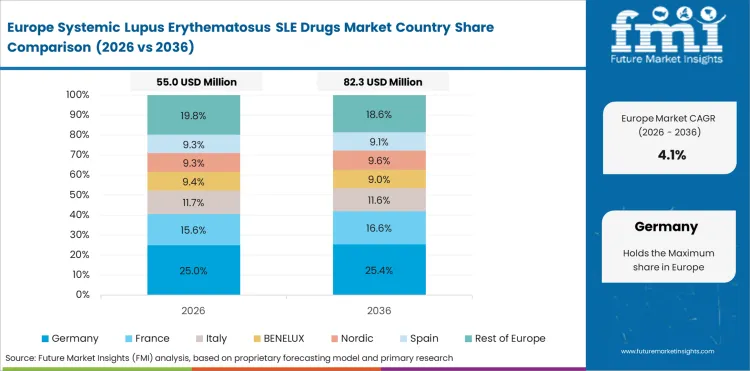
Germany is expected to grow at 4.3% through 2036, driven by its advanced rheumatology care, evidence-based treatment protocols, and established biologic prescribing.
- Advanced rheumatology care supports comprehensive SLE treatment.
- Evidence-based protocols guide treatment escalation decisions.
- Established biologic prescribing creates premium drug demand.
Sales Analysis of Systemic Lupus Erythematosus SLE Drugs Market in the United Kingdom
The UK is expected to grow at 3.4% through 2036, reflecting NHS rheumatology services, NICE treatment guidelines, and growing biologic access.
- NHS rheumatology services provide structured SLE management.
- NICE guidelines direct treatment decisions and biologic access criteria.
- Growing biologic access expands treatment options for severe patients.
Competitive Landscape and Strategic Positioning
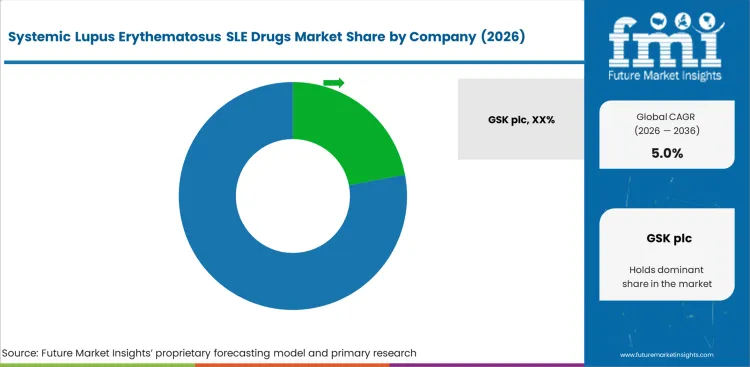
- GSK plc leads the market with comprehensive product and service capabilities and established customer relationships.
- Multiple global and regional players compete on technology capability, certification credentials, and geographic reach.
- Emerging players are targeting specialized applications and next generation technology development.
GSK leads the SLE biologics market through belimumab (Benlysta), the first biologic approved for SLE and lupus nephritis. AstraZeneca provides anifrolumab (Saphnelo) targeting the type I interferon pathway.
Amgen, Johnson & Johnson, and Gilead Sciences maintain active SLE pipeline programs targeting novel disease pathways. BMS and Sanofi provide immunology portfolios that include SLE treatment options.
Merck KGaA, UCB, and Teva Pharmaceutical provide conventional SLE drug classes including immunosuppressants and generic treatments that serve the majority of SLE patients globally.
Key Companies in the Systemic Lupus Erythematosus SLE Drugs Market
Key global companies leading the systemic lupus erythematosus sle drugs market include:
- GSK plc (UK), Anthera Pharmaceuticals / BMS (USA), ImmuPharma (UK), Merck KGaA (Germany), UCB S.A. (Belgium) hold strong positions through manufacturing scale, certification credentials, and established customer relationships.
- Amgen Inc. (USA), Gilead Sciences, Inc. (USA), Johnson & Johnson Services, Inc. (USA), AstraZeneca (UK) are expanding presence through regional focus and specialized product development.
- Sanofi (France), Teva Pharmaceutical Industries Ltd. (Israel) represent emerging participants targeting niche applications.
Competitive Benchmarking: Systemic Lupus Erythematosus SLE Drugs Market
| Company | Drug Portfolio | Pipeline Strength | Clinical Evidence | Geographic Reach |
|---|---|---|---|---|
| GSK plc | High | High | Strong | Global |
| BMS | High | High | Strong | Global |
| AstraZeneca | High | High | Strong | Global |
| Amgen Inc. | High | High | Strong | Global |
| Johnson & Johnson | High | High | Strong | Global |
| Merck KGaA | Medium | High | Strong | Europe, Global |
| UCB S.A. | Medium | High | Strong | Europe, Global |
| Gilead Sciences | Medium | High | Moderate | Global |
| Sanofi | High | High | Strong | Global |
| Teva Pharmaceutical | High | Medium | Strong | Global |
Source: Future Market Insights competitive analysis, 2026.
Key Players in the Systemic Lupus Erythematosus SLE Drugs Market
Major Global Players
- GSK plc (UK)
- Anthera Pharmaceuticals / BMS (USA)
- ImmuPharma (UK)
- Merck KGaA (Germany)
- UCB S.A. (Belgium)
Emerging Players/Startups
- Amgen Inc. (USA)
- Gilead Sciences, Inc. (USA)
- Johnson & Johnson Services, Inc. (USA)
- AstraZeneca (UK)
- Sanofi (France)
- Teva Pharmaceutical Industries Ltd. (Israel)
Report Scope and Coverage
| Parameter | Details |
|---|---|
| Quantitative Units | USD Million 221.66 to USD Million 361.05, at a CAGR of 5.0% |
| Market Definition | The systemic lupus erythematosus (SLE) drugs market covers pharmaceutical treatments for the management of lupus, a chronic autoimmune disease that causes the immune system to attack healthy tissues. Drug classes include immunosuppressants, NSAIDs, corticosteroids, antimalarials, and biologics administered through oral, intravenous, and subcutaneous routes across hospital pharmacies, retail pharmacies, and online pharmacy channels. |
| Regions Covered | North America, Latin America, Europe, East Asia, South Asia and Pacific, Middle East and Africa |
| Countries Covered | South Korea, Japan, China, Germany, India, UK, GCC Countries, and 30 plus countries |
| Key Companies Profiled | GSK plc, Anthera Pharmaceuticals / BMS, ImmuPharma, Merck KGaA, UCB S.A., Amgen Inc., Gilead Sciences, Inc., Johnson & Johnson Services, Inc. |
| Forecast Period | 2026 to 2036 |
| Approach | Hybrid bottom up and top down methodology starting with verified transaction data, projecting adoption velocity across segments and regions. |
Segmentation
Systemic Lupus Erythematosus SLE Drugs Market Segmented by Drug Class:
- Immunosuppresants
- NSAIDs
- Corticosteroids
- Antimalarials
- Biologics
Systemic Lupus Erythematosus SLE Drugs Market Segmented by Distribution Channel:
- Hospital pharmacies
- Retail pharmacies
- Online pharmacies
Systemic Lupus Erythematosus SLE Drugs Market Segmented by Route of Administration:
- Oral
- Intravenous
- Subcutaneous
Systemic Lupus Erythematosus SLE Drugs Market by Region:
- North America
- USA
- Canada
- Mexico
- Latin America
- Brazil
- Chile
- Rest of Latin America
- Western Europe
- Germany
- UK
- Italy
- Spain
- France
- Nordic
- BENELUX
- Rest of Western Europe
- Eastern Europe
- Russia
- Poland
- Hungary
- Balkan & Baltic
- Rest of Eastern Europe
- East Asia
- China
- Japan
- South Korea
- South Asia and Pacific
- India
- ASEAN
- Australia & New Zealand
- Rest of South Asia and Pacific
- Middle East & Africa
- Kingdom of Saudi Arabia
- Other GCC Countries
- Turkiye
- South Africa
- Other African Union
- Rest of Middle East & Africa
Research Sources and Bibliography
- 1. American College of Rheumatology. (2025). ACR Guidelines for the Treatment of Systemic Lupus Erythematosus. ACR.
- 2. European Alliance of Associations for Rheumatology. (2024). EULAR Recommendations for the Management of SLE. EULAR.
- 3. USA Food and Drug Administration. (2025). FDA Approved Drugs for Systemic Lupus Erythematosus. FDA.
- 4. Lupus Foundation of America. (2024). LFA Report: Understanding Lupus Prevalence and Treatment Access. LFA.
- 5. World Health Organization. (2025). WHO Classification of Diseases: Systemic Lupus Erythematosus. WHO.
This bibliography is provided for reader reference. The full Future Market Insights report contains the complete reference list.
This Report Answers
- Estimating the size of the market and projected revenue from 2026 to 2036.
- Segmentation by drug class, distribution channel, route of administration, and region.
- Insights across more than 30 country markets.
- Analysis of biologic drug development and treatment protocol evolution.
- Assessment of the competitive landscape and pharmaceutical company positioning.
- Identification of investment opportunities in biologics, lupus nephritis, and emerging market access.
- Tracking regulatory approvals and clinical pipeline developments.
- Delivery of data in PDF and Excel formats.
Frequently Asked Questions
What is the global market demand for Systemic Lupus Erythematosus SLE Drugs in 2026?
In 2026, the global systemic lupus erythematosus sle drugs market is expected to be worth USD Million 221.66 million.
How big will the Systemic Lupus Erythematosus SLE Drugs Market be in 2036?
By 2036, the systemic lupus erythematosus sle drugs market is expected to be worth USD Million 361.05 million.
How much is demand for Systemic Lupus Erythematosus SLE Drugs expected to grow between 2026 and 2036?
Between 2026 and 2036, demand is expected to grow at a CAGR of 5.0%.
Which drug class segment is expected to lead in 2026?
Immunosuppressants is expected to account for 36.4% of the drug class segment in 2026, driven by immunosuppressants' established role as the cornerstone of SLE treatment protocols for controlling immune mediated tissue damage and reducing disease flares in moderate to severe lupus patients.
What is causing demand to rise in South Korea?
South Korea is expected to grow at 5.7% CAGR through 2036. Advanced healthcare supports comprehensive SLE management.
What is causing demand to rise in Japan?
Japan is expected to grow at 5.4% CAGR through 2036. Rheumatology infrastructure supports specialist SLE management.
What does this report mean by 'Systemic Lupus Erythematosus SLE Drugs Market definition'?
The systemic lupus erythematosus (SLE) drugs market covers pharmaceutical treatments for the management of lupus, a chronic autoimmune disease that causes the immune system to attack healthy tissues. Drug classes include immunosuppressants, NSAIDs, corticosteroids, antimalarials, and biologics administered through oral, intravenous, and subcutaneous routes across hospital pharmacies, retail pharmacies, and online pharmacy channels.
How does FMI make the Systemic Lupus Erythematosus SLE Drugs forecast and validate it?
Forecasting models use a hybrid bottom up and top down approach, starting with verified transaction data and validating against industry production statistics and manufacturer disclosures.
Table of Content
- Executive Summary
- Global Market Outlook
- Demand to side Trends
- Supply to side Trends
- Technology Roadmap Analysis
- Analysis and Recommendations
- Market Overview
- Market Coverage / Taxonomy
- Market Definition / Scope / Limitations
- Research Methodology
- Chapter Orientation
- Analytical Lens and Working Hypotheses
- Market Structure, Signals, and Trend Drivers
- Benchmarking and Cross-market Comparability
- Market Sizing, Forecasting, and Opportunity Mapping
- Research Design and Evidence Framework
- Desk Research Programme (Secondary Evidence)
- Company Annual and Sustainability Reports
- Peer-reviewed Journals and Academic Literature
- Corporate Websites, Product Literature, and Technical Notes
- Earnings Decks and Investor Briefings
- Statutory Filings and Regulatory Disclosures
- Technical White Papers and Standards Notes
- Trade Journals, Industry Magazines, and Analyst Briefs
- Conference Proceedings, Webinars, and Seminar Materials
- Government Statistics Portals and Public Data Releases
- Press Releases and Reputable Media Coverage
- Specialist Newsletters and Curated Briefings
- Sector Databases and Reference Repositories
- FMI Internal Proprietary Databases and Historical Market Datasets
- Subscription Datasets and Paid Sources
- Social Channels, Communities, and Digital Listening Inputs
- Additional Desk Sources
- Expert Input and Fieldwork (Primary Evidence)
- Primary Modes
- Qualitative Interviews and Expert Elicitation
- Quantitative Surveys and Structured Data Capture
- Blended Approach
- Why Primary Evidence is Used
- Field Techniques
- Interviews
- Surveys
- Focus Groups
- Observational and In-context Research
- Social and Community Interactions
- Stakeholder Universe Engaged
- C-suite Leaders
- Board Members
- Presidents and Vice Presidents
- R&D and Innovation Heads
- Technical Specialists
- Domain Subject-matter Experts
- Scientists
- Physicians and Other Healthcare Professionals
- Governance, Ethics, and Data Stewardship
- Research Ethics
- Data Integrity and Handling
- Primary Modes
- Tooling, Models, and Reference Databases
- Desk Research Programme (Secondary Evidence)
- Data Engineering and Model Build
- Data Acquisition and Ingestion
- Cleaning, Normalisation, and Verification
- Synthesis, Triangulation, and Analysis
- Quality Assurance and Audit Trail
- Market Background
- Market Dynamics
- Drivers
- Restraints
- Opportunity
- Trends
- Scenario Forecast
- Demand in Optimistic Scenario
- Demand in Likely Scenario
- Demand in Conservative Scenario
- Opportunity Map Analysis
- Product Life Cycle Analysis
- Supply Chain Analysis
- Investment Feasibility Matrix
- Value Chain Analysis
- PESTLE and Porter’s Analysis
- Regulatory Landscape
- Regional Parent Market Outlook
- Production and Consumption Statistics
- Import and Export Statistics
- Market Dynamics
- Global Market Analysis 2021 to 2025 and Forecast, 2026 to 2036
- Historical Market Size Value (USD Million) Analysis, 2021 to 2025
- Current and Future Market Size Value (USD Million) Projections, 2026 to 2036
- Y to o to Y Growth Trend Analysis
- Absolute $ Opportunity Analysis
- Global Market Pricing Analysis 2021 to 2025 and Forecast 2026 to 2036
- Global Market Analysis 2021 to 2025 and Forecast 2026 to 2036, By Drug Class
- Introduction / Key Findings
- Historical Market Size Value (USD Million) Analysis By Drug Class , 2021 to 2025
- Current and Future Market Size Value (USD Million) Analysis and Forecast By Drug Class , 2026 to 2036
- Immunosuppresants
- NSAIDs
- Corticosteroids
- Antimalarials
- Biologics
- Immunosuppresants
- Y to o to Y Growth Trend Analysis By Drug Class , 2021 to 2025
- Absolute $ Opportunity Analysis By Drug Class , 2026 to 2036
- Global Market Analysis 2021 to 2025 and Forecast 2026 to 2036, By Distribution Channel
- Introduction / Key Findings
- Historical Market Size Value (USD Million) Analysis By Distribution Channel, 2021 to 2025
- Current and Future Market Size Value (USD Million) Analysis and Forecast By Distribution Channel, 2026 to 2036
- Hospital pharmacies
- Retail pharmacies
- Online pharmacies
- Hospital pharmacies
- Y to o to Y Growth Trend Analysis By Distribution Channel, 2021 to 2025
- Absolute $ Opportunity Analysis By Distribution Channel, 2026 to 2036
- Global Market Analysis 2021 to 2025 and Forecast 2026 to 2036, By Route of Administration
- Introduction / Key Findings
- Historical Market Size Value (USD Million) Analysis By Route of Administration, 2021 to 2025
- Current and Future Market Size Value (USD Million) Analysis and Forecast By Route of Administration, 2026 to 2036
- Oral
- Intravenous
- Subcutaneous
- Oral
- Y to o to Y Growth Trend Analysis By Route of Administration, 2021 to 2025
- Absolute $ Opportunity Analysis By Route of Administration, 2026 to 2036
- Global Market Analysis 2021 to 2025 and Forecast 2026 to 2036, By Region
- Introduction
- Historical Market Size Value (USD Million) Analysis By Region, 2021 to 2025
- Current Market Size Value (USD Million) Analysis and Forecast By Region, 2026 to 2036
- North America
- Latin America
- Western Europe
- Eastern Europe
- East Asia
- South Asia and Pacific
- Middle East & Africa
- Market Attractiveness Analysis By Region
- North America Market Analysis 2021 to 2025 and Forecast 2026 to 2036, By Country
- Historical Market Size Value (USD Million) Trend Analysis By Market Taxonomy, 2021 to 2025
- Market Size Value (USD Million) Forecast By Market Taxonomy, 2026 to 2036
- By Country
- USA
- Canada
- Mexico
- By Drug Class
- By Distribution Channel
- By Route of Administration
- By Country
- Market Attractiveness Analysis
- By Country
- By Drug Class
- By Distribution Channel
- By Route of Administration
- Key Takeaways
- Latin America Market Analysis 2021 to 2025 and Forecast 2026 to 2036, By Country
- Historical Market Size Value (USD Million) Trend Analysis By Market Taxonomy, 2021 to 2025
- Market Size Value (USD Million) Forecast By Market Taxonomy, 2026 to 2036
- By Country
- Brazil
- Chile
- Rest of Latin America
- By Drug Class
- By Distribution Channel
- By Route of Administration
- By Country
- Market Attractiveness Analysis
- By Country
- By Drug Class
- By Distribution Channel
- By Route of Administration
- Key Takeaways
- Western Europe Market Analysis 2021 to 2025 and Forecast 2026 to 2036, By Country
- Historical Market Size Value (USD Million) Trend Analysis By Market Taxonomy, 2021 to 2025
- Market Size Value (USD Million) Forecast By Market Taxonomy, 2026 to 2036
- By Country
- Germany
- UK
- Italy
- Spain
- France
- Nordic
- BENELUX
- Rest of Western Europe
- By Drug Class
- By Distribution Channel
- By Route of Administration
- By Country
- Market Attractiveness Analysis
- By Country
- By Drug Class
- By Distribution Channel
- By Route of Administration
- Key Takeaways
- Eastern Europe Market Analysis 2021 to 2025 and Forecast 2026 to 2036, By Country
- Historical Market Size Value (USD Million) Trend Analysis By Market Taxonomy, 2021 to 2025
- Market Size Value (USD Million) Forecast By Market Taxonomy, 2026 to 2036
- By Country
- Russia
- Poland
- Hungary
- Balkan & Baltic
- Rest of Eastern Europe
- By Drug Class
- By Distribution Channel
- By Route of Administration
- By Country
- Market Attractiveness Analysis
- By Country
- By Drug Class
- By Distribution Channel
- By Route of Administration
- Key Takeaways
- East Asia Market Analysis 2021 to 2025 and Forecast 2026 to 2036, By Country
- Historical Market Size Value (USD Million) Trend Analysis By Market Taxonomy, 2021 to 2025
- Market Size Value (USD Million) Forecast By Market Taxonomy, 2026 to 2036
- By Country
- China
- Japan
- South Korea
- By Drug Class
- By Distribution Channel
- By Route of Administration
- By Country
- Market Attractiveness Analysis
- By Country
- By Drug Class
- By Distribution Channel
- By Route of Administration
- Key Takeaways
- South Asia and Pacific Market Analysis 2021 to 2025 and Forecast 2026 to 2036, By Country
- Historical Market Size Value (USD Million) Trend Analysis By Market Taxonomy, 2021 to 2025
- Market Size Value (USD Million) Forecast By Market Taxonomy, 2026 to 2036
- By Country
- India
- ASEAN
- Australia & New Zealand
- Rest of South Asia and Pacific
- By Drug Class
- By Distribution Channel
- By Route of Administration
- By Country
- Market Attractiveness Analysis
- By Country
- By Drug Class
- By Distribution Channel
- By Route of Administration
- Key Takeaways
- Middle East & Africa Market Analysis 2021 to 2025 and Forecast 2026 to 2036, By Country
- Historical Market Size Value (USD Million) Trend Analysis By Market Taxonomy, 2021 to 2025
- Market Size Value (USD Million) Forecast By Market Taxonomy, 2026 to 2036
- By Country
- Kingdom of Saudi Arabia
- Other GCC Countries
- Turkiye
- South Africa
- Other African Union
- Rest of Middle East & Africa
- By Drug Class
- By Distribution Channel
- By Route of Administration
- By Country
- Market Attractiveness Analysis
- By Country
- By Drug Class
- By Distribution Channel
- By Route of Administration
- Key Takeaways
- Key Countries Market Analysis
- USA
- Pricing Analysis
- Market Share Analysis, 2025
- By Drug Class
- By Distribution Channel
- By Route of Administration
- Canada
- Pricing Analysis
- Market Share Analysis, 2025
- By Drug Class
- By Distribution Channel
- By Route of Administration
- Mexico
- Pricing Analysis
- Market Share Analysis, 2025
- By Drug Class
- By Distribution Channel
- By Route of Administration
- Brazil
- Pricing Analysis
- Market Share Analysis, 2025
- By Drug Class
- By Distribution Channel
- By Route of Administration
- Chile
- Pricing Analysis
- Market Share Analysis, 2025
- By Drug Class
- By Distribution Channel
- By Route of Administration
- Germany
- Pricing Analysis
- Market Share Analysis, 2025
- By Drug Class
- By Distribution Channel
- By Route of Administration
- UK
- Pricing Analysis
- Market Share Analysis, 2025
- By Drug Class
- By Distribution Channel
- By Route of Administration
- Italy
- Pricing Analysis
- Market Share Analysis, 2025
- By Drug Class
- By Distribution Channel
- By Route of Administration
- Spain
- Pricing Analysis
- Market Share Analysis, 2025
- By Drug Class
- By Distribution Channel
- By Route of Administration
- France
- Pricing Analysis
- Market Share Analysis, 2025
- By Drug Class
- By Distribution Channel
- By Route of Administration
- India
- Pricing Analysis
- Market Share Analysis, 2025
- By Drug Class
- By Distribution Channel
- By Route of Administration
- ASEAN
- Pricing Analysis
- Market Share Analysis, 2025
- By Drug Class
- By Distribution Channel
- By Route of Administration
- Australia & New Zealand
- Pricing Analysis
- Market Share Analysis, 2025
- By Drug Class
- By Distribution Channel
- By Route of Administration
- China
- Pricing Analysis
- Market Share Analysis, 2025
- By Drug Class
- By Distribution Channel
- By Route of Administration
- Japan
- Pricing Analysis
- Market Share Analysis, 2025
- By Drug Class
- By Distribution Channel
- By Route of Administration
- South Korea
- Pricing Analysis
- Market Share Analysis, 2025
- By Drug Class
- By Distribution Channel
- By Route of Administration
- Russia
- Pricing Analysis
- Market Share Analysis, 2025
- By Drug Class
- By Distribution Channel
- By Route of Administration
- Poland
- Pricing Analysis
- Market Share Analysis, 2025
- By Drug Class
- By Distribution Channel
- By Route of Administration
- Hungary
- Pricing Analysis
- Market Share Analysis, 2025
- By Drug Class
- By Distribution Channel
- By Route of Administration
- Kingdom of Saudi Arabia
- Pricing Analysis
- Market Share Analysis, 2025
- By Drug Class
- By Distribution Channel
- By Route of Administration
- Turkiye
- Pricing Analysis
- Market Share Analysis, 2025
- By Drug Class
- By Distribution Channel
- By Route of Administration
- South Africa
- Pricing Analysis
- Market Share Analysis, 2025
- By Drug Class
- By Distribution Channel
- By Route of Administration
- USA
- Market Structure Analysis
- Competition Dashboard
- Competition Benchmarking
- Market Share Analysis of Top Players
- By Regional
- By Drug Class
- By Distribution Channel
- By Route of Administration
- Competition Analysis
- Competition Deep Dive
- GSK plc
- Overview
- Product Portfolio
- Profitability by Market Segments (Product/Age /Sales Channel/Region)
- Sales Footprint
- Strategy Overview
- Marketing Strategy
- Product Strategy
- Channel Strategy
- Anthera Pharmaceuticals BMS
- ImmuPharma
- Merck KGaA
- UCB S.A.
- Amgen Inc.
- Gilead Sciences, Inc.
- Johnson & Johnson Services, Inc.
- AstraZeneca
- Sanofi
- Teva Pharmaceutical Industries Ltd.
- GSK plc
- Competition Deep Dive
- Assumptions & Acronyms Used
List of Tables
- Table 1: Global Market Value (USD Million) Forecast by Region, 2021 to 2036
- Table 2: Global Market Value (USD Million) Forecast by Drug Class , 2021 to 2036
- Table 3: Global Market Value (USD Million) Forecast by Distribution Channel, 2021 to 2036
- Table 4: Global Market Value (USD Million) Forecast by Route of Administration, 2021 to 2036
- Table 5: North America Market Value (USD Million) Forecast by Country, 2021 to 2036
- Table 6: North America Market Value (USD Million) Forecast by Drug Class , 2021 to 2036
- Table 7: North America Market Value (USD Million) Forecast by Distribution Channel, 2021 to 2036
- Table 8: North America Market Value (USD Million) Forecast by Route of Administration, 2021 to 2036
- Table 9: Latin America Market Value (USD Million) Forecast by Country, 2021 to 2036
- Table 10: Latin America Market Value (USD Million) Forecast by Drug Class , 2021 to 2036
- Table 11: Latin America Market Value (USD Million) Forecast by Distribution Channel, 2021 to 2036
- Table 12: Latin America Market Value (USD Million) Forecast by Route of Administration, 2021 to 2036
- Table 13: Western Europe Market Value (USD Million) Forecast by Country, 2021 to 2036
- Table 14: Western Europe Market Value (USD Million) Forecast by Drug Class , 2021 to 2036
- Table 15: Western Europe Market Value (USD Million) Forecast by Distribution Channel, 2021 to 2036
- Table 16: Western Europe Market Value (USD Million) Forecast by Route of Administration, 2021 to 2036
- Table 17: Eastern Europe Market Value (USD Million) Forecast by Country, 2021 to 2036
- Table 18: Eastern Europe Market Value (USD Million) Forecast by Drug Class , 2021 to 2036
- Table 19: Eastern Europe Market Value (USD Million) Forecast by Distribution Channel, 2021 to 2036
- Table 20: Eastern Europe Market Value (USD Million) Forecast by Route of Administration, 2021 to 2036
- Table 21: East Asia Market Value (USD Million) Forecast by Country, 2021 to 2036
- Table 22: East Asia Market Value (USD Million) Forecast by Drug Class , 2021 to 2036
- Table 23: East Asia Market Value (USD Million) Forecast by Distribution Channel, 2021 to 2036
- Table 24: East Asia Market Value (USD Million) Forecast by Route of Administration, 2021 to 2036
- Table 25: South Asia and Pacific Market Value (USD Million) Forecast by Country, 2021 to 2036
- Table 26: South Asia and Pacific Market Value (USD Million) Forecast by Drug Class , 2021 to 2036
- Table 27: South Asia and Pacific Market Value (USD Million) Forecast by Distribution Channel, 2021 to 2036
- Table 28: South Asia and Pacific Market Value (USD Million) Forecast by Route of Administration, 2021 to 2036
- Table 29: Middle East & Africa Market Value (USD Million) Forecast by Country, 2021 to 2036
- Table 30: Middle East & Africa Market Value (USD Million) Forecast by Drug Class , 2021 to 2036
- Table 31: Middle East & Africa Market Value (USD Million) Forecast by Distribution Channel, 2021 to 2036
- Table 32: Middle East & Africa Market Value (USD Million) Forecast by Route of Administration, 2021 to 2036
List of Figures
- Figure 1: Global Market Pricing Analysis
- Figure 2: Global Market Value (USD Million) Forecast 2021-2036
- Figure 3: Global Market Value Share and BPS Analysis by Drug Class , 2026 and 2036
- Figure 4: Global Market Y-o-Y Growth Comparison by Drug Class , 2026-2036
- Figure 5: Global Market Attractiveness Analysis by Drug Class
- Figure 6: Global Market Value Share and BPS Analysis by Distribution Channel, 2026 and 2036
- Figure 7: Global Market Y-o-Y Growth Comparison by Distribution Channel, 2026-2036
- Figure 8: Global Market Attractiveness Analysis by Distribution Channel
- Figure 9: Global Market Value Share and BPS Analysis by Route of Administration, 2026 and 2036
- Figure 10: Global Market Y-o-Y Growth Comparison by Route of Administration, 2026-2036
- Figure 11: Global Market Attractiveness Analysis by Route of Administration
- Figure 12: Global Market Value (USD Million) Share and BPS Analysis by Region, 2026 and 2036
- Figure 13: Global Market Y-o-Y Growth Comparison by Region, 2026-2036
- Figure 14: Global Market Attractiveness Analysis by Region
- Figure 15: North America Market Incremental Dollar Opportunity, 2026-2036
- Figure 16: Latin America Market Incremental Dollar Opportunity, 2026-2036
- Figure 17: Western Europe Market Incremental Dollar Opportunity, 2026-2036
- Figure 18: Eastern Europe Market Incremental Dollar Opportunity, 2026-2036
- Figure 19: East Asia Market Incremental Dollar Opportunity, 2026-2036
- Figure 20: South Asia and Pacific Market Incremental Dollar Opportunity, 2026-2036
- Figure 21: Middle East & Africa Market Incremental Dollar Opportunity, 2026-2036
- Figure 22: North America Market Value Share and BPS Analysis by Country, 2026 and 2036
- Figure 23: North America Market Value Share and BPS Analysis by Drug Class , 2026 and 2036
- Figure 24: North America Market Y-o-Y Growth Comparison by Drug Class , 2026-2036
- Figure 25: North America Market Attractiveness Analysis by Drug Class
- Figure 26: North America Market Value Share and BPS Analysis by Distribution Channel, 2026 and 2036
- Figure 27: North America Market Y-o-Y Growth Comparison by Distribution Channel, 2026-2036
- Figure 28: North America Market Attractiveness Analysis by Distribution Channel
- Figure 29: North America Market Value Share and BPS Analysis by Route of Administration, 2026 and 2036
- Figure 30: North America Market Y-o-Y Growth Comparison by Route of Administration, 2026-2036
- Figure 31: North America Market Attractiveness Analysis by Route of Administration
- Figure 32: Latin America Market Value Share and BPS Analysis by Country, 2026 and 2036
- Figure 33: Latin America Market Value Share and BPS Analysis by Drug Class , 2026 and 2036
- Figure 34: Latin America Market Y-o-Y Growth Comparison by Drug Class , 2026-2036
- Figure 35: Latin America Market Attractiveness Analysis by Drug Class
- Figure 36: Latin America Market Value Share and BPS Analysis by Distribution Channel, 2026 and 2036
- Figure 37: Latin America Market Y-o-Y Growth Comparison by Distribution Channel, 2026-2036
- Figure 38: Latin America Market Attractiveness Analysis by Distribution Channel
- Figure 39: Latin America Market Value Share and BPS Analysis by Route of Administration, 2026 and 2036
- Figure 40: Latin America Market Y-o-Y Growth Comparison by Route of Administration, 2026-2036
- Figure 41: Latin America Market Attractiveness Analysis by Route of Administration
- Figure 42: Western Europe Market Value Share and BPS Analysis by Country, 2026 and 2036
- Figure 43: Western Europe Market Value Share and BPS Analysis by Drug Class , 2026 and 2036
- Figure 44: Western Europe Market Y-o-Y Growth Comparison by Drug Class , 2026-2036
- Figure 45: Western Europe Market Attractiveness Analysis by Drug Class
- Figure 46: Western Europe Market Value Share and BPS Analysis by Distribution Channel, 2026 and 2036
- Figure 47: Western Europe Market Y-o-Y Growth Comparison by Distribution Channel, 2026-2036
- Figure 48: Western Europe Market Attractiveness Analysis by Distribution Channel
- Figure 49: Western Europe Market Value Share and BPS Analysis by Route of Administration, 2026 and 2036
- Figure 50: Western Europe Market Y-o-Y Growth Comparison by Route of Administration, 2026-2036
- Figure 51: Western Europe Market Attractiveness Analysis by Route of Administration
- Figure 52: Eastern Europe Market Value Share and BPS Analysis by Country, 2026 and 2036
- Figure 53: Eastern Europe Market Value Share and BPS Analysis by Drug Class , 2026 and 2036
- Figure 54: Eastern Europe Market Y-o-Y Growth Comparison by Drug Class , 2026-2036
- Figure 55: Eastern Europe Market Attractiveness Analysis by Drug Class
- Figure 56: Eastern Europe Market Value Share and BPS Analysis by Distribution Channel, 2026 and 2036
- Figure 57: Eastern Europe Market Y-o-Y Growth Comparison by Distribution Channel, 2026-2036
- Figure 58: Eastern Europe Market Attractiveness Analysis by Distribution Channel
- Figure 59: Eastern Europe Market Value Share and BPS Analysis by Route of Administration, 2026 and 2036
- Figure 60: Eastern Europe Market Y-o-Y Growth Comparison by Route of Administration, 2026-2036
- Figure 61: Eastern Europe Market Attractiveness Analysis by Route of Administration
- Figure 62: East Asia Market Value Share and BPS Analysis by Country, 2026 and 2036
- Figure 63: East Asia Market Value Share and BPS Analysis by Drug Class , 2026 and 2036
- Figure 64: East Asia Market Y-o-Y Growth Comparison by Drug Class , 2026-2036
- Figure 65: East Asia Market Attractiveness Analysis by Drug Class
- Figure 66: East Asia Market Value Share and BPS Analysis by Distribution Channel, 2026 and 2036
- Figure 67: East Asia Market Y-o-Y Growth Comparison by Distribution Channel, 2026-2036
- Figure 68: East Asia Market Attractiveness Analysis by Distribution Channel
- Figure 69: East Asia Market Value Share and BPS Analysis by Route of Administration, 2026 and 2036
- Figure 70: East Asia Market Y-o-Y Growth Comparison by Route of Administration, 2026-2036
- Figure 71: East Asia Market Attractiveness Analysis by Route of Administration
- Figure 72: South Asia and Pacific Market Value Share and BPS Analysis by Country, 2026 and 2036
- Figure 73: South Asia and Pacific Market Value Share and BPS Analysis by Drug Class , 2026 and 2036
- Figure 74: South Asia and Pacific Market Y-o-Y Growth Comparison by Drug Class , 2026-2036
- Figure 75: South Asia and Pacific Market Attractiveness Analysis by Drug Class
- Figure 76: South Asia and Pacific Market Value Share and BPS Analysis by Distribution Channel, 2026 and 2036
- Figure 77: South Asia and Pacific Market Y-o-Y Growth Comparison by Distribution Channel, 2026-2036
- Figure 78: South Asia and Pacific Market Attractiveness Analysis by Distribution Channel
- Figure 79: South Asia and Pacific Market Value Share and BPS Analysis by Route of Administration, 2026 and 2036
- Figure 80: South Asia and Pacific Market Y-o-Y Growth Comparison by Route of Administration, 2026-2036
- Figure 81: South Asia and Pacific Market Attractiveness Analysis by Route of Administration
- Figure 82: Middle East & Africa Market Value Share and BPS Analysis by Country, 2026 and 2036
- Figure 83: Middle East & Africa Market Value Share and BPS Analysis by Drug Class , 2026 and 2036
- Figure 84: Middle East & Africa Market Y-o-Y Growth Comparison by Drug Class , 2026-2036
- Figure 85: Middle East & Africa Market Attractiveness Analysis by Drug Class
- Figure 86: Middle East & Africa Market Value Share and BPS Analysis by Distribution Channel, 2026 and 2036
- Figure 87: Middle East & Africa Market Y-o-Y Growth Comparison by Distribution Channel, 2026-2036
- Figure 88: Middle East & Africa Market Attractiveness Analysis by Distribution Channel
- Figure 89: Middle East & Africa Market Value Share and BPS Analysis by Route of Administration, 2026 and 2036
- Figure 90: Middle East & Africa Market Y-o-Y Growth Comparison by Route of Administration, 2026-2036
- Figure 91: Middle East & Africa Market Attractiveness Analysis by Route of Administration
- Figure 92: Global Market - Tier Structure Analysis
- Figure 93: Global Market - Company Share Analysis
Full Research Suite comprises of:

Market outlook & trends analysis
Interviews & case studies
Strategic recommendations
Vendor profiles & capabilities analysis
5-year forecasts
8 regions and 60+ country-level data splits
Market segment data splits
12 months of continuous data updates
DELIVERED AS:
PDF EXCEL ONLINE


