

- Market Size (2026)
- USD 920.7 Mn
- Forecast (2036)
- USD 1712.1 Mn
- CAGR (2026 to 2036)
- 6.4%
How big is Terrazzo Flooring Resins Market in 2026?
USD 920.7 million in 2026 and USD 1,712.1 million by 2036 at a 6.4% CAGR.
Sales of terrazzo flooring resins are estimated to rise at 6.4% CAGR through 2036, increasing valuation from USD 920.7 million in 2026 to USD 1,712.1 million by 2036. Commercial developers compare construction chemicals with complete floor assemblies during long-life finish selection and warranty planning. Large public interiors compare concrete floor coatings through substrate preparation and long-term service expectations planning. The National Terrazzo and Mosaic Association documented 140,000 square feet of epoxy terrazzo across seven Intuit Dome stories in May 2025. Seven-story coverage rewards manufacturers that provide stable color matching and coordinated technical support throughout installation.
Regional purchasing routes differ through approval practice and specialist installer access across major construction markets. United States projects use established specifications across airports and public interiors with demanding traffic patterns. Phased airport programs test whether resin producers can preserve color and service continuity through expansions. The National Terrazzo and Mosaic Association documented a fifth epoxy terrazzo phase at Gerald R. Ford International Airport in May 2025. European teams emphasize emissions records while Gulf contractors need application controls suited to hot substrates and storage conditions. Japanese teams favor disciplined qualification, and construction aggregates availability affects marble chip selection and delivery timing.
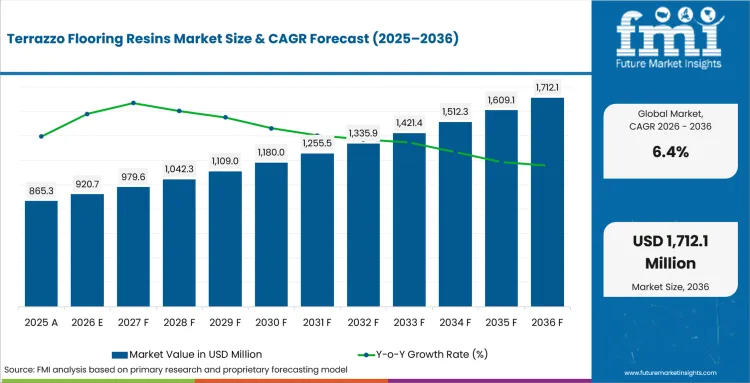
Key Takeaways of Terrazzo Flooring Resins Market
- Commercial interiors sustain demand through surfaces that manage heavy circulation and preserve coordinated visual identity.
- Epoxy terrazzo resins represent 58.0% share in 2026 through thin placement and controlled color delivery.
- Flooring contractors represent 45.0% share in 2026 through direct installation responsibility and disciplined slab control.
- Thin-set terrazzo represents 41.0% share in 2026 through limited height and practical renovation compatibility today.
- Moisture transmission and concrete movement restrict adoption by weakening adhesion or transferring cracks through surfaces.
- Eight verified companies represent specialist, global, and integrated resin-flooring models across major regional commercial projects.
Analyst Perspective
“Terrazzo resin decisions begin with slab conditions and finish with service continuity across the completed floor. Architects need stable color control alongside compatible moisture barriers and crack treatments for each site. Manufacturers gain specification access by coordinating those materials with trained installers and responsive field guidance throughout complex project construction.”
- Nikhil Kaitwade, Principal Analyst, Future Market Insights
How is the Terrazzo Flooring Resins Market segmented?
The terrazzo flooring resins industry is segmented by resin type, system, aggregate compatibility, end use, sales channel, and region.
The framework separates resin type by binder chemistry and system by installation configuration across the market. Aggregate compatibility groups marble, glass, quartz, granite, and recycled materials by their suitability for decorative resin mixes. End use distinguishes commercial buildings from education, healthcare, transport, retail, hospitality, and premium residential settings. Sales channel separates contractor-led purchasing from direct resin supply and complete terrazzo system provision across projects. Regional analysis compares how approval routes and specialist installer coverage change practical access across countries. Teams also review epoxy resin options for compatible primers, membranes, and repair materials within the complete flooring specification and warranty planning.
What supports demand for epoxy terrazzo resins within the resin type category?
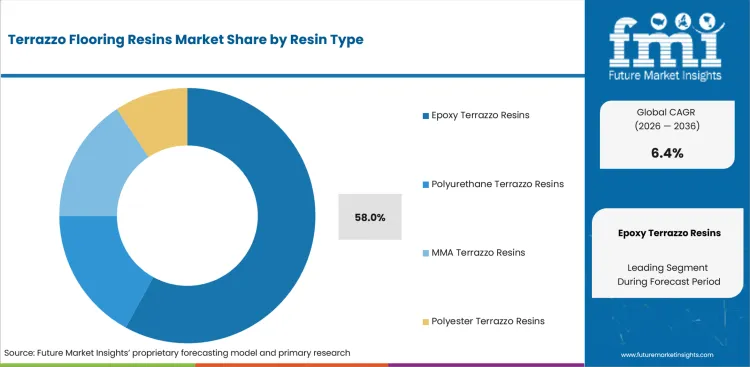
Finished thickness and pattern control determine resin selection across multistory interiors with coordinated floor transitions. NTMA guidance describes epoxy terrazzo as a quarter-inch or three-eighth-inch veneer with broad color flexibility. Thin construction reduces elevation conflicts and supports detailed graphics across prepared concrete slabs during renovations. Architects compare construction flooring chemicals for primers and membranes that protect the complete flooring assembly.
- Epoxy terrazzo resins are projected to hold 58.0% share in 2026 owing to controlled color and thin application. High-solids binders accommodate intricate patterns without cement hydration limits across large connected commercial interiors today. The segment maintains its position through design flexibility and repeatable finish control across demanding project specifications.
- Commercial facilities adopt epoxy systems for continuous surfaces and detailed wayfinding across concentrated pedestrian areas. Project teams coordinate moisture barriers and crack membranes with the chosen binder during system approval today. Compatible concrete bonding agents protect adhesion across prepared slabs and reduce warranty disputes between resin manufacturers and specialist installers.
Why does thin-set terrazzo shape demand within the system category?
Renovations with restricted floor elevations favor thin-set systems over deeper cementitious assemblies across existing slabs. Current manufacturer specifications confirm that thin-set formats serve commercial and institutional interiors with restricted elevations. Sika describes its epoxy terrazzo offer as a thin-set binder for commercial and institutional settings. Reduced thickness limits transition work beside doors and adjoining finishes across occupied properties during renovations.
- By system, thin-set terrazzo is estimated to hold 41.0% share in 2026 owing to limited build height and renovation planning. Its limited build height avoids deep slab recesses and preserves precise transitions across doors, adjoining finishes, and multistory renovation areas throughout occupied commercial projects without disruptive elevation changes onsite.
- Specialist contractors adopt thin-set systems through familiar troweling and grinding workflows across prepared concrete surfaces. Membranes protect identified cracks or movement locations during resin placement and divider installation across vulnerable slab areas. Epoxy grouts provide related handling knowledge for controlled mixing and detailed finishing across complex decorative borders during installation.
How do marble chips influence the aggregate compatibility category?
Aggregate selection determines color depth and polishing response across completed terrazzo surfaces in commercial interiors. NTMA technical guidance identifies marble beside quartz and recycled glass as standard terrazzo aggregates today. Marble chips provide familiar grading and broad natural variation across custom decorative resin mixes today. Installers require physical samples because quarry differences alter the final appearance across approved commercial designs.
- The marble chips segment is likely to capture 37.0% share in 2026 attributable to established grading and dependable mix design. Natural variation expands decorative choice, while specification familiarity and established fabrication knowledge preserve marble’s position among specialist terrazzo contractors across institutional and commercial interiors with repeatable polishing and grading.
- Design teams adopt marble chips through approved mockups that establish acceptable shade variation and aggregate density. Installer-produced samples align resin color with the actual stone blend during final detailed project approval. Floor polish systems provide a related reference for gloss retention and maintenance across heavily used commercial interiors during service.
What supports commercial buildings within the end use category?
Commercial buildings require flooring that combines circulation performance with visual identity across connected public interiors. Large transport projects test resin consistency across extensive floor areas and demanding daily operating schedules. NTMA recorded 650,000 square feet of epoxy terrazzo at Orlando Airport in May 2025. Terminal coverage links resin demand with navigation artwork and coordinated maintenance across high-traffic public spaces.
- The end use category is forecast to be led by commercial buildings at 31.0% share in 2026 due to high-traffic interiors. Airports and retail facilities value continuous surfaces across circulation zones, which supports repeated specifications across large projects with coordinated design programs and busy public gathering areas during service.
- Facility teams adopt resin terrazzo through lifecycle planning that favors repairable surfaces with limited joints. Approved cleaning programs preserve gloss and slip performance across busy public circulation areas during service. Tile adhesive systems provide a useful sequencing reference across mixed flooring packages and coordinated transition details during complex commercial renovations.
Why do flooring contractors lead the sales channel category?
Specialist installers coordinate slab correction with divider placement and resin mixing across complete terrazzo projects. The National Terrazzo and Mosaic Association links contractor membership with proficiency requirements and project review. Grinding and polishing require consistent sequencing across decorative floors and connected circulation zones during installation. Resin orders therefore pass through specialists controlling labor planning and surface quality throughout each project.
- In 2026, flooring contractors are expected to lead the sales channel category with 45.0% share because installation accountability shapes material selection. Specialists translate design intent into resin quantities and choose primers or membrane plans across projects. Their position reflects direct control of site sequence and responsibility for floor performance.
- General contractors engage specialist terrazzo installers to reduce defects across high-value decorative floors and public interiors. Qualified crews align moisture testing and divider placement with resin mixing or grinding schedules today. Manufacturers protect construction schedules through rapid technical response, local training, and dependable regional stock during unexpected onsite slab repairs.
What are the drivers, restraints, and opportunities in the Terrazzo Flooring Resins Market?
Durable commercial interiors support demand while substrate risk limits execution and verified material records improve specification access.
- Driver: Design-intensive public interiors require durable floors that preserve navigation and identity under concentrated traffic.
- Restraint: Moisture transmission and slab movement can weaken adhesion or transfer cracks through resin surfaces.
- Opportunity: Verified environmental records can improve access to projects that use formal material approval systems.
Design-intensive public interiors require floors that guide circulation and preserve architectural identity under concentrated traffic. Large projects extend resin specifications into stairs and fitted elements that need matching colors across connected spaces. A May 2026 National Terrazzo and Mosaic Association profile for Hunter’s Point documents epoxy flooring beside terrazzo wall panels and benches. Coordinated field support maintains color consistency across poured floors and precast components throughout public commercial interiors today.
Substrate uncertainty delays resin terrazzo across renovations and new construction with thin decorative flooring assemblies. Installation teams must resolve concrete movement and moisture risk during detailed preparation and final bidding. National Terrazzo and Mosaic Association guidance requires divider strips to follow concrete joints and identifies flexible membranes for crack treatment. Unresolved conditions raise remediation costs and shift warranty exposure across specialist contractors or resin producers and building operations and maintenance.
Formal environmental documentation improves access to institutional building projects that use structured material approval systems. Architects need emissions and lifecycle records tied to the exact flooring assembly under detailed review. Key Resin Company publishes HPD and EPD records for its epoxy terrazzo matrix and complete terrazzo systems. Verified records shorten document collection while application guidance and local technical response protect project-specific approval decisions without replacing slab testing or installer qualification.
Which country CAGRs are profiled in the Terrazzo Flooring Resins Market?
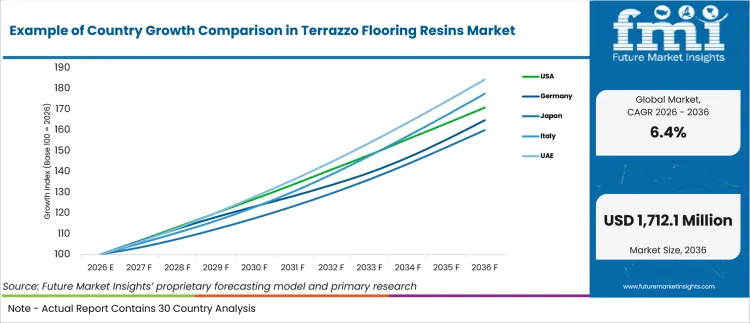
| Country | CAGR |
|---|---|
| UAE | 6.3% |
| Italy | 5.9% |
| United States | 5.5% |
| Germany | 5.1% |
| Japan | 4.8% |
How do country-level CAGRs compare in the Terrazzo Flooring Resins Market?
The five forecasts form a narrow 1.5-point band, so approval routes explain more than headline growth differences across countries. UAE and Italy convert design investment through climate controls or environmental tender rules that shape specification timing. United States and Germany rely on mature documentation systems, although labor economics and certification steps produce different project outcomes. Japan advances through disciplined product qualification, but concentrated installer coverage slows adoption beyond major metropolitan construction markets. The comparison therefore reflects gradual commercial progression rather than separate demand tiers across established terrazzo flooring channels.
- UAE projects convert through climate-qualified systems, yet imported aggregates complicate color delivery across commercial sites.
- Environmental tender rules support Italian resin specifications, although heritage renovations preserve cement terrazzo across projects.
- United States projects benefit from specifications, but skilled labor costs narrow economics beyond metropolitan markets.
- Germany converts through emissions documentation, while detailed approval extends substitution timelines across certified commercial interiors.
- Japan favors product-specific qualification, yet concentrated installer coverage limits practical access beyond major metropolitan markets.
Local approval routes and installer networks make similar forecasts produce different commercial entry conditions locally. The full report provides country-level CAGR analysis across North America, Latin America, Europe, East Asia, South Asia, Oceania and the Middle East and Africa.
Country-wise Analysis
- Dubai projects require conformity evidence for low-emitting coatings within regulated building approvals and indoor environments. Terrazzo flooring resin sales in the UAE are forecast to expand at 6.3% CAGR by 2036, supported by hospitality and transport interiors. Sika lists Sikafloor Terrazzo SA for hot tropical conditions and records Dubai Central Laboratory low-emitting certification. Local system availability gives designers a practical route for climate-specific epoxy terrazzo specifications across projects. High substrate temperatures reduce workable installation time, and imported aggregates add delivery risk across color programs. Manufacturers need local stock and climate-aware training to protect curing schedules across programmed commercial projects.
- Italian public works apply updated minimum environmental criteria across design services and building construction contracts. Italy’s terrazzo flooring resins outlook is anticipated to advance at 5.9% CAGR over the assessment period, shaped by design-led renovation. Public tender rules give manufacturers a formal route through documented environmental performance and material declarations. Italy adopted revised building criteria through a November 2025 decree published in the official gazette during December 2025. Established cement terrazzo traditions limit resin substitution across heritage-sensitive projects and complex restoration programs today. Local mockup support and complete environmental records help preserve design continuity without extending formal approval schedules.
- United States projects benefit from mature specifications and access to terrazzo contractors across metropolitan areas. The United States terrazzo sector is projected to record 5.5% CAGR during the assessment period, reinforced by institutional projects. National Terrazzo and Mosaic Association profiled Winthrop Center in May 2025 and identified Key Resin Company as the resin source. Completed work gives owners a practical basis for comparing resin system performance during material approval. Skilled labor costs and extensive slab remediation weaken project economics across smaller regional installations today. Regional inventory and coordinated warranties protect schedules beyond large construction markets and remote project locations.
- German commercial projects require structured emissions evidence for liquid-applied resin floors across certified building interiors. Adoption of terrazzo flooring resins in Germany is estimated to expand at 5.1% CAGR through 2036, underpinned by formal building practice. Recognized labels give architects a defined route for evaluating emissions evidence during detailed product review. DGNB lists Indoor Air Comfort Gold for flooring materials through December 2026 within its building certification criteria. Detailed approval extends substitution timelines, and specialist installer coverage varies across regional markets and smaller cities. Manufacturers need German-language documents and dependable technical response during tender clarification or site preparation activities.
- Japanese commercial projects rely on product-specific documentation and specialist installation for decorative resin flooring systems. Japan is estimated to post 4.8% CAGR over the forecast period, influenced by disciplined material evaluation. Perfect Wash lists an epoxy resin terrazzo method for airports and hospitals within its active flooring portfolio. Domestic product availability gives design teams a practical route for epoxy resin terrazzo installation and maintenance. Imported materials can extend delivery schedules, and specialist service costs rise outside several major cities today. Manufacturers need local stock and patient technical qualification to convert design interest into dependable purchasing across long project cycles.
Who are the notable companies in the Terrazzo Flooring Resins Market?
Terrazzo & Marble Supply Companies, Sika, MAPEI, Key Resin Company, Flowcrete, Concord Terrazzo Company, Crown Polymers, and Sherwin-Williams are the notable companies profiled in this market.
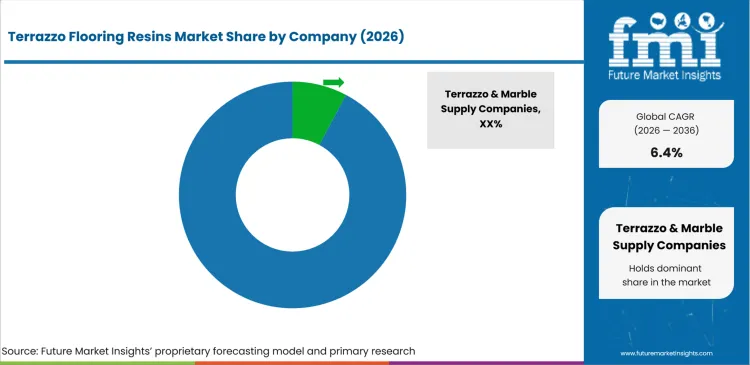
The field remains moderately fragmented as terrazzo specialists compete with global construction-chemical groups and integrated resin-flooring manufacturers. Regional entry remains possible through contractor relationships and construction adhesives distribution networks across local commercial projects. Expansion across several countries requires specification resources and dependable technical service through every approval stage. Complete system compatibility carries more weight than resin price across high-value installations with coordinated warranties. Companies differentiate through terrazzo materials and regional distribution or direct responsibility for installed flooring performance throughout projects.
- Terrazzo specialists compete through dedicated binders and aggregates alongside project-specific color development and mockup support. Terrazzo & Marble Supply Companies combines resin supply with aggregate and precast capability for specialist contractors across North America through coordinated technical advice during project specifications.
- Global construction-chemical groups compete through regional coverage and broader technical portfolios across several flooring categories. Sika and MAPEI maintain active epoxy terrazzo systems with documentation through local field teams and established technical channels for major regional commercial construction programs worldwide.
- Integrated resin-flooring manufacturers compete through exact-market systems and structured technical support across demanding interiors today. Flowcrete, Sherwin-Williams, and Crown Polymers support decorative terrazzo specifications across North America and several international commercial building markets through contractor-focused technical service and field guidance.
Competitive Benchmarking: Terrazzo Flooring Resins Market
| Company | Terrazzo System Breadth | Specification Support | Installer and Channel Support | Geographic Reach |
|---|---|---|---|---|
| Terrazzo & Marble Supply Companies | High | High | High | North America |
| Sika | High | High | High | Global |
| MAPEI | Medium | Medium | High | Global |
| Key Resin Company | High | High | Medium | North America |
| Flowcrete | Medium | Medium | Medium | Multi-region |
| Concord Terrazzo Company | High | High | Medium | North America |
| Crown Polymers | Medium | Medium | Medium | North America |
| Sherwin-Williams | Medium | Medium | High | Global |
Key Developments in the Terrazzo Flooring Resins Market
- In April 2025, Terrazzo & Marble Supply Companies completed the acquisition of Precast Terrazzo Enterprises during regional expansion. The transaction added custom precast manufacturing beside established resin and aggregate supply for architectural projects. Architects can coordinate poured flooring with stairs or fabricated elements through one source, although field-applied systems continue to require qualified specialist installation and detailed onsite slab condition review.
- In May 2025, Sika Hong Kong presented terrazzo flooring at HOFEX 2025 for hotel lobbies and public areas. The event placed the system beside commercial flooring solutions for hospitality environments with demanding durability requirements. Direct engagement expands early specification access, although qualified installation and local substrate review remain necessary across complex public interiors during planning for regionally distributed hospitality projects.
- In July 2025, MAPEI documented polished epoxy terrazzo flooring at Le Monde headquarters in Paris. The project used a complete epoxy system across lobby and restaurant floors requiring durability and visual continuity. The installation confirms resin terrazzo can serve demanding office interiors, but substrate preparation and specialist installation remain central to maintaining the specified surface across large connected public areas.
- In June 2026, Concord Terrazzo Company published an updated commercial guide for epoxy terrazzo flooring. The guide distinguishes thin-set resin systems from cement terrazzo through thickness and application conditions for commercial projects. Detailed comparisons support early system selection, but contractor mockups and project-specific substrate evaluation remain necessary before approval across renovation and new-build interiors with constrained floor elevations and transitions.
Terrazzo Flooring Resins Market - Report Scope
| Coverage field | Report scope |
|---|---|
| Market breakdown | Resin type, system, aggregate compatibility, end use, sales channel, and region. |
| Quantitative Units | Revenue in USD million and CAGR in %. |
| Market Definition | Resin binders and complete resin-based systems used to create poured or precast terrazzo flooring surfaces with decorative aggregates. |
| Regions Covered | North America, Latin America, Western Europe, Eastern Europe, East Asia, South Asia and Pacific, and Middle East and Africa. |
| Countries Covered | United States, Germany, Japan, Italy, UAE, and 20+ countries in full report |
| Key Companies Profiled | Terrazzo & Marble Supply Companies, Sika, MAPEI, Key Resin Company, Flowcrete, Concord Terrazzo Company, Crown Polymers, and Sherwin-Williams. |
| Forecast Period | 2026 to 2036. |
| Approach | Hybrid bottom-up and top-down market sizing supported by primary interviews and official desk research. |
Terrazzo Flooring Resins Market - Research Methodology
| Method | Approach |
|---|---|
| Primary Research | FMI analysts gathered input from manufacturers, service providers, technology developers, distributors, end users, procurement teams, and subject-matter experts. Interviews examined purchasing decisions, product or service evaluation, adoption barriers, approval requirements, pricing considerations, and expectations for technical or commercial support. Respondents were also asked what evidence is required before a trial, pilot, or initial order develops into regular purchasing. |
| Desk Research | Desk research covered government statistics, regulatory publications, trade data, industry associations, technical literature, standards, company filings, product information, and official corporate announcements. Sources were reviewed for relevance, publication date, geographic coverage, and consistency with the defined market scope. Claims relating to performance, applications, approvals, capacity, investment, and commercial activity were retained only when supported by credible public evidence. |
| Market Sizing and Forecasting | The market model combined the baseline value with historical performance, segment structure, pricing and volume indicators, adoption levels, company participation, and country-level demand conditions. Forecast assumptions considered economic activity, investment trends, regulatory developments, technology adoption, purchasing cycles, supply availability, and barriers to wider market use. Segment and regional estimates were reconciled before the final market total was calculated. |
| Data Validation | Estimates were checked against multiple independent indicators, including public data, company activity, trade patterns, industry developments, and findings from primary interviews. Validation also tested whether products, services, applications, and company revenues fell within the defined market boundaries. Adjacent categories, unsupported claims, overlapping revenues, and activities without direct market relevance were excluded to reduce double counting and maintain consistency across segments and countries. |
Terrazzo Flooring Resins Market by Segments
Terrazzo Flooring Resins Market segmented by Resin Type:
- Epoxy Terrazzo Resins
- Polyurethane Terrazzo Resins
- MMA Terrazzo Resins
- Polyester Terrazzo Resins
Terrazzo Flooring Resins Market segmented by System:
- Thin-set Terrazzo
- Poured-in-place Terrazzo
- Precast Terrazzo Tile
- Conductive - Specialty Terrazzo
Terrazzo Flooring Resins Market segmented by Aggregate Compatibility:
- Marble Chips
- Glass Chips
- Quartz - Granite Chips
- Recycled Aggregates
Terrazzo Flooring Resins Market segmented by End Use:
- Commercial Buildings
- Education - Healthcare
- Transport Hubs
- Retail - Hospitality
- Residential Premium
Terrazzo Flooring Resins Market segmented by Sales Channel:
- Flooring Contractors
- Direct Resin Supply
- Terrazzo System Suppliers
Terrazzo Flooring Resins Market by Region:
- North America
- United States
- Canada
- Latin America
- Brazil
- Mexico
- Argentina
- Chile
- Western Europe
- Germany
- France
- United Kingdom
- Italy
- Spain
- Benelux
- Nordics
- Eastern Europe
- Poland
- Czech Republic
- Romania
- Hungary
- East Asia
- China
- Japan
- South Korea
- South Asia and Pacific
- India
- ASEAN
- Australia and New Zealand
- Middle East and Africa
- GCC Countries
- South Africa
- Türkiye
- Israel
Research Sources and Bibliography
- National Terrazzo & Mosaic Association. (2025, May 21). Intuit Dome.
- National Terrazzo & Mosaic Association. (2025, May 21). Gerald R. Ford International Airport.
- National Terrazzo & Mosaic Association. (2025, May 21). Orlando International Airport - 2025 NTMA Job of the Year.
- National Terrazzo & Mosaic Association. (2026, May 15). Hunter’s Point.
- National Terrazzo & Mosaic Association. (2025, May 21). Winthrop Center.
- MAPEI. (2025, July 25). Iconic office projects featuring Mapei solutions.
- National Terrazzo & Mosaic Association. (n.d.). Crack Detailing & Joint Treatments for Epoxy Terrazzo.
- National Terrazzo & Mosaic Association. (n.d.). National Terrazzo & Mosaic Association: What’s in it for You?
- Ministero dell’Ambiente e della Sicurezza Energetica. (2025, December 3). Decreto 24 novembre 2025: Adozione dei criteri ambientali minimi per l’affidamento di servizi di progettazione e affidamento di lavori per interventi edilizi.
- German Sustainable Building Council. (n.d.). Label Indoor Air Comfort.
- Perfect Wash Co., Ltd. (n.d.). [Epoxy resin terrazzo PCP-YYF method].
- Terrazzo & Marble Supply Companies. (2025, April 3). T&M Expands Market Leadership with Acquisition of Premier Precast Terrazzo Manufacturer.
- Sika Hong Kong. (2025, May 14). Sika Hong Kong Highlights Superior Flooring Solutions at HOFEX 2025.
- Concord Terrazzo Company. (2026, June 2). Epoxy Terrazzo: A Proven Commercial Flooring Solution.
- Flowcrete UK Ltd. (n.d.). Terrazzo Flooring, Commercial Flooring & Epoxy Resin | Mondéco | Flowcrete UK Ltd.
This bibliography is provided for reader reference and is not exhaustive. The full report contains the complete reference list and detailed citations.
This Report Answers
- What is the global Terrazzo Flooring Resins market size in 2026?
- What market value is projected for the Terrazzo Flooring Resins market by 2036?
- What CAGR is expected for the market during 2026-2036?
- Which resin type segment holds the significant share of the Terrazzo Flooring Resins market in 2026?
- Which terrazzo system segment accounts for the notable market share in 2026?
- Which aggregate type segment dominates the market in 2026?
- Which leading companies are competing in the global Terrazzo Flooring Resins market?
- Which country-level market forecasts and growth trends are compared in the report?
Frequently Asked Questions
How big is the Terrazzo Flooring Resins Market in 2026?
The terrazzo flooring resins market is valued at USD 920.7 million in 2026 and is forecast to reach USD 1712.1 million by 2036. Growth is supported by commercial developers selecting durable resin floors that preserve coordinated color and visual identity across high-traffic public interiors and multistory projects.
What is the CAGR of the Terrazzo Flooring Resins Market from 2026 to 2036?
The terrazzo flooring resins market grows at a CAGR of 6.4% between 2026 and 2036, supported by design-intensive public interiors that require durable floors preserving navigation and architectural identity under concentrated traffic across airports, hospitals, and large connected commercial buildings.
Which resin type leads the Terrazzo Flooring Resins Market?
Epoxy terrazzo resins lead the terrazzo flooring resins market with a 58.0% resin type share in 2026, supported by controlled color delivery and thin application that accommodate intricate patterns without cement hydration limits across large connected commercial interiors.
How much will the Terrazzo Flooring Resins Market add between 2026 and 2036?
The terrazzo flooring resins market is set to add USD 791.4 million between 2026 and 2036, growing from USD 920.7 million to USD 1,712.1 million as durable, design-intensive flooring specifications expand across commercial, institutional, and public transport interiors worldwide.
Who are the leading companies in the Terrazzo Flooring Resins Market?
Eight companies lead the terrazzo flooring resins market in 2026, including Terrazzo & Marble Supply Companies, Sika, MAPEI, Key Resin Company, Flowcrete, Concord Terrazzo Company, Crown Polymers, and Sherwin-Williams, competing through specification support, installer networks, and complete resin-flooring system portfolios.
Preview the report firsthand - request a free sample
Get SampleGet the brochure for pricing and purchase details.
Get PDFTable of Content
- Key Takeaways
- Market Size and CAGR
- Top Growth Driver
- Fastest Growing Segment
- Leading Region
- Key Companies
- Emerging Opportunities
- Executive Summary
- Global Market Outlook
- Demand-side Trends
- Supply-side Trends
- Technology Roadmap Analysis
- Analysis and Recommendations
- Analyst Perspective (What is happening? Why now? What should investors know?)
- Key Questions Answered
- How large is the market?
- What is the CAGR?
- What are key trends?
- Which region dominates?
- Who are the leaders?
- Market Overview
- Market Coverage / Taxonomy
- Market Definition / Scope / Limitations
- Research Methodology
- Chapter Orientation
- Analytical Lens and Working Hypotheses
- Market Structure, Signals, and Trend Drivers
- Benchmarking and Cross-market Comparability
- Market Sizing, Forecasting, and Opportunity Mapping
- Research Design and Evidence Framework
- Desk Research Programme (Secondary Evidence)
- Expert Input and Fieldwork (Primary Evidence)
- Tooling, Models, and Reference Databases
- Data Engineering and Model Build
- Quality Assurance and Audit Trail
- Market Background
- Market Dynamics (Drivers, Restraints, Opportunity, Trends)
- Scenario Forecast (Optimistic, Likely, Conservative)
- Impact Analysis
- AI Impact
- Sustainability Impact
- Regulatory Impact
- Technology Impact
- Consumer / Buyer Analysis
- Purchase Drivers
- Adoption Barriers
- Buyer Journey
- Opportunity Map Analysis
- Product Life Cycle Analysis
- Supply Chain Analysis
- Investment Feasibility Matrix
- Value Chain Analysis
- PESTLE and Porter's Analysis
- Regulatory Landscape
- Regional Parent Market Outlook
- Production and Consumption Statistics
- Import and Export Statistics
- Global Market Analysis and Forecast, 2021 to 2036
- Historical Market Size Value (USD Million) Analysis, 2021 to 2025
- Current and Future Market Size Value (USD Million) Projections, 2026 to 2036
- Y-o-Y Growth Trend Analysis
- Absolute $ Opportunity Analysis
- Global Market Pricing Analysis, 2021 to 2036
- Global Market Analysis and Forecast, By Resin Type, 2021 to 2036
- Introduction / Key Findings
- Historical Market Size Value (USD Million) Analysis By Resin Type, 2021 to 2025
- Current and Future Market Size Value (USD Million) Analysis and Forecast By Resin Type, 2026 to 2036
- Epoxy Terrazzo Resins
- Polyurethane Terrazzo Resins
- MMA Terrazzo Resins
- Polyester Terrazzo Resins
- Epoxy Terrazzo Resins
- Y-o-Y Growth Trend Analysis By Resin Type, 2021 to 2025
- Absolute $ Opportunity Analysis By Resin Type, 2026 to 2036
- Global Market Analysis and Forecast, By System, 2021 to 2036
- Introduction / Key Findings
- Historical Market Size Value (USD Million) Analysis By System, 2021 to 2025
- Current and Future Market Size Value (USD Million) Analysis and Forecast By System, 2026 to 2036
- Thin-set Terrazzo
- Poured-in-place Terrazzo
- Precast Terrazzo Tile
- Conductive / Specialty Terrazzo
- Thin-set Terrazzo
- Y-o-Y Growth Trend Analysis By System, 2021 to 2025
- Absolute $ Opportunity Analysis By System, 2026 to 2036
- Global Market Analysis and Forecast, By Aggregate Compatibility, 2021 to 2036
- Introduction / Key Findings
- Historical Market Size Value (USD Million) Analysis By Aggregate Compatibility, 2021 to 2025
- Current and Future Market Size Value (USD Million) Analysis and Forecast By Aggregate Compatibility, 2026 to 2036
- Marble Chips
- Glass Chips
- Quartz / Granite Chips
- Recycled Aggregates
- Marble Chips
- Y-o-Y Growth Trend Analysis By Aggregate Compatibility, 2021 to 2025
- Absolute $ Opportunity Analysis By Aggregate Compatibility, 2026 to 2036
- Global Market Analysis and Forecast, By End Use, 2021 to 2036
- Introduction / Key Findings
- Historical Market Size Value (USD Million) Analysis By End Use, 2021 to 2025
- Current and Future Market Size Value (USD Million) Analysis and Forecast By End Use, 2026 to 2036
- Commercial Buildings
- Education / Healthcare
- Transport Hubs
- Retail / Hospitality
- Residential Premium
- Commercial Buildings
- Y-o-Y Growth Trend Analysis By End Use, 2021 to 2025
- Absolute $ Opportunity Analysis By End Use, 2026 to 2036
- Global Market Analysis and Forecast, By Sales Channel, 2021 to 2036
- Introduction / Key Findings
- Historical Market Size Value (USD Million) Analysis By Sales Channel, 2021 to 2025
- Current and Future Market Size Value (USD Million) Analysis and Forecast By Sales Channel, 2026 to 2036
- Flooring Contractors
- Direct Resin Supply
- Terrazzo System Suppliers
- Flooring Contractors
- Y-o-Y Growth Trend Analysis By Sales Channel, 2021 to 2025
- Absolute $ Opportunity Analysis By Sales Channel, 2026 to 2036
- Global Market Analysis and Forecast, By Region, 2021 to 2036
- Introduction
- Historical Market Size Value (USD Million) Analysis By Region, 2021 to 2025
- Current Market Size Value (USD Million) Analysis and Forecast By Region, 2026 to 2036
- North America
- Latin America
- Western Europe
- Eastern Europe
- East Asia
- South Asia and Pacific
- Middle East & Africa
- Market Attractiveness Analysis By Region
- North America Market Analysis and Forecast, By Country, 2021 to 2036
- Historical Market Size Value (USD Million) Trend Analysis By Market Taxonomy, 2021 to 2025
- Market Size Value (USD Million) Forecast By Market Taxonomy, 2026 to 2036
- By Country
- USA
- Canada
- By Resin Type
- By System
- By Aggregate Compatibility
- By End Use
- By Sales Channel
- By Country
- Market Attractiveness Analysis
- By Country
- By Resin Type
- By System
- By Aggregate Compatibility
- By End Use
- By Sales Channel
- Key Takeaways
- Latin America Market Analysis and Forecast, By Country
- Historical Market Size Value (USD Million) Trend Analysis By Market Taxonomy, 2021 to 2025
- Market Size Value (USD Million) Forecast By Market Taxonomy, 2026 to 2036
- By Country
- Brazil
- Mexico
- Chile
- Rest of Latin America
- By Resin Type
- By System
- By Aggregate Compatibility
- By End Use
- By Sales Channel
- By Country
- Market Attractiveness Analysis
- By Country
- By Resin Type
- By System
- By Aggregate Compatibility
- By End Use
- By Sales Channel
- Key Takeaways
- Western Europe Market Analysis and Forecast, By Country
- Historical Market Size Value (USD Million) Trend Analysis By Market Taxonomy, 2021 to 2025
- Market Size Value (USD Million) Forecast By Market Taxonomy, 2026 to 2036
- By Country
- Germany
- UK
- Italy
- Spain
- France
- Nordic
- BENELUX
- Rest of Western Europe
- By Resin Type
- By System
- By Aggregate Compatibility
- By End Use
- By Sales Channel
- By Country
- Market Attractiveness Analysis
- By Country
- By Resin Type
- By System
- By Aggregate Compatibility
- By End Use
- By Sales Channel
- Key Takeaways
- Eastern Europe Market Analysis and Forecast, By Country
- Historical Market Size Value (USD Million) Trend Analysis By Market Taxonomy, 2021 to 2025
- Market Size Value (USD Million) Forecast By Market Taxonomy, 2026 to 2036
- By Country
- Russia
- Poland
- Hungary
- Balkan & Baltic
- Rest of Eastern Europe
- By Resin Type
- By System
- By Aggregate Compatibility
- By End Use
- By Sales Channel
- By Country
- Market Attractiveness Analysis
- By Country
- By Resin Type
- By System
- By Aggregate Compatibility
- By End Use
- By Sales Channel
- Key Takeaways
- East Asia Market Analysis and Forecast, By Country
- Historical Market Size Value (USD Million) Trend Analysis By Market Taxonomy, 2021 to 2025
- Market Size Value (USD Million) Forecast By Market Taxonomy, 2026 to 2036
- By Country
- China
- Japan
- South Korea
- By Resin Type
- By System
- By Aggregate Compatibility
- By End Use
- By Sales Channel
- By Country
- Market Attractiveness Analysis
- By Country
- By Resin Type
- By System
- By Aggregate Compatibility
- By End Use
- By Sales Channel
- Key Takeaways
- South Asia and Pacific Market Analysis and Forecast, By Country
- Historical Market Size Value (USD Million) Trend Analysis By Market Taxonomy, 2021 to 2025
- Market Size Value (USD Million) Forecast By Market Taxonomy, 2026 to 2036
- By Country
- India
- ASEAN
- Australia & New Zealand
- Rest of South Asia and Pacific
- By Resin Type
- By System
- By Aggregate Compatibility
- By End Use
- By Sales Channel
- By Country
- Market Attractiveness Analysis
- By Country
- By Resin Type
- By System
- By Aggregate Compatibility
- By End Use
- By Sales Channel
- Key Takeaways
- Middle East & Africa Market Analysis and Forecast, By Country
- Historical Market Size Value (USD Million) Trend Analysis By Market Taxonomy, 2021 to 2025
- Market Size Value (USD Million) Forecast By Market Taxonomy, 2026 to 2036
- By Country
- Kingdom of Saudi Arabia
- Other GCC Countries
- Türkiye
- South Africa
- Other African Union
- Rest of Middle East & Africa
- By Resin Type
- By System
- By Aggregate Compatibility
- By End Use
- By Sales Channel
- By Country
- Market Attractiveness Analysis
- By Country
- By Resin Type
- By System
- By Aggregate Compatibility
- By End Use
- By Sales Channel
- Key Takeaways
- Key Countries Market Analysis
- USA
- Pricing Analysis
- Market Share Analysis, 2025
- By Resin Type
- By System
- By Aggregate Compatibility
- By End Use
- By Sales Channel
- Canada
- Pricing Analysis
- Market Share Analysis, 2025
- By Resin Type
- By System
- By Aggregate Compatibility
- By End Use
- By Sales Channel
- Mexico
- Pricing Analysis
- Market Share Analysis, 2025
- By Resin Type
- By System
- By Aggregate Compatibility
- By End Use
- By Sales Channel
- Brazil
- Pricing Analysis
- Market Share Analysis, 2025
- By Resin Type
- By System
- By Aggregate Compatibility
- By End Use
- By Sales Channel
- Chile
- Pricing Analysis
- Market Share Analysis, 2025
- By Resin Type
- By System
- By Aggregate Compatibility
- By End Use
- By Sales Channel
- Germany
- Pricing Analysis
- Market Share Analysis, 2025
- By Resin Type
- By System
- By Aggregate Compatibility
- By End Use
- By Sales Channel
- UK
- Pricing Analysis
- Market Share Analysis, 2025
- By Resin Type
- By System
- By Aggregate Compatibility
- By End Use
- By Sales Channel
- Italy
- Pricing Analysis
- Market Share Analysis, 2025
- By Resin Type
- By System
- By Aggregate Compatibility
- By End Use
- By Sales Channel
- Spain
- Pricing Analysis
- Market Share Analysis, 2025
- By Resin Type
- By System
- By Aggregate Compatibility
- By End Use
- By Sales Channel
- France
- Pricing Analysis
- Market Share Analysis, 2025
- By Resin Type
- By System
- By Aggregate Compatibility
- By End Use
- By Sales Channel
- India
- Pricing Analysis
- Market Share Analysis, 2025
- By Resin Type
- By System
- By Aggregate Compatibility
- By End Use
- By Sales Channel
- ASEAN
- Pricing Analysis
- Market Share Analysis, 2025
- By Resin Type
- By System
- By Aggregate Compatibility
- By End Use
- By Sales Channel
- Australia & New Zealand
- Pricing Analysis
- Market Share Analysis, 2025
- By Resin Type
- By System
- By Aggregate Compatibility
- By End Use
- By Sales Channel
- China
- Pricing Analysis
- Market Share Analysis, 2025
- By Resin Type
- By System
- By Aggregate Compatibility
- By End Use
- By Sales Channel
- Japan
- Pricing Analysis
- Market Share Analysis, 2025
- By Resin Type
- By System
- By Aggregate Compatibility
- By End Use
- By Sales Channel
- South Korea
- Pricing Analysis
- Market Share Analysis, 2025
- By Resin Type
- By System
- By Aggregate Compatibility
- By End Use
- By Sales Channel
- Russia
- Pricing Analysis
- Market Share Analysis, 2025
- By Resin Type
- By System
- By Aggregate Compatibility
- By End Use
- By Sales Channel
- Poland
- Pricing Analysis
- Market Share Analysis, 2025
- By Resin Type
- By System
- By Aggregate Compatibility
- By End Use
- By Sales Channel
- Hungary
- Pricing Analysis
- Market Share Analysis, 2025
- By Resin Type
- By System
- By Aggregate Compatibility
- By End Use
- By Sales Channel
- Kingdom of Saudi Arabia
- Pricing Analysis
- Market Share Analysis, 2025
- By Resin Type
- By System
- By Aggregate Compatibility
- By End Use
- By Sales Channel
- Türkiye
- Pricing Analysis
- Market Share Analysis, 2025
- By Resin Type
- By System
- By Aggregate Compatibility
- By End Use
- By Sales Channel
- South Africa
- Pricing Analysis
- Market Share Analysis, 2025
- By Resin Type
- By System
- By Aggregate Compatibility
- By End Use
- By Sales Channel
- USA
- Market Structure Analysis
- Competition Dashboard
- Competition Benchmarking
- Market Share Analysis of Top Players
- By Regional
- By Resin Type
- By System
- By Aggregate Compatibility
- By End Use
- By Sales Channel
- Emerging Startups
- Innovation Benchmarking
- Competition Analysis
- Competition Deep Dive
- Terrazzo & Marble Supply Companies
- Overview
- Product Portfolio
- Profitability by Market Segments
- Sales Footprint
- Strategy Overview
- Marketing Strategy
- Product Strategy
- Channel Strategy
- Sika
- Master Builders Solutions
- MAPEI
- Key Resin
- Tennant Coatings
- Stonhard
- Sherwin-Williams
- Flowcrete
- RPM International
- Terrazzo & Marble Supply Companies
- Case Studies
- Success Stories
- Recent Developments
- Competition Deep Dive
- Assumptions & Acronyms Used


