

- Market Size (2026)
- USD 745.4 Mn
- Forecast (2036)
- USD 1215.3 Mn
- CAGR (2026 to 2036)
- 5.0%
How big is Thickener Aids Market in 2026?
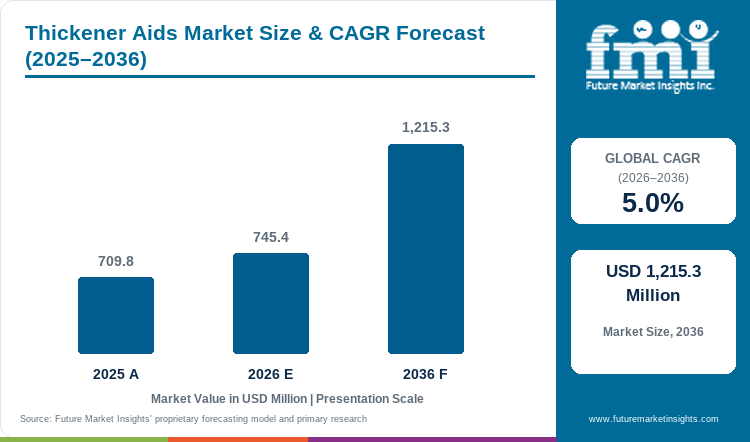
USD 745.4 million in 2026 and USD 1,215.3 million by 2036 at a 5.0% CAGR.
Sales of thickener aids are expected to grow at 5.0% CAGR through 2036. The value rises from USD 709.8 million in 2025 to USD 745.4 million in 2026. It is expected to reach USD 1,215.3 million by 2036. Mineral and sludge circuits use these aids to help solids settle and return more water to the process. A 2025 study tested clay-rich tailings under alkaline conditions. It found 46% lower water cloudiness (turbidity) after coagulant and flocculant treatment in sequence. Clearer water can also reduce the amount of solids that later steps must handle when dosing stays stable. Plants still need to match the dose to the feed because solids loads can change during normal operation.
South Africa is expected to grow faster than Japan because tailings rules keep solids control tied to mine safety and operating risk. In its 2025 technical investigation, the South African Department of Water and Sanitation reviewed the Jagersfontein failure. It reported that the 2022 failure released about 5.9 million cubic meters of fine tailings. In Japan, demand is tied more to controlled sludge handling and established treatment routines. These different needs affect how long site tests take more than which products can be used. Both countries still need stable treatment results before plants make routine changes to dosing programs.
Key Takeaways
- Plants use thickener aids to settle solids and recover more water. These daily needs support demand in mines and treatment plants.
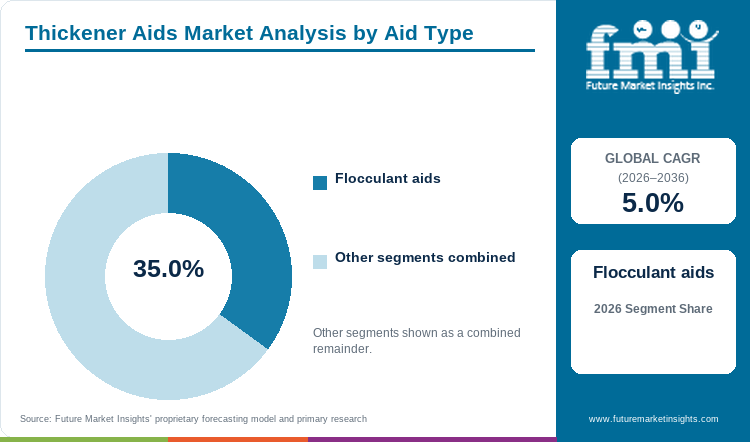
- Flocculant aids are projected to make up 35.0% of aid type demand in 2026. They help fine particles join so the solids settle more easily.
- Mineral thickening is estimated to make up 32.0% of application demand in 2026. It helps plants return water and handle the thick underflow.
- Mining is set to account for 44.0% of end use demand in 2026. Mines use these aids each day because concentrators and tailings circuits handle large solids loads.
- Feed changes are the main restraint. Ore makeup (mineralogy) and water chemistry can change the polymer dose a plant needs. Plants may need more site tests when the feed changes.
- Key companies include Kemira, SNF, Solenis, Ecolab / Nalco Water, Clariant, Ashland, Veolia Water Technologies & Solutions, and Kurita Water Industries.
Analyst Perspective
"What keeps a thickener-aid program stable when mineralogy and process water change? Programs work more reliably when plants match the chemistry with dose control. This approach helps flocs keep their structure as solids loads and shear change."
- Nikhil Kaitwade, Principal Consultant, Future Market Insights
How is the thickener aids market segmented?
The thickener aids market is segmented by aid type, application, end use, form, sales channel, and region.
Aid type covers flocculant aids, flow behavior (rheology) modifiers, coagulant aids, settling accelerators, and paste thickener aids. Application includes mineral thickening, tailings thickening, sludge thickening, process water clarification, and paste backfill. End use covers mining, water treatment, chemical processing, pulp and paper, and food processing. Form includes liquid polymers, powder polymers, emulsions, and solution blends. Sales channel covers chemical suppliers, direct plant contracts, service providers, and distributors. Region follows the report geography.
How does polymer bridging shape flocculant-aid selection within aid type?
Flocculant aids join fine particles into larger groups so they settle more easily. Current polyacrylamide chemistry includes anionic, cationic and nonionic grades in dry and emulsion forms. Plants test the charge type against the solids in the feed. Shear and poor make-down can change how well the solids settle.
- Based on aid type, flocculant aids are expected to account for 35.0% in 2026. They help particles join and keep the overflow water clear.
- Suppliers offer flocculant and coagulant chemistry with different charge ranges and help with product preparation. One recipe rarely works the same way with every ore or sludge feed.
How does water return shape mineral-thickening selection within application?
Mineral thickening links chemical use to the water balance in a concentrator. Clear overflow returns more process water to the plant. Dense underflow also cuts the solids load sent to filters or tailings storage. Plants test Mining tailings water-soluble flocculants by checking how fast solids settle. They also check water clarity and underflow behavior.
- By application, mineral thickening is expected to hold 32.0% in 2026. It helps plants return water and handle solids in later steps.
- Solenis documents flocculants for ore processing with lab and field support. Particle size and the mineral surface can change the dose that works well.
Why does continuous solids loading sustain mining within end use?
Mining circuits handle large amounts of solids. They use treatment chemicals in concentrators and tailings systems. Coagulants can work with flocculants when very fine particles do not join easily. Water return and underflow density link chemical performance to plant output and tailings handling.
- In 2026, mining is expected to account for 44.0% of end use demand. Concentrators and tailings circuits use these aids to handle large solids loads.
- Ecolab / Nalco Water and Clariant document tailings programs that use polymers with mixing or flow behavior (rheology) control. These programs help mines manage difficult water and solids conditions.
How do preparation and metering needs support liquid polymers within form?
Liquid and emulsion polymers need less make-down work than dry powders. They can also respond fast when the meter setting changes. SNF supplies liquid emulsion and solution flocculants. Kemira supplies inverse-emulsion polyacrylamides. Advanced wastewater flocculants involve similar preparation choices. Operators balance the amount of active polymer with how easily a pump can move the product.
- Liquid polymers are expected to account for 32.0% of the form category in 2026. Quick metering and easy handling support their use in treatment lines that run all day.
- Plants still compare transport cost and storage stability when they choose a liquid format. Easier handling does not remove the need for a steady amount of active polymer.
Why does application support favor chemical suppliers within sales channel?
Chemical suppliers have an advantage when buyers need sample tests and dose selection instead of a low unit price alone. Water and wastewater treatment chemicals often need changes at the site as feed or sludge behavior changes. Supplier labs and application teams can help plants move from screening to a stable program with less trial work.
- Chemical suppliers are expected to hold 40.0% of the sales channel category in 2026. Demand for product choice and dosing support helps maintain this share.
- Direct plant contracts remain important for large users. Service firms and distributors also give plants access to sludge treatment chemicals and other separation programs.
What are the drivers, restraints and opportunities in the Thickener Aids Market?
Water recovery sustains demand, feed variability slows switching, and automated dose control opens value when process signals can be translated into stable chemical use.
- Driver: Plants need to recover water each day. This keeps solid-liquid separation chemicals in daily use at mines and treatment plants.
- Restraint: Changes in feed chemistry can change floc structure. Plants may need more site testing before they switch the polymer program.
- Opportunity: Automated monitoring can change the chemical dose as the solids load changes. Better dose control can help plants avoid using too much chemical.
Water recovery keeps separation chemistry tied to operating performance
Mine and treatment operators track water recovery as part of daily solids work. Poor overflow quality gives plants less water to reuse and adds work to later steps. Australian Government mining handbooks include tailings control and water care as core mine practices. Thickener aids keep earning repeat use when steady settling protects water return without cutting plant output.
Feed variability makes chemistry changes expensive to qualify
Feed variability makes a chemistry change harder to approve because clay and dissolved ions can change charge demand. The 2025 clayey-tailings study found that dosage changed the structure of the particle groups under controlled conditions. Process teams test each polymer and dose range before they change a program that already protects plant output. This testing lowers the risk of a poor result after the switch.
Automated dose control can respond faster than manual adjustment
Automated feed control can reduce over-dosing or under-dosing when the solids load changes during a shift. Solenis documents Alcotech TC as a system that checks settling and clarity before it changes the flocculant dose. Plants gain more value when they connect monitoring data to a tested operating range. A stand-alone automation purchase does not replace the need for a proven dose window.
Which country CAGRs are profiled in the Thickener Aids Market?
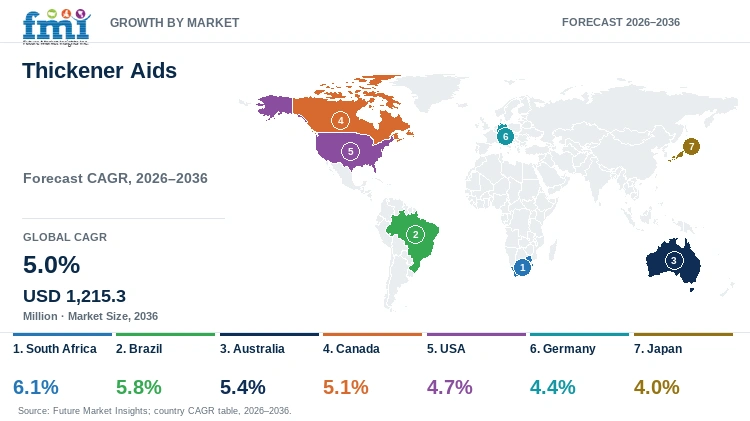
| Country | CAGR |
|---|---|
| South Africa | 6.1% |
| Brazil | 5.8% |
| Australia | 5.4% |
| Canada | 5.1% |
| USA | 4.7% |
| Germany | 4.4% |
| Japan | 4.0% |
How do country-level CAGRs compare in the Thickener Aids Market?
Country CAGRs show how fast demand may grow. They do not show the current size of each country market. South Africa and Brazil have large mine sectors and active rules for tailings. Australia links chemical use to mine-water control. Canada and the USA follow enforceable wastewater rules. Germany and Japan rely more on set sludge-treatment steps and site tests.
- South Africa links tailings chemicals to mine rules and water protection.
- Brazil has many dams under oversight and active ore-processing plants.
- Australia links chemical dosing to water use at remote mines.
- Canada links treatment programs to national rules for mine wastewater.
- The USA uses NPDES permits to control wastewater from ore processing.
- Germany is getting sludge plants ready for phosphorus-recovery rules.
- Japan focuses on steady sludge treatment and careful changes at each site.
These conditions affect service needs and test time more than product choice. The full report gives country CAGRs for North America and Latin America. It also covers Europe and East Asia. South Asia, Oceania and the Middle East and Africa are included as well.
Country-wise Analysis
- South African mines face strict checks on tailings safety and water protection after the Jagersfontein failure. South Africa is expected to post 6.1% CAGR over the forecast period because tailings rules affect daily mine choices. In November 2025, the Department of Water and Sanitation said the 2022 failure released about 5.9 million cubic meters of fine tailings. Thickener aids can help plants control solids and return water before tailings are stored. Small sites may delay changes when funds are tight. Local engineers help a plant prove that its dose stays steady before routine use. They can also help operators adjust the treatment when the feed or water changes.
- Brazilian ore plants work within a large system of tailings dams under national rules. Demand for thickener aids in Brazil is expected to rise at 5.8% CAGR over the forecast period. Rules for tailings from ore processing support this growth. In March 2026, the National Mining Agency reported more than 910 mining dams in Brazil. About 470 were covered by the national dam-safety policy. Local tests help plants set flocculant programs for different ore and water. Long service distances raise the cost of fixing dose problems. Regional teams can help a proven formula reach steady use with fewer delays. Plants still need local help when feed conditions change.
- Australian mines can be far from service teams and can face changes in water supply. Tailings control remains part of daily site work. Australia is expected to post 5.4% CAGR over the forecast period because national guidance supports tailings control and water care. Australian Government mining handbooks treat both topics as core mine practices. Thickener aids can help keep overflow clear and underflow dense when plant output changes. Remote sites face higher stock and field-service costs. Local stock and clear dosing steps help plants manage seasonal water changes without slowing production. These steps also reduce the risk of waiting for urgent chemicals or technical help.
- Canadian metal mines recover process water and must meet national wastewater limits. Canada is expected to post 5.1% CAGR over the forecast period. Discharge rules and active ore processing support this outlook. Environment and Climate Change Canada requires metal and diamond mines to meet effluent limits. Mines must also monitor and report their discharges. Industrial wastewater treatment chemicals can help remove solids before discharge or water reuse. Cold weather and long travel distances raise the cost of urgent changes. Plants value steady supply, proven dose changes and remote technical help. These services help operators respond when feed or water changes at sites far from service centers.
- U.S. ore mines and plants manage wastewater under federal rules through NPDES permits. Demand for thickener aids in the USA is expected to rise at 4.7% CAGR over the forecast period. Ongoing solids-control needs in ore processing support this outlook. The U.S. Environmental Protection Agency applies the Ore Mining and Dressing Effluent Guidelines to twelve subcategories. Industrial water treatment programs need chemicals that meet plant goals without harming permitted discharge. Different ore blends can still make site tests slow. Lab support and secure supply can help when feed conditions change. They can also help plants return more water to the process while keeping discharge under control.
- German wastewater plants are getting sludge routes ready for a rule change that starts in 2029. Germany’s thickener aids outlook is expected to advance at 4.4% CAGR over the assessment period. Rules on phosphorus recovery for qualifying sewage sludge shape this outlook. The German Environment Agency describes these duties under the amended Sewage Sludge Ordinance. Sludge treatment chemicals affect water removal and the liquid left after treatment. Plants must test each formula with current equipment and sludge conditions. A program helps operations when it improves solids handling without making the set process harder to run. Clear test results help operators choose a dose that works with the planned recovery route.
- Japanese treatment plants focus on steady operations and careful changes to current sludge processes. Thickener aid use in Japan is expected to grow at 4.0% CAGR through 2036. The amount of sewage sludge handled in the country supports this outlook. Japan’s Ministry of the Environment reported about 76.82 million metric tons of concentrated sewage sludge in fiscal 2024. It also reported a 76% beneficial-use rate on a dry basis. Water treatment chemistry must fit current handling steps and records. Careful change control can extend site tests. Programs that settle solids in a steady way and do not add preparation work are easier to use for planned replacement or process improvement.
Who are the notable companies in the Thickener Aids Market?
Kemira, SNF, Solenis, Ecolab / Nalco Water, Clariant, Ashland, Veolia Water Technologies & Solutions, and Kurita Water Industries
Suppliers compete on two things: the chemicals they sell and the help they give at a plant. Some firms sell a wide range of polymers. Mine-focused firms help with tailings flow behavior (rheology) and site tests. Water-treatment firms help with sludge and clear water. Buyers compare these skills before they choose a supplier for regular plant use.
- Broad polymer platforms: Kemira, SNF and Solenis serve this group. These firms document several types of flocculant aids for water or ore-processing use.
- Mine and tailings application platforms: Ecolab / Nalco Water, Clariant and Ashland serve this group. Their public material covers polymers used in tailings and ore processing.
- Industrial water-treatment platforms: Veolia Water Technologies & Solutions and Kurita Water Industries serve this group. They document programs that help particles clump and help water clear.
Competitive Benchmarking: Thickener Aids Market
| Company | Solid-Liquid Separation Chemistry | Form and Feed Compatibility | Plant Application Support | Geographic Reach |
|---|---|---|---|---|
| Kemira | High | Medium | High | Global mining and water-treatment network |
| SNF | High | High | High | Global mining regions with regional technical centers |
| Solenis | High | High | High | Global mineral-processing and water-intensive industries |
| Ecolab / Nalco Water | Medium | Low | High | Mining programs documented in the USA and Australia |
| Clariant | Medium | Low | High | Brazil technical center with wider mining support |
| Ashland | Low | Low | Low | Multi-region specialty-materials platform |
| Veolia Water Technologies & Solutions | Medium | Medium | High | Global industrial and mining water-treatment network |
| Kurita Water Industries | Medium | Medium | High | Global industrial water-treatment network |
Scoring basis: High means a company shows several flocculant or coagulant families for the uses in this report. Medium means the shown range is smaller. Low means the role is narrow. Form and feed fit checks dry and liquid products. It also checks emulsion or water-based forms. Plant support covers lab work, site tests, monitoring and onsite service.
Key Developments in the Thickener Aids Market
- In July 2026, Clariant reported higher Mining Solutions sales because price and sales volume increased. The update confirms current sales in a business that sells products for tailings flow behavior (rheology) and water management. It also confirms that the mining business was active during the reported period.
- In March 2026, Kurita announced a company in Mexico for water-treatment chemical sales. Kurita set May as the planned start month. The move adds a local sales route for coagulation and particle clumping (flocculation) support. Local sales can also help customers reach technical teams for routine treatment needs.
- In February 2026, Kemira announced an agreement to acquire SIDRA Wasserchemie and two German coagulant plants. The planned deal would give Kemira more local supply for clarification chemistry. It would also add sites that make chemicals for water treatment and clarification.
Key Players in the Thickener Aids Market
Broad polymer platforms
- Kemira
- SNF
- Solenis
Mine and tailings application platforms
- Ecolab / Nalco Water
- Clariant
- Ashland
Industrial water-treatment platforms
- Veolia Water Technologies & Solutions
- Kurita Water Industries
Thickener Aids Market - Report Scope
| Coverage field | Report scope |
|---|---|
| Market breakdown | By aid type, application, end use, form, sales channel, and region. |
| Quantitative Units | USD million. |
| Market Definition | Revenue includes formulated thickener aids for mineral, tailings, sludge, process-water and paste systems. Equipment, standalone preparation systems and unrelated substitute chemistry are excluded. |
| Regions Covered | North America, Latin America, Western Europe, Eastern Europe, East Asia, South Asia and Pacific, and Middle East and Africa. |
| Countries Covered | South Africa, Brazil, Australia, Canada, USA, Germany, Japan and 25+ additional countries. |
| Key Companies Profiled | Kemira, SNF, Solenis, Ecolab / Nalco Water, Clariant, Ashland, Veolia Water Technologies & Solutions, and Kurita Water Industries |
| Forecast Period | 2026 to 2036. |
| Approach | Primary and secondary research with market triangulation. |
Thickener Aids Market - Research Methodology
| Method | Approach |
|---|---|
| Primary Research | FMI analysts gathered input from manufacturers, service providers, technology developers, distributors, end users, procurement teams, and subject-matter experts. Interviews examined purchasing decisions, product or service evaluation, adoption barriers, approval requirements, pricing considerations, and expectations for technical or commercial support. Respondents were also asked what evidence is required before a trial, pilot, or initial order develops into regular purchasing. |
| Desk Research | Desk research covered government statistics, regulatory publications, trade data, industry associations, technical literature, standards, company filings, product information, and official corporate announcements. Sources were reviewed for relevance, publication date, geographic coverage, and consistency with the defined market scope. Claims relating to performance, applications, approvals, capacity, investment, and commercial activity were retained only when supported by credible public evidence. |
| Market Sizing and Forecasting | The market model combined the baseline value with historical performance, segment structure, pricing and volume indicators, adoption levels, company participation, and country-level demand conditions. Forecast assumptions considered economic activity, investment trends, regulatory developments, technology adoption, purchasing cycles, supply availability, and barriers to wider market use. Segment and regional estimates were reconciled before the final market total was calculated. |
| Data Validation | Estimates were checked against multiple independent indicators, including public data, company activity, trade patterns, industry developments, and findings from primary interviews. Validation also tested whether products, services, applications, and company revenues fell within the defined market boundaries. Adjacent categories, unsupported claims, overlapping revenues, and activities without direct market relevance were excluded to reduce double counting and maintain consistency across segments and countries. |
Thickener Aids Market by Segments
Thickener Aids Market segmented by Aid Type:
- Flocculant aids
- Rheology modifiers
- Coagulant aids
- Settling accelerators
- Paste thickener aids
Thickener Aids Market segmented by Application:
- Mineral thickening
- Tailings thickening
- Sludge thickening
- Process water clarification
- Paste backfill
Thickener Aids Market segmented by End Use:
- Mining
- Water treatment
- Chemical processing
- Pulp and paper
- Food processing
Thickener Aids Market segmented by Form:
- Liquid polymers
- Powder polymers
- Emulsions
- Solution blends
Thickener Aids Market segmented by Sales Channel:
- Chemical suppliers
- Direct plant contracts
- Service providers
- Distributors
Thickener Aids Market by Region:
- North America
- United States
- Canada
- Latin America
- Brazil
- Mexico
- Argentina
- Chile
- Western Europe
- Germany
- France
- United Kingdom
- Italy
- Spain
- Benelux
- Nordics
- Eastern Europe
- Poland
- Czech Republic
- Romania
- Hungary
- East Asia
- China
- Japan
- South Korea
- South Asia and Pacific
- India
- ASEAN
- Australia and New Zealand
- Middle East and Africa
- GCC Countries
- South Africa
- Türkiye
- Israel
Research Sources and Bibliography
- Nieto, S., Piceros, E., Reyes, E., Ramos, J., Robles, P., & Jeldres, R. (2025, June 10). Structural analysis of aggregates in clayey tailings treated with coagulant and flocculant.
- U.S. Environmental Protection Agency. (n.d.). Ore mining and dressing effluent guidelines.
- German Environment Agency. (2025, October 8). Phosphorus recovery from sewage sludge can be allocated to wastewater charges.
- Ministry of the Environment, Government of Japan. (2026). White Paper on the Environment, the Sound Material-Cycle Society and Biodiversity 2026: Sewage sludge and industrial waste treatment.
- Department of Industry, Science and Resources, Australian Government. (2026). Leading practice handbooks for sustainable mining.
- Agência Nacional de Mineração. (2026, March 10). Relatório destaca melhora no cenário de segurança das barragens de mineração em 2025.
- Environment and Climate Change Canada. (n.d.). Metal and Diamond Mining Effluent Regulations: Overview.
- Department of Water and Sanitation, Republic of South Africa. (2025, November 29). Technical investigation report on the failure of Jagersfontein Tailings Dam released.
- Kemira. (n.d.). Chemical flocculants.
- SNF. (n.d.). Industrial water treatment.
- SNF Mining. (n.d.). Mining chemicals, water treatment and process solutions.
- Solenis. (n.d.). Flocculants for mineral processing.
- Solenis. (n.d.). Alcotech TC automation technology.
- Ecolab / Nalco Water. (n.d.). Tailings management.
- Veolia Water Technologies & Solutions. (n.d.). Coagulants and flocculants for water treatment.
- Clariant. (n.d.). Water management in mining.
- Ashland. (n.d.). Performance specialties application overview.
- Kurita Water Industries. (n.d.). Kuriflock.
- Clariant. (2026, July 31). Clariant delivers continued strong results in volatile operating environment.
- Kurita Water Industries. (2026, March 16). Kurita to start operation of local company for water treatment chemical sales in Mexico.
- Kemira. (2026, February 11). Kemira strengthens its Water Solutions business with the acquisition of SIDRA Wasserchemie.
- SNF Mining. (2026, March 5). SNF has established a Mining Technical Center in Brazil.
- Clariant. (2026, May 8). Clariant delivers resilient performance in challenging environment.
This bibliography is for reader reference and does not cover every source. The full report includes the complete reference list and detailed citations.
This Report Answers
- How large is the thickener aids market in 2026 and what value is projected by 2036?
- Which aid type holds the largest 2026 share and why does polymer bridging matter?
- Why does mineral thickening lead the application category in 2026?
- How does mining sustain the leading end use position for thickener aids?
- Which site conditions drive demand and which feed variables slow switching?
- Which companies compete through polymer breadth or tailings application support and industrial water treatment?
- Where can automated dose control improve reagent use and separation stability?
Frequently Asked Questions
How big is the thickener aids market in 2026?
The thickener aids market is valued at USD 745.4 million in 2026. It is expected to reach USD 1,215.3 million by 2036. Water recovery and solids handling create demand in mineral and sludge circuits. Plants use these aids to support steady settling and return more process water.
What is the CAGR of the thickener aids market from 2026 to 2036?
The thickener aids market is expected to grow at 5.0% CAGR between 2026 and 2036. Plants need stable separation while they return process water and handle tailings or sludge. Changes in feed conditions can affect how well a dose works.
Which aid type leads the thickener aids market?
Flocculant aids are expected to hold 35.0% of aid type demand in the thickener aids market in 2026. They help fine particles join into larger groups. These groups settle more easily and can improve overflow clarity.
Which country is expected to record the highest growth in the thickener aids market?
South Africa is expected to grow at 6.1% CAGR through 2036 within the profiled country set. Tailings rules and water-protection needs keep solids-control decisions tied to mine operating risk. Plants also need stable dosing before they use a program in routine operations.
Which companies are active in the thickener aids market?
Key companies include Kemira, SNF, Solenis, Ecolab / Nalco Water, Clariant, Ashland, Veolia Water Technologies & Solutions, and Kurita Water Industries. They differ in the types of chemicals they offer and the plant help they provide. Some focus more on mining while others serve wider water-treatment needs.
Preview the report firsthand - request a free sample
Get SampleGet the brochure for pricing and purchase details.
Get PDFTable of Content
- Key Takeaways
- Market Size and CAGR
- Top Growth Driver
- Fastest Growing Segment
- Leading Region
- Key Companies
- Emerging Opportunities
- Executive Summary
- Global Market Outlook
- Demand-side Trends
- Supply-side Trends
- Technology Roadmap Analysis
- Analysis and Recommendations
- Analyst Perspective (What is happening? Why now? What should investors know?)
- Key Questions Answered
- How large is the market?
- What is the CAGR?
- What are key trends?
- Which region dominates?
- Who are the leaders?
- Market Overview
- Market Coverage / Taxonomy
- Market Definition / Scope / Limitations
- Research Methodology
- Chapter Orientation
- Analytical Lens and Working Hypotheses
- Market Structure, Signals, and Trend Drivers
- Benchmarking and Cross-market Comparability
- Market Sizing, Forecasting, and Opportunity Mapping
- Research Design and Evidence Framework
- Desk Research Programme (Secondary Evidence)
- Expert Input and Fieldwork (Primary Evidence)
- Tooling, Models, and Reference Databases
- Data Engineering and Model Build
- Quality Assurance and Audit Trail
- Market Background
- Market Dynamics (Drivers, Restraints, Opportunity, Trends)
- Scenario Forecast (Optimistic, Likely, Conservative)
- Impact Analysis
- AI Impact
- Sustainability Impact
- Regulatory Impact
- Technology Impact
- Consumer / Buyer Analysis
- Purchase Drivers
- Adoption Barriers
- Buyer Journey
- Opportunity Map Analysis
- Product Life Cycle Analysis
- Supply Chain Analysis
- Investment Feasibility Matrix
- Value Chain Analysis
- PESTLE and Porter's Analysis
- Regulatory Landscape
- Regional Parent Market Outlook
- Production and Consumption Statistics
- Import and Export Statistics
- Global Market Analysis and Forecast, 2021 to 2036
- Historical Market Size Value (USD Million) Analysis, 2021 to 2025
- Current and Future Market Size Value (USD Million) Projections, 2026 to 2036
- Y-o-Y Growth Trend Analysis
- Absolute $ Opportunity Analysis
- Global Market Pricing Analysis, 2021 to 2036
- Global Market Analysis and Forecast, By Aid Type, 2021 to 2036
- Introduction / Key Findings
- Historical Market Size Value (USD Million) Analysis By Aid Type, 2021 to 2025
- Current and Future Market Size Value (USD Million) Analysis and Forecast By Aid Type, 2026 to 2036
- Flocculant aids
- Rheology modifiers
- Coagulant aids
- Settling accelerators
- Paste thickener aids
- Y-o-Y Growth Trend Analysis By Aid Type, 2021 to 2025
- Absolute $ Opportunity Analysis By Aid Type, 2026 to 2036
- Global Market Analysis and Forecast, By Application, 2021 to 2036
- Introduction / Key Findings
- Historical Market Size Value (USD Million) Analysis By Application, 2021 to 2025
- Current and Future Market Size Value (USD Million) Analysis and Forecast By Application, 2026 to 2036
- Mineral thickening
- Tailings thickening
- Sludge thickening
- Process water clarification
- Paste backfill
- Y-o-Y Growth Trend Analysis By Application, 2021 to 2025
- Absolute $ Opportunity Analysis By Application, 2026 to 2036
- Global Market Analysis and Forecast, By End Use, 2021 to 2036
- Introduction / Key Findings
- Historical Market Size Value (USD Million) Analysis By End Use, 2021 to 2025
- Current and Future Market Size Value (USD Million) Analysis and Forecast By End Use, 2026 to 2036
- Mining
- Water treatment
- Chemical processing
- Pulp and paper
- Food processing
- Y-o-Y Growth Trend Analysis By End Use, 2021 to 2025
- Absolute $ Opportunity Analysis By End Use, 2026 to 2036
- Global Market Analysis and Forecast, By Form, 2021 to 2036
- Introduction / Key Findings
- Historical Market Size Value (USD Million) Analysis By Form, 2021 to 2025
- Current and Future Market Size Value (USD Million) Analysis and Forecast By Form, 2026 to 2036
- Liquid polymers
- Powder polymers
- Emulsions
- Solution blends
- Y-o-Y Growth Trend Analysis By Form, 2021 to 2025
- Absolute $ Opportunity Analysis By Form, 2026 to 2036
- Global Market Analysis and Forecast, By Sales Channel, 2021 to 2036
- Introduction / Key Findings
- Historical Market Size Value (USD Million) Analysis By Sales Channel, 2021 to 2025
- Current and Future Market Size Value (USD Million) Analysis and Forecast By Sales Channel, 2026 to 2036
- Chemical suppliers
- Direct plant contracts
- Service providers
- Distributors
- Y-o-Y Growth Trend Analysis By Sales Channel, 2021 to 2025
- Absolute $ Opportunity Analysis By Sales Channel, 2026 to 2036
- Global Market Analysis and Forecast, By Region, 2021 to 2036
- Introduction
- Historical Market Size Value (USD Million) Analysis By Region, 2021 to 2025
- Current Market Size Value (USD Million) Analysis and Forecast By Region, 2026 to 2036
- North America
- Latin America
- Western Europe
- Eastern Europe
- East Asia
- South Asia and Pacific
- Middle East and Africa
- Market Attractiveness Analysis By Region
- North America Market Analysis and Forecast, By Country, 2021 to 2036
- Historical Market Size Value (USD Million) Trend Analysis By Market Taxonomy, 2021 to 2025
- Market Size Value (USD Million) Forecast By Market Taxonomy, 2026 to 2036
- By Country
- United States
- Canada
- By Aid Type
- By Application
- By End Use
- By Form
- By Sales Channel
- By Country
- Market Attractiveness Analysis
- By Country
- By Aid Type
- By Application
- By End Use
- By Form
- By Sales Channel
- Key Takeaways
- Latin America Market Analysis and Forecast, By Country
- Historical Market Size Value (USD Million) Trend Analysis By Market Taxonomy, 2021 to 2025
- Market Size Value (USD Million) Forecast By Market Taxonomy, 2026 to 2036
- By Country
- Brazil
- Mexico
- Argentina
- Chile
- By Aid Type
- By Application
- By End Use
- By Form
- By Sales Channel
- By Country
- Market Attractiveness Analysis
- By Country
- By Aid Type
- By Application
- By End Use
- By Form
- By Sales Channel
- Key Takeaways
- Western Europe Market Analysis and Forecast, By Country
- Historical Market Size Value (USD Million) Trend Analysis By Market Taxonomy, 2021 to 2025
- Market Size Value (USD Million) Forecast By Market Taxonomy, 2026 to 2036
- By Country
- Germany
- France
- United Kingdom
- Italy
- Spain
- Benelux
- Nordics
- By Aid Type
- By Application
- By End Use
- By Form
- By Sales Channel
- By Country
- Market Attractiveness Analysis
- By Country
- By Aid Type
- By Application
- By End Use
- By Form
- By Sales Channel
- Key Takeaways
- Eastern Europe Market Analysis and Forecast, By Country
- Historical Market Size Value (USD Million) Trend Analysis By Market Taxonomy, 2021 to 2025
- Market Size Value (USD Million) Forecast By Market Taxonomy, 2026 to 2036
- By Country
- Poland
- Czech Republic
- Romania
- Hungary
- By Aid Type
- By Application
- By End Use
- By Form
- By Sales Channel
- By Country
- Market Attractiveness Analysis
- By Country
- By Aid Type
- By Application
- By End Use
- By Form
- By Sales Channel
- Key Takeaways
- East Asia Market Analysis and Forecast, By Country
- Historical Market Size Value (USD Million) Trend Analysis By Market Taxonomy, 2021 to 2025
- Market Size Value (USD Million) Forecast By Market Taxonomy, 2026 to 2036
- By Country
- China
- Japan
- South Korea
- By Aid Type
- By Application
- By End Use
- By Form
- By Sales Channel
- By Country
- Market Attractiveness Analysis
- By Country
- By Aid Type
- By Application
- By End Use
- By Form
- By Sales Channel
- Key Takeaways
- South Asia and Pacific Market Analysis and Forecast, By Country
- Historical Market Size Value (USD Million) Trend Analysis By Market Taxonomy, 2021 to 2025
- Market Size Value (USD Million) Forecast By Market Taxonomy, 2026 to 2036
- By Country
- India
- ASEAN
- Australia and New Zealand
- By Aid Type
- By Application
- By End Use
- By Form
- By Sales Channel
- By Country
- Market Attractiveness Analysis
- By Country
- By Aid Type
- By Application
- By End Use
- By Form
- By Sales Channel
- Key Takeaways
- Middle East and Africa Market Analysis and Forecast, By Country
- Historical Market Size Value (USD Million) Trend Analysis By Market Taxonomy, 2021 to 2025
- Market Size Value (USD Million) Forecast By Market Taxonomy, 2026 to 2036
- By Country
- GCC Countries
- South Africa
- Türkiye
- Israel
- By Aid Type
- By Application
- By End Use
- By Form
- By Sales Channel
- By Country
- Market Attractiveness Analysis
- By Country
- By Aid Type
- By Application
- By End Use
- By Form
- By Sales Channel
- Key Takeaways
- Key Countries Market Analysis
- United States
- Pricing Analysis
- Market Share Analysis, 2025
- By Aid Type
- By Application
- By End Use
- By Form
- By Sales Channel
- Canada
- Pricing Analysis
- Market Share Analysis, 2025
- By Aid Type
- By Application
- By End Use
- By Form
- By Sales Channel
- Mexico
- Pricing Analysis
- Market Share Analysis, 2025
- By Aid Type
- By Application
- By End Use
- By Form
- By Sales Channel
- Brazil
- Pricing Analysis
- Market Share Analysis, 2025
- By Aid Type
- By Application
- By End Use
- By Form
- By Sales Channel
- Chile
- Pricing Analysis
- Market Share Analysis, 2025
- By Aid Type
- By Application
- By End Use
- By Form
- By Sales Channel
- Germany
- Pricing Analysis
- Market Share Analysis, 2025
- By Aid Type
- By Application
- By End Use
- By Form
- By Sales Channel
- United Kingdom
- Pricing Analysis
- Market Share Analysis, 2025
- By Aid Type
- By Application
- By End Use
- By Form
- By Sales Channel
- Italy
- Pricing Analysis
- Market Share Analysis, 2025
- By Aid Type
- By Application
- By End Use
- By Form
- By Sales Channel
- Spain
- Pricing Analysis
- Market Share Analysis, 2025
- By Aid Type
- By Application
- By End Use
- By Form
- By Sales Channel
- France
- Pricing Analysis
- Market Share Analysis, 2025
- By Aid Type
- By Application
- By End Use
- By Form
- By Sales Channel
- India
- Pricing Analysis
- Market Share Analysis, 2025
- By Aid Type
- By Application
- By End Use
- By Form
- By Sales Channel
- ASEAN
- Pricing Analysis
- Market Share Analysis, 2025
- By Aid Type
- By Application
- By End Use
- By Form
- By Sales Channel
- Australia and New Zealand
- Pricing Analysis
- Market Share Analysis, 2025
- By Aid Type
- By Application
- By End Use
- By Form
- By Sales Channel
- China
- Pricing Analysis
- Market Share Analysis, 2025
- By Aid Type
- By Application
- By End Use
- By Form
- By Sales Channel
- Japan
- Pricing Analysis
- Market Share Analysis, 2025
- By Aid Type
- By Application
- By End Use
- By Form
- By Sales Channel
- South Korea
- Pricing Analysis
- Market Share Analysis, 2025
- By Aid Type
- By Application
- By End Use
- By Form
- By Sales Channel
- Poland
- Pricing Analysis
- Market Share Analysis, 2025
- By Aid Type
- By Application
- By End Use
- By Form
- By Sales Channel
- Hungary
- Pricing Analysis
- Market Share Analysis, 2025
- By Aid Type
- By Application
- By End Use
- By Form
- By Sales Channel
- Türkiye
- Pricing Analysis
- Market Share Analysis, 2025
- By Aid Type
- By Application
- By End Use
- By Form
- By Sales Channel
- South Africa
- Pricing Analysis
- Market Share Analysis, 2025
- By Aid Type
- By Application
- By End Use
- By Form
- By Sales Channel
- Australia
- Pricing Analysis
- Market Share Analysis, 2025
- By Aid Type
- By Application
- By End Use
- By Form
- By Sales Channel
- United States
- Market Structure Analysis
- Competition Dashboard
- Competition Benchmarking
- Market Share Analysis of Top Players
- By Regional
- By Aid Type
- By Application
- By End Use
- By Form
- By Sales Channel
- Emerging Startups
- Innovation Benchmarking
- Competition Analysis
- Competition Deep Dive
- Kemira
- Overview
- Product Portfolio
- Profitability by Market Segments
- Sales Footprint
- Strategy Overview
- Marketing Strategy
- Product Strategy
- Channel Strategy
- SNF
- Solenis
- Ecolab / Nalco Water
- Clariant
- Ashland
- Veolia Water Technologies & Solutions
- Kurita Water Industries
- Kemira
- Case Studies
- Success Stories
- Recent Developments
- Competition Deep Dive
- Assumptions & Acronyms Used


