

- Market Size (2026)
- USD 105.7 Mn
- Forecast (2036)
- USD 215.8 Mn
- CAGR (2026 to 2036)
- 7.4%
How big is Tigernut Flour Market in 2026?
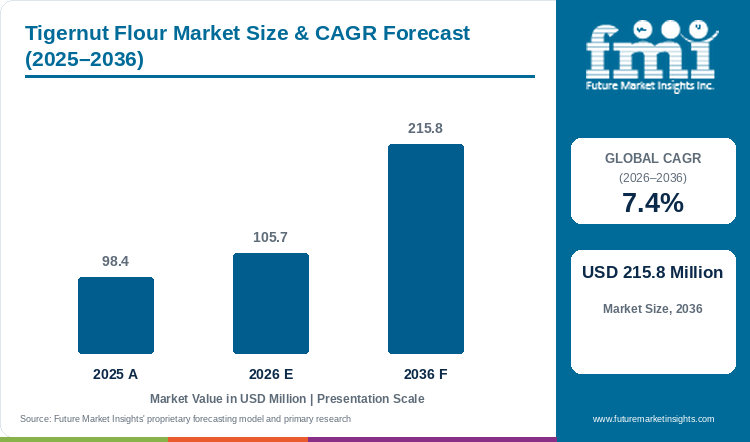
The global tigernut flour market demonstrated steady progress from USD 98.4 million in 2025 to USD 105.7 million in 2026, building toward a targeted valuation of USD 215.8 million by 2036 at a CAGR of 7.4%.
In October 2025, comparative baking trials published in Foods verified composite bread quality across 20 Cyperus esculentus tuber accessions at a 30% chufa inclusion rate, giving school-kitchen reformulators a defensible substitution benchmark rather than a recipe experiment [2]. The global tigernut flour market was valued at USD 98.4 million in 2025 and is estimated to reach USD 105.7 million in 2026, and the market is projected to reach USD 215.8 million by 2036, expanding at a compound annual growth rate (CAGR) of 7.4% between 2026 and 2036. Fine milled grade is projected to capture 44.6% of 2026 milling demand because uniform particle dispersion eliminates gritty mouthfeel in composite loaves. Demand for tigernut flour is supported by school-safe nut-free snack mandates, which classify chufa as a tuber and let bakeries borrow nut-adjacent flavor without inheriting tree-nut allergen labeling [7]. That same distinction keeps its growth close to the tiger nut market at 7.8% CAGR, since flour demand simply rides whole-tuber cultivation cycles. Manufacturers are also investing in processing capability, with Ardent Mills moving in July 2025 to acquire Stone Mill in North Dakota for certified gluten-free and identity-preserved specialty grain capacity [19], and GoodMills Innovation commercializing low-dust process flour across Europe in March 2026 [20]. Cafeterias buy the flour that clears allergen audits at the least rework, and dust control now decides which millers stay on those bid lists.
Key Market Trends & Insights
- By milling grade: Fine Milled Grade is projected to capture 44.6% of the milling grade segment in 2026 because uniform particle dispersion eliminates gritty peel texture in rotary-molded cookies.
- By processing type: Because whole dried tubers retain 22% to 26% intrinsic oleic oil, Full-Fat Native Flour is estimated to command 58.4% of the processing type segment in 2026 and reduce added shortening needs.
- By application: Short-dough cookie and snack-bar lines that operate without gluten networks place Biscuits & Snack Bars at a projected 38.2% share of the application segment in 2026.
- By claim: Conventional Allergen-Free is expected to hold 53.7% of the claim segment in 2026 to help co-packers satisfy statutory gluten-free thresholds without organic farm markups.
- By sales channel: Direct mycotoxin and spore auditing between primary tuber mills and contract bakers gives Direct to Industrial Bakeries a forecast 46.8% share of the sales channel segment in 2026.
Regional Highlights
- Top national expansion: The USA is projected to lead major commercial markets at an 8.6% CAGR through 2036 under nationwide grocery rollouts of grain-free cookies and snack bars.
- Broader country progression: The UK is expected to expand at an 8.1% CAGR ahead of France at 7.8% and Germany at 7.3%, while Japan is forecast to register a 5.6% CAGR through 2036.
Market Size & Forecast
Table 1: Market Size and Forecast for the Tigernut Flour Market (USD million and CAGR percentage), 2025 to 2036
| Metric | Value |
|---|---|
| 2025 Market Size | USD 98.4 million |
| Estimated Market Size in 2026 | USD 105.7 million |
| Projected Market Size by 2036 | USD 215.8 million |
| CAGR, 2026 to 2036 | 7.4% |
| Added Revenue, 2026 to 2036 | USD 110.1 million |
Substituting non-gluten tuber meal into yeast-leavened pan loaves dilutes viscoelastic glutenin proteins, making gas-cell retention the primary technical hurdle for industrial bread plants. When formulators push tigernut flour inclusion past 15% without adjusting dough hydration, insoluble pericarp fibers interrupt the gluten film and reduce oven spring. Rheology trials published in Foods in January 2025 evaluating 5% to 25% tigernut flour in soft-wheat bread established that a 10% replacement rate preserves an optimal 2.4 mL/g specific volume and 67.0% crumb porosity while 25% replacement raises crumb antioxidant activity to 111.31 mg TE/g dry matter [2]. Guided by that 10% to 15% structural threshold, industrial bakery teams blend milled chufa meal with cassava flour to maintain soft crumb resilience across seven-day supermarket shelf cycles.
Tuber-Harvest and Milled-Flour Output Sizing
Table 2: Tuber-Harvest and Milled-Flour Output Sizing for the Tigernut Flour Market (USD million and operational ranges), 2025 to 2036
| Metric | 2025 | 2026 | 2036 |
|---|---|---|---|
| Market size (USD million) | 98.4 | 105.7 | 215.8 |
| Commercial milled flour volume (thousand MT) | 18.5 to 19.3 | 19.7 to 20.5 | 37.4 to 39.0 |
| Raw dried chufa tuber input (thousand MT) | 23.1 to 24.5 | 24.6 to 26.0 | 46.5 to 49.2 |
| Realized B2B contract price per kg (USD) | 5.10 to 5.30 | 5.15 to 5.35 | 5.55 to 5.75 |
Operational note: Volume and input ranges apply an 80% to 82% dry-milling extraction yield from cleaned Cyperus esculentus tubers across Valencia processors in Spain and West Africa export mills.
Subterranean harvesting leaves raw chufa tubers coated in field stones and sandy soil, creating an 18% to 20% weight loss during washing, drying, and hull abrasion that directly governs B2B contract pricing. Primary processors in Valencia and West Africa must hold dry-milling extraction yields between 80% and 82% to keep wholesale contract realizations near USD 5.15 to USD 5.35 per kilogram in 2026. Multi-stage air-classification mills co-process cleaned chufa meal with gluten-free flours to lock in 150-micron particle distributions and stop free oil weeping on high-speed dough sheeters. That tight granulation control lowers line scrap for contract biscuit co-packers and underpins USD 110.1 million in incremental revenue additions between 2026 and 2036.
Per Capita & Bakery Facility Sizing
Table 3: Per Capita and Bakery-Line Spending Indicators for the Tigernut Flour Market (USD), 2025 to 2036
| Metric | 2025 | 2026 | 2036 |
|---|---|---|---|
| Global gluten-avoidant consumer base (million) | 285.0 | 294.0 | 382.0 |
| Spend per 1,000 gluten-avoidant consumers (USD) | 345.3 | 359.5 | 564.9 |
| Annual spend per qualified bakery plant (USD thousand) | 21.5 to 24.8 | 22.8 to 26.2 | 38.5 to 44.0 |
| Direct industrial bakery contract share (%) | 44.5% to 46.5% | 45.8% to 47.8% | 52.0% to 55.0% |
Table 4: Industrial Bakery & Mill Procurement Indicators for the Tigernut Flour Market (USD and percentages), 2026
| Metric | Value | Institutional Reference Basis |
|---|---|---|
| Market size, 2026 | USD 105.7 million | 2026 global revenue baseline |
| Qualified allergen-free bakery plants | 4,350 facilities | Global gluten-free and nut-free bakery plant registry |
| Market spend per bakery facility | USD 24,299 | Annualized B2B ingredient expenditure |
| Direct industrial bakery turnover, 2026 | USD 49.5 million | 46.8% sales channel allocation |
Rigorous third-party allergen and microbiological plant audits create high supplier-switching costs for commercial snack manufacturers. Once a bakery quality-assurance team validates an origin mill's below-20-ppm gluten logs and thermal spore-reduction records, procurement directors consolidate annual volume with that approved processor rather than buying spot lots. Qualified allergen-free bakeries spend an average of USD 24,299 per facility in 2026 by blending milled chufa fractions with functional flours across cookie and nutrition-bar SKUs. Direct industrial bakery contracts consequently generate USD 49.5 million in 2026 turnover and give origin mills multi-quarter production visibility.
Analyst Perspective
"Commercial conversion in the tigernut flour market is decided on the industrial baking line rather than at the concept bench. Ingredient suppliers that pair 100-to-250-micron granulation control with batch-certified under-20-ppm gluten documentation will capture multi-year contract volume across allergen-free snack and biscuit manufacturers."
- Nandini Roy Choudhury, Principal Analyst at Future Market Insights
How is the tigernut flour market segmented?
The tigernut flour market is segmented by milling grade, processing type, application, claim, sales channel, and region. In 2026, Fine Milled Grade is projected at 44.6% of the milling grade segment, Full-Fat Native Flour at 58.4% of the processing type segment, Biscuits & Snack Bars at 38.2% of the application segment, Conventional Allergen-Free at 53.7% of the claim segment, and Direct to Industrial Bakeries at 46.8% of the sales channel segment.
By milling grade: Fine Milled Grade, Standard Milled Grade, Extra-Fine Patisserie Grade, and Coarse High-Fiber Meal.
By processing type: Full-Fat Native Flour, Partially Defatted Flour, and Roasted Functional Flour.
By application: Biscuits & Snack Bars, Cakes & Sweet Goods, Composite Bread & Rolls, Dry Baking Mixes, and Extruded Snacks & Cereals.
By claim: Conventional Allergen-Free, Certified Organic, and PDO & Origin-Verified.
By sales channel: Direct to Industrial Bakeries, Specialty Ingredient Distributors, Foodservice & Artisan Supply, and Online B2B.
Why does Fine Milled Grade lead the milling grade segment?
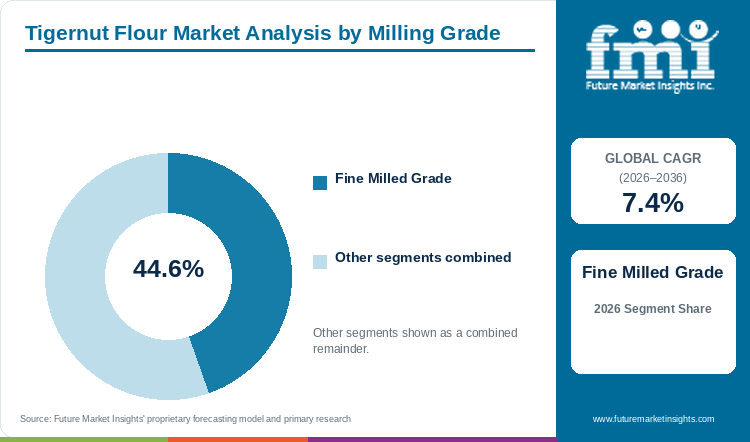
Fine Milled Grade is projected to capture 44.6% of the milling grade segment in 2026 because 100-to-250-micron classification removes gritty peel texture on rotary cookie lines.
Table 5: Milling Grade Share for the Tigernut Flour Market (percentage share), 2026
| Milling Grade | Share (2026) |
|---|---|
| Fine Milled Grade | 44.6% |
| Other Segments Combined | 55.4% |
| Total | 100.0% |
Calculated as the balance remaining after deducting the leading segment's reported share from 100.0%.
Table 6: Milling Grade Leadership and Market Growth for the Tigernut Flour Market (segment and CAGR percentage), 2026 to 2036
| Metric | Value |
|---|---|
| Global CAGR (2026 to 2036) | 7.4% |
| Leading Segment | Fine Milled Grade |
Shopper rejection of sandy, suberized peel specks in gluten-free cookies and nutrition bars steers industrial procurement toward tightly sieved tigernut grades. Outer tuber skins produce a gritty bite whenever particle diameters exceed 350 microns, whereas ultra-fine grinding below 100 microns drives up mill electricity consumption and blinds sifter screens with native oleic oil. Cryogenic and air-swept impact milling within a 100-to-250-micron window gives commercial bakeries formulating gluten-free products smooth palate dispersion without screen-blinding downtime.
- Fine Milled Grade is projected to capture 44.6% of the milling grade segment in 2026 by pairing balanced dough water absorption with smooth bite texture.
- Gluten-free cookie trials published in Foods in July 2025 showed that 20% and 40% specialty flour substitution elevates protein, ash, and phenolic acids including gallic and caffeic acid without altering cookie fracturability [3].
Why does Full-Fat Native Flour lead the processing type segment?
Full-Fat Native Flour is estimated to command 58.4% of the processing type segment in 2026 as unpressed tubers retain 22% to 26% oleic oil and natural sucrose.
Volatile palm-shortening and refined-sugar prices are prompting commercial cookie formulators to capitalize on the native lipid and sucrose content of unpressed chufa meal. Whole dried tubers naturally contain 22% to 26% oleic oil and 15% to 20% sucrose before mechanical pressing, allowing bakeries to trim added shortening and sugar in rotary-molded batters by 15% to 25%. Blending full-fat tigernut flour with lupin flour further raises protein density and natural dough lubricity while keeping synthetic mono- and diglycerides off the ingredient label.
- Full-Fat Native Flour is estimated to command 58.4% of the processing type segment in 2026 because unpressed milling avoids mechanical defatting fees and supplies built-in shortening lubricity.
- Mixture-design baking trials published in Food Science & Nutrition in May 2026 established that a 58.40% tigernut flour biscuit formulation delivers 18.95 g/100 g dietary fiber, a 1.13 oil-to-water absorption ratio, and a low glycemic index of 53.81 [4].
What keeps Biscuits & Snack Bars ahead in the application segment?
Biscuits & Snack Bars are expected to account for 38.2% of the application segment in 2026 because short-dough cookies and nutrition bars do not depend on viscoelastic gluten networks.
Because Cyperus esculentus tubers lack glutenin and gliadin proteins, commercial tonnage concentrates in low-moisture short doughs where high lipid and insoluble fiber levels improve crumb snap rather than causing loaf collapse. Rotary-molded cookies and cold-pressed snack bars rely on fat-coated starch and fiber particles rather than gas-trapping gluten films. Milled chufa flour also accelerates natural Maillard crust browning and boosts prebiotic fiber in tunnel ovens when co-blended with industrial bakery ingredients and mixes.
- Biscuits & Snack Bars are expected to hold 38.2% of the application segment in 2026 as nut-free school snack brands replace almond flour in short-dough cookies and bars.
- Functional bread studies published in Food Chemistry in June 2026 confirmed that yeast loaves require 50% to 72.5% wheat flour paired with 22.5% to 50% tigernut flour to preserve loaf structure, explaining why 100% grain-free volume centers on biscuits and bars [5].
Why does Conventional Allergen-Free lead the claim segment?
Conventional Allergen-Free is forecast to hold 53.7% of the claim segment in 2026 by delivering batch-certified below-20-ppm gluten compliance without organic raw-material surcharges.
Supermarket private-label and mainstream snack buyers enforce tight unit-price ceilings that keep conventional allergen-free chufa flour ahead of certified organic lots. Classroom-safe snack brands prioritize batch-tested exclusion of wheat gluten and tree-nut proteins so their packs qualify for nut-free school claims without absorbing the 30% farm-gate premium attached to organic tubers. Qualifying conventional chufa shipments through ELISA testing below 20 ppm gluten satisfies retail free-from compliance while preserving co-packer gross margins.
- Conventional Allergen-Free is forecast to represent 53.7% of the claim segment in 2026 owing to cost-disciplined procurement across contract biscuit and bar co-packers.
- Compliance guidance updated by the U.S. Food and Drug Administration in March 2026 under the Gluten-Free Food Labeling Final Rule mandates that unavoidable gluten remain strictly below 20 ppm across packaged foods [6].
What gives Direct to Industrial Bakeries the leading position in the sales channel segment?
Direct to Industrial Bakeries is anticipated to represent 46.8% of the sales channel segment in 2026 through plant-level steam-pasteurization and mycotoxin auditing.
Because chufa tubers develop underground in direct contact with soil microbes and aflatoxin-producing molds, industrial bakeries bypass spot commodity brokers and contract directly with origin mills. Quality-assurance teams audit primary processors in Spain and West Africa to verify validated steam-pasteurization logs and water-activity ceilings below 0.55 prior to container loading. Multi-quarter direct supply contracts also guarantee allergen-segregated 1,000-kilogram supersack deliveries and shield large snack brands from seasonal harvest price swings.
- Direct to Industrial Bakeries is anticipated to account for 46.8% of the sales channel segment in 2026 through plant-audited microbiological and particle-size contracting.
- In January 2025, the U.S. Food and Drug Administration released Edition 5 of its Questions and Answers Regarding Food Allergen Labeling guidance, tightening cross-contact preventive controls across commercial food plants [7].
What are the drivers, restraints, and opportunities in the tigernut flour market?
School-safe nut-free snack reformulation and shortening-cost reduction propel demand in the tigernut flour market, whereas subterranean spore decontamination expenses and warm-warehouse lipid oxidation restrain adoption in price-sensitive bread plants.
- Driver: Dual gluten-free and tree-nut-free allergen status enables bakery brands to replace almond flour in school-safe cookies and snack bars.
- Restraint: Absence of gluten-forming proteins and soil-borne microbial decontamination costs restrict high-inclusion bread applications and squeeze miller margins.
- Opportunity: Partially defatted press-cake flours and micronized grades unlock frozen dough and clean-label patisserie contracts.
Growth Analysis and Future Potential: Qualitative Demand Catalysts
Classroom bans on tree nuts and rising pediatric nut allergies are pushing commercial snack brands to replace blanched almond meal with root-tuber tigernut flour. Because Cyperus esculentus is a sedge tuber rather than a tree nut, co-packers can run grain-free cookie and bar batters on shared allergen-free lines without tree-nut anaphylaxis liabilities. Trade data in the March 2026 USDA Foreign Agricultural Service Food Processing Ingredients Annual report for Spain confirm that Spain ranks as the European Union's third-largest agricultural producer and a primary export processor of specialty food ingredients [8]. Biscuit and snack manufacturers across North America and Western Europe are consequently blending micronized Valencia chufa flour into bakery mixes to scale from retail pouches into 1,000-kilogram bulk tote orders.
Risk Assessment of the Tigernut Flour Market: Operational and Formulation Friction
Subterranean spore loads and rapid polyunsaturated lipid oxidation in warm warehouses remain the two primary operational hurdles restraining wider tigernut flour adoption. Raw tubers harvested from sandy fields carry soil bacteria and stones that require optical sorting and thermal steam pasteurization before dry milling. Under European Commission organic farming control regulations updated in March 2026, every organic processor and importer must pass annual physical inspection by an accredited control body before marketing lots as organic [9]. High native oil levels also accelerate rancidity whenever full-fat meal is stored above 25 degrees Celsius, requiring bakeries to source stabilizing antioxidants and hydrocolloids from European bakery ingredients suppliers.
Commercial Opportunity Analysis: Formulation Differentiation and Value-Add Formats
Upcycling cold-pressed tigernut oil press-cake into partially defatted functional flour opens a high-margin revenue stream for origin millers. Mechanical extraction of half of the native tuber oil concentrates insoluble resistant starch and dietary fiber above 45% while extending ambient shelf stability from 6 months to 18 months. Agricultural trade analysis in the April 2026 USDA Foreign Agricultural Service Grain and Feed Annual report for Ghana (GH2026-0011) documents expanding crop-processing and export infrastructure across West Africa [10]. Dry-mix formulators are pairing traceable Ghana and Spain press-cake flours with USA cassava flour to launch high-fiber brownie and pancake mixes that hydrate smoothly without oil separation.
Tigernut Flour Market by Country (2026 to 2036)
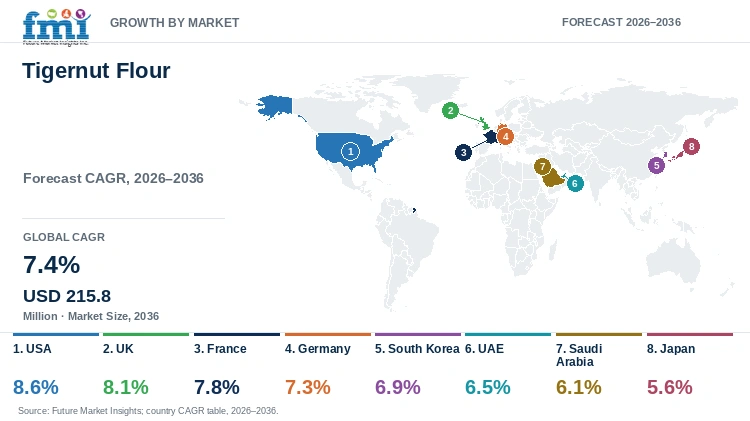
National demand patterns track the consolidation of grain-free snack brands and the enforcement of statutory gluten-free and nut-free labeling thresholds. The USA is projected to lead country growth at an 8.6% CAGR through 2036, whereas Japan is forecast to register a 5.6% CAGR owing to direct substitution from domestic rice flour in wheat-free baking.
Table 7: Country CAGR and Primary Growth Levers for the Tigernut Flour Market (CAGR percentage and operational drivers), 2026 to 2036
| Country | CAGR (2026 to 2036) | Primary Growth Lever |
|---|---|---|
| USA | 8.6% | Grain-free snack bar and cookie reformulation under FDA <20 ppm gluten-free rules |
| UK | 8.1% | Supermarket free-from aisle expansion and dedicated allergen-free milling lines |
| France | 7.8% | Organic patisserie and clean-label biscuit adoption across bio retail channels |
| Germany | 7.3% | Private-label organic bakery assortments and low-dust industrial functional flour blending |
| South Korea | 6.9% | Mandatory MFDS wheat-allergen disclosure driving composite rice-and-tuber bakery mixes |
| UAE | 6.5% | USDA-tracked HRI bakery imports and cold-conditioned specialty flour distribution |
| Saudi Arabia | 6.1% | SFDA import clearance compliance and modern supermarket dietetic bakery growth |
| Japan | 5.6% | Niche allergen-free patisserie demand moderated by domestic JAS non-gluten rice flour supply |
Source: Future Market Insights analysis
USA Tigernut Flour Market Outlook (2026 to 2036)
Acquisitions of grain-free snack brands by national packaged-bakery groups set the USA apart from fragmented health-store markets and drive a leading 8.6% CAGR through 2036. Mainstream grocery chains in the USA are expanding school-safe cookie and cracker bays where tree-nut almond flour faces classroom restrictions. In February 2025, Flowers Foods completed the acquisition of Simple Mills to scale national grocery distribution of clean-label crackers and baking mixes across the USA [11]. Contract bakeries are consequently converting chufa flour procurement from small bags to automated bulk totes, though strict U.S. Food and Drug Administration below-20-ppm gluten verification and peanut-free facility audits still raise onboarding costs for smaller origin mills.
Key takeaway: In the USA, national grocery distribution of grain-free snacks and baking mixes is projected to anchor recurring industrial bulk orders for certified allergen-free tigernut flour.
UK Tigernut Flour Market Outlook (2026 to 2036)
Centralized supermarket own-label free-from aisles govern ingredient specification in the UK, contrasting with independent health-food shop distribution in continental Europe. Retail category managers in the UK require contract bakers to exclude both wheat gluten and tree nuts inside segregated production rooms while lifting dietary fiber in gluten-free biscuits. Consumer survey data in Coeliac UK's January 2026 Gluten Free Shopping Habits Report covering 3,785 members documented strong shopper demand for wider audited bakery variety across UK supermarkets [12]. Biscuit co-packers in the UK are therefore substituting fine-milled tigernut flour for low-fiber rice starch, supporting an 8.1% CAGR from 2026 to 2036 despite tight supermarket private-label margin caps.
Key takeaway: In the UK, consumer demand for audited Crossed Grain free-from bakery variety is expected to drive biscuit processors toward fiber-rich tigernut flour blends.
France Tigernut Flour Market Outlook (2026 to 2036)
Strict culinary tolerances for smooth sablé and financier pastry texture and dual distribution across supermarkets and specialist bio stores shape commercial demand in France. Whereas snack-bar processors in the USA accept standard granulations, patisserie formulators in France reject any tuber meal that leaves coarse epidermal specks on the palate. Market tracking in the February 2025 USDA Foreign Agricultural Service report on the European Union organics sector (GM2025-0003) confirms that France ranks among the bloc's two largest organic markets with sales balanced between supermarkets and bio specialty retailers [13]. Short-haul truck freight from neighboring Valencia mills in Spain delivers extra-fine organic chufa flour at low logistics cost, sustaining a 7.8% CAGR in France from 2026 to 2036.
Key takeaway: In France, established bio retail channels and strict patisserie mouthfeel standards are projected to favor extra-fine certified organic tigernut flour imports from neighboring Spain.
Germany Tigernut Flour Market Outlook (2026 to 2036)
Strong household loyalty to certified Bio bakery goods paired with hard-discounter retail price ceilings defines tigernut flour (Erdmandelmehl) procurement in Germany. While Reformhaus health shops sell pure chufa meal packets, industrial muesli and biscuit plants must control batch costs to win private-label retail contracts. Sector figures released by Bund Ökologische Lebensmittelwirtschaft (BÖLW) at Biofach in February 2026 showed that organic food sales in Germany climbed 6.7% to EUR 18.23 billion in 2025 during tight raw-material supply [14]. Industrial bakeries in Germany manage raw-material inflation while retaining high-fiber claims by blending 10% to 20% tigernut meal with domestic gluten-free oat flour, supporting a 7.3% CAGR through 2036.
Key takeaway: In Germany, record EUR 18 billion organic grocery turnover is estimated to sustain steady procurement of organic tigernut meal for muesli and nut-free biscuits.
South Korea Tigernut Flour Market Outlook (2026 to 2036)
Heavy reliance on imported agricultural intermediates and a fast-moving urban café pastry market differentiate South Korea from Western retail baking channels. Commercial bakeries in Seoul and Busan formulate tigernut flour into gluten-free financiers and cookies sold through specialty coffee chains rather than household flour bags. Trade analysis in the May 2026 USDA Foreign Agricultural Service South Korea Food Processing Ingredients Annual report (KS2026-0013) confirms that domestic food manufacturers depend heavily on imported specialty ingredients [15]. Bakery R&D teams blend imported Spain fine chufa flour with domestic rice flour to prevent crumb drying in chilled café display cases, driving a 6.9% CAGR in South Korea from 2026 to 2036 despite container freight surcharges.
Key takeaway: In South Korea, strict MFDS labeling governance and premium café pastry innovation are forecast to support imports of pre-sterilized fine tigernut flour.
UAE Tigernut Flour Market Outlook (2026 to 2036)
Five-star hotel pastry demand combined with extreme summer port temperatures makes climate-controlled storage the decisive commercial variable in the UAE. Because full-fat tigernut flour retains up to 26% native oleic oil, unconditioned ocean containers arriving in Dubai or Abu Dhabi above 40 degrees Celsius trigger rapid free-fatty-acid rancidity. Import tracking in the April 2026 USDA Foreign Agricultural Service Grain and Feed Annual report for the UAE (TC2026-0005) confirms that hotel and institutional bakeries rely on imported specialty milling ingredients [16]. Specialty distributors therefore mandate refrigerated transit below 20 degrees Celsius to supply luxury hospitality kitchens, supporting a 6.5% CAGR in the UAE through 2036.
Key takeaway: In the UAE, hospitality bakery expansion and climate-controlled distributor warehousing are anticipated to govern supplier qualification for imported tigernut flour.
Saudi Arabia Tigernut Flour Market Outlook (2026 to 2036)
Dedicated dietetic and allergen-free bays expanding across Riyadh and Jeddah hypermarkets are generating new commercial orders for tigernut flour in Saudi Arabia, while port clearance rules filter out undocumented suppliers. Domestic biscuit manufacturers and specialty importers are adopting nut-free tuber flours to serve shoppers managing celiac disease and type-2 diabetes. Import clearance regulations updated by the Saudi Food and Drug Authority (SFDA) in August 2026 require every foreign food consignment to carry authenticated health certificates and Gulf technical standard documentation at Saudi Arabia ports [17]. Origin mills supplying accredited aflatoxin-free laboratory logs and Arabic-labeled sacks secure recurring hypermarket contracts, supporting a 6.1% CAGR in Saudi Arabia from 2026 to 2036.
Key takeaway: In Saudi Arabia, SFDA border clearance rules and modern supermarket dietetic aisle growth are predicted to structure distributor onboarding of tigernut flour.
Japan Tigernut Flour Market Outlook (2026 to 2036)
Abundant domestic supply of ultra-fine gluten-free rice flour holds imported tigernut flour in Japan to a measured 5.6% CAGR from 2026 to 2036 across commercial baking channels. Wholesale bread plants in Japan already rely on local non-glutinous rice flour for mainstream wheat-free loaves, limiting bulk tuber meal substitution. Retail tracking in the November 2025 USDA Foreign Agricultural Service Japan Retail Foods Annual report (JA2025-0048) places retail food sales in Japan at USD 193 billion, with supermarkets and convenience stores prioritizing ready-to-eat items [18]. Specialty importers in Tokyo and Osaka therefore direct steam-pasteurized tigernut flour into high-fiber wellness biscuits and artisan patisserie batters where white rice flour lacks natural oleic lipid richness.
Key takeaway: In Japan, widespread domestic gluten-free rice flour supply is projected to confine imported tigernut flour to high-fiber patisserie and wellness biscuit niches.
Full report country CAGRs cover: North America; Latin America; Western Europe; Eastern Europe; East Asia; South Asia and Pacific; Middle East and Africa.
Who are the notable companies in the tigernut flour market?
Tigernuts Traders, S.L., Organic Gemini, Not Nuts! (Cabfoods), Simple Mills (Flowers Foods), Ardent Mills, ADM, Bob's Red Mill, Doves Farm Foods (FREEE), Limagrain Ingredients, and GoodMills Group are the notable companies in the tigernut flour market.
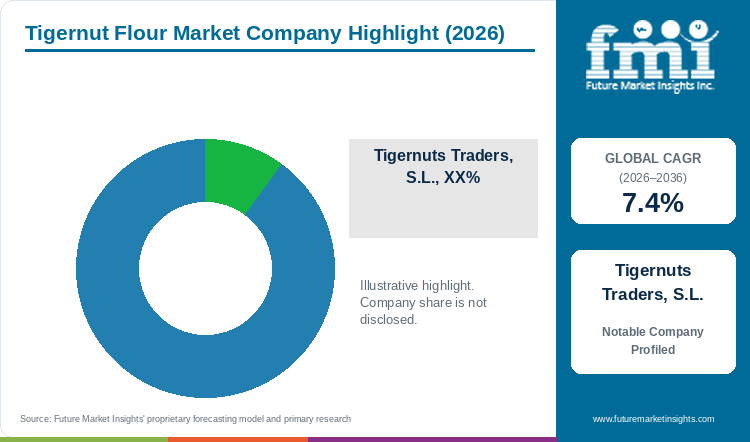
Vendor competition in the tigernut flour market is shaped by how effectively suppliers control subterranean microbial loads and particle granulation costs. Origin-integrated Cyperus esculentus processors in Spain and West Africa manage raw tuber washing and thermal spore pasteurization with cryogenic micron classification. Meanwhile, branded allergen-free baking-mix companies and multinational specialty milling groups compete by blending chufa flour with functional starches and providing industrial dough-rheology troubleshooting for contract bakeries.
- Origin Tuber Millers & Direct Tigernut Specialists: Tigernuts Traders and Organic Gemini with Not Nuts! (Cabfoods) process dedicated fine and organic tigernut flours from Spain and West Africa harvests.
- Branded Allergen-Free & Gluten-Free Flour Channels: Simple Mills (Flowers Foods) and Bob's Red Mill with Doves Farm Foods (FREEE) operate certified gluten-free baking mixes and commercial flour platforms.
- Industrial Specialty Milling & Functional Flour Platforms: Ardent Mills and ADM with Limagrain Ingredients and GoodMills Group deliver bulk allergen-controlled grain processing and industrial bakery rheology support.
Competitive Benchmarking: Tigernut Flour Market
Table 8: Competitive Benchmarking for the Tigernut Flour Market (qualitative capability ratings), 2026
| Company | Milling Granulation Control | Allergen & Gluten-Free Assurance | Industrial Bakery Formulation Support | Geographic Reach |
|---|---|---|---|---|
| Tigernuts Traders, S.L. | High | High | Medium | Spain, Europe, North America, and Asia export channels |
| Organic Gemini | High | High | Medium | USA retail, foodservice, and bulk B2B channels |
| Not Nuts! (Cabfoods) | Medium | High | Medium | Ghana origin milling and North America specialty distribution |
| Simple Mills (Flowers Foods) | Medium | High | High | USA nationwide natural and conventional grocery networks |
| Ardent Mills | High | High | High | USA, Canada, and Puerto Rico specialty milling network |
| ADM | High | High | High | North America and Europe alternative-flour and bakery platforms |
| Bob's Red Mill | High | High | Medium | USA and international bulk and packaged gluten-free channels |
| Doves Farm Foods (FREEE) | High | High | High | UK and Europe certified gluten-free facilities |
| Limagrain Ingredients | High | Medium | High | France and pan-European functional bakery flour operations |
| GoodMills Group | High | Medium | High | Seven Europe countries with Hamburg innovation center |
Capability assessment basis: Tier rankings evaluate documented particle-size classification (<100 micron sieving) and certified under-20-ppm gluten-free facility controls.
Key Developments in the Tigernut Flour Market
- In July 2025, Ardent Mills entered an agreement to acquire Stone Mill in North Dakota to add certified gluten-free and identity-preserved specialty grain processing capacity [19].
- In March 2026, GoodMills Innovation commercialized its low-dust process flour technology in Europe, reducing fine airborne flour particles to extend bakery cleaning intervals and improve workplace safety [20].
- In May 2026, ADM expanded its protein and ingredient innovation portfolio with eight regionally sourced soy and pea functional solutions tailored for alternative-flour bakery and snack systems [21].
Key Players in the Tigernut Flour Market
Origin Tuber Millers & Direct Tigernut Specialists
- Tigernuts Traders, S.L.
- Organic Gemini
- Not Nuts! (Cabfoods)
Branded Allergen-Free & Gluten-Free Flour Channels
- Simple Mills (Flowers Foods)
- Bob's Red Mill
- Doves Farm Foods (FREEE)
Industrial Specialty Milling & Functional Flour Platforms
- Ardent Mills
- ADM
- Limagrain Ingredients
- GoodMills Group
Tigernut Flour Market - Report Scope
Table 9: Report Scope for the Tigernut Flour Market (coverage fields and definitions), 2026 to 2036
| Coverage field | Report scope |
|---|---|
| Market breakdown | Milling Grade; Processing Type; Application; Claim; Sales Channel |
| Quantitative Units | USD Million |
| Market Definition | Includes commercial supplier revenue from food-grade dry-milled tigernut (Cyperus esculentus) flour across full-fat, partially defatted press-cake, and thermally stabilized functional grades. Category Scope Note: Excludes whole raw chufa tubers sold for fresh snacking, liquid horchata beverages, standalone cold-pressed tigernut oil, and downstream finished bakery retail value. |
| Regions Covered | North America; Latin America; Western Europe; Eastern Europe; East Asia; South Asia and Pacific; Middle East and Africa |
| Countries Covered | USA, UK, France, Germany, South Korea, UAE, Saudi Arabia, Japan, and additional countries in the full report |
| Key Companies Covered | Tigernuts Traders, S.L., Organic Gemini, Not Nuts! (Cabfoods), Simple Mills (Flowers Foods), Ardent Mills, ADM, Bob's Red Mill, Doves Farm Foods (FREEE), Limagrain Ingredients, GoodMills Group |
| Forecast Period | 2026 to 2036 |
| Approach | Primary and secondary research with top-down and bottom-up market triangulation. |
Tigernut Flour Market - Research Methodology
Table 10: Research Methodology for the Tigernut Flour Market (research methods and approach), 2026 edition
| Method | Approach |
|---|---|
| Primary Research | Structured interviews with Spain PDO Valencia and West Africa chufa millers, allergen-free biscuit R&D directors, gluten-free co-manufacturers, and specialty ingredient distributors to validate micron sieve specs and B2B contract pricing. |
| Secondary Research | Analysis of peer-reviewed food hydrocolloid and rheology journals (Foods, IJBM, Food Science & Nutrition), FDA 21 CFR 101.91 gluten-free and allergen guidance, Agence Bio and BÖLW organic trade reports, and corporate M&A disclosures. |
| Market Sizing and Forecasting | Bottom-up commercial dried chufa milling tonnage and extraction yields (80% to 82%) reconciled against top-down gluten-free and nut-free bakery ingredient procurement budgets from 2026 to 2036. |
| Country Forecasting Model | Econometric country projections weight celiac and tree-nut-allergy prevalence, free-from supermarket fixture density, organic retail turnover, and statutory import registration gates across eight national markets. |
| Operational Benchmark Traceability | Tuber input tonnage, bakery plant counts, and facility spending indicators in Tables 2, 3, and 4 trace to Spain and Ghana export milling yields, Coeliac UK consumer audits, and industrial biscuit formulation trials. |
| Data Triangulation and Validation | Revenue estimates are cross-checked against commercial tuber harvest volumes and B2B flour contract invoices while excluding liquid horchata concentrates, standalone tigernut oil, and finished retail snack sales to prevent double counting. |
Tigernut Flour Market by Segments
Tigernut Flour Market segmented by Milling Grade:
- Fine Milled Grade
- Standard Milled Grade
- Extra-Fine Patisserie Grade
- Coarse High-Fiber Meal
Tigernut Flour Market segmented by Processing Type:
- Full-Fat Native Flour
- Partially Defatted Flour
- Roasted Functional Flour
Tigernut Flour Market segmented by Application:
- Biscuits & Snack Bars
- Cakes & Sweet Goods
- Composite Bread & Rolls
- Dry Baking Mixes
- Extruded Snacks & Cereals
Tigernut Flour Market segmented by Claim:
- Conventional Allergen-Free
- Certified Organic
- PDO & Origin-Verified
Tigernut Flour Market segmented by Sales Channel:
- Direct to Industrial Bakeries
- Specialty Ingredient Distributors
- Foodservice & Artisan Supply
- Online B2B
Tigernut Flour Market by Region
- North America
- USA
- Canada
- Latin America
- Brazil
- Mexico
- Argentina
- Chile
- Western Europe
- Germany
- France
- UK
- Italy
- Spain
- Benelux
- Nordics
- Eastern Europe
- Poland
- Czech Republic
- Romania
- Hungary
- East Asia
- China
- Japan
- South Korea
- South Asia and Pacific
- India
- ASEAN
- Australia and New Zealand
- Middle East and Africa
- GCC Countries
- South Africa
- Türkiye
- Israel
Research Sources and Bibliography
- [1] Kon'kova, N. G., Khoreva, V. I., Popov, V. S., Yakusheva, T. V., Kibkalo, I. A., Malyshev, L. L., Solovyeva, A. E., & Shelenga, T. V. (2025, October 28). Technological Assessment of Bread with the Addition of Cyperus esculentus L. Accessions Flour Grown in the Kuban-Azov Plain. Foods, 14(21), 3680 (PubMed PMID 41227652).
- [2] Nedviha, S., & Harasym, J. (2025, January 13). Characteristics of Soft Wheat and Tiger Nut (Cyperus esculentus) Composite Flour Bread. Foods, 14(2), 229 (PMC11764678).
- [3] Bukonja, S., Tomić, J., Pestorić, M., et al. (2025, July 29). Exploring Sorghum Flour as a Sustainable Ingredient in Gluten-Free Cookie Production. Foods, 14(15), 2668 (PubMed PMID 40807606).
- [4] Tazoho, G. M., Tchassi, B., Bossi, D. S. D., Tene, S. T., Womeni, H. M., & Gouado, I. (2026, May 3). Formulation of Gluten-Free Biscuits Based on Tiger Nut, Dana, and Mixture of Avocado and Margarine: Nutritional Composition and Glycemic Index of Optimal Sample. Food Science & Nutrition, 14(5), e71852 (PubMed PMID 42088465).
- [5] Fasehun, O. I., Ademosun, A. O., & Oboh, G. (2026, June 30). Phenolic compounds and antihypertensive properties of Tiger nut (Cyperus esculentus) and Moringa (Moringa oleifera) enriched functional breads via nitric oxide restoration and arginase-ACE inhibition. Food Chemistry, 515, 149211 (PubMed PMID 41990495).
- [6] U.S. Food and Drug Administration. (2026, March 17). Gluten-Free Labeling of Foods - FDA. Center for Food Safety and Applied Nutrition.
- [7] U.S. Food and Drug Administration. (2025, January 6). Questions and Answers Regarding Food Allergen Labeling (Edition 5). Center for Food Safety and Applied Nutrition.
- [8] USDA Foreign Agricultural Service. (2026, March 31). Spain: Food Processing Ingredients Annual. Global Agricultural Information Network (GAIN).
- [9] European Commission. (2026, March 30). Controls - Agriculture and rural development - European Commission. Directorate-General for Agriculture and Rural Development.
- [10] USDA Foreign Agricultural Service. (2026, April 3). Ghana: Grain and Feed Annual - 2026. Global Agricultural Information Network (GAIN Report GH2026-0011).
- [11] Flowers Foods, Inc. (2025, February 21). FLOWERS FOODS, INC. COMPLETES ACQUISITION OF SIMPLE MILLS. Flowers Foods Investor Newsroom.
- [12] Coeliac UK. (2026, January 30). Gluten Free Shopping Habits Report launches - Coeliac UK. Coeliac UK Policy & Research.
- [13] USDA Foreign Agricultural Service. (2025, February 7). European Union: EU Organics Market Begins to Recover. Global Agricultural Information Network (GAIN Report GM2025-0003).
- [14] Bund Ökologische Lebensmittelwirtschaft (BÖLW). (2026, February 10). Biofach: Steigende Nachfrage, knappes Angebot - BÖLW. BÖLW Pressemeldungen.
- [15] USDA Foreign Agricultural Service. (2026, May 27). South Korea: Food Processing Ingredients Annual. Global Agricultural Information Network (GAIN Report KS2026-0013).
- [16] USDA Foreign Agricultural Service. (2026, April 17). United Arab Emirates: Grain and Feed Annual. Global Agricultural Information Network (GAIN Report TC2026-0005).
- [17] Saudi Food and Drug Authority. (2026, August 21). Conditions & Requirements for Importing Food to Saudi Arabia. SFDA Regulations Portal.
- [18] USDA Foreign Agricultural Service. (2025, November 19). Japan: Retail Foods Annual | USDA Foreign Agricultural Service. Global Agricultural Information Network (GAIN Report JA2025-0048).
- [19] Ardent Mills. (2025, July 31). Ardent Mills Enters Agreement to Acquire Stone Mill in North Dakota, Expanding Emerging Nutrition Portfolio. Ardent Mills Newsroom.
- [20] GoodMills Innovation GmbH. (2026, March 2). Low-dust process flour from GoodMills Innovation reduces fine particle content, extends cleaning intervals and improves workplace safety. GoodMills Innovation Technical Releases.
- [21] ADM. (2026, May 20). ADM Advances Protein Innovation with New Ingredient Solutions. Archer Daniels Midland Company.
- [22] King Arthur Baking Company. (2026, April 21). King Arthur Baking Taps Celebrations, Gluten-Free Demand, and Everyday Ease with Five New Mixes This Spring. King Arthur Baking Official Newsroom.
- [23] Flowers Foods, Inc. (2026, May 4). Flowers Foods' Innovations Deliver Fresh Variety to Breakfast, Snacking Categories. Flowers Foods Official Newsroom.
This bibliography is provided for reader reference and is not exhaustive. The full report contains the complete reference list and detailed citations.
This Report Answers
- How large is the tigernut flour market in 2026 and what is forecast for 2036?
- Which allergen-free and clean-label pressures support demand for tigernut flour?
- Why does Fine Milled Grade lead the milling grade segment?
- Why does Full-Fat Native Flour lead the processing type segment globally?
- How do growth rates differ across the USA and the UK as well as France and Germany?
- Which leading companies supply origin-milled tigernut flour and gluten-free baking platforms today?
- What limits adoption or supplier switching in the tigernut flour market?
- What should industrial bakery buyers evaluate before purchasing tigernut flour?
Frequently Asked Questions
How big is the tigernut flour market in 2026, and what is forecast for 2036?
Global tigernut flour sales are estimated at USD 105.7 million in 2026, up from USD 98.4 million in 2025. Total revenue is projected to reach USD 215.8 million by 2036 as allergen-free biscuit and snack bar brands scale commercial production.
What is the CAGR for the tigernut flour market from 2026 to 2036?
Global demand is projected to expand at a 7.4% CAGR between 2026 and 2036, generating USD 110.1 million in incremental turnover across industrial bakeries and specialty ingredient distributors.
Which milling grade segment leads the tigernut flour market?
Fine Milled Grade is projected to capture 44.6% of the milling grade segment in 2026 because controlled 100-to-250-micron sieving eliminates gritty suberized fiber mouthfeel in low-moisture cookies and snack bars.
Which processing type segment leads the tigernut flour market?
Because whole dried chufa tubers retain 22% to 26% intrinsic oleic lipid content and natural sucrose, Full-Fat Native Flour is estimated to command 58.4% of the processing type segment in 2026.
Which country has a notable growth outlook during the assessment period?
The USA is projected to lead national expansion at an 8.6% CAGR through 2036, supported by nationwide grocery rollouts of grain-free snacks and baking mixes governed by FDA under-20-ppm gluten-free labeling rules.
Who are the key players in the market?
Tigernuts Traders, S.L., Organic Gemini, Not Nuts! (Cabfoods), Simple Mills (Flowers Foods), Ardent Mills, ADM, Bob's Red Mill, Doves Farm Foods (FREEE), Limagrain Ingredients, and GoodMills Group lead commercial supply across tuber milling and allergen-free bakery formulation.
Preview the report firsthand - request a free sample
Get SampleGet the brochure for pricing and purchase details.
Get PDFTable of Content
- Key Takeaways
- Market Size and CAGR
- Top Growth Driver
- Fastest Growing Segment
- Leading Region
- Key Companies
- Emerging Opportunities
- Executive Summary
- Global Market Outlook
- Demand-side Trends
- Supply-side Trends
- Technology Roadmap Analysis
- Analysis and Recommendations
- Analyst Perspective (What is happening? Why now? What should investors know?)
- Key Questions Answered
- How large is the market?
- What is the CAGR?
- What are key trends?
- Which region dominates?
- Who are the leaders?
- Market Overview
- Market Coverage / Taxonomy
- Market Definition / Scope / Limitations
- Research Methodology
- Chapter Orientation
- Analytical Lens and Working Hypotheses
- Market Structure, Signals, and Trend Drivers
- Benchmarking and Cross-market Comparability
- Market Sizing, Forecasting, and Opportunity Mapping
- Research Design and Evidence Framework
- Desk Research Programme (Secondary Evidence)
- Expert Input and Fieldwork (Primary Evidence)
- Tooling, Models, and Reference Databases
- Data Engineering and Model Build
- Quality Assurance and Audit Trail
- Market Background
- Market Dynamics (Drivers, Restraints, Opportunity, Trends)
- Scenario Forecast (Optimistic, Likely, Conservative)
- Impact Analysis
- AI Impact
- Sustainability Impact
- Regulatory Impact
- Technology Impact
- Consumer / Buyer Analysis
- Purchase Drivers
- Adoption Barriers
- Buyer Journey
- Opportunity Map Analysis
- Product Life Cycle Analysis
- Supply Chain Analysis
- Investment Feasibility Matrix
- Value Chain Analysis
- PESTLE and Porter's Analysis
- Regulatory Landscape
- Regional Parent Market Outlook
- Production and Consumption Statistics
- Import and Export Statistics
- Global Market Analysis and Forecast, 2021 to 2036
- Historical Market Size Value (USD Million) Analysis, 2021 to 2025
- Current and Future Market Size Value (USD Million) Projections, 2026 to 2036
- Y-o-Y Growth Trend Analysis
- Absolute $ Opportunity Analysis
- Global Market Pricing Analysis, 2021 to 2036
- Global Market Analysis and Forecast, By Milling Grade, 2021 to 2036
- Introduction / Key Findings
- Historical Market Size Value (USD Million) Analysis By Milling Grade, 2021 to 2025
- Current and Future Market Size Value (USD Million) Analysis and Forecast By Milling Grade, 2026 to 2036
- Fine Milled Grade
- Standard Milled Grade
- Extra-Fine Patisserie Grade
- Coarse High-Fiber Meal
- Y-o-Y Growth Trend Analysis By Milling Grade, 2021 to 2025
- Absolute $ Opportunity Analysis By Milling Grade, 2026 to 2036
- Global Market Analysis and Forecast, By Processing Type, 2021 to 2036
- Introduction / Key Findings
- Historical Market Size Value (USD Million) Analysis By Processing Type, 2021 to 2025
- Current and Future Market Size Value (USD Million) Analysis and Forecast By Processing Type, 2026 to 2036
- Full-Fat Native Flour
- Partially Defatted Flour
- Roasted Functional Flour
- Y-o-Y Growth Trend Analysis By Processing Type, 2021 to 2025
- Absolute $ Opportunity Analysis By Processing Type, 2026 to 2036
- Global Market Analysis and Forecast, By Application, 2021 to 2036
- Introduction / Key Findings
- Historical Market Size Value (USD Million) Analysis By Application, 2021 to 2025
- Current and Future Market Size Value (USD Million) Analysis and Forecast By Application, 2026 to 2036
- Biscuits & Snack Bars
- Cakes & Sweet Goods
- Composite Bread & Rolls
- Dry Baking Mixes
- Extruded Snacks & Cereals
- Y-o-Y Growth Trend Analysis By Application, 2021 to 2025
- Absolute $ Opportunity Analysis By Application, 2026 to 2036
- Global Market Analysis and Forecast, By Claim, 2021 to 2036
- Introduction / Key Findings
- Historical Market Size Value (USD Million) Analysis By Claim, 2021 to 2025
- Current and Future Market Size Value (USD Million) Analysis and Forecast By Claim, 2026 to 2036
- Conventional Allergen-Free
- Certified Organic
- PDO & Origin-Verified
- Y-o-Y Growth Trend Analysis By Claim, 2021 to 2025
- Absolute $ Opportunity Analysis By Claim, 2026 to 2036
- Global Market Analysis and Forecast, By Sales Channel, 2021 to 2036
- Introduction / Key Findings
- Historical Market Size Value (USD Million) Analysis By Sales Channel, 2021 to 2025
- Current and Future Market Size Value (USD Million) Analysis and Forecast By Sales Channel, 2026 to 2036
- Direct to Industrial Bakeries
- Specialty Ingredient Distributors
- Foodservice & Artisan Supply
- Online B2B
- Y-o-Y Growth Trend Analysis By Sales Channel, 2021 to 2025
- Absolute $ Opportunity Analysis By Sales Channel, 2026 to 2036
- Global Market Analysis and Forecast, By Region, 2021 to 2036
- Introduction
- Historical Market Size Value (USD Million) Analysis By Region, 2021 to 2025
- Current Market Size Value (USD Million) Analysis and Forecast By Region, 2026 to 2036
- North America
- Latin America
- Western Europe
- Eastern Europe
- East Asia
- South Asia and Pacific
- Middle East and Africa
- Market Attractiveness Analysis By Region
- North America Market Analysis and Forecast, By Country, 2021 to 2036
- Historical Market Size Value (USD Million) Trend Analysis By Market Taxonomy, 2021 to 2025
- Market Size Value (USD Million) Forecast By Market Taxonomy, 2026 to 2036
- By Country
- USA
- Canada
- By Milling Grade
- By Processing Type
- By Application
- By Claim
- By Sales Channel
- By Country
- Market Attractiveness Analysis
- By Country
- By Milling Grade
- By Processing Type
- By Application
- By Claim
- By Sales Channel
- Key Takeaways
- Latin America Market Analysis and Forecast, By Country
- Historical Market Size Value (USD Million) Trend Analysis By Market Taxonomy, 2021 to 2025
- Market Size Value (USD Million) Forecast By Market Taxonomy, 2026 to 2036
- By Country
- Brazil
- Mexico
- Argentina
- Chile
- By Milling Grade
- By Processing Type
- By Application
- By Claim
- By Sales Channel
- By Country
- Market Attractiveness Analysis
- By Country
- By Milling Grade
- By Processing Type
- By Application
- By Claim
- By Sales Channel
- Key Takeaways
- Western Europe Market Analysis and Forecast, By Country
- Historical Market Size Value (USD Million) Trend Analysis By Market Taxonomy, 2021 to 2025
- Market Size Value (USD Million) Forecast By Market Taxonomy, 2026 to 2036
- By Country
- Germany
- France
- UK
- Italy
- Spain
- Benelux
- Nordics
- By Milling Grade
- By Processing Type
- By Application
- By Claim
- By Sales Channel
- By Country
- Market Attractiveness Analysis
- By Country
- By Milling Grade
- By Processing Type
- By Application
- By Claim
- By Sales Channel
- Key Takeaways
- Eastern Europe Market Analysis and Forecast, By Country
- Historical Market Size Value (USD Million) Trend Analysis By Market Taxonomy, 2021 to 2025
- Market Size Value (USD Million) Forecast By Market Taxonomy, 2026 to 2036
- By Country
- Poland
- Czech Republic
- Romania
- Hungary
- By Milling Grade
- By Processing Type
- By Application
- By Claim
- By Sales Channel
- By Country
- Market Attractiveness Analysis
- By Country
- By Milling Grade
- By Processing Type
- By Application
- By Claim
- By Sales Channel
- Key Takeaways
- East Asia Market Analysis and Forecast, By Country
- Historical Market Size Value (USD Million) Trend Analysis By Market Taxonomy, 2021 to 2025
- Market Size Value (USD Million) Forecast By Market Taxonomy, 2026 to 2036
- By Country
- China
- Japan
- South Korea
- By Milling Grade
- By Processing Type
- By Application
- By Claim
- By Sales Channel
- By Country
- Market Attractiveness Analysis
- By Country
- By Milling Grade
- By Processing Type
- By Application
- By Claim
- By Sales Channel
- Key Takeaways
- South Asia and Pacific Market Analysis and Forecast, By Country
- Historical Market Size Value (USD Million) Trend Analysis By Market Taxonomy, 2021 to 2025
- Market Size Value (USD Million) Forecast By Market Taxonomy, 2026 to 2036
- By Country
- India
- ASEAN
- Australia and New Zealand
- By Milling Grade
- By Processing Type
- By Application
- By Claim
- By Sales Channel
- By Country
- Market Attractiveness Analysis
- By Country
- By Milling Grade
- By Processing Type
- By Application
- By Claim
- By Sales Channel
- Key Takeaways
- Middle East and Africa Market Analysis and Forecast, By Country
- Historical Market Size Value (USD Million) Trend Analysis By Market Taxonomy, 2021 to 2025
- Market Size Value (USD Million) Forecast By Market Taxonomy, 2026 to 2036
- By Country
- GCC Countries
- South Africa
- Türkiye
- Israel
- By Milling Grade
- By Processing Type
- By Application
- By Claim
- By Sales Channel
- By Country
- Market Attractiveness Analysis
- By Country
- By Milling Grade
- By Processing Type
- By Application
- By Claim
- By Sales Channel
- Key Takeaways
- Key Countries Market Analysis
- USA
- Pricing Analysis
- Market Share Analysis, 2025
- By Milling Grade
- By Processing Type
- By Application
- By Claim
- By Sales Channel
- Canada
- Pricing Analysis
- Market Share Analysis, 2025
- By Milling Grade
- By Processing Type
- By Application
- By Claim
- By Sales Channel
- Mexico
- Pricing Analysis
- Market Share Analysis, 2025
- By Milling Grade
- By Processing Type
- By Application
- By Claim
- By Sales Channel
- Brazil
- Pricing Analysis
- Market Share Analysis, 2025
- By Milling Grade
- By Processing Type
- By Application
- By Claim
- By Sales Channel
- Chile
- Pricing Analysis
- Market Share Analysis, 2025
- By Milling Grade
- By Processing Type
- By Application
- By Claim
- By Sales Channel
- Germany
- Pricing Analysis
- Market Share Analysis, 2025
- By Milling Grade
- By Processing Type
- By Application
- By Claim
- By Sales Channel
- UK
- Pricing Analysis
- Market Share Analysis, 2025
- By Milling Grade
- By Processing Type
- By Application
- By Claim
- By Sales Channel
- Italy
- Pricing Analysis
- Market Share Analysis, 2025
- By Milling Grade
- By Processing Type
- By Application
- By Claim
- By Sales Channel
- Spain
- Pricing Analysis
- Market Share Analysis, 2025
- By Milling Grade
- By Processing Type
- By Application
- By Claim
- By Sales Channel
- France
- Pricing Analysis
- Market Share Analysis, 2025
- By Milling Grade
- By Processing Type
- By Application
- By Claim
- By Sales Channel
- India
- Pricing Analysis
- Market Share Analysis, 2025
- By Milling Grade
- By Processing Type
- By Application
- By Claim
- By Sales Channel
- ASEAN
- Pricing Analysis
- Market Share Analysis, 2025
- By Milling Grade
- By Processing Type
- By Application
- By Claim
- By Sales Channel
- Australia and New Zealand
- Pricing Analysis
- Market Share Analysis, 2025
- By Milling Grade
- By Processing Type
- By Application
- By Claim
- By Sales Channel
- China
- Pricing Analysis
- Market Share Analysis, 2025
- By Milling Grade
- By Processing Type
- By Application
- By Claim
- By Sales Channel
- Japan
- Pricing Analysis
- Market Share Analysis, 2025
- By Milling Grade
- By Processing Type
- By Application
- By Claim
- By Sales Channel
- South Korea
- Pricing Analysis
- Market Share Analysis, 2025
- By Milling Grade
- By Processing Type
- By Application
- By Claim
- By Sales Channel
- Poland
- Pricing Analysis
- Market Share Analysis, 2025
- By Milling Grade
- By Processing Type
- By Application
- By Claim
- By Sales Channel
- Hungary
- Pricing Analysis
- Market Share Analysis, 2025
- By Milling Grade
- By Processing Type
- By Application
- By Claim
- By Sales Channel
- Türkiye
- Pricing Analysis
- Market Share Analysis, 2025
- By Milling Grade
- By Processing Type
- By Application
- By Claim
- By Sales Channel
- South Africa
- Pricing Analysis
- Market Share Analysis, 2025
- By Milling Grade
- By Processing Type
- By Application
- By Claim
- By Sales Channel
- UAE
- Pricing Analysis
- Market Share Analysis, 2025
- By Milling Grade
- By Processing Type
- By Application
- By Claim
- By Sales Channel
- Saudi Arabia
- Pricing Analysis
- Market Share Analysis, 2025
- By Milling Grade
- By Processing Type
- By Application
- By Claim
- By Sales Channel
- USA
- Market Structure Analysis
- Competition Dashboard
- Competition Benchmarking
- Market Share Analysis of Top Players
- By Regional
- By Milling Grade
- By Processing Type
- By Application
- By Claim
- By Sales Channel
- Emerging Startups
- Innovation Benchmarking
- Competition Analysis
- Competition Deep Dive
- Tigernuts Traders, S.L.
- Overview
- Product Portfolio
- Profitability by Market Segments
- Sales Footprint
- Strategy Overview
- Marketing Strategy
- Product Strategy
- Channel Strategy
- Organic Gemini
- Not Nuts! (Cabfoods)
- Simple Mills (Flowers Foods)
- Ardent Mills
- ADM
- Bob's Red Mill
- Doves Farm Foods (FREEE)
- Limagrain Ingredients
- GoodMills Group
- Tigernuts Traders, S.L.
- Case Studies
- Success Stories
- Recent Developments
- Competition Deep Dive
- Assumptions & Acronyms Used


