

- Industry Size (2026)
- USD 29.9 Bn
- Forecast (2036)
- USD 88.6 Bn
- CAGR (2026 to 2036)
- 11.5%
Demand for Carrier Infrastructure in Telecom Applications in the UK 2026 to 2036
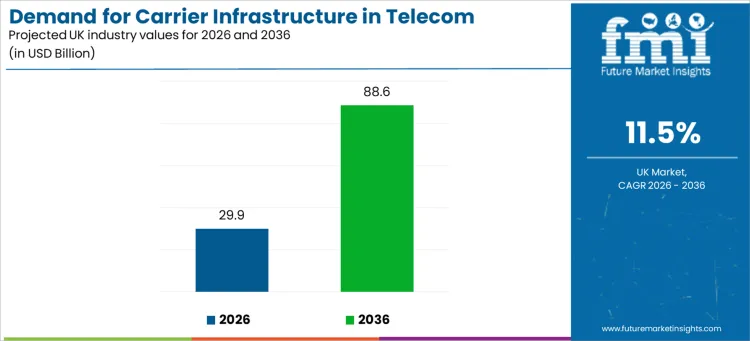
Demand for carrier infrastructure in telecom applications in the UK is likely to be valued at USD 29.9 billion in 2026 and is projected to reach USD 88.6 billion by 2036, reflecting an 11.5% CAGR. This demand is anchored in rising expectations for uninterrupted connectivity across consumer, enterprise, and public service environments. Network performance has become a baseline requirement tied to daily economic activity rather than a differentiating feature.
Carrier infrastructure investment is shaped by sustained growth in data traffic, latency sensitivity, and service reliability requirements. UK operators prioritize backbone capacity, access network densification, and resilient core architectures to support mobile broadband, fixed connectivity, and emerging edge-enabled workloads. Infrastructure choices emphasize long asset life, scalability, and predictable performance under peak load conditions. Equipment selection and network design focus on throughput stability, fault tolerance, and integration across multi-generation network layers.
Operational discipline reinforces continued demand. Service providers align infrastructure upgrades with long-term coverage obligations, spectrum utilization strategies, and service-level commitments. Enterprise connectivity needs linked to cloud usage, industrial connectivity, and real-time data exchange place additional pressure on transport and routing layers. Demand strength reflects the role of carrier infrastructure as foundational capital supporting service continuity, regulatory compliance, and future network evolution rather than short-cycle technology refresh.
Quick Stats for Carrier Infrastructure in Telecom Applications Industry in the UK
- Carrier Infrastructure in Telecom Applications Industry Value (2026): USD 29.9 billion
- Carrier Infrastructure in Telecom Applications Industry Forecast Value (2036): USD 88.6 billion
- Carrier Infrastructure in Telecom Applications Industry Forecast CAGR 2026 to 2036: 11.5%
- Leading Technology by Demand Share: 2G
- Fastest-Growing Regions: England, Scotland, Wales, Northern Ireland
- Key Industry Participants: Ericsson AB, Nokia Corporation, Samsung Electronics, Cisco Systems, Huawei Technologies
Carrier Infrastructure in Telecom Applications Industry in the UK Key Takeaways
| Metric | Value |
|---|---|
| Industry Value (2026) | USD 29.9 billion |
| Industry Forecast Value (2036) | USD 88.6 billion |
| Forecast CAGR (2026 to 2036) | 11.5% |
Why is the UK Building Steady Demand for Carrier Infrastructure in Telecom Applications?
Demand for carrier infrastructure in telecom applications across the UK strengthens as connectivity expectations rise among consumers and enterprises. Users now expect seamless high-speed data access at homes, workplaces and transit hubs, which pushes service providers to upgrade backbone networks and radio access layers. This drives investment in fibre rollout, densification of mobile sites and enhanced core network elements that handle escalating traffic volumes.
Regulatory and spectrum allocation frameworks within the UK encourage network expansion and technology refresh cycles. Operators seek to leverage new spectrum bands to boost capacity and improve coverage in urban and rural regions. Government initiatives that support nationwide gigabit connectivity targets propel carriers to accelerate infrastructure deployments, especially where private investment alone might lag. These frameworks shape operator strategies and signal ongoing infrastructure demand.
Service providers also respond to enterprise requirements for reliable, low-latency connectivity. Industries such as finance, manufacturing and logistics increasingly adopt Internet-of-Things applications and edge computing, which rely on robust carrier networks with scalable backhaul and resilient core routing. This influences procurement of switches, routers, optical transport equipment and edge nodes. Focus on performance and resilience drives continued uptake of carrier infrastructure components within the UK telecom environment.
How is Carrier Infrastructure Demand Segmented by Technology, End User, and Component in the UK?
Demand for carrier infrastructure in telecom applications across the UK reflects how network owners prioritise coverage continuity, service reliability, and lifecycle control across legacy and advanced networks. Segmentation patterns follow traffic management needs, regulatory obligations, and operational dependence on long-lived infrastructure assets.
Why does 2G remain the most represented technology layer?
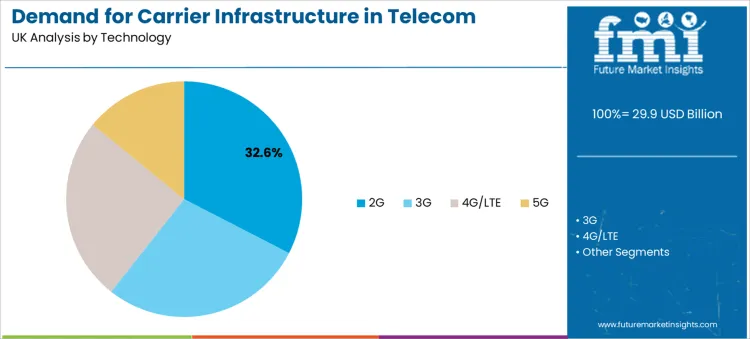
2G accounts for a 32.6% share, indicating continued reliance on legacy network layers. This persistence is linked to machine-to-machine connectivity, voice fallback requirements, and wide-area coverage where low data throughput remains sufficient. Many industrial systems, emergency services, and utility monitoring deployments still depend on 2G due to device longevity and proven stability.
Operators retain 2G infrastructure to avoid service disruption across installed bases that are costly to replace. Maintenance-focused investment supports uptime and compliance rather than capacity expansion, keeping 2G relevant within multi-generation network stacks.
What keeps telecom operators as the dominant end users?
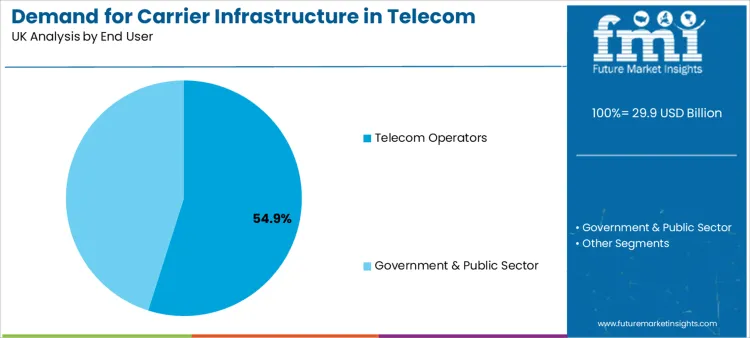
Telecom operators represent a 54.9% share, reflecting their central role in owning, upgrading, and maintaining carrier-grade infrastructure. These organisations manage spectrum assets, transmission networks, and access layers that require continuous performance assurance. Infrastructure decisions are shaped by traffic forecasting, service-level commitments, and regulatory coverage expectations.
Operators also coordinate integration across radio, core, and transport layers, which places infrastructure control at the centre of their operational strategy. Long planning cycles and capital discipline reinforce their position as the primary demand drivers.
Why do services account for the largest component share?
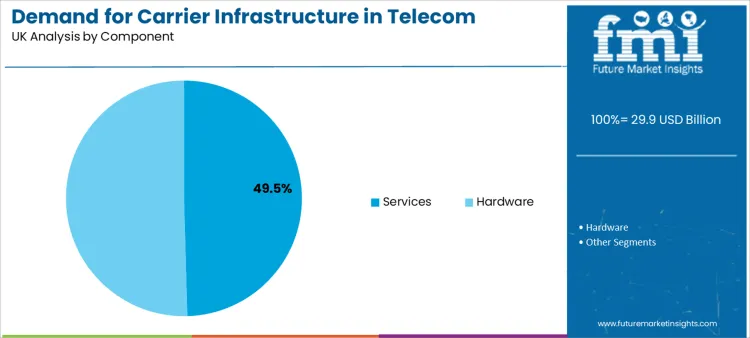
Services hold a 49.5% share, highlighting reliance on deployment, integration, and ongoing network support activities. Carrier infrastructure demands continuous optimisation, fault management, and upgrade coordination across live networks. Service engagements support software updates, capacity tuning, and interoperability checks across mixed-generation environments.
Operational teams depend on specialised service expertise to maintain performance consistency while managing complex vendor ecosystems and evolving technical standards.
What are the Key Dynamics in Demand for Carrier Infrastructure in Telecom Applications in the UK?
Demand for carrier infrastructure in the UK is influenced by network capacity expansion, service quality expectations, and regulatory requirements for ubiquitous connectivity. Mobile network operators (MNOs), fixed broadband providers, and enterprise communication carriers prioritize infrastructure that supports peak data throughput, low latency, and dependable coverage across urban and rural areas. Investment patterns reflect rollout of 5G mobile networks, fibre-to-the-premises (FTTP) broadband, and backbone upgrades that accommodate bandwidth growth from video streaming, cloud services, and IoT traffic.
How do technology upgrades and regulatory priorities drive adoption?
Technology upgrade cycles, especially 5G deployment and next-generation broadband expansion, significantly influence infrastructure demand in the UK. Operators are extending macrocell and small cell sites to densify coverage and support high-capacity use cases such as real-time video, AR/VR applications, and mission-critical services. Fibre infrastructure investment, covering both long-haul backhaul and local access links, responds to consumer and business demand for ultra-fast, symmetrical broadband services. Government and regulator policies promoting digital access and telecom competition shape carrier decisions on where to expand infrastructure, particularly in underserved regions.
How do cost pressures and geographic challenges influence demand patterns?
Cost pressures and geographic variability in deployment complexity influence how carrier infrastructure demand materializes across the UK. Dense urban centres often justify investment in fibre, small cells, and distributed antenna systems because of high subscriber density and strong traffic growth, while rural and semi-urban areas present a weaker commercial case without subsidy or shared infrastructure models. Permitting and planning requirements affect timelines and deployment costs for new sites, especially for macrocells and fibre trenches in historic or protected areas. Supply chain conditions for critical components such as optical fibre, radio equipment, and power systems affect budget planning and rollout sequencing, with global sourcing dynamics influencing delivery schedules.
How is Carrier Infrastructure in Telecom Applications Demand Evolving across Key Regions in the UK?
Demand for carrier infrastructure in telecom applications across the UK advances as operators expand fibre density, 5G backhaul, and network resilience. Regional variation reflects rollout intensity, urban density, capital prioritization, and how infrastructure upgrades align with coverage targets and service quality commitments.
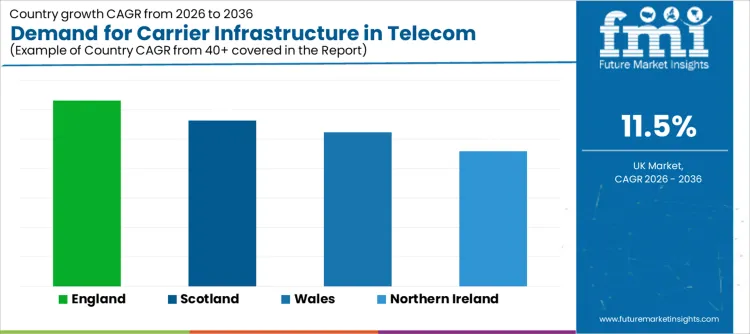
| Region | CAGR 2026 to 2036 |
|---|---|
| England | 12.6% |
| Scotland | 11.2% |
| Wales | 10.4% |
| Northern Ireland | 9.2% |
Why is England leading expansion through dense rollout programmes and capacity upgrades?
England grows at 12.6%, supported by intensive fibre deployment, urban 5G backhaul needs, and ongoing core network upgrades. Demand rises where operators scale transport capacity to support higher data loads and low-latency services. Infrastructure investment focuses on fibre routes, aggregation nodes, and power redundancy that sustain performance across high-traffic metropolitan and enterprise corridors.
How is Scotland progressing through targeted upgrades and regional coverage expansion?
Scotland expands at 11.2%, shaped by focused investment in backbone connectivity and regional coverage extension. Operators prioritise strengthening long-haul fibre links and upgrading access infrastructure to support mobile and fixed convergence. Demand builds where network planners address geographic dispersion while maintaining service reliability across urban centres and remote communities.
What is shaping Wales as operators balance rollout pace with deployment efficiency?
Wales advances at 10.4%, driven by structured infrastructure expansion aligned with coverage improvement goals. Demand strengthens when deployment strategies emphasise cost-efficient fibre builds and shared infrastructure models. Operators focus on improving backhaul robustness and access capacity while managing installation complexity across mixed urban and semi-rural environments.
Why is Northern Ireland showing measured growth tied to selective capacity investments?
Northern Ireland records 9.2% growth, reflecting selective capacity investments and phased infrastructure upgrades. Operators concentrate on reinforcing critical network segments that support mobile data growth and enterprise connectivity. Demand improves when projects deliver clear gains in network stability, latency control, and service continuity within defined rollout zones.
What Defines the Competitive Landscape for Carrier Infrastructure in Telecom Applications in the UK?
UK carrier infrastructure demand is shaped by 5G densification, fiber expansion, spectrum refarming, and resilience requirements across national networks. Operators evaluate radio performance, energy efficiency, software upgradability, interoperability, and long-term total cost ownership. Assessment includes security assurances, supply continuity, open interface support, and readiness for cloud-native network functions. Procurement behavior favors multi-vendor strategies, staged modernization, and vendors providing roadmap transparency and local support. Trend in the UK industry reflects accelerated 5G standalone adoption alongside fiber backhaul and edge compute integration.
Ericsson holds leading positioning through extensive 5G radio deployments, software-driven upgrades, and strong relationships with UK operators. Nokia competes with cloud-native core solutions, advanced optical transport, and growing traction in open network architectures. Samsung Electronics supports demand via energy-efficient radios and competitive 5G solutions tailored for dense urban rollouts. Cisco Systems remains relevant across IP routing, transport, and network automation supporting carrier-grade scalability. Huawei and ZTE participate under constrained conditions, influencing cost benchmarks and feature competition where permitted.
Key Industry Participants
- Ericsson AB
- Huawei Technologies Co., Ltd.
- Nokia Corporation
- ZTE Corporation
- Cisco Systems, Inc.
- Samsung Electronics Co., Ltd.
Scope of Report
| Items | Values |
|---|---|
| Quantitative Units | USD billion |
| Technology | 2G; 3G; 4G/LTE; 5G |
| End User | Telecom Operators; Government & Public Sector |
| Component | Services; Hardware |
| Regions Covered | England; Scotland; Wales; Northern Ireland |
| Key Companies Profiled | Ericsson AB; Huawei Technologies Co., Ltd.; Nokia Corporation; ZTE Corporation; Cisco Systems, Inc.; Samsung Electronics Co., Ltd. |
Carrier Infrastructure in Telecom Applications Demand in the UK by Segments
Technology:
- 2G
- 3G
- 4G/LTE
- 5G
End User:
- Telecom Operators
- Government & Public Sector
Component:
- Services
- Hardware
By Region:
- England
- Scotland
- Wales
- Northern Ireland
Bibliography
- Office of Communications. (2024). Connected nations 2024: UK telecom infrastructure and network performance. Ofcom.
- Department for Science, Innovation & Technology. (2024). UK digital connectivity strategy: Gigabit broadband and 5G deployment. UK Government.
- GSMA Intelligence. (2024). Mobile infrastructure evolution in advanced telecom markets. GSM Association.
- Cisco Systems, Inc. (2023). Global networking trends and carrier infrastructure evolution. Cisco Technical White Paper.
- Ericsson AB. (2024). Mobility report: Network infrastructure requirements for 5G standalone. Ericsson.
Frequently Asked Questions
How big is the demand for carrier infrastructure in telecom applications in the uk in 2026?
The demand for carrier infrastructure in telecom applications in the uk is estimated to be valued at USD 29.9 billion in 2026.
What will be the size of carrier infrastructure in telecom applications in the uk in 2036?
The market size for the carrier infrastructure in telecom applications in the uk is projected to reach USD 88.6 billion by 2036.
How much will be the demand for carrier infrastructure in telecom applications in the uk growth between 2026 and 2036?
The demand for carrier infrastructure in telecom applications in the uk is expected to grow at a 11.5% CAGR between 2026 and 2036.
What are the key product types in the carrier infrastructure in telecom applications in the uk?
The key product types in carrier infrastructure in telecom applications in the uk are 2g, 3g, 4g/lte and 5g.
Which end user segment is expected to contribute significant share in the carrier infrastructure in telecom applications in the uk in 2026?
In terms of end user, telecom operators segment is expected to command 54.9% share in the carrier infrastructure in telecom applications in the uk in 2026.
Preview the report firsthand - request a free sample
Get SampleGet the brochure for pricing and purchase details.
Get PDFTable of Content
- Executive Summary
- UK Market Outlook
- Demand-side Trends
- Supply-side Trends
- Technology Roadmap Analysis
- Analysis and Recommendations
- Market Overview
- Market Coverage / Taxonomy
- Market Definition / Scope / Limitations
- Market Background
- Market Dynamics
- Drivers
- Restraints
- Opportunity
- Trends
- Scenario Forecast
- Demand in Optimistic Scenario
- Demand in Likely Scenario
- Demand in Conservative Scenario
- Opportunity Map Analysis
- Product Life Cycle Analysis
- Supply Chain Analysis
- Investment Feasibility Matrix
- Value Chain Analysis
- PESTLE and Porter’s Analysis
- Regulatory Landscape
- Regional Parent Market Outlook
- Production and Consumption Statistics
- Import and Export Statistics
- Market Dynamics
- UK Market Analysis 2021 to 2025 and Forecast, 2026 to 2036
- Historical Market Size Value (USD Million) Analysis, 2021 to 2025
- Current and Future Market Size Value (USD Million) Projections, 2026 to 2036
- Y-o-Y Growth Trend Analysis
- Absolute $ Opportunity Analysis
- UK Market Pricing Analysis 2021 to 2025 and Forecast 2026 to 2036
- UK Market Analysis 2021 to 2025 and Forecast 2026 to 2036, By Technology
- Introduction / Key Findings
- Historical Market Size Value (USD Million) Analysis By Technology , 2021 to 2025
- Current and Future Market Size Value (USD Million) Analysis and Forecast By Technology , 2026 to 2036
- 2G
- 3G
- 4G/LTE
- 5G
- 2G
- Y-o-Y Growth Trend Analysis By Technology , 2021 to 2025
- Absolute $ Opportunity Analysis By Technology , 2026 to 2036
- UK Market Analysis 2021 to 2025 and Forecast 2026 to 2036, By End User
- Introduction / Key Findings
- Historical Market Size Value (USD Million) Analysis By End User, 2021 to 2025
- Current and Future Market Size Value (USD Million) Analysis and Forecast By End User, 2026 to 2036
- Telecom Operators
- Government & Public Sector
- Telecom Operators
- Y-o-Y Growth Trend Analysis By End User, 2021 to 2025
- Absolute $ Opportunity Analysis By End User, 2026 to 2036
- UK Market Analysis 2021 to 2025 and Forecast 2026 to 2036, By Component
- Introduction / Key Findings
- Historical Market Size Value (USD Million) Analysis By Component, 2021 to 2025
- Current and Future Market Size Value (USD Million) Analysis and Forecast By Component, 2026 to 2036
- Services
- Hardware
- Services
- Y-o-Y Growth Trend Analysis By Component, 2021 to 2025
- Absolute $ Opportunity Analysis By Component, 2026 to 2036
- Market Structure Analysis
- Competition Dashboard
- Competition Benchmarking
- Market Share Analysis of Top Players
- By Regional
- By Technology
- By End User
- By Component
- Competition Analysis
- Competition Deep Dive
- Ericsson AB
- Overview
- Product Portfolio
- Profitability by Market Segments (Product/Age /Sales Channel/Region)
- Sales Footprint
- Strategy Overview
- Marketing Strategy
- Product Strategy
- Channel Strategy
- Huawei Technologies Co., Ltd.
- Nokia Corporation
- ZTE Corporation
- Cisco Systems, Inc.
- Samsung Electronics Co., Ltd.
- Ericsson AB
- Competition Deep Dive
- Assumptions & Acronyms Used
- Research Methodology


