

- Industry Size (2026)
- USD 115.5 Bn
- Forecast (2036)
- USD 143.6 Bn
- CAGR (2026 to 2036)
- 2.2%
Demand for Beer in USA Market Size, Market Forecast and Outlook By FMI
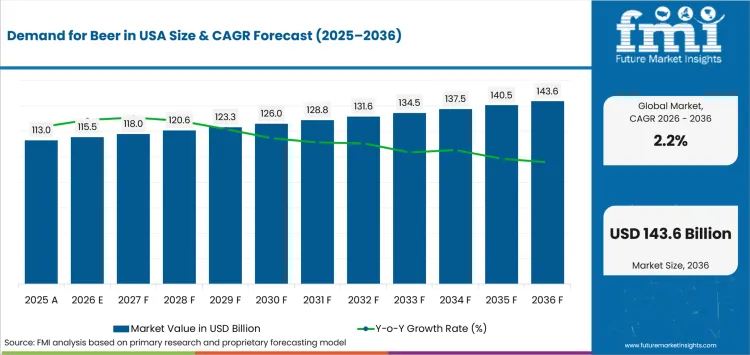
The demand for beer in usa market was valued at USD 289.00 billion in 2025, projected to reach USD 115.5 billion in 2026, and is forecast to expand to USD 143.6 billion by 2036 at a 2.2% CAGR. As per FMI, sustained purchasing patterns across multiple end-use channels and a widening distributor base are reinforcing steady volume throughput over the forecast horizon. Procurement cycles tied to contractual supply agreements continue to anchor repeat purchase activity, keeping baseline revenue flows predictable for established suppliers.
Summary of Demand for Beer in USA Market
- Market Overview
- The market is projected to reach USD 143.6 billion by 2036.
- The industry is expected to grow at a 2.2% CAGR from 2026 to 2036.
- The market is a volume-intensive, excise-regulated consumer beverage category shaped by premiumization cycles, three-tier distribution economics, and state-level licensing frameworks.
- Demand and Growth Drivers
- Premiumization across both on-premise and off-premise channels is shifting revenue mix toward higher-margin craft and specialty segments.
- Taproom and direct-to-consumer models in Western states are creating new revenue streams outside the traditional three-tier distribution system.
- Population growth in Sun Belt states is expanding the total addressable retail footprint for beer distribution.
- Among key regions, West at 8% CAGR, South at 7.1% CAGR, Northeast at 6.4% CAGR, Midwest at 5.5% CAGR.
- Product and Segment View
- The market covers lager, ale, stout, and specialty beer products distributed through retail, on-premise, and direct-to-consumer channels across macro, craft, and micro production scales.
- Lager leads by Product Type with 45.0% share in 2026.
- Bottle leads by Packaging with 42.0% share in 2026.
- The scope includes packaged beer for retail and on-premise consumption, excluding non-alcoholic beer, hard seltzer, and malt-based flavored beverages.
- Geography and Competitive Outlook
- West leads at 8% CAGR, driven by craft brewery concentration in California, Oregon, and Colorado.
- Midwest retains a stable consumption base anchored by macro-brewery brand loyalty and lower price points.
- Competition is concentrated among major brewers with established distribution networks, with key players including Anheuser-Busch InBev, Heineken N.V., China Resources Beer, Carlsberg Group, Molson Coors Beverage Company.
An absolute dollar opportunity of USD 293.14 billion over the forecast period reflects the combined momentum from premiumization trends, expanding craft beer penetration, and the evolving on-premise consumption landscape. FMI analysts observe that distributor consolidation is reshaping the three-tier system, with large wholesalers commanding pricing leverage across both national and regional brands. Excise tax structures at the state level continue to create uneven cost burdens, influencing where breweries allocate expansion capital.
Regional consumption patterns across the United States reflect divergent regulatory environments, demographic shifts, and on-premise density. West at 8%, South at 7.1%, Northeast at 6.4%, Midwest at 5.5%. The West records the highest growth rate, driven by a dense concentration of craft breweries in states like California, Oregon, and Colorado, where taproom culture and direct-to-consumer sales models fuel premium volume. Southern markets benefit from population growth and expanding retail alcohol licensing. Midwestern states maintain a steady base of macro-brewery consumption tied to long-established brand loyalty and lower average price points.
Demand for Beer in USA Market Key Takeaways
| Metric | Details |
|---|---|
| Industry Size (2026) | USD 115.5 billion |
| Industry Value (2036) | USD 143.6 billion |
| CAGR (2026-2036) | 2.2% |
Source: Future Market Insights, 2026
Demand for Beer in USA Market Definition
Beer represents an alcoholic beverage produced through the fermentation of cereal grains, primarily malted barley, with hops, water, and yeast. The category encompasses lagers, ales, stouts, and specialty varieties distributed through retail off-premise outlets, on-premise establishments, and direct-to-consumer channels. Production scales range from macro-brewery operations serving national distribution networks to craft and microbrewery facilities serving regional and local markets. Pricing and distribution are governed by the three-tier regulatory framework and state-level excise tax structures.
Demand for Beer in USA Market Inclusions
Market scope includes packaged lager, ale, stout, and specialty beer products for retail and on-premise consumption. The scope covers macro-brewery, craft brewery, and microbrewery production scales distributed through hypermarkets, convenience stores, online retailers, specialty stores, and independent retailers.
Demand for Beer in USA Market Exclusions
The scope excludes non-alcoholic beer, hard seltzer, malt-based flavored beverages, cider, and wine. Home brewing equipment and ingredients sold to individual consumers are also excluded from the market valuation.
Demand for Beer in USA Market Research Methodology
- Primary Research: Analysts conducted structured interviews with procurement managers, distribution executives, and category specialists to map purchasing decision criteria, contract renewal cycles, and supplier qualification processes.
- Desk Research: Data collection aggregated publicly available trade statistics, regulatory filings, industry association reports, and company financial disclosures to establish baseline market parameters.
- Market-Sizing and Forecasting: Baseline values derive from a bottom-up aggregation of trade volumes, applying category-specific growth coefficients and regional penetration rates to project forward demand trajectories.
- Data Validation and Update Cycle: Projections are cross-checked against reported company revenues, trade body statistics, and periodic primary research updates to maintain forecast accuracy.
What Is Driving the Demand for Beer in the USA?
The demand for beer in the USA has been built on long standing social habits, broad retail availability, and large scale domestic brewing capacity. Historically, beer served as the default alcoholic beverage for casual consumption due to its affordability, wide flavor neutrality, and strong presence in sports, dining, and regional traditions. Large breweries established national distribution networks that made beer accessible across convenience stores, supermarkets, bars, and entertainment venues. On premise consumption in restaurants and stadiums reinforced its role in social gatherings. Seasonal patterns such as summer grilling, holidays, and sporting calendars sustained predictable consumption cycles. This wide cultural integration created a stable base of recurring demand across multiple age groups and income segments.
Future demand for beer in the USA will be shaped by changing consumer preferences rather than volume driven expansion. Younger adults are drinking less frequently and experimenting across spirits, ready to drink beverages, and alcohol free options. Traditional mass market beer faces pressure as premium, craft, flavored, and low alcohol offerings capture greater interest. Health awareness, calorie sensitivity, and moderation trends are influencing both product formulation and serving occasions. At the same time, economic pressure affects discretionary spending on alcoholic beverages. Barriers include regulatory controls, shifting social attitudes, and competition from alternative beverage categories. The beer sector will continue to evolve through product positioning, premiumization, and diversification rather than broad growth in total consumption.
How Are Product Type and Packaging Structuring the Demand for Beer in USA?
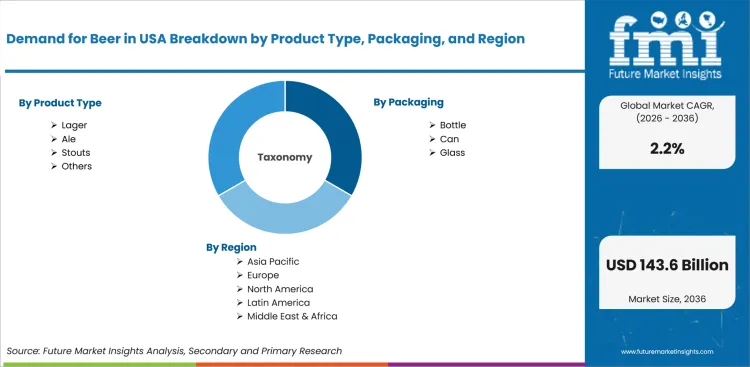
The demand for beer in the USA is structured by product type and packaging format. Lager accounts for 45% of total demand, followed by ale, stouts, and other specialty variants. By packaging, bottles represent 42.0% of total consumption, followed by cans, glass-based specialty formats, and other packaging types. Demand patterns are shaped by taste preferences, alcohol strength expectations, shelf life, portability, and retail distribution efficiency. These segments reflect how consumption occasions, storage conditions, and on-premise versus off-premise purchasing continue to influence beer demand patterns across different consumer groups in the USA.
Why Does Lager Lead the Product Type Demand for Beer in USA?
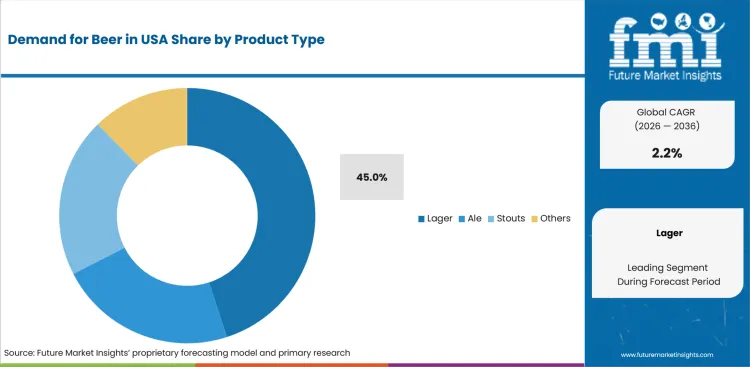
Lager accounts for 45% of total beer demand in the USA due to its mild flavor profile, low bitterness, and broad drinkability across age groups. Its clean finish supports frequent consumption in social settings such as sports events, casual dining, and large gatherings. Lagers perform strongly across supermarkets, convenience stores, bars, and restaurants. The style aligns well with warm-weather consumption patterns and high-volume sales environments. Consistency in taste also supports brand loyalty across national and regional consumer bases.
Lager production is supported by established large-scale brewing infrastructure that allows efficient batch processing and stable quality control. Brewing economics favor lagers due to predictable fermentation cycles and high output efficiency. Wide availability across economy, mainstream, and premium tiers supports large market coverage. National distribution networks prioritize lager inventory due to steady turnover rates. These production scale, distribution strength, and consumption frequency factors together sustain lager as the leading product type within the USA beer industry.
Why Do Bottles Dominate the Packaging Demand for Beer in USA?
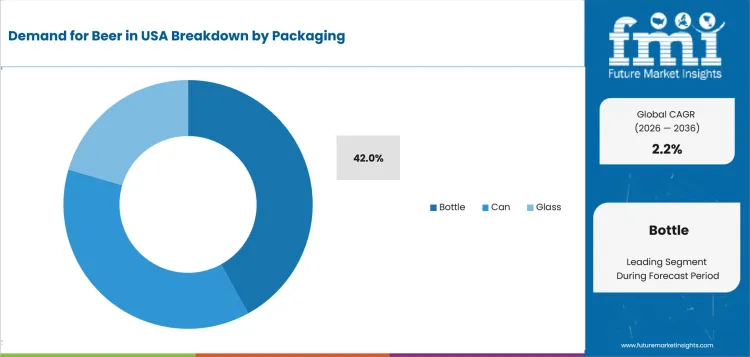
Bottle packaging accounts for 42.0% of total beer demand in the USA due to its extensive use across retail and hospitality environments. Bottles provide strong protection for carbonation and flavor stability when stored under controlled conditions. Their form factor supports standardized single-serve portions commonly used in bars and restaurants. Bottles remain widely accepted across both mass-produced and craft beer categories. Their durability during handling and transport supports long-distance distribution across national beverage supply chains.
Bottles also provide strong branding advantages through label design, embossing, and glass color variation. Hospitality venues favor bottles for portion control, inventory tracking, and consistent serving presentation. Glass recycling infrastructure across many states supports recovery and reuse programs. Premium and imported beers continue to rely heavily on bottle formats to convey quality perception. These handling, branding, recycling, and service-related advantages sustain bottles as the dominant packaging format for beer consumption in the USA.
What Forces Are Driving the Demand for Beer in the USA?
Demand for beer in the USA is driven by deep cultural integration, broad availability across retail and foodservice, and strong social consumption patterns tied to sporting events, dining, and entertainment. Beer remains the most widely consumed alcoholic beverage by volume due to its price accessibility and session drinking appeal. Large-scale distribution through supermarkets, convenience stores, and on-premise outlets sustains continuous movement. Seasonal events such as summer travel, holidays, and festivals reinforce peak demand cycles. The category also benefits from consistent mainstream consumption that cushions volatility seen in higher-priced alcoholic segments.
How Do Consumer Preferences and Product Segmentation Shape Beer Demand in the USA?
Beer demand in the USA is shaped by a wide segmentation between light lagers, craft beers, imports, flavored malt beverages, and non-alcoholic beer. Light beer dominates high-volume consumption due to calorie awareness and broad social use. Craft beer maintains strong regional loyalty tied to local brewing identity and taproom culture. Flavored and fruit-infused beers attract younger demographics seeking sweeter profiles. Non-alcoholic beer adoption grows among health-focused consumers and designated drivers. These layered preferences create a diversified demand base rather than reliance on a single dominant beer style.
What Economic, Health, and Regulatory Factors Restrain Beer Consumption Growth?
Beer consumption growth in the USA faces pressure from alcohol moderation trends, rising health awareness, and competition from spirits, wine, and ready-to-drink cocktails. Inflation in packaging, distribution, and raw materials narrows promotional flexibility at retail. State-level alcohol regulations, taxation structures, and distribution controls affect pricing and availability across regions. Younger consumers show greater interest in wellness-oriented beverages and functional alternatives. These economic, regulatory, and behavioral factors do not collapse beer demand, but they limit rapid consumption growth compared with prior decades.
How Are Craft Innovation, Low-Alcohol Formats, and Direct-to-Consumer Trends Reshaping Demand?
Beer demand in the USA is evolving through experimentation in flavor profiles, brewing methods, and alcohol content. Craft brewers focus on hazy IPAs, sour beers, barrel-aged styles, and small-batch seasonal releases to maintain engagement. Low-alcohol and alcohol-free beers gain space in retail and foodservice menus as social norms shift toward moderation. Taproom-based direct sales and brewery-led events enhance brand loyalty. Packaging shifts toward slim cans and variety packs to match modern consumption habits. These trends show beer demand moving toward diversification rather than purely volume expansion.
What is the Demand for Beer in USA by Region?
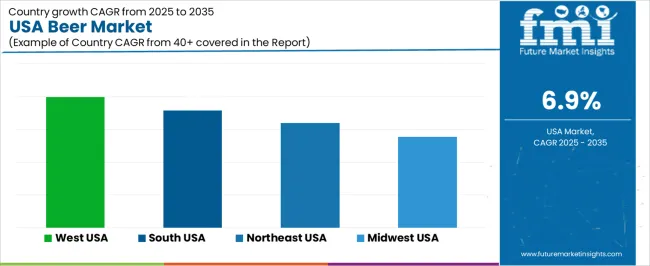
| Region | CAGR (%) |
|---|---|
| West | 8.0% |
| South | 7.1% |
| Northeast | 6.4% |
| Midwest | 5.5% |
The demand for beer in the USA shows steady regional variation, with the West leading at an 8.0% CAGR. This growth is supported by strong craft beer culture, expanding premium and flavored beer segments, and high consumption across urban centers and tourism-driven markets. The South follows at 7.1%, driven by population growth, rising disposable income, and expanding retail and on-premise beer sales. The Northeast records 6.4% growth, supported by a mature beer consumption base, strong presence of craft breweries, and steady demand from restaurants and sports venues. The Midwest shows the slowest growth at 5.5%, reflecting a more stable and traditional beer market with slower shifts toward premium and specialty beer categories.
What is Driving Beer Demand Growth in the West Region of USA?
Expansion in the West reflects a CAGR of 8.0% through 2036 for beer demand, supported by strong craft brewery concentration, lifestyle consumption patterns, and high tourism driven on premise sales. California, Oregon, and Washington maintain dense networks of microbreweries that sustain premium and specialty beer volumes. Outdoor recreation culture supports steady off premise retail demand. Urban populations favor low alcohol, flavored, and experimental beer styles. Distribution remains diversified across taprooms, convenience retail, and direct to consumer channels, sustaining consistent demand across premium and mass market beer categories.
- Craft breweries drive premium volume growth
- Tourism supports steady on premise beer sales
- Outdoor lifestyle sustains off premise consumption
- Experimental beer styles gain higher regional acceptance
How is the South Supporting Beer Demand in USA?
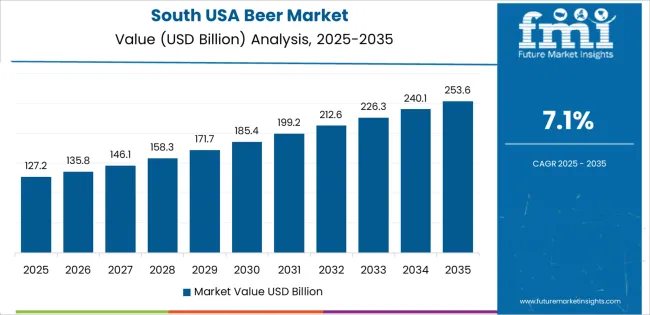
The South advances at a CAGR of 7.1% through 2036 for beer demand, driven by population growth, strong sports culture, and expanding casual dining and entertainment venues. Warm climate conditions sustain year round beer consumption across social gatherings and foodservice outlets. Large scale breweries maintain high capacity production to serve mass market lagers and flavored malt beverages. College towns and festival driven tourism support seasonal demand surges. Retail distribution remains anchored by convenience stores and large format beverage outlets across expanding suburban and semi urban markets.
- Warm climate supports year round consumption
- Sports and entertainment venues drive on premise sales
- Mass market lagers dominate volume contribution
- Suburban retail expansion improves distribution reach
Why is Beer Demand Rising Steadily in the Northeast Region of USA?
The Northeast records a CAGR of 6.4% through 2036 for beer demand, shaped by strong urban bar culture, established regional breweries, and consistent demand for imported and craft beer styles. Seasonal tourism, especially in coastal and city destinations, adds steady incremental consumption. Higher disposable income supports premium beer purchasing across metropolitan consumers. Cold winters concentrate beer consumption into indoor hospitality settings. Demand remains brand and style driven rather than volume led, with steady reorder cycles across bars, restaurants, and specialty liquor retail formats.
- Urban bar culture sustains consistent beer turnover
- Premium imports and craft styles drive value growth
- Seasonal tourism supports incremental demand uplift
- Indoor hospitality anchors winter consumption volumes
What is Influencing Beer Demand in the Midwest Region of USA?
The Midwest expands at a CAGR of 5.5% through 2036 for beer demand, supported by longstanding regional breweries, strong sports viewership culture, and steady packaged beer consumption. Lager remains the dominant category supported by high volume retail sales. Community events and local festivals maintain seasonal demand spikes. Rural and semi urban retail networks contribute steady off premise consumption. Demand remains volume driven rather than premium driven, with purchasing behavior shaped by price sensitivity and brand loyalty across regional beer consumers.
- Regional lager brands anchor core consumption
- Community events support seasonal demand spikes
- Off premise retail dominates sales channels
- Price sensitivity influences brand selection patterns
What Is Driving the Demand for Beer in USA and Who Are the Key Players Shaping the Industry?
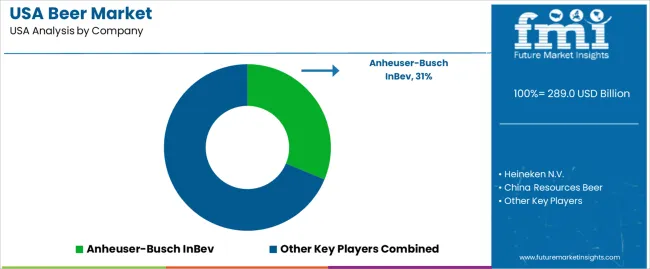
Demand for beer in the USA reflects a mix of long standing cultural habits, evolving consumer preferences, and shifting market trends. Beer remains a go to beverage for socializing, casual dining, sport events, and gatherings. Despite some decline in overall volume in recent years, a significant portion of consumers continue to drink beer weekly, supporting baseline demand. Interest in variety-craft beers, imports, lagers, low alcohol options, and premium brands-drives manufacturers to offer diverse styles, packaging, and pricing. Changing lifestyle patterns, including home consumption and convenience retail growth, support consistent beer demand even when on premise sales fluctuate.
Major global and multinational brewers shape the USA beer market landscape. Anheuser Busch InBev remains a dominant force with a strong footprint, supported by popular brands across price segments. Heineken N.V. and Molson Coors Beverage Company contribute through both domestic and imported beer portfolios, targeting both mainstream and niche segments. Carlsberg Group and China Resources Beer also supply imported and international style beers, catering to diverse consumer tastes. These firms influence market direction through brand strength, production and distribution scale, and ability to adapt portfolios to emerging trends such as premiumization, imports, and alternative beer styles.
Key Players in Beer Industry in USA
- Anheuser-Busch InBev
- Heineken N.V.
- China Resources Beer
- Carlsberg Group
- Molson Coors Beverage Company
Scope of the Report
| Metric | Value |
|---|---|
| Quantitative Units | USD 115.5 billion to USD 143.6 billion, at a CAGR of 2.2% |
| Market Definition | Beer encompasses fermented cereal grain beverages including lager, ale, and stout categories distributed through retail, on-premise, and direct channels. |
| Segmentation | Product Type: Lager, Ale, Stouts, Others; Packaging: Bottle, Can, Glass, Others; Production: Macro-brewery, Craft Brewery, Microbrewery, Other; Distribution Channel: Hypermarkets/Supermarkets, Convenience Stores, Online Retailers, Specialty Stores, Independent Retailers, Direct, Indirect |
| Regions Covered | West, South, Northeast, Midwest |
| Key Companies Profiled | Anheuser-Busch InBev, Heineken N.V., China Resources Beer, Carlsberg Group, Molson Coors Beverage Company |
| Forecast Period | 2026 to 2036 |
| Approach | Forecasting models apply a bottom-up methodology starting from trade volume baselines, applying category-specific growth coefficients and cross-validating against reported company financials and trade statistics. |
Beer Industry in USA Segmentation
Product Type:
- Lager
- Ale
- Stouts
- Others
Packaging:
- Bottle
- Can
- Glass
- Others
Production:
- Macro-brewery
- Craft Brewery
- Microbrewery
- Other
Distribution Channel:
- Hypermarkets/Supermarkets
- Convenience Stores
- Online Retailers
- Specialty Stores
- Independent Retailers
- Direct
- Indirect
Region:
- Northeast USA
- West USA
- Midwest USA
- South USA
Bibliography
- Alcohol and Tobacco Tax and Trade Bureau. (2025). Statistical Report: Beer. USA Department of the Treasury.
- Brewers Association. (2025). National Beer Sales and Production Data. Brewers Association.
- National Beer Wholesalers Association. (2024). Industry Overview and Economic Impact Study. NBWA.
- USA Department of the Treasury. (2024). Federal Excise Tax Rates on Beer. TTB.
- Organisation for Economic Co-operation and Development. (2024). OECD Health Statistics: Alcohol Consumption. OECD.
This bibliography is provided for reader reference. The full Future Market Insights report contains the complete reference list with primary research documentation.
Frequently Asked Questions
How large is the demand for beer in usa market in 2026?
The demand for beer in usa market is estimated to be valued at USD 115.5 billion in 2026.
What will be the market size of demand for beer in usa by 2036?
Market size for demand for beer in usa is projected to reach USD 143.6 billion by 2036.
What is the expected CAGR for demand for beer in usa between 2026 and 2036?
The demand for beer in usa market is expected to grow at a CAGR of 2.2% between 2026 and 2036.
Which product type segment is poised to lead in 2026?
Lager accounts for 45.0% share in 2026, making it the leading product type segment.
Which packaging segment holds a leading position?
Bottle holds 42.0% share in 2026, commanding the leading position by packaging.
Which region records the highest growth rate?
West records the highest CAGR at 8% during 2026 to 2036.
What is included in the scope of this report?
Market scope includes packaged lager, ale, stout, and specialty beer products for retail and on-premise consumption. The scope covers macro-brewery, craft brewery, and microbrewery production scales d.
What is excluded from the scope of this report?
The scope excludes non-alcoholic beer, hard seltzer, malt-based flavored beverages, cider, and wine. Home brewing equipment and ingredients sold to individual consumers are also excluded from the mark.
Preview the report firsthand - request a free sample
Get SampleGet the brochure for pricing and purchase details.
Get PDFTable of Content
- Executive Summary
- USA Market Outlook
- Demand-side Trends
- Supply-side Trends
- Technology Roadmap Analysis
- Analysis and Recommendations
- Market Overview
- Market Coverage / Taxonomy
- Market Definition / Scope / Limitations
- Research Methodology
- Chapter Orientation
- Analytical Lens and Working Hypotheses
- Market Structure, Signals, and Trend Drivers
- Benchmarking and Cross-market Comparability
- Market Sizing, Forecasting, and Opportunity Mapping
- Research Design and Evidence Framework
- Desk Research Programme (Secondary Evidence)
- Company Annual and Sustainability Reports
- Peer-reviewed Journals and Academic Literature
- Corporate Websites, Product Literature, and Technical Notes
- Earnings Decks and Investor Briefings
- Statutory Filings and Regulatory Disclosures
- Technical White Papers and Standards Notes
- Trade Journals, Industry Magazines, and Analyst Briefs
- Conference Proceedings, Webinars, and Seminar Materials
- Government Statistics Portals and Public Data Releases
- Press Releases and Reputable Media Coverage
- Specialist Newsletters and Curated Briefings
- Sector Databases and Reference Repositories
- FMI Internal Proprietary Databases and Historical Market Datasets
- Subscription Datasets and Paid Sources
- Social Channels, Communities, and Digital Listening Inputs
- Additional Desk Sources
- Expert Input and Fieldwork (Primary Evidence)
- Primary Modes
- Qualitative Interviews and Expert Elicitation
- Quantitative Surveys and Structured Data Capture
- Blended Approach
- Why Primary Evidence is Used
- Field Techniques
- Interviews
- Surveys
- Focus Groups
- Observational and In-context Research
- Social and Community Interactions
- Stakeholder Universe Engaged
- C-suite Leaders
- Board Members
- Presidents and Vice Presidents
- R&D and Innovation Heads
- Technical Specialists
- Domain Subject-matter Experts
- Scientists
- Physicians and Other Healthcare Professionals
- Governance, Ethics, and Data Stewardship
- Research Ethics
- Data Integrity and Handling
- Primary Modes
- Tooling, Models, and Reference Databases
- Desk Research Programme (Secondary Evidence)
- Data Engineering and Model Build
- Data Acquisition and Ingestion
- Cleaning, Normalisation, and Verification
- Synthesis, Triangulation, and Analysis
- Quality Assurance and Audit Trail
- Market Background
- Market Dynamics
- Drivers
- Restraints
- Opportunity
- Trends
- Scenario Forecast
- Demand in Optimistic Scenario
- Demand in Likely Scenario
- Demand in Conservative Scenario
- Opportunity Map Analysis
- Product Life Cycle Analysis
- Supply Chain Analysis
- Investment Feasibility Matrix
- Value Chain Analysis
- PESTLE and Porter’s Analysis
- Regulatory Landscape
- Regional Parent Market Outlook
- Production and Consumption Statistics
- Import and Export Statistics
- Market Dynamics
- USA Market Analysis 2021 to 2025 and Forecast, 2026 to 2036
- Historical Market Size Value (USD Million) Analysis, 2021 to 2025
- Current and Future Market Size Value (USD Million) Projections, 2026 to 2036
- Y-o-Y Growth Trend Analysis
- Absolute $ Opportunity Analysis
- USA Market Pricing Analysis 2021 to 2025 and Forecast 2026 to 2036
- USA Market Analysis 2021 to 2025 and Forecast 2026 to 2036, By Product Type
- Introduction / Key Findings
- Historical Market Size Value (USD Million) Analysis By Product Type , 2021 to 2025
- Current and Future Market Size Value (USD Million) Analysis and Forecast By Product Type , 2026 to 2036
- Lager
- Ale
- Stouts
- Others
- Lager
- Y-o-Y Growth Trend Analysis By Product Type , 2021 to 2025
- Absolute $ Opportunity Analysis By Product Type , 2026 to 2036
- USA Market Analysis 2021 to 2025 and Forecast 2026 to 2036, By Packaging
- Introduction / Key Findings
- Historical Market Size Value (USD Million) Analysis By Packaging, 2021 to 2025
- Current and Future Market Size Value (USD Million) Analysis and Forecast By Packaging, 2026 to 2036
- Bottle
- Can
- Glass
- Others
- Bottle
- Y-o-Y Growth Trend Analysis By Packaging, 2021 to 2025
- Absolute $ Opportunity Analysis By Packaging, 2026 to 2036
- USA Market Analysis 2021 to 2025 and Forecast 2026 to 2036, By Production
- Introduction / Key Findings
- Historical Market Size Value (USD Million) Analysis By Production, 2021 to 2025
- Current and Future Market Size Value (USD Million) Analysis and Forecast By Production, 2026 to 2036
- Macro-brewery
- Craft Brewery
- Microbrewery
- Other
- Macro-brewery
- Y-o-Y Growth Trend Analysis By Production, 2021 to 2025
- Absolute $ Opportunity Analysis By Production, 2026 to 2036
- USA Market Analysis 2021 to 2025 and Forecast 2026 to 2036, By Distribution Channel
- Introduction / Key Findings
- Historical Market Size Value (USD Million) Analysis By Distribution Channel, 2021 to 2025
- Current and Future Market Size Value (USD Million) Analysis and Forecast By Distribution Channel, 2026 to 2036
- Hypermarkets/Supermarkets
- Convenience Stores
- Online Retailers
- Specialty Stores
- Independent Retailers
- Direct
- Indirect
- Hypermarkets/Supermarkets
- Y-o-Y Growth Trend Analysis By Distribution Channel, 2021 to 2025
- Absolute $ Opportunity Analysis By Distribution Channel, 2026 to 2036
- USA Market Analysis 2021 to 2025 and Forecast 2026 to 2036, By Region
- Introduction
- Historical Market Size Value (USD Million) Analysis By Region, 2021 to 2025
- Current Market Size Value (USD Million) Analysis and Forecast By Region, 2026 to 2036
- West
- South
- Northeast
- Midwest
- Market Attractiveness Analysis By Region
- West Market Analysis 2021 to 2025 and Forecast 2026 to 2036, By Country
- Historical Market Size Value (USD Million) Trend Analysis By Market Taxonomy, 2021 to 2025
- Market Size Value (USD Million) Forecast By Market Taxonomy, 2026 to 2036
- By Country
- By Product Type
- By Packaging
- By Production
- By Distribution Channel
- By Country
- Market Attractiveness Analysis
- By Country
- By Product Type
- By Packaging
- By Production
- By Distribution Channel
- Key Takeaways
- South Market Analysis 2021 to 2025 and Forecast 2026 to 2036, By Country
- Historical Market Size Value (USD Million) Trend Analysis By Market Taxonomy, 2021 to 2025
- Market Size Value (USD Million) Forecast By Market Taxonomy, 2026 to 2036
- By Country
- By Product Type
- By Packaging
- By Production
- By Distribution Channel
- By Country
- Market Attractiveness Analysis
- By Country
- By Product Type
- By Packaging
- By Production
- By Distribution Channel
- Key Takeaways
- Northeast Market Analysis 2021 to 2025 and Forecast 2026 to 2036, By Country
- Historical Market Size Value (USD Million) Trend Analysis By Market Taxonomy, 2021 to 2025
- Market Size Value (USD Million) Forecast By Market Taxonomy, 2026 to 2036
- By Country
- By Product Type
- By Packaging
- By Production
- By Distribution Channel
- By Country
- Market Attractiveness Analysis
- By Country
- By Product Type
- By Packaging
- By Production
- By Distribution Channel
- Key Takeaways
- Midwest Market Analysis 2021 to 2025 and Forecast 2026 to 2036, By Country
- Historical Market Size Value (USD Million) Trend Analysis By Market Taxonomy, 2021 to 2025
- Market Size Value (USD Million) Forecast By Market Taxonomy, 2026 to 2036
- By Country
- By Product Type
- By Packaging
- By Production
- By Distribution Channel
- By Country
- Market Attractiveness Analysis
- By Country
- By Product Type
- By Packaging
- By Production
- By Distribution Channel
- Key Takeaways
- Key Countries Market Analysis
- West
- Pricing Analysis
- Market Share Analysis, 2025
- By Product Type
- By Packaging
- By Production
- By Distribution Channel
- South
- Pricing Analysis
- Market Share Analysis, 2025
- By Product Type
- By Packaging
- By Production
- By Distribution Channel
- Northeast
- Pricing Analysis
- Market Share Analysis, 2025
- By Product Type
- By Packaging
- By Production
- By Distribution Channel
- Midwest
- Pricing Analysis
- Market Share Analysis, 2025
- By Product Type
- By Packaging
- By Production
- By Distribution Channel
- West
- Market Structure Analysis
- Competition Dashboard
- Competition Benchmarking
- Market Share Analysis of Top Players
- By Regional
- By Product Type
- By Packaging
- By Production
- By Distribution Channel
- Competition Analysis
- Competition Deep Dive
- Anheuser-Busch InBev
- Overview
- Product Portfolio
- Profitability by Market Segments (Product/Age /Sales Channel/Region)
- Sales Footprint
- Strategy Overview
- Marketing Strategy
- Product Strategy
- Channel Strategy
- Heineken N.V.
- China Resources Beer
- Carlsberg Group
- Molson Coors Beverage Company
- Anheuser-Busch InBev
- Competition Deep Dive
- Assumptions & Acronyms Used


