

- Industry Size (2025)
- USD 2.0 Bn
- Forecast (2035)
- USD 2.8 Bn
- CAGR (2025 to 2035)
- 3.4%
Demand for Disposable Plates in USA 2025 to 2035
The USA disposable plates demand is valued at USD 2.0 billion in 2025 and is projected to reach USD 2.8 billion by 2035, registering a CAGR of 3.4%. Growth is supported by strong consumption in foodservice, catering, offices, and household convenience-driven dining. Quick-service restaurant penetration, continued reliance on takeout and delivery, and large-scale public events sustain steady USAge. Regulatory shifts away from non-recyclable plastics also direct institutional buyers toward compliant single-use serving solutions.
Paper plates represent the leading product category due to their biodegradability, cost efficiency, and wide acceptance in retail and hospitality settings. Ongoing improvements in plate rigidity, moisture resistance, and multilayer structures enable broader USAge across hot and heavy food applications. Packaging that emphasizes FSC-certified fibers and reduced carbon footprint continues to gain preference among environmentally conscious consumers and commercial food providers.
The West, South, and Northeast regions show the highest adoption driven by dense urban foodservice networks and stronger sustainability commitments in procurement. Competition consists of global packaging firms and specialized compostable product suppliers. Key players such as Vegware Ltd, Genpak LLC, Be Green Packaging LLC, Duni Global, and CKF Inc focus on material innovation, scalable molded fiber production, and expanding distributor relationships to meet institutional bulk demand and evolving sustainability standards.
Quick Stats for USA Disposable Plates Demand
- USA Disposable Plates Sales Value (2025): USD 2.0 billion
- USA Disposable Plates Forecast Value (2035): USD 2.8 billion
- USA Disposable Plates Forecast CAGR (2025 to 2035): 3.4%
- Leading Product Type in USA Disposable Plates Demand: Paper Plates
- Key Growth Regions in USA Disposable Plates Demand: West USA, South USA, Northeast USA
- Top Players in USA Disposable Plates Demand: Vegware Ltd, Genpak LLC, Be Green Packaging LLC, Duni Global, CKF Inc
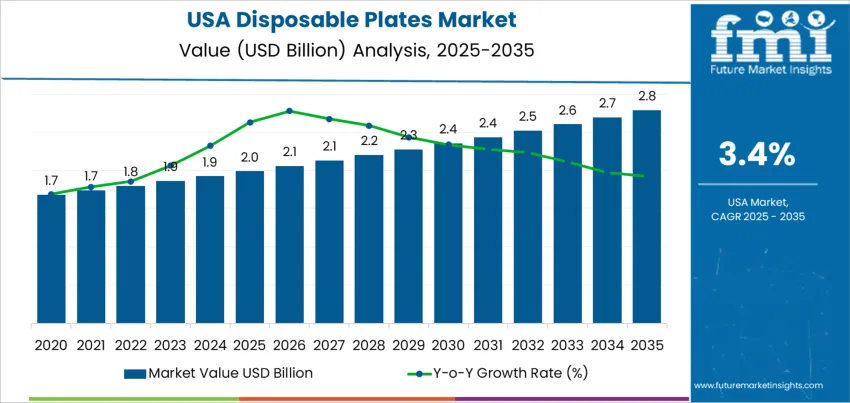
What is the Growth Forecast for Disposable Plates Industry in USA through 2035?
Demand for disposable plates in the United States approaches partial saturation in high-volume institutional and foodservice channels. Quick service restaurants, cafeterias, and event catering have established long-term reliance on single-use serving products, which limits incremental growth because USAge intensity is already high. Replacement and replenishment dominate purchasing behavior rather than first-time adoption. This indicates the early phase of saturation within commercial buyer groups.
Household consumption expands at a slower pace. Convenience purchases support steady demand, but mature distribution across supermarkets, wholesale clubs, and online platforms reduces room for substantial penetration gains. Environmental regulation influences category dynamics. Restrictions on foam and non-recyclable plastics shift demand toward paper-based and compostable formats, rather than accelerating total volume. Substitute products, including reusable plates and washable ware, set boundaries on growth potential in environmentally active regions.
Innovation focuses on sustainable materials to retain users and prevent decline rather than expanding total consumption. Therefore, the category operates near a functional saturation threshold in multiple U.S. segments. Growth continues where regulatory compliance forces product switching, but overall expansion remains moderate as the industry transitions from volume-led to material-innovation-led purchasing behavior in the United States.
USA Disposable Plates Key Takeaways
| Metric | Value |
|---|---|
| USA Disposable Plates Sales Value (2025) | USD 2.0 billion |
| USA Disposable Plates Forecast Value (2035) | USD 2.8 billion |
| USA Disposable Plates Forecast CAGR (2025 to 2035) | 3.4% |
Why is the Demand for Disposable Plates in the USA Growing?
Demand for disposable plates in the USA is increasing because convenience, hygiene and minimal cleanup remain high priorities for consumers hosting occasional meals, parties and outdoor events. Disposable plates offer fast, easy cleanup and reduce the time spent washing dishes, which appeals to busy households and people organizing social gatherings such as barbecues, picnics, birthdays and holiday dinners.
E-commerce platforms and retail stores expand assortments to include compostable or biodegradable disposable plates made from paper, bagasse, bamboo or other plant-based materials. These eco-friendly options attract consumers concerned about plastic waste and environmental impact. Growth in single-household living and small-family units supports greater purchase frequency of disposable dishware for day-to-day meals without investing in full dish sets.
Foodservice operations, caterers and event planners also contribute to demand by using disposable plates in large-volume settings such as corporate functions, schools, cafeterias and outdoor festivals. These segments value disposable tableware for cost efficiency and compliance with hygiene routines. Constraints include growing awareness about sustainability and waste reduction, which may reduce demand for single-use items in favor of reusable tableware. Higher cost of plant-based disposable plates can discourage cost-conscious buyers. Some consumers remain concerned about durability, leakage and heat resistance compared with conventional ceramics or plastics.
Which Product Types, Designs, and Sales Channels Lead Demand for Disposable Plates in the USA?
Demand for disposable plates in the United States is driven by large-scale foodservice consumption, takeaway culture, and household preference for convenience during events and travel use. Shifts toward sustainable materials influence purchasing behaviors across both retail and institutional channels. Growth is supported by catering services, quick-service restaurants, and corporate food facilities requiring bulk procurement. Increasing bans on single-use plastics in several states also impact product selection and accelerate adoption of compostable formats in regulated industries.
By Product Type, Paper Plates Hold the Largest Share
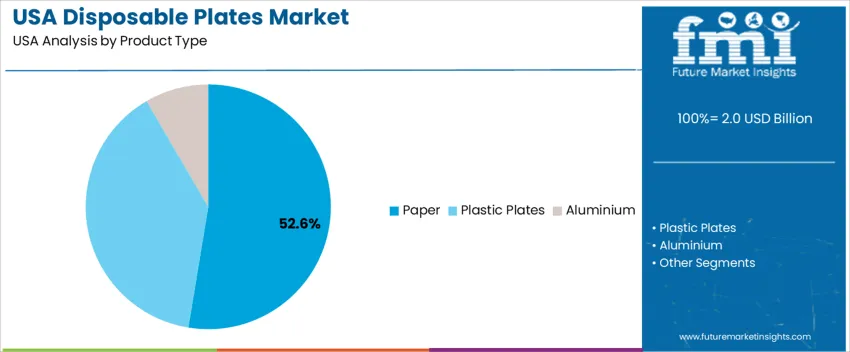
Paper disposable plates represent 52.6% of consumption, supported by eco-friendly positioning, compostable attributes, and regulatory alignment with plastic waste reduction. Their wide availability across everyday dining and catering services contributes to recurring high-volume replacement cycles. Plastic plates hold 39.0%, mainly used where additional rigidity and moisture resistance are required, including picnics, outdoor food vending, and institutional serving. Aluminum plates account for 8.4%, serving high-heat applications and premium food presentations in hospitality operations. Product preference is influenced by stiffness, liquid barrier needs, and compliance with packaging waste policies across state jurisdictions.
Key Points:
- Paper dominates due to sustainability compliance and retail accessibility
- Plastic supports sturdiness and wet food applications
- Aluminum serves heat-intensive and premium serving needs
By Design, Compartmental Plates Lead Demand
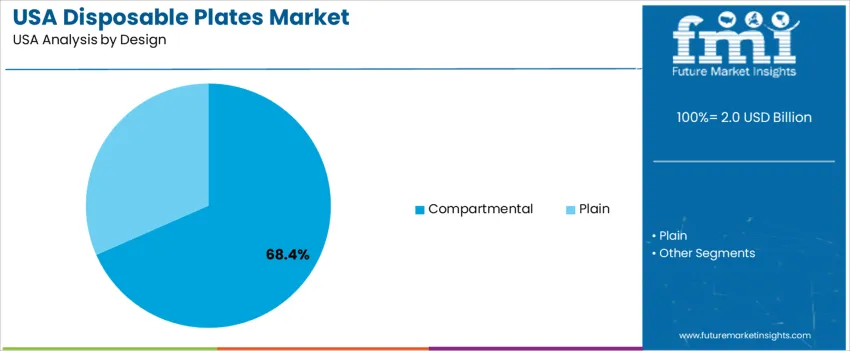
Compartmental plates account for 68.4%, driven by strong adoption in cafeterias, hospitals, and QSR chains where food separation improves presentation and portion control. These plates also reduce cross-flavor transfer and leakage, enhancing convenience for meal delivery. Plain plates hold 31.6%, widely used for desserts, snacks, and casual household occasions with minimal sectioning needs. Design selection aligns with serving environments, operational efficiency, and consumer preference for organized plating in multifunction dining formats.
Key Points:
- Compartmental layouts preferred in commercial and institutional foodservice
- Plain plates used in casual and home entertaining settings
- Separation features support hygiene, portability, and meal structuring
By Sales Channel, B2B Represents the Largest Share
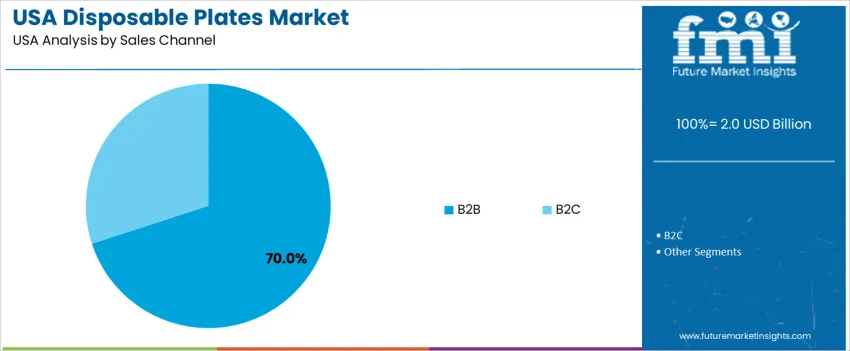
B2B procurement contributes 70.0%, driven by restaurants, catering firms, event organizers, and educational facilities sourcing in wholesale quantities. Institutional reliance on single-serve disposables for cost and hygiene considerations sustains ongoing volume demand. B2C represents 30.0%, with supermarkets, warehouse clubs, and online platforms supplying household purchases for seasonal gatherings and travel convenience. Channel split reflects higher frequency consumption within professional foodservice relative to sporadic residential use.
Key Points:
- B2B dominates due to bulk supply in commercial operations
- B2C demand rises during holidays and event-driven USAge
- Procurement influenced by cost efficiency and material compliance
What are the Drivers, Restraints, and Key Trends of the Demand for Disposable Plates in the USA?
Growth of convenience dining, strong foodservice activity and increased demand for event-ready tableware drive demand.
In the United States, disposable plates remain widely used across quick-service restaurants, catering services, cafeterias and institutional facilities that prioritize fast cleanup and labor efficiency. Consumers rely on disposable plates for home gatherings, outdoor events and holiday celebrations, supporting seasonal sales peaks. Busy household routines and frequent takeout dining strengthen everyday demand for disposable tableware that reduces dishwashing time. Retailers and e-commerce platforms provide broad access to bulk packs and themed plates for birthdays, sports events and community functions. Commercial users in retail foodservice, workplace cafeterias and educational campuses consistently replenish supplies as part of routine operations, maintaining ongoing procurement volumes nationwide.
Environmental sustainability concerns, regulatory restrictions and price sensitivity restrain demand.
Traditional plastic disposable plates contribute to landfill waste and pollution, prompting many municipalities to introduce bans or limits on single-use plastics. Some consumers reduce disposable tableware use based on environmental priorities or cost-saving habits, especially when durable alternatives are available for home use. Fluctuation in raw-material pricing, including pulp and petroleum-based plastics, influences retail pricing and can deter bulk purchases in price-sensitive customer groups. Foodservice operators face pressure to demonstrate sustainability targets, reducing reliance on non-recyclable or non-compostable products. These factors moderate volume growth in conventional disposable plate categories.
Shift toward compostable and biodegradable options, increased demand from casual food formats and rising emphasis on recyclable packaging define key trends.
Manufacturers expand offerings made from paper, bagasse, bamboo and other renewable materials to align with waste-reduction goals and state sustainability mandates. Fast-casual restaurants, food trucks and delivery-focused brands adopt sturdier and leak-resistant plate designs that maintain food presentation for takeout and catering. Clear recycling guidance and packaging improvements support consumer choices aligned with environmental values. Smaller pack sizes appeal to apartment dwellers and single-person households, while bulk supplies support frequent entertaining and institutional use. These developments indicate steady, convenience-driven demand for disposable plates across the United States, shaped increasingly by sustainable product transition and diversified foodservice formats.
Analysis of the Demand for Disposable Plates in the USA by Region
Demand for disposable plates in the United States remains stable as foodservice operators, event organizers, and households continue to rely on single-use tableware for convenience, sanitation, and time-saving consumption patterns. Growth hinges on catering activities, fast-casual dining expansion, and takeaway meal penetration. Regulatory shifts targeting polystyrene foam and non-recyclable plastics increase interest in paper-based and compostable plate formats. Price sensitivity and supply chain reliability remain critical in procurement decisions. West USA leads at 3.9% CAGR, followed by South USA at 3.5%, Northeast USA at 3.1%, and Midwest USA at 2.7%, reflecting differences in material regulations, lifestyle behaviors, and disposable income levels that shape category performance across the country.
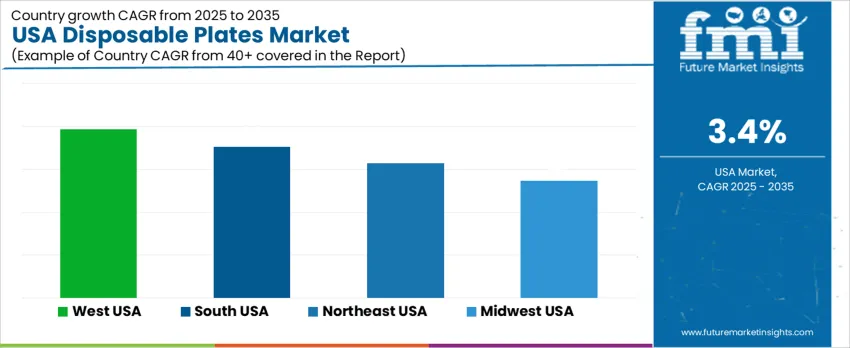
| Region | CAGR (2025 to 2035) |
|---|---|
| West USA | 3.9% |
| South USA | 3.5% |
| Northeast USA | 3.1% |
| Midwest USA | 2.7% |
How is the West USA driving demand for disposable plates?
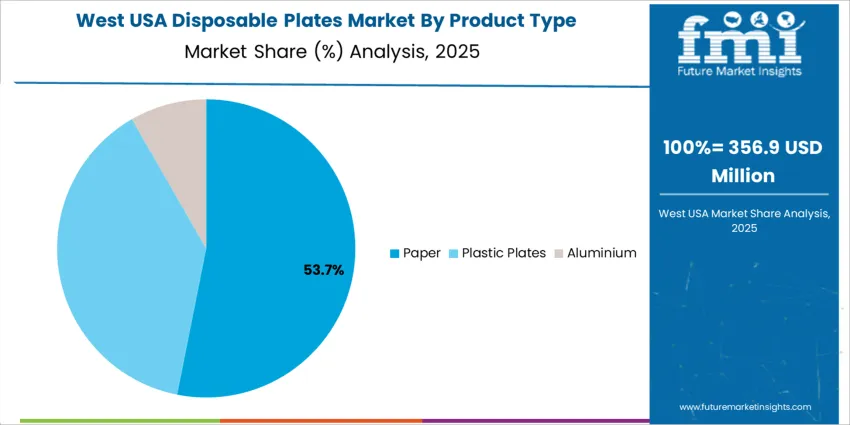
The West USA grows at 3.9% CAGR, supported by strong outdoor dining culture, food truck networks, and hospitality operations concentrated in California, Washington, and Nevada. Legislation restricting rigid plastics and expanded polystyrene encourages procurement of compostable or recyclable plate formats. Retailers expand shelf space for fiber-based and molded-pulp plates backed by certification for municipal composting participation. Events and entertainment venues require lightweight, safe, and disposable options to manage high foot traffic and sanitation needs. E-commerce channels supply bulk packaging tailored for households and catering service groups. Buyers evaluate grease-resistance, stack strength, and compatibility with hot food applications to ensure USAbility across diverse consumption environments.
- Plastic regulations promoting paper-based adoption
- Outdoor dining and events sustaining bulk demand
- Retail expansion of certified compostable options
- Performance and durability guiding supplier selection
How is the South USA shaping category demand?
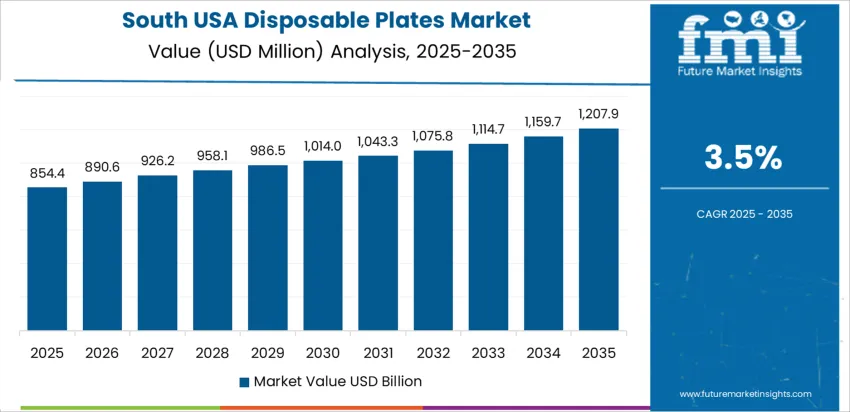
The South USA records 3.5% CAGR, driven by strong catering activity linked to social gatherings, corporate events, and tourism-connected service sectors. Disposable plates remain preferred for warm-weather dining where outdoor and recreational meals are frequent. Retailers position value-tier products appealing to budget-focused households across Texas, Florida, and Georgia. Large grocery chains and warehouse clubs offer multi-pack SKUs to support high-volume household consumption. Buyers focus on affordability, sturdiness, and moisture handling as key purchasing criteria aligned with regional cuisine styles featuring sauces and fried foods.
- Catering and tourism services sustaining consumption
- Outdoor dining habits supporting category continuity
- Value-driven purchasing influencing brand mix
- Retail bulk packs ensuring supply convenience
How is the Northeast USA influencing procurement trends?
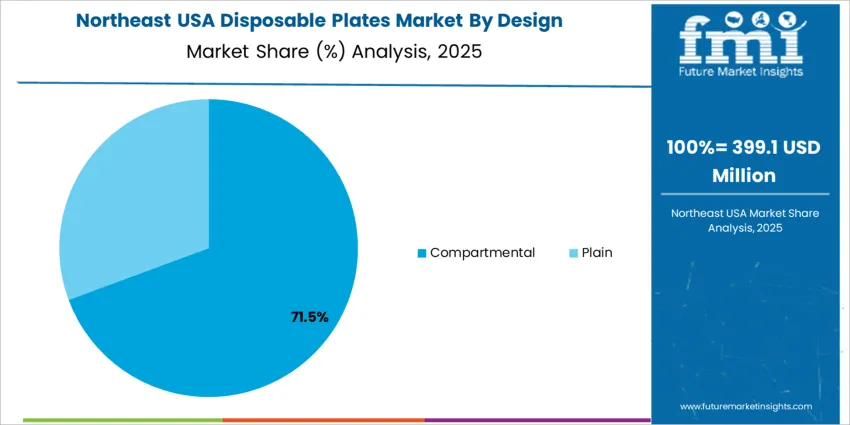
The Northeast USA expands at 3.1% CAGR, linked to dense urban meal-service operations and strong demand for disposable formats in convenience-driven dining occasions. Restaurants and quick-serve outlets adopt rigid paper and molded-pulp plates compatible with sustainability messaging. Cold-weather seasons emphasize indoor takeout demand, supporting consistent food-service USAge. Municipal policies in New York and Massachusetts encourage recycling-friendly materials, prompting procurement teams to vet plate composition for compliance. Households prefer stackable, lightweight options aligned with small-apartment living spaces.
- Convenience-focused consumption supporting stability
- Sustainability standards influencing product sourcing
- Takeout and delivery scenarios driving repeat USAge
- Space-efficient packaging valued in compact residences
How is the Midwest USA contributing to category growth?
The Midwest USA increases at 2.7% CAGR, reflecting practical consumption needs in institutional dining and community events across Illinois, Michigan, and Ohio. Buyers in schools, corporate cafeterias, and healthcare settings rely on predictable supply partnerships with established distributors. Price competitiveness remains a dominant factor, as procurement strives to balance cost with plate performance, especially for heat-tolerant and leak-resistant applications. Households maintain modest USAge linked to celebrations and seasonal gatherings. Distribution networks prioritize inventory consistency over rapid product shifts.
- Institutional dining reinforcing baseline demand
- Cost efficiency driving product selection
- Reliable distribution supporting procurement continuity
- Seasonal events contributing periodic volume growth
How is competitive positioning arranged among disposable-plate suppliers in the United States, and which companies lead demand?
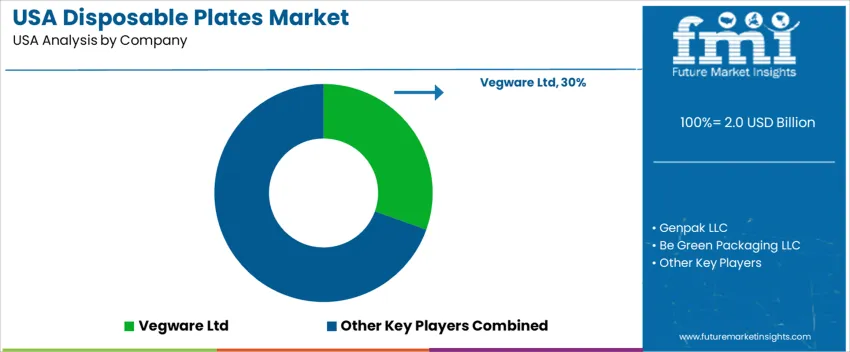
Demand for disposable plates in the United States is shaped by food-service volume, regulatory preference for compostable or disposable tableware in events and catering, and convenience for take-out and delivery services. Primary buyer considerations include material compliance (food safety, heat resistance), packaging volume, supply continuity, and cost. Vegware Ltd holds an estimated 30.5% share, supported by a wide range of compostable plates and strong relationships with eco-conscious foodservice operators. Their product line aligns closely with growing demand for environmentally friendly disposables in urban centers and corporate catering.
Genpak LLC competes strongly by offering traditional polystyrene, foam, and coated paper disposable plates to mass-market and value-oriented segments, making it a go-to for high-volume quick-service and buffet-style operations. Be Green Packaging LLC positions itself in the compostable and sustainable niche, targeting retailers and small foodservice brands seeking eco-friendly alternatives.
Duni Global serves mid-range and upscale catering by combining aesthetic presentation with disposable convenience, appealing to events, hospitality, and retail food sectors. CKF Inc maintains presence through bulk supply to institutions, cafeterias, and budget-conscious service providers where price and supply reliability influence procurement decisions. Competitive advantage depends increasingly on regulatory compliance, compostability certification, cost-per-unit efficiency at scale, and reliable supply networks. Suppliers combining environmental credentials with large-scale distribution retain stronger positioning in the United States disposable-plate demand landscape.
Key Players in USA Disposable Plates Demand
- Vegware Ltd
- Genpak LLC
- Be Green Packaging LLC
- Duni Global
- Ckf Inc
Scope of the Report
| Items | Values |
|---|---|
| Quantitative Units | USD billion |
| Product Type | Paper, Plastic Plates, Aluminium |
| Design | Compartmental, Plain |
| Sales Channel | B2B, B2C |
| Regions Covered | West USA, South USA, Northeast USA, Midwest USA |
| Key Companies Profiled | Vegware Ltd, Genpak LLC, Be Green Packaging LLC, Duni Global, CKF Inc |
| Additional Attributes | Dollar sales by product type, design, and sales channels; regional adoption supported by single-use plastic regulations and foodservice demand; competitive landscape in compostable paper-based and recyclable aluminum plates; growth in institutional catering and takeaway consumption; vendor emphasis on sustainable materials and bulk distribution partnerships. |
USA Disposable Plates Demand by Segments
Product Type:
- Paper
- Plastic Plates
- Aluminium
Design:
- Compartmental
- Plain
Sales Channel:
- B2B
- B2C
Region:
- West USA
- South USA
- Northeast USA
- Midwest USA
Frequently Asked Questions
How big is the demand for disposable plates in USA in 2025?
The demand for disposable plates in USA is estimated to be valued at USD 2.0 billion in 2025.
What will be the size of disposable plates in USA in 2035?
The market size for the disposable plates in USA is projected to reach USD 2.8 billion by 2035.
How much will be the demand for disposable plates in USA growth between 2025 and 2035?
The demand for disposable plates in USA is expected to grow at a 3.4% CAGR between 2025 and 2035.
What are the key product types in the disposable plates in USA?
The key product types in disposable plates in USA are paper, plastic plates and aluminium.
Which design segment is expected to contribute significant share in the disposable plates in USA in 2025?
In terms of design, compartmental segment is expected to command 68.4% share in the disposable plates in USA in 2025.
Preview the report firsthand - request a free sample
Get SampleGet the brochure for pricing and purchase details.
Get PDFTable of Content
- Executive Summary
- USA Market Outlook
- Demand-side Trends
- Supply-side Trends
- Technology Roadmap Analysis
- Analysis and Recommendations
- Market Overview
- Market Coverage / Taxonomy
- Market Definition / Scope / Limitations
- Market Background
- Market Dynamics
- Drivers
- Restraints
- Opportunity
- Trends
- Scenario Forecast
- Demand in Optimistic Scenario
- Demand in Likely Scenario
- Demand in Conservative Scenario
- Opportunity Map Analysis
- Product Life Cycle Analysis
- Supply Chain Analysis
- Investment Feasibility Matrix
- Value Chain Analysis
- PESTLE and Porter’s Analysis
- Regulatory Landscape
- Regional Parent Market Outlook
- Production and Consumption Statistics
- Import and Export Statistics
- Market Dynamics
- USA Market Analysis 2020 to 2024 and Forecast, 2025 to 2035
- Historical Market Size Value (USD Million) Analysis, 2020 to 2024
- Current and Future Market Size Value (USD Million) Projections, 2025 to 2035
- Y-o-Y Growth Trend Analysis
- Absolute $ Opportunity Analysis
- USA Market Pricing Analysis 2020 to 2024 and Forecast 2025 to 2035
- USA Market Analysis 2020 to 2024 and Forecast 2025 to 2035, By Product Type
- Introduction / Key Findings
- Historical Market Size Value (USD Million) Analysis By Product Type , 2020 to 2024
- Current and Future Market Size Value (USD Million) Analysis and Forecast By Product Type , 2025 to 2035
- Paper
- Plastic Plates
- Aluminium
- Y-o-Y Growth Trend Analysis By Product Type , 2020 to 2024
- Absolute $ Opportunity Analysis By Product Type , 2025 to 2035
- USA Market Analysis 2020 to 2024 and Forecast 2025 to 2035, By Design
- Introduction / Key Findings
- Historical Market Size Value (USD Million) Analysis By Design, 2020 to 2024
- Current and Future Market Size Value (USD Million) Analysis and Forecast By Design, 2025 to 2035
- Compartmental
- Plain
- Y-o-Y Growth Trend Analysis By Design, 2020 to 2024
- Absolute $ Opportunity Analysis By Design, 2025 to 2035
- USA Market Analysis 2020 to 2024 and Forecast 2025 to 2035, By Sales Channel
- Introduction / Key Findings
- Historical Market Size Value (USD Million) Analysis By Sales Channel, 2020 to 2024
- Current and Future Market Size Value (USD Million) Analysis and Forecast By Sales Channel, 2025 to 2035
- B2B
- B2C
- Y-o-Y Growth Trend Analysis By Sales Channel, 2020 to 2024
- Absolute $ Opportunity Analysis By Sales Channel, 2025 to 2035
- Market Structure Analysis
- Competition Dashboard
- Competition Benchmarking
- Market Share Analysis of Top Players
- By Regional
- By Product Type
- By Design
- By Sales Channel
- Competition Analysis
- Competition Deep Dive
- Vegware Ltd
- Overview
- Product Portfolio
- Profitability by Market Segments (Product/Age /Sales Channel/Region)
- Sales Footprint
- Strategy Overview
- Marketing Strategy
- Product Strategy
- Channel Strategy
- Genpak LLC
- Be Green Packaging LLC
- Duni Global
- Ckf Inc
- Vegware Ltd
- Competition Deep Dive
- Assumptions & Acronyms Used
- Research Methodology


