

- Industry Size (2026)
- USD 8.2 Bn
- Forecast (2036)
- USD 17.8 Bn
- CAGR (2026 to 2036)
- 8.1%
Disposable Contact Lenses Market Size, Market Forecast and Outlook By FMI
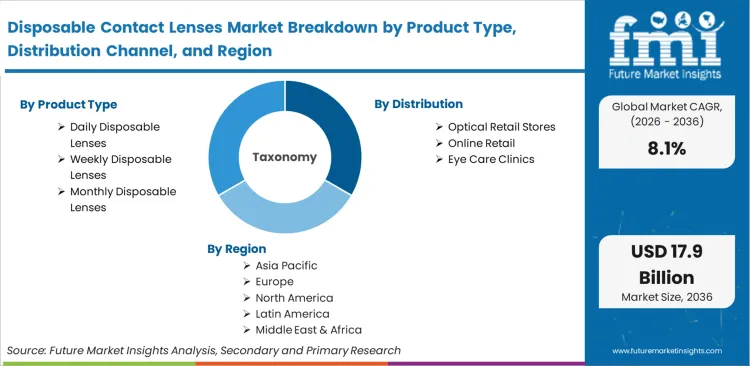
The disposable contact lenses market was worth USD 7.6 billion in 2025. Valuation is forecast to grow to USD 8.2 billion in 2026 and further to USD 17.8 billion by 2036. This trajectory represents a compound annual growth rate of 8.1% over the forecast timeline.
Sales of disposable contact lenses is expanding due to rising preference for convenient vision correction solutions. Consumers are shifting from reusable lenses to daily and monthly disposables to reduce cleaning effort and storage requirements. Short replacement cycles support recurring revenue visibility for manufacturers and retailers. Eye care practitioners are recommending disposable formats to limit deposit buildup and infection risks. Increasing screen exposure across working professionals and students is driving demand for corrective eyewear alternatives that offer comfort during prolonged digital usage.
Summary of Disposable Contact Lenses Market
- Disposable Contact Lenses Market Definition:
- The industry encompasses prescription and non-prescription contact lenses designed for temporary vision correction across consumer eyewear, clinical settings, and cosmetic applications.
- Demand Drivers in the Market:
- Increasing incidence of myopia supports higher adoption of contact lenses as an alternative to conventional eyeglasses for vision correction.
- Growing focus on eye hygiene encourages preference for lenses designed for single-day use, lowering contamination and infection exposure.
- Advancements in oxygen transmissibility enhance corneal safety while preserving comfort during extended wearing hours.
- Key Segments Analyzed in the Report:
- Product Type: Daily Disposable Lenses (48%) versus weekly and monthly replacement formats.
- Distribution Channel: Optical Retail Stores (41%) versus online platforms and clinical dispensaries.
- Geography: High-growth Asia Pacific versus mature North American and European markets.
- Analyst Opinion at FMI:
- Nandini Roy Choudhury, Senior Consultant for Consumer Products at Future Market Insights, states, “The revised Disposable Contact Lenses Market Report for 2026 to 2036 outlines the growing emphasis on prescription consistency, requiring manufacturers to uphold strict optical calibration across high-volume output. My evaluation suggests that evolving biocompatibility criteria influence formulation and testing stages, while intensive regulatory validation procedures may pose challenges for companies catering to budget-driven consumer groups.”
- Strategic Implications/Executive Takeaways
- Redirect strategic emphasis toward daily disposable lens systems in place of extended wear formats.
- Position online retail alliances as a core distribution pathway rather than a secondary sales channel.
- Elevate oxygen permeability benchmarks to minimize corneal stress and sustain prolonged usage comfort.
- Methodology
- Validated through direct optical retail sales data and prescription fill tracking.
- Zero reliance on speculative vision correction trend forecasting.
- Based on verifiable brand performance metrics and verified distribution agreements.
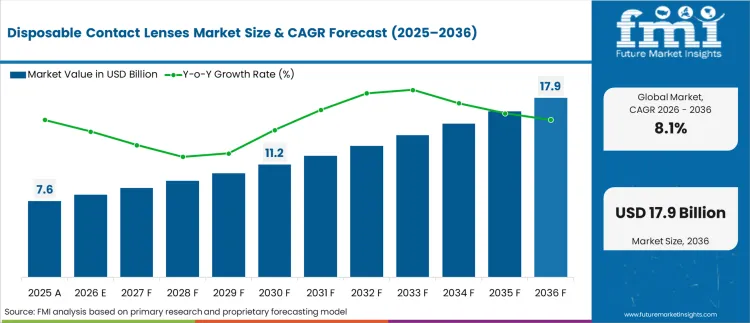
Growing focus on myopia and presbyopia treatment across urban populations is accelerating prescription lens adoption. Health authorities such as World Health Organization have highlighted increasing global vision impairment cases, supporting long term demand outlook. As per the WHO, short sightedness is expected to affect nearly 3.4 billion people by 2030. [1] Manufacturers including Johnson & Johnson Vision and Alcon Inc. are investing in silicone hydrogel materials that enhance oxygen permeability and moisture retention. Product innovations in UV protection and blue light filtering features are influencing premium SKU mix. Expansion of optical retail chains and online eye care platforms is widening consumer access in emerging markets.
Prominent companies are focusing on acquisition strategies to broaden their product portfolios. For instance, in June 2025, Carl Zeiss Vision International GmbH entered a definitive agreement to acquire Brighten Optix, a prominent player in the field of orthokeratology and specialty contact lenses. Through this move, the company made a strong addition to its already successful myopia management portfolio.
“Progressive myopia is one of the biggest vision care challenges we see in the world today. The topic is so important as the sight of children is at risk. We are already proud of our spectacle lens portfolio, which is clinically proven to significantly slow the progression of myopia. But at the same time, we also know that we need to offer even more options to our partners, the doctors and eye care professionals. That is why we are delighted to have found such a great partner. Our future partnership will allow us to meet exactly this need. We will broaden our portfolio and enable our customers to protect and improve the vision of many more children”, says Sven Hermann, CEO of ZEISS Vision Care and Member of the Executive Board of ZEISS. “Furthermore, Brighten Optix is known for its commitment to research and development. With ZEISS’ heritage of leading innovation, I am confident that this common strength will be of even greater advantage in our joint future”, Hermann concludes.[2]
Disposable Contact Lenses Market Key Takeaways
| Metric | Value |
|---|---|
| Market Value (2026) | USD 8.2 billion |
| Market Forecast Value (2036) | USD 17.8 billion |
| Forecast CAGR (2026-2036) | 8.1% |
Source: FMI analysis based on proprietary forecasting model and primary research
Disposable Contact Lenses Market Definition
The disposable contact lenses market covers the global design, manufacturing, and sale of prescription and non-prescription lenses built around scheduled replacement systems. It includes products developed with biocompatible materials, controlled wear durations, and standardized performance parameters for corrective vision applications.
Disposable Contact Lenses Market Inclusions
The report delivers detailed analysis of market dynamics, presenting global and regional market sizes in both volume and value, along with a 10-year forecast from 2026 to 2036. It segments the market by product type into daily disposable lenses, weekly disposable lenses, monthly disposable lenses, and extended wear lenses. Distribution channels include optical retail stores, online retail, eye care clinics, and hospital pharmacies, while applications cover myopia, hyperopia, astigmatism, and presbyopia correction.
Disposable Contact Lenses Market Exclusions
The study does not include rigid gas permeable lenses, custom scleral formats, orthokeratology systems, or specialty theatrical lenses. It excludes manufacturers of lens care solutions, contact lens storage cases, and optical diagnostic devices. Coverage is limited to finished disposable lenses prepared for consumer purchase and vision correction use. Services related to lens fitting and contact lens insurance programs with limited brand distinction are not considered within this market scope.
Disposable Contact Lenses Market Research Methodology
- Primary Research: Interviews were conducted with contact lens manufacturers, optical retail representatives, eye care professionals, distribution channel managers, and vision care associations across major markets. Optometry consultants clarified prescription standards and fitting requirements.
- Desk Research: Consumer purchase data from optical retail analytics platforms, vision correction adoption rates from healthcare surveys, and import/export statistics from trade organizations supported market benchmarking.
- Market-Sizing and Forecasting: A hybrid top-down and bottom-up model was developed. Demand was reconstructed from brand sales figures, retail store inventory turnover data, and prescription fill volumes, then validated against manufacturing output capacity and distribution network coverage.
- Data Validation and Update Cycle: Outputs undergo variance checks across retail and wholesale datasets, cross-verification with optometry industry associations, and structured expert review prior to release.
Segmental Analysis
Disposable Contact Lenses Market Analysis by Product Type
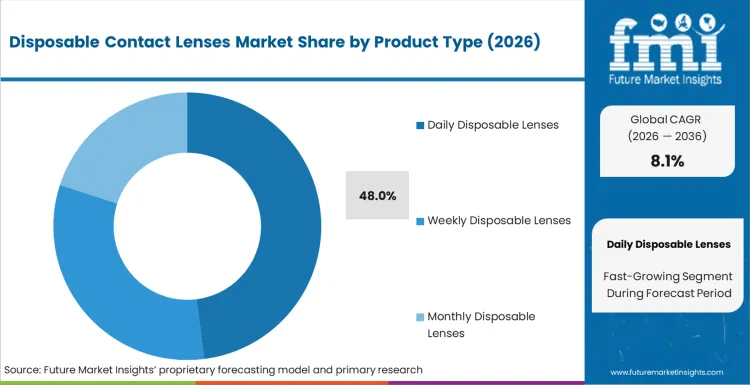
The daily disposable lenses segment is estimated to capture 48% share in 2026. Huge demand for daily disposable contact lenses is driven by hygiene prioritization and infection risk reduction. Single use format eliminates cleaning solutions and storage cases. This reduces contamination exposure linked with improper lens maintenance. Eye care professionals are recommending daily replacement schedules to limit microbial buildup and inflammatory complications. Rising screen time is increasing dry eye complaints. Manufacturers are investing in high oxygen permeability silicone hydrogel materials. Moisture retention technologies enhance comfort during prolonged digital device exposure. Comfort differentiation is supporting trade up toward premium daily SKUs.
- Digital Eye Strain Management: Manufacturers are integrating blue light filtering layers and UV blocking features within lens matrices, supporting prolonged screen exposure needs across working professionals and students. This positioning aligns with rising digital device dependency and strengthens premium SKU uptake across prescription and cosmetic daily formats.
- Subscription Fulfilment Integration: Brands are aligning daily disposable portfolios with auto replenishment platforms and app-based prescription tracking systems, improving reorder consistency and lifetime customer value. This structure enhances revenue predictability while supporting direct to consumer distribution expansion in urban and tier two markets.
Disposable Contact Lenses Market Analysis by Distribution Channel
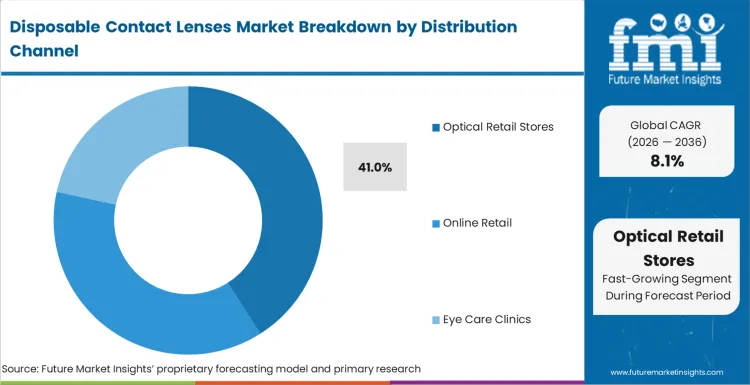
The optical retail stores segment is poised to witness a 41% market share in 2026. In store optometrists conduct eye examinations and corneal measurements, ensuring correct fit and minimizing complication risks. This clinical touchpoint strengthens consumer trust and supports higher conversion rates.
Trial fitting services are a key driver for in store sales. Consumers often test comfort, hydration response, and visual clarity before finalizing brand selection. Optical retailers provide sample lenses and guided wear instructions, improving compliance and repeat purchase likelihood. Personalized consultation increases cross selling of premium daily variants.
- Clinical Compliance Assurance: Optical retail stores operate under regulated dispensing frameworks that require documented prescriptions and fit confirmation before sale. This structured environment reassures consumers about safety standards and product authenticity, strengthening in store purchase preference for medical grade daily and monthly disposable lenses.
- Integrated Product Bundling: Retailers combine lens sales with care solutions, protective cases, and follow up checkups within a single transaction ecosystem. This bundled approach increases basket value while reinforcing repeat footfall through scheduled eye health reviews and annual vision assessments.
Disposable Contact Lenses Market Drivers, Restraints, and Opportunities
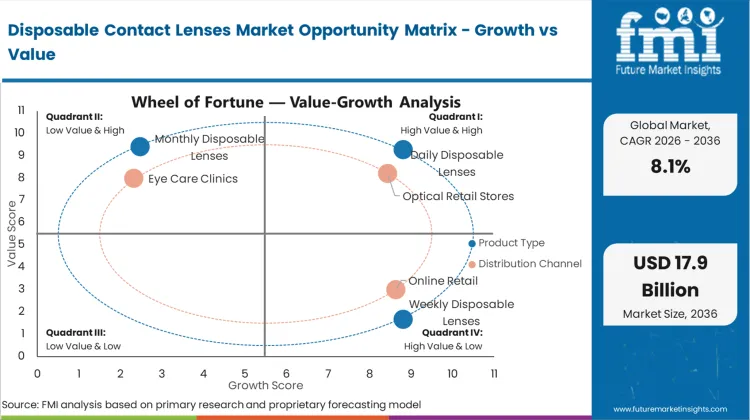
Cosmetic daily disposable lenses are gaining traction among younger demographics seeking natural enhancement and occasional style variation. Social media influence and digital content creation are amplifying appearance focused purchasing behavior. Manufacturers are expanding color ranges and limbal ring designs to capture fashion driven demand. Optical retailers are allocating greater shelf space to cosmetic variants, improving visibility and impulse conversion. This convergence of performance need and appearance preference is broadening the addressable consumer base beyond traditional medical prescription users.
High recurring cost remains a primary constraint for price sensitive consumers. Daily disposable formats require continuous repurchase, creating higher annual spending compared to reusable lenses. Limited reimbursement coverage in several countries reduces affordability for lower income groups. Supply chain dependence on specialized polymer materials exposes manufacturers to raw material price volatility. Regulatory scrutiny on medical device labeling and safety compliance increases approval timelines. Environmental concerns regarding plastic blister waste are prompting criticism from sustainability focused advocacy groups. These cost and compliance pressures can restrict volume penetration in emerging markets where affordability drives purchase decisions.
Advances in silicone hydrogel chemistry are enhancing oxygen transmissibility, supporting extended daily wear comfort across high screen exposure users. Manufacturers are developing lenses with embedded moisture gradient structures that maintain hydration stability throughout the day. Integration of blue light filtering capabilities addresses digital eye strain concerns among working professionals and students. Precision manufacturing using automated molding and surface treatment systems is improving parameter accuracy and reducing defect rates. Companies such as CooperVision Inc. are investing in advanced material science platforms to optimize fit consistency across diverse corneal profiles. Customizable toric and multifocal daily lenses are expanding addressable patient segments. Smart packaging with QR based authentication is strengthening supply chain transparency. These technological enhancements create pricing power, improve practitioner confidence, and support premium portfolio expansion across global markets.
Regional Analysis
Based on regional analysis, the disposable contact lenses market is segmented into North America, Latin America, Europe, East Asia, South Asia, Oceania and Middle East & Africa across 40 countries. The full report also offers market attractiveness analysis based on regional trends.
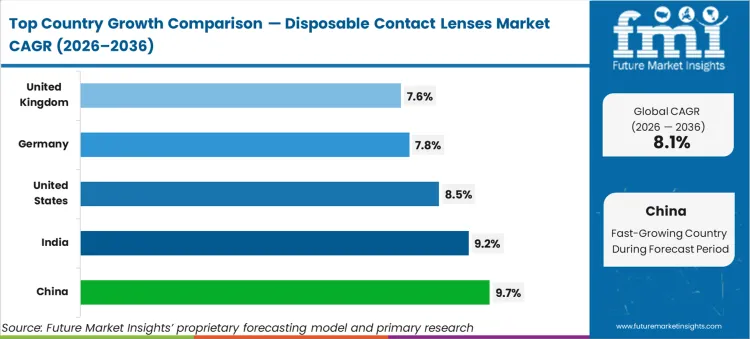
.webp "Top Country Growth Comparison Disposable Contact Lenses Market Cagr (2026 2036)")
| Country | CAGR (2026 to 2036) |
|---|---|
| United States | 8.5% |
| United Kingdom | 7.6% |
| Germany | 7.8% |
| China | 9.7% |
| India | 9.2% |
Source: Market analysis based on proprietary forecasting model and primary research
North America Disposable Contact Lenses Market Analysis
North America disposable contact lenses market is expanding due to high diagnosed prevalence of myopia and presbyopia across the USA and Canada. Eye examination culture supports regular prescription updates and lens replacement adherence. Clinical guidance from the American Academy of Ophthalmology encourages compliance with recommended replacement cycles, strengthening daily disposable uptake. Strong insurance backed vision care programs improve affordability across employed populations.
- United States: Demand for disposable contact lenses in the United States is projected to grow at 8.5% CAGR from 2026 to 2036. Large corporate health plans include annual eye examinations and contact lens allowances, improving affordability of premium daily formats. This reimbursement structure increases upgrade rates from reusable lenses to higher margin single use variants. Optical retail chains are aligning product portfolios with insurance billing systems, simplifying purchase processes and accelerating prescription conversion.
The report provides comprehensive insights into growth across North America, featuring country-level evaluation of the United States and Canada. It highlights trends in myopia incidence, shifts in retail channel structures, and market progression across varied product categories and distribution approaches.
Asia Pacific Disposable Contact Lenses Market Analysis
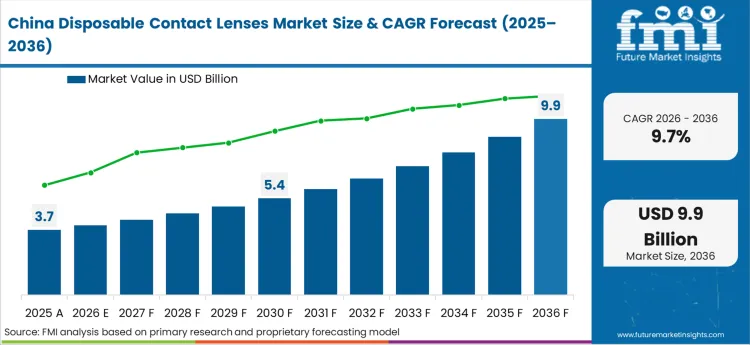
Increasing workforce participation among young professionals is driving preference for spectacle free vision correction. According to the Migration Policy Institute, Asia’s working-age population (aged15 to 64) is growing by 1.5% every year.[3] Long working hours and digital device exposure are strengthening demand for high hydration daily formats. Regional manufacturers are scaling silicone hydrogel production capacity to meet prescription upgrades.
Cosmetic lens adoption is a strong growth lever in East Asia. Fashion influenced consumers in markets such as China and Japan are purchasing colored daily disposables for aesthetic enhancement. Social commerce platforms are accelerating brand discovery and direct sales. Local production hubs are improving cost competitiveness and reducing import dependence.
- China: The Chinese disposable contact lenses market is set to grow at a 9.7% CAGR during the forecast period. Domestic manufacturing capability is strengthening supply security and cost efficiency. Local producers are scaling silicone hydrogel capacity and automated molding systems to compete with global brands. E commerce platforms such as Alibaba Group and JD.com are expanding direct to consumer lens distribution. Fast logistics networks enable quick replenishment, supporting subscription based purchases.
- India: Sales of disposable contact lenses in India are poised to expand at 9.2% CAGR during the study period. Growth of organized optical retail chains is improving prescription access in metro and tier two cities. Mall based eye clinics and standalone optometry centers are expanding fitting services. E commerce penetration is accelerating refill purchases through subscription and auto reorder models. Digital payment adoption supports repeat transactions with minimal friction.
The complete study evaluates the disposable contact lenses market across East and South Asia from 2021 to 2036. It reviews myopia incidence patterns, evolution of distribution networks, and prescription format preferences in China, Japan, South Korea, India, Singapore, and Australia. The analysis outlines pricing frameworks that support deeper regional penetration and competitive positioning across diverse consumer segments.
Europe Disposable Contact Lenses Market Analysis
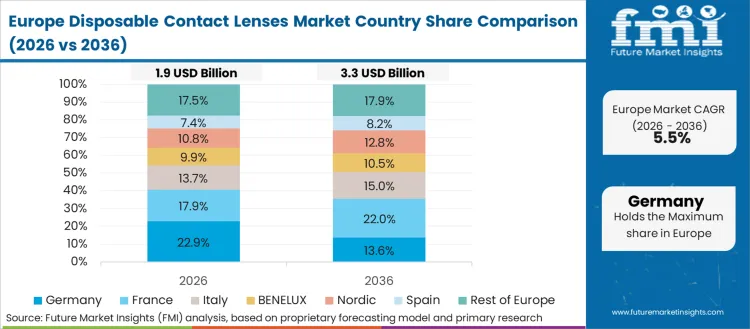
Regulatory clarity under the Medical Device Regulation framework enhances product traceability and quality assurance in Europe. This structured compliance environment supports practitioner confidence and premium product positioning. Silicone hydrogel penetration remains high across developed European markets, enabling higher average selling prices. E commerce growth and pharmacy based dispensing models are expanding access beyond traditional optical stores. Subscription refill systems are improving recurring revenue stability.
- Germany: Demand for disposable contact lenses in Germany is slated to grow at 7.8% CAGR from 2026 to 2036. The market is expanding due to strong statutory health insurance penetration and structured optometry networks. A large share of the population undergoes periodic vision testing through regulated eye care channels, supporting prescription renewal cycles. Consumers show high preference for certified medical grade products, reinforcing demand for daily disposable lenses with advanced material specifications.
- United Kingdom: The U.K. disposable contact lenses market is estimated to expand at 7.6% CAGR during the study period. The market is growing due to high acceptance of subscription-based vision correction models. Major optical chains operate integrated eye testing and auto replenishment systems, driving predictable recurring sales. Consumers prefer direct debit lens supply plans that include annual eye examinations and parameter updates.
The European disposable contact lenses market assessment provides country-level insights for the United Kingdom, Germany, France, Italy, Spain, the Netherlands, and Scandinavia. It delivers detailed evaluation of prescription fulfillment patterns and evolving vision correction adoption trends across the region, offering clarity on consumer usage behavior and retail dispensing dynamics within key European economies.
Competitive Landscape for Disposable Contact Lenses Market Players
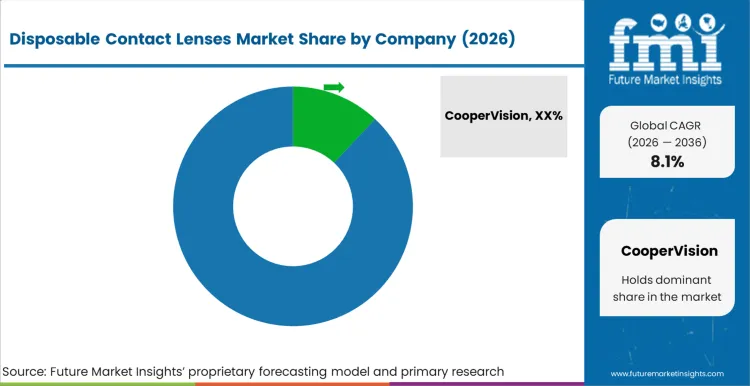
Companies such as Alcon Inc., Johnson & Johnson Vision and CooperVision Inc. control a significant share of global volume through advanced silicone hydrogel portfolios and strong practitioner relationships. Their scale advantages in R&D, automated molding, and global regulatory compliance create high entry barriers for smaller players.
Competition is centered on material science innovation, oxygen transmissibility performance, and moisture retention differentiation. Daily disposable segment remains the key battleground due to higher margins and recurring consumption cycles. Companies are expanding toric and multifocal daily variants to capture aging population demand. Pricing strategy varies across regions, with premium positioning in North America and Western Europe, and tiered offerings in Asia Pacific to address cost sensitivity.
Strategic partnerships with optical retail chains and subscription platforms are strengthening direct to consumer channels. Investment in sustainable blister packaging and recyclable materials is emerging as a competitive lever. Brand equity, clinical endorsement, and supply chain resilience remain core differentiators shaping competitive intensity in the disposable contact lenses market.
Recent Developments:
The report includes comprehensive coverage of key industry developments and competitive positioning:
- In October 2025, ZEISS Vision Care, a prominent name in the eye and vision care industry, signed a definitive agreement to acquire a 10% stake in Ocumeda AG to enhance its vision care portfolio.[4]
- In August 2025, Alcon Company unveiled its intent to acquire STAAR Surgical Company, , the manufacturer of the Implantable Collamer® Lens (ICL). The acquisition includes the EVO family of lenses (EVO ICL™) for vision correction for patients with moderate to high myopia (nearsightedness), with or without astigmatism.[5]
- In March 2025, Alcon Company announced to acquire LENSAR, Inc., a global medical technology company focused on advanced laser solutions for the treatment of cataracts. This move is set to help Alcon broaden its product portfolio.[6]
Key Players in Disposable Contact Lenses Market
- CooperVision
- Novartis International AG
- Johnson & Johnson
- Bausch Health Companies Inc.
- ZEISS Group
- Alcon Company
- Hoya Corporation
Scope of the Report
| Metric | Value |
|---|---|
| Quantitative Units | USD 8.2 billion (2026) to USD 17.8 billion (2036), at a CAGR of 8.1% |
| Market Definition | The disposable contact lenses market comprises the global development, production, and distribution of prescription and non-prescription contact lenses including daily, weekly, and monthly replacement formats designed for temporary vision correction across consumer and clinical applications. |
| Product Type Segmentation | Daily Disposable Lenses, Weekly Disposable Lenses, Monthly Disposable Lenses, Extended Wear Lenses |
| Distribution Channel Coverage | Optical Retail Stores, Online Retail, Eye Care Clinics, Hospital Pharmacies |
| Application Segmentation | Myopia Correction, Hyperopia Correction, Astigmatism Correction, Presbyopia Correction |
| Regions Covered | North America, Latin America, Europe, East Asia, South Asia, Oceania, Middle East and Africa |
| Countries Covered | United States, Canada, United Kingdom, Germany, France, China, Japan, India, Brazil, UAE and 40 countries |
| Key Companies Profiled | CooperVision, Novartis International AG, Johnson & Johnson, Bausch Health Companies Inc., ZEISS Group, Alcon Company, Hoya Corporation |
| Forecast Period | 2026 to 2036 |
| Approach | Hybrid top down and bottom up market modeling validated through optical retail sales tracking and prescription fill surveys, supported by distribution network verification and fitting pattern analysis |
Disposable Contact Lenses Market Analysis by Segments
Product Type:
- Daily Disposable Lenses
- Weekly Disposable Lenses
- Monthly Disposable Lenses
- Extended Wear Lenses
Distribution Channel:
- Optical Retail Stores
- Online Retail
- Eye Care Clinics
- Hospital Pharmacies
- Others (subscription services, mobile optometry units)
Application:
- Myopia Correction
- Hyperopia Correction
- Astigmatism Correction
- Presbyopia Correction
Region:
- Asia Pacific
- China
- Japan
- South Korea
- India
- Australia
- Singapore
- Thailand
- Rest of Asia Pacific
- Europe
- United Kingdom
- Germany
- France
- Italy
- Spain
- Netherlands
- Scandinavia
- Switzerland
- Rest of Europe
- North America
- United States
- Canada
- Latin America
- Brazil
- Mexico
- Argentina
- Rest of Latin America
- Middle East & Africa
- United Arab Emirates
- Saudi Arabia
- South Africa
- Israel
- Rest of Middle East & Africa
Bibliography
- [1] Thomson, E., & North, M. (2024, October 7). Short-sightedness is on the rise - including among kids. Here’s what can be done. World Economic Forum.
- [2] Carl Zeiss Vision International GmbH. (2025, June 4). Carl Zeiss Vision International GmbH announces agreement to acquire Brighten Optix [Press release]. ZEISS Vision Care.
- [3] Hugo, G. (2008, October). Emerging demographic trends in Asia and the Pacific: Implications for international migration [Report]. Migration Policy Institute.
- [4] ZEISS Vision Care. (2025, October 1). ZEISS Vision Care announces investment in Ocumeda amid plans to scale the leading tele-ophthalmology platform with Fielmann Group [Press release].
- [5] Alcon Inc. (2025, August 5). Alcon agrees to acquire STAAR Surgical [Press release].
- [6] Alcon Inc. (2025, March 24). Alcon agrees to acquire LENSAR, Inc. [Press release].
This bibliography is provided for reader reference and is not exhaustive. The full report contains the complete reference list and detailed citations.
This Report Addresses
- Market intelligence to enable strategic decision making across established and emerging vision correction markets
- Market size estimation and 10-year revenue forecasts from 2026 to 2036, supported by validated optical retail sales data and prescription fill surveys
- Growth opportunity mapping across product types and application segments with emphasis on material innovation
- Segment and regional revenue forecasts covering daily disposable lenses, weekly replacement formats, monthly options, and retail distribution networks
- Competition strategy assessment including optometry partnership requirements, material specification positioning, and prescription range adoption
- Product development tracking including silicone hydrogel innovations, aspheric design trends, and oxygen permeability capabilities
- Market access analysis covering distribution agreements, optical retail partnerships, and eye care professional engagement programs
- Market report delivery in PDF, Excel, PPT, and interactive dashboard formats for executive and operational use
Frequently Asked Questions
How large is the demand for Disposable Contact Lenses in the global market in 2026?
Demand for Disposable Contact Lenses in the global market is estimated to be valued at USD 8.2 billion in 2026.
What will be the market size of Disposable Contact Lenses in the global market by 2036?
Market size for Disposable Contact Lenses is projected to reach USD 17.8 billion by 2036.
What is the expected demand growth for Disposable Contact Lenses in the global market between 2026 and 2036?
Demand for Disposable Contact Lenses in the global market is expected to grow at a CAGR of 8.1% between 2026 and 2036.
Which Product Type is poised to lead global sales by 2026?
Daily Disposable Lenses is expected to be the dominant product type, capturing approximately 48.0% of global market share in 2026 due to convenience benefits and hygiene advantages.
How significant is the role of Optical Retail Stores in driving Disposable Contact Lenses adoption in 2026?
Optical retail stores represent a primary distribution channel, projected to hold approximately 41% share of the total market in 2026 as prescription verification services and professional fitting programs maintain physical retail relevance.
What is Driving Disposable Contact Lenses Demand in the United States?
Daily disposable format adoption and increased online prescription fulfillment across consumer age groups are driving growth.
What Consumer Trends are Referenced for the United States?
Myopia prevalence patterns and digital eye strain awareness programs are referenced as key consumer behavior shifts.
What is the United States Growth Outlook in this Report?
The United States is projected to grow at a CAGR of 8.5% during 2026 to 2036.
Why is Europe described as Important for Lens Development in this Report?
Growth is driven by healthcare coverage standards and optometry practice density that establish standardized prescription specifications.
What Type of Product Development Dominates in Europe?
Silicone hydrogel lenses with advanced oxygen transmission and moisture retention dominates regional market segments.
What is Germany Growth Outlook in this Report?
Germany is projected to expand at a CAGR of 7.8% during 2026 to 2036.
What is United Kingdom Growth Outlook in this Report?
United Kingdom is projected to expand at a CAGR of 7.6% during 2026 to 2036.
Does the Report Cover China in its Regional Analysis?
China is included within East Asia under the regional scope of analysis.
What are the Sources referred to for analyzing the Market in China?
Myopia prevalence data, optical retail expansion statistics, and domestic brand performance tracking covering purchase patterns, price sensitivity analysis, and prescription preference evolution are cited as primary reference sources.
What is the Main Development Theme Linked to China in Asia Coverage?
Asia Pacific development is associated with domestic optical retail expansion enabling lens standardization across urban centers.
Does the Report Cover India in its Regional Analysis?
India is included within South Asia under the regional coverage framework.
What is the Main India Related Development Theme in Asia Coverage?
Rising middle-class purchasing power creating foundation for contact lens adoption and local manufacturing using cost-effective production methods is emphasized.
Which Distribution Strategies are Strategically Important for Asia Pacific Market Entry?
Online retail partnerships and optical chain collaborations are prioritized for cost-effective brand building across regional markets.
What is Disposable Contact Lenses and What is It Mainly Used For?
Disposable contact lenses involve prescription and non-prescription lenses primarily used for temporary vision correction including consumer eyewear, clinical applications, and cosmetic use.
What does Disposable Contact Lenses Market Mean in this Report?
Disposable contact lenses market refers to global development, manufacturing, and retail distribution of replacement schedule lenses across various application categories and user segments.
What is Included in the Scope of this Disposable Contact Lenses Market Report?
Scope covers lenses by product type, key distribution channels such as optical retail stores and online platforms, and application segments including myopia correction, hyperopia correction, and astigmatism correction.
What is Excluded from the Scope of this Report?
Rigid gas permeable lenses, custom scleral lenses, orthokeratology devices, and specialty theatrical lenses are excluded unless part of disposable lens product offerings.
What does Market Forecast Mean on this Page?
Market forecast represents model-based projections built on optical retail sales trends and prescription fill assumptions for strategic planning purposes.
How is the Disposable Contact Lenses Market Forecast Built and Validated?
Forecast is developed using hybrid modeling validated through optical retail point-of-sale data, prescription fill surveys, and distribution network verification.
What does Zero Reliance on Speculative Third Party Market Research Mean Here?
Market analysis is based on verifiable sales figures, prescription fill data, and lens fitting patterns rather than speculative vision correction trend predictions.
Preview the report firsthand - request a free sample
Get SampleGet the brochure for pricing and purchase details.
Get PDFTable of Content
- Executive Summary
- Global Market Outlook
- Demand-side Trends
- Supply-side Trends
- Technology Roadmap Analysis
- Analysis and Recommendations
- Market Overview
- Market Coverage / Taxonomy
- Market Definition / Scope / Limitations
- Research Methodology
- Chapter Orientation
- Analytical Lens and Working Hypotheses
- Market Structure, Signals, and Trend Drivers
- Benchmarking and Cross-market Comparability
- Market Sizing, Forecasting, and Opportunity Mapping
- Research Design and Evidence Framework
- Desk Research Programme (Secondary Evidence)
- Company Annual and Sustainability Reports
- Peer-reviewed Journals and Academic Literature
- Corporate Websites, Product Literature, and Technical Notes
- Earnings Decks and Investor Briefings
- Statutory Filings and Regulatory Disclosures
- Technical White Papers and Standards Notes
- Trade Journals, Industry Magazines, and Analyst Briefs
- Conference Proceedings, Webinars, and Seminar Materials
- Government Statistics Portals and Public Data Releases
- Press Releases and Reputable Media Coverage
- Specialist Newsletters and Curated Briefings
- Sector Databases and Reference Repositories
- FMI Internal Proprietary Databases and Historical Market Datasets
- Subscription Datasets and Paid Sources
- Social Channels, Communities, and Digital Listening Inputs
- Additional Desk Sources
- Expert Input and Fieldwork (Primary Evidence)
- Primary Modes
- Qualitative Interviews and Expert Elicitation
- Quantitative Surveys and Structured Data Capture
- Blended Approach
- Why Primary Evidence is Used
- Field Techniques
- Interviews
- Surveys
- Focus Groups
- Observational and In-context Research
- Social and Community Interactions
- Stakeholder Universe Engaged
- C-suite Leaders
- Board Members
- Presidents and Vice Presidents
- R&D and Innovation Heads
- Technical Specialists
- Domain Subject-matter Experts
- Scientists
- Physicians and Other Healthcare Professionals
- Governance, Ethics, and Data Stewardship
- Research Ethics
- Data Integrity and Handling
- Primary Modes
- Tooling, Models, and Reference Databases
- Desk Research Programme (Secondary Evidence)
- Data Engineering and Model Build
- Data Acquisition and Ingestion
- Cleaning, Normalisation, and Verification
- Synthesis, Triangulation, and Analysis
- Quality Assurance and Audit Trail
- Market Background
- Market Dynamics
- Drivers
- Restraints
- Opportunity
- Trends
- Scenario Forecast
- Demand in Optimistic Scenario
- Demand in Likely Scenario
- Demand in Conservative Scenario
- Opportunity Map Analysis
- Product Life Cycle Analysis
- Supply Chain Analysis
- Investment Feasibility Matrix
- Value Chain Analysis
- PESTLE and Porter’s Analysis
- Regulatory Landscape
- Regional Parent Market Outlook
- Production and Consumption Statistics
- Import and Export Statistics
- Market Dynamics
- Global Market Analysis 2021 to 2025 and Forecast, 2026 to 2036
- Historical Market Size Value (USD Million) Analysis, 2021 to 2025
- Current and Future Market Size Value (USD Million) Projections, 2026 to 2036
- Y-o-Y Growth Trend Analysis
- Absolute $ Opportunity Analysis
- Global Market Pricing Analysis 2021 to 2025 and Forecast 2026 to 2036
- Global Market Analysis 2021 to 2025 and Forecast 2026 to 2036, By Product Type
- Introduction / Key Findings
- Historical Market Size Value (USD Million) Analysis By Product Type , 2021 to 2025
- Current and Future Market Size Value (USD Million) Analysis and Forecast By Product Type , 2026 to 2036
- Daily Disposable Lenses
- Weekly Disposable Lenses
- Monthly Disposable Lenses
- Daily Disposable Lenses
- Y-o-Y Growth Trend Analysis By Product Type , 2021 to 2025
- Absolute $ Opportunity Analysis By Product Type , 2026 to 2036
- Global Market Analysis 2021 to 2025 and Forecast 2026 to 2036, By Distribution Channel
- Introduction / Key Findings
- Historical Market Size Value (USD Million) Analysis By Distribution Channel, 2021 to 2025
- Current and Future Market Size Value (USD Million) Analysis and Forecast By Distribution Channel, 2026 to 2036
- Optical Retail Stores
- Online Retail
- Eye Care Clinics
- Optical Retail Stores
- Y-o-Y Growth Trend Analysis By Distribution Channel, 2021 to 2025
- Absolute $ Opportunity Analysis By Distribution Channel, 2026 to 2036
- Global Market Analysis 2021 to 2025 and Forecast 2026 to 2036, By Region
- Introduction
- Historical Market Size Value (USD Million) Analysis By Region, 2021 to 2025
- Current Market Size Value (USD Million) Analysis and Forecast By Region, 2026 to 2036
- North America
- Latin America
- Western Europe
- Eastern Europe
- East Asia
- South Asia and Pacific
- Middle East & Africa
- Market Attractiveness Analysis By Region
- North America Market Analysis 2021 to 2025 and Forecast 2026 to 2036, By Country
- Historical Market Size Value (USD Million) Trend Analysis By Market Taxonomy, 2021 to 2025
- Market Size Value (USD Million) Forecast By Market Taxonomy, 2026 to 2036
- By Country
- USA
- Canada
- Mexico
- By Product Type
- By Distribution Channel
- By Country
- Market Attractiveness Analysis
- By Country
- By Product Type
- By Distribution Channel
- Key Takeaways
- Latin America Market Analysis 2021 to 2025 and Forecast 2026 to 2036, By Country
- Historical Market Size Value (USD Million) Trend Analysis By Market Taxonomy, 2021 to 2025
- Market Size Value (USD Million) Forecast By Market Taxonomy, 2026 to 2036
- By Country
- Brazil
- Chile
- Rest of Latin America
- By Product Type
- By Distribution Channel
- By Country
- Market Attractiveness Analysis
- By Country
- By Product Type
- By Distribution Channel
- Key Takeaways
- Western Europe Market Analysis 2021 to 2025 and Forecast 2026 to 2036, By Country
- Historical Market Size Value (USD Million) Trend Analysis By Market Taxonomy, 2021 to 2025
- Market Size Value (USD Million) Forecast By Market Taxonomy, 2026 to 2036
- By Country
- Germany
- UK
- Italy
- Spain
- France
- Nordic
- BENELUX
- Rest of Western Europe
- By Product Type
- By Distribution Channel
- By Country
- Market Attractiveness Analysis
- By Country
- By Product Type
- By Distribution Channel
- Key Takeaways
- Eastern Europe Market Analysis 2021 to 2025 and Forecast 2026 to 2036, By Country
- Historical Market Size Value (USD Million) Trend Analysis By Market Taxonomy, 2021 to 2025
- Market Size Value (USD Million) Forecast By Market Taxonomy, 2026 to 2036
- By Country
- Russia
- Poland
- Hungary
- Balkan & Baltic
- Rest of Eastern Europe
- By Product Type
- By Distribution Channel
- By Country
- Market Attractiveness Analysis
- By Country
- By Product Type
- By Distribution Channel
- Key Takeaways
- East Asia Market Analysis 2021 to 2025 and Forecast 2026 to 2036, By Country
- Historical Market Size Value (USD Million) Trend Analysis By Market Taxonomy, 2021 to 2025
- Market Size Value (USD Million) Forecast By Market Taxonomy, 2026 to 2036
- By Country
- China
- Japan
- South Korea
- By Product Type
- By Distribution Channel
- By Country
- Market Attractiveness Analysis
- By Country
- By Product Type
- By Distribution Channel
- Key Takeaways
- South Asia and Pacific Market Analysis 2021 to 2025 and Forecast 2026 to 2036, By Country
- Historical Market Size Value (USD Million) Trend Analysis By Market Taxonomy, 2021 to 2025
- Market Size Value (USD Million) Forecast By Market Taxonomy, 2026 to 2036
- By Country
- India
- ASEAN
- Australia & New Zealand
- Rest of South Asia and Pacific
- By Product Type
- By Distribution Channel
- By Country
- Market Attractiveness Analysis
- By Country
- By Product Type
- By Distribution Channel
- Key Takeaways
- Middle East & Africa Market Analysis 2021 to 2025 and Forecast 2026 to 2036, By Country
- Historical Market Size Value (USD Million) Trend Analysis By Market Taxonomy, 2021 to 2025
- Market Size Value (USD Million) Forecast By Market Taxonomy, 2026 to 2036
- By Country
- Kingdom of Saudi Arabia
- Other GCC Countries
- Turkiye
- South Africa
- Other African Union
- Rest of Middle East & Africa
- By Product Type
- By Distribution Channel
- By Country
- Market Attractiveness Analysis
- By Country
- By Product Type
- By Distribution Channel
- Key Takeaways
- Key Countries Market Analysis
- USA
- Pricing Analysis
- Market Share Analysis, 2025
- By Product Type
- By Distribution Channel
- Canada
- Pricing Analysis
- Market Share Analysis, 2025
- By Product Type
- By Distribution Channel
- Mexico
- Pricing Analysis
- Market Share Analysis, 2025
- By Product Type
- By Distribution Channel
- Brazil
- Pricing Analysis
- Market Share Analysis, 2025
- By Product Type
- By Distribution Channel
- Chile
- Pricing Analysis
- Market Share Analysis, 2025
- By Product Type
- By Distribution Channel
- Germany
- Pricing Analysis
- Market Share Analysis, 2025
- By Product Type
- By Distribution Channel
- UK
- Pricing Analysis
- Market Share Analysis, 2025
- By Product Type
- By Distribution Channel
- Italy
- Pricing Analysis
- Market Share Analysis, 2025
- By Product Type
- By Distribution Channel
- Spain
- Pricing Analysis
- Market Share Analysis, 2025
- By Product Type
- By Distribution Channel
- France
- Pricing Analysis
- Market Share Analysis, 2025
- By Product Type
- By Distribution Channel
- India
- Pricing Analysis
- Market Share Analysis, 2025
- By Product Type
- By Distribution Channel
- ASEAN
- Pricing Analysis
- Market Share Analysis, 2025
- By Product Type
- By Distribution Channel
- Australia & New Zealand
- Pricing Analysis
- Market Share Analysis, 2025
- By Product Type
- By Distribution Channel
- China
- Pricing Analysis
- Market Share Analysis, 2025
- By Product Type
- By Distribution Channel
- Japan
- Pricing Analysis
- Market Share Analysis, 2025
- By Product Type
- By Distribution Channel
- South Korea
- Pricing Analysis
- Market Share Analysis, 2025
- By Product Type
- By Distribution Channel
- Russia
- Pricing Analysis
- Market Share Analysis, 2025
- By Product Type
- By Distribution Channel
- Poland
- Pricing Analysis
- Market Share Analysis, 2025
- By Product Type
- By Distribution Channel
- Hungary
- Pricing Analysis
- Market Share Analysis, 2025
- By Product Type
- By Distribution Channel
- Kingdom of Saudi Arabia
- Pricing Analysis
- Market Share Analysis, 2025
- By Product Type
- By Distribution Channel
- Turkiye
- Pricing Analysis
- Market Share Analysis, 2025
- By Product Type
- By Distribution Channel
- South Africa
- Pricing Analysis
- Market Share Analysis, 2025
- By Product Type
- By Distribution Channel
- USA
- Market Structure Analysis
- Competition Dashboard
- Competition Benchmarking
- Market Share Analysis of Top Players
- By Regional
- By Product Type
- By Distribution Channel
- Competition Analysis
- Competition Deep Dive
- CooperVision
- Overview
- Product Portfolio
- Profitability by Market Segments (Product/Age /Sales Channel/Region)
- Sales Footprint
- Strategy Overview
- Marketing Strategy
- Product Strategy
- Channel Strategy
- Novartis International AG
- Johnson & Johnson
- Bausch Health Companies Inc.
- ZEISS Group
- Alcon Company
- Hoya Corporation
- CooperVision
- Competition Deep Dive
- Assumptions & Acronyms Used


