

- Industry Size (2025)
- USD 537.9 Mn
- Forecast (2035)
- USD 795.5 Mn
- CAGR (2025 to 2035)
- 4.0%
Demand for Green Supplement in USA Forecast and Outlook 2025 to 2035
The demand for green supplements in the USA is expected to grow from USD 537.9 million in 2025 to USD 795.5 million by 2035, with CAGR of 4.0%. Green supplements, which include products made from nutrient-dense plants like spirulina, chlorella, wheatgrass, and kale, are gaining popularity among consumers who seek to enhance their nutrition and support overall wellness. The rising awareness of the health benefits associated with green supplements, such as improved immunity, detoxification, and digestion, is driving the industry growth. As more consumers focus on adopting healthier lifestyles, the demand for green supplements is expected to continue expanding, particularly among health-conscious individuals seeking natural and plant-based solutions.
The green supplement sector in the USA will benefit from the ongoing trend toward clean-label, natural, and functional foods, with increasing interest in plant-based diets and sustainable living. The growing emphasis on personalized health and the integration of supplements into daily wellness routines will support the demand for green supplements. Product innovation will also play a role in expanding the industry, as manufacturers create new blends and formulations to cater to evolving consumer preferences. Increasing availability of green supplements in health stores, e-commerce platforms, and mainstream retail outlets will further drive industry expansion, making these products more accessible to a wider audience.
Quick Stats of the Demand for Green Supplement in USA
- Demand for Green Supplement in USA Value (2025): USD 537.9 million
- Demand for Green Supplement in USA Forecast Value (2035): USD 795.5 million
- Demand for Green Supplement in USA Forecast CAGR (2025-2035): 4.0%
- Demand for Green Supplement in USA Leading Product Type: Algae
- Demand for Green Supplement in USA Key Growth Regions: West USA, South USA, Northeast USA, Midwest USA
- Demand for Green Supplement in USA Top Players: GNC Holdings Inc., Herbalife Nutrition Ltd., Amway Corporation, Vitacost.com Inc., Herbal Hills
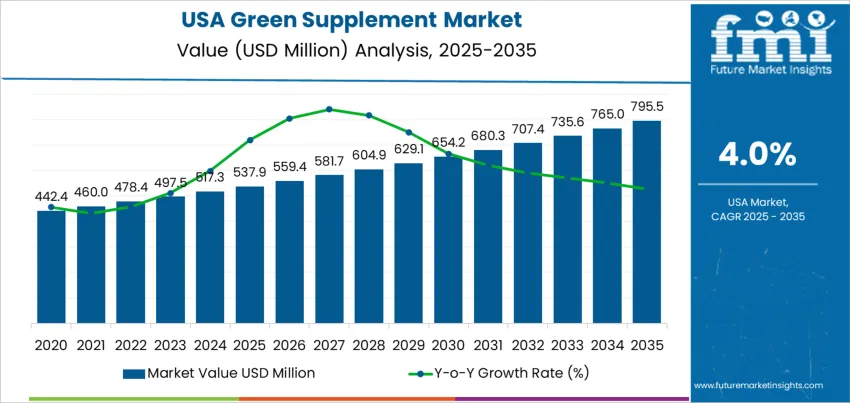
What is the Growth Forecast for the Demand for Green Supplement in USA through 2035?
From 2025 to 2030, the demand for green supplements is expected to grow from USD 537.9 million to USD 654.2 million, adding USD 116.3 million in value. This phase will be marked by strong growth driven by rising awareness of the benefits of plant-based nutrition, as well as greater availability of green supplements in both retail and online industrys. The adoption of green supplements will be boosted by the increasing focus on health optimization and the desire for convenient, natural, and nutrient-rich products.
From 2030 to 2035, the demand will rise from USD 654.2 million to USD 795.5 million, contributing USD 141.3 million in value. Although the growth rate may moderate as the industry matures, demand will remain strong due to continued innovation in product offerings and the ongoing shift toward natural wellness solutions. As more consumers turn to green supplements for their daily nutritional needs, the industry will see steady growth, supported by the continued interest in plant-based nutrition and sustainable health practices. The focus on eco-friendly and organic ingredients will further drive consumer interest and industry expansion.
Demand for Green Supplement in USA Key Takeaways
| Metric | Value |
|---|---|
| Demand for Green Supplement in USA Value (2025) | USD 537.9 million |
| Demand for Green Supplement in USA Forecast Value (2035) | USD 795.5 million |
| Demand for Green Supplement in USA Forecast CAGR (2025-2035) | 4.0% |
Why is the Demand for Green Supplement in USA Growing?
The demand for green supplements in the USA is growing as consumers become more focused on health, wellness, and the benefits of plant-based nutrition. Green supplements, typically made from a variety of green vegetables, herbs, and algae, are gaining popularity for their ability to boost overall health, support detoxification, and improve digestion. As awareness of the importance of nutrient-dense foods grows, more individuals are turning to green supplements as an easy way to enhance their diet and improve their well-being.
A significant driver of this growth is the rising interest in plant-based and clean eating trends. Consumers are increasingly seeking natural, organic, and plant-derived products that can help support their health goals. Green supplements, which are often seen as a convenient and effective way to increase vegetable intake, align with these trends, particularly as people become more health-conscious and aware of the benefits of antioxidants, vitamins, and minerals found in greens.
The growing demand for natural supplements and the shift toward preventive healthcare is contributing to the rise in green supplement consumption. As more people adopt health-conscious lifestyles and seek natural alternatives to conventional medicines, the industry for green supplements is expected to continue growing. Innovations in product formulations, such as the inclusion of superfoods and the availability of green supplements in convenient forms like powders and capsules, further support their appeal. The green supplement industry in the USA is projected to grow steadily through 2035, driven by these health and wellness trends.
What is the Segment-Wise Analysis of Demand for Green Supplements in USA?
Demand for green supplements in the USA is segmented by product type and form. By product type, demand is divided into algae, grasses, and vegetables, with algae leading at 46%. The demand is also segmented by form, including capsules, powder, and tablets, with capsules accounting for 45%. Regionally, demand is divided into Kanto, Kinki, Chubu, Kyushu & Okinawa, Tohoku, and the Rest of Japan.
Why Does Algae Lead the Demand for Green Supplements in USA?
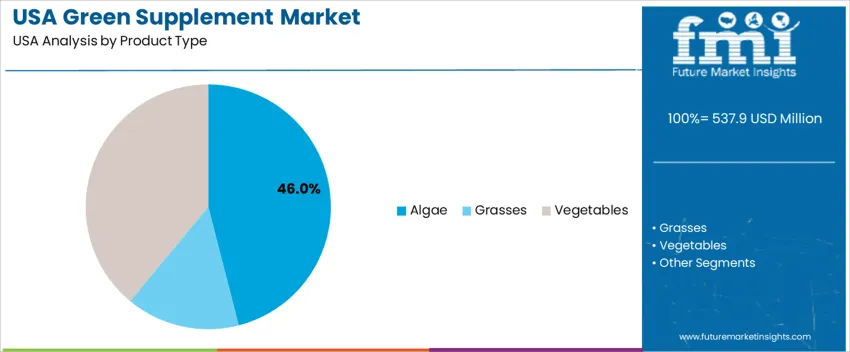
Algae accounts for 46% of the demand for green supplements in the USA, driven by its nutrient density and health benefits. Algae, particularly varieties like spirulina and chlorella, are rich in essential vitamins, minerals, antioxidants, and amino acids, making them a popular choice for consumers seeking natural, plant-based supplements. The increasing awareness of algae's potential to support immune function, detoxification, and overall health has contributed to its popularity in the green supplement industry. Algae-based supplements are often industries as sustainable and eco-friendly alternatives to other sources of protein and nutrients, appealing to health-conscious and environmentally aware consumers. As the trend toward plant-based diets and natural wellness solutions grows, algae will continue to lead the industry for green supplements in the USA.
Why Do Capsules Lead the Demand for Green Supplements in USA?
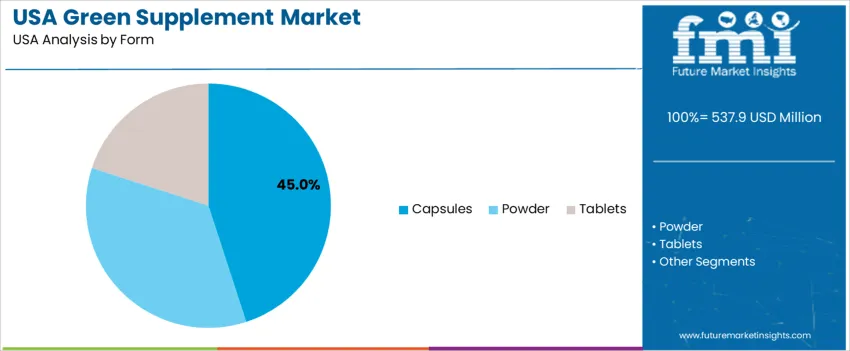
Capsules account for 45% of the demand for green supplements in the USA, driven by their convenience, ease of use, and precise dosage. Capsules are a popular form for consumers looking for an efficient way to consume green supplements without the need for preparation or measuring, which is often required with powders or tablets. They are also easy to carry and take on the go, making them a favored choice for busy individuals seeking to maintain their daily nutritional intake. Capsules can mask the strong taste of certain green supplements, such as algae or grasses, making them more palatable for consumers. As demand for green supplements continues to rise, capsules will remain the dominant form due to their practicality and consumer preference for easy, no-fuss supplementation.
What are the Key Trends, Drivers, and Restraints in Demand for Green Supplements in USA?
Demand for green supplements (such as powdered greens, plant‑based extracts, algae blends, leafy‑green mixes) in the USA is rising as more consumers pursue preventive health, wellness, and convenient nutrition. As part of the broader dietary‑supplement industry, this segment is growing fast due to increased health consciousness, interest in plant‑based and natural products, and a desire to fill nutritional gaps that many people have due to busy lifestyles or less‑than‑ideal diets. The popularity of “clean‑label” and “natural” products, plus rising use among fitness‑minded individuals and older adults seeking general wellness or immune support, appears to be driving growth. Taste/acceptability issues (some powders are considered unpalatable), price sensitivity, and consumer skepticism about efficacy may restrain growth in certain segments.
Why is Demand for Green Supplements Growing in USA?
Green supplements are increasingly appealing because they offer a convenient, time‑efficient way to access nutrients from vegetables, algae, and other plant sources often vitamins, minerals, antioxidants, and fiber which many people miss in their regular diets. With rising interest in preventive health, immune support, digestive health, weight management, and overall well‑being, supplements like greens powders or extracts offer a simple way to boost nutritional intake. The shift toward plant‑based diets, veganism, and sustainability also underpins demand: consumers seeking natural, ethical, and environmentally friendly nutrition options are drawing toward green supplements.
How are Technological & Industry Innovations Driving Green Supplement Demand in USA?
Product formulation and manufacturing innovations are making green supplements more attractive. Advances in extraction, drying, and powderization have improved nutrient preservation, shelf‑life, and ease of use. Manufacturers are offering blends tailored for different needs immunity, detox, energy, digestive health and packaging them in convenient formats (powders, capsules, ready‑mix packets) for modern busy lifestyles. Growing distribution via online retail, subscription models, and direct‑to‑consumer sales expands reach beyond traditional health‑food stores. Transparency in sourcing, clean‑label and organic certifications, and third‑party testing is also building consumer trust, making green supplements more mainstream.
What are the Key Challenges and Risks That Could Limit Green Supplement Demand in USA?
Despite growth momentum, there are obstacles to wider adoption. First, taste and palatability many green powders have strong, “earthy” flavors that some find unpleasant. Second, cost high‑quality green supplements often come at a premium, which may deter price‑sensitive buyers. Third, consumer skepticism regarding effectiveness: some people question how much benefit powdered supplements offer compared to fresh produce, especially given nutrition and diet experts’ emphasis on whole foods. Regulatory scrutiny and the need for transparent ingredient quality and safety especially in an industry with many players and varying standards can hinder trust and slow uptake among cautious consumers.
What is the Regional Demand Outlook for Green Supplement in USA?
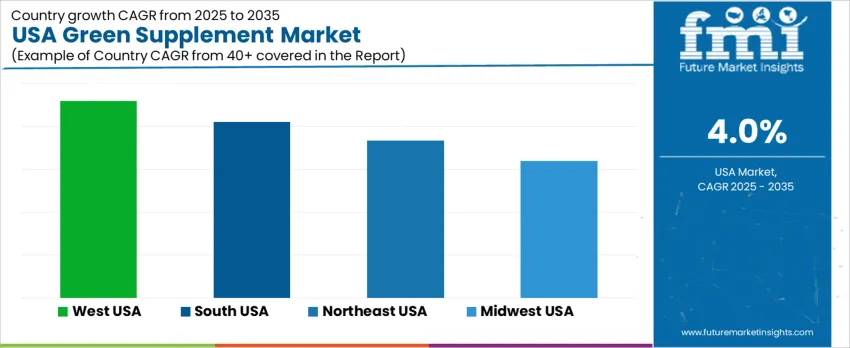
| Region | CAGR (%) |
|---|---|
| West USA | 4.6% |
| South USA | 4.1% |
| Northeast USA | 3.7% |
| Midwest USA | 3.2% |
Demand for green supplements in the USA is steadily growing, with West USA leading at a 4.6% CAGR, driven by a health-conscious population and a strong focus on wellness and sustainability. South USA follows with a 4.1% CAGR, supported by increasing awareness of the benefits of green supplements for overall health. Northeast USA shows a 3.7% CAGR, fueled by the region’s urban centers and growing interest in plant-based diets and preventive health. Midwest USA experiences a 3.2% CAGR, with steady growth driven by health trends and the growing availability of these products. As consumers increasingly prioritize health and wellness, demand for green supplements will continue to rise across the country.
How is Demand for Green Supplements Growing in West USA?
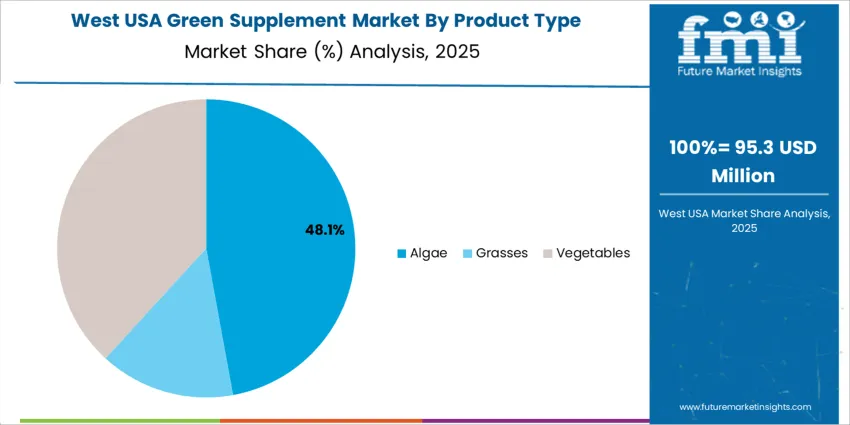
West USA leads the demand for green supplements, growing at a 4.6% CAGR. The region’s health-conscious population, particularly in cities like Los Angeles and San Francisco, is a major driver of this growth. As more consumers prioritize wellness and nutrition, green supplements, known for their rich content of vitamins, minerals, and antioxidants, are becoming an essential part of daily health routines. The rise in plant-based diets, along with the popularity of superfoods like spirulina, chlorella, and wheatgrass, further fuels the demand. West USA’s focus on sustainability and eco-friendly products supports the adoption of green supplements made from organic ingredients. As consumers seek convenient, natural ways to boost their health, the demand for green supplements in West USA will continue to grow steadily, supported by both consumer trends and the region’s commitment to wellness.
Why is Demand for Green Supplements Rising in South USA?
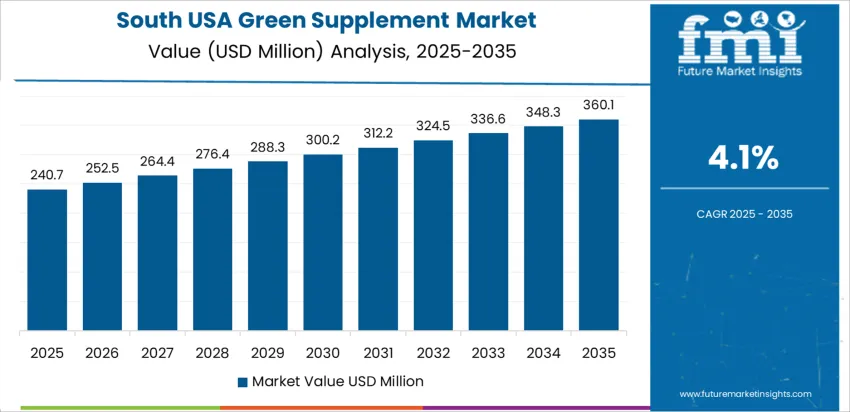
South USA is experiencing steady demand for green supplements, with a 4.1% CAGR. The region’s increasing focus on health, wellness, and preventive care is driving the rise in popularity of green supplements. With states like Texas and Florida showing strong demand, consumers are increasingly turning to these supplements for their potential health benefits, such as improved digestion, detoxification, and immune support. The growing interest in plant-based diets and natural products, including supergreens like spirulina and chlorella, contributes to the demand. South USA’s aging population is fueling the need for supplements that support overall well-being. As more retailers offer green supplements in stores and online, and as consumer awareness about the benefits of these products increases, demand for green supplements in South USA is expected to continue growing steadily, supported by the region’s evolving health trends.
How is Demand for Green Supplements Expanding in Northeast USA?
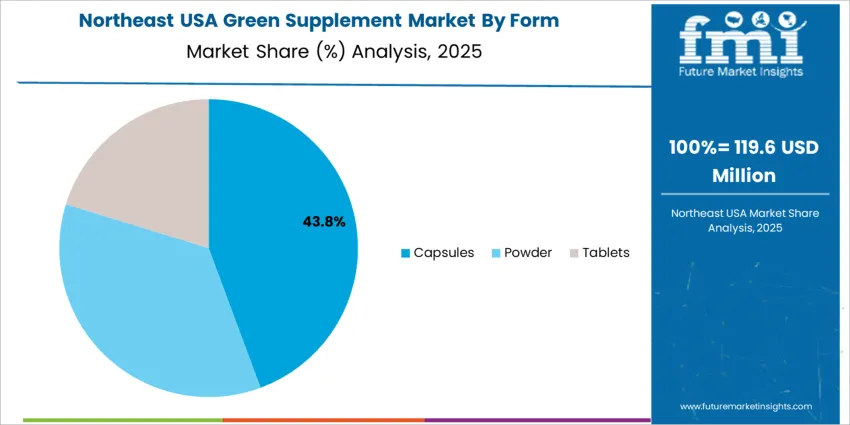
Northeast USA is seeing steady demand for green supplements, with a 3.7% CAGR. The region’s urban centers, such as New York and Boston, are home to a large health-conscious population that is increasingly adopting plant-based diets and wellness routines. As consumers seek natural ways to enhance their health and energy levels, green supplements like spirulina, barley grass, and wheatgrass are becoming popular choices. The growing focus on preventative healthcare and immune support, coupled with the region’s interest in organic and sustainably sourced products, is driving the demand for green supplements. As more consumers learn about the health benefits of these supplements, including detoxification and digestion improvement, demand continues to rise. As Northeast USA embraces cleaner, more natural products, the demand for green supplements will remain strong and steadily increase, reflecting broader consumer health trends.
Why is Demand for Green Supplements Growing in Midwest USA?
Midwest USA is experiencing moderate growth in demand for green supplements, with a 3.2% CAGR. As more consumers in the region become interested in health, wellness, and natural products, green supplements have gained traction for their potential health benefits. The Midwest’s focus on fitness and preventive care is contributing to the adoption of green supplements, particularly among individuals seeking to improve their energy levels, detoxify, and support their immune systems. The growing availability of green supplements in health food stores, superindustrys, and online platforms is making these products more accessible to a wider audience. The region’s interest in plant-based diets and natural remedies is further fueling demand. As consumers continue to prioritize health and nutrition, the demand for green supplements in Midwest USA is expected to grow steadily, driven by both health-conscious individuals and the increasing availability of these products.
What is the Competitive Landscape of Green Supplement Demand in USA?
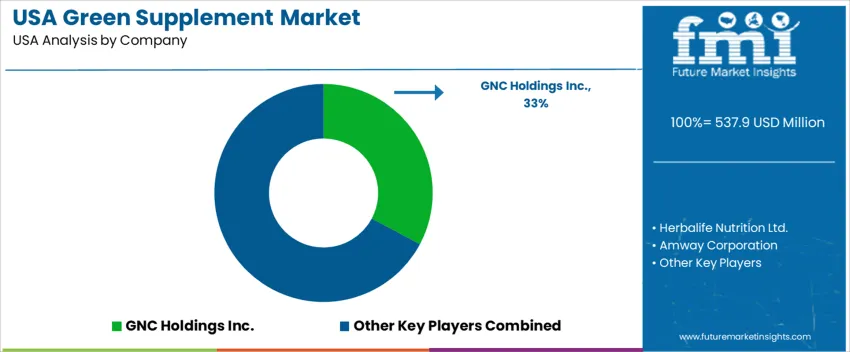
Demand for green supplements in the USA is rising as consumers increasingly seek convenient ways to boost nutrition, support immunity, and complement busy lifestyles with plant-based nutrition. Green supplements often made from algae, grasses, seaweeds, and powdered vegetables are seen as a quick way to add vitamins, minerals, antioxidants, and phytonutrients to daily diets. As health awareness grows, many Americans turn to green supplements when diet or lifestyle makes fresh produce intake difficult.
Major players in the USA green supplement space include GNC Holdings Inc., Herbalife Nutrition Ltd., Amway Corporation, Vitacost.com Inc., and Herbal Hills. GNC Holdings Inc. leads with an estimated 32.8% share, offering a broad selection of greens powders, capsules, and blends targeted at wellness- and fitness-oriented customers. Other providers like Herbalife and Amway appeal to consumers seeking broader supplement portfolios that include green-based products alongside vitamins, minerals, and lifestyle supplements. Specialty and niche providers such as Vitacost.com and Herbal Hills address demand for clean-label, plant-derived, and often organic formulations.
Growth in the green supplement segment is driven by a combination of rising health consciousness, increasing demand for plant-based nutrition, and growing interest in preventive wellness. Many consumers view green supplements as a way to fill nutritional gaps, support energy levels, and enhance overall health when fresh produce intake is inadequate. The trend toward clean-label and natural ingredients strengthens demand for supplements without synthetic additives. As competition intensifies, providers seek to differentiate through ingredient quality, formulation variety (powders vs capsules), transparent sourcing, and broad retail or e-commerce distribution focused on convenience and accessibility.
Key Players in USA Green Supplement Demand
- GNC Holdings Inc.
- Herbalife Nutrition Ltd.
- Amway Corporation
- Vitacost.com Inc.
- Herbal Hills
Scope of Report
| Items | Values |
|---|---|
| Quantitative Units (2025) | USD million |
| Product Type | Algae, Grasses, Vegetables |
| Form | Capsules, Powder, Tablets |
| Region | West USA, South USA, Northeast USA, Midwest USA |
| Countries Covered | USA |
| Key Companies Profiled | GNC Holdings Inc., Herbalife Nutrition Ltd., Amway Corporation, Vitacost.com Inc., Herbal Hills |
| Additional Attributes | Dollar sales by product type and form; regional demand trends for algae-based, grass-based, and vegetable-based supplements; innovations in packaging and formulations; increasing use of green supplements for immunity support. |
USA Green Supplement Demand by Key Segments
Product Type:
- Algae
- Grasses
- Vegetables
Form:
- Capsules
- Powder
- Tablets
Region:
- West USA
- South USA
- Northeast USA
- Midwest USA
Frequently Asked Questions
How big is the demand for green supplement in USA in 2025?
The demand for green supplement in USA is estimated to be valued at USD 537.9 million in 2025.
What will be the size of green supplement in USA in 2035?
The market size for the green supplement in USA is projected to reach USD 795.5 million by 2035.
How much will be the demand for green supplement in USA growth between 2025 and 2035?
The demand for green supplement in USA is expected to grow at a 4.0% CAGR between 2025 and 2035.
What are the key product types in the green supplement in USA?
The key product types in green supplement in USA are algae, grasses and vegetables.
Which form segment is expected to contribute significant share in the green supplement in USA in 2025?
In terms of form, capsules segment is expected to command 45.0% share in the green supplement in USA in 2025.
Preview the report firsthand - request a free sample
Get SampleGet the brochure for pricing and purchase details.
Get PDFTable of Content
- Executive Summary
- USA Market Outlook
- Demand-side Trends
- Supply-side Trends
- Technology Roadmap Analysis
- Analysis and Recommendations
- Market Overview
- Market Coverage / Taxonomy
- Market Definition / Scope / Limitations
- Market Background
- Market Dynamics
- Drivers
- Restraints
- Opportunity
- Trends
- Scenario Forecast
- Demand in Optimistic Scenario
- Demand in Likely Scenario
- Demand in Conservative Scenario
- Opportunity Map Analysis
- Product Life Cycle Analysis
- Supply Chain Analysis
- Investment Feasibility Matrix
- Value Chain Analysis
- PESTLE and Porter’s Analysis
- Regulatory Landscape
- Regional Parent Market Outlook
- Production and Consumption Statistics
- Import and Export Statistics
- Market Dynamics
- USA Market Analysis 2020 to 2024 and Forecast, 2025 to 2035
- Historical Market Size Value (USD Million) Analysis, 2020 to 2024
- Current and Future Market Size Value (USD Million) Projections, 2025 to 2035
- Y-o-Y Growth Trend Analysis
- Absolute $ Opportunity Analysis
- USA Market Pricing Analysis 2020 to 2024 and Forecast 2025 to 2035
- USA Market Analysis 2020 to 2024 and Forecast 2025 to 2035, By Product Type
- Introduction / Key Findings
- Historical Market Size Value (USD Million) Analysis By Product Type , 2020 to 2024
- Current and Future Market Size Value (USD Million) Analysis and Forecast By Product Type , 2025 to 2035
- Algae
- Grasses
- Vegetables
- Y-o-Y Growth Trend Analysis By Product Type , 2020 to 2024
- Absolute $ Opportunity Analysis By Product Type , 2025 to 2035
- USA Market Analysis 2020 to 2024 and Forecast 2025 to 2035, By Form
- Introduction / Key Findings
- Historical Market Size Value (USD Million) Analysis By Form, 2020 to 2024
- Current and Future Market Size Value (USD Million) Analysis and Forecast By Form, 2025 to 2035
- Capsules
- Powder
- Tablets
- Y-o-Y Growth Trend Analysis By Form, 2020 to 2024
- Absolute $ Opportunity Analysis By Form, 2025 to 2035
- Market Structure Analysis
- Competition Dashboard
- Competition Benchmarking
- Market Share Analysis of Top Players
- By Regional
- By Product Type
- By Form
- Competition Analysis
- Competition Deep Dive
- GNC Holdings Inc.
- Overview
- Product Portfolio
- Profitability by Market Segments (Product/Age /Sales Channel/Region)
- Sales Footprint
- Strategy Overview
- Marketing Strategy
- Product Strategy
- Channel Strategy
- Herbalife Nutrition Ltd.
- Amway Corporation
- Vitacost.com Inc.
- Herbal Hills
- GNC Holdings Inc.
- Competition Deep Dive
- Assumptions & Acronyms Used
- Research Methodology


