

- Industry Size (2026)
- USD 320.0 Mn
- Forecast (2036)
- USD 850.0 Mn
- CAGR (2026 to 2036)
- 10.0%
Green-Lipped Mussel Powder Market Size, Market Forecast and Outlook By FMI
In 2025, green-lipped mussel powder market surpassed a value of USD 295.0 million. Projections of USD 320.0 million for 2026 and USD 850.0 million by 2036 imply a 10.0% CAGR, with momentum tied to aging demographics requiring natural joint-health ingredient formats positioned for mobility support in aging populations.
Online retail expansion is improving access to joint-health supplements, including green-lipped mussel ingredients, alongside traditional pharmacy and specialty-store channels. As per FMI's projection, omnichannel scaling reshapes procurement economics, allowing premium origin-verified marine ingredients to capture higher margins. In Q4 2024, United States e-commerce captured 16.1% of total retail sales, creating a structural pathway for niche nutraceuticals [4]. Brands deploy bone and joint health supplement subscriptions to lock in recurring revenue while lowering customer acquisition costs.
Summary of Green-Lipped Mussel Powder
- Green-Lipped Mussel Powder Market Definition
- Extract derived from Perna canaliculus utilized as an active anti-inflammatory agent in clinical and consumer mobility formulations.
- Demand Drivers in the Market
- Surging clinical arthritis prevalence expands addressable user bases.
- Digital commerce acceleration reduces specialty supplement acquisition friction.
- Pet humanization trends elevate spending on companion animal mobility support.
- Key Segments Analyzed in the FMI Report
- Product Form: Dominant powder (68%) versus liquid/oil extracts and capsules.
- Application: Dietary supplements (54% of total volume) versus pet nutrition and functional foods.
- Geography: High-growth North America (United States 11.0%) versus regulatory-driven Europe (United Kingdom 10.6%, Germany 10.2%) and emerging Asia.
- Analyst Opinion at FMI
- Nandini Roy Choudhury, Principal Consultant for Food & Beverage at Future Market Insights, opines, “In our updated Green-Lipped Mussel Powder Market study, my team and I have identified clinical substantiation as the defining competitive lever. While consumer awareness around joint mobility and anti-inflammatory nutrition is expanding, procurement teams increasingly demand standardized lipid and glycosaminoglycan content. Suppliers investing in freeze-drying precision and validated bioactive retention will secure premium positioning across both human and companion animal wellness segments.”
- Strategic Implications/Executive Takeaways
- Secure long-term supply contracts to hedge against spat mortality risks.
- Integrate recognized quality marks to defend premium retail pricing.
- Pivot marketing toward preventative daily routines over reactive interventions.
- Methodology
- Validated through first-hand corporate production and capacity data.
- Zero reliance on speculative third-party market research reports.
- Based on verifiable industrial benchmarks and verified sources.
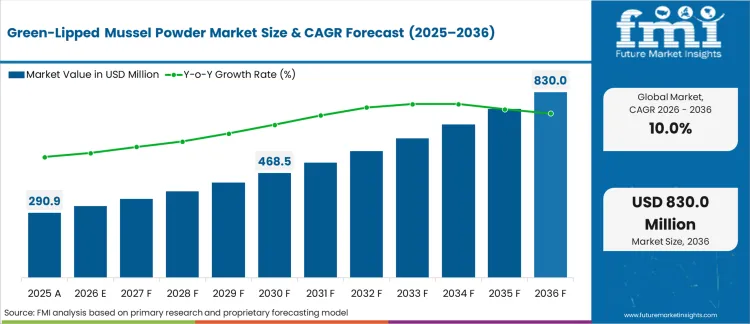
Green-Lipped Mussel Powder Market Key Takeaways
| Metric | Details |
|---|---|
| Industry Size (2026) | USD 320.0 million |
| Industry Value (2036) | USD 850.0 million |
| CAGR (2026-2036) | 10.0% |
"At Green Source Organics, we are committed to delivering the highest quality ingredients to our customers in the animal nutrition industry," said Eric Duong, COO at Green Source Organics. "Our Extracted Green Lipped Mussel Powder is a testament to our dedication to innovation and sustainability, offering a superior ingredient that meets the evolving needs of pet food manufacturers and animal nutrition specialists." [2]
Across North America, Europe, and Asia, growth concentrates where online sales penetration aligns with rising clinical burdens. Regional adoption mirrors regulatory environments, with markets clearing origin-certified shipments faster. High baseline joint-support demand redirects spend toward traceable aquaculture extracts featuring documented clinical profiles.
Green-Lipped Mussel Powder Market Definition
Green-lipped mussel powder represents a functional ingredient derived from Perna canaliculus, cultivated primarily in New Zealand waters. Processors freeze-dry or cold-extract raw biomass to preserve heat-sensitive glycosaminoglycans and lipid fractions. Downstream formulators utilize stabilized extracts in clinical mobility treatments and companion animal formulations.
Green-Lipped Mussel Powder Market Inclusions
Scope includes full-fat and defatted powder grades specifically synthesized from New Zealand greenshell mussels. Analysis incorporates bulk ingredient trade intended for human nutraceuticals and companion animal applications. Formulations evaluated encompass pure encapsulations and multi-ingredient marine collagen products containing focal powder.
Green-Lipped Mussel Powder Market Exclusions
Research excludes non-powder derivatives such as pure lipid concentrates unless sold as a blended powder matrix. Raw whole-shell seafood intended for culinary consumption falls outside defined boundaries. Formulations utilizing alternative bivalve species or synthetic glucosamine alternatives do not contribute to revenue aggregates.
Green-Lipped Mussel Powder Market Research Methodology
- Primary Research: Interviews involved aquaculture operators, freeze-drying facility managers, ingredient distributors, and regulatory compliance officers across critical export zones.
- Desk Research: Ministry of Primary Industries production data, global e-commerce performance statistics, and national health burden registries supported baseline volumetric calculations.
- Market-Sizing and Forecasting: Analysts built a top-down and bottom-up model, mapping raw material harvest ceilings against downstream formulation throughputs and validating capacities via processor disclosures.
- Data Validation and Update Cycle: Outputs undergo anomaly screening, variance checks across production and trade datasets, and structured peer review prior to release.
Segmental Analysis
Green-Lipped Mussel Powder Market Analysis by Product Form
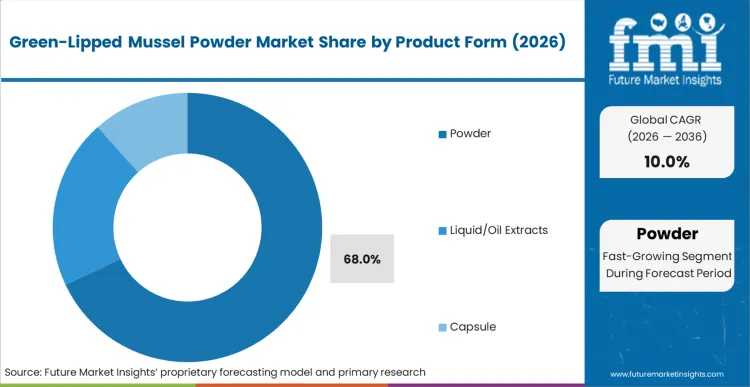
Manufacturers increasingly favor powder formats because they offer longer shelf life and greater blending flexibility, helping reduce moisture management costs across production lines. Powder grades accounted for 68% of total volume in 2026, reflecting strong demand for stable, easy-to-handle marine ingredients. Processors rely on advanced lyophilization techniques to transform sensitive marine biomass into standardized powders suitable for encapsulation and tableting.
FMI projects that this formulation flexibility allows brands to combine marine bioactive with complementary compounds to develop comprehensive mobility-focused solutions. With more than 93,000 tons of Greenshell mussels harvested in New Zealand in 2023 [1], upstream supply remains sufficient to support scaled extraction. Suppliers are also highlighting strict quality certifications to distinguish high-efficacy powders from lower-value by-products in secondary markets.
- Procurement trigger: Buyers mandate certified lipid thresholds to guarantee biological efficacy and avoid inconsistent clinical outcomes across premium product tiers. March 2024 publication of an 8+ Lipids mark provides a verifiable minimum specification, allowing formulators to secure stronger repeat purchase rates and defend margins [11].
- Capacity expansion: Aggressive extraction infrastructure investments directly address upstream processing bottlenecks, ensuring steady ingredient flow for global pet dietary supplements.
- Supply-side resilience: Hatchery upgrades stabilize volatile input volumes for powder manufacturers facing unpredictable environmental stressors and spat shortages. Cawthron Institute 2025 genomics and selective breeding program accelerates raw material yield improvements, providing processors with predictable harvest metrics and lowering wholesale price volatility [19].
Green-Lipped Mussel Powder Market Analysis by Application
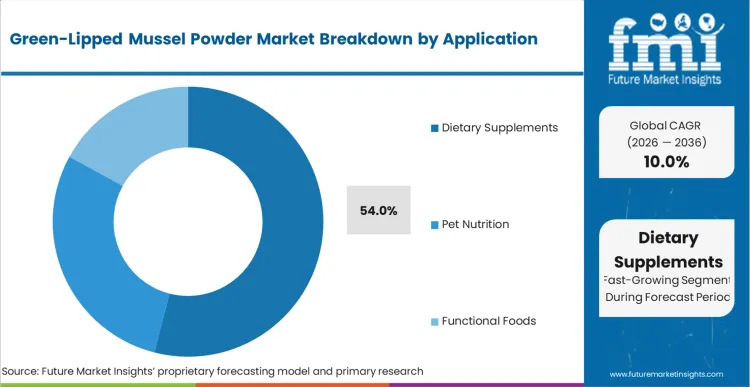
Dietary supplements capture 54% of segment share in 2026 as clinical validation of glycosaminoglycans positions extracts as a primary alternative to synthetic glucosamine supplement therapies. Aging populations facing mobility restrictions drive consistent capsule and tablet turnover across pharmacy and direct-to-consumer networks. FMI analysts opine that routine-driven preventative regimens increase daily consumption rates compared to intermittent spot treatments. Ingredient suppliers increasingly target adjacent growth vectors, launching specific ranges tailored for companion animals to capture premium veterinary spend.
Brands utilizing named, proprietary formulations maintain stronger pricing power against mass-market alternatives. Strategic pivoting toward high-purity veterinary lines aligns animal care with advanced human nutritional science, unlocking highly lucrative revenue streams independent of traditional retail channels.
- Category diversification: Manufacturers rapidly integrate marine bioactive into functional treats to capture surging veterinary spend and reduce reliance on human pharmacy channels.
- Formulation pivot: Upstream suppliers introduce dedicated animal-grade extracts to satisfy specific veterinary formulation requirements and isolate premium pricing tiers.
- Differentiation strategy: Proprietary ingredient branding isolates premium supplements from generic competition, anchoring consumer trust through verifiable clinical specifications. YuMOVE exclusive deployment of ActivEase branded extracts across its 2026 portfolio ensures unmatched category leadership and defends retail shelf space against uncertified low-cost substitutions [14].
Green-Lipped Mussel Powder Market Drivers, Restraints, and Opportunities
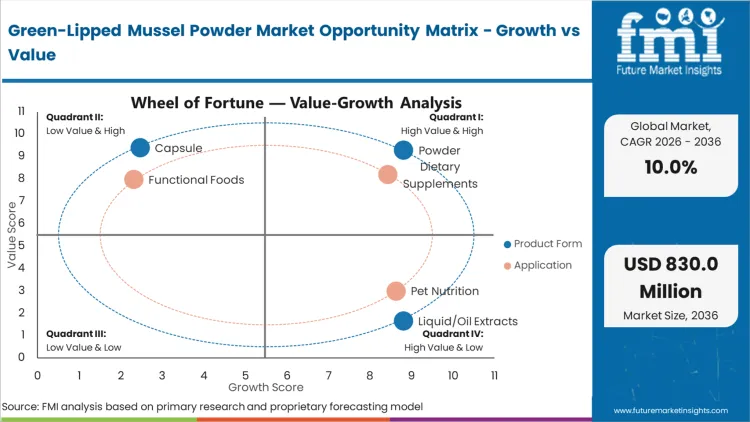
Accelerating osteoarthritis prevalence acts as a primary catalyst expanding global consumer bases. Patients experiencing chronic mobility limitations increasingly reject long-term synthetic anti-inflammatories, seeking bioavailable marine alternatives capable of sustained joint preservation. High-impact active lifestyles trigger early-onset cartilage wear, pulling initial adoption ages lower and extending total lifetime customer value. United States health data recorded a 21.3% prevalence of diagnosed arthritis in adults, illustrating a massive clinical requirement for continuous intervention [3]. Retailers respond by dedicating prominent digital and physical shelf space to mobility-focused stacks featuring origin-certified marine ingredients.
Upstream raw material volatility constraints downstream processing throughput and limits immediate scalability for global extractors. Aquaculture operations face unpredictable environmental stressors, invasive species incursions, and spat mortality events that suddenly reduce harvestable biomass. A 2025 Ministry for the Environment report detailed USD 26.4 million in direct economic losses to green-lipped mussel aquaculture over 24 years due to invasive species [12]. Processors mitigate supply shocks by acquiring independent hatcheries, vertically integrating operations to internalize seed stock production. Buyers navigate unpredictable lead times by negotiating multi-year supply agreements and maintaining buffer inventories to ensure uninterrupted manufacturing schedules.
- Capacity alignment: Major acquisitions consolidate production assets, enabling scaled extraction runs and stabilizing international supply lines. Talley's April 2023 agreement to acquire Greenshell mussel exporter assets adds 8,000t of annual output capability, fortifying supply chain resilience against localized crop failures [13].
- Veterinary premiumization: Integration of human-grade marine powders into companion animal lines unlocks high-margin revenue streams independent of traditional human retail. Brands deploying pet joint health supplement formulations bypass congested human pharmacy aisles to access highly lucrative pet specialty channels [9].
- Origin certification: Standardized quality marks provide definitive proof of lipid activity, allowing premium brands to justify higher price points. Introduction of specific industry marks protects verified New Zealand producers from low-grade synthetic substitutions and secures consumer trust [10].
Regional Analysis
Based on the regional analysis, the Green-Lipped Mussel Powder market is segmented into North America, Latin America, Europe, East Asia, South Asia, Oceania and Middle East & Africa across 40+ countries. The full report also offers market attractiveness analysis based on regional trends.
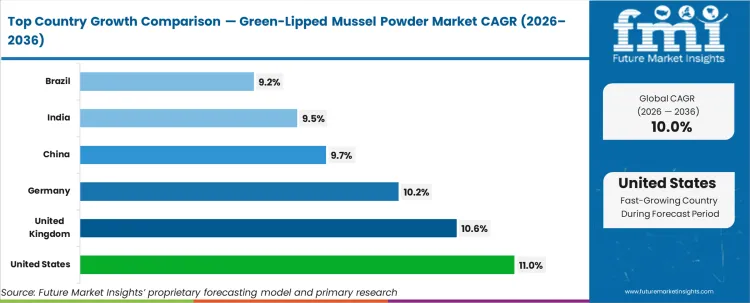
.webp "Top Country Growth Comparison Green Lipped Mussel Powder Market Cagr (2026 2036)")
| Country | CAGR (2026 to 2036) |
|---|---|
| United States | 11.0% |
| United Kingdom | 10.6% |
| Germany | 10.2% |
| China | 9.7% |
| India | 9.5% |
| Brazil | 9.2% |
Source: Future Market Insights (FMI) analysis, based on proprietary forecasting model and primary research
North America Green-Lipped Mussel Powder Market Analysis
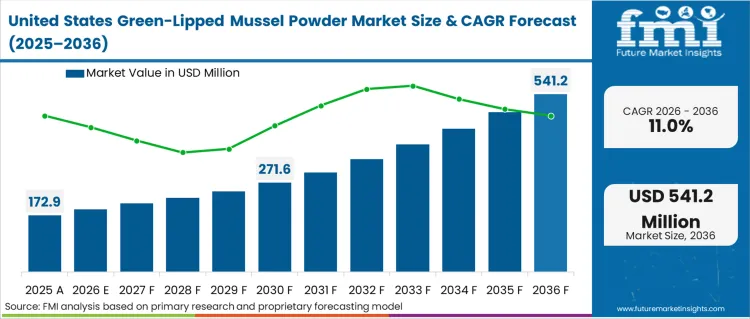
North American expansion relies on widespread digital commerce infrastructure paired with acute chronic health burdens. High disposable incomes support continuous repeat purchasing of joint-support supplements, while transparent labelling regulations favor natural, clinically backed bioactive. Consumers actively transition away from traditional synthetics toward holistic EPA DHA omega 3 ingredients and glycosaminoglycan profiles. Intense brand competition forces formulators to leverage certified New Zealand origin stories to defend premium positioning. FMI analysts opine that procurement teams consolidate supplier networks, partnering only with extraction facilities demonstrating absolute traceability. Strict FDA compliance frameworks further isolate high-quality marine suppliers from unverified international blenders.
- United States: Demand for Green-Lipped Mussel Powder in the United States is set to grow at 11.0% CAGR through 2036, supported by immense arthritis prevalence before procurement cycles translate into higher bulk ingredient imports.
FMI’s report includes an exhaustive regional outlook detailing specific channel dynamics. Canada and Mexico present notable adjacent opportunities where aging demographics mirror broader North American mobility challenges. Canadian digital retail environments reflect comparable subscription maturity, allowing established brands to execute cross-border market entry strategies.
Europe Green-Lipped Mussel Powder Market Analysis
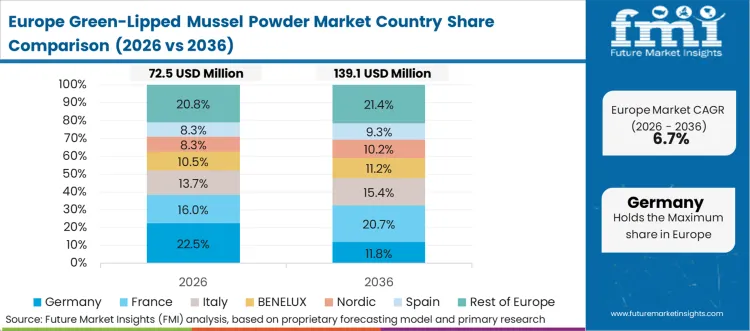
Across Europe, consumption is shaped by strong clinical validation requirements and strict oversight of health claims. Pharmacies and specialized health retailers remain trusted channels, prompting brands to present detailed scientific evidence supporting anti-inflammatory benefits. At the same time, the growing humanization of pets is channeling additional volume into premium companion animal supplements. FMI estimates that tight compliance standards are gradually removing substandard suppliers, consolidating share among origin-verified producers. A June 2025 Food Standards Agency survey reviewing 822 products underscores the intensity of regulatory monitoring, requiring manufacturers to maintain precise formulation consistency [18]. Buyers increasingly favor lyophilized powders with stable lipid profiles to meet demanding border inspection standards.
- United Kingdom: In the United Kingdom, expanding investment in pet mobility solutions and stronger veterinary endorsement are reinforcing retail demand for Green-Lipped Mussel Powder. Broader global trade growth, rising 4% to USD 32.2 trillion, supports stable import flows into British distribution networks [17]. As brands focus on defending specialized veterinary positioning against synthetic substitutes, Green-Lipped Mussel Powder sales in the United Kingdom are projected to grow at a 10.6% CAGR from 2026 to 2036.
- Germany: The Germany Green-Lipped Mussel Powder sector is poised to expand at 10.2% CAGR during 2026 to 2036 because pharmacy-led online retail accelerates, which lifts utilization rates and justifies premium brand launches. Global wellness monitors tracking a USD 161.7 billion supplements industry indicate German consumers readily adopt scientifically validated preventative routines [20]. Brands leverage clinical purity marks to secure exclusive pharmacy shelf placement.
FMI’s report includes comprehensive European tracking and country-wise assessment. France, Italy, and Spain show rising adoption rates linked to sports recovery applications and expanding functional pet nutrition aisles. Brands entering France navigate strict local nutrivigilance frameworks by partnering with established ingredient distributors possessing complete New Zealand traceability documentation.
East Asia Green-Lipped Mussel Powder Market Analysis
East Asian dynamics hinge on cross-border e-commerce networks facilitating rapid import of premium foreign nutrition. Middle-class consumers view pristine New Zealand marine inputs as ultimate quality benchmarks, happily paying elevated premiums for guaranteed authenticity. Regulatory bodies aggressively monitor import claims, necessitating absolute transparency from offshore processing facilities. Traceability acts as a primary competitive wedge, allowing verified brands to dominate digital marketplaces. Distributors prioritize partnerships featuring blockchain-enabled supply chain visibility to satisfy cautious buyers.
- China: In China, expanding cross-border digital trade is strengthening the connection between premium imported nutraceuticals and sustained consumer demand. With global e-commerce sales accelerating by 60% between 2016 and 2022 [5], distribution networks are now well equipped to handle specialized foreign supplements. Against this backdrop, Green-Lipped Mussel Powder demand in China is projected to grow at a 9.7% CAGR from 2026 to 2036, as upstream suppliers tailor packaging formats to navigate complex customs requirements more efficiently and maintain smooth import flows.
FMI’s report includes granular tracking of East Asian import regulations and consumer trends. Japan and South Korea represent critical high-value destinations where severe demographic aging forces rapid evolution in preventative joint care. South Korean buyers exhibit extreme preference for scientifically patented extraction methods, compelling suppliers to highlight lipid-preservation techniques during procurement negotiations.
South Asia Green-Lipped Mussel Powder Market Analysis
South Asian markets blend massive population scale with rapidly modernizing digital retail ecosystems. Clinical recommendations from orthopedic specialists strongly influence consumer selection, pushing patients toward natural anti-inflammatory adjuncts. Price sensitivity remains a fundamental barrier; successful brands formulate multi-ingredient blends, mixing high-cost marine powders with economical botanicals to hit acceptable retail price points. Rapidly improving internet penetration unlocks vast tier-two city demographics previously inaccessible to niche supplement brands. Projections indicating one third of global populations will exceed 60 years by 2050 guarantee persistent long-term demand for anti-inflammatory marine extracts across expanding South Asian demographics [6]. Local packagers forge alliances with offshore extractors to minimize import duties.
- India: In India, growing doctor-recommended joint care routines are increasingly influencing consumer purchasing behavior, translating clinical advice into measurable digital retail demand. Expanding global e-commerce activity, valued at USD 27 trillion across business networks, supports the scalable distribution and last-mile connectivity required for imported nutraceutical ingredients [15]. Domestic formulators are sourcing bulk Green-Lipped Mussel Powder to produce cost-optimized capsule lines tailored to local price sensitivities. As these dynamics strengthen, the market in India is projected to grow at a 9.5% CAGR through 2036.
FMI’s report includes deep analysis of South Asian formulation economics and regulatory landscapes. Bangladesh and Sri Lanka emerge as longer-term prospects contingent upon continued maturation of domestic cold-chain logistics and rising disposable incomes. Manufacturers seeking entry must establish robust local manufacturing partnerships to circumvent prohibitive finished-goods import tariffs.
Latin America Green-Lipped Mussel Powder Market Analysis
Latin American adoption scales gradually through targeted sports nutrition and emerging premium pet care channels. Currency volatility and substantial import tariffs dictate procurement strategies, forcing distributors to optimize shipment volumes and hedge against foreign exchange risk. Consumers in urban centers demonstrate rising interest in natural joint preservation, moving away from exclusive reliance on synthetic pharmaceuticals. Establishing bulk import agreements paired with local encapsulation facilities represents the most viable margin-protection strategy. New Zealand trade reports valuing Greenshell mussel exports at approximately NZD 300 million highlight established global logistics networks Latin American buyers tap into.
- Brazil: Brazil is forecast to register 9.2% CAGR in Green-Lipped Mussel Powder sales through 2036 as sports mobility and pet nutrition overlap, raising the addressable pipeline for vendors with local-ready integration. Over 100,000 dietary supplements occupy global landscapes, demanding Brazilian formulators utilize clear clinical value propositions to win conversions [16]. Distributors lock in long-term supply pricing to buffer local currency fluctuations.
FMI’s report includes localized assessments across primary Latin American economies. Mexico and Chile offer strategic footholds, where trade agreements facilitate smoother ingredient imports compared to heavily restricted neighbors. Chilean buyers increasingly explore functional pet ingredients to differentiate domestic animal nutrition brands, signaling a maturation of local manufacturing bases.
Competitive Aligners for Market Players
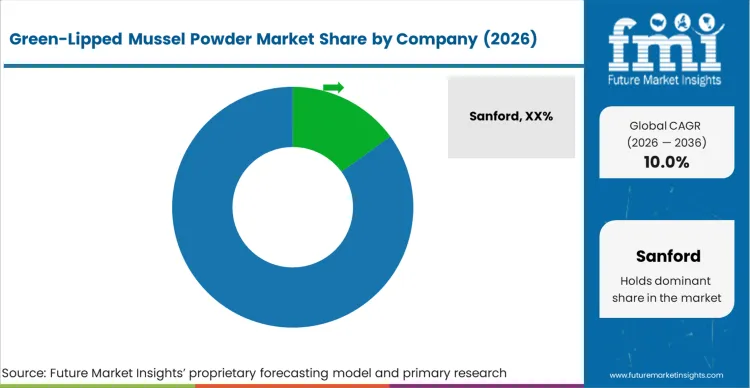
Market structure remains highly concentrated upstream, controlled by a limited number of licensed New Zealand aquaculture operators and specialized freeze-drying facilities. Downstream brand competition relies entirely on securing uninterrupted access to proprietary ingredient streams. Vertically integrated players who control hatcheries, marine farms, and extraction lines dictate global pricing and hold immense leverage over formulation brands.
Regulatory compliance and specific quality markers serve as absolute prerequisites for premium positioning. Initiatives like the 8+ Lipids standard effectively segment the industry, isolating scientifically validated powders from inferior defatted by-products. Companies capable of proving lipid integrity capture high-margin clinical and veterinary contracts, while uncertified suppliers compete purely on volatile commodity pricing.
Asset acquisition defines the current strategic landscape as operators race to internalize capacity and hedge against spat shortages. Transactions transferring major harvesting assets directly consolidate output control among a few dominant entities. Suppliers lacking captive biomass depend entirely on spot-market availability, exposing downstream clients to severe out-of-stock risks during poor harvest seasons.
Recent Developments
The report includes full coverage of key trends from competitive benchmarking. Some of the recent developments covered in the reports:
- In August 2024, Mars Petcare announced a new functional petfood range in New Zealand featuring green-lipped mussel [8].
- In May 2024, Green Source Organics launched Extracted Green Lipped Mussel Powder targeting companion animal applications [7].
Key Players in Green-Lipped Mussel Powder Market
- Sanford
- Talley's
- Waitaki Biosciences
- Green Source Organics
- Aroma NZ
- Maclab
Scope of the Report
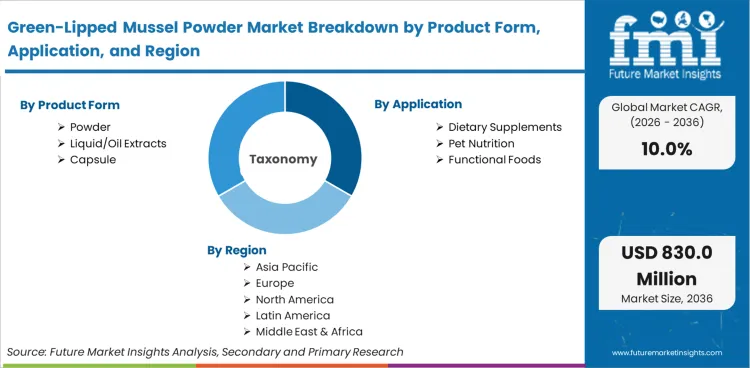
| Metric | Value |
|---|---|
| Quantitative Units | USD 320.0 million (2026) to USD 850.0 million (2036), at a CAGR of 10.0% |
| Market Definition | Extract derived from Perna canaliculus utilized as an active anti-inflammatory agent in clinical and consumer mobility formulations. |
| Product Form Segmentation | Powder, Liquid/Oil extracts, Capsule |
| Application Segmentation | Dietary Supplements, Pet Nutrition, Functional Foods |
| Distribution Channel Coverage | Online Retail, Pharmacies, Specialty Stores |
| Consumer Group Coverage | Adults, Seniors, Pets |
| Regions Covered | North America, Latin America, Europe, East Asia, South Asia, Oceania, Middle East and Africa |
| Countries Covered | United States, Canada, Mexico, Brazil, Argentina, Germany, France, United Kingdom, Italy, Spain, China, India, Japan, South Korea, Indonesia, Australia and 40 plus countries |
| Key Companies Profiled | Sanford, Talley's, Waitaki Biosciences, Green Source Organics, Aroma NZ, Maclab |
| Forecast Period | 2026 to 2036 |
| Approach | Hybrid top down and bottom up market modeling validated through primary interviews with ingredient processors and brands, supported by aquaculture yield benchmarking |
Green-Lipped Mussel Powder Market Analysis by Segments
Product Form
- Powder
- Liquid/Oil Extracts
- Capsule
Application
- Dietary Supplements
- Pet Nutrition
- Functional Foods
Distribution Channel
- Online Retail
- Pharmacies
- Specialty Stores
Consumer Group
- Adults
- Seniors
- Pets
Region
- Asia Pacific
- India
- China
- Japan
- South Korea
- Indonesia
- Australia & New Zealand
- ASEAN
- Rest of Asia Pacific
- Europe
- Germany
- Italy
- France
- United Kingdom
- Spain
- Benelux
- Nordics
- Central & Eastern Europe
- Rest of Europe
- North America
- United States
- Canada
- Mexico
- Latin America
- Brazil
- Argentina
- Chile
- Rest of Latin America
- Middle East & Africa
- Kingdom of Saudi Arabia
- United Arab Emirates
- South Africa
- Turkey
- Rest of Middle East & Africa
Bibliography
- [1] Ministry for Primary Industries. NZ Aquaculture Development Plan 2025-2030. 2025.
- [2] Petfood Industry. (2024). Freeze-dried green-lipped mussel supports animal health.
- [3] Centers for Disease Control and Prevention. Arthritis Data and Statistics. February 2024.
- [4] United States Census Bureau. Quarterly Retail E-Commerce Sales. February 2025.
- [5] UN Trade and Development. Digital Economy Report 2024. July 2024.
- [6] World Bank Blogs. Lessons for aging countries. December 2024.
- [7] PetfoodIndustry. Freeze-dried green lipped mussel supports animal health. May 2024.
- [8] Scoop. Mars launches new functional petfood range. August 2024.
- [9] RNZ. Seven million mussels to be placed in Hauraki Gulf. July 2024.
- [10] AquaFeed. Stamping our mark on New Zealand greenshell mussel powder. October 2023.
- [11] NutraIngredients. New Zealand Greenshell mussel powder for sustainably produced protein. March 2024.
- [12] Ministry for the Environment. Our marine environment 2025. 2025.
- [13] Undercurrent News. New Zealand's Talley's takes on assets. April 2023.
- [14] YuMOVE. ActivEase Green Lipped Mussel positioning. 2026.
- [15] UN Trade and Development. Business E-commerce metrics. July 2024.
- [16] USA Food and Drug Administration. Dietary Supplements. October 2024.
- [17] World Trade Organization. World Trade Statistics. 2024.
- [18] Food Standards Agency. FSA publishes results of latest retail surveillance survey. June 2025.
- [19] Cawthron Institute. Strengthening shellfish industries. 2025.
- [20] Global Wellness Institute. Wellness Economy Monitor 2024. November 2024.
This bibliography is provided for reader reference and is not exhaustive. The full report contains the complete reference list and detailed citations.
This Report Addresses
- Market intelligence to enable structured strategic decision making across premium nutraceutical sectors and omega 3 concentrates industries
- Market size estimation and 10 year revenue forecasts from 2026 to 2036, supported by validated aquaculture yields and processing throughputs
- Growth opportunity mapping across powder formats with emphasis on lipid stabilization technologies within the broader fish oil ecosystem
- Segment and regional revenue forecasts covering dietary supplements, functional pet foods, and clinical joint preservation applications
- Competition strategy assessment including vertical integration models, hatchery acquisitions, and verified capacity benchmarks
- Product reformulation tracking including lipid purity marks, extraction methods, and origin verification standards
- Regulatory impact analysis covering FDA oversight, European nutrivigilance, and strict cross border e-commerce policies
- Market report delivery in PDF, Excel, PPT, and interactive dashboard formats for executive and operational use
Frequently Asked Questions
How large is the demand for Green-Lipped Mussel Powder in the global market in 2026?
Demand for Green-Lipped Mussel Powder in the global market is estimated to be valued at USD 320.0 million in 2026.
What will be the market size of Green-Lipped Mussel Powder in the global market by 2036?
Market size for Green-Lipped Mussel Powder is projected to reach USD 850.0 million by 2036.
What is the expected demand growth for Green-Lipped Mussel Powder in the global market between 2026 and 2036?
Demand for Green-Lipped Mussel Powder in the global market is expected to grow at a CAGR of 10.0% between 2026 and 2036.
Which Product Form is poised to lead global sales by 2026?
Powder commands 68% of the volume in 2026, driven by superior shelf stability and versatile blending characteristics for encapsulation.
How significant is the role of Dietary Supplements in driving Green-Lipped Mussel Powder adoption in 2026?
Dietary supplements dominate consumption, capturing 54% of segment share in 2026 as clinical validation positions the extract as a primary alternative to synthetic joint therapies.
What is driving demand in the United States?
Immense arthritis prevalence and established e-commerce pathways drive continuous repeat purchasing of joint-support supplements.
What compliance standards or regulations are referenced for the United States?
FDA dietary supplement regulations dictate marketing claims and require absolute traceability from offshore extraction facilities.
What is the United States growth outlook in this report?
The United States is projected to grow at a CAGR of 11.0% during 2026 to 2036.
Why is Europe described as a priority region in this report?
Europe enforces rigorous clinical validation standards, consolidating market share among top-tier origin-verified producers capable of passing nutrivigilance checks.
What type of demand dominates in Europe?
Demand driven by pharmacy-led clinical credibility and rapidly expanding premium companion animal mobility solutions.
What is United Kingdom growth outlook in this report?
The United Kingdom is projected to expand at a CAGR of 10.6% during 2026 to 2036.
Does the report cover Germany in its regional analysis?
Yes, Germany is included within Europe under the regional scope of analysis.
What are the sources referred to for analyzing Germany?
Official wellness economy monitors, e-commerce growth indices, and regulatory tracking by food standards agencies shape the analysis.
What is the main demand theme linked to Germany in its region coverage?
Growth hinges on pharmacy-led online retail acceleration and high consumer trust in clinically validated marine extracts.
Does the report cover China in its regional analysis?
Yes, China is included within East Asia under the regional coverage framework.
What is the main China related demand theme in its region coverage?
Cross-border digital trade expands rapid import of premium foreign nutrition, linking origin status directly to sustained consumption.
Does the report cover India in its regional analysis?
Yes, India is included within South Asia under the regional coverage framework.
What is the main India related demand theme in its region coverage?
Doctor-influenced joint care routines convert into measurable digital retail orders as e-commerce penetration scales.
Which product formats or configurations are strategically important for North America supply chains?
Standardized powders featuring verified lipid profiles are critical to clearing FDA scrutiny and securing premium online placement.
What is Green-Lipped Mussel Powder and what is it mainly used for?
It is a freeze-dried or cold-extracted powder from New Zealand Greenshell mussels, utilized primarily as a natural anti-inflammatory in human and pet joint supplements.
What does Green-Lipped Mussel Powder mean in this report?
The market refers to bulk ingredient trade and finished functional products containing stabilized extracts from Perna canaliculus.
What is included in the scope of this Green-Lipped Mussel Powder report?
The scope includes full-fat and defatted powder grades utilized in human nutraceuticals and companion animal applications.
What is excluded from the scope of this report?
Pure lipid concentrates sold separately, raw whole-shell seafood, alternative bivalve species, and synthetic glucosamine alternatives are excluded.
What does market forecast mean on this page?
Market forecast represents a model-based projection built on defined demographic and aquaculture yield assumptions for strategic planning.
How does FMI build and validate the Green-Lipped Mussel Powder forecast?
Forecast is developed using a hybrid top-down and bottom-up model validated through processor disclosures and national export valuations.
What does zero reliance on speculative third party market research mean here?
Primary interviews and verifiable public datasets are utilized instead of unverified syndicated market estimates.
Preview the report firsthand - request a free sample
Get SampleGet the brochure for pricing and purchase details.
Get PDFTable of Content
- Executive Summary
- Global Market Outlook
- Demand-side Trends
- Supply-side Trends
- Technology Roadmap Analysis
- Analysis and Recommendations
- Market Overview
- Market Coverage / Taxonomy
- Market Definition / Scope / Limitations
- Research Methodology
- Chapter Orientation
- Analytical Lens and Working Hypotheses
- Market Structure, Signals, and Trend Drivers
- Benchmarking and Cross-market Comparability
- Market Sizing, Forecasting, and Opportunity Mapping
- Research Design and Evidence Framework
- Desk Research Programme (Secondary Evidence)
- Company Annual and Sustainability Reports
- Peer-reviewed Journals and Academic Literature
- Corporate Websites, Product Literature, and Technical Notes
- Earnings Decks and Investor Briefings
- Government Statistics Portals and Public Data Releases
- Press Releases and Reputable Media Coverage
- Specialist Newsletters and Curated Briefings
- Sector Databases and Reference Repositories
- FMI Internal Proprietary Databases and Historical Market Datasets
- Subscription Datasets and Paid Sources
- Social Channels, Communities, and Digital Listening Inputs
- Additional Desk Sources
- Expert Input and Fieldwork (Primary Evidence)
- Primary Modes
- Qualitative Interviews and Expert Elicitation
- Quantitative Surveys and Structured Data Capture
- Blended Approach
- Why Primary Evidence is Used
- Field Techniques
- Interviews
- Surveys
- Focus Groups
- Observational and In-context Research
- Social and Community Interactions
- Stakeholder Universe Engaged
- C-suite Leaders
- Board Members
- Presidents and Vice Presidents
- R&D and Innovation Heads
- Technical Specialists
- Domain Subject-matter Experts
- Scientists
- Physicians and Other Healthcare Professionals
- Governance, Ethics, and Data Stewardship
- Research Ethics
- Data Integrity and Handling
- Primary Modes
- Tooling, Models, and Reference Databases
- Desk Research Programme (Secondary Evidence)
- Data Engineering and Model Build
- Data Acquisition and Ingestion
- Cleaning, Normalisation, and Verification
- Synthesis, Triangulation, and Analysis
- Quality Assurance and Audit Trail
- Market Background
- Market Dynamics
- Drivers
- Restraints
- Opportunity
- Trends
- Scenario Forecast
- Demand in Optimistic Scenario
- Demand in Likely Scenario
- Demand in Conservative Scenario
- Opportunity Map Analysis
- Product Life Cycle Analysis
- Supply Chain Analysis
- Investment Feasibility Matrix
- Value Chain Analysis
- PESTLE and Porter’s Analysis
- Regulatory Landscape
- Regional Parent Market Outlook
- Production and Consumption Statistics
- Import and Export Statistics
- Market Dynamics
- Global Market Analysis 2021 to 2025 and Forecast, 2026 to 2036
- Historical Market Size Value (USD Million) Analysis, 2021 to 2025
- Current and Future Market Size Value (USD Million) Projections, 2026 to 2036
- Y-o-Y Growth Trend Analysis
- Absolute $ Opportunity Analysis
- Global Market Pricing Analysis 2021 to 2025 and Forecast 2026 to 2036
- Global Market Analysis 2021 to 2025 and Forecast 2026 to 2036, By Product Form
- Introduction / Key Findings
- Historical Market Size Value (USD Million) Analysis By Product Form , 2021 to 2025
- Current and Future Market Size Value (USD Million) Analysis and Forecast By Product Form , 2026 to 2036
- Powder
- Liquid/Oil Extracts
- Capsule
- Powder
- Y-o-Y Growth Trend Analysis By Product Form , 2021 to 2025
- Absolute $ Opportunity Analysis By Product Form , 2026 to 2036
- Global Market Analysis 2021 to 2025 and Forecast 2026 to 2036, By Application
- Introduction / Key Findings
- Historical Market Size Value (USD Million) Analysis By Application, 2021 to 2025
- Current and Future Market Size Value (USD Million) Analysis and Forecast By Application, 2026 to 2036
- Dietary Supplements
- Pet Nutrition
- Functional Foods
- Dietary Supplements
- Y-o-Y Growth Trend Analysis By Application, 2021 to 2025
- Absolute $ Opportunity Analysis By Application, 2026 to 2036
- Global Market Analysis 2021 to 2025 and Forecast 2026 to 2036, By Region
- Introduction
- Historical Market Size Value (USD Million) Analysis By Region, 2021 to 2025
- Current Market Size Value (USD Million) Analysis and Forecast By Region, 2026 to 2036
- North America
- Latin America
- Western Europe
- Eastern Europe
- East Asia
- South Asia and Pacific
- Middle East & Africa
- Market Attractiveness Analysis By Region
- North America Market Analysis 2021 to 2025 and Forecast 2026 to 2036, By Country
- Historical Market Size Value (USD Million) Trend Analysis By Market Taxonomy, 2021 to 2025
- Market Size Value (USD Million) Forecast By Market Taxonomy, 2026 to 2036
- By Country
- USA
- Canada
- Mexico
- By Product Form
- By Application
- By Country
- Market Attractiveness Analysis
- By Country
- By Product Form
- By Application
- Key Takeaways
- Latin America Market Analysis 2021 to 2025 and Forecast 2026 to 2036, By Country
- Historical Market Size Value (USD Million) Trend Analysis By Market Taxonomy, 2021 to 2025
- Market Size Value (USD Million) Forecast By Market Taxonomy, 2026 to 2036
- By Country
- Brazil
- Chile
- Rest of Latin America
- By Product Form
- By Application
- By Country
- Market Attractiveness Analysis
- By Country
- By Product Form
- By Application
- Key Takeaways
- Western Europe Market Analysis 2021 to 2025 and Forecast 2026 to 2036, By Country
- Historical Market Size Value (USD Million) Trend Analysis By Market Taxonomy, 2021 to 2025
- Market Size Value (USD Million) Forecast By Market Taxonomy, 2026 to 2036
- By Country
- Germany
- UK
- Italy
- Spain
- France
- Nordic
- BENELUX
- Rest of Western Europe
- By Product Form
- By Application
- By Country
- Market Attractiveness Analysis
- By Country
- By Product Form
- By Application
- Key Takeaways
- Eastern Europe Market Analysis 2021 to 2025 and Forecast 2026 to 2036, By Country
- Historical Market Size Value (USD Million) Trend Analysis By Market Taxonomy, 2021 to 2025
- Market Size Value (USD Million) Forecast By Market Taxonomy, 2026 to 2036
- By Country
- Russia
- Poland
- Hungary
- Balkan & Baltic
- Rest of Eastern Europe
- By Product Form
- By Application
- By Country
- Market Attractiveness Analysis
- By Country
- By Product Form
- By Application
- Key Takeaways
- East Asia Market Analysis 2021 to 2025 and Forecast 2026 to 2036, By Country
- Historical Market Size Value (USD Million) Trend Analysis By Market Taxonomy, 2021 to 2025
- Market Size Value (USD Million) Forecast By Market Taxonomy, 2026 to 2036
- By Country
- China
- Japan
- South Korea
- By Product Form
- By Application
- By Country
- Market Attractiveness Analysis
- By Country
- By Product Form
- By Application
- Key Takeaways
- South Asia and Pacific Market Analysis 2021 to 2025 and Forecast 2026 to 2036, By Country
- Historical Market Size Value (USD Million) Trend Analysis By Market Taxonomy, 2021 to 2025
- Market Size Value (USD Million) Forecast By Market Taxonomy, 2026 to 2036
- By Country
- India
- ASEAN
- Australia & New Zealand
- Rest of South Asia and Pacific
- By Product Form
- By Application
- By Country
- Market Attractiveness Analysis
- By Country
- By Product Form
- By Application
- Key Takeaways
- Middle East & Africa Market Analysis 2021 to 2025 and Forecast 2026 to 2036, By Country
- Historical Market Size Value (USD Million) Trend Analysis By Market Taxonomy, 2021 to 2025
- Market Size Value (USD Million) Forecast By Market Taxonomy, 2026 to 2036
- By Country
- Kingdom of Saudi Arabia
- Other GCC Countries
- Turkiye
- South Africa
- Other African Union
- Rest of Middle East & Africa
- By Product Form
- By Application
- By Country
- Market Attractiveness Analysis
- By Country
- By Product Form
- By Application
- Key Takeaways
- Key Countries Market Analysis
- USA
- Pricing Analysis
- Market Share Analysis, 2025
- By Product Form
- By Application
- Canada
- Pricing Analysis
- Market Share Analysis, 2025
- By Product Form
- By Application
- Mexico
- Pricing Analysis
- Market Share Analysis, 2025
- By Product Form
- By Application
- Brazil
- Pricing Analysis
- Market Share Analysis, 2025
- By Product Form
- By Application
- Chile
- Pricing Analysis
- Market Share Analysis, 2025
- By Product Form
- By Application
- Germany
- Pricing Analysis
- Market Share Analysis, 2025
- By Product Form
- By Application
- UK
- Pricing Analysis
- Market Share Analysis, 2025
- By Product Form
- By Application
- Italy
- Pricing Analysis
- Market Share Analysis, 2025
- By Product Form
- By Application
- Spain
- Pricing Analysis
- Market Share Analysis, 2025
- By Product Form
- By Application
- France
- Pricing Analysis
- Market Share Analysis, 2025
- By Product Form
- By Application
- India
- Pricing Analysis
- Market Share Analysis, 2025
- By Product Form
- By Application
- ASEAN
- Pricing Analysis
- Market Share Analysis, 2025
- By Product Form
- By Application
- Australia & New Zealand
- Pricing Analysis
- Market Share Analysis, 2025
- By Product Form
- By Application
- China
- Pricing Analysis
- Market Share Analysis, 2025
- By Product Form
- By Application
- Japan
- Pricing Analysis
- Market Share Analysis, 2025
- By Product Form
- By Application
- South Korea
- Pricing Analysis
- Market Share Analysis, 2025
- By Product Form
- By Application
- Russia
- Pricing Analysis
- Market Share Analysis, 2025
- By Product Form
- By Application
- Poland
- Pricing Analysis
- Market Share Analysis, 2025
- By Product Form
- By Application
- Hungary
- Pricing Analysis
- Market Share Analysis, 2025
- By Product Form
- By Application
- Kingdom of Saudi Arabia
- Pricing Analysis
- Market Share Analysis, 2025
- By Product Form
- By Application
- Turkiye
- Pricing Analysis
- Market Share Analysis, 2025
- By Product Form
- By Application
- South Africa
- Pricing Analysis
- Market Share Analysis, 2025
- By Product Form
- By Application
- USA
- Market Structure Analysis
- Competition Dashboard
- Competition Benchmarking
- Market Share Analysis of Top Players
- By Regional
- By Product Form
- By Application
- Competition Analysis
- Competition Deep Dive
- Sanford
- Overview
- Product Portfolio
- Profitability by Market Segments (Product/Age /Sales Channel/Region)
- Sales Footprint
- Strategy Overview
- Marketing Strategy
- Product Strategy
- Channel Strategy
- Talley's
- Waitaki Biosciences
- Green Source Organics
- Aroma NZ
- Maclab
- Sanford
- Competition Deep Dive
- Assumptions & Acronyms Used


