

- Industry Size (2026)
- USD 0.4 Bn
- Forecast (2036)
- USD 0.9 Bn
- CAGR (2026 to 2036)
- 7.6%
Demand for Gum Arabic in USA Forecast and Outlook 2026 to 2036
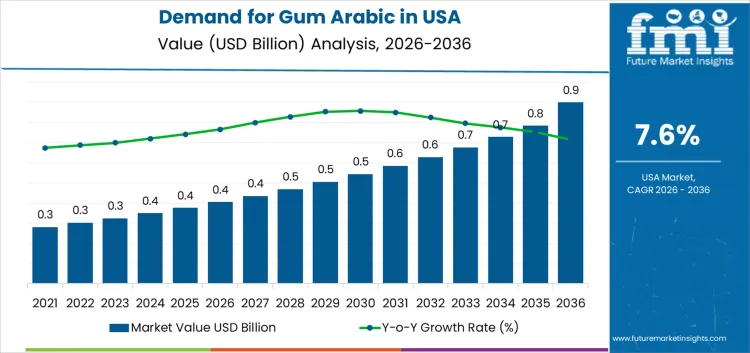
The demand for gum arabic in the USA is growing steadily, with the industry projected to expand from USD 0.4 billion in 2026 to USD 0.9 billion in 2036, reflecting a 7.6% CAGR. The demand is segmented by nature, function, application, and region, with organic gum arabic leading the industry, accounting for 65% of the demand. This surge in organic gum arabic is driven by the growing consumer preference for natural, clean-label ingredients in food, beverages, and pharmaceuticals. As industries focus on sustainability and eco-friendly products, organic gum arabic’s appeal in applications like emulsification and stabilization continues to rise.
Quick Stats of the Demand for Gum Arabic in USA
- Demand for Gum Arabic in USA Value (2026): USD 0.4 billion
- Demand for Gum Arabic in USA Forecast Value (2036): USD 0.9 billion
- Demand for Gum Arabic in USA Forecast CAGR (2026-2036): 7.6%
- Demand for Gum Arabic in USA Leading Function: Thickener
- Demand for Gum Arabic in USA Key Growth Regions: West USA, South USA, Northeast USA, Midwest USA
- Demand for Gum Arabic in USA Top Players: Nexira, Tic Gums Inc., Ingredion, Prodigy AG, Ashland Inc.
The pharmaceutical industry accounts for 45% of the total demand, where gum arabic is used extensively for its binding, emulsifying, and stabilizing properties in syrups, capsules, and emulsions. In the food and beverage sector, gum arabic is favored for its ability to enhance texture and stability, making it essential in products like soft drinks, confectioneries, and bakery items. The demand from the printing industry is also notable, as gum arabic is utilized in printing and dyeing processes. Regionally, West USA leads with an 8.7% CAGR, driven by its strong presence in the food, beverage, and cosmetics sectors. South USA follows with a 7.8% CAGR, supported by its growing food processing and pharmaceutical industries. Northeast and Midwest USA show steady demand growth as well, with sectors such as food manufacturing and cosmetics driving adoption.
Demand for Gum Arabic in USA Key Takeaways
| Metric | Value |
|---|---|
| Demand for Gum Arabic in USA Value (2026) | USD 0.4 billion |
| Demand for Gum Arabic in USA Forecast Value (2036) | USD 0.9 billion |
| Demand for Gum Arabic in USA Forecast CAGR (2026-2036) | 7.6% |
Why is the Demand for Gum Arabic in USA Growing?
The demand for gum arabic in the USA is growing due to its widespread use in various industries, including food and beverages, pharmaceuticals, cosmetics, and textiles. Gum arabic, a natural gum derived from the acacia tree, is valued for its emulsifying, stabilizing, and thickening properties. It is commonly used as a stabilizer in soft drinks, as a binder in confectioneries, and as a food coating agent. The rising consumer preference for natural ingredients in processed food products is driving the demand for gum arabic, as it is considered a safe and effective alternative to synthetic additives.
Key drivers for this growth include the increasing demand for functional food and beverages, which require natural emulsifiers and stabilizers to improve texture and shelf life. The rising popularity of plant-based and clean-label products, which avoid artificial ingredients, is also contributing to the demand for gum arabic, as it is a versatile and natural ingredient. The growing demand for pharmaceutical and cosmetic applications, where gum arabic is used as a binding agent, thickener, and carrier for active ingredients, is further boosting its use across multiple sectors.
The growth in the textile industry, where gum arabic is used in printing and dyeing processes, is supporting industry expansion. However, challenges such as fluctuations in supply due to climatic conditions and the high cost of gum arabic production may affect availability and prices. Despite these challenges, the continued focus on natural ingredients and the wide range of applications in various industries are expected to drive steady growth in the demand for gum arabic in the USA through 2036.
What is the Segment-Wise Analysis of Demand for Gum Arabic in USA?
Demand for gum arabic in the USA is segmented by nature, function, application, functionality, and region. By nature, organic gum arabic leads with 65% of the demand, followed by conventional gum arabic. In terms of function, gum arabic is primarily used as a thickener, gelling agent, fat replacer, and stabilizer. Regarding application, the pharmaceutical industry accounts for 45% of the demand, followed by food and beverages and printing industries. The functionality of gum arabic includes viscosity, solubility, emulsification, film forming, fat substitution, fiber content, and stabilization. Regionally, demand is distributed across West USA, South USA, Northeast USA, and Midwest USA
How Does Organic Nature Lead the Demand for Gum Arabic in USA?
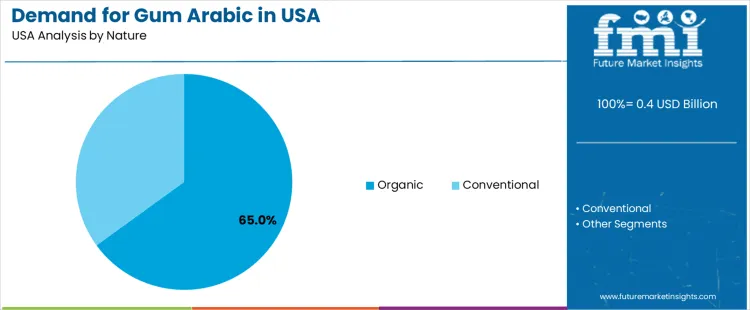
Organic gum arabic accounts for 65% of the demand in the USA, driven by the growing consumer preference for natural and sustainably sourced ingredients. Organic gum arabic is valued for its purity and environmental benefits, as it is free from synthetic pesticides and fertilizers. This makes it particularly appealing in the food, beverage, and pharmaceutical industries, where consumers are increasingly seeking organic, clean-label products. The demand for organic ingredients is also supported by the rising trend toward health-conscious consumption and eco-friendly manufacturing practices.
In addition, organic gum arabic is widely used as a stabilizer and emulsifier, ensuring that products maintain their texture and quality over time. As the trend for organic and natural food and health products continues to grow, the demand for organic gum arabic is expected to rise, reinforcing its dominant position in the industry.
How Does Pharmaceutical Industry Application Lead the Demand for Gum Arabic in USA?
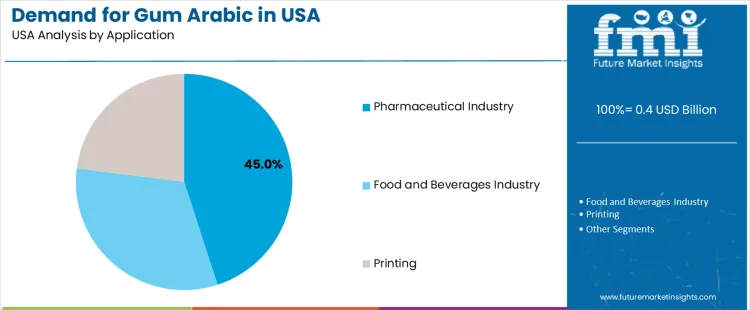
The pharmaceutical industry accounts for 45% of the demand for gum arabic in the USA, driven by its role as a stabilizer, emulsifier, and binder in various pharmaceutical formulations. Gum arabic is used extensively in the production of syrups, emulsions, and capsules due to its ability to improve the texture and stability of formulations. It is particularly valued for its viscosity and film-forming properties, which enhance the delivery and release of active ingredients in oral medications.
The increasing demand for natural, plant-based excipients in pharmaceutical products has further boosted the use of gum arabic, particularly as patients and manufacturers seek cleaner, more sustainable alternatives to synthetic substances. As the demand for pharmaceutical products continues to grow, especially in areas such as oral care, the use of gum arabic as an essential ingredient in drug formulations is expected to rise, solidifying its position as a key component in the pharmaceutical industry.
What are the Key Trends, Drivers and Restraints in Demand for Gum Arabic in USA?
Demand for gum arabic in the USA is rising as food and beverage, confectionery, and pharmaceutical industries seek natural stabilizers, emulsifiers and dietary fiber. Growth in health conscious consumption and organic product lines supports its use. Restraints include competition from alternative hydrocolloids and stabilizers such as guar gum and pectin, fluctuating supply and prices due to weather impacts in primary producing regions, and limited awareness among smaller manufacturers. Regulatory compliance and quality assurance also influence adoption.
Why is Demand for Gum Arabic Growing in USA?
Demand for gum arabic in the USA is growing because manufacturers prioritize natural ingredients that meet consumer demand for clean label products. Food and beverage brands are replacing synthetic additives with plant based alternatives to appeal to health minded shoppers. Gum arabic enhances texture, mouthfeel and stability in beverages, confectionery, and bakery items without artificial ingredients. Its use in dietary fiber supplements and nutraceuticals adds value for digestive health positioning. Expansion of organic and functional food categories, along with increased product launches featuring natural emulsifiers, drives broader use. As sustainability and natural claims become more important to consumers, gum arabic’s appeal continues to expand across multiple segments.
How are Technological and Industry Innovations Driving Gum Arabic Demand in USA?
Technological improvements and formulation innovations are boosting demand for gum arabic in the USA by making it easier to use across applications. Enhanced processing, purification and fractionation enable consistent quality and performance in complex food systems. Research into synergistic blends with other natural hydrocolloids improves emulsification, foaming and stability properties, widening application potential. Manufacturers are developing tailored grades of gum arabic optimized for beverages, confections, and encapsulation of flavors or actives. Advances in clean label formulation help brands reduce reliance on artificial stabilizers while maintaining product quality. These innovations support broader incorporation of gum arabic in new product development and reformulation efforts in food, beverage and health product categories.
What are the Key Challenges and Risks That Could Limit Gum Arabic Demand in USA?
Supply chain volatility due to climate, regional instability in producing countries, and logistical constraints can impact availability and pricing, discouraging some buyers. Competition from other plant based stabilizers like guar gum, pectin and modified starches may reduce its share, especially where cost pressures are strong. Some manufacturers may lack technical expertise to formulate with gum arabic effectively, creating hesitation. Variability in quality grades and the need for rigorous quality control can increase development costs. Limited awareness among smaller brands about its benefits may slow uptake outside established food and beverage categories.
What is the Regional Demand Outlook for Gum Arabic in USA?
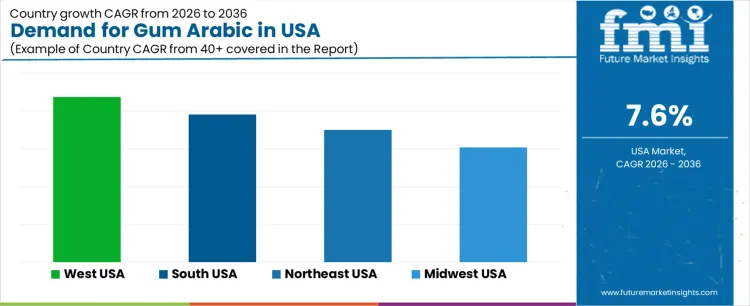
| Region | CAGR (%) |
|---|---|
| West USA | 8.7% |
| South USA | 7.8% |
| Northeast USA | 7.0% |
| Midwest USA | 6.1% |
Demand for gum arabic in the USA is growing steadily, with West USA leading at an 8.7% CAGR, driven by its strong food, beverage, and cosmetics industries and increasing consumer demand for natural ingredients. South USA follows with a 7.8% CAGR, fueled by its growing food processing and pharmaceutical sectors. Northeast USA shows a 7.0% CAGR, supported by its established manufacturing and focus on clean-label products. Midwest USA experiences a 6.1% CAGR, with steady growth driven by food, pharmaceutical, and cosmetics industries seeking natural stabilizers and emulsifiers.
How is Demand for Gum Arabic Growing in West USA?
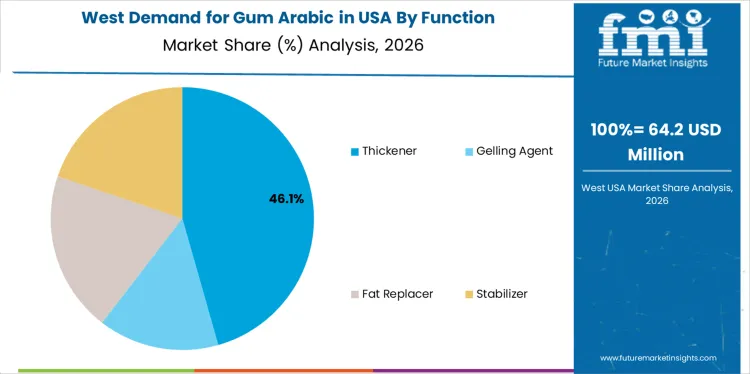
West USA leads the demand for gum arabic, growing at an 8.7% CAGR. The region’s strong presence in industries like food and beverages, cosmetics, and pharmaceuticals is driving the increasing use of gum arabic, a versatile natural gum with applications ranging from emulsifying agents to stabilizers. States like California and Oregon have high concentrations of food processing, beverage, and cosmetic manufacturing, where gum arabic is widely used to improve texture, consistency, and shelf life. The growing consumer preference for natural and clean-label ingredients is fueling the demand for gum arabic in the region. The West's focus on sustainability and eco-friendly products is also pushing the industry, as gum arabic is a renewable resource. As demand for natural ingredients continues to rise, the West is expected to maintain its leadership in the growth of gum arabic consumption, particularly in health-conscious and eco-aware sectors.
Why is Demand for Gum Arabic Rising in South USA?
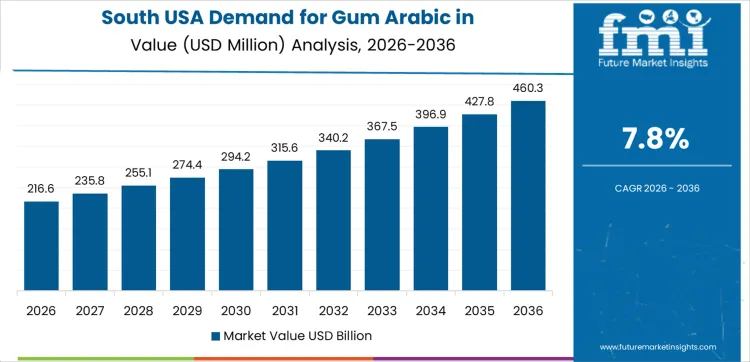
South USA is experiencing strong demand for gum arabic, with a 7.8% CAGR. The region’s growing food and beverage industry, coupled with its large-scale agricultural sector, is contributing to this increase. States like Texas, Florida, and Georgia are major hubs for food processing, where gum arabic is widely used for its stabilizing and emulsifying properties. The rising consumer demand for natural ingredients in food products is driving the adoption of gum arabic, as it is considered a healthier, plant-based alternative to synthetic additives. The South’s expanding pharmaceutical and cosmetics industries, where gum arabic is used in formulations like lotions, syrups, and vitamins, is also a contributing factor. With the increasing focus on natural ingredients and sustainable sourcing, the demand for gum arabic in the South is expected to grow steadily, supported by both food-related and non-food applications.
How is Demand for Gum Arabic Expanding in Northeast USA?
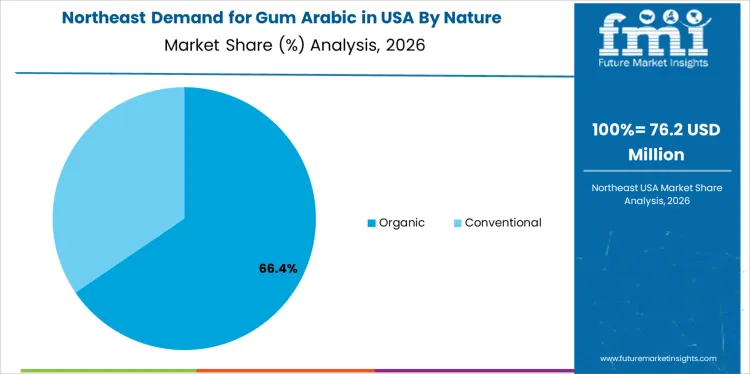
Northeast USA is seeing steady demand for gum arabic, with a 7.0% CAGR. The region’s strong food manufacturing, pharmaceutical, and cosmetic industries are key drivers of this growth. States like New York, Pennsylvania, and Massachusetts have a high concentration of food processing and cosmetic companies, where gum arabic plays a critical role as a thickening agent, stabilizer, and emulsifier. The demand for natural, clean-label products continues to rise, especially in the food and beverage sector, where consumers are increasingly choosing products with fewer artificial additives. In the pharmaceutical and cosmetic industries, gum arabic is valued for its versatility in different formulations, such as suspensions, syrups, and creams. The Northeast’s commitment to innovation in clean and natural ingredients is further driving the adoption of gum arabic. As these industries grow and consumers continue to seek more natural alternatives, demand for gum arabic in the Northeast will continue to expand steadily.
How is Demand for Gum Arabic Growing in Midwest USA?
Midwest USA is experiencing moderate demand for gum arabic, with a 6.1% CAGR. The region’s established food processing industry, particularly in states like Michigan, Illinois, and Ohio, is contributing to the rising need for natural gums like gum arabic in products such as beverages, bakery goods, and sauces. Gum arabic is increasingly used as an emulsifier and stabilizer in these products, where there is a growing consumer preference for clean-label and natural ingredients. The pharmaceutical and cosmetics sectors in the Midwest are adopting gum arabic in formulations such as soft gels, syrups, and creams, where its unique properties are highly valued. As the demand for plant-based and natural ingredients continues to rise across various industries, the need for gum arabic is expected to grow in the Midwest, driven by both food and non-food applications.
What is the Competitive Landscape of Gum Arabic Demand in USA?
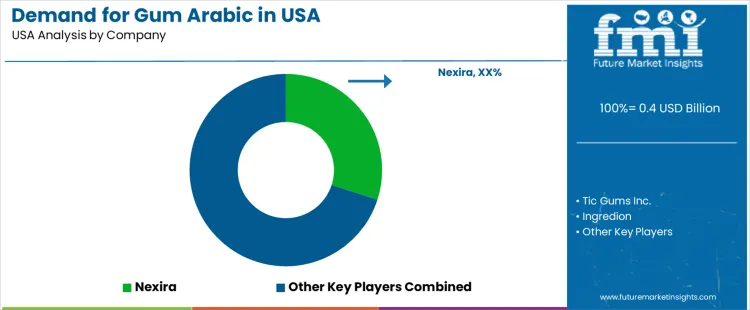
Demand for gum arabic in the USA is increasing as industries such as food and beverage, pharmaceuticals, and cosmetics seek natural, plant-derived ingredients for use in emulsification, stabilizing, and thickening applications. Gum arabic is highly valued for its versatility and wide range of uses, from flavor encapsulation in beverages to serving as a binder in pharmaceuticals. As consumer preferences shift toward cleaner labels and natural ingredients, the demand for gum arabic is expected to grow, especially in sectors where sustainability and ingredient transparency are key drivers.
Nexira is a key player in the gum arabic industry, offering high-quality, sustainable gum arabic sourced from acacia trees. The company’s strategy focuses on delivering innovative, natural solutions that meet the evolving needs of its customers in the food, beverage, and health sectors. Nexira's focus on sustainability and innovation in gum arabic production has positioned it as a leading supplier in the competitive landscape.
Tic Gums specializes in providing customized solutions that enhance product texture and stability, particularly in the food industry. Ingredion offers a wide range of gum arabic products, positioning itself as a global leader in ingredient solutions with a focus on food applications. Prodigy AG is known for its focus on natural, high-quality gum arabic, catering to both food and pharmaceutical sectors. Ashland Inc. provides a variety of gum arabic solutions with applications in personal care, food, and beverage industries, emphasizing product functionality and performance. As the industry for natural ingredients continues to grow, these companies are competing by innovating in gum arabic formulations and ensuring their offerings meet consumer demand for clean, sustainable, and functional ingredients.
Key Players in USA Gum Arabic Demand
- Nexira
- Tic Gums Inc.
- Ingredion
- Prodigy AG
- Ashland Inc.
Scope of Report
| Items | Values |
|---|---|
| Quantitative Units (2026) | USD billion |
| Key Segments | Thickener, Gelling Agent, Fat Replacer, Stabilizer |
| Nature | Organic, Conventional |
| Application | Pharmaceutical Industry, Food and Beverages Industry, Printing |
| Functionality | Viscosity, Solubility, Emulsifier, Film Forming, Fat Substitute, Fiber, Stabilizer |
| Key Country | USA |
| Region | West USA, South USA, Northeast USA, Midwest USA |
| Key Players Profiled | Nexira, Tic Gums Inc., Ingredion, Prodigy AG, Ashland Inc. |
| Additional Attributes | Dollar sales by function, nature, and application; regional CAGR and growth trends in Gum Arabic demand in the USA |
USA Gum Arabic Demand by Key Segments
Function:
- Thickener
- Gelling Agent
- Fat Replacer
- Stabilizer
Nature:
- Organic
- Conventional
Application:
- Pharmaceutical Industry
- Food and Beverages Industry
- Printing
Functionality:
- Viscosity
- Solubility
- Emulsifier
- Film Forming
- Fat Substitute
- Fiber
- Stabilizer
Region:
- West USA
- South USA
- Northeast USA
- Midwest USA
Frequently Asked Questions
How big is the demand for gum arabic in USA in 2026?
The demand for gum arabic in USA is estimated to be valued at USD 0.4 billion in 2026.
What will be the size of gum arabic in USA in 2036?
The market size for the gum arabic in USA is projected to reach USD 0.9 billion by 2036.
How much will be the demand for gum arabic in USA growth between 2026 and 2036?
The demand for gum arabic in USA is expected to grow at a 7.6% CAGR between 2026 and 2036.
What are the key product types in the gum arabic in USA?
The key product types in gum arabic in USA are thickener, gelling agent, fat replacer and stabilizer.
Which nature segment is expected to contribute significant share in the gum arabic in USA in 2026?
In terms of nature, organic segment is expected to command 65.0% share in the gum arabic in USA in 2026.
Preview the report firsthand - request a free sample
Get SampleGet the brochure for pricing and purchase details.
Get PDFTable of Content
- Executive Summary
- USA Market Outlook
- Demand-side Trends
- Supply-side Trends
- Technology Roadmap Analysis
- Analysis and Recommendations
- Market Overview
- Market Coverage / Taxonomy
- Market Definition / Scope / Limitations
- Market Background
- Market Dynamics
- Drivers
- Restraints
- Opportunity
- Trends
- Scenario Forecast
- Demand in Optimistic Scenario
- Demand in Likely Scenario
- Demand in Conservative Scenario
- Opportunity Map Analysis
- Product Life Cycle Analysis
- Supply Chain Analysis
- Investment Feasibility Matrix
- Value Chain Analysis
- PESTLE and Porter’s Analysis
- Regulatory Landscape
- Regional Parent Market Outlook
- Production and Consumption Statistics
- Import and Export Statistics
- Market Dynamics
- USA Market Analysis 2020 to 2024 and Forecast, 2025 to 2035
- Historical Market Size Value (USD Million) Analysis, 2020 to 2024
- Current and Future Market Size Value (USD Million) Projections, 2025 to 2035
- Y-o-Y Growth Trend Analysis
- Absolute $ Opportunity Analysis
- USA Market Pricing Analysis 2020 to 2024 and Forecast 2025 to 2035
- USA Market Analysis 2020 to 2024 and Forecast 2025 to 2035, By Function
- Introduction / Key Findings
- Historical Market Size Value (USD Million) Analysis By Function , 2020 to 2024
- Current and Future Market Size Value (USD Million) Analysis and Forecast By Function , 2025 to 2035
- Thickener
- Gelling Agent
- Fat Replacer
- Stabilizer
- Y-o-Y Growth Trend Analysis By Function , 2020 to 2024
- Absolute $ Opportunity Analysis By Function , 2025 to 2035
- USA Market Analysis 2020 to 2024 and Forecast 2025 to 2035, By Nature
- Introduction / Key Findings
- Historical Market Size Value (USD Million) Analysis By Nature, 2020 to 2024
- Current and Future Market Size Value (USD Million) Analysis and Forecast By Nature, 2025 to 2035
- Organic
- Conventional
- Y-o-Y Growth Trend Analysis By Nature, 2020 to 2024
- Absolute $ Opportunity Analysis By Nature, 2025 to 2035
- USA Market Analysis 2020 to 2024 and Forecast 2025 to 2035, By Application
- Introduction / Key Findings
- Historical Market Size Value (USD Million) Analysis By Application, 2020 to 2024
- Current and Future Market Size Value (USD Million) Analysis and Forecast By Application, 2025 to 2035
- Pharmaceutical Industry
- Food and Beverages Industry
- Printing
- Y-o-Y Growth Trend Analysis By Application, 2020 to 2024
- Absolute $ Opportunity Analysis By Application, 2025 to 2035
- USA Market Analysis 2020 to 2024 and Forecast 2025 to 2035, By Functionality
- Introduction / Key Findings
- Historical Market Size Value (USD Million) Analysis By Functionality, 2020 to 2024
- Current and Future Market Size Value (USD Million) Analysis and Forecast By Functionality, 2025 to 2035
- Viscosity
- Solubility
- Emulsifier
- Film Forming
- Fat Substitute
- Fiber
- Stabilizer
- Y-o-Y Growth Trend Analysis By Functionality, 2020 to 2024
- Absolute $ Opportunity Analysis By Functionality, 2025 to 2035
- Market Structure Analysis
- Competition Dashboard
- Competition Benchmarking
- Market Share Analysis of Top Players
- By Regional
- By Function
- By Nature
- By Application
- By Functionality
- Competition Analysis
- Competition Deep Dive
- Nexira
- Overview
- Product Portfolio
- Profitability by Market Segments (Product/Age /Sales Channel/Region)
- Sales Footprint
- Strategy Overview
- Marketing Strategy
- Product Strategy
- Channel Strategy
- Tic Gums Inc.
- Ingredion
- Prodigy AG
- Ashland Inc.
- Nexira
- Competition Deep Dive
- Assumptions & Acronyms Used
- Research Methodology


