

- Industry Size (2025)
- USD 50.9 Mn
- Forecast (2035)
- USD 91.1 Mn
- CAGR (2025 to 2035)
- 6.0%
Demand for Gum Arabic in Japan Forecast and Outlook 2025 to 2035
Demand for gum arabic in Japan is expected to grow from USD 50.9 million in 2025 to USD 91.1 million by 2035, reflecting a compound annual growth rate (CAGR) of 6.0%. Gum arabic, derived from the sap of acacia trees, is widely used in the food, beverage, pharmaceutical, and cosmetic industries as a stabilizer, emulsifier, and thickening agent. Demand growth is driven by increasing use of natural and plant-based ingredients across products and by growing consumer preference for clean-label, non-synthetic additives. As the food and beverage sector in Japan continues to innovate with healthier, more sustainable products, gum arabic's natural properties make it a key ingredient in this trend.
Growth is further supported by the rising demand for functional food ingredients, especially in beverages, where gum arabic plays a crucial role in maintaining texture and consistency. Japan’s strong focus on sustainability and the growing preference for natural ingredients over synthetic chemicals will continue to propel the demand for gum arabic, making it a popular choice across several industries. Increasing demand for gum arabic in emerging applications like pharmaceutical coatings and cosmetics will further drive market growth over the next decade.
Quick Stats of the Demand for Gum Arabic in Japan
- Demand for Gum Arabic in Japan Value (2025): USD 50.9 million
- Demand for Gum Arabic in Japan Forecast Value (2035): USD 91.1 million
- Demand for Gum Arabic in Japan Forecast CAGR (2025-2035): 6.0%
- Demand for Gum Arabic in Japan Leading Nature: Organic (65%)
- Demand for Gum Arabic in Japan Key Growth Regions: Kyushu & Okinawa, Kanto, Kansai, Chubu, Tohoku, Rest of Japan
- Demand for Gum Arabic in Japan Key Players: Nexira, Tic Gums Inc., Ingredion, Prodigy AG, Ashland Inc.
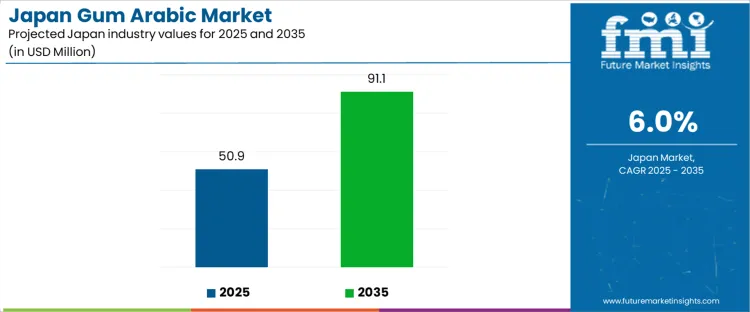
What is the Growth Forecast for the Gum Arabic Market through 2035?
Acceleration and deceleration pattern for the gum arabic market in Japan indicates a steady increase in demand over the forecast period, with a clear acceleration in the middle years. Starting at USD 50.9 million in 2025, the market grows gradually in the initial years, reaching USD 53.9 million in 2026 and USD 57.2 million in 2027. These early years reflect stable growth as gum arabic continues to be a standard ingredient in food and beverage products.
From 2027 to 2030, the growth rate accelerates, with the market reaching USD 60.6 million in 2028, USD 64.2 million in 2029, and USD 68.1 million in 2030. This acceleration is driven by increasing demand for natural food ingredients and the expanding use of gum arabic in functional products and new applications. By 2035, the market is expected to reach USD 91.1 million, showing a steady increase as the market matures. The acceleration pattern indicates that while the initial years reflect moderate growth, the demand for gum arabic will gain significant momentum as its use expands across food, beverage, pharmaceutical, and cosmetic applications.
Key Takeaways of Gum Arabic Industry in Japan
| Metric | Value |
|---|---|
| Industry Sales Value (2025) | USD 50.9 million |
| Industry Forecast Value (2035) | USD 91.1 million |
| Industry Forecast CAGR (2025-2035) | 6% |
What Is Driving the Demand for Gum Arabic in Japan?
Demand for gum Arabic in Japan has been driven by growing interest in natural and clean label ingredients among food and beverage, pharmaceutical, and personal care industries. Gum Arabic is used as a stabilizer, emulsifier, thickener or binder in beverages, confectionery, dairy products, tablets and cosmetics. In food and beverage products the increasing preference for natural additives over synthetic emulsifiers supports its use. Manufacturers of confectionery, soft drinks, flavored waters, and dairy-based beverages rely on Gum Arabic to improve texture, stabilize emulsions and ensure consistency. In pharmaceuticals and nutraceuticals the gum finds use as a binder or suspending agent in tablets, capsules or syrups. Cosmetics and personal-care producers favour Gum Arabic for stabilizing creams, lotions and other formulations.
Future demand for gum arabic in Japan is expected to rise as consumer demand continues shifting toward natural, plant-derived and clean label products. Growth of processed foods, functional beverages, fortified dairy, nutraceuticals, and natural cosmetics will likely boost their use as the population ages and interest in health and wellness rises. Demand for dietary supplements, fortified foods and easy-to-use consumer products may expand applications of Gum Arabic. Challenges such as reliance on imports and competition from alternative hydrocolloids remain, but demand may increase provided supply stability and regulatory compliance are maintained.
What Are the Key Segments in Gum Arabic Market in Japan?
The gum arabic market in Japan is segmented by function and nature. Thickener leads the function segment, holding 45% of the market share. By nature, organic gum arabic dominates, accounting for 65% of the market. The growing demand for natural and versatile ingredients in the food and beverage, pharmaceutical, and cosmetic industries is driving the adoption of gum arabic in Japan.
Which Function Drives Gum Arabic Demand in Japan?
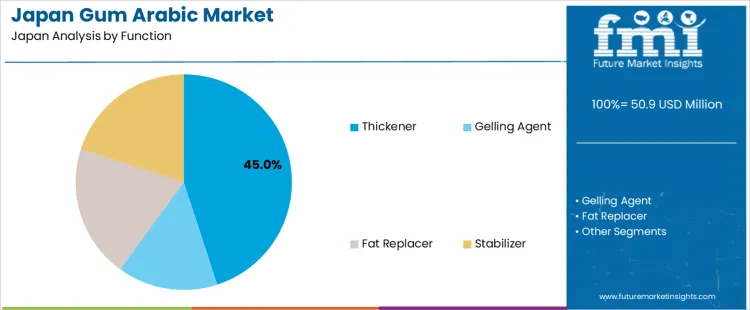
Thickener is the most widely used function for gum arabic in Japan, representing 45% of the market share. Gum arabic is primarily used as a thickening agent in a variety of applications, including food and beverages, where it improves texture, consistency, and mouthfeel. It is highly valued in the production of soft drinks, confectionery, dairy products, and sauces for its ability to stabilize emulsions and prevent separation. The demand for gum arabic as a thickener is driven by its natural origin, effectiveness in low concentrations, and ability to perform well under different conditions. While other functions such as gelling agent, fat replacer, and stabilizer are also important, thickening remains the dominant use due to the widespread need for viscosity control in a wide range of food and non-food applications.
Which Nature Drives Gum Arabic Demand in Japan?
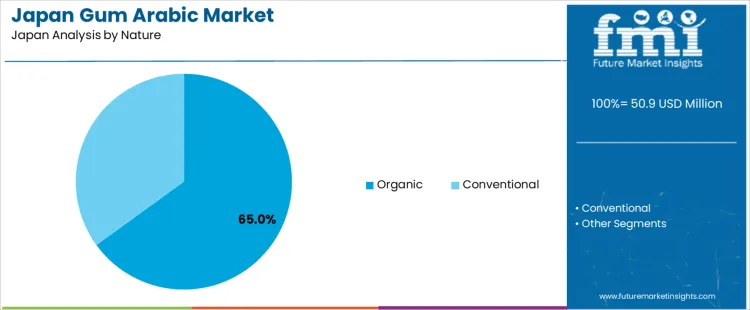
Organic gum arabic is the leading type in the market, accounting for 65% of the market share. Organic gum arabic is preferred due to its natural and eco-friendly attributes, which align with the growing demand for clean-label and sustainably sourced ingredients. The use of organic gum arabic is prevalent in the food and beverage sector, where consumers are increasingly seeking products with organic and non-GMO certifications. It is also used in the pharmaceutical and cosmetic industries, where purity and sustainability are key considerations. While conventional gum arabic is also used, the preference for organic variants is growing, driven by consumer demand for natural and health-conscious products. The shift towards organic ingredients is expected to continue as consumers prioritize sustainability and transparency in product sourcing.
What is the Key Dynamics for Gum Arabic Demand in Japan?
Demand for gum arabic in Japan is growing as industries increasingly prefer natural, plant-based additives for food, beverages, pharmaceuticals and personal care products. Gum Arabic is being used for its emulsifying, stabilizing, thickening and film-forming properties in processed foods, confectionery, beverages, dietary supplements, and cosmetic formulations. Rising interest among Japanese consumers in product quality, ingredient transparency, and clean-label formulations is driving adoption. The overall market for Gum Arabic in Japan reflects these shifting preferences and expanding application areas.
What are the Key Drivers for Gum Arabic Demand in Japan?
A major driver is the growing demand for clean-label and natural ingredients in food and beverage products, which pushes manufacturers to choose Gum Arabic over synthetic additives. Its functionality as a stabilizer, emulsifier and thickener makes it suitable for a variety of products such as soft drinks, confectionery, dairy items, and health supplements. Expansion of the processed foods and nutritional supplement industry in Japan supports increased use of Gum Arabic. Rise in demand for natural and mild cosmetic and personal care formulations is also contributing, since Gum Arabic’s film forming and binding abilities are valued in creams, lotions and other products.
What are the Restraints for Gum Arabic Demand in Japan?
One constraint is dependence on imports for Gum Arabic supply because Japan lacks significant domestic production, which makes the market vulnerable to global supply chain disruptions and raw material sourcing issues. Price fluctuations and potential volatility in supply from producing regions can lead to cost uncertainties for manufacturers. Availability of alternative hydrocolloids or stabilizers such as synthetic gums or other natural gums may limit adoption of Gum Arabic in price sensitive product segments. Regulatory or quality assurance requirements for food additives might also pose hurdles for consistent use in certain applications.
What are the Key Trends in Gum Arabic Demand in Japan?
Clean label and natural ingredient trends are encouraging broader use of Gum Arabic across food, beverage, supplement and cosmetic sectors. Use of Gum Arabic in functional products such as fiber fortified foods, dietary supplements, and wellness drinks is rising as consumers seek health oriented options. Its role in confectionery, bakery, and beverage formulations remains strong because of its emulsifying and stabilizing properties. Growth in premium and organic product segments supports demand for natural gums rather than synthetic additives. Also, manufacturers are increasingly choosing Gum Arabic for multi functional roles (thickener, emulsifier, film former), which helps simplify ingredient lists and cater to evolving consumer preferences.
What is the Regional Demand Outlook for Gum Arabic in Japan?
Demand for gum arabic in Japan is projected to grow steadily, with Kyushu & Okinawa leading the way at a projected CAGR of 7.5%. Kanto follows with a growth rate of 6.9%, while Kansai is expected to grow at 6.1%. Chubu is projected to grow at a rate of 5.3%, while Tohoku and Rest of Japan show more moderate growth, with CAGRs of 4.7% and 4.4%, respectively. Increasing demand for natural ingredients in the food and beverage sector, along with the rising interest in sustainable and versatile gums, is driving the adoption of gum arabic across Japan.
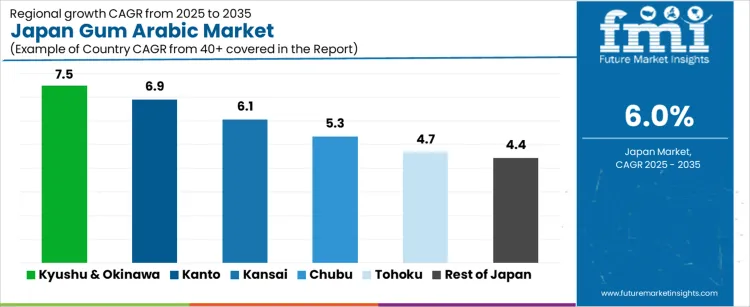
| Region | CAGR (2025-2035) |
|---|---|
| Kyushu & Okinawa | 7.5% |
| Kanto | 6.9% |
| Kansai | 6.1% |
| Chubu | 5.3% |
| Tohoku | 4.7% |
| Rest of Japan | 4.4% |
What is Driving the Growth of Gum Arabic in Kyushu & Okinawa?
Kyushu & Okinawa are projected to experience the highest growth in the gum arabic market, with a projected CAGR of 7.5%. As consumers in Kyushu & Okinawa become more health-conscious and demand more sustainable products, the adoption of natural ingredients like gum arabic is rising.
Why is the Gum Arabic Market Expanding in Kanto?
In Kanto, the demand for gum arabic is projected to grow at a CAGR of 6.9%. Kanto, which includes Tokyo, the most populous city in Japan, is a key hub for the food, beverage, and pharmaceutical industries. As urbanization continues and consumer preferences shift toward natural and organic products, the demand for gum arabic as a versatile and sustainable ingredient is increasing. Gum arabic’s ability to improve the texture, stability, and shelf life of products makes it particularly valuable in beverages, confections, and dietary supplements, which are in high demand in Kanto. The region’s focus on innovation in food and beverage manufacturing is also driving the adoption of gum arabic in both traditional and new product formulations. As Kanto leads Japan in adopting clean-label and eco-friendly ingredients, the demand for gum arabic is expected to expand rapidly.
How is the Gum Arabic Market Growing in Kansai?
In Kansai, the gum arabic market is projected to grow at a CAGR of 6.1%. Kansai, home to cities like Osaka and Kyoto, has a robust food manufacturing industry, with a strong emphasis on producing high-quality, functional food ingredients. The demand for natural ingredients, such as gum arabic, is driven by the region’s focus on providing health-conscious consumers with nutritious and eco-friendly food options. Gum arabic is particularly popular in confectionery, dairy, and beverage products, where it acts as an emulsifier and stabilizer. Kansai’s growing interest in clean-label foods and its desire to reduce reliance on synthetic ingredients are fueling the market for gum arabic. As consumer awareness about sustainability and health benefits continues to rise, the market for gum arabic in Kansai is expected to expand steadily.
What is Contributing to the Growth of Gum Arabic in Chubu?
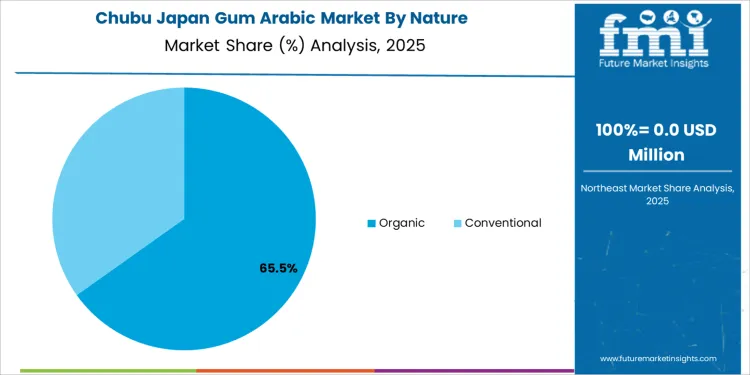
In Chubu, the gum arabic market is expected to grow at a CAGR of 5.3%. Chubu, with its industrial base and diverse manufacturing sectors, has seen increased adoption of natural ingredients in food products, including gum arabic. The region’s food and beverage industry is increasingly using gum arabic in beverages, sauces, dairy products, and confectioneries to improve stability and texture while keeping products natural and clean-label. As consumer demand for more sustainable and natural food products grows, Chubu’s food manufacturers are seeking to incorporate more plant-based, functional ingredients like gum arabic. The region’s focus on improving the nutritional profile of food products and reducing reliance on artificial additives is expected to contribute to the steady rise in demand for gum arabic.
What is Influencing the Growth of Gum Arabic in Tohoku?
In Tohoku, the gum arabic market is projected to grow at a CAGR of 4.7%. Although the growth rate is slower compared to more urbanized regions, the demand for natural food ingredients is steadily increasing. Tohoku’s food industry, particularly in rural and agricultural areas, is adopting gum arabic to improve the quality and shelf life of locally produced food items. As the region’s food sector continues to modernize, the need for more stable and functional ingredients like gum arabic will rise. Additionally, the region's increasing interest in clean-label and health-conscious food options is contributing to the demand for gum arabic. As more consumers in Tohoku seek healthier and more natural food choices, the market for gum arabic is expected to grow steadily.
What is Contributing to the Growth of Gum Arabic in Rest of Japan?
In Rest of Japan, the gum arabic market is expected to grow at a more moderate rate of 4.4%. The demand for gum arabic in rural and less urbanized regions is being driven by the increasing awareness of natural and sustainable food ingredients. As consumer preferences shift toward healthier food choices and eco-friendly products, the adoption of gum arabic is rising, particularly in the food and beverage sectors. Rest of Japan’s growing interest in clean-label ingredients is contributing to the demand for gum arabic, especially in regions with expanding food production capabilities. As access to natural ingredients becomes more widespread and consumer awareness continues to grow, the market for gum arabic is expected to experience gradual growth across Rest of Japan.
What is the Competitive Landscape for Demand for Gum Arabic in Japan?
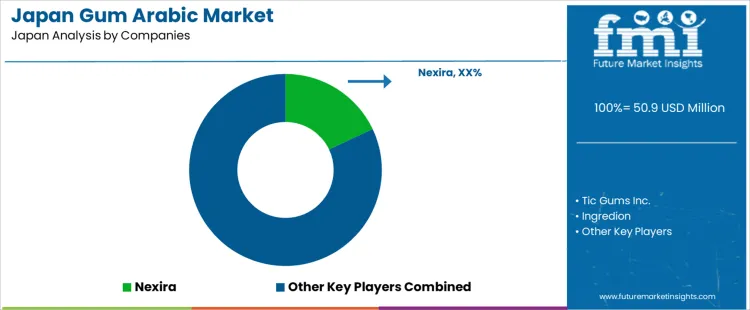
Demand for gum Arabic in Japan has been rising in line with growing preference for natural, plant based and clean label ingredients in food, beverages, and functional products. Gum Arabic is widely accepted for its role as an emulsifier, stabilizer, thickener, and dietary fiber source. Its applications in confectionery, beverages, nutritional products, and clean label foods appeal to manufacturers seeking to replace synthetic additives. The shift toward health, wellness, prebiotics, and transparent ingredient sourcing has strengthened interest in gum Arabic. As Japan’s food industry formulators respond to consumer demand for “better for you” and natural ingredient solutions, gum Arabic adoption is gaining momentum across multiple segments from drinks to fortified and functional foods.
Competition among global and regional ingredient suppliers is shaping the market. Nexira leads among identified suppliers, followed by Tic Gums Inc., Ingredion, Prodigy AG, and Ashland Inc. These companies supply import-grade gum Arabic for food, beverage, nutraceutical and other applications in Japan. Competition among them hinges on ingredient purity and consistency, compliance with Japanese food additive standards (gum arabic is listed among approved additives), reliability of supply (given most raw material originates overseas), and capability to support diversified applications-from emulsified beverages and confectionery to dietary fiber fortification and clean label formulations. Suppliers offering high quality, traceable, and food safety compliant gum Arabic along with technical support for formulation are best positioned to capture growth as demand increases in Japan’s food and wellness markets.
Key Players of the Gum Arabic Industry in Japan
- Nexira
- Tic Gums Inc.
- Ingredion
- Prodigy AG
- Ashland Inc.
Scope of the Report
| Items | Values |
|---|---|
| Quantitative Units (2025) | USD Million |
| Function | Thickener, Gelling Agent, Fat Replacer, Stabilizer |
| Nature | Organic, Conventional |
| Application | Pharmaceutical Industry, Food and Beverages Industry, Printing |
| Functionality | Viscosity, Solubility, Emulsifier, Film Forming, Fat Substitute, Fiber, Stabilizer |
| Companies | Nexira, Tic Gums Inc., Ingredion, Prodigy AG, Ashland Inc. |
| Regions Covered | Kyushu & Okinawa, Kanto, Kansai, Chubu, Tohoku, Rest of Japan |
| Additional Attributes | Dollar by sales by function, nature, application, functionality, and region. Includes gum arabic quality and purity, performance as a stabilizer and emulsifier, cost-effectiveness in production, market trends towards organic and conventional types, impact on product texture and shelf life, health benefits in food and pharmaceuticals, market share and competitive positioning of key companies, sustainability practices, and regulatory compliance in different industries. |
Key Segments in the Demand for Gum Arabic in Japan
Function
- Thickener
- Gelling Agent
- Fat Replacer
- Stabilizer
Nature
- Organic
- Conventional
Application
- Pharmaceutical Industry
- Food and Beverages Industry
- Printing
Functionality
- Viscosity
- Solubility
- Emulsifier
- Film Forming
- Fat Substitute
- Fiber
- Stabilizer
Region
- Kyushu & Okinawa
- Kanto
- Kansai
- Chubu
- Tohoku
- Rest of Japan
Frequently Asked Questions
How big is the demand for gum arabic in Japan in 2025?
The demand for gum arabic in Japan is estimated to be valued at USD 50.9 million in 2025.
What will be the size of gum arabic in Japan in 2035?
The market size for the gum arabic in Japan is projected to reach USD 91.1 million by 2035.
How much will be the demand for gum arabic in Japan growth between 2025 and 2035?
The demand for gum arabic in Japan is expected to grow at a 6.0% CAGR between 2025 and 2035.
What are the key product types in the gum arabic in Japan?
The key product types in gum arabic in Japan are thickener, gelling agent, fat replacer and stabilizer.
Which nature segment is expected to contribute significant share in the gum arabic in Japan in 2025?
In terms of nature, organic segment is expected to command 65.0% share in the gum arabic in Japan in 2025.
Preview the report firsthand - request a free sample
Get SampleGet the brochure for pricing and purchase details.
Get PDFTable of Content
- Executive Summary
- Japan Market Outlook
- Demand-side Trends
- Supply-side Trends
- Technology Roadmap Analysis
- Analysis and Recommendations
- Market Overview
- Market Coverage / Taxonomy
- Market Definition / Scope / Limitations
- Market Background
- Market Dynamics
- Drivers
- Restraints
- Opportunity
- Trends
- Scenario Forecast
- Demand in Optimistic Scenario
- Demand in Likely Scenario
- Demand in Conservative Scenario
- Opportunity Map Analysis
- Product Life Cycle Analysis
- Supply Chain Analysis
- Investment Feasibility Matrix
- Value Chain Analysis
- PESTLE and Porter’s Analysis
- Regulatory Landscape
- Regional Parent Market Outlook
- Production and Consumption Statistics
- Import and Export Statistics
- Market Dynamics
- Japan Market Analysis 2020 to 2024 and Forecast, 2025 to 2035
- Historical Market Size Value (USD Million) Analysis, 2020 to 2024
- Current and Future Market Size Value (USD Million) Projections, 2025 to 2035
- Y-o-Y Growth Trend Analysis
- Absolute $ Opportunity Analysis
- Japan Market Pricing Analysis 2020 to 2024 and Forecast 2025 to 2035
- Japan Market Analysis 2020 to 2024 and Forecast 2025 to 2035, By Function
- Introduction / Key Findings
- Historical Market Size Value (USD Million) Analysis By Function , 2020 to 2024
- Current and Future Market Size Value (USD Million) Analysis and Forecast By Function , 2025 to 2035
- Thickener
- Gelling Agent
- Fat Replacer
- Stabilizer
- Y-o-Y Growth Trend Analysis By Function , 2020 to 2024
- Absolute $ Opportunity Analysis By Function , 2025 to 2035
- Japan Market Analysis 2020 to 2024 and Forecast 2025 to 2035, By Nature
- Introduction / Key Findings
- Historical Market Size Value (USD Million) Analysis By Nature, 2020 to 2024
- Current and Future Market Size Value (USD Million) Analysis and Forecast By Nature, 2025 to 2035
- Organic
- Conventional
- Y-o-Y Growth Trend Analysis By Nature, 2020 to 2024
- Absolute $ Opportunity Analysis By Nature, 2025 to 2035
- Japan Market Analysis 2020 to 2024 and Forecast 2025 to 2035, By Application
- Introduction / Key Findings
- Historical Market Size Value (USD Million) Analysis By Application, 2020 to 2024
- Current and Future Market Size Value (USD Million) Analysis and Forecast By Application, 2025 to 2035
- Pharmaceutical Industry
- Food and Beverages Industry
- Printing
- Y-o-Y Growth Trend Analysis By Application, 2020 to 2024
- Absolute $ Opportunity Analysis By Application, 2025 to 2035
- Japan Market Analysis 2020 to 2024 and Forecast 2025 to 2035, By Functionality
- Introduction / Key Findings
- Historical Market Size Value (USD Million) Analysis By Functionality, 2020 to 2024
- Current and Future Market Size Value (USD Million) Analysis and Forecast By Functionality, 2025 to 2035
- Viscosity
- Solubility
- Emulsifier
- Film Forming
- Fat Substitute
- Fiber
- Stabilizer
- Y-o-Y Growth Trend Analysis By Functionality, 2020 to 2024
- Absolute $ Opportunity Analysis By Functionality, 2025 to 2035
- Market Structure Analysis
- Competition Dashboard
- Competition Benchmarking
- Market Share Analysis of Top Players
- By Regional
- By Function
- By Nature
- By Application
- By Functionality
- Competition Analysis
- Competition Deep Dive
- Nexira
- Overview
- Product Portfolio
- Profitability by Market Segments (Product/Age /Sales Channel/Region)
- Sales Footprint
- Strategy Overview
- Marketing Strategy
- Product Strategy
- Channel Strategy
- Tic Gums Inc.
- Ingredion
- Prodigy AG
- Ashland Inc.
- Nexira
- Competition Deep Dive
- Assumptions & Acronyms Used
- Research Methodology


