

- Industry Size (2025)
- USD 41.3 Mn
- Forecast (2035)
- USD 55.2 Mn
- CAGR (2025 to 2035)
- 2.9%
Demand for Magazine and Literature Bag in USA 2025 to 2035
The USA magazine and literature bag demand is valued at USD 41.3 million in 2025 and is forecasted to reach USD 55.2 million by 2035, reflecting a CAGR of 2.9%. Demand is shaped by continued distribution of printed magazines, catalogs, mailers, and specialty publications that require tear-resistant protection during shipping and handling. Retail promotions, subscription-based deliveries, and document storage needs add to consumption in commercial, institutional, and household segments. Paper maintains a leading share because of its recyclability, branding adaptability, and compatibility with postal guidelines. It remains favored for mail-safe packaging formats, magazine enclosures, and literature sleeves used by publishers, educational suppliers, and marketing agencies. The transition away from conventional single-use plastics reinforces higher adoption of fiber-based protective products.
West USA, South USA, and Northeast USA record the strongest utilization levels due to larger publication distribution networks, higher direct-mail activity, and more extensive e-commerce fulfillment operations. Regional buyers include media distributors, postal logistics providers, schools, libraries, and event organizers. Major suppliers include TitanShield, BCW, Jecery, ChoiCARE, and ULINE. These companies provide standardized and custom-dimension protective bags in paper and alternative materials designed for publication packaging, document storage, and mailing compliance.
Quick Stats for USA Magazine and Literature Bag Demand
- USA Magazine and Literature Bag Sales Value (2025): USD 41.3 million
- USA Magazine and Literature Bag Forecast Value (2035): USD 55.2 million
- USA Magazine and Literature Bag Forecast CAGR (2025–2035): 2.9%
- Leading Material in USA Magazine and Literature Bag Demand: Paper
- Key Growth Regions in USA Magazine and Literature Bag Demand: West USA, South USA, Northeast USA
- Top Players in USA Magazine and Literature Bag Demand: TitanShield, BCW, Jecery, ChoiCARE, ULINE
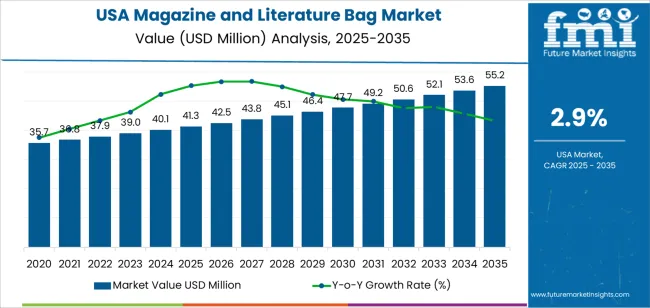
What is the Growth Forecast for Magazine and Literature Bag Industry in USA through 2035?
Demand for magazine and literature bags in the United States follows an evolving acceleration and deceleration pattern linked to changes in media distribution and packaging ecofriendly priorities. The initial acceleration arises from continued USAge within niche print-distribution channels such as catalog delivery, educational materials, and promotional mailers from retailers and nonprofit organizations. These segments maintain structured packaging requirements for protection, branding, and logistics efficiency, maintaining steady early-period demand.
As the forecast period progresses, deceleration becomes more evident due to the long-term transition from physical to digital content consumption. Declining print magazine circulation, reduced door-to-door promotional marketing, and cost optimization strategies in publishing soften volume growth. Environmental concerns and single-use plastic restrictions further influence the slowdown, prompting a shift toward recyclable paper-based packaging or unwrapped distribution models. Any later-period acceleration depends on green material innovation, including bio-based and compostable bag formats that align with compliance standards and brand ecofriendly commitments.
Demand expands modestly in early years due to established physical-media logistics, followed by measured deceleration as digital alternatives reduce dependence on this packaging category. The trajectory reflects structural sectoral change rather than cyclical fluctuation, emphasizing the importance of material innovation to maintain relevance.
USA Magazine and Literature Bag Key Takeaways
| Metric | Value |
|---|---|
| USA Magazine and Literature Bag Sales Value (2025) | USD 41.3 million |
| USA Magazine and Literature Bag Forecast Value (2035) | USD 55.2 million |
| USA Magazine and Literature Bag Forecast CAGR (2025-2035) | 2.9% |
Why is the Demand for Magazine and Literature Bags in the USA Growing?
Demand for magazine and literature bags in the USA is increasing because publishers, mailing houses and marketing teams continue to use printed promotional materials that require clean and protective packaging during distribution. These bags shield catalogs, brochures, magazines and event literature from moisture, dust and handling damage while in transit through postal and courier channels. Growth in subscription box programs, direct mail advertising and educational mailers supports steady USAge, especially for regional publications and targeted campaigns. Retailers and nonprofit organizations also use literature bags for in store handouts, trade shows and fundraising materials where presentation quality influences engagement.
Manufacturers introduce recyclable and clearer film options that improve print visibility and align with ecofriendly goals in the USA printing and packaging sector. Custom sizing and branding allow organizations to differentiate mailed materials and reinforce marketing messages. Automated bagging equipment increases adoption in fulfillment centers that require efficient packing. Constraints include digital media competition that reduces total print runs for some publications, and price sensitivity when material costs rise. Smaller print volumes may delay large procurement orders until campaign schedules are confirmed.
Which Materials and Basis Weights Lead Demand for Magazine and Literature Bags in the USA?
Demand for magazine and literature bags in the United States reflects standardized protection and distribution of printed literature, including catalogs, periodicals, direct mail booklets, and promotional reading materials. Selection depends on transparency, durability, recyclability, and compatibility with high-volume automated inserting and mailing systems operated by printers and fulfillment centers. USA adoption also reflects postal regulations for tear resistance and label readability when shipping magazines through bulk mail routes. Environmental expectations influence purchasing decisions because repeat postal distribution increases plastic USAge assessments.
By Material Composition, Paper Represents the Largest Share
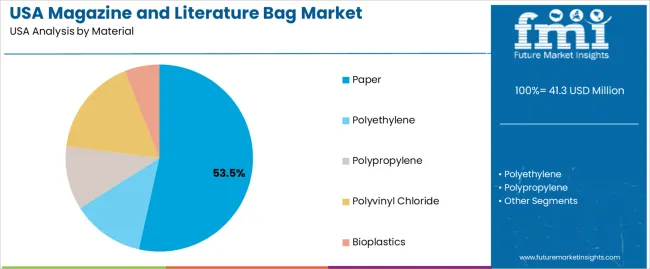
Paper accounts for 53.5%, reflecting recyclable packaging expectations and legislative pressure to reduce conventional plastics. Polyvinyl chloride (PVC) represents 17.0%, used where clarity and high tear strength support label scanning and handling requirements. Polyethylene accounts for 12.5%, offering moisture defense for outdoor distribution routes. Polypropylene holds 11.0%, providing clarity and stiffness for printed inserts. Bioplastics represent 6.0%, observed in pilot adoption where compostability and renewable feedstock reporting apply. Material selection across the United States aims to balance print quality, postal compliance, and mechanical protection during sortation and transportation in high-volume mail streams supporting subscriber delivery performance.
Key points:
- Paper dominates due to recyclability and printing compatibility.
- PVC supports higher durability for automated handling.
- Bioplastics remain limited but increasing in trials.
By Basis Weight, 25–30 GSM Holds the Largest Share
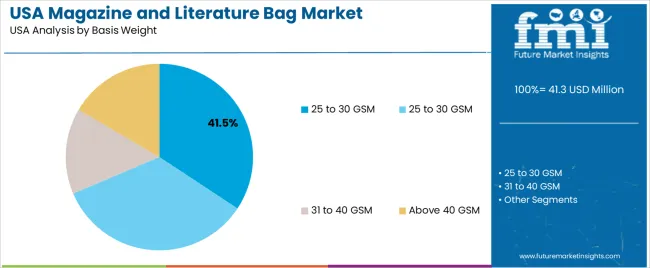
Basis-weight selection impacts surface strength, folding behavior, and throughput in automated packaging lines distributing magazines at scale. The 25–30 GSM segment represents 41.5%, balancing lightweight handling and sufficient protection. A separate 25–30 GSM listing at 20.5% suggests a secondary category variation, reflecting similar USAge in lower-volume publisher operations where lower rigidity is acceptable. The 31–40 GSM category holds 18.0%, used for premium publications requiring higher protection levels and improved crease resistance. Above 40 GSM accounts for 20.0%, supporting costly media shipments needing upgraded tear resistance. USA buyer decisions reflect consistent machinability through inserting equipment and durability through postal logistics.
Key points:
- 25–30 GSM dominates automated mail fulfillment.
- Above 40 GSM supports premium catalogs and longer transport cycles.
- Weight selection ensures compliance with postal handling needs.
What are the Drivers, Restraints, and Key Trends of the Demand for Magazine and Literature Bags in the USA?
Direct mail advertising volumes, continued use of printed promotional materials, and fulfillment needs for hobby and collector industries are driving demand.
In the United States, magazine and literature bags maintain steady demand as direct mail remains widely used by retail, nonprofit and subscription-based advertisers who need protective sleeves for catalogs, brochures and special-edition magazines. Hobby industries such as comic books, collectible magazines and archival print items rely on polypropylene and polyethylene bags to preserve condition during shipment and long-term storage, particularly in states with large collector communities such as California, Texas and Florida. Universities, healthcare systems and financial institutions distribute informational literature in protective bags at conferences and community programs, supporting recurring procurement by printing and mailing service providers. The expansion of small online publishers and independent magazines also contributes to steady USAge as they ship print editions to subscribers nationwide.
Weakening print circulation, sustainability concerns about plastic bags and limited adoption of advanced materials restrain demand.
Declines in newspaper and magazine circulation reduce bulk shipment volumes for traditional literature bags. Environmental concerns and local regulations targeting single-use plastics push some USA brands toward alternative distribution formats such as paper wraps or digital-only outreach. Printers and mailers may hesitate to adopt higher-cost recyclable or compostable films if clients do not prioritize sustainability spending. These industry pressures create slow growth conditions and significant regional variation in procurement volumes.
Shift toward recycled-content films, increased customization for branding visibility and rising demand in specialty collector channels define key trends.
Producers are offering literature bags containing post-consumer recycled resin to align with corporate ecofriendly goals and retailer expectations. Larger brands and nonprofit organizations increasingly request custom-printed bags for clear branding during mailing and event distribution. Specialty collector channels such as comic-book retailers and archival-grade storage suppliers continue to increase use of acid-free, UV-resistant bags to protect high-value issues. E-commerce mailing services also introduce resealable bags to reduce damage in last-mile delivery. These trends indicate a durable, niche-supported USA demand for magazine and literature bags.
Analysis of the Demand for Magazine and Literature Bags in the USA by Region
Demand for magazine and literature bags in the United States is influenced by mail-order distribution, promotional printing, educational content circulation, and protection of paper-based materials in logistics networks. Product USAge depends on publication density, direct-mail marketing, and retail print segments that require moisture and abrasion protection during transport. West USA leads at 3.4%, followed by South USA (3.0%), Northeast USA (2.7%), and Midwest USA (2.4%).
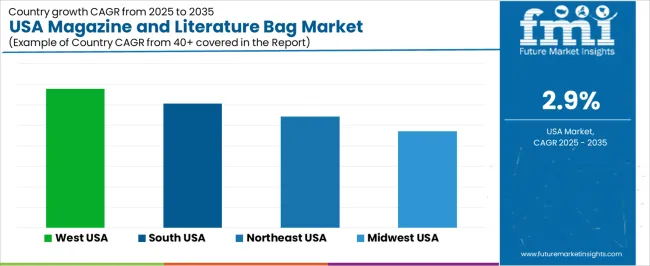
| Region | CAGR (2025 to 2035) |
|---|---|
| West USA | 3.4% |
| South USA | 3.0% |
| Northeast USA | 2.7% |
| Midwest USA | 2.4% |
How is the West USA driving demand for magazine and literature bags?
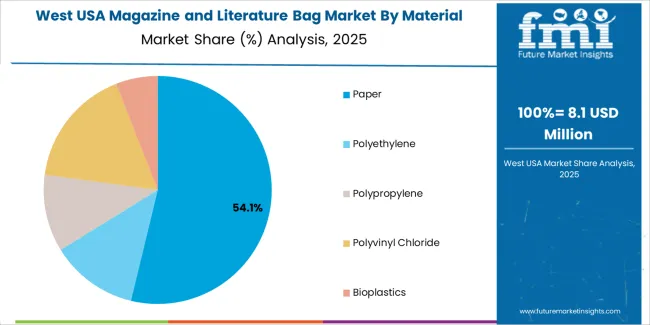
West USA grows at 3.4% CAGR, supported by large circulation volumes across California, Washington, and Colorado, where lifestyle magazines, event guides, and catalog mailers maintain consistent distribution. Regional fulfillment centers handle printed promotional materials for retail, tourism, and entertainment industries that require protective packaging to prevent surface wear during transit. Universities and educational distributors ship informational packets to student populations, increasing demand for durable poly sleeves sized for documents and literature sets. Hospitality businesses, including resort and travel operators, distribute printed marketing packets that require moisture protection in varied climates. Regional warehouses rely on automated bagging compatible with high-speed mailing workflows.
- Print and catalog distribution requiring handling protection
- Retail and tourism materials shipped in protected sleeves
- Educational packet circulation supporting steady volumes
- Fulfillment centers using automated bagging processes
How is the South USA shaping demand for magazine and literature bags?
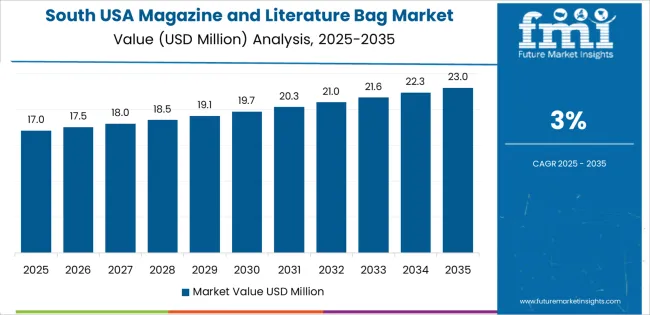
South USA grows at 3.0% CAGR, influenced by promotional-print distribution across Texas, Florida, and Georgia. Direct-mail campaigns in retail and real estate sectors maintain steady demand for protective literature packaging. Educational institutions distribute printed learning materials in sealed bags for consistent handling through school networks. Convention and trade-event industries supply brochures and venue guides that require abrasion protection. Warehouses distributing catalogues and print inserts rely on reliable film strength to preserve appearance quality during extended shipping routes.
- Direct-mail promotions supporting print-packaging needs
- School networks circulating printed information packets
- Event and convention materials requiring protective sleeves
- Regional logistics maintaining volume-based procurement
How is the Northeast USA influencing demand for magazine and literature bags?
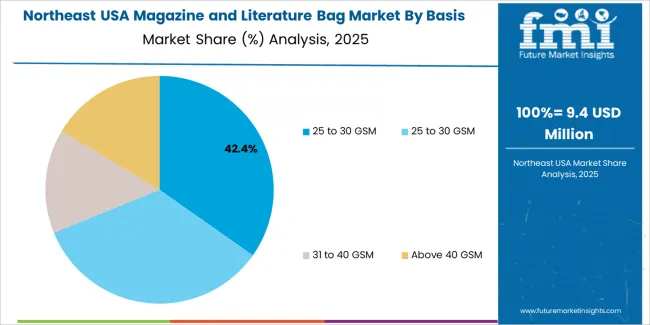
Northeast USA expands at 2.7% CAGR, supported by concentrated print-media hubs in New York, New Jersey, and Massachusetts. Large magazine publishers maintain controlled circulation for lifestyle, finance, and cultural publications needing moisture-resistant packaging for subscriber mailings. Museums and cultural institutions distribute brochures for tourism and donor outreach, reinforcing protective bag USAge. Urban fulfillment operations handle dense delivery routes where printed marketing relies on clear exterior bags for address visibility. Educational distributors support packet shipments to universities and professional programs with consistent film requirements.
- Print-media circulation requiring sealed packaging
- Cultural institutions using protective bags for outreach
- Dense last-mile logistics encouraging damage prevention
- Universities distributing informational literature sets
How is the Midwest USA contributing to demand for magazine and literature bags?
Midwest USA grows at 2.4% CAGR, shaped by steady document handling across Illinois, Ohio, and Michigan. Local printing networks supply catalogues, service guides, and nonprofit publications relying on cost-focused protective packaging. Regional distribution centers receive printed materials for automotive and consumer-goods industries that benefit from scuff protection. Public agencies distribute literacy materials packaged for handling durability. Procurement decisions emphasize compatibility with legacy mailing equipment and value-oriented formats suitable for broad distribution lists.
- Regional print shops fulfilling catalog and guide shipments
- Protective handling for mailed industrial literature
- Public agencies circulating informational content
- Buyers prioritizing low-cost materials with consistent performance
What is the competitive landscape of demand for magazine and literature bags in the USA?
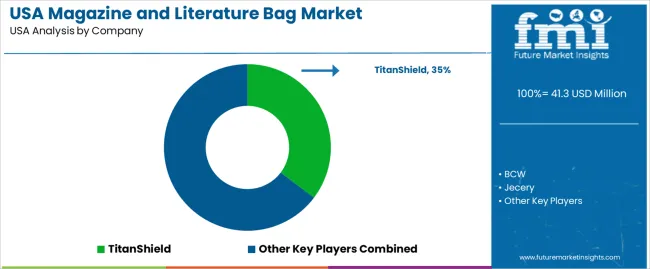
Demand for magazine and literature bags in the USA is shaped by suppliers of polypropylene and polyethylene protective sleeves used in publishing, trading-card hobbies, and document fulfillment. TitanShield holds an estimated 35.3% share, supported by controlled film-clarity standards, reliable size consistency, and broad availability within hobby retail and e-commerce channels. Its sleeves provide predictable protection for printed media stored in collectors’ environments.
BCW maintains strong participation with archival-safe polypropylene sleeves widely used by USA comic-book collectors, libraries, and specialty retailers. BCW products offer stable thickness tolerances and consistent dimensional accuracy suited to long-term preservation. ULINE contributes meaningful share in commercial and office-supply distribution. Its packaging sleeves provide durable performance for literature handling, event materials, and direct-mail fulfillment where basic protective properties and dependable bulk availability are required.
Jecery supports online demand for lightweight sleeves used in small-scale protection of magazines and printed materials. These products deliver steady film uniformity in value-oriented applications. ChoiCARE offers polyethylene sleeves positioned for general protection and short-term handling needs within consumer e-commerce channels, providing straightforward tear resistance and predictable sealing performance. Competition in the USA centers on film clarity, thickness stability, archival safety, dimensional accuracy, and nationwide supply logistics. Demand remains stable as collectors, publishers, and commercial mailers require clear, protective sleeves that preserve printed media during handling, shipping, and storage within both hobby and business distribution routines.
Key Players in USA Magazine and Literature Bag Demand
- TitanShield
- BCW
- Jecery
- ChoiCARE
- ULINE
Scope of the Report
| Items | Values |
|---|---|
| Quantitative Units | USD million |
| Material | Paper, Polyethylene, Polypropylene, Polyvinyl Chloride, Bioplastics |
| Basis Weight | 25 to 30 GSM, 31 to 40 GSM, Above 40 GSM |
| Regions Covered | West USA, South USA, Northeast USA, Midwest USA |
| Key Companies Profiled | TitanShield, BCW, Jecery, ChoiCARE, ULINE |
| Additional Attributes | Includes segmentation by material sustainability, clarity, and durability requirements; demand influenced by publishing, postal distribution, collectibles, and retail marketing; shift toward recyclable and biodegradable bag formats; sizing customization for magazines, catalogs, and promotional literature; distribution through packaging suppliers and online commercial channels. |
USA Magazine and Literature Bag Demand by Segments
Material:
- Paper
- Polyethylene
- Polypropylene
- Polyvinyl Chloride
- Bioplastics
Basis Weight:
- 25 to 30 GSM
- 25 to 30 GSM
- 31 to 40 GSM
- Above 40 GSM
Region:
- West USA
- South USA
- Northeast USA
- Midwest USA
Frequently Asked Questions
How big is the demand for magazine and literature bag in USA in 2025?
The demand for magazine and literature bag in USA is estimated to be valued at USD 41.3 million in 2025.
What will be the size of magazine and literature bag in USA in 2035?
The market size for the magazine and literature bag in USA is projected to reach USD 55.2 million by 2035.
How much will be the demand for magazine and literature bag in USA growth between 2025 and 2035?
The demand for magazine and literature bag in USA is expected to grow at a 2.9% CAGR between 2025 and 2035.
What are the key product types in the magazine and literature bag in USA?
The key product types in magazine and literature bag in USA are paper, polyethylene, polypropylene, polyvinyl chloride and bioplastics.
Which basis weight segment is expected to contribute significant share in the magazine and literature bag in USA in 2025?
In terms of basis weight, 25 to 30 gsm segment is expected to command 41.5% share in the magazine and literature bag in USA in 2025.
Preview the report firsthand - request a free sample
Get SampleGet the brochure for pricing and purchase details.
Get PDFTable of Content
- Executive Summary
- USA Market Outlook
- Demand-side Trends
- Supply-side Trends
- Technology Roadmap Analysis
- Analysis and Recommendations
- Market Overview
- Market Coverage / Taxonomy
- Market Definition / Scope / Limitations
- Market Background
- Market Dynamics
- Drivers
- Restraints
- Opportunity
- Trends
- Scenario Forecast
- Demand in Optimistic Scenario
- Demand in Likely Scenario
- Demand in Conservative Scenario
- Opportunity Map Analysis
- Product Life Cycle Analysis
- Supply Chain Analysis
- Investment Feasibility Matrix
- Value Chain Analysis
- PESTLE and Porter’s Analysis
- Regulatory Landscape
- Regional Parent Market Outlook
- Production and Consumption Statistics
- Import and Export Statistics
- Market Dynamics
- USA Market Analysis 2020 to 2024 and Forecast, 2025 to 2035
- Historical Market Size Value (USD Million) Analysis, 2020 to 2024
- Current and Future Market Size Value (USD Million) Projections, 2025 to 2035
- Y-o-Y Growth Trend Analysis
- Absolute $ Opportunity Analysis
- USA Market Pricing Analysis 2020 to 2024 and Forecast 2025 to 2035
- USA Market Analysis 2020 to 2024 and Forecast 2025 to 2035, By Material
- Introduction / Key Findings
- Historical Market Size Value (USD Million) Analysis By Material , 2020 to 2024
- Current and Future Market Size Value (USD Million) Analysis and Forecast By Material , 2025 to 2035
- Paper
- Polyethylene
- Polypropylene
- Polyvinyl Chloride
- Bioplastics
- Y-o-Y Growth Trend Analysis By Material , 2020 to 2024
- Absolute $ Opportunity Analysis By Material , 2025 to 2035
- USA Market Analysis 2020 to 2024 and Forecast 2025 to 2035, By Basis Weight
- Introduction / Key Findings
- Historical Market Size Value (USD Million) Analysis By Basis Weight, 2020 to 2024
- Current and Future Market Size Value (USD Million) Analysis and Forecast By Basis Weight, 2025 to 2035
- 25 to 30 GSM
- 25 to 30 GSM
- 31 to 40 GSM
- Above 40 GSM
- Y-o-Y Growth Trend Analysis By Basis Weight, 2020 to 2024
- Absolute $ Opportunity Analysis By Basis Weight, 2025 to 2035
- Market Structure Analysis
- Competition Dashboard
- Competition Benchmarking
- Market Share Analysis of Top Players
- By Regional
- By Material
- By Basis Weight
- Competition Analysis
- Competition Deep Dive
- TitanShield
- Overview
- Product Portfolio
- Profitability by Market Segments (Product/Age /Sales Channel/Region)
- Sales Footprint
- Strategy Overview
- Marketing Strategy
- Product Strategy
- Channel Strategy
- BCW
- Jecery
- ChoiCARE
- ULINE
- TitanShield
- Competition Deep Dive
- Assumptions & Acronyms Used
- Research Methodology


