

- Industry Size (2025)
- USD 1.1 Bn
- Forecast (2035)
- USD 1.7 Bn
- CAGR (2025 to 2035)
- 4.8%
Demand for Bag-in-Box Filler in USA Forecast and Outlook 2025 to 2035
The demand for bag-in-box fillers in the USA is expected to grow from USD 1.1 billion in 2025 to USD 1.7 billion by 2035, reflecting a compound annual growth rate (CAGR) of 4.8%. Bag-in-box fillers are widely used in industries such as beverage packaging, food processing, and chemicals, providing a convenient and cost-effective solution for storing and dispensing liquids.
The market for bag-in-box fillers is expected to grow steadily, driven by the increasing adoption of flexible packaging solutions in sectors such as wine, juices, and other liquid-based products. Growing sustainability trends also influence the demand, as bag-in-box packaging is seen as an eco-friendly alternative to rigid containers.
Quick Stats of the Demand for Bag-in-Box Filler in USA
- Demand for Bag-in-Box Filler in USA Value (2025): USD 1.1 billion
- Demand for Bag-in-Box Filler in USA Forecast Value (2035): USD 1.7 billion
- Demand for Bag-in-Box Filler in USA Forecast CAGR (2025-2035): 4.8%
- Demand for Bag-in-Box Filler in USA Leading Automation Type: Automatic (64%)
- Demand for Bag-in-Box Filler in USA Key Growth Regions: West USA, South USA, Northeast USA, Midwest USA
- Demand for Bag-in-Box Filler in USA Key Players: A TriMas Company, Linapack, TORR Industries, Smurfit Kappa, Frain Industries
What is the Growth Forecast for the Bag-in-Box Filler Industry in USA through 2035?
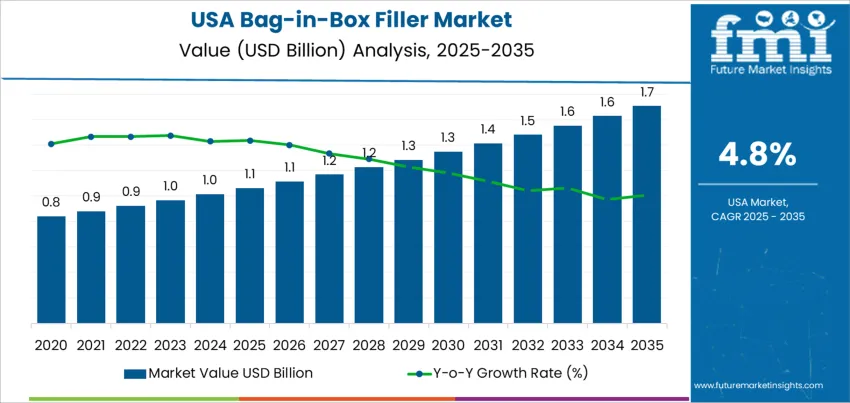
The market will experience steady growth, starting at USD 1.1 billion in 2025 and rising to USD 1.1 billion in 2026, USD 1.2 billion in 2027, and USD 1.2 billion in 2028. By 2029, demand for bag-in-box fillers will rise to USD 1.3 billion, continuing its upward trajectory throughout the 2030s. By 2035, the demand for bag-in-box fillers is projected to reach USD 1.7 billion, driven by the increasing use of flexible packaging in beverage, food, and chemical industries, as well as the growing trend of sustainable packaging solutions.
The 5-year growth block analysis for bag-in-box fillers shows steady growth over the forecast period, with moderate annual increases in demand, particularly in the initial years (2025-2029). From USD 1.1 billion in 2025, the market will increase to USD 1.2 billion by 2027, reflecting a gradual but consistent rise as flexible packaging solutions gain traction in the beverage, food, and chemical sectors. The market will continue to experience steady growth in the subsequent years (2027-2030), with the demand rising to USD 1.3 billion.
The second half of the forecast period (2030-2035) will see more significant growth, reaching USD 1.7 billion by 2035. This period will likely see more pronounced increases driven by further innovation in flexible packaging and a stronger push for sustainable packaging alternatives, particularly in the beverage and food industries. As sustainability trends and cost-effective packaging solutions become more critical, the market for bag-in-box fillers will continue to expand steadily through 2035.
USA Bag-in-Box Filler Industry Key Takeaways
| Metric | Value |
|---|---|
| Industry Sales Value (2025) | USD 1.1 billion |
| Industry Forecast Value (2035) | USD 1.7 billion |
| Industry Forecast CAGR (2025-2035) | 4.8% |
Why is the Demand for Bag-in-Box Fillers in USA Growing?
Demand for bag in box fillers in the USA is rising as manufacturers and packagers increasingly adopt bag in box packaging for beverages, liquid foods, and other liquid products. The bag in box format offers benefits including extended shelf life, reduced oxygen exposure, and efficient dispensing - features valuable for wines, juices, syrups, and dairy based drinks. Because bag in box packaging helps lower shipping weight, reduce storage space, and simplify logistics, producers see cost and operational advantages when filling large volumes. These factors drive growing investment in bag in box filling lines and related equipment across beverage, foodservice, and liquid food sectors.
Use of bag in box is not limited to beverages and food. Liquid products such as cleaning solutions, concentrates, and industrial grade fluids benefit from controlled dispensing, reduced spillage risk, and ease of handling afforded by bag in box systems. As demand increases for flexible, efficient, and scalable liquid packaging, companies seek reliable filling equipment to meet production needs. Improvements in bag in box film materials, fitments and aseptic filling technology enhance hygiene and product stability, encouraging wider adoption. Considering these trends - growth in beverage and liquid product demand, logistic and cost advantages, and broader acceptance of flexible packaging - demand for bag in box fillers in the USA is likely to grow steadily in coming years.
What Is the Current State of the Demand for Bag-in-Box Fillers in the USA in Terms of Automation and Filling Technology?
The demand for bag-in-box fillers in the USA is primarily driven by automation and filling technology. The leading automation type is automatic, which accounts for 64% of the market share, while aseptic filling dominates the filling technology segment, capturing 58% of the demand. Bag-in-box fillers are essential in various industries for packaging liquids, such as beverages, food products, and chemicals. The increasing demand for efficient, hygienic, and reliable packaging solutions continues to drive the adoption of both automatic systems and aseptic filling technology.
How Are Automatic Systems Leading the Automation Demand for Bag-in-Box Fillers in the USA?
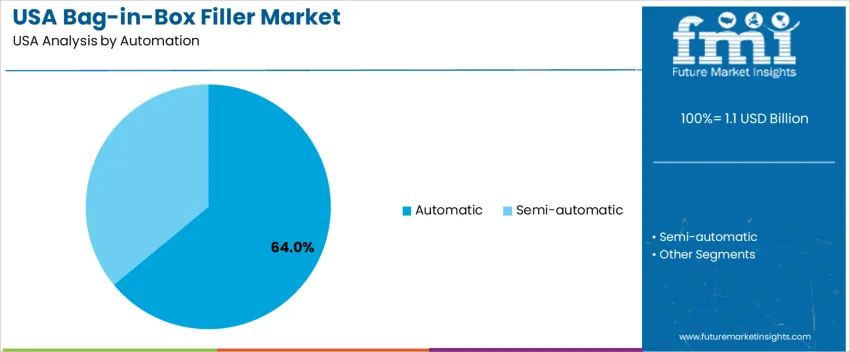
Automatic systems lead the automation demand for bag-in-box fillers in the USA, holding 64% of the market share. Automatic bag-in-box fillers are highly efficient, requiring minimal manual intervention, making them ideal for high-volume production lines. These systems ensure consistent, precise filling while improving operational efficiency and reducing labor costs. Automation is particularly valuable in industries like beverages and food, where speed, accuracy, and hygiene are paramount.
The demand for automatic bag-in-box fillers is driven by the increasing need for large-scale production and packaging of liquid products. Automatic systems offer numerous advantages, including faster cycle times, higher throughput, and greater consistency in filling volumes. As companies continue to focus on optimizing production and enhancing product quality, automatic systems provide an effective solution to meet these needs. With growing demand for bulk packaging in various sectors, automatic bag-in-box fillers will remain the preferred choice for large-scale manufacturers in the USA.
How Is Aseptic Filling Leading the Filling Technology Demand for Bag-in-Box Fillers in the USA?
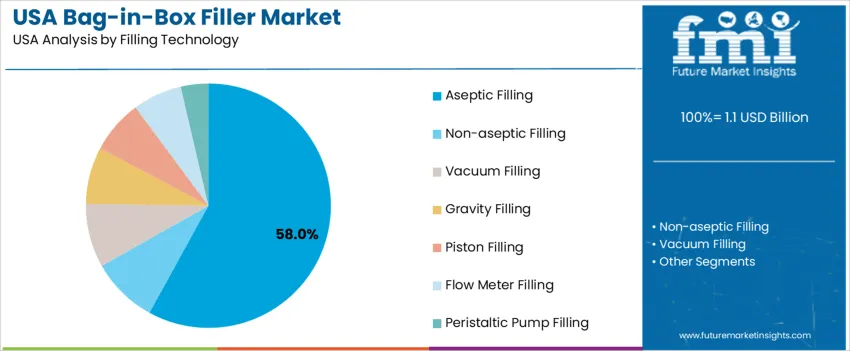
Aseptic filling leads the filling technology demand for bag-in-box fillers in the USA, accounting for 58% of the market share. Aseptic filling is crucial for packaging products that require preservation without refrigeration, such as juices, sauces, dairy products, and pharmaceuticals. This technology maintains product sterility by filling the bags in a sterile environment, preventing contamination and extending shelf life. Aseptic filling ensures that the products remain safe for consumption and retain their quality over extended periods.
The demand for aseptic filling is driven by its ability to meet the growing consumer demand for fresh, shelf-stable products. The food and beverage industry, in particular, is increasingly adopting aseptic filling technology as it allows for the distribution of perishable products without the need for refrigeration or preservatives. As health-conscious consumers demand more natural, preservative-free products, aseptic filling technology is becoming even more critical. With the rise in convenience foods and beverages, the demand for aseptic bag-in-box fillers in the USA is expected to continue growing.
What is the Summary of Demand for Bag-in-Box Fillers in the USA?
Demand for Bag-in-Box (BIB) fillers in the USA is rising as manufacturers increasingly adopt Bag-in-Box packaging for liquids and semi liquids. Bag-in-Box packaging is widely used for beverages, sauces, edible oils, dairy alternatives, and industrial liquids. As the overall Bag-in-Box packaging market expands in the USA, the requirement for efficient filling machinery - BIB fillers - also grows. Many companies prefer Bag-in-Box format because it reduces packaging waste, lowers transport and storage costs, and improves convenience for end-users. Market outlook for BIB fillers remains positive as beverage, food, and industrial sectors continue shifting toward flexible and efficient packaging.
What are the Drivers of Demand for Bag-in-Box Fillers in the USA?
One driver is strong growth in the food and beverage industry where Bag-in-Box packaging is popular for wine, juices, sauces, and bulk liquids. As producers rely more on BIB packaging, they need fillers capable of handling high throughput to meet production demands. Another driver is demand for cost efficient and sustainable packaging solutions. Bag-in-Box reduces material use compared with rigid containers and often results in lighter, easier-to transport shipments, which reduces logistics cost.
Growth in private label brands, bulk packaging needs, and industrial liquid markets (e.g., cleaning solutions, oils) broadens the range of applications for BIB fillers. Advances in filling equipment that ensure hygiene, reduce wastage (through precise fill volume), and support automated lines make BIB fillers appealing for manufacturers aiming for efficiency and regulatory compliance.
What are the Restraints on Demand for Bag-in-Box Fillers in the USA?
One constraint is that not all liquid or semi liquid products are suitable for Bag-in-Box packaging; products requiring rigid packaging or special barrier properties may still rely on bottles or cans, limiting the addressable market for BIB fillers. Another restraint arises from the initial investment cost: acquiring automated filling machinery and associated infrastructure can be expensive, which may deter smaller producers or craft scale manufacturers. Maintenance complexity, need for trained staff, and cleaning requirements (especially for food or aseptic applications) can also make adoption less attractive. Additionally, regulatory or quality control standards for certain products (e.g. dairy, sensitive chemicals) may require specialized filling and sealing equipment, which increases cost and complexity of BIB filler installation and operation.
What are the Key Trends Influencing Demand for Bag-in-Box Fillers in the USA?
A major trend is the growing share of Bag-in-Box packaging in the USA market as producers shift from rigid containers to more flexible and efficient formats for liquids and semi liquids. This shift drives increased adoption of BIB fillers to meet packaging needs. There is also a trend toward automation and high speed filling solutions as manufacturers scale up production and seek improved throughput and consistency.
Another trend is expanding use of Bag-in-Box packaging beyond beverages - into sauces, edible oils, dairy alternatives, cleaning products, and industrial liquids - broadening demand for versatile filling machines. Increased focus on sustainability, waste reduction, and material cost efficiency encourages wider adoption of BIB systems. Finally, regulatory and food safety standards are pushing manufacturers to invest in hygienic, precise filling technology, which often makes BIB fillers a preferred choice over manual or less-sophisticated packaging.
What is the Regional Demand Outlook for Bag-in-Box Fillers in the USA?
The demand for bag-in-box fillers in the USA is projected to grow steadily across all regions, with the West leading at a CAGR of 5.6%. The South follows with 5.0%, the Northeast at 4.5%, and the Midwest at 3.9%. These regional differences are influenced by the varying industrial applications, including food and beverage packaging, chemicals, and other liquid-based products. The increasing demand for efficient, cost-effective, and sustainable packaging solutions contributes to the rise in popularity of bag-in-box fillers, which are especially useful in high-volume production and logistics.
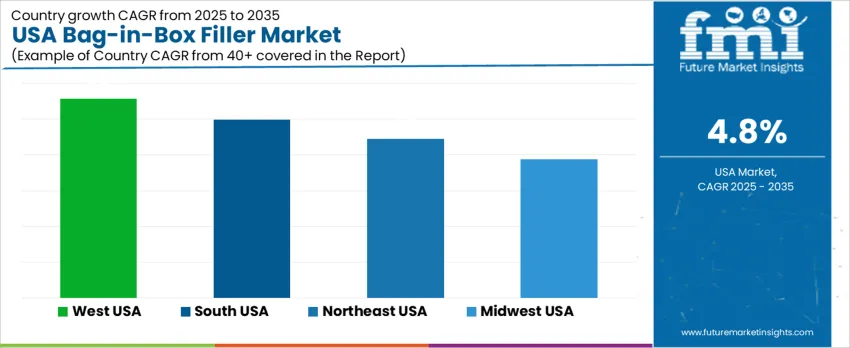
| Region | CAGR (%) |
|---|---|
| West USA | 5.6 |
| South USA | 5.0 |
| Northeast USA | 4.5 |
| Midwest USA | 3.9 |
What Drives Demand for Bag-in-Box Fillers in the West USA?
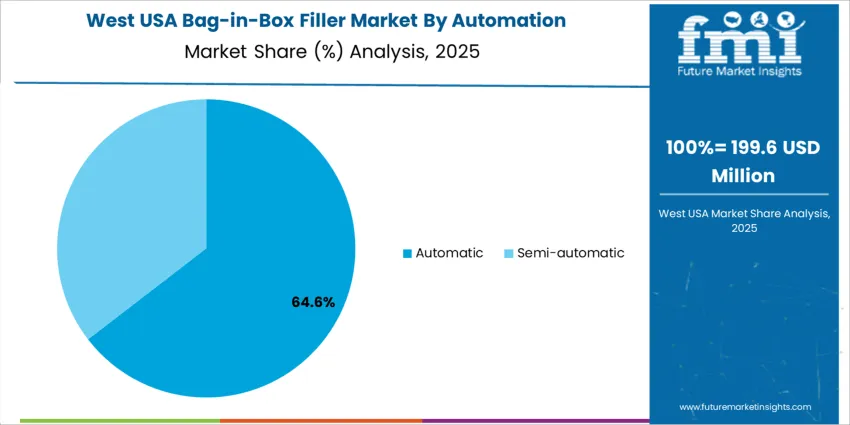
In the West USA, the projected 5.6% annual growth in demand for bag-in-box fillers is driven by the region's large food and beverage industry, which is increasingly adopting flexible, cost-effective packaging solutions. Bag-in-box fillers are ideal for products such as wine, juices, and syrups, which are widely produced and distributed in this region. The West is also home to a high concentration of eco-conscious consumers and businesses, leading to a preference for sustainable packaging options that reduce material waste and improve storage efficiency.
The rapid growth of e-commerce in the region also contributes to the demand for bag-in-box systems, as they offer a reliable and efficient way to package and ship large volumes of liquid products. Additionally, advancements in filler technology, which allow for faster and more accurate filling processes, support this growing demand.
Why is Demand for Bag-in-Box Fillers Growing in the South USA?
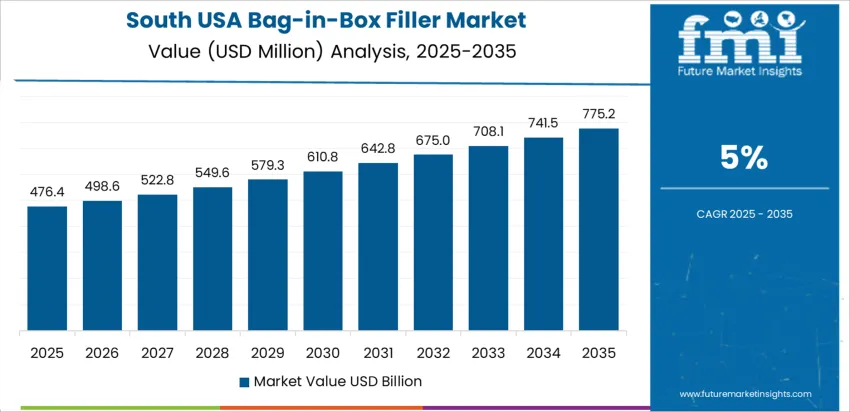
In the South USA, the projected CAGR for bag-in-box fillers is 5.0%. This growth is fueled by the region’s strong agricultural sector and expanding food and beverage manufacturing base. As more products are produced for local and national markets, the need for packaging solutions that streamline production and shipping increases. Bag-in-box fillers are particularly well-suited for high-volume liquids like fruit juices, sauces, and even wines, which are common in Southern production. The South’s growing focus on cost-efficiency and sustainability also drives the adoption of these packaging systems, which offer lower material costs and space-saving benefits. With a growing demand for bulk packaging solutions in both commercial and industrial applications, the market for bag-in-box fillers in the South is expected to expand.
What Supports the Growth of Bag-in-Box Fillers in the Northeast USA?
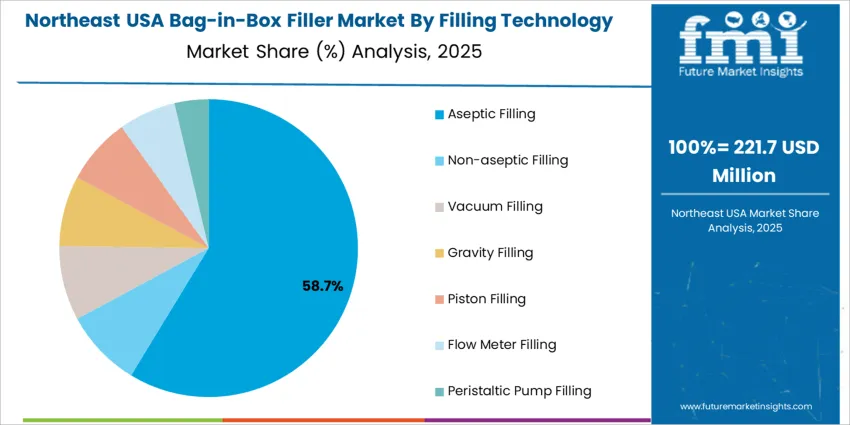
In the Northeast USA, the demand for bag-in-box fillers is expected to grow at a CAGR of 4.5%. The region’s diverse industrial base, including food and beverage, chemicals, and pharmaceuticals, plays a significant role in driving this demand. The growing preference for eco-friendly and efficient packaging solutions is evident in the Northeast, as businesses seek ways to reduce waste and improve supply chain efficiency.
Additionally, the region’s high population density and large urban areas increase the demand for packaged products, particularly in ready-to-consume formats such as beverages and liquids. The versatility of bag-in-box fillers, which are ideal for both small and large-scale production, makes them a preferred choice for industries looking to optimize their packaging processes. The steady adoption of these systems by food manufacturers, as well as an increase in bulk liquid product offerings, supports the growth of the market.
How is Demand for Bag-in-Box Fillers Evolving in the Midwest USA?
In the Midwest USA, the projected CAGR for bag-in-box fillers is 3.9%. Although the growth rate is slower than in other regions, steady demand persists due to the region's strong presence in agriculture and manufacturing. The Midwest’s extensive agricultural output, including juices, dairy products, and sauces, drives demand for bag-in-box fillers, which are ideal for packaging large quantities of liquids in a cost-effective and sustainable manner.
As more companies in the Midwest seek to enhance production efficiency, the adoption of bag-in-box systems is expected to rise. The Midwest’s increasing focus on environmental sustainability and reducing packaging waste also supports the growth of these solutions. While the growth rate may be more moderate compared to other regions, the ongoing need for efficient packaging solutions ensures that the demand for bag-in-box fillers will continue to increase in the Midwest.
What is the Competitive Landscape for the Bag-in-Box Filler Market in the USA?
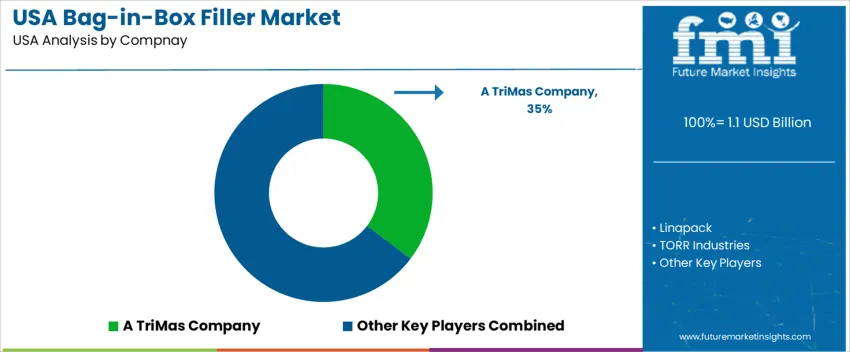
Demand for Bag-in-Box fillers in the USA is rising as manufacturers increasingly adopt Bag-in-Box (BiB) packaging for food, beverages, chemicals and liquid products. BiB packaging offers lower shipping weight, improved storage density, easier handling, and reduced waste compared with rigid containers, making it attractive for cost efficient and sustainable supply chains. The US portion of the faster growing North American market reflects strong uptake in beverage, dairy, sauces, condiments and industrial liquid segments, where producers value efficient filling systems, extended shelf life and convenient dispensing.
In that environment several firms compete for market share among fillers, machines and systems. According to your list, A TriMas Company leads with roughly 35.3% share. Other key suppliers include Linapack, TORR Industries, Smurfit Kappa, and Frain Industries. These companies supply automated or semi automated filling lines, fitments, Bag-in-Box kits and packaging line integration services.
They differentiate on factors such as filling speed, sealing reliability, compatibility with different liquid viscosities, hygiene (aseptic vs non aseptic), flexibility for small and large batches, and ability to supply full packaging systems rather than components alone. As demand for efficient, sustainable, and scalable liquid packaging rises, suppliers capable of delivering reliable, high throughput Bag-in-Box filler systems are best positioned to capture growth.
Key Players of the Bag-in-Box Filler Industry in USA
- A TriMas Company
- Linapack
- TORR Industries
- Smurfit Kappa
- Frain Industries
Scope of the Report
| Items | Details |
|---|---|
| Quantitative Units | USD Billion |
| Regions Covered | USA |
| Automation | Automatic, Semi-automatic |
| Filling Technology | Aseptic Filling, Non-aseptic Filling, Vacuum Filling, Gravity Filling, Piston Filling, Flow Meter Filling, Peristaltic Pump Filling |
| End Use | Beverages, Healthcare, Homecare and Personal Care, Other |
| Key Companies Profiled | A TriMas Company, Linapack, TORR Industries, Smurfit Kappa, Frain Industries |
| Additional Attributes | Dollar sales by automation, filling technology, and end-use show strong demand for automatic bag-in-box fillers, particularly in the beverage industry. Aseptic filling is preferred in healthcare and beverages for maintaining product sterility. Semi-automatic fillers are more common in smaller production lines. Companies like Smurfit Kappa and Frain Industries are key players in providing diverse bag-in-box filling solutions. The market is expected to grow with increasing demand for flexible packaging solutions and the rising use of bag-in-box systems in food, beverages, and personal care products. |
Key Segments in the Demand for Bag-in-Box Filler in USA
Automation
- Automatic
- Semi-automatic
Filling Technology
- Aseptic Filling
- Non-aseptic Filling
- Vacuum Filling
- Gravity Filling
- Piston Filling
- Flow Meter Filling
- Peristaltic Pump Filling
End Use
- Beverages
- Healthcare
- Homecare and Personal Care
- Other
Region
- Northeast USA
- West USA
- Midwest USA
- South USA
Frequently Asked Questions
How big is the demand for bag-in-box filler in USA in 2025?
The demand for bag-in-box filler in USA is estimated to be valued at USD 1.1 billion in 2025.
What will be the size of bag-in-box filler in USA in 2035?
The market size for the bag-in-box filler in USA is projected to reach USD 1.7 billion by 2035.
How much will be the demand for bag-in-box filler in USA growth between 2025 and 2035?
The demand for bag-in-box filler in USA is expected to grow at a 4.8% CAGR between 2025 and 2035.
What are the key product types in the bag-in-box filler in USA?
The key product types in bag-in-box filler in USA are automatic and semi-automatic.
Which filling technology segment is expected to contribute significant share in the bag-in-box filler in USA in 2025?
In terms of filling technology, aseptic filling segment is expected to command 58.0% share in the bag-in-box filler in USA in 2025.
Preview the report firsthand - request a free sample
Get SampleGet the brochure for pricing and purchase details.
Get PDFTable of Content
- Executive Summary
- USA Market Outlook
- Demand-side Trends
- Supply-side Trends
- Technology Roadmap Analysis
- Analysis and Recommendations
- Market Overview
- Market Coverage / Taxonomy
- Market Definition / Scope / Limitations
- Market Background
- Market Dynamics
- Drivers
- Restraints
- Opportunity
- Trends
- Scenario Forecast
- Demand in Optimistic Scenario
- Demand in Likely Scenario
- Demand in Conservative Scenario
- Opportunity Map Analysis
- Product Life Cycle Analysis
- Supply Chain Analysis
- Investment Feasibility Matrix
- Value Chain Analysis
- PESTLE and Porter’s Analysis
- Regulatory Landscape
- Regional Parent Market Outlook
- Production and Consumption Statistics
- Import and Export Statistics
- Market Dynamics
- USA Market Analysis 2020 to 2024 and Forecast, 2025 to 2035
- Historical Market Size Value (USD Million) Analysis, 2020 to 2024
- Current and Future Market Size Value (USD Million) Projections, 2025 to 2035
- Y-o-Y Growth Trend Analysis
- Absolute $ Opportunity Analysis
- USA Market Pricing Analysis 2020 to 2024 and Forecast 2025 to 2035
- USA Market Analysis 2020 to 2024 and Forecast 2025 to 2035, By Automation
- Introduction / Key Findings
- Historical Market Size Value (USD Million) Analysis By Automation , 2020 to 2024
- Current and Future Market Size Value (USD Million) Analysis and Forecast By Automation , 2025 to 2035
- Automatic
- Semi-automatic
- Y-o-Y Growth Trend Analysis By Automation , 2020 to 2024
- Absolute $ Opportunity Analysis By Automation , 2025 to 2035
- USA Market Analysis 2020 to 2024 and Forecast 2025 to 2035, By Filling Technology
- Introduction / Key Findings
- Historical Market Size Value (USD Million) Analysis By Filling Technology, 2020 to 2024
- Current and Future Market Size Value (USD Million) Analysis and Forecast By Filling Technology, 2025 to 2035
- Aseptic Filling
- Non-aseptic Filling
- Vacuum Filling
- Gravity Filling
- Piston Filling
- Flow Meter Filling
- Peristaltic Pump Filling
- Y-o-Y Growth Trend Analysis By Filling Technology, 2020 to 2024
- Absolute $ Opportunity Analysis By Filling Technology, 2025 to 2035
- USA Market Analysis 2020 to 2024 and Forecast 2025 to 2035, By End Use
- Introduction / Key Findings
- Historical Market Size Value (USD Million) Analysis By End Use, 2020 to 2024
- Current and Future Market Size Value (USD Million) Analysis and Forecast By End Use, 2025 to 2035
- Beverages
- Healthcare
- Homecare and personal care
- Other
- Y-o-Y Growth Trend Analysis By End Use, 2020 to 2024
- Absolute $ Opportunity Analysis By End Use, 2025 to 2035
- Market Structure Analysis
- Competition Dashboard
- Competition Benchmarking
- Market Share Analysis of Top Players
- By Regional
- By Automation
- By Filling Technology
- By End Use
- Competition Analysis
- Competition Deep Dive
- A TriMas Company
- Overview
- Product Portfolio
- Profitability by Market Segments (Product/Age /Sales Channel/Region)
- Sales Footprint
- Strategy Overview
- Marketing Strategy
- Product Strategy
- Channel Strategy
- Linapack
- TORR Industries
- Smurfit Kappa
- Frain Industries
- A TriMas Company
- Competition Deep Dive
- Assumptions & Acronyms Used
- Research Methodology


