

- Industry Size (2025)
- USD 18.8 Bn
- Forecast (2035)
- USD 28.6 Bn
- CAGR (2025 to 2035)
- 4.3%
Demand for Stainless Steel Welded Pipe in USA 2025 to 2035
The USA stainless steel welded pipe demand is valued at USD 18.8 billion in 2025 and is estimated to reach USD 28.6 billion by 2035, reflecting a CAGR of 4.3%. Growth is supported by expanding infrastructure development, strong energy sector requirements, and upgrades to water treatment and chemical processing systems. Rising investment in corrosion-resistant fluid handling solutions across industrial applications continues to drive procurement.
The 300 Series grade leads adoption due to its strength, weldability, and performance in corrosive and high-temperature environments. Its wide use in petrochemical lines, food processing facilities, and construction projects reinforces consistent purchasing patterns. Technical advances in automated welding and finishing processes enhance dimensional accuracy and extend service life in demanding installations.
The West, South, and Northeast regions maintain strong consumption tied to large industrial bases and continued expansion of utilities and construction activity. ArcelorMittal S.A., Sosta GmbH & Co. KG, Hyundai Steel Co., Ltd., Marcegaglia, and Nippon Steel represent key suppliers. Their focus includes expanding production of high-purity grades, improving energy-efficient fabrication, and strengthening supply chains to support large-scale infrastructure and energy transmission projects.
Quick Stats for USA Stainless Steel Welded Pipe Demand
- USA Stainless Steel Welded Pipe Sales Value (2025): USD 18.8 billion
- USA Stainless Steel Welded Pipe Forecast Value (2035): USD 28.6 billion
- USA Stainless Steel Welded Pipe Forecast CAGR (2025–2035): 4.3%
- Leading Grade in USA Stainless Steel Welded Pipe Demand: 300 Series
- Key Growth Regions in USA Stainless Steel Welded Pipe Demand: West USA, South USA, Northeast USA
- Top Players in USA Stainless Steel Welded Pipe Demand: ArcelorMittal S.A., Sosta GmbH & Co. KG, Hyundai Steel Co., Ltd., Marcegaglia, Nippon Steel
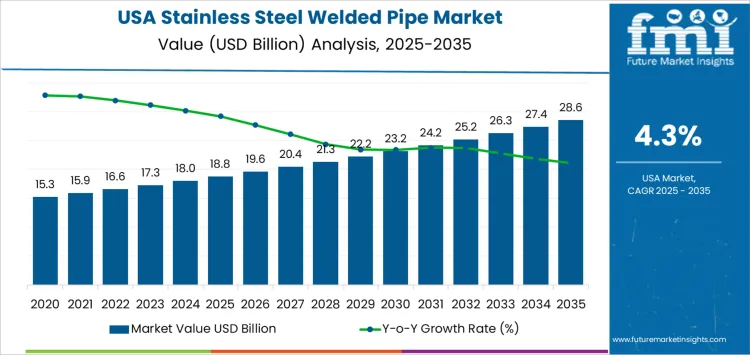
What is the Growth Forecast for Stainless Steel Welded Pipe Industry in USA through 2035?
Demand for stainless steel welded pipe in the United States shows moderate growth rate stability over the coming decade. Core demand drivers include construction, oil and gas, chemical processing, and water infrastructure upgrades. These sectors expand at relatively predictable rates, which limits abrupt fluctuations in annual demand. Replacement cycles in industrial facilities also provide a stable recurring baseline, reducing volatility from year to year.
External influences introduce some variability, but not sharply. Project approvals in energy and petrochemical fields align with regulatory timelines and capital expenditure plans, which distribute demand increases more steadily. Infrastructure funding decisions can cause brief accelerations when federal programs release large contracts. However, such accelerations usually remain contained within specific segments rather than shifting national demand patterns.
Raw material cost swings for stainless steel inputs can temporarily affect procurement timing, though long-term usage remains constant due to corrosion resistance requirements. The growth rate volatility index remains in a middle range. This indicates that annual demand changes in the United States are noticeable but controlled, supported by a broad industrial base that ensures continued utilization without dramatic surges or sharp declines across the forecast horizon.
USA Stainless Steel Welded Pipe Key Takeaways
| Metric | Value |
|---|---|
| USA Stainless Steel Welded Pipe Sales Value (2025) | USD 18.8 billion |
| USA Stainless Steel Welded Pipe Forecast Value (2035) | USD 28.6 billion |
| USA Stainless Steel Welded Pipe Forecast CAGR (2025-2035) | 4.3% |
Why is the Demand for Stainless Steel Welded Pipe in the USA Growing?
Demand for stainless steel welded pipe in the USA is increasing because industries such as oil and gas, chemical processing, food and beverage, and water treatment require pipelines that offer corrosion resistance, hygiene compliance, and long service life. Welded stainless steel pipe supports safe transport of corrosive chemicals, high-purity water, and sanitary processing fluids. Growth in industrial infrastructure projects and maintenance needs drives procurement of stainless welded pipe for new plants and retrofit applications. In food and beverage production, stainless steel meets regulatory and cleanliness standards for sanitary tubing and piping systems. Water treatment utilities also specify stainless pipe when dealing with aggressive water chemistries and extended system lifespans.
Construction of commercial buildings, data centers and HVAC systems supports demand for welded pipe in plumbing and mechanical applications where durability and resistance to corrosion are valued. Fabricators and contractors select stainless welded pipe because it simplifies installation compared with seamless options and reduces on-site welding work. Constraints include higher material cost relative to carbon steel, which increases project budgets, and price fluctuation for nickel and chromium alloys used in stainless steel. Some small-scale pipelines or non-corrosive applications may still use cheaper pipe types to reduce upfront cost.
Which Grades, Applications, and Outer Diameters Lead Demand for Stainless Steel Welded Pipes in the USA?
Demand for stainless steel welded pipes in the United States is driven by large-scale infrastructure renovation, energy transmission upgrades, and industrial fluid handling requirements. Performance benefits such as corrosion resistance, weld integrity, and structural strength support adoption across municipal, commercial, and process industries. Procurement is influenced by compliance standards, operating pressure requirements, and environmental durability. Growth aligns with water treatment expansion, oil and gas transportation upgrades, and continuous construction activity in industrial and urban development projects.
By Grade, 300 Series Holds the Largest Share
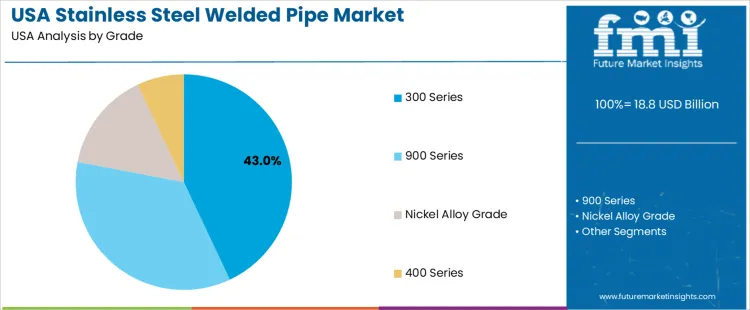
300 series stainless steel accounts for 43.0%, driven by high corrosion resistance, versatile weldability, and suitability across water systems, construction fittings, and sanitary processing applications. 900 series grades represent 35.0%, supported by high-temperature and pressure-resistant properties required in petrochemical and energy sectors. Nickel alloy grades hold 15.0%, addressing specialized use cases where chemical resilience and performance stability in harsh environments are necessary. The 400 series accounts for 7.0%, used primarily in structural applications where cost control outweighs corrosion performance. Grade selection is determined by engineering quality standards, lifecycle cost targets, and exposure to corrosive media across USA industries.
Key Points:
- 300 series pipes serve general industrial, municipal, and sanitary needs
- 900 series supports severe-service thermal and pressure environments
- Nickel alloys retained for critical chemical-use applications
By Application, Water Distribution Leads Usage
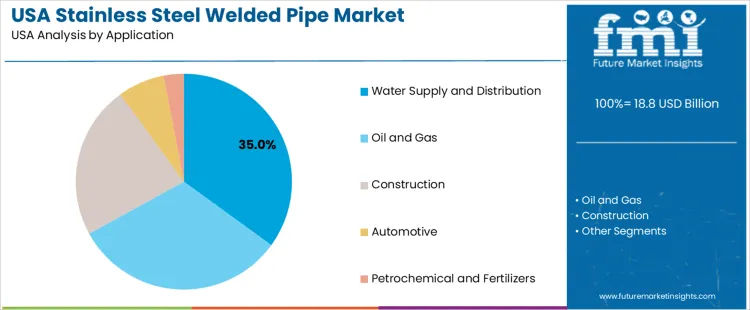
Water supply and distribution systems hold 35.0%, supported by upgrades in municipal pipelines, wastewater treatment expansions, and corrosion control requirements in drinking water networks. Oil and gas applications represent 32.0%, where welded stainless pipes support flow assurance and pipeline safety requirements in midstream and downstream operations. The construction sector accounts for 23.0%, with usage in structural supports, HVAC systems, and fire suppression networks. Automotive applications account for 7.0%, with a focus on exhaust and fuel system components. Petrochemical and fertilizer industries hold 3.0%, tied to chemical-containing piping assemblies. Demand aligns with regulatory focus on safe fluid handling and infrastructure modernization.
Key Points:
- Public utility upgrades drive major consumption
- Oil and gas remains a high-spec industrial buyer
- Construction demand linked to urban and commercial expansion
By Outer Diameter, Small-Diameter Pipes Hold the Largest Share
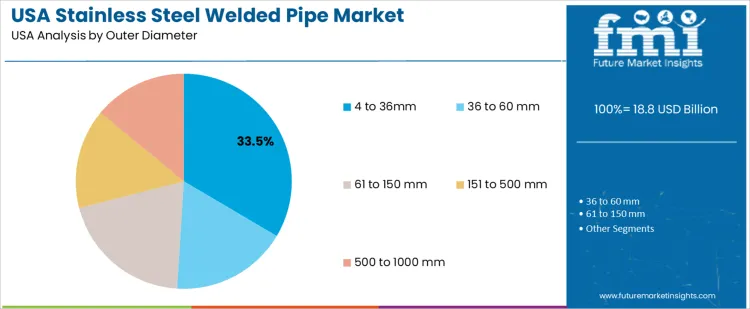
Welded pipes sized 4 to 36 mm account for 33.5%, primarily used in control systems, instrument lines, and precision assemblies within industrial and water distribution layouts. Outer diameters 61 to 150 mm represent 20.0%, suitable for structural and service pipelines requiring balanced pressure handling. The 36 to 60 mm segment accounts for 17.5%, serving HVAC and fabrication uses. Diameters 151 to 500 mm hold 15.0%, tied to municipal pipelines and processing plants. Large diameters 500 to 1000 mm represent 14.0%, used in bulk liquid movement applications. Diameter selection aligns with operational flow needs, material cost, and compliance with building and environmental safety standards.
Key Points:
- Small OD pipes dominate instrumentation and controlled-flow systems
- Mid-range diameters support structural distribution networks
- Large OD applications remain focused on bulk utility movement
What are the Drivers, Restraints, and Key Trends of the Demand for Stainless Steel Welded Pipe in the USA?
Industrial infrastructure expansion, strong demand from energy and chemical sectors and increased focus on corrosion-resistant pipe systems drive demand.
In the United States, stainless steel welded pipes are widely used in oil and gas processing, chemical plants and power generation facilities where corrosion resistance and material reliability are essential. Federal investments in refinery upgrades, LNG facilities and petrochemical capacity support large pipeline and process-pipe installations. Food and beverage manufacturers adopt stainless steel welded pipes to maintain sanitation standards in dairy, brewing and liquid food processing lines. The construction sector uses durable stainless piping in commercial buildings, HVAC networks and water supply systems, particularly in coastal regions where corrosion risk is higher. Domestic fabrication and certification standards encourage procurement from USA mills that supply high-quality welded pipe systems to regulated industries.
High material cost, competition from alternative metals and project delays from permitting complexity restrain demand.
Stainless steel pricing depends on nickel and chromium industries, and cost volatility can make welded pipe significantly more expensive than carbon steel alternatives in less corrosive environments. Some industrial users shift to plastic or composite pipes for lower-pressure water systems to manage project budgets. Major infrastructure projects may experience delays due to lengthy permitting processes, which postpone welded pipe orders and create uncertainty in contractor purchasing schedules. These financial and regulatory challenges reduce rapid adoption in cost-sensitive or lower-specification applications.
Shift toward automated welding technologies, increased adoption in water treatment upgrades and rising preference for domestic sourcing define key trends.
Manufacturers invest in automated welding and inspection technologies to improve pipe consistency and throughput for large industrial orders. Municipal and industrial water treatment facilities upgrade distribution lines and plant piping using stainless steel welded pipes to meet corrosion control and quality compliance goals. USA procurement preferences emphasizing domestic supply chains support local production capacity and reduce reliance on imported pipe for critical projects. Fabricators expand piping solutions that integrate fittings, valves and modular skids for faster installation on energy and industrial sites. These developments indicate stable, specification-driven demand for stainless steel welded pipes across the United States supported by industrial modernization and resilience priorities.
Analysis of the Demand for Stainless Steel Welded Pipe in the USA by Region
Demand for stainless steel welded pipes in the United States is rising as infrastructure renewal, energy transmission upgrades, and industrial fluid-handling requirements progress across construction, petrochemical, water treatment, and food-processing sectors. Corrosion resistance, lifecycle performance, and compliance with hygiene and safety standards influence procurement decisions. Fabrication capabilities, raw material access, and welding-quality certification shape distribution networks regionally. West USA leads at 4.9% CAGR, followed by South USA at 4.4%, Northeast USA at 3.9%, and Midwest USA at 3.4%. Expansion remains tied to capital-intensive projects, manufacturing modernization, sustainability-linked material standards, and supply chain responsiveness across domestic production hubs.
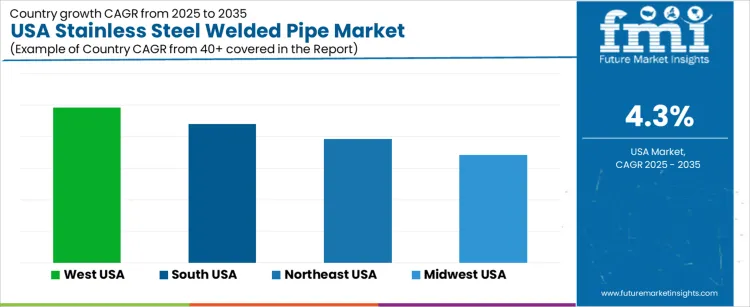
| Region | CAGR (2025-2035) |
|---|---|
| West USA | 4.9% |
| South USA | 4.4% |
| Northeast USA | 3.9% |
| Midwest USA | 3.4% |
How is the West USA driving demand for stainless steel welded pipes?
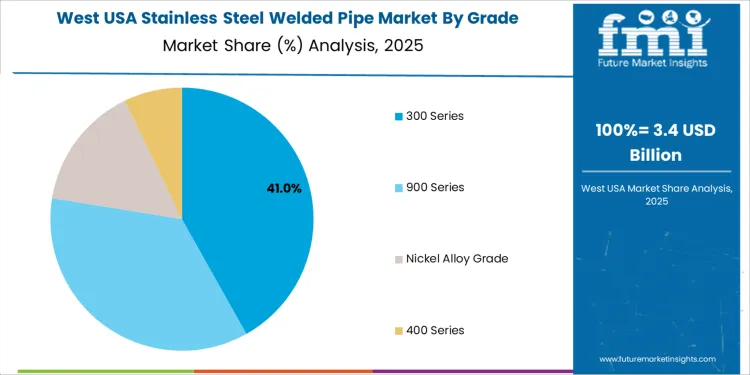
The West USA is expected to grow at a 4.9% CAGR, supported by extensive commercial construction, semiconductor fabrication expansion, and desalination-driven infrastructure on the Pacific coast. Industrial users require welded stainless pipes in fluid transport systems that handle chemicals, steam, and high-purity water. Large technology and biotech facilities in California prioritize stainless-grade consistency and fabrication precision aligned with clean-room standards. Water-utilities upgrade distribution networks and corrosion-prone pipelines, prompting additional stainless pipe installations in treatment plants. Proximity to port infrastructure strengthens access to coiled steel inputs and supports project delivery timelines. Buyers emphasize compliance with ASME pressure-piping codes and weld-integrity traceability from domestic mills and certified fabricators. Preventive-maintenance approaches favor welded stainless systems with longer lifecycle performance in aggressive environments.
- High-tech manufacturing increasing demand for hygienic and corrosion-resistant piping
- Water-infrastructure modernization requiring durable welded material specifications
- Port-supported logistics improving supply continuity
- Lifecycle performance and certification shaping procurement priorities
How is the South USA shaping demand for stainless steel welded pipes?
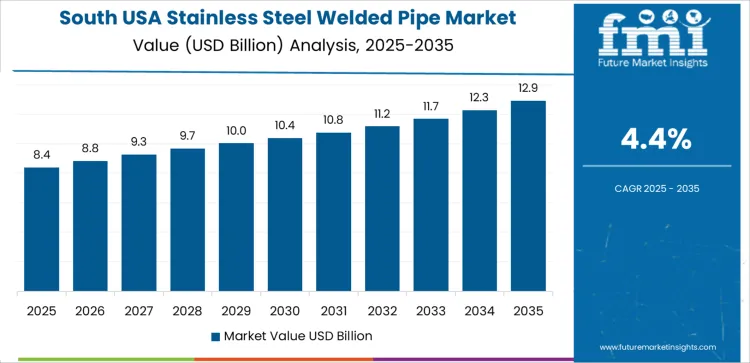
The South USA is forecast to expand at 4.4% CAGR, driven by petrochemical processing, LNG export terminals, and refinery modernization concentrated along the Gulf Coast. Welded stainless steel pipes support chemical transfer lines, heat-exchanger circuits, and high-pressure steam applications. Food-processing clusters in Georgia and Arkansas adopt stainless piping for sanitation-critical fluid systems. Structural use in commercial facilities grows with population and industrial-park development. Buyers evaluate weld-quality conformity to industry standards such as ASTM A312 and corrosion-resistant grades aligned with chemical exposure levels. Major distributors maintain inventory near coastal industrial zones, reducing lead times for shutdown-driven replacement needs. Workforce-training initiatives support welding-skill development required for large-scale pipeline fabrication and installation.
- Petrochemical capital investments sustaining pipeline and process upgrades
- Food-processing facilities driving sanitary welded-pipe requirements
- Fast-growth industrial corridors increasing building-systems installation
- Inventory availability aligned with refinery and plant maintenance cycles
How is the Northeast USA influencing adoption of stainless steel welded pipes?
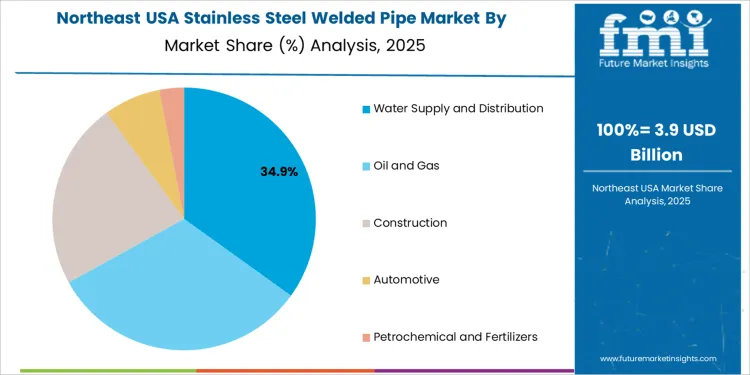
The Northeast USA shows growth at 3.9% CAGR, influenced by infrastructure rehabilitation, biopharmaceutical production, and steam-distribution modernization in urban centers like New York and Boston. Facilities adopt stainless welded pipes to meet sterile-processing and safety compliance standards in pharma and hospital mechanical systems. Municipal energy networks replace aging steam lines with corrosion-resistant welded configurations for improved operational reliability. Compact construction sites intensify the need for prefabricated pipe spools to reduce installation time. Engineering firms prefer materials validated for high-pressure and high-temperature reliability in space-constrained environments. Procurement emphasizes traceable weld documentation, NDT testing, and adherence to cleanability specifications in regulated industries.
- Bio-pharma and healthcare systems requiring sanitary welded piping
- Steam-grid upgrades reducing leak-related losses and downtime
- Urban construction favoring pre-fabrication for efficiency
- Compliance and inspection rigor guiding product qualification
How is the Midwest USA supporting demand for stainless steel welded pipes?
The Midwest USA expands at 3.4% CAGR, linked to manufacturing plants, automotive production facilities, and municipal water infrastructure upgrades across states including Ohio, Illinois, and Michigan. Welded stainless steel pipes are selected for chemical-handling and thermal-fluid systems in factory modernization projects. Food-processing and beverage producers adopt welded lines supporting hygiene-controlled processing zones. Water-utility investments target corrosion-resistant materials to extend replacement intervals in treatment and conveyance infrastructure. Procurement decisions emphasize availability of standardized diameters and reliable weld fit-up to existing mechanical systems. Supply chains leverage regional steel manufacturing, improving affordability and delivery predictability for planned shutdown activities.
- Manufacturing-sector modernization increasing process-piping demand
- Water utilities using stainless to improve lifecycle economics
- Food and beverage plants requiring sanitary welded lines
- Domestic steel supply supporting stable deployment timelines
How is competitive positioning structured among suppliers of stainless steel welded pipe in the United States?
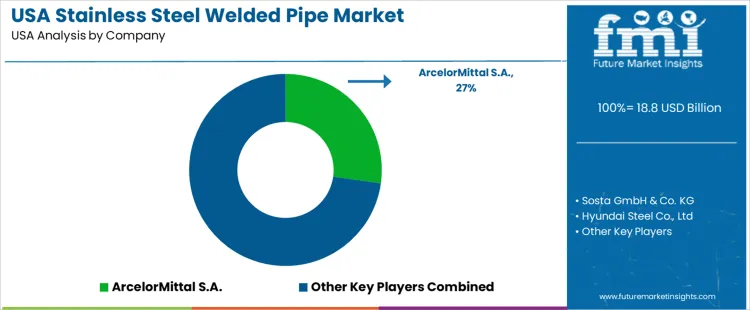
Competitive strength in the United States stainless-steel welded pipe segment depends on domestic production capacity, compliance with ASTM/NACE standards, and supply reliability to construction, energy, and industrial maintenance industries. Because of strong demand for high-grade stainless steel piping for corrosive and sanitary applications, suppliers with local manufacturing or warehoused stock hold stronger positions. ArcelorMittal S.A. holds an estimated 27.2% share in USA demand. Its global scale allows for sustained supply under contract manufacturing, and its steel-processing capabilities support welded pipe lines that meet USA specification standards. That position benefits from integrated production and long-term contracts with fabrication firms.
Nippon Steel competes by leveraging high-quality stainless steel grades and global distribution agreements that supply USA buyers seeking corrosion-resistant piping with assured metallurgical consistency. Hyundai Steel Co., Ltd. maintains share through export-supported welded pipes that meet ASTM and international standards, offering cost-effective alternatives when domestic mills face backlog. Marcegaglia serves demand through its welded-pipe fabrication network and ability to meet custom-diameter and wall-thickness specifications, appealing to niche industrial and commercial users. Sosta GmbH & Co. KG contributes through specialty welded-pipe solutions imported for performance-critical applications, particularly in chemical-processing and high-pressure systems. Competitive advantage depends on consistent delivery lead times, material certification, and compliance with USA pipe standards for pressure, corrosion resistance, and weld integrity. Suppliers with USA-adapted supply chains and responsive customer support retain the most durable positioning in stainless-steel welded-pipe demand.
Key Players in USA Stainless Steel Welded Pipe Demand
- ArcelorMittal S.A.
- Sosta GmbH & Co. KG
- Hyundai Steel Co., Ltd
- Marcegaglia
- Nippon Steel
Scope of the Report
| Items | Values |
|---|---|
| Quantitative Units | USD billion |
| Grade | 300 Series, 900 Series, Nickel Alloy Grade, 400 Series |
| Application | Water Supply and Distribution, Oil and Gas, Construction, Automotive, Petrochemical and Fertilizers |
| Outer Diameter | 4 to 36 mm, 36 to 60 mm, 61 to 150 mm, 151 to 500 mm, 500 to 1000 mm |
| Regions Covered | West USA, South USA, Northeast USA, Midwest USA |
| Key Companies Profiled | ArcelorMittal S.A., Sosta GmbH & Co. KG, Hyundai Steel Co., Ltd., Marcegaglia, Nippon Steel |
| Additional Attributes | Dollar sales by grade, diameter categories, and industrial applications; regional adoption trends driven by pipeline replacement, construction spending, and petrochemical capacity expansion; competitive landscape among domestic and imported stainless-steel welded pipes; specification-driven procurement for strength, corrosion resistance, and high-temperature performance; alignment with sustainability mandates and regulatory codes in infrastructure and oil & gas transmission across the USA. |
USA Stainless Steel Welded Pipe Demand by Segments
Grade:
- 300 Series
- 900 Series
- Nickel Alloy Grade
- 400 Series
Application:
- Water Supply and Distribution
- Oil and Gas
- Construction
- Automotive
- Petrochemical and Fertilizers
Outer Diameter:
- 4 to 36mm
- 36 to 60 mm
- 61 to 150 mm
- 151 to 500 mm
- 500 to 1000 mm
Region:
- West USA
- South USA
- Northeast USA
- Midwest USA
Frequently Asked Questions
How big is the demand for stainless steel welded pipe in USA in 2025?
The demand for stainless steel welded pipe in USA is estimated to be valued at USD 18.8 billion in 2025.
What will be the size of stainless steel welded pipe in USA in 2035?
The market size for the stainless steel welded pipe in USA is projected to reach USD 28.6 billion by 2035.
How much will be the demand for stainless steel welded pipe in USA growth between 2025 and 2035?
The demand for stainless steel welded pipe in USA is expected to grow at a 4.3% CAGR between 2025 and 2035.
What are the key product types in the stainless steel welded pipe in USA?
The key product types in stainless steel welded pipe in USA are 300 series, 900 series, nickel alloy grade and 400 series.
Which application segment is expected to contribute significant share in the stainless steel welded pipe in USA in 2025?
In terms of application, water supply and distribution segment is expected to command 35.0% share in the stainless steel welded pipe in USA in 2025.
Preview the report firsthand - request a free sample
Get SampleGet the brochure for pricing and purchase details.
Get PDFTable of Content
- Executive Summary
- USA Market Outlook
- Demand-side Trends
- Supply-side Trends
- Technology Roadmap Analysis
- Analysis and Recommendations
- Market Overview
- Market Coverage / Taxonomy
- Market Definition / Scope / Limitations
- Market Background
- Market Dynamics
- Drivers
- Restraints
- Opportunity
- Trends
- Scenario Forecast
- Demand in Optimistic Scenario
- Demand in Likely Scenario
- Demand in Conservative Scenario
- Opportunity Map Analysis
- Product Life Cycle Analysis
- Supply Chain Analysis
- Investment Feasibility Matrix
- Value Chain Analysis
- PESTLE and Porter’s Analysis
- Regulatory Landscape
- Regional Parent Market Outlook
- Production and Consumption Statistics
- Import and Export Statistics
- Market Dynamics
- USA Market Analysis 2020 to 2024 and Forecast, 2025 to 2035
- Historical Market Size Value (USD Million) Analysis, 2020 to 2024
- Current and Future Market Size Value (USD Million) Projections, 2025 to 2035
- Y-o-Y Growth Trend Analysis
- Absolute $ Opportunity Analysis
- USA Market Pricing Analysis 2020 to 2024 and Forecast 2025 to 2035
- USA Market Analysis 2020 to 2024 and Forecast 2025 to 2035, By Grade
- Introduction / Key Findings
- Historical Market Size Value (USD Million) Analysis By Grade , 2020 to 2024
- Current and Future Market Size Value (USD Million) Analysis and Forecast By Grade , 2025 to 2035
- 300 Series
- 900 Series
- Nickel Alloy Grade
- 400 Series
- Y-o-Y Growth Trend Analysis By Grade , 2020 to 2024
- Absolute $ Opportunity Analysis By Grade , 2025 to 2035
- USA Market Analysis 2020 to 2024 and Forecast 2025 to 2035, By Application
- Introduction / Key Findings
- Historical Market Size Value (USD Million) Analysis By Application, 2020 to 2024
- Current and Future Market Size Value (USD Million) Analysis and Forecast By Application, 2025 to 2035
- Water Supply and Distribution
- Oil and Gas
- Construction
- Automotive
- Petrochemical and Fertilizers
- Y-o-Y Growth Trend Analysis By Application, 2020 to 2024
- Absolute $ Opportunity Analysis By Application, 2025 to 2035
- USA Market Analysis 2020 to 2024 and Forecast 2025 to 2035, By Outer Diameter
- Introduction / Key Findings
- Historical Market Size Value (USD Million) Analysis By Outer Diameter, 2020 to 2024
- Current and Future Market Size Value (USD Million) Analysis and Forecast By Outer Diameter, 2025 to 2035
- 4 to 36mm
- 36 to 60 mm
- 61 to 150 mm
- 151 to 500 mm
- 500 to 1000 mm
- Y-o-Y Growth Trend Analysis By Outer Diameter, 2020 to 2024
- Absolute $ Opportunity Analysis By Outer Diameter, 2025 to 2035
- Market Structure Analysis
- Competition Dashboard
- Competition Benchmarking
- Market Share Analysis of Top Players
- By Regional
- By Grade
- By Application
- By Outer Diameter
- Competition Analysis
- Competition Deep Dive
- ArcelorMittal S.A.
- Overview
- Product Portfolio
- Profitability by Market Segments (Product/Age /Sales Channel/Region)
- Sales Footprint
- Strategy Overview
- Marketing Strategy
- Product Strategy
- Channel Strategy
- Sosta GmbH & Co. KG
- Hyundai Steel Co., Ltd
- Marcegaglia
- Nippon Steel
- ArcelorMittal S.A.
- Competition Deep Dive
- Assumptions & Acronyms Used
- Research Methodology


