

- Industry Size (2026)
- USD 1397.3 Mn
- Forecast (2036)
- USD 2525.8 Mn
- CAGR (2026 to 2036)
- 6.1%
Stainless Steel Turning Inserts Market Size, Market Forecast and Outlook By FMI
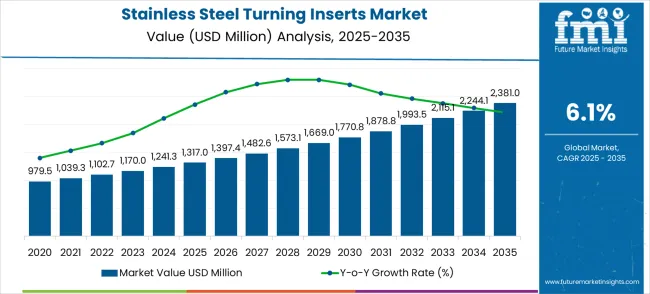
In 2025, the stainless steel turning inserts market was valued at USD 1,317.0 million. Based on Future Market Insights' analysis, demand for stainless steel turning inserts is estimated to grow to USD 1,397.3 million in 2026 and USD 2,525.8 million by 2036. FMI projects a CAGR of 6.1% during the forecast period.
An absolute dollar growth of USD 1,128.5 million between 2026 and 2036 reflects a structural shift from general purpose tooling to application optimized inserts designed for specific stainless steel grades and machining operations. Growth depends on the conversion of conventional machining operations to high speed and hard turning applications and the penetration of advanced coating technologies into small and medium enterprise machine shops. According to FMI, tooling manufacturers are capturing value not from carbide substrate sales alone but from engineered coating systems, chip control geometries, and digital tool life prediction services that accompany physical inserts.
Summary of the Stainless Steel Turning Inserts Market
- Market Definition
- The market comprises indexable cutting tool inserts with advanced coatings specifically engineered for turning operations on stainless steel workpieces, used across automotive, aerospace, and general manufacturing industries where precision and tool life are critical.
- Demand Drivers
- Increasing complexity of stainless steel components in automotive and aerospace applications requiring tighter tolerances and superior surface finishes that demand high performance tooling.
- Growing adoption of difficult to machine austenitic and duplex stainless steel grades in industrial equipment and medical devices creating demand for inserts with enhanced wear resistance.
- Shift toward automated and unattended machining operations requiring predictable tool life and consistent performance to minimize production interruptions.
- Key Segments Analyzed
- Coating Type: CVD coating leads, accounting for 38% share in 2025 due to exceptional wear resistance, thermal stability, and suitability for high speed, high temperature stainless steel machining.
- End Use Industry: Automotive dominates at 50% share, reflecting the industry's massive consumption of stainless steel components and high volume precision machining requirements.
- Geography: Asia Pacific leads growth through manufacturing expansion and industrial modernization; North America leads value through aerospace and medical device applications.
- Analyst Opinion at FMI
- Nikhil Kaitwade, Principal Consultant for Chemicals and Materials at Future Market Insights, observes: “The stainless steel turning inserts market has entered an era where coating technology defines competitive advantage rather than substrate composition. The 18% year over year growth in demand for negative geometry finishing inserts signals that manufacturers are prioritizing edge stability and chip control over simple cost per edge calculations. In this revised forecast, we see that customers are no longer asking for inserts that simply cut stainless steel. They are demanding inserts that deliver predictable tool life within 5% variance, maintain surface finish across thousands of components, and integrate with digital monitoring systems that trigger replacement before failure occurs.”
- Strategic Implications / Executive Takeaways
- Develop coating systems specifically optimized for the three major stainless steel families austenitic, ferritic, and martensitic rather than one size fits all solutions to capture application specific premium pricing.
- Invest in digital tool life prediction models that enable customers to optimize cutting parameters and replacement schedules, creating software enabled value beyond physical products.
- Expand technical service programs that provide on site machining optimization support to build customer loyalty and differentiate from low cost competitors.
- Methodology
- Built on primary interviews with cutting tool manufacturers and industrial machining managers.
- Benchmarked against stainless steel production data and machine tool consumption statistics.
- Validated using shipment audit data and internal peer review as per FMI modelling standards.
According to recent industry reports, the global demand for negative general stainless steel finishing turning inserts has grown by 18% year over year in 2024, with North America and East Asia accounting for the largest share of consumption. This growth is largely attributed to increased automation in machining centers and heightened emphasis on precision engineering in high value manufacturing. Tooling is no longer just about cutting; it is about consistent performance, predictability, and cost efficiency for manufacturers dealing with tough materials like austenitic and martensitic stainless steels. [1]
China leads global expansion with a projected CAGR of 8.2%, supported by massive manufacturing capacity, industrial modernization programs under Made in China 2025, and increasing demand for precision cutting tools in automotive and aerospace component production. India follows at 7.6% CAGR, driven by expanding stainless steel production, growing automotive manufacturing capabilities, and rising industrial investment under the Production Linked Incentive scheme. Germany grows at 7.0% CAGR on the back of precision engineering excellence, advanced manufacturing research, and strong automotive and machinery sectors requiring high performance tooling.
Mature markets such as the United States and Japan generate comparatively slower expansion where demand is shaped primarily by technology upgrades and replacement cycles rather than first time adoption. The USA market shows a 5.8% CAGR supported by aerospace manufacturing expansion and reshoring initiatives, while Japan at 4.6% CAGR demonstrates steady demand from precision machinery and automotive sectors.
Stainless Steel Turning Inserts Market Definition
The stainless steel turning inserts market covers the global production and supply of indexable cutting tool inserts specifically designed for turning operations on stainless steel workpieces. These inserts are manufactured from cemented carbide substrates and coated with advanced materials using chemical vapor deposition or physical vapor deposition technologies to enhance wear resistance, thermal stability, and chip control. They are used across automotive, aerospace, medical device, and general manufacturing industries where stainless steel components require precise dimensional accuracy and surface finish.
Market Inclusions
The report includes global and regional market size estimates in value terms, with a forecast period from 2026 to 2036. It provides segmentation by Coating Type, End Use Industry, and Region. The analysis incorporates manufacturing technology trends, coating process innovations, substrate material developments, and digital tooling integration. Regional demand dynamics, country level growth rates, and competitive positioning are also evaluated as per FMI methodology.
Market Exclusions
The scope excludes cutting tool holders and boring bars when sold separately from inserts. It also excludes turning inserts designed exclusively for materials other than stainless steel such as cast iron, aluminum, or titanium. Regrinding and recoating services are not considered as they represent aftermarket services rather than new insert sales. Custom engineered inserts produced in sub commercial volumes for specialized applications are excluded due to negligible market contribution.
Research Methodology
- Primary Research: Interviews were conducted with cutting tool manufacturers, industrial distributors, machining workshop managers, and manufacturing engineering consultants.
- Desk Research: Public company filings, industrial production statistics, manufacturing technology adoption surveys, and cutting tool industry association publications were reviewed.
- Market Sizing and Forecasting: A hybrid top down and bottom up model was constructed, reconstructing demand from stainless steel consumption figures, machine tool utilization rates, and per machine tooling expenditure benchmarks.
- Data Validation and Update Cycle: Outputs were subjected to variance testing against production shipment data, trade flow benchmarking under relevant HS codes, and structured internal review prior to publication.
Stainless Steel Turning Inserts Market Drivers, Restraints, and Opportunities
The market has historically functioned as a replacement business driven by consumable tooling needs in high volume manufacturing. Its baseline scale is anchored in the predictable consumption patterns of automotive powertrain component production, where insert replacement intervals are established through production engineering studies.
FMI analysts observe a bifurcation between commodity inserts produced for general purpose machining and engineered solutions developed for specific stainless steel grades and operations. Standard uncoated or simple coated inserts face margin compression where procurement is centralized by large manufacturers, while growth is concentrated in products that offer documented performance improvements in tool life, surface finish, and cycle time reduction validated through customer machining trials.
- Automotive lightweighting impact: The automotive industry's shift toward lightweight construction has increased the proportion of stainless steel in exhaust systems, fuel systems, and structural components. These applications require machining of thin walled components where insert sharpness and chip control are critical, driving demand for advanced edge preparation technologies. [2]
- Aerospace material trends: Aerospace manufacturers are increasing their use of precipitation hardening stainless steels for structural components due to their combination of strength and corrosion resistance. These materials are notoriously difficult to machine, requiring inserts with exceptional thermal stability and wear resistance that only advanced CVD coatings can provide. [3]
- Medical device manufacturing growth: The global medical device industry's expansion, particularly in orthopedic implants and surgical instruments, has created demand for precision machined stainless steel components. These applications require surface finishes measured in microns and dimensional tolerances that demand insert geometries optimized for finishing operations. [4]
Segmental Analysis
Stainless Steel Turning Inserts Market Analysis by Coating Type
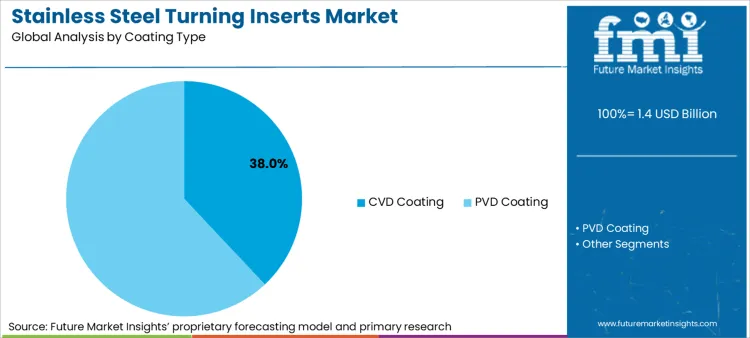
Based on FMI's stainless steel turning inserts market report, demand for CVD coated inserts remains the leading coating category, capturing 38% of the market share. The exceptional wear resistance and thermal stability that chemical vapor deposition coatings provide under the high temperatures and pressures encountered in stainless steel machining sustain this dominance. CVD coatings, typically consisting of multiple layers of titanium carbide, titanium carbonitride, and aluminum oxide, create a thermal barrier that protects the carbide substrate while maintaining cutting edge integrity.
- Coating technology advancement: Manufacturers are developing specialized CVD coating sequences optimized for specific stainless steel families. Sandvik Coromant introduced a new generation of CVD coated inserts in 2024 featuring a refined aluminum oxide layer structure that improves adhesion and reduces flaking during interrupted cuts common in stainless steel machining. [5]
- Post coating treatment innovation: The application of surface brushing or light blasting after CVD coating to create controlled residual compressive stress in the coating layer has been shown to improve insert life by 20% in austenitic stainless steel applications. This post treatment process represents a significant value add that commands premium pricing. [6]
- PVD coating niche: While smaller in overall share, PVD coated inserts maintain a strong position in finishing operations where sharp cutting edges and lower cutting forces are prioritized over maximum wear resistance. PVD coatings typically operate at lower deposition temperatures, preserving substrate toughness and enabling sharper edge geometries.
Stainless Steel Turning Inserts Market Analysis by End Use Industry
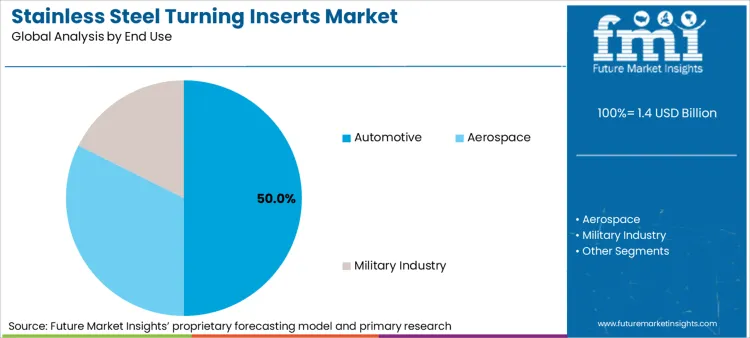
The automotive segment generates maximum demand at 50% for stainless steel turning inserts because the industry combines massive production volumes with demanding precision requirements. Modern vehicles contain dozens of machined stainless steel components including fuel injector bodies, exhaust valves, sensor housings, and transmission components. Each of these parts requires multiple turning operations with insert geometries optimized for specific stainless steel grades and machining conditions.
- Electric vehicle impact: The transition to electric vehicles is changing rather than reducing demand for stainless steel machining. Electric motor housings, battery cooling system components, and charging infrastructure parts all require precision machined stainless steel, creating new applications that offset declining internal combustion engine component production. [7]
- Aerospace expansion: The aerospace segment, while smaller in volume, commands premium pricing for inserts used in critical safety components. Aerospace manufacturers typically specify insert geometries and grades through extensive qualification processes, creating long term supply relationships that are resistant to price based competition.
- Medical device specialization: Medical device manufacturers represent a growing niche within the market, requiring inserts capable of producing the exceptional surface finishes demanded by implantable devices and surgical instruments. These applications often require custom insert geometries and edge preparations that command significant price premiums.
Regional Analysis
The stainless steel turning inserts market is segmented geographically across North America, Europe, Asia Pacific, Latin America, and Middle East and Africa. Growth dynamics differ based on manufacturing activity levels, industrial automation adoption, stainless steel production capacity, and export oriented manufacturing strategies.

| Country | CAGR 2026 to 2036 |
|---|---|
| China | 8.2% |
| India | 7.6% |
| Germany | 7.0% |
| Brazil | 6.4% |
| United States | 5.8% |
| United Kingdom | 5.2% |
| Japan | 4.6% |
Source: Future Market Insights analysis, based on proprietary forecasting model and primary research
Asia Pacific Market Analysis
Asia Pacific remains the growth engine for the global stainless steel turning inserts market, driven by massive manufacturing capacity, industrial modernization programs, and increasing adoption of automated machining centers. The region benefits from the world's largest stainless steel production base, with China and India accounting for over 60% of global stainless steel output, creating natural demand for tooling to process this material.
- China: Stainless steel turning inserts demand in China is projected to rise at 8.2% CAGR through 2036, the highest among major markets. Growth is supported by the Ministry of Industry and Information Technology's industrial modernization programs under Made in China 2025, which provide subsidies for manufacturers upgrading to advanced machine tools and cutting tool technologies. China's dominance in automotive component manufacturing, consumer goods production, and industrial equipment fabrication creates sustained demand across all stainless steel machining applications. [8]
China's market is distinctive for its scale and the presence of both domestic manufacturers serving price sensitive segments and international brands capturing premium positions in export oriented manufacturing and multinational facilities.
- India: Demand for stainless steel turning inserts in India is projected to rise at 7.6% CAGR through 2036. Growth is driven by the Production Linked Incentive scheme for automotive components, which has attracted investment in advanced manufacturing facilities equipped with modern CNC machine tools requiring high performance cutting inserts. India's stainless steel production capacity expansion, particularly in the western and southern states, has created a domestic supply chain that supports manufacturing growth. [9]
Unlike China's emphasis on export manufacturing, India's growth is increasingly driven by domestic consumption as rising incomes expand the market for automobiles, consumer goods, and industrial equipment.
Europe Market Analysis
Europe acts as a precision engineering and technology development center for the global stainless steel turning inserts market. The region's strength lies in its advanced automotive manufacturing, specialized machinery production, and aerospace industry, all of which demand the highest performance cutting tools.
- Germany: Demand for stainless steel turning inserts in Germany is projected to rise at 7.0% CAGR through 2036. Growth is influenced by the Fraunhofer Institute's manufacturing technology research programs, which develop advanced machining processes that are then adopted by German industry. Germany's automotive suppliers, machinery manufacturers, and precision engineering firms require inserts capable of achieving the tight tolerances and fine surface finishes demanded by premium vehicle components and export machinery. [10]
Germany's market is characterized by strong preference for engineering validated solutions, with manufacturers willing to pay premium prices for inserts backed by comprehensive technical data and application support.
- United Kingdom: The United Kingdom demonstrates a 5.2% CAGR, reflecting the strength of its aerospace and medical device manufacturing sectors. The UK's precision engineering heritage and concentration of high value manufacturing create demand for specialized inserts capable of machining difficult materials for critical applications. [11]
North America Market Analysis
North America functions as a technology adoption leader for the stainless steel turning inserts market, characterized by early adoption of advanced coating technologies and strong aerospace and medical device manufacturing sectors.
- United States: Demand for stainless steel turning inserts in the United States is forecasted to advance at 5.8% CAGR through 2036. Growth is driven by aerospace manufacturing expansion, reshoring initiatives bringing production back from offshore locations, and the Defense Department's industrial base strengthening programs. The USA market benefits from strong intellectual property protection that encourages manufacturers to invest in coating technology development and application engineering. [12]
Unlike emerging markets where growth is volume led through manufacturing expansion, USA growth is value led through technology upgrades and the conversion of conventional machining operations to high speed and hard turning applications.
Competitive Aligners for Market Players

The stainless steel turning inserts market is moderately consolidated with Sandvik Coromant, Kennametal, and Mitsubishi Materials Corporation representing the largest global players. Regional specialists such as Kyocera in Japan and Seco Tools in Europe maintain strong positions through technical expertise and deep customer relationships in their home markets.
The primary competitive variable has shifted from substrate composition to coating technology performance and application engineering support. Manufacturers investing in advanced coating development, comprehensive machining databases, and customer technical support gain preferred vendor status with large manufacturing customers.
Buyer behavior in this market reflects growing sophistication among manufacturing engineers who evaluate inserts based on cost per component produced rather than initial purchase price. This total cost of ownership perspective favors manufacturers with documented performance advantages validated through customer machining trials.
Recent Developments:
- Sandvik Coromant - Product Launch 2024: Sandvik introduced new generation CVD coated inserts with refined aluminum oxide layer structure for improved performance in austenitic stainless steel applications. [5]
- Kennametal - Technology Expansion 2025: Kennametal expanded its stainless steel turning insert portfolio with new geometries optimized for thin walled automotive components in electric vehicle applications.
- Mitsubishi Materials - Coating Innovation 2024: Mitsubishi announced development of advanced post coating surface treatment technology that improves insert life by 20% in interrupted cut applications. [6]
Key Players in the Stainless Steel Turning Inserts Market
- Sandvik Coromant
- KYOCERA
- Kennametal
- Mitsubishi Materials Corporation
- Sumitomo Corporation
- Seco Tools
- Walter Tools
- Dormer Pramet
- Korloy
- ISCAR
Scope of Report
| Metric | Value |
|---|---|
| Quantitative Units | USD 1,397.3 million 2026 to USD 2,525.8 million 2036 at a CAGR of 6.1% |
| Market Definition | The stainless steel turning inserts market comprises the global production and supply of indexable cutting tool inserts specifically designed for turning operations on stainless steel workpieces, manufactured from cemented carbide substrates with advanced coatings for wear resistance and thermal stability. |
| Coating Type Segmentation | CVD Coating, PVD Coating, Others |
| End Use Industry Segmentation | Aerospace, Automotive, Military Industry, Others |
| Region Segmentation | North America, Europe, Asia Pacific, Latin America, Middle East and Africa |
| Countries Covered | United States, Canada, Germany, United Kingdom, France, Italy, Spain, China, India, Japan, South Korea, Brazil and 40 plus countries |
| Key Companies Profiled | Sandvik Coromant, KYOCERA, Kennametal, Mitsubishi Materials Corporation, Sumitomo Corporation, Seco Tools, Walter Tools, Dormer Pramet, Korloy, ISCAR |
| Forecast Period | 2026 to 2036 |
| Approach | Hybrid top down and bottom up market modeling validated through primary interviews with cutting tool manufacturers, industrial distributors, and machining workshop managers supported by trade benchmarking and stainless steel consumption analysis |
Stainless Steel Turning Inserts Market Analysis by Segments
Coating Type:
- CVD Coating
- PVD Coating
- Others
End Use Industry:
- Aerospace
- Automotive
- Military Industry
- Others
Region:
- North America (USA, Canada, Mexico)
- Latin America (Brazil, Chile, Rest of Latin America)
- Western Europe (Germany, UK, Italy, Spain, France, Nordic, BENELUX, Rest of Western Europe)
- Eastern Europe (Russia, Poland, Hungary, Balkan and Baltic, Rest of Eastern Europe)
- East Asia (China, Japan, South Korea)
- South Asia and Pacific (India, ASEAN, Australia and New Zealand, Rest of South Asia and Pacific)
- Middle East and Africa (Kingdom of Saudi Arabia, Other GCC Countries, Turkiye, South Africa, Other African Union, Rest of Middle East and Africa)
Bibliography
- [1] Taizhou City Ruian Cemented Carbides Tool Co., Ltd. (2025, June 13). Surge in demand for negative general stainless steel finishing turning inserts signals shift in metalworking industry. Industry News.
- [2] International Stainless Steel Forum. (2025). Stainless steel in automotive applications: Lightweighting trends and material requirements. Brussels: ISSF.
- [3] Aerospace Industries Association. (2024). Aerospace manufacturing technology survey: Cutting tool requirements for advanced materials. Arlington, VA: AIA.
- [4] Medical Device Manufacturing Association. (2025). Precision machining requirements for implantable devices. Washington, D.C.: MDMA.
- [5] Sandvik Coromant. (2024, September 15). Sandvik Coromant introduces next generation CVD coated inserts for stainless steel machining. Sandvik Press Release.
- [6] Mitsubishi Materials Corporation. (2024, November 8). Mitsubishi Materials develops advanced post coating treatment technology for turning inserts. Mitsubishi Corporate News.
- [7] International Energy Agency. (2025). Electric vehicle supply chain and manufacturing requirements. Paris: IEA.
- [8] Ministry of Industry and Information Technology, People's Republic of China. (2024). Made in China 2025 implementation progress: Advanced manufacturing technology adoption. Beijing: MIIT.
- [9] Ministry of Heavy Industries, Government of India. (2025). Production Linked Incentive scheme for automotive components: Investment and technology adoption report. New Delhi: MHI.
- [10] Fraunhofer Institute for Production Technology. (2024). Advanced machining processes for stainless steel components. Aachen: Fraunhofer IPT.
- [11] UK Aerospace Research Consortium. (2025). Precision machining capabilities in UK aerospace supply chain. London: UK ARC.
- [12] USA Department of Defense. (2024). Industrial base strengthening programs: Cutting tool technology assessment. Washington, D.C.: DOD.
This Report Addresses
- Market intelligence to enable structured strategic decision making across cutting tool manufacturers, industrial distributors, and manufacturing engineering leaders.
- Market size estimation and 10 year revenue forecasts from 2026 to 2036 including validated CAGR and absolute dollar opportunity sizing.
- Growth opportunity mapping across Coating Type, End Use Industry, and regional demand pockets with emphasis on application specific coating systems and digital tool life prediction services.
- Segment and regional forecasting covering CVD and PVD coating technologies alongside demand trajectories across automotive, aerospace, and medical device manufacturing.
- Competition strategy assessment including coating technology development, application engineering support, and total cost of ownership documentation shaping manufacturer selection in industrial procurement.
- Product and compliance tracking focused on coating adhesion performance, edge preparation consistency, and machining data validation through customer trials.
- Regulatory impact analysis covering automotive lightweighting trends, aerospace material specifications, and medical device manufacturing standards influencing insert performance requirements.
- Report delivery in PDF, Excel, and presentation ready formats to support executive planning, product development alignment, and market entry strategy development.
Frequently Asked Questions
How large is the demand for stainless steel turning inserts in the global market in 2026?
Demand for stainless steel turning inserts is estimated to be valued at USD 1,397.3 million in 2026.
What will be the market size of stainless steel turning inserts in the global market by 2036?
Market size for stainless steel turning inserts is projected to reach USD 2,525.8 million by 2036.
What is the expected demand growth for stainless steel turning inserts between 2026 and 2036?
Demand for stainless steel turning inserts is expected to grow at a 6.1% CAGR between 2026 and 2036.
Which coating type segment is poised to lead global sales?
CVD coating is expected to remain the leading coating type segment, anchored by exceptional wear resistance and thermal stability in high speed stainless steel machining, holding 38% share in 2025.
Which end use industry dominates the stainless steel turning inserts market?
Automotive is the dominant end use industry at 50% share in 2025, reflecting the industry's massive consumption of stainless steel components and high volume precision machining requirements.
What is driving demand in China?
Massive manufacturing capacity, industrial modernization programs under Made in China 2025, and increasing demand for precision cutting tools in automotive and aerospace component production are driving demand in China.
What is China's growth outlook in this report?
China is projected to expand at an 8.2% CAGR during 2026 to 2036.
What is driving demand in India?
Expanding stainless steel production, growing automotive manufacturing capabilities under the Production Linked Incentive scheme, and rising industrial investment are driving demand in India.
What is India's growth outlook in this report?
India is projected to expand at a 7.6% CAGR during 2026 to 2036.
What is driving demand in Germany?
Fraunhofer Institute manufacturing technology research programs, strong automotive supplier precision requirements, and export machinery manufacturing are driving demand in Germany.
What is Germany's growth outlook in this report?
Germany is projected to expand at a 7.0% CAGR during 2026 to 2036.
Does the report cover the United Kingdom in its regional analysis?
Yes, the United Kingdom is included within Europe under the regional coverage framework.
What is the United Kingdom's growth outlook in this report?
The United Kingdom is projected to expand at a 5.2% CAGR during 2026 to 2036.
What is driving demand in the United States?
Aerospace manufacturing expansion, reshoring initiatives, and Defense Department industrial base strengthening programs are driving demand in the United States.
What is the United States growth outlook in this report?
The United States is projected to expand at a 5.8% CAGR during 2026 to 2036.
Does the report cover Japan in its regional analysis?
Yes, Japan is included within East Asia under the regional scope of analysis.
What is Japan's growth outlook in this report?
Japan is projected to expand at a 4.6% CAGR during 2026 to 2036.
Does the report cover Brazil in its regional analysis?
Yes, Brazil is included within Latin America and is covered in the country wise assessment.
What is Brazil's growth outlook in this report?
Brazil is projected to expand at a 6.4% CAGR during 2026 to 2036.
What are stainless steel turning inserts and what are they mainly used for?
Stainless steel turning inserts are indexable cutting tool inserts manufactured from cemented carbide substrates with advanced coatings, specifically designed for turning operations on stainless steel workpieces. They are mainly used in automotive, aerospace, medical device, and general manufacturing to achieve precise dimensional accuracy and surface finish on stainless steel components.
What does the stainless steel turning inserts market mean in this report?
It refers to the global production and supply of stainless steel turning inserts by coating type, end use industry, and region, measured in value terms at the manufacturer shipment layer.
What is included in the scope of this stainless steel turning inserts market report?
Scope includes market sizing and forecasting for 2026 to 2036, segmentation by coating type, end use industry, and region, along with competitive assessment, technology trend analysis, and country wise outlook.
What is excluded from the scope of this report?
The scope excludes cutting tool holders sold separately, inserts designed exclusively for materials other than stainless steel, regrinding and recoating services, and custom engineered inserts for specialized applications.
How are technological developments shaping the stainless steel turning inserts market?
Technological developments including advanced multilayer CVD coating sequences, post coating surface treatments, and digital tool life prediction models are shifting competitive advantage from substrate composition to coating system performance and application engineering support as manufacturers seek documented improvements in tool life and machining efficiency.
Preview the report firsthand - request a free sample
Get SampleGet the brochure for pricing and purchase details.
Get PDFTable of Content
- Executive Summary
- Global Market Outlook
- Demand-side Trends
- Supply-side Trends
- Technology Roadmap Analysis
- Analysis and Recommendations
- Market Overview
- Market Coverage / Taxonomy
- Market Definition / Scope / Limitations
- Research Methodology
- Chapter Orientation
- Analytical Lens and Working Hypotheses
- Market Structure, Signals, and Trend Drivers
- Benchmarking and Cross-market Comparability
- Market Sizing, Forecasting, and Opportunity Mapping
- Research Design and Evidence Framework
- Desk Research Programme (Secondary Evidence)
- Company Annual and Sustainability Reports
- Peer-reviewed Journals and Academic Literature
- Corporate Websites, Product Literature, and Technical Notes
- Earnings Decks and Investor Briefings
- Statutory Filings and Regulatory Disclosures
- Technical White Papers and Standards Notes
- Trade Journals, Industry Magazines, and Analyst Briefs
- Conference Proceedings, Webinars, and Seminar Materials
- Government Statistics Portals and Public Data Releases
- Press Releases and Reputable Media Coverage
- Specialist Newsletters and Curated Briefings
- Sector Databases and Reference Repositories
- FMI Internal Proprietary Databases and Historical Market Datasets
- Subscription Datasets and Paid Sources
- Social Channels, Communities, and Digital Listening Inputs
- Additional Desk Sources
- Expert Input and Fieldwork (Primary Evidence)
- Primary Modes
- Qualitative Interviews and Expert Elicitation
- Quantitative Surveys and Structured Data Capture
- Blended Approach
- Why Primary Evidence is Used
- Field Techniques
- Interviews
- Surveys
- Focus Groups
- Observational and In-context Research
- Social and Community Interactions
- Stakeholder Universe Engaged
- C-suite Leaders
- Board Members
- Presidents and Vice Presidents
- R&D and Innovation Heads
- Technical Specialists
- Domain Subject-matter Experts
- Scientists
- Physicians and Other Healthcare Professionals
- Governance, Ethics, and Data Stewardship
- Research Ethics
- Data Integrity and Handling
- Primary Modes
- Tooling, Models, and Reference Databases
- Desk Research Programme (Secondary Evidence)
- Data Engineering and Model Build
- Data Acquisition and Ingestion
- Cleaning, Normalisation, and Verification
- Synthesis, Triangulation, and Analysis
- Quality Assurance and Audit Trail
- Market Background
- Market Dynamics
- Drivers
- Restraints
- Opportunity
- Trends
- Scenario Forecast
- Demand in Optimistic Scenario
- Demand in Likely Scenario
- Demand in Conservative Scenario
- Opportunity Map Analysis
- Product Life Cycle Analysis
- Supply Chain Analysis
- Investment Feasibility Matrix
- Value Chain Analysis
- PESTLE and Porter’s Analysis
- Regulatory Landscape
- Regional Parent Market Outlook
- Production and Consumption Statistics
- Import and Export Statistics
- Market Dynamics
- Global Market Analysis 2021 to 2025 and Forecast, 2026 to 2036
- Historical Market Size Value (USD Million) Analysis, 2021 to 2025
- Current and Future Market Size Value (USD Million) Projections, 2026 to 2036
- Y-o-Y Growth Trend Analysis
- Absolute $ Opportunity Analysis
- Global Market Pricing Analysis 2021 to 2025 and Forecast 2026 to 2036
- Global Market Analysis 2021 to 2025 and Forecast 2026 to 2036, By Coating Type
- Introduction / Key Findings
- Historical Market Size Value (USD Million) Analysis By Coating Type , 2021 to 2025
- Current and Future Market Size Value (USD Million) Analysis and Forecast By Coating Type , 2026 to 2036
- CVD Coating
- PVD Coating
- CVD Coating
- Y-o-Y Growth Trend Analysis By Coating Type , 2021 to 2025
- Absolute $ Opportunity Analysis By Coating Type , 2026 to 2036
- Global Market Analysis 2021 to 2025 and Forecast 2026 to 2036, By End Use
- Introduction / Key Findings
- Historical Market Size Value (USD Million) Analysis By End Use, 2021 to 2025
- Current and Future Market Size Value (USD Million) Analysis and Forecast By End Use, 2026 to 2036
- Automotive
- Aerospace
- Military Industry
- Automotive
- Y-o-Y Growth Trend Analysis By End Use, 2021 to 2025
- Absolute $ Opportunity Analysis By End Use, 2026 to 2036
- Global Market Analysis 2021 to 2025 and Forecast 2026 to 2036, By Region
- Introduction
- Historical Market Size Value (USD Million) Analysis By Region, 2021 to 2025
- Current Market Size Value (USD Million) Analysis and Forecast By Region, 2026 to 2036
- North America
- Latin America
- Western Europe
- Eastern Europe
- East Asia
- South Asia and Pacific
- Middle East & Africa
- Market Attractiveness Analysis By Region
- North America Market Analysis 2021 to 2025 and Forecast 2026 to 2036, By Country
- Historical Market Size Value (USD Million) Trend Analysis By Market Taxonomy, 2021 to 2025
- Market Size Value (USD Million) Forecast By Market Taxonomy, 2026 to 2036
- By Country
- USA
- Canada
- Mexico
- By Coating Type
- By End Use
- By Country
- Market Attractiveness Analysis
- By Country
- By Coating Type
- By End Use
- Key Takeaways
- Latin America Market Analysis 2021 to 2025 and Forecast 2026 to 2036, By Country
- Historical Market Size Value (USD Million) Trend Analysis By Market Taxonomy, 2021 to 2025
- Market Size Value (USD Million) Forecast By Market Taxonomy, 2026 to 2036
- By Country
- Brazil
- Chile
- Rest of Latin America
- By Coating Type
- By End Use
- By Country
- Market Attractiveness Analysis
- By Country
- By Coating Type
- By End Use
- Key Takeaways
- Western Europe Market Analysis 2021 to 2025 and Forecast 2026 to 2036, By Country
- Historical Market Size Value (USD Million) Trend Analysis By Market Taxonomy, 2021 to 2025
- Market Size Value (USD Million) Forecast By Market Taxonomy, 2026 to 2036
- By Country
- Germany
- UK
- Italy
- Spain
- France
- Nordic
- BENELUX
- Rest of Western Europe
- By Coating Type
- By End Use
- By Country
- Market Attractiveness Analysis
- By Country
- By Coating Type
- By End Use
- Key Takeaways
- Eastern Europe Market Analysis 2021 to 2025 and Forecast 2026 to 2036, By Country
- Historical Market Size Value (USD Million) Trend Analysis By Market Taxonomy, 2021 to 2025
- Market Size Value (USD Million) Forecast By Market Taxonomy, 2026 to 2036
- By Country
- Russia
- Poland
- Hungary
- Balkan & Baltic
- Rest of Eastern Europe
- By Coating Type
- By End Use
- By Country
- Market Attractiveness Analysis
- By Country
- By Coating Type
- By End Use
- Key Takeaways
- East Asia Market Analysis 2021 to 2025 and Forecast 2026 to 2036, By Country
- Historical Market Size Value (USD Million) Trend Analysis By Market Taxonomy, 2021 to 2025
- Market Size Value (USD Million) Forecast By Market Taxonomy, 2026 to 2036
- By Country
- China
- Japan
- South Korea
- By Coating Type
- By End Use
- By Country
- Market Attractiveness Analysis
- By Country
- By Coating Type
- By End Use
- Key Takeaways
- South Asia and Pacific Market Analysis 2021 to 2025 and Forecast 2026 to 2036, By Country
- Historical Market Size Value (USD Million) Trend Analysis By Market Taxonomy, 2021 to 2025
- Market Size Value (USD Million) Forecast By Market Taxonomy, 2026 to 2036
- By Country
- India
- ASEAN
- Australia & New Zealand
- Rest of South Asia and Pacific
- By Coating Type
- By End Use
- By Country
- Market Attractiveness Analysis
- By Country
- By Coating Type
- By End Use
- Key Takeaways
- Middle East & Africa Market Analysis 2021 to 2025 and Forecast 2026 to 2036, By Country
- Historical Market Size Value (USD Million) Trend Analysis By Market Taxonomy, 2021 to 2025
- Market Size Value (USD Million) Forecast By Market Taxonomy, 2026 to 2036
- By Country
- Kingdom of Saudi Arabia
- Other GCC Countries
- Turkiye
- South Africa
- Other African Union
- Rest of Middle East & Africa
- By Coating Type
- By End Use
- By Country
- Market Attractiveness Analysis
- By Country
- By Coating Type
- By End Use
- Key Takeaways
- Key Countries Market Analysis
- USA
- Pricing Analysis
- Market Share Analysis, 2025
- By Coating Type
- By End Use
- Canada
- Pricing Analysis
- Market Share Analysis, 2025
- By Coating Type
- By End Use
- Mexico
- Pricing Analysis
- Market Share Analysis, 2025
- By Coating Type
- By End Use
- Brazil
- Pricing Analysis
- Market Share Analysis, 2025
- By Coating Type
- By End Use
- Chile
- Pricing Analysis
- Market Share Analysis, 2025
- By Coating Type
- By End Use
- Germany
- Pricing Analysis
- Market Share Analysis, 2025
- By Coating Type
- By End Use
- UK
- Pricing Analysis
- Market Share Analysis, 2025
- By Coating Type
- By End Use
- Italy
- Pricing Analysis
- Market Share Analysis, 2025
- By Coating Type
- By End Use
- Spain
- Pricing Analysis
- Market Share Analysis, 2025
- By Coating Type
- By End Use
- France
- Pricing Analysis
- Market Share Analysis, 2025
- By Coating Type
- By End Use
- India
- Pricing Analysis
- Market Share Analysis, 2025
- By Coating Type
- By End Use
- ASEAN
- Pricing Analysis
- Market Share Analysis, 2025
- By Coating Type
- By End Use
- Australia & New Zealand
- Pricing Analysis
- Market Share Analysis, 2025
- By Coating Type
- By End Use
- China
- Pricing Analysis
- Market Share Analysis, 2025
- By Coating Type
- By End Use
- Japan
- Pricing Analysis
- Market Share Analysis, 2025
- By Coating Type
- By End Use
- South Korea
- Pricing Analysis
- Market Share Analysis, 2025
- By Coating Type
- By End Use
- Russia
- Pricing Analysis
- Market Share Analysis, 2025
- By Coating Type
- By End Use
- Poland
- Pricing Analysis
- Market Share Analysis, 2025
- By Coating Type
- By End Use
- Hungary
- Pricing Analysis
- Market Share Analysis, 2025
- By Coating Type
- By End Use
- Kingdom of Saudi Arabia
- Pricing Analysis
- Market Share Analysis, 2025
- By Coating Type
- By End Use
- Turkiye
- Pricing Analysis
- Market Share Analysis, 2025
- By Coating Type
- By End Use
- South Africa
- Pricing Analysis
- Market Share Analysis, 2025
- By Coating Type
- By End Use
- USA
- Market Structure Analysis
- Competition Dashboard
- Competition Benchmarking
- Market Share Analysis of Top Players
- By Regional
- By Coating Type
- By End Use
- Competition Analysis
- Competition Deep Dive
- Sandvik Coromant
- Overview
- Product Portfolio
- Profitability by Market Segments (Product/Age /Sales Channel/Region)
- Sales Footprint
- Strategy Overview
- Marketing Strategy
- Product Strategy
- Channel Strategy
- KYOCERA
- Kennametal
- Mitsubishi Materials Corporation
- Sumitomo Corporation
- Seco Tools
- Walter Tools
- Sandvik Coromant
- Competition Deep Dive
- Assumptions & Acronyms Used


