

- Market Size (2026)
- USD 1193.2 Mn
- Forecast (2036)
- USD 3297.6 Mn
- CAGR (2026 to 2036)
- 10.7%
How big is Vascular Thromboembolic Disease Thrombectomy Market in 2026?
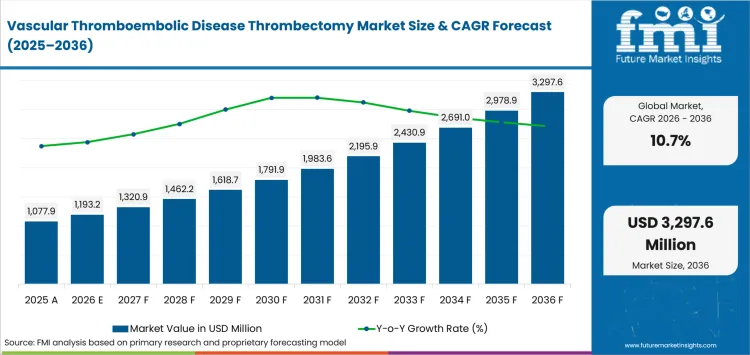
USD 1,193.2 million in 2026 and USD 3,297.6 million by 2036 at a 10.7% CAGR.
Demand for vascular thromboembolic disease thrombectomy is expected to rise at 10.7% CAGR from 2026 to 2036, pushing industry value from USD 1193.2 million in 2026 to USD 3297.6 million by 2036. Current thrombectomy systems span venous and arterial procedures alongside neurovascular care that requires different access routes and specialist teams. FDA records dated May and June 2025 document separate clearances for the Symphony and Liberant systems. The regulatory activity supports continued product renewal without proving uniform purchasing across every hospital or disease pathway.
Commercial adoption depends on rapid imaging and appropriate case selection together with reliable transfer into a capable interventional service. Hospitals also need trained clinicians and inventory plans that support emergency procedures outside routine daytime schedules. Demand for blood clot retrieval devices therefore reflects complete pathway readiness rather than device availability alone. Manufacturers gain stronger account access through service coverage and procedural education that reduce delays during urgent clot-removal decisions.
Key Takeaways of Vascular Thromboembolic Disease Thrombectomy Market
- Demand for vascular thromboembolic disease thrombectomy solutions is shaped by the need for rapid clot removal, coordinated patient transfer, and reliable endovascular treatment across acute vascular emergencies.
- By disease type, deep vein thrombosis holds the leading position with 39.6% share in 2026, reflecting established venous intervention pathways for patients with significant clot burden requiring thrombectomy.
- Aspiration thrombectomy devices lead the device category with 41.3% share in 2026, reflecting direct clot evacuation workflows and device designs suited to different vascular territories.
- Endovascular thrombectomy accounts for 31.5% share in 2026, supported by catheter-based access and targeted thrombus removal across neurovascular and peripheral treatment pathways.
- Hospitals represent 30.2% share in 2026, reflecting their concentration of imaging, emergency procedural capability, specialist staffing, and post-procedure monitoring.
- Referral delays, emergency pathway coordination, equipment setup requirements, clinician training, and service coverage remain key operational barriers to wider thrombectomy adoption.
- Competition centers on Penumbra, Inari Medical, Medtronic, Johnson & Johnson MedTech, Boston Scientific, Abbott, AngioDynamics, and Philips, with differentiation spanning aspiration systems, mechanical extraction platforms, access technologies, and procedural support.
Analyst Perspective
"The vascular thromboembolic disease thrombectomy market is increasingly shaped by procedural reliability across defined vascular conditions rather than device capability alone. Hospitals are assessing treatment readiness, clot-removal performance, and emergency workflow integration as separate measures of value. Companies that provide consistent clinical evidence, structured training, and dependable maintenance support will be better positioned to strengthen adoption across thrombectomy programs."
— Anurag Sharma, Principal Analyst at Future Market Insights
Source: FMI's proprietary forecasting model and primary research
How is the Vascular Thromboembolic Disease Thrombectomy Market segmented?
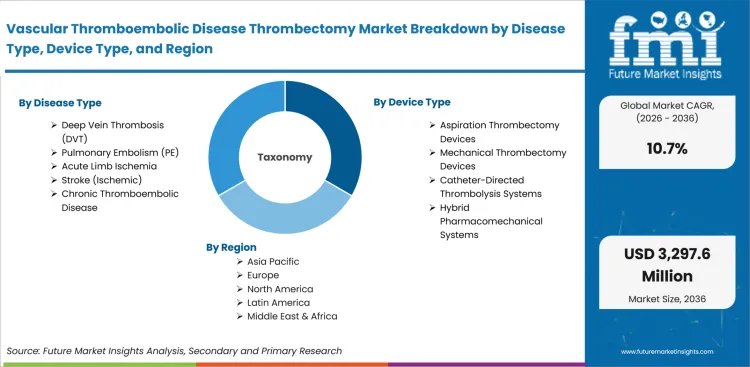
The vascular thromboembolic disease thrombectomy industry is segmented by disease type, device type, procedure type, end user, and region.
The segmentation framework separates the clinical condition from the equipment and procedure selected for thrombus removal. Disease analysis covers venous and arterial events together with ischemic stroke and chronic thromboembolic disease. Device analysis distinguishes aspiration platforms from mechanical systems and hybrid technologies that combine clot disruption with evacuation. Procedure analysis compares endovascular removal with thrombolytic and fragmentation approaches across several distinct vascular beds and emergency pathways. End-user analysis separates hospitals from catheterization laboratories and specialist centers with different staffing and equipment models. Regional assessment connects neurovascular devices with local transfer networks and regulatory pathways across the covered countries.
What supports demand for deep vein thrombosis within the disease type category?
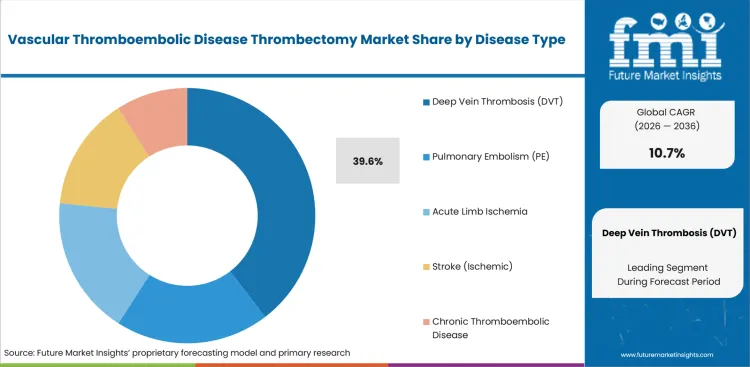
Deep vein thrombosis creates large peripheral venous clot burdens that can require rapid escalation beyond anticoagulation alone. The current venous thromboembolism treatment landscape therefore includes device selection alongside access planning and bleeding-risk review. Commercial demand increases where vascular teams can identify suitable patients and maintain a dependable post-procedure monitoring pathway.
- In 2026, deep vein thrombosis is expected to hold 39.6% share of the disease type category, driven by established venous intervention pathways. Its position reflects the need to manage clot burden and protect venous flow across symptomatic patients selected for intervention.
- Vascular specialists adopt DVT thrombectomy systems through protocols that define imaging thresholds and adjunctive treatment choices. Hospitals gain value from platforms that support predictable clot extraction without creating unclear ownership for monitoring and follow-up.
How are aspiration thrombectomy devices positioned within the device type category?
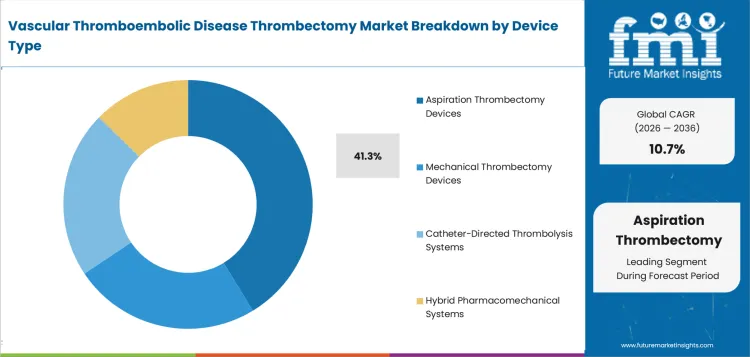
Aspiration systems remove thrombus through controlled suction and require catheters that remain navigable across challenging vascular anatomy. Related neurointerventional devices use aspiration within cerebral vessels but follow different indications and procedural controls. Device comparisons must therefore separate pump performance from catheter trackability and the vascular territory approved for treatment.
- By device type, aspiration thrombectomy devices are projected to represent 41.3% share in 2026, attributable to direct clot evacuation across several endovascular workflows. The share position also reflects product designs that combine aspiration control with catheters sized for specific vascular territories.
- Interventional teams favor aspiration platforms that simplify setup and provide clear feedback during clot engagement. Purchasing decisions remain sensitive to blood-loss management and compatible accessories because those factors influence total procedural reliability.
Why does endovascular thrombectomy lead the procedure type category?
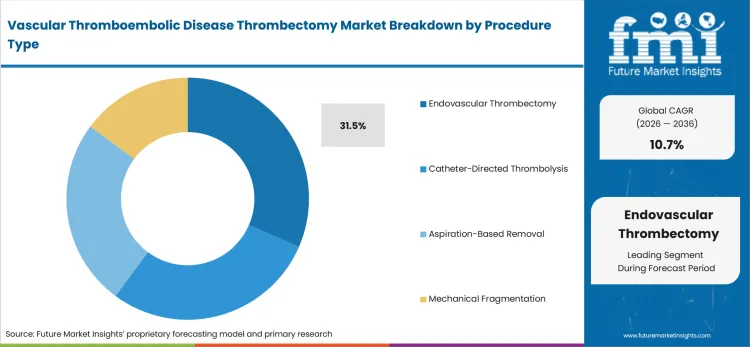
Endovascular thrombectomy allows specialists to reach an occlusion through catheter-based access rather than open surgical exposure. NHS England states that eligible stroke patients should transfer without delay to a specialist mechanical thrombectomy center. The transfer requirement shows why catheter-directed thrombolysis and thrombectomy programs depend on coordinated imaging and transport pathways. Procedure demand grows where referring hospitals can activate a qualified receiving service without repeated case review or avoidable handoffs.
- Endovascular thrombectomy is forecast to account for 31.5% share in 2026, supported by minimally invasive access and targeted clot removal. Its position reflects procedural flexibility across neurovascular and peripheral cases that meet defined intervention criteria.
- Hospitals expand endovascular thrombectomy through referral agreements that specify imaging transfer and specialist acceptance responsibilities. A technically effective device cannot compensate for transport delays that prevent patients from reaching a capable treatment center.
What makes hospitals central to the end user category?
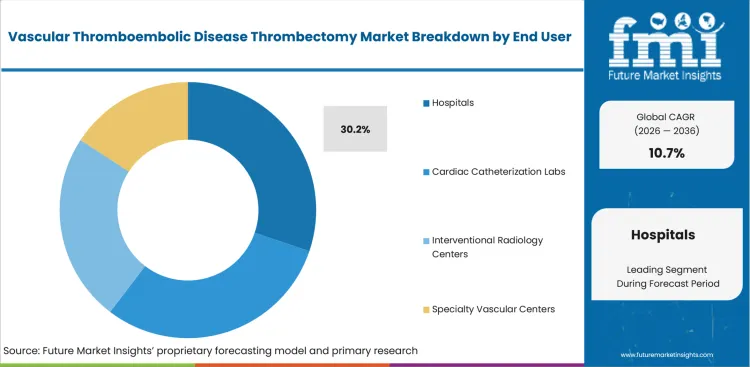
Hospitals combine imaging and anesthesia support with specialist teams that manage complications during urgent thrombectomy procedures. The German Stroke Society updated certification criteria for stroke units during 2025 and maintains requirements for structured specialist care. Many interventional radiology services also support peripheral venous and arterial procedures through shared imaging and catheter laboratories. Hospital investment depends on procedure volume and round-the-clock readiness that justify equipment service and clinician training costs.
- Hospitals are estimated to hold 30.2% share in 2026, owing to their concentration of imaging and emergency procedural capability. The share also reflects post-procedure care requirements that are difficult to reproduce across smaller standalone treatment settings.
- Hospital committees evaluate thrombectomy equipment through pathway performance and support coverage rather than isolated catheter specifications. Systems gain wider use once nursing and imaging teams can reproduce setup steps across urgent cases and scheduled training exercises.
What are the drivers, restraints, and opportunities in the Vascular Thromboembolic Disease Thrombectomy Market?
Time-sensitive vascular events support demand for effective clot removal, while service gaps and pathway delays limit routine adoption.
- Driver: Specialist teams need thrombectomy systems that restore flow through a predictable procedure during urgent vascular events.
- Restraint: Labeling errors and inconsistent training can interrupt deployment even when the underlying device remains technically capable.
- Opportunity: Better imaging coordination can identify eligible patients sooner and direct them toward the correct thrombectomy pathway.
Urgent clot-removal decisions are projected to support market growth through demand for faster treatment preparation and more consistent procedural control. NHS England reported in December 2025 that 15,377 patients received AI-supported scan review across the evaluated stroke hospitals. The same program was associated with thrombectomy rates rising from 2.3% to 4.6% across the evaluation sites. Investment in endovascular therapy devices becomes easier to defend once imaging support increases appropriate referral without weakening specialist oversight.
Operational reliability limits adoption whenever product labeling or setup guidance creates uncertainty during an emergency procedure. The FDA posted a May 2025 Class 2 recall for one Artix lot following an incorrect vessel-range statement on the label. The event concerned labeling rather than the complete platform but required affected inventory to be identified and corrected. Hospitals therefore need controlled stock records and rapid manufacturer communication that prevent avoidable disruption across urgent vascular cases.
Earlier pathway coordination creates an opportunity to treat eligible patients before clinical deterioration narrows the available intervention choices. Johnson & Johnson launched the CEREGLIDE 92 system in February 2025 to support neurovascular access during acute ischemic stroke procedures. The system expands the access toolkit used with aspiration catheters and compatible stent retrievers across complex cerebral anatomy. Commercial value grows through integrated imaging and device protocols that reduce avoidable exchanges without replacing physician case selection.
Which country CAGRs are profiled in the Vascular Thromboembolic Disease Thrombectomy Market?
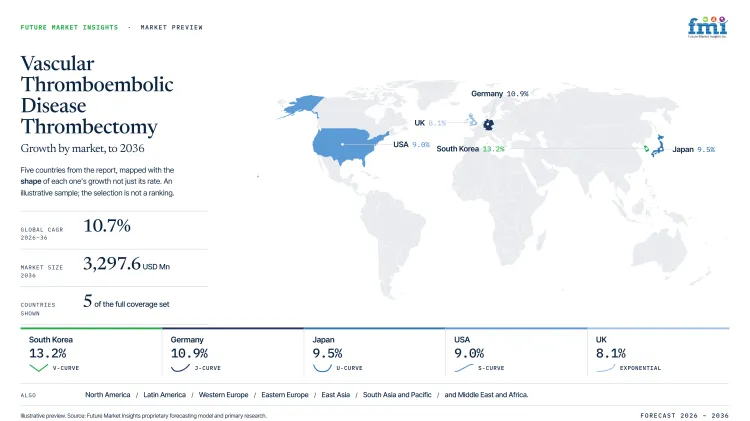
| Country | CAGR |
|---|---|
| USA | 9.0% |
| UK | 8.1% |
| Germany | 10.9% |
| Japan | 9.5% |
| South Korea | 13.2% |
How do country-level CAGRs compare in the Vascular Thromboembolic Disease Thrombectomy Market?
The country outlook spans a 5.1 percentage-point range between the UK and South Korea. Germany and Japan form a middle growth band with rates above the USA and UK profiles. South Korea occupies a separate upper position through its 13.2% CAGR and stronger approved growth profile. The pattern reflects different specialist networks and payment structures rather than a single regional adoption sequence.
- South Korea forms the upper growth position and remains 2.3 percentage points above Germany during the forecast period.
- Germany and Japan create the central cluster with a 1.4 percentage-point separation across their approved country forecasts.
- The USA and UK form the lower cluster while retaining positive expansion across mature hospital and reimbursement systems.
- Country rates describe the profiled outlook and do not replace local assessment of service capacity or patient transfer conditions.
Similar growth rates can produce different entry conditions across public systems and mixed hospital networks. Manufacturers must evaluate distributor support and training access alongside payment rules across each national service pathway.
Country-wise Analysis
- United States hospitals operate through large academic centers and regional referral networks with uneven access to specialist thrombectomy teams. The USA is projected to expand at 9.0% CAGR from 2026 to 2036, supported by broad device availability and established reimbursement pathways. CDC reported in January 2025 that up to 900,000 Americans experience venous thromboembolism during a typical year. Current peripheral vascular devices can reach major hospitals through direct company service and national distribution networks. Rural transfer distance remains a material friction because time-sensitive patients may begin care far from an equipped intervention center.
- United Kingdom adoption operates through NHS stroke networks and centralized specialist centers that receive patients from surrounding hospitals. The UK is forecast to record 8.1% CAGR through 2036, linked to service expansion and formal transfer pathways. NHS England reported during 2025 that a national review covered 26 mechanical thrombectomy sites and supported wider access planning. Public procurement can consolidate training and service requirements across regional networks through coordinated contracts and credentialing programs. Specialist staffing and transfer capacity remain material frictions for hospitals seeking dependable coverage during nights and weekends.
- German thrombectomy services operate through certified stroke units and neurovascular networks with formal quality and training requirements. Germany is estimated to post 10.9% CAGR by 2036, underpinned by structured specialist infrastructure and regulated clinical pathways. The German Stroke Society reported in July 2025 that its NIHSS training platform had registered 4,005 qualified healthcare professionals. National manufacturer subsidiaries and regional distributors support equipment maintenance routes across major metropolitan hospital clusters and specialist centers. Certification obligations and specialist workforce availability create material friction for smaller hospitals outside established neurovascular networks.
- Japanese stroke care combines accredited centers with strict device review and hospital purchasing processes across densely populated regions. Japan is anticipated to advance at 9.5% CAGR during the forecast period, shaped by clinical discipline and continued neurovascular technology adoption. The Japan Stroke Society released revised 2025 items for its national stroke treatment guideline on June 30. PMDA also began publishing device review summaries for qualifying applications submitted from fiscal 2025 onward. Long evaluation cycles and concentrated specialist expertise can slow broader access beyond major urban centers despite strong clinical capability.
- South Korea is expanding coordinated cardio-cerebrovascular services through regional centers and formal emergency referral responsibilities. The country is predicted to record 13.2% CAGR between 2026 and 2036, reinforced by tertiary-care capacity and fast technology evaluation. The Ministry of Health and Welfare selected ten new regional cardio-cerebrovascular disease centers during January 2025. The added centers create a direct enabler through broader access to advanced care and interhospital transfer coordination. Specialist concentration outside leading metropolitan hospitals remains a material friction for consistent national thrombectomy coverage.
Who are the notable companies in the Vascular Thromboembolic Disease Thrombectomy Market?
Penumbra, Inc. and Inari Medical are notable thrombectomy companies within the defined market. Boston Scientific Corporation and Medtronic plc compete alongside Abbott Laboratories and Johnson & Johnson MedTech. AngioDynamics, Inc. and Philips Healthcare provide focused peripheral thrombectomy systems.
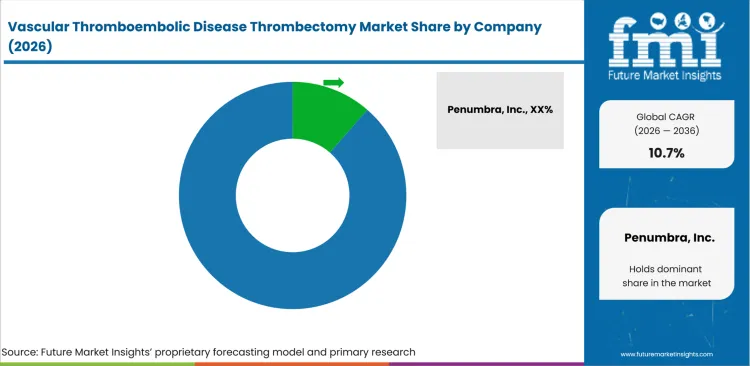
The competitive field combines broad thrombectomy platforms with focused peripheral and neurovascular product portfolios across several specialist treatment pathways. Penumbra remains operationally independent while its announced transaction with Boston Scientific progresses toward a stated 2026 closing. The SEC filing states that existing Penumbra contracts and partnerships remain unchanged before transaction completion. Comparisons with interventional cardiology devices help procurement teams separate vascular access support from direct thrombus-removal capability. Commercial performance depends on exact indication fit and service response rather than corporate scale across unrelated medical technology categories.
- Penumbra and Inari Medical provide dedicated aspiration and mechanical platforms across venous and peripheral arterial thrombus cases. Their portfolios support complex clot burdens through integrated catheters and purpose-built procedural components across peripheral vascular procedures.
- Medtronic and Johnson & Johnson MedTech maintain neurovascular thrombectomy portfolios that combine aspiration catheters with stent retrievers and access systems. Their competitive strength depends on complete stroke workflow compatibility across access and aspiration steps during urgent procedures.
- Boston Scientific and Abbott provide peripheral clot-removal systems through pharmacomechanical or hydrodynamic approaches across arterial and venous procedures. AngioDynamics and Philips offer aspiration platforms with different indication breadth and capital requirements across each account.
Competitive Benchmarking: Vascular Thromboembolic Disease Thrombectomy Market
| Company | Thrombus Removal Breadth | Workflow Integration | Clinical Evidence Depth | Geographic Reach |
|---|---|---|---|---|
| Penumbra, Inc. | High | High | High | Global |
| Inari Medical (Stryker Corporation) | High | High | High | Global |
| Boston Scientific Corporation | High | High | High | Global |
| Medtronic plc | High | High | High | Global |
| Abbott Laboratories | Medium | Medium | Medium | Global |
| Johnson & Johnson MedTech | Medium | High | High | Global |
| AngioDynamics, Inc. | High | High | Medium | North America and Europe |
| Philips Healthcare | Medium | Medium | Low | United States and selected markets |
Key Developments in the Vascular Thromboembolic Disease Thrombectomy Market
- In February 2025, Stryker completed its acquisition of Inari Medical and added a dedicated venous thromboembolism portfolio to its interventional business. The completed transaction changed Inari ownership while preserving the established product brand and vascular operating focus within Stryker. The acquisition gives Stryker direct participation in peripheral venous clot removal alongside its established neurovascular operations and specialist service network.
- In December 2025, Medtronic announced the first commercial use of the Liberant thrombectomy system at Mount Sinai Hospital in New York. The system is indicated for fresh soft emboli or thrombi in peripheral arterial and venous vessels. The launch broadens Medtronic participation beyond neurovascular thrombectomy into peripheral aspiration procedures across arterial and venous treatment pathways.
- In January 2026, Penumbra launched Lightning Flash 3.0 for pulmonary and venous thrombus removal through its computer-assisted vacuum thrombectomy platform. The release added enhanced clot detection and an automated backflush function for large thrombus burdens. The update strengthens Penumbra workflow control across high-volume venous thrombectomy cases that require rapid management of substantial clot burdens.
- In February 2026, Johnson & Johnson launched CEREGLIDE 42 and 57 aspiration catheters together with the INNERGLIDE 7 delivery aid. The additions completed a multi-axial aspiration-first stroke portfolio designed for distal neurovascular targets and complex vessel access. The launch expands catheter size selection across ischemic stroke thrombectomy workflows that require different aspiration and delivery profiles.
Key Players in the Vascular Thromboembolic Disease Thrombectomy Market
VTE and Peripheral Thrombectomy Systems
- Penumbra, Inc.
- Inari Medical (Stryker Corporation)
- Boston Scientific Corporation
Neurovascular and Multi-Bed Platforms
- Medtronic plc
- Johnson & Johnson MedTech
- Abbott Laboratories
Focused Peripheral Systems
- AngioDynamics, Inc.
- Philips Healthcare
Vascular Thromboembolic Disease Thrombectomy Market - Report Scope
| Coverage field | Report scope |
|---|---|
| Market breakdown | Disease type, device type, procedure type, end user, and region. |
| Quantitative Units | Revenue in USD Million, CAGR in %. |
| Market Definition | Devices and systems used to remove thrombus through aspiration or mechanical extraction together with pharmacomechanical action and related endovascular approaches across defined vascular diseases. |
| Regions Covered | North America, Latin America, Western Europe, Eastern Europe, East Asia, South Asia and Pacific, and Middle East and Africa. |
| Countries Covered | USA, UK, Germany, Japan, and South Korea. Additional country analysis follows the complete regional framework. |
| Key Companies Profiled | Penumbra, Inc. and Inari Medical are profiled alongside Boston Scientific Corporation and Medtronic plc. Abbott Laboratories and Johnson & Johnson MedTech are also profiled. AngioDynamics, Inc. and Philips Healthcare complete the company group. |
| Forecast Period | 2026 to 2036. |
| Approach | Hybrid bottom-up and top-down market sizing supported by structured industry consultation and authoritative desk research. |
Vascular Thromboembolic Disease Thrombectomy Market - Research Methodology
| Method | Approach |
|---|---|
| Primary Research | FMI analysts gathered input from manufacturers, service providers, technology developers, distributors, end users, procurement teams, and subject-matter experts. Interviews examined purchasing decisions, product or service evaluation, adoption barriers, approval requirements, pricing considerations, and expectations for technical or commercial support. Respondents were also asked what evidence is required before a trial, pilot, or initial order develops into regular purchasing. |
| Desk Research | Desk research covered government statistics, regulatory publications, trade data, industry associations, technical literature, standards, company filings, product information, and official corporate announcements. Sources were reviewed for relevance, publication date, geographic coverage, and consistency with the defined market scope. Claims relating to performance, applications, approvals, capacity, investment, and commercial activity were retained only when supported by credible public evidence. |
| Market Sizing and Forecasting | The market model combined the baseline value with historical performance, segment structure, pricing and volume indicators, adoption levels, company participation, and country-level demand conditions. Forecast assumptions considered economic activity, investment trends, regulatory developments, technology adoption, purchasing cycles, supply availability, and barriers to wider market use. Segment and regional estimates were reconciled before the final market total was calculated. |
| Data Validation | Estimates were checked against multiple independent indicators, including public data, company activity, trade patterns, industry developments, and findings from primary interviews. Validation also tested whether products, services, applications, and company revenues fell within the defined market boundaries. Adjacent categories, unsupported claims, overlapping revenues, and activities without direct market relevance were excluded to reduce double counting and maintain consistency across segments and countries. |
Vascular Thromboembolic Disease Thrombectomy Market by Segments
Vascular Thromboembolic Disease Thrombectomy Market segmented by Disease Type:
- Deep Vein Thrombosis (DVT)
- Pulmonary Embolism (PE)
- Acute Limb Ischemia
- Stroke (Ischemic)
- Chronic Thromboembolic Disease
Vascular Thromboembolic Disease Thrombectomy Market segmented by Device Type:
- Aspiration Thrombectomy Devices
- Mechanical Thrombectomy Devices
- Catheter-Directed Thrombolysis Systems
- Hybrid Pharmacomechanical Systems
Vascular Thromboembolic Disease Thrombectomy Market segmented by Procedure Type:
- Endovascular Thrombectomy
- Catheter-Directed Thrombolysis
- Aspiration-Based Removal
- Mechanical Fragmentation
Vascular Thromboembolic Disease Thrombectomy Market segmented by End User:
- Hospitals
- Cardiac Catheterization Labs
- Interventional Radiology Centers
- Specialty Vascular Centers
Vascular Thromboembolic Disease Thrombectomy Market by Region:
- North America
- United States
- Canada
- Latin America
- Brazil
- Mexico
- Argentina
- Chile
- Western Europe
- Germany
- France
- United Kingdom
- Italy
- Spain
- Benelux
- Nordics
- Eastern Europe
- Poland
- Czech Republic
- Romania
- Hungary
- East Asia
- China
- Japan
- South Korea
- South Asia and Pacific
- India
- ASEAN
- Australia and New Zealand
- Middle East and Africa
- GCC Countries
- South Africa
- Türkiye
- Israel
Research Sources and Bibliography
- USA Food and Drug Administration. (2025, May 14). 510(k) Premarket Notification: Symphony Thrombectomy System (K250775).
- USA Food and Drug Administration. (2025, June 11). 510(k) Premarket Notification: Liberant Thrombectomy System (K250787).
- Centers for Disease Control and Prevention. (2025, January 27). Data and Statistics on Venous Thromboembolism.
- NHS England. (2025, December 2). “Life-changing” AI support helping stroke patients get a second chance.
- NHS England. (2025, February 6). Operational performance update.
- NHS England. (2025, April 4). 2025/26 NHS Payment Scheme - Annex C: Guidance on best practice tariffs.
- Boston Scientific Corporation. (n.d.). ANGIOJET Peripheral Thrombectomy System.
- Abbott. (n.d.). JETi Hydrodynamic Thrombectomy System: Important Safety Information.
- USA Food and Drug Administration. (2025, May 6). Class 2 Device Recall Artix MT Thrombectomy Device.
- Johnson & Johnson. (2025, February 12). Johnson & Johnson MedTech Launches CEREGLIDE 92 Catheter System for Acute Ischemic Stroke.
- Deutsche Schlaganfall-Gesellschaft. (2025). Zertifizierungskriterien für Stroke-Units in Deutschland: Update 2025.
- Deutsche Schlaganfall-Gesellschaft. (2025, July 30). Ein Jahr NIH-Schlaganfall-Skala: Großer Erfolg für DSG-Schulungsplattform.
- The Japan Stroke Society. (2025, June 30).2025〕 [Japanese Guidelines for the Management of Stroke 2021, revised 2025].
- Pharmaceuticals and Medical Devices Agency. (n.d.). [Overview of medical device reviews].
- Ministry of Health and Welfare, Republic of Korea. (2025, January 16).[Ten new regional cardio-cerebrovascular disease centers selected].
- USA Securities and Exchange Commission. (2026, January 16). Penumbra transaction communications filed under Rule 425.
- Stryker. (2025, March 6). Inari Medical, now part of Stryker, launches Artix Thrombectomy System.
- Stryker. (2025, February 19). Stryker completes acquisition of Inari Medical, Inc., providing entry into the high-growth peripheral vascular segment.
- Medtronic. (n.d.). Acute Ischemic Stroke Revascularization Products.
- Medtronic. (2025, December 10). Medtronic announces successful early commercial use of Liberant thrombectomy system.
- Penumbra, Inc.. (2026, January 26). Penumbra Launches Lightning Flash 3.0: The Next Evolution in CAVT Technology.
- Johnson & Johnson. (2026, February 26). Johnson & Johnson Completes Catheter Portfolio with Launch of CEREGLIDE 42, CEREGLIDE 57, and INNERGLIDE 7.
- AngioDynamics. (n.d.). AlphaVac Mechanical Thrombectomy System.
- Philips. (n.d.). QuickClear quick brochure.
This bibliography is provided for reader reference and is not exhaustive. The full report contains the complete reference list and detailed citations.
This Report Answers
- How large is the vascular thromboembolic disease thrombectomy market in 2026 and 2036?
- Which clinical and operating conditions support the 10.7% CAGR through 2036?
- Why does deep vein thrombosis hold the largest disease type share during 2026?
- How do aspiration thrombectomy devices shape purchasing decisions across vascular services?
- Why does endovascular thrombectomy lead the procedure type category during 2026?
- How do country growth rates differ across the USA, UK, Germany, Japan, and South Korea?
- Which companies provide direct thrombectomy systems within the defined market boundary?
- What service and pathway constraints can limit routine adoption across hospital networks?
- How should hospitals compare product breadth, workflow integration, and clinical evidence depth?
Frequently Asked Questions
How big is the Vascular Thromboembolic Disease Thrombectomy Market in 2026?
The vascular thromboembolic disease thrombectomy market is valued at USD 1193.2 million in 2026 and is forecast to reach USD 3297.6 million by 2036.
What is the CAGR of the Vascular Thromboembolic Disease Thrombectomy Market from 2026 to 2036?
The vascular thromboembolic disease thrombectomy market is projected to grow at a CAGR of 10.7% between 2026 and 2036, supported by broader endovascular capability across major hospitals.
Which segment leads the Vascular Thromboembolic Disease Thrombectomy Market?
Deep Vein Thrombosis (DVT) accounts for 39.6% of the vascular thromboembolic disease thrombectomy market by disease type in 2026, driven by established venous intervention pathways and clot-removal requirements.
Which country is growing fastest in the Vascular Thromboembolic Disease Thrombectomy Market?
South Korea is the fastest-growing profiled market for vascular thromboembolic disease thrombectomy, expanding at a 13.2% CAGR through 2036, ahead of the global market average of 10.7%.
Who are the leading companies in the Vascular Thromboembolic Disease Thrombectomy Market?
Leading companies in the vascular thromboembolic disease thrombectomy market include Penumbra, Inc., Inari Medical, Boston Scientific Corporation, Medtronic plc, and Johnson & Johnson MedTech.
Preview the report firsthand - request a free sample
Get SampleGet the brochure for pricing and purchase details.
Get PDFTable of Content
- Key Takeaways
- Market Size and CAGR
- Top Growth Driver
- Fastest Growing Segment
- Leading Region
- Key Companies
- Emerging Opportunities
- Executive Summary
- Global Market Outlook
- Demand-side Trends
- Supply-side Trends
- Technology Roadmap Analysis
- Analysis and Recommendations
- Analyst Perspective (What is happening? Why now? What should investors know?)
- Key Questions Answered
- How large is the market?
- What is the CAGR?
- What are key trends?
- Which region dominates?
- Who are the leaders?
- Market Overview
- Market Coverage / Taxonomy
- Market Definition / Scope / Limitations
- Research Methodology
- Chapter Orientation
- Analytical Lens and Working Hypotheses
- Market Structure, Signals, and Trend Drivers
- Benchmarking and Cross-market Comparability
- Market Sizing, Forecasting, and Opportunity Mapping
- Research Design and Evidence Framework
- Desk Research Programme (Secondary Evidence)
- Expert Input and Fieldwork (Primary Evidence)
- Tooling, Models, and Reference Databases
- Data Engineering and Model Build
- Quality Assurance and Audit Trail
- Market Background
- Market Dynamics (Drivers, Restraints, Opportunity, Trends)
- Scenario Forecast (Optimistic, Likely, Conservative)
- Impact Analysis
- AI Impact
- Sustainability Impact
- Regulatory Impact
- Technology Impact
- Consumer / Buyer Analysis
- Purchase Drivers
- Adoption Barriers
- Buyer Journey
- Opportunity Map Analysis
- Product Life Cycle Analysis
- Supply Chain Analysis
- Investment Feasibility Matrix
- Value Chain Analysis
- PESTLE and Porter's Analysis
- Regulatory Landscape
- Regional Parent Market Outlook
- Production and Consumption Statistics
- Import and Export Statistics
- Global Market Analysis and Forecast, 2021 to 2036
- Historical Market Size Value (USD Million) Analysis, 2021 to 2025
- Current and Future Market Size Value (USD Million) Projections, 2026 to 2036
- Y-o-Y Growth Trend Analysis
- Absolute $ Opportunity Analysis
- Global Market Pricing Analysis, 2021 to 2036
- Global Market Analysis and Forecast, By Disease Type, 2021 to 2036
- Introduction / Key Findings
- Historical Market Size Value (USD Million) Analysis By Disease Type, 2021 to 2025
- Current and Future Market Size Value (USD Million) Analysis and Forecast By Disease Type, 2026 to 2036
- Deep Vein Thrombosis (DVT)
- Pulmonary Embolism (PE)
- Acute Limb Ischemia
- Stroke (Ischemic)
- Chronic Thromboembolic Disease
- Deep Vein Thrombosis (DVT)
- Y-o-Y Growth Trend Analysis By Disease Type, 2021 to 2025
- Absolute $ Opportunity Analysis By Disease Type, 2026 to 2036
- Global Market Analysis and Forecast, By Device Type, 2021 to 2036
- Introduction / Key Findings
- Historical Market Size Value (USD Million) Analysis By Device Type, 2021 to 2025
- Current and Future Market Size Value (USD Million) Analysis and Forecast By Device Type, 2026 to 2036
- Aspiration Thrombectomy Devices
- Mechanical Thrombectomy Devices
- Catheter-Directed Thrombolysis Systems
- Hybrid Pharmacomechanical Systems
- Aspiration Thrombectomy Devices
- Y-o-Y Growth Trend Analysis By Device Type, 2021 to 2025
- Absolute $ Opportunity Analysis By Device Type, 2026 to 2036
- Global Market Analysis and Forecast, By Procedure Type, 2021 to 2036
- Introduction / Key Findings
- Historical Market Size Value (USD Million) Analysis By Procedure Type, 2021 to 2025
- Current and Future Market Size Value (USD Million) Analysis and Forecast By Procedure Type, 2026 to 2036
- Endovascular Thrombectomy
- Catheter-Directed Thrombolysis
- Aspiration-Based Removal
- Mechanical Fragmentation
- Endovascular Thrombectomy
- Y-o-Y Growth Trend Analysis By Procedure Type, 2021 to 2025
- Absolute $ Opportunity Analysis By Procedure Type, 2026 to 2036
- Global Market Analysis and Forecast, By End User, 2021 to 2036
- Introduction / Key Findings
- Historical Market Size Value (USD Million) Analysis By End User, 2021 to 2025
- Current and Future Market Size Value (USD Million) Analysis and Forecast By End User, 2026 to 2036
- Hospitals
- Cardiac Catheterization Labs
- Interventional Radiology Centers
- Specialty Vascular Centers
- Hospitals
- Y-o-Y Growth Trend Analysis By End User, 2021 to 2025
- Absolute $ Opportunity Analysis By End User, 2026 to 2036
- Global Market Analysis and Forecast, By Region, 2021 to 2036
- Introduction
- Historical Market Size Value (USD Million) Analysis By Region, 2021 to 2025
- Current Market Size Value (USD Million) Analysis and Forecast By Region, 2026 to 2036
- North America
- Latin America
- Western Europe
- Eastern Europe
- East Asia
- South Asia and Pacific
- Middle East & Africa
- Market Attractiveness Analysis By Region
- North America Market Analysis and Forecast, By Country, 2021 to 2036
- Historical Market Size Value (USD Million) Trend Analysis By Market Taxonomy, 2021 to 2025
- Market Size Value (USD Million) Forecast By Market Taxonomy, 2026 to 2036
- By Country
- USA
- Canada
- By Disease Type
- By Device Type
- By Procedure Type
- By End User
- By Country
- Market Attractiveness Analysis
- By Country
- By Disease Type
- By Device Type
- By Procedure Type
- By End User
- Key Takeaways
- Latin America Market Analysis and Forecast, By Country
- Historical Market Size Value (USD Million) Trend Analysis By Market Taxonomy, 2021 to 2025
- Market Size Value (USD Million) Forecast By Market Taxonomy, 2026 to 2036
- By Country
- Brazil
- Mexico
- Chile
- Rest of Latin America
- By Disease Type
- By Device Type
- By Procedure Type
- By End User
- By Country
- Market Attractiveness Analysis
- By Country
- By Disease Type
- By Device Type
- By Procedure Type
- By End User
- Key Takeaways
- Western Europe Market Analysis and Forecast, By Country
- Historical Market Size Value (USD Million) Trend Analysis By Market Taxonomy, 2021 to 2025
- Market Size Value (USD Million) Forecast By Market Taxonomy, 2026 to 2036
- By Country
- Germany
- UK
- Italy
- Spain
- France
- Nordic
- BENELUX
- Rest of Western Europe
- By Disease Type
- By Device Type
- By Procedure Type
- By End User
- By Country
- Market Attractiveness Analysis
- By Country
- By Disease Type
- By Device Type
- By Procedure Type
- By End User
- Key Takeaways
- Eastern Europe Market Analysis and Forecast, By Country
- Historical Market Size Value (USD Million) Trend Analysis By Market Taxonomy, 2021 to 2025
- Market Size Value (USD Million) Forecast By Market Taxonomy, 2026 to 2036
- By Country
- Russia
- Poland
- Hungary
- Balkan & Baltic
- Rest of Eastern Europe
- By Disease Type
- By Device Type
- By Procedure Type
- By End User
- By Country
- Market Attractiveness Analysis
- By Country
- By Disease Type
- By Device Type
- By Procedure Type
- By End User
- Key Takeaways
- East Asia Market Analysis and Forecast, By Country
- Historical Market Size Value (USD Million) Trend Analysis By Market Taxonomy, 2021 to 2025
- Market Size Value (USD Million) Forecast By Market Taxonomy, 2026 to 2036
- By Country
- China
- Japan
- South Korea
- By Disease Type
- By Device Type
- By Procedure Type
- By End User
- By Country
- Market Attractiveness Analysis
- By Country
- By Disease Type
- By Device Type
- By Procedure Type
- By End User
- Key Takeaways
- South Asia and Pacific Market Analysis and Forecast, By Country
- Historical Market Size Value (USD Million) Trend Analysis By Market Taxonomy, 2021 to 2025
- Market Size Value (USD Million) Forecast By Market Taxonomy, 2026 to 2036
- By Country
- India
- ASEAN
- Australia & New Zealand
- Rest of South Asia and Pacific
- By Disease Type
- By Device Type
- By Procedure Type
- By End User
- By Country
- Market Attractiveness Analysis
- By Country
- By Disease Type
- By Device Type
- By Procedure Type
- By End User
- Key Takeaways
- Middle East & Africa Market Analysis and Forecast, By Country
- Historical Market Size Value (USD Million) Trend Analysis By Market Taxonomy, 2021 to 2025
- Market Size Value (USD Million) Forecast By Market Taxonomy, 2026 to 2036
- By Country
- Kingdom of Saudi Arabia
- Other GCC Countries
- Türkiye
- South Africa
- Other African Union
- Rest of Middle East & Africa
- By Disease Type
- By Device Type
- By Procedure Type
- By End User
- By Country
- Market Attractiveness Analysis
- By Country
- By Disease Type
- By Device Type
- By Procedure Type
- By End User
- Key Takeaways
- Key Countries Market Analysis
- USA
- Pricing Analysis
- Market Share Analysis, 2025
- By Disease Type
- By Device Type
- By Procedure Type
- By End User
- Canada
- Pricing Analysis
- Market Share Analysis, 2025
- By Disease Type
- By Device Type
- By Procedure Type
- By End User
- Mexico
- Pricing Analysis
- Market Share Analysis, 2025
- By Disease Type
- By Device Type
- By Procedure Type
- By End User
- Brazil
- Pricing Analysis
- Market Share Analysis, 2025
- By Disease Type
- By Device Type
- By Procedure Type
- By End User
- Chile
- Pricing Analysis
- Market Share Analysis, 2025
- By Disease Type
- By Device Type
- By Procedure Type
- By End User
- Germany
- Pricing Analysis
- Market Share Analysis, 2025
- By Disease Type
- By Device Type
- By Procedure Type
- By End User
- UK
- Pricing Analysis
- Market Share Analysis, 2025
- By Disease Type
- By Device Type
- By Procedure Type
- By End User
- Italy
- Pricing Analysis
- Market Share Analysis, 2025
- By Disease Type
- By Device Type
- By Procedure Type
- By End User
- Spain
- Pricing Analysis
- Market Share Analysis, 2025
- By Disease Type
- By Device Type
- By Procedure Type
- By End User
- France
- Pricing Analysis
- Market Share Analysis, 2025
- By Disease Type
- By Device Type
- By Procedure Type
- By End User
- India
- Pricing Analysis
- Market Share Analysis, 2025
- By Disease Type
- By Device Type
- By Procedure Type
- By End User
- ASEAN
- Pricing Analysis
- Market Share Analysis, 2025
- By Disease Type
- By Device Type
- By Procedure Type
- By End User
- Australia & New Zealand
- Pricing Analysis
- Market Share Analysis, 2025
- By Disease Type
- By Device Type
- By Procedure Type
- By End User
- China
- Pricing Analysis
- Market Share Analysis, 2025
- By Disease Type
- By Device Type
- By Procedure Type
- By End User
- Japan
- Pricing Analysis
- Market Share Analysis, 2025
- By Disease Type
- By Device Type
- By Procedure Type
- By End User
- South Korea
- Pricing Analysis
- Market Share Analysis, 2025
- By Disease Type
- By Device Type
- By Procedure Type
- By End User
- Russia
- Pricing Analysis
- Market Share Analysis, 2025
- By Disease Type
- By Device Type
- By Procedure Type
- By End User
- Poland
- Pricing Analysis
- Market Share Analysis, 2025
- By Disease Type
- By Device Type
- By Procedure Type
- By End User
- Hungary
- Pricing Analysis
- Market Share Analysis, 2025
- By Disease Type
- By Device Type
- By Procedure Type
- By End User
- Kingdom of Saudi Arabia
- Pricing Analysis
- Market Share Analysis, 2025
- By Disease Type
- By Device Type
- By Procedure Type
- By End User
- Türkiye
- Pricing Analysis
- Market Share Analysis, 2025
- By Disease Type
- By Device Type
- By Procedure Type
- By End User
- South Africa
- Pricing Analysis
- Market Share Analysis, 2025
- By Disease Type
- By Device Type
- By Procedure Type
- By End User
- USA
- Market Structure Analysis
- Competition Dashboard
- Competition Benchmarking
- Market Share Analysis of Top Players
- By Regional
- By Disease Type
- By Device Type
- By Procedure Type
- By End User
- Emerging Startups
- Innovation Benchmarking
- Competition Analysis
- Competition Deep Dive
- Penumbra, Inc.
- Overview
- Product Portfolio
- Profitability by Market Segments
- Sales Footprint
- Strategy Overview
- Marketing Strategy
- Product Strategy
- Channel Strategy
- Inari Medical (Stryker Corporation)
- Boston Scientific Corporation
- Medtronic plc
- Abbott Laboratories
- Teleflex Incorporated
- Edwards Lifesciences Corporation
- Johnson & Johnson MedTech
- AngioDynamics, Inc.
- Philips Healthcare
- Penumbra, Inc.
- Case Studies
- Success Stories
- Recent Developments
- Competition Deep Dive
- Assumptions & Acronyms Used


