

- Market Size (2026)
- USD 308.1 Mn
- Forecast (2036)
- USD 516.4 Mn
- CAGR (2026 to 2036)
- 5.3%
How big is Wine Shippers Molded Pulp Market in 2026?
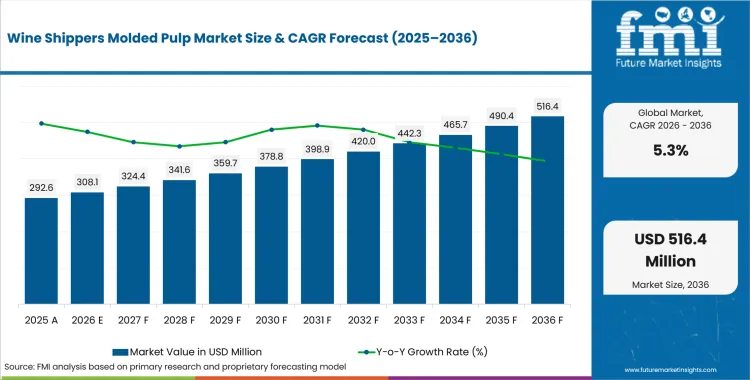
USD 308.1 million in 2026 and USD 516.4 million by 2036 at a 5.3% CAGR.
Sales of wine shippers molded pulp is expected to rise from USD 308.1 million in 2026 to USD 516.4 million by 2036 at a 5.3% CAGR. Parcel fulfillment makes bottle separation a recurring specification because individual packages face repeated handling across carrier networks. Ranpak introduced three automated packaging systems in January 2025 for higher-throughput paper cushioning at fulfillment stations. Higher-throughput paper handling favors protective packaging that holds bottle position without slowing high-volume pack-out operations. Repeatable pack-out also raises the value of e-commerce packaging designs that standardize cushioning around fragile bottles.
Regulatory exposure changes the specification burden across wine-shipping markets even though glass protection remains the same commercial requirement. The European Commission stated in August 2026 that EU packaging waste could rise 19% by 2030 without further action. European wineries therefore face stronger material documentation while United States operators screen destination rules before direct shipment. Regulatory differences separate recycling approval from legal channel access and change wine packaging decisions by destination. European molded fiber programs therefore face a different approval path from United States wine packaging programs.
Key Takeaways of Wine Shippers Molded Pulp Market
- Parcel wine fulfillment supports demand because molded pulp keeps glass bottles separated during repeated handling without requiring loose protective material.
- Based on format type, standard formats are projected to account for 41.0% in 2026 due to common bottle counts that reduce tooling changes and repeated qualification work.
- By material, paper-based systems are estimated to hold 34.0% in 2026 owing to fiber protection that fits established paper recovery routes in major markets.
- In 2026, standard duty is expected to lead performance class with 40.0% share because routine parcel lanes prioritize proven mechanical protection before thermal features.
- New formats face slower conversion where alcohol-channel rules and transport testing require destination checks before a packaging specification can be released.
- Some of the key players in this market include Huhtamaki Oyj, Western Pulp Products Company, Ranpak Holdings Corp., Pregis LLC, Storopack Hans Reichenecker GmbH, Smurfit Westrock plc, Signode, and Sealed Air Corporation.
Analyst Perspective
"Wine shippers should be qualified against the actual bottle mix and outer carton before unit price enters the final comparison. The stronger commercial offer pairs repeatable transit protection with replenishment capacity and pack-line fit across seasonal direct-to-consumer programs."
- Nandini Roy Choudhury, Principal Consultant, Future Market Insights
How is the Wine Shippers Molded Pulp Market segmented?
The market is segmented by format type, material, performance class, end use, sales channel and region.
Format type includes standard formats and recyclable-optimized formats alongside premium and branded formats plus custom-engineered formats. Material categories include paper-based systems and foam systems alongside air and film systems plus thermal insulated systems. Performance class covers standard duty and heavy duty plus temperature-assured shipping requirements for specialized routes. End use spans e-commerce and parcel alongside electronics and industrial plus pharma and healthcare and food and grocery. Sales channels include direct accounts and packaging distributors alongside online B2B routes for routine replenishment.
Why does e-commerce and parcel lead the end use category?
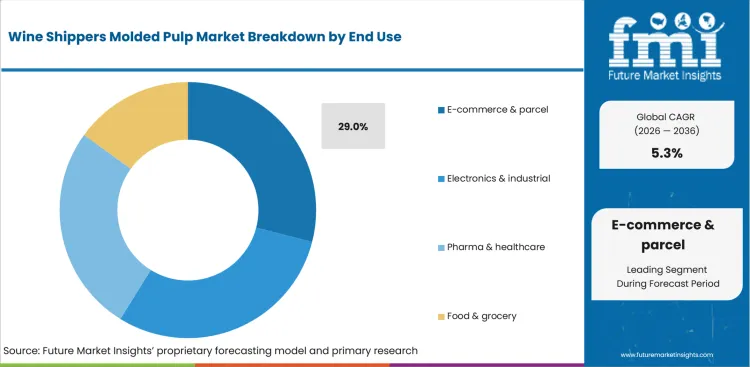
E-commerce shipping exposes wine cases to sorting and transfer cycles that differ from stable pallet movement between trade locations.
- E-commerce and parcel is projected to hold 29.0% share in 2026 because repeated handling raises demand for consistent bottle isolation and carton fit. Ranpak and Walmart announced an August 2025 rollout of automated paper void-fill systems across five next-generation fulfillment centers.
- Automated fulfillment raises the commercial value of inserts that load quickly and preserve pack consistency across operators during peaks. The throughput logic shapes retail e-commerce packaging programs with high seasonal order variability across recurring peak periods.
Why do standard formats lead the format type category?
Standard formats simplify qualification work for wineries that repeatedly ship familiar bottle counts within stable outer-carton footprints. Repeat pack counts also reduce format changes during seasonal replenishment across established direct-shipping programs and orders. Huhtamaki stated in its February-March 2026 investor presentation that its molded fiber business supplies packaging for wine globally.
- By format type, standard formats are projected to hold 41.0% share in 2026 because repeat geometries reduce tooling changes and replenishment complexity.
- Established designs give fulfillment teams a stable pack-out method for recurring bottle configurations and seasonal replenishment. The same geometry discipline supports molded fiber pulp qualification across repeated fragile-product orders during replenishment cycles.
Why do paper-based systems lead the material category?
Paper-based inserts protect bottle surfaces within a fiber structure that wineries can specify alongside familiar paper recovery routes.
- Paper-based systems are estimated to hold 34.0% share in 2026 because molded fiber provides bottle separation with an established recycling route.
- Compression and shock performance still determine whether a paper insert survives qualification across the intended carton and parcel route. MFT-CKF described its WinePacks in March 2025 as molded-fiber wine shippers made from fully recycled and recyclable fiber, giving material reviews a direct wine application alongside sustainable packaging claims. The WinePacks format gives wineries a direct fiber reference for assessing bottle separation against established recycling expectations.
Why does standard duty lead the performance class category?
Routine wine parcels first require mechanical protection that prevents contact between bottles and limits movement inside the outer carton. Signode expanded its documented custom protective packaging work in May 2025 around corrugated and honeycomb formats supported by a dedicated design center.
- Standard duty is anticipated to account for 40.0% share in 2026 because most routine routes require validated impact protection without thermal conditioning.
- Heavy-duty and temperature-assured formats remain relevant for higher-risk routes, but extra materials and qualification steps narrow routine use. Protective engineers may compare molded fiber packaging with bio-foam protection as route severity and temperature exposure increase.
What are the drivers, restraints and opportunities in the Wine Shippers Molded Pulp Market?
Parcel breakage control supports qualification, while alcohol-channel rules slow format changes and molded-fiber capacity expansion broadens supply for better fitted paper systems.
- Driver: Repeated parcel handling rewards inserts that keep bottles separated and centered inside a qualified outer carton during distribution.
- Restraint: Destination-specific alcohol rules and packaging tests can delay conversion from an approved shipper to a newly designed format.
- Opportunity: Expanded molded-fiber capacity supports right-sized inserts for recurring wine programs when tooling matches repeat bottle geometries.
Glass damage risk is the direct purchasing trigger because leakage and replacement costs appear immediately after a protective format fails in transit. Smurfit Westrock reported in January 2025 that Encirc adopted its paper pallet wrap for glass transport after testing the material for high energy absorption and humidity performance. Wine shippers therefore compete on controlled movement and repeatable pack-out rather than on fiber content alone.
Channel eligibility can block a packaging order even after the insert passes mechanical review for the intended bottle and carton. Wine Institute updated its state-by-state direct-shipping table in May 2025 and continued to distinguish allowed routes from restricted shipping conditions across the United States. Wineries and fulfillment operators must therefore confirm destination rules before standardizing one shipper across national direct-to-consumer programs.
Additional molded-fiber capacity can shorten the route from a validated tray design to recurring supply once tooling matches established bottle geometries. Huhtamaki acquired Florida-based Zellwin Farms Company for about USD 18 million in April 2025 and added molded-fiber manufacturing capacity. The acquired operation serves egg packaging, so the commercial signal is manufacturing depth rather than direct wine demand.
Which country CAGRs are profiled in the Wine Shippers Molded Pulp Market?
| Country | CAGR |
|---|---|
| UAE | 6.5% |
| USA | 5.9% |
| UK | 5.6% |
| France | 5.3% |
| Germany | 5.0% |
How do country-level CAGRs compare in the Wine Shippers Molded Pulp Market?
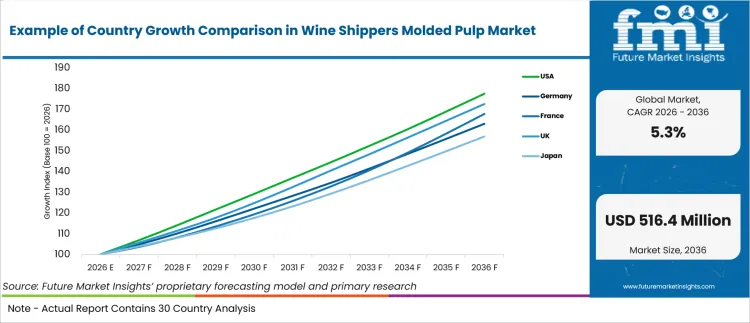
The profiled country CAGRs span 1.5 percentage points from UAE at 6.5% to Germany at 5.0% under commercially distinct channel and compliance conditions. The middle band contains USA and UK under direct-shipping and fee conditions, while France and Germany move more slowly under tighter material documentation and recycling rules.
- UAE requires licensed alcohol channels alongside faster restrictions affecting selected plastic formats.
- USA direct-shipping rules vary by state and complicate nationally standardized wine shipper specifications.
- UK paper formats receive cost signals from packaging producer-responsibility base fees.
- France faces timing risk as professional-packaging EPR approaches its 2027 operational start.
- Germany gives converters clearer recyclability criteria before new fiber formats enter qualification.
Legal and recycling differences therefore change qualification costs even where national forecast growth remains close. The full report provides country-level CAGR analysis across North America, Latin America, Europe, East Asia, South Asia, Oceania and the Middle East and Africa.
Country-wise Analysis
- UAE wine shipping runs through licensed alcohol channels where distributors separate route eligibility from packaging performance for premium retail and hospitality orders across each approved channel. Wine shippers molded pulp demand in UAE is forecast to expand at 6.5% CAGR through 2036 as fitted fiber inserts support recurring fragile-glass deliveries across licensed routes. Dubai Municipality confirmed in December 2025 that its final single-use plastic ban would start on January 1 2026 and require approved alternatives across covered categories. Fiber formats gain a local opening from that policy while hot-route exposure and alcohol licensing still complicate qualification for recurring orders across demanding distribution conditions.
- United States wineries use private parcel carriers inside state-by-state alcohol rules that make destination screening part of routine wine-club fulfillment across a fragmented national channel. Wine Institute reported in March 2026 that United States wine exports to Canada fell 78% during 2025 and lost USD 357 million in value during that disruption. Wine shippers molded pulp demand in USA is projected to record 5.9% CAGR during the assessment period as direct accounts value tested inserts and repeatable packing instructions. Route volatility supports dependable pack-out methods while carrier requirements and state obligations still limit one national specification across recurring programs serving different destinations.
- United Kingdom wine merchants operate mature parcel networks where producer-responsibility charges now sit beside carton and insert costs during recurring specification reviews for direct customer shipments. The UK wine shippers molded pulp sector is estimated to advance at 5.6% CAGR by 2036 as paper formats receive a clearer cost signal during material selection. PackUK published June 2025 base fees of GBP 196 per tonne for paper and card against GBP 423 for plastic across covered packaging obligations. Qualified fiber formats benefit from that differential while tested bottle protection and accurate material classification remain necessary before reported savings become recurring commercial orders.
- French wine distribution serves export-oriented producers whose professional packaging obligations bring end-of-life treatment into specification reviews for domestic and cross-border bottle shipments across established trade channels. The French ecological ministry announced in July 2026 that professional-packaging EPR would begin operationally on January 1 2027 after implementation uncertainty delayed the original timetable. Adoption of wine shippers molded pulp in France is projected to grow at 5.3% CAGR over the forecast period as fiber formats fit the policy direction. Documentation timing and structural testing remain local frictions for producers shipping several bottle geometries across recurring programs and mixed domestic or export routes.
- German packaging engineers screen wine shippers against recyclability documentation before approving material changes for recurring domestic and export routes used by established wineries and fulfillment partners. The Central Agency Packaging Register published its 2025 minimum standard in August and stated the 2030 target for packaging on the market to be at least 70% recyclable. Clearer criteria give packaging companies an earlier design reference, but wineries still require documented composition and proven bottle protection before replacing qualified formats. Wine shippers molded pulp demand in Germany is forecast to expand at 5.0% CAGR by 2036 as paper-based specifications gain a clearer commercial qualification route.
Who are the notable companies in the Wine Shippers Molded Pulp Market?
Huhtamaki Oyj, Western Pulp Products Company, Ranpak Holdings Corp., Pregis LLC, Storopack Hans Reichenecker GmbH, Smurfit Westrock plc, Signode, and Sealed Air Corporation are the notable companies serving this market.
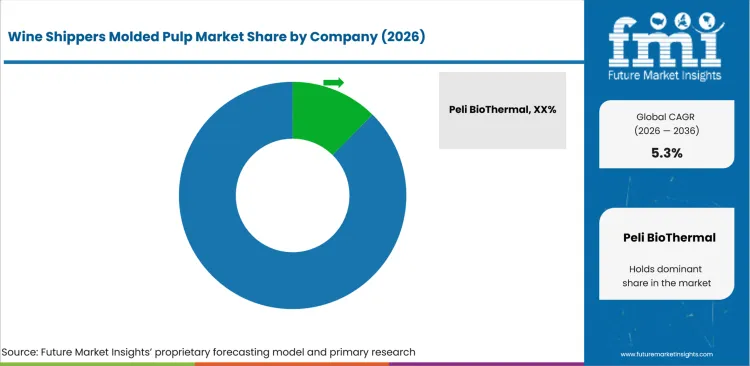
Direct molded-fiber producers compete against broader paper-protection and automation groups where wineries need qualified bottle protection beside reliable replenishment. Huhtamaki and Western Pulp have direct fiber experience, while Ranpak and Pregis emphasize paper protection and Signode or Sealed Air add automation around retail glass packaging programs.
- Huhtamaki Oyj and Western Pulp Products Company provide molded-fiber formats with direct wine or fragile-product relevance.
- Ranpak Holdings Corp., Pregis LLC, Storopack Hans Reichenecker GmbH and Smurfit Westrock plc provide paper protection for fulfillment.
- Signode and Sealed Air Corporation support protective programs with engineering and automated packing equipment.
Competitive Benchmarking: Wine Shippers Molded Pulp Market
| Company | Wine/Fiber Protection Evidence | Pack-Station Integration | Qualification & Design Support | Geographic Reach |
|---|---|---|---|---|
| Huhtamaki Oyj | High | Low | Medium | Global fiber packaging operations |
| Western Pulp Products Company | High | Low | Medium | United States with selected export markets |
| Ranpak Holdings Corp. | Medium | High | High | North America, Europe and Asia-Pacific |
| Pregis LLC | Medium | High | High | North America and Europe with wider distribution |
| Storopack Hans Reichenecker GmbH | Medium | High | High | Europe, North America and Asia-Pacific |
| Smurfit Westrock plc | Medium | Medium | High | Global paper and corrugated network |
| Signode | Medium | High | High | Global end-of-line packaging network |
| Sealed Air Corporation | Low | High | High | Global protective-packaging coverage |
Scoring basis: High wine evidence requires direct wine molded-fiber supply or several documented fiber formats. Medium covers broader paper-protection evidence, while Low identifies one narrower fiber role within the reviewed scope. High pack integration requires automated multi-station equipment, Medium requires line integration and Low reflects material supply. High qualification support requires documented design or testing services, while Medium reflects application engineering and Low reflects limited support.
Key Developments in the Wine Shippers Molded Pulp Market
- In June 2026, Storopack Hans Reichenecker GmbH launched PAPERwrap as recyclable paper cushioning for fragile goods and glass surfaces.
- In January 2026, Pregis LLC launched EasyPack Strata for individual packing stations and centralized fulfillment lines.
- In September 2025, Sealed Air Corporation launched the AUTOBAG 850HB hybrid bagging machine for paper and poly mailers.
Key Players in the Wine Shippers Molded Pulp Market
Molded-Fiber Specialists
- Huhtamaki Oyj
- Western Pulp Products Company
Paper Protection and Fulfillment Platforms
- Ranpak Holdings Corp.
- Pregis LLC
- Storopack Hans Reichenecker GmbH
- Smurfit Westrock plc
End-of-Line Engineering and Automation
- Signode
- Sealed Air Corporation
Wine Shippers Molded Pulp Market - Report Scope
| Coverage field | Report scope |
|---|---|
| Market breakdown | By format type, material, performance class, end use, sales channel and region. |
| Quantitative Units | USD million. |
| Market Definition | Molded pulp and closely related fiber protective formats used to separate and protect wine bottles during shipment. |
| Regions Covered | North America, Latin America, Europe, East Asia, South Asia and Pacific and Middle East and Africa. |
| Countries Covered | UAE, USA, UK, France, Germany, and 20+ countries included in the full report. |
| Key Companies Profiled | Huhtamaki Oyj, Western Pulp Products Company, Ranpak Holdings Corp., Pregis LLC, Storopack Hans Reichenecker GmbH, Smurfit Westrock plc, Signode, and Sealed Air Corporation. |
| Forecast Period | 2026 to 2036. |
| Approach | Primary and secondary research with market triangulation. |
Wine Shippers Molded Pulp Market - Research Methodology
| Method | Approach |
|---|---|
| Primary Research | FMI analysts gathered input from manufacturers, service providers, technology developers, distributors, end users, procurement teams, and subject-matter experts. Interviews examined purchasing decisions, product or service evaluation, adoption barriers, approval requirements, pricing considerations, and expectations for technical or commercial support. Respondents were also asked what evidence is required before a trial, pilot, or initial order develops into regular purchasing. |
| Desk Research | Desk research covered government statistics, regulatory publications, trade data, industry associations, technical literature, standards, company filings, product information, and official corporate announcements. Sources were reviewed for relevance, publication date, geographic coverage, and consistency with the defined market scope. Claims relating to performance, applications, approvals, capacity, investment, and commercial activity were retained only when supported by credible public evidence. |
| Market Sizing and Forecasting | The market model combined the baseline value with historical performance, segment structure, pricing and volume indicators, adoption levels, company participation, and country-level demand conditions. Forecast assumptions considered economic activity, investment trends, regulatory developments, technology adoption, purchasing cycles, supply availability, and barriers to wider market use. Segment and regional estimates were reconciled before the final market total was calculated. |
| Data Validation | Estimates were checked against multiple independent indicators, including public data, company activity, trade patterns, industry developments, and findings from primary interviews. Validation also tested whether products, services, applications, and company revenues fell within the defined market boundaries. Adjacent categories, unsupported claims, overlapping revenues, and activities without direct market relevance were excluded to reduce double counting and maintain consistency across segments and countries. |
Wine Shippers Molded Pulp Market by Segments
Wine Shippers Molded Pulp Market segmented by Format Type:
- Standard formats
- Recyclable-optimized formats
- Premium & branded formats
- Custom-engineered formats
Wine Shippers Molded Pulp Market segmented by Material:
- Paper-based systems
- Foam systems
- Air & film systems
- Thermal insulated systems
Wine Shippers Molded Pulp Market segmented by Performance Class:
- Standard duty
- Heavy duty
- Temperature-assured
Wine Shippers Molded Pulp Market segmented by End Use:
- E-commerce & parcel
- Electronics & industrial
- Pharma & healthcare
- Food & grocery
Wine Shippers Molded Pulp Market segmented by Sales Channel:
- Direct accounts
- Packaging distributors
- Online B2B
Wine Shippers Molded Pulp Market by Region:
- North America
- United States
- Canada
- Latin America
- Brazil
- Mexico
- Chile
- Rest of Latin America
- Western Europe
- Germany
- United Kingdom
- Italy
- Spain
- France
- Nordics
- Benelux
- Rest of Western Europe
- Eastern Europe
- Russia
- Poland
- Hungary
- Balkan and Baltic States
- Rest of Eastern Europe
- East Asia
- China
- Japan
- South Korea
- South Asia and Pacific
- India
- ASEAN
- Australia and New Zealand
- Rest of South Asia and Pacific
- Middle East and Africa
- Kingdom of Saudi Arabia
- Other GCC Countries
- Türkiye
- South Africa
- Other African Union Countries
- Rest of Middle East and Africa
Research Sources and Bibliography
- Ranpak Holdings Corp. (2025, January 22). Ranpak announces three new automated packaging solutions to drive improved productivity.
- European Commission. (2026, August 11). New EU rules on packaging enter into application.
- Huhtamaki Oyj. (2026, February). Roadshow presentation February-March 2026.
- Molded Fiber Technology. (2025, March 27). What WinePacks Can Do For You.
- Signode (2025, May 19). Optimal Outcomes - Custom Protective Packaging.
- Ranpak Holdings Corp. (2025, August 26). Ranpak and Walmart join forces to roll out automated technology and sustainable packaging collaboration.
- Smurfit Westrock plc. (2025, January 9). Smurfit Westrock’s paper pallet wrap set to drive down supply chain emissions.
- Wine Institute. (2025, May 20). Direct Shipping Table.
- Huhtamaki Oyj. (2025, April 24). Huhtamaki acquires Zellwin Farms Company.
- Dubai Municipality. (2025, December 24). Dubai to enforce final phase of single-use plastic ban from 2026.
- Wine Institute. (2026, March 4). One Year Later, Canadian Bans on USA Wine Cost American Industry $357 Million In 2025.
- PackUK. (2025, June 30). Extended Producer Responsibility for Packaging: 2025 base fees.
- French Ministry for Ecological Transition. (2026, July 28). Filière REP pour les emballages professionnels : Mathieu Lefèvre annonce la mise en oeuvre opérationnelle de la filière à partir du 1er janvier 2027.
- Central Agency Packaging Register. (2025, August 29). 2025 minimum standard published - initial touchstone for companies preparing for the EU Packaging and Packaging Waste Regulation (PPWR).
- Western Pulp Products Company. (2025). Western Pulp advances energy performance through Oregon’s SEM program. Retrieved August 17, 2026.
- Storopack Hans Reichenecker GmbH. (2026, June 30). Paper Wrapping for Optimal Protection.
- Pregis LLC. (2026, January 27). Pregis Launches EasyPack Strata, a High-Speed On-Demand Paper System Designed for Versatile Protection in Fulfillment Operations.
- Sealed Air Corporation. (2025, September 16). Sealed Air Launches AUTOBAG® Brand 850HB Hybrid Bagging Machine for Paper and Poly Mailers.
- Ranpak Holdings Corp. (2026, January 13). Ranpak and Medline partner to advance automation and sustainable packaging across high-volume distribution operations.
- Smurfit Westrock plc. (2026, May 5). Smurfit Westrock launches prototype of glueline-free packaging solution.
- Pregis LLC. (2025, May 20). Pregis expands its curbside recyclable paper packaging portfolio with white EasyPack GeoTerra.
- Storopack Hans Reichenecker GmbH. (2025, November 26). RENATURE Honeycomb.
- Sealed Air Corporation. (2026, April 9). Sealed Air announces completion of acquisition by CD&R.
- PAPACKS Sales GmbH. (2026, March 5). Joint appearance with TransGourmet Seafood at Fish International.
This bibliography is provided for reader reference and is not exhaustive. The full report contains the complete reference list and detailed citations
This Report Answers
- How large is the wine shippers molded pulp market in 2026 and 2036?
- Which format and material categories hold the largest 2026 shares?
- How do standard duty and parcel applications shape protection requirements?
- What increases demand across wine parcel fulfillment?
- Which channel rules slow approved wine-shipper changes?
- How do CAGRs compare across UAE, USA, UK, France and Germany?
- Which companies provide molded-fiber or paper transit protection?
- How do companies compare on fiber evidence and pack-station integration?
- Which developments affect paper protection and fulfillment automation?
Frequently Asked Questions
How big is the Wine Shippers Molded Pulp Market in 2026?
The wine shippers molded pulp market is expected to be valued at USD 308.1 million in 2026. Parcel fulfillment and fragile-glass protection requirements support recurring demand for fitted inserts across direct shipping routes.
What is the CAGR of the Wine Shippers Molded Pulp Market from 2026 to 2036?
The wine shippers molded pulp market is projected to grow at 5.3% CAGR from 2026 to 2036. Growth depends on tested transit protection alongside wider use of recyclable fiber formats across recurring parcel programs.
Which format type leads the Wine Shippers Molded Pulp Market?
The standard formats segment is expected to hold 41.0% of the wine shippers molded pulp market in 2026, supported by repeat bottle counts and established pack-out dimensions. Reusable specifications reduce repeated tooling work and give fulfillment teams a stable format for recurring seasonal orders.
Which end-use segment is projected to grow at the fastest pace in the Wine Shippers Molded Pulp Market?
No segment-level CAGR establishes the fastest-growing end-use segment in the wine shippers molded pulp market through 2036. E-commerce and parcel holds 29.0% share in 2026, but current share does not establish the fastest forecast pace.
Which companies are key players in the Wine Shippers Molded Pulp Market?
The wine shippers molded pulp market includes Huhtamaki Oyj, Western Pulp Products Company, Ranpak Holdings Corp., Pregis LLC, Storopack Hans Reichenecker GmbH, Smurfit Westrock plc, Signode Industrial Group LLC, and Sealed Air Corporation. Their roles span molded fiber and paper protection across recurring fulfillment programs.
Preview the report firsthand - request a free sample
Get SampleGet the brochure for pricing and purchase details.
Get PDFTable of Content
- Key Takeaways
- Market Size and CAGR
- Top Growth Driver
- Fastest Growing Segment
- Leading Region
- Key Companies
- Emerging Opportunities
- Executive Summary
- Global Market Outlook
- Demand-side Trends
- Supply-side Trends
- Technology Roadmap Analysis
- Analysis and Recommendations
- Analyst Perspective (What is happening? Why now? What should investors know?)
- Key Questions Answered
- How large is the market?
- What is the CAGR?
- What are key trends?
- Which region dominates?
- Who are the leaders?
- Market Overview
- Market Coverage / Taxonomy
- Market Definition / Scope / Limitations
- Research Methodology
- Chapter Orientation
- Analytical Lens and Working Hypotheses
- Market Structure, Signals, and Trend Drivers
- Benchmarking and Cross-market Comparability
- Market Sizing, Forecasting, and Opportunity Mapping
- Research Design and Evidence Framework
- Desk Research Programme (Secondary Evidence)
- Expert Input and Fieldwork (Primary Evidence)
- Tooling, Models, and Reference Databases
- Data Engineering and Model Build
- Quality Assurance and Audit Trail
- Market Background
- Market Dynamics (Drivers, Restraints, Opportunity, Trends)
- Scenario Forecast (Optimistic, Likely, Conservative)
- Impact Analysis
- AI Impact
- Sustainability Impact
- Regulatory Impact
- Technology Impact
- Consumer / Buyer Analysis
- Purchase Drivers
- Adoption Barriers
- Buyer Journey
- Opportunity Map Analysis
- Product Life Cycle Analysis
- Supply Chain Analysis
- Investment Feasibility Matrix
- Value Chain Analysis
- PESTLE and Porter's Analysis
- Regulatory Landscape
- Regional Parent Market Outlook
- Production and Consumption Statistics
- Import and Export Statistics
- Global Market Analysis and Forecast, 2021 to 2036
- Historical Market Size Value (USD Million) Analysis, 2021 to 2025
- Current and Future Market Size Value (USD Million) Projections, 2026 to 2036
- Y-o-Y Growth Trend Analysis
- Absolute $ Opportunity Analysis
- Global Market Pricing Analysis, 2021 to 2036
- Global Market Analysis and Forecast, By Format Type, 2021 to 2036
- Introduction / Key Findings
- Historical Market Size Value (USD Million) Analysis By Format Type, 2021 to 2025
- Current and Future Market Size Value (USD Million) Analysis and Forecast By Format Type, 2026 to 2036
- Standard formats
- Recyclable-optimized formats
- Premium & branded formats
- Custom-engineered formats
- Standard formats
- Y-o-Y Growth Trend Analysis By Format Type, 2021 to 2025
- Absolute $ Opportunity Analysis By Format Type, 2026 to 2036
- Global Market Analysis and Forecast, By Material, 2021 to 2036
- Introduction / Key Findings
- Historical Market Size Value (USD Million) Analysis By Material, 2021 to 2025
- Current and Future Market Size Value (USD Million) Analysis and Forecast By Material, 2026 to 2036
- Paper-based systems
- Foam systems
- Air & film systems
- Thermal insulated systems
- Paper-based systems
- Y-o-Y Growth Trend Analysis By Material, 2021 to 2025
- Absolute $ Opportunity Analysis By Material, 2026 to 2036
- Global Market Analysis and Forecast, By Performance Class, 2021 to 2036
- Introduction / Key Findings
- Historical Market Size Value (USD Million) Analysis By Performance Class, 2021 to 2025
- Current and Future Market Size Value (USD Million) Analysis and Forecast By Performance Class, 2026 to 2036
- Standard duty
- Heavy duty
- Temperature-assured
- Standard duty
- Y-o-Y Growth Trend Analysis By Performance Class, 2021 to 2025
- Absolute $ Opportunity Analysis By Performance Class, 2026 to 2036
- Global Market Analysis and Forecast, By End Use, 2021 to 2036
- Introduction / Key Findings
- Historical Market Size Value (USD Million) Analysis By End Use, 2021 to 2025
- Current and Future Market Size Value (USD Million) Analysis and Forecast By End Use, 2026 to 2036
- E-commerce & parcel
- Electronics & industrial
- Pharma & healthcare
- Food & grocery
- E-commerce & parcel
- Y-o-Y Growth Trend Analysis By End Use, 2021 to 2025
- Absolute $ Opportunity Analysis By End Use, 2026 to 2036
- Global Market Analysis and Forecast, By Sales Channel, 2021 to 2036
- Introduction / Key Findings
- Historical Market Size Value (USD Million) Analysis By Sales Channel, 2021 to 2025
- Current and Future Market Size Value (USD Million) Analysis and Forecast By Sales Channel, 2026 to 2036
- Direct accounts
- Packaging distributors
- Online B2B
- Direct accounts
- Y-o-Y Growth Trend Analysis By Sales Channel, 2021 to 2025
- Absolute $ Opportunity Analysis By Sales Channel, 2026 to 2036
- Global Market Analysis and Forecast, By Region, 2021 to 2036
- Introduction
- Historical Market Size Value (USD Million) Analysis By Region, 2021 to 2025
- Current Market Size Value (USD Million) Analysis and Forecast By Region, 2026 to 2036
- North America
- Latin America
- Western Europe
- Eastern Europe
- East Asia
- South Asia and Pacific
- Middle East & Africa
- Market Attractiveness Analysis By Region
- North America Market Analysis and Forecast, By Country, 2021 to 2036
- Historical Market Size Value (USD Million) Trend Analysis By Market Taxonomy, 2021 to 2025
- Market Size Value (USD Million) Forecast By Market Taxonomy, 2026 to 2036
- By Country
- USA
- Canada
- By Format Type
- By Material
- By Performance Class
- By End Use
- By Sales Channel
- By Country
- Market Attractiveness Analysis
- By Country
- By Format Type
- By Material
- By Performance Class
- By End Use
- By Sales Channel
- Key Takeaways
- Latin America Market Analysis and Forecast, By Country
- Historical Market Size Value (USD Million) Trend Analysis By Market Taxonomy, 2021 to 2025
- Market Size Value (USD Million) Forecast By Market Taxonomy, 2026 to 2036
- By Country
- Brazil
- Mexico
- Chile
- Rest of Latin America
- By Format Type
- By Material
- By Performance Class
- By End Use
- By Sales Channel
- By Country
- Market Attractiveness Analysis
- By Country
- By Format Type
- By Material
- By Performance Class
- By End Use
- By Sales Channel
- Key Takeaways
- Western Europe Market Analysis and Forecast, By Country
- Historical Market Size Value (USD Million) Trend Analysis By Market Taxonomy, 2021 to 2025
- Market Size Value (USD Million) Forecast By Market Taxonomy, 2026 to 2036
- By Country
- Germany
- UK
- Italy
- Spain
- France
- Nordic
- BENELUX
- Rest of Western Europe
- By Format Type
- By Material
- By Performance Class
- By End Use
- By Sales Channel
- By Country
- Market Attractiveness Analysis
- By Country
- By Format Type
- By Material
- By Performance Class
- By End Use
- By Sales Channel
- Key Takeaways
- Eastern Europe Market Analysis and Forecast, By Country
- Historical Market Size Value (USD Million) Trend Analysis By Market Taxonomy, 2021 to 2025
- Market Size Value (USD Million) Forecast By Market Taxonomy, 2026 to 2036
- By Country
- Russia
- Poland
- Hungary
- Balkan & Baltic
- Rest of Eastern Europe
- By Format Type
- By Material
- By Performance Class
- By End Use
- By Sales Channel
- By Country
- Market Attractiveness Analysis
- By Country
- By Format Type
- By Material
- By Performance Class
- By End Use
- By Sales Channel
- Key Takeaways
- East Asia Market Analysis and Forecast, By Country
- Historical Market Size Value (USD Million) Trend Analysis By Market Taxonomy, 2021 to 2025
- Market Size Value (USD Million) Forecast By Market Taxonomy, 2026 to 2036
- By Country
- China
- Japan
- South Korea
- By Format Type
- By Material
- By Performance Class
- By End Use
- By Sales Channel
- By Country
- Market Attractiveness Analysis
- By Country
- By Format Type
- By Material
- By Performance Class
- By End Use
- By Sales Channel
- Key Takeaways
- South Asia and Pacific Market Analysis and Forecast, By Country
- Historical Market Size Value (USD Million) Trend Analysis By Market Taxonomy, 2021 to 2025
- Market Size Value (USD Million) Forecast By Market Taxonomy, 2026 to 2036
- By Country
- India
- ASEAN
- Australia & New Zealand
- Rest of South Asia and Pacific
- By Format Type
- By Material
- By Performance Class
- By End Use
- By Sales Channel
- By Country
- Market Attractiveness Analysis
- By Country
- By Format Type
- By Material
- By Performance Class
- By End Use
- By Sales Channel
- Key Takeaways
- Middle East & Africa Market Analysis and Forecast, By Country
- Historical Market Size Value (USD Million) Trend Analysis By Market Taxonomy, 2021 to 2025
- Market Size Value (USD Million) Forecast By Market Taxonomy, 2026 to 2036
- By Country
- Kingdom of Saudi Arabia
- Other GCC Countries
- Türkiye
- South Africa
- Other African Union
- Rest of Middle East & Africa
- By Format Type
- By Material
- By Performance Class
- By End Use
- By Sales Channel
- By Country
- Market Attractiveness Analysis
- By Country
- By Format Type
- By Material
- By Performance Class
- By End Use
- By Sales Channel
- Key Takeaways
- Key Countries Market Analysis
- USA
- Pricing Analysis
- Market Share Analysis, 2025
- By Format Type
- By Material
- By Performance Class
- By End Use
- By Sales Channel
- Canada
- Pricing Analysis
- Market Share Analysis, 2025
- By Format Type
- By Material
- By Performance Class
- By End Use
- By Sales Channel
- Mexico
- Pricing Analysis
- Market Share Analysis, 2025
- By Format Type
- By Material
- By Performance Class
- By End Use
- By Sales Channel
- Brazil
- Pricing Analysis
- Market Share Analysis, 2025
- By Format Type
- By Material
- By Performance Class
- By End Use
- By Sales Channel
- Chile
- Pricing Analysis
- Market Share Analysis, 2025
- By Format Type
- By Material
- By Performance Class
- By End Use
- By Sales Channel
- Germany
- Pricing Analysis
- Market Share Analysis, 2025
- By Format Type
- By Material
- By Performance Class
- By End Use
- By Sales Channel
- UK
- Pricing Analysis
- Market Share Analysis, 2025
- By Format Type
- By Material
- By Performance Class
- By End Use
- By Sales Channel
- Italy
- Pricing Analysis
- Market Share Analysis, 2025
- By Format Type
- By Material
- By Performance Class
- By End Use
- By Sales Channel
- Spain
- Pricing Analysis
- Market Share Analysis, 2025
- By Format Type
- By Material
- By Performance Class
- By End Use
- By Sales Channel
- France
- Pricing Analysis
- Market Share Analysis, 2025
- By Format Type
- By Material
- By Performance Class
- By End Use
- By Sales Channel
- India
- Pricing Analysis
- Market Share Analysis, 2025
- By Format Type
- By Material
- By Performance Class
- By End Use
- By Sales Channel
- ASEAN
- Pricing Analysis
- Market Share Analysis, 2025
- By Format Type
- By Material
- By Performance Class
- By End Use
- By Sales Channel
- Australia & New Zealand
- Pricing Analysis
- Market Share Analysis, 2025
- By Format Type
- By Material
- By Performance Class
- By End Use
- By Sales Channel
- China
- Pricing Analysis
- Market Share Analysis, 2025
- By Format Type
- By Material
- By Performance Class
- By End Use
- By Sales Channel
- Japan
- Pricing Analysis
- Market Share Analysis, 2025
- By Format Type
- By Material
- By Performance Class
- By End Use
- By Sales Channel
- South Korea
- Pricing Analysis
- Market Share Analysis, 2025
- By Format Type
- By Material
- By Performance Class
- By End Use
- By Sales Channel
- Russia
- Pricing Analysis
- Market Share Analysis, 2025
- By Format Type
- By Material
- By Performance Class
- By End Use
- By Sales Channel
- Poland
- Pricing Analysis
- Market Share Analysis, 2025
- By Format Type
- By Material
- By Performance Class
- By End Use
- By Sales Channel
- Hungary
- Pricing Analysis
- Market Share Analysis, 2025
- By Format Type
- By Material
- By Performance Class
- By End Use
- By Sales Channel
- Kingdom of Saudi Arabia
- Pricing Analysis
- Market Share Analysis, 2025
- By Format Type
- By Material
- By Performance Class
- By End Use
- By Sales Channel
- Türkiye
- Pricing Analysis
- Market Share Analysis, 2025
- By Format Type
- By Material
- By Performance Class
- By End Use
- By Sales Channel
- South Africa
- Pricing Analysis
- Market Share Analysis, 2025
- By Format Type
- By Material
- By Performance Class
- By End Use
- By Sales Channel
- USA
- Market Structure Analysis
- Competition Dashboard
- Competition Benchmarking
- Market Share Analysis of Top Players
- By Regional
- By Format Type
- By Material
- By Performance Class
- By End Use
- By Sales Channel
- Emerging Startups
- Innovation Benchmarking
- Competition Analysis
- Competition Deep Dive
- Peli BioThermal
- Overview
- Product Portfolio
- Profitability by Market Segments
- Sales Footprint
- Strategy Overview
- Marketing Strategy
- Product Strategy
- Channel Strategy
- Signode
- Ranpak
- va-Q-tec
- Sealed Air
- Pregis
- Storopack
- Cold Chain Technologies
- Sonoco ThermoSafe
- Smurfit Westrock
- Peli BioThermal
- Case Studies
- Success Stories
- Recent Developments
- Competition Deep Dive
- Assumptions & Acronyms Used


