

- Industry Size (2026)
- USD 2140.0 Mn
- Forecast (2036)
- USD 4451.8 Mn
- CAGR (2026 to 2036)
- 7.60%
Wire Mesh Welding Machine Market Forecast and Outlook 2026 to 2036
The wire mesh welding machine market is valued at USD 2,140.0 million in 2026 and is projected to reach USD 4,451.8 million by 2036, expanding at a CAGR of 7.6% over the forecast period. Procurement decisions in this market are shaped by production risk, compliance requirements, and long equipment lifecycles rather than upfront pricing alone. Buyers are typically risk-averse, as inconsistent weld quality or machine downtime can disrupt construction supply chains and expose fabricators to contractual penalties.
Preference is given to vendors with proven references, established service networks, and stable control platforms, reinforcing vendor lock-in once machines are commissioned and integrated with material handling lines. Switching costs are elevated due to customized mesh formats, software configurations, operator training, and validation against structural standards. Procurement is often bundled into capacity expansion or plant modernization cycles, limiting frequent supplier changes. As a result, purchasing behavior favors reliability, uptime guarantees, and long-term parts availability, allowing incumbent suppliers to retain contracts while new entrants face extended qualification timelines and cautious trial adoption.
Quick Stats for Wire Mesh Welding Machine Market
- Wire Mesh Welding Machine Market Value (2026): USD 2,140.0 Million
- Wire Mesh Welding Machine Market Forecast Value (2036): USD 4,451.8 Million
- Wire Mesh Welding Machine Market Forecast CAGR 2026 to 2036: 7.60%
- Leading Product Type in Wire Mesh Welding Machine Market: Automatic Wire Mesh Welding Lines
- Leading Application in Wire Mesh Welding Machine Market: Construction (Rebar or Wire Mesh)
- Key Growth Regions in Wire Mesh Welding Machine Market: Asia Pacific, Middle East & Africa, Latin America
- Top Key Players in Wire Mesh Welding Machine Market: Schlatter Group, EVG, MEP Group, WAFIOS, Lincoln Electric, KUKA, Schnell Group, Cloos, Airmatic, Regional Chinese OEMs

Wire Mesh Welding Machine Market Key Takeaways
| Metric | Value |
|---|---|
| Industry Value (2026) | USD 2,140.0 Million |
| Forecast Value (2036) | USD 4,451.8 Million |
| Forecast CAGR 2026 to 2036 | 7.60% |
How Is the Global Wire Mesh Welding Machine Market Advancing?
The global wire mesh welding machine market is advancing steadily, driven by rising demand from construction, infrastructure, and industrial manufacturing sectors. Wire mesh welding machines are widely used to produce welded wire meshes for applications such as concrete reinforcement, fencing, cages, and prefabricated construction elements. Their ability to deliver consistent weld quality and high production efficiency makes them essential equipment in large-scale fabrication environments.
A key driver supporting market growth is the continued expansion of construction and infrastructure projects across residential, commercial, and industrial segments. Increasing use of prefabricated and modular construction techniques is boosting demand for standardized welded wire meshes, encouraging manufacturers to invest in automated and high-speed welding machines. These systems improve productivity while reducing material wastage and labor dependency.
Technological advancements are further strengthening market adoption. Improvements in automation, programmable controls, and welding precision are enhancing machine flexibility and operational efficiency. Modern wire mesh welding machines support variable mesh sizes, wire diameters, and production speeds, enabling manufacturers to serve diverse end-use requirements. Integration with material handling systems and digital monitoring tools is improving uptime and process control. As construction activity and industrial fabrication continue to scale globally, the wire mesh welding machine market is expected to maintain consistent growth over the forecast period.
What Is the Segment-Wise Overview of the Wire Mesh Welding Machine Market?
The wire mesh welding machine market is driven by automation demand and strong construction sector consumption. Automatic wire mesh welding lines lead with a 52% share, reflecting their ability to deliver high-speed, consistent, and large-volume production with reduced labor dependency. These systems are preferred for standardized mesh and rebar fabrication. On the end-use side, construction applications account for 54% of demand, as welded wire mesh is essential for reinforced concrete structures, infrastructure projects, and prefabricated building systems. Together, these segments highlight a market focused on productivity-driven automation and sustained demand from construction-led infrastructure development.
Why Do Automatic Wire Mesh Welding Lines Lead the Wire Mesh Welding Machine Market?
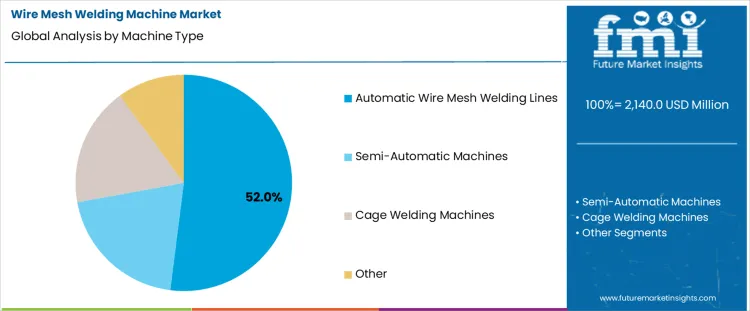
Automatic wire mesh welding lines account for 52% of the wire mesh welding machine market due to their high productivity, precision, and suitability for large-scale manufacturing. These systems are designed to handle continuous, high-speed welding operations with minimal manual intervention, making them ideal for mass production of wire mesh panels and rebar grids. Automatic lines ensure consistent weld quality, uniform spacing, and reduced material wastage, which are critical for meeting construction and industrial standards.
Manufacturers prefer these machines for their ability to lower labor dependency and improve throughput while maintaining repeatable quality. Integration with automated feeding, cutting, and stacking systems further enhances operational efficiency. As demand grows for standardized, high-volume wire mesh products, automatic welding lines continue to dominate machine-type adoption.
Why Does the Construction Sector Dominate End-Use Demand in the Wire Mesh Welding Machine Market?
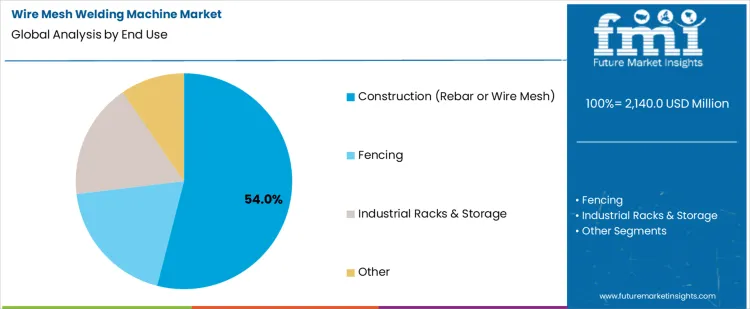
Construction applications represent 54% of total end-use demand, making them the largest segment in the wire mesh welding machine market. Wire mesh and rebar assemblies are essential components in reinforced concrete structures, infrastructure projects, and prefabricated building systems. Construction companies require high-strength, consistently welded mesh products to meet structural safety and regulatory requirements.
The rise of large-scale infrastructure development, urban housing projects, and industrial construction drives sustained demand for welded wire mesh. Automated production supports faster project execution and reliable supply of standardized mesh panels. As construction activity continues to expand across developing and developed regions, the sector remains the primary driver of demand for wire mesh welding machines.
What Are the Key Dynamics for the Wire Mesh Welding Machine Market?
Wire mesh welding machines automate the process of joining intersecting wires into uniform mesh panels, improving production efficiency and consistency. Key market dynamics include rapid urbanization, escalating infrastructure investments, and growing requirements for high-strength reinforcement materials to support durable construction. Technological advancements such as programmable welding parameters, PLC control integration, and automated material handling enhance productivity and reduce labor dependence. Rising adoption of prefabricated construction components and stringent quality standards in commercial and civil projects support growth of welding equipment that delivers precision and repeatability.
Why Is the Wire Mesh Welding Machine Market Growing?
The wire mesh welding machine market is growing as global construction activity increases across residential, commercial, and industrial segments, prompting greater use of welded mesh for structural reinforcement and safety applications. Expansion of roadways, bridges, high-rise buildings, and industrial facilities fuels demand for consistent and high-quality wire mesh produced with automated welding systems. Manufacturers benefit from improved production throughput and lower defect rates compared to manual welding processes. The surge in steel consumption for mesh products, driven by growth in emerging economies and reconstruction projects in developed regions, underpins investments in modern welding machinery to meet market requirements for performance, durability, and compliance with international technical standards.
How Are the Key Drivers Shaping the Wire Mesh Welding Machine Market?
Key drivers shaping the wire mesh welding machine market include the increasing use of welded mesh in reinforced concrete applications, where uniform reinforcement improves structural integrity and reduces material wastage. Infrastructure development programs initiated by governments and private-sector investments stimulate demand for high-capacity welding machines capable of producing large volumes of wire mesh. Rising focus on automation and digital control integration, such as touch-screen interfaces and IoT-enabled monitoring, enhances operational efficiency and reduces dependence on skilled manpower. Manufacturers are also introducing modular machines with adjustable mesh sizes and customizable welding schedules to meet diverse application needs.
What Is the Growth Outlook for the Wire Mesh Welding Machine Market by Country?
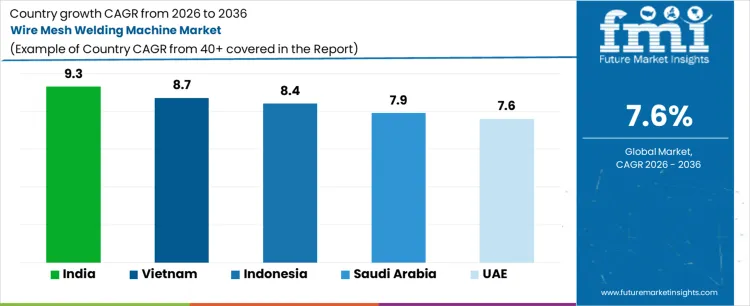
| Country | CAGR (%) |
|---|---|
| India | 9.3% |
| Vietnam | 8.7% |
| Indonesia | 8.4% |
| Saudi Arabia | 7.9% |
| UAE | 7.6% |
The wire mesh welding machine market is expanding steadily as construction and infrastructure activity increases across emerging and developing regions. India leads with a 9.3% CAGR, driven by large-scale infrastructure spending and growth in precast construction. Vietnam (8.7%) and Indonesia (8.4%) follow, supported by industrialization and urban development. Saudi Arabia (7.9%) benefits from major infrastructure and urban projects, while the UAE (7.6%) shows stable growth driven by quality-focused construction and equipment upgrades. As demand for welded wire mesh continues to rise, adoption of automated welding machines is expected to increase across these regions.
What Is Driving the Growth of the Wire Mesh Welding Machine Market in India?
The wire mesh welding machine market in India is growing at a CAGR of 9.3%, driven by strong expansion in construction, infrastructure, and industrial manufacturing. Rapid development of residential buildings, highways, metro projects, and industrial facilities is increasing demand for welded wire mesh used in reinforcement, fencing, and precast concrete applications. Manufacturers are increasingly adopting automated and semi-automated welding machines to improve production speed, consistency, and labor efficiency. Growth of precast concrete plants and modular construction practices is further strengthening demand for high-capacity wire mesh welding systems. Rising investment in infrastructure under government-backed programs is encouraging domestic production of construction materials. Small and mid-sized fabrication units are also upgrading equipment to meet quality and volume requirements.
How Is the Wire Mesh Welding Machine Market Expanding in Vietnam?
The wire mesh welding machine market in Vietnam is expanding at a CAGR of 8.7%, supported by rapid industrialization and growth in construction activity. Expansion of manufacturing zones, logistics facilities, and urban housing projects is driving demand for welded wire mesh products. Fabricators are increasingly investing in automated welding machines to meet rising production volumes and export-quality standards. Growth of infrastructure projects such as highways, ports, and industrial parks further supports market demand. Vietnam’s role as a regional manufacturing hub is also encouraging local production of construction components, including wire mesh panels and cages. In addition, rising labor costs are pushing manufacturers toward automation to improve productivity. As Vietnam continues to expand its construction and industrial base, demand for wire mesh welding machines is expected to rise consistently.
What Is Supporting Growth of the Wire Mesh Welding Machine Market in Indonesia?
The wire mesh welding machine market in Indonesia is growing at a CAGR of 8.4%, driven by expanding infrastructure development and urban construction. Government investment in roads, bridges, housing, and public facilities is increasing demand for welded wire mesh in reinforcement and safety applications. Local manufacturers are adopting welding machines to reduce dependence on imported mesh products and improve supply reliability. Growth of fencing, agriculture, and industrial enclosures is also contributing to broader market demand. Increasing adoption of prefabricated construction methods is encouraging use of standardized wire mesh panels produced through automated welding systems. As Indonesia continues to strengthen its domestic construction supply chain, demand for wire mesh welding machines is expected to grow steadily.
How Is the Wire Mesh Welding Machine Market Developing in Saudi Arabia?
The wire mesh welding machine market in Saudi Arabia is expanding at a CAGR of 7.9%, supported by large-scale infrastructure and urban development projects. Construction of residential complexes, commercial buildings, industrial zones, and transport infrastructure is driving demand for welded wire mesh products. Manufacturers and fabricators are investing in advanced welding machines to meet high-volume requirements and quality standards. Growth of fencing and security installations across construction sites and industrial facilities further supports market expansion. Government-led development initiatives and long-term infrastructure investment plans are encouraging localization of construction material production. Emphasis on project timelines and quality consistency is pushing adoption of automated welding solutions. As Saudi Arabia continues to invest heavily in construction and infrastructure, demand for wire mesh welding machines is expected to increase steadily.
How Is the Wire Mesh Welding Machine Market Expanding in the UAE?
The wire mesh welding machine market in the UAE is growing at a CAGR of 7.6%, driven by sustained construction activity and demand for high-quality building materials. Urban development, commercial real estate projects, and infrastructure upgrades are increasing use of welded wire mesh in reinforcement and safety applications. Fabricators are adopting automated welding machines to ensure precision, reduce waste, and meet stringent quality expectations. Growth of prefabricated construction and modular building techniques is also supporting demand for standardized wire mesh components. In addition, strong focus on efficiency and reduced labor dependency is encouraging equipment upgrades. While the market is relatively mature, replacement demand and project-driven purchases continue to support steady growth. As construction quality standards remain high, adoption of wire mesh welding machines in the UAE is expected to continue at a stable pace.
How Are Companies Competing in the Wire Mesh Welding Machine Market?
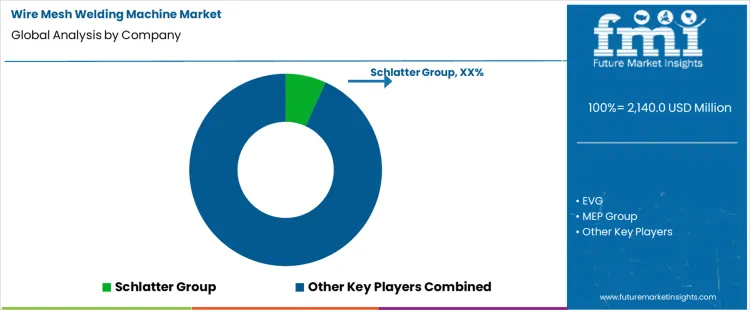
Competition in the wire mesh welding machine market is driven by welding precision, production speed, automation capability, and the ability to handle diverse wire diameters and mesh configurations. These machines are widely used in construction reinforcement, fencing, industrial mesh, and prefabricated concrete applications, where consistency and throughput directly impact manufacturing efficiency. Companies compete on servo-controlled welding accuracy, electrode life, energy efficiency, and flexibility to switch between mesh sizes with minimal downtime. Differentiation increasingly centers on digital control systems, automation integration, and long-term reliability in high-volume production environments.
Schlatter Group, EVG, MEP Group, WAFIOS, Schnell Group, and Lincoln Electric lead competition through advanced engineering, automation depth, and strong global references. Schlatter and EVG differentiate with high-speed, fully automated mesh welding lines designed for large-scale reinforcement producers. MEP and Schnell focus on flexible systems that support both standard and customized mesh formats, appealing to precast and infrastructure projects. WAFIOS competes through precision mechanical design and process stability, while Lincoln Electric leverages welding technology expertise to enhance power control, weld quality, and system robustness.
KUKA, Cloos, Airmatic, and regional Chinese OEMs compete through robotics integration, cost positioning, and market accessibility. KUKA and Cloos differentiate by integrating robotic handling, automation cells, and smart factory concepts around welding operations. Airmatic focuses on specialized and mid-scale mesh welding solutions. Regional Chinese OEMs compete aggressively on price, faster delivery, and increasing capability in automated systems. Across the market, competitive advantage is defined by weld consistency, automation scalability, production uptime, and the ability to balance precision with cost efficiency across global markets.
Key Players in Wire Mesh Welding Machine Market
- Schlatter Group
- EVG
- MEP Group
- WAFIOS
- Lincoln Electric
- KUKA
- Schnell Group
- Cloos
- Airmatic
- Regional Chinese OEMs
Scope of Report
| Attributes | Description |
|---|---|
| Quantitative Unit (2026) | USD Million |
| Machine Type | Automatic Wire Mesh Welding Lines, Semi-Automatic Machines, Cage Welding Machines, Other |
| End Use | Construction (Rebar or Wire Mesh), Fencing, Industrial Racks & Storage, Other |
| Regions Covered | Asia Pacific, Europe, North America, Latin America, Middle East & Africa |
| Countries Covered | China, Japan, South Korea, India, Australia & New Zealand, ASEAN, Rest of Asia Pacific, Germany, United Kingdom, France, Italy, Spain, Nordic, BENELUX, Rest of Europe, United States, Canada, Mexico, Brazil, Chile, Rest of Latin America, Kingdom of Saudi Arabia, Other GCC Countries, Turkey, South Africa, Other African Union, Rest of Middle East & Africa |
| Key Companies Profiled | SchlatterGroup, EVG, MEP Group, WAFIOS, Lincoln Electric, KUKA, Schnell Group,Cloos,Airmatic, Regional Chinese OEMs |
| Additional Attributes | Dollar sales by machine type and end use; regional market size and forecast analysis; growth outlook across major regions; adoption trends for automated wire mesh welding systems; assessment of productivity improvement, automation penetration, and demand patterns across construction, fencing, and industrial storage fabrication applications. |
Wire Mesh Welding Machine Market by Key Segments
Machine Type:
- Automatic Wire Mesh Welding Lines
- Semi-Automatic Machines
- Cage Welding Machines
- Other
End Use:
- Construction (Rebar or Wire Mesh)
- Fencing
- Industrial Racks & Storage
- Other
Region:
- Asia Pacific
- China
- Japan
- South Korea
- India
- Australia & New Zealand
- ASEAN
- Rest of Asia Pacific
- Europe
- Germany
- United Kingdom
- France
- Italy
- Spain
- Nordic
- BENELUX
- Rest of Europe
- North America
- United States
- Canada
- Mexico
- Latin America
- Brazil
- Chile
- Rest of Latin America
- Middle East & Africa
- Kingdom of Saudi Arabia
- Other GCC Countries
- Turkey
- South Africa
- Other African Union
- Rest of Middle East & Africa
Bibliography
- Schlatter Industries AG. (2024). Corporate brochure 2024: Automatic welding systems for wire mesh and reinforcement applications. Schlatter Industries AG.
- MEP Group. (2024). Company profile 2024: Automated wire mesh and cage welding technologies for the construction sector. MEP Group.
- WAFIOS AG. (2025). Annual report 2025: Wire processing and automation systems for industrial manufacturing. WAFIOS AG.
Frequently Asked Questions
How big is the wire mesh welding machine market in 2026?
The global wire mesh welding machine market is estimated to be valued at USD 2,140.0 million in 2026.
What will be the size of wire mesh welding machine market in 2036?
The market size for the wire mesh welding machine market is projected to reach USD 4,451.8 million by 2036.
How much will be the wire mesh welding machine market growth between 2026 and 2036?
The wire mesh welding machine market is expected to grow at a 7.6% CAGR between 2026 and 2036.
What are the key product types in the wire mesh welding machine market?
The key product types in wire mesh welding machine market are automatic wire mesh welding lines, semi-automatic machines, cage welding machines and other.
Which end use segment to contribute significant share in the wire mesh welding machine market in 2026?
In terms of end use, construction (rebar or wire mesh) segment to command 54.0% share in the wire mesh welding machine market in 2026.
Preview the report firsthand - request a free sample
Get SampleGet the brochure for pricing and purchase details.
Get PDFTable of Content
- Executive Summary
- Global Market Outlook
- Demand-side Trends
- Supply-side Trends
- Technology Roadmap Analysis
- Analysis and Recommendations
- Market Overview
- Market Coverage / Taxonomy
- Market Definition / Scope / Limitations
- Market Background
- Market Dynamics
- Drivers
- Restraints
- Opportunity
- Trends
- Scenario Forecast
- Demand in Optimistic Scenario
- Demand in Likely Scenario
- Demand in Conservative Scenario
- Opportunity Map Analysis
- Product Life Cycle Analysis
- Supply Chain Analysis
- Investment Feasibility Matrix
- Value Chain Analysis
- PESTLE and Porter’s Analysis
- Regulatory Landscape
- Regional Parent Market Outlook
- Production and Consumption Statistics
- Import and Export Statistics
- Market Dynamics
- Global Market Analysis 2021 to 2025 and Forecast, 2026 to 2036
- Historical Market Size Value (USD Million) Analysis, 2021 to 2025
- Current and Future Market Size Value (USD Million) Projections, 2026 to 2036
- Y-o-Y Growth Trend Analysis
- Absolute $ Opportunity Analysis
- Global Market Pricing Analysis 2021 to 2025 and Forecast 2026 to 2036
- Global Market Analysis 2021 to 2025 and Forecast 2026 to 2036, By Machine Type
- Introduction / Key Findings
- Historical Market Size Value (USD Million) Analysis By Machine Type , 2021 to 2025
- Current and Future Market Size Value (USD Million) Analysis and Forecast By Machine Type , 2026 to 2036
- Automatic Wire Mesh Welding Lines
- Semi-Automatic Machines
- Cage Welding Machines
- Other
- Automatic Wire Mesh Welding Lines
- Y-o-Y Growth Trend Analysis By Machine Type , 2021 to 2025
- Absolute $ Opportunity Analysis By Machine Type , 2026 to 2036
- Global Market Analysis 2021 to 2025 and Forecast 2026 to 2036, By End Use
- Introduction / Key Findings
- Historical Market Size Value (USD Million) Analysis By End Use, 2021 to 2025
- Current and Future Market Size Value (USD Million) Analysis and Forecast By End Use, 2026 to 2036
- Construction (Rebar or Wire Mesh)
- Fencing
- Industrial Racks & Storage
- Other
- Construction (Rebar or Wire Mesh)
- Y-o-Y Growth Trend Analysis By End Use, 2021 to 2025
- Absolute $ Opportunity Analysis By End Use, 2026 to 2036
- Global Market Analysis 2021 to 2025 and Forecast 2026 to 2036, By Region
- Introduction
- Historical Market Size Value (USD Million) Analysis By Region, 2021 to 2025
- Current Market Size Value (USD Million) Analysis and Forecast By Region, 2026 to 2036
- North America
- Latin America
- Western Europe
- Eastern Europe
- East Asia
- South Asia and Pacific
- Middle East & Africa
- Market Attractiveness Analysis By Region
- North America Market Analysis 2021 to 2025 and Forecast 2026 to 2036, By Country
- Historical Market Size Value (USD Million) Trend Analysis By Market Taxonomy, 2021 to 2025
- Market Size Value (USD Million) Forecast By Market Taxonomy, 2026 to 2036
- By Country
- USA
- Canada
- Mexico
- By Machine Type
- By End Use
- By Country
- Market Attractiveness Analysis
- By Country
- By Machine Type
- By End Use
- Key Takeaways
- Latin America Market Analysis 2021 to 2025 and Forecast 2026 to 2036, By Country
- Historical Market Size Value (USD Million) Trend Analysis By Market Taxonomy, 2021 to 2025
- Market Size Value (USD Million) Forecast By Market Taxonomy, 2026 to 2036
- By Country
- Brazil
- Chile
- Rest of Latin America
- By Machine Type
- By End Use
- By Country
- Market Attractiveness Analysis
- By Country
- By Machine Type
- By End Use
- Key Takeaways
- Western Europe Market Analysis 2021 to 2025 and Forecast 2026 to 2036, By Country
- Historical Market Size Value (USD Million) Trend Analysis By Market Taxonomy, 2021 to 2025
- Market Size Value (USD Million) Forecast By Market Taxonomy, 2026 to 2036
- By Country
- Germany
- UK
- Italy
- Spain
- France
- Nordic
- BENELUX
- Rest of Western Europe
- By Machine Type
- By End Use
- By Country
- Market Attractiveness Analysis
- By Country
- By Machine Type
- By End Use
- Key Takeaways
- Eastern Europe Market Analysis 2021 to 2025 and Forecast 2026 to 2036, By Country
- Historical Market Size Value (USD Million) Trend Analysis By Market Taxonomy, 2021 to 2025
- Market Size Value (USD Million) Forecast By Market Taxonomy, 2026 to 2036
- By Country
- Russia
- Poland
- Hungary
- Balkan & Baltic
- Rest of Eastern Europe
- By Machine Type
- By End Use
- By Country
- Market Attractiveness Analysis
- By Country
- By Machine Type
- By End Use
- Key Takeaways
- East Asia Market Analysis 2021 to 2025 and Forecast 2026 to 2036, By Country
- Historical Market Size Value (USD Million) Trend Analysis By Market Taxonomy, 2021 to 2025
- Market Size Value (USD Million) Forecast By Market Taxonomy, 2026 to 2036
- By Country
- China
- Japan
- South Korea
- By Machine Type
- By End Use
- By Country
- Market Attractiveness Analysis
- By Country
- By Machine Type
- By End Use
- Key Takeaways
- South Asia and Pacific Market Analysis 2021 to 2025 and Forecast 2026 to 2036, By Country
- Historical Market Size Value (USD Million) Trend Analysis By Market Taxonomy, 2021 to 2025
- Market Size Value (USD Million) Forecast By Market Taxonomy, 2026 to 2036
- By Country
- India
- ASEAN
- Australia & New Zealand
- Rest of South Asia and Pacific
- By Machine Type
- By End Use
- By Country
- Market Attractiveness Analysis
- By Country
- By Machine Type
- By End Use
- Key Takeaways
- Middle East & Africa Market Analysis 2021 to 2025 and Forecast 2026 to 2036, By Country
- Historical Market Size Value (USD Million) Trend Analysis By Market Taxonomy, 2021 to 2025
- Market Size Value (USD Million) Forecast By Market Taxonomy, 2026 to 2036
- By Country
- Kingdom of Saudi Arabia
- Other GCC Countries
- Turkiye
- South Africa
- Other African Union
- Rest of Middle East & Africa
- By Machine Type
- By End Use
- By Country
- Market Attractiveness Analysis
- By Country
- By Machine Type
- By End Use
- Key Takeaways
- Key Countries Market Analysis
- USA
- Pricing Analysis
- Market Share Analysis, 2025
- By Machine Type
- By End Use
- Canada
- Pricing Analysis
- Market Share Analysis, 2025
- By Machine Type
- By End Use
- Mexico
- Pricing Analysis
- Market Share Analysis, 2025
- By Machine Type
- By End Use
- Brazil
- Pricing Analysis
- Market Share Analysis, 2025
- By Machine Type
- By End Use
- Chile
- Pricing Analysis
- Market Share Analysis, 2025
- By Machine Type
- By End Use
- Germany
- Pricing Analysis
- Market Share Analysis, 2025
- By Machine Type
- By End Use
- UK
- Pricing Analysis
- Market Share Analysis, 2025
- By Machine Type
- By End Use
- Italy
- Pricing Analysis
- Market Share Analysis, 2025
- By Machine Type
- By End Use
- Spain
- Pricing Analysis
- Market Share Analysis, 2025
- By Machine Type
- By End Use
- France
- Pricing Analysis
- Market Share Analysis, 2025
- By Machine Type
- By End Use
- India
- Pricing Analysis
- Market Share Analysis, 2025
- By Machine Type
- By End Use
- ASEAN
- Pricing Analysis
- Market Share Analysis, 2025
- By Machine Type
- By End Use
- Australia & New Zealand
- Pricing Analysis
- Market Share Analysis, 2025
- By Machine Type
- By End Use
- China
- Pricing Analysis
- Market Share Analysis, 2025
- By Machine Type
- By End Use
- Japan
- Pricing Analysis
- Market Share Analysis, 2025
- By Machine Type
- By End Use
- South Korea
- Pricing Analysis
- Market Share Analysis, 2025
- By Machine Type
- By End Use
- Russia
- Pricing Analysis
- Market Share Analysis, 2025
- By Machine Type
- By End Use
- Poland
- Pricing Analysis
- Market Share Analysis, 2025
- By Machine Type
- By End Use
- Hungary
- Pricing Analysis
- Market Share Analysis, 2025
- By Machine Type
- By End Use
- Kingdom of Saudi Arabia
- Pricing Analysis
- Market Share Analysis, 2025
- By Machine Type
- By End Use
- Turkiye
- Pricing Analysis
- Market Share Analysis, 2025
- By Machine Type
- By End Use
- South Africa
- Pricing Analysis
- Market Share Analysis, 2025
- By Machine Type
- By End Use
- USA
- Market Structure Analysis
- Competition Dashboard
- Competition Benchmarking
- Market Share Analysis of Top Players
- By Regional
- By Machine Type
- By End Use
- Competition Analysis
- Competition Deep Dive
- Schlatter Group
- Overview
- Product Portfolio
- Profitability by Market Segments (Product/Age /Sales Channel/Region)
- Sales Footprint
- Strategy Overview
- Marketing Strategy
- Product Strategy
- Channel Strategy
- EVG
- MEP Group
- WAFIOS
- Lincoln Electric
- KUKA
- Schnell Group
- Cloos
- Airmatic
- Regional Chinese OEMs
- Schlatter Group
- Competition Deep Dive
- Assumptions & Acronyms Used
- Research Methodology


