

- Market Size (2026)
- USD 980.6 Mn
- Forecast (2036)
- USD 1675.0 Mn
- CAGR (2026 to 2036)
- 5.5%
How big is Zinc Borate Market in 2026?
USD 980.6 million in 2026 and USD 1675.0 million by 2036 at a 5.5% CAGR.
Zinc borate demand is projected to rise from USD 980.6 million in 2026 to USD 1675.0 million by 2036 at 5.5% CAGR. Polymer formulators purchase flame-retardant synergists after fire tests confirm flame control and smoke reduction within a defined resin system. USA Borax reported in March 2026 that Firebrake ZB serves polymer applications including wiring and cables while providing flame-retardant and smoke-suppressant functions. That product-specific activity supports specification-led purchasing because compounders qualify zinc borate within the full additive package before recurring orders begin.
Growth rates diverge as infrastructure additions create more new formulation work than mature replacement cycles. South Korea's Ministry of Trade, Industry and Energy forecast 145.6 GW of baseline peak demand for 2038 in February 2025. That load path requires major grid reinforcement and gives Korean cable compounders a larger stream of new specifications. Germany and Japan advance more through replacement projects where approved material changes face longer technical review.
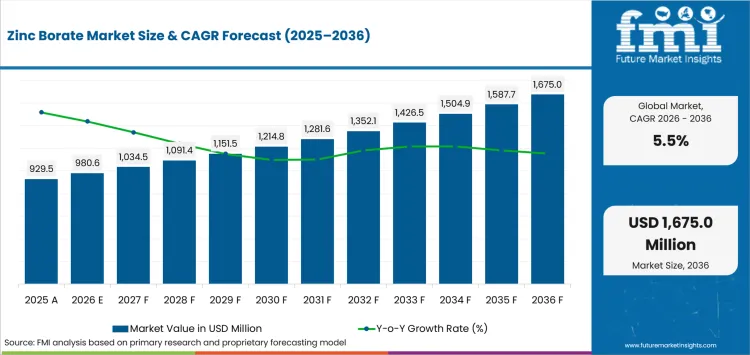
Key Takeaways of Zinc Borate Market
- Power-grid expansion increases orders for zinc borate after cable compounds pass required flame and smoke tests for specific service conditions.
- By grade, anhydrous zinc borate is estimated to hold 51.0% in 2026 owing to water-free chemistry suited to higher-temperature polymer processing.
- Smoke suppressant is projected to hold 38.0% share in 2026 owing to fire specifications that evaluate smoke output alongside flame resistance.
- In 2026, engineering plastics are expected to lead application demand with 34.0% share because additive stability matters during demanding molding and electrical uses.
- Formulation trials and certification work delay additive switching because zinc borate performance changes with resin chemistry and the remaining flame-retardant package.
- USA Borax / Rio Tinto, Shandong Taixing Advanced Material Co. Ltd., Niknam Chemicals Pvt. Ltd., Daejung Chemicals Co. Ltd., Shandong Aosen New Material Technology Co. Ltd., Akdeniz Chemson, Royce Global and Eti Maden are some notable players.
Analyst Perspective
"Zinc borate earns value after formulators prove that hydration state, particle control and additive synergy fit the exact polymer process. Suppliers that combine repeatable grades with application support are better positioned than companies competing on powder price alone."
- Nikhil Kaitwade, Principal Consultant, Future Market Insights
How is the Zinc Borate Market segmented?
The zinc borate market is segmented by grade, function, application, polymer, sales channel and region.
Grade includes anhydrous zinc borate, standard hydrated grade, fine particle grade and surface-treated grade. Function includes smoke suppressant, flame retardant synergist, afterglow suppressant, anti-arcing additive and fungistatic additive. Application covers engineering plastics, wire and cable compounds, rubber, coatings and wood composites. Polymer includes polyolefins, PVC, polyamides, epoxy or thermosets and elastomers. Sales channels include direct additive supply, compounders, distributors and masterbatch suppliers.
How do engineering plastics shape demand within the application category?
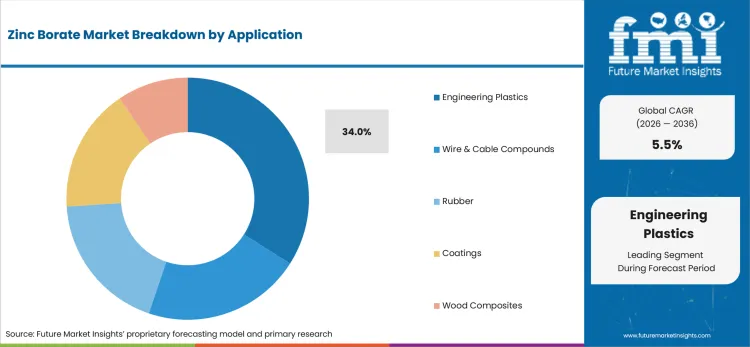
Engineering plastics combine higher process temperatures with demanding electrical or mechanical properties that restrict additive choices. Zinc borate must disperse consistently without weakening the performance that makes these polymers useful in safety-critical components.
- By application, engineering plastics are forecast to represent 34.0% in 2026 driven by thermal stability and dispersion requirements across demanding molded electrical and mechanical parts.
- Shandong Taixing described zinc borate use in engineering plastics in March 2025 with emphasis on thermal stability and dispersion. The technical article connects additive selection to processing conditions that determine qualification across molded electrical and mechanical components.
What makes anhydrous zinc borate central to the grade category?
Anhydrous zinc borate serves polymer systems whose process temperatures release water from hydrated grades before final shaping. Grade selection therefore starts with processing temperature and the compounder's tolerance for moisture during extrusion or molding.
- Based on grade, anhydrous zinc borate is projected to account for 51.0% in 2026 due to stable water-free chemistry during higher-temperature processing and molding.
- Shandong Aosen described anhydrous zinc borate in February 2025 for plastics and electrical components that require stable fire performance. The technical release connects water-free chemistry with processing conditions that separate anhydrous material from hydrated grades during qualification.
Why does smoke suppressant lead the function category?
Low-smoke flame retardants address a strict fire-safety problem because a polymer that resists ignition still releases unacceptable smoke. Zinc borate earns specification value by combining smoke control with char formation and afterglow suppression inside a wider additive package.
- In 2026, smoke suppressant is expected to lead the function category with 38.0% share because compounders evaluate smoke output alongside flame resistance in qualified fire-safety packages.
- Shandong Taixing explained in February 2025 that zinc borate can improve smoke suppression when combined with established flame-retardant systems. That operating role gives formulators a second performance reason to retain zinc borate after the base flame requirement is met.
What supports polyolefins within the polymer category?
Polyolefin formulations span cable sheathing, molded components and other uses where low smoke or halogen-free fire performance becomes a purchase requirement. Additive systems must preserve mechanical behavior while reaching the required commercial fire classification.
- Polyolefins are set to lead the polymer category with 31.0% share in 2026 due to broad polyethylene and polypropylene routes for flame-retardant cable and molded formulations.
- Shandong Taixing published polyolefin-specific zinc borate guidance in January 2026 for PP, PE and EVA cable materials used with mineral flame retardants. The guidance connects zinc borate loading and particle selection with smoke suppression plus dispersion requirements during low-smoke formulation work.
What are the drivers, restraints and opportunities in the Zinc Borate Market?
Grid expansion enlarges the cable qualification base, polymer-specific testing slows additive changes and antimony supply risk increases interest in validated zinc borate substitution.
- Driver: Transmission upgrades increase the number of cable and electrical polymer programs that require qualified flame-retardant formulations.
- Restraint: Resin-specific fire testing slows substitution because a zinc borate loading that works in one polymer does not transfer reliably to another.
- Opportunity: Antimony supply concentration gives formulators a reason to validate zinc borate as a partial replacement inside existing fire-retardant packages.
Grid Expansion Extends the Cable Qualification Base
The strongest demand route begins with transmission investment because each new wire and cable compounds program requires polymer materials that pass fire and smoke specifications. The USA Department of Energy opened an approximately USD 1.9 billion SPARK funding opportunity in March 2026 for rapid transmission upgrades. Zinc borate demand converts from that infrastructure activity after compounders qualify an additive package for the selected insulation or sheathing system.
Formulation Qualification Slows Additive Switching
Additive changes remain slow when flame-retardant TPEs must satisfy fire performance without sacrificing mechanical or electrical behavior. Avient expanded its non-halogen flame-retardant TPE portfolio in February 2026 with materials meeting UL 94 V-0 plus REACH and RoHS requirements. That qualification burden affects zinc borate adoption because resin chemistry and loading changes require fresh validation before a commercial recipe replaces an established system.
Antimony Supply Risk Expands Substitution Trials
Antimony trioxide constraints create a targeted substitution opening where zinc borate reduces dependence without forcing a complete flame-retardant redesign. The USA Geological Survey reported in June 2026 that China had applied export controls to antimony and other minerals since 2023. Suppliers convert that concern into orders by documenting replacement ratios that preserve fire performance in the customer's exact resin and process.
Which country CAGRs are profiled in the Zinc Borate Market?
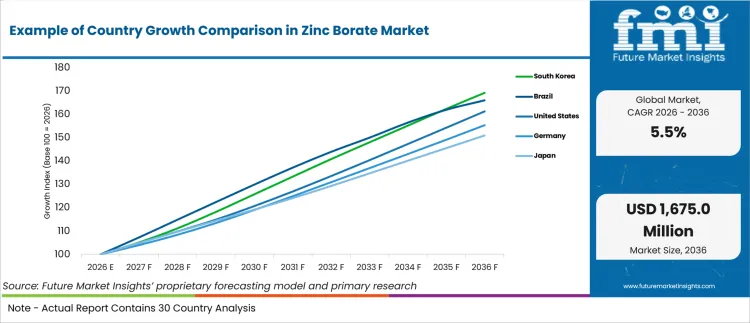
| Country | CAGR |
|---|---|
| South Korea | 5.4% |
| Brazil | 5.2% |
| United States | 4.9% |
| Germany | 4.5% |
| Japan | 4.2% |
How do country-level CAGRs compare in the zinc borate market?
The five profiled countries span a 1.2 percentage-point range that separates expansion-led cable programs from mature replacement cycles. South Korea and Brazil form the upper group as new transmission work creates fresh specifications. The United States mixes expansion with modernization while Germany and Japan rely more on controlled replacement inside established networks.
- South Korea gains specifications as KEPCO expands high-voltage connections serving industrial clusters.
- Brazil links long transmission corridors with cable needs across varied service environments.
- United States programs combine reconductoring with rising electricity use at power-intensive facilities.
- Germany's regulated corridors reward documented compounds suited to long-lived transmission asset upgrades.
- Japan favors dependable compounds that fit conservative qualification and stable electrical specifications.
Similar rates therefore mask different qualification timelines and local inventory requirements across each country.
The full report provides country-level CAGR analysis across North America, Latin America, Europe, East Asia, South Asia, Oceania and the Middle East and Africa.
Country-wise Analysis
- South Korea's zinc borate outlook is anticipated to advance at 5.4% CAGR over the assessment period as transmission additions create new cable qualification programs. KEPCO brought the 345 kV Shin-Cheongju substation and associated lines into operation in June 2025 to serve semiconductor industrial areas with rising power demand. Domestic cable and compounder engineering supports local testing, yet project schedules depend on coordinated permitting across utilities and regional authorities serving large industrial clusters. Suppliers need consistent hydration and particle specifications plus application support before scheduled cable programs convert into recurring additive orders. That timing makes local inventory useful for cable programs that cannot absorb late formulation changes.
- Brazilian additive demand follows transmission corridors that cross long distances and expose cable systems to varied service conditions. Zinc borate demand in Brazil is forecast to rise at 5.2% CAGR over the forecast period as transmission investment creates new qualification work. ANEEL signed February 2026 contracts covering 1,081 kilometers of transmission lines across twelve states. Compounders and distributors can qualify smoke-suppressing formulations near project demand, although imported specialty additives face longer replenishment routes and currency-sensitive landed costs. Reliable inventory plus application support becomes important where construction schedules leave little room for delayed compound changes. Regional stock also protects project schedules from ocean freight delays during concentrated construction periods locally.
- United States compounders serve utilities that are modernizing existing corridors while commercial electricity consumption rises across power-intensive facilities. The United States zinc borate sector is projected to record 4.9% CAGR during the assessment period as utilities expand cable qualification work. EIA reported in July 2026 that year-to-date commercial electricity sales reached 603,713 million kWh through May. Large domestic testing networks support qualification across several resin systems, yet cable standards differ by voltage class and service environment. Additive companies therefore need repeatable lots plus documentation that lets compounders validate reformulated recipes before recurring production begins. Domestic inventory reduces replenishment risk during utility programs that require repeatable formulations across scheduled production.
- German cable programs operate within a mature standards environment that places material documentation at the center of supplier approval. Zinc borate sales in Germany are forecast to expand at 4.5% CAGR by 2036 as regulated grid work creates documented cable-material reviews. Bundesnetzagentur reported in January 2026 that roughly 2,000 kilometers of power lines received approval during 2025. Established chemical and cable engineering supports detailed compound trials, although conservative change control can lengthen approval for a new additive grade. Suppliers gain access by documenting stable hydration and particle properties that fit long-lived network specifications. Local technical teams can also shorten clarification cycles during regulated procurement and extended project reviews.
- Japanese electrical manufacturers place strong weight on repeatable specifications because cable compounds often remain qualified across long product cycles. Adoption of zinc borate in Japan is estimated to expand at 4.2% CAGR through 2036 as network investment creates controlled cable qualification work. METI reported in April 2026 that national electricity generation reached 0.9911 petawatt-hours during fiscal 2024. A technically mature polymer base supports controlled formulation work, yet conservative requalification raises the cost of replacing established additives. Local technical response and tight particle control therefore matter before a new grade enters recurring electrical production.
Who are the notable companies in the Zinc Borate Market?
USA Borax / Rio Tinto, Shandong Taixing Advanced Material Co. Ltd., Niknam Chemicals Pvt. Ltd., Daejung Chemicals & Metals Co., Ltd., Shandong Aosen New Material Technology Co. Ltd., Akdeniz Chemson, Royce Global and Eti Maden serve the zinc borate market.
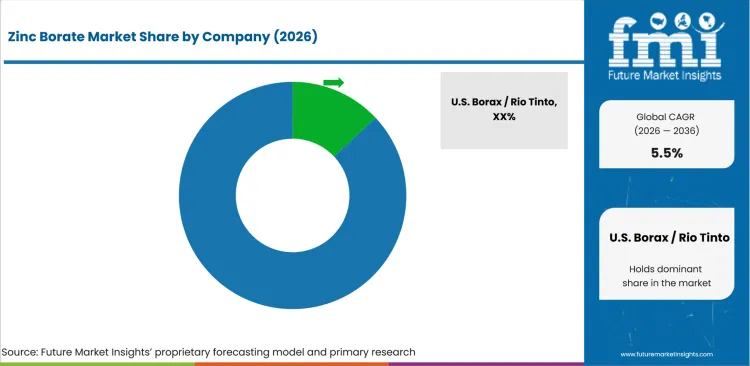
Competition separates integrated borate producers from specialist flame-retardant manufacturers and distributors that provide application testing. Entry depends on repeatable zinc borate chemistry and documentation covering hydration state plus particle size before qualification.
- USA Borax / Rio Tinto, Eti Maden, Shandong Taixing Advanced Material Co. Ltd. and Akdeniz Chemson combine direct zinc borate supply with polymer and coating formulation support.
- Niknam Chemicals Pvt. Ltd., Shandong Aosen New Material Technology Co. Ltd., Daejung Chemicals & Metals Co., Ltd. and Royce Global compete through specialty supply, batch documentation and application testing.
Competitive Benchmarking: Zinc Borate Market
| Company | Grade Range | Application Documentation | Qualification Support | Geographic Reach |
|---|---|---|---|---|
| USA Borax / Rio Tinto | High | High | High | North America with global distribution |
| Shandong Taixing Advanced Material Co. Ltd. | High | High | High | China with exports across Europe, Americas and Asia |
| Niknam Chemicals Pvt. Ltd. | Medium | High | Medium | India with international trade-show outreach |
| Daejung Chemicals & Metals Co., Ltd. | Low | Medium | Medium | South Korea with export-oriented chemical supply |
| Shandong Aosen New Material Technology Co. Ltd. | Medium | Medium | Medium | China with international specialty-chemical sales |
| Akdeniz Chemson | Low | Medium | Medium | Türkiye with Europe, Asia and Americas presence |
| Royce Global | Low | Medium | Medium | North America with international warehousing |
| Eti Maden | Low | Medium | Medium | Türkiye with global borate distribution |
Key Developments in the Zinc Borate Market
- In April 2026, USA Borax announced infrastructure upgrades at its Coudekerque site focused on battery-grade and advanced-electronics boric acid products, expanding the facility's precision manufacturing capabilities for tightly specified downstream applications.
- In July 2025, Niknam Chemicals Pvt. Ltd. announced plans to present zinc borate at K 2025 for polymer and cable formulations during the October exhibition in Düsseldorf.
- In April 2025, Shandong Taixing Advanced Material Co. Ltd. displayed zinc borate at Chinaplas 2025 and provided application consultation through its sales and technical teams.
Key Players in the Zinc Borate Market
Integrated Borate Producers
- USA Borax / Rio Tinto
- Eti Maden
Zinc Borate and Flame-Retardant Specialists
- Shandong Taixing Advanced Material Co. Ltd.
- Niknam Chemicals Pvt. Ltd.
- Shandong Aosen New Material Technology Co. Ltd.
- Akdeniz Chemson
Chemical Supply and Qualification Specialists
- Daejung Chemicals & Metals Co., Ltd.
- Royce Global
Zinc Borate Market - Report Scope
| Coverage field | Report scope |
|---|---|
| Market breakdown | By grade, function, application, polymer, sales channel and region. |
| Quantitative Units | Revenue in USD million and CAGR in %. |
| Market Definition | Commercial zinc borate supplied as flame-retardant, smoke-suppressant and multifunctional additive grades for qualified polymer and material applications. |
| Regions Covered | North America, Latin America, Europe, East Asia, South Asia and Pacific, and Middle East and Africa. |
| Countries Covered | South Korea, Brazil, United States, Germany, Japan, and 20+ countries included in the full report. |
| Key Companies Profiled | USA Borax / Rio Tinto, Shandong Taixing Advanced Material Co. Ltd., Niknam Chemicals Pvt. Ltd., Daejung Chemicals & Metals Co., Ltd., Shandong Aosen New Material Technology Co. Ltd., Akdeniz Chemson, Royce Global, and Eti Maden. |
| Forecast Period | 2026 to 2036. |
| Approach | Primary and secondary research with market triangulation. |
Zinc Borate Market - Research Methodology
| Method | Approach |
|---|---|
| Primary Research | FMI analysts gathered input from manufacturers, service providers, technology developers, distributors, end users, procurement teams, and subject-matter experts. Interviews examined purchasing decisions, product or service evaluation, adoption barriers, approval requirements, pricing considerations, and expectations for technical or commercial support. Respondents were also asked what evidence is required before a trial, pilot, or initial order develops into regular purchasing. |
| Desk Research | Desk research covered government statistics, regulatory publications, trade data, industry associations, technical literature, standards, company filings, product information, and official corporate announcements. Sources were reviewed for relevance, publication date, geographic coverage, and consistency with the defined market scope. Claims relating to performance, applications, approvals, capacity, investment, and commercial activity were retained only when supported by credible public evidence. |
| Market Sizing and Forecasting | The market model combined the baseline value with historical performance, segment structure, pricing and volume indicators, adoption levels, company participation, and country-level demand conditions. Forecast assumptions considered economic activity, investment trends, regulatory developments, technology adoption, purchasing cycles, supply availability, and barriers to wider market use. Segment and regional estimates were reconciled before the final market total was calculated. |
| Data Validation | Estimates were checked against multiple independent indicators, including public data, company activity, trade patterns, industry developments, and findings from primary interviews. Validation also tested whether products, services, applications, and company revenues fell within the defined market boundaries. Adjacent categories, unsupported claims, overlapping revenues, and activities without direct market relevance were excluded to reduce double counting and maintain consistency across segments and countries. |
Zinc Borate Market by Segments
Zinc Borate Market segmented by Grade:
- Anhydrous Zinc Borate
- Standard Hydrated Grade
- Fine Particle Grade
- Surface-Treated Grade
Zinc Borate Market segmented by Function:
- Smoke Suppressant
- Flame Retardant Synergist
- Afterglow Suppressant
- Anti-Arcing Additive
- Fungistatic Additive
Zinc Borate Market segmented by Application:
- Engineering Plastics
- Wire & Cable Compounds
- Rubber
- Coatings
- Wood Composites
Zinc Borate Market segmented by Polymer:
- Polyolefins
- PVC
- Polyamides
- Epoxy or Thermosets
- Elastomers
Zinc Borate Market segmented by Sales Channel:
- Direct Additive Supply
- Compounders
- Distributors
- Masterbatch Suppliers
Zinc Borate Market by Region:
- North America
- United States
- Canada
- Latin America
- Brazil
- Mexico
- Chile
- Rest of Latin America
- Western Europe
- Germany
- United Kingdom
- Italy
- Spain
- France
- Nordics
- Benelux
- Rest of Western Europe
- Eastern Europe
- Russia
- Poland
- Hungary
- Balkan and Baltic States
- Rest of Eastern Europe
- East Asia
- China
- Japan
- South Korea
- South Asia and Pacific
- India
- ASEAN
- Australia and New Zealand
- Rest of South Asia and Pacific
- Middle East and Africa
- Kingdom of Saudi Arabia
- Other GCC Countries
- Türkiye
- South Africa
- Other African Union Countries
- Rest of Middle East and Africa
Research Sources and Bibliography
- USA Borax. (2026, March 2). Borates for fire safety in plastics and polymers.
- Ministry of Trade, Industry and Energy. (2025, February 21).
- Shandong Aosen New Material Technology Co. Ltd. (2025, February 17). Flame Retardant Assistant: Anhydrous Zinc Borate.
- Shandong Taixing Advanced Material Co. Ltd. (2025, February 21). Why does zinc borate have a flame retardant effect?
- Shandong Taixing Advanced Material Co. Ltd. (2025, March 14). Application of Zinc Borate Flame Retardant in Engineering Plastics.
- Shandong Taixing Advanced Material Co. Ltd. (2026, January 30). How to Achieve the Best Effect by Combining Zinc Borate with Different Flame Retardants (Such as Magnesium Hydroxide and Red Phosphorus)?
- USA Department of Energy. (2026, March 12). Speed to Power through Accelerated Reconductoring and other Key Advanced Transmission Technology Upgrades (SPARK).
- Avient Corporation. (2026, February 3). Avient Expands Non-Halogen Flame-Retardant TPE Portfolio with OnFlex™ NHFR 7001 Series.
- USA Geological Survey. (2026, June 12). Production of mineral commodities and geospatial map of the mineral industries and related infrastructure of China.
- Korea Electric Power Corporation. (2025, December). HIGHLIGHT.
- Agência Nacional de Energia Elétrica. (2026, February 23). Assinados novos contratos de empreendimentos de transmissão.
- USA Energy Information Administration. (2026, July 23). Electric Power Monthly: Table 5.1, Sales of Electricity to Ultimate Customers.
- Bundesnetzagentur. (2026, January 2). Energy transition clears crucial hurdle - significant progress in electricity grid expansion in 2025.
- Ministry of Economy, Trade and Industry. (2026, April 14). FY2024 Energy Supply and Demand Report (Revised Report).
- USA Borax. (2026, April 6). New upgrades enhance purity, granulation capabilities at Coudekerque.
- Niknam Chemicals Pvt. Ltd. (2025, July 14). Zinc Borate Manufacturers in Ahmedabad with High-Purity Flame Retardant Additi...
- Shandong Taixing Advanced Material Co. Ltd. (2025, April 21). Taixing made a shining appearance at the 2025 Chinaplas, leading the industry in safety innovation.
- Royce Global. (2026, accessed August 13). Home - Royce Global - Defining Excellence Since 1929.
- Eti Maden. (2026, February 24). REFINED PRODUCTS.
This bibliography is provided for reader reference and is not exhaustive. The full report contains the complete reference list and detailed citations
This Report Answers
- How large is the zinc borate market in 2026 and 2036?
- Which fire-safety requirements convert polymer formulation work into zinc borate orders?
- Why does anhydrous zinc borate account for 51.0% of grade demand in 2026?
- How does smoke suppression influence zinc borate selection within multifunctional flame-retardant packages?
- Why do engineering plastics and polyolefins remain central to additive qualification?
- Which market conditions create the clearest driver, restraint and substitution opportunity?
- How do country growth rates differ across South Korea, Brazil, the United States, Germany and Japan?
- Which companies combine zinc borate manufacturing, distribution and application support?
- What buyer criteria separate competitors during zinc borate grade qualification?
Frequently Asked Questions
How big is the Zinc Borate Market in 2026?
The zinc borate market is expected to be valued at USD 980.6 million in 2026 and reach USD 1675.0 million by 2036. Recurring demand converts after compounders qualify zinc borate for cable and polymer fire-safety formulations.
What is the CAGR of the Zinc Borate Market from 2026 to 2036?
The zinc borate market is projected to grow at a 5.5% CAGR between 2026 and 2036. Expansion reflects grid-related cable requirements and broader fire-safety testing across polymer applications that use zinc borate as a multifunctional additive.
Which grade segment leads the Zinc Borate Market?
Anhydrous zinc borate is projected to account for 51.0% of grade demand in 2026. Its position reflects higher-temperature polymer processing that can favor water-free additive chemistry during extrusion and molding.
How much incremental opportunity does the Zinc Borate Market create between 2026 and 2036?
The zinc borate market is expected to add USD 694.4 million in value between 2026 and 2036. Revenue conversion depends on validated replacement ratios and consistent grades that meet customer-specific fire-test requirements.
Which companies are active in the Zinc Borate Market?
The zinc borate market profiles U.S. Borax / Rio Tinto, Shandong Taixing Advanced Material Co. Ltd., Niknam Chemicals Pvt. Ltd., Daejung Chemicals Co. Ltd., Shandong Aosen New Material Technology Co. Ltd., Akdeniz Chemson, Royce Global and Eti Maden. Competition centers on grade consistency and application support.
Preview the report firsthand - request a free sample
Get SampleGet the brochure for pricing and purchase details.
Get PDFTable of Content
- Key Takeaways
- Market Size and CAGR
- Top Growth Driver
- Fastest Growing Segment
- Leading Region
- Key Companies
- Emerging Opportunities
- Executive Summary
- Global Market Outlook
- Demand-side Trends
- Supply-side Trends
- Technology Roadmap Analysis
- Analysis and Recommendations
- Analyst Perspective (What is happening? Why now? What should investors know?)
- Key Questions Answered
- How large is the market?
- What is the CAGR?
- What are key trends?
- Which region dominates?
- Who are the leaders?
- Market Overview
- Market Coverage / Taxonomy
- Market Definition / Scope / Limitations
- Research Methodology
- Chapter Orientation
- Analytical Lens and Working Hypotheses
- Market Structure, Signals, and Trend Drivers
- Benchmarking and Cross-market Comparability
- Market Sizing, Forecasting, and Opportunity Mapping
- Research Design and Evidence Framework
- Desk Research Programme (Secondary Evidence)
- Expert Input and Fieldwork (Primary Evidence)
- Tooling, Models, and Reference Databases
- Data Engineering and Model Build
- Quality Assurance and Audit Trail
- Market Background
- Market Dynamics (Drivers, Restraints, Opportunity, Trends)
- Scenario Forecast (Optimistic, Likely, Conservative)
- Impact Analysis
- AI Impact
- Sustainability Impact
- Regulatory Impact
- Technology Impact
- Consumer / Buyer Analysis
- Purchase Drivers
- Adoption Barriers
- Buyer Journey
- Opportunity Map Analysis
- Product Life Cycle Analysis
- Supply Chain Analysis
- Investment Feasibility Matrix
- Value Chain Analysis
- PESTLE and Porter's Analysis
- Regulatory Landscape
- Regional Parent Market Outlook
- Production and Consumption Statistics
- Import and Export Statistics
- Global Market Analysis and Forecast, 2021 to 2036
- Historical Market Size Value (USD Million) Analysis, 2021 to 2025
- Current and Future Market Size Value (USD Million) Projections, 2026 to 2036
- Y-o-Y Growth Trend Analysis
- Absolute $ Opportunity Analysis
- Global Market Pricing Analysis, 2021 to 2036
- Global Market Analysis and Forecast, By Grade, 2021 to 2036
- Introduction / Key Findings
- Historical Market Size Value (USD Million) Analysis By Grade, 2021 to 2025
- Current and Future Market Size Value (USD Million) Analysis and Forecast By Grade, 2026 to 2036
- Standard Hydrated Grade
- Anhydrous zinc borate
- Fine particle grade
- Surface-treated grade
- Standard Hydrated Grade
- Y-o-Y Growth Trend Analysis By Grade, 2021 to 2025
- Absolute $ Opportunity Analysis By Grade, 2026 to 2036
- Global Market Analysis and Forecast, By Function, 2021 to 2036
- Introduction / Key Findings
- Historical Market Size Value (USD Million) Analysis By Function, 2021 to 2025
- Current and Future Market Size Value (USD Million) Analysis and Forecast By Function, 2026 to 2036
- Flame retardant synergist
- Smoke suppressant
- Afterglow suppressant
- Anti-arcing additive
- Fungistatic additive
- Flame retardant synergist
- Y-o-Y Growth Trend Analysis By Function, 2021 to 2025
- Absolute $ Opportunity Analysis By Function, 2026 to 2036
- Global Market Analysis and Forecast, By Application, 2021 to 2036
- Introduction / Key Findings
- Historical Market Size Value (USD Million) Analysis By Application, 2021 to 2025
- Current and Future Market Size Value (USD Million) Analysis and Forecast By Application, 2026 to 2036
- Wire & cable compounds
- Engineering plastics
- Rubber
- Coatings
- Wood composites
- Wire & cable compounds
- Y-o-Y Growth Trend Analysis By Application, 2021 to 2025
- Absolute $ Opportunity Analysis By Application, 2026 to 2036
- Global Market Analysis and Forecast, By Polymer Type, 2021 to 2036
- Introduction / Key Findings
- Historical Market Size Value (USD Million) Analysis By Polymer Type, 2021 to 2025
- Current and Future Market Size Value (USD Million) Analysis and Forecast By Polymer Type, 2026 to 2036
- PVC
- Polyolefins
- Polyamides
- Epoxy or thermosets
- Elastomers
- PVC
- Y-o-Y Growth Trend Analysis By Polymer Type, 2021 to 2025
- Absolute $ Opportunity Analysis By Polymer Type, 2026 to 2036
- Global Market Analysis and Forecast, By Sales Channel, 2021 to 2036
- Introduction / Key Findings
- Historical Market Size Value (USD Million) Analysis By Sales Channel, 2021 to 2025
- Current and Future Market Size Value (USD Million) Analysis and Forecast By Sales Channel, 2026 to 2036
- Compounders
- Direct additive supply
- Distributors
- Masterbatch suppliers
- Compounders
- Y-o-Y Growth Trend Analysis By Sales Channel, 2021 to 2025
- Absolute $ Opportunity Analysis By Sales Channel, 2026 to 2036
- Global Market Analysis and Forecast, By Region, 2021 to 2036
- Introduction
- Historical Market Size Value (USD Million) Analysis By Region, 2021 to 2025
- Current Market Size Value (USD Million) Analysis and Forecast By Region, 2026 to 2036
- North America
- Latin America
- Western Europe
- Eastern Europe
- East Asia
- South Asia and Pacific
- Middle East & Africa
- Market Attractiveness Analysis By Region
- North America Market Analysis and Forecast, By Country, 2021 to 2036
- Historical Market Size Value (USD Million) Trend Analysis By Market Taxonomy, 2021 to 2025
- Market Size Value (USD Million) Forecast By Market Taxonomy, 2026 to 2036
- By Country
- USA
- Canada
- By Grade
- By Function
- By Application
- By Polymer Type
- By Sales Channel
- By Country
- Market Attractiveness Analysis
- By Country
- By Grade
- By Function
- By Application
- By Polymer Type
- By Sales Channel
- Key Takeaways
- Latin America Market Analysis and Forecast, By Country
- Historical Market Size Value (USD Million) Trend Analysis By Market Taxonomy, 2021 to 2025
- Market Size Value (USD Million) Forecast By Market Taxonomy, 2026 to 2036
- By Country
- Brazil
- Mexico
- Chile
- Rest of Latin America
- By Grade
- By Function
- By Application
- By Polymer Type
- By Sales Channel
- By Country
- Market Attractiveness Analysis
- By Country
- By Grade
- By Function
- By Application
- By Polymer Type
- By Sales Channel
- Key Takeaways
- Western Europe Market Analysis and Forecast, By Country
- Historical Market Size Value (USD Million) Trend Analysis By Market Taxonomy, 2021 to 2025
- Market Size Value (USD Million) Forecast By Market Taxonomy, 2026 to 2036
- By Country
- Germany
- UK
- Italy
- Spain
- France
- Nordic
- BENELUX
- Rest of Western Europe
- By Grade
- By Function
- By Application
- By Polymer Type
- By Sales Channel
- By Country
- Market Attractiveness Analysis
- By Country
- By Grade
- By Function
- By Application
- By Polymer Type
- By Sales Channel
- Key Takeaways
- Eastern Europe Market Analysis and Forecast, By Country
- Historical Market Size Value (USD Million) Trend Analysis By Market Taxonomy, 2021 to 2025
- Market Size Value (USD Million) Forecast By Market Taxonomy, 2026 to 2036
- By Country
- Russia
- Poland
- Hungary
- Balkan & Baltic
- Rest of Eastern Europe
- By Grade
- By Function
- By Application
- By Polymer Type
- By Sales Channel
- By Country
- Market Attractiveness Analysis
- By Country
- By Grade
- By Function
- By Application
- By Polymer Type
- By Sales Channel
- Key Takeaways
- East Asia Market Analysis and Forecast, By Country
- Historical Market Size Value (USD Million) Trend Analysis By Market Taxonomy, 2021 to 2025
- Market Size Value (USD Million) Forecast By Market Taxonomy, 2026 to 2036
- By Country
- China
- Japan
- South Korea
- By Grade
- By Function
- By Application
- By Polymer Type
- By Sales Channel
- By Country
- Market Attractiveness Analysis
- By Country
- By Grade
- By Function
- By Application
- By Polymer Type
- By Sales Channel
- Key Takeaways
- South Asia and Pacific Market Analysis and Forecast, By Country
- Historical Market Size Value (USD Million) Trend Analysis By Market Taxonomy, 2021 to 2025
- Market Size Value (USD Million) Forecast By Market Taxonomy, 2026 to 2036
- By Country
- India
- ASEAN
- Australia & New Zealand
- Rest of South Asia and Pacific
- By Grade
- By Function
- By Application
- By Polymer Type
- By Sales Channel
- By Country
- Market Attractiveness Analysis
- By Country
- By Grade
- By Function
- By Application
- By Polymer Type
- By Sales Channel
- Key Takeaways
- Middle East & Africa Market Analysis and Forecast, By Country
- Historical Market Size Value (USD Million) Trend Analysis By Market Taxonomy, 2021 to 2025
- Market Size Value (USD Million) Forecast By Market Taxonomy, 2026 to 2036
- By Country
- Kingdom of Saudi Arabia
- Other GCC Countries
- Türkiye
- South Africa
- Other African Union
- Rest of Middle East & Africa
- By Grade
- By Function
- By Application
- By Polymer Type
- By Sales Channel
- By Country
- Market Attractiveness Analysis
- By Country
- By Grade
- By Function
- By Application
- By Polymer Type
- By Sales Channel
- Key Takeaways
- Key Countries Market Analysis
- USA
- Pricing Analysis
- Market Share Analysis, 2025
- By Grade
- By Function
- By Application
- By Polymer Type
- By Sales Channel
- Canada
- Pricing Analysis
- Market Share Analysis, 2025
- By Grade
- By Function
- By Application
- By Polymer Type
- By Sales Channel
- Mexico
- Pricing Analysis
- Market Share Analysis, 2025
- By Grade
- By Function
- By Application
- By Polymer Type
- By Sales Channel
- Brazil
- Pricing Analysis
- Market Share Analysis, 2025
- By Grade
- By Function
- By Application
- By Polymer Type
- By Sales Channel
- Chile
- Pricing Analysis
- Market Share Analysis, 2025
- By Grade
- By Function
- By Application
- By Polymer Type
- By Sales Channel
- Germany
- Pricing Analysis
- Market Share Analysis, 2025
- By Grade
- By Function
- By Application
- By Polymer Type
- By Sales Channel
- UK
- Pricing Analysis
- Market Share Analysis, 2025
- By Grade
- By Function
- By Application
- By Polymer Type
- By Sales Channel
- Italy
- Pricing Analysis
- Market Share Analysis, 2025
- By Grade
- By Function
- By Application
- By Polymer Type
- By Sales Channel
- Spain
- Pricing Analysis
- Market Share Analysis, 2025
- By Grade
- By Function
- By Application
- By Polymer Type
- By Sales Channel
- France
- Pricing Analysis
- Market Share Analysis, 2025
- By Grade
- By Function
- By Application
- By Polymer Type
- By Sales Channel
- India
- Pricing Analysis
- Market Share Analysis, 2025
- By Grade
- By Function
- By Application
- By Polymer Type
- By Sales Channel
- ASEAN
- Pricing Analysis
- Market Share Analysis, 2025
- By Grade
- By Function
- By Application
- By Polymer Type
- By Sales Channel
- Australia & New Zealand
- Pricing Analysis
- Market Share Analysis, 2025
- By Grade
- By Function
- By Application
- By Polymer Type
- By Sales Channel
- China
- Pricing Analysis
- Market Share Analysis, 2025
- By Grade
- By Function
- By Application
- By Polymer Type
- By Sales Channel
- Japan
- Pricing Analysis
- Market Share Analysis, 2025
- By Grade
- By Function
- By Application
- By Polymer Type
- By Sales Channel
- South Korea
- Pricing Analysis
- Market Share Analysis, 2025
- By Grade
- By Function
- By Application
- By Polymer Type
- By Sales Channel
- Russia
- Pricing Analysis
- Market Share Analysis, 2025
- By Grade
- By Function
- By Application
- By Polymer Type
- By Sales Channel
- Poland
- Pricing Analysis
- Market Share Analysis, 2025
- By Grade
- By Function
- By Application
- By Polymer Type
- By Sales Channel
- Hungary
- Pricing Analysis
- Market Share Analysis, 2025
- By Grade
- By Function
- By Application
- By Polymer Type
- By Sales Channel
- Kingdom of Saudi Arabia
- Pricing Analysis
- Market Share Analysis, 2025
- By Grade
- By Function
- By Application
- By Polymer Type
- By Sales Channel
- Türkiye
- Pricing Analysis
- Market Share Analysis, 2025
- By Grade
- By Function
- By Application
- By Polymer Type
- By Sales Channel
- South Africa
- Pricing Analysis
- Market Share Analysis, 2025
- By Grade
- By Function
- By Application
- By Polymer Type
- By Sales Channel
- USA
- Market Structure Analysis
- Competition Dashboard
- Competition Benchmarking
- Market Share Analysis of Top Players
- By Regional
- By Grade
- By Function
- By Application
- By Polymer Type
- By Sales Channel
- Emerging Startups
- Innovation Benchmarking
- Competition Analysis
- Competition Deep Dive
- USA Borax or Rio Tinto
- Overview
- Product Portfolio
- Profitability by Market Segments
- Sales Footprint
- Strategy Overview
- Marketing Strategy
- Product Strategy
- Channel Strategy
- Borax Argentina
- Societa Chimica Larderello
- Wuwei Industrial
- Shandong Bio Industry
- Zibo Wuwei Industrial
- Royce Global
- LANXESS
- Akdeniz Chemson
- Baerlocher
- USA Borax or Rio Tinto
- Case Studies
- Success Stories
- Recent Developments
- Competition Deep Dive
- Assumptions & Acronyms Used


