

- Market Size (2026)
- USD 420.7 Mn
- Forecast (2036)
- USD 875.2 Mn
- CAGR (2026 to 2036)
- 7.6%
How big is Zip Chain Actuator Market in 2026?
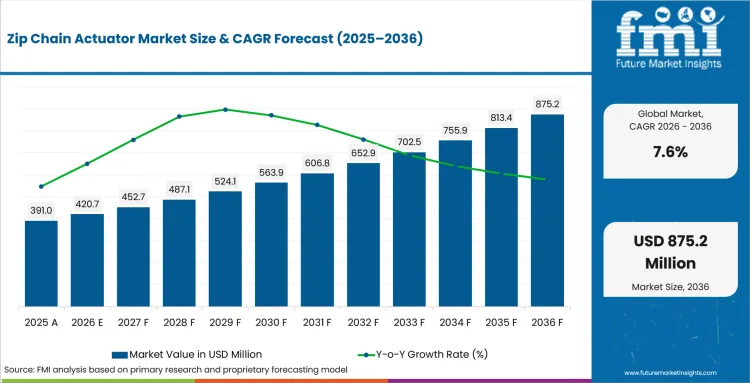
USD 420.7 million in 2026 and USD 875.2 million by 2036 at a 7.6% CAGR.
Sales of zip chain actuators are estimated to rise at 7.6% CAGR through 2036, increasing valuation from USD 420.7 million in 2026 to USD 875.2 million by 2036. The packaging advantage is rooted in the way a rigid chain converts compact storage into usable linear travel: GROB explains in an official Linear Chain learning-center source, that a linear chain stiffens under compression and coils beside the drive, helping engineers fit electric linear actuators inside restricted machine envelopes. Selection depends on usable stroke, thrust and guidance responsibility rather than nominal speed alone during final machinery approval.
The same space-efficiency argument is strengthened by post-2024 factory automation data rather than another product specification. The International Federation of Robotics reported in September 2025 that 542,000 industrial robots were installed worldwide in 2024, with annual installations remaining above 500,000 units for the fourth consecutive year. This scale of automated equipment deployment supports demand for compact auxiliary axes, including lifting columns, where long travel, controlled stopping and shallow machine envelopes must be reconciled during integration.
Key Takeaways of Zip Chain Actuator Market
- Compact chain storage places long-stroke lifting and transfer motion inside machinery that cannot accept cylinder-length retraction space.
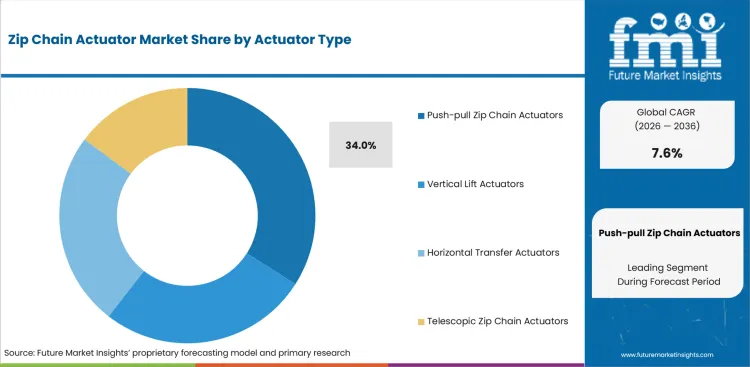
- Push-pull zip chain actuators are projected to represent 34.0% share in 2026, supported by bidirectional force transmission within one mechanism.
- The 500-1,500 mm range is estimated to account for 42.0% share in 2026 across common lifting and transfer envelopes.
- Medium duty is forecast to capture 47.0% share in 2026, due to industrial handling tasks requiring practical thrust and repeatable braking.
- Buckling limits, external guidance and power-loss holding remain material restraints during equipment design and final acceptance.
- Tsubakimoto Chain, SERAPID Group, GROB, Framo Morat, iwis, Hengjiu Group, Gumptious Technology Co. and Power-Lift Limited compete through distinct load ranges and engineering models.
Analyst Perspective
Zip chain actuators earn their place when long travel must fit inside machinery that cannot accept a full retraction envelope. The decisive commercial document is the duty calculation covering guidance, braking and cycle life; compact packaging has limited value if acceptance testing exposes unstable motion or unclear service responsibility.
- Nikhil Kaitwade, Principal Analyst, Future Market Insights
How is the Zip Chain Actuator Market segmented?
The market is segmented by actuator type, stroke length, load capacity, application, sales model, and region.
Actuator type distinguishes push-pull, vertical lift, horizontal transfer and telescopic arrangements, while stroke length separates short adjustment motion from longer guided travel. Load capacity reflects dynamic thrust and stability requirements, and application identifies automated lifting, stage motion, factory automation, ergonomic equipment or logistics handling. Sales model assigns commercial responsibility across standard, custom and integrator-bundled material handling equipment and installation scope.
What supports push-pull zip chain actuators within the actuator type category?
Press-tool transfer needs controlled movement in both directions without separate drive systems, and stored-chain geometry preserves service space around dies. In October 2025, SERAPID entered a new development phase after Capital Croissance acquired a majority stake alongside management and the France Nucléaire Fund, with the transaction positioned to accelerate elevator, entertainment, industrial and nuclear applications for rigid-chain technology. That strategic backing gives push-pull and heavy-load systems a stronger commercial context than a standalone quick-die product description.
- Push-pull zip chain actuators are set to lead the actuator type category with 34.0% share in 2026 due to bidirectional force transmission. One compact mechanism reduces drive duplication and preserves access around press tooling during maintenance and die changes.
- Press manufacturers favor push-pull units for alternating transfer cycles requiring controlled acceleration, repeatable stopping and compatible robotics actuators without hydraulic infrastructure.
Why does the 500-1,500 mm segment shape the stroke length category?
Common machine travel often exceeds short adjustment strokes without requiring long guided chains or large magazines. The International Federation of Robotics reported in September 2025 that Asia accounted for 74% of new industrial robot deployments in 2024, while Europe represented 16% and the Americas 9%. That deployment pattern supports mid-stroke auxiliary axes in dense automation environments, where the 500-1,500 mm band balances useful travel with manageable guarding and commissioning across standard machinery projects.
- By stroke length, the 500-1,500 mm segment is forecast to represent 42.0% in 2026 driven by common lifting and transfer envelopes. Stored chain supports practical guarding and service access beside the drive during scheduled maintenance work.
- Tooling stations and transfer equipment use this stroke band for meaningful movement without extensive guide structures, while longer travel needs stronger buckling analysis and site-specific commissioning.
How is medium duty positioned within the load capacity category?
Medium-duty machinery needs practical thrust with predictable wear and safe stopping across repeated cycles inside routine production equipment. In June 2026, the International Federation of Robotics reported that USA food-sector robot adoption rose 30% in 2025, showing demand for flexible automation beyond automotive lines. That shift supports compact automated handling systems used for fixtures, conveyors and tool-change tasks where medium loads and repeatable braking matter more than maximum lift rating.
- The medium-duty segment is likely to capture 47.0% share in 2026 attributable to industrial handling tasks that need practical thrust without heavy foundations. Standard motors and brakes support one approval route across several machine families during repeat equipment programs.
- Factories select medium-duty systems for fixtures and conveyors requiring controlled movement without specialized lifting structures. Application approval often depends on derating rules for acceleration plus power loss and off-center loading.
What makes automated lifting central to the application category?
Automated lifting places vertical travel beneath platforms and fixtures with limited installation depth inside production cells and venues. In March 2026, Framo Morat documented a Compacta linear-chain lifting mechanism inside GEBHARDT's KARIS autonomous mobile robot, linking rigid-chain lifting to mobile intralogistics rather than only static machinery. The development reinforces demand for multi-axis motion controls that coordinate payload movement, stopping logic and compact lift packaging.
- The application category is forecast to be led by automated lifting at 29.0% share in 2026 due to limited retraction space beneath platforms. Synchronized chains distribute force without long hydraulic cylinders beneath wide production platforms and industrial fixtures.
- Factories and venues use automated lifting to change platform height through coordinated electric controls, accessible inspection routes and demonstrated power-loss holding during safety testing.
Why do standard units lead the sales model category?
Standard units shorten engineering work through documented housings, chain-storage arrangements and operating limits across repeat equipment programs. The National Institute of Standards and Technology's 2025 Manufacturing USA Annual Report covers network activity through September 2023 and identifies digital and automation work as part of advanced manufacturing institute activity. That policy-backed automation context supports reusable factory automation controls, while unusual routing or synchronized motion still requires custom engineering.
- By sales model, standard units are estimated to hold 46.0% share in 2026 owing to faster quoting and repeatable component selection. Adaptable mounting interfaces avoid redesigning the complete drive assembly during standard machinery integration projects worldwide.
- Distributors and integrators favor standard units for projects with defined envelopes and service conditions, while synchronized lifting or unusual environments require dedicated engineering.
What are the drivers, restraints, and opportunities in the Zip Chain Actuator Market?
Compact machinery supports demand; application engineering limits unsuitable substitutions; pre-engineered packages reduce retrofit work.
- Driver: Compact machinery needs long push-pull travel without cylinder-length retraction space or hydraulic service infrastructure.
- Restraint: Compression stability, external guidance and integrated braking require application-specific validation during production release and acceptance.
- Opportunity: Pre-engineered actuator packages can reduce retrofit work across lifting and transfer equipment using established controls.
Machine builders add auxiliary lifting and transfer axes around production equipment with limited remaining space. The International Federation of Robotics reported in September 2025 that the global stock of industrial robots in operation reached 4,664,000 units in 2024, up 9% from the prior year. That installed base creates recurring demand for compact auxiliary motion around industrial robotics, especially where retrofit projects must fit existing controls and maintenance routines.
Compression stability limits substitution across unsupported lengths and repeated load cycles, so integrators must define guidance plus braking and safety ownership during design. ISO published ISO 10218-2:2025 in February 2025 for complete industrial robot applications and integrated cells. The standard covers integration, commissioning, operation and maintenance; unclear obligations can delay production release and increase final acceptance costs.
Pre-engineered actuator packages can reduce retrofit design across lifting and transfer equipment inside existing factory layouts. In September 2025, the International Federation of Robotics reported that China installed 295,000 industrial robots in 2024 and accounted for 54% of global deployments, underscoring the scale of high-density automation environments. Such settings strengthen demand for documented automated material handling packages, though multiple-chain systems still need synchronized controls and verified guidance across wider platform designs.
Which country CAGRs are profiled in the Zip Chain Actuator Market?
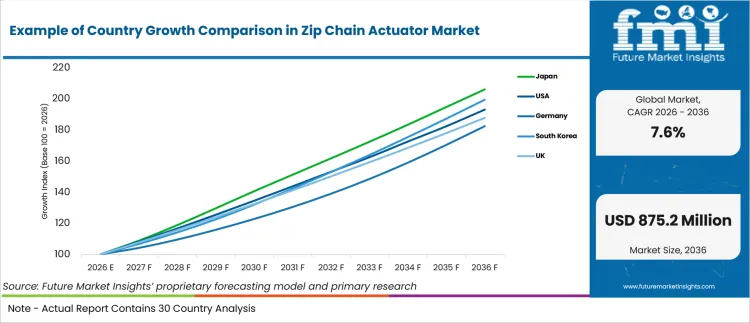
| Country | CAGR |
|---|---|
| Japan | 7.5% |
| United States | 6.8% |
| Germany | 6.2% |
| South Korea | 7.1% |
| UK | 6.5% |
How do country-level CAGRs compare in the Zip Chain Actuator Market?
The five forecasts form a gradual progression across a 1.3-point range rather than separate growth tiers. Japan and South Korea benefit from dense automation networks, while the United States and UK rely more heavily on regional integrators. Germany combines machine-building depth with formal technical acceptance, so similar rates can mask different service distances and approval responsibilities.
- Japan combines domestic motion-control expertise with machinery builders that expect detailed duty evidence during production acceptance.
- South Korea concentrates automated manufacturing within corridors that support rapid engineering response and dependable replacement service.
- United States projects benefit from experienced integrators, although dispersed facilities increase travel costs and spare-parts requirements.
- The UK combines specialist engineering with uneven automation adoption across smaller manufacturers and constrained capital budgets.
- Germany supports complex applications through machine-building expertise, but certification work and specialist labor can extend schedules.
Comparable CAGRs can still produce different revenue outcomes through varied installed bases and service models. The full report provides country-level CAGR analysis across North America, Latin America, Europe, East Asia, South Asia, Oceania and the Middle East and Africa.
Country-wise Analysis
- Japanese automotive plants use dense robot cells requiring compact fixture-lift and transfer axes during line changes. Japan is estimated to post 7.5% CAGR over the forecast period, supported by domestic motion-control engineering. The International Federation of Robotics reported in July 2025 that automakers installed about 13,000 industrial robots during 2024. Local expertise shortens application review, but safety documentation and duty validation remain necessary during final production approval.
- United States manufacturers depend on integrators that commission automated cells across widely separated facilities and manufacturing regions. By 2036, the United States is projected to grow at 6.8% CAGR, reinforced by industrial modernization. The International Federation of Robotics reported in June 2026 that the country installed 38,000 industrial robots during 2025. Regional service supports deployment, but distance raises spare-parts and response requirements across distributed operating sites.
- Germany combines machine-building depth with local rigid-chain and precision-drive engineering across specialized equipment projects and acceptance routes. Adoption of zip chain actuators is estimated to expand at 6.2% CAGR through 2036, underpinned by machinery demand. The International Federation of Robotics reported in September 2025 that Germany installed 26,982 industrial robots during 2024. Domestic engineering supports adoption, but certification and specialist labor can extend acceptance across project schedules.
- South Korea concentrates electronics and automotive production within corridors supporting rapid technical service across major production regions. Its zip chain actuator outlook is anticipated to advance at 7.1% CAGR over the assessment period, shaped by compact equipment requirements. Tsubakimoto Korea exhibited ZIP Chain Actuators at Smart Factory + Automation World in Seoul during March 2025. Direct product access supports trials, but local service capacity remains essential during unplanned production stoppages that threaten line availability and recovery schedules.
- UK manufacturers use specialist integrators for retrofits that must fit existing controls and limited machine space. Zip chain actuator sales are forecast to expand at 6.5% CAGR by 2036, aided by equipment modernization. The Office for National Statistics reported in March 2025 that 14% of manufacturing firms used robotics during 2023. Automation capability supports targeted projects, while skills and capital constraints restrict standardized volume across smaller manufacturing sites.
Who are the notable companies in the Zip Chain Actuator Market?
Tsubakimoto Chain, SERAPID Group, GROB GmbH Antriebstechnik, Framo Morat, iwis, Hengjiu Group, Gumptious Technology Co., and Power-Lift Limited are notable companies shaping the zip chain actuator market.
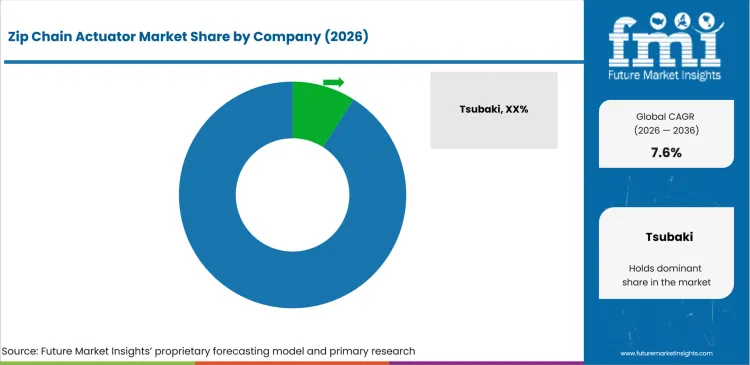
Zip chain actuator supply remains fragmented across proprietary platforms, custom drive specialists and regional manufacturers. Competition depends on load envelope, guidance engineering, control integration and service responsibility rather than company scale. Entry requires proven chain geometry plus application support for buckling and braking, while conveying equipment providers influence system design without entering actuator bids.
- Tsubakimoto Chain and SERAPID Group provide dedicated rigid-chain architectures for high-speed motion or heavy lifting, supported by proprietary chain geometry and field engineering.
- GROB, Framo Morat and Power-Lift Limited address long-stroke or heavy-lift systems through custom engineering that assigns guidance, synchronization and performance responsibility.
- iwis, Hengjiu Group and Gumptious Technology Co. widen sourcing through configurable systems, but equipment builders must compare dynamic load, environmental limits and service reach.
Competitive Benchmarking: Zip Chain Actuator Market
| Company | Heavy-Load Scope | Positioning Control | Compact Chain Storage | Geographic Reach |
|---|---|---|---|---|
| Tsubakimoto Chain | Medium | High | High | Global or multi-region |
| SERAPID Group | High | High | High | Global or multi-region |
| GROB GmbH Antriebstechnik | High | High | High | Europe and selected export markets |
| Framo Morat | High | High | High | Europe and selected export markets |
| iwis | Medium | Medium | High | Global or multi-region |
| Hengjiu Group | Medium | Medium | Medium | China and export markets |
| Gumptious Technology Co. | Medium | Medium | High | Taiwan and mainland China |
| Power-Lift Limited | High | Medium | High | United Kingdom and export markets |
Scoring basis: High denotes dedicated exact-market capability with documented commercial use, Medium denotes narrower direct support and Low denotes verified limited support. Geographic reach records the official operating footprint for each verified company profile across regions worldwide.
Key Developments in the Zip Chain Actuator Market
- In January 2026, Gumptious Technology Co. introduced the PKW rigid-chain system for long-stroke transmission inside confined automation equipment, reducing retraction space while retaining application-specific guidance and braking requirements.
- In March 2026, Framo Morat documented a Compacta linear-chain lifting mechanism inside GEBHARDT's KARIS autonomous mobile robot, extending rigid-chain demand into mobile intralogistics with coordinated payload and control validation.
- In November 2025, GROB completed final acceptance of an Ehingen stage system using four TC060 TowerChain units, moving a 22.5-ton dynamic load through overload, braking and safety-function tests.
- In February 2026, Gumptious Technology Co. introduced a rigid-chain lift platform for movement between floors, extending compact vertical travel for people and cargo within defined payload and stopping limits.
Zip Chain Actuator Market - Report Scope
| Coverage field | Report scope |
|---|---|
| Market breakdown | Actuator type, stroke length, load capacity, application, sales model, and region. |
| Market Definition | Electromechanical rigid-chain actuator assemblies that transmit compression and tension for controlled linear pushing, pulling or lifting. The scope includes standard and custom chain drives, motors and integrated controls sold with the actuator. |
| Regions Covered | North America, Latin America, Europe, East Asia, South Asia, Oceania, and Middle East and Africa. |
| Countries Covered | Japan, United States, Germany, South Korea and UK. |
| Key Companies Profiled | Tsubakimoto Chain, SERAPID Group, GROB GmbH Antriebstechnik, Framo Morat, iwis, Hengjiu Group, Gumptious Technology Co., and Power-Lift Limited. |
| Forecast Period | 2026 to 2036. |
| Approach | Hybrid bottom-up and top-down market sizing supported by primary interviews and official desk research. |
Zip Chain Actuator Market - Research Methodology
| Method | Approach |
|---|---|
| Primary Research | FMI analysts gathered input from manufacturers, service providers, technology developers, distributors, end users, procurement teams, and subject-matter experts. Interviews examined purchasing decisions, product or service evaluation, adoption barriers, approval requirements, pricing considerations, and expectations for technical or commercial support. Respondents were also asked what evidence is required before a trial, pilot, or initial order develops into regular purchasing. |
| Desk Research | Desk research covered government statistics, regulatory publications, trade data, industry associations, technical literature, standards, company filings, product information, and official corporate announcements. Sources were reviewed for relevance, publication date, geographic coverage, and consistency with the defined market scope. Claims relating to performance, applications, approvals, capacity, investment, and commercial activity were retained only when supported by credible public evidence. |
| Market Sizing and Forecasting | The market model combined the baseline value with historical performance, segment structure, pricing and volume indicators, adoption levels, company participation, and country-level demand conditions. Forecast assumptions considered economic activity, investment trends, regulatory developments, technology adoption, purchasing cycles, supply availability, and barriers to wider market use. Segment and regional estimates were reconciled before the final market total was calculated. |
| Data Validation | Estimates were checked against multiple independent indicators, including public data, company activity, trade patterns, industry developments, and findings from primary interviews. Validation also tested whether products, services, applications, and company revenues fell within the defined market boundaries. Adjacent categories, unsupported claims, overlapping revenues, and activities without direct market relevance were excluded to reduce double counting and maintain consistency across segments and countries. |
Zip Chain Actuator Market by Segments
Zip Chain Actuator Market segmented by Actuator Type:
- Push-pull Zip Chain Actuators
- Vertical Lift Actuators
- Horizontal Transfer Actuators
- Telescopic Zip Chain Actuators
Zip Chain Actuator Market segmented by Stroke Length:
- 500-1,500 mm
- <500 mm
- 1,500-3,000 mm
- >3,000 mm
Zip Chain Actuator Market segmented by Load Capacity:
- Medium Duty
- Light Duty
- Heavy Duty
Zip Chain Actuator Market segmented by Application:
- Automated Lifting
- Stage / Platform Motion
- Factory Automation
- Medical / Ergonomic Equipment
- Logistics Handling
Zip Chain Actuator Market segmented by Sales Model:
- Standard Units
- Custom Engineered Units
- Integrator Bundled
Zip Chain Actuator Market by Region:
- North America
- United States
- Canada
- Latin America
- Brazil
- Mexico
- Argentina
- Chile
- Western Europe
- Germany
- France
- United Kingdom
- Italy
- Spain
- Benelux
- Nordics
- Eastern Europe
- Poland
- Czech Republic
- Romania
- Hungary
- East Asia
- China
- Japan
- South Korea
- South Asia and Pacific
- India
- ASEAN
- Australia and New Zealand
- Middle East and Africa
- GCC Countries
- South Africa
- Türkiye
- Israel
Research Sources and Bibliography
- International Federation of Robotics. (2025, September 25). World Robotics 2025 report - INDUSTRIAL ROBOTS - released by IFR.
- International Federation of Robotics. (2025, September 25). World Robotics 2025 report - Industrial Robots released.
- International Federation of Robotics. (2025, July 15). Japan’s Car Industry has Highest Robot Installations in Five Years.
- International Federation of Robotics. (2026, June 18). US Robot Industry Returns to Double Digit Growth.
- International Organization for Standardization. (2025, February). ISO 10218-2:2025 - Robotics - Safety requirements - Part 2: Industrial robot applications and robot cells.
- Office for National Statistics. (2025, March 24). Management practices and the adoption of technology and artificial intelligence in UK firms: 2023.
- Tsubakimoto Chain Co. (2025). Shows and Events List.
- LBO France. (2025, October 21). SERAPID, expert in rigid chain technology for heavy load handling, enters a new phase of development with Capital Croissance becoming majority shareholder.
- GROB GmbH Antriebstechnik. (n.d.). What is a Linear Chain and where is it used?
- GROB GmbH Antriebstechnik. (n.d.). The Linear Chain saves wire harnesses from dying.
- GROB GmbH Antriebstechnik. (2025, November 27). Stage adjustment using a Tower Chain.
- Framo Morat. (2026, March 13). Drive solutions for intralogistics: Framo Morat at LogiMAT 2026.
- International Federation of Robotics. (2026, June 18). US Robot Industry Returns to Double Digit Growth.
- National Institute of Standards and Technology. (2025). Manufacturing USA Annual Report 2025.
- Gumptious Technology Co. (2026, January 21). High-Efficiency Transmission Solution Breaking Space Limitations - PKW Rigid Chain System.
- Gumptious Technology Co. (2026, February 12). Rigid Chain Lift Platform - Accessible Between Floors.
This bibliography is provided for reader reference and is not exhaustive. The full report contains the complete reference list and detailed citations
This Report Answers
- How large is the zip chain actuator market in 2026 and 2036?
- Which machinery constraints support investment in compact rigid-chain motion?
- Why do push-pull actuators account for the selected actuator type share?
- How does the 500-1,500 mm range balance travel and engineering effort?
- Why does medium duty fit repeatable industrial handling tasks?
- How do country growth routes differ across the five profiled markets?
- Which companies provide dedicated platforms, custom systems or configurable alternatives?
- What should engineers validate before approving a zip chain actuator?
Frequently Asked Questions
How big is the Zip Chain Actuator Market in 2026?
The zip chain actuator market is valued at USD 420.7 million in 2026 and is forecast to reach USD 875.2 million by 2036. Growth is supported by compact machine envelopes that require long push-pull travel without cylinder-length retraction space across dense industrial automation and robotics installations worldwide.
What is the CAGR of the Zip Chain Actuator Market from 2026 to 2036?
The zip chain actuator market grows at a CAGR of 7.6% between 2026 and 2036, supported by compact machinery needing long-stroke push-pull motion without hydraulic infrastructure, alongside a growing installed robotics base that sustains demand for auxiliary lifting and transfer axes.
Which actuator type leads the Zip Chain Actuator Market?
Push-pull zip chain actuators account for 34.0% of the zip chain actuator market by actuator type in 2026, driven by bidirectional force transmission within one compact mechanism that reduces drive duplication and preserves service access around press tooling and transfer equipment.
How much will the Zip Chain Actuator Market add between 2026 and 2036?
The zip chain actuator market is set to add USD 454.5 million between 2026 and 2036, growing from USD 420.7 million to USD 875.2 million as compact machinery and expanding industrial robotics installations sustain demand for space-efficient lifting and transfer axes worldwide.
Who are the leading companies in the Zip Chain Actuator Market?
Eight companies lead the zip chain actuator market, including Tsubakimoto Chain, SERAPID Group, GROB GmbH Antriebstechnik, Framo Morat, iwis, Hengjiu Group, Gumptious Technology Co., and Power-Lift Limited, competing through heavy-load scope, positioning control, and compact chain storage across global networks.
Preview the report firsthand - request a free sample
Get SampleGet the brochure for pricing and purchase details.
Get PDFTable of Content
- Key Takeaways
- Market Size and CAGR
- Top Growth Driver
- Fastest Growing Segment
- Leading Region
- Key Companies
- Emerging Opportunities
- Executive Summary
- Global Market Outlook
- Demand-side Trends
- Supply-side Trends
- Technology Roadmap Analysis
- Analysis and Recommendations
- Analyst Perspective (What is happening? Why now? What should investors know?)
- Key Questions Answered
- How large is the market?
- What is the CAGR?
- What are key trends?
- Which region dominates?
- Who are the leaders?
- Market Overview
- Market Coverage / Taxonomy
- Market Definition / Scope / Limitations
- Research Methodology
- Chapter Orientation
- Analytical Lens and Working Hypotheses
- Market Structure, Signals, and Trend Drivers
- Benchmarking and Cross-market Comparability
- Market Sizing, Forecasting, and Opportunity Mapping
- Research Design and Evidence Framework
- Desk Research Programme (Secondary Evidence)
- Expert Input and Fieldwork (Primary Evidence)
- Tooling, Models, and Reference Databases
- Data Engineering and Model Build
- Quality Assurance and Audit Trail
- Market Background
- Market Dynamics (Drivers, Restraints, Opportunity, Trends)
- Scenario Forecast (Optimistic, Likely, Conservative)
- Impact Analysis
- AI Impact
- Sustainability Impact
- Regulatory Impact
- Technology Impact
- Consumer / Buyer Analysis
- Purchase Drivers
- Adoption Barriers
- Buyer Journey
- Opportunity Map Analysis
- Product Life Cycle Analysis
- Supply Chain Analysis
- Investment Feasibility Matrix
- Value Chain Analysis
- PESTLE and Porter's Analysis
- Regulatory Landscape
- Regional Parent Market Outlook
- Production and Consumption Statistics
- Import and Export Statistics
- Global Market Analysis and Forecast, 2021 to 2036
- Historical Market Size Value (USD Million) Analysis, 2021 to 2025
- Current and Future Market Size Value (USD Million) Projections, 2026 to 2036
- Y-o-Y Growth Trend Analysis
- Absolute $ Opportunity Analysis
- Global Market Pricing Analysis, 2021 to 2036
- Global Market Analysis and Forecast, By Actuator Type, 2021 to 2036
- Introduction / Key Findings
- Historical Market Size Value (USD Million) Analysis By Actuator Type, 2021 to 2025
- Current and Future Market Size Value (USD Million) Analysis and Forecast By Actuator Type, 2026 to 2036
- Push-pull Zip Chain Actuators
- Vertical Lift Actuators
- Horizontal Transfer Actuators
- Telescopic Zip Chain Actuators
- Push-pull Zip Chain Actuators
- Y-o-Y Growth Trend Analysis By Actuator Type, 2021 to 2025
- Absolute $ Opportunity Analysis By Actuator Type, 2026 to 2036
- Global Market Analysis and Forecast, By Stroke Length, 2021 to 2036
- Introduction / Key Findings
- Historical Market Size Value (USD Million) Analysis By Stroke Length, 2021 to 2025
- Current and Future Market Size Value (USD Million) Analysis and Forecast By Stroke Length, 2026 to 2036
- 500-1,500 mm
- <500 mm
- 1,500-3,000 mm
- >3,000 mm
- 500-1,500 mm
- Y-o-Y Growth Trend Analysis By Stroke Length, 2021 to 2025
- Absolute $ Opportunity Analysis By Stroke Length, 2026 to 2036
- Global Market Analysis and Forecast, By Load Capacity, 2021 to 2036
- Introduction / Key Findings
- Historical Market Size Value (USD Million) Analysis By Load Capacity, 2021 to 2025
- Current and Future Market Size Value (USD Million) Analysis and Forecast By Load Capacity, 2026 to 2036
- Medium Duty
- Light Duty
- Heavy Duty
- Medium Duty
- Y-o-Y Growth Trend Analysis By Load Capacity, 2021 to 2025
- Absolute $ Opportunity Analysis By Load Capacity, 2026 to 2036
- Global Market Analysis and Forecast, By Application, 2021 to 2036
- Introduction / Key Findings
- Historical Market Size Value (USD Million) Analysis By Application, 2021 to 2025
- Current and Future Market Size Value (USD Million) Analysis and Forecast By Application, 2026 to 2036
- Automated Lifting
- Stage / Platform Motion
- Factory Automation
- Medical / Ergonomic Equipment
- Logistics Handling
- Automated Lifting
- Y-o-Y Growth Trend Analysis By Application, 2021 to 2025
- Absolute $ Opportunity Analysis By Application, 2026 to 2036
- Global Market Analysis and Forecast, By Sales Model, 2021 to 2036
- Introduction / Key Findings
- Historical Market Size Value (USD Million) Analysis By Sales Model, 2021 to 2025
- Current and Future Market Size Value (USD Million) Analysis and Forecast By Sales Model, 2026 to 2036
- Standard Units
- Custom Engineered Units
- Integrator Bundled
- Standard Units
- Y-o-Y Growth Trend Analysis By Sales Model, 2021 to 2025
- Absolute $ Opportunity Analysis By Sales Model, 2026 to 2036
- Global Market Analysis and Forecast, By Region, 2021 to 2036
- Introduction
- Historical Market Size Value (USD Million) Analysis By Region, 2021 to 2025
- Current Market Size Value (USD Million) Analysis and Forecast By Region, 2026 to 2036
- North America
- Latin America
- Western Europe
- Eastern Europe
- East Asia
- South Asia and Pacific
- Middle East & Africa
- Market Attractiveness Analysis By Region
- North America Market Analysis and Forecast, By Country, 2021 to 2036
- Historical Market Size Value (USD Million) Trend Analysis By Market Taxonomy, 2021 to 2025
- Market Size Value (USD Million) Forecast By Market Taxonomy, 2026 to 2036
- By Country
- USA
- Canada
- By Actuator Type
- By Stroke Length
- By Load Capacity
- By Application
- By Sales Model
- By Country
- Market Attractiveness Analysis
- By Country
- By Actuator Type
- By Stroke Length
- By Load Capacity
- By Application
- By Sales Model
- Key Takeaways
- Latin America Market Analysis and Forecast, By Country
- Historical Market Size Value (USD Million) Trend Analysis By Market Taxonomy, 2021 to 2025
- Market Size Value (USD Million) Forecast By Market Taxonomy, 2026 to 2036
- By Country
- Brazil
- Mexico
- Chile
- Rest of Latin America
- By Actuator Type
- By Stroke Length
- By Load Capacity
- By Application
- By Sales Model
- By Country
- Market Attractiveness Analysis
- By Country
- By Actuator Type
- By Stroke Length
- By Load Capacity
- By Application
- By Sales Model
- Key Takeaways
- Western Europe Market Analysis and Forecast, By Country
- Historical Market Size Value (USD Million) Trend Analysis By Market Taxonomy, 2021 to 2025
- Market Size Value (USD Million) Forecast By Market Taxonomy, 2026 to 2036
- By Country
- Germany
- UK
- Italy
- Spain
- France
- Nordic
- BENELUX
- Rest of Western Europe
- By Actuator Type
- By Stroke Length
- By Load Capacity
- By Application
- By Sales Model
- By Country
- Market Attractiveness Analysis
- By Country
- By Actuator Type
- By Stroke Length
- By Load Capacity
- By Application
- By Sales Model
- Key Takeaways
- Eastern Europe Market Analysis and Forecast, By Country
- Historical Market Size Value (USD Million) Trend Analysis By Market Taxonomy, 2021 to 2025
- Market Size Value (USD Million) Forecast By Market Taxonomy, 2026 to 2036
- By Country
- Russia
- Poland
- Hungary
- Balkan & Baltic
- Rest of Eastern Europe
- By Actuator Type
- By Stroke Length
- By Load Capacity
- By Application
- By Sales Model
- By Country
- Market Attractiveness Analysis
- By Country
- By Actuator Type
- By Stroke Length
- By Load Capacity
- By Application
- By Sales Model
- Key Takeaways
- East Asia Market Analysis and Forecast, By Country
- Historical Market Size Value (USD Million) Trend Analysis By Market Taxonomy, 2021 to 2025
- Market Size Value (USD Million) Forecast By Market Taxonomy, 2026 to 2036
- By Country
- China
- Japan
- South Korea
- By Actuator Type
- By Stroke Length
- By Load Capacity
- By Application
- By Sales Model
- By Country
- Market Attractiveness Analysis
- By Country
- By Actuator Type
- By Stroke Length
- By Load Capacity
- By Application
- By Sales Model
- Key Takeaways
- South Asia and Pacific Market Analysis and Forecast, By Country
- Historical Market Size Value (USD Million) Trend Analysis By Market Taxonomy, 2021 to 2025
- Market Size Value (USD Million) Forecast By Market Taxonomy, 2026 to 2036
- By Country
- India
- ASEAN
- Australia & New Zealand
- Rest of South Asia and Pacific
- By Actuator Type
- By Stroke Length
- By Load Capacity
- By Application
- By Sales Model
- By Country
- Market Attractiveness Analysis
- By Country
- By Actuator Type
- By Stroke Length
- By Load Capacity
- By Application
- By Sales Model
- Key Takeaways
- Middle East & Africa Market Analysis and Forecast, By Country
- Historical Market Size Value (USD Million) Trend Analysis By Market Taxonomy, 2021 to 2025
- Market Size Value (USD Million) Forecast By Market Taxonomy, 2026 to 2036
- By Country
- Kingdom of Saudi Arabia
- Other GCC Countries
- Türkiye
- South Africa
- Other African Union
- Rest of Middle East & Africa
- By Actuator Type
- By Stroke Length
- By Load Capacity
- By Application
- By Sales Model
- By Country
- Market Attractiveness Analysis
- By Country
- By Actuator Type
- By Stroke Length
- By Load Capacity
- By Application
- By Sales Model
- Key Takeaways
- Key Countries Market Analysis
- USA
- Pricing Analysis
- Market Share Analysis, 2025
- By Actuator Type
- By Stroke Length
- By Load Capacity
- By Application
- By Sales Model
- Canada
- Pricing Analysis
- Market Share Analysis, 2025
- By Actuator Type
- By Stroke Length
- By Load Capacity
- By Application
- By Sales Model
- Mexico
- Pricing Analysis
- Market Share Analysis, 2025
- By Actuator Type
- By Stroke Length
- By Load Capacity
- By Application
- By Sales Model
- Brazil
- Pricing Analysis
- Market Share Analysis, 2025
- By Actuator Type
- By Stroke Length
- By Load Capacity
- By Application
- By Sales Model
- Chile
- Pricing Analysis
- Market Share Analysis, 2025
- By Actuator Type
- By Stroke Length
- By Load Capacity
- By Application
- By Sales Model
- Germany
- Pricing Analysis
- Market Share Analysis, 2025
- By Actuator Type
- By Stroke Length
- By Load Capacity
- By Application
- By Sales Model
- UK
- Pricing Analysis
- Market Share Analysis, 2025
- By Actuator Type
- By Stroke Length
- By Load Capacity
- By Application
- By Sales Model
- Italy
- Pricing Analysis
- Market Share Analysis, 2025
- By Actuator Type
- By Stroke Length
- By Load Capacity
- By Application
- By Sales Model
- Spain
- Pricing Analysis
- Market Share Analysis, 2025
- By Actuator Type
- By Stroke Length
- By Load Capacity
- By Application
- By Sales Model
- France
- Pricing Analysis
- Market Share Analysis, 2025
- By Actuator Type
- By Stroke Length
- By Load Capacity
- By Application
- By Sales Model
- India
- Pricing Analysis
- Market Share Analysis, 2025
- By Actuator Type
- By Stroke Length
- By Load Capacity
- By Application
- By Sales Model
- ASEAN
- Pricing Analysis
- Market Share Analysis, 2025
- By Actuator Type
- By Stroke Length
- By Load Capacity
- By Application
- By Sales Model
- Australia & New Zealand
- Pricing Analysis
- Market Share Analysis, 2025
- By Actuator Type
- By Stroke Length
- By Load Capacity
- By Application
- By Sales Model
- China
- Pricing Analysis
- Market Share Analysis, 2025
- By Actuator Type
- By Stroke Length
- By Load Capacity
- By Application
- By Sales Model
- Japan
- Pricing Analysis
- Market Share Analysis, 2025
- By Actuator Type
- By Stroke Length
- By Load Capacity
- By Application
- By Sales Model
- South Korea
- Pricing Analysis
- Market Share Analysis, 2025
- By Actuator Type
- By Stroke Length
- By Load Capacity
- By Application
- By Sales Model
- Russia
- Pricing Analysis
- Market Share Analysis, 2025
- By Actuator Type
- By Stroke Length
- By Load Capacity
- By Application
- By Sales Model
- Poland
- Pricing Analysis
- Market Share Analysis, 2025
- By Actuator Type
- By Stroke Length
- By Load Capacity
- By Application
- By Sales Model
- Hungary
- Pricing Analysis
- Market Share Analysis, 2025
- By Actuator Type
- By Stroke Length
- By Load Capacity
- By Application
- By Sales Model
- Kingdom of Saudi Arabia
- Pricing Analysis
- Market Share Analysis, 2025
- By Actuator Type
- By Stroke Length
- By Load Capacity
- By Application
- By Sales Model
- Türkiye
- Pricing Analysis
- Market Share Analysis, 2025
- By Actuator Type
- By Stroke Length
- By Load Capacity
- By Application
- By Sales Model
- South Africa
- Pricing Analysis
- Market Share Analysis, 2025
- By Actuator Type
- By Stroke Length
- By Load Capacity
- By Application
- By Sales Model
- USA
- Market Structure Analysis
- Competition Dashboard
- Competition Benchmarking
- Market Share Analysis of Top Players
- By Regional
- By Actuator Type
- By Stroke Length
- By Load Capacity
- By Application
- By Sales Model
- Emerging Startups
- Innovation Benchmarking
- Competition Analysis
- Competition Deep Dive
- Tsubaki
- Overview
- Product Portfolio
- Profitability by Market Segments
- Sales Footprint
- Strategy Overview
- Marketing Strategy
- Product Strategy
- Channel Strategy
- Serapid
- Framo Morat
- Grob GmbH
- Joyce Dayton
- Thomson Industries
- Duff-Norton
- Nook Industries
- Linak
- ZIMM
- Tsubaki
- Case Studies
- Success Stories
- Recent Developments
- Competition Deep Dive
- Assumptions & Acronyms Used


