

- Industry Size (2026)
- USD 5.44 Bn
- Forecast (2036)
- USD 10.12 Bn
- CAGR (2026 to 2036)
- 6.4%
Butter and Margarine Market Size, Market Forecast and Outlook By FMI
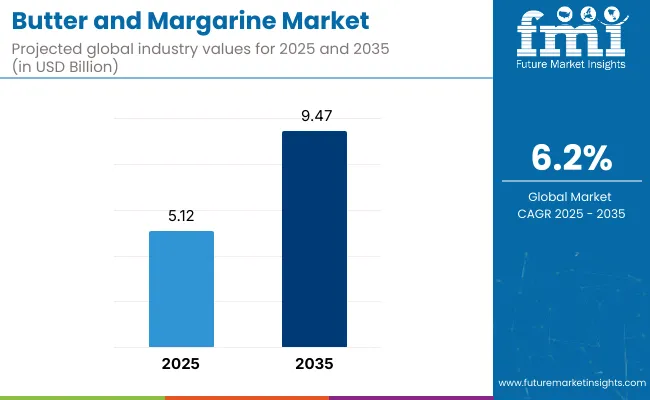
The butter and margarine industry is expected to reach a valuation of USD 5.44 billion in 2026, supported by rising demand for versatile cooking fats and strong expansion of the bakery sector across major regions. Revenue from butter and margarine sales is projected to grow at a steady CAGR of 6.4% through 2036, lifting the overall industry value to over USD 10.12 billion by the end of the forecast period. Rapid urbanization and shifting dietary preferences, as per FMI’s projection, continue to serve as the primary drivers shaping this growth trajectory.
Processing facilities are directing significant capital toward production innovation, targeting texture enhancement through sophisticated churning methodologies while preserving nutritional integrity. Manufacturing specialists now pivot from elementary spreading uses toward customized culinary applications, reshaping fat utilization trends throughout industrialized regions. These technological advances motivate food companies to develop extensive dairy fat ranges employing improved preservation techniques.
Quick Stats for Butter and Margarine Market
- Butter and Margarine Industry Value (2026): USD 5.44 Billion
- Butter and Margarine Industry Forecast Value (2036): USD 10.12 Billion
- Butter and Margarine Industry Forecast CAGR: 6.4%
- Butter and Margarine Industry Leading Type: Traditional (44%)
- Butter and Margarine Industry Key Growth Regions: USA, Germany, India
- Butter and Margarine Industry Key Players: Arla Foods, Dean Foods Company, Farmers' Cooperative Creamery, OJSC Creative Group, AMUL India
Scientific teams merge fat crystallization knowledge with emulsification advances to enhance spreadable properties. Organic dairy processing development gains traction, responding to clean-label demands within premium segments. Attention turns toward integrated fat performance approaches that balance melting characteristics alongside taste preservation. Packaging innovations enable producers to maximize shelf stability with precision, improving distribution reach while minimizing spoilage. Such breakthroughs prove crucial in creating tomorrow's landscape where butter and margarine achieve uniform excellence across varied uses.
Butter and Margarine Market Key Takeaways
| Metric | Value |
|---|---|
| Industry Size (2026) | USD 5.44 Billion |
| Industry Value (2036) | USD 10.12 Billion |
| CAGR (2026-2036) | 6.4% |
Source: Future Market Insights’ proprietary forecasting model and primary research
What Drivers Are Accelerating Traditional Fat Product Adoption?
Culinary authenticity movements propel widespread embrace of established dairy fats. Production improvements in churning have enhanced manufacturing protocols through butterfat preservation during processing operations. Traditional methods attract consumers desiring recognizable flavor characteristics with proven cooking heritage. Scientific advances combining conventional fats with contemporary packaging extend storage capabilities within retail segments. Culinary education emphasizing natural dairy fat advantages promotes chef approval. Food service establishments leverage these developments by featuring traditional butter in high-end cooking experiences. Commercial facilities now incorporate historical production techniques while maintaining safety compliance.
How Is the Butter and Margarine Market Segmented Across Key Categories?
International markets divide comprehensively to serve culinary industry requirements, organizing sectors through product classification, application use, manufacturing processes, and sales channels. This structural approach enables participants to pinpoint targeted applications, including increased spreadable format demand in consumer markets or all-purpose preference in professional kitchens. Through segment evaluation, producers can customize manufacturing to address household versus commercial food service requirements. Market division also reveals transitions from basic commodity fat trading toward application-specific product development. Industry maturation makes detailed segmentation vital for understanding purchasing behavior and quality demands, ensuring development matches evolving cooking standards.
Why Do Traditional Types Maintain Dominance?
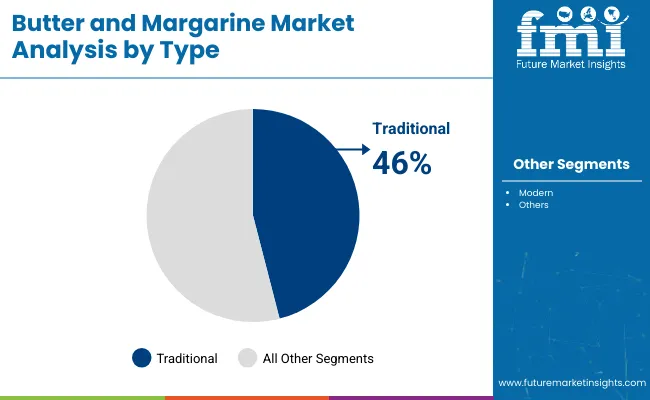
Traditional varieties capture 44% market presence in 2026 through consumer loyalty toward familiar tastes and proven cooking results. Market leadership stems from established production delivering consistent quality despite seasonal fluctuations. This segment profits from ongoing processing enhancements, including temperature management optimizing fat crystal development. Traditional butter maturation research revitalizes artisan producer interest. Classic baking integration strengthens market position, as these products provide reliable outcomes at conventional usage rates. Culinary authenticity priorities sustain traditional butter and margarine demand.
Why Are Spreadable Applications the Preferred Usage?
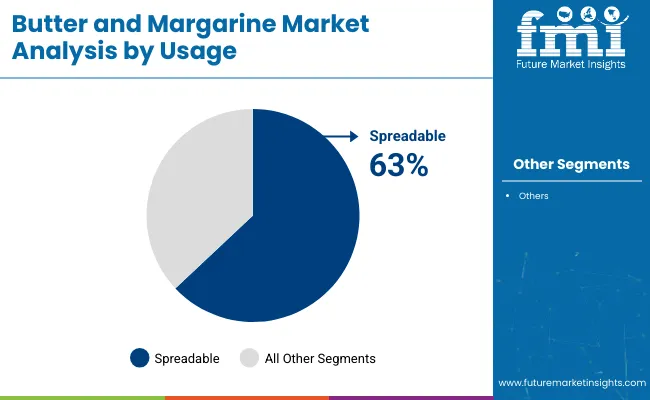
Spreadable uses dominate with 65% sector share in 2026, demonstrating consumer preference for immediate convenience and kitchen versatility. Market control connects to superior texture enabling smooth application across bread varieties and temperature ranges. Manufacturers employ specialized processing for optimal consistency during storage. These applications deliver instant meal solutions for busy consumers, establishing retail brand importance. Continuous spreadability improvements maintain refrigerated product preference. Frequent usage patterns require flexible packaging, supporting dairy processor revenues.
Why Does Traditional Type Lead Product Categories?
Traditional classification holds 44% market share in 2026 through widespread acceptance demanding authentic dairy experiences. Leadership follows culinary recommendations for traditional fats across cooking applications achieving optimal flavors. Food enthusiasts choose these products for dependable performance and recipe compatibility. Professional baking usage drives commercial establishment volume increases. Multiple cooking method compatibility enables application adaptability across preparation styles. Traditional production focus secures valuable culinary partnerships.
How Will Plant-Based Alternatives Impact Traditional Products?
Plant-based trends reshape portfolios by requiring dairy-free alternatives. Vegan lifestyle adoption enables plant oil processing with comparable performance for lactose-sensitive consumers. Ethical consumption shifts create demand addressing environmental responsibilities simultaneously. Companies lacking inclusive positioning lose environmentally-aware consumer visibility. Coconut and olive oil alternatives for specialized uses drive complementary products. Hybrid formulation innovations stimulate plant-animal fat blend optimization.
How Will Health Consciousness Transform Product Development?
Health awareness revolutionizes composition by emphasizing reduced saturated content. Nutritional enhancement integration enables fortified product delivery throughout retail networks. Dietary education drives sodium reduction with nutritionist recommendations for lower salt formulations. Processing expansion offers trans-fat-free alternatives versus conventional hydrogenated options. Health applications featuring nutrition tracking create wellness-focused consumption engagement.
How Will Retail Evolution Affect Market Growth?
Retail transformations create producer opportunities and challenges. Advanced refrigeration requires consistent cold chain management while preserving quality. Private label retail developments enable competitive pricing and market differentiation. International retail growth facilitates global brand penetration. Increasing quality requirements force traceability food system investments validating production claims.
How Will the Butter and Margarine Industry Evolve in Major Nations?
Worldwide butter and margarine markets reflect diverse culinary heritages, shaped by dairy consumption habits and preparation methods. Mature markets emphasize premium quality with artisanal techniques, while developing economies prioritize affordability and basic cooking needs. Asia-Pacific emerges as growth center through Western food integration and commercial baking expansion. European markets shift toward organic production with traditional processing. Developing nation government support for dairy development maintains butter and margarine demand across demographics.
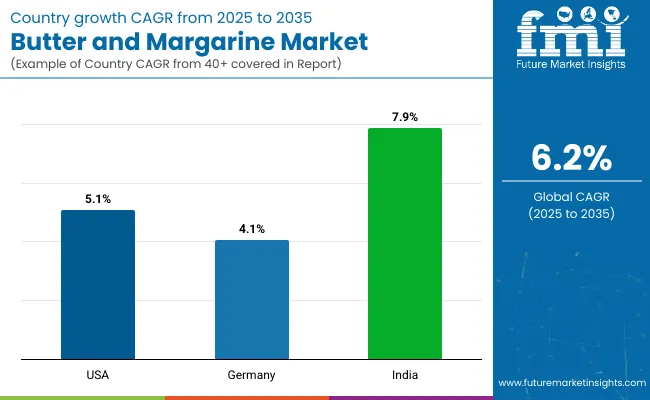
| Country | CAGR (2026 to 2036) |
|---|---|
| USA | 4.8% |
| Germany | 3.7% |
| India | 6.9% |
| Brazil | 5.2% |
| China | 4.3% |
| UK | 3.9% |
Source: Future Market Insights analysis, supported by a proprietary forecasting model and primary research
Why is the Butter and Margarine Industry in USA Growing?
American butter and margarine sales will expand 4.8% CAGR through 2036. Growth stems from established dairy systems and artisanal baking popularity among consumers. Premium positioning emphasizing grass-fed sources and specialty margarines fuels expansion, and FMI is of the opinion that quality differentiation is becoming central to brand competitiveness. Health awareness increases organic butter consumption among quality-focused buyers. Major cooperatives developing direct sales streamline distribution while reducing retail costs. Farm-to-table movements with traceable sourcing maintain USA leadership in premium products.
Why is the Butter and Margarine Sector in Germany Expanding?
German butter and margarine demand grows 3.7% CAGR during assessment timeframe. Organic production initiatives and traditional methods create premium product environments. Eco-friendly packaging investments advantage environmentally-conscious brands. Quality-focused populations demanding authentic dairy prompt artisanal butter development. Government sustainable dairy policies accelerate organic adoption across urban markets, improving environmental standards.
Why is the Butter and Margarine Industry in India Showing Potential?
Indian butter and margarine sectors prepare for 6.9% CAGR expansion. Growth attributes to Western baking technique adoption among city populations. Government dairy modernization supporting rural development encourages advanced processing. Local cooperative partnerships with food services ensure quality butter availability. Economic expansion with middle class growth attracts modern processing investments. Agricultural frameworks ensuring milk quality build consumer confidence.
Why is the Butter and Margarine Industry in Brazil Growing?
Brazilian butter and margarine products anticipate 5.2% CAGR growth. Abundant dairy resources support large production capabilities. Bakery consumption increases drive commercial-grade product demand. Modern processing adoption creates steady domestic supply. Dairy research standards and export quality prompt technology investments. Regional cuisine preservation and tradition maintain Latin American production leadership.
Why is the Butter and Margarine Sector in China Expanding?
Chinese butter and margarine revenue expects 4.3% CAGR advancement. Rapid urbanization supports Western food pattern adoption. Hotel and restaurant growth drives professional cooking fat demand. Moderate dairy and bakery adoption generates food service revenues. International company presence develops quality standards and distribution. Food safety regulations and import controls maintain cost-competitive import positioning.
What is the Competitive Outlook for the Butter and Margarine Market?
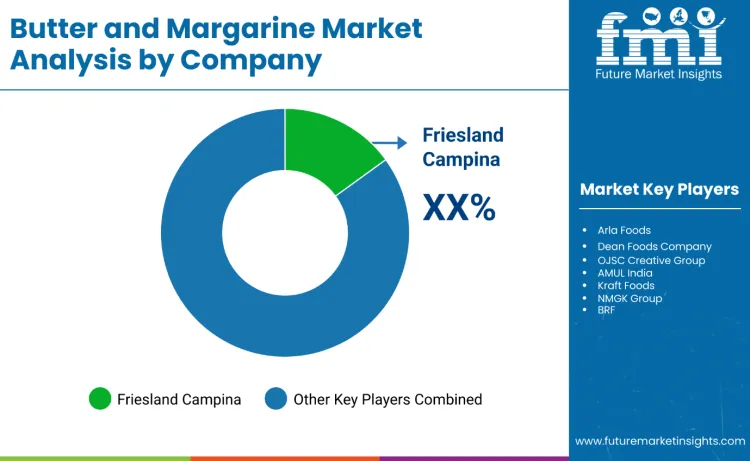
Market competitors increasingly emphasize production innovation for dairy fat differentiation. Industry leaders including Arla Foods and AMUL India invest in dairy science partnerships for processing optimization research. Organic certification platform development meets consumer natural ingredient demands with premium marketing. Strategic bakery chain partnerships secure consistent bulk purchasing for commercial uses.
Innovation drives competitive advancement through novel packaging for preservation and convenience, as per FMI’s projection. Moderate consolidation as specialty dairy companies acquire distribution channels against established conglomerates. Arla Foods maintains significant presence through cooperative structure and sustainable sourcing investments.
Key Players in Butter and Margarine Market
- Arla Foods
- Dean Foods Company
- Farmers' Cooperative Creamery
- OJSC Creative Group
- AMUL India
- Kraft Foods
- Friesland Campina
- NMGK Group
- BRF
- Groupo Lala
Scope of Report
| Items | Values |
|---|---|
| Quantitative Units | USD Billion |
| Type Segments | Traditional; Modern |
| Usage Categories | Spreadable; All Purpose |
| Processing Method Types | Churned; Blended; Cultured; Salted; Unsalted |
| Regions Covered | North America, Europe, East Asia, South Asia, Latin America, Middle East & Africa |
| Key Countries | USA, Germany, India, Brazil, China, UK |
| Key Companies Profiled | Arla Foods; Dean Foods Company; Farmers' Cooperative Creamery; OJSC Creative Group; AMUL India; Kraft Foods; Friesland Campina; NMGK Group; BRF; Groupo Lala |
| Additional Attributes | Dollar sales measured for butter and margarine products used in culinary applications and food manufacturing, specified by fat content type (full-fat, reduced-fat, light), processing method preference (traditional vs. industrial), application focus (baking, cooking, spreading), end-user model (retail vs. food service), and compliance alignment with evolving dairy standards and food safety regulations. |
Butter and Margarine Market by Segments
Type
- Traditional
- Modern
Usage
- Spreadable
- All Purpose
Processing Method
- Churned
- Blended
- Cultured
- Salted
- Unsalted
Bibliography
- International Dairy Federation. (2024). Global butter and fat‑based spread production trends, processing standards, and quality frameworks.
- European Dairy Association. (2024). Butter and margarine manufacturing practices, organic production trends, and market positioning in Europe.
- International Food & Beverage Alliance. (2024). Fat ingredient utilization trends across bakery, culinary, and processed food applications.
Frequently Asked Questions
How big is the butter and margarine market in 2026?
The butter and margarine industry is valued at USD 5.44 billion in 2026.
What will be the size of the butter and margarine market in 2036?
The butter and margarine market is projected to reach USD 10.12 billion by 2036.
How much will the butter and margarine market grow between 2026 and 2036?
The market is expected to expand at a CAGR of 6.4% during the 2026 to 2036 forecast period.
Which type segment leads the butter and margarine market?
Traditional type leads the product category, accounting for 44% share in 2026.
Which usage segment holds the dominant share in the butter and margarine market?
Spreadable usage dominates the market landscape with a 65% share in 2026.
Preview the report firsthand - request a free sample
Get SampleGet the brochure for pricing and purchase details.
Get PDFTable of Content
- Executive Summary
- Global Market Outlook
- Demand-side Trends
- Supply-side Trends
- Technology Roadmap Analysis
- Analysis and Recommendations
- Market Overview
- Market Coverage / Taxonomy
- Market Definition / Scope / Limitations
- Market Background
- Market Dynamics
- Drivers
- Restraints
- Opportunity
- Trends
- Scenario Forecast
- Demand in Optimistic Scenario
- Demand in Likely Scenario
- Demand in Conservative Scenario
- Opportunity Map Analysis
- Product Life Cycle Analysis
- Supply Chain Analysis
- Investment Feasibility Matrix
- Value Chain Analysis
- PESTLE and Porter’s Analysis
- Regulatory Landscape
- Regional Parent Market Outlook
- Production and Consumption Statistics
- Import and Export Statistics
- Market Dynamics
- Global Market Analysis 2020 to 2025 and Forecast, 2026 to 2036
- Historical Market Size Value (USD Million) Analysis, 2020 to 2025
- Current and Future Market Size Value (USD Million) Projections, 2026 to 2036
- Y-o-Y Growth Trend Analysis
- Absolute $ Opportunity Analysis
- Global Market Pricing Analysis 2020 to 2025 and Forecast 2026 to 2036
- Global Market Analysis 2020 to 2025 and Forecast 2026 to 2036, By Type
- Introduction / Key Findings
- Historical Market Size Value (USD Million) Analysis By Type, 2020 to 2025
- Current and Future Market Size Value (USD Million) Analysis and Forecast By Type, 2026 to 2036
- Traditional
- Modern
- Y-o-Y Growth Trend Analysis By Type, 2020 to 2025
- Absolute $ Opportunity Analysis By Type, 2026 to 2036
- Global Market Analysis 2020 to 2025 and Forecast 2026 to 2036, By Usage
- Introduction / Key Findings
- Historical Market Size Value (USD Million) Analysis By Usage, 2020 to 2025
- Current and Future Market Size Value (USD Million) Analysis and Forecast By Usage, 2026 to 2036
- Spreadable
- All Purpose
- Y-o-Y Growth Trend Analysis By Usage, 2020 to 2025
- Absolute $ Opportunity Analysis By Usage, 2026 to 2036
- Global Market Analysis 2020 to 2025 and Forecast 2026 to 2036, By Processing Method
- Introduction / Key Findings
- Historical Market Size Value (USD Million) Analysis By Processing Method, 2020 to 2025
- Current and Future Market Size Value (USD Million) Analysis and Forecast By Processing Method, 2026 to 2036
- Churned
- Blended
- Cultured
- Salted
- Unsalted
- Y-o-Y Growth Trend Analysis By Processing Method, 2020 to 2025
- Absolute $ Opportunity Analysis By Processing Method, 2026 to 2036
- Market Structure Analysis
- Competition Dashboard
- Competition Benchmarking
- Market Share Analysis of Top Players
- By Regional
- By Type
- By Usage
- By Processing Method
- Competition Analysis
- Competition Deep Dive
- Arla Foods
- Overview
- Product Portfolio
- Profitability by Market Segments (Product/Age /Sales Channel/Region)
- Sales Footprint
- Strategy Overview
- Marketing Strategy
- Product Strategy
- Channel Strategy
- Dean Foods Company
- Farmers’ Cooperative Creamery
- OJSC Creative Group
- AMUL India
- Arla Foods
- Competition Deep Dive
- Assumptions & Acronyms Used
- Research Methodology


