

- Market Size (2026)
- USD 1.3 Bn
- Forecast (2036)
- USD 2.2 Bn
- CAGR (2026 to 2036)
- 5.4%
Imitation Whipped Cream Market Size, Market Forecast and Outlook By FMI
Summary of the Imitation Whipped Cream Market
- Demand and Growth Drivers
- Bakery chains use imitation whipped cream to control topping cost and keep cake finishing stable across repeat orders.
- Lactose-sensitive households and vegan dessert shoppers support retail movement for dairy-free toppings in chilled and shelf-stable formats.
- Foodservice dessert teams prefer products with longer storage life as waste control affects daily menu planning.
- Product and Segment View
- Conventional products lead nature demand since standard formulas stay easier to price for routine bakery and café use.
- Powder formats lead form demand as dry storage and simple reconstitution reduce handling pressure for commercial kitchens.
- Vegetable oil-based formulations hold the strongest ingredient base position since they support stable aeration and lower input cost.
- Geography and Competitive Outlook
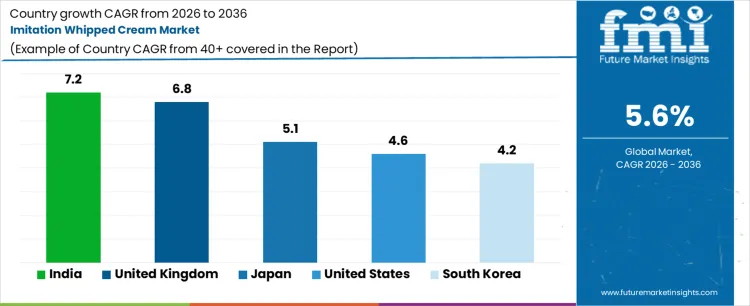
- India leads the country growth set as bakery expansion and dairy-free dessert awareness lift adoption in urban outlets.
- The United Kingdom follows as vegan dessert culture and supermarket alternative dairy shelves support product trial.
- Kraft Heinz and Rich Products compete through retail reach. Puratos along with Nestlé and Danone add formulation support. Kerry adds ingredient depth.
- Analyst Opinion
- Nandini Roy Choudhury, Principal Analyst for Food and Beverages at FMI, observes, “Imitation whipped cream demand remains aligned with cost control and reliable dessert finish. Bakery teams choose these products because they need stable foam and repeat taste without higher dairy cream exposure. The 2036 outlook should depend on powder formats and foodservice dessert menus. Dairy-free retail packs add to sector demand. Suppliers with clean labels and strong texture support should hold a better position with professional bakeries.”
- Imitation Whipped Cream Market Value Analysis
- Revenue growth is driven by bakery desserts as cakes and pastries create repeat topping demand across commercial outlets.
- Powdered products support value retention since dry storage lowers waste and simplifies transport for distributors.
- Foodservice demand increases volume as cafés and dessert shops need consistent topping output throughout the day.
- Retail packs add value as households buy dairy-free toppings for home cakes and chilled desserts.
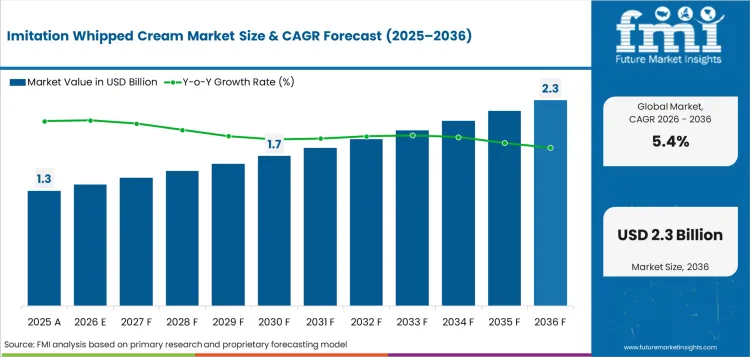
Key Takeaways
| Metric | Value |
|---|---|
| Market Size (2025) | USD 1.2 Billion |
| Market Size (2036) | USD 2.2 Billion |
| CAGR (2026–2036) | 5.4% |
| Incremental Opportunity (2026–2036) | USD 0.9 Billion |
| Leading Nature (2026) | Conventional Products |
| Conventional Products Share (2026) | 82.0% |
| Fastest-Growing Country | India |
| India CAGR | 7.2% |
| 2nd Fastest-Growing Country | United Kingdom |
| United Kingdom CAGR | 6.8% |
Imitation Whipped Cream Market Definition
The imitation whipped cream sector covers non-dairy or dairy-reduced topping products formulated to mimic whipped cream texture and appearance. Products usually use vegetable fats and stabilizers. Sweeteners help create foam for cakes and desserts. Scope includes powder and liquid formats sold to bakeries and cafés. Restaurants and food processors are counted through pack sales. Retailers and households are counted through retail movement. Products counted in this study include conventional and organic formats. Direct dairy whipped cream and fresh cream are outside this boundary unless sold as imitation whipped topping blends.
Imitation Whipped Cream Market Inclusions
Included products cover powder mixes and liquid toppings. Ready-to-whip bases and blended non-dairy cream alternatives are counted as dessert finishing inputs. Scope includes foodservice supply and retail grocery. Online stores and direct bakery supply are included. Ingredient distribution is included. Included applications cover cakes and pastries. Beverages and chilled desserts are counted. Plated desserts and frozen dessert toppings are counted. Ingredient bases include vegetable oil and soy. Coconut and almond bases are included. Oat alternatives are included if sold as imitation whipped cream or topping.
Imitation Whipped Cream Market Exclusions
Excluded products include fresh dairy whipping cream and buttercream frosting. Non-edible cake décor and aerosol dairy cream are outside scope. Base bakery ingredients are excluded if sold without whipped topping use. General plant-based milk and coffee creamer products are excluded unless sold for whipped dessert topping use. Bakery machinery and aeration equipment are outside scope. Sauces and syrups are excluded. Fruit purées and chocolate coatings are excluded unless packaged as imitation whipped cream substitutes. Cream cheese and dairy dessert bases are outside scope unless positioned as whipped topping replacements.
Imitation Whipped Cream Market Research Methodology
- Primary Research: FMI analysts reviewed inputs from whipped topping manufacturers, bakery ingredient suppliers, foodservice distributors, and retail dessert teams active in imitation whipped cream trade.
- Desk Research: The study used company materials and public food industry references. Product launch updates and ingredient documents were reviewed for dairy-free whipped topping use.
- Market Sizing and Forecasting: Baseline values were built from supplied market inputs and aligned with nature mix, form demand, application use, and country growth patterns.
- Data Validation and Update Cycle: Forecasts were checked against segment shares, company presence, product availability, and country growth patterns across the imitation whipped cream industry.
Why is the Imitation Whipped Cream Market Growing?
- Bakery and dessert outlets need toppings that hold shape during display and service without raising dairy cream cost.
- Dairy-free dessert demand is expanding as lactose-sensitive shoppers and vegan households seek easier topping options.
- Powder formats help distributors and commercial kitchens reduce storage pressure across long-distance supply routes.
Bakery demand supports this sector because cake finishing needs speed and consistency. Dairy cream can deliver taste but requires tighter cold handling and shorter usage periods. Imitation whipped cream offers bakeries a more predictable option for daily output. Commercial kitchens gain from products that can be stored longer and prepared only as needed. Longer storage helps reduce waste in outlets that face uneven dessert traffic. Similar whipped topping concentrate demand supports the same pattern in professional kitchens.
Dietary choice raises sector demand. Vegan shoppers and lactose-sensitive households create prospects for non-dairy topping lines in retail freezers and bakery counters. Flexitarian dessert use adds to sector expansion. Texture and taste influence repeat use. Label comfort influences repeat purchase. Suppliers improving foam stability and reducing artificial ingredients should gain better shelf access. Dry cream substitute prospects mirror the same shift toward shelf-stable cream alternatives.
Format choice affects adoption because powder mixes are easier to store than liquid toppings and can be prepared close to use. This helps small bakeries and foodservice dessert teams manage inventory without extra cold-chain pressure. Liquid formats retain revenue in outlets requiring fast whipping and smoother preparation. Ingredient suppliers that support both formats can serve retail packs and professional kitchens without forcing a single handling system.
Market Segmentation Analysis
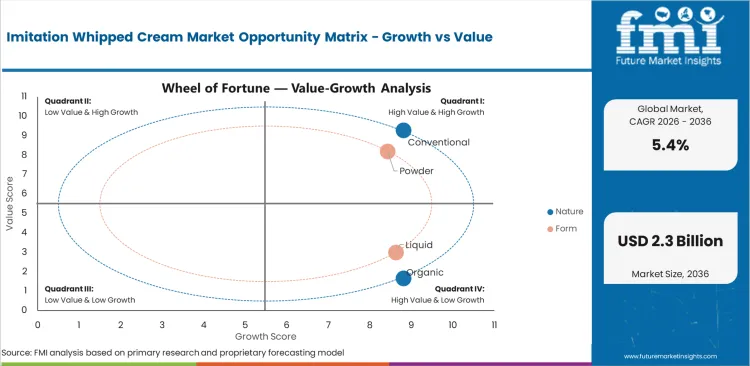
- Conventional products are projected to lead nature demand with 82.0% share in 2026 due to standard formulations supporting lower price points.
- Powder forms are expected to lead form demand with 78.0% share in 2026 since dry storage fulfils long shelf-life requirements.
- Bakery and desserts are estimated to lead application demand with 46.0% share in 2026 as cakes use topping volume repeatedly.
- Foodservice is estimated to lead sales channel demand with 39.0% share in 2026 as cafés and restaurants need steady dessert finishing inputs.
Segment structure in this sector tracks nature and form as demand shifts across bakery, dessert, and beverage preparation. Source base and application add to sector demand since vegetable oil-based toppings and bakery use create a large share of routine volume. Foodservice outlets favor powder formats because storage life and reconstitution control support daily topping preparation. Bakery teams and cafe operators shape buying patterns through texture checks and recipe trials before repeat ordering. Larger bakery chains move through foodservice supply contracts while household packs sell through supermarkets and online retail.
Imitation Whipped Cream Market Analysis by Nature
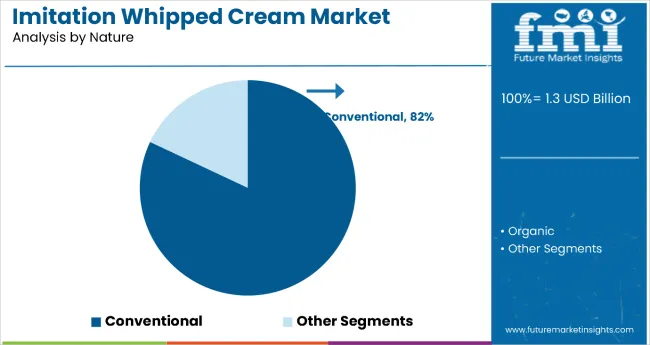
- Conventional imitation whipped cream is expected to account for 82.0% share of nature demand in 2026 due to standard formulas offering lower cost and wider availability for routine bakery use. Foodservice dessert teams often choose conventional products as they require consistent foam and predictable sweetness across high-volume cake finishing.
- Organic products are forecast to advance from a smaller base as premium bakeries and health-led retail shelves test cleaner topping lines. Conventional leadership should remain firm because regular cakes and buffet desserts remain price-sensitive.
Insights into the Organic Segment
-
Organic imitation whipped cream is likely to gain measured adoption through premium retail and specialist bakery channels. Higher ingredient cost limits adoption in standard dessert use. Organic labels support premium shelf placement if taste and foam stability align with conventional alternatives.
- Adoption will depend on supplier ability to offer clean ingredient lists without reducing whipping performance. Bakery cafes serving premium cakes may test organic lines first because they can recover higher input cost through dessert pricing.
Imitation Whipped Cream Market Analysis by Form
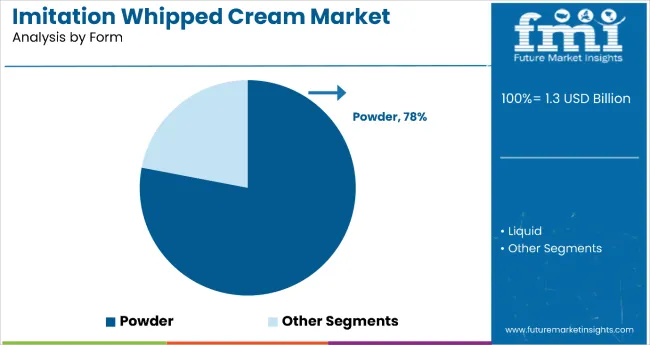
- Powder imitation whipped cream is projected to contribute 78.0% share of form demand in 2026 due to dry mixes offering long storage life and easier transport. High use of reconstitution in bakeries and foodservice kitchens that need batch control supports adoption.
- Powder reduces spoilage risk during distribution. Liquid formats keep demand in professional kitchens that need quick preparation and smoother blending. Powder leadership is set to continue as emerging markets add bakery outlets with limited cold storage capacity.
Insights into the Liquid Segment
- Liquid imitation whipped cream is expected to retain use in outlets that require faster preparation and smoother whipping. Larger bakeries often use liquid toppings to reduce mixing time during peak cake production.
- Liquid products are projected to influence premium mouthfeel in cafés and patisseries. Suppliers with dependable cold-chain access are likely to retain business in cities with dense bakery and café demand.
Imitation Whipped Cream Market Analysis by Application
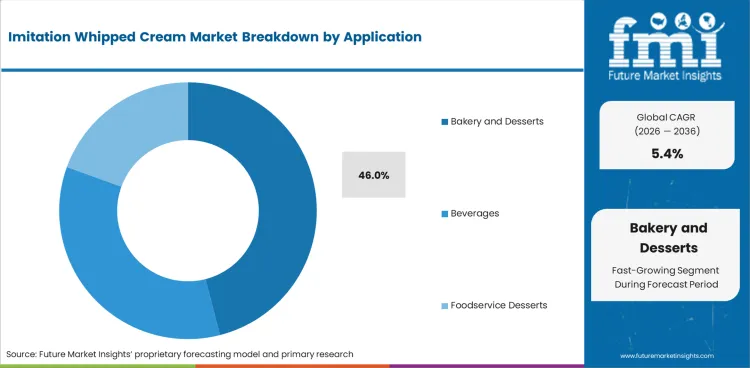
- Bakery and desserts are estimated to hold 46.0% share of application demand in 2026 as cakes and pastries require regular topping use. Repeat demand comes from celebration cakes and commercial pastry production.
- Beverage toppings add volume through coffee chains and cafe menus. Frozen desserts use whipped topping as a finishing input. Retail home baking stays active during festive periods. Commercial bakery use creates steadier yearly movement.
Insights into the Beverage Segment
- Beverage use should expand as cafés add cold coffees and shakes. Dessert drinks add another use case for stable topping. Foam stability affects repeat purchase as drinks often spend time in takeaway cups before consumption.
- Powder and liquid formats support this requirement. Powder helps with inventory control in smaller cafes. Liquid toppings support faster service in high-traffic outlets. Urban cafe clusters and branded dessert beverage chains should sustain beverage use.
Imitation Whipped Cream Market Analysis by Sales Channel
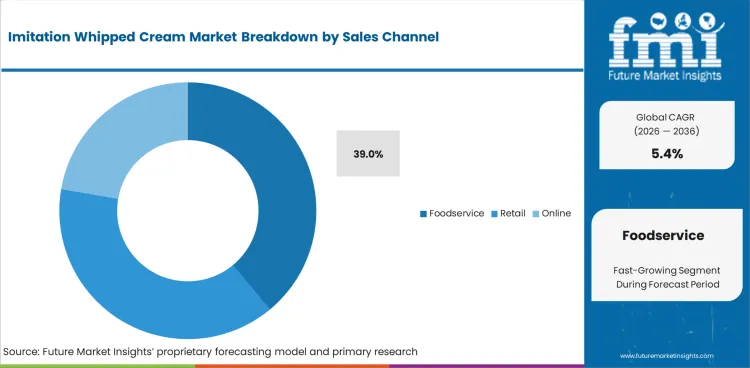
- Foodservice is estimated to secure 39.0% share of sales channel demand in 2026 due to restaurants and cafes adopting whipped toppings in repeated menu preparation. The need for consistent dessert finishing during regular service influences channel demand.
- Retail follows through supermarkets and grocery chains that sell household packs. Direct supply supports larger bakery accounts. Online sales grow from a smaller base as home bakers buy specialty dairy-free topping options.
Insights into the Retail Segment
- Retail sales are anticipated to grow as households buy imitation whipped cream for home cakes and chilled desserts. Supermarkets help product trial by placing dairy-free toppings near dessert mixes and frozen sweet goods.
- Private label can create price pressure in standard packs. Branded products are likely to defend shelf space through better taste and texture claims. Online grocery adds access for specialty products that do not receive large physical shelf allocation.
Imitation Whipped Cream Market Analysis by Ingredient Base
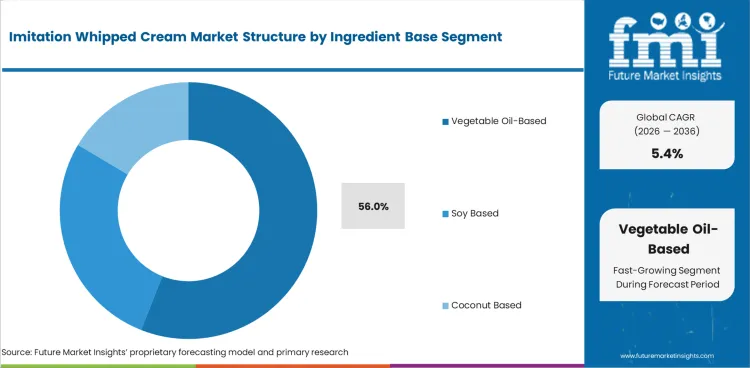
- Vegetable oil-based products are estimated to represent 56.0% share of ingredient base demand in 2026 as they balance cost and foam stability.
- Soy and coconut bases serve dairy-free label needs. Almond and oat bases support premium alternatives. Ingredient choice is predicted to remain linked to price control and taste performance rather than plant label claims alone.
Insights into the Coconut Based Segment
- Coconut-based imitation whipped cream is likely to gain in premium dairy-free dessert lines. Coconut supports richer mouthfeel and a familiar plant-based taste profile. Coconut-based imitation whipped cream adoption is limited by flavor carryover in neutral cakes and beverages.
- Product teams often choose coconut for chocolate desserts and tropical bakery formats. Supply cost can be higher than standard vegetable oil systems, limiting adoption in mass dessert packs.
Imitation Whipped Cream Market Analysis by Price Positioning
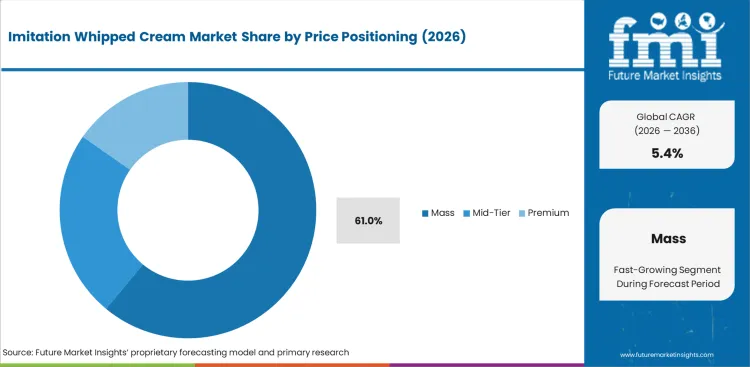
- Mass segment products are estimated to hold 61.0% share of price positioning demand in 2026 as daily cakes and restaurant desserts require cost-controlled topping inputs.
- Mid-tier products serve outlets requiring better flavor without premium pricing. Premium and organic premium lines are forecast to expand in specialty bakery and cafe formats. Price-led competition should remain active in retail freezer packs.
Insights into the Premium Segment
- Premium imitation whipped cream is forecast to gain from cafes and patisseries requiring a cleaner finish and richer taste. Dessert outlets can recover higher product cost through plated desserts and specialty cake pricing. Premium products need stronger stability because appearance affects display performance.
- Urban channels are likely to influence expansion because they serve higher-value sweet goods. Suppliers need to show product consistency before bakery chains accept premium lines at scale.
Imitation Whipped Cream Market Drivers Restraints and Opportunities
- Cost control drives adoption as bakeries seek cream-like topping with longer storage life and lower waste exposure.
- Taste comparison with dairy cream restrains repeat purchase in premium dessert use if mouthfeel falls short.
- Cleaner plant-based formulas create an opportunity as retail shelves and cafes test dairy-free toppings with simpler labels.
Imitation whipped cream demand is expected to expand through bakery and dessert use as foodservice teams seek lower spoilage and more consistent topping performance. Cafes and commercial bakeries can use powder formats to manage storage without heavy cold-chain needs. Revenue outlook remains positive as dairy price pressure pushes more operators toward cream-like toppings for regular cakes and beverages. Taste gaps and ingredient concerns may limit adoption among shoppers seeking cleaner labels. Premium dessert makers may retain dairy cream if imitation toppings fail to match texture and flavor expectations. Expansion is likely to come from plant-based retail packs and foodservice beverage toppings that combine stable foam with simpler formulation.
- Cost Control and Storage Life Support Adoption: Storage life and lower waste exposure will support imitation whipped cream use across bakeries and cafes through 2036. Foodservice teams can reduce spoilage risk by using shelf-stable formats in dessert and beverage preparation. Powder products help outlets manage batches more easily across locations with uneven cold-chain access.
- Taste and Label Concerns Limit Repeat Use: Taste comparison with fresh dairy cream may restrict repeat purchase in premium dessert applications. Some shoppers may avoid products linked with artificial stabilizers or hydrogenated fats. Cleaner label reformulation can raise costs if foam stability weakens during bakery or beverage use.
- Plant-Based Formats Open Fresh Upside: Plant-based imitation whipped cream offers the clearest room for expansion in retail packs and cafe menus. Dairy-free toppings can support cold drinks and seasonal desserts across chain foodservice outlets. Suppliers with stable texture and simple ingredient lists can secure better positions across bakery and beverage applications.
Regional Analysis
.webp "Top Country Growth Comparison Imitation Whipped Cream Market Cagr (2026 2036)")
| Country | CAGR 2026 to 2036 |
|---|---|
| India | 7.2% CAGR |
| United Kingdom | 6.8% CAGR |
| Japan | 5.1% CAGR |
| United States | 4.6% CAGR |
| South Korea | 4.2% CAGR |
Source: Future Market Insights analysis based on published country growth values and analyst interpretation in 2026.
Analysis of Imitation Whipped Cream Market by Key Countries
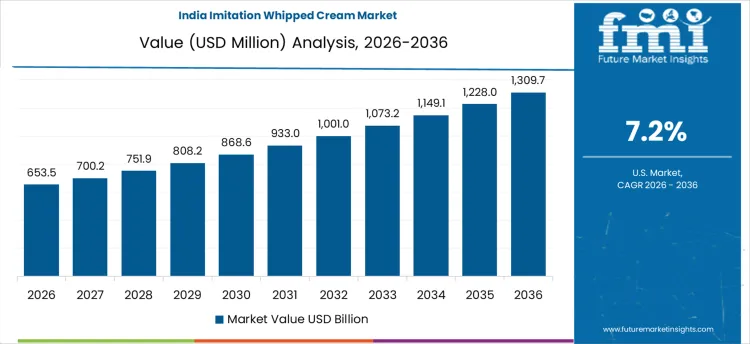
- India is projected to post the fastest pace at 7.2% CAGR through 2036 as urban bakery chains and dessert cafés increase use of stable whipped toppings.
- United Kingdom is expected to follow at 6.8% CAGR through 2036 since vegan dessert acceptance and supermarket dairy-free shelves support household trial.
- Japan at 5.1% CAGR, the United States at 4.6% CAGR, and South Korea at 4.2% CAGR are forecast to maintain steady expansion through 2036. Premium cakes, frozen desserts, and cafe drinks sustain whipped topping adoption in these countries.
Country growth differs with bakery maturity and dairy-free product access. Cold-chain depth also affects adoption. India leads because bakery expansion combines with urban dessert consumption. The United Kingdom follows because vegan dessert culture supports trial. Japan advances at a moderate pace due to refined dessert habits. United States expands from a mature retail base. South Korea grows from café dessert activity and younger consumer interest.
Demand Outlook for Imitation Whipped Cream Market in India
Demand expansion for the sector in India is projected to record 7.2% CAGR through 2036 as urban bakery chains and dessert cafes adopt stable whipped toppings for cakes and chilled sweets. Powder formats are likely to expand due to smaller outlets often requiring easier storage. Rich Products and Puratos have stronger professional bakery recognition in India through non-dairy topping supply. Adoption should remain firm in metro and tier-one dessert outlets.
- Urban bakery chains support a repeat topping use as celebration cakes and café desserts require stable finishing across daily service.
- Powder formats help smaller outlets manage storage more easily because many bakeries operate without heavy cold-chain spending.
- Professional supply brands benefit as bakeries depend on stable foam and easier preparation for cakes, pastries, and chilled desserts.
Demand Outlook for Imitation Whipped Cream Market in the United Kingdom
United Kingdom industry demand is forecast to rise at 6.8% CAGR through 2036 due to vegan dessert acceptance and supermarket dairy-free shelves supporting product trial. Cafe desserts and chilled retail products add steady use. Puratos and Danone benefit from bakery ingredient and plant-based recognition in this country. Industry expansion is likely to favor products that combine clean labels with stable whipping results.
- Vegan dessert habits influence steady trial of dairy-free whipped topping alternatives across cakes and chilled retail desserts.
- Supermarket shelves provide household packs better access as shoppers look for dairy-free options during dessert purchases.
- Café use expands as cold beverages and cakes need stable dairy-free finishing that can hold texture during service.
Industry Analysis of Imitation Whipped Cream in Japan
Japan demand is expected to advance at 5.1% CAGR through 2036 as premium cake culture and convenience dessert retail support measured topping use. Japanese dessert retailers place importance on clean finish and texture reliability. Powder formats can serve smaller bakeries. Liquid products support premium dessert counters. Quality requirements should guide adoption more than volume expansion.
- Premium cake culture supports demand for smoother topping texture since display quality influences dessert purchase decisions.
- Convenience dessert retail creates steady need for consistent whipped finishing inputs across chilled cakes and packaged sweets.
- Mature dessert habits keep growth measured as product acceptance is stable. New usage occasions expand more slowly.
Sales Analysis of Imitation Whipped Cream Market in the United States
Industry sales for the sector in the United States are projected to expand at 4.6% CAGR through 2036 since established whipped topping brands already hold firm household and foodservice access. Kraft Heinz supports retail familiarity through Cool Whip. Rich Products contributes to professional bakery use through non-dairy topping lines. Zero sugar and reduced fat products should support category activity.
- Established brands keep household awareness high as frozen whipped toppings are already familiar in dessert preparation.
- Foodservice bakeries support repeat demand since cakes and prepared desserts require reliable topping performance across service cycles.
- Reduced sugar and dairy-free claims can help brands defend shelf space as shoppers compare dessert toppings more closely.
Demand Outlook for Imitation Whipped Cream Market in South Korea
South Korea demand is expected to grow at 4.2% CAGR through 2036 since cafe dessert culture and urban bakery formats influence stable topping use. Product adoption is steadier as dessert retail is already developed. Dairy-free positioning can help in cafes that sell premium drinks and celebration cakes. Suppliers need flavor consistency to acquire repeat professional orders.
- Urban cafés use whipped toppings in dessert drinks and plated sweets as menu presentation depends on stable finishing.
- Celebration cake demand supports steady integration of imitation whipped cream across bakery counters since toppings are used for decoration and texture.
- Mature retail dessert channels keep expansion slower than India and the United Kingdom as industry adoption is already established.
Competitive Structure of Imitation Whipped Cream Market
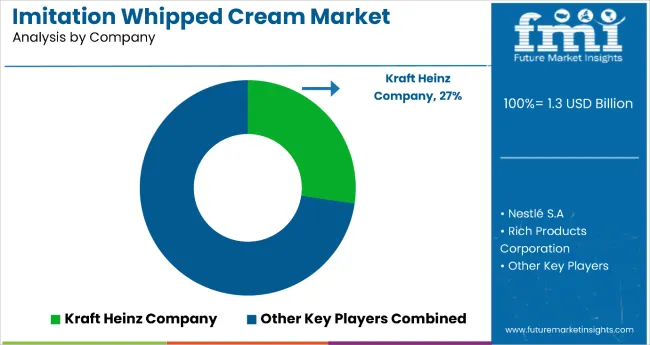
- Large food groups compete through retail access and brand trust across household dessert topping use.
- Bakery ingredient suppliers compete on foam stability and professional application support for cakes and pastries.
- Regional suppliers can win accounts through price control and local flavor adjustment.
Competition is split between consumer-facing brands and professional bakery suppliers. Kraft Heinz holds strong retail recognition through Cool Whip in North America. Rich Products has an established position in non-dairy whipped topping for bakery and foodservice use. Puratos serves professional patisserie teams through Ambiante and Chantypak lines. Whippak adds another product route. Ingredient firms such as Kerry support texture and dairy-free taste systems that help finished-product brands improve performance.
Incumbent advantage comes from product familiarity and proven preparation results. Bakery chains resist switching if a new topping changes cake finish or holding time. Product range is useful because accounts often need powder and liquid options. Flavored and dairy-free options add account depth. Imitation whipped cream demand in Europe mirrors sweet goods channel competition.
Entry in the competitive outlook for the sector is difficult as foam stability must survive transport and storage. Whipping performance and display stability remain challenges. Smaller suppliers can compete in local bakery channels if they offer reliable texture at lower price. Premium specialists can compete through cleaner labels and plant-based ingredient claims. Kerry texturant systems for whipped creams can improve shelf stability and pipeability. Puratos expanded Ambiante with a dairy-free chocolate flavor in October 2024, influencing professional topping variety.
Competitive Benchmarking: Imitation Whipped Cream Market
| Company | Retail Reach | Bakery Support | Formulation Depth | Geographic Footprint |
|---|---|---|---|---|
| Kraft Heinz Company | High | Medium | Medium | North America |
| Rich Products Corporation | Medium | High | High | Global |
| Puratos | Medium | High | High | Global |
| Nestlé S.A. | High | Medium | Medium | Global |
| Danone | High | Medium | Medium | Global |
| Kerry | Low | High | High | Global |
| Grupo Chantilly SA de CV | Medium | High | Medium | Latin America |
| Eurocas Group of Companies | Low | Medium | Medium | Europe |
| Dos Anclas | Medium | Medium | Low | Latin America |
| Trader Joe's Company | High | Low | Low | United States |
Source: Future Market Insights competitive analysis in 2026. Ratings reflect product reach and bakery application support. Formulation depth was also reviewed.
Key Developments in Imitation Whipped Cream Market
- In October 2024, Puratos launched Ambiante Chocolate Flavor as a dairy-free ready-to-whip topping for patisserie and dessert use.
- In June 2025, Kraft Heinz said it would stop launching new USA products with FD&C colors.
- In September 2025, Puratos USA presented bakery product launches at IBIE 2025 for professional bakery channels.
Key Companies in the Imitation Whipped Cream Market
Large Global Suppliers
- Kraft Heinz Company
- Nestlé S.A.
- Rich Products Corporation
- Danone
- Kerry
- Puratos
Regional and Retail Participants
- Grupo Chantilly SA de CV
- Trader Joe's Company
- Eurocas Group of Companies
- Dos Anclas
Report Scope and Coverage
| Item | Value |
|---|---|
| Market value in 2025 | USD 1.2 billion |
| Market value in 2026 | USD 1.3 billion |
| Market value in 2036 | USD 2.2 billion |
| CAGR from 2026 to 2036 | 5.4% CAGR |
| Quantitative Units | USD billion |
| Market Definition | Non-dairy or dairy-reduced whipped topping products used in cakes and desserts. Beverage and bakery applications are included |
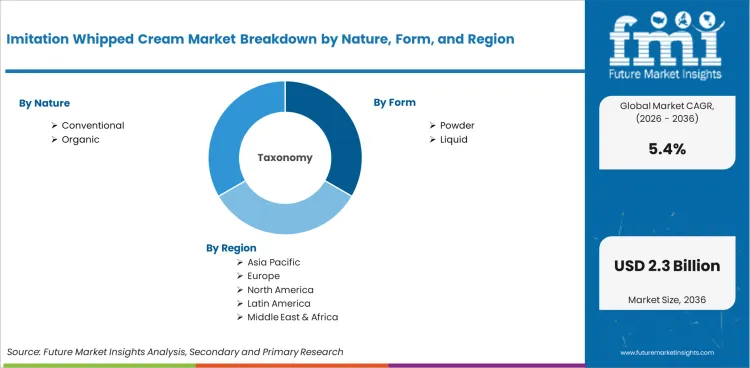
| By Nature | Conventional, Organic |
| By Form | Powder, Liquid |
| By Application | Bakery and Desserts, Beverages, Foodservice Desserts, Retail Home Baking, Frozen Desserts |
| By Sales Channel | Foodservice, Retail, Online, Direct Supply, Ingredient Distribution |
| By Ingredient Base | Vegetable Oil Based, Soy Based, Coconut Based, Almond Based, Oat Based |
| By Price Positioning | Mass Segment, Mid-Tier, Premium, Organic Premium |
| Regions Covered | North America, Latin America, Europe, East Asia, South Asia and Pacific, Middle East and Africa |
| Countries Covered | India, United Kingdom, Japan, United States, South Korea and other report countries |
| Key Companies Profiled | Kraft Heinz Company, Nestlé S.A., Rich Products Corporation, Danone, Grupo Chantilly SA de CV, Trader Joe's Company, Kerry, Eurocas Group of Companies, Dos Anclas, Puratos |
| Forecast Period | 2026 to 2036 |
| Approach | FMI public forecast aligned with product form and sales route. Country growth and supplier evidence were reviewed |
Source: Future Market Insights analysis, 2026.
Imitation Whipped Cream Market Breakdown by Nature, Form, Application, Sales Channel, Ingredient Base, Price Positioning, and Region
Imitation Whipped Cream Market Segmented by Nature
- Conventional
- Organic
Imitation Whipped Cream Market Segmented by Form
- Powder
- Liquid
Imitation Whipped Cream Market Segmented by Application
- Bakery and Desserts
- Beverages
- Foodservice Desserts
- Retail Home Baking
- Frozen Desserts
Imitation Whipped Cream Market Segmented by Sales Channel
- Foodservice
- Retail
- Online
- Direct Supply
- Ingredient Distribution
Imitation Whipped Cream Market Segmented by Ingredient Base
- Vegetable Oil Based
- Soy Based
- Coconut Based
- Almond Based
- Oat Based
Imitation Whipped Cream Market Segmented by Price Positioning
- Mass Segment
- Mid-Tier
- Premium
- Organic Premium
Imitation Whipped Cream Market by Region
- North America
- Latin America
- Europe
- East Asia
- South Asia and Pacific
- Middle East and Africa
Research Sources and Bibliography
- Good Food Institute. (2025). 2024 state of alternative proteins report.
- Good Food Institute India. (2024). Insights on the plant-based dairy category in India, 2024.
- Ipsos, & Plant Based Foods Industry Association. (2025). An outlook on India’s plant-based foods sector.
- Kerry Group plc. (2025). Kerry Group annual report 2024.
- Kerry Group plc. (2025, February 18). Kerry Group preliminary results for the year ended 31 December 2024.
- Puratos. (2024, October 10). Puratos launches new plant-based, whippable Ambiante Chocolate Flavor for toppings and fillings.
- Puratos USA. (2025, September 23). Puratos unveils award-winning innovations and new product launches at IBIE 2025.
- Reuters. (2025, June 17). Kraft Heinz to stop launching new products with artificial colors.
- Rich Products Corporation. (2026). Responsible business report 2025.
- The Kraft Heinz Company. (2025, June 17). Kraft Heinz commits to remove FD&C colors from its USA portfolio before the end of 2027 and will not launch new products in the USA with FD&C colors, effective immediately.
- USA Department of Agriculture, Economic Research Service. (2025, March 17). Livestock, dairy, and poultry outlook: March 2025.
Bibliography is provided for reader reference and direct source checking.
This Report Answers
- How large the imitation whipped cream market is in 2026 and how far it can rise by 2036?
- Which nature and form segments hold the strongest projected share positions in 2026?
- Why conventional products and powder formats lead current demand structure?
- Why India and the United Kingdom lead the published country growth table through 2036?
- How foodservice demand shapes routine use across bakery and dessert outlets?
- Which supplier capabilities help brands defend position in non-dairy whipped toppings?
- What is included and excluded from this study boundary?
Frequently Asked Questions
How large is the imitation whipped cream market in 2026?
The imitation whipped cream market is projected at USD 1.3 billion in 2026.
What will the imitation whipped cream market be worth by 2036?
Market value is forecast to reach USD 2.2 billion by 2036 as bakery and dessert applications keep demand active.
What CAGR is projected for the imitation whipped cream market from 2026 to 2036?
The imitation whipped cream market is projected to expand at 5.4% CAGR from 2026 to 2036.
Which nature segment leads the imitation whipped cream market?
Conventional products lead nature demand with an estimated 82.0% share in 2026 because standard formulas support lower-cost dessert use.
Which form segment leads the imitation whipped cream market?
Powder is expected to lead form demand with 78.0% share in 2026 because dry storage and reconstitution support bakery use.
Which country grows fastest in the imitation whipped cream market?
India is forecast to lead the country outlook for the sector with 7.2% CAGR through 2036 due to urban bakery and dessert outlet expansion.
Why does powder retain a strong role in the Imitation Whipped Cream Market?
Powder retains a strong role because it reduces storage pressure and lets kitchens prepare topping close to use.
Who are the leading suppliers in the Imitation Whipped Cream Market?
Kraft Heinz Company and Rich Products Corporation are established suppliers in this sector. Puratos and Nestlé S.A. support competition. Danone and Kerry add product depth.
Preview the report firsthand - request a free sample
Get SampleGet the brochure for pricing and purchase details.
Get PDFTable of Content
- Executive Summary
- Global Market Outlook
- Demand-side Trends
- Supply-side Trends
- Technology Roadmap Analysis
- Analysis and Recommendations
- Market Overview
- Market Coverage / Taxonomy
- Market Definition / Scope / Limitations
- Research Methodology
- Chapter Orientation
- Analytical Lens and Working Hypotheses
- Market Structure, Signals, and Trend Drivers
- Benchmarking and Cross-market Comparability
- Market Sizing, Forecasting, and Opportunity Mapping
- Research Design and Evidence Framework
- Desk Research Programme (Secondary Evidence)
- Company Annual and Sustainability Reports
- Peer-reviewed Journals and Academic Literature
- Corporate Websites, Product Literature, and Technical Notes
- Earnings Decks and Investor Briefings
- Statutory Filings and Regulatory Disclosures
- Technical White Papers and Standards Notes
- Trade Journals, Industry Magazines, and Analyst Briefs
- Conference Proceedings, Webinars, and Seminar Materials
- Government Statistics Portals and Public Data Releases
- Press Releases and Reputable Media Coverage
- Specialist Newsletters and Curated Briefings
- Sector Databases and Reference Repositories
- FMI Internal Proprietary Databases and Historical Market Datasets
- Subscription Datasets and Paid Sources
- Social Channels, Communities, and Digital Listening Inputs
- Additional Desk Sources
- Expert Input and Fieldwork (Primary Evidence)
- Primary Modes
- Qualitative Interviews and Expert Elicitation
- Quantitative Surveys and Structured Data Capture
- Blended Approach
- Why Primary Evidence is Used
- Field Techniques
- Interviews
- Surveys
- Focus Groups
- Observational and In-context Research
- Social and Community Interactions
- Stakeholder Universe Engaged
- C-suite Leaders
- Board Members
- Presidents and Vice Presidents
- R&D and Innovation Heads
- Technical Specialists
- Domain Subject-matter Experts
- Scientists
- Physicians and Other Healthcare Professionals
- Governance, Ethics, and Data Stewardship
- Research Ethics
- Data Integrity and Handling
- Primary Modes
- Tooling, Models, and Reference Databases
- Desk Research Programme (Secondary Evidence)
- Data Engineering and Model Build
- Data Acquisition and Ingestion
- Cleaning, Normalisation, and Verification
- Synthesis, Triangulation, and Analysis
- Quality Assurance and Audit Trail
- Market Background
- Market Dynamics
- Drivers
- Restraints
- Opportunity
- Trends
- Scenario Forecast
- Demand in Optimistic Scenario
- Demand in Likely Scenario
- Demand in Conservative Scenario
- Opportunity Map Analysis
- Product Life Cycle Analysis
- Supply Chain Analysis
- Investment Feasibility Matrix
- Value Chain Analysis
- PESTLE and Porter’s Analysis
- Regulatory Landscape
- Regional Parent Market Outlook
- Production and Consumption Statistics
- Import and Export Statistics
- Market Dynamics
- Global Market Analysis 2021 to 2025 and Forecast, 2026 to 2036
- Historical Market Size Value (USD Million) Analysis, 2021 to 2025
- Current and Future Market Size Value (USD Million) Projections, 2026 to 2036
- Y-o-Y Growth Trend Analysis
- Absolute $ Opportunity Analysis
- Global Market Pricing Analysis 2021 to 2025 and Forecast 2026 to 2036
- Global Market Analysis 2021 to 2025 and Forecast 2026 to 2036, By Nature
- Introduction / Key Findings
- Historical Market Size Value (USD Million) Analysis By Nature , 2021 to 2025
- Current and Future Market Size Value (USD Million) Analysis and Forecast By Nature , 2026 to 2036
- Conventional
- Organic
- Conventional
- Y-o-Y Growth Trend Analysis By Nature , 2021 to 2025
- Absolute $ Opportunity Analysis By Nature , 2026 to 2036
- Global Market Analysis 2021 to 2025 and Forecast 2026 to 2036, By Form
- Introduction / Key Findings
- Historical Market Size Value (USD Million) Analysis By Form, 2021 to 2025
- Current and Future Market Size Value (USD Million) Analysis and Forecast By Form, 2026 to 2036
- Powder
- Liquid
- Powder
- Y-o-Y Growth Trend Analysis By Form, 2021 to 2025
- Absolute $ Opportunity Analysis By Form, 2026 to 2036
- Global Market Analysis 2021 to 2025 and Forecast 2026 to 2036, By Application
- Introduction / Key Findings
- Historical Market Size Value (USD Million) Analysis By Application, 2021 to 2025
- Current and Future Market Size Value (USD Million) Analysis and Forecast By Application, 2026 to 2036
- Bakery and Desserts
- Beverages
- Foodservice Desserts
- Bakery and Desserts
- Y-o-Y Growth Trend Analysis By Application, 2021 to 2025
- Absolute $ Opportunity Analysis By Application, 2026 to 2036
- Global Market Analysis 2021 to 2025 and Forecast 2026 to 2036, By Sales Channel
- Introduction / Key Findings
- Historical Market Size Value (USD Million) Analysis By Sales Channel, 2021 to 2025
- Current and Future Market Size Value (USD Million) Analysis and Forecast By Sales Channel, 2026 to 2036
- Foodservice
- Retail
- Online
- Foodservice
- Y-o-Y Growth Trend Analysis By Sales Channel, 2021 to 2025
- Absolute $ Opportunity Analysis By Sales Channel, 2026 to 2036
- Global Market Analysis 2021 to 2025 and Forecast 2026 to 2036, By Ingredient Base
- Introduction / Key Findings
- Historical Market Size Value (USD Million) Analysis By Ingredient Base, 2021 to 2025
- Current and Future Market Size Value (USD Million) Analysis and Forecast By Ingredient Base, 2026 to 2036
- Vegetable Oil-Based
- Soy Based
- Coconut Based
- Vegetable Oil-Based
- Y-o-Y Growth Trend Analysis By Ingredient Base, 2021 to 2025
- Absolute $ Opportunity Analysis By Ingredient Base, 2026 to 2036
- Global Market Analysis 2021 to 2025 and Forecast 2026 to 2036, By Price Positioning
- Introduction / Key Findings
- Historical Market Size Value (USD Million) Analysis By Price Positioning, 2021 to 2025
- Current and Future Market Size Value (USD Million) Analysis and Forecast By Price Positioning, 2026 to 2036
- Mass
- Mid-Tier
- Premium
- Mass
- Y-o-Y Growth Trend Analysis By Price Positioning, 2021 to 2025
- Absolute $ Opportunity Analysis By Price Positioning, 2026 to 2036
- Global Market Analysis 2021 to 2025 and Forecast 2026 to 2036, By Region
- Introduction
- Historical Market Size Value (USD Million) Analysis By Region, 2021 to 2025
- Current Market Size Value (USD Million) Analysis and Forecast By Region, 2026 to 2036
- North America
- Latin America
- Western Europe
- Eastern Europe
- East Asia
- South Asia and Pacific
- Middle East & Africa
- Market Attractiveness Analysis By Region
- North America Market Analysis 2021 to 2025 and Forecast 2026 to 2036, By Country
- Historical Market Size Value (USD Million) Trend Analysis By Market Taxonomy, 2021 to 2025
- Market Size Value (USD Million) Forecast By Market Taxonomy, 2026 to 2036
- By Country
- USA
- Canada
- Mexico
- By Nature
- By Form
- By Application
- By Sales Channel
- By Ingredient Base
- By Price Positioning
- By Country
- Market Attractiveness Analysis
- By Country
- By Nature
- By Form
- By Application
- By Sales Channel
- By Ingredient Base
- By Price Positioning
- Key Takeaways
- Latin America Market Analysis 2021 to 2025 and Forecast 2026 to 2036, By Country
- Historical Market Size Value (USD Million) Trend Analysis By Market Taxonomy, 2021 to 2025
- Market Size Value (USD Million) Forecast By Market Taxonomy, 2026 to 2036
- By Country
- Brazil
- Chile
- Rest of Latin America
- By Nature
- By Form
- By Application
- By Sales Channel
- By Ingredient Base
- By Price Positioning
- By Country
- Market Attractiveness Analysis
- By Country
- By Nature
- By Form
- By Application
- By Sales Channel
- By Ingredient Base
- By Price Positioning
- Key Takeaways
- Western Europe Market Analysis 2021 to 2025 and Forecast 2026 to 2036, By Country
- Historical Market Size Value (USD Million) Trend Analysis By Market Taxonomy, 2021 to 2025
- Market Size Value (USD Million) Forecast By Market Taxonomy, 2026 to 2036
- By Country
- Germany
- UK
- Italy
- Spain
- France
- Nordic
- BENELUX
- Rest of Western Europe
- By Nature
- By Form
- By Application
- By Sales Channel
- By Ingredient Base
- By Price Positioning
- By Country
- Market Attractiveness Analysis
- By Country
- By Nature
- By Form
- By Application
- By Sales Channel
- By Ingredient Base
- By Price Positioning
- Key Takeaways
- Eastern Europe Market Analysis 2021 to 2025 and Forecast 2026 to 2036, By Country
- Historical Market Size Value (USD Million) Trend Analysis By Market Taxonomy, 2021 to 2025
- Market Size Value (USD Million) Forecast By Market Taxonomy, 2026 to 2036
- By Country
- Russia
- Poland
- Hungary
- Balkan & Baltic
- Rest of Eastern Europe
- By Nature
- By Form
- By Application
- By Sales Channel
- By Ingredient Base
- By Price Positioning
- By Country
- Market Attractiveness Analysis
- By Country
- By Nature
- By Form
- By Application
- By Sales Channel
- By Ingredient Base
- By Price Positioning
- Key Takeaways
- East Asia Market Analysis 2021 to 2025 and Forecast 2026 to 2036, By Country
- Historical Market Size Value (USD Million) Trend Analysis By Market Taxonomy, 2021 to 2025
- Market Size Value (USD Million) Forecast By Market Taxonomy, 2026 to 2036
- By Country
- China
- Japan
- South Korea
- By Nature
- By Form
- By Application
- By Sales Channel
- By Ingredient Base
- By Price Positioning
- By Country
- Market Attractiveness Analysis
- By Country
- By Nature
- By Form
- By Application
- By Sales Channel
- By Ingredient Base
- By Price Positioning
- Key Takeaways
- South Asia and Pacific Market Analysis 2021 to 2025 and Forecast 2026 to 2036, By Country
- Historical Market Size Value (USD Million) Trend Analysis By Market Taxonomy, 2021 to 2025
- Market Size Value (USD Million) Forecast By Market Taxonomy, 2026 to 2036
- By Country
- India
- ASEAN
- Australia & New Zealand
- Rest of South Asia and Pacific
- By Nature
- By Form
- By Application
- By Sales Channel
- By Ingredient Base
- By Price Positioning
- By Country
- Market Attractiveness Analysis
- By Country
- By Nature
- By Form
- By Application
- By Sales Channel
- By Ingredient Base
- By Price Positioning
- Key Takeaways
- Middle East & Africa Market Analysis 2021 to 2025 and Forecast 2026 to 2036, By Country
- Historical Market Size Value (USD Million) Trend Analysis By Market Taxonomy, 2021 to 2025
- Market Size Value (USD Million) Forecast By Market Taxonomy, 2026 to 2036
- By Country
- Kingdom of Saudi Arabia
- Other GCC Countries
- Turkiye
- South Africa
- Other African Union
- Rest of Middle East & Africa
- By Nature
- By Form
- By Application
- By Sales Channel
- By Ingredient Base
- By Price Positioning
- By Country
- Market Attractiveness Analysis
- By Country
- By Nature
- By Form
- By Application
- By Sales Channel
- By Ingredient Base
- By Price Positioning
- Key Takeaways
- Key Countries Market Analysis
- USA
- Pricing Analysis
- Market Share Analysis, 2025
- By Nature
- By Form
- By Application
- By Sales Channel
- By Ingredient Base
- By Price Positioning
- Canada
- Pricing Analysis
- Market Share Analysis, 2025
- By Nature
- By Form
- By Application
- By Sales Channel
- By Ingredient Base
- By Price Positioning
- Mexico
- Pricing Analysis
- Market Share Analysis, 2025
- By Nature
- By Form
- By Application
- By Sales Channel
- By Ingredient Base
- By Price Positioning
- Brazil
- Pricing Analysis
- Market Share Analysis, 2025
- By Nature
- By Form
- By Application
- By Sales Channel
- By Ingredient Base
- By Price Positioning
- Chile
- Pricing Analysis
- Market Share Analysis, 2025
- By Nature
- By Form
- By Application
- By Sales Channel
- By Ingredient Base
- By Price Positioning
- Germany
- Pricing Analysis
- Market Share Analysis, 2025
- By Nature
- By Form
- By Application
- By Sales Channel
- By Ingredient Base
- By Price Positioning
- UK
- Pricing Analysis
- Market Share Analysis, 2025
- By Nature
- By Form
- By Application
- By Sales Channel
- By Ingredient Base
- By Price Positioning
- Italy
- Pricing Analysis
- Market Share Analysis, 2025
- By Nature
- By Form
- By Application
- By Sales Channel
- By Ingredient Base
- By Price Positioning
- Spain
- Pricing Analysis
- Market Share Analysis, 2025
- By Nature
- By Form
- By Application
- By Sales Channel
- By Ingredient Base
- By Price Positioning
- France
- Pricing Analysis
- Market Share Analysis, 2025
- By Nature
- By Form
- By Application
- By Sales Channel
- By Ingredient Base
- By Price Positioning
- India
- Pricing Analysis
- Market Share Analysis, 2025
- By Nature
- By Form
- By Application
- By Sales Channel
- By Ingredient Base
- By Price Positioning
- ASEAN
- Pricing Analysis
- Market Share Analysis, 2025
- By Nature
- By Form
- By Application
- By Sales Channel
- By Ingredient Base
- By Price Positioning
- Australia & New Zealand
- Pricing Analysis
- Market Share Analysis, 2025
- By Nature
- By Form
- By Application
- By Sales Channel
- By Ingredient Base
- By Price Positioning
- China
- Pricing Analysis
- Market Share Analysis, 2025
- By Nature
- By Form
- By Application
- By Sales Channel
- By Ingredient Base
- By Price Positioning
- Japan
- Pricing Analysis
- Market Share Analysis, 2025
- By Nature
- By Form
- By Application
- By Sales Channel
- By Ingredient Base
- By Price Positioning
- South Korea
- Pricing Analysis
- Market Share Analysis, 2025
- By Nature
- By Form
- By Application
- By Sales Channel
- By Ingredient Base
- By Price Positioning
- Russia
- Pricing Analysis
- Market Share Analysis, 2025
- By Nature
- By Form
- By Application
- By Sales Channel
- By Ingredient Base
- By Price Positioning
- Poland
- Pricing Analysis
- Market Share Analysis, 2025
- By Nature
- By Form
- By Application
- By Sales Channel
- By Ingredient Base
- By Price Positioning
- Hungary
- Pricing Analysis
- Market Share Analysis, 2025
- By Nature
- By Form
- By Application
- By Sales Channel
- By Ingredient Base
- By Price Positioning
- Kingdom of Saudi Arabia
- Pricing Analysis
- Market Share Analysis, 2025
- By Nature
- By Form
- By Application
- By Sales Channel
- By Ingredient Base
- By Price Positioning
- Turkiye
- Pricing Analysis
- Market Share Analysis, 2025
- By Nature
- By Form
- By Application
- By Sales Channel
- By Ingredient Base
- By Price Positioning
- South Africa
- Pricing Analysis
- Market Share Analysis, 2025
- By Nature
- By Form
- By Application
- By Sales Channel
- By Ingredient Base
- By Price Positioning
- USA
- Market Structure Analysis
- Competition Dashboard
- Competition Benchmarking
- Market Share Analysis of Top Players
- By Regional
- By Nature
- By Form
- By Application
- By Sales Channel
- By Ingredient Base
- By Price Positioning
- Competition Analysis
- Competition Deep Dive
- Kraft Heinz Company
- Overview
- Product Portfolio
- Profitability by Market Segments (Product/Age /Sales Channel/Region)
- Sales Footprint
- Strategy Overview
- Marketing Strategy
- Product Strategy
- Channel Strategy
- Nestlé S.A.
- Rich Products Corporation
- Danone
- Kerry
- Puratos
- Kraft Heinz Company
- Competition Deep Dive
- Assumptions & Acronyms Used


