


- China is strengthening its position in the Bone Defect Repair Materials Market by increasing manufacturing capacity, having competitive prices and with the growing healthcare demand in the country.
- The global Bone Defect Repair Materials Market is expected to grow at a CAGR of 12.6% during the forecast period (2026-2036) to reach USD 2.9 billion in 2026 and USD 9.6 billion by 2036.
- Artificial Bone is the largest product category, and it is anticipated to hold 40.0% of the total market demand in 2026.
- Orthopedics is projected to account for 55.0% of application demand in 2026, generating sustained demand for advanced bone repair materials.
- Chinese manufacturers continue to improve the quality of their products and have cost advantages attractive to hospitals and purchasing agencies.
- International suppliers remain competitive with clinical evidence, regulatory support and specialized biomaterial technologies.
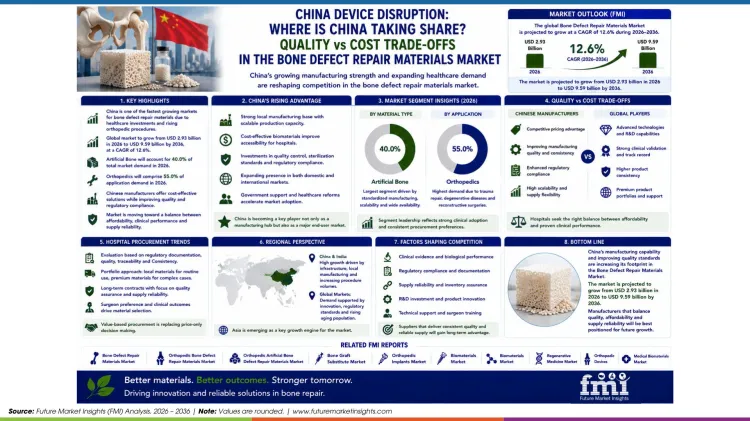
China Is Expanding Its Role in Bone Repair Materials
China is playing an increasingly important role in the Bone Defect Repair Materials Market. Growth in healthcare infrastructure, orthopedic procedures and domestic manufacturing has led to increased production capacity and market presence for local manufacturers.
The market is projected to reach a valuation of USD 2.9 billion in 2026 and to grow to USD 9.6 billion by 2036, according to Future Market Insights, indicating continued demand for advanced bone regeneration solutions globally.
Combined manufacturing investment and healthcare expansion have made China a large producer and fast growing consumer of bone defect repair materials.
Artificial Bone Supports Competitive Manufacturing
Artificial Bone, the largest product segment, is projected to hold 40.0% share of the market demand in 2026.
Synthetic biomaterials can be produced using standardized manufacturing processes, allowing for scalability and cost-effectiveness. These presents Chinese manufacturers with an opportunity to supply hospitals with products at competitive prices and to expand their output.
Local manufacturers are improving their competitiveness at home and abroad, as production technologies are being constantly upgraded.
Cost Advantages Must Be Balanced with Quality
Lower manufacturing costs offer a significant competitive advantage, but hospitals look beyond the purchase price when selecting suppliers.
Healthcare providers also consider the product consistency, sterilization standards, regulatory documentation, traceability and long-term clinical performance. These factors are still important because the repair materials of bone are directly related to the outcome of the patients.
Manufacturers that can demonstrate good quality systems may be able to move up in the market even when competing against lower-cost alternatives.
Orthopedic Demand Raises Performance Expectations
Orthopedic is expected to be the largest application segment in the market, with 55.0% of application demand in 2026.
Materials with predictable biological performance and reliable handling characteristics are required by surgeons performing trauma repair, spinal procedures and reconstructive operations. Procurement decisions therefore balance affordability against documented clinical reliability.
Many hospitals still use multiple sourcing strategies, combining local manufactured products with premium biomaterials for special procedures.
Competition Is Moving Beyond Price
The market is gradually changing from a pure price competition to value based differentiation.
But providing technical support, regulatory expertise, stable supply chains, and clinically validated products could build long-term relationships with healthcare providers. Cost remains important but buying decisions are more and more being made on the total value provided over the course of the procurement cycle.
That means continued investments in manufacturing quality and product development in all the key producing regions.
Bottom Line
As China increases manufacturing capacity and provides competitive prices, its share of the Bone Defect Repair Materials Market is growing, and ongoing quality improvements are bolstering its role in global healthcare supply chains. As the market grows from USD 2.9 billion in 2026 to USD 9.6 billion by 2036, suppliers who are able to strike a balance between affordability while ensuring consistent product performance and regulatory compliance are expected to be well-positioned for future growth.
Related FMI Reports
- Bone Defect Repair Materials Market
- Orthopedic Bone Defect Repair Materials Market
- Orthopedic Artificial Bone Defect Repair Materials Market
- Bone Graft Substitute Market
- Orthopedic Digit Implants Market
- Biomaterials Market
- Regenerative Medicine Market
- Orthopedic Trauma Device Market
- Tissue Protectors Market
- Medical Wax Market

