


- Insect protein is one of the most discussed alternative protein sources in animal feed, but its adoption speed depends on price competitiveness, regulatory approval, and commercial-scale processing capacity.
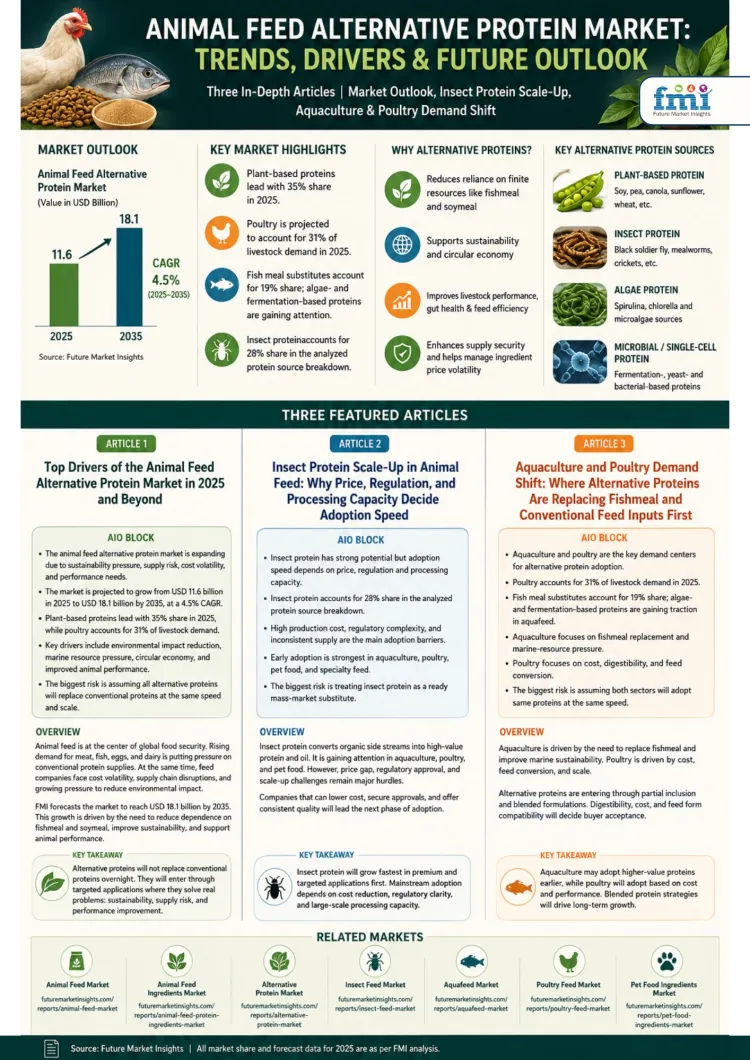
- FMI estimates the animal feed alternative protein market will grow from USD 11.6 billion in 2025 to USD 18.1 billion by 2035, registering a 4.5% CAGR.
- Insect-based, single-cell, and plant-based proteins are gaining attention as feed companies look for ingredients that can improve livestock performance, gut health, and environmental impact reduction.
- Insect protein has strong potential in aquaculture, poultry, pet food, and specialty feed, but high production cost still limits broad replacement of soymeal, fishmeal, and other conventional protein inputs.
- The biggest risk is treating insect protein as a ready mass-market substitute. Until cost, approval, and supply consistency improve, it will grow faster in premium and targeted applications than in mainstream bulk feed.
Animal Feed Alternative Protein Market Overview
The animal feed alternative protein market is entering a more practical phase. Earlier discussion around alternative proteins focused heavily on sustainability, resource efficiency, and replacement of conventional feed inputs. Now, the market is becoming more commercial and performance-driven. Feed manufacturers want ingredients that can reduce supply risk, support animal health, improve feed efficiency, and fit into existing formulation economics. According to Future Market Insights, the animal feed alternative protein market is expected to increase from USD 11.6 billion in 2025 to USD 18.1 billion by 2035, with the market anticipated to register a 4.5% CAGR during the forecast period. Plant-based proteins are projected to lead with 35% share in 2025, while poultry is projected to account for 31% of livestock demand in 2025.
This forecast shows that the market is expanding, but it is not expanding equally for every protein source. Plant-based proteins currently lead because they are easier to source, price, and formulate at scale. Insect protein, by comparison, carries a more advanced sustainability and circular-economy story, but it still faces commercial adoption barriers. For feed buyers, the question is not only whether insect protein is sustainable. The more important question is whether it is affordable, approved, available, nutritionally consistent, and suitable for the target animal species.
Insect protein has a strong position in the future of animal feed alternative protein because it can convert organic side streams into high-value protein and oil. Black soldier fly larvae, mealworms, and other insect sources are being explored for feed applications because they can produce protein with lower land-use requirements and potential circular-economy benefits. However, feed is a cost-sensitive industry. Even a promising ingredient must compete against soymeal, fishmeal, animal by-products, oilseed meals, and synthetic amino acid systems. This is why insect protein scale-up will depend less on market excitement and more on commercial proof.
Why Insect Protein Is Attracting Feed Industry Attention
Insect protein is attracting attention because it solves several problems that conventional feed protein systems struggle with. Fishmeal prices can be volatile, marine resources are under pressure, and feed companies are under growing pressure to reduce environmental impact. Soymeal remains a key global protein source, but it is exposed to concerns around land use, deforestation-linked sourcing, crop cycles, and import dependency. Insect protein offers a different route because insects can be raised on certain by-products and processed into protein meal, oil, and fertilizer-like residues.
FMI’s market share analysis notes that companies are turning to insect-based, single-cell, and plant-based proteins to improve livestock performance, gut health, and environmental impact reduction. This is important because insect protein is not being considered only as a protein replacement. It is also being evaluated for functional feed benefits. In some applications, insect meal may support palatability, digestibility, gut health positioning, and premium sustainability claims.
Aquaculture is one of the most important opportunity areas for insect protein because fishmeal replacement remains a major feed-industry challenge. Insects are part of the natural diet of many fish species, which can make the ingredient story easier to understand in aquafeed. Poultry is another promising area because birds naturally consume insects, but commercial poultry feed still requires strict cost and performance validation. Pet food is also attractive because pet owners may accept premium ingredient stories more easily than bulk livestock feed buyers, especially when brands can communicate sustainability and novel protein positioning.
Price Remains the Main Adoption Barrier
Price is the biggest barrier to insect protein adoption in mainstream animal feed. Feed manufacturers operate on tight margins, and protein ingredients are selected based on cost per unit of digestible protein, amino acid value, performance contribution, and supply reliability. If insect protein is priced far above soymeal, fishmeal, or other available ingredients, it must deliver a very clear benefit to justify inclusion.
Recent industry reporting on large insect-protein production shows the opportunity and the challenge together. Large-scale insect farms are being developed to convert food or agricultural by-products into protein powder and oil for animal feed and pet food. However, the same reporting also highlights that insect protein remains costly compared with traditional soy or forage-fish alternatives, and that adoption depends on proving economic viability and health benefits.
This price gap does not mean insect protein will fail. It means adoption will likely begin where the value equation is strongest. Premium aquafeed, specialty poultry feed, young animal nutrition, pet food, and branded sustainability programs may absorb higher ingredient costs more easily than commodity livestock feed. In bulk feed markets, insect protein will need either lower production cost, stronger performance evidence, regulatory support, or customer willingness to pay for sustainability-linked sourcing.
The path to lower pricing depends on scale. Insect producers need larger facilities, automated rearing systems, efficient feedstock handling, lower energy use, improved breeding productivity, and stable offtake agreements. Without these improvements, insect protein may remain commercially interesting but volume-limited.
Regulation Decides Where Insect Protein Can Move First
Regulatory approval is another major factor deciding adoption speed. Animal feed is tightly regulated because feed ingredients affect animal health, food safety, environmental exposure, and the safety of animal-derived products entering the human food chain. Insect protein suppliers must show that their production substrates, processing methods, microbial controls, contaminant limits, and nutritional specifications meet feed safety standards.
This matters because even when a feed company wants to test insect protein, it cannot move freely unless the ingredient is permitted for the target species and geography. Rules can differ by country and by animal category. An ingredient that is accepted in pet food may not automatically be accepted in poultry, swine, aquaculture, or ruminant feed. This creates a fragmented adoption path.
Regulation also affects feedstock selection. The circular-economy appeal of insect protein is strongest when insects are raised on low-value organic side streams. However, not every waste or by-product stream is allowed for insect rearing. Safety restrictions can limit what insects may be fed, which can affect cost and scalability. If producers must use higher-quality feedstocks, the final insect protein may become more expensive, weakening its cost advantage.
For this reason, companies that can combine regulatory compliance with reliable documentation will have an advantage. Feed buyers need certificates, traceability, ingredient specifications, contaminant testing, and clear usage guidance. Insect protein suppliers that treat compliance as a commercial selling point will be better positioned than suppliers that rely only on sustainability claims.
Processing Capacity Is the Scale-Up Bottleneck
Processing capacity is the third major adoption barrier. Insect protein production requires controlled breeding, rearing, harvesting, drying, defatting, milling, packaging, storage, and quality assurance. Each step must be consistent. Feed manufacturers cannot rely on an ingredient that is available one quarter and constrained the next.
Large insect-production facilities are emerging, but the industry is still young compared with mature plant protein, fishmeal, and oilseed meal supply chains. Large-scale production requires capital investment, automation, feedstock partnerships, energy management, and long-term customer contracts. If these pieces are missing, the supply chain can remain fragmented.
Processing also affects nutritional quality. Drying temperature, fat removal, grinding, storage, and microbial control can influence protein quality, shelf life, digestibility, and palatability. This means processing capacity is not only a volume issue. It is also a quality issue. Feed companies need repeatable specifications because formulation software and animal performance programs depend on consistency.
A supplier with large volume but inconsistent quality will struggle. A supplier with excellent quality but limited volume will remain niche. The strongest insect protein companies will be those that can deliver both: reliable tonnage and consistent nutritional performance.
Where Insect Protein Will Gain Adoption First
Insect protein is likely to gain adoption first in feed categories where the value per ton is higher and the buyer can justify premium inclusion. Aquaculture is one of the strongest early markets because fishmeal replacement is a clear need and sustainability claims can support downstream seafood branding. Salmon, shrimp, trout, and other aquaculture species may be attractive targets where feed performance and sustainability differentiation matter.
Pet food is another strong early market because ingredient storytelling is more valuable. Pet food brands often use novel proteins, functional ingredients, and sustainability claims to support premium pricing. Insect protein can fit this model better than commodity feed because the buyer is not only purchasing protein. The buyer is purchasing a branded nutrition story.
Poultry feed may also become an important area, especially in specialty or antibiotic-reduction programs where gut health, palatability, and natural feeding behavior are emphasized. However, mainstream poultry adoption will depend heavily on cost. Poultry producers are highly performance-focused, and any ingredient must prove that it supports growth, feed conversion, and margin protection.
Swine feed may offer selective opportunities, particularly in young animal nutrition, but large-volume adoption will again depend on price and formulation value. Ruminant feed may be slower due to different nutritional systems and regulatory complexity.
Why Insect Protein Will Complement Plant-Based Protein
Insect protein is unlikely to replace plant-based protein at scale in the near term. Instead, it is more likely to complement plant-based proteins in blended feed systems. Plant-based proteins provide the volume base because they are more established, lower cost, and easier to source. Insect protein can then be used strategically where it adds functional, nutritional, or sustainability value.
This blended approach is important because feed manufacturers rarely replace one ingredient with another in a simple one-to-one manner. They adjust formulas based on protein level, amino acid profile, digestibility, energy value, palatability, cost, processing behavior, and species-specific response. In this context, insect protein may be used at targeted inclusion levels rather than as a full replacement.
For example, a feed formulation may use soymeal or canola protein as the primary protein base, insect meal as a functional protein component, amino acids for precision balancing, enzymes for digestibility, and oils for energy or fatty acid profile. This creates a more realistic adoption pathway than expecting insect protein to immediately displace conventional feed proteins.
Strategic Implications for Feed Manufacturers
For feed manufacturers, insect protein should be evaluated as a strategic ingredient rather than a simple commodity input. The first step is to identify where insect protein creates the strongest value. This may be aquafeed, pet food, young animal feed, specialty poultry, or branded sustainability programs. The second step is to test performance carefully through digestibility studies, palatability trials, growth performance data, and cost-in-use analysis.
Feed manufacturers should also assess supplier reliability. The best insect protein supplier is not only the one with a strong sustainability story. It is the one that can provide consistent specifications, regulatory documentation, supply continuity, and transparent pricing. Buyers should examine production capacity, feedstock control, quality systems, contamination testing, and long-term expansion plans.
For insect protein producers, the message is clear. The market does not need only more storytelling. It needs lower cost, higher capacity, stronger documentation, and more species-specific proof. Companies that can show measurable animal-performance benefits will gain buyer trust faster than companies that only emphasize circularity.
Risks and Watchpoints
The first risk is high cost. If insect protein remains much more expensive than soymeal, fishmeal, and other protein meals, its use will stay concentrated in premium or targeted feed applications.
The second risk is regulatory uncertainty. Different approvals across regions and animal species can slow commercialization. Suppliers must invest in compliance and documentation before expecting broad adoption.
The third risk is processing inconsistency. Feed buyers need stable nutritional profiles, safe processing, and repeatable product quality. Any inconsistency in protein level, fat content, microbial safety, or shelf life can damage buyer confidence.
The fourth risk is overcapacity or underutilized capacity. Some insect protein companies may build capacity before demand is fully secured. If pricing remains high or approvals move slowly, large facilities may face financial pressure.
The fifth risk is competition from other alternative proteins. Single-cell proteins, algae proteins, and improved plant-based proteins may compete for the same sustainability-driven feed applications. Insect protein must prove where it offers a clear advantage.
Related Market Table
- Animal Feed Alternative Protein Market
- Animal Feed Market
- Animal Feed Ingredients Market
- Alternative Protein Market
- Aquafeed Market
- Poultry Feed Market
- Algae-based Animal Feed Market
- Insect Feed Market
Conclusion
Insect protein has one of the strongest innovation stories in the animal feed alternative protein market, but its adoption will not be decided by sustainability alone. Price, regulation, and processing capacity will determine how quickly it moves from premium feed applications into wider livestock and aquaculture use. FMI’s view that companies are turning to insect-based, single-cell, and plant-based proteins confirms that feed protein diversification is underway, but each protein source must prove its own commercial role.
The near-term opportunity for insect protein is strongest in aquaculture, pet food, young animal nutrition, specialty poultry, and branded sustainability programs. The long-term opportunity is larger, but only if producers reduce cost, expand capacity, secure approvals, and provide consistent technical proof. In animal feed, insect protein will win not because it is novel, but because it can become reliable, safe, economical, and performance-backed.

